Chemically reversible isomerization of inorganic clusters
Pith reviewed 2026-05-25 15:16 UTC · model grok-4.3
The pith
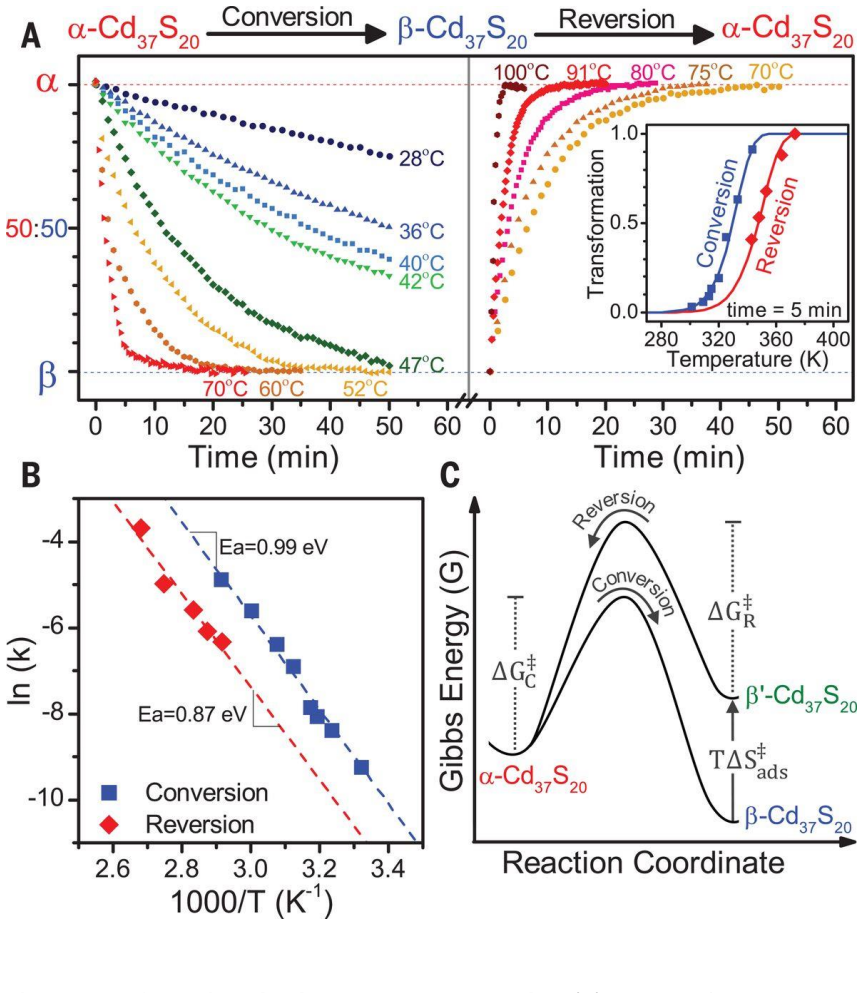
CdS cluster isomers interconvert over a 1 eV barrier with a 140 meV excitonic gap shift through diffusionless core reconfiguration driven by ligand distortion and hydroxyl physisorption.
A machine-rendered reading of the paper's core claim, the machinery that carries it, and where it could break.
Core claim
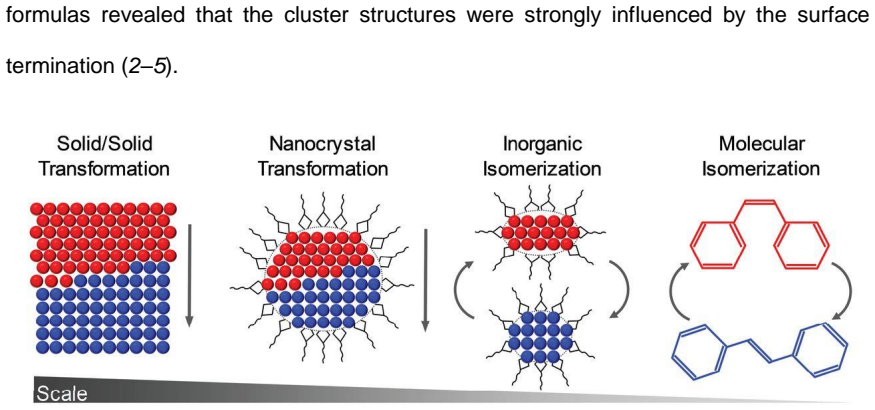
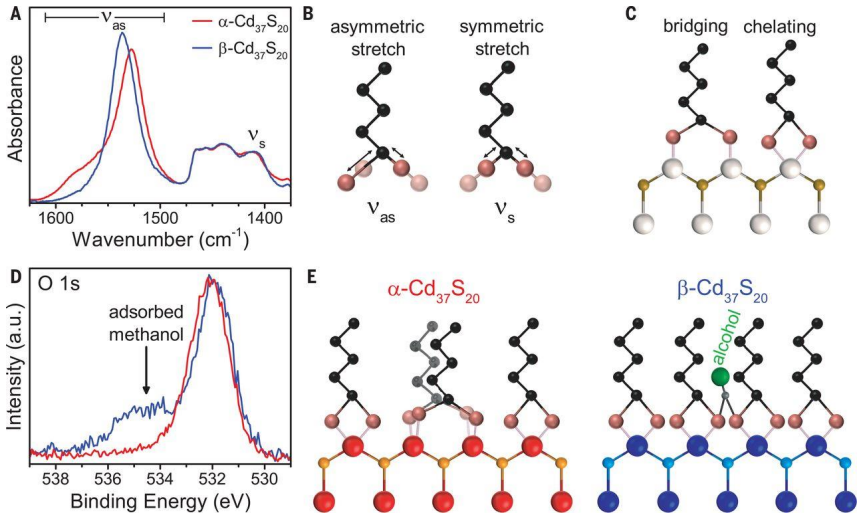
A pair of CdS cluster isomers coherently interconvert over an estimated 1 eV energy barrier with a 140 meV shift in their excitonic energy gaps. There is a diffusionless, displacive reconfiguration of the inorganic core with first-order transformation kinetics. Driven by a distortion of the ligand binding motifs, the presence of hydroxyl species changes the surface energy via physisorption, which determines phase stability in this system. This reaction possesses essential characteristics of both solid-solid transformations and molecular isomerizations, and bridges these disparate length scales.
What carries the argument
the hydroxyl-physisorption-driven change in surface energy that selects between two ligand-distorted CdS cluster isomers
If this is right
- The structural change occurs without atomic diffusion and follows first-order kinetics.
- The excitonic energy gap shifts by 140 meV upon isomerization.
- Ligand motif distortion and hydroxyl physisorption together control which isomer is thermodynamically favored.
- The process exhibits traits of both molecular isomerization and solid-solid phase change within the same atomically precise object.
Where Pith is reading between the lines
- Clusters of this type could be used to create chemically addressable optical switches at the nanoscale.
- The surface-energy mechanism may generalize to other ligand-stabilized inorganic particles and influence their phase stability under varying chemical conditions.
- The system offers a platform for testing models of how collective atomic rearrangements couple to surface chemistry in finite-size objects.
Load-bearing premise
Hydroxyl species determine which isomer is stable by physisorbing and thereby changing the surface energy of the cluster.
What would settle it
Observation that the two isomers fail to interconvert when hydroxyl species are rigorously excluded from the system, or direct measurement showing that surface energy does not shift with hydroxyl adsorption.
Figures
read the original abstract
Structural transformations in molecules and solids have generally been studied in isolation, while intermediate systems have eluded characterization. We show that a pair of CdS cluster isomers provides an advantageous experimental platform to study isomerization in well-defined atomically precise systems. The clusters coherently interconvert over an est. 1 eV energy barrier with a 140 meV shift in their excitonic energy gaps. There is a diffusionless, displacive reconfiguration of the inorganic core (solid-solid transformation) with first order (isomerization-like) transformation kinetics. Driven by a distortion of the ligand binding motifs, the presence of hydroxyl species changes the surface energy via physisorption, which determines phase stability in this system. This reaction possesses essential characteristics of both solid-solid transformations and molecular isomerizations, and bridges these disparate length scales.
Editorial analysis
A structured set of objections, weighed in public.
Referee Report
Summary. The manuscript reports experimental observations of chemically reversible isomerization between a pair of atomically precise CdS cluster isomers. The clusters are claimed to interconvert coherently via a diffusionless, displacive reconfiguration of the inorganic core over an estimated 1 eV barrier, accompanied by a 140 meV shift in excitonic energy gaps and first-order kinetics. The driving mechanism is attributed to distortion of ligand binding motifs together with hydroxyl physisorption that alters surface energy and thereby reverses phase stability.
Significance. If substantiated, the work supplies an atomically precise experimental platform for studying structural transformations that combine features of molecular isomerizations and solid-solid phase changes. The reported coherent interconversion and energy-gap shift constitute a concrete observation that could inform models of surface-energy-driven stability in ligand-passivated clusters.
major comments (1)
- [Abstract] Abstract (final sentence): the claim that hydroxyl physisorption 'changes the surface energy via physisorption, which determines phase stability' is presented without any reported control experiments, surface-energy calculations, or comparative data showing that removal of hydroxyl species specifically abolishes the isomerization while other variables (ligand distortion alone, solvent, etc.) do not. This attribution is load-bearing for the stated driving mechanism yet rests on assertion rather than distinguishing evidence.
minor comments (2)
- The abstract supplies no raw data, error bars, sample characterization details, or explicit controls for the interconversion observations; these omissions hinder assessment of the central experimental claims.
- The 'est. 1 eV energy barrier' is labeled an estimate with no stated derivation, fitting procedure, or computational/experimental basis provided in the abstract.
Simulated Author's Rebuttal
We thank the referee for their thoughtful review and for recognizing the potential of this system as a platform bridging molecular isomerization and solid-solid transformations. We address the single major comment below.
read point-by-point responses
-
Referee: [Abstract] Abstract (final sentence): the claim that hydroxyl physisorption 'changes the surface energy via physisorption, which determines phase stability' is presented without any reported control experiments, surface-energy calculations, or comparative data showing that removal of hydroxyl species specifically abolishes the isomerization while other variables (ligand distortion alone, solvent, etc.) do not. This attribution is load-bearing for the stated driving mechanism yet rests on assertion rather than distinguishing evidence.
Authors: We agree that the final sentence of the abstract asserts a mechanistic role for hydroxyl physisorption in reversing phase stability without the distinguishing controls the referee requests. The manuscript reports that isomerization occurs only in the presence of hydroxyl species, is accompanied by observed changes in ligand-binding motifs, and exhibits first-order kinetics with a ~1 eV barrier; these observations are used to infer that physisorption alters surface energy. No explicit control experiments that remove hydroxyls while holding ligand distortion, solvent, and other variables fixed are presented, nor are surface-energy calculations provided. In the revised manuscript we will (i) rephrase the abstract to state that the data are consistent with hydroxyl physisorption modulating surface energy rather than claiming it definitively determines phase stability, and (ii) add a paragraph in the discussion section that explicitly notes the absence of such controls and outlines the experiments that would be required to isolate this contribution. revision: yes
Circularity Check
No circularity: purely experimental report with no derivations or fitted predictions
full rationale
The paper presents direct experimental observations of CdS cluster isomer interconversion, including kinetics, energy gaps, and structural changes, without any mathematical derivations, model fitting, parameter estimation from subsets of data, or first-principles calculations that could reduce to their own inputs. Claims about hydroxyl physisorption as a stability driver are interpretive assertions based on the observed behavior rather than any self-referential loop or renamed empirical pattern. No self-citations, ansatzes, or uniqueness theorems are invoked in a load-bearing way. The derivation chain is empty by nature of the work, making the result self-contained against external benchmarks.
Axiom & Free-Parameter Ledger
axioms (1)
- domain assumption Excitonic energy gaps measured by optical spectroscopy reliably report distinct cluster core structures.
Lean theorems connected to this paper
-
IndisputableMonolith/Cost/FunctionalEquation.leanwashburn_uniqueness_aczel unclear?
unclearRelation between the paper passage and the cited Recognition theorem.
Driven by a distortion of the ligand binding motifs, the presence of hydroxyl species changes the surface energy via physisorption, which determines phase stability in this system.
-
IndisputableMonolith/Foundation/AlexanderDuality.leanalexander_duality_circle_linking unclear?
unclearRelation between the paper passage and the cited Recognition theorem.
The clusters coherently interconvert over an est. 1 eV energy barrier with a 140 meV shift in their excitonic energy gaps. There is a diffusionless, displacive reconfiguration of the inorganic core (solid-solid transformation) with first order (isomerization-like) transformation kinetics.
What do these tags mean?
- matches
- The paper's claim is directly supported by a theorem in the formal canon.
- supports
- The theorem supports part of the paper's argument, but the paper may add assumptions or extra steps.
- extends
- The paper goes beyond the formal theorem; the theorem is a base layer rather than the whole result.
- uses
- The paper appears to rely on the theorem as machinery.
- contradicts
- The paper's claim conflicts with a theorem or certificate in the canon.
- unclear
- Pith found a possible connection, but the passage is too broad, indirect, or ambiguous to say the theorem truly supports the claim.
Reference graph
Works this paper leans on
-
[1]
C. M. Wayman, Solid-state phase transformations. Annu. Rev. Mater. Sci. 1, 185– 210 (1971)
work page 1971
-
[2]
C. Chen, A. B. Herhold, C. S. Johnson, A. P. Alivisatos, Size Dependence of Structural Metastability in Semiconductor Nanocrystals. Science. 276, 398–401 (1997)
work page 1997
- [3]
-
[4]
D. R. Nevers, C. B. Williamson, T. Hanrath, R. D. Robinson, Surface chemistry of cadmium sulfide magic-sized clusters: a window into ligand-nanoparticle interactions. Chem. Commun. 53, 2866–2869 (2017)
work page 2017
-
[5]
D. C. Gary, A. Petrone, X. Li, B. M. Cossairt, Investigating the role of amine in InP nanocrystal synthesis: destabilizing cluster intermediates by Z-type ligand displacement. Chem. Commun. 53, 161–164 (2017)
work page 2017
-
[6]
Zhang et al., Thermally-induced reversible structural magic-size clusters
B. Zhang et al., Thermally-induced reversible structural magic-size clusters. Nat. Commun. 9, 2499 (2018)
work page 2018
-
[7]
Q. Yu, C. Liu, Study of Magic-Size-Cluster Mediated Formation of CdS Nanocrystals : Properties of the Magic-Size Clusters and Mechanism Implication. J. Phys. Chem. C. 113, 12766–12771 (2009)
work page 2009
-
[8]
B. M. Cossairt, J. S. Owen, CdSe Clusters: At the Interface of Small Molecules and Quantum Dots. Chem. Mater. 23, 3114–3119 (2011)
work page 2011
-
[9]
S. J. L. Billinge, I. Levin, The Problem with Determining Atomic Structure at the Nanoscale. Science. 316, 561–565 (2007)
work page 2007
-
[10]
C. B. Williamson, D. R. Nevers, T. Hanrath, R. D. Robinson, Prodigious Effects of Concentration Intensification on Nanoparticle Synthesis: A High-Quality, Scalable Approach. J. Am. Chem. Soc. 137, 15843–15851 (2015)
work page 2015
-
[11]
D. R. Nevers et al., Mesophase Formation Stabilizes High-Purity Magic-Sized Clusters. J. Am. Chem. Soc. 140, 3652–3662 (2018)
work page 2018
-
[12]
H. M. D. Bandara, S. C. Burdette, Photoisomerization in different classes of azobenzene. Chem. Soc. Rev. 41, 1809–1825 (2012)
work page 2012
-
[13]
J. Ning, J. Liu, Y. Levi-Kalisman, A. I. Frenkel, U. Banin, Controlling Anisotropic Growth of Colloidal ZnSe Nanostructures. J. Am. Chem. Soc. 140, 14627–14637 (2018)
work page 2018
-
[14]
D. C. Gary et al., Single-Crystal and Electronic Structure of a 1.3 nm Indium Phosphide Nanocluster. J. Am. Chem. Soc. 138, 1510–1513 (2016)
work page 2016
- [15]
-
[16]
A. N. Beecher et al., Atomic Structures and Gram Scale Synthesis of Three Tetrahedral Quantum Dots. J. Am. Chem. Soc. 136, 10645–10653 (2014)
work page 2014
-
[17]
T. Vossmeyer, G. Reck, B. Schulz, L. Katsikas, H. Weller, Double-Layer Superlattice Structure Built Up of Cd32S14(SCH2CH(OH)CH3)36.4H2O Clusters. J. Am. Chem. Soc. 117, 12881–12882 (1995)
work page 1995
- [18]
-
[19]
J. M. Gibson, M. M. J. Treacy, P. M. Voyles, Atom pair persistence in disordered materials from fluctuation microscopy. Ultramicroscopy. 83, 169–178 (2000)
work page 2000
-
[20]
X. Chen, J. P. Sullivan, T. A. Friedmann, J. M. Gibson, Fluctuation microscopy studies of medium-raange ordering in amorphous diamond-like carbon films. Appl. Phys. Lett. 84, 2823–2825 (2004)
work page 2004
-
[21]
N. W. Alcock, V. M. Tracey, T. C. Waddington, Acetates and acetato-complexes. Part 2. Spectroscopic studies. J. Chem. Soc., Dalt. Trans., 1970–1973 (1976)
work page 1970
-
[22]
L. C. Cass, M. Malicki, E. A. Weiss, The Chemical Environments of Oleate Species within Samples of Oleate-Coated PbS Quantum Dots. Anal. Chem. 85, 6974–6979 (2013)
work page 2013
-
[23]
A. I. Grigor’ev, Infrared Absorption Spectra of Acetates of Elements in Groups I and II of the Periodic System. Russ. J. Inorg. Chem. 8, 409 (1963)
work page 1963
-
[24]
G. B. Deacon, R. J. Phillips, Relationship Between the Carbon-Oxygen Stretching Frequencies of Carboxylato Complexes and the Type of Carboxylate Coordination. Coord. Chem. Rev. 33, 227–250 (1980)
work page 1980
-
[25]
Schaefer et al., Methanol Adsorption and Oxidation on Reduced and Oxidized TbOx(111) Surfaces
A. Schaefer et al., Methanol Adsorption and Oxidation on Reduced and Oxidized TbOx(111) Surfaces. J. Phys. Chem. C. 120, 28617–28269 (2016)
work page 2016
-
[26]
G. S. Herman, Z. Dohna, N. Ruzycki, U. Diebold, Experimental Investigation of the Interaction of Water and Methanol with Anatase−TiO2(101). J. Phys. Chem. B. 107, 2788–2795 (2003)
work page 2003
-
[27]
C. T. Campbell, J. R. V Sellers, The Entropies of Adsorbed Molecules. J. Am. Chem. Soc. 134, 18109–18115 (2012)
work page 2012
-
[28]
N. N. Thadhanit, M. A. Meyers, Kinetics of Isothermal Martensitic Transformation. Prog. Mater. Sci. 30, 1–37 (1986)
work page 1986
-
[29]
C. L. Magee, The Kinetics of Martensite Formation in Small Particles. Metall. Trans. 2, 2419–2430 (1971)
work page 1971
-
[30]
A. Puzder et al., The Effect of Organic Ligand Binding on the Growth CdSe Nanoparticles Probed by Ab-Initio Calculations. Nano Lett. 4, 2361–2365 (2004)
work page 2004
-
[31]
R. S. Ramalho, M. Ruel, Heats of Mixing for Binary Systems: n‐Alkanes + n‐ Alcohols and n‐Alcohols. Can. J. Chem. Eng. 46, 456–461 (1968)
work page 1968
-
[32]
L. E. Brus et al., Theoretical Metastability of Semiconductor Crystallites in High- Pressure Phases , with Application to β-Tin Structure Silicon. J. Am. Chem. Soc. 118, 4834–4838 (1996)
work page 1996
-
[33]
S. H. Tolbert, A. P. Alivisatos, Size Dependence of a First Order Solid-Solid Phase Transition : The Wurtzite to Rock Salt Transformation in CdSe Nanocrystals. Science. 265, 373–376 (1994)
work page 1994
-
[34]
D. G. Truhlar, B. C. Garrett, B. B. V, M. S. K-, S. J. Klippenstein, Current Status of Transition-State Theory. J. Phys. Chem. 100, 12771–12800 (1996)
work page 1996
-
[35]
A. S. Pine, Thermal Brillouin Scattering in Cadmium Sulfide: Velocity and Attenuation of Sound: Acoustoelectric Effects. Phys. Rev. B. 5, 2997–3003 (1972)
work page 1972
-
[36]
A. P. Hammersley, FIT2D: An Introduction and Overview. ESRF Intern. Rep. (1997), p. ESRF97HA02T
work page 1997
- [37]
-
[38]
A. S. Masadeh et al., Quantitative size-dependent structure and strain S65 determination of CdSe nanoparticles using atomic pair distribution function analysis. Phys. Rev. B - Condens. Matter Mater. Phys. 76, 1–11 (2007)
work page 2007
-
[39]
C. L. Farrow, S. J. L. Billinge, Relationship between the atomic pair distribution function and small-angle scattering: Implications for modeling of nanoparticles. Acta Crystallogr. Sect. A Found. Crystallogr. 65, 232–239 (2009)
work page 2009
-
[40]
P. J. Brown, A. G. Fox, E. N. Maslen, M. A. O’Keefe, B. T. M. Willis, International Tables for Crystallography (ed. 3, 2006), vol. C
work page 2006
-
[41]
X. Yang et al., Confirmation of disordered structure of ultrasmall CdSe nanoparticles from X-ray atomic pair distribution function analysis. Phys. Chem. Chem. Phys. 15, 8480–8486 (2013)
work page 2013
-
[42]
Kaneko et al., Structure and Crystallization Behavior of the β Phase of Oleic Acid
F. Kaneko et al., Structure and Crystallization Behavior of the β Phase of Oleic Acid. J. Phys. Chem. B. 101, 1803–1809 (1997)
work page 1997
-
[43]
W. W. Yu, L. Qu, W. Guo, X. Peng, Experimental Determination of the Extinction Coefficient of CdTe , CdSe , and CdS Nanocrystals Experimental Determination of the Extinction Coefficient of CdTe , CdSe , and CdS Nanocrystals. Chem. Mater. 125, 2854–2860 (2003)
work page 2003
-
[44]
J. Van Der Mynsbrugge, K. Hemelsoet, M. Vandichel, M. Waroquier, V. Van Speybroeck, Efficient Approach for the Computational Study of Alcohol and Nitrile Adsorption in H-ZSM-5. J. Phys. Chem. C. 116, 5499–5508 (2012)
work page 2012
-
[45]
Table of Dieletric Constants of Pure Liquids
A. A. Maryott, E. R. Smith, “Table of Dieletric Constants of Pure Liquids” (1951)
work page 1951
-
[46]
D. J. Metz, A. Glines, Density, viscosity, and dielectric constant of tetrahydrofuran between -78 and 30.degree. J. Phys. Chem. 71, 1158–1158 (1967)
work page 1967
-
[47]
C. J. Drummond, G. Georgaklis, D. Y. C. Chan, Fluorocarbons : Surface Free Energies and van der Waals Interaction. Langmuir. 12, 2617–2621 (1996)
work page 1996
-
[48]
L. H. Mukherjee, E. Grunwald, Physical Properties and Hydrogen-Bonding in the System Ethanol-2,2,2 Trifluoro-ethanol. J. Phys. Chem. 62, 1311–1314 (1958)
work page 1958
discussion (0)
Sign in with ORCID, Apple, or X to comment. Anyone can read and Pith papers without signing in.