Density functional perturbation theory for lattice dynamics with fully relativistic ultrasoft pseudopotentials: the magnetic case
Pith reviewed 2026-05-25 13:54 UTC · model grok-4.3
The pith
Density functional perturbation theory for lattice dynamics is extended to magnetic materials with fully relativistic ultrasoft pseudopotentials by applying the time-reversal operator to the Sternheimer linear system.
A machine-rendered reading of the paper's core claim, the machinery that carries it, and where it could break.
Core claim
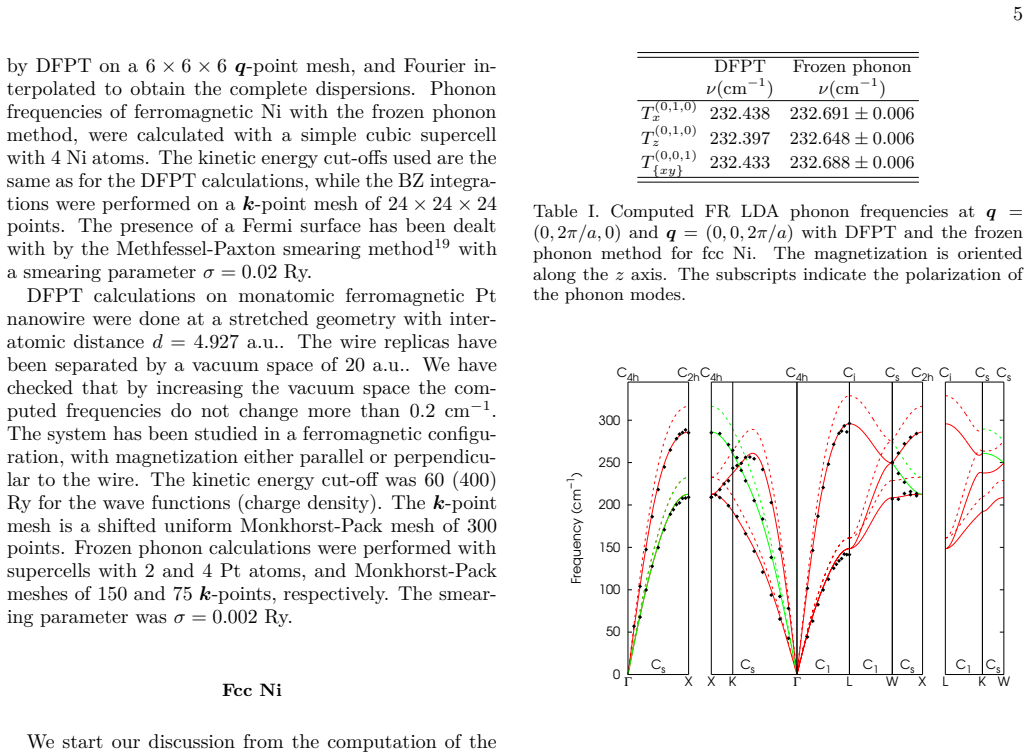
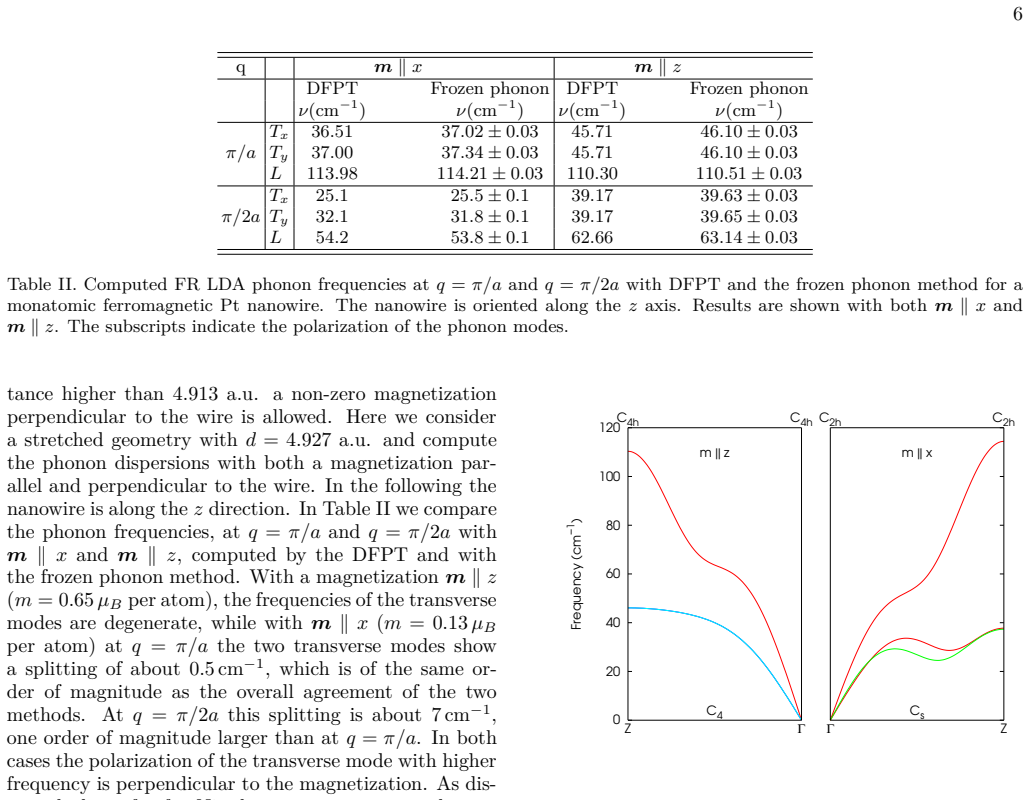
We extend density functional perturbation theory for lattice dynamics with fully relativistic ultrasoft pseudopotentials to magnetic materials. Our approach is based on the application of the time-reversal operator to the Sternheimer linear system and to its self-consistent solutions. Moreover, we discuss how to include in the formalism the symmetry operations of the magnetic point group which require the time-reversal operator. We validate our implementation by comparison with the frozen phonon method in fcc Ni and in a monatomic ferromagnetic Pt wire.
What carries the argument
Application of the time-reversal operator to the Sternheimer linear system and its self-consistent solutions within the fully relativistic ultrasoft pseudopotential formalism for magnetic systems.
If this is right
- Phonon calculations become possible for magnetic materials using DFPT with fully relativistic USPP.
- Symmetries requiring time reversal can be included to reduce computational effort in magnetic point groups.
- The method agrees with frozen phonon calculations for fcc nickel and ferromagnetic platinum wire.
- This allows treatment of relativistic effects and magnetism together in lattice dynamics.
Where Pith is reading between the lines
- This extension might enable studies of how magnetism affects phonon spectra in complex structures like antiferromagnets.
- Connections could be made to calculations of spin-phonon interactions in materials with strong spin-orbit coupling.
- Further validation could involve testing on systems with non-collinear magnetism.
Load-bearing premise
The time-reversal operator can be applied directly to the Sternheimer linear system and its self-consistent solutions while keeping the fully relativistic ultrasoft pseudopotential approach valid for magnetic materials.
What would settle it
If phonon frequencies computed with this extended DFPT method for fcc Ni differ substantially from those obtained by the frozen phonon method, the extension would be falsified.
Figures
read the original abstract
We extend density functional perturbation theory for lattice dynamics with fully relativistic ultrasoft pseudopotentials to magnetic materials. Our approach is based on the application of the time-reversal operator to the Sternheimer linear system and to its self-consistent solutions. Moreover, we discuss how to include in the formalism the symmetry operations of the magnetic point group which require the time-reversal operator. We validate our implementation by comparison with the frozen phonon method in fcc Ni and in a monatomic ferromagnetic Pt wire.
Editorial analysis
A structured set of objections, weighed in public.
Referee Report
Summary. The manuscript extends density functional perturbation theory (DFPT) for lattice dynamics with fully relativistic ultrasoft pseudopotentials to the magnetic case. The central construction applies the time-reversal operator to the Sternheimer linear system and its self-consistent solutions, and incorporates symmetry operations of the magnetic point group that involve time reversal. Validation consists of direct numerical comparison against the frozen-phonon method for fcc Ni and a monatomic ferromagnetic Pt wire.
Significance. If correct, the work supplies a practical route to phonon calculations in magnetic materials that already employ fully relativistic ultrasoft pseudopotentials, preserving the computational advantages of DFPT while handling time-reversal and magnetic symmetries. The explicit validation against an independent frozen-phonon implementation on two distinct systems supplies falsifiable numerical support for the central claim and avoids reliance on fitted parameters or circular self-consistency checks.
minor comments (2)
- [Abstract] Abstract: the statement that the approach is 'based on the application of the time-reversal operator' would benefit from a one-sentence clarification of how the operator acts on the charge-density response (as opposed to the wave-function response) to make the self-consistent cycle well-defined.
- The manuscript should state the plane-wave cutoff, k-point sampling, and smearing parameters used in both the DFPT and frozen-phonon calculations for Ni and Pt so that the numerical agreement can be reproduced.
Simulated Author's Rebuttal
We thank the referee for the careful reading of the manuscript, the positive assessment of its significance, and the recommendation to accept.
Circularity Check
No significant circularity
full rationale
The paper extends existing DFPT machinery to magnetic cases via explicit application of the time-reversal operator to the Sternheimer linear system and inclusion of magnetic point-group symmetries. The derivation is presented as a direct methodological extension, with the central implementation validated by independent numerical comparison to frozen-phonon calculations on fcc Ni and a ferromagnetic Pt wire. No load-bearing steps reduce by construction to fitted parameters, self-definitions, or unverified self-citations; the validation supplies external falsifiability outside the paper's own formalism.
Axiom & Free-Parameter Ledger
axioms (1)
- domain assumption Time-reversal operator can be applied to the Sternheimer linear system and its self-consistent solutions in the fully relativistic ultrasoft pseudopotential formalism
Lean theorems connected to this paper
-
IndisputableMonolith/Foundation/RealityFromDistinction.leanreality_from_one_distinction unclear?
unclearRelation between the paper passage and the cited Recognition theorem.
We extend density functional perturbation theory ... by applying the time-reversal operator to the Sternheimer linear system
What do these tags mean?
- matches
- The paper's claim is directly supported by a theorem in the formal canon.
- supports
- The theorem supports part of the paper's argument, but the paper may add assumptions or extra steps.
- extends
- The paper goes beyond the formal theorem; the theorem is a base layer rather than the whole result.
- uses
- The paper appears to rely on the theorem as machinery.
- contradicts
- The paper's claim conflicts with a theorem or certificate in the canon.
- unclear
- Pith found a possible connection, but the passage is too broad, indirect, or ambiguous to say the theorem truly supports the claim.
Reference graph
Works this paper leans on
- [1]
- [2]
- [3]
- [4]
-
[5]
K. Cao, H. Lambert, P. G. Radaelli, and F. Giustino, Phys. Rev. B 97, 024420 (2018)
work page 2018
- [6]
- [7]
- [8]
-
[9]
J. P. Perdew and A. Zunger, Phys. Rev. B 23, 5048 (1981)
work page 1981
-
[10]
J. P. Perdew, K. Burke, and M. Ernzerhof, Phys. Rev. Lett. 77, 3865 (1996)
work page 1996
-
[11]
P. Giannozzi, S. Baroni, N. Bonini, M. Calandra, R. Car, C. Cavazzoni, D. Ceresoli, G. L. Chiarotti, M. Cococcioni, I. Dabo, et al., J. Phys. Condens. Matter 21, 395502 (2009) (See http://www.quantum-espresso.org)
work page 2009
-
[12]
P. Giannozzi, O. Andreussi, T. Brumme, O. Bunau, M. B. Nardelli, M. Calandra, R. Car, C. Cavazzoni, D. Ceresoli, M. Cococcioni, et al., J. Phys. Condens. Matter 29, 465901 (2017)
work page 2017
-
[13]
For more information see https://dalcorso.github.io/thermo_pw
thermo \_ pw is an extension of the Quantum ESPRESSO (QE) package which provides an alternative organization of the QE work-flow for the most common tasks. For more information see https://dalcorso.github.io/thermo_pw
- [14]
- [15]
-
[16]
See https://dalcorso.github.io/pslibrary
-
[17]
R. W. G. Wyckoff, Crystal Structures, John Wiley & Sons, Inc., (Wiley, New York, 1963), Volume 1, 7-83
work page 1963
- [18]
- [19]
-
[20]
R. J. Birgeneau, J. Cordes, G. Dolling, and A. D. B. Woods, Phys. Rev. 136, A1359 (1964)
work page 1964
- [21]
-
[22]
A. Smogunov, A. Dal Corso, A. Delin, R. Weht, and E. Tosatti, Nature Nanotechnology 3, 22 (2008)
work page 2008
- [23]
discussion (0)
Sign in with ORCID, Apple, or X to comment. Anyone can read and Pith papers without signing in.