Spin-polarized electronic surface states of Re(0001): an ab-initio investigation
Pith reviewed 2026-05-25 14:51 UTC · model grok-4.3
The pith
Ab initio calculations find empty surface resonances on Re(0001) that cross the Fermi level with Rashba-like spin polarization.
A machine-rendered reading of the paper's core claim, the machinery that carries it, and where it could break.
Core claim
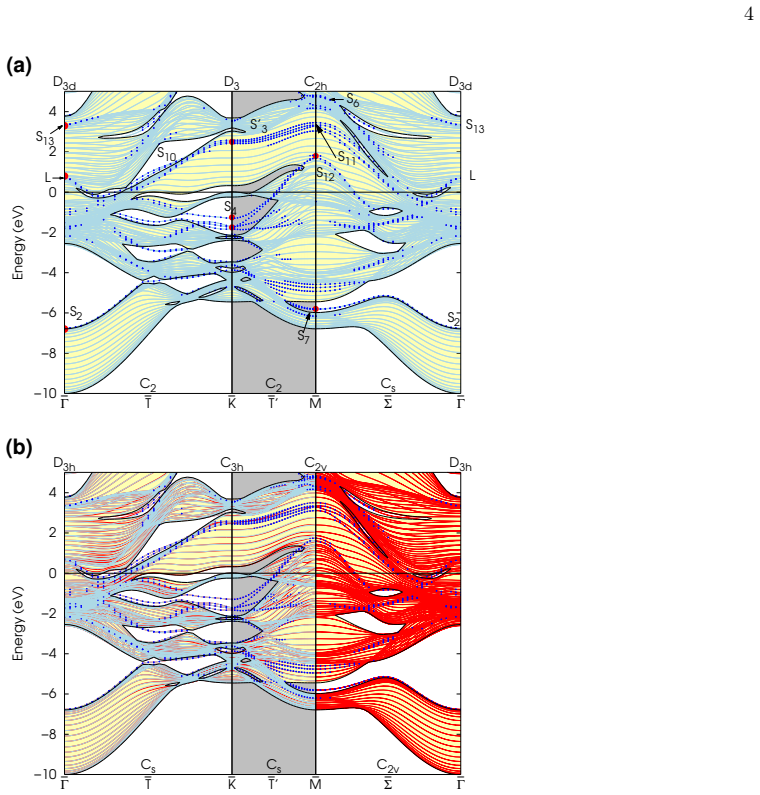
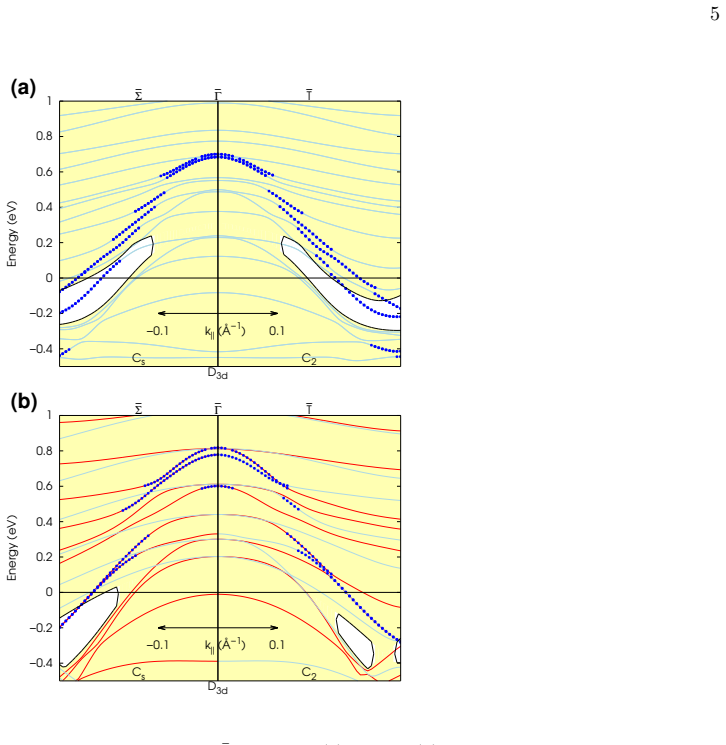
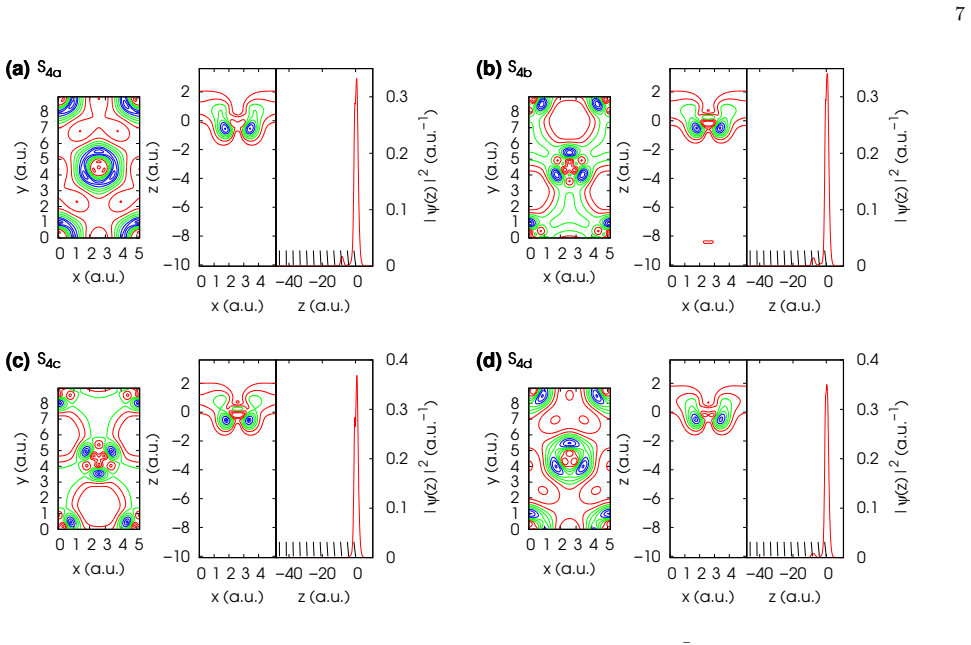
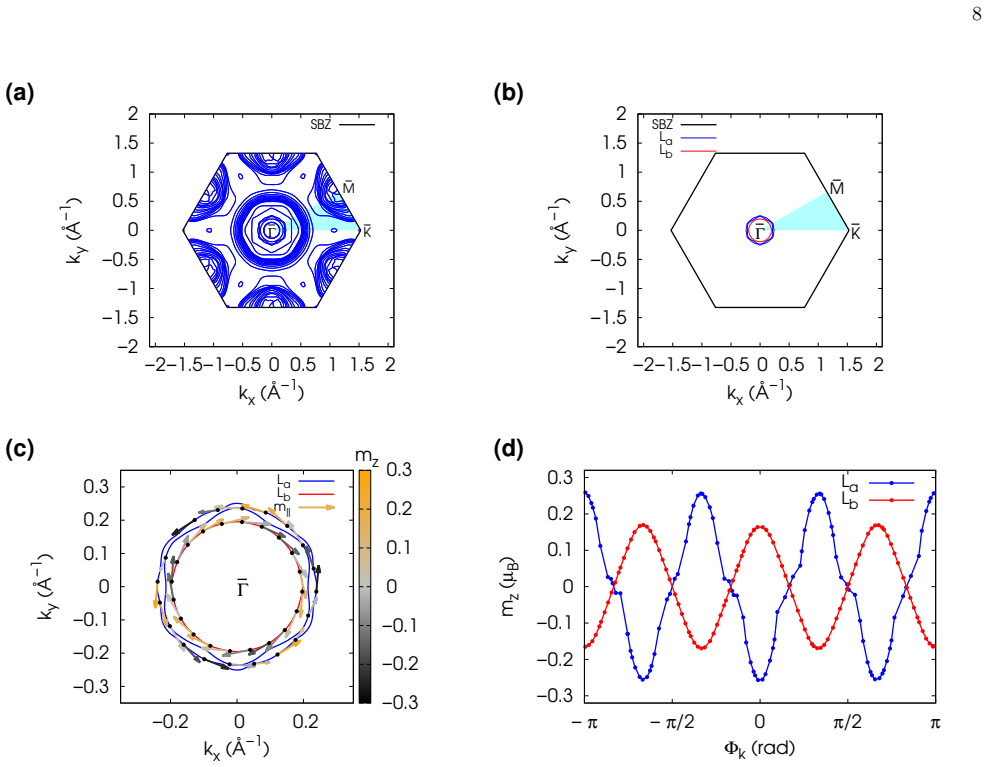
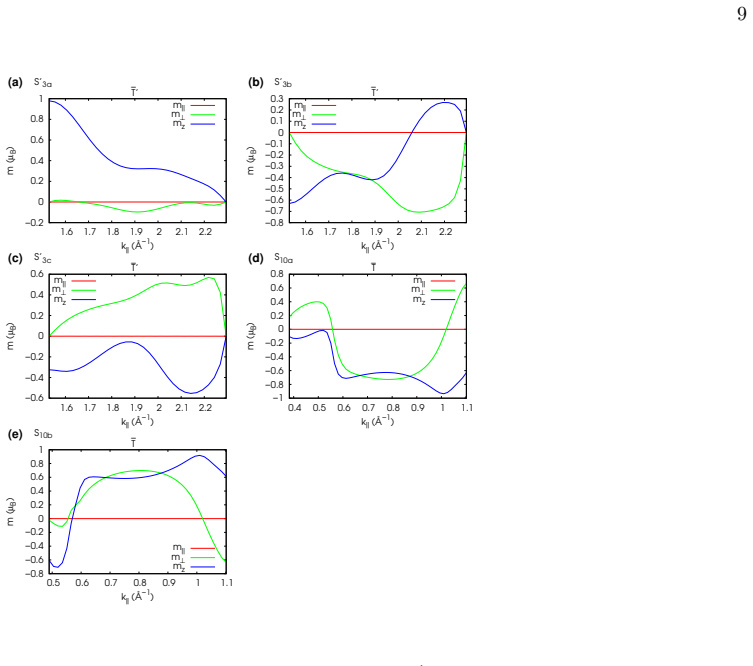
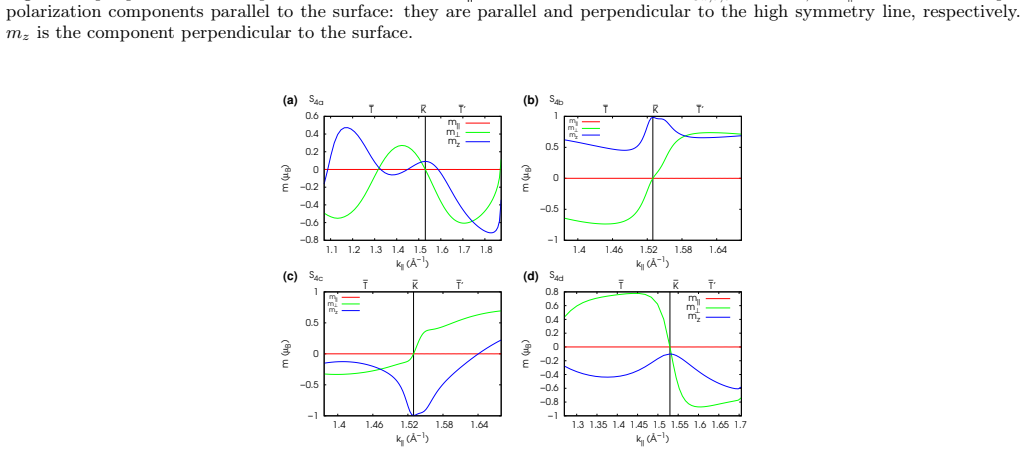
We find empty resonances, located below a gap similar to the L-gap of the (111) fcc surfaces, that have a downward dispersion and cross the Fermi level, similarly to the recently studied Os(0001) surface. Their spin polarization at the Fermi level is similar to that predicted by the Rashba model, but the usual level crossing at Γ is not found with our slab thickness. Moreover, for selected states, we follow the spin polarization along the high symmetry lines, discussing its behavior with respect to k_parallel.
What carries the argument
Fully relativistic DFT slab calculations that resolve energy dispersion and spin polarization of surface resonances on Re(0001).
If this is right
- The identified resonances disperse downward and cross the Fermi level.
- Spin polarization at the Fermi level follows the form expected from the Rashba model.
- Spin polarization of individual states varies with parallel wave-vector along the main symmetry lines.
- The pattern of states and polarization closely resembles the one found earlier on Os(0001).
Where Pith is reading between the lines
- A thicker slab calculation could restore the missing Gamma crossing and confirm that the two surfaces are decoupled.
- The states may affect spin-dependent scattering or transport at the rhenium surface in experiments.
- Similar slab-thickness checks would be useful for other heavy-metal surfaces where Rashba-type crossings are predicted.
Load-bearing premise
The finite slab thickness used is large enough to keep the two surfaces from hybridizing artificially and thereby removing the expected level crossing at Gamma.
What would settle it
Repeating the calculation with a substantially thicker slab and checking whether states of opposite spin now cross at the Gamma point.
Figures
read the original abstract
We study the electronic structure of the Re(0001) surface by means of ab-initio techniques based on the Fully Relativistic (FR) Density Functional Theory (DFT) and the Projector Augmented-Wave (PAW) method. We identify the main surface states and resonances and study in detail their energy dispersion along the main symmetry lines of the SBZ. Moreover, we discuss the effect of spin-orbit coupling on the energy splittings and the spin-polarization of the main surface states and resonances. Whenever possible, we compare the results with previously studied heavy metals surfaces. We find empty resonances, located below a gap similar to the L-gap of the (111) fcc surfaces, that have a downward dispersion and cross the Fermi level, similarly to the recently studied Os(0001) surface. Their spin polarization at the Fermi level is similar to that predicted by the Rashba model, but the usual level crossing at $\bar{\Gamma}$ is not found with our slab thickness. Moreover, for selected states, we follow the spin polarization along the high symmetry lines, discussing its behavior with respect to ${\bf k}_{\parallel}$, the wave-vector parallel to the surface.
Editorial analysis
A structured set of objections, weighed in public.
Referee Report
Summary. The manuscript reports an ab-initio study of the Re(0001) surface using fully relativistic DFT within the PAW method. It identifies the principal surface states and resonances, maps their dispersions along high-symmetry lines of the surface Brillouin zone, and examines the influence of spin-orbit coupling on splittings and spin polarization. The central finding is a set of empty resonances lying below a gap analogous to the L-gap of fcc(111) surfaces; these resonances disperse downward, cross the Fermi level, and exhibit a spin polarization at EF that the authors describe as similar to the Rashba model, although the expected level crossing at Γ is absent for the slab thickness employed. Results are compared with prior work on Os(0001) and other heavy-metal surfaces.
Significance. If the reported dispersions and spin textures are robust, the work supplies concrete ab-initio reference data for spin-polarized resonances on an hcp(0001) surface, extending the existing literature on Rashba-like states from fcc to hcp metals and highlighting both similarities and thickness-dependent differences. The direct numerical solution of the Kohn-Sham equations without fitted parameters or self-referential definitions is a methodological strength.
major comments (2)
- [Discussion of empty resonances and Γ-point behavior] The text states that the usual level crossing at Γ is not observed with the slab thickness chosen, yet provides no convergence tests with respect to slab thickness. Because the two surfaces of a finite slab are related by inversion, insufficient thickness permits artificial inter-surface hybridization that can open a gap or modify the spin texture of states near EF; without explicit checks that the reported Rashba-like spin polarization at EF survives in the decoupled limit, the central claim remains provisional.
- [Computational details] Neither the abstract nor the provided description specifies the exchange-correlation functional, k-point sampling density, slab thickness, vacuum spacing, or convergence criteria employed. These parameters directly control the accuracy of the dispersions and spin polarizations that constitute the paper’s main results.
Simulated Author's Rebuttal
We thank the referee for the positive evaluation of our work and the detailed, constructive comments. We address each major comment below and will revise the manuscript to incorporate the requested information and checks.
read point-by-point responses
-
Referee: [Discussion of empty resonances and Γ-point behavior] The text states that the usual level crossing at Γ is not observed with the slab thickness chosen, yet provides no convergence tests with respect to slab thickness. Because the two surfaces of a finite slab are related by inversion, insufficient thickness permits artificial inter-surface hybridization that can open a gap or modify the spin texture of states near EF; without explicit checks that the reported Rashba-like spin polarization at EF survives in the decoupled limit, the central claim remains provisional.
Authors: We agree that the lack of explicit slab-thickness convergence tests leaves the robustness of the reported spin texture open to the concern raised. The manuscript already notes that the missing Γ crossing is a finite-thickness effect, but we did not demonstrate that the spin polarization at EF is insensitive to further thickening. We will therefore perform additional calculations with thicker slabs (at least doubling the current thickness) to verify that the Rashba-like spin polarization at the Fermi level remains unchanged once inter-surface hybridization is suppressed. These results, together with a brief discussion of the convergence, will be added to the revised manuscript. revision: yes
-
Referee: [Computational details] Neither the abstract nor the provided description specifies the exchange-correlation functional, k-point sampling density, slab thickness, vacuum spacing, or convergence criteria employed. These parameters directly control the accuracy of the dispersions and spin polarizations that constitute the paper’s main results.
Authors: We apologize for the omission of these essential parameters. The calculations were performed with the PBE exchange-correlation functional, a Monkhorst-Pack k-point mesh of 24×24×1 for the surface Brillouin zone, a slab of 13 atomic layers, a vacuum spacing of 15 Å, and energy and force convergence criteria of 10^{-5} eV and 10^{-4} eV/Å, respectively. All of these details will be inserted into the methods section of the revised manuscript; a concise statement of the slab thickness and functional will also be added to the abstract. revision: yes
Circularity Check
No significant circularity: direct ab-initio DFT output
full rationale
The paper computes surface electronic states via fully relativistic DFT + PAW on finite slabs. All reported dispersions, gaps, and spin polarizations are numerical solutions of the Kohn-Sham equations for the chosen slab geometry; no parameters are fitted to the target resonances or spin textures, no self-referential definitions appear, and no load-bearing uniqueness theorems or ansatzes are imported from prior self-citations. The noted absence of the Γ crossing is an explicit finite-thickness artifact acknowledged in the text, not a circularity. This is the normal case of a self-contained computational study.
Axiom & Free-Parameter Ledger
axioms (1)
- domain assumption The chosen exchange-correlation functional and relativistic treatment are adequate for describing surface states on Re(0001).
Lean theorems connected to this paper
-
IndisputableMonolith/Cost/FunctionalEquation.leanwashburn_uniqueness_aczel unclear?
unclearRelation between the paper passage and the cited Recognition theorem.
We study the electronic structure of the Re(0001) surface by means of ab-initio techniques based on the Fully Relativistic (FR) Density Functional Theory (DFT) and the Projector Augmented-Wave (PAW) method.
-
IndisputableMonolith/Foundation/RealityFromDistinction.leanreality_from_one_distinction unclear?
unclearRelation between the paper passage and the cited Recognition theorem.
Their spin polarization at the Fermi level is similar to that predicted by the Rashba model, but the usual level crossing at Γ is not found with our slab thickness.
What do these tags mean?
- matches
- The paper's claim is directly supported by a theorem in the formal canon.
- supports
- The theorem supports part of the paper's argument, but the paper may add assumptions or extra steps.
- extends
- The paper goes beyond the formal theorem; the theorem is a base layer rather than the whole result.
- uses
- The paper appears to rely on the theorem as machinery.
- contradicts
- The paper's claim conflicts with a theorem or certificate in the canon.
- unclear
- Pith found a possible connection, but the passage is too broad, indirect, or ambiguous to say the theorem truly supports the claim.
Reference graph
Works this paper leans on
-
[1]
Spin-polarized electronic surface states of Re(0001): an ab-initio investigation
The paper is organized as follows: in Section II, we de- scribe the methods and the computational parameters. In Section III, we present the Re(0001) electronic band structure and analyze the main surface states and reso- nances. In Section IV, we discuss the spin polarization of some selected states and finally, in Section V, we present our conclusions. I...
work page internal anchor Pith review Pith/arXiv arXiv 1906
-
[2]
The convention onm∥, m⊥, and mz is the same as in Fig
Spin polarization components as a function ofk∥ for the FR surface statesS4a,b,c,d. The convention onm∥, m⊥, and mz is the same as in Fig. 7 charge density. At ¯Γ we found a gap similar to the L- gap of the (111) fcc surfaces. Like in the recently studied Os(0001) and at variance with other well known metal surfaces (e.g. Au(111)), this gap does not conta...
work page 2018
-
[3]
2 G. Nicolay, F. Reinert, S. Hüfner, Spin-orbit splitting of the L-gap surface state on Au(111) and Ag(111), Phys. Rev. B 65 (2001) 033407. 3 J. Henk, A. Ernst, P. Bruno, Spin polarization of the L-gap surface states on Au(111): a first-principles investigation, Surf. Sci. 566-568 (2004)
work page 2001
-
[4]
4 J. Henk, M. Hoesch, J. Osterwalder, A. Ernst, P. Bruno, Spin-orbit coupling in the L-gap surface states of Au(111): spin-resolved photoemission experiments and first-principles calculations, J. Phys. Condens. Matter 16 (2004) 7581-7597. 5 R. Mazzarello, A. Dal Corso, E. Tosatti, Spin-orbit mod- ifications and splittings of deep surface states on clean Au(...
work page 2004
-
[5]
6 S. Bornemann, O. Šipr, S. Mankovsky, S. Polesya, J. B. Staunton, W. Wurth, H. Ebert, J. Minár, Trends in the magnetic properties of Fe, Co, and Ni clusters and mono- layers on Ir(111), Pt(111), and Au(111), Phys. Rev. B 86 (2012) 104436. 7 R. Requist, Polina M. Sheverdyaeva, Paolo Moras, Sanjoy K. Mahatha, Carlo Carbone, Erio Tosatti, Spin-orbit in- ter...
work page 2012
-
[6]
9 A. Urru and A. Dal Corso, Clean Os(0001) electronic sur- face states: A first-principle fully relativistic investigation, Surf. Sci. 671 (2018)
work page 2018
-
[7]
11 S. LaShell, B. A. McDougall, E. Jensen, Spin Splitting of an Au(111) Surface State Band Observed with Angle Resolved Photoelectron Spectroscopy, Phys. Rev. Lett. 77 (1996)
work page 1996
-
[8]
12 F. Reinert, G. Nicolay, S. Schmidt, D. Ehm, S. Hüfner, Direct measurements of the L-gap surface states on the (111) face of noble metals by photoelectron spectroscopy, Phys. Rev. B 63 (2001) 115415. 13 W. Di, K.E. Smith, S.D. Kevan, Angle-resolved photoe- mission study of the clean and hydrogen-covered Pt(111) surface, Phys. Rev. B 45 (1992)
work page 2001
-
[9]
14 A. Ramstad, S. Raaen, N. Barrett, Electronic structure of the La-Pt(111) surface alloy, Surf. Sci. 448 (2000)
work page 2000
-
[10]
15 J. Wiebe, F. Meier, K. Hashimoto, G. Bihlmayer, S. Blügel, P. Ferriani, S. Heinze, R. Wiesendanger, Unoccu- pied surface state on Pt(111) revealed by scanning tunnel- ing spectroscopy, Phys. Rev. B 72 (2005) 193406. 16 E. Frantzeskakis, S. Pons, A. Crepaldi, H. Brune, K. Kern, M. Grioni, Ag-coverage-dependent symmetry of the elec- tronic states of the ...
work page 2005
-
[11]
22 E. Miniussi, E. R. Hernández, M. Pozzo, A. Baraldi, E. Vesselli, G. Comelli, S. Lizzit, D. Alfé, Non-local Effects on Oxygen-Induced Surface Core Level Shifts of Re(0001), J. Phys. Chem. C 116, 23297-23307. 23 J. Ontaneda, R. A. Bennett, R. Grau-Crespo, Electronic Structure of Pd Multilayers on Re(0001): The Role of Charge Transfer, J.Phys. Chem. C 119,...
work page 2018
-
[12]
31 A. Dal Corso, Projector augmented-wave method: Appli- cation to relativistic spin-density functional theory, Phys. Rev. B 82 (2010) 075116. 32 A. Dal Corso, Pseudopotentials periodic table: From H to Pu, Comp. Mat. Sci. 95 (2014)
work page 2010
-
[13]
33 See https://dalcorso.github.io/pslibrary. 34 R. W. G. Wyckoff, Crystal Structures 1 (1963) 7-83. 35 J. Monkhorst, J.D. Pack, Special points for Brillouin-zone integrations, Phys. Rev. B 13 (1976)
work page 1963
-
[14]
36 M. Methfessel, A.T. Paxton, High-precision sampling for Brillouin-zone integration in metals, Phys. Rev. B 40 (1989)
work page 1989
-
[15]
37 A band structure calculation of a 41-layers slab shows that the spin splittings decrease, but quite slowly: for instance, the splitting of theS′ 3 states decreases of about 30 %. 38 H. Bentmann, T. Kuzumaki, G. Bihlmayer, S. Blügel, E. V. Chulkov, F. Reinert, and K. Sakamoto, Spin orientation and sign of the Rashba splitting in Bi/Cu(111), Phys. Rev. B...
work page 2011
-
[16]
43 A. Manchon, H. C. Koo, J. Nitta, S. M. Frolov, and R. A. Duine, New perspectives for Rashba spin-orbit coupling, Nature Materials 14 (2015)
work page 2015
- [17]
discussion (0)
Sign in with ORCID, Apple, or X to comment. Anyone can read and Pith papers without signing in.