MARVEL analysis of the measured high-resolution spectra of ¹⁴NH
Pith reviewed 2026-05-25 01:35 UTC · model grok-4.3
The pith
MARVEL processing of 3002 transitions in 14NH yields one consistent network of 2954 lines and 1058 energy levels across three electronic states.
A machine-rendered reading of the paper's core claim, the machinery that carries it, and where it could break.
Core claim
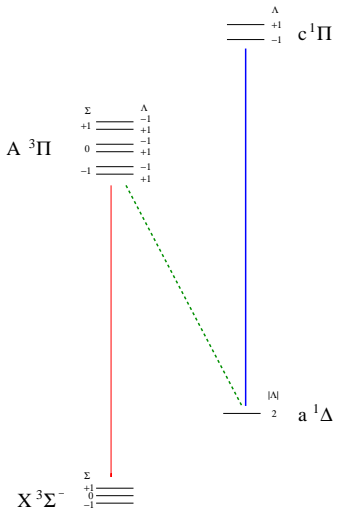
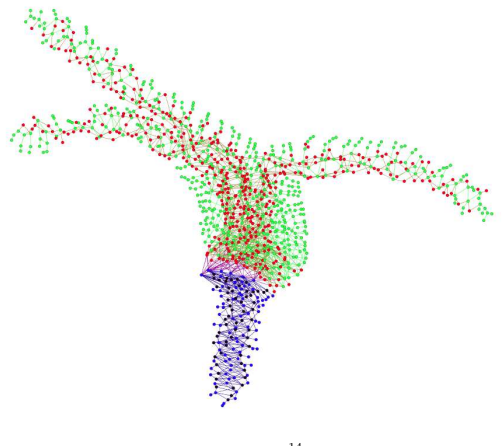
Rovibronic energy levels are determined for four low-lying electronic states (X, A, Sa, and Sc) of the imidogen free radical (14NH) using the MARVEL technique. Compilation of transitions from both laboratory measurements and solar spectra, found in 18 publications, yields a dataset of 3002 rovibronic transitions forming elements of a measured spectroscopic network. At the end of the MARVEL procedure, the majority of the transitions form a single, self-consistent SN component of 2954 rovibronic transitions and 1058 energy levels, NoX, NoA, and Noc for the X, A, and Sc electronic states, respectively. The Sa electronic state is characterized by Noa Lambda-doublet levels, counting each level, 1
What carries the argument
The MARVEL (Measured Active Rotational-Vibrational Energy Levels) procedure, which assembles measured transitions into a self-consistent spectroscopic network of energy levels.
If this is right
- The validated energy levels allow reliable prediction of unobserved transitions in the X, A, and Sc states.
- The single network component supplies a unified set of term values that can be used directly in atmospheric and astrophysical modeling of NH.
- The separate treatment of the Sa state isolates its Lambda-doublet structure for further spectroscopic study.
- The observed failure of CCSD(T) to reproduce the Sa excitation energy indicates that higher-level electronic-structure methods are required for that state.
Where Pith is reading between the lines
- The resulting network could serve as a test set for assessing the accuracy of new ab initio methods on open-shell radicals.
- Similar MARVEL analyses on other NH isotopologues would test whether the same pattern of network connectivity holds across isotopic variants.
- The discrepancy in the Sa state energy may point to specific electron-correlation challenges that appear only in certain excited states of light hydrides.
Load-bearing premise
The 3002 input transitions compiled from the 18 publications are correctly assigned and free of systematic measurement or assignment errors.
What would settle it
A new high-resolution laboratory measurement of any transition whose observed frequency lies outside the uncertainty range predicted from the derived energy levels would show the network is not internally consistent.
Figures
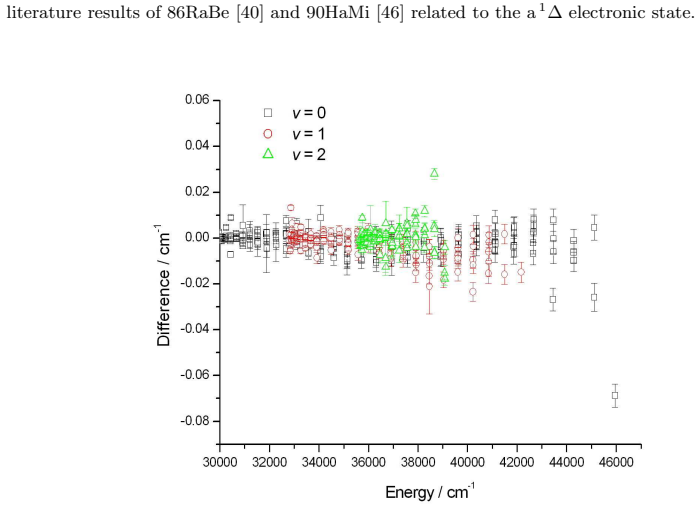
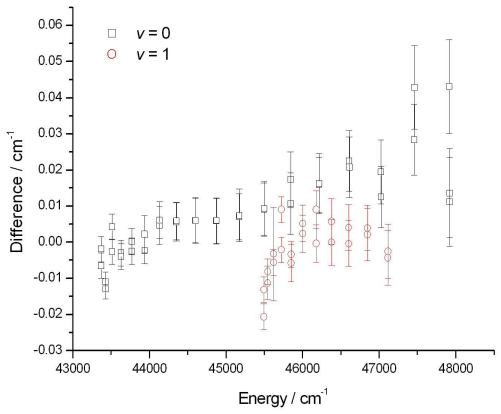
read the original abstract
Rovibronic energy levels are determined for four low-lying electronic states (\X, \A, \Sa, and \Sc) of the imidogen free radical ($^{14}$NH) using the \Marvel\ (Measured Active Rotational-Vibrational Energy Levels) technique. Compilation of transitions from both laboratory measurements and solar spectra, found in 18 publications, yields a dataset of 3002 rovibronic transitions forming elements of a measured spectroscopic network (SN). At the end of the MARVEL procedure, the majority of the transitions form a single, self-consistent SN component of 2954 rovibronic transitions and 1058 energy levels, \NoX, \NoA, and \Noc\ for the \X, \A, and \Sc\ electronic states, respectively. The \Sa\ electronic state is characterized by \Noa\ $\Lambda$-doublet levels, counting each level only once. Electronic structure computations show that unusually the CCSD(T) method does not accurately predict the \Sa\ excitation energy even at the complete basis set limit.
Editorial analysis
A structured set of objections, weighed in public.
Referee Report
Summary. The manuscript compiles 3002 rovibronic transitions for ^{14}NH from 18 publications and applies the established MARVEL procedure to construct a spectroscopic network. This yields a single self-consistent component containing 2954 transitions and 1058 energy levels for the X, A, and Sc electronic states (with separate characterization of the Sa state as Noa Λ-doublet levels counted once each), plus a computational note that CCSD(T) fails to predict the Sa excitation energy accurately even at the CBS limit.
Significance. If the input assignments hold, the work supplies a directly measured, internally consistent set of energy levels for NH that can serve as a reference database for laboratory spectroscopy, astrophysical modeling, and benchmarking of electronic-structure methods. The parameter-free network solution and explicit reporting of the largest connected component are strengths.
major comments (1)
- [Data compilation and input preparation] The central claim that 2954 transitions form a single consistent SN component rests on the correctness and completeness of the 3002 input transitions compiled from the 18 sources. The manuscript provides no explicit section detailing the selection criteria, possible post-hoc exclusions, or systematic-error checks applied to the published line lists; this information is load-bearing for assessing whether the reported counts are robust.
minor comments (2)
- [Abstract] The abstract uses undefined LaTeX macros (NoX, NoA, Noc, Noa) in place of numerical values; these should be expanded to the actual counts for readability.
- [Introduction] Notation for the electronic states (X, A, Sa, Sc) is introduced without a table summarizing term symbols, symmetries, or the number of levels per state beyond the totals given in the abstract.
Simulated Author's Rebuttal
We thank the referee for their positive evaluation of the work and the recommendation for minor revision. We address the single major comment below.
read point-by-point responses
-
Referee: [Data compilation and input preparation] The central claim that 2954 transitions form a single consistent SN component rests on the correctness and completeness of the 3002 input transitions compiled from the 18 sources. The manuscript provides no explicit section detailing the selection criteria, possible post-hoc exclusions, or systematic-error checks applied to the published line lists; this information is load-bearing for assessing whether the reported counts are robust.
Authors: We agree that an explicit description of the input data preparation would improve clarity and allow readers to better assess robustness. In the revised manuscript we will add a dedicated subsection (under Methods) that lists the 18 source publications, states that all reported transitions with assigned uncertainties were initially included without selective filtering, describes the standard MARVEL consistency checks that identify and remove inconsistent transitions (resulting in the reduction from 3002 to 2954), and notes that no additional post-hoc exclusions or systematic-error corrections were applied beyond the network-based validation already described in the MARVEL procedure. The input line lists were taken directly from the cited literature. revision: yes
Circularity Check
No significant circularity in MARVEL network solution
full rationale
The central result is the direct output of applying the established MARVEL algorithm to a fixed input list of 3002 transitions compiled from 18 external publications. The reported single connected component (2954 transitions, 1058 levels) follows immediately from constructing the spectroscopic network and solving its linear equations for energy levels; no fitted parameters, self-referential predictions, or load-bearing self-citations are invoked to obtain these numbers. The derivation is therefore self-contained data processing with no reduction to its own inputs by construction.
Axiom & Free-Parameter Ledger
axioms (1)
- domain assumption Transitions from laboratory and solar spectra can be treated as a single connected spectroscopic network whose energy levels are uniquely determined up to an overall offset.
Reference graph
Works this paper leans on
-
[1]
J. Masanet, A. Gilles, C. Vermeil, Light emission of the p hotofragments produced by photolysis of ammonia and ammonia- d3 at 147, 123.6 and 104.8 nm: First observation of the b 1Σ+ – X 3Σ− transition of NH and ND, J. Photochem. 3 (1974) 417–429
work page 1974
-
[2]
Y. Maruyama, T. Hikida, Y. Mori, Formation of NH (A 3Πi) in the flash photolysis of HN 3 at 121.6 nm. Role of N 2 triplet states, Chem. Phys. Lett. 116 (1985) 371–373
work page 1985
-
[3]
S. S. Harilal, B. E. Brumfield, M. C. Phillips, An evaluati on of equilibrium conditions and temperature-dependent speciation in a laser-produced air plasma, Phys. Plasmas 25 (2018) 083303
work page 2018
-
[4]
R. Pflieger, T. Ouerhani, T. Belmonte, S. I. Nikitenko, Us e of NH (A 3Π – X 3Σ− ) sonolumines- cence for diagnostics of nonequilibrium plasma produced by multibubble cavitation, Phys. Chem. Chem. Phys. 19 (2017) 26272–26279
work page 2017
-
[5]
A. Hamdan, J.-L. Liu, M. S. Cha, Microwave plasma jet in wa ter: Characterization and feasibility to wastewater treatment, Plasma Chem. Plasma Proc. 38 (2018 ) 1003–1020
work page 2018
- [6]
-
[7]
R. Perillo, R. Chandra, G. R. A. Akkermans, W. A. J. Vijver s, W. A. A. D. Graef, I. G. J. Classen, J. van Dijk, M. R. de Baar, Studying the influence of n itrogen seeding in a detached-like hydrogen plasma by means of numerical simulations, Plasma P hys. Controlled Fussion 60 (2018) 105004
work page 2018
-
[8]
E. Pawelec, T. Dittmar, A. Drenik, A. Meigs, J. Contribut ors, Molecular ND Band Spectroscopy in the Divertor Region of Nitrogen Seeded JET Discharges, J. Phys. Conf. Ser. 959 (2018) 012009
work page 2018
-
[9]
C. Brackmann, E. J. K. Nilsson, J. D. Naucler, M. Alden, A. A. Konnov, Formation of NO and NH in NH 3-doped CH 4 + N 2 + O 2 flame: Experiments and modelling, Combust. Flame 194 (2018) 278–284
work page 2018
-
[10]
N. Lamoureux, L. Gasnot, P. Desgroux, Quantitative NH m easurements by using laser-based diagnostics in low-pressure flames, Proc. Combustion Inst. 37 (2019) 1313–1320
work page 2019
-
[11]
W. C. Campbell, E. Tsikata, H.-I. Lu, L. D. van Buuren, J. M. Doyle, Magnetic trapping and Zeeman relaxation of NH (X 3Σ− ), Phys. Rev. Lett. 98 (2007) 213001. 17
work page 2007
-
[12]
E. Tsikata, W. C. Campbell, M. T. Hummon, H.-I. Lu, J. M. D oyle, Magnetic trapping of NH molecules with 20 s lifetimes, New J. Phys 12 (2010) 065028
work page 2010
-
[13]
A. O. G. Wallis, E. J. J. Longdon, P. S. Zuchowski, J. M. Hu tson, The prospects of sympathetic cooling of NH molecules with Li atoms, Eur. Phys. J. D 65 (2011 ) 151–160
work page 2011
-
[14]
L. M. C. Janssen, A. van der Avoird, G. C. Groenenboom, Qu antum reactive scattering of ultracold NH(X 3Σ− ) Radicals in a magnetic trap, Phys. Rev. Lett. 110 (2013) 063 201
work page 2013
-
[15]
J. L. Rinnenthal, K.-H. Gericke, State-to-state energ y transfer of NH (X 3Σ− , v = 0 , J, N) in collisions with He and N 2, J. Chem. Phys. 116 (2002) 9776–9791
work page 2002
-
[16]
Kajita, Collision between magnetically trapped NH m olecules in the ( N = 0 , J = 1) state, Phys
M. Kajita, Collision between magnetically trapped NH m olecules in the ( N = 0 , J = 1) state, Phys. Rev. A 74 (3) (2006) 032710
work page 2006
-
[17]
J. H. Smith, D. W. Robinson, Pure rotational lasing in fo ur electronic states of NH: Impulsive to adiabatic collisional pumping, J. Chem. Phys. 71 (1979) 2 71–280
work page 1979
-
[18]
J. M. Eder, Contributions to spectral analysis, Denksc hr. Wien Akad. 60 (1893) 1–24
- [19]
-
[20]
N. Grevesse, A. J. Sauval, A study of molecular lines in t he solar photospheric spectrum, Astron. Astrophys. 27 (1973) 29
work page 1973
- [21]
-
[22]
D. L. Lambert, R. Beer, Vibration-rotation bands of NH i n the spectrum of alpha Orionis, Astrophys. J. 177 (1972) 541
work page 1972
-
[23]
D. M. Meyer, K. C. Roth, Discovery of interstellar NH, As trophys. J. 376 (1991) L49–L52
work page 1991
-
[24]
I. A. Crawford, D. A. Williams, Detection of interstell ar NH towards zeta Ophiuchi by means of ultra-high-resolution spectroscopy, Mon. Not. R. Astron. Soc. 291 (1997) L53–L56
work page 1997
-
[25]
T. Weselak, G. A. Galazutdinov, Y. Beletsky, J. Krelows ki, Interstellar NH molecule in translu- cent sightlines, Mon. Not. R. Astron. Soc. 400 (2009) 392–39 7
work page 2009
-
[26]
W. Aoki, T. Tsuji, High resolution infrared spectrosco py of CN and NH lines: nitrogen abundance in oxygen-rich giants through K to late M, Astron. Astrophys . 328 (1997) 175–186
work page 1997
-
[27]
G. H. Dieke, R. W. Blue, A 1Π →1 ∆ Band of NH and the Corresponding ND Band, Phys. Rev. 45 (1934) 395–400
work page 1934
-
[28]
J. S. A. Brooke, P. F. Bernath, C. M. Western, M. C. van Hem ert, G. C. Groenenboom, Line strengths of rovibrational and rotational transitions wit hin the X 3Σ− ground state of NH, J. Chem. Phys. 141 (2014) 054310
work page 2014
-
[29]
J. S. A. Brooke, P. F. Bernath, C. M. Western, Note: Impro ved line strengths of rovibrational 18 and rotational transitions within the X 3Σ− ground state of NH, J. Chem. Phys. 143 (2015) 026101
work page 2015
-
[30]
A. M. Fernando, P. F. Bernath, J. N. Hodges, T. Masseron, A new linelist for the A 3Π – X 3Σ− transition of the NH free radical, J. Quant. Spectrosc. Radi at. Transf. 217 (2018) 29–34
work page 2018
-
[31]
J. Malicet, J. Brion, H. Guenebau, Spectroscopic study of A 3Π(I) – X 3σ− S transition in NH radicals, J. Chimie Physique Physico-Chimie Biologique 67 (1970) 24
work page 1970
-
[32]
H. E. Radford, M. M. LitvakI, Imine (NH) detected by lase r magnetic resonance, Chem. Phys. Lett. 34 (1975) 561–564
work page 1975
-
[33]
F. D. Wayne, H. E. Radford, Laser magnetic-resonance sp ectra of imine (NH) and its isotopes, Mol. Phys. 32 (1976) 1407–1422
work page 1976
-
[34]
W. R. M. Graham, H. Lew, Spectra of the d 1Σ+ –c 1Π and d 1Σ–b 1Σ+ systems and dissociation energy of NH and ND, Can. J. Phys. 56 (1978) 85–99
work page 1978
-
[35]
P. F. Bernath, T. Amano, Difference frequency laser spec troscopy of the v = 1 − 0 transition of NH, J. Mol. Spectrosc. 95 (1982) 359–364
work page 1982
-
[36]
D. A. Ramsay, P. J. Sarre, The c 1Π – a 1∆ system of the NH molecule, J. Mol. Spectrosc. 93 (1982) 445–446
work page 1982
-
[37]
F. C. Van den Heuvel, W. L. Meerts, A. Dymanus, Rotationa l hyperfine spectrum of the NH radical around 1 THz, Chem. Phys. Lett. 92 (1982) 215–218
work page 1982
- [38]
-
[39]
J. L. Hall, H. Adams, J. V. V. Kasper, R. F. Curl, F. K. Titt el, Color-center laser kinetic spectroscopy: observation of the a 1∆ NH vibrational fundamental, J. Opt. Soc. Am. B 2 (1985) 781–785
work page 1985
-
[40]
R. S. Ram, P. F. Bernath, Fourier-transform spectrosco py of NH: the c 1Π – a 1∆ transition, J. Opt. Soc. Am. B 3 (1986) 1170–1174
work page 1986
-
[41]
C. R. Brazier, R. S. Ram, P. F. Bernath, Fourier transfor m spectroscopy of the A 3Π – X 3Σ− transition of NH, J. Mol. Spectrosc. 120 (1986) 381–402
work page 1986
-
[42]
K. R. Leopold, K. M. Evenson, J. M. Brown, Far infrared la ser magnetic resonance detection of NH and ND (a 1∆), J. Chem. Phys. 85 (1986) 324–330
work page 1986
- [43]
-
[44]
D. Boudjaadar, J. Brion, P. Chollet, G. Guelachvilli, M . Vervloet, Infrared-emission spectra of 5 ∆v = 1 sequence bands of the free-radical NH in its X 3Σ− state, J. Mol. Spectrosc. 119 (1986) 352–366. 19
work page 1986
-
[45]
E. C. C. Vasconcellos, S. A. Davidson, J. M. Brown, K. R. L eopold, K. M. Evenson, Rotational and hyperfine constants of vibrationally excited NH(a 1∆; v = 1), J. Mol. Spectrosc. 122 (1987) 242 – 245
work page 1987
-
[46]
W. Hack, T. Mill, Spectroscopic constants of NH(a 1∆) from the c 1Π(v′ = 0) - a 1∆(v” ≤ 3) laser-induced fluorescence spectra, J. Mol. Spectrosc. 144 (1990) 358 – 365
work page 1990
- [47]
-
[48]
R. S. Ram, P. F. Bernath, K. H. Hinkle, Infrared emission spectroscopy of NH: Comparison of a cryogenic echelle spectrograph with a Fourier transform sp ectrometer, J. Chem. Phys. 110 (1999) 5557–5563
work page 1999
-
[49]
J. L. Rinnenthal, K.-H. Gericke, Direct high-resoluti on determination of the singlet–triplet split- ting in NH using stimulated emission pumping, J. Mol. Spectr osc. 198 (1999) 115–122
work page 1999
-
[50]
S. Y. T. van de Meerakker, B. G. Sartakov, A. P. Mosk, R. T. Jongma, G. Meijer, Optical pumping of metastable NH radicals into the paramagnetic gro und state, Phys. Rev. A 68 (2003) 032508
work page 2003
-
[51]
J. Flores-Mijangos, J. M. Brown, F. Matsushima, H. Odas hima, K. Takagi, L. R. Zink, K. M. Evenson, The far-infrared spectrum of the 14NH radical in its X 3Σ− state, J. Mol. Spectrosc. 225 (2004) 189–195
work page 2004
- [52]
-
[53]
A. Robinson, J. Brown, J. Flores-Mijangos, L. Zink, M. J ackson, Spectroscopic study of the 14NH radical in vibrationally excited levels of the X 3Σ− state by far infrared laser magnetic resonance, Mol. Phys. 105 (2007) 639–662
work page 2007
-
[54]
R. S. Ram, P. F. Bernath, Revised molecular constants an d term values for the X 3Σ− and A 3Π states of NH, J. Mol. Spectrosc. 260 (2010) 115–119
work page 2010
-
[55]
N. Grevesse, D. L. Lambert, A. J. Sauval, E. F. Van Dishoe ck, C. B. Farmer, R. H. Norton, Identification of solar vibration-rotation lines of NH and t he solar nitrogen abundance, Astron. Astrophys. 232 (1990) 225–230
work page 1990
- [56]
-
[57]
T. Furtenbacher, A. G. Cs´ asz´ ar, J. Tennyson, MAR VEL:measured active rotational-vibrational energy levels, J. Mol. Spectrosc. 245 (2007) 115–125
work page 2007
-
[58]
A. G. Cs´ asz´ ar, G. Czak´ o, T. Furtenbacher, E. M´ atyus, An active database approach to complete rotational–vibrational spectra of small molecules, Annu. Rep. Comput. Chem. 3 (2007) 155–176. 20
work page 2007
-
[59]
T. Furtenbacher, A. G. Cs´ asz´ ar, MAR VEL: measured active rotational-vibrational energy levels. II. Algorithmic improvements, J. Quant. Spectrosc. Radiat . Transf. 113 (2012) 929–935
work page 2012
-
[60]
R. T´ obi´ as, T. Furtenbacher, J. Tennyson, A. G. Cs´ asz´ ar, Accurate empirical rovibrational energies and transitions of H 2 16O, Phys. Chem. Chem. Phys. 21 (2019) 3473–3495
work page 2019
-
[61]
T. Furtenbacher, T. Szidarovszky, J. Hruby, A. A. Kyube ris, N. F. Zobov, O. L. Polyansky, J. Tennyson, A. G. Cs´ asz´ ar, Definitive high-temperature ideal-gas thermochemical functions of the H 2 16O molecule, J. Phys. Chem. Ref. Data 45 (2016) 043104
work page 2016
-
[62]
P. A. Coles, R. I. Ovsyannikov, O. L. Polyansky, S. N. Yur chenko, J. Tennyson, Improved poten- tial energy surface and spectral assignments for ammonia in the near-infrared region, J. Quant. Spectrosc. Radiat. Transf. 219 (2018) 199–212
work page 2018
-
[63]
O. L. Polyansky, A. A. Kyuberis, N. F. Zobov, J. Tennyson , S. N. Yurchenko, L. Lodi, ExoMol molecular line lists XXX: a complete high-accuracy line lis t for water, Mon. Not. R. Astron. Soc. 480 (2018) 2597–2608
work page 2018
- [64]
-
[65]
L. C. Owono Owono, N. Jaidane, M. G. Kwato Njock, Z. Ben La khdar, Theoretical investigation of excited and Rydberg states of imidogen radical NH: Potent ial energy curves, spectroscopic constants, and dipole moment functions, J. Chem. Phys. 126 ( 2007) 244302
work page 2007
-
[66]
Z. Song, D. Shi, J. Sun, Z. Zhu, Accurate spectroscopic c alculations of the 12 Λ-S and 25 Ω states of the NH radical including the spin-orbit coupling effect, C omput. Theor. Chem. 1093 (2016) 81–90
work page 2016
-
[67]
S. V. O’Neil, H. F. Schaefer, Configuration interaction study of the X 3Σ− , a 1∆, and b 1Σ+ states of NH, J. Chem. Phys. 55 (1971) 394–401
work page 1971
- [68]
-
[69]
J. Koput, Ab initio ground-state potential energy func tion and vibration-rotation energy levels of imidogen, NH, J. Comput. Chem. 36 (2015) 1286–1294
work page 2015
-
[70]
A. G. Cs´ asz´ ar, T. Furtenbacher, Spectroscopic networks, J. Mol. Spectrosc. 266 (2011) 99 – 103
work page 2011
-
[71]
T. Furtenbacher, A. G. Cs´ asz´ ar, The role of intensities in determining characteristics of spectro- scopic networks, J. Molec. Struct. 1009 (2012) 123 – 129
work page 2012
-
[72]
T. Furtenbacher, P. ´Arend´ as, G. Mellau, A. G. Cs´ asz´ ar, Simple molecules as complex systems, Sci. Rep. 4 (2014) 4654. 21
work page 2014
-
[73]
P. ´Arend´ as, T. Furtenbacher, A. G. Cs´ asz´ ar, On spectra of spectra, J. Math. Chem. 54 (2016) 806–822
work page 2016
-
[74]
L. K. McKemmish, T. Masseron, S. Sheppard, E. Sandeman, Z. Schofield, T. Furtenbacher, A. G. Cs´ asz´ ar, J. Tennyson, C. Sousa-Silva, MAR VEL analysis ofthe measured high-resolution spectra of 48Ti16O, Astrophys. J. Suppl. 228 (2017) 15
work page 2017
-
[75]
L. K. McKemmish, T. Masseron, J. Hoeijmakers, V. V. P´ er ez-Mesa, S. L. Grimm, S. N. Yurchenko, J. Tennyson, ExoMol molecular linelists – XXXII I. The spectrum of titanium ox- ide, Mon. Not. R. Astron. Soc. (2019)
work page 2019
-
[76]
T. Furtenbacher, I. Szab´ o, A. G. Cs´ asz´ ar, P. F. Bernath, S. N. Yurchenko, J. Tennyson, Experi- mental energy levels and partition function of the 12C2 molecule, Astrophys. J. Suppl. 224 (2016) 44
work page 2016
-
[77]
K. L. Chubb, M. Joseph, J. Franklin, N. Choudhury, T. Fur tenbacher, A. G. Cs´ asz´ ar, G. Gaspard, P. Oguoko, A. Kelly, S. N. Yurchenko, J. Tennyson, C. Sousa-S ilva, MAR VEL analysis of the measured high-resolution spectra of C 2H2, J. Quant. Spectrosc. Radiat. Transf. 204 (2018) 42–55
work page 2018
-
[78]
A. R. Al Derzi, T. Furtenbacher, S. N. Yurchenko, J. Tenn yson, A. G. Cs´ asz´ ar, MAR VEL analysis of the measured high-resolution spectra of 14NH3, J. Quant. Spectrosc. Radiat. Transf. 161 (2015) 117–130
work page 2015
-
[79]
T. Furtenbacher, P. A. Coles, J. Tennyson, A. G. Cs´ asz´ ar, Updated MAR VEL energy levels for ammonia, J. Quant. Spectrosc. Radiat. Transf.To be submitt ed (2019)
work page 2019
-
[80]
R. T´ obi´ as, T. Furtenbacher, A. G. Cs´ asz´ ar, O. V. Naumenko, J. Tennyson, J.-M. Flaud, P. Ku- mard, B. Poirier, Critical evaluation of measured rotation al-vibrational transitions of four sulphur isotopologues of S 16O2, J. Quant. Spectrosc. Radiat. Transf. 208 (2018) 152–163
work page 2018
discussion (0)
Sign in with ORCID, Apple, or X to comment. Anyone can read and Pith papers without signing in.