Order and randomness in dopant distributions: exploring the thermodynamics of solid solutions from atomically resolved imaging
Pith reviewed 2026-05-24 22:53 UTC · model grok-4.3
The pith
Atomically resolved images of Mo_x Re_{1-x} S_2 yield an effective interaction model for predicting dopant arrangements across concentrations and formation temperatures.
A machine-rendered reading of the paper's core claim, the machinery that carries it, and where it could break.
Core claim
Data from a series of atomically-resolved scanning transmission electron microscopy images of Mo_x Re_{1-x} S_2 at varying stoichiometries can be used to propose an effective interaction model. This model is then applied to generate atomic configurations and make testable predictions at a range of concentrations and formation temperatures, after model optimization and statistical hypothesis testing address uncertainties in the material's processing history.
What carries the argument
Effective interaction model extracted from STEM image data via optimization plus hypothesis testing, which generates stochastic atomic configurations.
If this is right
- The model generates defect configuration libraries as stochastic representations of atomic structures.
- Parameters of mesoscopic thermodynamic models can be derived for improved structure-property predictions.
- The approach applies to materials with strong electronic or chemical correlations where mean-field theories fail.
- Testable predictions become available for dopant distributions at concentrations and temperatures beyond the imaged samples.
Where Pith is reading between the lines
- The same imaging-to-model pipeline could supply starting configurations for larger-scale simulations of electronic behavior.
- If the interaction parameters prove transferable, the method could guide synthesis routes that target specific segregation patterns.
- Extending the hypothesis-testing step to include multiple materials might reveal common classes of effective interactions in transition-metal dichalcogenide solid solutions.
Load-bearing premise
The limited set of available images combined with unknown processing history can be turned into reliable interaction parameters by model optimization plus statistical hypothesis testing.
What would settle it
New experimental STEM images at untested Mo/Re concentrations or formation temperatures that the generated configurations from the model systematically fail to match.
Figures


read the original abstract
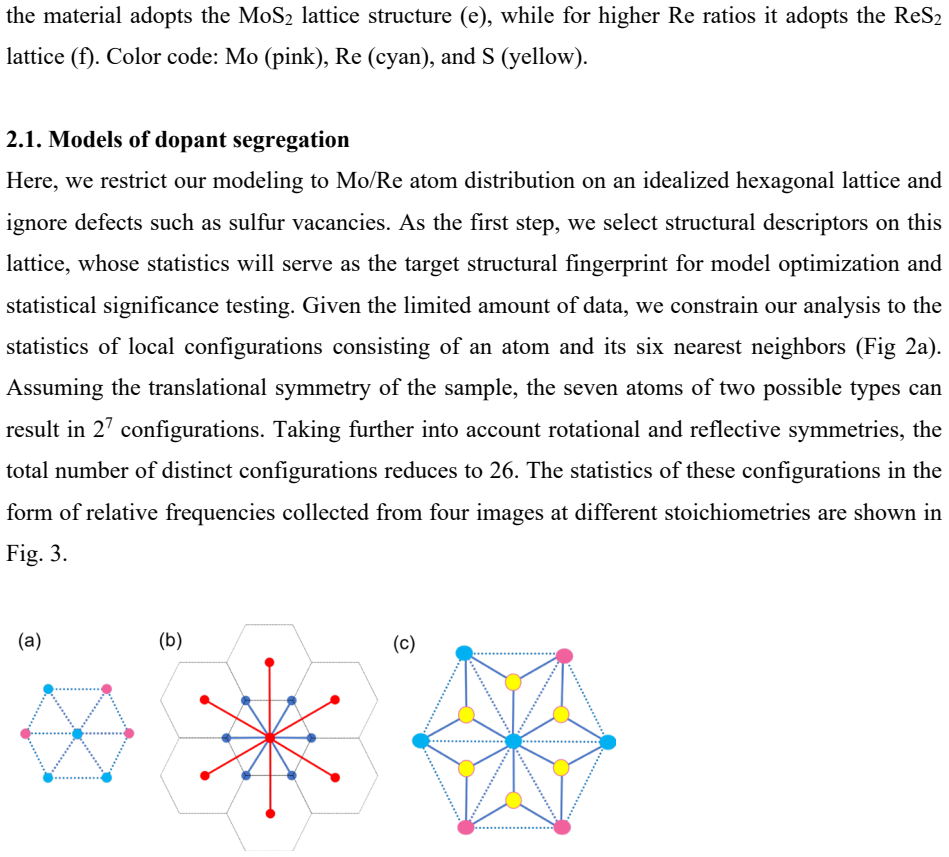
Exploration of structure-property relationships as a function of dopant concentration is commonly based on mean field theories for solid solutions. However, such theories that work well for semiconductors tend to fail in materials with strong correlations, either in electronic behavior or chemical segregation. In these cases, the details of atomic arrangements are generally not explored and analyzed. The knowledge of the generative physics and chemistry of the material can obviate this problem, since defect configuration libraries as stochastic representation of atomic level structures can be generated, or parameters of mesoscopic thermodynamic models can be derived. To obtain such information for improved predictions, we use data from atomically resolved microscopic images that visualize complex structural correlations within the system and translate them into statistical mechanical models of structure formation. Given the significant uncertainties about the microscopic aspects of the material's processing history along with the limited number of available images, we combine model optimization techniques with the principles of statistical hypothesis testing. We demonstrate the approach on data from a series of atomically-resolved scanning transmission electron microscopy images of Mo$_x$Re$_{1-x}$S$_2$ at varying ratios of Mo/Re stoichiometries, for which we propose an effective interaction model that is then used to generate atomic configurations and make testable predictions at a range of concentrations and formation temperatures.
Editorial analysis
A structured set of objections, weighed in public.
Referee Report
Summary. The paper claims that a limited set of atomically resolved STEM images of Mo_x Re_{1-x} S_2, combined with model optimization and statistical hypothesis testing, can be used to extract reliable effective pairwise interaction parameters despite unknown processing history. These parameters define an effective interaction model that generates atomic configurations and yields testable predictions across dopant concentrations and formation temperatures, addressing limitations of mean-field theories for strongly correlated solid solutions.
Significance. If the extraction procedure produces parameters whose predictions hold on independent data or match external thermodynamic benchmarks, the approach would offer a practical route to parameterize mesoscopic models directly from imaging, enabling better structure-property predictions in doped 2D materials where mean-field approximations fail. The explicit use of hypothesis testing to handle limited data and history uncertainties is a methodological strength worth highlighting if validated.
major comments (2)
- [Abstract] Abstract and methods section on model fitting: the effective interaction energies are optimized directly against neighbor-pair statistics extracted from the same STEM images later used to assess model fidelity and generate predictions. Without an explicit hold-out set, cross-validation protocol, or external benchmark (e.g., comparison to independent calorimetry or diffraction data), the statistical hypothesis testing does not demonstrably break the circularity between fitting and validation.
- [Methods / Results on parameter extraction] Section describing image representativeness and equilibrium assumption: the manuscript asserts that the small number of available images can be treated as representative of equilibrium states at given formation temperatures, yet provides no quantitative test (e.g., convergence of extracted parameters with additional images or comparison to simulated annealing trajectories) that would substantiate this for the claimed range of concentrations.
minor comments (2)
- [Model definition] Notation for the effective pairwise energies should be introduced with a clear equation number and distinguished from any mean-field terms used for comparison.
- [Figure captions] Figure captions for the generated configurations should state the exact temperature and concentration values used and whether they lie inside or outside the fitted range.
Simulated Author's Rebuttal
We appreciate the referee's insightful comments on our manuscript. Below, we provide point-by-point responses to the major comments, indicating where revisions will be made to address the concerns raised.
read point-by-point responses
-
Referee: [Abstract] Abstract and methods section on model fitting: the effective interaction energies are optimized directly against neighbor-pair statistics extracted from the same STEM images later used to assess model fidelity and generate predictions. Without an explicit hold-out set, cross-validation protocol, or external benchmark (e.g., comparison to independent calorimetry or diffraction data), the statistical hypothesis testing does not demonstrably break the circularity between fitting and validation.
Authors: The limited number of available STEM images necessitates using the same data for both parameter optimization and model assessment. Our approach employs statistical hypothesis testing to evaluate whether the effective pairwise interaction model significantly outperforms a random mixing null hypothesis in explaining the observed pair correlations, thereby incorporating uncertainties from unknown processing history. This testing framework helps address potential circularity by focusing on statistical significance rather than exact reproduction of the data. We agree that an external benchmark would provide stronger validation; however, such data are not available for this system. We will revise the abstract and methods sections to more clearly articulate the role of hypothesis testing and explicitly note the absence of hold-out validation as a limitation of the current study. revision: partial
-
Referee: [Methods / Results on parameter extraction] Section describing image representativeness and equilibrium assumption: the manuscript asserts that the small number of available images can be treated as representative of equilibrium states at given formation temperatures, yet provides no quantitative test (e.g., convergence of extracted parameters with additional images or comparison to simulated annealing trajectories) that would substantiate this for the claimed range of concentrations.
Authors: We recognize that the representativeness of the limited images as equilibrium configurations is an assumption underlying the extraction of interaction parameters. The hypothesis testing across the available images provides some measure of robustness to variability, but we do not include a quantitative convergence analysis due to the absence of additional independent images. We will update the methods section to explicitly discuss this assumption, its potential impact on predictions across concentrations, and the reliance on the statistical testing to partially mitigate uncertainties. revision: partial
Circularity Check
No significant circularity detected
full rationale
The derivation extracts effective interaction parameters via model optimization and statistical hypothesis testing applied to STEM images of Mo_x Re_{1-x} S_2, then generates configurations for predictions at varied concentrations and temperatures. No step in the provided abstract or described chain reduces a claimed prediction to the fitted inputs by construction (e.g., no parameter fitted to neighbor statistics and then renamed as an independent prediction on identical data). The statistical framework is presented as directly handling limited images and unknown processing history, rendering the central claim self-contained with independent content from the imaging data rather than self-definition, self-citation load-bearing, or ansatz smuggling.
Axiom & Free-Parameter Ledger
free parameters (1)
- effective pairwise interaction energies
axioms (2)
- domain assumption The imaged atomic arrangements reflect equilibrium statistics at the formation temperature.
- domain assumption A lattice model with short-range pairwise interactions is sufficient to capture the observed correlations.
Reference graph
Works this paper leans on
-
[1]
Helmholtz free energy F and excess entropy Sex of the equilibrium model as a function of Re fraction x and inverse reduced temperature 𝛽. CONCLUSIONS We have used atomically resolved STEM images of compositional fluctuations in MoxRe1-xS2 to develop statistical models of elemental distribution at different stoichiometries. Using these thermodynamic models...
work page 2048
-
[2]
Winter, M.; Besenhard, J. O.; Spahr, M. E.; Novak, P., Insertion electrode materials for rechargeable lithium batteries. Adv. Mater. 1998, 10 (10), 725-763
work page 1998
-
[3]
Chung, S. Y.; Kim, I. D.; Kang, S. J. L., Strong nonlinear current-voltage behaviour in perovskite-derivative calcium copper titanate. Nat. Mater. 2004, 3 (11), 774-778
work page 2004
-
[4]
Kittel, C.; McEuen, P.; McEuen, P., Introduction to solid state physics. Wiley New York: 1976; Vol
work page 1976
-
[5]
Manley, M. E.; Lynn, J. W.; Abernathy, D.; Specht, E.; Delaire, O.; Bishop, A.; Sahul, R.; Budai, J., Phonon localization drives polar nanoregions in a relaxor ferroelectric. Nat. Commun. 2014, 5,
work page 2014
-
[6]
Science 2005, 309 (5732), 257-262
Dagotto, E., Complexity in strongly correlated electronic systems. Science 2005, 309 (5732), 257-262
work page 2005
-
[7]
Dagotto, E.; Hotta, T.; Moreo, A., Colossal magnetoresistant materials: The key role of phase separation. Phys. Rep.-Rev. Sec. Phys. Lett. 2001, 344 (1-3), 1-153
work page 2001
-
[8]
Science 2000, 288 (5465), 462-468
Tokura, Y.; Nagaosa, N., Orbital physics in transition-metal oxides. Science 2000, 288 (5465), 462-468
work page 2000
-
[9]
Imada, M.; Fujimori, A.; Tokura, Y., Metal-insulator transitions. Rev. Mod. Phys. 1998, 70 (4), 1039-1263
work page 1998
-
[10]
Vugmeister, B. E.; Rabitz, H., Kinetics of electric-field-induced ferroelectric phase transitions in relaxor ferroelectrics. Physical Review B 2002, 65 (2)
work page 2002
-
[11]
Ma, E. Y.; Bryant, B.; Tokunaga, Y.; Aeppli, G.; Tokura, Y.; Shen, Z.-X., Charge-order domain walls with enhanced conductivity in a layered manganite. Nat. Commun. 2015, 6,
work page 2015
-
[12]
K.; Dixit, H.; Tselev, A.; Qiao, L.; Meyer, T
Vasudevan, R. K.; Dixit, H.; Tselev, A.; Qiao, L.; Meyer, T. L.; Cooper, V. R.; Baddorf, A. P.; Lee, H. N.; Ganesh, P.; Kalinin, S. V., Surface reconstructions and modified surface states in La1-xCaxMnO3. Phys. Rev. Materials 2018, 2 (10), 104418
work page 2018
-
[13]
V.; Yang, S.; Yu, P.; Bhattacharya, S.; Wu, P
Chang, H.; Kalinin, S. V.; Yang, S.; Yu, P.; Bhattacharya, S.; Wu, P. P.; Balke, N.; Jesse, S.; Chen, L. Q.; Ramesh, R.; Pennycook, S. J.; Borisevich, A. Y., Watching domains grow: In-situ studies of polarization switching by combined scanning probe and scanning transmission electron microscopy. J. Appl. Phys. 2011, 110 (5), 052014
work page 2011
-
[14]
Nelson, C. T.; Gao, P.; Jokisaari, J. R.; Heikes, C.; Adamo, C.; Melville, A.; Baek, S.-H.; Folkman, C. M.; Winchester, B.; Gu, Y.; Liu, Y.; Zhang, K.; Wang, E.; Li, J.; Chen, L.-Q.; Eom, C.-B.; Schlom, D. G.; Pan, X., Domain Dynamics During Ferroelectric Switching. Science 2011, 334 (6058),
work page 2011
-
[15]
Krivanek, O. L.; Chisholm, M. F.; Nicolosi, V.; Pennycook, T. J.; Corbin, G. J.; Dellby, N.; Murfitt, M. F.; Own, C. S.; Szilagyi, Z. S.; Oxley, M. P.; Pantelides, S. T.; Pennycook, S. J., Atom-by-atom 22 structural and chemical analysis by annular dark-field electron microscopy. Nature 2010, 464 (7288), 571-574
work page 2010
-
[16]
Huang, P. Y.; Kurasch, S.; Alden, J. S.; Shekhawat, A.; Alemi, A. A.; McEuen, P. L.; Sethna, J. P.; Kaiser, U.; Muller, D. A., Imaging Atomic Rearrangements in Two-Dimensional Silica Glass: Watching Silica's Dance. Science 2013, 342 (6155), 224-227
work page 2013
-
[17]
Stroscio, J. A.; Feenstra, R. M.; Fein, A. P., Electronic Structure of the Si(111)2 x 1 Surface by Scanning-Tunneling Microscopy. Phys. Rev. Lett. 1986, 57 (20), 2579-2582
work page 1986
-
[18]
A.; Garra, J., Scanning probe microscopy of oxide surfaces: atomic structure and properties
Bonnell, D. A.; Garra, J., Scanning probe microscopy of oxide surfaces: atomic structure and properties. Rep. Prog. Phys. 2008, (71(4)), 044501
work page 2008
-
[19]
Nature 2007, 446 (7131), 64-67
Sugimoto, Y.; Pou, P.; Abe, M.; Jelinek, P.; Perez, R.; Morita, S.; Custance, O., Chemical identification of individual surface atoms by atomic force microscopy. Nature 2007, 446 (7131), 64-67
work page 2007
-
[20]
Vlcek, L.; Vasudevan, R. K.; Jesse, S.; Kalinin, S. V., Consistent integration of experimental and ab initio data into effective physical models. J. Chem. Theory Comput. 2017, 5179-5194
work page 2017
-
[21]
K., Statistical distance and Hilbert space
Wootters, W. K., Statistical distance and Hilbert space. Phys. Rev. D 1981, 23 (2), 357-362
work page 1981
-
[22]
Braunstein, S. L.; Caves, C. M., Statistical distance and the geometry of quantum states. Phys. Rev. Lett. 1994, 72 (22), 3439-3443
work page 1994
-
[23]
A., Rigorous force field optimization principles based on statistical distance minimization
Vlcek, L.; Chialvo, A. A., Rigorous force field optimization principles based on statistical distance minimization. J. Chem. Phys. 2015, 143 (14), 144110
work page 2015
-
[24]
Tuyl, F., A Note on Priors for the Multinomial Model. Am. Stat. 2017, 71 (4), 298-301
work page 2017
-
[25]
K.; Ziatdinov, M.; Jesse, S.; Kalinin, S
Vasudevan, R. K.; Ziatdinov, M.; Jesse, S.; Kalinin, S. V., Phases and interfaces from real space atomically resolved data: Physics-based deep data image analysis. Nano Lett. 2016, 16 (9), 5574-5581
work page 2016
-
[26]
G.; Ngo, C.-W., Evaluating bag-of-visual-words representations in scene classification
Yang, J.; Jiang, Y.-G.; Hauptmann, A. G.; Ngo, C.-W., Evaluating bag-of-visual-words representations in scene classification. In Proceedings of the international workshop on Workshop on multimedia information retrieval, ACM: Augsburg, Bavaria, Germany, 2007; pp 197-206
work page 2007
-
[27]
Vlcek, L.; Maksov, A.; Pan, M.; Vasudevan, R. K.; Kalinin, S. V., Knowledge Extraction from Atomically Resolved Images. ACS Nano 2017, 11 (10), 10313-10320
work page 2017
-
[28]
Vlcek, L.; Ziatdinov, M.; Maksov, A.; Tselev, A.; Baddorf, A. P.; Kalinin, S. V.; Vasudevan, R. K., Learning from Imperfections: Predicting Structure and Thermodynamics from Atomic Imaging of Fluctuations. ACS Nano 2019, 13 (1), 718-727
work page 2019
-
[29]
Elfadaly, F. G.; Garthwaite, P. H.; Crawford, J. R., On point estimation of the abnormality of a Mahalanobis index. Computational statistics & data analysis 2016, 99, 115-130
work page 2016
-
[30]
J., Fisher information and stochastic complexity
Rissanen, J. J., Fisher information and stochastic complexity. IEEE Transactions on Information Theory 1996, 42 (1), 40-47
work page 1996
-
[31]
Journal of Mathematical Psychology 2000, 44 (1), 133-152
Grünwald, P., Model Selection Based on Minimum Description Length. Journal of Mathematical Psychology 2000, 44 (1), 133-152
work page 2000
-
[32]
Schwarz, G., Estimating the Dimension of a Model. Ann. Statist. 1978, 6 (2), 461-464
work page 1978
-
[33]
Z.; Gong, Y.; Manchanda, P.; Zhang, Y
Yang, S. Z.; Gong, Y.; Manchanda, P.; Zhang, Y. Y.; Ye, G.; Chen, S.; Song, L.; Pantelides, S. T.; Ajayan, P. M.; Chisholm, M. F., Rhenium‐Doped and Stabilized MoS2 Atomic Layers with Basal‐Plane Catalytic Activity. Adv. Mater. 2018, 30 (51), 1803477
work page 2018
-
[34]
Yang, S.-Z.; Sun, W.; Zhang, Y.-Y.; Gong, Y.; Oxley, M. P.; Lupini, A. R.; Ajayan, P. M.; Chisholm, M. F.; Pantelides, S. T.; Zhou, W., Direct Cation Exchange in Monolayer MoS 2 via Recombination-Enhanced Migration. Phys. Rev. Lett. 2019, 122 (10), 106101
work page 2019
-
[35]
Somnath, S.; Smith, C. R.; Kalinin, S. V.; Chi, M.; Borisevich, A.; Cross, N.; Duscher, G.; Jesse, S., Feature extraction via similarity search: application to atom finding and denoising in electron and scanning probe microscopy imaging. Advanced structural and chemical imaging 2018, 4 (1),
work page 2018
-
[36]
USID and Pycroscopy -- Open frameworks for storing and analyzing spectroscopic and imaging data
Somnath, S.; Smith, C. R.; Laanait, N.; Vasudevan, R. K.; Ievlev, A.; Belianinov, A.; Lupini, A. R.; Shankar, M.; Kalinin, S. V.; Jesse, S., USID and Pycroscopy--Open frameworks for storing and analyzing spectroscopic and imaging data. arXiv preprint arXiv:1903.09515
work page internal anchor Pith review Pith/arXiv arXiv 1903
-
[37]
V.; Strelcov, E.; Belianinov, A.; Somnath, S.; Vasudevan, R
Kalinin, S. V.; Strelcov, E.; Belianinov, A.; Somnath, S.; Vasudevan, R. K.; Lingerfelt, E. J.; Archibald, R. K.; Chen, C. M.; Proksch, R.; Laanait, N.; Jesse, S., Big, Deep, and Smart Data in Scanning Probe Microscopy. ACS Nano 2016, 10 (10), 9068-9086
work page 2016
-
[38]
Kalinin S.V., S. B. G., Archibald R.K., Big-deep-smart data in imaging for guiding materials design. Nat. Mater. 2015, 14,
work page 2015
-
[39]
Chialvo, A. A., Excess properties of liquid-mixtures from computer simulation - a coupling parameter approach to the determination of their dependence on molecular asymmetry. Mol. Phys. 1991, 73 (1), 127-140
work page 1991
-
[40]
Shirts, M. R.; Chodera, J. D., Statistically optimal analysis of samples from multiple equilibrium states. J. Chem. Phys. 2008, 129 (12). 24 SUPPORTING INFORMATION Order and randomness in dopant distributions: exploring the thermodynamics of solid solutions from atomically resolved imaging Lukas Vlcek,1,2 Shize Yang,3 Yongji Gong,4 Pulickel Ajayan,5 Wu Zh...
work page 2008
discussion (0)
Sign in with ORCID, Apple, or X to comment. Anyone can read and Pith papers without signing in.