Origin of energy shift in kaonic atom and kaon-nucleus interaction
Pith reviewed 2026-05-24 22:19 UTC · model grok-4.3
The pith
Kaonic-atom data require a K^--nucleus potential with large imaginary part rather than one driven by nuclear-state repulsion.
A machine-rendered reading of the paper's core claim, the machinery that carries it, and where it could break.
Core claim
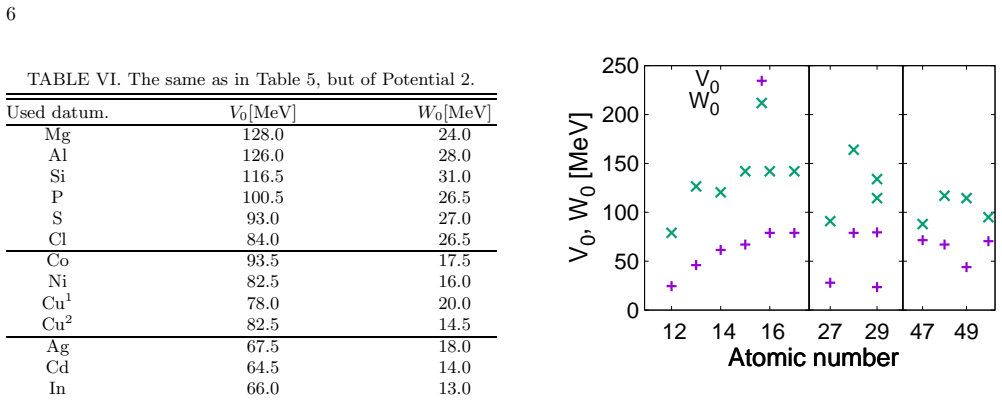
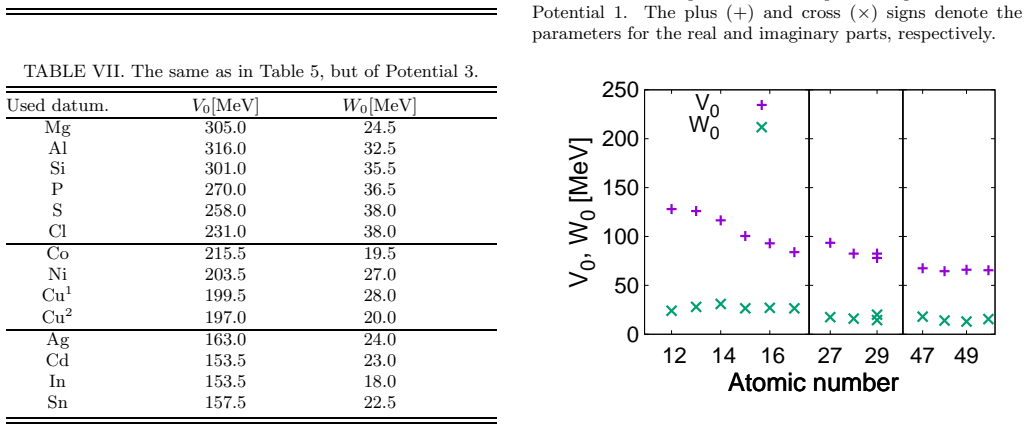
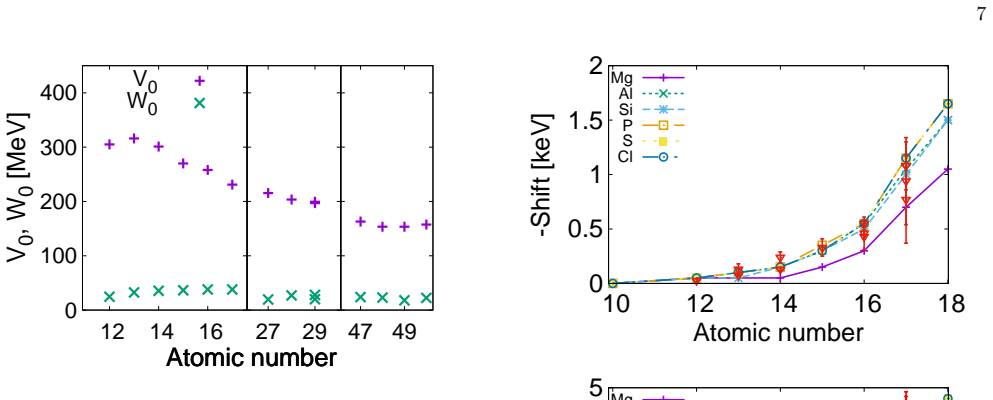
In the linear nuclear density approximation the K^- optical potential can be parameterized in two distinct ways that both reproduce individual kaonic-atom data. The first produces deep real attraction sufficient to support nuclear states sharing the atomic quantum numbers; mixing then repels the atomic level upward. The second produces large imaginary strength whose effect on the atomic wave function is also repulsive. Only the second family simultaneously describes the observed shifts and widths across the full range of nuclei, implying that the global K^--nucleus potential for kaonic atoms is characterized by strong absorption rather than by level repulsion with nuclear states.
What carries the argument
Linear-density K^- optical potential with independently fitted real and imaginary strengths for each atom; the distinction between real-part-driven level repulsion and imaginary-part-driven repulsion.
If this is right
- The picture that repulsive atomic shifts arise from mixing with nuclear states does not hold across the full data set.
- The K^--nucleus optical potential must carry a large imaginary part.
- All conventionally used phenomenological potentials already belong to the absorption-dominated class.
- Nonlinear density corrections leave the conclusion unchanged.
Where Pith is reading between the lines
- Precision data on additional light nuclei could test whether the same absorption-dominated form continues to work at lower densities.
- The result implies that any attempt to extract the real part of the potential from kaonic atoms will remain coupled to strong absorption effects.
- If the large imaginary component is confirmed it points toward dominant multi-nucleon absorption channels or strong in-medium broadening of the Lambda(1405).
Load-bearing premise
That independently fitting real and imaginary strengths for each kaonic atom inside the linear-density approximation is enough to identify which global feature of the K^--nucleus interaction is realized.
What would settle it
A new kaonic-atom measurement whose shift and width cannot be reproduced by any large-imaginary linear-density potential but can be fit by a level-repulsion solution would falsify the global preference for the imaginary-dominated family.
Figures




read the original abstract
The $K^-$-nucleus optical potential is revisited to investigate its global feature phenomenologically. It is a puzzle that the energy shift is found to be repulsive in all of the observed kaonic atom, although the $K^-N$ interaction is known to be so attractive as to form the $\Lambda(1405)$ resonance. To solve this puzzle, we examine the $K^-$ optical potential in the linear density approximation and determine the potential parameters of each kaonic atom so as to reproduce the observed energy shift and absorption width. We find two types of the potentials. One potential has a so large real part as to provide nuclear states with the same quantum number to the atomic state in the last orbit. The level repulsion between the atomic state and the nuclear states takes place due to their mixing, and it makes the atomic state shifted repulsively. The other type of the potential has a large imaginary part and the imaginary part works repulsively for atomic states. We find that only the latter solution reproduce a wide of the observed data, and thus is realized as a $K^-$-nucleus potential for kaonic atom. In the linear nuclear density optical potential, the picture that the repulsive shifts in the atomic states stem from the existence of the nuclear states does not globally stand up. This implies that the $K^-$-nucleus optical potential should have a large imaginary part. We examine some nonlinear density effects and find that the conclusion does not change. We also confirm that the conventionally known optical potentials are categorized into the latter type of the potential.
Editorial analysis
A structured set of objections, weighed in public.
Referee Report
Summary. The manuscript examines the K^--nucleus optical potential in the linear density approximation to address the puzzle of repulsive energy shifts observed in all kaonic atoms despite the attractive K^-N interaction forming the Lambda(1405). Parameters of the real and imaginary parts are fitted independently for each kaonic atom to reproduce the observed energy shift and absorption width. This yields two classes of solutions: one with a large real part that generates nuclear states with the same quantum numbers, leading to level repulsion and repulsive atomic shifts via mixing; the other with a large imaginary part that itself produces repulsive shifts. The authors conclude that only the large-imaginary solutions reproduce a wide range of the observed data and are thus realized globally, that the nuclear-state repulsion picture does not hold, that nonlinear density effects leave the conclusion unchanged, and that conventional potentials belong to the large-imaginary class.
Significance. If the central claim holds, the work would supply phenomenological evidence that a strongly absorptive optical potential, rather than nuclear-state mixing, accounts for the repulsive shifts, with implications for kaon-nucleus interaction models. The per-atom classification, consistency check with conventional potentials, and nonlinear test provide modest additional support, but the absence of error bars, statistical measures, or a global simultaneous fit limits the strength of the evidence for a single realized potential form.
major comments (2)
- [Fitting procedure (method and results sections)] The classification of solutions and the claim that 'only the latter solution reproduce a wide of the observed data' (abstract) rest on independent per-atom fits of real and imaginary strengths in the linear-density approximation. Because each atom receives its own unconstrained parameter pair, this procedure shows that large-imaginary solutions exist for many atoms but does not demonstrate that any single fixed (Re, Im) pair or functional form simultaneously reproduces the full data set, weakening the inference that the large-imaginary solution 'is realized as a K^--nucleus potential' globally.
- [Nonlinear density effects section] The nonlinear-density test (final section) inherits the identical per-atom independent fitting structure, so it cannot resolve the gap between per-atom existence of solutions and global consistency of one potential form across all atoms.
minor comments (2)
- [Abstract] Typo in abstract: 'reproduce a wide of the observed data' should read 'reproduce a wide range of the observed data'.
- [Abstract] The sentence 'the picture that the repulsive shifts in the atomic states stem from the existence of the nuclear states does not globally stand up' is awkwardly phrased; consider rewording for clarity.
Simulated Author's Rebuttal
We thank the referee for the careful reading of our manuscript and the constructive comments. We address each major comment below, clarifying the purpose and limitations of our phenomenological approach.
read point-by-point responses
-
Referee: [Fitting procedure (method and results sections)] The classification of solutions and the claim that 'only the latter solution reproduce a wide of the observed data' (abstract) rest on independent per-atom fits of real and imaginary strengths in the linear-density approximation. Because each atom receives its own unconstrained parameter pair, this procedure shows that large-imaginary solutions exist for many atoms but does not demonstrate that any single fixed (Re, Im) pair or functional form simultaneously reproduces the full data set, weakening the inference that the large-imaginary solution 'is realized as a K^--nucleus potential' globally.
Authors: The per-atom fitting procedure is deliberately chosen to classify the two possible types of solutions that can reproduce the data for each individual kaonic atom. This reveals a consistent pattern: for a wide range of atoms, only the large-imaginary solutions provide acceptable fits to both the energy shift and absorption width, while the large-real solutions (relying on nuclear-state mixing) fail to do so consistently or lead to unphysical results. This classification supports our conclusion that the large-imaginary class is the one realized globally as the K^--nucleus potential. We acknowledge that a single simultaneous global fit with fixed parameters across all atoms would provide additional support, but the current study focuses on identifying the dominant phenomenological type, which is also consistent with conventional potentials. revision: no
-
Referee: [Nonlinear density effects section] The nonlinear-density test (final section) inherits the identical per-atom independent fitting structure, so it cannot resolve the gap between per-atom existence of solutions and global consistency of one potential form across all atoms.
Authors: The nonlinear-density test applies the same per-atom classification to examine whether density-dependent corrections alter the preference for large imaginary parts. We find that the conclusion remains unchanged, reinforcing that the linear-density result captures the essential global feature. While this does not constitute a global simultaneous fit, it demonstrates the robustness of the large-imaginary class under nonlinear effects. revision: no
Circularity Check
No significant circularity; phenomenological classification of per-atom fits
full rationale
The paper determines real and imaginary strengths independently for each kaonic atom to reproduce its observed shift and width in the linear-density approximation, classifies the resulting solutions into two types, and reports that the large-imaginary class accommodates a wider set of atoms. This is a direct enumeration of fitting outcomes rather than a derivation in which a claimed result (e.g., a prediction or global potential) is shown by the paper's own equations to be identical to the fitted inputs. No self-citation is invoked as a load-bearing uniqueness theorem, no ansatz is smuggled, and no quantity is renamed as a first-principles result. The analysis remains self-contained within its stated phenomenological scope.
Axiom & Free-Parameter Ledger
free parameters (2)
- real part of optical potential
- imaginary part of optical potential
axioms (1)
- domain assumption K^- optical potential is linear in nuclear density
Lean theorems connected to this paper
-
IndisputableMonolith/Cost/FunctionalEquation.leanwashburn_uniqueness_aczel unclear?
unclearRelation between the paper passage and the cited Recognition theorem.
We examine the K− optical potential in the linear density approximation and determine the potential parameters of each kaonic atom so as to reproduce the observed energy shift and absorption width.
What do these tags mean?
- matches
- The paper's claim is directly supported by a theorem in the formal canon.
- supports
- The theorem supports part of the paper's argument, but the paper may add assumptions or extra steps.
- extends
- The paper goes beyond the formal theorem; the theorem is a base layer rather than the whole result.
- uses
- The paper appears to rely on the theorem as machinery.
- contradicts
- The paper's claim conflicts with a theorem or certificate in the canon.
- unclear
- Pith found a possible connection, but the passage is too broad, indirect, or ambiguous to say the theorem truly supports the claim.
Reference graph
Works this paper leans on
-
[1]
5i)(ρN (r)/ρ 0) MeV) in the previous section. This is a natural result because the potential (13) is similar to the phenomenological potential is Ref [1] and it has already universality to reproduce a wide range of the ob- served kaonic atoms. -0.2 0 0.2 0.4 22 24 26 28 30 -Shift [keV] Atomic number Co Ni Cu1 Cu2 0 0.5 1 1.5 2 2.5 22 24 26 28 30 Width [ke...
- [2]
-
[3]
C. J. Batty, E. Friedman and A. Gal, Phys. Rept. 287, 385 (1997)
work page 1997
- [4]
-
[5]
C. J. Batty, Nucl. Phys. A 372, 418 (1981)
work page 1981
- [6]
- [7]
- [8]
- [9]
- [10]
- [11]
- [12]
-
[13]
J. Schaffner, J. Bondorf and I. N. Mishustin, Nucl. Phys. A 625, 325 (1997)
work page 1997
-
[14]
T. Waas, N. Kaiser and W. Weise, Phys. Lett. B 365, 12 (1996)
work page 1996
-
[15]
T. Waas, N. Kaiser and W. Weise, Phys. Lett. B 379, 34 (1996)
work page 1996
- [16]
- [17]
- [18]
-
[19]
K. Tsushima, K. Saito, A. W. Thomas and S. V. Wright, Phys. Lett. B 429, 239 (1998); Phys. Lett. B 436, 453(E) (1998)
work page 1998
- [20]
- [21]
-
[22]
S. Hirenzaki, Y. Okumura, H. Toki, E. Oset and A. Ramos, Phys. Rev. C 61, 055205 (2000)
work page 2000
-
[23]
A. Baca, C. Garcia-Recio and J. Nieves, Nucl. Phys. A 673, 335 (2000)
work page 2000
- [24]
- [25]
-
[26]
C. L. Korpa and M. F. M. Lutz, Acta Phys. Hung. A 22, 21 (2005). 12
work page 2005
- [27]
- [28]
- [29]
- [30]
- [31]
-
[32]
T. Sekihara, J. Yamagata-Sekihara, D. Jido, and Y. Kanada-En’yo, Phys. Rev. C 86, 065205 (2012)
work page 2012
-
[33]
J. Yamagata-Sekihara, N. Ikeno, H. Nagahiro, D. Jido, and S. Hirenzaki, Nucl. Phys. A914, 344 (2013)
work page 2013
- [34]
- [35]
- [36]
- [37]
-
[38]
J. Yamagata, H. Nagahiro, Y. Okumura, and S. Hiren- zaki, Prog. Theor. Phys. 114, 301 (2005); 114, 905(E) (2005)
work page 2005
-
[39]
J. Yamagata, H. Nagahiro, and S. Hirenzaki, Phys. Rev. C76, 014604 (2006)
work page 2006
-
[40]
J. Yamagata, H. Nagahiro, R. Kimura, and S. Hirenzaki, Phys. Rev. C76, 045204 (2007)
work page 2007
-
[41]
J. Yamagata-Sekihara, D. Jido, H. Nagahiro, and S. Hirenzaki, Phys. Rev. C80, 045204 (2009)
work page 2009
-
[42]
T. Koike and T. Harada, Phys. Lett. B 652, 262 (2007); Nucl. Phys. A 804, 231 (2008)
work page 2007
-
[43]
V. K. Magas, J. Yamagata-Sekihara, S. Hirenzaki, E. Oset and A. Ramos, Phys. Rev. C 81, 024609 (2010)
work page 2010
-
[44]
Y. Ichikawa et al. , JPS Conf. Proc. 13, 020007 (2017); talk given in the 13th International Conference on Hy- pernuclear and Strange Particle Physics (HYP2018)
work page 2017
- [45]
- [46]
-
[47]
R. H. Dalitz, T. C. Wong and G. Rajasekaran, Phys. Rev. 153, 1617 (1967)
work page 1967
- [48]
-
[49]
C. W. De Jager, H. De Vries and C. De Vries, Atom. Data Nucl. Data Tabl. 14, 479 (1974); Atom. Data Nucl. Data Tabl. 16, 580(E) (1975)
work page 1974
-
[50]
H. De Vries, C. W. De Jager and C. De Vries, Atom. Data Nucl. Data Tabl. 36, 495 (1987)
work page 1987
-
[51]
G. Backenstoss et al. , Phys. Lett. 38B, 181 (1972); G. Backenstoss, J. Egger, H. Koch, H. P. Povel, A. Schwitter and L. Tauscher, Nucl. Phys. B 73, 189 (1974)
work page 1972
-
[52]
C. J. Batty et al. , Nucl. Phys. A 329, 407 (1979)
work page 1979
-
[53]
P. D. Barnes et al. , Nucl. Phys. A 231, 477 (1974)
work page 1974
discussion (0)
Sign in with ORCID, Apple, or X to comment. Anyone can read and Pith papers without signing in.