Fluorescence polarization as a precise tool for understanding nonsequential many-photon ionization
Pith reviewed 2026-05-24 20:54 UTC · model grok-4.3
The pith
A vanishing dominant ionization channel causes an unexpected sharp change in fluorescence polarization at one specific photon energy.
A machine-rendered reading of the paper's core claim, the machinery that carries it, and where it could break.
Core claim
In nonsequential two-photon ionization of inner-shell np subshells of neutral atoms by circularly polarized light, the degree of polarization of the subsequent fluorescence remains approximately constant with beam energy except at resonances; however, it exhibits a strong unexpected change at a specific incident beam energy due to a zero contribution of the otherwise dominant ionization channel. The position of this energy is highly sensitive to the details of the employed theory, so fluorescence polarization measurements there are proposed as a tool for evaluating theoretical calculations of nonlinear ionization at high accuracy.
What carries the argument
The zero contribution of the dominant ionization channel at a specific photon energy, which shifts the relative weights of the remaining channels that determine the fluorescence polarization.
If this is right
- The degree of polarization of the fluorescence depends less on beam parameters than other observables in the process.
- Measurements at this specific beam energy enable evaluation of theoretical calculations of nonlinear ionization at hitherto unreachable accuracy.
- The effect supplies a new signature for identifying and studying nonsequential many-photon ionization.
Where Pith is reading between the lines
- The same zero-contribution mechanism may produce analogous polarization features in other subshells or for higher-order photon processes.
- Experimental location of the energy could be used to refine the atomic potentials or correlation treatments inside the ionization amplitude calculations.
- The approach might extend to linear polarization or to sequential ionization pathways, offering additional diagnostic points.
Load-bearing premise
The theoretical framework used to compute the ionization amplitudes and channel contributions is sufficiently accurate that a true zero in the dominant channel can be identified and its energy position predicted reliably enough to distinguish different models.
What would settle it
An experiment that scans fluorescence polarization versus photon energy and finds either no sharp change or a change occurring at an energy different from the model's prediction would falsify the central claim.
Figures
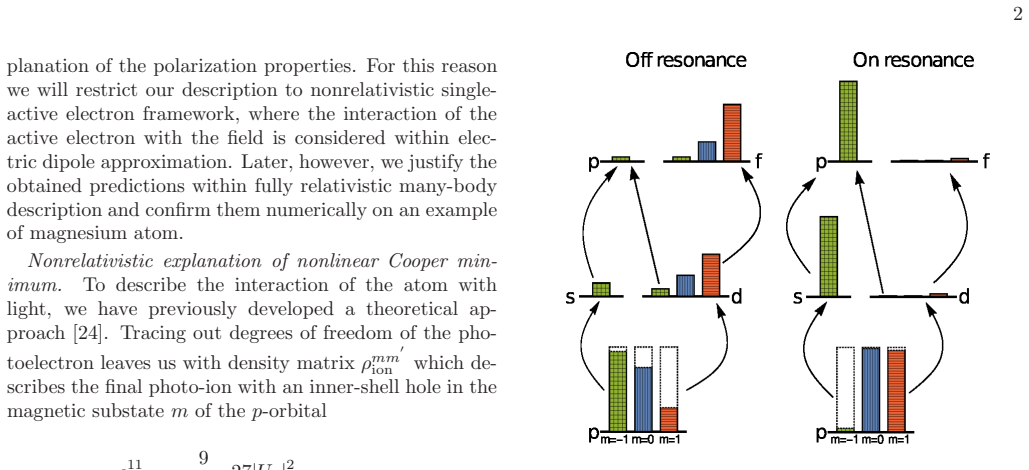


read the original abstract
Nonsequential two-photon ionization of inner-shell $np$ subshell of neutral atoms by circularly polarized light is investigated. Detection of subsequent fluorescence as a signature of the process is proposed and the dependence of fluorescence degree of polarization on incident photon beam energy is studied. It is generally expected that the degree of polarization remains approximately constant, except when the beam energy is tuned to an intermediate $n's$ resonance. However, strong unexpected change in the polarization degree is discovered for nonsequential two-photon ionization at specific incident beam energy due to a zero contribution of the otherwise dominant ionization channel. Polarization degree of the fluorescence depends less on the beam parameters and its measurements at this specific beam energy, whose position is very sensitive to the details of the employed theory, are highly desirable for evaluation of theoretical calculations of nonlinear ionization at hitherto unreachable accuracy.
Editorial analysis
A structured set of objections, weighed in public.
Referee Report
Summary. The manuscript examines nonsequential two-photon ionization of inner-shell np subshells in neutral atoms by circularly polarized light. It proposes detecting the subsequent fluorescence as a process signature and analyzes the energy dependence of the fluorescence polarization degree. The central claim is that, contrary to the general expectation of near-constant polarization (except near n's resonances), a strong change occurs at a specific photon energy because the dominant ionization channel contribution vanishes exactly; the position of this energy is highly sensitive to theoretical details, so polarization measurements there would allow stringent tests of nonlinear ionization models.
Significance. If the reported zero in the dominant channel and the resulting polarization feature are confirmed by explicit calculation, the work supplies a new, relatively beam-parameter-independent diagnostic for discriminating among theoretical treatments of nonsequential multiphoton ionization. The sensitivity of the zero's location to model details could enable accuracy checks that are difficult to achieve with other observables.
major comments (1)
- [Abstract] Abstract: the central claim that a true zero occurs in the dominant channel at a specific energy (producing the reported polarization change) is asserted without any displayed amplitudes, partial-wave contributions, or numerical results. The finding therefore cannot be verified from the information provided.
Simulated Author's Rebuttal
We thank the referee for the detailed review and constructive feedback on our manuscript. We address the single major comment below.
read point-by-point responses
-
Referee: [Abstract] Abstract: the central claim that a true zero occurs in the dominant channel at a specific energy (producing the reported polarization change) is asserted without any displayed amplitudes, partial-wave contributions, or numerical results. The finding therefore cannot be verified from the information provided.
Authors: We agree that the abstract, owing to length constraints, does not display the supporting amplitudes or partial-wave data. The full manuscript contains the explicit numerical evaluation of the two-photon ionization amplitudes (including the vanishing contribution from the dominant channel) and the resulting polarization curves; these are shown via the energy-dependent partial cross sections and the derived polarization degree plotted in the figures. To make this clearer, we will revise the abstract to state that the zero is obtained from direct computation of the transition amplitudes and will add an explicit cross-reference to the relevant figure and section in the main text. revision: yes
Circularity Check
No significant circularity identified
full rationale
The abstract and provided context describe a theoretical prediction of a zero in the dominant ionization channel at a specific energy, leading to a change in fluorescence polarization. No equations, fitted parameters, or self-citations are quoted that would reduce this prediction to an input by construction. The energy position is explicitly stated to be sensitive to theoretical details, and the proposal is to use it as an external test of models. No load-bearing step reduces to a self-definition, fitted input renamed as prediction, or self-citation chain. The derivation chain is self-contained against external benchmarks.
Axiom & Free-Parameter Ledger
Reference graph
Works this paper leans on
-
[1]
9 − 57 × 10− 60cm4s. The reason for this wide range of values was appointed to systematic uncertainty in beam parameters of LCLS FEL which determine the absolute flux [12]. Similarly, Richter et al. [11] report 30% un- certainty in the beam flux at FLASH FEL which results in ≈ 50% uncertainty in the extracted cross section of two-photon ionization of singly...
-
[2]
A. A. Sorokin, S. V. Bobashev, T. Feigl, K. Tiedtke, H. Wabnitz, and M. Richter, Phys. Rev. Lett. 99, 213002 (2007)
work page 2007
-
[3]
M. Richter, M. Y. Amusia, S. V. Bobashev, T. Feigl, P. N. Jurani´ c, M. Martins, A. A. Sorokin, and K. Tiedtke, Phys. Rev. Lett. 102, 163002 (2009)
work page 2009
- [4]
-
[5]
S. A. Novikov and A. N. Hopersky, Journal of Physics B 34, 4857 (2001)
work page 2001
-
[6]
A. Sytcheva, S. Pabst, S.-K. Son, and R. Santra, Phys. Rev. A 85, 023414 (2012)
work page 2012
- [7]
-
[8]
K. Tamasaku, E. Shigemasa, Y. Inubushi, T. Katayama, K. Sawada, H. Yumoto, H. Ohashi, H. Mimura, M. Yabashi, K. Yamauchi, and T. Ishikawa, Nat. Photonincs 8, 313 (2014)
work page 2014
-
[9]
K. Tamasaku, E. Shigemasa, Y. Inubushi, I. Inoue, T. Os- aka, T. Katayama, M. Yabashi, A. Koide, T. Yokoyama, and T. Ishikawa, Phys. Rev. Lett. 121, 083901 (2018)
work page 2018
-
[10]
G. Doumy, C. Roedig, S.-K. Son, C. I. Blaga, A. D. DiChiara, R. Santra, N. Berrah, C. Bostedt, J. D. Bozek, P. H. Bucksbaum, J. P. Cryan, L. Fang, S. Ghimire, J. M. Glownia, M. Hoener, E. P. Kanter, B. Kr¨ assig, M. Kuebel, M. Messerschmidt, G. G. Paulus, D. A. Reis, N. Rohringer, L. Young, P. Agostini, and L. F. DiMauro, Phys. Rev. Lett. 106, 083002 (2011)
work page 2011
-
[11]
R. K. Lam, S. L. Raj, T. A. Pascal, C. Pemmaraju, L. Foglia, A. Simoncig, N. Fabris, P. Miotti, C. J. Hull, A. M. Rizzuto, J. W. Smith, R. Mincigrucci, C. Masciovecchio, A. Gessini, G. D. Ninno, B. Di- viacco, E. Roussel, S. Spampinati, G. Penco, S. D. Mitri, M. Trov, M. B. Danailov, S. T. Christensen, D. Sokaras, T.-C. Weng, M. Coreno, L. Poletto, W. S. ...
work page 2018
-
[12]
M. Richter, S. V. Bobashev, A. A. Sorokin, and K. Tiedtke, Journal of Physics B: Atomic, Molecular and Optical Physics 43, 194005 (2010)
work page 2010
-
[13]
S. Ghimire, M. Fuchs, J. Hastings, S. C. Herrmann, Y. In- ubushi, J. Pines, S. Shwartz, M. Yabashi, and D. A. Reis, Phys. Rev. A 94, 043418 (2016)
work page 2016
-
[14]
J. Szlachetko, J. Hoszowska, J.-C. Dousse, M. Nachte- gaal, W. B/suppress lachucki, Y. Kayser, J. S` a, M. Messerschmidt, S. Boutet, G. J. Williams, C. David, G. Smolentsev, J. A. van Bokhoven, B. D. Patterson, T. J. Penfold, G. Knopp, M. Pajek, R. Abela, and C. J. Milne, Sci. Rep. 6, 33292 (2016)
work page 2016
-
[15]
A. Saenz and P. Lambropoulos, Journal of Physics B: Atomic, Molecular and Optical Physics 32, 5629 (1999)
work page 1999
-
[16]
V. Florescu, O. Budriga, and H. Bachau, Phys. Rev. A 84, 033425 (2011). 7
work page 2011
-
[17]
I. Bray, D. Fursa, A. Kadyrov, A. Stel- bovics, A. Kheifets, and A. Mukhamedzhanov, Physics Reports 520, 135 (2012), electron- and photon- impact atomic ionisation
work page 2012
-
[18]
N. Douguet, A. N. Grum-Grzhimailo, E. V. Gryzlova, E. I. Staroselskaya, J. Venzke, and K. Bartschat, Phys. Rev. A 93, 033402 (2016)
work page 2016
-
[19]
A. N. Grum-Grzhimailo, E. V. Gryzlova, E. I. Staroselskaya, J. Venzke, and K. Bartschat, Phys. Rev. A 91, 063418 (2015)
work page 2015
-
[20]
T. Sato, K. L. Ishikawa, I. Bˇ rezinov´ a, F. Lackner, S. Nagele, and J. Burgd¨ orfer, Phys. Rev. A 94, 023405 (2016)
work page 2016
- [21]
-
[22]
J. Hofbrucker, A. V. Volotka, and S. Fritzsche, Phys. Rev. A 96, 013409 (2017)
work page 2017
-
[23]
J. W. Cooper, Phys. Rev. 128, 681 (1962)
work page 1962
-
[24]
J. W. Cooper, Phys. Rev. Lett. 13, 762 (1964)
work page 1964
- [26]
- [27]
-
[28]
Shen, V.K., Siderius, D.W., Krekelberg, W.P., and Hatch, H.W., Eds., NIST Standard Refer- ence Simulation Website, NIST Standard Refer- ence Database Number 173, National Institute of Standards and Technology, Gaithersburg MD, 20899, http://doi.org/10.18434/T4M88Q, (retrieved 03/05/2019)
-
[29]
N. R. Badnell, D. Petrini, and S. Stoica, J. Phys. B 30, L665 (1997)
work page 1997
- [30]
-
[31]
J. Hofbrucker, A. V. Volotka, and S. Fritzsche, Phys. Rev. A 94, 063412 (2016)
work page 2016
- [32]
-
[33]
J. P. Perdew and A. Zunger, Phys. Rev. B 23, 5048 (1981)
work page 1981
- [34]
-
[35]
J. C. Slater, Phys. Rev. 81, 385 (1951)
work page 1951
-
[36]
Lambropoulos, Advances in Atomic and Molecular Physics (Academic Press, New York, 1976) edited by D
P. Lambropoulos, Advances in Atomic and Molecular Physics (Academic Press, New York, 1976) edited by D. R. Bates and B. Bederson
work page 1976
-
[37]
H. Derenbach and V. Schmidt, Journal of Physics B: Atomic and Molecular Physics 16, L337 (1983)
work page 1983
-
[38]
A. Fahlman, T. A. Carlson, and M. O. Krause, Journal of Physics B: Atomic and Molecular Physics 16, L485 (1983)
work page 1983
-
[39]
W. R. Johnson and K. T. Cheng, Phys. Rev. Lett. 40, 1167 (1978)
work page 1978
-
[40]
O. Hemmers, R. Guillemin, E. P. Kanter, B. Kr¨ assig, D. W. Lindle, S. H. Southworth, R. Wehlitz, J. Baker, A. Hudson, M. Lotrakul, D. Rolles, W. C. Stolte, I. C. Tran, A. Wolska, S. W. Yu, M. Y. Amusia, K. T. Cheng, L. V. Chernysheva, W. R. Johnson, and S. T. Manson, Phys. Rev. Lett. 91, 053002 (2003)
work page 2003
-
[41]
S. Saha, A. Mandal, J. Jose, H. R. Varma, P. C. Desh- mukh, A. S. Kheifets, V. K. Dolmatov, and S. T. Man- son, Phys. Rev. A 90, 053406 (2014)
work page 2014
-
[42]
M. Ilchen, G. Hartmann, E. V. Gryzlova, A. Achner, E. Allaria, A. Beckmann, M. Braune, J. Buck, C. Calle- gari, R. N. Coffee, R. Cucini, M. Danailov, A. De Fa- nis, A. Demidovich, E. Ferrari, P. Finetti, L. Glaser, A. Knie, A. O. Lindahl, O. Plekan, N. Mahne, T. Mazza, L. Raimondi, E. Roussel, F. Scholz, J. Seltmann, I. Shevchuk, C. Svetina, P. Walter, M. ...
work page 2018
-
[43]
G. W. F. Drake and Z.-C. Yan, Canadian Journal of Physics 86, 45 (2008), https://doi.org/10.1139/p07-154
-
[44]
B. M. Henson, R. I. Khakimov, R. G. Dall, K. G. H. Baldwin, L.-Y. Tang, and A. G. Truscott, Phys. Rev. Lett. 115, 043004 (2015)
work page 2015
-
[45]
Y.-H. Zhang, L.-Y. Tang, X.-Z. Zhang, and T.-Y. Shi, Phys. Rev. A 93, 052516 (2016)
work page 2016
-
[46]
J. Hofbrucker, A. V. Volotka, and S. Fritzsche, Phys. Rev. Lett. 121, 053401 (2018)
work page 2018
-
[47]
N. L. Manakov, S. I. Marmo, and S. A. Sviridov, J. Exp. Theor. Phys. 108, 557 (2009)
work page 2009
discussion (0)
Sign in with ORCID, Apple, or X to comment. Anyone can read and Pith papers without signing in.