Quantum tunneling devices incorporating two-dimensional magnetic semiconductors
Pith reviewed 2026-05-24 20:51 UTC · model grok-4.3
The pith
Two-dimensional CrI3 enables spin-based quantum tunneling devices that may outperform traditional films.
A machine-rendered reading of the paper's core claim, the machinery that carries it, and where it could break.
Core claim
The central claim is that 2D magnetic semiconductors such as CrI3, isolated in atomically thin form despite chemical instability, differ in nature from their bulk counterparts and can be incorporated into spin-based quantum tunneling devices, where high crystallinity and absence of dangling bonds may yield heterostructures with performance exceeding that of traditional films.
What carries the argument
Atomically thin CrI3 layers incorporated into tunneling devices and heterostructures for spintronics applications.
If this is right
- Enables fundamental studies of quantum phenomena such as magnetism in atomically thin systems.
- Supports development of spin-based quantum devices with potentially enhanced characteristics.
- Allows heterostructures that may exceed the performance of traditional thin films.
- Provides a pathway for new quantum tunneling technologies based on 2D magnetic semiconductors.
Where Pith is reading between the lines
- The same integration approach could apply to other chemically unstable 2D materials showing superconductivity or related effects.
- Specific fabrication methods would be needed to handle the chemical instability during device assembly.
- Direct measurements of tunneling currents in CrI3 heterostructures would test the performance edge over bulk-based devices.
Load-bearing premise
That the 2D phases maintain high crystallinity and lack dangling bonds when formed into devices, allowing useful differences from bulk behavior.
What would settle it
Fabricating a CrI3 tunneling device and finding its performance no better than traditional films, or finding the 2D phase identical to bulk, would challenge the claimed advantages.
Figures
read the original abstract
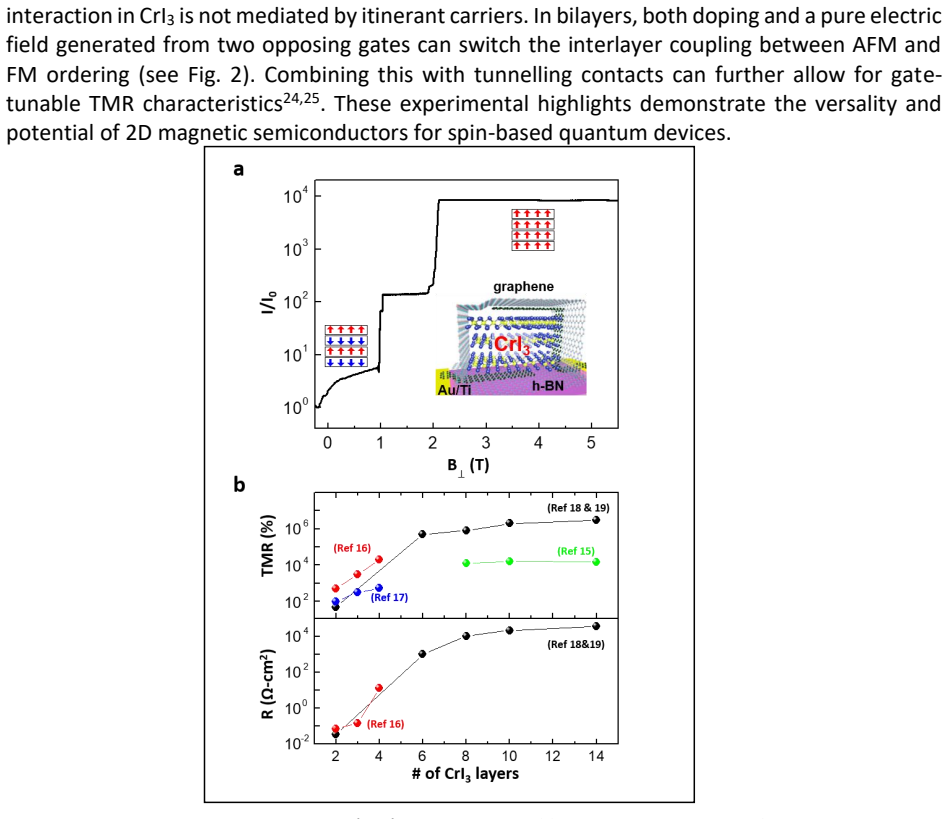
Research in two-dimensional (2D) materials has experienced rapid growth in the past few years. In particular, various layered compounds exhibiting quantum phenomena, such as superconductivity and magnetism, have been isolated in atomically thin form, often in spite of their chemical instability. The nature of the 2D phases can be different than their bulk counterparts, making such systems attractive for fundamental studies. Owing to their high crystallinity and absence of dangling bonds, devices and heterostructures incorporating these materials may also show performance exceeding that of traditional films. In this roadmap article, we focus on a few recent developments in spin-based quantum devices utilizing the 2D magnetic semiconductor, CrI$_3$.
Editorial analysis
A structured set of objections, weighed in public.
Referee Report
Summary. This is a roadmap article reviewing recent literature on the 2D magnetic semiconductor CrI3, its isolation in atomically thin form despite chemical instability, differences between 2D and bulk phases, and potential advantages of CrI3-based heterostructures for spin-based quantum tunneling devices arising from high crystallinity and absence of dangling bonds. The focus is on summarizing developments rather than presenting new data or derivations.
Significance. If the forward-looking suggestions hold, the manuscript could help orient researchers toward 2D magnets for quantum spintronics by consolidating known properties of CrI3 devices. Its value lies in the synthesis of existing results rather than novel claims; the hedged language on performance advantages is appropriate for a review.
minor comments (2)
- The abstract states the focus on 'a few recent developments' but does not enumerate which specific CrI3 device architectures or tunneling mechanisms are covered; adding a short enumerated list would improve clarity for readers.
- The manuscript is described as a 'roadmap article' yet lacks an explicit forward-looking section outlining open questions or suggested experiments; including one would strengthen its utility as a roadmap.
Simulated Author's Rebuttal
We thank the referee for their positive assessment of our roadmap article and for recommending acceptance. The referee's summary correctly identifies the manuscript as a review consolidating existing results on CrI3-based devices rather than presenting new data.
Circularity Check
No significant circularity; descriptive review with no derivations or predictions
full rationale
This is a roadmap/review article summarizing known properties of 2D magnetic semiconductors like CrI3 and suggesting future device applications. No mathematical derivations, equations, fitted parameters, or quantitative predictions appear in the text. All statements are descriptive or hedged forward-looking suggestions (e.g., 'may also show performance exceeding'), with no opportunity for self-definitional, fitted-input, or self-citation-load-bearing circularity. The content is self-contained as literature review without internal reductions to inputs.
Axiom & Free-Parameter Ledger
Reference graph
Works this paper leans on
-
[1]
Saito Y, Nojima T and Iwasa Y 2016 Highly crystalline 2D superconductors. Nat. Rev. Mater. 2, 16094
work page 2016
-
[2]
Gong C and Zhang X 2019 Two -dimensional magnetic crystals and emergent heterostructure devices. Science 363, 706
work page 2019
- [3]
-
[4]
Kim K, Lim S Y, Lee J -U, Lee S, Kim T Y, Park K, Jeon G S, Park C -H, Park J -G and Cheong H 2019 Suppression of magnetic ordering in XXZ -type antiferromagnetic monolayer NiPS3. Nat. Commun. 10, 345
work page 2019
-
[5]
Gong C, Li L, Li Z, Ji H, Stern A, Xia Y, Cao T, Bao W, Wang C, Wang Y, Qiu Z Q, Cava R J, Louie S G, Xia J and Zhang X 2017 Discovery of intrinsic ferromagnetism in two-dimensional van der Waals crystals. Nature 546, 265-269
work page 2017
-
[6]
Huang B, Clark G, Navarro -Moratalla E, Klein D R, Cheng R, Seyler K L, Zhong D, Schmidgall E, McGuire M A, Cobden D H, Yao W, Xiao D, Jarillo -Herrero P, and Xu X 2017 Layer-dependent ferromagnetism in a van der Waals crystal down to the monolayer limit. Nature, 546, 270-273
work page 2017
-
[7]
Ghazaryan D, Greenaway M T, Wang Z, Guarochico -Moreira V H, Vera -Marun I J, Yin J, Liao Y, Morozov S V, Kristanovski O, Lichtenstein A I, Katsnelson M I, Withers F, Mishchenko A, Eaves L, Geim A K, Novoselov K S and Misra A 2018 Magnon-assisted tunnelling in van der Waals heterostructures based on CrBr3. Nat. Electron. 1, 344-349
work page 2018
-
[8]
Kim H H, Yang B, Li S, Jiang S, Jin C, Tao Z, Nichols G, Sfigakis F, Zhong S, Li C, Tian S, Cory D G, Miao G-X, Shan J, Mak K F, Lei H, Sun K, Zhao L and Tsen A W 2019 Evolution of interlayer and intralayer magnetism in three atomically thin chromium trihalides. Proc. Natl. Acad. Sci. U.S.A. 116, 11131-11136
work page 2019
-
[9]
preprint at https://arxiv.org/abs/1903.00002
Klein D R, MacNeill D, Song Q, Larson D T, Fang S, Xu M, Ribe iro R A, Canfield P C, Kaxiras E, Comin R and Jarillo -Herrero P 2019 Giant enhancement of interlayer exchange in an ultrathin 2D magnet. preprint at https://arxiv.org/abs/1903.00002
- [10]
-
[11]
Deng Y, Yu Y, Song Y, Zhang J, Wang N Z, Wu Y Z, Zhu J, Wang J, Chen X H and Zhang Y 2018 Gate-tunable Room-temperature Ferromagnetism in Two-dimensional Fe3GeTe2. Nature 563, 94-99
work page 2018
-
[12]
Bonilla M, Kolekar S, Ma Y, Diaz H C, Kalappattil V, Das R, Eggers T, Gutierrez H R, Phan M-H and Batzill M 2018 Strong room -temperature ferromagnetism in VSe 2 monolayers on van der Waals substrates. Nat. Nanotech. 13, 289-293
work page 2018
-
[13]
Physical review letters, 17, 1133-1136
Mermin N D and Wagner H 1966 Absence of Ferromagnetism or Antiferromagnetism in One- or Two-Dimensional Isotropic Heisenberg Models. Physical review letters, 17, 1133-1136
work page 1966
- [14]
-
[15]
Wang Z, Gutiérrez-Lezama I, Ubrig N, Kroner M, Taniguchi T, Watanabe K, Imamoğlu A, Giannini E and Morpurgo A F 2018 Very Large T unneling Magnetoresistance in Layered Magnetic Semiconductor CrI3. Nat. Commun. 9, 2516
work page 2018
-
[16]
Song T, Cai X, Tu M W-Y, Zhang X, Huang B, Wilson N P, Seyler K L, Zhu L, Taniguchi T, Watanabe K, McGuire M A, Cobden D H, Xiao D, Yao W and Xu X 2018 Giant tunne ling magnetoresistance in spin-filter van der Waals heterostructures. Science 360, 1214-1218
work page 2018
-
[17]
Klein D R, MacNeill D, Lado J L, Soriano D, Navarro -Moratalla E, Watanabe K, Taniguchi T, Manni S, Canfield P, Fernández -Rossier J and Jarillo -Herrero P 2018 Probing magnetism in 2D van der Waals crystalline insulators via electron tunneling. Science 360, 1218- 1222
work page 2018
- [18]
-
[19]
Tailored tunnel magnetoresistance response in three ultrathin chromium trihalides
Kim H H, Yang B, Tian S, Li C, Miao G-X, Lei H and Tsen A W 2019 Maximizing tunnel magnetoresistance across three ultrathin chromium trihalides. arXiv e -prints, https://arxiv.org/abs/1904.10476
work page internal anchor Pith review Pith/arXiv arXiv 2019
-
[20]
Miao G-X, Müller M and Moodera J S 2009 Magnetoresistance in Double Spin Filter Tunnel Junctions with Nonmagnetic Electrodes and its Unconventional Bias Dependence. Phys. Rev. Lett. 102, 076601
work page 2009
-
[21]
Jiang S, Li L, Wang Z, Mak K F and Shan J 2018 Controlling ma gnetism in 2D CrI 3 by electrostatic doping. Nat. Nanotech. 13, 549-553
work page 2018
-
[22]
Huang B, Clark G, Klein D R, MacNeill D, Navarro -Moratalla E, Seyler K L, Wilson N, McGuire M A, Cobden D H, Xiao D, Yao W, Jarillo-Herrero P and Xu X 2018 Electrical control of 2D magnetism in bilayer CrI3. Nat. Nanotech.13, 544-548
work page 2018
-
[23]
Jiang S, Shan J and Mak K F 2018 Electric -field switching of two -dimensional van der Waals magnets. Nat. Mater. 17, 406-410
work page 2018
-
[24]
Jiang S, Li L, Wang Z, Shan J and Mak K F 2019 Spin tunnel field-effect transistors based on two-dimensional van der Waals heterostructures. Nat. Electron. 2, 159-163
work page 2019
- [25]
-
[26]
arXiv e -prints, preprint at https://arxiv.org/abs/1904.11357
You J -Y, Zhang Z, Gu B and Su G 2019 Two -Dimensional Room Temperature Ferromagnetic Semiconductors with Quantum Anomalous Hall Effect. arXiv e -prints, preprint at https://arxiv.org/abs/1904.11357
-
[27]
Fuh H -R, Chang C -R, Wang Y -K, Evans R F L, Chantrell R W and Jeng H -T 2016 Newtype single-layer magnetic semiconductor in transition-metal dichalcogenides VX2 (X = S, Se and Te). Sci. Rep. 6, 32625
work page 2016
discussion (0)
Sign in with ORCID, Apple, or X to comment. Anyone can read and Pith papers without signing in.