Algebraic cluster models calculations for shape phase transitions of boson-fermion systems
Pith reviewed 2026-05-24 18:16 UTC · model grok-4.3
The pith
An extended transitional Hamiltonian from affine SU(1,1) Lie algebra solves shape phase transitions in algebraic cluster models for boson-fermion systems.
A machine-rendered reading of the paper's core claim, the machinery that carries it, and where it could break.
Core claim
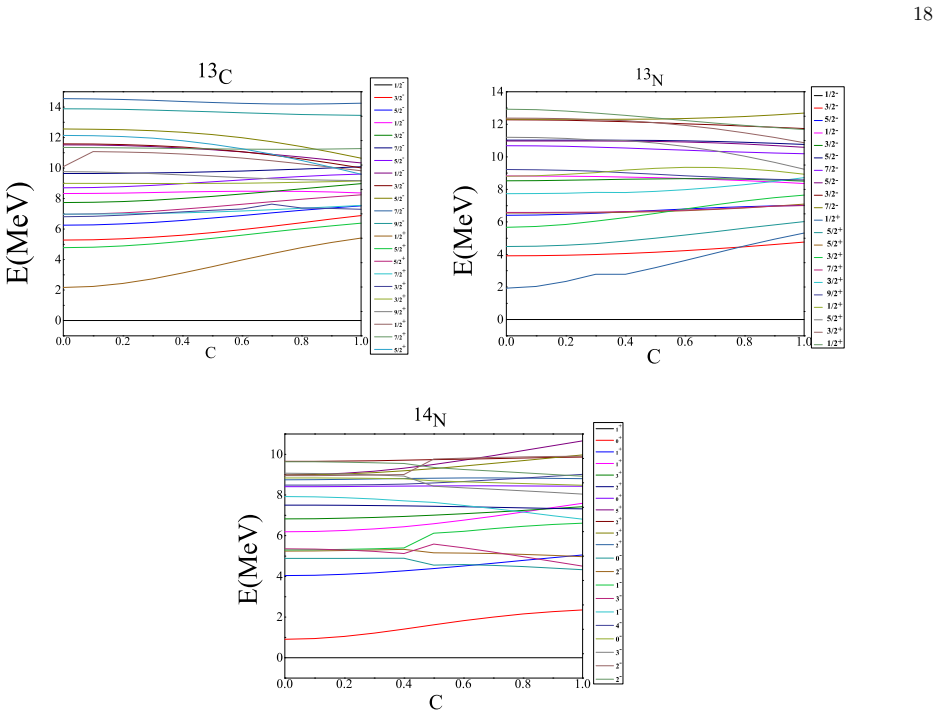
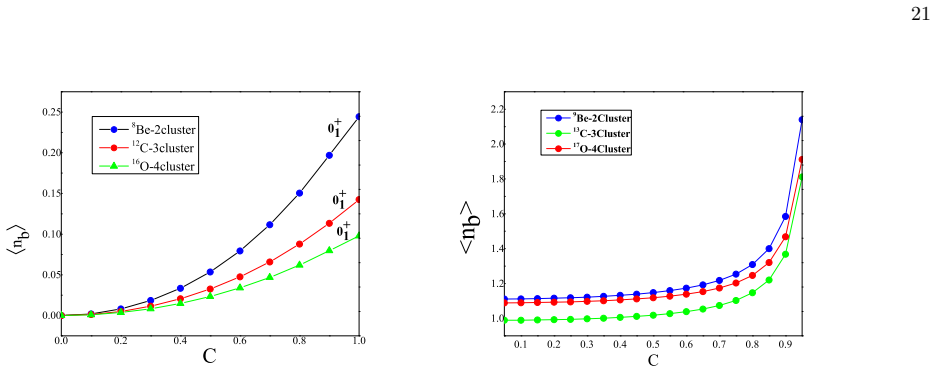
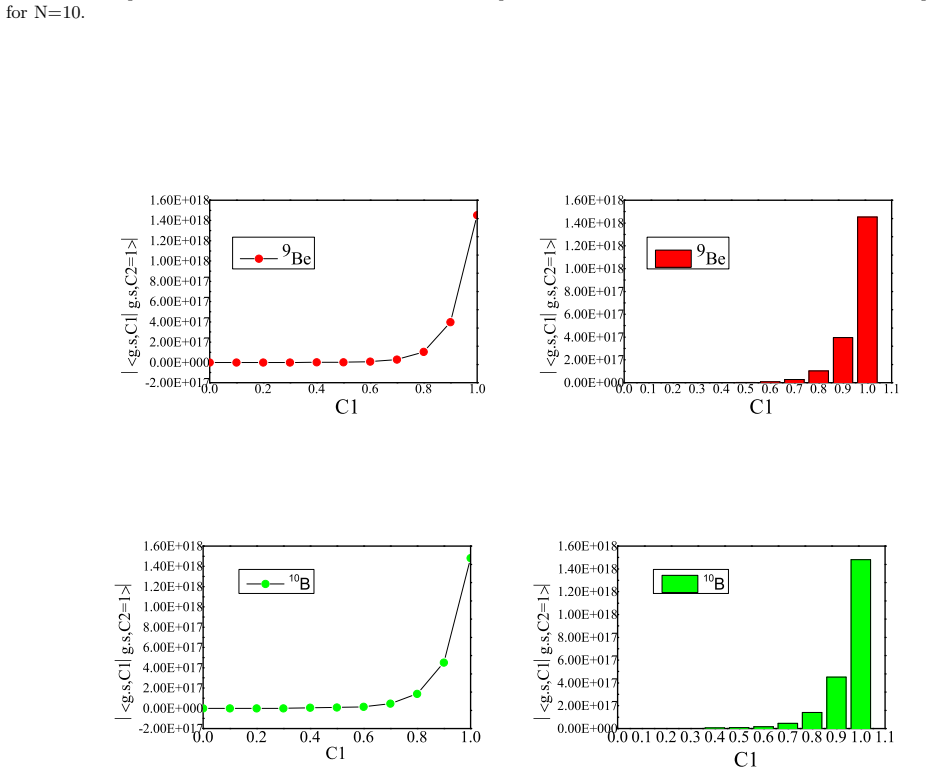
We schemed a solvable extended transitional Hamiltonian based on affine SU(1,1) Lie algebra within the framework for two-, three- and four- body algebraic cluster models that explains both regions O(4)↔U(3), O(7)↔U(6) and O(10)↔U(9), respectively. Numerical extraction to the energy levels, the expectation value of boson number operator and behavior of the overlap of the ground-state wave function within the control parameters of this evaluated Hamiltonian are presented. The effect of the coupling of the odd particle to an even-even boson core is discussed along the shape transition and, in particular, at the critical point.
What carries the argument
The affine SU(1,1) Lie algebra extended transitional Hamiltonian, which generates exact solutions for the vibrational and rotational degrees of freedom in cluster configurations.
Load-bearing premise
The affine SU(1,1) Lie algebra supplies a Hamiltonian whose eigenvalues and eigenstates directly correspond to physical energy levels and wave functions of the cluster configurations without requiring additional approximations that break solvability.
What would settle it
Experimental measurement of energy levels in nuclei such as 9Be or 13C that deviate significantly from the predictions of this Hamiltonian would falsify the model's applicability.
Figures



read the original abstract
The Algebraic Cluster Model(ACM) is an interacting boson model that gives the relative motion of the cluster configurations in which all vibrational and rotational degrees of freedom are present from the outset. We schemed a solvable extended transitional Hamiltonian based on affine $ {{SU(1,1)}} $ Lie algebra within the framework for two-, three- and four- body algebraic cluster models that explains both regions $ O(4)\leftrightarrow U(3) $, $ O(7)\leftrightarrow U(6) $ and $ O(10)\leftrightarrow U(9) $, respectively . We offer that this method can be used to study of $k\alpha + x$ nucleon structures with k = 2, 3,4 and x = 1, 2, . . . , in specific x = 1,2 such as structures $^{9}Be$,$^{9}B$,$^{10}B$ ; $^{13}C$, $^{13}N$, $^{14}N$; $^{17}O$, $^{17}F$. Numerical extraction to the energy levels, the expectation value of boson number operator and behavior of the overlap of the ground-state wave function within the control parameters of this evaluated Hamiltonian are presented. The effect of the coupling of the odd particle to an even-even boson core is discussed along the shape transition and, in particular, at the critical point.
Editorial analysis
A structured set of objections, weighed in public.
Referee Report
Summary. The manuscript proposes a solvable extended transitional Hamiltonian constructed from affine SU(1,1) Lie algebra within the algebraic cluster model framework for two-, three-, and four-body systems. It claims this Hamiltonian describes the shape-phase transitions O(4)↔U(3), O(7)↔U(6), and O(10)↔U(9), incorporates odd-particle (fermion) coupling, and is applied to nuclei such as 9Be, 13C, 17O. Numerical results are presented for energy levels, expectation values of the boson number operator, and ground-state wave-function overlaps as functions of the control parameters, with discussion of the critical-point behavior under boson-fermion coupling.
Significance. If the exact solvability of the full Hamiltonian (including the boson-fermion interaction term) is rigorously demonstrated with closed-form eigenvalues and eigenstates, the approach would supply a controlled algebraic framework for tracing shape transitions in light cluster nuclei that include both even-even and odd-A systems. The numerical extraction of overlaps and boson-number expectation values could then serve as falsifiable signatures for experimental tests in the cited nuclei.
major comments (2)
- [Abstract] Abstract: the claim that the Hamiltonian is exactly solvable for arbitrary values of the control parameters is stated without any derivation of the eigenvalues or eigenstates of the full boson-fermion Hamiltonian; this derivation is load-bearing for all subsequent numerical results and must be supplied explicitly (including the form of the affine SU(1,1) generators and the boson-fermion coupling term).
- The manuscript supplies no error estimates on the numerical spectra, no direct comparison of calculated levels with experimental data for the cited nuclei (9Be, 13C, etc.), and no independent benchmark (e.g., limiting cases or known solvable points) that would confirm the overlaps and boson-number values are genuine predictions rather than fits.
minor comments (1)
- Notation for the control parameters and the precise definition of the affine SU(1,1) generators should be introduced with explicit equations before the numerical sections.
Simulated Author's Rebuttal
We appreciate the referee's detailed review and suggestions for improving the manuscript. We address each major comment below and plan to incorporate revisions to strengthen the presentation of the solvability and numerical aspects.
read point-by-point responses
-
Referee: [Abstract] Abstract: the claim that the Hamiltonian is exactly solvable for arbitrary values of the control parameters is stated without any derivation of the eigenvalues or eigenstates of the full boson-fermion Hamiltonian; this derivation is load-bearing for all subsequent numerical results and must be supplied explicitly (including the form of the affine SU(1,1) generators and the boson-fermion coupling term).
Authors: The construction of the extended transitional Hamiltonian is based on the affine SU(1,1) Lie algebra, and the manuscript provides the form of the Hamiltonian and its application. However, to address this valid point, we will expand the manuscript with an explicit derivation of the eigenvalues and eigenstates for the full boson-fermion system, including the definitions of the generators and the coupling term. This will be added in a new subsection to rigorously support the numerical results. revision: yes
-
Referee: The manuscript supplies no error estimates on the numerical spectra, no direct comparison of calculated levels with experimental data for the cited nuclei (9Be, 13C, etc.), and no independent benchmark (e.g., limiting cases or known solvable points) that would confirm the overlaps and boson-number values are genuine predictions rather than fits.
Authors: We note that the focus of the paper is on the development of the algebraic model and the qualitative behavior of the shape phase transitions, including the effect of the odd particle coupling, rather than quantitative fits to data. Nevertheless, we agree that providing benchmarks would enhance credibility. In the revised manuscript, we will include calculations in the limiting cases (pure dynamical symmetries) as independent checks, and add error estimates for the numerical diagonalization where relevant. Direct comparisons with experimental data for the specific nuclei are not included as the work is primarily methodological, but the model parameters can be adjusted for such comparisons in future studies. revision: partial
Circularity Check
No significant circularity
full rationale
The paper constructs an extended transitional Hamiltonian from the affine SU(1,1) Lie algebra for the two-, three-, and four-body cluster models and then extracts numerical spectra, boson-number expectations, and ground-state overlaps by varying the control parameters. No quoted equation or self-citation reduces a claimed prediction or eigenvalue to a fitted input by construction; the algebraic framework supplies the closed-form solvability directly, and the reported quantities follow from that construction without the load-bearing steps matching any of the enumerated circularity patterns.
Axiom & Free-Parameter Ledger
free parameters (1)
- control parameters of the Hamiltonian
axioms (1)
- domain assumption Affine SU(1,1) Lie algebra yields an exactly solvable extended transitional Hamiltonian for the stated O(n)-U(m) pairs.
Reference graph
Works this paper leans on
-
[1]
The odd-A nuclei : 9 4Be and 9 4B For more than two decades, is known that the 9 4Be nucleus is an example of a molecular covalent bond in nuclear physics, Where two particles with valence neutron are limited. The 9 4Be nucleus , which has unlimited system properties 2 α + n is the cornerstone of cluster physics[18, 21, 22, 32]. Due to its low n eutron se...
-
[2]
The odd-odd nuclei : 10 5 B The structure of the odd-odd nuclei may be illustrated as an unpair ed proton and an unpaired neutron coupled to a boson core. In this paper, the method described in Refs.[38, 39 ] will be developed and performed to mixed boson-fermion-fermion systems. The approach based on boson- fermion symmetries has been also applied to odd...
-
[3]
The odd-A nuclei : 13 6 C and 13 7 N Similar to the covalently bound structures of two α particles and neutrons discussed earlier, we can continue the discussion with three α particles and neutrons. To start we can regard to the properties of 13C for which the experimental evidence has recently been collected [18, 31, 32]. The structure of the linear chai...
-
[4]
The odd-odd nuclei : 14 7 N The 14N nucleus is considered as a mediator between the cluster nucleus 12C and the doubly magic nucleus 16O [17, 32]. The study of 14N nuclei can expand understanding of the evolution of increasingly co mplex structures beyond the α -clustering. The information about the structure of 14N has practical value. As a major compone...
-
[5]
The odd-A nuclei : 17 8 O and 17 9 F In this work, we study the structure 17 8 O as Four - α particles and a neutron and 17 9 F as Four - α particles and a proton. The negative parity states in the even - odd nuclei 17 8 O and 17 9 F are built mainly on the 1p 1 2 shell model orbit. The single - particle orbits 1d 5 2 and 2s 1 2 establish the positive par...
-
[6]
Iachello, F., Iachello, F., Arima, A., and Iachello, F. ( 1987). The interacting boson model. Cambridge University P ress
work page 1987
-
[7]
Iachello, F., and Levine, R. D. (1995). Algebraic theory of molecules. Oxford University Press
work page 1995
-
[8]
Bijker, R. (2012). Spectrum generating algebras for few -body systems. In Journal of Physics: Conference Series (Vo l. 380, No. 1, p. 012003). IOP Publishing
work page 2012
-
[9]
Bijker, R., and Iachello, F. (2017). The algebraic clust er model: Structure of 16O. Nuclear Physics A, 957, 154-176
work page 2017
-
[10]
Bijker, R., and Iachello, F. (2000). Cluster states in nu clei as representations of a U (ν + 1) group. Physical Review C, 61(6), 067305
work page 2000
-
[11]
Bijker, R., and Iachello, F. (2002). The algebraic clust er model: Three-body clusters. Annals of Physics, 298(2), 3 34-360
work page 2002
-
[12]
Iachello, F., and Jackson, A. D. (1982). A phenomenologi cal approch to α-clustering in heavy nuclei. Physics Letters B, 108(3), 151-154
work page 1982
-
[13]
Iachello, F. (1983). Algebraic approach to nuclear stru cture. Nuclear Physics A, 396, 233-243. 11
work page 1983
-
[14]
Daley, H., and Iachello, F. (1983). Alpha-clustering in heavy nuclei. Physics Letters B, 131(4-6), 281-284
work page 1983
-
[15]
Iachello, F., Mukhopadhyay, N. C., and Zhang, L. (1991) . Spectrum-generating algebra for stringlike mesons: Mass formula for q ¯q mesons. Physical Review D, 44(3), 898
work page 1991
-
[16]
Iachello, F., and Kusnezov, D. (1992). Radiative decay s of ( Q ¯Q) mesons. Physical Review D, 45(11), 4156
work page 1992
-
[17]
Bijker, R., Iachello, F., and Leviatan, A. (1994). Alge braic models of hadron structure. I. Nonstrange baryons. An nals of Physics, 236(1), 69-116
work page 1994
-
[18]
Bijker, R., Iachello, F., and Leviatan, A. (2000). Alge braic models of hadron structure: II. Strange baryons. Anna ls of Physics, 284(1), 89-133
work page 2000
-
[19]
Bijker, R., Dieperink, A. E. L., and Leviatan, A. (1995) . Spectrum-generating algebra for X3 molecules. Physical Review A, 52(4), 2786
work page 1995
-
[20]
Bijker, R., and Leviatan, A. (1998). Algebraic treatme nt of three-body problems. Few-Body Systems, 25(1-3), 89-1 0
work page 1998
-
[21]
Bijker, R., and Iachello, F. (2014). Evidence for Tetra hedral Symmetry in 16O. Physical review letters, 112(15), 152501
work page 2014
-
[22]
Majarshin, A. J., Sabri, H., Jafarizadeh, M. A. and Amir i, N. (2018). Energy spectra of vibron and cluster models in molecular and nuclear systems. The European Physical Journ al A, 54(3), 36
work page 2018
-
[23]
von Oertzen, W., Freer, M., and Kanada-Enyo, Y. (2006). Nuclear clusters and nuclear molecules. Physics Reports, 4 32(2), 43-113
work page 2006
-
[24]
Hiura, J., and Shimodaya, I. (1963). Alpha-Particle Mo del for 9Be. Progress of Theoretical Physics, 30(5), 585-600
work page 1963
-
[25]
Abe, Y., Hiura, J., and Tanaka, H. (1973). A molecular-o rbital model of the atomic nuclei. Progress of Theoretical P hysics, 49(3), 800-824
work page 1973
-
[26]
Okabe, S., Abe, Y., and Tanaka, H. (1977). The Structure of 9Be Nucleus by a Molecular Model. I. Progress of Theoretical Physics, 57(3), 866-881
work page 1977
-
[27]
Okabe, S., and Abe, Y. (1979). The Structure of 9Be by a Molecular Model. II. Progress of Theoretical Physics, 6 1(4), 1049-1064
work page 1979
-
[28]
Feldmeier, H., and Schnack, J. (2000). Molecular dynam ics for fermions. Reviews of Modern Physics, 72(3), 655
work page 2000
-
[29]
Roth, R., Neff, T., Hergert, H., and Feldmeier, H. (2004) . Nuclear structure based on correlated realistic nucleonn ucleon potentials. Nuclear Physics A, 745(1-2), 3-33
work page 2004
- [30]
-
[31]
Neff, T., Feldmeier, H., and Roth, R. (2005). Structure o f light nuclei in Fermionic Molecular Dynamics. Nuclear Phy sics A, 752, 321-324
work page 2005
-
[32]
Kanada-En’yo, Y., and Horiuchi, H. (2001). Structure o f light unstable nuclei studied with antisymmetrized molec ular dynamics. Progress of Theoretical Physics Supplement, 142 , 205-263
work page 2001
-
[33]
Kanada-En’yo, Y., Kimura, M., and Horiuchi, H. (2003). Antisymmetrized Molecular Dynamics: a new insight into the structure of nuclei. Comptes Rendus Physique, 4(4-5), 497- 520
work page 2003
-
[34]
Kanada-Enyo, Y., and Horiuchi, H. (2003). Cluster stru ctures of the ground and excited states of 12Bestudied with antisymmetrized molecular dynamics. Physical Review C, 68 (1), 014319
work page 2003
-
[35]
M., Friedrich, H., Weiguny, A., and Wong, C
Brink, D. M., Friedrich, H., Weiguny, A., and Wong, C. W. (1970). Investigation of the alpha-particle model for ligh t nuclei. Physics Letters B, 33(2), 143-146
work page 1970
-
[36]
Della Rocca, V., Bijker, R., and Iachello, F. (2017). Si ngle-particle levels in cluster potentials. Nuclear Physi cs A, 966, 158-184
work page 2017
-
[37]
Bijker, R., and Iachello, F. (2019). Evidence for Trian gular D3h Symmetry in 13C . Physical review letters, 122(16), 162501
work page 2019
-
[38]
Leviatan, A., and Kirson, M. W. (1988). Intrinsic and co llective structure of an algebraic model of molecular rotat ion- vibration spectra. Annals of Physics, 188(1), 142-185
work page 1988
-
[39]
Roosmalen, O. S. V. (1982). Algebraic descriptions of n uclear and molecular rotation-vibration spectra (Doctora l disser- tation, Rijksuniversiteit Groningen)
work page 1982
-
[40]
Iachello, F., and Levine, R. D. (1982). Algebraic appro ach to molecular rotationvibration spectra. I. Diatomic mo lecules. The Journal of Chemical Physics, 77(6), 3046-3055
work page 1982
-
[41]
Bijker, R. (2010, December). Algebraic cluster model w ith tetrahedral symmetry. In AIP Conference Proceedings (V ol. 1323, No. 1, pp. 28-39). AIP
work page 2010
-
[42]
Kramer, P., and Moshinsky, M. (1966). Group theory of ha rmonic oscillators (III). States with permutational symme try. Nuclear Physics, 82(2), 241-274
work page 1966
-
[43]
Pan, F., and Draayer, J. P. (1998). New algebraic soluti ons for SO(6) ↔ U (5) transitional nuclei in the interacting boson model. Nuclear Physics A, 636(2), 156-168
work page 1998
-
[44]
Pan, F., Zhang, X., and Draayer, J. P. (2002). Algebraic solutions of an sl-boson system in the U (2l + 1) ↔ O(2l + 2) transitional region. Journal of Physics A: Mathematical an d General, 35(33), 7173
work page 2002
-
[45]
Iachello, F., and Arima, A. (1974). Boson symmetries in vibrational nuclei. Physics Letters B, 53(4), 309-312
work page 1974
-
[46]
Tilley, D. R., Kelley, J. H., Godwin, J. L., Millener, D. J., Purcell, J. E., Sheu, C. G., and Weller, H. R. (2004). Ener gy levels of light nuclei A= 8, 9, 10. Nuclear Physics A, 745(3-4 ), 155-362
work page 2004
-
[47]
Ajzenberg-Selove, F. (1979). Energy levels of light nu clei A = 5 − 10. Nuclear Physics A, 320(1), 1-224
work page 1979
-
[48]
Ajzenberg-Selove, F. (1984). Energy levels of light nu clei A = 5 − 10. Nuclear Physics A, 413(1), 1-168
work page 1984
-
[49]
F., Heinze, S., Linnem ann, A., and Werner, V
Jolie, J., Cejnar, P., Casten, R. F., Heinze, S., Linnem ann, A., and Werner, V. (2002). Triple point of nuclear defor mations. Physical review letters, 89(18), 182502
work page 2002
-
[50]
Pan, F., Zhang, Y., and Draayer, J. P. (2005). Quantum ph ase transitions in the U (5) ↔ O(6) large-N limit. Journal of Physics G: Nuclear and Particle Physics, 31(9), 1039
work page 2005
-
[51]
Zhang, Y., Hou, Z. F., and Liu, Y. X. (2007). Distinguish ing a first order from a second order nuclear shape phase trans ition 12 in the interacting boson model. Physical Review C, 76(1), 01 1305
work page 2007
-
[52]
F., Chen, H., Wei, H., and Liu, Y
Zhang, Y., Hou, Z. F., Chen, H., Wei, H., and Liu, Y. X. (20 08). Quantum phase transition in the U (4) vibron model and the E(3) symmetry. Physical Review C, 78(2), 024314. 13 Table 1. Energy spectra for 9Be. The experimental values are taken form Ref.[43]. J π C=0 C=0.1 C=0.2 C=0.3 C=0.4 C=0.5 C=0.6 C=0.7 C=0.8 C=0.9 C=1 Eexp (3/2)− 1 0 0 0 0 0 0 0 0 0 ...
work page 2032
discussion (0)
Sign in with ORCID, Apple, or X to comment. Anyone can read and Pith papers without signing in.