Energy-Efficient Hybrid Precoding for Massive MIMO mmWave Systems With a Fully-Adaptive-Connected Structure
Pith reviewed 2026-05-24 17:32 UTC · model grok-4.3
The pith
Decoupling a mixed-integer problem into continuous precoding and discrete connection subproblems yields a convergent algorithm for energy-efficient hybrid precoding in fully-adaptive-connected mmWave systems.
A machine-rendered reading of the paper's core claim, the machinery that carries it, and where it could break.
Core claim
The authors formulate the energy-efficiency maximization under the fully-adaptive-connected structure as a joint mixed-integer non-convex program. They first decouple it into a continuous hybrid-precoding subproblem solved by an alternating algorithm and an equivalent discrete connection-state problem whose 0-1 variables are then optimized by the matching-assisted fully-adaptive hybrid precoding algorithm. The MA-FAHP procedure is shown to converge to a stable solution with polynomial complexity, and numerical results confirm higher energy efficiency and improved beampattern compared with prior hybrid-precoding schemes.
What carries the argument
The matching-assisted fully-adaptive hybrid precoding (MA-FAHP) algorithm, which first obtains a hybrid precoder from the alternating hybrid precoding (AHP) routine and then solves the discrete 0-1 connection-state problem via matching.
If this is right
- The MA-FAHP algorithm converges to a stable solution.
- Its computational cost scales polynomially with the problem size.
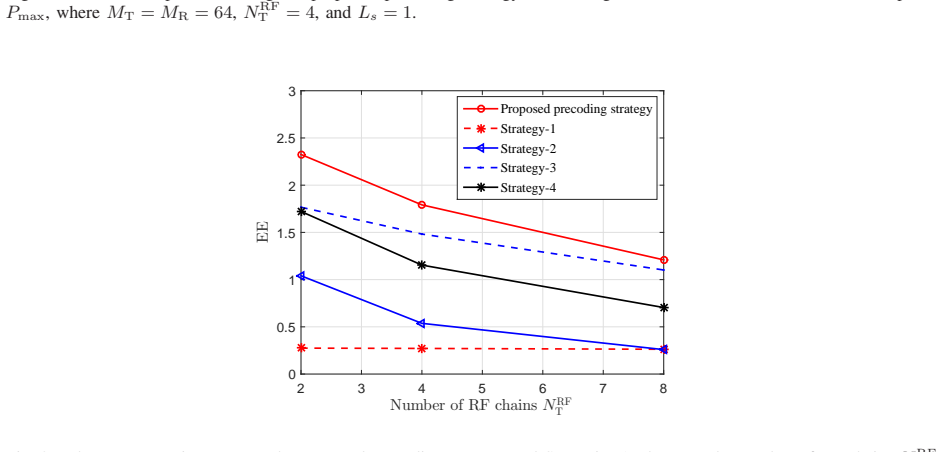
- Numerical experiments show higher energy efficiency and better beampattern than existing hybrid-precoding methods under the same fully-adaptive-connected structure.
Where Pith is reading between the lines
- Hardware designers could reduce RF-chain power draw by adopting switch-based adaptive connections instead of fixed fully-connected or partially-connected architectures.
- The same two-stage continuous-then-discrete reformulation may extend to other mixed-integer beamforming problems that include both analog weights and discrete selection variables.
- Improved beampattern control could translate into lower inter-cell interference in dense mmWave deployments.
Load-bearing premise
The original joint mixed-integer problem can be decoupled into a continuous hybrid-precoding subproblem followed by an equivalent discrete connection-state problem without losing global or near-optimality.
What would settle it
A small instance in which an exhaustive search over all feasible connection patterns and precoders produces a measurably higher energy efficiency than the solution returned by the two-stage decoupled procedure.
Figures




read the original abstract
This paper investigates the hybrid precoding design in millimeter-wave (mmWave) systems with a fully-adaptive-connected precoding structure, where a switch-controlled connection is deployed between every antenna and every radio frequency (RF) chain. To maximally enhance the energy efficiency (EE) of hybrid precoding under this structure, the joint optimization of switch-controlled connections and the hybrid precoders is formulated as a large-scale mixed-integer non-convex problem with high-dimensional power constraints. To efficiently solve such a challenging problem, we first decouple it into a continuous hybrid precoding (CHP) subproblem. Then, with the hybrid precoder obtained from the CHP subproblem, the original problem can be equivalently reformulated as a discrete connection-state (DCS) problem with only 0-1 integer variables. For the CHP subproblem, we propose an alternating hybrid precoding (AHP) algorithm. Then, with the hybrid precoder provided by the AHP algorithm, we develop a matching assisted fully-adaptive hybrid precoding (MA-FAHP) algorithm to solve the DCS problem. It is theoretically shown that the proposed MA-FAHP algorithm always converges to a stable solution with the polynomial complexity. Finally, simulation results demonstrate that the superior performance of the proposed MA-FAHP algorithm in terms of EE and beampattern.
Editorial analysis
A structured set of objections, weighed in public.
Referee Report
Summary. The paper addresses energy-efficient hybrid precoding in mmWave massive MIMO systems using a fully-adaptive-connected structure with switch-controlled connections between antennas and RF chains. It formulates the joint optimization of connections and precoders as a large-scale mixed-integer non-convex problem, decouples it into a continuous hybrid precoding (CHP) subproblem solved via an alternating hybrid precoding (AHP) algorithm, then equivalently reformulates the remainder as a discrete connection-state (DCS) problem solved by the matching assisted fully-adaptive hybrid precoding (MA-FAHP) algorithm. The authors claim MA-FAHP converges to a stable solution with polynomial complexity, and simulations show superior energy efficiency and beampattern performance.
Significance. If the decoupling preserves near-optimality for the joint objective and the convergence result holds, the work would offer a practical polynomial-time approach to EE maximization under the fully-adaptive structure, which is relevant for hardware-constrained mmWave systems. The explicit convergence guarantee and complexity analysis for MA-FAHP, along with simulation comparisons, are positive elements that strengthen the contribution if the reformulation is rigorously justified.
major comments (2)
- [Abstract / problem reformulation] Abstract (problem reformulation paragraph): the claim that fixing the hybrid precoder from the CHP subproblem allows the original joint mixed-integer problem to be 'equivalently reformulated' as a DCS problem with only 0-1 variables is load-bearing for the overall approach. The sequential decoupling (solve CHP first, then optimize connections for that fixed precoder) does not automatically preserve joint optimality or near-optimality of the mixed-integer objective under the power constraints; a proof or bound showing that the resulting pair is optimal (or within a stated factor) for the original problem is required.
- [Abstract / algorithm description] Abstract (MA-FAHP description): while convergence to a stable solution with polynomial complexity is claimed for MA-FAHP on the DCS subproblem, the manuscript must clarify whether this convergence applies only to the DCS stage or extends to guaranteeing quality of the overall solution relative to the original joint problem; if the former, the performance claims in simulation rest on an unverified assumption about the quality of the CHP solution.
minor comments (1)
- [Abstract] Abstract: the phrase 'the superior performance of the proposed MA-FAHP algorithm in terms of EE and beampattern' should be qualified with the specific baselines used and the magnitude of gains, as 'superior' is comparative.
Simulated Author's Rebuttal
We thank the referee for the insightful comments on the problem reformulation and convergence claims. We address each major point below and will revise the abstract accordingly to improve clarity without overstating the approach.
read point-by-point responses
-
Referee: [Abstract / problem reformulation] Abstract (problem reformulation paragraph): the claim that fixing the hybrid precoder from the CHP subproblem allows the original joint mixed-integer problem to be 'equivalently reformulated' as a DCS problem with only 0-1 variables is load-bearing for the overall approach. The sequential decoupling (solve CHP first, then optimize connections for that fixed precoder) does not automatically preserve joint optimality or near-optimality of the mixed-integer objective under the power constraints; a proof or bound showing that the resulting pair is optimal (or within a stated factor) for the original problem is required.
Authors: We agree that the phrasing 'equivalently reformulated' is imprecise and could be misinterpreted as claiming preservation of joint optimality. The decoupling is a heuristic sequential procedure: the CHP subproblem is solved first via AHP to obtain a hybrid precoder, after which the connection optimization reduces to the DCS problem. No proof of joint optimality or approximation bound is provided in the manuscript, as the method prioritizes computational tractability over global optimality guarantees. We will revise the abstract to replace 'equivalently' with 'approximately' or 'conditionally' and explicitly describe the approach as alternating optimization between the two subproblems. revision: yes
-
Referee: [Abstract / algorithm description] Abstract (MA-FAHP description): while convergence to a stable solution with polynomial complexity is claimed for MA-FAHP on the DCS subproblem, the manuscript must clarify whether this convergence applies only to the DCS stage or extends to guaranteeing quality of the overall solution relative to the original joint problem; if the former, the performance claims in simulation rest on an unverified assumption about the quality of the CHP solution.
Authors: The convergence guarantee and polynomial complexity analysis apply strictly to the MA-FAHP algorithm on the DCS subproblem (as stated in the full manuscript's theoretical analysis). We will revise the abstract to make this scope explicit. The overall solution quality is not theoretically guaranteed relative to the joint optimum and is instead validated empirically through simulations showing improved EE and beampattern performance versus baselines; we will add a sentence in the abstract noting that simulation results demonstrate practical effectiveness of the combined AHP+MA-FAHP procedure. revision: yes
Circularity Check
No circularity: decoupling and algorithm steps are independent of fitted inputs or self-referential definitions
full rationale
The paper formulates a joint mixed-integer optimization, decouples it into CHP then DCS subproblems (claiming equivalence), and proposes AHP/MA-FAHP algorithms with a convergence proof. No equations or text reduce any claimed result to its own inputs by construction, rename fitted parameters as predictions, or rely on load-bearing self-citations for uniqueness. The decoupling is a methodological step whose validity is external to the derivation chain itself; the convergence claim applies only to the DCS solver. This matches the default case of a self-contained optimization procedure without circular reductions.
Axiom & Free-Parameter Ledger
Reference graph
Works this paper leans on
-
[1]
Spectral-ene rgy efficient hybrid precoding for mmWave systems with an adaptive-connected structure,
X. Xue, Y . Wang, L. Yang, J. Shi, and Zan Li, “Spectral-ene rgy efficient hybrid precoding for mmWave systems with an adaptive-connected structure,” in Proc. IEEE ICC , May. 2019, pp. 1–6
work page 2019
-
[2]
W. Roh, J-Y . Seol, J. Park, B. Lee, J. Lee, Y . Kim, J. Cho, K. Cheun, and F. Aryanfar, “Millimeter-wave beamforming as an enabling technology for 5G cellular communications: T heoretical feasibility and prototype results,” IEEE Commun. Mag., vol. 52, no. 2, pp. 106–113, Feb. 2014
work page 2014
-
[3]
Millimeter wave communications for future mobil e networks,
M. Xiao, S. Mumtaz, Y . Huang, L. Dai, Y . Li, M. Matthaiou, G . K. Karagiannidis, E. Bj¨ ornson, K. Yang, C. L. I, and A. Ghosh, “Millimeter wave communications for future mobil e networks,” IEEE J. Sel. Areas Commun. , vol. 35, no. 9, pp. 1909–1935, Sep. 2017
work page 1909
-
[4]
Millimeter wave mobile communications for 5G cellular: It will work!
T. S. Rappaport, S. Sun and R. Mayzus, H. Zhao, Y . Azar, K. W ang, G. N. Wong, J. K. Schulz, M. Samimi and F. Gutierrez, “Millimeter wave mobile communications for 5G cellular: It will work!”, IEEE Access , vol. 1, pp. 335–349, May 2013
work page 2013
-
[5]
An overview of signal processing techniques for millimeter wave MIMO systems,
R. W. Heath, N. Gonz´ alez-Prelcic, S. Rangan, W. Roh and A . M. Sayeed, “An overview of signal processing techniques for millimeter wave MIMO systems,” IEEE J. Sel. Topics Signal Process. , vol. 10, no. 3, pp. 436–453, Apr. 2016
work page 2016
-
[6]
Large-scale antenna sys tems with hybrid analog and digital beamforming for millime ter wave 5G,
S. Han, C. I, Z. Xu and C. Rowell, “Large-scale antenna sys tems with hybrid analog and digital beamforming for millime ter wave 5G,” IEEE Commun. Mag. , vol. 53, no. 1, pp. 186–194, Jan. 2015
work page 2015
- [7]
-
[8]
MIMO precoding and combining solutions for millimeter-wa ve systems,
A. Alkhateeb, J. Mo, N. Gonzalez-Prelcic and R. W. Heath, “MIMO precoding and combining solutions for millimeter-wa ve systems,” IEEE Commun. Mag. , vol. 52, no. 12, pp. 122–131, December 2014
work page 2014
-
[9]
On the optimality of multianten na broadcast scheduling using zero-forcing beamforming,
T. Y oo and A. Goldsmith, “On the optimality of multianten na broadcast scheduling using zero-forcing beamforming,” IEEE J. Sel. Areas Commun. , vol. 24, no. 3, pp. 528–541, Mar. 2006
work page 2006
-
[10]
Millimeter-Wa ve Cellular Wireless Networks: Potentials and Challenges,
S. Rangan, T. S. Rappaport and E. Erkip, “Millimeter-Wa ve Cellular Wireless Networks: Potentials and Challenges, ” Proceed. IEEE , vol. 102, no. 3, pp. 366–385, Mar. 2014
work page 2014
-
[11]
Study and proto typing of practically large-scale mmWave antenna systems for 5G cellular devices,
W. Hong, K. Baek, Y . Lee, Y . Kim and S. Ko, “Study and proto typing of practically large-scale mmWave antenna systems for 5G cellular devices,” IEEE Commun. Mag. , vol. 52, no. 9, pp. 63–69, Sep. 2014
work page 2014
-
[12]
Spatially sparse precoding in millimeter wave MIMO systems,
O. E. Ayach, S. Rajagopal, S. Abu-Surra, Z. Pi, and R. W. H eath, “Spatially sparse precoding in millimeter wave MIMO systems,” IEEE Trans. Wireless Commun. , vol. 13, no. 3, pp. 1499–1513, Mar. 2014
work page 2014
-
[13]
Alternati ng minimization algorithms for hybrid precoding in millime ter wave MIMO systems,
X. Y u, J. C. Shen, J. Zhang, and K. B. Letaief, “Alternati ng minimization algorithms for hybrid precoding in millime ter wave MIMO systems,” IEEE J. Sel. Topics Signal Process. , vol. 10, no. 3, pp. 485–500, Apr. 2016
work page 2016
-
[14]
An iterative hybrid transceiver design alg orithm for millimeter wave MIMO systems,
C. E. Chen, “An iterative hybrid transceiver design alg orithm for millimeter wave MIMO systems,” IEEE Wireless Commun. Lett., vol. 4, no. 3, pp. 285–288, Jun. 2015
work page 2015
-
[15]
Hybrid precodin g for millimeter wave MIMO systems: A matrix factorization approach,
J. Jin, Y . R. Zheng, W. Chen and C. Xiao, “Hybrid precodin g for millimeter wave MIMO systems: A matrix factorization approach,” IEEE Trans. Wireless Commun. vol. 17, no. 5, pp. 3327–3339, May 2018
work page 2018
-
[16]
Limited feedback hybrid precoding for multi-user millimeter wave systems,
A. Alkhateeb, G. Leus and R. W. Heath, “Limited feedback hybrid precoding for multi-user millimeter wave systems,” IEEE Trans. Wireless Commun. , vol. 14, no. 11, pp. 6481–6494, Nov. 2015
work page 2015
-
[17]
Hybrid block diagonalization for mas sive multiuser MIMO systems,
W. Ni and X. Dong, “Hybrid block diagonalization for mas sive multiuser MIMO systems,” IEEE Trans. Commun. , vol. 64, no. 1, pp. 201–211, Jan. 2016
work page 2016
-
[18]
Low-complexity hybrid prec oding in massive multiuser MIMO systems,
L. Liang, W. Xu and X. Dong, “Low-complexity hybrid prec oding in massive multiuser MIMO systems,” IEEE Wireless Commun. Lett. , vol. 3, no. 6, pp. 653–656, Dec. 2014
work page 2014
-
[19]
Near-optima l hybrid analog and digital precoding for downlink mmWave massive MIMO systems,
L. Dai, X. Gao, J. Quan, S. Han, and C.-L. I, “Near-optima l hybrid analog and digital precoding for downlink mmWave massive MIMO systems,” in Proc. IEEE ICC , Jun. 2015, pp. 1334–1339. 25
work page 2015
-
[20]
X. Gao, L. Dai, S. Han, C.-L. I and R. W. Heath, “Energy-ef ficient hybrid analog and digital precoding for mmWave MIMO systems with large antenna arrays,” IEEE J. Sel. Areas Commun. , vol. 34, no. 4, pp. 998-1009, Apr. 2016
work page 2016
-
[21]
J. Du, W. Xu, H. Shen, X. Dong and C. Zhao, “Hybrid precodi ng architecture for massive multiuser MIMO with dissipatio n: Sub-connected or fully connected structures?” IEEE Trans. Wireless Commun. , vol. 17, no. 8, pp. 5465–5479, Aug. 2018
work page 2018
-
[22]
A hardware-efficient a nalog network structure for hybrid precoding in millimeter wave systems,
X. Y u, J. Zhang and K. B. Letaief, “A hardware-efficient a nalog network structure for hybrid precoding in millimeter wave systems,” IEEE J. Sel. Topics Signal Process. , vol. 12, no. 2, pp. 282–297, May 2018
work page 2018
-
[23]
Dynamic subarray s for hybrid precoding in wideband mmWave MIMO systems,
S. Park, A. Alkhateeb and R. W. Heath, “Dynamic subarray s for hybrid precoding in wideband mmWave MIMO systems,” IEEE Trans. Wireless Commun. , vol. 16, no. 5, pp. 2907–2920, May 2017
work page 2017
-
[24]
Dynamically connected h ybrid precoding scheme for millimeter-wave massive MIMO systems,
X. Jing, L. Li, H. Liu and S. Li, “Dynamically connected h ybrid precoding scheme for millimeter-wave massive MIMO systems,” IEEE Commun. Lett. , vol. 22, no. 12, pp. 2583–2586, Dec. 2018
work page 2018
-
[25]
Hybrid beamfor ming for large antenna arrays with phase shifter selection,
S. Payami, M. Ghoraishi and M. Dianati, “Hybrid beamfor ming for large antenna arrays with phase shifter selection, ” IEEE Trans. Wireless Commun. , vol. 15, no. 11, pp. 7258–7271, Nov. 2016
work page 2016
-
[26]
A. Yazdan, J. Park, S. Park, T. A. Khan and R. W. Heath, “En ergy-efficient massive MIMO: Wireless-powered communication, multiuser MIMO with hybrid precoding, and c loud radio access network with variable-resolution ADCs,” IEEE Microwave Mag. , vol. 18, no. 5, pp. 18–30, July-Aug. 2017
work page 2017
-
[27]
Codeb ook-based hybrid precoding for millimeter wave multiuser systems,
S. He, J. Wang, Y . Huang, B. Ottersten and W. Hong, “Codeb ook-based hybrid precoding for millimeter wave multiuser systems,” IEEE Trans. on Signal Process. , vol. 65, no. 20, pp. 5289–5304, Oct. 2017
work page 2017
-
[28]
Energy-efficient transc eiver design for hybrid sub-array architecture MIMO system s,
S. He, C. Qi, Y . Wu and Y . Huang, “Energy-efficient transc eiver design for hybrid sub-array architecture MIMO system s,” IEEE Access , vol. 4, pp. 9895–9905, 2016
work page 2016
-
[29]
Ene rgy efficiency optimization of 5G radio frequency chain systems,
R. Zi, X. Ge, J. Thompson, C. Wang, H. Wang and T. Han, “Ene rgy efficiency optimization of 5G radio frequency chain systems,” IEEE J. Sel. Areas Commun. , vol. 34, no. 4, pp. 758–771, Apr. 2016
work page 2016
-
[30]
Energy and sp ectral efficiency of very large multiuser MIMO systems,
H. Q. Ngo, E. G. Larsson and T. L. Marzetta, “Energy and sp ectral efficiency of very large multiuser MIMO systems,” IEEE Trans. Commun. , vol. 61, no. 4, pp. 1436–1449, Apr. 2013
work page 2013
-
[31]
Coordinated beamfor ming for energy efficient transmission in multicell multius er Systems,
S. He, Y . Huang, S. Jin and L. Yang, “Coordinated beamfor ming for energy efficient transmission in multicell multius er Systems,” IEEE Trans. Commun. , vol. 61, no. 12, pp. 4961–4971, Dec. 2013
work page 2013
-
[32]
A regularized limited memory BFGS method for nonconvex unconstrained minimization,
T. W. Liu. “A regularized limited memory BFGS method for nonconvex unconstrained minimization,” Numerical Algorithms, vol. 65, no. 2, pp. 305–323, Oct. 2014
work page 2014
-
[33]
Matching theory: App lications in wireless communications,
S. Bayat, Y . Li, L. Song and Z. Han, “Matching theory: App lications in wireless communications,” IEEE Signal Process. Mag., vol. 33, no. 6, pp. 103–122, Nov. 2016
work page 2016
-
[34]
Z. Han, Y . Gu, and W. Saad, Matching Theory for Wireless Networks , Incorporated Springer Publishing Company, 2017
work page 2017
-
[35]
B. Di, L. Song and Y . Li, “Sub-Channel assignment, power allocation, and user scheduling for non-orthogonal multip le access networks,” IEEE Trans. Wireless Commun. , vol. 15, no. 11, pp. 7686–7698, Nov. 2016
work page 2016
-
[36]
Peer effects and stability in matching markets,
E. Bodine-Baron, C. Lee, A. Chong, B. Hassibi, and A. Wie rman, “Peer effects and stability in matching markets,” Pro c. 4th Symp. Algorithmic Game Theory (SAGT), Amalfi, Italy, Oct . 2011, pp. 117–129
work page 2011
-
[37]
T. S. Rappaport, R. W. Heath, R. C. Daniels, and J. N. Murd ock, Millimeter wave wireless communications , Prentice Hall, 2015
work page 2015
discussion (0)
Sign in with ORCID, Apple, or X to comment. Anyone can read and Pith papers without signing in.