Neutron-proton pairing in Nuclear Matter
Pith reviewed 2026-05-24 16:02 UTC · model grok-4.3
The pith
Self-energy effects strongly modify the neutron-proton pairing gap, and the results calibrate an effective force for nuclei.
A machine-rendered reading of the paper's core claim, the machinery that carries it, and where it could break.
Core claim
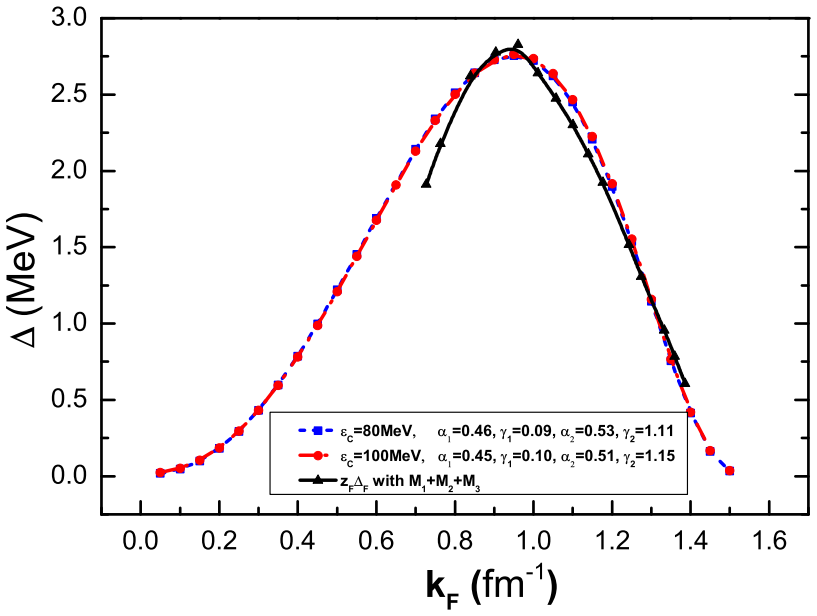
Within the extended BHF approach combined with BCS theory, the self-energy up to the second-order contribution reduces strongly the effective energy gap, while the renormalization term enhances it significantly. The effect of the three-body force on the np pairing gap is negligible. An effective density-dependent zero-range pairing force is established with parameters calibrated to the microscopically calculated energy gap to connect with np pairing in finite nuclei.
What carries the argument
Extended Brueckner-Hartree-Fock approach combined with BCS theory applied to self-energy contributions in neutron-proton pairing.
If this is right
- The effective np pairing gap is reduced by second-order self-energy effects.
- The renormalization term provides significant enhancement to the gap.
- Three-body forces have negligible impact on the gap.
- The microscopic gap allows calibration of a simple effective pairing force for finite nuclei.
Where Pith is reading between the lines
- This calibration could improve modeling of pairing correlations in finite nuclei by supplying a practical contact force.
- The negligible three-body force effect indicates that two-body interactions dominate the gap at the densities considered.
- Similar self-energy analysis could be applied to other pairing channels such as neutron-neutron or proton-proton.
Load-bearing premise
The extended BHF approach combined with BCS theory accurately captures the self-energy contributions to the np pairing gap when using the chosen nucleon-nucleon interaction.
What would settle it
An independent many-body calculation of the neutron-proton pairing gap at nuclear saturation density that shows a value differing substantially from the self-energy corrected result.
Figures


read the original abstract
The self-energy effect on the neutron-proton (np) pairing gap is investigated up to the third order within the framework of the extend Bruecker-Hartree-Fock (BHF) approach combined with the BCS theory. The self-energy up to the second-order contribution turns out to reduce strongly the effective energy gap, while the \emph{renormalization} term enhances it significantly. In addition, the effect of the three-body force on the np pairing gap is shown to be negligible. To connect the present results with the np pairing in finite nuclei, an effective density-dependent zero-range pairing force is established with the parameters calibrated to the microscopically calculated energy gap.
Editorial analysis
A structured set of objections, weighed in public.
Referee Report
Summary. The paper examines the effects of self-energy contributions up to third order on the neutron-proton pairing gap in nuclear matter using the extended Brueckner-Hartree-Fock approach combined with BCS theory. It finds that the second-order self-energy reduces the gap significantly, the renormalization term enhances it, and three-body forces have a negligible effect. An effective density-dependent zero-range pairing force is then calibrated to these microscopic results for application to finite nuclei.
Significance. If the numerical trends hold, the order-by-order decomposition of self-energy effects on the np gap provides useful insight into many-body contributions in nuclear matter. The negligible impact of three-body forces is a clear result worth noting. The calibrated effective force could serve as a practical tool for finite-nucleus calculations, though its transferability requires further scrutiny.
major comments (2)
- [Abstract] Abstract: The effective density-dependent zero-range pairing force parameters are calibrated directly to the microscopically computed gap obtained from the same extended BHF+BCS calculation. This makes the force for finite nuclei dependent on the paper's own output rather than an independent benchmark, which is load-bearing for the central claim of connecting the nuclear-matter results to np pairing in finite nuclei.
- [Abstract] Abstract: No error estimates on the gap values, no details on the specific nucleon-nucleon interaction employed, and no verification that the order-by-order self-energy separation is free of double-counting are provided. These omissions undermine assessment of the reported trends (second-order reduction and renormalization enhancement).
minor comments (1)
- [Abstract] The abstract contains the typographical error 'extend Bruecker-Hartree-Fock' (should be 'extended Brueckner-Hartree-Fock').
Simulated Author's Rebuttal
We thank the referee for the careful reading of our manuscript and the constructive comments. We address each major comment point by point below, indicating planned revisions where appropriate.
read point-by-point responses
-
Referee: [Abstract] Abstract: The effective density-dependent zero-range pairing force parameters are calibrated directly to the microscopically computed gap obtained from the same extended BHF+BCS calculation. This makes the force for finite nuclei dependent on the paper's own output rather than an independent benchmark, which is load-bearing for the central claim of connecting the nuclear-matter results to np pairing in finite nuclei.
Authors: We agree that the effective pairing force is calibrated directly to the gaps obtained from our extended BHF+BCS calculations. This is intentional, as the goal is to transfer the microscopic nuclear-matter results into a practical form for finite-nucleus applications. However, we acknowledge that this calibration is not an independent benchmark. In the revised manuscript we will explicitly state in the abstract and conclusions that the force parameters are fitted to the computed gaps from the present calculations and will discuss the implications for transferability. revision: yes
-
Referee: [Abstract] Abstract: No error estimates on the gap values, no details on the specific nucleon-nucleon interaction employed, and no verification that the order-by-order self-energy separation is free of double-counting are provided. These omissions undermine assessment of the reported trends (second-order reduction and renormalization enhancement).
Authors: We will add the specific nucleon-nucleon interaction (Argonne V18) to the revised abstract and methods section. The order-by-order separation in the extended BHF framework is constructed without double-counting: the second-order self-energy is the explicit perturbative correction while the renormalization term is the quasiparticle strength factor Z applied to the single-particle energies; these are distinct and non-overlapping contributions by definition of the approach. We will insert a brief clarifying sentence on this point. Quantitative error estimates on the gap values are not provided because the calculations are deterministic within the chosen truncation; a discussion of numerical sensitivity can be added, but full uncertainty quantification from many-body truncation lies beyond the present scope. revision: partial
Circularity Check
Effective pairing force parameters calibrated directly to paper's own microscopic gap calculation
specific steps
-
fitted input called prediction
[Abstract]
"To connect the present results with the np pairing in finite nuclei, an effective density-dependent zero-range pairing force is established with the parameters calibrated to the microscopically calculated energy gap."
The parameters of the effective force are fitted to the energy gap value obtained from the paper's own extended BHF+BCS calculation, so the claimed connection to finite nuclei is constructed by direct calibration to the paper's microscopic result rather than an external or independent constraint.
full rationale
The paper computes the np pairing gap in nuclear matter using extended BHF+BCS, then directly calibrates an effective density-dependent zero-range force to that computed gap for use in finite nuclei. This calibration step makes the effective force a fitted representation of the paper's own output rather than an independent benchmark or derivation. The abstract explicitly states the calibration, matching the fitted_input_called_prediction pattern with no additional self-citation or definitional circularity in the provided text.
Axiom & Free-Parameter Ledger
free parameters (1)
- effective pairing force parameters
axioms (2)
- domain assumption Extended Brueckner-Hartree-Fock plus BCS theory provides a controlled expansion for self-energy effects on the pairing gap
- domain assumption Three-body force contributions can be added perturbatively without altering the gap significantly
Reference graph
Works this paper leans on
-
[1]
which is also true for the exact gap of equation (9). The presen ce of the quasiparticle strength, which is less than unitary in a small region around the Ferm i surface where the Cooper pairs are mainly formed, reduces the pairing gap. The gap equation should be solved self-consistently with the density constraint since the pairing could modify the chemi...
-
[2]
As mentioned in the introductio n, the imaginary part of Σ( k, ω ) goes to zero at the Fermi energy
75kF is exhibited in the upper panel of Fig.2. As mentioned in the introductio n, the imaginary part of Σ( k, ω ) goes to zero at the Fermi energy. This is true for the momentum k = kF as well, which implies the quasiparticle strength approximation is reliable near kF . However, ImΣ becomes sizable compared to the real part of the se lf-energy at the s.p....
-
[3]
is shown in the inset. The present obtained effective gap in the ex tended BHF approach turns out to be slightly larger than that in the T matrix approximation in the density region of ρ > 0. 045f m− 3, while it becomes a bit smaller than that in the T matrix approximation 9 /s48/s46/s48 /s48/s46/s50 /s48/s46/s52 /s48/s46/s54 /s48/s46/s56 /s49/s46/s48 /s49...
- [4]
-
[5]
R. A. Broglia and V. V. Zelevinsky, Fifty Years of Nuclear BCS: Pairing in Finite Systems (World Scientific, 2013)
work page 2013
-
[6]
D. J. Dean and M. Hjorth-Jensen, Rev. Mod. Phys. 75 607 (2003)
work page 2003
-
[7]
S. Frauendorf and A. O. Macchiavelli, Prog. Part. Nucl. P hys. 78 24-90 (2014)
work page 2014
-
[8]
A. M. Lane, Nuclear Theory, Benjamin (1964)
work page 1964
-
[9]
G. F. Bertsch and Y. Luo, Phys. Rev. C 81 064320 (2010)
work page 2010
- [10]
- [11]
- [12]
-
[13]
Xinle Shang, and Wei Zuo, Phys. Rev. C. 88, 025806 (2013)
work page 2013
-
[14]
T. Alm, G. R¨ opke, and M. Schmidt, Z. Phys. A 337 355 (1990)
work page 1990
-
[15]
Xin-le Shang, Pei Wang, Peng Yin and Wei Zuo, J. Phys. G: N ucl. Part. Phys. 42 055105 (2015)
work page 2015
-
[16]
G.R¨ opke, A.Schnell, P.Schuck, and U.Lombardo, Phys. Rev. C 61, 024306 (2000)
work page 2000
- [17]
- [18]
-
[19]
Ø.Elgaroy, L.Engvik, M.Hjorth-Jensen, and E.Osnes, P hys. Rev. C. 57, R1069 (1998)
work page 1998
-
[20]
J. Clark, C.-G. K¨ allman, C.-H. Yang, D. Chakkalakal, P hys. Lett. B 61 331 (1976)
work page 1976
- [21]
-
[22]
H.-J. Schulze, J. Cugnon, A. Lejeune, M. Baldo, and U. Lo mbardo, Phys. Lett. B 375 1 (1996)
work page 1996
- [23]
-
[24]
L. G. Cao, U.Lombardo, P.Schuck, Phys. Rev. C. 74, 064301 (2006)
work page 2006
-
[25]
S. S. Zhang, L. G. Cao, U. Lombardo and P. Schuck, Phys. Re v. C 93 044329 (2016)
work page 2016
- [26]
- [27]
- [28]
-
[29]
J. P. Jeukenne, A. Lejeune, and C. Mahaux, Phys. Rep., Ph ys. Lett. bf 25C 83 (1976)
work page 1976
-
[30]
W. Zuo, I. Bombaci, and U. Lombardo, Phys. Rev. C 60 024605 (1999)
work page 1999
- [31]
-
[32]
J. M. Dong, U. Lombardo and W. Zuo, Phys. Rev. C 87 062801 (R) (2013)
work page 2013
-
[33]
P. Grang´ e, A. Lejeune, M. Martzolff, and J. -F. Mathiot, P hys. Rev. C 40 1040 (1989)
work page 1989
-
[34]
W. Zuo, A. Lejeune, U. Lombardo, and J.-F. Mathiot, Nucl . Phys. A 706 418 (2002); Eur. Phys. J. A 14 469 (2002)
work page 2002
- [35]
- [36]
-
[37]
A. A. Abrikosov, L. P. Gorkov, and I. E. Dzyaloshinskii, Methods of Quantum Field Theory in Statistical Physics (Prentice- Hall, Englewood Cliffs, NJ , 1963). 13
work page 1963
-
[38]
Nozi` eres, Theory of Interacting Fermi Systems (Ben jamin, New York, 1966)
P. Nozi` eres, Theory of Interacting Fermi Systems (Ben jamin, New York, 1966)
work page 1966
-
[39]
A. B. Migdal, Theory of Finite Systems and Applications to Atomic Nuclei (Benjamin, New York, 1964)
work page 1964
-
[40]
J. R. Schrieffer, Theory of Superconductivity (Addison- Wesley, New York, 1964)
work page 1964
- [41]
- [42]
- [43]
- [44]
-
[45]
Caiwan Shen, U. Lombardo, P. Schuck, W. Zuo, and N. Sandu lescu, Phys. Rev. C 67 061302 (R) (2003)
work page 2003
-
[46]
G. F. Bertsch and H. Esbensen, Ann. Phys. (N.Y.) 209, 327 (1991); H. Esbensen, G. F. Bertsch, and K. Hencken, Phys. Rev. C 56, 3054 (1997)
work page 1991
-
[47]
Caiwan Shen, U. Lombardo, P. Schuck, Phys. Rev. C 71 054301 (R) (2005). 14
work page 2005
discussion (0)
Sign in with ORCID, Apple, or X to comment. Anyone can read and Pith papers without signing in.