Unusual Transport Properties with Non-Commutative System-Bath Coupling Operators
Pith reviewed 2026-05-24 15:49 UTC · model grok-4.3
The pith
Non-commutative system-bath coupling operators enhance heat current and alter its scaling in a non-equilibrium spin-boson model.
A machine-rendered reading of the paper's core claim, the machinery that carries it, and where it could break.
Core claim
In the generalized non-equilibrium spin-boson model with non-commutative system-bath coupling operators, rotating those operators greatly enhances the steady-state heat current relative to the commutative case; when operator asymmetry coexists with coupling-strength asymmetry the two effects add constructively to thermal rectification; and at weak system-bath coupling and in the adiabatic limit the scaling of heat current with coupling strength and energy gap changes qualitatively once the operators fail to commute, with the new scalings recovered from the non-equilibrium polaron-transformed Redfield equation.
What carries the argument
Non-commutative system-bath coupling operators in the NESB model, whose rotation produces the reported enhancement and scaling change.
If this is right
- Heat current increases substantially upon rotation of the coupling operators compared with the standard commutative NESB model.
- Thermal rectification receives a constructive contribution when asymmetry in coupling strength is combined with asymmetry in the coupling operators.
- At weak coupling and adiabatic limit the heat current's dependence on coupling strength and system energy gap changes qualitatively once the operators become non-commutative.
- The altered scalings are recovered analytically from the non-equilibrium polaron-transformed Redfield equation.
Where Pith is reading between the lines
- The same non-commutativity effect could appear in other open quantum systems whose bath couplings do not commute, such as driven qubit chains or multi-terminal setups.
- Device designs that deliberately engineer non-commuting couplings might achieve higher rectification ratios than those relying on coupling-strength asymmetry alone.
- The analytic scaling relations supply a testable prediction for the crossover point between commutative and non-commutative regimes as a function of the rotation angle.
Load-bearing premise
The non-equilibrium polaron-transformed Redfield equation remains accurate enough to capture the new scaling relations once the coupling operators are made non-commutative.
What would settle it
A direct numerical simulation or experiment showing that the heat-current scaling with coupling strength and gap stays unchanged when the operators are rotated into a non-commuting configuration at weak coupling and adiabatic driving would falsify the central claim.
Figures



read the original abstract
Understanding non-equilibrium heat transport is crucial for controling heat flow in nano-scale systems. We study thermal energy transfer in a generalized non-equilibrium spin-boson model (NESB) with non-commutative system-bath coupling operators and discover unusual transport properties. Compared to the conventional NESB, the heat current is greatly enhanced by rotating the coupling operators. Constructive contribution to thermal rectification can be optimized when two sources of asymmetry, system-bath coupling strength and coupling operators, coexist. At the weak coupling and the adiabatic limit, the scaling dependence of heat current on the coupling strength and the system energy gap changes drastically when the coupling operators become non-commutative. These scaling relations can further be explained analytically by the non-equilibrium polaron-transformed Redfield equation. These novel transport properties, arising from the pure quantum effect of non-commutative coupling operators, should generally appear in other non-equilibrium set-ups and driven-systems.
Editorial analysis
A structured set of objections, weighed in public.
Referee Report
Summary. The manuscript examines thermal transport in a generalized non-equilibrium spin-boson model (NESB) with non-commutative system-bath coupling operators. It claims that rotating the coupling operators greatly enhances the heat current relative to the standard NESB, that thermal rectification receives a constructive contribution optimized when asymmetries in both coupling strength and operators are present, and that in the weak-coupling adiabatic limit the scaling of heat current with coupling strength and system energy gap changes when the operators become non-commutative. These scaling relations are stated to be explained analytically by the non-equilibrium polaron-transformed Redfield equation, with the effects attributed to a pure quantum non-commutativity phenomenon expected to appear in other non-equilibrium setups.
Significance. If the central claims hold, the work identifies a previously unexamined quantum effect of non-commutative coupling operators on non-equilibrium transport, including quantitative changes in current magnitude, rectification, and scaling exponents. The provision of an analytic explanation via the polaron-transformed Redfield equation for the altered scalings constitutes a strength that could aid falsifiability and generalization.
major comments (1)
- [analytic explanation following the scaling claims] The analytic explanation of the changed scaling relations (heat current vs. coupling strength and gap) rests on the non-equilibrium polaron-transformed Redfield equation, but the manuscript provides no derivation or error-bound verification showing that the standard polaron transformation and subsequent secular Redfield approximation remain valid once the two coupling operators are rotated to become non-commutative; the usual interaction-picture closure may acquire additional cross terms.
minor comments (1)
- The abstract states that the heat current 'is greatly enhanced' but supplies no numerical factor or figure reference; a brief quantitative statement would improve clarity.
Simulated Author's Rebuttal
We thank the referee for their positive assessment of the significance of our findings and for the constructive comment on the analytic explanation. We respond to the major comment below.
read point-by-point responses
-
Referee: The analytic explanation of the changed scaling relations (heat current vs. coupling strength and gap) rests on the non-equilibrium polaron-transformed Redfield equation, but the manuscript provides no derivation or error-bound verification showing that the standard polaron transformation and subsequent secular Redfield approximation remain valid once the two coupling operators are rotated to become non-commutative; the usual interaction-picture closure may acquire additional cross terms.
Authors: We agree that the original manuscript did not include an explicit derivation or error-bound analysis of the non-equilibrium polaron-transformed Redfield equation for non-commutative coupling operators. In the revised manuscript we will add this derivation, showing that the polaron transformation proceeds in the standard way and that the secular Redfield approximation remains valid, with an explicit treatment of any additional cross terms that arise in the interaction picture. We will also provide error estimates confirming the regime of applicability. revision: yes
Circularity Check
No significant circularity; claims rest on generalized model and external analytic method
full rationale
The paper presents enhancements to heat current and altered scaling relations as direct consequences of introducing non-commutative system-bath coupling operators into the NESB model. These are then stated to be explained by the non-equilibrium polaron-transformed Redfield equation. No quoted step shows a quantity defined in terms of itself, a fitted parameter renamed as a prediction, or a central result that reduces by construction to an input or self-citation chain. The reader's assessment confirms the absence of fitted quantities inside the model, and the derivation chain remains independent of the enumerated circularity patterns.
Axiom & Free-Parameter Ledger
axioms (1)
- domain assumption The non-equilibrium polaron-transformed Redfield equation accurately captures the scaling of heat current when coupling operators are non-commutative
Reference graph
Works this paper leans on
-
[1]
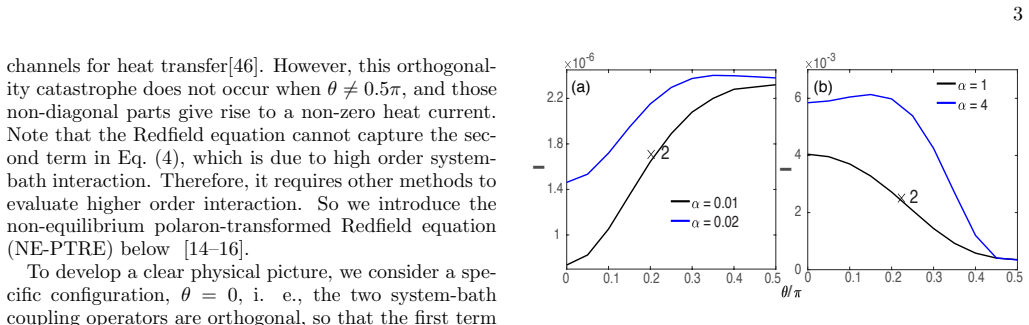
exp(−iωt))/ω2. Here we have ˙QX 2 (t) = dQX 2 (t)/dt and the Bose-Einstein distribution function nν(ω) = 1 /(exp(βνω)− 1). On one hand, both C X 1 (t) and QX 2 (t) are linearly dependent on the cou- pling strength α, giving I ∼ α2. On the other hand, Eq. (6) clearly predicts a non-vanishing heat current I(∆ = 0) = −2 ∫∞ 0 dt(C R 1 (t) ˙QI 2(t) + C I 1(t) ...
- [2]
- [3]
-
[4]
J. Ronagel, S.T. Dawkins, K.N. Tolazzi, O. Abah, E. Lutz, F. Schmidt-Kaler, and K. Singer, Science 352, 325 (2016)
work page 2016
- [5]
-
[6]
A. Bermudez, M. Bruderer, and M. B. Plenio, Phys. Rev. Lett. 111, 040601 (2013)
work page 2013
-
[7]
D. M. Leitner, Adv, Phys., 2015, 64, p445
work page 2015
- [8]
- [9]
-
[10]
B. K. Agarwalla, and D. Segal, New J. Phys. 19, 043030 (2017)
work page 2017
- [11]
- [12]
-
[13]
J. Liu, H. Xu, B. Li, and C. Wu, Phys. Rev. E 96, 012135 (2017)
work page 2017
-
[14]
M. Esposito, M. A. Ochoa, and M. Galperin, Phys. Rev. Lett. 114, 080602(2015)
work page 2015
-
[15]
C. Wang, J. Ren, and J. Cao, Sci. Rep. 5, 11787 (2015)
work page 2015
-
[16]
D. Xu, C. Wang, Y. Zhao, and J. Cao, New J. Phys. 18, 023003 (2016)
work page 2016
-
[17]
C. Wang, J. Ren, and J. Cao, Phys. Rev. A 95, 023610 (2017)
work page 2017
- [18]
-
[19]
K. A. Velizhanin, H. Wang, and M. Thoss, Chem. Phys. Lett. 460, 325 (2008)
work page 2008
- [20]
- [21]
- [22]
- [23]
- [24]
- [25]
-
[26]
D. J. Gross, Proc. Natl. Acad. Sci. USA 93, 14256 (1996)
work page 1996
- [27]
-
[28]
J. Lehmann, S. Kohler, P. H¨ anggi, and A. Nitzan, Phys. Rev. Lett. 88, 228305 (2002)
work page 2002
-
[29]
M. Walschaers, J. Fernandez-de-Cossio Diaz, R. Mulet, and A. Buchleitner, Phys. Rev. Lett. 111, 180601 (2013)
work page 2013
- [30]
- [31]
-
[32]
N. Li, J. Ren, L. Wang, G. Zhang, P. H¨ anggi, and B. Li, Rev. Mod. Phys. 84, 1045 (2012)
work page 2012
-
[33]
A. H. Castro Neto, E. Novais, L. Borda, G. Zarand, and I. Affleck, Phys. Rev. Lett. 91, 096401 (2003)
work page 2003
- [34]
-
[35]
C. Guo, A. Weichselbaum, J. von Delft, and M. Vojta, Phys. Rev. Lett. 108, 160401 (2012)
work page 2012
- [36]
-
[37]
B. Bruognolo, A. Weichselbaum, C. Guo, J. von Delft, I. Schneider, and M. Vojta, Phys. Rev. B 90, 245130 (2014)
work page 2014
- [38]
- [39]
-
[40]
Z. Tang, X. Ouyang, Z. Gong, H. Wang, and J. Wu, J. Chem. Phys. 143, 224112 (2015)
work page 2015
-
[41]
C. Duan, Z. Tang, J. Cao, and J. Wu, Phys. Rev. B 95, 214308 (2017)
work page 2017
-
[42]
C. Duan, Q. Wang, Z. Tang, and J. Wu, J. Chem. Phys. 147, 164112 (2017)
work page 2017
- [43]
-
[44]
Theα dependence on I are also demonstrated with different 0 <θ< 0.5π
See Suplememntary Materials for the details of the ex- tended HEOM and the NE-PTRE. Theα dependence on I are also demonstrated with different 0 <θ< 0.5π
- [45]
-
[46]
D. Gelbwaser-Klimovsky and A. Aspuru-Guzik, J. Phys. Chem. Lett. 6, 3477 (2015)
work page 2015
-
[47]
P. W. Anderson, Phys. Rev. Lett. 18, 1049 (1967)
work page 1967
- [48]
discussion (0)
Sign in with ORCID, Apple, or X to comment. Anyone can read and Pith papers without signing in.