REVIEW 3 major objections 5 minor 78 references
CME -- HSS interaction and characteristics tracked from Sun to Earth
T0 review · 3 major / 5 minor · reviewed 2026-08-14 · deepseek-v4-flash
Pith's one-line read This paper shows that a coronal hole's open magnetic field deflected a CME at least 30 degrees between 1.3 and 3 solar radii, sending an initially southward eruption toward Earth and leaving in situ signatures of a skimming spacecraft…
desk verdict The coronal-side story is the real contribution and it holds together; the in situ chain ends in an honest but unverified skimming-trajectory assumption. read the letter →
The pith
A machine-rendered reading of the paper's core claim, the machinery that carries it, and where it could break.
The reading
What carries the argument
The mechanism that carries the argument is magnetic deflection by an open-field barrier: as the CME expands toward the coronal hole, it compresses the hole's open magnetic field lines, building magnetic pressure that blocks further expansion southward and westward and redirects the CME north-eastward. The quantitative piece is a three-part modeling chain—global nonlinear force-free field (NLFFF) reconstruction of the coronal magnetic field, Graduated Cylindrical Shell (GCS) reconstruction of the CME flux rope from white-light coronagraph images, and a ForeCAT ensemble that simulates CME deflection from magnetic pressure and tension forces—where the observed trajectory is matched by GCS and reproduced by ForeCAT only after the compressed coronal-hole field is added as an external pressure.
What would settle it
A second spacecraft crossing the same CME closer to its apex would see ejecta speed above the ambient HSS speed and a stronger or less oblique shock; if instead all crossings show ejecta speed equal to the HSS speed, the skimming-edge explanation fails.
Extended reading notes
Core claim
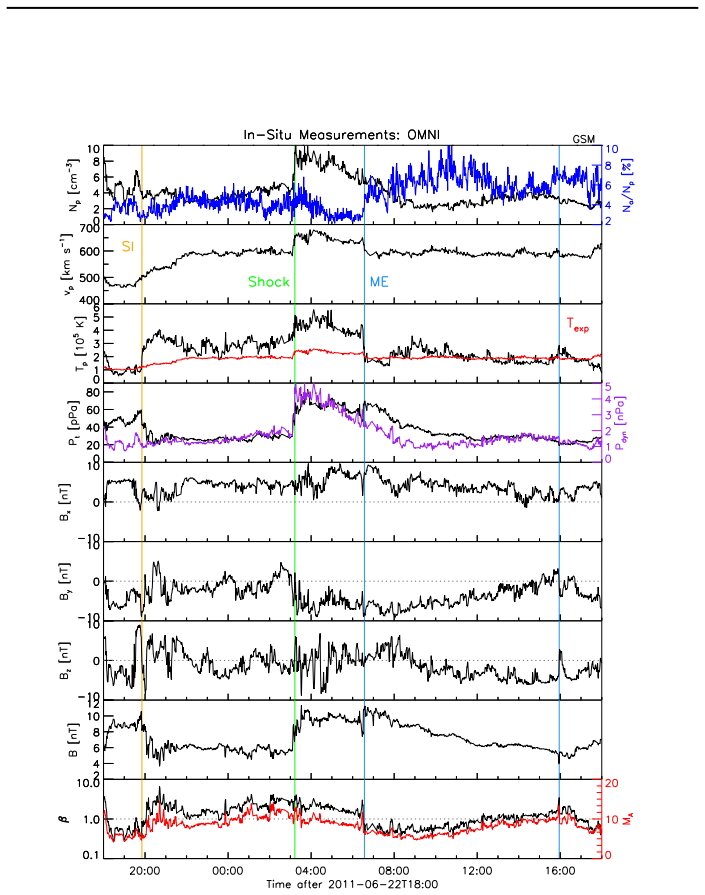
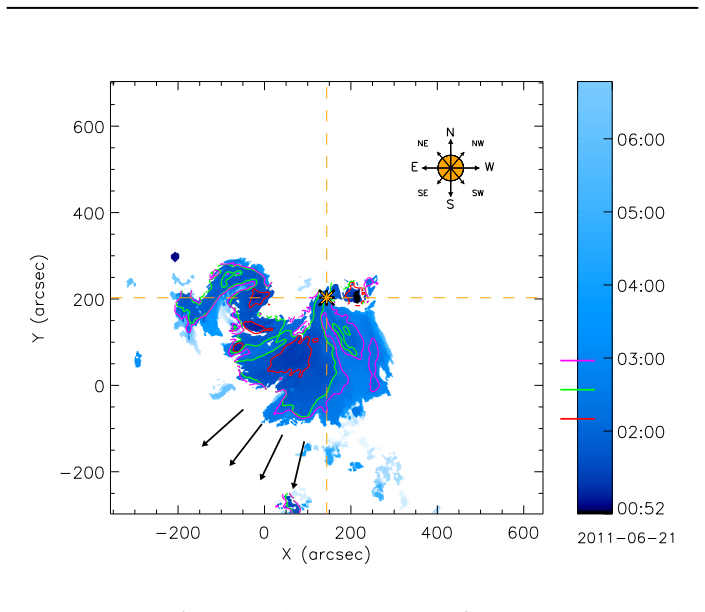
The central claim, stated on the paper's own terms, is that the peculiar plasma and magnetic-field configuration seen near L1 on June 22–23, 2011 is one CME–high-speed-stream interaction viewed from the wrong part of the CME. The CME, associated with a C7.7 flare in active region N17/W12 on June 21, initially propagated southward, as shown by coronal dimming and EUV off-limb images; starting near 1.3 solar radii the open field of a coronal hole to the south and west acted as a magnetic barrier, stopping the southward motion and turning the ejecta north-eastward by at least 30 degrees by about 3 solar radii. At 1 au the stream interface, the shock inside the high-speed stream, the short sheath, and the bidirectional suprathermal electron flux all identify an ejecta embedded in the stream, but its measured speed equals the stream speed even though the shock is faster. The paper resolves the contradiction by proposing that the spacecraft crossed only the outer edge of the flux rope: the shock remains driven at the apex, and the high-speed plasma doing the driving was never sampled. The authors are explicit that the Lundquist force-free fit was inconclusive, so this trajectory is inferred rather than directly measured.
Load-bearing premise
The in situ interpretation rests on the claim that the spacecraft crossed only the outer edge of the CME's flux rope, and the paper admits the Lundquist force-free fit was inconclusive about which part of the structure was intersected.
Editorial extensions
If this is right
- An initially southward CME can become Earth-directed when a neighboring coronal hole blocks its expansion, so launch-site proximity to open-field regions should be treated as a trajectory-shaping factor from the first few solar radii.
- The shock inside a high-speed stream can be driven by CME apex plasma even when the ejecta measured at 1 au moves at the stream's speed; in situ profiles of this kind do not imply that the ejecta is passive.
- The low expansion factor $n_A \approx 0.51$ derived for the flux rope implies either that the HSS slowed the CME's expansion or that the spacecraft sampled only part of the rope, both of which affect how CME size and arrival are inferred from single-spacecraft data.
- Geomagnetic effects in such events are dominated by the sheath and by dynamic-pressure compression: correcting the SYM-H index for magnetopause currents nearly doubles the inferred storm strength, even though the event's overall activity is moderate.
Reading between the lines
- If this deflection geometry operates generally, then CMEs launched near coronal holes should show a systematic bias: coronagraph-based arrival predictions that assume radial expansion will misjudge both which CMEs are Earth-directed and when they arrive.
- The paper's skimming-crossing interpretation predicts an observational correlation: events with shocks inside high-speed streams and ejecta speeds matching the stream should also show monotonically decreasing field profiles and low expansion factors; a statistical survey could test whether that signature reliably indicates a peripheral crossing.
- Because the HSS wraps around and entrains the CME, the interaction may act as a speed regulator that synchronizes CME and stream speeds well before 1 au, which would imply that travel-time models for CMEs embedded in HSSs need a drag or momentum-coupling term rather than free expansion.
- The artificial field compression and over-expansion introduced into ForeCAT to match the observed northward deflection suggest an empirically testable extension: incorporating a time-dependent compression factor based on the coronal hole's magnetic pressure could turn ForeCAT into a predictive tool for low-corona deflection strength.
Signed reviews
Editorial analysis
A structured set of objections, weighed in public.
Referee Report
Summary. The paper presents a multi-instrument, multi-spacecraft case study of a CME on June 21, 2011 and its interaction with a high-speed stream (HSS) emanating from a nearby coronal hole. It combines EUV dimming analysis, STEREO/SOHO coronagraph and heliospheric imaging, NLFFF modeling, GCS flux-rope reconstructions, and ForeCAT ensemble simulations to argue that the CME was launched south-eastward, was deflected north-eastward by at least 30 degrees between roughly 1.3 and 3 solar radii due to the open-field configuration of the coronal hole, and at 1 AU was engulfed by the HSS. The paper's central in situ interpretation is that the spacecraft skimmed only the outer edge of the magnetic ejecta, so the observed shock at ~700 km/s is driven by unobserved, faster apex plasma while the measured ejecta speed equals the HSS speed. The paper also analyzes the resulting geomagnetic effects, including magnetopause compression and moderate storm activity.
Significance. If the interpretation holds, the paper is a valuable complete Sun-to-Earth case study: it combines independent remote-sensing observations (coronal dimming, stereoscopic EUV, GCS fits with stated error bars) to establish a non-radial launch followed by a large deflection, and it proposes a concrete, falsifiable geometric explanation for otherwise puzzling in situ signatures. The authors are unusually candid about their limitations, explicitly stating that the Lundquist force-free fit was inconclusive and that the flux-rope expansion analysis is internally inconsistent. These strengths make the coronal part of the paper convincing. However, the answer to the paper's second motivating question ('Is the shock driven?') rests on an unverified skimming-trajectory assumption, and the ForeCAT agreement is obtained only after adding an empirically tuned compression factor. Both issues are acknowledged in the text, but they materially weaken the certainty with which the conclusions are stated.
major comments (3)
- [Section 6] The answer to the second motivating question ('Is the shock driven?') rests entirely on the claim that the spacecraft skimmed the outer edge of the magnetic ejecta, so that the fast apex plasma driving the shock was not observed. The authors themselves state in Section 6 that the Lundquist force-free fit was inconclusive and that 'we are not able to reliably determine the part of the structure which the spacecraft intersected.' The supporting arguments are not discriminative: a steadily decreasing B profile is merely consistent with a flank crossing, and the expansion analysis is self-contradictory (nA = 0.51 together with B1au ≈ 10 nT forces the alternatives 'either the initial field was very low... or nA does not reflect nB'). If the spacecraft actually crossed closer to the flux-rope axis, then the measured ejecta speed equal to the HSS speed (~600 km/s) combined with a shock speed of ~700 km/s would refute a locally driven shock. The skimming hypothesis must therefore be either supported by an independent quantitative test (e.g., a family of force-free fits with a free impact parameter, or a comparison of the modeled FR cross-section along the Sun-Earth line), or it must be explicitly labeled as an unverified hypothesis that leaves the second motivating question open. The current wording overstates the certainty of the conclusion.
- [Section 4.3] The claim that the ForeCAT model reproduces the observed northward deflection is only valid after adding the empirically estimated compression factor S = 1 + (R - R0)/0.15 R_sun and an ad hoc lateral overexpansion. The text states that the standard ForeCAT model (Figure 8, left panels) does not show the continuous latitudinal rise seen in the GCS fits, and that the right panels are obtained only when these modifications are included. Since S is derived from the very event being modeled, the agreement with GCS is, to a degree, constructed rather than predictive. This does not invalidate the observed deflection, which rests on GCS and EUV data, but it means the model should be presented as an illustrative mechanism consistent with the data, and the sensitivity of the result to S and to the overexpansion parameter should be reported. The summary bullet ('to be consistent with the GCS results, the ForeCAT model input requests an artificially scaled background field and a wider CME') acknowledges the tuning, but the abstract and conclusions present the model as independent support, which is misleading.
- [Sections 4.2 and 4.3] The quantitative claim that the major interaction begins at 1.3 R_sun is not directly supported by the GCS data used to measure the deflection: the text states that GCS reconstructions are available only from about 2.3 R_sun onward. The 1.3 R_sun onset appears to come from visual inspection of EUV running-difference images (Figure 7) and dimming evolution, which is reasonable but is a less quantitative measurement. The paper should either quote an explicit uncertainty on this height, or state that the interaction onset is known only approximately and that the quantitative deflection is measured from about 2.3 R_sun onward.
minor comments (5)
- [Section 7] In the first bullet of the summary, 'adress' should be 'address'.
- [Section 4.3] The phrase 'we include the overexpression and external compression in ForeCAT' should read 'overexpansion' rather than 'overexpression'.
- [Table 1] Table 1 is difficult to parse because the column entries are not cleanly separated; please reformat the table so that Stonyhurst longitude, latitude, tilt, height, aspect ratio, and half-angle are clearly distinguishable.
- [Section 4.4] The sentence 'which then seems to adjust to the speed of the surrounding HSS' is not directly measured between 10 R_sun and 1 AU; please specify that this adjustment is inferred from the 1 AU in situ speed and the J-map rather than from continuous tracking.
- [Section 6] The phrase 'were are not able' should be 'we are not able'.
Circularity Check
ForeCAT is calibrated to GCS before being cited as corroboration, making that model leg partially circular; the GCS-based deflection claim itself remains independent.
-
fitted input called prediction
[Section 4.3 (ForeCAT and GCS, Figure 8); echoed in Section 7 Summary]
"To simulate the compression we scaled the magnetic field strength in the direction of the CH by a scaling factor S = 1 + (R −R0)/0.15R⊙ which was estimated empirically, where R0 is the initial height of the CME nose. ... We see this northward motion is reproduced when we include the overexpression and external compression in ForeCAT."
The standard ForeCAT ensemble (Figure 8 left) does not produce the northward latitude rise that GCS shows; the rise appears only after adding lateral overexpansion and an empirical scaling S = 1 + (R −R0)/0.15R⊙ that is 'estimated empirically' rather than derived from independent data. The Summary confirms the calibration: 'to be consistent with the GCS results, the ForeCAT model input requests an artificially scaled background field and a wider CME.' Thus the ForeCAT 'reproduction' of the northward motion is a fit to the GCS deflection, not an independent prediction, and using it as corroboration ('indicated by both the GCS measurements as well as the ForeCAT model') is a fitted-input-called-prediction step.
full rationale
The central deflection claim ('the CME undergoes a strong north-eastward deflection of at least 30 degrees ... 1.3 Rsun up to 3 Rsun') is grounded in GCS reconstructions from STEREO/LASCO white-light data, which are independent external measurements, and is consistent with the independently identified southward launch (coronal dimming and EUVI running differences) and the NLFFF open-field configuration. That part is not circular. The circularity is confined to the ForeCAT model leg: the standard model does not show the northward rise, and the rise appears only after adding an empirical compression scaling and overexpansion chosen to match GCS; the paper openly acknowledges this in Section 7. Thus ForeCAT is calibrated to the GCS result, not an independent prediction of it. I do not count the Section 6 in-situ skimming interpretation as a circular step: the paper explicitly states the Lundquist force-free fit was 'inconclusive' and that 'we are not able to reliably determine the part of the structure which the spacecraft intersected,' so the skimming scenario is an acknowledged assumption and limitation on the in-situ inference rather than a derivation that reduces to its own input. The self-identified nA/nB inconsistency similarly weakens the flux-rope expansion argument but is not a circular reduction. Overall, one load-bearing modeling prediction reduces by construction to a fit, giving partial circularity; the observational core remains independent.
Assumptions & free parameters
free parameters (3)
- ForeCAT field compression scaling factor S =
S = 1 + (R - R0)/0.15 Rsun (empirically estimated)
- ForeCAT ensemble seed position and orientation =
Not stated numerically (best guess)
- GCS flux rope parameters (position, tilt, aspect ratio, half-angle) =
9 timesteps tabulated in Table 1
assumptions (6)
- domain assumption The NLFFF global coronal field reconstruction from HMI synoptic vector magnetograms (CR2111) adequately represents the coronal magnetic configuration near the AR and CH.
- domain assumption The PFSS-based background magnetic field used by ForeCAT is a valid approximation for computing CME deflecting magnetic forces.
- domain assumption Self-similar expansion with constant axial magnetic flux between 13 Rsun and 1 au holds for this CME.
- domain assumption The CME-HSS interaction in interplanetary space does not significantly alter the CME trajectory or shape.
- standard math Magnetic coplanarity and mixed-mode coplanarity give valid shock normals for this quasi-parallel shock.
- domain assumption The Shue et al. (1998) model captures magnetopause position and shape changes for this event.
Cite this review
Pith. "Pith review of CME -- HSS interaction and characteristics tracked from Sun to Earth." pith.science (2026). https://pith.science/paper/6RP7ALAA
@misc{pith2026190810161,
  author       = {Pith},
  title        = {Pith review of: CME -- HSS interaction and characteristics tracked from Sun to Earth},
  year         = {2026},
  howpublished = {\url{https://pith.science/paper/6RP7ALAA}},
  note         = {Machine review of arXiv:1908.10161}
}
read the original abstract
In a thorough study, we investigate the origin of a remarkable plasma and magnetic field configuration observed in situ on June 22, 2011 near L1, which appears to be a magnetic ejecta (ME) and a shock signature engulfed by a solar wind high-speed stream (HSS). We identify the signatures as an Earth-directed coronal mass ejection (CME), associated with a C7.7 flare on June 21, 2011, and its interaction with a HSS, which emanates from a coronal hole (CH) close to the launch site of the CME. The results indicate that the major interaction between the CME and the HSS starts at a height of 1.3 Rsun up to 3 Rsun. Over that distance range, the CME undergoes a strong north-eastward deflection of at least 30 degrees due to the open magnetic field configuration of the CH. We perform a comprehensive analysis for the CME-HSS event using multi-viewpoint data (from the Solar TErrestrial RElations Observatories, the Solar and Heliospheric Observatory and the Solar Dynamics Observatory), and combined modeling efforts (nonlinear force-free field modeling, Graduated Cylindrical Shell CME modeling, and the Forecasting a CMEs Altered Trajectory ForeCAT model). We aim at better understanding its early evolution and interaction process as well as its interplanetary propagation and related in situ signatures, and finally the resulting impact on the Earth's magnetosphere.
Figures


Figures from the paper (8 more)




Reference graph
Works this paper leans on
-
[1]
: 1972 , Determination of magnetohydrodynamic shock normals
barticle Abraham-Shrauner , B. : 1972 , Determination of magnetohydrodynamic shock normals . 77 ( 4 ), 736 . https://doi.org/10.1029/JA077i004p00736 . https://ui.adsabs.harvard.edu/abs/1972JGR....77..736A . barticle
-
[2]
barticle Abraham-Shrauner , B. , Yun , S.H. : 1976 , Interplanetary shocks seen by AMES plasma probe on Pioneer 6 and 7 . 81 , 2097 . https://doi.org/10.1029/JA081i013p02097 . https://ui.adsabs.harvard.edu/abs/1976JGR....81.2097A . barticle
-
[3]
barticle Acu \ n a , M.H. , Ogilvie , K.W. , Baker , D.N. , Curtis , S.A. , Fairfield , D.H. , Mish , W.H. : 1995 , The Global Geospace Science Program and Its Investigations . 71 , 5 . https://doi.org/10.1007/BF00751323 . 1995SSRv...71....5A . barticle
-
[4]
barticle Alves , M.V. , Echer , E. , Gonzalez , W.D. : 2006 , Geoeffectiveness of corotating interaction regions as measured by Dst index . Journal of Geophysical Research (Space Physics) 111 , A07S05 . https://doi.org/10.1029/2005JA011379 . 2006JGRA..111.7S05A . barticle
-
[5]
barticle Brueckner , G.E. , Howard , R.A. , Koomen , M.J. , Korendyke , C.M. , Michels , D.J. , Moses , J.D. , Socker , D.G. , Dere , K.P. , Lamy , P.L. , Llebaria , A. , Bout , M.V. , Schwenn , R. , Simnett , G.M. , Bedford , D.K. , Eyles , C.J. : 1995 , The Large Angle Spectroscopic Coronagraph (LASCO) . 162 , 357 . https://doi.org/10.1007/BF00733434 . ...
-
[6]
bchapter Carcaboso Morales , F. , G \'o mez-Herrero , R. , Hidago , M. \'A . , Espinosa , F. , Cernuda , I. , Rodr \' guez-Pacheco , , J. : 2018 , Suprathermal electrons bidirectionality study inside magnetic clouds observed by STEREO (2007 - 2014) . In: Solar Heliospheric and INterplanetary Environment (SHINE 2018) , 81 . 2018shin.confE..81C . bchapter
work page 2018
-
[7]
barticle Colburn , D.S. , Sonett , C.P. : 1966 , Discontinuities in the Solar Wind . 5 ( 4 ), 439 . https://doi.org/10.1007/BF00240575 . https://ui.adsabs.harvard.edu/abs/1966SSRv....5..439C . barticle
-
[8]
barticle Couvidat , S. , Schou , J. , Hoeksema , J.T. , Bogart , R.S. , Bush , R.I. , Duvall , T.L. , Liu , Y. , Norton , A.A. , Scherrer , P.H. : 2016 , Observables Processing for the Helioseismic and Magnetic Imager Instrument on the Solar Dynamics Observatory . 291 , 1887 . https://doi.org/10.1007/s11207-016-0957-3 . 2016SoPh..291.1887C . barticle
Show all 78 references
-
[9]
, Bothmer , V
barticle Cremades , H. , Bothmer , V. , Tripathi , D. : 2006 , Properties of structured coronal mass ejections in solar cycle 23 . Advances in Space Research 38 , 461 . https://doi.org/10.1016/j.asr.2005.01.095 . http://cdsads.u-strasbg.fr/abs/2006AdSpR..38..461C . barticle
2006 doi
-
[10]
, Mandrini , C.H
barticle Dasso , S. , Mandrini , C.H. , D \'e moulin , P. , Luoni , M.L. : 2006 , A new model-independent method to compute magnetic helicity in magnetic clouds . 455 ( 1 ), 349 . https://doi.org/10.1051/0004-6361:20064806 . https://ui.adsabs.harvard.edu/abs/2006A&A...455..349...
2006 doi
-
[11]
, Nakwacki , M.S
barticle D \'e moulin , P. , Nakwacki , M.S. , Dasso , S. , Mandrini , C.H. : 2008 , Expected in Situ Velocities from a Hierarchical Model for Expanding Interplanetary Coronal Mass Ejections . 250 , 347 . https://doi.org/10.1007/s11207-008-9221-9 . 2008SoPh..250..347D . barticle
2008 doi
-
[12]
: 2000 , Magnetic Helicity Generation by Solar Differential Rotation
barticle DeVore , C.R. : 2000 , Magnetic Helicity Generation by Solar Differential Rotation . 539 , 944 . https://doi.org/10.1086/309274 . 2000ApJ...539..944D . barticle
2000 doi
-
[13]
, Veronig , A.M
barticle Dissauer , K. , Veronig , A.M. , Temmer , M. , Podladchikova , T. , Vanninathan , K. : 2018 , On the Detection of Coronal Dimmings and the Extraction of Their Characteristic Properties . 855 , 137 . https://doi.org/10.3847/1538-4357/aaadb5 . 2018ApJ...855..137D . barticle
2018 doi
-
[14]
, Veronig , A.M
barticle Dissauer , K. , Veronig , A.M. , Temmer , M. , Podladchikova , T. : 2019 , Statistics of Coronal Dimmings Associated with Coronal Mass Ejections. II. Relationship between Coronal Dimmings and Their Associated CMEs . 874 , 123 . https://doi.org/10.3847/1538-4357/ab0962...
2019 doi
-
[15]
, Fleck , B
barticle Domingo , V. , Fleck , B. , Poland , A.I. : 1995 , The SOHO Mission: an Overview . 162 , 1 . https://doi.org/10.1007/BF00733425 . http://cdsads.u-strasbg.fr/abs/1995SoPh..162....1D . barticle
1995 doi
-
[16]
, Heber , B
barticle Dumbovi \'c , M. , Heber , B. , Vr s nak , B. , Temmer , M. , Kirin , A. : 2018 , An Analytical Diffusion-Expansion Model for Forbush Decreases Caused by Flux Ropes . 860 , 71 . https://doi.org/10.3847/1538-4357/aac2de . http://cdsads.u-strasbg.fr/abs/2018ApJ...860......
2018 doi
-
[17]
, Burlaga , L.F
barticle Farrugia , C.J. , Burlaga , L.F. , Lepping , R.P. : 1997 , Magnetic clouds and the quiet-storm effect at Earth . Washington DC American Geophysical Union Geophysical Monograph Series 98 , 91 . https://doi.org/10.1029/GM098p0091 . http://cdsads.u-strasbg.fr/abs/1997GMS...
1997 doi
-
[18]
, M \"a kel \"a , P
barticle Gopalswamy , N. , M \"a kel \"a , P. , Xie , H. , Akiyama , S. , Yashiro , S. : 2009 , CME interactions with coronal holes and their interplanetary consequences . Journal of Geophysical Research (Space Physics) 114 , A00A22 . https://doi.org/10.1029/2008JA013686 . htt...
2009 doi
-
[19]
, Baker , D.N
barticle Gosling , J.T. , Baker , D.N. , Bame , S.J. , Feldman , W.C. , Zwickl , R.D. , Smith , E.J. : 1987 , Bidirectional solar wind electron heat flux events . Journal of Geophysical Research: Space Physics 92 ( A8 ), 8519 . https://doi.org/10.1029/JA092iA08p08519 . https:/...
1987 doi
-
[20]
, D \'e moulin , P
barticle Gulisano , A.M. , D \'e moulin , P. , Dasso , S. , Rodriguez , L. : 2012 , Expansion of magnetic clouds in the outer heliosphere . 543 , A107 . https://doi.org/10.1051/0004-6361/201118748 . http://cdsads.u-strasbg.fr/abs/2012A\ barticle
2012 doi
-
[21]
, Liu , Y.D
barticle He , W. , Liu , Y.D. , Hu , H. , Wang , R. , Zhao , X. : 2018 , A Stealth CME Bracketed between Slow and Fast Wind Producing Unexpected Geoeffectiveness . 860 , 78 . https://doi.org/10.3847/1538-4357/aac381 . https://ui.adsabs.harvard.edu/abs/2018ApJ...860...78H . barticle
2018 doi
-
[22]
, Moses , J.D
barticle Howard , R.A. , Moses , J.D. , Vourlidas , A. , Newmark , J.S. , Socker , D.G. , Plunkett , S.P. , Korendyke , C.M. , Cook , J.W. , Hurley , A. , Davila , J.M. , Thompson , W.T. , St Cyr , O.C. , Mentzell , E. , Mehalick , K. , Lemen , J.R. , Wuelser , J.P. , Duncan ,...
2008
-
[23]
, Lemen , J.R
bchapter Hudson , H.S. , Lemen , J.R. , Webb , D.F. : 1996 , Coronal X-ray dimming in two limb flares. In: Bentley , R.D. , Mariska , J.T. (eds.) Astronomical Society of the Pacific Conference Series , Astronomical Society of the Pacific Conference Series 111 , 379 . http://cd...
1996
-
[24]
, Vourlidas , A
barticle Isavnin , A. , Vourlidas , A. , Kilpua , E.K.J. : 2013 , Three-Dimensional Evolution of Erupted Flux Ropes from the Sun (2 - 20 R _ ☉ ) to 1 AU . 284 ( 1 ), 203 . https://doi.org/10.1007/s11207-012-0214-3 . https://ui.adsabs.harvard.edu/abs/2013SoPh..284..203I . barticle
2013 doi
-
[25]
, Kucera , T.A
barticle Kaiser , M.L. , Kucera , T.A. , Davila , J.M. , St. Cyr , O.C. , Guhathakurta , M. , Christian , E. : 2008 , The STEREO Mission: An Introduction . 136 , 5 . https://doi.org/10.1007/s11214-007-9277-0 . 2008SSRv..136....5K . barticle
2008 doi
-
[26]
, Gopalswamy , N
barticle Kay , C. , Gopalswamy , N. : 2018 , The Effects of Uncertainty in Initial CME Input Parameters on Deflection, Rotation, B _ z , and Arrival Time Predictions . Journal of Geophysical Research (Space Physics) 123 , 7220 . https://doi.org/10.1029/2018JA025780 . 2018JGRA....
2018 doi
-
[27]
, Opher , M
barticle Kay , C. , Opher , M. , Evans , R.M. : 2013 , Forecasting a Coronal Mass Ejection's Altered Trajectory: ForeCAT . 775 , 5 . https://doi.org/10.1088/0004-637X/775/1/5 . http://cdsads.u-strasbg.fr/abs/2013ApJ...775....5K . barticle
2013 doi
-
[28]
, Opher , M
barticle Kay , C. , Opher , M. , Evans , R.M. : 2015 , Global Trends of CME Deflections Based on CME and Solar Parameters . 805 , 168 . https://doi.org/10.1088/0004-637X/805/2/168 . http://cdsads.u-strasbg.fr/abs/2015ApJ...805..168K . barticle
2015 doi
-
[29]
, Koskinen , H.E.J
barticle Kilpua , E. , Koskinen , H.E.J. , Pulkkinen , T.I. : 2017 , Coronal mass ejections and their sheath regions in interplanetary space . Living Reviews in Solar Physics 14 , 5 . https://doi.org/10.1007/s41116-017-0009-6 . 2017LRSP...14....5K . barticle
2017 doi
-
[30]
, Ruffenach , A
barticle Lavraud , B. , Ruffenach , A. , Rouillard , A.P. , Kajdic , P. , Manchester , W.B. , Lugaz , N. : 2014 , Geo-effectiveness and radial dependence of magnetic cloud erosion by magnetic reconnection . Journal of Geophysical Research (Space Physics) 119 , 26 . https://doi...
2014 doi
-
[31]
, Title , A.M
barticle Lemen , J.R. , Title , A.M. , Akin , D.J. , Boerner , P.F. , Chou , C. , Drake , J.F. , Duncan , D.W. , Edwards , C.G. , Friedlaender , F.M. , Heyman , G.F. , Hurlburt , N.E. , Katz , N.L. , Kushner , G.D. , Levay , M. , Lindgren , R.W. , Mathur , D.P. , McFeaters , E...
2012
-
[32]
, Luhmann , J.G
barticle Liu , Y.D. , Luhmann , J.G. , Kajdi c , P. , Kilpua , E.K.J. , Lugaz , N. , Nitta , N.V. , M \"o stl , C. , Lavraud , B. , Bale , S.D. , Farrugia , C.J. , Galvin , A.B. : 2014 , Observations of an extreme storm in interplanetary space caused by successive coronal mass...
2014 doi
-
[33]
: 1987 , Solar cycle invariance in solar wind proton temperature relationships
barticle Lopez , R.E. : 1987 , Solar cycle invariance in solar wind proton temperature relationships . 92 , 11189 . https://doi.org/10.1029/JA092iA10p11189 . http://cdsads.u-strasbg.fr/abs/1987JGR....9211189L . barticle
1987 doi
-
[34]
, Farrugia , C.J
barticle Lugaz , N. , Farrugia , C.J. , Smith , C.W. , Paulson , K. : 2015 , Shocks inside CMEs: A survey of properties from 1997 to 2006 . Journal of Geophysical Research (Space Physics) 120 , 2409 . https://doi.org/10.1002/2014JA020848 . 2015JGRA..120.2409L . barticle
2015 doi
-
[35]
, Gopalswamy , N
barticle M \"a kel \"a , P. , Gopalswamy , N. , Xie , H. , Mohamed , A.A. , Akiyama , S. , Yashiro , S. : 2013 , Coronal Hole Influence on the Observed Structure of Interplanetary CMEs . 284 , 59 . https://doi.org/10.1007/s11207-012-0211-6 . http://cdsads.u-strasbg.fr/abs/2013...
2013 doi
-
[36]
IV , Gombosi , T.I
barticle Manchester , W.B. IV , Gombosi , T.I. , De Zeeuw , D.L. , Sokolov , I.V. , Roussev , I.I. , Powell , K.G. , K \'o ta , J. , T \'o th , G. , Zurbuchen , T.H. : 2005 , Coronal Mass Ejection Shock and Sheath Structures Relevant to Particle Acceleration . 622 , 1225 . htt...
2005 doi
-
[37]
, Gombosi , T.I
barticle Manchester , W.B. , Gombosi , T.I. , Roussev , I. , Ridley , A. , de Zeeuw , D.L. , Sokolov , I.V. , Powell , K.G. , T \'o th , G. : 2004 , Modeling a space weather event from the Sun to the Earth: CME generation and interplanetary propagation . Journal of Geophysical...
2004 doi
-
[38]
, Nakwacki , M.S
barticle Mandrini , C.H. , Nakwacki , M.S. , Attrill , G. , van Driel-Gesztelyi , L. , D \'e moulin , P. , Dasso , S. , Elliott , H. : 2007 , Are CME-Related Dimmings Always a Simple Signature of Interplanetary Magnetic Cloud Footpoints? 244 , 25 . https://doi.org/10.1007/s112...
2007 doi
-
[39]
, Asbridge , J.R
barticle Montgomery , M.D. , Asbridge , J.R. , Bame , S.J. , Feldman , W.C. : 1974 , Solar wind electron temperature depressions following some interplanetary shock waves: Evidence for magnetic merging? Journal of Geophysical Research 79 ( 22 ), 3103 . https://doi.org/10.1029/...
1974 doi
-
[40]
, Colaninno , R
barticle Nieves-Chinchilla , T. , Colaninno , R. , Vourlidas , A. , Szabo , A. , Lepping , R.P. , Boardsen , S.A. , Anderson , B.J. , Korth , H. : 2012 , Remote and in situ observations of an unusual Earth-directed coronal mass ejection from multiple viewpoints . Journal of Ge...
2012 doi
-
[41]
, Daly , P.W
botherref Paschmann , G. , Daly , P.W. : 1998, Analysis Methods for Multi-Spacecraft Data. ISSI Scientific Reports Series SR-001, ESA/ISSI, Vol. 1. ISBN 1608-280X, 1998 . ISSI Scientific Reports Series 1. https://ui.adsabs.harvard.edu/abs/1998ISSIR...1.....P . botherref
1998
-
[42]
, Thompson , B.J
barticle Pesnell , W.D. , Thompson , B.J. , Chamberlin , P.C. : 2012 , The Solar Dynamics Observatory (SDO) . 275 , 3 . https://doi.org/10.1007/s11207-011-9841-3 . 2012SoPh..275....3P . barticle
2012 doi
-
[43]
, Van der Linden , R
barticle Podladchikova , T. , Van der Linden , R. , Veronig , A.M. : 2017 , Sunspot Number Second Differences as a Precursor of the Following 11-year Sunspot Cycle . 850 , 81 . https://doi.org/10.3847/1538-4357/aa93ef . http://cdsads.u-strasbg.fr/abs/2017ApJ...850...81P . barticle
2017 doi
-
[44]
, Hu , Q
barticle Qiu , J. , Hu , Q. , Howard , T.A. , Yurchyshyn , V.B. : 2007 , On the Magnetic Flux Budget in Low-Corona Magnetic Reconnection and Interplanetary Coronal Mass Ejections . 659 , 758 . https://doi.org/10.1086/512060 . 2007ApJ...659..758Q . barticle
2007 doi
-
[45]
: 2018 , Solar wind stream interaction regions throughout the heliosphere
barticle Richardson , I.G. : 2018 , Solar wind stream interaction regions throughout the heliosphere . Living Reviews in Solar Physics 15 , 1 . https://doi.org/10.1007/s41116-017-0011-z . 2018LRSP...15....1R . barticle
2018 doi
-
[46]
, Cane , H.V
barticle Richardson , I.G. , Cane , H.V. : 2010 , Near-Earth Interplanetary Coronal Mass Ejections During Solar Cycle 23 (1996 - 2009): Catalog and Summary of Properties . 264 , 189 . https://doi.org/10.1007/s11207-010-9568-6 . 2010SoPh..264..189R . barticle
2010 doi
-
[47]
, Crooker , N.U
barticle Riley , P. , Crooker , N.U. : 2004 , Kinematic Treatment of Coronal Mass Ejection Evolution in the Solar Wind . 600 ( 2 ), 1035 . https://doi.org/10.1086/379974 . https://ui.adsabs.harvard.edu/abs/2004ApJ...600.1035R . barticle
2004 doi
-
[48]
, Lavraud , B
barticle Ruffenach , A. , Lavraud , B. , Owens , M.J. , Sauvaud , J.-A. , Savani , N.P. , Rouillard , A.P. , D \'e moulin , P. , Foullon , C. , Opitz , A. , Fedorov , A. : 2012 , Multispacecraft observation of magnetic cloud erosion by magnetic reconnection during propagation ...
2012 doi
-
[49]
, Lavraud , B
barticle Ruffenach , A. , Lavraud , B. , Farrugia , C.J. , D \'e moulin , P. , Dasso , S. , Owens , M.J. , Sauvaud , J.-A. , Rouillard , A.P. , Lynnyk , A. , Foullon , C. : 2015 , Statistical study of magnetic cloud erosion by magnetic reconnection . Journal of Geophysical Res...
2015 doi
-
[50]
, Shinde , A.A
barticle Russell , C.T. , Shinde , A.A. , Jian , L. : 2005 , A new parameter to define interplanetary coronal mass ejections . Advances in Space Research 35 , 2178 . https://doi.org/10.1016/j.asr.2005.04.024 . 2005AdSpR..35.2178R . barticle
2005 doi
-
[51]
, Andalsvik , Y.L
barticle Sandholt , P.E. , Andalsvik , Y.L. , Farrugia , C.J. : 2012 , The pulsed nature of the nightside contribution to polar cap convection: repetitive substorm activity under steady interplanetary driving . Annales Geophysicae 30 , 1539 . https://doi.org/10.5194/angeo-30-1...
2012 doi
-
[52]
, Ness , N.F
barticle Schatten , K.H. , Ness , N.F. , Wilcox , J.M. : 1968 , Influence of a Solar Active Region on the Interplanetary Magnetic Field . 5 , 240 . https://doi.org/10.1007/BF00147968 . http://cdsads.u-strasbg.fr/abs/1968SoPh....5..240S . barticle
1968 doi
-
[53]
, Scherrer , P.H
barticle Schou , J. , Scherrer , P.H. , Bush , R.I. , Wachter , R. , Couvidat , S. , Rabello-Soares , M.C. , Bogart , R.S. , Hoeksema , J.T. , Liu , Y. , Duvall , T.L. , Akin , D.J. , Allard , B.A. , Miles , J.W. , Rairden , R. , Shine , R.A. , Tarbell , T.D. , Title , A.M. , ...
2012
-
[54]
, Song , P
barticle Shue , J.-H. , Song , P. , Russell , C.T. , Steinberg , J.T. , Chao , J.K. , Zastenker , G. , Vaisberg , O.L. , Kokubun , S. , Singer , H.J. , Detman , T.R. , Kawano , H. : 1998 , Magnetopause location under extreme solar wind conditions . 103 , 17691 . https://doi.or...
1998 doi
-
[55]
, Hudson , H.S
barticle Sterling , A.C. , Hudson , H.S. : 1997 , Yohkoh SXT Observations of X-Ray ``Dimming'' Associated with a Halo Coronal Mass Ejection . 491 , L55 . https://doi.org/10.1086/311043 . http://cdsads.u-strasbg.fr/abs/1997ApJ...491L..55S . barticle
1997 doi
-
[56]
, Frandsen , A.M
barticle Stone , E.C. , Frandsen , A.M. , Mewaldt , R.A. , Christian , E.R. , Margolies , D. , Ormes , J.F. , Snow , F. : 1998 , The Advanced Composition Explorer . 86 , 1 . https://doi.org/10.1023/A:1005082526237 . 1998SSRv...86....1S . barticle
1998 doi
-
[57]
, Wiegelmann , T
barticle Tadesse , T. , Wiegelmann , T. , Gosain , S. , MacNeice , P. , Pevtsov , A.A. : 2014 , First use of synoptic vector magnetograms for global nonlinear, force-free coronal magnetic field models . 562 , A105 . https://doi.org/10.1051/0004-6361/201322418 . http://cdsads.u...
2014 doi
-
[58]
, Reiss , M.A
barticle Temmer , M. , Reiss , M.A. , Nikolic , L. , Hofmeister , S.J. , Veronig , A.M. : 2017 , Preconditioning of Interplanetary Space Due to Transient CME Disturbances . 835 , 141 . https://doi.org/10.3847/1538-4357/835/2/141 . 2017ApJ...835..141T . barticle
2017 doi
-
[59]
: 2011 , Implementation of the Graduated Cylindrical Shell Model for the Three-dimensional Reconstruction of Coronal Mass Ejections
barticle Thernisien , A. : 2011 , Implementation of the Graduated Cylindrical Shell Model for the Three-dimensional Reconstruction of Coronal Mass Ejections . 194 , 33 . https://doi.org/10.1088/0067-0049/194/2/33 . http://cdsads.u-strasbg.fr/abs/2011ApJS..194...33T . barticle
2011 doi
-
[60]
, Vourlidas , A
barticle Thernisien , A. , Vourlidas , A. , Howard , R.A. : 2009 , Forward Modeling of Coronal Mass Ejections Using STEREO/SECCHI Data . 256 , 111 . https://doi.org/10.1007/s11207-009-9346-5 . http://cdsads.u-strasbg.fr/abs/2009SoPh..256..111T . barticle
2009 doi
-
[61]
, Howard , R.A
barticle Thernisien , A.F.R. , Howard , R.A. , Vourlidas , A. : 2006 , Modeling of Flux Rope Coronal Mass Ejections . 652 , 763 . https://doi.org/10.1086/508254 . http://cdsads.u-strasbg.fr/abs/2006ApJ...652..763T . barticle
2006 doi
-
[62]
, Plunkett , S.P
barticle Thompson , B.J. , Plunkett , S.P. , Gurman , J.B. , Newmark , J.S. , St. Cyr , O.C. , Michels , D.J. : 1998 , SOHO/EIT observations of an Earth-directed coronal mass ejection on May 12, 1997 . 25 , 2465 . https://doi.org/10.1029/98GL50429 . http://cdsads.u-strasbg.fr/...
1998 doi
-
[63]
, Cliver , E.W
barticle Thompson , B.J. , Cliver , E.W. , Nitta , N. , Delann \'e e , C. , Delaboudini \`e re , J.-P. : 2000 , Coronal dimmings and energetic CMEs in April-May 1998 . 27 , 1431 . https://doi.org/10.1029/1999GL003668 . http://cdsads.u-strasbg.fr/abs/2000GeoRL..27.1431T . barticle
2000 doi
-
[64]
, Vr s nak , B
barticle Verbanac , G. , Vr s nak , B. , Z ivkovi \'c , S. , Hojsak , T. , Veronig , A.M. , Temmer , M. : 2011 , Solar wind high-speed streams and related geomagnetic activity in the declining phase of solar cycle 23 . 533 , A49 . https://doi.org/10.1051/0004-6361/201116615 . ...
2011 doi
-
[65]
, Dumbovi \'c , M
barticle Vr s nak , B. , Dumbovi \'c , M. , C alogovi \'c , J. , Verbanac , G. , Poljan c i \'c Beljan , I. : 2017 , Geomagnetic Effects of Corotating Interaction Regions . 292 , 140 . https://doi.org/10.1007/s11207-017-1165-5 . 2017SoPh..292..140V . barticle
2017 doi
-
[66]
, Shen , C
barticle Wang , Y. , Shen , C. , Wang , S. , Ye , P. : 2004 , Deflection of coronal mass ejection in the interplanetary medium . 222 ( 2 ), 329 . https://doi.org/10.1023/B:SOLA.0000043576.21942.aa . https://ui.adsabs.harvard.edu/abs/2004SoPh..222..329W . barticle
2004
-
[67]
, Xue , X
barticle Wang , Y. , Xue , X. , Shen , C. , Ye , P. , Wang , S. , Zhang , J. : 2006 , Impact of Major Coronal Mass Ejections on Geospace during 2005 September 7-13 . 646 ( 1 ), 625 . https://doi.org/10.1086/504676 . https://ui.adsabs.harvard.edu/abs/2006ApJ...646..625W . barticle
2006 doi
-
[68]
, Chen , C
barticle Wang , Y. , Chen , C. , Gui , B. , Shen , C. , Ye , P. , Wang , S. : 2011 , Statistical study of coronal mass ejection source locations: Understanding CMEs viewed in coronagraphs . Journal of Geophysical Research (Space Physics) 116 , A04104 . https://doi.org/10.1029/...
2011 doi
-
[70]
, Wang , B
barticle Wang , Y. , Wang , B. , Shen , C. , Shen , F. , Lugaz , N. : 2014 b, Deflected propagation of a coronal mass ejection from the corona to interplanetary space . Journal of Geophysical Research (Space Physics) 119 , 5117 . https://doi.org/10.1002/2013JA019537 . 2014JGRA...
2014 doi
-
[71]
, Zhou , Z
barticle Wang , Y. , Zhou , Z. , Shen , C. , Liu , R. , Wang , S. : 2015 , Investigating plasma motion of magnetic clouds at 1 AU through a velocity-modified cylindrical force-free flux rope model . Journal of Geophysical Research (Space Physics) 120 ( 3 ), 1543 . https://doi....
2015 doi
-
[72]
, Zhang , Q
barticle Wang , Y. , Zhang , Q. , Liu , J. , Shen , C. , Shen , F. , Yang , Z. , Zic , T. , Vrsnak , B. , Webb , D.F. , Liu , R. : 2016 , On the propagation of a geoeffective coronal mass ejection during 15-17 March 2015 . Journal of Geophysical Research (Space Physics) 121 ( ...
2016 doi
-
[73]
, Shen , C
barticle Wang , Y. , Shen , C. , Liu , R. , Liu , J. , Guo , J. , Li , X. , Xu , M. , Hu , Q. , Zhang , T. : 2018 , Understanding the Twist Distribution Inside Magnetic Flux Ropes by Anatomizing an Interplanetary Magnetic Cloud . Journal of Geophysical Research (Space Physics)...
2018 doi
-
[74]
, Sturrock , P.A
barticle Wheatland , M.S. , Sturrock , P.A. , Roumeliotis , G. : 2000 , An Optimization Approach to Reconstructing Force-free Fields . 540 , 1150 . https://doi.org/10.1086/309355 . http://cdsads.u-strasbg.fr/abs/2000ApJ...540.1150W . barticle
2000 doi
-
[75]
: 2007 , Computing Nonlinear Force-Free Coronal Magnetic Fields in Spherical Geometry
barticle Wiegelmann , T. : 2007 , Computing Nonlinear Force-Free Coronal Magnetic Fields in Spherical Geometry . 240 , 227 . https://doi.org/10.1007/s11207-006-0266-3 . http://cdsads.u-strasbg.fr/abs/2007SoPh..240..227W . barticle
2007 doi
-
[76]
, Lugaz , N
barticle Winslow , R.M. , Lugaz , N. , Schwadron , N.A. , Farrugia , C.J. , Yu , W. , Raines , J.M. , Mays , M.L. , Galvin , A.B. , Zurbuchen , T.H. : 2016 , Longitudinal conjunction between MESSENGER and STEREO A: Development of ICME complexity through stream interactions . J...
2016 doi
-
[77]
, Lodkina , I.G
barticle Yermolaev , Y.I. , Lodkina , I.G. , Nikolaeva , N.S. , Yermolaev , M.Y. , Riazantseva , M.O. , Rakhmanova , L.S. : 2018 , Statistic study of the geoeffectiveness of compression regions CIRs and Sheaths . Journal of Atmospheric and Solar-Terrestrial Physics 180 , 52 . ...
2018 doi
-
[78]
: 2008 , Relationship between EIT Posteruption Arcades, Coronal Mass Ejections, the Coronal Neutral Line, and Magnetic Clouds
barticle Yurchyshyn , V. : 2008 , Relationship between EIT Posteruption Arcades, Coronal Mass Ejections, the Coronal Neutral Line, and Magnetic Clouds . 675 ( 1 ), L49 . https://doi.org/10.1086/533413 . https://ui.adsabs.harvard.edu/abs/2008ApJ...675L..49Y . barticle
2008 doi
-
[79]
, Wang , Y
barticle Zhuang , B. , Wang , Y. , Hu , Y. , Shen , C. , Liu , R. , Gou , T. , Zhang , Q. , Li , X. : 2019 , Numerical Simulations on the Deflection of Coronal Mass Ejections in the Interplanetary Space . 876 ( 1 ), 73 . https://doi.org/10.3847/1538-4357/ab139e . https://ui.ad...
2019 doi
Reviewed August 14, 2026 · model on record in the stance chip above.
Discussion (0). Continue with ORCID to comment.