pith.machine review for the scientific record.sign in
astro-ph.SR
Solar and Stellar Astrophysics
White dwarfs, brown dwarfs, cataclysmic variables. Star formation and protostellar systems, stellar astrobiology, binary and multiple systems of stars, stellar evolution and structure, coronas. Central stars of planetary nebulae. Helioseismology, solar neutrinos, production and detection of gravitational radiation from stellar systems
We present a detailed chemical abundance analysis of the eclipsing binary system V505 Per. High resolution spectra were analyzed using the MOOG spectrum analysis code, and we determined abundances not only for iron and lithium but also for Si, Na, Ca, Mn, and Ni, elements that have not previously been analyzed in detail for this system. Abundances were computed across 15 temperature points using model atmospheres, with stellar parameters refined by minimizing abundance trends with excitation potential. We determined effective temperatures of T_eff = 6650 +/- 50 K for the primary and T_eff = 6550 +/- 50 K for the secondary, with iron abundances of [Fe/H] = -0.10 +/- 0.06 and [Fe/H] = -0.19 +/- 0.07, respectively. Most [X/Fe] ratios are consistent with solar values, though manganese is deficient. Our analysis of the effective temperatures shows that both stars lie on the hot edge of the lithium dip, consistent with Koenigsberger et al. (2025), which may help resolve the inconsistency noted of the stars lithium abundance within the dip by Baugh et al. (2013).
Stellar rotation on the main sequence is a complex function of mass and age, displaying multiple regimes whose physical origin remains only partially understood. In particular, the connection between the diversity of observed rotation rates and the internal structure and thermodynamic properties of stellar interiors is still unclear. We investigated how the depth of the convective zones and the degree of plasma coupling, quantified through the plasma coupling parameter, relate to the observed rotation rates of solar-mass stars. We used a grid of $1 \, M_\odot$ MESA stellar models with a wide range of metallicities to identify the best-matching models for 243 main-sequence stars with measured rotation periods. We then examined correlations between their rotation rates and both the structural properties of the convective zones and the corresponding convective plasma coupling parameter. For this sample, rotation rates show only weak correlations with either the convective-zone depth or the plasma coupling parameter when considered independently. However, during the first two-thirds of the main-sequence lifetime, the correlation strengthens when both factors are considered jointly through a combined convective coupling index, indicating a moderate and statistically significant relationship. For older stars, these correlations weaken and lose significance, although the thermodynamic component becomes relatively more influential. These trends suggest that microphysical plasma properties may contribute to the regulation of angular momentum loss and may be connected to the onset of weakened magnetic braking.
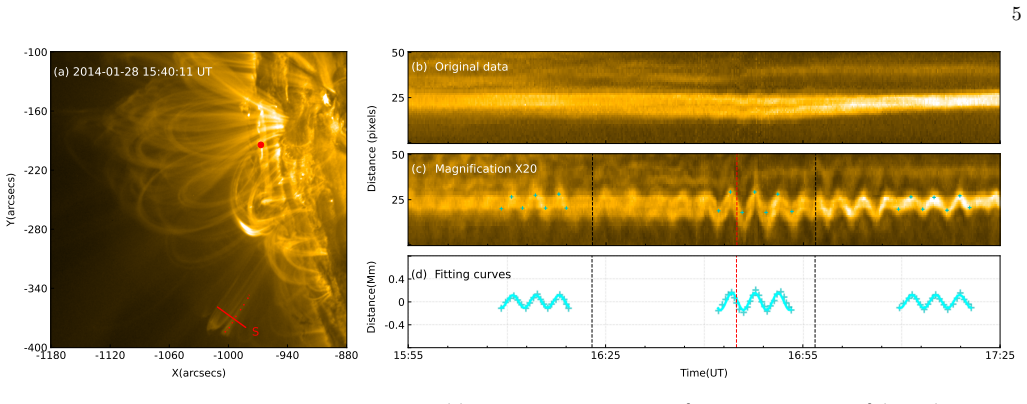
We present a statistical study of 130 solar flares (B to X class) that lack soft X-ray quasi-periodic pulsations and show no kink oscillations of nearby coronal loops visible in SDO/AIA 171~\AA~images. The aim is to investigate whether decayless kink oscillations of coronal loops respond to nearby flaring activity. Using the Fractional Anisotropy-based Video Motion Magnification technique, we detected low-amplitude decayless oscillations in all 130 loops before, during, and after each flare, confirming their ubiquitous nature. Oscillation periods are found to range from 122~s to 268~s, and the projected displacement amplitudes are 0.023--0.111~Mm. No amplitude--period correlation is found. For each event, we estimated the amplitude before, during, and after the flare. Across all flare classes, the average amplitude remains unchanged. However, in some specific cases, the oscillation amplitude may exhibit minor changes. For B-, C-, and M-class flares, the fraction of events with an amplitude change exceeding 10% is approximately 23%, 41%, and 36%, respectively. In M-class flares, such minor amplitude increases occur four times more often than decreases; in X-class flares (only six events), decreases dominate by a factor of three. The fraction of events that exhibit an increase in the amplitude of more than 20% appears to be highest when the loop centre is located at a distance of 100--120~Mm from the flare site, reaching 33% (6 out of 18 events). Overall, the amplitude of decayless kink oscillations does not undergo a major change in response to nearby flares, especially for less powerful classes, suggesting that flare-related processes such as blast waves and reconnection inflows have little effect on the energy supply to oscillating loops.
Dwarf carbon stars are dominated by members of the Galactic halo and are thus likely carbon-enhanced metal-poor stars. In this work, a sample of 879 bona fide dwarf carbon stars are characterized by their ground-based light curves, and p<15 d modulation is found to be significant in 31 objects (3.5%), consistent with starspots and rotation in tidally-locked, post-common envelope binaries. Among these is an unambiguous halo star that is eclipsing every 1.224 d, and where the 30% eclipse depth rules out a white dwarf occulter. Available Gaia data do not indicate any tertiary in the eclipsing system, but this remains a possibility and follow-up data are necessary to determine the evolutionary history of this first eclipsing binary among carbon-enhanced stars. Four of the variable sources exhibit clear multi-year, quasi-sinusoidal trends indicative of magnetic-activity and starspot cycles in rapidly-rotating, dynamo-rejuvenated stars. These data support a picture where carbon pollution results from wind capture prior to Roche lobe overflow, and the orbital period distribution appears to be moderately shifted to longer periods than carbon-normal, low-mass stars in similar binaries. The band-combined approach adopted in this work may be more sensitive than prior work using single-bandpass light curves, where at most 19 of 34 binary candidates published by Roulston et al. (2021) are independently confirmed here.
We present new Doppler images of the K0 subgiant primary component of the RS CVn-type binary UX Arietis (UX Ari), derived from time-series spectra obtained in November--December of 2017 and 2024. Observations demonstrate that some spectral lines of the K0 IV component exhibit rapid changes on timescales of 1-2 hours, which seem not to be resulting from spot activity, meanwhile other spectral lines show no such fast variations. Through an investigation, we find that the Ca I 6439 $\unicode{x212B}$ profile shows variation that follows the rotational modulation of spots. Using this line as a reference, we derive the least-squares deconvolution (LSD) profile from the selected lines of each spectrum so as to generate a more reliable Doppler image, which is consistent with the shape of the corresponding Ca I 6439 $\unicode{x212B}$ line. The Doppler images are separately reconstructed from the Ca I 6439 $\unicode{x212B}$ and the LSD profiles for each dataset, and the surface maps are in good agreement with each other. All of the surface maps show dominant starspot structure at mid-to-high latitudes with appendages extending to the equator, while their locations differ by about 0.5 in the rotational phase between 2017 and 2024. In 2017 November-December, the main starspot group appears to be spatially associated with a large flare event just half a month later. Through the cross-correlation method, we have derived a weak anti-solar differential rotation for the primary component of UX Ari, while its equator belt is well tidally locked.
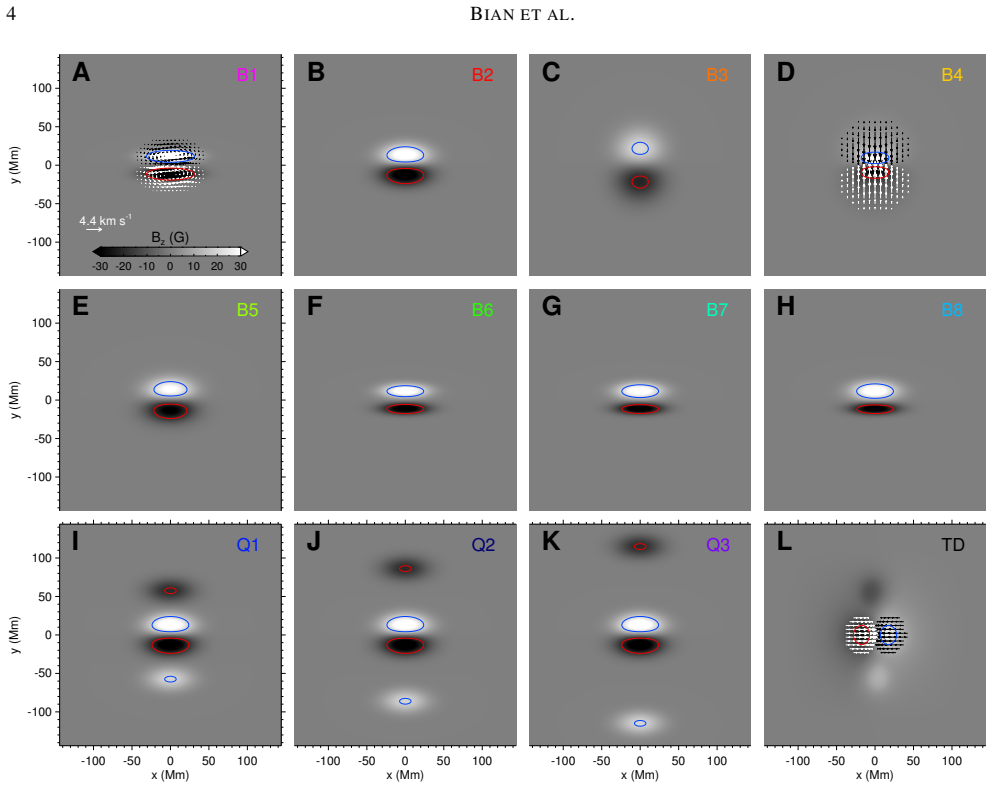
Identifying universal, topology-independent thresholds in the coronal magnetic fields at onset of solar eruptions is crucial for physics-based prediction of eruptions. To this end, we systematically analyze the evolution of magnetic energy and helicity in twelve high-fidelity 3D magnetohydrodynamic simulations where eruptions are triggered by magnetic reconnection. The simulations encompass a comprehensive parameter space, including bipolar and quadrupolar configurations, sheared arcades and pre-existing flux ropes, and various photospheric driving motions. We find that the ratio of current-carrying helicity to total relative helicity $(H_j/H_r)$ exhibits a remarkably consistent threshold of $0.38 \pm 0.04$ at eruption onset across all cases, with a coefficient of variation of only $\sim 10$\%. This threshold specifically characterizes the critical conditions at eruption onset and is largely independent of the subsequent temporal evolution, making it the most robust eruptivity indicator identified. In contrast, other normalized helicity and energy metrics show greater scatter. Crucially, we further find that $H_j/H_r$ does not necessarily achieve its peak at the eruption onset time and its post-eruption evolution diverges based on magnetic topology: it continues to increase in bipolar configurations due to tether-cutting reconnection, which transforms sheared arcade into the erupting current-carrying magnetic flux, but decreases in quadrupolar configurations as breakout reconnection peels off the erupting flux. These results highlight the helicity ratio as a promising and consistent eruptivity indicator and provide new insights into its dynamic evolution due to different reconnections.
Most stars host short-period planets that are expected to be engulfed during post-main-sequence expansion. The dissolution of engulfed planets has been proposed as a possible mechanism for producing stars enriched in lithium and refractory elements. We perform three-dimensional hydrodynamical simulations of a Jupiter-like planet engulfed within a stellar envelope using the Seven-League Hydro code. Unlike previous studies that represent the planet as a point mass or rigid sphere, we adopt a wind-tunnel setup that resolves the planet's gaseous structure. We find that a continuous mass-ablation process operates during planetary engulfment, contrary to the common assumption that destruction occurs at a specific depth due to ram pressure, tidal forces, or thermal evaporation. The ablation rate scales nearly linearly with the wind momentum flux and is largely insensitive to the Mach number, consistent with an analytical model based on Kelvin-Helmholtz instability developing at the planetary surface. We define efficiency coefficients for drag and ablation, finding pressure-drag coefficients of 0.44-0.56 and smaller ablation efficiencies of 0.054-0.11. Applying these coefficients to a numerically integrated inspiral through a stellar profile, we find that continuous ablation could lead to complete dissolution of the planet within the convective envelope, producing observable lithium enrichment at the stellar surface. Our results provide prescriptions for drag and mass loss that enable large parameter-space studies of planetary engulfment and suggest that chemical enrichment may occur over a broader range of stellar parameters than previously thought.
An important open question in exoplanet studies is whether planets leave detectable chemical fingerprints on their host stars. While several studies have suggested possible planetary chemical signatures in planet-hosting stars, their origin remains debated because of stellar birth conditions and evolutionary effects. Wide binaries, whose components share a common formation environment, provide an ideal testbed for identifying planetary signatures. Such signatures are often characterized by differential abundance trends with condensation temperature (Tc), which traces the partitioning between gaseous and rocky planetary material. We investigate whether these trends are associated with planetary architectures in wide binaries. We obtained high-resolution NIR spectra of four planet-hosting wide binaries. We measured abundances for both components and analyzed differential abundances in each system. We also compiled literature measurements for planet-hosting and non-hosting wide binaries and compared their Tc trends. WASP-160 A/B and WASP-127/TYC 4916-897-1 exhibit significant abundance trends with Tc, while HD 20782/HD 20781 shows a weaker correlation and K2-54/K2-54 B is consistent with a flat relation. The trends are diverse, including both volatile- and refractory-enhanced patterns in planet-hosting stars. Literature comparisons indicate that extreme Tc slopes may occur more frequently among planet-hosting wide binaries, particularly at large separations, although the statistics remain limited by sample size and definition. Our results indicate that chemical signatures in planet-hosting wide binaries are not universal but vary across systems. While planetary architectures may be associated with some host-star abundance patterns, multiple processes are likely to contribute. Larger samples are essential for disentangling planetary signatures from stellar and binary effects.
Observational abundances of CEMP stars with patterns in between those produced by the rapid and slow nucleosynthesis processes (CEMP-rs stars) are currently invoked as evidence of synthesis via the intermediate process in the early AGB evolutionary phase of metal-poor low mass stars. Nevertheless, discriminating between r+s- and i-process hypotheses requires high-precision abundances obtained through advanced spectral modelling techniques. Theoretical models of the i-process have become more robust, incorporating refined stellar modelling and nuclear reaction physics, providing ranges of probable elemental abundances and isotopic ratios predictions to be confronted with observational determinations. We performed a new analysis of a high resolution and high S/N UVES spectrum of TYC 6044-714-1. We derived accurate effective temperature and highly precise atmospheric parameters, element abundances, and isotopic ratios using state-of-the-art 1D non-LTE and 3D non-LTE spectral line modelling. Using the latest AGB nucleosynthesis models, we assessed the possibility of the i-process to act aside the s-process. We find that TYC~6044-714-1 was likely born as a normal in-situ halo star about 13 Gyr ago, pre-enriched by the r-process through a standard Galactic chemical-evolution pathway. The s+r model provides the best overall reproduction of the observed heavy-element abundance pattern and Ba isotopic ratios, yielding excellent agreement across all three s-process peaks. While i+s+r models with increasing overshooting efficiency improve the fit for specific elements, they do not consistently reproduce the full abundance pattern. The i+s+r models require extreme and physically implausible conditions, and predict s-process Ba fractions inconsistent with those inferred from isotopic ratios of the 4934 \AA\ resonance line. We conclude that the pure s+r scenario is the most plausible explanation.
The International Astronomical Union 2015 Resolution B2 (IAU2015GARB2) has resolved the long-standing problem of zero-point constants for the absolute and apparent bolometric magnitude scales and opened a new window in fundamental astrophysics. The empirical zero-point constants of the bolometric corrections, $C_2(\xi)$, and the absolute/apparent magnitudes, $C_\xi/c_\xi$, for the {\it Gaia} passbands were obtained from 88 {\it Gaia} XP spectra, and absolute bolometric/filtered magnitudes. The individual zero-point constants $\langle C_{\rm 2}\rangle$ of the bolometric corrections ($BC_\xi$) for each star revealed weighted averages of $\langle C_{\rm 2}(G)\rangle=0.8677\pm0.0109$ mag, $\langle C_{\rm 2}(G_{\rm BP})\rangle=1.0449\pm0.0116$ mag, and $\langle C_{\rm 2}(G_{\rm RP})\rangle=2.0510\pm0.0087$ mag. Furthermore, $C_{\rm Bol}=71.197425...$ mag and $c_{\rm Bol} =-18.997351...$mag announced by IAU2015GARB2, and using the definition of $C_{\rm 2}=C_{\rm Bol}-C_{\xi}=c_{\rm Bol}-c_{\xi}$, where the subscript $2$ indicate the wavelength ranges of two in which one is for bolometric and the other for one of the three filters, the zero-point constants of magnitudes for {\it Gaia} filters as $C_{\rm G}=70.1525\pm0.0109$ mag and $c_{\rm G}=-19.8651\pm0.0105$ mag, $C_{\rm G_{\rm BP}}=70.1525\pm0.0116$ mag and $c_{\rm G_{\rm BP}}=-20.0423\pm0.0116$ mag, and $C_{\rm G_{\rm RP}}=69.1464\pm0.0087$ mag and $c_{\rm G_{\rm RP}}=-21.0484\pm0.0087$ mag, if $L_{\xi}$ and $f_{\xi}$ are in SI units in case no extinctions. Lastly, spectroscopic $BC$s for {\it Gaia} magnitudes of 88 stars and the spectroscopic $BC-T_{\rm eff}$ relation for each {\it Gaia} filter are presented.
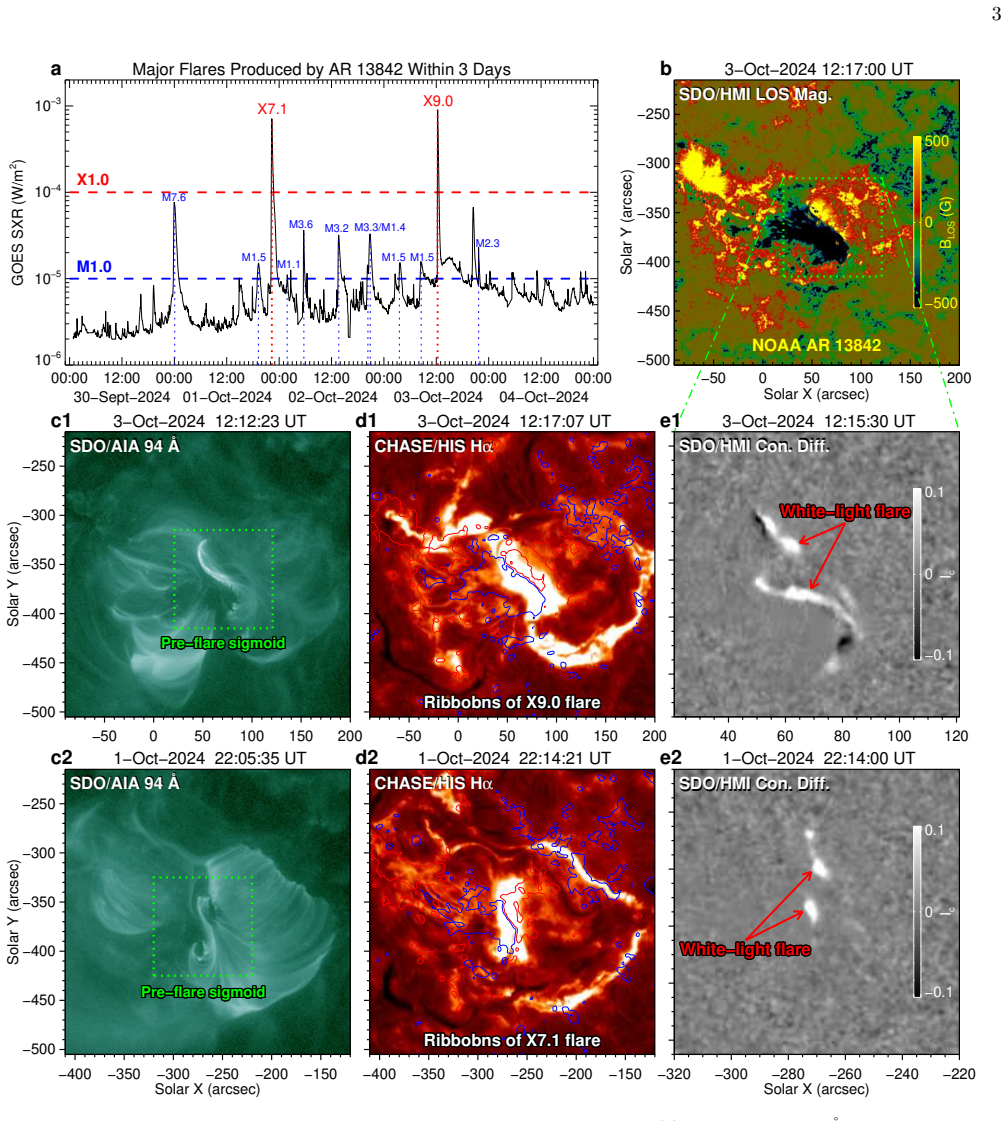
Shearing motion and magnetic flux cancellation around the polarity inversion line (PIL) play significant roles in the build-up of free magnetic energy and magnetic flux rope (MFR) in source region of major solar flares. Here we investigate the magnetic evolution of a highly-sheared PIL in active region (AR) 13842, hosting the largest X9.0 flare of Solar Cycle 25. Since 2024 September 29, a positive-polarity pore persistently drifted northward along the western side of the AR's main negative-polarity sunspot. The main sunspot remained stationary until negative-polarity patches successively emerged to its east and approached. Rear-ended by these same-polarity patches, the sunspot then began moving westward toward the opposite-polarity pore around October 1, forming a collisional PIL. Meanwhile, on the PIL's other side, the pore was also rear-ended by same-polarity patches sequentially emerging behind it, accelerating the shearing motion around the PIL, where frequent flux cancellations were also observed. Synchronous rapid accumulation of free magnetic energy and formation of MFR were then observed in the PIL, where multiple major flares successively occurred within two days. Before these large flares, the area and total free energy of the high-free-energy-density PIL region gradually decreased in the photosphere, which could be caused by the initial ascent of MFR before eruption and serve as a precursor of solar eruptions. These results suggest that persistent flux emergences with cross separation directions facilitates rapid formation of collisional shearing PIL and frequent flux cancellations, leading to repeated MFR formations and multiple large flares in a relatively short time.
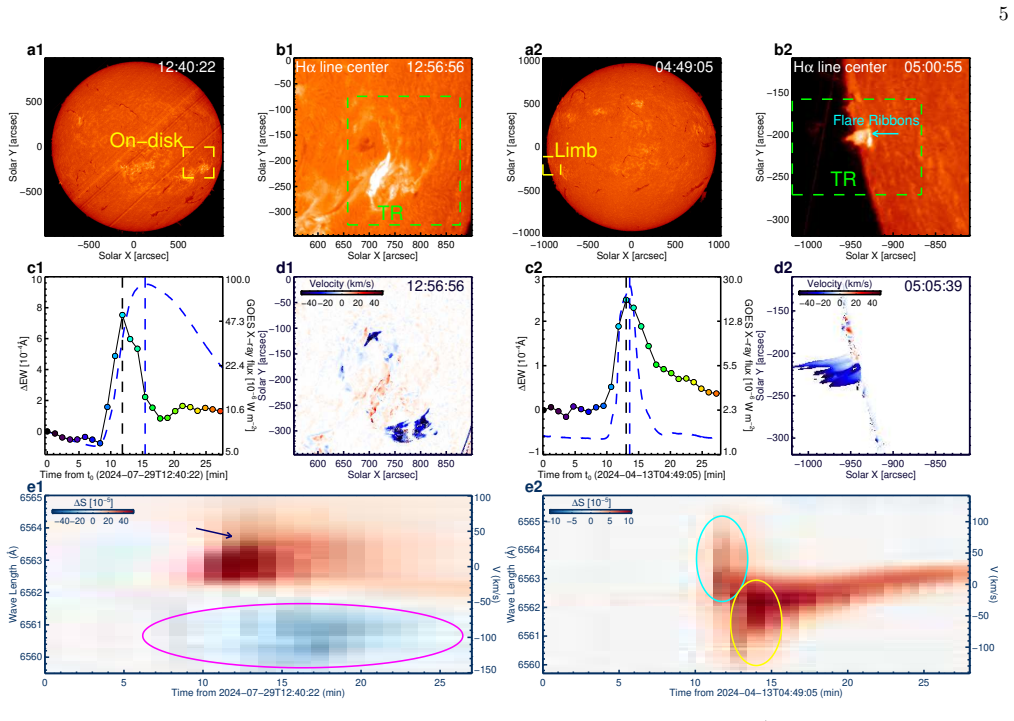
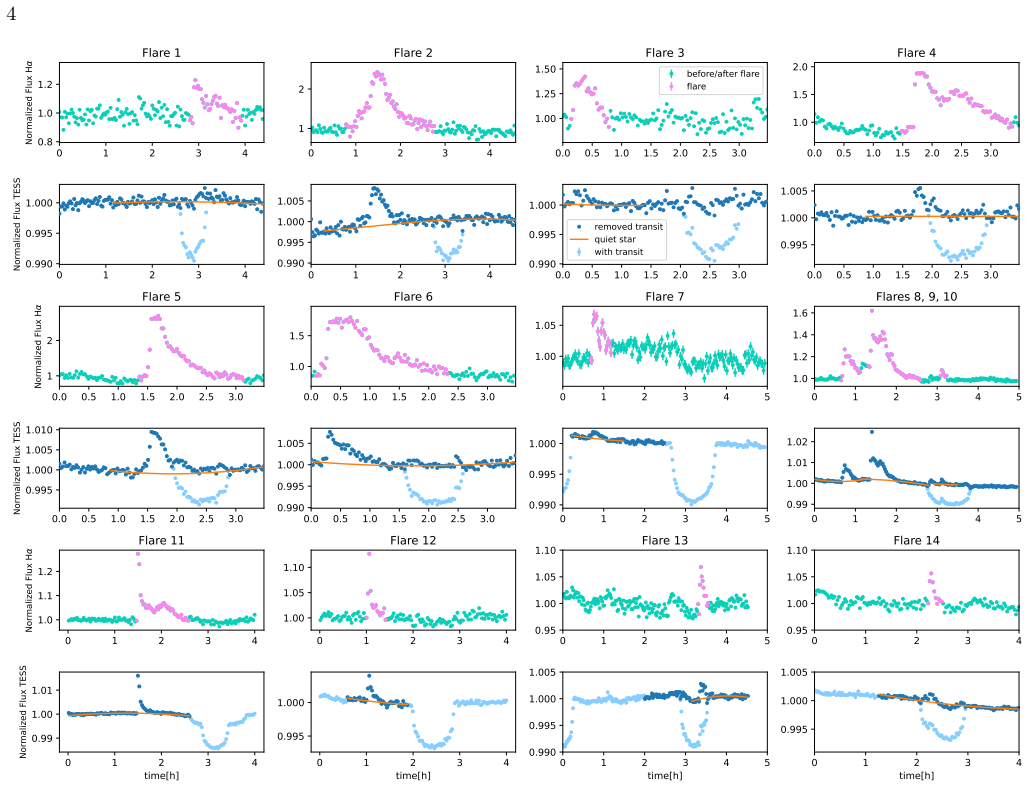
Solar filament/prominence eruptions can significantly perturb geospace when originating from favorable source locations and directions. While stellar analogs have been recently reported, the disk locations and magnetic environments of their source regions remain spatially unresolved on other stars. To bridge this gap, we investigate the typical Sun-as-a-star H$\alpha$ temporal spectral characteristics of solar filament/prominence eruptions with different source region locations (on-disk vs. limb, active region vs. quiet-Sun region). It is revealed that limb eruptions are characterized by blueshifted/redshifted emission caused by the bright off-limb erupting structures, whereas on-disk eruptions may show blueshifted absorptions due to the dark erupting filaments. Among the limb eruptions, front-side limb eruptions usually display line center emission before the blueshifted/redshifted emission, while far-side limb eruptions show the opposite sequence. Moreover, the magnetic environment at source also shapes the spectral characteristics. On-disk filament eruptions from active region exhibit much more intense flare-ribbon-dominated line center emission features compared with those from quiet-Sun region. Limb active region eruptions often show single-wing emissions, whereas large-scale quiet-Sun region (quiescent) prominence eruptions frequently display expansion-induced emission in both wings followed by line center absorption due to the disappearance of bright prominence. These distinct Sun-as-a-star H$\alpha$ spectral characteristics, dependent on eruption location, provide a diagnostic basis for inferring source regions of stellar filament/prominence eruptions from spatially unresolved H$\alpha$ spectra.
$\epsilon$ Ori (HD 37128) is an $\alpha$ Cygni variable characterized by irregular and small amplitude variations. From TESS observations, we find the presence of stochastic low-frequency variability in this star. We have constructed a sequence of models for this star in the mass range of 30 to 70 M$_{\odot}$, using recently derived values of luminosity (log $(L/L_{\odot})$ = 5.92) and effective temperature. In these considered models, both radial and non-radial linear stability analyses have been performed. Low-order radial modes are excited in models having mass below 62 M$_{\odot}$. These radially excited modes have periods ranging from 6.8 days for the fundamental mode to a few hours for higher-order modes. Similar to the case of radial modes, several non-radial modes are found to be unstable in models having higher luminosity-to-mass ratios. Linear stability analysis for the case of $l$ = 2 and $l$ = 4 reveals the presence of a strongly unstable mode in models having a mass below 40 M$_{\odot}$. This mode is found to be unstable in all the considered models and the strength of the instability varies as a function of harmonic degree. The non-adiabatic reversible approximation reveals that the origin of instabilities associated with the low-order modes is indeed linked with strange modes. To find out the consequence of radial instabilities, non-linear numerical simulations have been performed in selected models of $\epsilon$ Ori. In the non-linear regime, these instabilities lead to the envelope inflation, finite amplitude regular and irregular pulsations consistent with an $\alpha$ Cygni variable.
The transition region is a thin inhomogeneous region where Alfven waves' energy fluxes generated elsewhere in the solar atmosphere are effectively converted. Large-scale kinetic Alfven wave propagations, transmission, and reflection processes across the transition region are examined. The two-fluid model is adopted, and a study is conducted of how the kinetic Alfven wave electric displacement field changes across the transition region. The analysis outcomes are: the kinetic Alfven wave and electrostatic ion sound waves are coupled by the transverse wavenumber; wave electric field components (normal to the transition region) become enhanced up to two orders; the energy fluxes of transmitted kinetic Alfven waves are re-directed almost horizontally along the transition region, an evanescent electric field zone of enhanced intensity is induced tightly beyond the transition region; the ponderomotive force that emerges in that zone due to the reflected kinetic Alfven waves accelerates plasma particle upwards compared to their initial energy in the upper chromosphere.
We present a study that combines remote-sensing and in-situ observations of coronal mass ejections (CMEs) interacting with the nearby heliospheric current sheet (HCS). The sequence of eruptive events under study culminates in the largest directly observed flare of solar cycle 25 on 3 October 2024, producing a fast halo CME. Their source region can be linked to a so-called nested active region (or active longitude) that persisted over several solar rotations. Such long-lived regions reflect deep-seated magnetic structures that shape the global magnetic field configuration.
By applying the drag-based CME propagation model, we connect the near-Sun observations from several CMEs during that activity period with in-situ measurements. While one of the CMEs propagated on the opposite side of the HCS from Earth, and therefore did not produce in-situ signatures near Earth, we detect, over the period October 5-10, 2024, a complex of HCS and CME structures propagating together with a shock ahead of them. The HCS seems to be locally replaced by the CME signatures, leading to a long-duration sector reversal of more than 48 hours.
This event highlights the intrinsic connection between solar surface structures, the global magnetic field, and the evolution of complex eruptive events.
Nonlinear Force-free Field (NLFFF) models are widely used to investigate coronal magnetic field structure in solar active regions, but methods to validate them remain limited. Here, we use Gaussian separation, recently applied to solar vector magnetogram data, to assess the accuracy of NLFFF models constructed with two methods: optimization and the current-field iteration (CFIT) implementation of the Grad-Rubin method. Gaussian separation partitions the photospheric vector magnetic field into three components associated with currents flowing below, above, and passing through the photosphere, respectively. Comparing the photospheric field components due to coronal currents in an NLFFF model with those in the original vector magnetogram data provides a check on the accuracy of the model's coronal currents. We consider NLFFF models constructed for the active region AR 11429. The photospheric signatures of coronal currents in both the models and the vector magnetogram data indicate currents flowing above and parallel to central, sheared polarity inversion lines (PILs), consistent with other recent studies. We find that while both models reproduce the coronal current signatures along the upper section of the main PIL, the CFIT model significantly alters the signature of a flux rope along the lower section of the PIL, including shifting its positive-polarity footpoint. These differences arise from modifications to the vector magnetogram boundary data when solving the NLFFF equations, and from the assumptions underlying the models. We propose Gaussian separation as a useful tool to validate coronal magnetic field models, in addition to existing methods.
Model matches full solutions with over 0.99 correlation in key layers and under 2 percent profile residuals.
abstractclick to expand
Spectropolarimetric interpretation of chromospheric lines requires solving the radiative transfer problem under non-local thermodynamic equilibrium (non-LTE) conditions. This means computing atomic-level populations self-consistently with the radiation field. While traditional inversion codes employ 1.5D approximations, they neglect horizontal radiative transfer, which can be significant near magnetic structures and in the chromosphere. We present a method to solve 3D atomic-level populations using Graph Neural Networks (GNNs), extending prior 1.5D work to the full 3D domain. By discretizing the solar atmosphere as a directed graph, in which nodes encode physical properties and edges encode spatial distances, an Encode-Process-Decode GNN propagates information to efficiently capture radiative coupling. The network is trained on a Bifrost simulation using Ca II populations from Multi3D as ground truth. The trained GNN accurately predicts populations of the five-level Ca II atom plus continuum. Correlations exceed 0.99 in the photosphere and mid-chromosphere; errors in the upper chromosphere remain unbiased. Inference is $\sim 10^6$ times faster than traditional iterative solvers. Spectral synthesis of the Ca II 8542 \AA\ line yields intensity profiles with $< 2 \%$ mean residuals relative to the full 3D solution. This framework bypasses the computational bottleneck of iterative solvers while preserving essential non-LTE physics, including horizontal transfer, paving the way toward routine 3D non-LTE inversions.
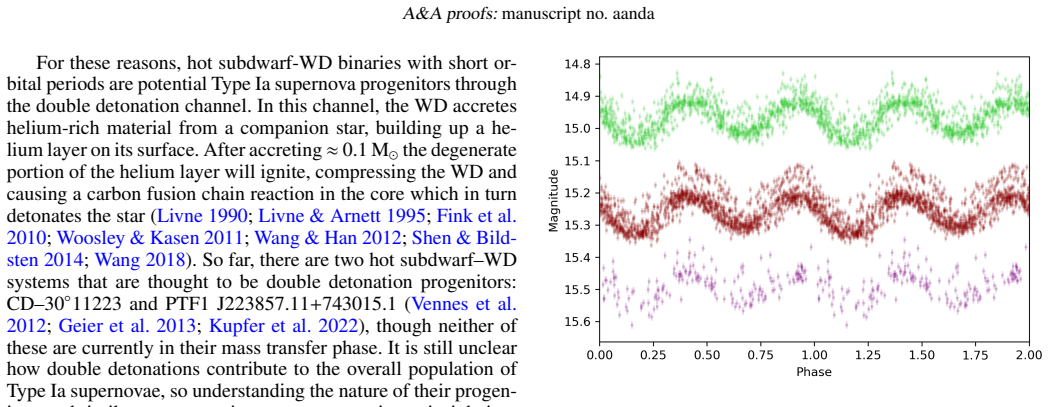
Nova-like variables are high-accretion-rate cataclysmic variables (CVs) that, in contrast to dwarf novae, do not undergo outbursts caused by thermal-viscous instability. However, a small group of nova-likes, classified as AH Pic-type stars, show recurrent small-amplitude outbursts, which are unexpected by the classical disk instability model. The physical mechanisms underlying these outbursts are not clear. In this study, we present a comprehensive time-domain analysis of the CV candidate GSC 08227-00723 using photometric data from ASAS-SN and TESS. The long-term light curves reveal a sequence of low-amplitude, recurrent stunted outbursts with recurrence times ranging from 30 to 50 days. Notably, these outbursts are frequently preceded by precursor brightenings, a feature reminiscent of super-outbursts in SU UMa stars driven by tidal instability. Period analysis of high-cadence TESS data identifies a coherent periodic modulation at 0.297 d, likely the orbital period, and a persistent positive superhump signal at 0.352 d. The latter corresponds to an exceptionally large superhump excess of $\epsilon^+ \approx 0.19$, surpassing typical values seen in CVs. Additionally, we detect short-timescale variability resembling quasi-periodic oscillations in the TESS light curves. Based on the outburst properties and photometric behavior, we classify GSC 08227-00723 as a new member of the AH Pic subclass of nova-like stars. We discuss how tidal effects may be involved in the observed behavior, although the exact mechanism is still unclear.
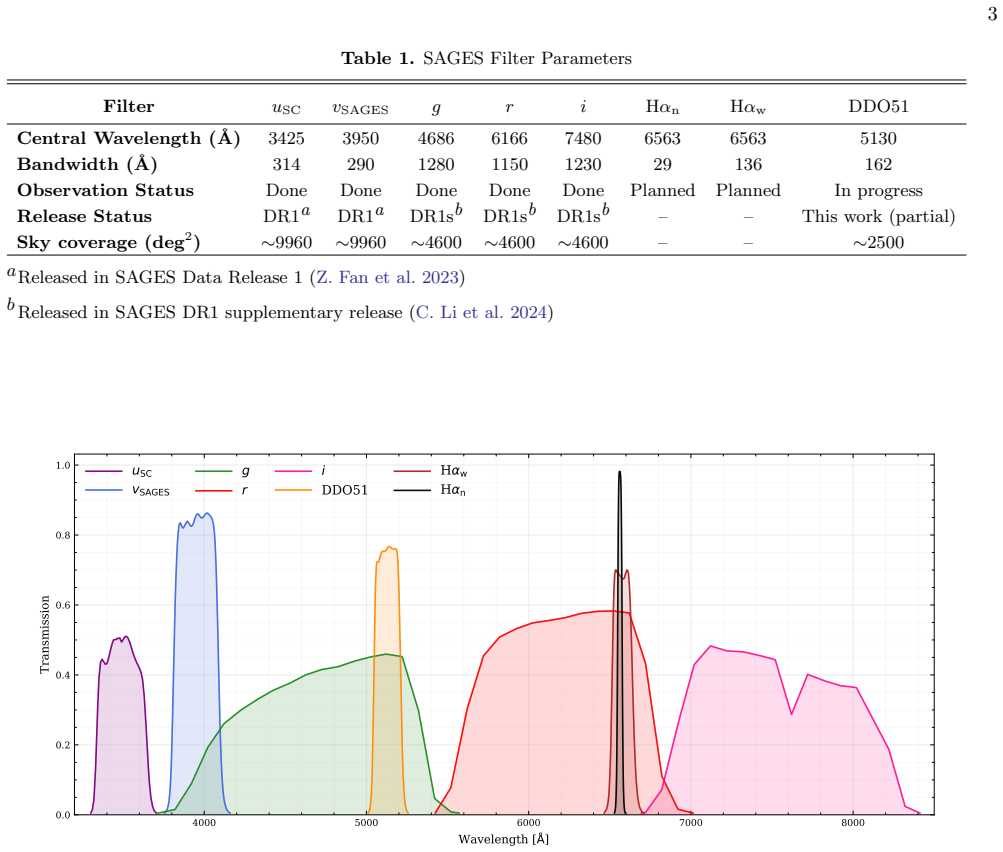
We present the first public data release of DDO51 band from the Stellar Abundances and Galactic Evolution Survey (SAGES), based on Nanshan One-meter Wide-field Telescope (NOWT) observations obtained between 2023 September and 2024 January. This release initiates the DDO51-band component of the survey, covering $\sim$ 2,500 deg$^2$ of the northern sky and including more than 10 million sources. The DDO51 filter is centered near the \ion{Mg}{1}~$b$ triplet and the adjacent MgH feature, offering sensitivity to stellar surface gravity. The data reduction pipeline incorporates an improved astrometric solution anchored to Gaia DR3 and a photometric calibration strategy tied to synthetic photometry from Gaia XP spectra. These procedures yield a point-source depth of $\sim$18.9 mag at S/N$\sim$10 and an internal photometric precision $\approx$6-7 mmag at the bright end. A preliminary color--color analysis using Gaia broadband photometry confirms the expected sensitivity of the DDO51 band to stellar surface gravity, demonstrating a clear photometric separation between dwarf and giant sequences for late-type stars. This dataset, when combined with existing SAGES photometry in other bands, provides a crucial tool for disentangling the substructures of the Milky Way. All data products from this release upon publication will be available.
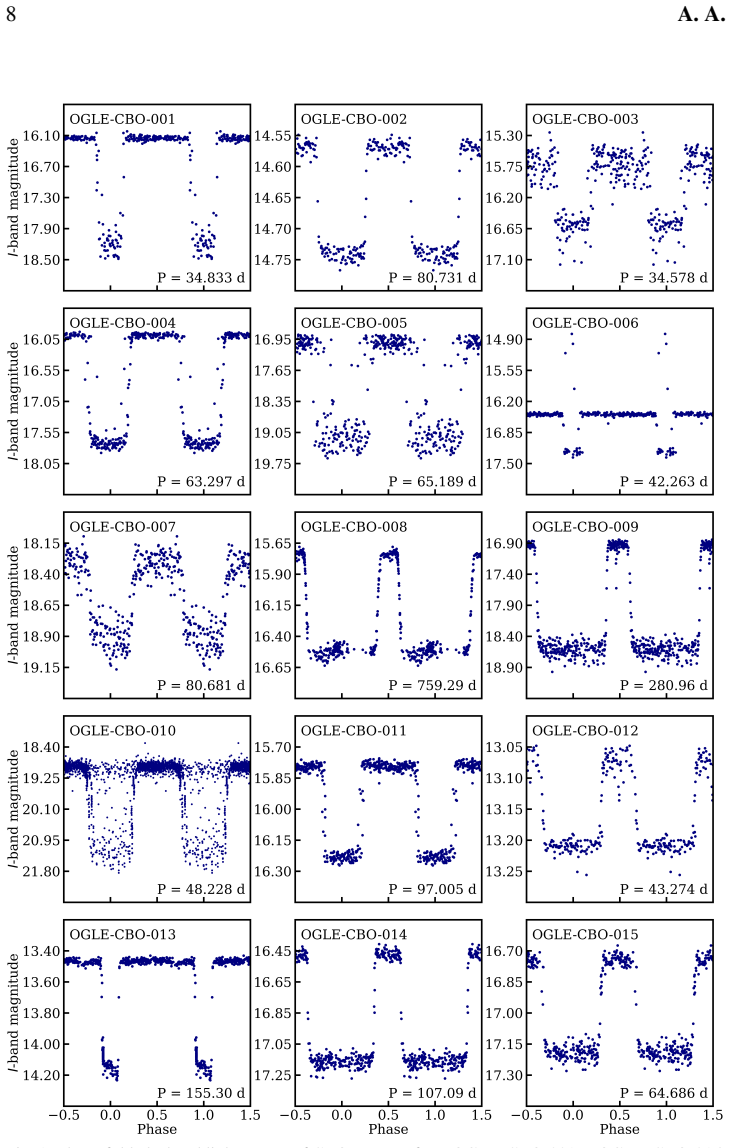
We present a catalog of 30 stars that are candidates for KH 15D-like binary systems, in which the observed brightness variations are caused by a circumbinary dusty disk that periodically obscures at least one of the stellar components as it moves along its orbit. Thanks to the regular observations conducted within the Optical Gravitational Lensing Experiment (OGLE) project, we provide unique light curves in the I and V bands with very long time baselines, in some cases beginning as early as 1997 and extending to the present day. Such long-term monitoring allows us to identify changes in eclipse widths, amplitudes, and light-curve shapes on timescales of many years. We highlight several circumbinary disk occultation (CBO) systems of particular interest and present spectra for three of them.
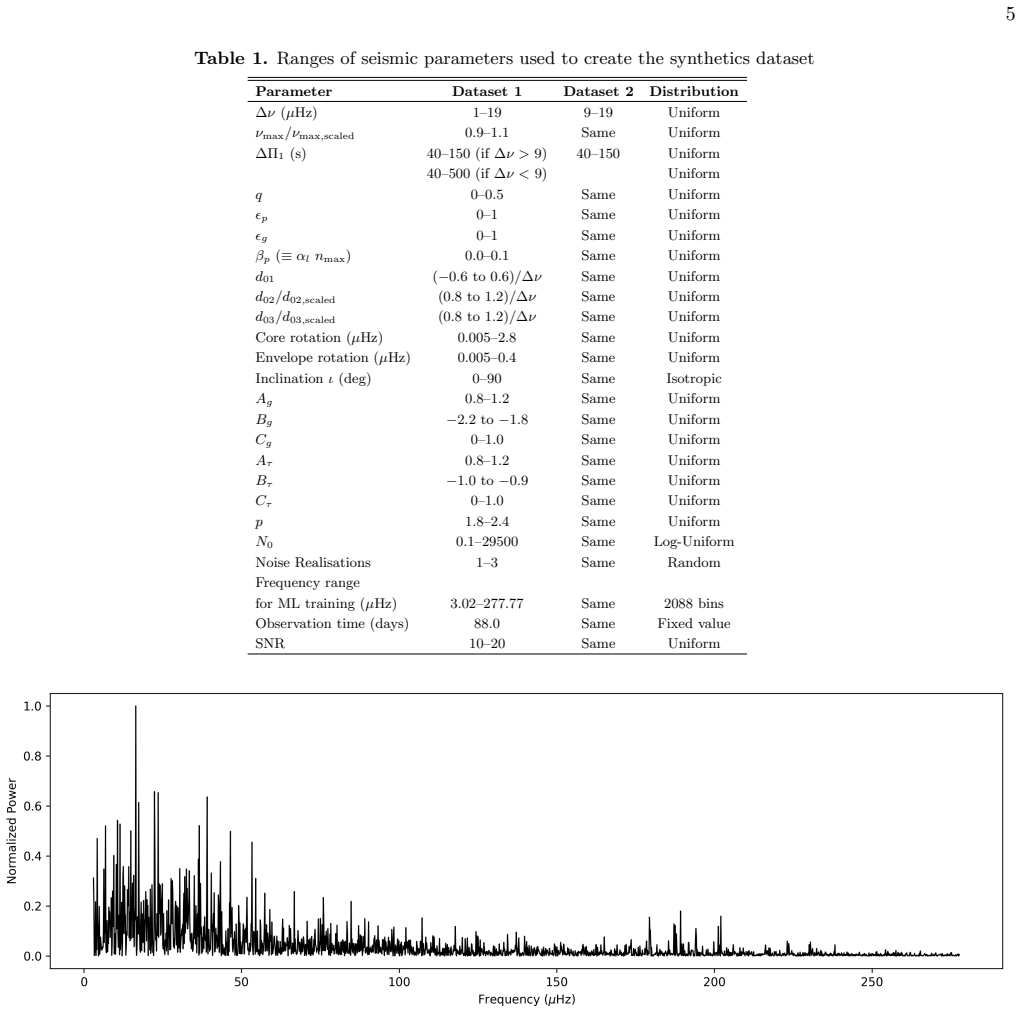
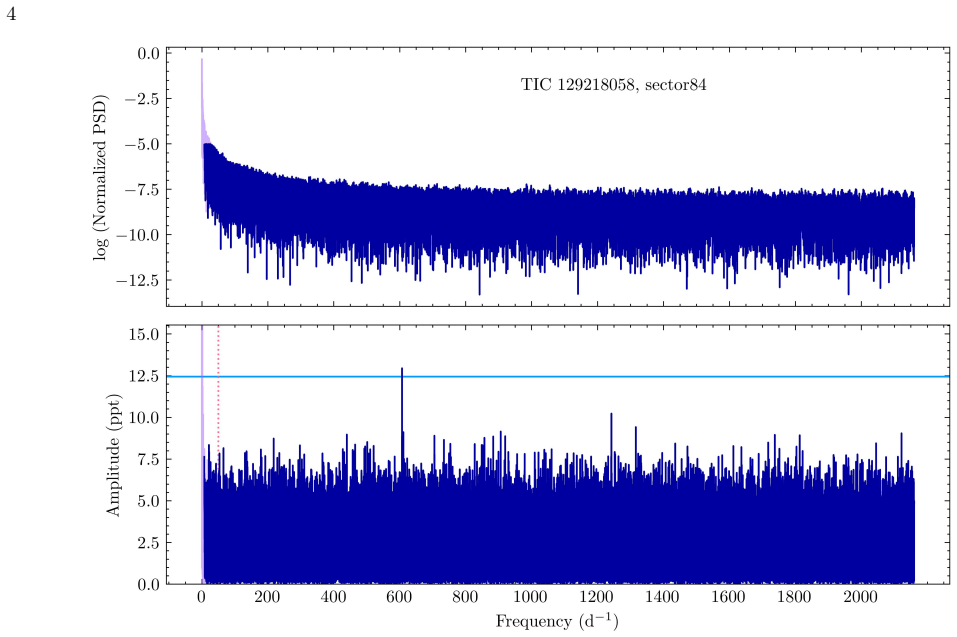
Asteroseismology is the study of resonant oscillations of stars to infer their internal structure and dynamics. It is also a powerful tool for precisely determining stellar parameters such as mass, radius, surface gravity, and age. The ongoing TESS mission, with its nearly complete sky coverage, presents a unique opportunity to uniformly probe stellar populations across the Milky Way. TESS is estimated to have observed more than 300,000 oscillating red giants, most of which have one to two months of observations. Given the scale of this dataset, we need a fast, efficient, and robust way to analyse the data. In this work, our objective is to develop a machine learning (ML) based method to infer asteroseismic parameters from short-duration observations. Specifically, we focus on two global seismic parameters, the large frequency separation ($\Delta\nu$) and the frequency at maximum power ($\nu_{\mathrm{max}}$), from one-month-long TESS observations of red giants. Meanwhile, for K2 data, our focus extends to inferring the period spacings of dipolar gravity modes ($\Delta\Pi_{1}$), in addition to $\Delta\nu$ and $\nu_{\mathrm{max}}$. Our findings demonstrate that our machine learning algorithm can accurately infer $\Delta\nu$ and $\nu_{\mathrm{max}}$ for approximately 50% of samples created by taking one-month Kepler and K2 observations. For TESS one sector data however, we recover reliable $\Delta\nu$ for only about 23% of the stars. Additionally, we get reliable $\Delta\Pi_{1}$ inferences for about 200 young red-giants from K2. For these $\Delta\Pi_{1}$ inferences, we see a good match with the well known $\Delta\nu-\Delta\Pi_{1}$ degenerate sequence observed in Kepler red-giants.
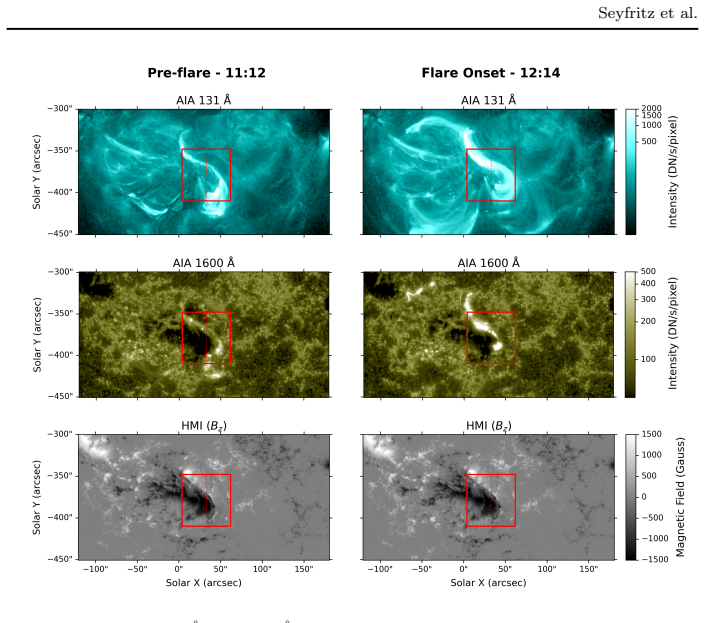
On October 3rd, 2024, the Sun emitted an X9.0-class flare from active region NOAA 13842. The event was recorded by multiple space-based instruments, beginning hours before the eruption, granting a unique opportunity to provide insight into the flare's pre-flare phase. In this study, we employ analysis of Interface Region Imaging Spectrograph (IRIS) spectroscopic data to investigate pre-flaring phenomena associated with this flare. We present time-series and wavelet analysis of non-thermal velocity, Doppler velocity, and line intensity quantities of the IRIS Si IV 1403 angstrom line. We find two ranges of periodic oscillations during the pre-flare phase: ~7-10 min and ~18-21 min oscillations, with local enhancements occurring near the polarity inversion line. We also find a steady rise in Si IV line parameters beginning 3 hours before the flare in the same region, transitioning into strong non-thermal velocities and blueshifts ~15 minutes before onset. These findings are consistent with a slow destabilization of the coronal magnetic field, possibly driven by the gradual activation of a flux rope, followed by a rapid shift to intense reconnection activity leading to flare onset.
We present a comprehensive analysis of extended H$_2$ emission from 34 protoplanetary disks observed with the JWST Disk Infrared Spectroscopic Chemistry Survey (JDISCS), supplemented by archival data. We investigated the morphology, kinematics, excitation conditions, and mass dynamics of H$_2$. Extended emission from pure rotational H$_2$ lines is found to be common, with 16 sources exhibiting clear signatures of disk winds. These include monopolar and bipolar structures in inclined disks and ring-like or bubble-like morphologies in face-on systems features indicative of wide-angle disk winds. Our analysis shows that the H$_2$ is consistent with slow {(4.2$^{+6.7}_{-3.0}$ km s$^{-1}$)} MHD driven winds. For ten disks, we model the wind morphology and find a median half-opening angle of $45\arcdeg^{+5}_{-4}$ and a characteristic power-law index of $\alpha \sim$ 1.6. Excitation analysis yields a median gas temperature of 624 $\pm$ 130 K and a column density of $\log(N_{\mathrm{tot}}\,[\mathrm{cm}^{-2}]) = 18.6 \pm 0.6$. The median wind mass-loss rate, ${\rm log_{10}}(\dot{\rm M}_{\rm wind}^{\rm tot}) = -9_{-0.4}^{+0.8}\,{\rm M_\odot\,yr^{-1}}$, implies that, if molecular winds are the dominant mechanism responsible for disk dispersal, a typical disk with a mass of $2-3\,M_{\rm Jup}$ would dissipate on a $\sim$2-3 Myr timescale, consistent with observed disk lifetimes. The $\dot{\rm M}_{\mathrm{\rm wind}}^{\rm tot}$ span a relatively narrow range ($\sim$2 dex) and do not correlate strongly with accretion rates onto the star, suggesting that the mass loss rate and the accretion rates are probing different timescales. Our findings demonstrate that spatially extended warm H$_2$ emission is a widespread and reliable tracer of molecular disk winds in protoplanetary systems.
We explore the origin of the rotation rates of massive stars. Contrary to their low-mass siblings, most massive stars do not have detectable magnetic fields, so that star-disk interaction models used for the formation of rotating low-mass stars do not apply. We investigate whether the magnetic fields of protostellar jets present in the parent molecular cloud prevent the protostar from reaching the critical angular velocity. Starting from the gravitational collapse of a molecular cloud, we run two two-dimensional radiation-gravito-magnetohydroynamical simulations to study the formation of an accretion disk and the launching of magnetically-driven protostellar outflows (of particular interest is the formation of a magnetocentrifugal jet originating from the protostar and inner disk). We then study the angular momentum transfer from the disk and jet onto the protostar. Finally, we compute one-dimensional stellar evolution models of the pre-main sequence including our results from the disk-jet simulations and follow the angular momentum redistribution within the structure of the protostar. We find that the angular momentum transported outwards by the magnetically-driven protostellar outflows is sufficient for keeping the protostar below the critical speed at all times. Moreover, we are able to link the strength of the jet, and thus the rotation rate at the end of the accretion epoch, to the initial conditions for star formation. Our results show that the jet strength produces a variety of stellar rotation rates, suggesting that protostellar jets fix the rotation rate of massive stars.
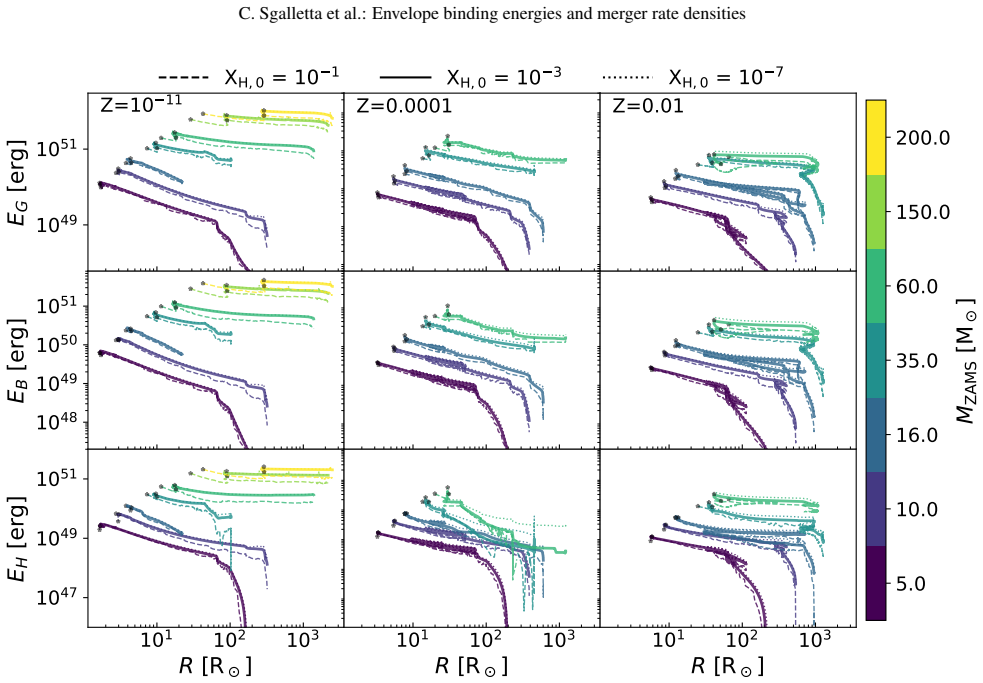
The common envelope (CE) phase plays a key role in the formation of binary compact object systems. Its final outcome strongly depends on the envelope binding energy, but this quantity is often estimated using fitting formulas that are not fully consistent with the underlying stellar evolution models adopted in population-synthesis codes. Here, we investigate envelope binding energies across the most extensive stellar grid considered to date. Our stellar tracks, evolved with PARSEC v2.0, include hydrogen (H) -rich stars with metallicities ranging from $Z = 10^{-11}$ (Population III stars) to $Z = 0.03$, and initial masses between 2 and 2000 M$_\odot$, as well as pure-helium stars with masses from 0.36 to 350 M$_\odot$. We examine the sensitivity of the envelope binding energies to the selected core-envelope boundary definition and to different internal energy source contributions. For H-rich stars, we find that internal energy sources can alter the envelope binding energy by more than an order of magnitude, whereas the core boundary criteria play a secondary role. In contrast, for pure helium stars, the core-boundary criterion becomes the dominant factor. The envelope binding energies derived from different stellar tracks can show deviations of several orders of magnitude, with larger differences for more massive stars and higher metallicities.Finally, by implementing our new envelope binding energy prescriptions into the binary population synthesis code SEVN, we show that the predicted merger rate densities of compact binaries can differ by more than an order of magnitude compared to previous models. Our results highlight the importance of using envelope binding energies that are consistent with the underlying stellar evolution models and caution against extrapolating empirical fits beyond the considered parameter space.
We present VLA C-band (5~cm) continuum, K-band (1.3~cm) continuum, and water maser (22.235 GHz) monitoring of the protostar HOPS-373. We additionally present the contemporaneous monitoring for 95 sources within the 5~cm field of view for over two years during the peak of the HOPS-373 outburst and an additional epoch in 2026. HOPS-373 is a binary Class 0 protostar located in the Orion star forming region that was found to have a $\sim$4$\times$ luminosity burst from the JCMT Transient Survey and NEOWISE monitoring. We do not find evidence for a change in the free-free emission traced by VLA 5~cm continuum during the peak of its outburst or during the decline. Moreover, the 1.3~cm continuum does not show significant variability between the NE and SW components of the HOPS-373 binary. The water maser emission is highly variable toward HOPS-373, multiple velocity components are detected at different (or the same) times and the maser spots are located close to the 1.3~cm continuum source of HOPS-373-SW. There is tentative evidence for the water maser spots to be propagating away from the source, but there is not a robust connection between the outburst and the observed maser activity. The lack of correlation between outburst and free-free emission from HOPS-373 indicates that the free-free emission may not directly respond to increases in the accretion rate and subsequently the outflow rate. The lack of a link could be due to the outflow mostly being neutral, or there may be offsets in the timescale for the free-free response.
The strong correlation between energy injection and mid-infrared (mid-IR) emission observed during solar flares can be used to probe energy deposition throughout the chromosphere, since the IR tracks prompt flare-induced changes in electron density. Despite its diagnostic value, solar mid-IR observations are relatively recent, with sporadic campaigns over the last decade resulting in only a few recorded flares. Earlier studies found time lags between mid-IR emissions from spatially resolved footpoints, offering clues about flare energy transport. Building on this, we analyse the time lags between emissions at two wavelengths (5.2 micrometers and 8.2 micrometers) for each footpoint. Using a local cross-correlation function, we show for the first time that the 8.2 micrometers emission channel peaks 0.3 s-0.45 s before the 5.2 micrometer channel. We investigate the origin of this lag, obtaining infrared emission estimates using results from the RADYN radiation hydrodynamics code. The theoretical lag values fall within the range of the observed ones. Variations in opacity-primarily due to flare-induced ionization-explain the wavelength-dependent temporal shift between emission maxima. In particular, longer wavelengths exhibit a smaller lag between the peak of energy injection and peak of intensity. These results contribute to a better understanding of how energy deposition during a flare affects the chromospheric layers of the atmosphere. Future observations with higher temporal resolution could exploit measurements of these time lags to more fully characterize the dynamics of energy deposition during solar flares, opening a new avenue for studying heating and energy transport processes in the solar atmosphere.
Simulating coronal mass ejections (CMEs) from their origin in active regions (ARs) to their propagation to Earth remains challenging, particularly when aiming to resolve AR scales and employ realistic magnetic field strengths without compromising computational efficiency. Here we present a methodology for end-to-end CME modeling that addresses these challenges. Three nested magnetohydrodynamic simulations are coupled to jointly cover the heliosphere from solar surface to beyond $1.5$ au. A block-structured adaptive mesh refinement scheme is employed to achieve $\sim 700$ km resolution in the low corona, allowing AR scales to be resolved while maintaining the total grid count below $10^8$ across the entire computational domain. A semi-relativistic Boris correction combined with a relativistic mass-density factor is used to handle magnetic field strengths up to $10^3$ G without prohibitively small time steps. Using this model, we simulate the emergence of a bipolar AR into the corona, the initiation of a CME by shearing of the AR core field and the subsequent evolution. Our simulation captures its pre-eruption energy buildup, triggering by magnetic reconnection, rapid acceleration, and propagation to 1 au and beyond. The simulated CME exhibits a three-part structure in synthetic coronagraph images and a torus-shaped flux rope in the heliosphere, with synthetic in-situ observations showing shock formation, density compression, and a prolonged southward $B_z$ component at 1 au. The entire simulation requires about one day on a moderately sized cluster (e.g., $600$ processors), while the simulated CME takes three days to arrive at $1$ au, offering a lead time of two days if used for forecasting.
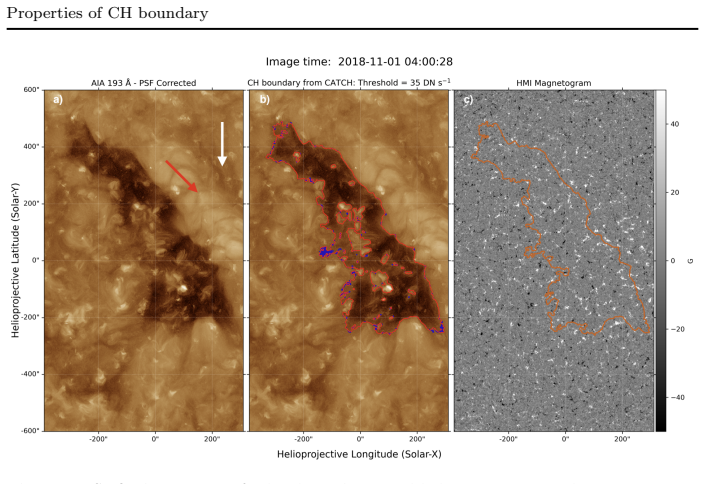
Coronal hole boundaries are the interfaces between closed and open magnetic field regions in the solar atmosphere. Many fundamental processes take place at these regions, including magnetic reconnection that is responsible for solar wind release and restructuring of the solar magnetic field. In this paper, we present a case study in which we investigate the physical properties of the boundary of a large low-latitude coronal hole. Differential Emission Measure analysis is used to derive the plasma properties of these regions. We also apply correlation dimension mapping analysis to measure the irregularities of the coronal hole boundary. We find that the leading boundary of this coronal hole has a slightly higher average plasma temperature, is associated with a stronger and more unipolar magnetic field, and has a smoother boundary line than the trailing counterpart. These differences are hypothesised to be direct consequences of the local magnetic field configurations of the coronal hole boundary: the leading boundary corresponds to large, well-organised coronal loops, and the trailing boundary corresponds to more dispersed, randomly orientated small magnetic bipoles. Hence, we suggest that the surrounding magnetic field structure and the nature of magnetic reconnection influence the properties of coronal hole boundaries.
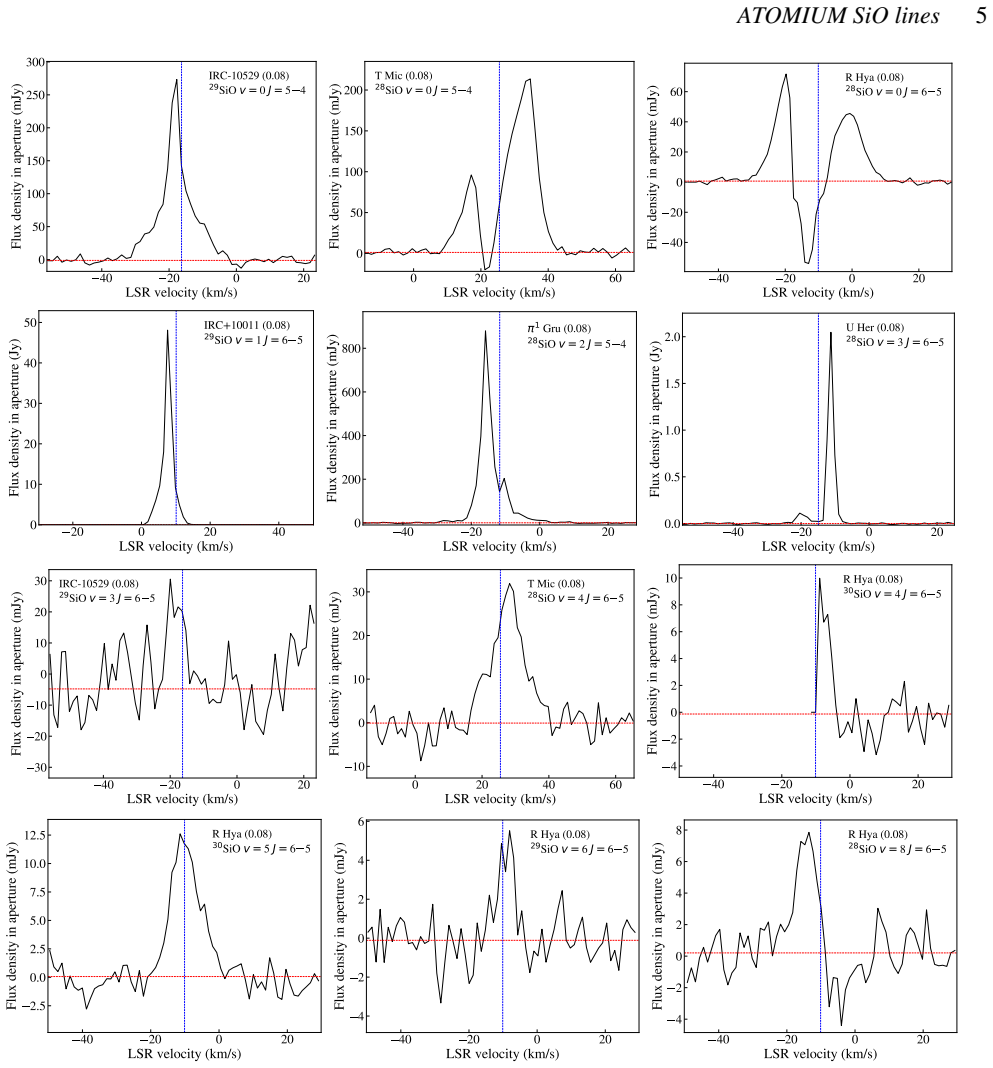
Silicon monoxide (SiO) traces the physical conditions and dynamics in the circumstellar envelopes (CSEs) of AGB stars. We present high-resolution ALMA Band 6 observations of highly excited SiO emission in 14 oxygen-rich AGB stars. We cover transitions from v = 0 to v = 8, including first detections of 28SiO v = 3, 4, 8, J = 6-5, 29SiO v = 6, J = 6-5, and 30SiO v = 4, 5, J = 6-5, some of which are masers. The v = 8 transition is the highest v-state observed in an AGB star yet. Masers in v = 0 are detected clearly in V PsA and IRC+10011 and tentatively in T Mic. R Hya exhibits the richest SiO spectrum. SiO J = 6-5 absorption is seen in R Aql, R Hya, S Pav, and T Mic, with features indicative of both infalls and outflows, and tentative detection of 28SiO v = 8, J = 6-5 absorption is found towards S Pav and R Aql. Highly excited SiO emission is often distributed in arcs or clumps with velocity gradients; components in R Hya and U Her align with predicted shock fronts. Detection rates show no significant difference between low and high mass-loss rate stars, although line overlap may affect some intensities. Maser detections appear uncorrelated with pulsation period or phase. The radius enclosing 90 per cent of compact SiO emission shows a tentative correlation with mass-loss rate. These results highlight the role of mass loss and CSE geometry in shaping high-excitation SiO emission.
IY Lyr, historically misclassified as an eclipsing binary, is now established as a first-overtone RR Lyrae star (RRc star). Using multi-band photometry (ASAS-SN, ZTF, TESS, and our BVRI data), LAMOST spectroscopy, and Gaia astrometry, we investigate its pulsation, binarity, and Galactic population. From O-C analysis, we detect a long-term period decrease and a light-travel time effect with an orbital period of 3.94 years, eccentricity of 0.46, and a mass function of 0.65 M$_{\odot}$. The companion is independently confirmed by radial velocity residuals and Gaia proper motions. Combined constraints yield an orbital inclination of 94.8$^{\circ}$ and a companion mass of 1.37 M$_{\odot}$. Chemical abundances ([Fe/H] $\simeq$ -1.0, [$\alpha$/Fe] $\simeq$ +0.27, Xiang et al. 2019) and dynamics ($L_{\rm z}$ $\simeq$ 1250 kpc km s$^{-1}$, $Z_{\rm max}$ $\simeq$ 1.31 kpc) identify IY Lyr as an old, high-$\alpha$, thick-disk star. The companion mass lies at the peak of the neutron star mass distribution, and the system's age excludes a main-sequence star; we conclude the companion is most likely a typical neutron star, although a massive white dwarf near the Chandrasekhar limit cannot be ruled out. IY Lyr is among the few RRc binaries with a compact companion verified by multiple methods, and it has important implications for thick-disk binary evolution and neutron star formation.
Polar brightening (PB) observed at microwave frequencies serves as an important probe to study the thermal and magnetic properties in the Sun's polar regions. Building on earlier studies that linked microwave PB to polar faculae, small-scale loops, and the polar coronal holes (PCHs), we present a comprehensive analysis of the long-term behaviour of 17 GHz microwave PB and its relation to polar magnetic field and coronal hole evolution. Using daily Nobeyama Radioheliograph observations spanning 1992 to 2018, we quantify microwave PB peak temperature variations and compare them with the temporal evolution of PCH area extracted from SDO/AIA-based SPoCA coronal hole catalogues during the period 2010-2018. We also examine the correspondence between microwave PB and the polar magnetic field to assess the nature of their association. Our results show a strong correlation between microwave PB peak temperature and PCH area, as well as with the polar magnetic-field strength. In addition, we found that regions of enhanced microwave emission are frequently associated with small-scale loop structures, consistent with Coronal Bright Points (CBPs), which are often associated with the eruption of jets. Overall, this study aims to investigate the impact of coronal holes, polar magnetic fields, and small-scale polar activity on polar brightening observed at 17 GHz and its long-term evolution.
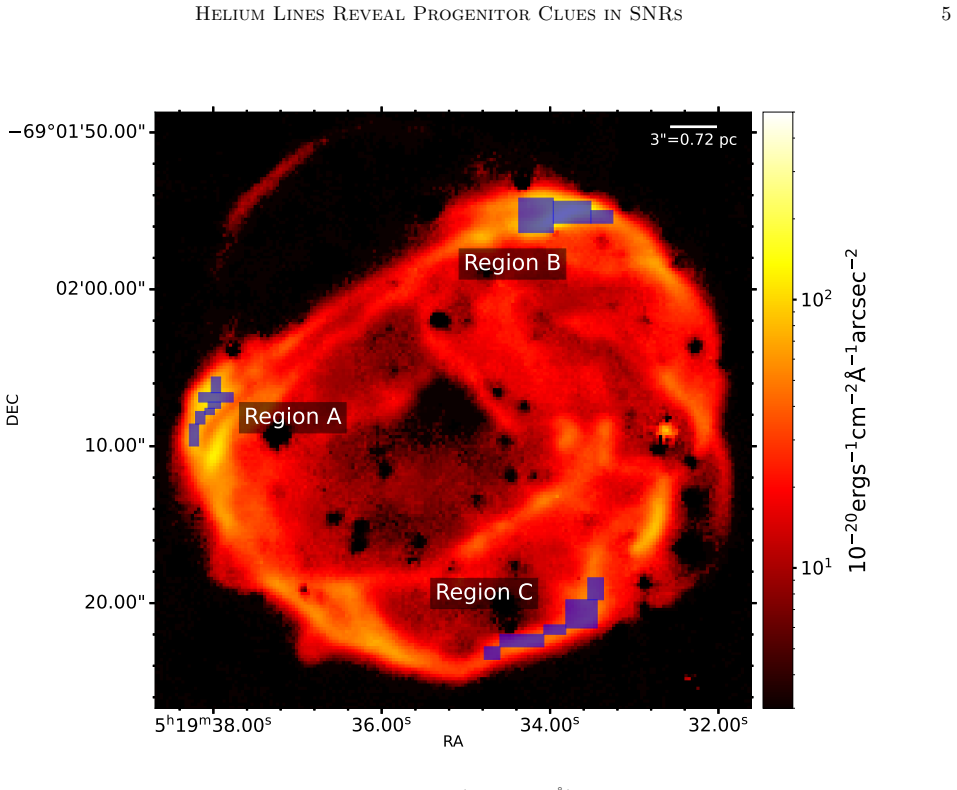
Balmer-dominated shocks in Type Ia supernova remnants offer powerful probes into collisionless shock physics and hints towards supernova progenitor environments. Prior studies focused on the hydrogen Balmer lines, which manifest as a superposition of broad and narrow emission lines. Using integral-field spectroscopy with MUSE, we discovered broad and narrow helium emission lines from Balmer-dominated filaments of three Type Ia supernovae remnants in the Large Magellanic Cloud: SNR 0509-67.5, SNR 0519-69.0 and N103B. We detect broad and narrow He~\textsc{i} 5876~\AA~,7065~\AA\ emission in SNR 0519 and N103B and He \textsc{ii} 8236~\AA\ in SNR 0519. In SNR 0509 we detect narrow He~\textsc{i} 5015~\AA, 6678~\AA, 7065~\AA\ and 7281~\AA, with only 7065~\AA~ exhibiting a broad component. The detection of narrow He\,\textsc{ii} challenges existing shock models, where such emission is not expected, and may indicate either incomplete ion-ion equilibration behind the shock or an origin in shock precursors. For SNR 0509 and N103B, the neutral He/H line ratios indicate enhanced helium abundances, whereas SNR 0519 is consistent with the primordial He/H value. We therefore propose helium emission in Balmer-dominated shocks as a new diagnostic of shock physics and Type Ia supernova circumstellar environments. Although our modeling is primarily a proof of concept, it demonstrates the possibility to infer the total He-to-H abundance ratio, with dominant uncertainties arising from the assumed initial ionization fractions. Despite the uncertainties, we demonstrate that narrow helium lines can serve as effective probes of circumstellar conditions and progenitor evolution when analysed alongside reliable constraints on the preshock neutral H/He abundance ratio.
TRAPPIST-1 is an ultra-cool dwarf that flares frequently. These flares shape the surrounding planets' high-energy irradiation environments, with consequences for atmospheric chemistry and escape, and they can contaminate transmission spectroscopy of those planets. A quantitative flare-frequency distribution (FFD) spanning the full energy range is therefore essential for both interpreting JWST spectra and modeling the planets' irradiation histories. Here we present a unified FFD over four orders of magnitude in energy by jointly analyzing $\approx$87\,hr of JWST/NIRISS and JWST/NIRSpec time-series spectroscopy together with $\approx$74\,days of \textit{Kepler}/K2 photometry. To enable a consistent comparison across these heterogeneous datasets, we convert all events to energies in the TESS bandpass. For the Kepler-to-TESS conversion we adopt a cooler flare continuum appropriate for ultra-cool dwarfs ($T_{\rm flare}=3500$\,K). After correcting for flare-detection sensitivities, the combined JWST+K2 cumulative FFD is consistent with a single power law, $N(\ge E_\mathrm{TESS})\propto E_\mathrm{TESS}^{-\beta}$, with $\beta=0.753$ over $E_{\rm TESS}\simeq10^{29}$-$10^{33}$\,erg. The slope of the distribution indicates that the time-averaged flare energy budget is dominated by rare, high-energy events rather than by the more numerous low-energy flares. This bandpass-consistent FFD provides a practical basis for JWST transit-spectroscopy planning and for modeling the flare-driven irradiation environment of the TRAPPIST-1 planets.
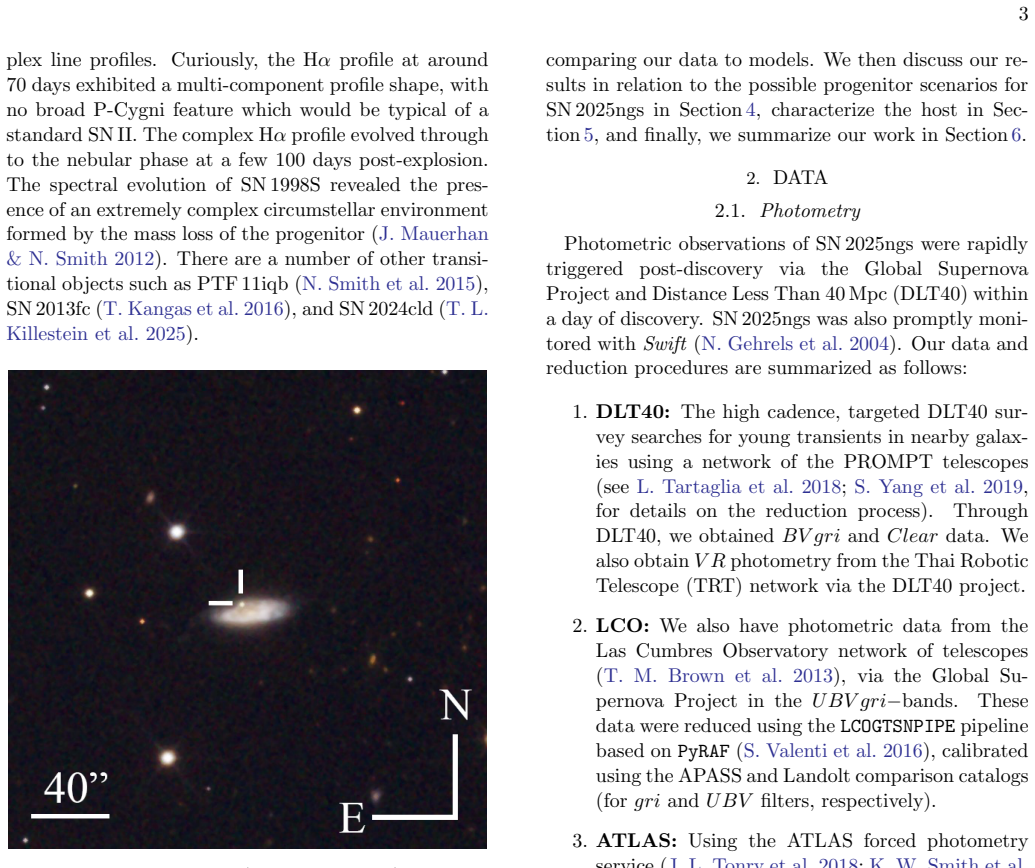
Interacting supernovae probe the twilight years of massive stars, exhibiting signatures of interaction between the supernova ejecta and surrounding material expelled from the progenitor. We present the peculiar interacting supernova, SN\,2025ngs in NGC5961 (37.8 Mpc). This transient toes the line between strongly interacting supernovae (type IIn) and type IIP supernovae. SN 2025ngs presents photometrically as a short-plateau supernova, with a plateau duration, t$_{\mathrm{PT}}^{}\approx70$ days. Interaction features subside within a week post-explosion, consistent with the growing number of flash supernovae, giving way to a short period where a typical IIP spectrum is exhibited. Towards the drop off the plateau, interaction features re-emerge, exhibiting complex H$\alpha$ profiles throughout the rest of the transient evolution. We compare with models of early spectra, finding the abundances generally consistent with a supergiant progenitor with a high mass-loss rate (10$^{-3}$ M$_\odot$ yr$^{-1}$). Early, high-resolution spectra reveal a double-horned H$\alpha$ profile, providing strong evidence for shock interaction with a proximate disk-like circumstellar medium. Spectroscopically, SN 2025ngs closely resembles the luminous SN 1998S, despite photometric differences, with SN 2025ngs having a relatively modest peak magnitude of $M_\mathrm{V}=-17.9$ mag, adding another member to the surprisingly diverse 98S-like group.
We present high-resolution zoom-in simulations of molecular clouds exposed to an interstellar radiation field and cosmic ray ionisation rate up to 1000 times stronger than that of the solar neighbourhood. We detail the evolution of the accretion discs that form around the first protostar in each simulation, for a total of 7 discs, for up to 100 kyr. The use of a zoom-in procedure allows for the au-scale discs to be well resolved (with resolution < 0.25 au) whilst retaining the structure of the wider parsec-scale molecular cloud. We find that discs exposed to a stronger radiation field tend to be more massive, hotter and denser. Similarly, their host stars grow to become more massive as a result of accreting more rapidly from their surroundings. All the discs show evidence of recurrent instability during the simulations, but only some of them fragment. We investigate whether stability metrics, such as the Toomre $Q$, $\alpha$ viscosity, and $\beta$ cooling parameter, can predict fragmentation by calculating them just before the discs fragment. We find that the metrics are generally unable to do so, as the discs appear stable even up to a few hundred years before fragmenting. In solar-like environments fragments are typically of planetary mass and often migrate to the centre of the disc, whereas fragments in a high-radiation environment are massive ($\rm > 0.1 \, M_\odot$) and fully disrupt/accrete from the progenitor disc. We conclude that the evolution and properties of circumstellar discs depend on both their radiation and physical environment.
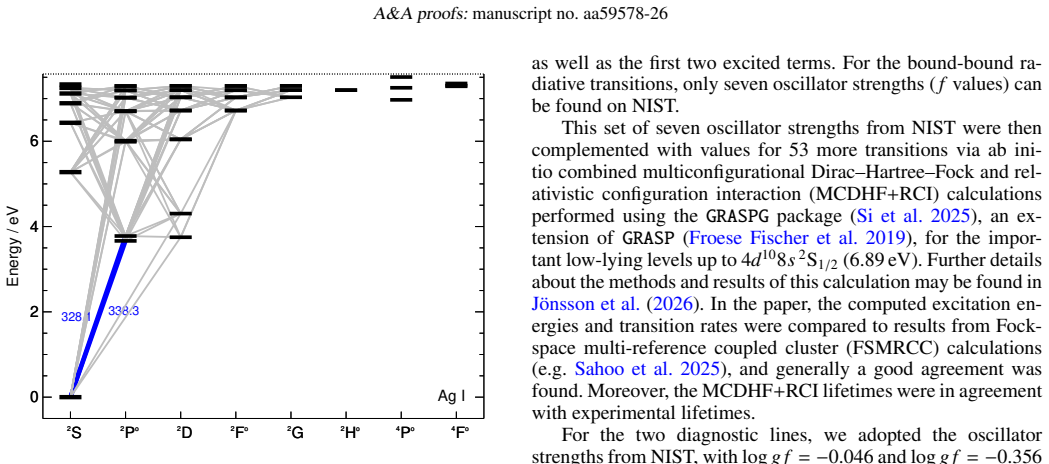
Silver is an important light neutron-capture element whose stellar abundances help constrain the origin of the weak r-process. The Sun is an important reference point for such studies; moreover, being a moderately volatile element in CI chondrites, the solar silver abundance is interesting as a diagnostic for the debated Sun-CI abundance vs. condensation temperature trend. These studies require accurate silver abundances that go beyond the commonly used assumptions of 1D atmospheres and local thermodynamic equilibrium (LTE); however, no consistent 3D non-LTE analysis of silver has been available to date. We present a new Ag I model atom built from carefully curated radiative and collisional data, including newly computed oscillator strengths using an ab initio multi-configurational Hartree-Fock method and inelastic hydrogen collision rates based on a combined asymptotic and free-electron model approach. We assess modelling uncertainties via targeted sensitivity tests, finding the results most sensitive to hydrogen collision data. Applying the model to the solar Ag I 328 and 338 nm resonance lines, we find severe positive abundance corrections from coupled 3D and non-LTE effects. Using revised equivalent width measurements, we derive a recommended solar 3D non-LTE silver abundance of 1.15 +/- 0.08. This is an increase of 0.19 dex relative to the current reference value. Our ab initio model significantly reduces the discrepancy with the meteoritic value from 0.25 to 0.06 dex; moreover, this residual offset is consistent with recent results for other moderately volatile elements. The Sun provides the benchmark test for the first Ag I non-LTE model atom presented here. In subsequent work, this model will be applied to determine 3D non-LTE silver abundances in metal-poor dwarfs and giants, enabling improved constraints on Galactic chemical evolution and weak r-process nucleosynthesis.
Stellar rotation is a fundamental ingredient in shaping the evolution of stars and it can also be used to trace past stellar interactions. Yet, systematic studies of stellar rotation in large samples of stars belonging to different populations have only recently been made possible, thanks to spectroscopic surveys. We profit from the catalogue of rotational broadening and rotation periods released with Gaia DR3. We focus on open clusters to study the rotational behaviour of several interesting populations including, among others, blue stragglers and extended main sequence turnoffs (eMSTO). We use literature lists of almost a million member stars in several thousand open clusters in the Milky Way. We collect properties of stars and clusters from large surveys, including Gaia, and from various literature sources. We include a comprehensive collection of known variables and binary stars from various databases. We manually select (exotic) stellar populations from the color-magnitude diagrams of individual clusters and study their rotational properties. Our catalogue contains more than 44 000 rotationally characterised stars, almost 57 000 variables (excluding binaries) and more than 22 000 binary stars. We find several interesting results, including a few hundred new blue stragglers, several fast rotating red giants, and we increase the number of clusters with an eMSTO to 96. We discover that most clusters more massive than $10^3$ $M_{\odot}$ display an eMSTO. We present a new parametrization of the number of blue stragglers as a function of cluster mass and age. We find that the percentage of binary stars in the equal-mass binary sequence and in the main sequence are similar. We present the first large-scale statistical exploration of stellar rotation in open clusters, which already yielded new interesting results and which can be used as the basis for several detailed follow-up studies.
In the coming decade, the millihertz gravitational wave observatory LISA will provide the best constraints yet on the tens of thousands of close white dwarf binaries in the Milky Way, yielding unprecedented insights into the most abundant class of compact object binaries. Following inspiral via gravitational wave emission, interacting white dwarf binary pairs can lead to a multitude of outcomes, including AM Canum Venaticorum (AM CVn) binaries, R Coronae Borealis stars, young, rapidly-spinning single white dwarfs, (millisecond) magnetars, and a variety of explosive transients, most notably Type Ia supernovae. Current and future electromagnetic observations of these various outcomes coupled with the forthcoming flood of data from LISA place us on the precipice of a significant advance in our understanding of the long-term fate of white dwarf binaries. In this paper, we present a suite of mock catalogs of the Milky Way's white dwarf merger history, created using the population synthesis code $\texttt{COSMIC}$. We summarize the various merger outcomes expected (based upon varying white dwarf masses and chemical compositions) and explore ways the rates of these outcomes may vary with model uncertainties pertaining to binary evolution. We publicly release these merger catalogs as a tool for facilitating connections between gravitational wave science and white dwarf binary astrophysics.
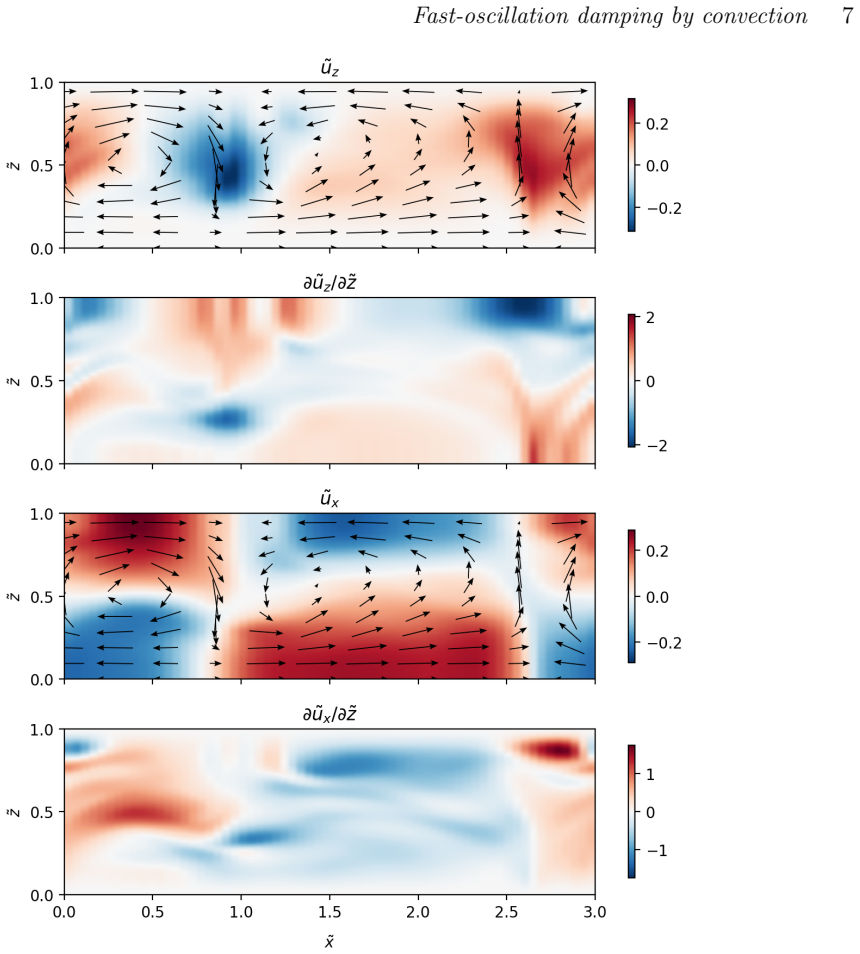
We present three-dimensional Dedalus simulations of Rayleigh-B\'enard convection with a blackbody-radiating free upper surface, subject to a low-amplitude oscillatory forcing that mimics tidal perturbations in convective envelopes of stars and planets. The forcing period is 10-100 times shorter than the convective timescale, $t_{\rm conv}$. Using a Reynolds decomposition of the velocity field averaged over one oscillation period, in which the tidal oscillations naturally constitute the fluctuating field and convection the mean flow, we elucidate the kinetic energy exchange between the two. Provided the oscillatory Reynolds number exceeds a modest threshold, we find that the oscillations systematically transfer kinetic energy to the mean flow at a volume-averaged rate $D_R \sim u'^2 t_{\rm conv}^{-1}$, where $u'$ is the rms fluctuation velocity. This reflects strong, order-unity correlations between the fluctuation velocities and the mean flow. These arise because the oscillatory forcing displaces fluid elements that are then redirected by buoyancy and incompressibility in the same manner as the mean flow. The transfer is dominated by correlations involving vertical velocity fluctuations and vertical gradients of the mean flow. The resulting energy transfer rate is consistent, within the equilibrium-tide framework, with the observed tidal circularisation of solar-type binaries and with the orbital evolution of moons of Jupiter and Saturn. This validates the formalism proposed by Terquem (2021) for the dissipation of fast tides, a longstanding problem. Replacing the free surface with a rigid upper boundary significantly and artificially modifies the correlations.
Supernova remnants (SNRs) play a central role in shaping the interstellar medium. Core-Collapse Supernova (CCSN) progenitors are massive stars, which produce a dense circumstellar medium (CSM) through intense mass loss in post-main sequence evolution. The subsequent CCSN produces a strong shock which expands into a highly structured, complex magnetised environment. Magnetohydrodynamic (MHD) consideration of pre- and post-CCSN evolution in multi-D are desirable to further our understanding of non-thermal aspects. We aim to determine how detailed stellar evolution treatment influences the shock propagation, focusing on Red Supergiants (RSGs) and Wolf-Rayet (WR) stars. We use the PION code to perform 3D MHD simulations of these CCSN progenitors. We use a detailed stellar evolution prescription to accurately and self-consistently model the pre-SN CSM and initialise CCSN explosions to investigate the surrounding environment. Our 2D and 3D treatment, inclusion of radiative cooling and assumption of full photoionization produces CSM features not identified in previous work. In the WR model we produce a coherent set of fast reflected shocks. In both cases we find faster forward shocks than predicted by analytic theory due to additional wind acceleration from photoionization for the RSG case, and accounting for the CSM expansion in the WR case. Model predictions of slowly rotating RSG and WR stars results in weakly magnetised wind bubbles, limiting potential for their SNRs to become PeV particle accelerators. Detailed multi-D MHD treatment of the CSM is needed to account for SNR evolution beyond the wind termination shock, where dynamic instabilities can be important. Including self-consistent stellar evolution is important for determining the CSM density and magnetic field structure close to the star, which govern the shock properties and SNR evolution for the first few hundred yr. (Abridged)
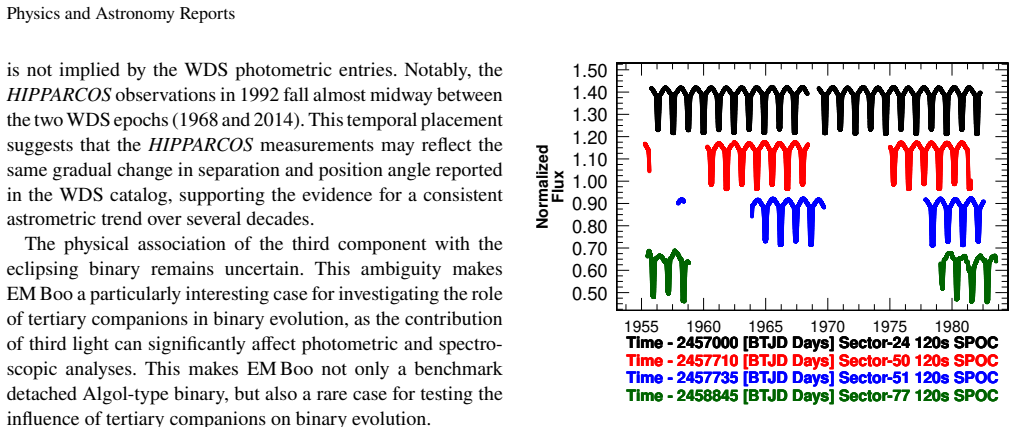
We present a comprehensive photometric and spectroscopic study of the triple stellar system EM\,Boo. The system is composed of detached, low-mass components, and for the first time in the literature, the spectrum of the tertiary component has been successfully disentangled from the composite spectrum using the \texttt{KOREL} code. Synthetic spectra were generated for each disentangled component, allowing determination of their atmospheric parameters. The depth of the H$_\alpha$ line in the tertiary spectrum indicates that it is an intermediate-temperature star, consistent with spectral types between A and F, and its effective temperature was determined to be 7000~K. By analyzing the radial velocity and light curves simultaneously, the fundamental physical parameters of the system were derived, and its detailed evolutionary status was investigated using \texttt{MESA} models. The \textit{HIPPARCOS} trigonometric parallax ($\varpi_{\rm Hip}=1.33\pm1.45$ mas) and \textit{Gaia} DR3 trigonometric parallax ($\varpi_{\rm Gaia}=3.9699\pm0.1812$ mas) show a significant discrepancy, most likely related to the system's multiplicity and the limitations of single-star astrometric solutions. To provide independent distance estimates, we modeled the spectral energy distribution (SED) using multi-wavelength flux data, yielding $E(B-V)=0.05$ mag and a trigonometric parallax $\varpi_{\rm SED}=3.2$ mas, corresponding to $d_{\rm SED}=313$ pc. Furthermore, photometric distance estimates based on the components' absolute magnitudes yield $d_{1}=299$ pc and $d_{2}=301$ pc, in good agreement with the SED-based distance. Both the SED-based and photometric distances converge around $d=300$ pc, indicating that the \textit{Gaia} trigonometric parallax underestimates the true distance of EM\,Boo.
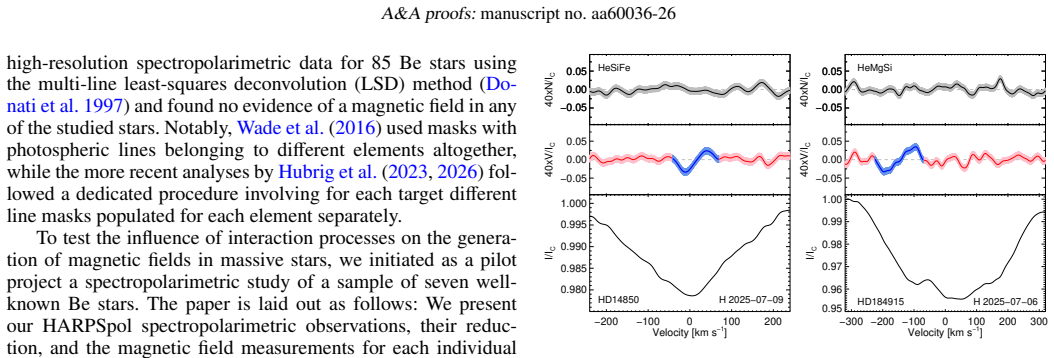
Recent observational studies suggest that Be stars most likely are formed through the process of mass transfer in binary systems. In view of the wide consensus that the origin of the magnetic field in stars with radiative envelopes involves binary interaction processes, searching for magnetic fields in Be stars appears especially promising. As a pilot project, we searched for the presence of magnetic fields in a sample of seven well-known Be stars. We used high-resolution HARPSpol spectra to measure the mean longitudinal magnetic field, employing the least squares deconvolution technique. A dedicated measurement procedure introduced by our group in recent years was applied. Opposite to previous spectropolarimetric studies reporting that magnetic fields in Be stars are weak and usually below 100 G, our study presents the first observational evidence that magnetic fields in Be stars can be as strong as a few hundred gauss. Magnetic fields are detected in all studied Be stars, with the strongest magnetic field being about -460 G for the B0.5 III star HD 184915. Magnetic fields in the range between 338 and 380 G (in absolute values) are detected in three other Be stars, HD 209409, HD 209522, and HD 224686. Due to the fact that magnetic fields in Be stars are stronger than previously believed, we must re-evaluate our understanding of the initial conditions of massive binaries to be able to determine the origin of such systems.
The interaction of a fast magnetoacoustic wave with a magnetic null point is studied in the context of the sympathetic flare phenomenon. Attention is paid to steepening the wave caused by the finite-amplitude effects in a non-uniform plasma environment. The null point is modelled by a potential magnetic configuration without a guiding field. The equilibrium plasma density and temperature are taken to be constant. The fast wave is excited by an impulsive point source outside the distance at which the local Alfv\'en and sound speeds are equal to each other. The incoming fast wave approaches the null point along the bisector of the magnetic configuration, i.e., across the local field. The fast-speed non-uniformity around the null point causes the refraction of the incident fast wave. However, the segment of the incoming wave, which approaches the null point is locally plane. The decrease in the fast speed towards the null point amplifies the nonlinear deformation of the incoming wave. Hence, the fast wave can become subject to nonlinear dissipation at a distance from the null point and not reach it.
This study quantifies how uncertainty in physically meaningful coronal mass ejection (CME) and solar-wind inputs propagates into forecast-relevant diagnostics from eruption to 1 AU. We use a semi-analytic erupting flux rope (EFR) model to simulate CME initiation and Sun-to-1 AU propagation under Lorentz, gravitational, and drag forces, driven by a prescribed time-dependent poloidal-flux injection. Relative to the original EFR formulation, we include sheath and pile-up effects through an effective mass and update the drag term for CME solar-wind coupling. The model is embedded in a Monte Carlo framework with truncated-normal sampling of key eruption and background solar-wind inputs. Across six CME events, the ensembles show event-dependent dispersion in the 1 AU diagnostics. For +/- 20% input sampling, all spreads are 1-sigma ensemble standard deviations. The time-of-arrival spread is 2.4-7.7 h and is mainly controlled by the poloidal-flux injection history, upstream wind speed, and drag coefficient. The leading-edge speed spread is 28-53 km/s and is primarily controlled by background-flow properties. Magnetic-field diagnostics show two regimes: the sheath field is relatively tightly distributed, with a spread of 1-3.5 nT and sensitivity to upstream wind, size, and expansion scaling, whereas the internal flux-rope field has a larger spread of 1-7.6 nT and is governed mainly by eruption-driving and flux-content parameters. The impact-duration spread is 2.4-6.3 h and is controlled mostly by geometric size and expansion scaling, with additional sensitivity to the driving timescale. These results establish a quantitative link between EFR input uncertainties and the resulting spread in CME arrival and impact diagnostics, identifying the physical parameters that most strongly limit forecast precision at 1 AU.
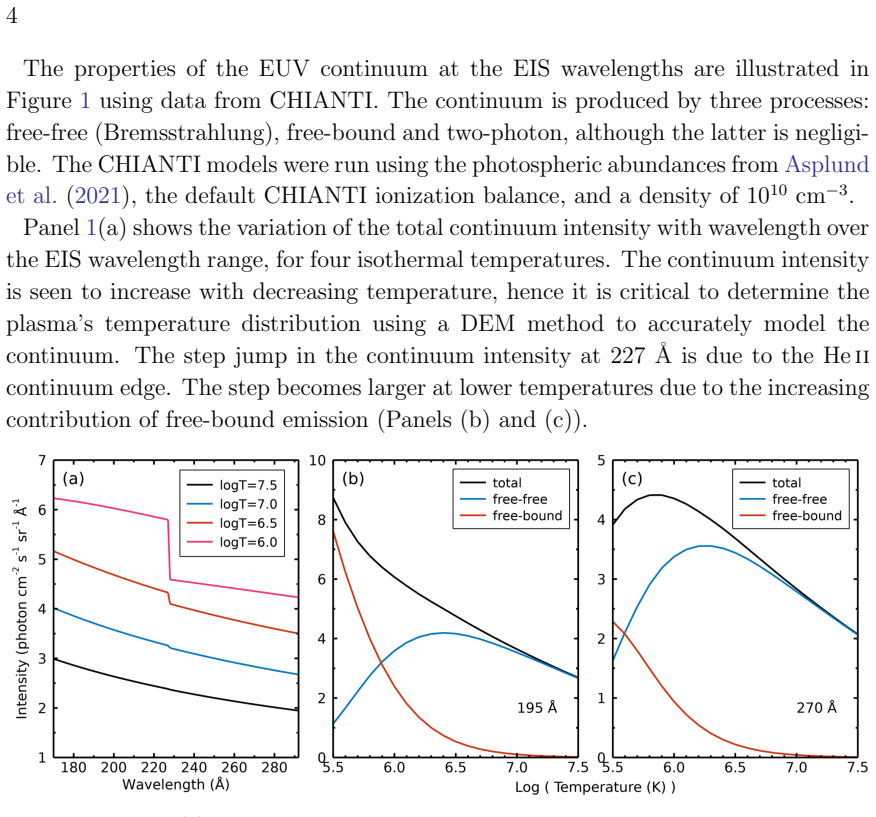
Continuum emission from a solar flare observed with the Extreme ultraviolet Imaging Spectrometer (EIS) on board the Hinode satellite is used to obtain the radiometric calibration of the instrument. The flare had a GOES class of M8, and peaked at 23:59 UT on 2024 September 30. The continuum is modeled by computing a differential emission measure curve using EIS emission lines and atomic data from the CHIANTI database. The ratio of the observed continuum to model continuum yields effective area curves for the instrument. The new curves confirm earlier findings that the EIS long-wavelength channel has degraded by a factor two compared to the short-wavelength channel. However, no evidence is found for the fine-scale structure in the effective area curves that has been presented by previous authors. In order to reproduce both the emission line intensities and the continuum, it is found that the plasma must be depleted in elements with low first ionization potentials (FIPs), i.e., the so-called inverse FIP-effect. In particular, the Fe/H relative abundance is found to be a factor 0.57 below the photospheric value at a temperature of 10 MK. This is confirmed by analysis of soft X-ray spectra from the Solar X-ray Monitor on Chandrayaan-2, which yields an Fe/H FIP bias of 0.55 averaged over the entire flare.
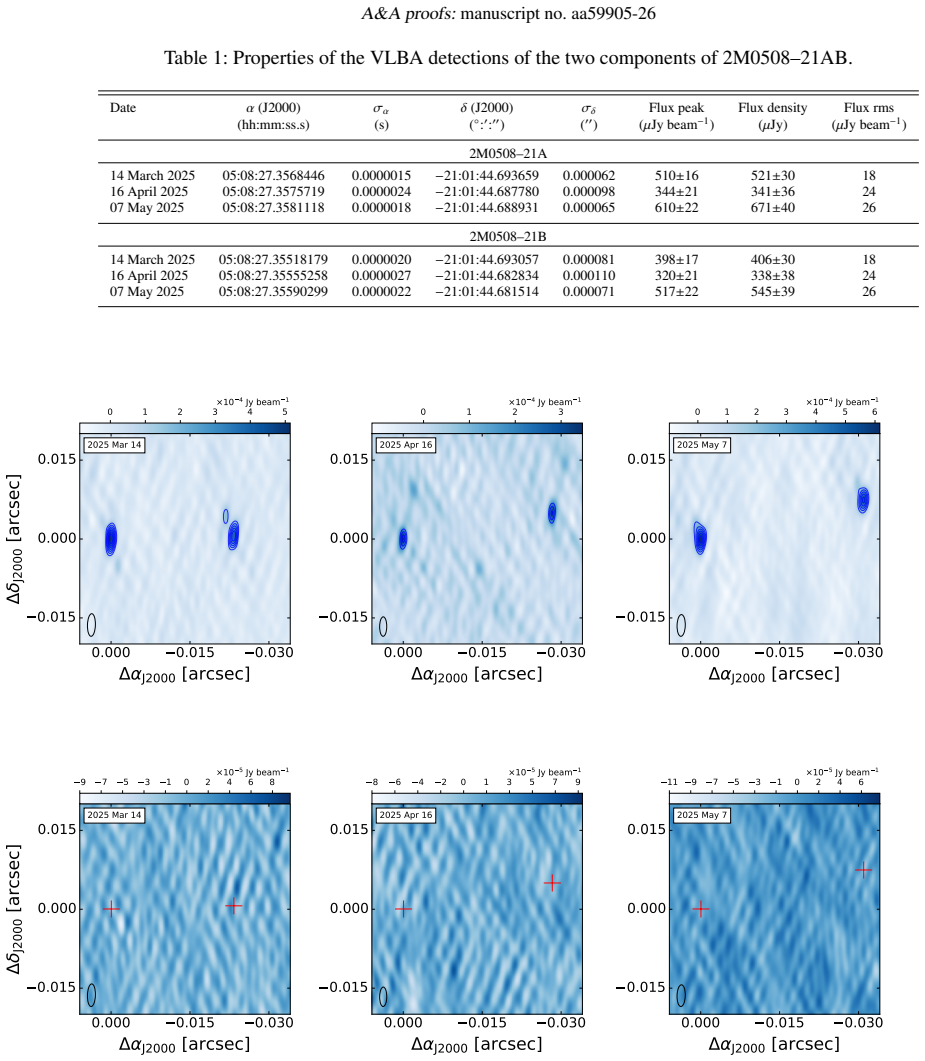
We uses very long baseline interferometry to constrain the orbit of the binary system 2MASS J05082729-2101444. We observed the system with the VLBA in three epochs at a frequency of 4.85 GHz, which provides an angular resolution of about 3 mas. We combined the three radio astrometric observations, 119 RVs (60 VIS and 59 NIR) obtained with the CARMENES high-resolution spectrograph over a period of 8.1 years, and a relative astrometric measurement of an archival H-band Keck NIRC adaptive optics image to fit the orbital motion of the binary system. The VLBA observations resolved the binary system and show emission from both stellar components, with similar flux density levels (0.34-0.67 mJy) and showing slight temporal flux variations. The emission appears quiescent, with no significant circular polarization, and with no flare events. We obtained a fit of the orbital motion of this binary system, which has an eccentric orbit (e = 0.71) with an orbital period of 2.19 yr and a semimajor axis of 26.964 mas (1.3 au). The VLBA observations made it possible to resolve the binary system and identify both stars as radio-loud sources. The combined fit shows that 2M0508-21 is an M-dwarf binary with a total dynamical mass of $0.459\pm0.007$ M$_{\odot}$, assuming Gaia parallax. This mass is slightly larger than those estimated from the luminosity and theoretical evolutionary models. The upper limit of the circular polarization at 4.85 GHz ($\lesssim$10\%), the persistence of the quiescent emission, and the relatively low brightness temperatures are consistent with a gyro-synchrotron or synchrotron origin for the radio emission. Further VLBA observations are needed to obtain the individual masses of the stars, as well as to verify Gaia's parallax of the system. A complete characterization of the system will help improve evolutionary models for young objects at the substellar boundary.
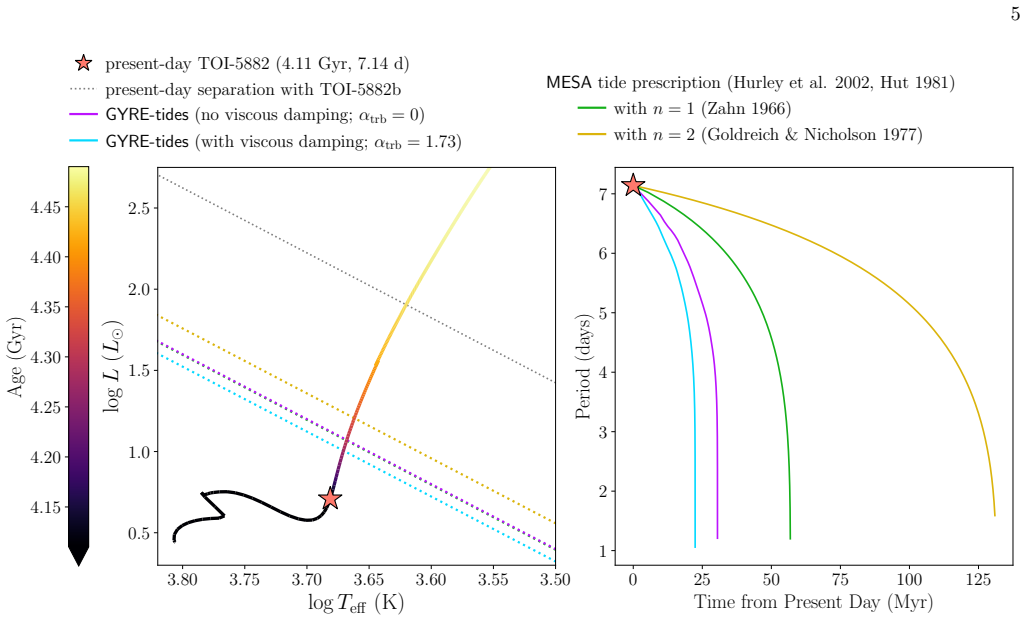
We present a self-consistent tidal evolution framework that couples binary evolution from MESA to the full linear tidal response from GYRE-tides. Applying this framework to TOI-5882, a subgiant hosting a short-period brown dwarf, we show that interior radiative damping dominates the system's tidal evolution, with the classical equilibrium tidal model significantly underestimating the star's angular momentum evolution by several orders of magnitude. Consequently, our combined framework predicts a 2--6 fold reduction in the engulfment timescale, accelerating the companion's inspiral by roughly 25--110 Myr. By modeling angular momentum transport through the star as it evolves, we demonstrate that the early inspiral is driven by the non-resonant dissipation of internal gravity waves, before transitioning into a regime dominated by resonance crossings as the system approaches Roche-lobe overflow. We highlight the necessity of reframing the historical dichotomy between equilibrium and dynamical tides and instead propose categorizing tidal interactions around their dissipation mechanisms: radiatively and viscously damped tides. Our framework is broadly applicable to the tidal modeling of a wide class of star-companion systems, from binary stars to hot Jupiters, in a self-consistent and computationally feasible manner.
Detection rule using NUV signatures recovers 14 of 18 HΞ± events and estimates formation height.
abstractclick to expand
Context. Ellerman bombs (EBs) are observational signatures of small-scale magnetic reconnection, key to understanding the lower solar atmosphere. While their role in active regions has been widely studied using the H$\alpha$ line, near-ultraviolet (NUV) spectra routinely observed by the Interface Region Imaging Spectrograph (IRIS) offer a promising alternative for EB identification, enabling large-scale studies. Aims. We aim to identify the most important spectral signatures of EBs in the IRIS NUV spectra. With this, we seek to develop a robust criterion for their detection solely using the IRIS NUV spectra. In parallel, we determine the typical atmospheric stratification associated with EBs. Methods. We used four coordinated observations between the Swedish 1-m Solar Telescope (SST) and IRIS. Using the H$\alpha$ line as a reference, we detected 18 different EBs and studied their associated IRIS NUV spectra. In addition, we used the IRIS$^{2+}$ inversion tool to infer the temperature, line-of-sight velocity, and non-thermal broadening from the EB spectra. Results. The defining feature of EBs in the IRIS NUV is the enhancement of the wings of the subordinated Mg II triplet in between the Mg II h&k lines. Inversions reveal that these signatures are produced by localized temperature increase of $\Delta$ T~1650 K around log$\tau$=-3.8. Using only the Mg II triplet signatures, we found a detection criterion that successfully recovered 14 of 18 H$\alpha$-detected EBs. In addition, the shape of the Mg II h&k lines in relation to the Mg II triplet can serve as a proxy for the EB formation height. Conclusions. The NUV spectrum observed by IRIS is a good candidate for detecting EBs, opening the doors to large-scale studies across the extensive IRIS database, removing the dependence on H$\alpha$ observations.
Thermohaline convection is a standard chemical mixing process in stellar interiors, yet its mixing efficiency is not fully settled. Competing theories predict turbulent diffusion coefficients, $D_\mu$, that can differ by orders of magnitude, leading to uncertainties in stellar models and interpretations of observations. This paper explores a potential resolution to existing discrepancies. We first complete the linear stability theory and identify two types of unstable modes: slow growing modes at large length scales and fast growing modes at small length scales. We then reevaluate $D_\mu$ considering the full spectrum of unstable modes and find that it can self-consistently interpolate between previously proposed theoretical scalings across the instability parameter space. The question of thermohaline mixing efficiency in stars may be settled by future simulations that quantify the scale-dependent contributions of fast and slow modes to $D_\mu$ and determine how the modes dominating the transport change across parameter space.
The frequency of pressure (p) mode in $\delta$~Scuti stars can exceed the Nyquist limit of \textit{Kepler} long-cadence photometry. {These 'super-Nyquist frequencies' (SNFs) are observed as 'reflected' peaks at lower frequencies, i.e., they are Nyquist aliases that pose} a threat to asteroseismic diagnostics. Their impact on $\delta$~Scuti p modes has yet to be comprehensively explored. We performed a systematic survey to search for SNFs in 1,838 \textit{Kepler} $\delta$~Scuti stars through a novel technique based on sliding Lomb-Scargle periodogram, identifying 15,265 confirmed SNFs in 1,309 stars, from a total of 259,883 frequencies. We observe that the total number of detected frequencies per star remains featureless across the $\delta$~Scuti instability strip; however, young stars pulsate in higher frequencies and so have significantly more SNFs on average. Both the number and the rate of SNFs diminishes accordingly as $\delta$~Scuti stars become more evolved, which is consistent with both observation and stellar models. Furthermore, our method detects a greater fraction of modes as SNFs at higher frequencies, rising from approximately 1\% at 20 \(\mu \)Hz to 23\% at the Nyquist limit. The rate of underdetection is highest amongst low-amplitude modes. The SNF modulation patterns can be well distinguished from phase modulations induced by binarity or nonlinear mode interactions. We provide a frequency catalog for future asteroseismic studies of $\delta$~Scuti stars, wherein we identify each peak as being real or an alias, enabling further investigations into regular patterns of pulsation modes, linear combination frequencies, and theoretical modeling.
Energetic electrons accelerated at coronal reconnection sites during solar flares precipitate into the lower solar atmosphere, generating nonthermal emissions and regulating energy deposition. However, how their transport and precipitation are jointly governed by the three-dimensional (3D) magnetic topology, turbulent scattering, and Coulomb collisions remains unclear. Here, we aim to disentangle these physical processes by using a data-constrained 3D particle transport model for the 2011 August 4 flare. The simulated distribution of precipitated electrons aligns closely with photospheric quasi-separatrix layers and reproduces the observed two-ribbon morphology in 1700~\AA. We reveal a strong polarity asymmetry, with the 10~s precipitation fraction about six times higher in the weak positive polarity. This arises primarily from distinct mirror ratios of different polarities under the 3D magnetic configuration and can be understood via a modified escape probability for an asymmetric magnetic bottle. Varying strengths of turbulent scattering lead to a rise-then-fall trend and a pronounced energy dependence in the precipitation fraction. Coulomb collisions globally suppress precipitation, especially at low energies, and further amplify the polarity asymmetry. This integrated modeling framework bridges detailed transport physics to observable flare emissions and advances the development of quantitative models for realistic solar flare events.
Due to computational efficiency and numerical stability limitations, coronal simulations constrained by static magnetograms are typically performed first and then used to drive inner-heliosphere (IH) models. In this paper, we calculate the Sun-to-Earth coronal and wind evolutions using a single time-evolving MHD model, showing that implicit MHD models have the potential to meaningfully simplify and improve the overall Sun-to-Earth modelling pipeline. We extend the implicit time-evolving coronal MHD model COCONUT out to 1 AU, and utilise it to investigate solar coronal and wind evolutions around a solar maximum Carrington rotation (CR). We compare quasi-steady-state and time-evolving Sun-to-Earth simulations to evaluate the impact of the inner-boundary magnetic field evolution, which is neglected in steady-state simulations, on background plasma parameters. Comparisons with commonly used coupled Sun-to-Earth simulations are also conducted to further validate and assess the Sun-to-Earth model COCONUT. The results show that the time-evolving implicit MHD modelling approach yields noticeable differences compared to oversimplified steady-state simulations, and is efficient enough for practical applications. Modelling the solar corona and wind using a single MHD model simplifies the modelling pipeline and avoids uncertainties associated with coupling different coronal and IH models. The noticeable differences in the temporal evolution of plasma parameters at the L1 and L5 points highlight the need to use continuously evolving, synchronised magnetic field observations to improve global coronal and solar wind simulations, whereas the overall consistent evolutionary trend reveals the reliability of using L5 observations to forecast solar wind conditions near Earth about four days in advance.
High-quality, short-cadence photometry from TESS enables the detection of rapid oscillators with unprecedented sensitivity. In this work, we conduct a homogeneous search for high-frequency variability using 20-second cadence light curves from TESS Cycle 7 (Sectors 84--96). From $\sim 3.9\times10^{4}$ light curves, we compute Lomb-Scargle periodograms and select candidates exhibiting at least one significant signal with $\mathrm{FAP}\le 10^{-4}$ at frequencies $f\ge 50~\mathrm{d^{-1}}$. After excluding previously reported objects and performing pixel-level and light-curve vetting to mitigate contamination, we identify 73 rapid oscillators, including 24 pulsating white dwarfs, 31 hot subdwarfs, and 18 A-F stars. Using an iterative prewhitening procedure, we carry out a detailed frequency analysis for each target and derive the oscillation frequencies and amplitudes. We further investigate the physical origins of the detected frequency content and present statistical characterizations of the rapid-oscillator sample. We highlight one white dwarf and one subdwarf that exhibit clear frequency multiplets consistent with rotational splitting. This work enlarges the sample of rapid oscillators accessible with TESS data and provides a uniformly measured frequency-amplitude catalog, establishing a consistent basis for future asteroseismic and population studies.
Metallicity can play a significant role in massive binary evolution through its impact on the opacity within stellar interiors and wind-driven mass loss. In this work, we investigate how the double neutron star (DNS) delay time distribution (DTD) is shaped by the metallicity-dependent evolution of the helium star$-$NS progenitor system. Drawing from insights rooted in single and binary star physics, we argue that at a given metallicity, the stellar radius during the helium main-sequence sets a lower limit on the size of the DNS orbit at birth. We then perform population synthesis with the detailed binary evolution code POSYDON to illustrate the resulting DTD across a range of metallicities. Our results indicate that, independent of binary physics assumptions, the majority of DNS mergers across metallicities occur typically no earlier than $\simeq 40\,\rm{Myr}$ after star formation and peaks strongly between $80-250\,\rm{Myr}$. Roughly $15\%$ of DNSs merge within 80 Myr, which may explain $r$-process enrichment in environments with brief star formation histories, while $\gtrsim 20\%$ merge on delay times $>1$Gyr, providing an explanation for short gamma-ray bursts in old, metal-poor galaxies. The shape of the DTD can be complex, with a metallicity-dependent split in the dominant formation channel imprinting a characteristic double-peaked structure. Although ideally oriented natal kicks can produce very short merging DNS, we find that the required kick magnitudes are inconsistent with observations. Our work has implications for assessing the contribution of DNS mergers to $r$-process enrichment and gamma-ray bursts/kilonovae transients across cosmic time.
k-like shapes signaling suprathermal velocities appear far more often when the field is nearly perpendicular to the line of sight.
abstractclick to expand
High resolution spectral observations of transition region spectral lines capture the signatures of energy deposition and redistribution at the boundary between the lower and upper atmosphere, and have significant relevance for investigating the physical processes responsible for heating the solar atmosphere. Spectroscopic observations of the solar transition region have long revealed excess line broadening and non-Gaussian profiles, but their physical origin remains debated, and their spatial distribution and prevalence not well established. Here we analyze Si IV line profiles in full-disk mosaics of observations with Interface Region Imaging Spectrograph (IRIS), and show that the non-Gaussian profiles comprise ~60% of the observed profiles, significantly more than previously reported. The IRIS observations, together with magnetic field extrapolations, indicate that the degree of non-Gaussianity systematically depends on the viewing angle between the line of sight and the magnetic field. We find that k-like profiles, indicative of suprathermal velocity distributions, are significantly more prevalent when the magnetic field is oriented at a large angle with respect to the line of sight, at all intensity levels. k-like profiles on average correspond to more limited line width and reduced redshift, compared with Gaussian profiles, particularly in bright regions, such as plage and moss. The results provide observational evidence of the importance of anisotropic kinetic processes in the solar transition region that are not captured by the magnetohydrodynamic approaches that are typically invoked to study the low solar atmosphere. Our observations indicate that more advanced multi-fluid and/or kinetic modeling should be developed.
3D simulation shows only dense cool material produces the narrow multi-band jets seen in the corona.
abstractclick to expand
Reconnection-driven nanoflares are widely considered a leading mechanism for coronal-loop heating, but their direct fingerprints in the tenuous coronal plasma remain elusive. The recently discovered coronal nanojets offer a potential probe of reconnection dynamics, but their extreme collimation, directionality and multi-wavelength visibility are not fully understood. Here we present a 3D rMHD simulation that unprecedentedly reproduces the key properties of nanojets, offering a viable model to explain their nature. These results provide a unified picture in which nanojet morphology, dynamics and detectability are contingent on the thermodynamic environment of reconnection. Together, our results point to a cool origin of coronal nanojets, where cool and dense material permits narrow, multi-band jet signatures to emerge from reconnection.
Coupling between the photosphere, chromosphere and corona in the quiet Sun (QS) is governed by a complex interplay between magnetic structuring, heating, mass loading, and radiative cooling. Constraining how this balance responds to variations in small-scale magnetic flux remains limited. We investigate how chromospheric heating and its thermodynamic coupling to higher atmospheric layers vary as a function of small-scale magnetic flux emergence. We performed a parametric set of 3D radiative-MHD simulations with the Bifrost code, starting from a weakly magnetised QS reference model and injecting horizontal magnetic flux of increasing amplitude into the sub-surface convection zone. The resulting chromospheric dynamics, heating, mass loading, and coronal response were analysed. Chromospheric temperatures and mechanical heating rise monotonically with increasing magnetic-field strength. Although the fractional contribution of shocks decreases, reconnecting current sheets keeps maintaining about 50%. In contrast, the temperature at the base of the corona exhibits a non-monotonic response, reaching a maximum at intermediate magnetic amplitudes and decreasing for the strongest-field case. We show that stronger magnetic-field strength increases chromospheric heating, which increases the coronal-base density through efficient mass loading, and amplifies radiative losses. These density-driven radiative losses dominate the coronal energy balance and thus lead to reduced coronal-base temperatures despite increased heating. Our results demonstrate the sensitivity of chromospheric structure and dynamics to small-scale flux emergence, and its key role in regulating coronal thermodynamics. This result illustrates the chromosphere-s role as a thermodynamic gatekeeper, and further warrants future investigations of atmospheric models relevant to global solar-wind models and space-weather forecasts.
Hot subdwarf binaries with white dwarf companions with orbital periods of less than two hours are progenitor candidates for massive single white dwarfs as well as a variety of thermonuclear explosions. Our aim is to determine the binary properties of the hot subdwarf -- white dwarf system ZTF J000742.62+480414.51, model its future evolution, and characterize the brightening events seen in TESS photometry. Using data from ZTF and TESS, we performed a Lomb Scargle analysis to find the orbital period and the period of the brightening events. Analysis of time-resolved spectroscopy was combined with light curve modeling to determine the effective temperature, surface gravity, and radius of the primary star, the masses of both stars, and to confirm the presence of an accretion disk. X-ray observations were performed with Swift, and MESA modeling was used to find the future evolution of the system. The kinematics of the system were also calculated. ZTF J000742.62+480414.51 consists of an accreting $0.48\pm0.01\,M_\odot$ white dwarf with a $0.42\pm0.01\,M_\odot$ B-type hot subdwarf acting as a donor. The system exhibits SU UMa type dwarf nova outbursts with a recurrence time of $P_{\mathrm{out}} \approx 9$ days. No X-rays were detected, with an upper limit on the X-ray luminosity of about $3\times10^{31}$ erg/sec. The system lies in the Galactic thin disk, and has an orbital period of $P_{\mathrm{orb}} = 108.72\pm0.01$ minutes. The system has likely formed from a main sequence binary with component masses $\gtrsim2\,\mathrm{M_{\odot}}$ and will likely merge into a single white dwarf, but a thermonuclear explosion cannot be ruled out. ZTF J000742.62+480414.51 consists of a low mass white dwarf actively accreting hydrogen rich material from a B-type hot subdwarf, and is the first hot subdwarf -- white dwarf system discovered that produces dwarf nova outbursts.
In this paper, we use a highly sensitive telescope to characterize solar X-ray transients ranging from microflares in active regions down to weakly energetic brightenings in the quiet Sun. X-rays are closely linked to the initial energy release and immediate heating of solar flares, making them invaluable in understanding their driving processes. NuSTAR is the first long-term, direct focusing hard X-ray observatory to have observed the Sun, offering a unique opportunity to search for and characterize X-ray events from inside and outside active regions that would be otherwise unobservable. We present the first statistical survey of NuSTAR solar observations, characterizing the thermal and possibly nonthermal properties of 113 weakly energetic transients down to $10^{26}$ erg, making this the first to directly compare events from the quiet Sun to those in active regions. Relative to RHESSI microflares, our NuSTAR transients are generally cooler, dimmer, and have slightly steeper spectra. Thermal energy content of active region transients appears to be independent of the volume of emitting plasma for transients produced by active regions. This is in contrast to those from the quiet corona, which on average have lower energy content, smaller emission volumes, and appear cool but bright rather than hot but dim, suggesting a break in trends from traditional microflares. We found no quiet Sun transients with a thermal energy content above $3^{27}$ erg, implying an upper limit on the amount of energy released in plasma above 3 MK by quiescent processes.
While flare-associated CMEs generally show a strong association between flare X-ray flux and CME kinematics, their volumetric evolution and its link to both kinematics and flare activity remains less explored. In this study, we investigate the volumetric and kinematic co-evolution of ten Earth-directed, flare-associated CMEs using multi-viewpoint observations from STEREO-A, STEREO-B, and SOHO. We perform 3D reconstructions of the CME flux ropes with the Graduated Cylindrical Shell (GCS) model and derive their geometrical parameters. We find that the total CME volume follows a power-law dependence on the leading edge height, and that different structural components expand at different rates, with the ellipsoidal front expanding faster than the conical legs. Furthermore, the volumetric evolution follows a multi-phase pattern: initial overexpansion, a gradual reduction in the expansion rate, and finally saturation at a higher heliocentric distance. This is similar to the well-established three-phase evolution of the CME kinematics. Notably, the second-order derivative of volume with time shows a strong temporal correlation with both CME acceleration and the GOES soft X-ray flux of the associated flare. This is the first study to report such a correspondence between volumetric evolution and flare timing, highlighting the role of flare energy release in governing CME expansion dynamics. Our findings motivate further studies into the coupling between magnetic reconnection and CME volumetric evolution in the corona.
The O I 135.6 nm spectral line is formed in the chromosphere at the same heights as the Mg II h&k line cores are formed. As the O I line is optically thin, it represents a possibility for measuring the non-thermal velocities in this region without the complications added by optically thick radiative transfer. Numerical models have hitherto strained to reproduce Mg II core line widths, challenging current understanding of chromospheric energetics and dynamics. We aim to construct numerical models, varying physical and numerical parameters in order to asses which of these is most important in setting the Mg II core intensity and width. A set of numerical models of varying resolution, size, magnetic topology and strength are considered and used to synthesize O I line emission and to investigate the constraints that observations of this line place on chromospheric dynamics and densities. We find that, for quiet Sun, while non-thermal motions undeniably provide a source of Doppler broadening and chromospheric mass loading, the average strength of the photospheric magnetic field is the most important parameter in setting the Mg II core width to values within 5 km/s of observed values. Furthermore, for plage, we identify non-equilibrium hydrogen ionization and three dimensional radiative transfer as important ingredients in understanding chromospheric diagnostics and deciphering chromospheric structure.
RX J1553.0+4457 (TMTS J15530469+4457458) is a nearby detached post-common-envelope binary containing a white dwarf and an active late-type companion. We present a multi-wavelength study of its short-timescale optical activity, orbital modulation, X-ray behaviour, and broadband spectral energy distribution. The analysis combines high-cadence BOOTES multi-band photometry, six sectors of public TESS full-frame imaging, Einstein Probe/FXT X-ray observations obtained after the WXT detection, CAFOS optical spectroscopy, and archival UV-to-mid-IR photometry. The BOOTES data reveal two short optical flares separated by about 3 h, with amplitudes of roughly 1-1.5 mag and faster decay at shorter wavelengths. The combined TESS light curve shows a stable signal at P = 0.083782 d, consistent with the first harmonic of the known spectroscopic orbital period, and the TESS flare sample lies in the energetic regime of active M-dwarf flares. During the same activity window, the EP/FXT spectra show a factor of about four decline in the 0.3-10 keV flux, mainly associated with decreasing emission measures. The broadband SED is well reproduced by a cool white dwarf plus a late-type M dwarf, with no clear mid-infrared excess. RX J1553.0+4457 is therefore best interpreted as a detached post-common-envelope binary whose rapid optical variability is dominated by magnetic activity on the late-type companion. A weak wind-fed or intermittent accretion contribution remains possible, but the current data do not require a luminous accretion disc or a dominant accretion-powered optical component.
51-element pattern matches r-I stars and ED-2 stream after dilution, showing supernova and r-process origins in shared birth cluster.
abstractclick to expand
The Gaia BH3 system hosts the most massive known stellar-origin black hole and a low-mass metal-poor companion whose chemical composition may constrain early explosive nucleosynthesis processes. We investigate the chemical abundances of the companion in order to constrain the formation of this remarkable system. We perform a detailed analysis of high-resolution ESO-UVES spectra of the companion. 51 elements from lithium to uranium were investigated through spectral synthesis, including 15 treated in NLTE. We compare the resulting pattern to r-process enriched stars, to nucleosynthesis models and to stars of the ED-2 stream. The abundance pattern of the BH3 companion is consistent with that of r-I stars and is well reproduced by a combination of core-collapse supernova yields and an r-process component. The chemical patterns of four ED-2 stars closely match that of the companion especially when a dilution is taken into account. The present analysis provides the most detailed chemical characterisation of a metal-poor star associated with a stellar-mass black hole. The chemical similarity with ED-2 stars argue against local pollution across the binary system. The abundances instead reflect early spatially inhomogeneous enrichment of the progenitor cluster.
A growing number of Galactic Wolf-Rayet (WR) stars, in particular WC and transitional WN/C (WNC) objects, have been reported at comparatively low luminosities. If confirmed, these low-luminosity WR stars provide stringent tests of stellar-evolution models, because their HR-diagram locations and surface compositions are highly sensitive to internal mixing and to the adopted WR-phase mass-loss history.We examine whether the HR-diagram positions and wind properties of low-luminosity WC/WNC stars can be reproduced by single-star evolutionary tracks at approximately solar metallicity, and we identify cases where additional channels (e.g. binary stripping) or dominant systematic uncertainties are likely required. Low-luminosity WNC/WC stars offer sensitive leverage on WR mixing and mass-loss prescriptions. A staged model-data comparison shows that revised WR winds can alleviate the luminosity-side tension for faint WCL stars, but the simultaneous requirements of temperature, surface composition, and WR-like wind density remain important. The WNC stars provide the strongest evidence that additional mixing, stripping, or binary-related channels may be required.
Rotationally modulated photometric variability of ultracool dwarfs encodes key information about cloud structure and temperature contrasts. Large homogeneous optical datasets are crucial for linking atmospheric heterogeneity to fundamental parameters such as rotation, mass, and age. We present a search for rotation periods in ultracool dwarfs using Zwicky Transient Facility (ZTF) optical light curves. By propagating the coordinates to the ZTF epoch and applying Lomb-Scargle analysis, we identified 226 periodic variables, including 32 robust detections and 194 tentative cases. Among the robust detections, 12 have no previously published periods, while 20 have literature counterparts, most of which are consistent with the published values. Most robust detections are M dwarfs, reflecting the optical sensitivity limits of ZTF. We find a trend of decreasing periods toward later spectral types in relatively old dwarfs (> 100 Myr), suggesting faster rotation for late-M types than for mid-M types. The age-period relation of our sample is broadly consistent with angular-momentum-conservation models at higher-mass regime of brown dwarfs, consistent with the M-dwarf bias of our catalog. Many additional candidates remain to be confirmed due to sparse sampling or low S/N. Future high-cadence, multi-wavelength monitoring and systematic mining of ZTF and upcoming surveys will be crucial for validating these periods, extend sensitivity to later (L/T) types, and better connect rotation with cloud physics across the stellar-substellar boundary.
Lack of 30Si excess in a meteorite aggregate grain supports low-mass star origins and shows mostly uniform galactic chemical evolution.
abstractclick to expand
We report O, Mg-Al, Si, Ca, and Ti isotopic data for an unusual presolar oxide/silicate aggregate grain, M526-69, previously reported in the primitive ordinary chondrite Meteorite Hills 00526. The $\approx 1\mu$m aggregate consists of a Mg- and Ca-rich silicate, a Al-rich oxide, and a tiny TiO$_2$ grain. A large $^{18}$O depletion and high inferred $^{26}$Al/$^{27}$Al classifies M526-69 as a Group 2 grain. Both low-mass (LM) and intermediate-mass (IM) asymptotic giant branch (AGB) stars are considered viable candidate parent stars of Group 2 grains based on their O isotopes and inferred $^{26}$Al/$^{27}$Al ratios. The lack of a large $^{30}$Si excess in M526-69 strongly supports an LM-AGB origin for it and other Group 2 grains. The stable Mg, Ca, and Ti isotopes all reflect the initial composition of the parent star, set by galactic chemical evolution (GCE) processes. Presolar O-rich grains provide a better measure of the GCE trends for Ti isotopes than presolar SiC grains as the latter are also affected by neutron capture reactions in the parent stars. Most of the Mg, Ca, and Ti isotopic ratios in M526-69 are consistent with its parent star having metallicity lower than solar. However, small excesses in stable non-radiogenic $^{26}$Mg, $^{46}$Ti, and $^{44}$Ca do not fit this pattern and instead point to heterogeneous GCE processes, though quantitative modeling is needed to test this hypothesis. Multi-phase presolar grains are extremely valuable for nuclear astrophysics as they can both provide isotopic compositions for multiple elements that must be matched at a single time and place in a single star.
FU Orionis (FUor) objects are thought to be described by a steady-state Keplerian disk. However, the characteristic double-peaked Keplerian line profile is not readily seen in most near-infrared spectra of FUors. In this paper, we measure the near-infrared line profiles of 15 FUors and FUor-like objects by convolving model cool atmosphere spectra with a linear combination of Gaussians. The models are fit to high-resolution spectra obtained with iSHELL on the NASA Infrared Telescope Facility (IRTF). Five of the targets are found to have double-peaked line profiles in K-band, which can also be fitted by a Keplerian line profile. For eight targets that were also observed in J-band, we find that the line profiles are well-correlated to what is observed in K-band, but the linewidth does not clearly appear to decrease with wavelength. We find that a double-peaked line profile can be difficult to see for several reasons, which include blending with extraneous molecular features and potential absorption from a disk wind or infalling material. The CO lines in M-band are morphologically different from their counterparts in K-band, so they are probably of a different origin.
Elemental abundances in the solar corona and solar wind are often observed to differ from those in the solar photosphere, most commonly showing an enhancement of low first ionization-potential (FIP) elements (the FIP effect). The observational evidence of the connection between the chemical fractionation in the solar atmosphere with FIP suggests that the mechanisms responsible for this effect take place in the chromosphere, where low-FIP elements are mostly ionized, while high-FIP elements remain mostly neutral. We discuss the findings of recent observational studies that have investigated the possible footprint of coronal abundance anomalies in the lower atmosphere. We also discuss the limitations of current observations, and future perspectives on addressing this important open issue in solar physics.
The coupling between plasma flows and magnetic fields in the solar atmosphere governs the transport of angular momentum and the redistribution of magnetic flux, yet its manifestation in the magnetically dominated upper chromosphere remains uncertain. Using 27 years of 17 GHz full-disk solar radio imaging observations from the Nobeyama Radioheliograph, we report the first detection of a poleward flow signature at heights of $3000\pm500$ km, an altitude where plasma magnetohydrodynamics expects magnetic dominance ($\beta<1$). The derived latitudinal velocity profile ($5-15$ m/s) mirrors the established photospheric meridional circulation, displaying modulation with solar cycle parameters. Comparison with long-term synoptic magnetograms reveals that the motion of 17 GHz brightness features closely tracks poleward magnetic flux transport, implying a deep magnetic anchoring of these structures. This finding provides the first observational evidence that chromospheric flows at radio wavelengths reflect subsurface meridional dynamics, consistent with the "magnetic tree" hypothesis, which links high-altitude motion to deep-seated magnetic connectivity.
Nonthermal features are ubiquitously observed in electron velocity distribution functions in the solar wind, yet their origin in the collisionless, turbulent, expanding solar-wind plasma remains unclear. We investigate how solar-wind expansion and Alfv\'enic turbulence jointly generate and regulate these features using the first fully kinetic particle-in-cell simulation of an expanding turbulent plasma under heliospheric conditions. In our setup, expansion-driven weakening of the magnetic field adiabatically cools the plasma perpendicularly to the mean field while leaving the parallel temperature largely unchanged, driving the system toward the firehose-instability threshold. Concurrently, strongly anisotropic turbulence leads to perpendicular heating and the development of nonthermal features. Subsequently, we find that suprathermal electron populations preferentially develop in the parallel direction, forming pronounced power-law tails even under weakly compressive, highly Alfv\'enic conditions, and persist despite anisotropy regulation by the firehose instability. The preferentially parallel energization suggests the involvement of parallel electric fields or resonant wave--particle interactions, rather than simple velocity-space redistribution. These results provide the first direct evidence of the emergence of nonthermal-electron features in a unified kinetic framework linking expansion, turbulence, and instabilities in the solar wind.
We investigate the propagation of high-speed solar wind streams from their origin near the Sun to 1 AU using three-dimensional magnetohydrodynamic simulations. By tracking both global stream structure and individual plasma parcels, we assess how local in-situ measurements relate to the underlying plasma evolution. We find that high-speed streams are not parcel-preserving structures: commonly used diagnostics such as peak velocity, density, or temperature do not trace fixed plasma elements, and feature-based radial trends can therefore misrepresent the true evolution. Instead, velocity-based relationships provide a more robust framework for linking plasma parcels across heliocentric distances. Stream evolution is dominated by interaction regions, where compression leads to deceleration of fast wind, acceleration of slow wind, and significant heating. A boundary layer forms close to the Sun and can dominate narrow streams, biasing in-situ measurements toward lower apparent velocities. We show that three-dimensional transport, in particular latitudinal flows, redistributes mass and magnetic flux and reduces center-to-flank contrasts. While radial magnetic flux is conserved, the total field strength is not in spherical sampling geometries due to non-radial components. Finally, observed stream properties and geoeffectivity depend strongly on sampling location, stream geometry, and latitudinal magnetic deflection, introducing systematic variability and asymmetries in geomagnetic response.
We present the point-spread function (PSF) of the Extreme Ultraviolet High-Resolution Imager (HRIEUV) onboard Solar Orbiter, which observes the Sun at 174 Angstrom. This PSF provides a quantitative description of light diffracted by the mesh and mounting supporting the entrance filter, light diffracted by the mesh supporting the filter-wheel filter, as well as light that is diffusely scattered by the microroughness of the mirrors. Deconvolution with this PSF corrects the images for instrumental scattered light, substantially improving image quality and photometric accuracy. First, we determine the diffraction component of the PSF from mechanical drawings of the instrument. We find that 26% of the incoming light is diffracted, predominantly by the entrance-filter mounting and mesh. Second, we fit the diffuse scattered light using partial image occultations during the 2023-Jan-03 Mercury transit. We find that the diffuse scattered light is well described by a softened power law, which scatters 42% of light over the detector. Combined, 57% of the incoming light is redistributed over the detector by diffraction and scattering. Correcting for these effects markedly enhances the dynamic range and contrast of the observations. The intensity in bright structures intensifies by up to 40% and the intensity in dark structures decreases by up to 85 %. All images features become much clearer, facilitating a more precise scientific analysis of HRIEUV observations.
The properties of the solar wind, as measured in situ throughout the heliosphere, depend both on the characteristics of its coronal source and on the intrinsic processes governing its interplanetary evolution. Recently, radial and Parker spiral alignment techniques have been applied to Parker Solar Probe (PSP) and Solar Orbiter (SO) observations to investigate the radial evolution of the same solar wind parcel. These studies have shown that the solar wind can undergo significant acceleration even beyond its primary acceleration region (i.e., above 15 solar radii). However, such radial and Parker spiral alignments are rare in practice, which limits the statistical significance and general applicability of the results. We introduce a new source alignment technique designed to overcome these limitations. Using magnetic backmapping, we associate similar solar wind streams observed by the two spacecraft based on the proximity of their photospheric footpoints, combined with additional in-situ stream similarity criteria. Applying the source alignment method to PSP and SO observations, we identify a total of 548 alignment intervals, each lasting 30 minutes. By constructing statistics over all alignments, we find that the solar wind speed increases by an average of 45% per radial decade (approximately 147 km/s) between the two probes. This result demonstrates that solar wind acceleration in the inner heliosphere remains significant compared to that occurring below 15 solar radii. Among the different studied plasma parameters, the radial evolution of the electron temperature and plasma density, show the strongest anti-correlation with the increase in bulk velocity.
Results of speckle interferometry observations at the 4.1 m SOuthern Astrophysical Research (SOAR) telescope obtained during 2024-2025 are presented. We present 5316 measurements of relative positions and magnitude differences in 3532 pairs (including 524 unpublished measures made before 2024) with median and minimum separations of 0.19" and 12 mas, respectively; non-resolutions of 1723 stars are documented as well. More than 400 pairs have been resolved here for the first time and not resolved by Gaia; among those are 222 TESS objects of interest, 46 inner subsystems in known wider binaries within 100 pc, and 43 subdwarfs. Positional measurements are used to compute or improve binary orbits; elements of 202 orbits with meaningful errors are given here, while preliminary and tentative orbits are published elsewhere. Of special note are orbits with large and accurately measured eccentricties (e.g. e=0.9866+/-0.0014 for J13038-2035) and orbits of pre-main sequence binaries. Appendix contains parameters of 86 binaries used for calibration of pixel scale and orientation.
We present the results of a joint targeted search of candidate symbiotic stars at millimeter wavelengths using the South Pole Telescope (SPT) and the Atacama Cosmology Telescope (ACT). Candidates are selected from the New Online Database of Symbiotic Variables, restricting to objects that are within either the SPT-3G or ACT~DR6 footprint, covering most of the southern hemisphere and up to a declination of $+20^\circ$. Forced photometry on the 828 candidate symbiotic star locations in SPT and ACT data results in 31 unique objects detected with more than a $3\sigma$ significance using two frequency bands: 18 confirmed and 13 suspected symbiotic stars. We provide the SPT and ACT 95/98, 150, and 220~GHz light curves, along with optical and infrared light curves from 2016--2026, as well as spectral energy distributions, physical parameters from the literature, and brief summaries regarding the nature of each individual object. Using Herschel SPIRE data from 2013, we place upper limits on millimeter flux for CN Cha near the beginning of the optical rise in its 2012/2013 nova, which suggests a strong variability and lag at millimeter wavelengths and results in a rare observance of a Galactic millimeter slow transient. In addition, we provide coadded thumbnails and light curves for the remaining 797 candidate symbiotic stars that did not pass our detection thresholds. Millimeter-wave emission from symbiotic stars is primarily a combination of free-free emission of the ionization region and optically thick blackbody emission of the cooler dust components of the system. When combined with contemporaneous multi-wavelength observations, millimeter-wave observations can be used to test binary models of symbiotic stars and provide insight on the geometry and physical properties of these systems.
This study performs a multi-wavelength astrometric and photometric examination of a high-confidence sample $(N = 120,418)$ derived from a parent population of 2.36 million unique WDSS-seeded systems. By establishing an empirical polynomial ridge line for the broader Gaia-2MASS-Pan-STARRS subset, we calculated magnitude residuals $(\Delta G)$ to probe the systemic limits of the Gaia single-star model. Results reveal a distinct "Detection Gap" manifested as a tri-modal distribution: 14,705 stars $(12\%)$ were identified as overt Astrometric Discordance failures $(\mathrm{RUWE} > 1.4)$, while a significant subset of candidates exhibits signs of Astrometric Suppression -- where dual-flux profiles are absorbed into a stable single-star solution $(\mathrm{RUWE} < 1.4)$ despite the physical presence of a companion.
Crucially, while the raw failure rate reaches $12\%$ globally, we identify an asymptotic Intrinsic Binary Residual (IBR) of $\approx 7.0\%$ $(\approx 8,429$ sources) that persists independently of stellar density. Utilizing a "Triple Constraint" framework -- astrometric noise (RUWE), photometric excess $(\Delta G)$, and the absence of official Non-Single Star (NSS) classification -- we identify a $5.9\%$ Detection Gap subset within the Gaia-2MASS audit chain that is consistent with a population of "orphaned" binaries clustered near the theoretical -0.75 magnitude "Binary Ridge." This $7\%$ floor is interpreted here as an apparent global sensitivity limit in the Gaia pipeline, suggesting that local stellar mass density models -- which rely on single-star mass-to-light ratios -- may require a quantifiable correction to accurately reflect the local baryonic mass budget.
Arcade features at 20,000β600,000 K differ from coronal loops and connect to small-scale dynamics that move heat and material through the TR
abstractclick to expand
Transition region (TR) loops are arcade-like features in the solar transition region, with temperatures roughly between $2\times10^4$ K and $6\times10^5$ K. They are a fundamental building block of TR, which are results of the coupling between the magnetic field and the TR plasma. Their dynamics is closely related to the transport of energy and mass through the TR. Studies on this class of loops since the launch of the Interface Region Imaging Spectrograph (IRIS) have revealed that they are distinct from coronal loops. Observations have revealed that they are associated with many small-scale dynamic phenomena in the TR, from which one can infer the physics behind the energy and mass transfer in a magnetically confined environment at TR temperature. This review summarises the observational results of TR loops, showing their morphology, dynamics, plasma parameters, their relationship with flux emergence, their heating properties, and their implication in the heating of the solar atmosphere. This class of magnetic loops is much less well understood than their coronal counterparts. This review also concludes with several critical questions that need to be answered in the coming era with more advanced observational techniques and more precise and realistic simulations.
We investigate the properties of known RR Lyrae in the Vera C. Rubin Observatory Data Preview 1 (DP1) fields and compare those with the predictions based on stellar pulsation models tailored to the Legacy Survey of Space and Time (LSST) filters. The cross-match of the DP1 data with two public variable star catalogs resulted in $\sim 600$ RR Lyrae with adequate light curve sampling in five (out of seven) DP1 fields. The majority of RR Lyrae are in the 47 Tucanae and Fornax fields. We estimated photometric metallicities for these RR Lyrae using the theoretical metallicity-color relation based on $gri$-band data, and find a good agreement with literature values where the light curve sampling is sufficient for fitting template light curves accurately. The distance modulus to all RR Lyrae in DP1 fields were determined using the theoretical period-luminosity-metallicity (PLZ) relations and the $W_{gr}$ period-Wesenheit-metallicity (PWZ) relation which has the smallest metallicity term. The distances based on PWZ relations are in good agreement with the literature values with a mean offset of $0.01\pm0.36$~mag. However, the PLZ-based distance moduli are systematically large which could be due to the theoretical calibration uncertainties that include evolved horizontal branch models. The predicted period-amplitude relations based on evolved models are also inconsistent with the amplitudes based on DP1 light curves. We conclude that the metallicity and distance estimates are sensitive to the template fitting to sparsely sampled light curves in DP1 data and future data release will significantly improve these determinations for RR Lyrae stars.