Single Molecule Mixture: A Concept in Polymer Science
Pith reviewed 2026-05-24 14:18 UTC · model grok-4.3
The pith
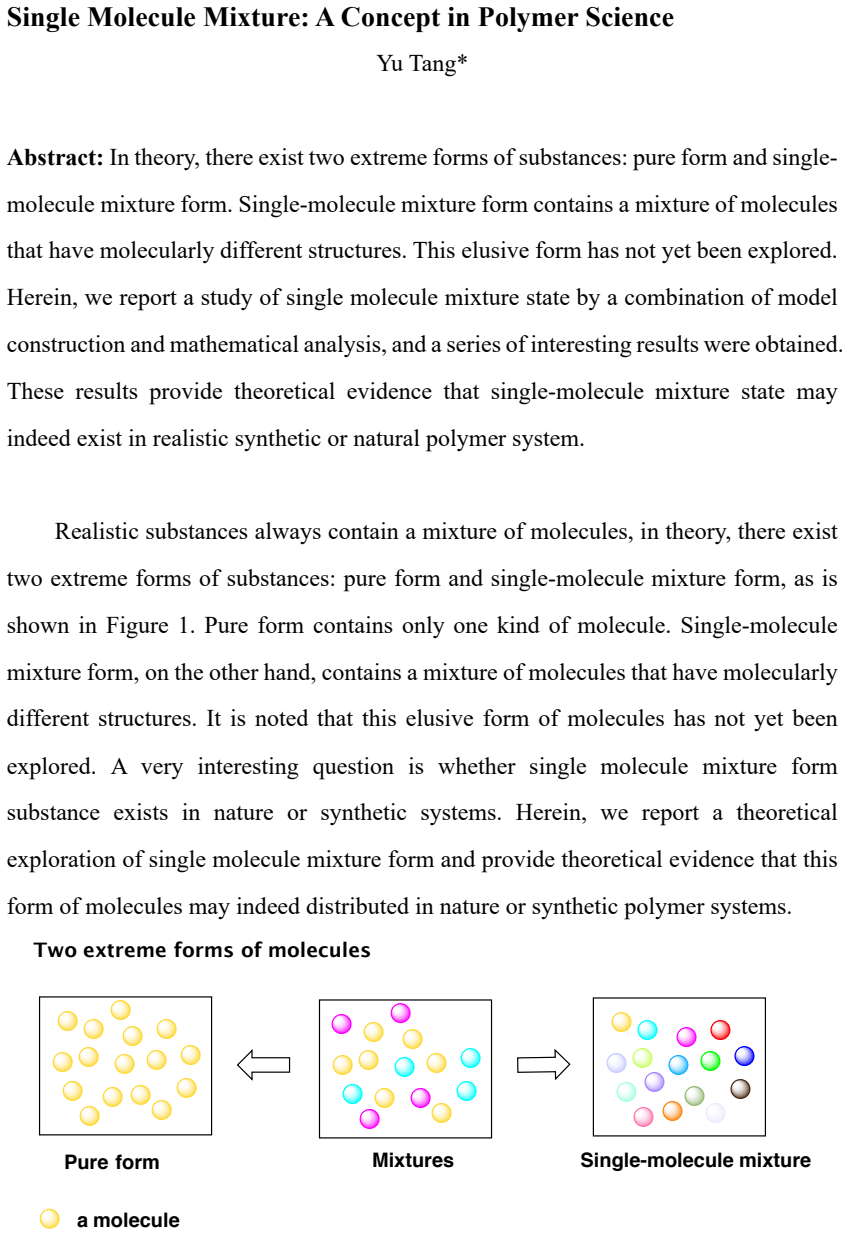
Theoretical models and analysis indicate that single-molecule mixture states can exist in polymer systems.
A machine-rendered reading of the paper's core claim, the machinery that carries it, and where it could break.
Core claim
The paper constructs models of polymer systems and performs mathematical analysis on them, obtaining results that supply theoretical evidence for the existence of single-molecule mixture states in realistic synthetic or natural polymer systems.
What carries the argument
Model construction combined with mathematical analysis of polymer systems to test for single-molecule mixture states.
If this is right
- Polymer systems could contain mixtures where each molecule differs structurally from the others while still forming a stable state.
- Both laboratory-synthesized polymers and those found in nature might exhibit this single-molecule mixture form.
- The distinction between pure substances and mixtures needs to include this intermediate molecular-scale mixing possibility.
Where Pith is reading between the lines
- If single-molecule mixtures prove real, polymer property predictions may need to account for heterogeneity at the individual chain level rather than only average composition.
- Synthetic routes could be designed to favor or suppress this state to control material responses.
- Similar modeling approaches might apply to other molecular systems beyond polymers where structural variation at the single-unit scale matters.
Load-bearing premise
The specific models built and the mathematical steps applied are enough to show that single-molecule mixtures can occur in actual polymer materials.
What would settle it
Direct experimental detection or absence of molecules with differing structures mixed at the single-molecule level in a polymer sample prepared under conditions matching the models.
Figures
read the original abstract
In theory, there exist two extreme forms of substances: pure form and single-molecule mixture form. Single-molecule mixture form contains a mixture of molecules that have molecularly different structures. This elusive form has not yet been explored. Herein, we report a study of single molecule mixture state by a combination of model construction and mathematical analysis, and a series of interesting results were obtained. These results provide theoretical evidence that single-molecule mixture state may indeed exist in realistic synthetic or natural polymer system.
Editorial analysis
A structured set of objections, weighed in public.
Referee Report
Summary. The manuscript introduces the concept of a 'single-molecule mixture' state in substances (distinct from pure forms), defined as a mixture of molecules with molecularly different structures. It reports performing model construction and mathematical analysis on this state and concludes that the results provide theoretical evidence for the existence of this state in realistic synthetic or natural polymer systems.
Significance. If the models and analysis were shown to map onto realistic polymer parameters and interactions, the work could introduce a new conceptual category in polymer science with potential implications for understanding mixing, phase behavior, and material properties. However, the manuscript provides no such mapping, equations, or validation, so the significance cannot be assessed beyond the conceptual proposal itself.
major comments (2)
- [Abstract] Abstract: The central claim that 'these results provide theoretical evidence that single-molecule mixture state may indeed exist in realistic synthetic or natural polymer system' is unsupported because the abstract (and the described approach) supplies no Hamiltonian, statistical ensemble, chain statistics, interaction potentials, or calibration to polymer-specific quantities such as Flory-Huggins parameters or persistence length.
- [Abstract] Abstract: The description of 'model construction and mathematical analysis' is too generic to evaluate whether the analysis demonstrates existence under realistic conditions rather than in an abstract or toy model; no assumptions, error analysis, or falsifiable predictions are stated.
minor comments (1)
- The distinction between 'single-molecule mixture' and conventional polymer blends or random copolymers should be defined more precisely, including whether the state is claimed to be thermodynamically stable or kinetically trapped.
Simulated Author's Rebuttal
We thank the referee for the thoughtful comments on our manuscript. We address each major comment below and indicate where revisions will be made.
read point-by-point responses
-
Referee: [Abstract] Abstract: The central claim that 'these results provide theoretical evidence that single-molecule mixture state may indeed exist in realistic synthetic or natural polymer system' is unsupported because the abstract (and the described approach) supplies no Hamiltonian, statistical ensemble, chain statistics, interaction potentials, or calibration to polymer-specific quantities such as Flory-Huggins parameters or persistence length.
Authors: We agree that the claim of providing theoretical evidence for realistic polymer systems is not supported by the current analysis, which remains at a conceptual and mathematical level without specific mappings to polymer parameters or interaction models. This point is valid, and we will revise the abstract to remove the unsupported claim, limiting the scope to the introduction of the concept and the mathematical results obtained. revision: yes
-
Referee: [Abstract] Abstract: The description of 'model construction and mathematical analysis' is too generic to evaluate whether the analysis demonstrates existence under realistic conditions rather than in an abstract or toy model; no assumptions, error analysis, or falsifiable predictions are stated.
Authors: The work is intentionally conceptual, proposing a new state distinct from pure substances and analyzing it mathematically in an abstract setting. We will revise the manuscript to provide a more detailed description of the model construction, including explicit assumptions underlying the mathematical analysis. As this is a theoretical proposal rather than a calibrated simulation, traditional error analysis and experimental falsifiable predictions are outside the current scope, but we will clarify this distinction. revision: partial
Circularity Check
No significant circularity; derivation self-contained in model construction.
full rationale
The paper's central claim rests on constructing models and performing mathematical analysis to obtain results that provide theoretical evidence for the single-molecule mixture state in polymer systems. No equations, fitted parameters, self-citations, or ansatzes are quoted that reduce any prediction or uniqueness claim to the inputs by construction. The abstract describes an internal modeling process without invoking external self-citations for load-bearing premises or renaming known results. This is the most common honest finding for theoretical modeling papers whose internal consistency does not rely on redefining the target as an input.
Axiom & Free-Parameter Ledger
invented entities (1)
-
single-molecule mixture state
no independent evidence
Reference graph
Works this paper leans on
-
[2]
(A) A model 24 mer of O-propyl substituted D-mannitol system. (B) Hybrid molecular structure of the model single molecule mixture system. In this model system, although the structure of each molecules is different, in that the R group in each substitute site varied, they come randomly from the same structure space, inspired by the concept of orbital hybri...
-
[3]
Semler, J. J.; Jhon, Y. K.; Tonelli, A.; Beevers, M.; Krishnamoorti, R.; Genzer, J. Facile Method of Controlling Monomer Sequence Distributions in Random Copolymers. Adv. Mater., 2007, 19, 2877–2883
work page 2007
-
[4]
Noble, K. F.; Noble, A. M.; Talley, S. J.; Moore, R. B. Blocky bromination of syndiotactic polystyrene via post-polymerization functionalization in the heterogeneous gel state. Polym. Chem., 2018, 9, 5095–5106
work page 2018
-
[5]
Boaen, N. K.; Hillmyer, M. A. Post-Polymerization Functionalization of Polyolefins. Chem. Soc. Rev. 2005, 34, 267−275
work page 2005
-
[6]
Gauthier, M. A.; Gibson, M. I.; Klok, H. A. Synthesis of Functional Polymers by Post-Polymerization Modification. Angew. Chem., Int. Ed. 2009, 48, 48−58
work page 2009
-
[7]
Functionalization of Syndiotactic Polystyrene
Zinck, P.; Bonnet, F.; Mortreux, A.; Visseaux, M. Functionalization of Syndiotactic Polystyrene. Prog. Polym. Sci. 2009, 34, 369−392
work page 2009
-
[8]
Jo, T. S.; Kim, S. H.; Shin, J.; Bae, C. Highly Efficient Incorporation of Functional Groups into Aromatic Main-Chain Polymer Using Iridium-Catalyzed C−H Activation and Suzuki−Miyaura Reaction. J. Am. Chem. Soc. 2009, 131, 1656−1657
work page 2009
-
[9]
Dizman, C.; Tasdelen, M. A.; Yagci, Y . Recent Advances in the Preparation of Functionalized Polysulfones. Polym. Int. 2013, 62, 991−1007
work page 2013
-
[10]
Williamson, J. B.; Lewis, S. E.; Johnson, R. R., 3rd; Manning, I. M.; Leibfarth, F. A. C-H Functionalization of Commodity Polymers. Angew. Chem., Int. Ed. 2019, 58, 8654−8668
work page 2019
-
[11]
Abatti, G. P.; Gross, I. P.; da Conceica̧õ, T. F. Tuningthe Thermal and Mechanical Properties of PSU by Post-Polymerization Friedel-Crafts Acylation. Eur. Polym. J. 2021, 142, 110111
work page 2021
-
[12]
King, E. R.; Hunt, S. B.; Hamernik, L. J.; Gonce, L. E.; Wiggins, J. S.; Azoulay, J. D. Gold-Catalyzed Post-Polymerization Modification of Commodity Aromatic Polymers. JACS Au. 2021, 1, 1342−1347
work page 2021
-
[13]
Chromatin Modifications and their Function
Kouzarides, T. Chromatin Modifications and their Function. Cell. 2007, 128, 693−705
work page 2007
-
[14]
The DNA Methyltransferase Family: a Versatile Toolkit for Epigenetic Regulation
Lyko, F. The DNA Methyltransferase Family: a Versatile Toolkit for Epigenetic Regulation. Nat. Rev. Genet. 2017, 19, 81−92
work page 2017
-
[15]
Chemical and Biochemical Perspectives of Protein Lysine Methylation
Luo, M. Chemical and Biochemical Perspectives of Protein Lysine Methylation. Chem. Rev. 2018, 118, 6656–6705
work page 2018
-
[16]
Histone Methylation Makes its Mark on Longevity
Han, S.; Brunet, A. Histone Methylation Makes its Mark on Longevity. Trends Cell Biol. 2012, 22, 42−49
work page 2012
-
[17]
The Nature of the Chemical Bond
Pauling, L. The Nature of the Chemical Bond. Application of Results Obtained from the Quantum Mechanics and from a Theory of Paramagnetic Susceptibility to the Structure of Molecules. J. Am. Chem. Soc. 1931, 53, 1367−1400
work page 1931
-
[18]
Slater, J. C. Directed Valence in Polyatomic Molecules. Phys. Rev. 1931, 37, 481−489
work page 1931
-
[19]
Half A Century of Hybridization
Barbier, C.; Berthier, G. Half A Century of Hybridization. Adv. Quantum Chem. 2000, 36, 1−25
work page 2000
-
[20]
Bingel, W. A.; Lüttke, W. Hybrid Orbitals and Their Applications in Structural Chemistry. Angew. Chem., Int. Ed. 1981, 20, 899−990. TOC
work page 1981
discussion (0)
Sign in with ORCID, Apple, or X to comment. Anyone can read and Pith papers without signing in.