A simple method to reprogram the binding specificity of DNA-coated colloids that crystallize
Pith reviewed 2026-05-24 11:21 UTC · model grok-4.3
The pith
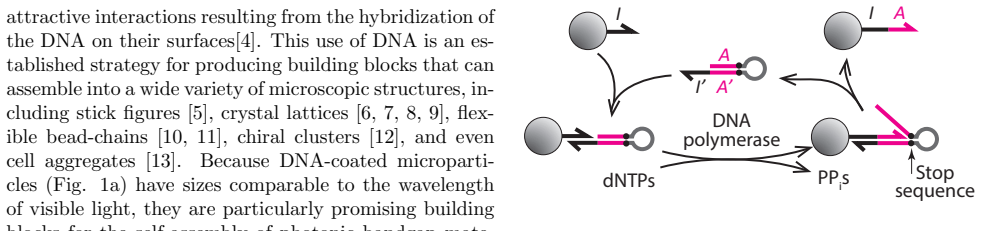
A template reaction appends new DNA domains to existing DNA-coated colloids in under an hour, yielding particles that crystallize identically to those made by direct synthesis.
A machine-rendered reading of the paper's core claim, the machinery that carries it, and where it could break.
Core claim
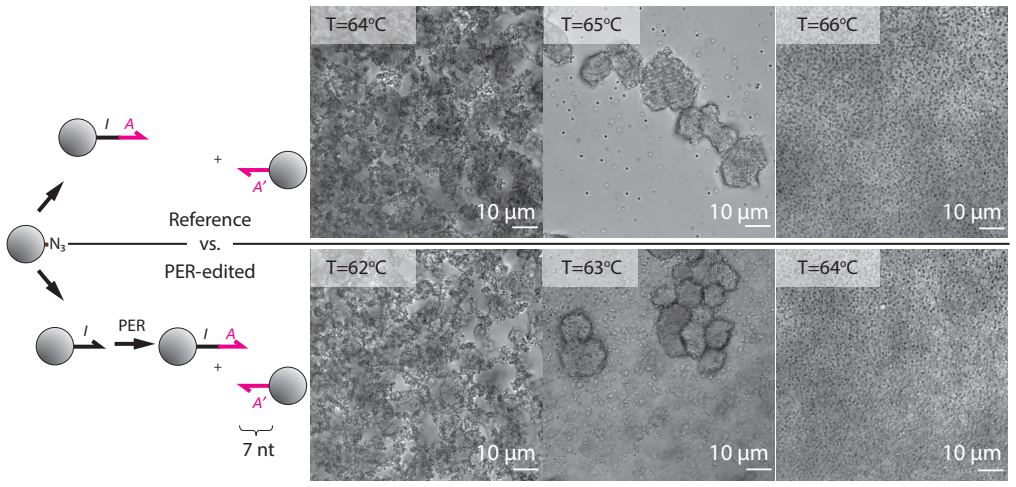
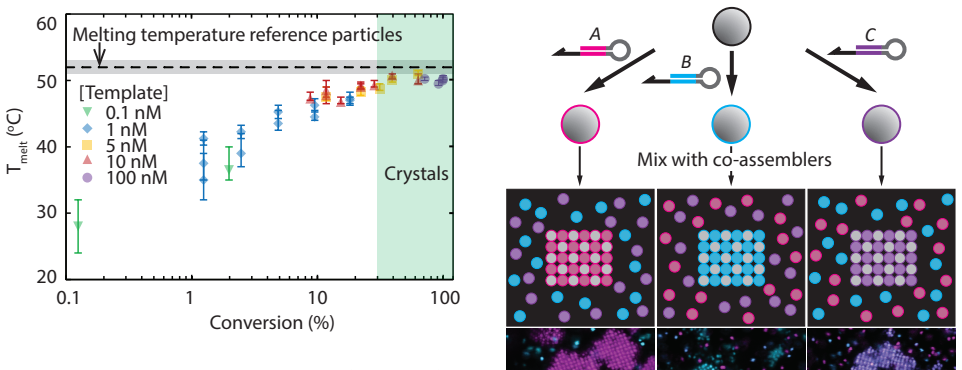
Particles initially coated with one DNA sequence can be converted into building blocks with new binding specificities by appending different DNA domains through a template-directed reaction; the resulting particles crystallize as readily and at the same temperature as particles prepared by direct attachment of the desired sequences.
What carries the argument
The template-directed appending reaction that extends the existing grafted DNA strands on the colloid surface with new sequence domains.
If this is right
- A single feedstock of DNA-coated particles can be turned into many different building blocks simply by choosing different appending sequences.
- The time to test a new particle design drops from more than one day to under an hour at ambient conditions.
- Sequence designs that previously required month-long custom DNA orders become testable with templates that suppliers produce in less than a week.
- Exploration of complex or optimal sequence combinations for specific lattices becomes practical for more laboratories.
Where Pith is reading between the lines
- The method could support libraries of particles that are reprogrammed on demand for different self-assembly experiments.
- If the appending chemistry can be made reversible, it might allow particles to switch specificities during an ongoing assembly process.
- Similar surface-extension reactions could be explored for other recognition molecules besides DNA.
- The reduced barrier to entry could increase the number of groups studying DNA-colloid photonic structures.
Load-bearing premise
The new DNA segments added by the template reaction bind with exactly the same strength and specificity as chemically synthesized strands, without leftover original sequence or reaction byproducts disrupting the intended interactions.
What would settle it
Prepare particles with appended DNA intended for a known crystal lattice, then measure whether they form that lattice or remain dispersed at the temperature where directly synthesized equivalents crystallize.
Figures

read the original abstract
DNA-coated colloids can crystallize into a multitude of lattices, ranging from face-centered cubic to diamond and thereby contribute to our understanding of crystallization and open avenues to producing structures with useful photonic properties. Despite the broad potential design space of DNA-coated colloids, the design cycle for synthesizing DNA-coated particles is slow: preparing a particle with a new type of DNA sequence takes more than one day and requires custom-made and chemically modified DNA that typically takes the supplier over a month to synthesize. Here, we introduce a method to generate particles with custom sequences from a single feed stock in under an hour at ambient conditions. Our method appends new DNA domains onto the DNA grafted to colloidal particles based on a template that takes the supplier less than a week to produce. The resultant particles crystallize as readily and at the same temperature as those produced via direct chemical synthesis. Moreover, we show that particles coated with a single sequence can be converted into a variety of building blocks with differing specificities by appending different DNA sequences to them. This approach to DNA-coated particle preparation will make it practical to identify optimal and complex particle sequence designs and to expand the use of DNA-coated colloids to a much broader range of investigators and commercial entities.
Editorial analysis
A structured set of objections, weighed in public.
Referee Report
Summary. The manuscript introduces a template-directed method to append new DNA domains onto DNA strands already grafted to colloidal particles, enabling rapid reprogramming of binding specificity from a single feedstock. The central claims are that the resulting particles crystallize as readily and at the same temperature as those prepared by direct chemical synthesis, and that particles coated with one sequence can be converted into multiple building blocks with different specificities by appending different sequences via the template reaction.
Significance. If the functional equivalence is quantitatively demonstrated, the approach would substantially shorten the experimental cycle for DNA-coated colloid design from over a month to under a week, addressing a key practical bottleneck and potentially expanding access to complex lattice studies and photonic applications.
major comments (1)
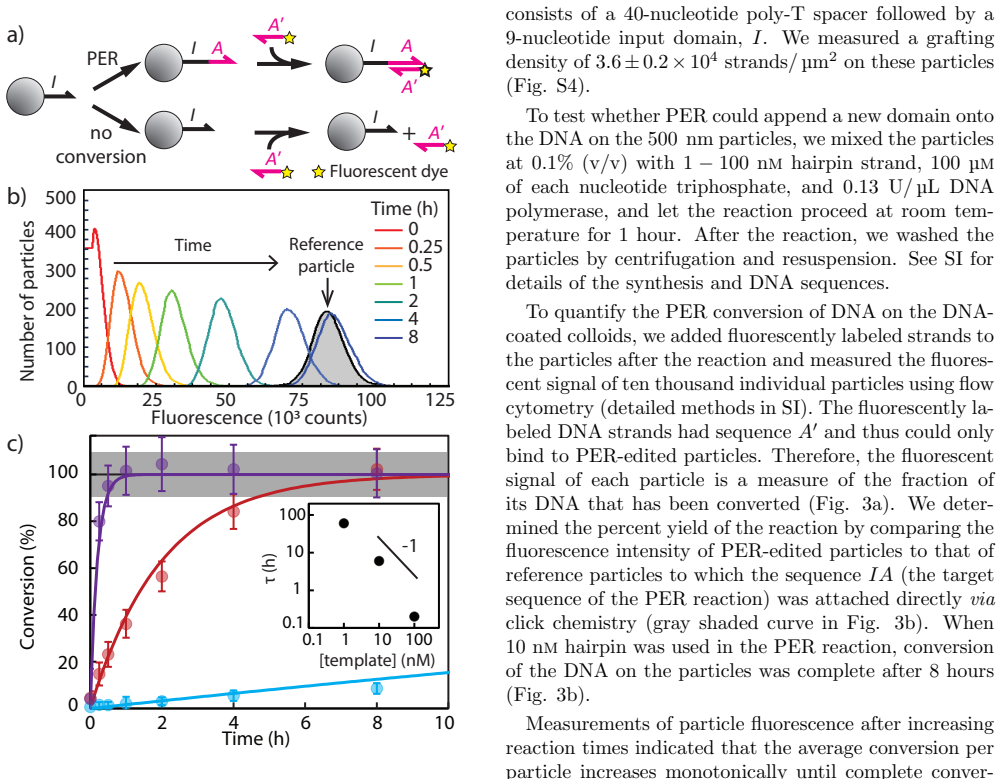
- [Abstract] Abstract: the assertion that the resultant particles 'crystallize as readily and at the same temperature' as directly synthesized ones is the load-bearing claim, yet the provided text supplies no quantitative metrics, melting curves, lattice yields, error bars, or controls to support equivalence. This must be addressed with specific data from the results section to allow assessment of the weakest assumption regarding binding specificity and lack of interference from residuals or side products.
Simulated Author's Rebuttal
We thank the referee for their positive evaluation and recommendation of minor revision. We address the single major comment below.
read point-by-point responses
-
Referee: [Abstract] Abstract: the assertion that the resultant particles 'crystallize as readily and at the same temperature' as directly synthesized ones is the load-bearing claim, yet the provided text supplies no quantitative metrics, melting curves, lattice yields, error bars, or controls to support equivalence. This must be addressed with specific data from the results section to allow assessment of the weakest assumption regarding binding specificity and lack of interference from residuals or side products.
Authors: We agree that the abstract would benefit from explicit pointers to the supporting data. The full manuscript reports quantitative comparisons in the results: Figure 3 shows melting curves for template-reprogrammed and directly synthesized particles with overlapping transition temperatures (within 0.5 °C) and comparable transition widths; Figure 4 quantifies lattice yields (with standard deviations from n=3 independent preparations) that are statistically indistinguishable; and control experiments in the supplementary information confirm that residual template strands do not alter binding specificity or introduce nonspecific aggregation. We will revise the abstract to reference these specific figures and metrics. revision: yes
Circularity Check
No circularity: purely experimental methods paper with direct empirical validation
full rationale
The manuscript presents a laboratory protocol for appending DNA domains to pre-grafted colloidal particles and validates the outcome solely by comparing crystallization temperatures and lattice formation against directly synthesized controls. No equations, fitted parameters, derivations, or uniqueness theorems appear. The central equivalence claim is tested by experiment rather than derived from prior self-citations or definitions, satisfying the self-contained criterion.
Axiom & Free-Parameter Ledger
axioms (1)
- domain assumption Complementary DNA strands hybridize specifically according to Watson-Crick base-pairing rules under the stated buffer and temperature conditions.
Reference graph
Works this paper leans on
-
[1]
Us- ing DNA to program the selfassembly of colloidal nanoparticles and microparticles
Rogers, W.B.; Shih W.M.; Manoharan, V.N. Us- ing DNA to program the selfassembly of colloidal nanoparticles and microparticles. Nat. Rev. Mat. 2015, 1, 1-14, doi:10.1038/natrevmats.2016.8
-
[2]
A DNA-based method for ra- tionally assembling nanoparticles into macro- scopic materials
Mirkin, C.A.; Letsinger, R.L.; Mucic, R.C.; Storhoff, J.J. A DNA-based method for ra- tionally assembling nanoparticles into macro- scopic materials. Nature 1996, 382, 607–609. doi:10.1038/382607a0
-
[3]
Organization of ‘nanocrystal molecules’ using DNA
Alivisatos, A.P.; Johnson, K.P.; Peng, X.; Wilson, T.E.; Loweth, C.J.; Bruchez Jr., M.P.; Schultz, P.G. Organization of ‘nanocrystal molecules’ using DNA. Nature 1996, 382, 609–611. doi:10.1038/382609a0
-
[4]
Direct measurements of DNA-mediated colloidal interactions and their quantitative modeling
Rogers, W.B.; Crocker, J.C. Direct measurements of DNA-mediated colloidal interactions and their quantitative modeling. Proc. Natl. Acad. Sci. 2011, 108, 15687 —15692. doi:10.1073/pnas.1109853108
-
[5]
Liu, W.; Halverson, J.; Tian, Y.; Tkachenko, V.T.; Gang. O. Self-organized architectures from assorted DNA-framed nanoparticles. Nature. Chem. 2016, 8, 867–873. doi:10.1038/nchem.2540
-
[6]
Y.; Lytton-Jean, A.K.R.; Lee, B.; Weigand, S.; Schatz, G.C; Mirkin, C.A
Park, S. Y.; Lytton-Jean, A.K.R.; Lee, B.; Weigand, S.; Schatz, G.C; Mirkin, C.A. DNA-programmable nanoparticle crystallization. Nature 2008, 451, 553–556. doi:10.1038/nature06508
-
[7]
Auyeung, E.; Lee, T.I.N.G; Senesi, A.J.; Schmucker, A.L.; Pals, B.C.; Olvera de la Cruz, M.; Mirkin, C.A.; DNA-mediated nanoparticle crystallization into Wulff polyhedra. Nature 2014. 505, 73–77. doi:10.1038/nature12739
-
[8]
Rogers, W. B.; Manoharan, V. N. Program- ming colloidal phase transitions with DNA strand displacement. Science 2015, 347, 639-642. doi:10.1126/science.1259762
-
[9]
Wang, Y.; Jenkins, I. C.; McGinley, J. T.; Sinno, T.; Crocker, J. C. Colloidal crystals with diamond sym- metry at optical lengthscales. Nat. Commun. 2017, 8, 14173. doi:10.1038/ncomms14173
-
[10]
McMullen, A.; Holmes-Cerfon, M.; Sciortino, F.; Grosberg, A.Y.; Brujic, J.; Freely Jointed Poly- mers Made of Droplets. Phys. Rev. Lett. 2018, 121, 138002. doi:10.1103/PhysRevLett.121.138002
-
[11]
Flexibility- induced effects in the Brownian motion of col- loidal trimers
Verweij, R.; Moerman, P.G.; Ligthart, N.E.G.; Huijnen, L.P.P.; Groenewold, J.; Kegel, W.K.; Van Blaaderen, A.; Kraft, D.J. Flexibility- induced effects in the Brownian motion of col- loidal trimers. Phys. Rev. Research 2020, 2, 033136. doi:10.1103/PhysRevResearch.2.033136
-
[12]
Self-assembled three- dimensional chiral colloidal architecture
Ben Zion, M.Y.; He, X.; Maass, C.C.; Sha, R.; Seeman, N.C.; Chaikin, P.M. Self-assembled three- dimensional chiral colloidal architecture. Science 2017, 358, 633-636. doi:10.1126/science.aan5404
-
[13]
Programmed syn- thesis of three-dimensional tissues
Todhunter, M.; Jee, N.; Hughes, A.; Coyle, M.C.; Cerchiari, A.; Farlow, J.; Garbe, J.C.; LaBarge, M.A.; Desai, T.A.; Gartner, Z.J. Programmed syn- thesis of three-dimensional tissues. Nat. Methods 2015, 12, 975–981. doi:10.1038/nmeth.3553 7
-
[14]
The diversity of three-dimensional photonic crystals
Cersonsky, R.K.; Antonaglia, J.; Dice, B.D.; Glotzer, S.C. The diversity of three-dimensional photonic crystals. Nat. Commun. 2021, 12, 2543. doi:10.1038/s41467-021-22809-6
-
[15]
He, M.; Gales, J.P.; Ducrot, ´E.; Gong, Z.; Yi, G-R.; Sacanna, S.; Pine, D.J.; Colloidal diamond. Nature 2020, 585, 524–529. doi:10.1038/s41586-020-2718-6
-
[16]
Ducrot, E.; He, M.; Yi, G. R.; Pine, D. J. Colloidal alloys with preassembled clusters and spheres. Nat. Mater. 2017, 16, 652–657. doi:10.1038/nmat4869
-
[17]
Oh, J. S.; Lee, S.; Glotzer, S. C.; Yi, G-R.; Pine, D. J. Colloidal fibers and rings by cooper- ative assembly. Nat. Commun. 2019, 10(1), 3936. doi:10.1038/s41467-019-11915-1
-
[18]
Self-replicating colloidal clusters
Zeravcic, Z.; Brenner, M.P. Self-replicating colloidal clusters. Proc. Natl. Acad. Sci. 2014, 111, 1748-
work page 2014
-
[19]
doi:10.1073/pnas.1313601111
-
[20]
Transient self-organisation of DNA coated colloids directed by enzymatic reactions
Dehne, H.; Reitenbach, A.; Bausch, A.R. Transient self-organisation of DNA coated colloids directed by enzymatic reactions. Sci. Rep. 2019, 9, 7350. doi:10.1038/s41598-019-43720-7
-
[21]
DNA-Coated Microspheres and Their Colloidal Superstructures
Moon, J.; Jo, I.S.; Ducrot, E.; Oh, J.S.; Pine, D.J, Yi, G-R. DNA-Coated Microspheres and Their Colloidal Superstructures. Macromol. Res. 2018, 26, 1085–1094. doi:10.1007/s13233-018-6151- 8
-
[22]
Engineering DNA-Mediated Colloidal Crys- tallization Langmuir 2006, 22, 1991-2001
Kim, A.J.; Biancaniello, P.L.; Crocker, J.C. Engineering DNA-Mediated Colloidal Crys- tallization Langmuir 2006, 22, 1991-2001. doi:10.1021/la0528955
-
[23]
Multistep kinetic self-assembly of DNA-coated colloids
Di Michele, L.; Varrato, F.; Kotar, J.; Nathan, S.H.; Foffi, G.; Eiser, E. Multistep kinetic self-assembly of DNA-coated colloids. Nat. Commun. 2013, 4, 2007. doi:10.1038/ncomms3007
-
[24]
Controlled Assembly of Mesoscale Structures Using DNA as Molecular Bridges
Soto, C.M.; Srinivasan, A.; Ratna, B.R. Controlled Assembly of Mesoscale Structures Using DNA as Molecular Bridges. J. Am. Chem. Soc. 2002, 124, 8508-8509. doi:10.1021/ja017653f
-
[25]
Synthetic strategies toward DNA-coated colloids that crys- tallize
Wang, Y.; Wang, Y.; Zheng, X.; Ducrot, E.; Lee, M.G.; Yi G-R.; Weck, M.; Pine, D.J. Synthetic strategies toward DNA-coated colloids that crys- tallize. J. Am. Chem. Soc. 2015, 137 (33), 10760- 10766
work page 2015
-
[26]
High- Density PEO-b-DNA Brushes on Polymer Particles for Colloidal Superstructures
Oh, J.S.; Wang, Y.; Pine, D.J.; Yi, G-R. High- Density PEO-b-DNA Brushes on Polymer Particles for Colloidal Superstructures. Chem. Mater. 2015, 27, 8337–8344. doi:10.1021/acs.chemmater.5b03683
-
[27]
Oh, J.S.; He, M.; Yi, G-R.; Pine, D.J. High- Density DNA Coatings on Carboxylated Colloids by DMTMM- and Azide-Mediated Coupling Re- actions. Langmuir 2020, 36(13), 3583-3589. doi: 10.1021/acs.langmuir.9b03386
-
[28]
Wang, Y.; Wang, Y.; Zheng, X.; Ducrot, E.; Yodh, J. S.; Weck, M.; Pine, D. J. Crystallization of DNA-coated colloids. Nat. Commun. 2015, 6, 7253. doi:10.1038/ncomms8253
-
[29]
Two-step crystallization and solid–solid transitions in binary colloidal mixtures
Fang, H.; Hagan, M.F.; Rogers, W.B. Two-step crystallization and solid–solid transitions in binary colloidal mixtures. Proc. Natl. Acad. Sci. 2020, 117, 27927-27933. doi: 10.1073/pnas.2008561117
-
[30]
Self- assembly of photonic crystals by controlling the nucleation and growth of DNA-coated colloids
Hensley, A.;Jacobs, W.M.; Rogers, W.B. Self- assembly of photonic crystals by controlling the nucleation and growth of DNA-coated colloids. Proc. Natl. Acad. Sci. 2022, 119, e2114050118. doi.org/10.1073/pnas.2114050118
-
[31]
Integrated DNA Technologies (IDT) provides tailored DNA sequences with DBCO modifications ont he 3’ or 5’ end: https://www.idtdna.com/pages/education/decoded/ article/need-a-non-standard-modification
-
[32]
Programmable autonomous synthesis of single-stranded DNA Nature Chemistry 2018, 10, 155-164
Kishi, J.Y.; Schaus, T.E.; Gopalkrishnan, N.; Xuan, F.; Yin, P. Programmable autonomous synthesis of single-stranded DNA Nature Chemistry 2018, 10, 155-164. doi:10.1038/nchem.2872
-
[33]
Rolando, J.C.; Jue, E.; Barlow, J.T.; Ismag- ilov, R.F. Real-time kinetics and high-resolution melt curves in single-molecule digital LAMP to differentiate and study specific and non-specific amplification. Nucleic Acids Res. 2020, 48, e42. doi:10.1093/nar/gkaa099
-
[34]
Ab initio synthesis by DNA polymerases
Zyrina, N.V.; Antipova, V.N.; Zheleznaya, L.A. Ab initio synthesis by DNA polymerases. FEMS Micro- biology Letters 2014, 351, 1–6. doi:10.1111/1574- 6968.12326
-
[35]
Catalytic DNA Polymerization Can Be Expedited by Active Product Release
Moerman, P.G.; Gavrilov, M.; Ha, T.J.; Schul- man, R. Catalytic DNA Polymerization Can Be Expedited by Active Product Release. doi:10.26434/chemrxiv-2022-3k98v
-
[36]
Tong, X.; Smith, L. M. Solid-Phase Method for the Purification of DNA Sequencing Re- actions. Anal. Chem. 1992, 64, 2672-2677. doi:10.1021/ac00046a004
-
[37]
Sim- ple Quantitative Model for the Reversible Associa- tion of DNA Coated Colloids.Phys
Dreyfus, R.; Leunissen, M.E.; Sha, R.; Tkachenko, R.V.; Seeman, N.C.; Pine, D.J.; Chaikin, P.M. Sim- ple Quantitative Model for the Reversible Associa- tion of DNA Coated Colloids.Phys. Rev. Lett. 2009, 102, 048301. doi:10.1103/PhysRevLett.102.048301 8
-
[38]
DNA-functionalized colloids: Physical properties and applications
Geerts, N.;Eiser, E. DNA-functionalized colloids: Physical properties and applications. Soft Matter 6, 4647-4660. doi:10.1039/C001603A
-
[39]
SantaLucia, J. Jr. A unified view of polymer, dumb- bell, and oligonucleotide DNA nearest-neighbor thermodynamics. Proc. Natl. Acac. Sci. USA 1998, 95, 1460-1465. doi:10.1073/pnas.95.4.1460
-
[40]
LASIC: Light Activated Site-Specific Conjugation of Native IgGs
Hui, J.Z.; Tamsen, S.; Song, Y.; Tsourkas, A. LASIC: Light Activated Site-Specific Conjugation of Native IgGs. Bioconjug Chem. Bioconjug. Chem. 2015 19, 1456-60. doi:10.1021/acs.bioconjchem.5b00275
-
[41]
Self-assembly of finite- sized colloidal aggregates
Jana, P.K.; Mognetti, B.M. Self-assembly of finite- sized colloidal aggregates. Soft Matter 2020, 16, 5915-5924. doi:10.1039/D0SM00234H
-
[42]
Parvez, M.; Zanjani, M.B.; Synthetic Self-Limiting Structures Engineered with Defective Colloidal Clusters. Adv. Funct. Mater. 2020, 30, 2003317. doi:10.1002/adfm.202003317
-
[43]
Multifarious assembly mixtures: Sys- tems allowing retrieval of diverse stored struc- tures
Murugan, A.; Zeravcic, Z.; Brenner, M.P.; Leibler, S. Multifarious assembly mixtures: Sys- tems allowing retrieval of diverse stored struc- tures. Proc. Acad. Natl. Sci. 2015, 112, 54-59. doi:10.1073/pnas.1413941112
-
[44]
Wu, K.; Feng, L.; Sha, R.; Chaikin, P. Polygamous Particles. Proc. Acad. Natl. Sci. 2012, 106, 18731- 18736. doi:10.1073/pnas.1207356109
-
[45]
Emergence of Multiscale Dynamics in Col- loidal Gels
Cho, J.H.; Cerbino, R.; Bischofberger, I. Emergence of Multiscale Dynamics in Col- loidal Gels. Phys. Rev. Lett. 2020, 124, 08800. doi:10.1103/PhysRevLett.124.088005
-
[46]
Colloidal Nanocrystal Gels from Thermodynamic Principles
Sherman, Z.M.; Green, A.M.; Howard, M.P.; Anslyn, E.V.; Truskett, T.M.; Milliron, D.J. Colloidal Nanocrystal Gels from Thermodynamic Principles. Acc. Chem. Res 2021, 54, 798–807. doi:10.1021/acs.accounts.0c00796
-
[47]
Life and death of colloidal bonds control the rate-dependent rheology of gels
Nabizadeh, M.; Jamali, S. Life and death of colloidal bonds control the rate-dependent rheology of gels. Nat. Comm. 2021, 12, 4274. doi:10.1038/s41467- 021-24416-x
-
[48]
Com- paring whole genomes using DNA microarrays
Gresham, D.; Dunham, M.J.; Bodstein, D. Com- paring whole genomes using DNA microarrays. Nat. Rev. Genet. 2008, 9, 291–302. doi:10.1038/nrg2335
-
[49]
Dissipative Self-Assembly Driven by the Consumption of Chemical Fuels
De, S.; Klajn, R. Dissipative Self-Assembly Driven by the Consumption of Chemical Fuels. Adv. Mater. 2018, 30, 1706750. doi:10.1002/adma.201706750
-
[50]
Out-of-Equilibrium Col- loidal Assembly Driven by Chemical Reaction Networks
Van Ravensteijn, B.G.P.;Voets, I.K.; Kegel, W.K.; Eelkema, R. Out-of-Equilibrium Col- loidal Assembly Driven by Chemical Reaction Networks. Langmuir 2020, 36, 10639–10656. doi:10.1021/acs.langmuir.0c01763 9
discussion (0)
Sign in with ORCID, Apple, or X to comment. Anyone can read and Pith papers without signing in.