Geometric Floquet Condition for Quantum Adiabaticity
Pith reviewed 2026-05-24 09:29 UTC · model grok-4.3
The pith
A geometric condition extracted from one driving period suffices to guarantee adiabatic evolution over arbitrarily many periods in periodically driven quantum systems.
A machine-rendered reading of the paper's core claim, the machinery that carries it, and where it could break.
Core claim
Using Floquet formalism the authors obtain a sufficient adiabaticity condition that is valid for any number of driving periods: the product involving the Fubini-Study length of the instantaneous eigenray and the quasienergy separation extracted from the one-period Floquet operator must remain sufficiently small. The bound is geometric and stroboscopic, depending solely on single-cycle information. A state-targeted version reduces conservativeness when only one eigenbranch is relevant. The result supplies a certification tool for existing periodic protocols in closed finite-dimensional systems.
What carries the argument
The one-period Floquet operator, from which the quasienergy spectrum supplies a separation measure that converts the single-cycle Fubini-Study length of the eigenray into a multi-period adiabaticity bound.
If this is right
- Adiabaticity for any number of periods can be checked using only single-cycle calculations.
- The criterion supplies an alternative to instantaneous energy-gap conditions for repeated driving protocols.
- A state-targeted refinement yields a less conservative bound when interest is limited to one adiabatic branch.
- The condition certifies given periodic protocols rather than synthesizing new controls.
Where Pith is reading between the lines
- The geometric bound could be used to screen candidate periodic sequences before full dynamical simulation.
- The stroboscopic character may connect to discrete-time adiabatic theorems in other contexts.
- Numerical checks on small driven systems such as qubits could reveal how tight the derived bound actually is.
Load-bearing premise
The quasienergy separation from the single-period Floquet operator remains a valid control on the total accumulated deviation after many cycles.
What would settle it
A numerical simulation or experiment on a finite-dimensional driven system in which the geometric condition is satisfied yet the evolved state deviates from the target instantaneous eigenstate by more than the predicted amount after many periods.
Figures

read the original abstract
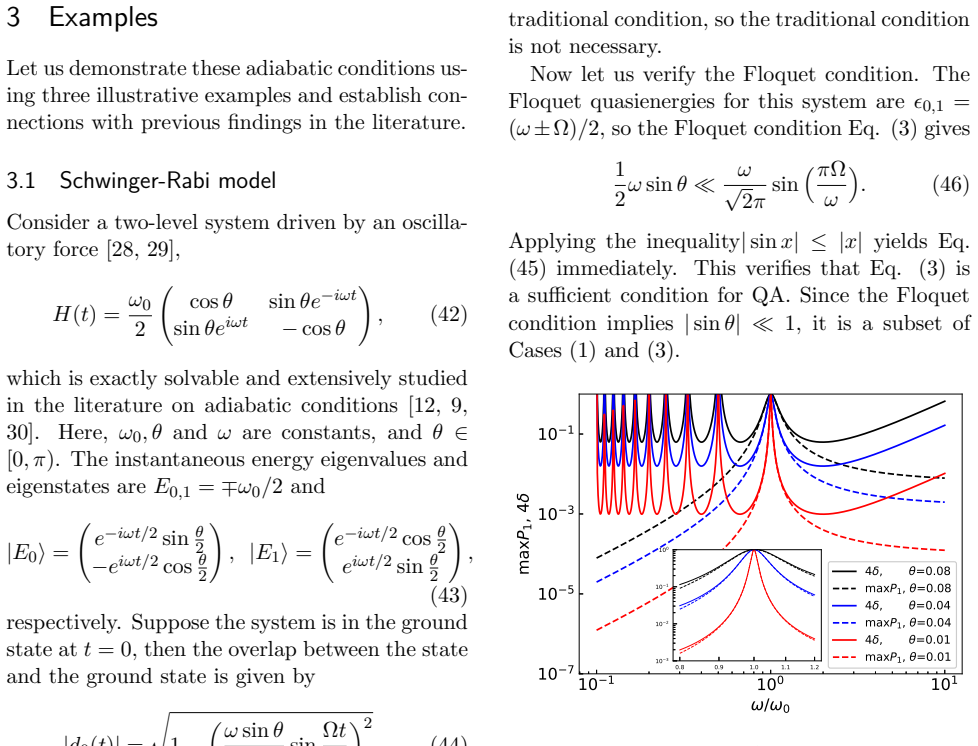
Quantum adiabaticity is the evolution of a quantum system that remains close to an instantaneous eigenstate of a time-dependent Hamiltonian. Using Floquet formalism, we derive a rigorous sufficient condition for adiabaticity in closed, finite-dimensional periodically driven systems that is valid for arbitrarily many driving periods. The condition is stroboscopic and geometric, depending only on single-cycle information: the Fubini--Study length of the instantaneous eigenray and a quasienergy-separation measure extracted from the Floquet operator. We also formulate a state-targeted refinement that reduces conservativeness when only one adiabatic branch is relevant. Rather than synthesizing control pulses, the result provides a certification criterion for a given periodic protocol. We illustrate the criterion and contrast it with conventional instantaneous-gap conditions in three representative examples.
Editorial analysis
A structured set of objections, weighed in public.
Referee Report
Summary. The manuscript derives a rigorous sufficient condition for stroboscopic adiabaticity in closed, finite-dimensional periodically driven quantum systems. Using Floquet theory, the condition is expressed in terms of single-cycle geometric data: the Fubini-Study length traversed by an instantaneous eigenray and a quasienergy separation extracted from the one-period Floquet operator. The bound is claimed to hold for an arbitrary number of driving periods. A state-targeted refinement is introduced to reduce conservativeness when only one adiabatic branch matters. The criterion is illustrated on three examples and contrasted with conventional instantaneous-gap conditions.
Significance. If the central derivation holds, the result supplies a practical, single-period certification tool for adiabaticity under periodic driving that does not require pulse synthesis. The geometric, Floquet-based formulation and its multi-period validity constitute a clear advance over instantaneous-gap heuristics for finite-dimensional closed systems. The explicit examples and the state-targeted variant add concrete value for applications in Floquet engineering and quantum control.
minor comments (2)
- The abstract and introduction use the term 'eigenray' without an explicit definition or reference to the projective Hilbert space; a brief clarification in §2 would improve readability for readers outside geometric quantum mechanics.
- In the example sections, the numerical values of the Fubini-Study length and quasienergy gap are reported but the precise definition of the quasienergy-separation measure (e.g., min |ε_i - ε_j| or a rescaled variant) is not restated; repeating the formula from the main derivation would aid direct comparison.
Simulated Author's Rebuttal
We thank the referee for their positive summary, assessment of significance, and recommendation to accept the manuscript. We are pleased that the geometric Floquet condition and its practical implications were viewed favorably.
Circularity Check
No significant circularity; derivation self-contained from standard Floquet theory
full rationale
The paper presents a derivation of a sufficient stroboscopic geometric condition for adiabaticity in periodically driven finite-dimensional systems, relying on the Fubini-Study length of the instantaneous eigenray and a quasienergy separation from the Floquet operator. This is obtained by applying standard Floquet formalism to the periodic drive without reducing any load-bearing step to a fitted parameter, self-definition, or self-citation chain. The result is framed as a certification criterion independent of the target data, with no evidence that the multi-period bound is forced by construction from single-cycle inputs. This is the most common honest outcome for a derivation paper.
Axiom & Free-Parameter Ledger
axioms (1)
- domain assumption The quantum system is closed and finite-dimensional, allowing definition of the Floquet operator over one period.
Lean theorems connected to this paper
-
IndisputableMonolith/Foundation/DimensionForcing.lean; IndisputableMonolith/Cost/FunctionalEquation.leanreality_from_one_distinction; washburn_uniqueness_aczel unclear?
unclearRelation between the paper passage and the cited Recognition theorem.
max |⟨Em|˙En⟩| ≪ (ω/π)√[2(N−1)] min |sin[π(ϵn−ϵm)/ω]| (Eq. 3); analogous integral form (Eq. 4) obtained from single-cycle Floquet data
-
IndisputableMonolith/Foundation/ArithmeticFromLogic.lean; IndisputableMonolith/Foundation/AlexanderDuality.leanLogicNat recovery; alexander_duality_circle_linking unclear?
unclearRelation between the paper passage and the cited Recognition theorem.
derivation proceeds via expansion in instantaneous eigenbasis, integration of |dṁ| bounds, and Floquet-mode decomposition yielding sin²[(ϵi−ϵj)T/2] factors
What do these tags mean?
- matches
- The paper's claim is directly supported by a theorem in the formal canon.
- supports
- The theorem supports part of the paper's argument, but the paper may add assumptions or extra steps.
- extends
- The paper goes beyond the formal theorem; the theorem is a base layer rather than the whole result.
- uses
- The paper appears to rely on the theorem as machinery.
- contradicts
- The paper's claim conflicts with a theorem or certificate in the canon.
- unclear
- Pith found a possible connection, but the passage is too broad, indirect, or ambiguous to say the theorem truly supports the claim.
Reference graph
Works this paper leans on
-
[1]
Adiabatische invari- anten und quantentheorie
Paul Ehrenfest. Adiabatische invari- anten und quantentheorie. Ann. Phys. , 356(19):327–352, 1916
work page 1916
-
[2]
Max Born and Vladimir Fock. Beweis des adiabatensatzes. Zeitschrift f¨ ur Physik, 51(3-4):165–180, 1928
work page 1928
-
[3]
Bound states in quantum field theory
Murray Gell-Mann and Francis Low. Bound states in quantum field theory. Phys. Rev., 84:350–354, Oct 1951
work page 1951
-
[4]
A quantum adiabatic evolution algorithm applied to random in- stances of an np-complete problem
Edward Farhi, Jeffrey Goldstone, Sam Gut- mann, Joshua Lapan, Andrew Lundgren, and Daniel Preda. A quantum adiabatic evolution algorithm applied to random in- stances of an np-complete problem. Science, 292(5516):472–475, 2001
work page 2001
-
[5]
Milena Grifoni and Peter H¨ anggi. Driven quantum tunneling. Phys. Rep. , 304(5- 6):229–354, 1998
work page 1998
-
[6]
Marin Bukov, Luca D’Alessio, and Anatoli Polkovnikov. Universal high-frequency be- havior of periodically driven systems: from dynamical stabilization to floquet engineer- ing. Adv. Phys., 64(2):139–226, 2015
work page 2015
-
[7]
Colloquium: Atomic quan- tum gases in periodically driven optical lat- tices
Andr´ e Eckardt. Colloquium: Atomic quan- tum gases in periodically driven optical lat- tices. Rev. Mod. Phys., 89(1):011004, 2017
work page 2017
-
[8]
Floquet engineering of quantum materials
Takashi Oka and Sota Kitamura. Floquet engineering of quantum materials. Annu. Rev. Condens. Matter Phys. , 10:387–408, 2019
work page 2019
-
[9]
General conditions for quantum adiabatic evolution
Daniel Comparat. General conditions for quantum adiabatic evolution. Phys. Rev. A, 80(1):012106, jul 2009
work page 2009
-
[10]
Daniel Comparat. Comment on “Quantita- tive Condition is Necessary in Guarantee- ing the Validity of the Adiabatic Approxi- mation”. Phys. Rev. Lett. , 106(13):138902, apr 2011
work page 2011
-
[11]
Karl-Peter Marzlin and Barry C. Sanders. Inconsistency in the Application of the Adiabatic Theorem. Phys. Rev. Lett. , 93(16):160408, oct 2004
work page 2004
-
[12]
D. M. Tong, K. Singh, L. C. Kwek, and C. H. Oh. Quantitative Conditions Do Not Guar- antee the Validity of the Adiabatic Approxi- mation. Phys. Rev. Lett., 95(11):110407, sep 2005
work page 2005
-
[13]
Ex- perimental Study of the Validity of Quanti- tative Conditions in the Quantum Adiabatic Theorem
Jiangfeng Du, Lingzhi Hu, Ya Wang, Jianda Wu, Meisheng Zhao, and Dieter Suter. Ex- perimental Study of the Validity of Quanti- tative Conditions in the Quantum Adiabatic Theorem. Phys. Rev. Lett. , 101(6):060403, aug 2008
work page 2008
-
[14]
Validity of the quantum adiabatic theorem
Zhaoyan Wu and Hui Yang. Validity of the quantum adiabatic theorem. Phys. Rev. A , 72(1):012114, 2005
work page 2005
-
[15]
R. MacKenzie, A. Morin-Duchesne, H. Pa- quette, and J. Pinel. Validity of the adia- batic approximation in quantum mechanics. Phys. Rev. A , 76(4):044102, 2007
work page 2007
-
[16]
M. H. S. Amin. Consistency of the Adiabatic Theorem. Phys. Rev. Lett., 102(22):220401, jun 2009
work page 2009
-
[17]
Quantum adiabatic theorem in light of the marzlin-sanders inconsistency
Juan Ortigoso. Quantum adiabatic theorem in light of the marzlin-sanders inconsistency. Phys. Rev. A , 86(3):032121, 2012
work page 2012
-
[18]
Tong, K Singh, Leong Chuan Kwek, and Choo Hiap Oh
D.M. Tong, K Singh, Leong Chuan Kwek, and Choo Hiap Oh. Sufficiency criterion for the validity of the adiabatic approximation. Phys. Rev. Lett., 98(15):150402, 2007
work page 2007
-
[19]
Adiabatic con- dition and quantum geometric potential
Jian Da Wu, Mei Sheng Zhao, Jian Lan Chen, and Yong De Zhang. Adiabatic con- dition and quantum geometric potential. Phys. Rev. A , 77(6):062114, 2008
work page 2008
-
[20]
Nec- essary and sufficient condition for quantum adiabatic evolution by unitary control fields
Zhen-Yu Wang and Martin B Plenio. Nec- essary and sufficient condition for quantum adiabatic evolution by unitary control fields. Phys. Rev. A , 93(5):052107, 2016
work page 2016
-
[21]
Quantum mechanics: foun- dations and applications
Arno Bohm. Quantum mechanics: foun- dations and applications . Springer-Verlag, New York, 1993
work page 1993
-
[22]
A. C. Aguiar Pinto, M. C. Nemes, J. G. Peixoto de Faria, and M. T. Thomaz. Com- ment on the adiabatic condition. Am. J. Phys., 68(10):955–958, oct 2000
work page 2000
-
[23]
N. A. Sinitsyn and Ilya Nemenman. Uni- versal Geometric Theory of Mesoscopic Stochastic Pumps and Reversible Ratchets. Phys. Rev. Lett., 99(22):220408, nov 2007. 9
work page 2007
-
[24]
N. A. Sinitsyn and I. Nemenman. The Berry phase and the pump flux in stochastic chem- ical kinetics. EPL, 77(5):58001, mar 2007
work page 2007
-
[25]
Berry-Phase-Induced Heat Pumping and Its Impact on the Fluctuation Theorem
Jie Ren, Peter H¨ anggi, and Baowen Li. Berry-Phase-Induced Heat Pumping and Its Impact on the Fluctuation Theorem. Phys. Rev. Lett., 104(17):170601, apr 2010
work page 2010
-
[26]
Jie Gu, Xiang-Guo Li, Hai-Ping Cheng, and X.-G. Zhang. Adiabatic Spin Pump through a Molecular Antiferromagnet Ce 3 Mn 8 III. J. Phys. Chem. C , 122(2):1422–1429, jan 2018
work page 2018
-
[27]
Floquet resonances close to the adia- batic limit and the effect of dissipation
Angelo Russomanno and Giuseppe E San- toro. Floquet resonances close to the adia- batic limit and the effect of dissipation. J. Stat. Mech. Theory Exp. , 2017(10):103104, 2017
work page 2017
-
[28]
On nonadiabatic pro- cesses in inhomogeneous fields
Julian Schwinger. On nonadiabatic pro- cesses in inhomogeneous fields. Phys. Rev., 51(8):648, 1937
work page 1937
-
[29]
Space quantization in a gyrating magnetic field
Isidor Isaac Rabi. Space quantization in a gyrating magnetic field. Phys. Rev. , 51(8):652, 1937
work page 1937
-
[30]
D. M. Tong. Quantitative Condition is Nec- essary in Guaranteeing the Validity of the Adiabatic Approximation. Phys. Rev. Lett., 104(12):120401, mar 2010
work page 2010
-
[31]
Floquet perturbation the- ory: formalism and application to low- frequency limit
M Rodriguez-Vega, Meghan Lentz, and Babak Seradjeh. Floquet perturbation the- ory: formalism and application to low- frequency limit. New J. Phys., 20(9):093022, 2018
work page 2018
-
[32]
Is the Adiabatic Approximation Inconsistent?
Solomon Duki, H. Mathur, and Onuttom Narayan. Is the Adiabatic Approxima- tion Inconsistent? arXiv:quant-ph/0510131, pages 1–5, oct 2005
work page internal anchor Pith review Pith/arXiv arXiv 2005
-
[33]
Nonperturbative approach to the quantum adiabatic condition
Chu Guo, Qian-Heng Duan, Wei Wu, and Ping-Xing Chen. Nonperturbative approach to the quantum adiabatic condition. Phys. Rev. A, 88(1):012114, jul 2013
work page 2013
-
[34]
Magnetic resonance for nonrotating fields
F Bloch and A Siegert. Magnetic resonance for nonrotating fields. Phys. Rev., 57(6):522, 1940
work page 1940
-
[35]
quantitative condition is neces- sary in guaranteeing the validity of the adi- abatic approximation
Meisheng Zhao and Jianda Wu. Com- ment on “quantitative condition is neces- sary in guaranteeing the validity of the adi- abatic approximation”. Phys. Rev. Lett. , 106(13):138901, 2011
work page 2011
-
[36]
Why the quantitative condition fails to reveal quantum adiabaticity
Dafa Li and Man-Hong Yung. Why the quantitative condition fails to reveal quantum adiabaticity. New J. Phys. , 16(5):053023, may 2014
work page 2014
-
[37]
Distribu- tion of work in isothermal nonequilibrium processes
Thomas Speck and Udo Seifert. Distribu- tion of work in isothermal nonequilibrium processes. Phys. Rev. E , 70(6):066112, De- cember 2004
work page 2004
-
[38]
Analysis of slow transitions between nonequilibrium steady states
Dibyendu Mandal and Christopher Jarzyn- ski. Analysis of slow transitions between nonequilibrium steady states. J. Stat. Mech., 2016(6):063204, June 2016
work page 2016
-
[39]
Work statistics in slow ther- modynamic processes
Jie Gu. Work statistics in slow ther- modynamic processes. J. Chem. Phys. , 158(7):074104, February 2023
work page 2023
-
[40]
Harry J. D. Miller, Matteo Scandi, Janet Anders, and Mart´ ı Perarnau-Llobet. Work Fluctuations in Slow Processes: Quantum Signatures and Optimal Control. Phys. Rev. Lett., 123(23):230603, December 2019
work page 2019
-
[41]
Harry J. D. Miller, Giacomo Guarnieri, Mark T. Mitchison, and John Goold. Quan- tum fluctuations hinder finite-time informa- tion erasure near the Landauer limit. Phys. Rev. Lett., 125(16):160602, October 2020
work page 2020
-
[42]
Matteo Scandi, Harry J. D. Miller, Janet Anders, and Mart´ ı Perarnau-Llobet. Quan- tum work statistics close to equilibrium. Phys. Rev. Research , 2(2):023377, June 2020
work page 2020
-
[43]
H. T. Quan, Yu-xi Liu, C. P. Sun, and Franco Nori. Quantum thermodynamic cy- cles and quantum heat engines. Phys. Rev. E, 76(3):031105, sep 2007
work page 2007
-
[44]
Nikolay V. Vitanov, Andon A. Rangelov, Bruce W. Shore, and Klaas Bergmann. Stimulated Raman adiabatic passage in physics, chemistry, and beyond. Rev. Mod. Phys., 89(1):015006, mar 2017
work page 2017
-
[45]
Enhancing co- herence in molecular spin qubits via atomic clock transitions
Muhandis Shiddiq, Dorsa Komijani, Yan Duan, Alejandro Gaita-Ari˜ no, Eugenio Coronado, and Stephen Hill. Enhancing co- herence in molecular spin qubits via atomic clock transitions. Nature, 531(7594):348– 351, 2016
work page 2016
-
[46]
Angelo Russomanno, Alessandro Silva, and Giuseppe E. Santoro. Periodic steady regime and interference in a periodically 10 driven quantum system. Phys. Rev. Lett. , 109(25):1–5, 2012
work page 2012
-
[47]
Plenio, Fedor Jelezko, and Jianming Cai
Zijun Shu, Yu Liu, Qingyun Cao, Pengcheng Yang, Shaoliang Zhang, Martin B. Plenio, Fedor Jelezko, and Jianming Cai. Obser- vation of Floquet Raman Transition in a Driven Solid-State Spin System. Phys. Rev. Lett., 121(21):210501, nov 2018
work page 2018
-
[48]
Claeys, Stijn De Baerdemacker, Omar El Araby, and Jean-S´ ebastien Caux
Pieter W. Claeys, Stijn De Baerdemacker, Omar El Araby, and Jean-S´ ebastien Caux. Spin Polarization through Floquet Reso- nances in a Driven Central Spin Model. Phys. Rev. Lett., 121(8):080401, aug 2018
work page 2018
-
[49]
Claeys, Isaac Perez Castillo, and Jean- S´ ebastien Caux
Sergio Enrique Tapias Arze, Pieter W. Claeys, Isaac Perez Castillo, and Jean- S´ ebastien Caux. Out-of-equilibrium phase transitions induced by Floquet resonances in a periodically quench-driven XY spin chain. SciPost Phys. Core , 3(1):001, jul 2020
work page 2020
-
[50]
Driv- ing Enhanced Quantum Sensing in Partially Accessible Many-Body Systems
Utkarsh Mishra and Abolfazl Bayat. Driv- ing Enhanced Quantum Sensing in Partially Accessible Many-Body Systems. Phys. Rev. Lett., 127(8):080504, aug 2021. 11
work page 2021
discussion (0)
Sign in with ORCID, Apple, or X to comment. Anyone can read and Pith papers without signing in.