Spin transport and magnetic proximity effect in CoFeB/normal metal/Pt trilayers
Pith reviewed 2026-05-24 08:04 UTC · model grok-4.3
The pith
Inserting a normal-metal interlayer between CoFeB and Pt reduces total damping by suppressing magnetic polarization of the Pt layer.
A machine-rendered reading of the paper's core claim, the machinery that carries it, and where it could break.
Core claim
In CoFeB/Pt bilayers the total damping contains an extra channel arising from the magnetically polarized Pt created by the magnetic proximity effect. Placing a thin normal-metal interlayer suppresses that polarization regardless of whether the interlayer is Al, Cr, or Ta. A model that accounts for spin relaxation isolates the proximity contribution, while element-selective Kerr spectroscopy at the Pt absorption edges directly verifies the loss of ferromagnetic order in the Pt once the interlayer is inserted.
What carries the argument
The magnetic proximity effect that induces ferromagnetic order in the Pt layer and adds to the measured damping; the interlayer blocks this order and the added damping channel.
If this is right
- Damping reduction is independent of the specific interlayer material chosen.
- Spin-transport parameters extracted from CoFeB/Pt stacks must be corrected for the proximity contribution.
- Element-sensitive Kerr spectroscopy at the Pt M2,3 and N7 edges can detect the presence or absence of proximity-induced order.
- The spin-relaxation model isolates the proximity term from other damping mechanisms.
Where Pith is reading between the lines
- Interface design that blocks proximity polarization could be used to tune effective spin-orbit torques in Pt-based devices without altering the Pt bulk.
- Reanalysis of earlier spin-pumping data on ferromagnet/Pt bilayers may be needed once proximity damping is subtracted.
- Similar proximity-induced damping channels may exist in other heavy-metal systems where spin Hall effects are studied.
Load-bearing premise
The spin-relaxation model correctly separates the proximity-effect damping from all other channels and the Kerr spectra give unambiguous proof of induced order in Pt.
What would settle it
Observation that damping remains unchanged after interlayer insertion, or that Kerr spectra at the Pt edges show no loss of magnetic response, would falsify the claim that the interlayer suppresses the proximity effect.
Figures


read the original abstract
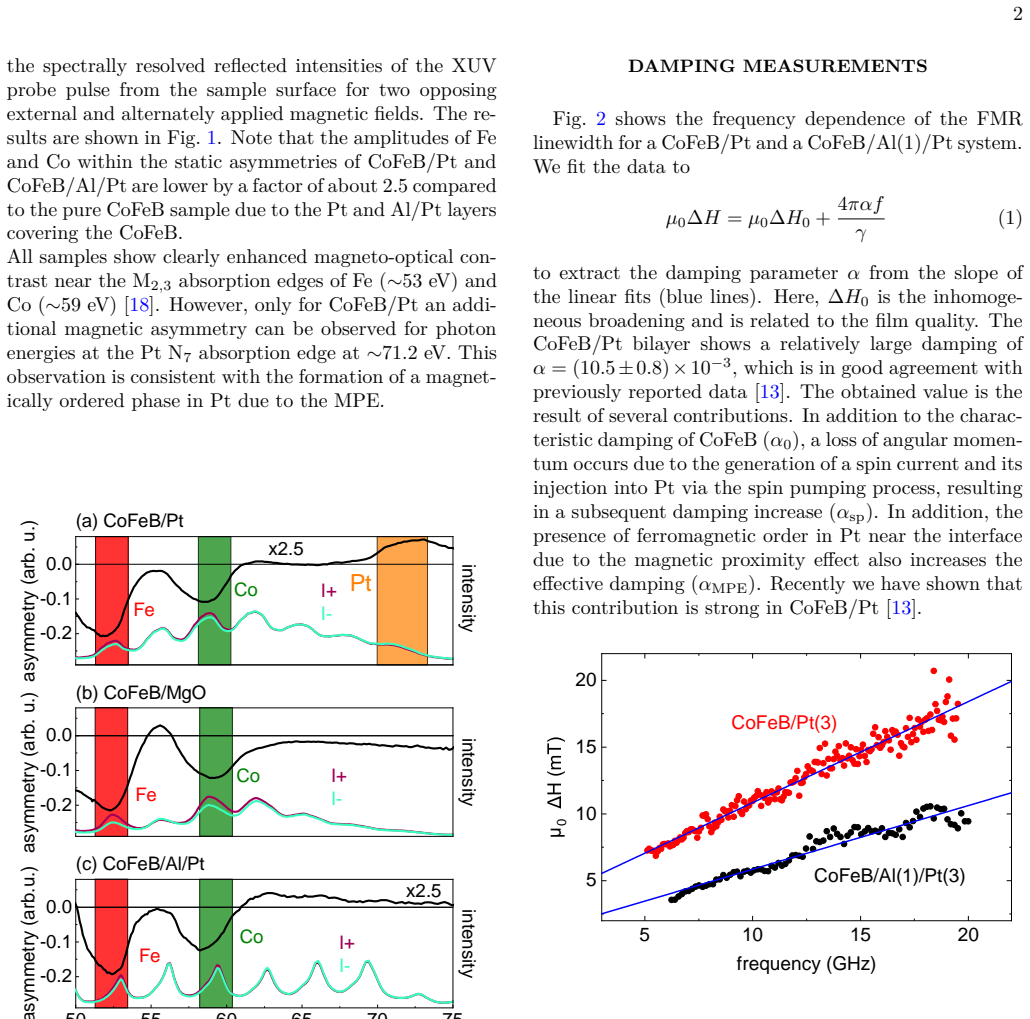
We present a study of the damping and spin pumping properties of CoFeB/X/Pt systems with $\rm X=Al,Cr$ and $\rm Ta$. We show that the total damping of the CoFeB/Pt systems is strongly reduced when an interlayer is introduced independently of the material. Using a model that considers spin relaxation, we identify the origin of this contribution in the magnetically polarized Pt formed by the magnetic proximity effect (MPE), which is suppressed by the introduction of the interlayer. The induced ferromagnetic order in the Pt layer is confirmed by transverse magneto-optical Kerr spectroscopy at the M$_{2,3}$ and N$_7$ absorption edges as an element-sensitive probe. We discuss the impact of the MPE on parameter extraction in the spin transport model.
Editorial analysis
A structured set of objections, weighed in public.
Referee Report
Summary. The manuscript examines damping and spin pumping in CoFeB/X/Pt trilayers (X = Al, Cr, Ta). It reports that inserting any of these interlayers strongly reduces the total damping of the CoFeB/Pt system independently of the interlayer material. A spin-relaxation model is used to attribute the reduction to suppression of the magnetic proximity effect (MPE) that otherwise induces ferromagnetic order in the Pt layer; this induced order is confirmed element-specifically by transverse magneto-optical Kerr spectroscopy at the Pt M_{2,3} and N_7 edges. The work also discusses consequences for parameter extraction in spin-transport models.
Significance. If the attribution of the damping change to MPE suppression is robust, the result clarifies a previously under-accounted channel that can bias extracted values of spin-mixing conductance and spin-diffusion length in FM/Pt heterostructures. The element-sensitive spectroscopic confirmation adds direct evidence for induced Pt magnetism and the interlayer suppression mechanism.
major comments (2)
- [spin-relaxation model] The spin-relaxation model used to isolate the MPE contribution from other damping channels is central to the claim yet is presented without the explicit equations, fitting procedure, or error analysis that would allow assessment of whether post-hoc parameter choices affect the extracted MPE term (see abstract and the paragraph following the damping data).
- [TMOKS spectroscopy] The transverse magneto-optical Kerr spectroscopy at the Pt M_{2,3} and N_7 edges is invoked as unambiguous confirmation of induced ferromagnetic order, but the manuscript does not report the raw spectra, background subtraction, or quantitative comparison to reference ferromagnetic Pt signals that would establish the detection limit and rule out artifacts.
minor comments (2)
- Figure captions should explicitly state the number of independent samples measured and the error bars used for the damping values.
- Notation for the interlayer materials (Al, Cr, Ta) should be consistent between text and figures.
Simulated Author's Rebuttal
We thank the referee for their careful reading of the manuscript and constructive comments on the spin-relaxation model and TMOKS spectroscopy. We address each point below and will revise the manuscript to incorporate additional details as requested.
read point-by-point responses
-
Referee: [spin-relaxation model] The spin-relaxation model used to isolate the MPE contribution from other damping channels is central to the claim yet is presented without the explicit equations, fitting procedure, or error analysis that would allow assessment of whether post-hoc parameter choices affect the extracted MPE term (see abstract and the paragraph following the damping data).
Authors: We agree that the spin-relaxation model was not presented with sufficient detail. In the revised manuscript we will add the explicit equations, describe the fitting procedure used to separate the MPE contribution from other damping channels, and include a quantitative error analysis demonstrating the robustness of the extracted MPE term with respect to parameter choices. revision: yes
-
Referee: [TMOKS spectroscopy] The transverse magneto-optical Kerr spectroscopy at the Pt M_{2,3} and N_7 edges is invoked as unambiguous confirmation of induced ferromagnetic order, but the manuscript does not report the raw spectra, background subtraction, or quantitative comparison to reference ferromagnetic Pt signals that would establish the detection limit and rule out artifacts.
Authors: We acknowledge that the TMOKS data presentation was incomplete. The revised manuscript will include the raw spectra, a description of the background subtraction procedure, and quantitative comparisons to reference signals from ferromagnetic Pt to establish the detection limit and rule out possible artifacts. revision: yes
Circularity Check
Primarily experimental work; no load-bearing derivation reduces to fitted inputs or self-citation chain
full rationale
The central claims rest on measured changes in damping upon interlayer insertion and element-specific TMOKS confirmation of induced order in Pt. The spin-relaxation model is used for interpretation of the data but does not generate predictions that are forced by construction from the paper's own fitted parameters or equations. No self-citation is invoked as the sole justification for a uniqueness theorem or ansatz that would render the attribution circular. This yields a low but non-zero score reflecting normal experimental practice rather than any reduction of the result to its inputs.
Axiom & Free-Parameter Ledger
Reference graph
Works this paper leans on
-
[1]
Y. Tserkovnyak, A. Brataas, G. E. W. Bauer, and B. I. Halperin, Reviews of Modern Physics77, 1375 (2005)
work page 2005
-
[2]
Y. Tserkovnyak, A. Brataas, and G. E. W. Bauer, Phys- ical Review Letters88, 117601 (2002)
work page 2002
-
[3]
M. Caminale, A. Ghosh, S. Auffret, U. Ebels, K. Ollefs, F. Wilhelm, A. Rogalev, and W. E. Bailey, Physical Re- view B 94, 014414 (2016)
work page 2016
- [4]
-
[5]
F. Wilhelm, P. Poulopoulos, G. Ceballos, H. Wende, K.Baberschke, P.Srivastava, D.Benea, H.Ebert, M.An- gelakeris, N. K. Flevaris, D. Niarchos, A. Rogalev, and N. B. Brookes, Physical Review Letters85, 413 (2000)
work page 2000
-
[6]
T. Kuschel, C. Klewe, P. Bougiatioti, O. Kuschel, J. Wollschlager, L. Bouchenoire, S. D. Brown, J.-M. Schmalhorst, D. Meier, and G. Reiss, IEEE Transactions on Magnetics 52, 1 (2016)
work page 2016
-
[7]
W. J. Antel, M. M. Schwickert, T. Lin, W. L. O’Brien, and G. R. Harp, Physical Review B60, 12933 (1999)
work page 1999
-
[8]
C. T. Boone, J. M. Shaw, H. T. Nembach, and T. J. Silva, Journal of Applied Physics117, 223910 (2015)
work page 2015
- [9]
-
[10]
X. Liu, W. Zhang, M. J. Carter, and G. Xiao, Journal of Applied Physics 110, 033910 (2011)
work page 2011
-
[11]
A. Conca, E. T. Papaioannou, S. Klingler, J. Greser, T. Sebastian, B. Leven, J. Lösch, and B. Hillebrands, Applied Physics Letters104, 10.1063/1.4875927 (2014)
-
[12]
A. Conca, J. Greser, T. Sebastian, S. Klingler, B. Obry, B. Leven, and B. Hillebrands, Journal of Applied Physics 113, 10.1063/1.4808462 (2013)
- [13]
- [14]
-
[15]
A. Rundquist, C. G. Durfee, Z. Chang, C. Herne, S. Backus, M. M. Murnane, and H. C. Kapteyn, Science 280, 1412 (1998)
work page 1998
-
[16]
S. Mathias, C. La-O-Vorakiat, P. Grychtol, P. Granitzka, E. Turgut, J. M. Shaw, R. Adam, H. T. Nembach, M. E. Siemens, S.Eich, C.M.Schneider, T.J.Silva, M.Aeschli- mann, M. M. Murnane, and H. C. Kapteyn, Proceedings of the National Academy of Sciences109, 4792 (2012)
work page 2012
-
[17]
C. La-O-Vorakiat, M. Siemens, M. M. Murnane, H. C. Kapteyn, S. Mathias, M. Aeschlimann, P. Grychtol, R. Adam, C. M. Schneider, J. M. Shaw, H. Nembach, and T. J. Silva, Physical Review Letters 103, 257402 (2009)
work page 2009
-
[18]
A. C. Thompson, I. Lindau, D. Attwood, Y. Liu, E. Gullikson, P. Pianetta, M. Howells, A. Robinson, K.-J. Kim, J. Scofield, J. Kirz, J. Underwood, J. Kor- tright, G. Williams, and H. Winick, X-ray data book- let, Lawrence Berkeley National Laboratory, University of California, Berkley, California 94720 (2009)
work page 2009
-
[19]
J. Bass and W. P. Pratt, Journal of Physics: Condensed Matter 19, 183201 (2007)
work page 2007
-
[20]
J.-C. Rojas-Sánchez, N. Reyren, P. Laczkowski, W. Savero, J.-P. Attané, C. Deranlot, M. Jamet, J.-M. George, L. Vila, and H. Jaffrès, Physical Review Letters 112, 106602 (2014)
work page 2014
-
[21]
L. Mihalceanu, S. Keller, J. Greser, D. Karfaridis, K. Simeonidis, G. Vourlias, T. Kehagias, A. Conca, B. Hillebrands, and E. T. Papaioannou, Applied Physics Letters 110, 10.1063/1.4989678 (2017). 6
- [22]
-
[23]
D. R. Lide, CRC Handbook of Chemistry and Physics, 89th ed. (CRC, 2008) p. 777
work page 2008
-
[24]
D. Qu, S. Y. Huang, and C. L. Chien, Physical Review B 92, 020418 (2015)
work page 2015
discussion (0)
Sign in with ORCID, Apple, or X to comment. Anyone can read and Pith papers without signing in.