Dust and Volatiles in the Disintegrating Comet C/2019 Y4 (ATLAS)
Pith reviewed 2026-05-24 04:54 UTC · model grok-4.3
The pith
Porous dust accounts for the red reflectivity gradient observed in the disintegrating comet C/2019 Y4 (ATLAS).
A machine-rendered reading of the paper's core claim, the machinery that carries it, and where it could break.
Core claim
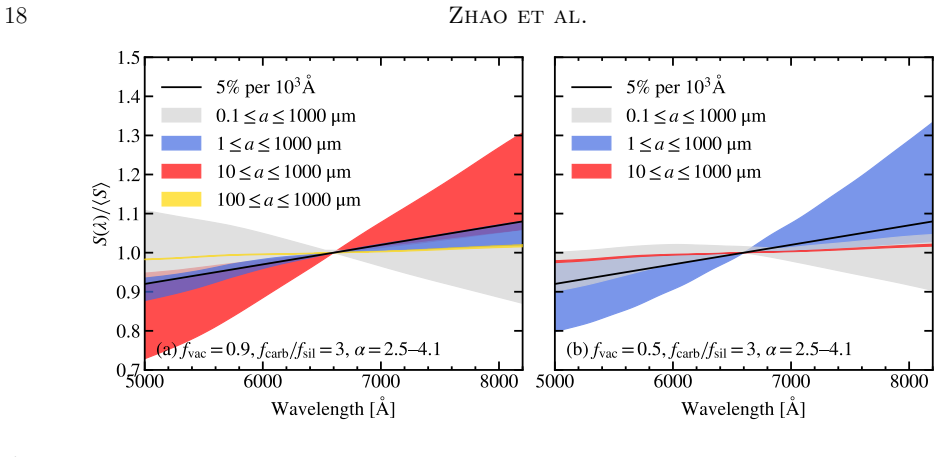
Long-slit spectra reveal strong CN, C2, C3, and NH2 bands on a dust continuum; Haser-model production rates and molecular ratios classify the comet as typical yet less dusty, while the measured reflectivity gradient of roughly 5 percent per 1000 angstroms is reproduced by scattering calculations for porous dust.
What carries the argument
Modeling of the dust-scattering reflectivity gradient using porous dust parameters.
If this is right
- C/2019 Y4 (ATLAS) belongs to the typical class of Oort-cloud comets by its C2/CN and C3/CN ratios.
- The comet is less dusty than average according to its Af rho values.
- The observed red color arises from the scattering properties of porous grains.
- Disintegration does not alter the basic volatile composition enough to change the comet's taxonomic placement.
Where Pith is reading between the lines
- Porosity may be a common feature of dust released during Oort-cloud comet breakup events.
- Similar modeling could be tested on other disintegrating comets to check whether red slopes are routinely explained by porosity alone.
- If porosity dominates the color, then changes in grain structure during disintegration could be tracked through repeated reflectivity measurements.
Load-bearing premise
The Haser model scale lengths and the porous-dust scattering parameters taken from earlier literature apply directly to this comet without modification for its disintegration.
What would settle it
New spectra or images that yield a reflectivity gradient outside the range predicted by the porous-dust scattering model, or production rates that deviate systematically from Haser-model expectations under the adopted scale lengths.
Figures


read the original abstract
C/2019 Y4 (ATLAS) is an Oort cloud comet with an orbital period of $\sim$5895$\,{\rm yr}$. Starting in March 2020, its nucleus underwent disintegration. In order to investigate the gas and dust properties of C/2019 Y4 (ATLAS) during its disintegration, we obtained long-slit spectra at 3600--8700$\,{\rm\mathring{A}}$ and $BVRI$ multi-band images with the Xinglong 2.16-Meter Telescope in April 2020. Our observations revealed that C/2019 Y4 (ATLAS) exhibited strong emission bands of CN, C$_2$, C$_3$, and NH$_2$ which are superimposed on a dust scattering continuum, typical of cometary spectra in the optical. The production rates of CN, C$_2$, and C$_3$ derived using the Haser model and the corresponding C$_2$/CN and C$_3$/CN ratios suggest that C/2019 Y4 (ATLAS) is a ``typical'' Oort cloud comet under the A'Hearn classification, although it appears less dusty as revealed by the $Af\rho$ quantities. Its dust-scattering reflectivity is slightly red, with a gradient of $\sim$5% per $10^3\,{\rm\mathring{A}}$. We model the reflectivity gradient in terms of porous dust and find that the red color is accounted for by porous dust.
Editorial analysis
A structured set of objections, weighed in public.
Referee Report
Summary. The manuscript reports long-slit optical spectroscopy (3600–8700 Å) and BVRI imaging of the disintegrating Oort-cloud comet C/2019 Y4 (ATLAS) obtained in April 2020. Gas production rates for CN, C₂ and C₃ are derived with the Haser model; the resulting C₂/CN and C₃/CN ratios classify the comet as “typical” under the A’Hearn scheme, while Afρ values indicate it is less dusty than average. The dust-scattering continuum shows a red reflectivity gradient of ~5 % per 10³ Å that is modeled with porous-dust scattering parameters taken from the literature, leading to the conclusion that porous dust accounts for the observed color.
Significance. If the modeling holds, the work supplies a useful data point on volatile ratios and dust properties during an Oort-cloud comet disintegration event. The direct spectroscopic measurements of production rates and the reflectivity gradient constitute the primary strengths; the application of standard Haser and scattering models from the external literature is a conventional but not novel approach.
major comments (2)
- [Abstract and dust-modeling section] Abstract and dust-modeling section: the central claim that the observed ~5 % per 10³ Å gradient “is accounted for by porous dust” rests on scattering parameters (porosity, refractive indices, size distribution) taken unchanged from prior literature. No sensitivity test or justification is supplied showing that these parameters remain appropriate for the grain properties expected during nucleus disintegration; this assumption is load-bearing for the dust-color conclusion.
- [Production-rate section] Haser-model application (production-rate derivation): the scale lengths are adopted from the external literature without reported adjustment or uncertainty propagation for the specific dynamical environment of a disintegrating comet. Because the classification as “typical” rests on the resulting C₂/CN and C₃/CN ratios, a brief sensitivity analysis to plausible variations in scale lengths would be required to confirm robustness.
Simulated Author's Rebuttal
We thank the referee for the constructive comments on our manuscript. We address each major point below, indicating where revisions have been made to strengthen the paper while maintaining the focus on the observational results.
read point-by-point responses
-
Referee: [Abstract and dust-modeling section] Abstract and dust-modeling section: the central claim that the observed ~5 % per 10³ Å gradient “is accounted for by porous dust” rests on scattering parameters (porosity, refractive indices, size distribution) taken unchanged from prior literature. No sensitivity test or justification is supplied showing that these parameters remain appropriate for the grain properties expected during nucleus disintegration; this assumption is load-bearing for the dust-color conclusion.
Authors: The parameters were drawn from established literature on cometary dust (porous aggregates with typical refractive indices and size distributions for Oort-cloud comets). These are standard choices for modeling optical reflectivity gradients and have been applied to similar objects. We agree that explicit justification for the disintegration context strengthens the presentation. In revision we have added a short paragraph in the dust-modeling section citing prior work on disintegrating comets that used the same parameter set, thereby linking the choice to the expected grain properties. A full new sensitivity study lies outside the scope of the present observational paper; the model is used only to show consistency with porous dust rather than to derive new microphysical parameters. revision: partial
-
Referee: [Production-rate section] Haser-model application (production-rate derivation): the scale lengths are adopted from the external literature without reported adjustment or uncertainty propagation for the specific dynamical environment of a disintegrating comet. Because the classification as “typical” rests on the resulting C₂/CN and C₃/CN ratios, a brief sensitivity analysis to plausible variations in scale lengths would be required to confirm robustness.
Authors: The Haser scale lengths employed are the canonical values from the A’Hearn et al. classification scheme, which is the standard reference for placing comets in the “typical” or “depleted” categories. While the dynamical environment of a disintegrating comet may differ, the scheme itself is applied with these fixed lengths. To address the concern we have inserted a brief sensitivity test in the revised production-rate section: the scale lengths were varied by factors of 0.5 and 2.0 (a range that brackets plausible uncertainties), and the resulting C₂/CN and C₃/CN ratios remain within the “typical” domain. This addition confirms the robustness of the classification without altering the primary conclusions. revision: yes
Circularity Check
No significant circularity; observations and external models are independent
full rationale
The paper directly measures the reflectivity gradient (~5% per 10^3 Å) and production rates from long-slit spectra and BVRI images. It applies the standard Haser model (from external literature) to derive CN, C2, C3 rates and ratios, and models the gradient using porous dust scattering parameters also drawn from prior external literature. No step reduces a claimed prediction or result to a parameter fitted or defined within this paper itself, nor does any load-bearing premise rest on a self-citation chain that is unverified. The central claim (red color accounted for by porous dust) is an application of independent models to new data and does not collapse by construction.
Axiom & Free-Parameter Ledger
free parameters (1)
- Haser model scale lengths
axioms (2)
- domain assumption The Haser model accurately describes the spatial distribution of cometary gases for deriving production rates.
- domain assumption Porous dust aggregates can be used to model the observed dust-scattering reflectivity gradient.
Reference graph
Works this paper leans on
-
[1]
A'Hearn , M. F., Millis , R. C., Schleicher , D. O., Osip , D. J., & Birch , P. V. 1995, , 118, 223, 10.1006/icar.1995.1190
-
[2]
A'Hearn , M. F., Schleicher , D. G., Millis , R. L., Feldman , P. D., & Thompson , D. T. 1984, , 89, 579, 10.1086/113552
-
[3]
2022, VizieR Online Data Catalog, V/154
Ahumada , R., Allende Prieto , C., Almeida , A., & et al. 2022, VizieR Online Data Catalog, V/154
work page 2022
-
[4]
Astropy Collaboration , Robitaille , T. P., Tollerud , E. J., et al. 2013, , 558, A33, 10.1051/0004-6361/201322068
-
[5]
Astropy-Specutils Development Team . 2019, Specutils: Spectroscopic analysis and reduction , Astrophysics Source Code Library, record ascl:1902.012. 1902.012
work page 2019
-
[6]
2017, , 469, S712, 10.1093/mnras/stx2640
Bardyn , A., Baklouti , D., Cottin , H., et al. 2017, , 469, S712, 10.1093/mnras/stx2640
-
[7]
2008, , 46, 21, 10.1146/annurev.astro.46.060407.145152
Blum , J., & Wurm , G. 2008, , 46, 21, 10.1146/annurev.astro.46.060407.145152
-
[8]
Bohlin , R. C., Gordon , K. D., & Tremblay , P. E. 2014, , 126, 711, 10.1086/677655
-
[9]
Bohren , C. F., & Huffman , D. R. 1983, Absorption and scattering of light by small particles
work page 1983
-
[10]
2019, astropy/photutils: v0.6, 10.5281/zenodo.2533376
Bradley, L., Sip o cz, B., Robitaille, T., et al. 2019, astropy/photutils: v0.6, 10.5281/zenodo.2533376
-
[11]
Brown , M. E., Bouchez , A. H., Spinrad , A. H., & Johns-Krull , C. M. 1996, , 112, 1197, 10.1086/118090
-
[12]
Chonis , T. S., & Gaskell , C. M. 2008, , 135, 264, 10.1088/0004-6256/135/1/264
-
[13]
Draine , B. T., & Lee , H. M. 1984, , 285, 89, 10.1086/162480
-
[14]
2016, , 128, 115005, 10.1088/1538-3873/128/969/115005
Fan , Z., Wang , H., Jiang , X., et al. 2016, , 128, 115005, 10.1088/1538-3873/128/969/115005
-
[15]
Fink , U., & Hicks , M. D. 1996, , 459, 729, 10.1086/176938
-
[16]
Foreman-Mackey , D., Hogg , D. W., Lang , D., & Goodman , J. 2013, PASP, 125, 306, 10.1086/670067
-
[17]
Fray , N., B \'e nilan , Y., Cottin , H., Gazeau , M. C., & Crovisier , J. 2005, , 53, 1243, 10.1016/j.pss.2005.06.005
-
[18]
Ginsburg , A., Sip o cz , B. M., Brasseur , C. E., et al. 2019, , 157, 98, 10.3847/1538-3881/aafc33
-
[19]
Greenberg , J. M. 1998, , 330, 375
work page 1998
-
[20]
Greenberg , J. M., & Hage , J. I. 1990, , 361, 260, 10.1086/169191
-
[21]
Henyey , L. G., & Greenstein , J. L. 1941, , 93, 70, 10.1086/144246
-
[22]
2020, , 160, 91, 10.3847/1538-3881/ab9d81
Hui , M.-T., & Ye , Q.-Z. 2020, , 160, 91, 10.3847/1538-3881/ab9d81
-
[23]
2021, , 507, 5376, 10.1093/mnras/stab2306
Ivanova , O., Luk'yanyk , I., Tomko , D., & Moiseev , A. 2021, , 507, 5376, 10.1093/mnras/stab2306
-
[24]
Jewitt , D., & Meech , K. J. 1986, , 310, 937, 10.1086/164745
-
[25]
W., Mierle , K., Blanton , M., & Roweis , S
Lang , D., Hogg , D. W., Mierle , K., Blanton , M., & Roweis , S. 2010, , 139, 1782, 10.1088/0004-6256/139/5/1782
-
[26]
Langland-Shula , L. E., & Smith , G. H. 2011, , 213, 280, 10.1016/j.icarus.2011.02.007
-
[27]
C., Hadamcik , E., & Alcouffe , G
Lasue , J., Levasseur-Regourd , A. C., Hadamcik , E., & Alcouffe , G. 2009, , 199, 129, 10.1016/j.icarus.2008.09.008
-
[28]
2008, in Small bodies in planetary systems (Berlin: Springer), 167--188
Li, A. 2008, in Small bodies in planetary systems (Berlin: Springer), 167--188
work page 2008
-
[29]
Li , A., & Greenberg , J. M. 1998 a , , 338, 364
work page 1998
-
[30]
1998 b , , 498, L83, 10.1086/311308
---. 1998 b , , 498, L83, 10.1086/311308
-
[31]
McDonnell , J. A. M., Lamy , P. L., & Pankiewicz , G. S. 1991, Physical Properties of Cometary Dust , ed. J. Newburn , R. L., M. Neugebauer , & J. Rahe , Vol. 167, 1043
work page 1991
-
[32]
Mommert , M., Kelley , M., de Val-Borro , M., et al. 2019, The Journal of Open Source Software, 4, 1426, 10.21105/joss.01426
-
[33]
Newville , M., Stensitzki , T., Allen , D. B., & Ingargiola , A. 2014, LMFIT: Non-Linear Least-Square Minimization and Curve-Fitting for Python , 0.8.0, Zenodo, 10.5281/zenodo.11813
-
[34]
Price , M. C., Kearsley , A. T., Burchell , M. J., et al. 2010, Meteoritics and Planetary Science, 45, 1409, 10.1111/j.1945-5100.2010.01104.x
-
[35]
2012, , 752, 5, 10.1088/0004-637X/752/1/5
Ram \' rez , I., Michel , R., Sefako , R., et al. 2012, , 752, 5, 10.1088/0004-637X/752/1/5
-
[36]
Rouleau , F., & Martin , P. G. 1991, , 377, 526, 10.1086/170382
-
[37]
Schleicher , D. G. 2010, , 140, 973, 10.1088/0004-6256/140/4/973
-
[38]
Schleicher , D. G., & Bair , A. N. 2011, , 141, 177, 10.1088/0004-6256/141/6/177
-
[39]
2020, Central Bureau Electronic Telegrams, 4751, 1
Sekanina , Z., Guido , E., & Bryssinck , E. 2020, Central Bureau Electronic Telegrams, 4751, 1
work page 2020
-
[40]
Steele , I. A., Smith , R. J., & Marchant , J. 2020, The Astronomer's Telegram, 13622, 1
work page 2020
-
[41]
1999, , 90, 269, 10.1023/A:1005270703284
Strazzulla , G. 1999, , 90, 269, 10.1023/A:1005270703284
-
[42]
1941, Lick Observatory Bulletin, 508, 131, 10.5479/ADS/bib/1941LicOB.19.131S
Swings , P. 1941, Lick Observatory Bulletin, 508, 131, 10.5479/ADS/bib/1941LicOB.19.131S
-
[43]
2020, The Astronomer's Telegram, 13651, 1
Ye , Q., & Hui , M.-T. 2020, The Astronomer's Telegram, 13651, 1
work page 2020
-
[44]
2020, The Astronomer's Telegram, 13620, 1
Ye , Q., & Zhang , Q. 2020, The Astronomer's Telegram, 13620, 1
work page 2020
-
[45]
2021, , 162, 70, 10.3847/1538-3881/abfec3
Ye , Q., Jewitt , D., Hui , M.-T., et al. 2021, , 162, 70, 10.3847/1538-3881/abfec3
-
[46]
2020, , 497, 1536, 10.1093/mnras/staa1725
Zubko , E., Zheltobryukhov , M., Chornaya , E., et al. 2020, , 497, 1536, 10.1093/mnras/staa1725
-
[47]
, " * write output.state after.block = add.period write newline
ENTRY address archivePrefix author booktitle chapter doi edition editor eprint howpublished institution journal key month number organization pages publisher school series title misctitle type volume year version url label extra.label sort.label short.list INTEGERS output.state before.all mid.sentence after.sentence after.block FUNCTION init.state.consts ...
-
[48]
" write newline "" before.all 'output.state := FUNCTION format.url url empty "" new.block "" url * "" * if FUNCTION format.eprint eprint empty "" archivePrefix empty "" archivePrefix "arXiv" = new.block " " eprint * " " * new.block " " eprint * " " * if if if FUNCTION format.doi doi empty "" " " doi * " " * if FUNCTION format.pid doi empty eprint empty ur...
-
[49]
- [1] #1 = = ^ ^ ^ .\!\!^ d .\!\!^ h .\!\!^ m .\!\!^ s .\!\!^ @mss
thebibliography [1] 20pt to REFERENCES 6pt =0pt 10pt plus 3pt =0pt =0pt =1pt plus 1pt =0pt =0pt -12pt =13pt plus 1pt =20pt =13pt plus 1pt \@M =10000 =-1.0em =0pt =0pt 0pt =0pt =1.0em @enumiv\@empty 10000 10000 `\.\@m \@noitemerr \@latex@warning Empty `thebibliography' environment \@ifnextchar \@reference \@latexerr Missing key on reference command Each re...
discussion (0)
Sign in with ORCID, Apple, or X to comment. Anyone can read and Pith papers without signing in.