Generalized transmon Hamiltonian for Andreev spin qubits
Pith reviewed 2026-05-24 03:52 UTC · model grok-4.3
The pith
Flat-band Richardson approximation yields an exact solvable generalized transmon Hamiltonian that treats quantum-dot, Josephson, and charging physics on equal footing.
A machine-rendered reading of the paper's core claim, the machinery that carries it, and where it could break.
Core claim
By applying the flat-band approximation to the Richardson model, the full Hilbert space of the quantum-dot–Josephson-junction system with charging energy reduces to a tractable size that still contains every state required for low-energy physics; exact diagonalization then produces a generalized transmon Hamiltonian whose eigenstates encode the coupled fluctuations of the superconducting phase and the quantum-dot spin.
What carries the argument
Flat-band approximation of the Richardson model, which truncates the superconducting quasiparticle spectrum to allow exact diagonalization while preserving all low-energy states and the phase–dot coupling.
If this is right
- The Hamiltonian can be used for Andreev spin qubits in transmon circuits across the full range of charging energies and tunnel couplings.
- Time-dependent driving protocols can be simulated without additional approximations.
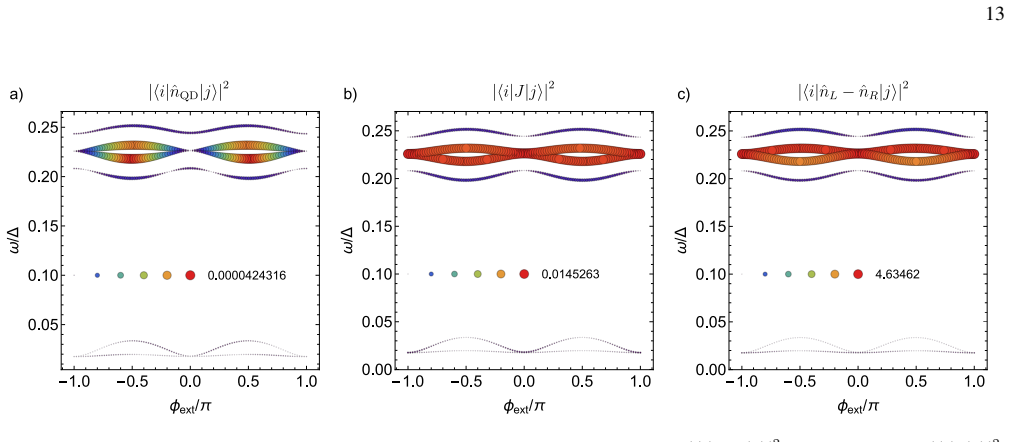
- Transition matrix elements for charge-, current-, and spin-flip microwave processes become directly computable.
- Quantum phase fluctuations and their back-action on the dot spin are automatically included.
Where Pith is reading between the lines
- The same diagonalization procedure could be reused to extract effective qubit-qubit interactions when multiple dots share a common transmon.
- Adding a small number of non-flat bands would provide a controlled way to test the approximation's accuracy at higher energies.
- The method supplies a microscopic starting point for deriving reduced master equations that include both charge and spin noise channels.
Load-bearing premise
The flat-band truncation keeps every state that matters for the low-energy spectrum and dynamics.
What would settle it
Direct comparison of the calculated low-energy spectrum or microwave transition rates against measurements performed on an actual Andreev spin qubit inside a transmon circuit.
Figures







read the original abstract
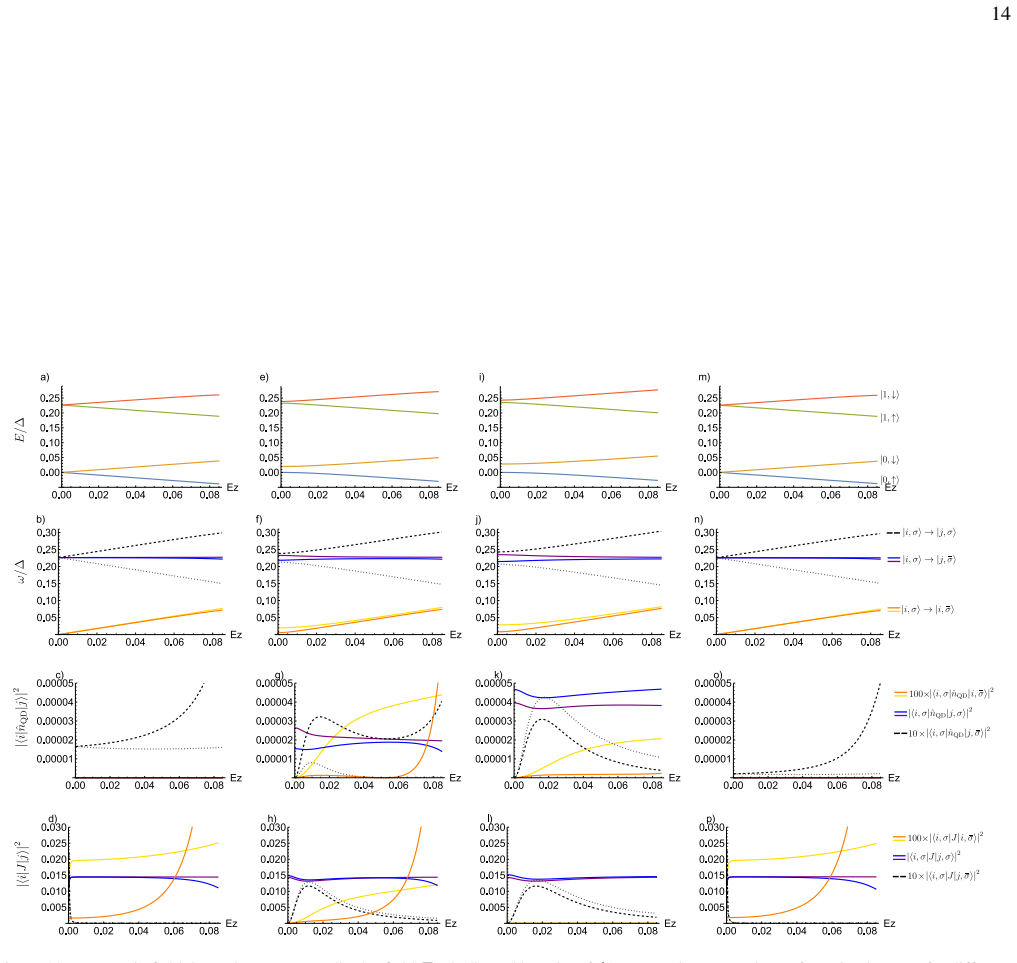
We solve the problem of an interacting quantum dot embedded in a Josephson junction between two superconductors with finite charging energy described by the transmon (Cooper pair box) Hamiltonian. The approach is based on the flat-band approximation of the Richardson model, which reduces the Hilbert space to the point where exact diagonalisation is possible while retaining all states that are necessary to describe the low energy phenomena. The presented method accounts for the physics of the quantum dot, the Josephson effect and the Coulomb repulsion (charging energy) at the same level. In particular, it captures the quantum fluctuations of the superconducting phase as well as the coupling between the superconducting phase and the quantum dot (spin) degrees of freedom. The method can be directly applied for modelling Andreev spin qubits embedded in transmon circuits in all parameter regimes, for describing time-dependent processes, and for the calculation of transition matrix elements for microwave-driven transmon, spin-flip and mixed transitions that involve coupling to charge or current degree of freedom.
Editorial analysis
A structured set of objections, weighed in public.
Referee Report
Summary. The paper develops a generalized transmon Hamiltonian for an interacting quantum dot embedded in a Josephson junction with finite charging energy. It employs the flat-band approximation of the Richardson model to reduce the Hilbert space sufficiently for exact diagonalization while retaining states needed for low-energy physics, including superconducting phase fluctuations and their coupling to the quantum-dot spin. The resulting framework is claimed to treat the quantum dot, Josephson effect, and Coulomb repulsion on equal footing and is positioned for direct application to Andreev spin qubits in transmon circuits, including time-dependent dynamics and microwave transition matrix elements.
Significance. If the central approximation is validated, the work supplies a unified, numerically tractable description of hybrid superconducting systems that simultaneously incorporates charging energy, phase fluctuations, and spin-phase coupling. This addresses a practical modeling gap for Andreev spin qubits and enables calculation of mixed transitions involving charge or current degrees of freedom.
major comments (2)
- [§2] §2 (flat-band Richardson approximation): the assertion that the approximation retains every state required for low-energy phase-spin coupling is load-bearing for the central claim, yet the manuscript provides no explicit numerical benchmark against the dispersive (finite-bandwidth) Richardson model once finite E_C is restored. Without such a check, it remains unclear whether band dispersion introduces additional low-energy matrix elements that would alter the effective Hamiltonian.
- [§3] §3 (exact diagonalization and effective Hamiltonian): the derivation of the generalized transmon Hamiltonian from the reduced Hilbert space must demonstrate that the retained basis is closed under the charging-energy term; otherwise the claimed quantitative reliability across all parameter regimes is not guaranteed.
minor comments (2)
- Notation for the phase operator and its conjugate charge should be introduced with an explicit commutation relation at first use to avoid ambiguity when the effective Hamiltonian is written.
- Figure captions for the energy spectra should state the precise parameter values (E_C, E_J, dot level position) used, rather than referring only to 'typical' regimes.
Simulated Author's Rebuttal
We thank the referee for their thorough review and insightful comments on our manuscript. We address each of the major comments below and outline the revisions we plan to make.
read point-by-point responses
-
Referee: [§2] §2 (flat-band Richardson approximation): the assertion that the approximation retains every state required for low-energy phase-spin coupling is load-bearing for the central claim, yet the manuscript provides no explicit numerical benchmark against the dispersive (finite-bandwidth) Richardson model once finite E_C is restored. Without such a check, it remains unclear whether band dispersion introduces additional low-energy matrix elements that would alter the effective Hamiltonian.
Authors: The flat-band approximation is central to enabling exact diagonalization while preserving the low-energy physics of the Andreev spin qubit coupled to the transmon. We justify its use in the manuscript by noting that it retains all states necessary for the low-energy phenomena as per the Richardson model properties. However, we acknowledge the value of an explicit benchmark. In the revised manuscript, we will add a section or appendix providing a numerical comparison for small systems between the flat-band results and a truncated finite-bandwidth Richardson model with finite E_C, to verify that dispersion effects do not introduce significant alterations to the low-energy effective Hamiltonian. revision: yes
-
Referee: [§3] §3 (exact diagonalization and effective Hamiltonian): the derivation of the generalized transmon Hamiltonian from the reduced Hilbert space must demonstrate that the retained basis is closed under the charging-energy term; otherwise the claimed quantitative reliability across all parameter regimes is not guaranteed.
Authors: The reduced basis is obtained by diagonalizing the Richardson Hamiltonian in the flat-band limit, which spans the relevant charge and spin configurations for the quantum dot. The charging energy is the transmon charging term, which depends on the total excess charge. Since the basis states are eigenstates with well-defined parity or charge properties in the superconducting context, the charging term preserves the subspace. To address the concern, we will include in the revised manuscript an explicit proof or demonstration that the charging-energy operator maps the retained basis to itself, ensuring the effective Hamiltonian is well-defined within this space. revision: yes
Circularity Check
No circularity; method is an explicit approximation choice without self-referential reduction
full rationale
The paper states its central construction as the flat-band approximation of the Richardson model, which is presented as an input assumption that reduces the Hilbert space for exact diagonalization while retaining low-energy states. No quoted step shows a derived quantity defined in terms of itself, a fitted parameter renamed as a prediction, or a load-bearing claim justified only by self-citation. The abstract and description treat the approximation as a modeling choice whose validity is external to the derivation chain itself, making the overall approach self-contained against the stated model rather than circular.
Axiom & Free-Parameter Ledger
axioms (1)
- domain assumption Flat-band approximation of the Richardson model reduces the Hilbert space while retaining all states necessary for low-energy phenomena
Reference graph
Works this paper leans on
-
[1]
Subgap spectrum of the SC-QD-SC junction We begin by reproducing the basic properties of a JJ with an embedded QD, starting with tp = 0, i.e., without the refer- 7 ence junction, and Ec = 0, i.e., without any charging energy terms. In this simplest case the phase difference ϕ is a con- served scalar quantity (good quantum number) that labels the eigenstat...
-
[2]
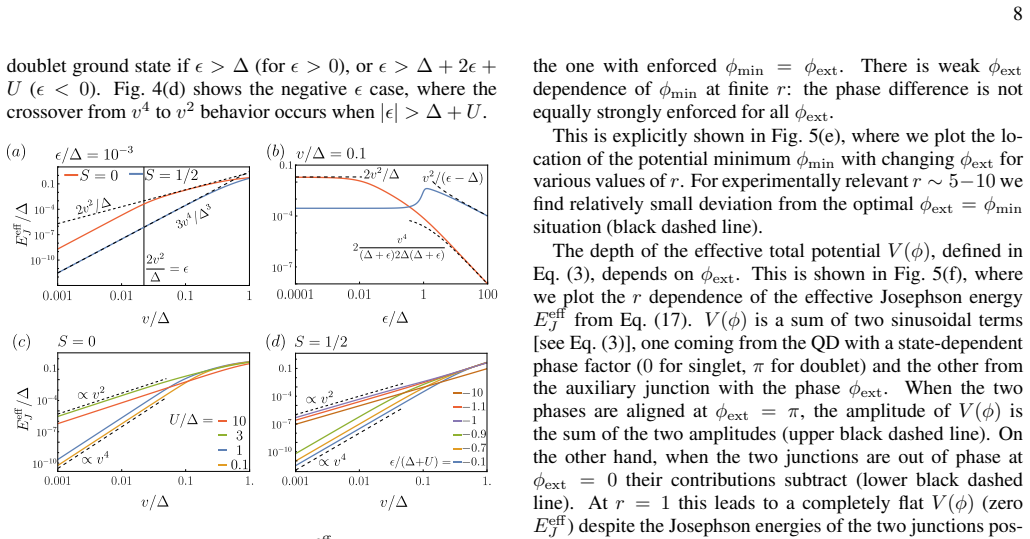
Effective Josephson energy In analogy with a standard JJ, we define the effective Josephson energy as the half-width of the energy band ob- tained by varying ϕ, Eeff J = 1 2 max ϕ E(ϕ) − min ϕ E(ϕ) , (17) where E(ϕ) is the energy of the lowest state in the singlet or doublet subspace (the result is state-dependent). The extreme values are taken at ϕ = 0 a...
-
[3]
The model can be applied to other states as well
the calculation of QD spin flipping induced by a pulse, 3) the investigation of transition matrix elements. The model can be applied to other states as well. While in this work we have focused on the doublet subspace, as appro- priate for Andreev spin qubits, it is equally possible to study the singlet subspace which is relevant for Andreev level qubits b...
-
[4]
Singlet states The singlet manifold has dimension 14, consisting of one state with no unpaired particles: • |mL, 0, mR, 0⟩, six states with two unpaired particles: • |mL, 0, mR, 2⟩, • |mL, 2, mR, 0⟩, • d† ↓d† ↑|mL, 0, mR, 0⟩, • d† ↑|mL, ↓, mR, 0⟩ − d† ↓|mL, ↑, mR, 0⟩ / √ 2, • d† ↑|mL, 0, mR, ↓⟩ − d† ↓|mL, 0, mR, ↑⟩ / √ 2, • (|mL, ↑, mR, ↓⟩ − |mL, ↓, mR, ↑...
-
[5]
Doublet states The doublet manifold also has dimension 14. It contains three states with one unpaired particle: • d† ↑|mL, 0, mR, 0⟩, • |mL, ↑, mR, 0⟩, • |mL, 0, mR, ↑⟩, eight states with three unpaired particles: • d† ↓d† ↑|mL, ↑, mR, 0⟩, • d† ↓d† ↑|mL, 0, mR, ↑⟩, • d† ↑|mL, 2, mR, 0⟩, • d† ↑|mL, 0, mR, 2⟩, • |mL, ↑, mR, 2⟩, • |mL, 2, mR, ↑⟩, • d† ↓|mL, ...
-
[6]
Hamiltonian generation The diagonal part of the Hamiltonian is Hdiag =ϵnQD + U nQD↑nQD↓ + g 2 X βσ f † βσ fβσ + X β Eβ c X σ f † βσ fβσ + 2mβ − n0 !2 (A1) and can be read out directly for each basis state. The off-diagonal part is generated by first calculating ana- lytical expressions for all matrix elements ⟨d′, m′ L, f ′ L, m′ R, f ′ R|Hhyb|d, mL, fL, ...
-
[7]
M. Kjaergaard, M. E. Schwartz, J. Braum ¨uller, P. Krantz, J. I.- J. Wang, S. Gustavsson, and W. D. Oliver, Annual Review of Condensed Matter Physics 11, 369 (2020)
work page 2020
-
[8]
M. H. Devoret, A. Wallraff, and J. M. Martinis, Superconduct- ing qubits: A short review (2004)
work page 2004
-
[9]
Devoret, Quantum Fluctuations: Volume 63 , edited by S
M. Devoret, Quantum Fluctuations: Volume 63 , edited by S. Reynaud, E. Giacobino, and F. David, Les Houches (North- Holland, Oxford, England, 1997)
work page 1997
-
[11]
Wendin, Reports on Progress in Physics 80, 106001 (2017)
G. Wendin, Reports on Progress in Physics 80, 106001 (2017)
work page 2017
-
[12]
M. Hays, V . Fatemi, D. Bouman, J. Cerrillo, S. Diamond, K. Serniak, T. Connolly, P. Krogstrup, J. Nyg ˚ard, A. L. Yey- ati, A. Geresdi, and M. H. Devoret, Science 373, 430 (2021)
work page 2021
-
[13]
M. Pita-Vidal, A. Bargerbos, R. ˇZitko, L. J. Splitthoff, L. Gr ¨unhaupt, J. J. Wesdorp, Y . Liu, L. P. Kouwenhoven, R. Aguado, B. van Heck, A. Kou, and C. K. Andersen, Nature Physics 10.1038/s41567-023-02071-x (2023)
-
[14]
M. Pita-Vidal, J. J. Wesdorp, L. J. Splitthoff, A. Bargerbos, Y . Liu, L. P. Kouwenhoven, and C. K. Andersen, Strong tun- able coupling between two distant superconducting spin qubits (2023), arXiv:2307.15654 [quant-ph]
-
[15]
N. M. Chtchelkatchev and Y . V . Nazarov, Phys. Rev. Lett. 90, 226806 (2003)
work page 2003
-
[17]
K. G. Wilson, Reviews of Modern Physics 47, 773 (1975)
work page 1975
- [18]
-
[19]
Tinkham, Introduction to superconductivity, 2nd ed
M. Tinkham, Introduction to superconductivity, 2nd ed. (Dover Publications, 2004)
work page 2004
- [20]
-
[21]
L. Glazman and G. Catelani, SciPost Physics Lecture Notes 10.21468/scipostphyslectnotes.31 (2021)
-
[22]
M. T. Tuominen, J. M. Hergenrother, T. S. Tighe, and M. Tin- kham, Physical Review Letters 69, 1997 (1992)
work page 1997
-
[23]
P. Lafarge, P. Joyez, D. Esteve, C. Urbina, and M. H. Devoret, Physical Review Letters 70, 994 (1993)
work page 1993
-
[24]
V . Bouchiat, D. Vion, P. Joyez, D. Esteve, and M. H. Devoret, Physica Scripta T76, 165 (1998)
work page 1998
- [25]
-
[26]
Cottet, Implementation of a quantum bit in a superconduct- ing circuit , Ph.D
A. Cottet, Implementation of a quantum bit in a superconduct- ing circuit , Ph.D. thesis, Ecole normale superieure de Paris (2002)
work page 2002
-
[27]
T. W. Larsen, K. D. Petersson, F. Kuemmeth, T. S. Jespersen, P. Krogstrup, J. Nyg ˚ard, and C. M. Marcus, Physical Review Letters 115 (2015)
work page 2015
-
[28]
G. de Lange, B. van Heck, A. Bruno, D. J. van Woerkom, A. Geresdi, S. R. Plissard, E. P. A. M. Bakkers, A. R. Akhmerov, and L. DiCarlo, Physical Review Letters 115 (2015)
work page 2015
-
[29]
H. Zheng, L. Y . Cheung, N. Sangwan, A. Kononov, R. Haller, J. Ridderbos, C. Ciaccia, J. H. Ungerer, A. Li, E. P. A. M. Bakkers, A. Baumgartner, and C. Sch ¨onenberger, Coherent control of a few-channel hole type gatemon qubit (2023), arXiv:2312.06411 [cond-mat.mes-hall]
- [30]
- [31]
- [32]
-
[33]
A. I. Rusinov, JETP Lett. 9, 85 (1969), zh. Eksp. Teor. Fiz. Pisma Red. 9, 146 (1968)
work page 1969
-
[34]
A. C. Hewson, The Kondo Problem to Heavy Fermions (Cam- bridge University Press, 1993)
work page 1993
-
[35]
A. V . Rozhkov and D. P. Arovas, Physical Review Letters 82, 2788 (1999)
work page 1999
-
[36]
A. A. Clerk and V . Ambegaokar, Physical Review B 61, 9109 (2000)
work page 2000
-
[37]
E. Vecino, A. Mart ´ın-Rodero, and A. L. Yeyati, Physical Re- view B 68, 10.1103/physrevb.68.035105 (2003)
-
[38]
M.-S. Choi, M. Lee, K. Kang, and W. Belzig, Physical Review B 70, 10.1103/physrevb.70.020502 (2004)
- [39]
-
[40]
J. A. van Dam, Y . V . Nazarov, E. P. A. M. Bakkers, S. D. Franceschi, and L. P. Kouwenhoven, Nature442, 667 (2006)
work page 2006
-
[41]
R. ˇZitko, Josephson potentials for single impurity Anderson im- purity in a junction between two superconductors (2022)
work page 2022
-
[42]
A. Bargerbos, M. Pita-Vidal, R. ˇZitko, J. ´Avila, L. J. Split- thoff, L. Gr ¨unhaupt, J. J. Wesdorp, C. K. Andersen, Y . Liu, L. P. Kouwenhoven, R. Aguado, A. Kou, and B. van Heck, PRX Quantum 3, 10.1103/prxquantum.3.030311 (2022)
-
[43]
M. R. Sahu, F. J. Matute-Ca ˜nadas, M. Benito, P. Krogstrup, J. Nyg˚ard, M. F. Goffman, C. Urbina, A. L. Yeyati, and H. Poth- ier, Ground state phase diagram and ”parity flipping” mi- crowave transitions in a gate-tunable josephson junction (2023), arXiv:2312.12914 [cond-mat.mes-hall]
-
[44]
L. Bulaevskii, V . Kuzii, and A. Sobyanin, Solid State Commu- nications 25, 1053 (1978)
work page 1978
-
[45]
D. Vion, A. Aassime, A. Cottet, P. Joyez, H. Pothier, C. Urbina, D. Esteve, and M. H. Devoret, Physica Scripta T102, 162 (2002)
work page 2002
-
[46]
D. Vion, A. Aassime, A. Cottet, P. Joyez, H. Pothier, C. Urbina, D. Esteve, and M. Devoret, Fortschritte der Physik 51, 462 (2003)
work page 2003
-
[47]
M. L. Della Rocca, M. Chauvin, B. Huard, H. Pothier, D. Es- teve, and C. Urbina, Physical Review Letters 99, 127005 (2007)
work page 2007
-
[48]
L. V . Ginzburg, I. E. Batov, V . V . Bol’ginov, S. V . Egorov, V . I. Chichkov, A. E. Shchegolev, N. V . Klenov, I. I. Soloviev, S. V . Bakurskiy, and M. Y . Kupriyanov, JETP Letters 107, 48–54 (2018)
work page 2018
-
[49]
A. Bargerbos, M. Pita-Vidal, R. ˇZitko, L. J. Splitthoff, L. Gr ¨unhaupt, J. J. Wesdorp, Y . Liu, L. P. Kouwenhoven, R. Aguado, C. K. Andersen, A. Kou, and B. van Heck, Phys. Rev. Lett. 131, 097001 (2023)
work page 2023
-
[50]
L. Pave ˇsi´c, M. Pita-Vidal, A. Bargerbos, and R. ˇZitko, SciPost Physics 15, 2542 (2023)
work page 2023
-
[51]
R. W. Richardson and N. Sherman, Nuclear Physics 52, 221 (1964)
work page 1964
- [52]
-
[53]
L. Pave ˇsi´c, D. Bauernfeind, and R. ˇZitko, Physical Review B 104, 10.1103/physrevb.104.l241409 (2021)
-
[54]
J. Rom ´an, G. Sierra, and J. Dukelsky, Nuclear Physics B 634, 483–510 (2002). 23
work page 2002
-
[55]
J. Dukelsky, S. Pittel, and G. Sierra, Reviews of Modern Physics 76, 643 (2004)
work page 2004
- [56]
-
[58]
L. Pave ˇsi´c and R. ˇZitko, Physical Review B105, 10.1103/phys- revb.105.075129 (2022)
-
[59]
For detailed derivations and expressions at general filling see Ref. 51
-
[60]
S. T. Belyaev, JETP Letters 12, 968 (1961)
work page 1961
-
[61]
V . A. Khodel’ and V . R. Shaginyan, JETP Letters 51, 488 (1990)
work page 1990
-
[62]
G. E. V olovik, JETP Letters107, 516 (2018)
work page 2018
- [63]
-
[64]
Wolfram Research, Inc., Mathematica, Version 13.3 (2023), Champaign, IL, 2023
work page 2023
-
[65]
Pave ˇsiˇc, Flat band two channel, https://github.com/ PavesicL/flat_band_two_channel (2023)
L. Pave ˇsiˇc, Flat band two channel, https://github.com/ PavesicL/flat_band_two_channel (2023)
work page 2023
-
[66]
M. H. Devoret, Journal of Superconductivity and Novel Mag- netism 34, 1633–1642 (2021)
work page 2021
-
[67]
I. Affleck, J.-S. Caux, and A. M. Zagoskin, Physical Review B 62, 1433 (2000)
work page 2000
-
[68]
F. S. Bergeret, A. L. Yeyati, and A. Mart ´ın-Rodero, Physical Review B 76, 10.1103/physrevb.76.174510 (2007)
-
[69]
K. Grove-Rasmussen, G. Steffensen, A. Jellinggaard, M. H. Madsen, R. ˇZitko, J. Paaske, and J. Nyg ˚ard, Nature Commu- nications 9, 10.1038/s41467-018-04683-x (2018)
- [70]
-
[71]
C. Hermansen, A. L. Yeyati, and J. Paaske, Physical Review B 105, 10.1103/physrevb.105.054503 (2022)
-
[72]
H. Schmid, J. F. Steiner, K. J. Franke, and F. von Oppen, Phys- ical Review B 105, 10.1103/physrevb.105.235406 (2022)
-
[73]
L. Pave ˇsiˇc, R. Aguado, and R. ˇZitko, Strong-coupling theory of quantum dot josephson junctions: role of the residual quasipar- ticle (2023)
work page 2023
-
[74]
A. F. Andreev, Zh. Eksperim. i Teor. Fiz. 46, (1964)
work page 1964
-
[75]
C. P. Koch, U. Boscain, T. Calarco, G. Dirr, S. Filipp, S. J. Glaser, R. Kosloff, S. Montangero, T. Schulte-Herbr ¨uggen, D. Sugny, and F. K. Wilhelm, EPJ Quantum Technology 9, 10.1140/epjqt/s40507-022-00138-x (2022)
-
[76]
M. Rossignolo, T. Reisser, A. Marshall, P. Rembold, A. Pagano, P. J. Vetter, R. S. Said, M. M. M ¨uller, F. Motzoi, T. Calarco, F. Jelezko, and S. Montangero, Computer Physics Communica- tions 291, 108782 (2023)
work page 2023
-
[77]
V . N. Golovach, M. Borhani, and D. Loss, Physical Review B 74, https://doi.org/10.1103/PhysRevB.74.165319 (2006)
-
[78]
K. C. Nowack, F. H. L. Koppens, Y . V . Nazarov, and L. M. K. Vandersypen, Science 318, 1430 (2007)
work page 2007
-
[79]
M. Pioro-Ladri `ere, T. Obata, Y . Tokura, Y .-S. Shin, T. Kubo, K. Yoshida, T. Taniyama, and S. Tarucha, Nature Physics 4, 776 (2008)
work page 2008
-
[80]
S. Nadj-Perge, S. M. Frolov, E. P. A. M. Bakkers, and L. P. Kouwenhoven, Nature 468, 1084 (2010)
work page 2010
-
[81]
J. W. G. van den Berg, S. Nadj-Perge, V . S. Prib- iag, S. R. Plissard, E. P. A. M. Bakkers, S. M. Frolov, and L. P. Kouwenhoven, Physical Review Letters 110, https://doi.org/10.1103/PhysRevLett.110.066806 (2013)
-
[82]
B. Li, T. Calarco, and F. Motzoi, PRX Quantum 3, 10.1103/prxquantum.3.030313 (2022)
discussion (0)
Sign in with ORCID, Apple, or X to comment. Anyone can read and Pith papers without signing in.