Light Cone Cancellation for Variational Quantum Eigensolver in Solving Noisy Max-Cut
Pith reviewed 2026-05-24 01:51 UTC · model grok-4.3
The pith
Light cone cancellation applied to VQE raises approximation ratios on noisy Max-Cut instances up to 100 qubits.
A machine-rendered reading of the paper's core claim, the machinery that carries it, and where it could break.
Core claim
Light cone cancellation applied to a single-layer two-local ansatz decomposes each variational circuit into multiple subcircuits that use fewer qubits and fewer gates. On fake noisy backends the reduced circuits return higher approximation ratios for Max-Cut instances up to 100 qubits than the unreduced circuits, which the authors interpret as evidence that device noise is mitigated. Multi-layer ansatzes were tested but the single-layer version remained superior under the same noise model.
What carries the argument
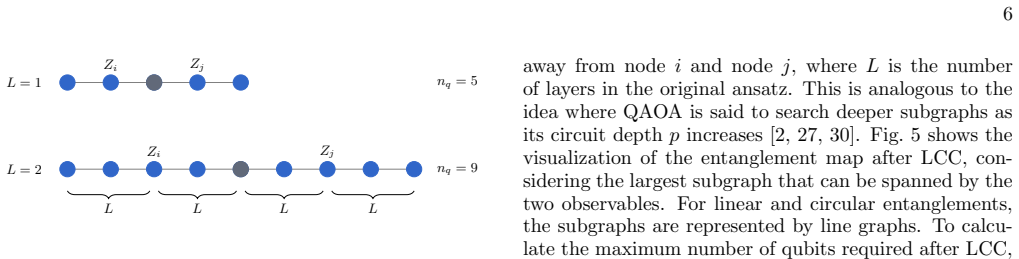
Light Cone Cancellation (LCC), the procedure that removes gates whose removal does not change the expectation value of any local observable, thereby enabling decomposition into smaller subcircuits.
If this is right
- Max-Cut problems larger than the available qubit count can be solved by evaluating only the smaller subcircuits.
- Fewer gates per subcircuit reduce the total error accumulated from hardware noise.
- The single-layer two-local ansatz combined with LCC outperforms multi-layer versions on the tested noisy simulators.
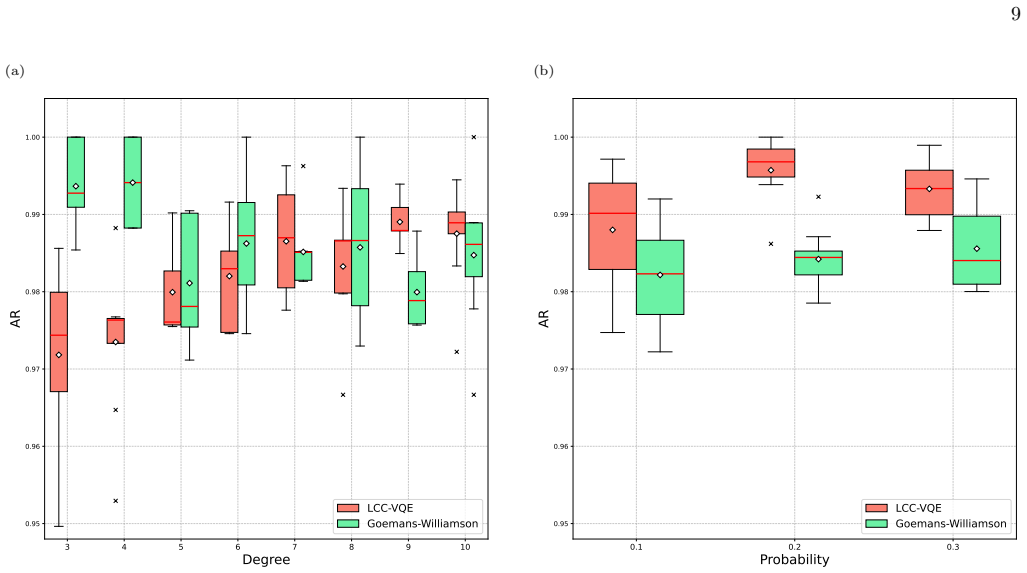
- The method produces approximation ratios that can be compared directly with the Goemans-Williamson classical bound under noiseless conditions.
Where Pith is reading between the lines
- The same cancellation technique could be applied to other variational algorithms whose cost functions depend on local observables.
- Subcircuit decomposition may enable parallel execution across multiple small quantum processors.
- Combining LCC with additional error-suppression methods could further enlarge the size of solvable instances.
Load-bearing premise
The cancellation step removes only gates that truly have no effect on the measured local observable, so the smaller subcircuits still compute exactly the same expectation values as the original circuit.
What would settle it
If the same Max-Cut instances run on real quantum hardware show no improvement or a reversal in approximation ratio when LCC is used versus when it is not used, the claimed noise-mitigation benefit would be falsified.
Figures






read the original abstract
Variational Quantum Eigensolver (VQE) is a quantum-classical hybrid algorithm used to estimate the ground energy of a given Hamiltonian. It consists of a parameterized quantum circuit, which the parameters are optimized using a classical optimizer. With the increasing need in solving large-scale problems in real-world applications, solving those large problems with fewer qubits and fewer gates becomes essential, so that we reduce the simulation difficulty and mitigate the effect of noise in real quantum hardware. In this study, we applied the Light Cone Cancellation (LCC) method to reduce the number of qubits and gates required in a two-local ansatz. LCC removes redundant gates that are not required in the calculation of the expectation value for a local observable. This leads to two consequences: 1) the quantum circuit used to create the trial wavefunction of VQE can be broken down into multiple quantum subcircuits with fewer qubits, enabling large-scale problems to be solved without actually simulating the entire circuit; and 2) reduced number of quantum gates in the circuit leads to the noise mitigation in quantum hardware. The main purpose of this work is to demonstrate the effectiveness of this method (called the LCC-VQE) in mitigating the device noise when solving the Max-Cut problem up to 100 qubits, using simulations on small (7-qubit and 27-qubit) fake noisy backends. Employing a single-layer two-local ansatz circuit architecture, the reuslts show that LCC-VQE yields higher approximation ratios than those cases without LCC, implying that the effect of noise is mitigated when LCC is applied. An analysis of more than one layer of two-local ansatz is also performed, but empirical results show that the single-layer ansatz still performs the best among them. We also compare LCC-VQE under noiseless conditions with the Goemans-Williamson algorithm.
Editorial analysis
A structured set of objections, weighed in public.
Referee Report
Summary. The paper proposes Light Cone Cancellation (LCC) for VQE on Max-Cut instances, using a single-layer two-local ansatz. LCC decomposes the circuit into smaller subcircuits by canceling gates outside the causal light cone of each local ZZ observable, reducing qubit and gate counts. Simulations on 7- and 27-qubit fake noisy backends for problems up to 100 qubits report higher approximation ratios with LCC-VQE than without; single-layer ansatz outperforms multi-layer variants, and noiseless LCC-VQE is compared to the Goemans-Williamson algorithm.
Significance. If the empirical noise-mitigation claim holds under proper statistical controls, the method offers a practical route to scale VQE for combinatorial problems on NISQ hardware by exploiting the locality of the Max-Cut Hamiltonian. The light-cone reduction is a standard and parameter-free consequence of the two-local ansatz and observable structure, providing a clear theoretical basis for the gate-count savings.
major comments (3)
- [§4, Figure 3] §4 (Results), Figure 3 and associated text: approximation ratios for LCC-VQE versus standard VQE are reported without error bars, number of independent runs, or statistical significance tests; this directly undermines the central claim that LCC mitigates noise, as the observed differences cannot be assessed for robustness.
- [§3.2] §3.2 (Methods): the classical optimizer (type, learning rate, iteration count, convergence tolerance) and exact gate counts before/after LCC are not specified; these details are load-bearing for reproducing the VQE optimization trajectories and for quantifying the noise reduction attributed to fewer gates.
- [§4.3] §4.3 (multi-layer analysis): the statement that the single-layer ansatz performs best lacks quantitative metrics (e.g., final approximation ratios or variance across layers) and a clear description of how deeper circuits were optimized under the same noise model, weakening the architectural recommendation.
minor comments (2)
- [Abstract] Abstract: typo 'reuslts' should be 'results'.
- [§2] Notation for the reduced subcircuits and the precise definition of the light-cone cutoff could be clarified with a small diagram or explicit equation in §2.
Simulated Author's Rebuttal
We thank the referee for the constructive and detailed comments, which highlight important aspects for improving the clarity and rigor of our empirical claims. We address each major comment below and will revise the manuscript to incorporate the suggested enhancements.
read point-by-point responses
-
Referee: [§4, Figure 3] §4 (Results), Figure 3 and associated text: approximation ratios for LCC-VQE versus standard VQE are reported without error bars, number of independent runs, or statistical significance tests; this directly undermines the central claim that LCC mitigates noise, as the observed differences cannot be assessed for robustness.
Authors: We agree that the lack of error bars, run counts, and statistical tests weakens the ability to evaluate the robustness of the noise-mitigation results. In the revised version, we will rerun the simulations with multiple independent optimizations (at least 10 runs per problem instance) under the same noise models, report mean approximation ratios with standard error bars, and include p-values from paired t-tests comparing LCC-VQE and standard VQE to quantify significance. revision: yes
-
Referee: [§3.2] §3.2 (Methods): the classical optimizer (type, learning rate, iteration count, convergence tolerance) and exact gate counts before/after LCC are not specified; these details are load-bearing for reproducing the VQE optimization trajectories and for quantifying the noise reduction attributed to fewer gates.
Authors: We acknowledge these omissions hinder reproducibility. The revised Methods section will explicitly state the optimizer (COBYLA), its parameters (e.g., maxiter=200, tol=1e-6), and provide a table of exact gate counts (CNOT and single-qubit) before and after LCC for representative 7-, 27-, and 100-qubit instances, along with the resulting circuit depths. revision: yes
-
Referee: [§4.3] §4.3 (multi-layer analysis): the statement that the single-layer ansatz performs best lacks quantitative metrics (e.g., final approximation ratios or variance across layers) and a clear description of how deeper circuits were optimized under the same noise model, weakening the architectural recommendation.
Authors: We will expand §4.3 with a table reporting mean approximation ratios and variances for 1-, 2-, and 3-layer ansatze across the test instances. The text will clarify that all layer depths were optimized using identical hyperparameters, the same fake backend noise models, and the same number of shots to ensure fair comparison. revision: yes
Circularity Check
No significant circularity identified
full rationale
The paper's central claim rests on direct numerical simulations comparing approximation ratios of LCC-VQE versus standard VQE on fake noisy backends for Max-Cut instances up to 100 qubits, using an explicit single-layer two-local ansatz. The LCC step is justified by standard causal light-cone arguments on local ZZ observables, which leave the ideal expectation value unchanged while reducing gate count; this is not derived from any fitted parameter, self-citation chain, or ansatz smuggled in via prior work by the same authors. No equations reduce a prediction to its input by construction, and the noiseless comparison to Goemans-Williamson is an external benchmark. The derivation chain is therefore self-contained and externally falsifiable via the reported circuit simulations.
Axiom & Free-Parameter Ledger
Lean theorems connected to this paper
-
IndisputableMonolith/Foundation/AlexanderDuality.leanalexander_duality_circle_linking echoes?
echoesECHOES: this paper passage has the same mathematical shape or conceptual pattern as the Recognition theorem, but is not a direct formal dependency.
LCC removes redundant gates that are not required in the calculation of the expectation value for a local observable... the quantum circuit... can be broken down into multiple quantum subcircuits with fewer qubits
-
IndisputableMonolith/Cost/FunctionalEquation.leanwashburn_uniqueness_aczel unclear?
unclearRelation between the paper passage and the cited Recognition theorem.
Employing a single-layer two-local ansatz circuit architecture, the results show that LCC-VQE yields higher approximation ratios
What do these tags mean?
- matches
- The paper's claim is directly supported by a theorem in the formal canon.
- supports
- The theorem supports part of the paper's argument, but the paper may add assumptions or extra steps.
- extends
- The paper goes beyond the formal theorem; the theorem is a base layer rather than the whole result.
- uses
- The paper appears to rely on the theorem as machinery.
- contradicts
- The paper's claim conflicts with a theorem or certificate in the canon.
- unclear
- Pith found a possible connection, but the passage is too broad, indirect, or ambiguous to say the theorem truly supports the claim.
Forward citations
Cited by 1 Pith paper
-
CVaR-Assisted Custom Penalty Function for Constrained Optimization
A nonlinear custom penalty without slack variables plus CVaR sampling improves optimality gaps and consistency on knapsack instances for quantum constrained optimization.
Reference graph
Works this paper leans on
- [1]
-
[2]
A Quantum Approximate Optimization Algorithm
E. Farhi, J. Goldstone, and S. Gutmann, A quan- tum approximate optimization algorithm (2014), arXiv:arXiv:1411.4028 [quant-ph]
work page internal anchor Pith review Pith/arXiv arXiv 2014
-
[3]
L. Zhou, S.-T. Wang, S. Choi, H. Pichler, and M. D. Lukin,Quantum approximate optimization algorithm: Performance, mechanism, and implementation on near- term devices, Phys. Rev. X10, 021067 (2020)
work page 2020
-
[4]
J. Cook, S. Eidenbenz, and A. B¨ artschi,The quantum alternating operator ansatz on maximum k-vertex cover, 2020 IEEE International Conference on Quantum Com- puting and Engineering (QCE) , 83–92 (2020)
work page 2020
-
[5]
X. Lee, N. Xie, D. Cai, Y. Saito, and N. Asai,A depth-progressive initialization strategy for quantum ap- proximate optimization algorithm, Mathematics11, 2176 (2023)
work page 2023
-
[6]
Quantum Computation by Adiabatic Evolution
E. Farhi, J. Goldstone, S. Gutmann, and M. Sipser, Quantum computation by adiabatic evolution (2000), arXiv:arXiv:quant-ph/0001106
work page internal anchor Pith review Pith/arXiv arXiv 2000
-
[7]
S. H. Sack and M. Serbyn,Quantum annealing initializa- tion of the quantum approximate optimization algorithm, Quantum5, 491 (2021)
work page 2021
-
[8]
A. Peruzzo, J. McClean, P. Shadbolt, M.-H. Yung, X.-Q. Zhou, P. J. Love, A. Aspuru-Guzik, and J. L. O’brien, A variational eigenvalue solver on a photonic quantum processor, Nature communications5, 4213 (2014)
work page 2014
-
[9]
S. Sim, P. D. Johnson, and A. Aspuru-Guzik,Ex- pressibility and entangling capability of parameter- ized quantum circuits for hybrid quantum-classical algorithms, Advanced Quantum Technologies2, 10.1002/qute.201900070 (2019)
-
[10]
X. Yan, X. Lee, D. Cai, and N. Asai,Comparison between the performances of general two-local ansatzes and qaoa in max-cut problem, IPSJ SIG Technical Report2024- QS-11, 1–8 (2024)
work page 2024
-
[11]
R. Herrman, P. C. Lotshaw, J. Ostrowski, T. S. Humble, and G. Siopsis,Multi-angle quantum approximate opti- mization algorithm, Scientific Reports12, 6781 (2022)
work page 2022
-
[12]
Preskill,Quantum computing in the nisq era and be- yond, Quantum2, 79 (2018)
J. Preskill,Quantum computing in the nisq era and be- yond, Quantum2, 79 (2018)
work page 2018
-
[13]
A. Lowe, M. H. Gordon, P. Czarnik, A. Arrasmith, P. J. Coles, and L. Cincio,Unified approach to data-driven quantum error mitigation, Physical Review Research3, 10.1103/physrevresearch.3.033098 (2021)
- [14]
-
[15]
E. Pelofske, A. B¨ artschi, and S. Eidenbenz,Short-depth qaoa circuits and quantum annealing on higher-order ising models, npj Quantum Information10, 30 (2024)
work page 2024
-
[16]
C. Huang, F. Zhang, M. Newman, X. Ni, D. Ding, J. Cai, X. Gao, T. Wang, F. Wu, G. Zhang, H.-S. Ku, Z. Tian, J. Wu, H. Xu, H. Yu, B. Yuan, M. Szegedy, Y. Shi, H.-H. Zhao, C. Deng, and J. Chen,Efficient paralleliza- tion of tensor network contraction for simulating quan- tum computation, Nature Computational Science1, 578– 587 (2021)
work page 2021
- [17]
-
[18]
D. Lykov and Y. Alexeev, in2021 IEEE Computer So- ciety Annual Symposium on VLSI (ISVLSI)(2021) pp. 447–452
work page 2021
-
[19]
G. Vidal,Class of quantum many-body states that can be efficiently simulated, Physical Review Letters101, 10.1103/physrevlett.101.110501 (2008)
-
[20]
M. Fr´ ıas-P´ erez and M. C. Ba˜ nuls,Light cone tensor network and time evolution, Physical Review B106, 10.1103/physrevb.106.115117 (2022)
-
[21]
R. Haghshenas, J. Gray, A. C. Potter, and G. K.- L. Chan,Variational power of quantum circuit ten- sor networks, Physical Review X12, 10.1103/phys- revx.12.011047 (2022)
- [22]
-
[23]
M. X. Goemans and D. P. Williamson,Improved approx- imation algorithms for maximum cut and satisfiability problems using semidefinite programming, Journal of the ACM (JACM)42, 1115–1145 (1995)
work page 1995
-
[24]
R. M. Karp, in50 Years of Integer Programming 1958- 2008: from the Early Years to the State-of-the-Art (Springer, 2009) pp. 219–241
work page 1958
-
[25]
A. Jagannath, J. Ko, and S. Sen,Maxκ-cut and the inhomogeneous potts spin glass, The Annals of Applied Probability28, 1536–1572 (2018)
work page 2018
-
[26]
M. Benedetti, M. Fiorentini, and M. Lubasch,Hardware- efficient variational quantum algorithms for time evolu- tion, Physical Review Research3, 033083 (2021)
work page 2021
-
[27]
F. G. S. L. Brandao, M. Broughton, E. Farhi, S. Gut- mann, and H. Neven, For fixed control parameters the quantum approximate optimization algorithm’s objective function value concentrates for typical instances (2018), arXiv:arXiv:1812.04170 [quant-ph]
work page internal anchor Pith review Pith/arXiv arXiv 2018
- [28]
-
[29]
J. Wurtz and D. Lykov,Fixed-angle conjectures for the quantum approximate optimization algorithm on regular maxcut graphs, Phys. Rev. A104, 052419 (2021)
work page 2021
- [30]
-
[31]
M. J. D. Powell, A direct search optimization method that models the objective and constraint functions by lin- ear interpolation, inAdvances in Optimization and Nu- merical Analysis(1994) pp. 51–67
work page 1994
-
[32]
A. Javadi-Abhari, M. Treinish, K. Krsulich, C. J. Wood, J. Lishman, J. Gacon, S. Martiel, P. D. Nation, L. S. Bishop, A. W. Cross, B. R. Johnson, and J. M. Gambetta, Quantum computing with Qiskit (2024), arXiv:2405.08810 [quant-ph]
work page internal anchor Pith review Pith/arXiv arXiv 2024
-
[33]
Qiskit contributors, Qiskit: An open-source framework for quantum computing (2023)
work page 2023
-
[34]
M. H. Mu˜ noz-Arias, S. Kourtis, and A. Blais,Low-depth clifford circuits approximately solve maxcut, Physical Re- 14 view Research6, 023294 (2024)
work page 2024
-
[35]
V. Vijendran, A. Das, D. E. Koh, S. M. Assad, and P. K. Lam,An expressive ansatz for low-depth quantum ap- proximate optimisation, Quantum Science and Technol- ogy9, 025010 (2024)
work page 2024
-
[36]
Gurobi Optimization, LLC, Gurobi Optimizer Reference Manual (2024)
work page 2024
-
[37]
X. Lee, Y. Saito, and X. Yan, LCC-Dataset (GitHub) (2025)
work page 2025
discussion (0)
Sign in with ORCID, Apple, or X to comment. Anyone can read and Pith papers without signing in.