Dynamics of dilute nuclear matter with light clusters and in-medium effects
Pith reviewed 2026-05-24 01:12 UTC · model grok-4.3
The pith
Spinodal instabilities and growth rates in dilute nuclear matter change sharply when light clusters and in-medium Mott effects are included.
A machine-rendered reading of the paper's core claim, the machinery that carries it, and where it could break.
Core claim
Within a linear response treatment of dilute matter containing nucleons and light clusters, the inclusion of in-medium Mott effects through a density-dependent momentum cut-off demonstrates that spinodal instabilities and the associated growth rates are severely affected by the presence of the clusters and by the particular treatment of those in-medium effects.
What carries the argument
Linear response approach with a density-dependent momentum cut-off that encodes the in-medium Mott dissolution of light clusters.
If this is right
- Spinodal instabilities shift when light clusters are present.
- Instability growth rates depend on the chosen treatment of in-medium effects.
- Fragment formation in heavy-ion collisions is expected to be influenced by these changes.
- The results carry over to astrophysical settings that involve dilute nuclear matter.
Where Pith is reading between the lines
- Models of heavy-ion collisions that omit clusters may therefore predict different fragmentation timescales and sizes.
- The same mechanism could modify the equation of state used in supernova or neutron-star crust simulations.
- The density-dependent cut-off would benefit from direct checks against microscopic calculations that include additional many-body corrections.
Load-bearing premise
The linear response framework remains valid once light clusters and the density-dependent momentum cut-off are added to the dilute regime.
What would settle it
A direct comparison, in the same linear response calculation, of spinodal growth rates computed with and without the light clusters plus the density-dependent cut-off that shows no measurable difference would falsify the claim.
Figures


read the original abstract
We investigate the dynamics of dilute systems composed of nucleons and light clusters within a linear response approach, taking into account the in-medium Mott effects on cluster appearance, through a density-dependent momentum cut-off. We find that spinodal instabilities and associated growth rates are severely affected by the presence of light clusters and, in particular, by the treatment of in-medium effects, foreshadowing intriguing consequences for fragment formation in heavy-ion collisions and in the broader astrophysical context.
Editorial analysis
A structured set of objections, weighed in public.
Referee Report
Summary. The manuscript investigates the dynamics of dilute nuclear matter consisting of nucleons and light clusters using a linear response approach. In-medium Mott effects on cluster appearance are incorporated via a density-dependent momentum cut-off. The central claim is that spinodal instabilities and their associated growth rates are severely affected by the presence of light clusters and, in particular, by the treatment of in-medium effects, with implications for fragment formation in heavy-ion collisions and astrophysical contexts.
Significance. If the central claim holds after addressing the validity of the framework, the result would underscore the importance of cluster degrees of freedom and in-medium modifications in models of dilute nuclear systems. This could influence interpretations of heavy-ion collision data and equations of state relevant to astrophysics, extending standard linear response techniques to clustered regimes.
major comments (1)
- [Linear response and dispersion relation section] The linear response framework (Section describing the dispersion relation and response function) assumes that cluster degrees of freedom remain perturbative and that the density-dependent momentum cut-off does not introduce additional poles or non-analyticities invalidating the linearization. No explicit verification is provided that the extracted eigenvalues remain small enough for the approximation to hold at the densities where clusters appear, nor is there a comparison against a non-linear or kinetic-theory treatment. This is load-bearing for the growth-rate claims.
minor comments (2)
- [Abstract] The abstract would benefit from a brief mention of the specific cluster model or interaction employed to allow readers to assess the scope immediately.
- [Formalism] Notation for the density-dependent cut-off parameters should be introduced with an explicit equation reference in the formalism section for clarity.
Simulated Author's Rebuttal
We thank the referee for their careful reading of the manuscript and for raising this important point about the validity of the linear response framework. We address the comment in detail below.
read point-by-point responses
-
Referee: The linear response framework (Section describing the dispersion relation and response function) assumes that cluster degrees of freedom remain perturbative and that the density-dependent momentum cut-off does not introduce additional poles or non-analyticities invalidating the linearization. No explicit verification is provided that the extracted eigenvalues remain small enough for the approximation to hold at the densities where clusters appear, nor is there a comparison against a non-linear or kinetic-theory treatment. This is load-bearing for the growth-rate claims.
Authors: The linear response approach is the standard method for identifying the onset and growth rates of spinodal instabilities in nuclear matter, as it directly yields the dispersion relation whose imaginary part gives the growth rate of unstable modes. The density-dependent momentum cut-off is constructed as a smooth function of density that suppresses cluster contributions above the Mott density; within the density and wave-number range explored, it does not generate additional poles or non-analyticities in the response function. In the revised manuscript we have added an explicit check (new paragraph and supplementary figure) demonstrating that the extracted growth rates remain small relative to the real part of the frequency (typically < 0.1 in natural units) precisely in the density window where light clusters are present, thereby confirming the perturbative character of the linearization. A direct comparison with non-linear hydrodynamic or kinetic-theory simulations lies outside the scope of the present work, which is focused on the linear regime that provides the initial growth rates seeding subsequent non-linear evolution; such a comparison would be a natural extension for future studies. revision: yes
Circularity Check
Derivation chain shows no significant circularity
full rationale
The paper applies a standard linear response framework to a model of nucleons plus light clusters, introducing a density-dependent momentum cut-off as an explicit ansatz to encode Mott dissolution. The reported effects on spinodal instabilities and growth rates follow from solving the resulting dispersion relation; no equation reduces a claimed prediction to a fitted parameter by construction, no uniqueness theorem is imported via self-citation, and no known empirical pattern is merely renamed. The derivation therefore remains self-contained against external benchmarks and receives the default non-finding.
Axiom & Free-Parameter Ledger
free parameters (1)
- density-dependent momentum cut-off parameters
axioms (1)
- domain assumption Linear response theory remains valid once clusters and the density-dependent cut-off are added
Lean theorems connected to this paper
-
IndisputableMonolith/Cost/FunctionalEquation.leanwashburn_uniqueness_aczel unclear?
unclearRelation between the paper passage and the cited Recognition theorem.
linear response approach... density-dependent momentum cut-off... spinodal instabilities and associated growth rates
-
IndisputableMonolith/Foundation/RealityFromDistinction.leanreality_from_one_distinction unclear?
unclearRelation between the paper passage and the cited Recognition theorem.
linearized Vlasov equations... Lindhard function... Landau parameters
What do these tags mean?
- matches
- The paper's claim is directly supported by a theorem in the formal canon.
- supports
- The theorem supports part of the paper's argument, but the paper may add assumptions or extra steps.
- extends
- The paper goes beyond the formal theorem; the theorem is a base layer rather than the whole result.
- uses
- The paper appears to rely on the theorem as machinery.
- contradicts
- The paper's claim conflicts with a theorem or certificate in the canon.
- unclear
- Pith found a possible connection, but the passage is too broad, indirect, or ambiguous to say the theorem truly supports the claim.
Reference graph
Works this paper leans on
-
[1]
Then 1 A unitary value is adopted for the speed of light. 2 These temperature values mainly lie beyond the critical one for the functional F does not include any contribution from boson condensation. Our aim here is to account, within a unified theoret- ical framework, for the formation of heavy fragments driven by the volume instabilities and the presence...
-
[2]
admits plane-wave solutions δfj, periodic in time with frequency ω and wave vector k, such as δfj ∼ ∑ k δf k j ei(k·r− ωt). Following a standard Landau procedure [ 44], one can derive a system of three coupled equations for neutron, proton and the light cluster species considered, which can be expressed in the following com- pact form (see Supplemental Ma...
-
[3]
The result from a “hybrid” case is also included (green, see text for de- tails)
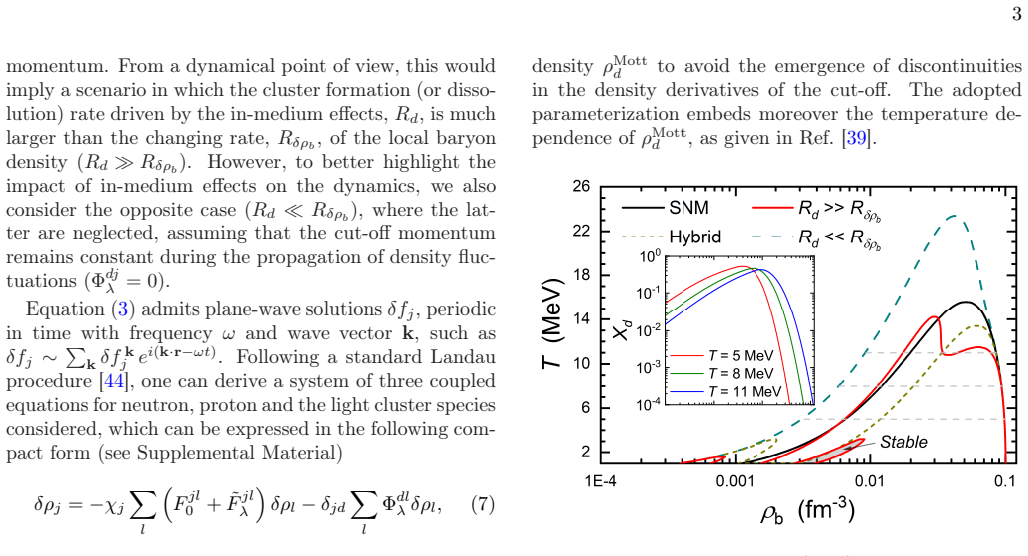
pure nucleonic matter (SNM, black); 2) for nuclear mat- ter with deuterons, including in-medium effects ( Rd ≫ Rδρb , red); 3) for nuclear matter with deuterons, neglecting ( Rd ≪ Rδρb , cyan) in-medium effects in the dynamics. The result from a “hybrid” case is also included (green, see text for de- tails). The inset shows the ρb dependence of the deuteron...
-
[4]
vanishes for ω = 0 (χ q = χ d = 1) [18, 47]. The main panel of Fig. 1 displays the spinodal border in the (ρb, T ) plane, as obtained by taking into account the lo- cal density-dependence of the cut-off in the dynamics (red line). This represents a suitable choice, considering that at the spinodal boundary one has ω = 0 , therefore the condition Rd ≫ Rδρb ...
-
[5]
002 fm− 3). Moreover, in the case of the full calcula- tions, a further escape and re-entrance from the region of spinodal instabilities is seen at a larger density, in som e analogy with the findings of recent works [ 48, 49], where the emergence of such a meta-stable region was discussed. /s48/s46/s48/s48 /s48/s46/s48/s50 /s48/s46/s48/s52 /s48/s46/s48/s5...
-
[6]
to be equal to zero. From this condition, one ex- tracts the dispersion relation, connecting the frequency ω to the wave number k. Inside the spinodal region, a pure imaginary ω will be obtained in a certain k interval, lead- ing to an unstable growth of those modes. In Fig. 2, we show the imaginary sound velocity, Im(ω )/k (for k → 0), as a function of t...
-
[7]
We notice that in-medium effects associated with the density de- pendence of the cut-off along the dynamics ( Rd ≫ Rδρb ) typically induce a suppression of the growth rate of the instability with respect to the case of pure nucleonic mat- ter, thus slowing down fragment formation, especially at the largest temperature considered, where deuterons sur- vive u...
-
[8]
C. J. Horowitz and A. Schwenk, Nucl. Phys. A 776, 55 (2006)
work page 2006
- [9]
- [10]
-
[11]
A. Bauswein, N.-U. F. Bastian, D. B. Blaschke, K. Chatziioannou, J. A. Clark, T. Fischer, and M. Oertel, Phys. Rev. Lett. 122, 061102 (2019)
work page 2019
-
[12]
G. Burgio, H.-J. Schulze, I. Vidaña, and J.-B. Wei, Prog. Part. Nucl. Phys. 120, 103879 (2021)
work page 2021
-
[13]
A. Sedrakian, J. J. Li, and F. Weber, Prog. Part. Nucl. Phys. 131, 104041 (2023)
work page 2023
-
[14]
B. Zhou, Y. Funaki, H. Horiuchi, Y.-G. Ma, G. Röpke, P. Schuck, A. Tohsaki, and T. Yamada, Nat. Commun. 14, 8206 (2023)
work page 2023
- [15]
- [16]
- [17]
- [18]
-
[19]
I. Tews, J. Margueron, and S. Reddy, Eur. Phys. J. A 55, 97 (2019)
work page 2019
- [20]
-
[21]
S. Burrello, F. Gulminelli, F. Aymard, M. Colonna, and A. R. Raduta, Phys. Rev. C 92, 055804 (2015)
work page 2015
-
[22]
H. D. Thi, T. Carreau, A. F. Fantina, and F. Gulminelli, Astron. Astrophys. 654, A114 (2021) . 6
work page 2021
- [23]
-
[24]
A. Rios, A. Polls, and W. Dickhoff, Phys. Rev. C 89, 044303 (2014)
work page 2014
- [25]
- [26]
- [27]
-
[28]
H. Pais, F. Gulminelli, C. Providência, and G. Röpke, Phys. Rev. C 99, 055806 (2019)
work page 2019
- [29]
- [30]
- [31]
- [32]
-
[33]
A. Sorensen, K. Agarwal, K. W. Brown, Z. Cha- jęcki, P. Danielewicz, C. Drischler, S. Gandolfi, J. W. Holt, M. Kaminski, C.-M. Ko, et al., Prog. Part. Nucl. Phys. 134, 104080 (2024)
work page 2024
- [34]
- [35]
- [36]
-
[37]
A. Ono, J. Phys.: Conf. Ser. 420, 012103 (2013)
work page 2013
-
[38]
D. Oliinychenko, L.-G. Pang, H. Elfner, and V. Koch, Phys. Rev. C 99, 044907 (2019)
work page 2019
- [39]
-
[40]
R. Wang, Y.-G. Ma, L.-W. Chen, C. M. Ko, K.-J. Sun, and Z. Zhang, Phys. Rev. C 108, L031601 (2023)
work page 2023
-
[41]
G. Coci, S. Gläßel, V. Kireyeu, J. Aichelin, C. Blume, E. Bratkovskaya, V. Kolesnikov, and V. Voronyuk, Phys. Rev. C 108, 014902 (2023)
work page 2023
- [42]
-
[43]
K.-J. Sun, R. Wang, C. M. Ko, Y.-G. Ma, and C. Shen, Nat. Commun. 15, 1074 (2024)
work page 2024
- [44]
- [45]
- [46]
- [47]
- [48]
- [49]
-
[50]
S. Burrello, M. Colonna, G. Colò, D. Lacroix, X. Roca-Maza, G. Scamps, and H. Zheng, Phys. Rev. C 99, 054314 (2019)
work page 2019
- [51]
- [52]
- [53]
- [54]
- [55]
- [56]
-
[57]
B. Borderie, N. Le Neindre, M. Rivet, P. Dés- esquelles, E. Bonnet, R. Bougault, A. Chbihi, D. Dell’Aquila, Q. Fable, J. Frankland, et al., Phys. Lett. B 782, 291 (2018)
work page 2018
- [58]
-
[59]
C. Y. Tsang, M. B. Tsang, W. G. Lynch, R. Kumar, and C. J. Horowitz, Nat. Astron. 8, 328 (2024) . 7 Supplemental Material I. ENERGY DENSITY FUNCTIONAL AND SINGLE P AR TICLE ENERGY In the expression of the free energy density functional F = E − T S, the energy density functional E = K + U is the sum of the kinetic energy density K = ∑ j gj ∫ Λj dp (2π ℏ)3 ...
work page 2024
discussion (0)
Sign in with ORCID, Apple, or X to comment. Anyone can read and Pith papers without signing in.