Quantum Resource Theories beyond Convexity
Pith reviewed 2026-05-24 01:22 UTC · model grok-4.3
The pith
Non-convex star-shaped sets form the basis for quantum resource theories that capture properties standard convex theories miss.
A machine-rendered reading of the paper's core claim, the machinery that carries it, and where it could break.
Core claim
A class of quantum resource theories based on non-convex star-shape sets captures key quantum properties that cannot be studied by standard convex theories; operational interpretations are supplied and advantages are demonstrated for correlated quantum discrimination tasks, testing of quantum combs, description of quantum discord and total correlations, estimation of non-Markovianity, and the problem of unistochasticity of bistochastic matrices, with non-linear witnesses outperforming linear ones in all listed applications.
What carries the argument
Non-convex star-shaped sets that serve as the free sets for the resource theory and generate non-linear witnesses.
If this is right
- Performance improves in correlated quantum discrimination tasks.
- Testing of quantum combs becomes more effective.
- Quantum discord and total correlations in composite systems can be described directly.
- The degree of non-Markovianity of a quantum dynamics can be estimated more accurately.
- Unistochasticity of bistochastic matrices can be checked with better witnesses, relevant to quantization of classical dynamics.
Where Pith is reading between the lines
- The framework may extend to other quantum phenomena whose natural sets are non-convex, such as certain forms of contextuality or steering.
- Non-linear witnesses could be combined with existing convex-resource tools to create hybrid detection schemes for mixed convex-nonconvex properties.
- Applications to high-energy physics quantities like CP-symmetry violation may require checking whether the star-shaped geometry preserves the necessary invariance properties under Lorentz transformations.
Load-bearing premise
Non-convex star-shaped sets can be given consistent operational interpretations inside quantum mechanics without creating inconsistencies with existing theory or losing the structure required of a resource theory.
What would settle it
A concrete calculation or experiment in which the non-linear witnesses derived from star-shaped sets fail to outperform linear witnesses on any of the listed tasks or produce predictions that contradict standard quantum mechanics.
Figures




read the original abstract
A class of quantum resource theories, based on non-convex star-shape sets, presented in this work captures the key quantum properties that cannot be studied by standard convex theories. We provide operational interpretations for a resource of this class and demonstrate its advantage to improve performance of correlated quantum discrimination tasks and testing of quantum combs. Proposed techniques provide useful tools to describe quantum discord, total correlations in composite quantum systems and to estimate the degree of non-Markovianity of an analyzed quantum dynamics. Other applications include the problem of unistochasticity of a given bistochastic matrix, with relevance for quantization of classical dynamics and studies of violation of CP-symmetry in high energy physics. In all these cases, the non-linear witnesses introduced here outperform the standard linear witnesses. Importance of our findings for quantum information theory is also emphasized.
Editorial analysis
A structured set of objections, weighed in public.
Referee Report
Summary. The manuscript proposes a framework for quantum resource theories (QRTs) that relaxes the standard convexity requirement on free sets, instead using non-convex star-shaped sets. It claims to furnish operational interpretations for resources defined this way, construct non-linear witnesses that outperform linear ones, and demonstrate advantages in correlated quantum discrimination tasks, testing of quantum combs, description of quantum discord and total correlations, estimation of non-Markovianity, and assessment of unistochasticity of bistochastic matrices.
Significance. If the constructions are shown to be operationally consistent, the work would meaningfully extend the reach of QRTs to non-convex phenomena such as discord that lie outside standard convex theories, supplying new witnesses and free operations with concrete advantages in discrimination and channel-testing tasks.
major comments (2)
- [Operational interpretations section (around the definition of free operations)] The central claim that star-shaped free sets admit consistent free operations requires an explicit construction (beyond the abstract) of completely positive trace-preserving maps that leave the star-shaped set invariant without forcing its convex hull; the skeptic note correctly identifies this as load-bearing, and the manuscript must exhibit at least one concrete family of such maps for the discord or non-Markovianity examples.
- [Non-linear witnesses and applications to discord / non-Markovianity] For the non-linear witnesses introduced to outperform linear ones, it must be verified that each witness is non-negative everywhere on the claimed star-shaped free set (not merely on its extreme points or rays); if the functional can take negative values inside the set, the separation property fails and the construction reduces to a convex theory or becomes inconsistent.
minor comments (2)
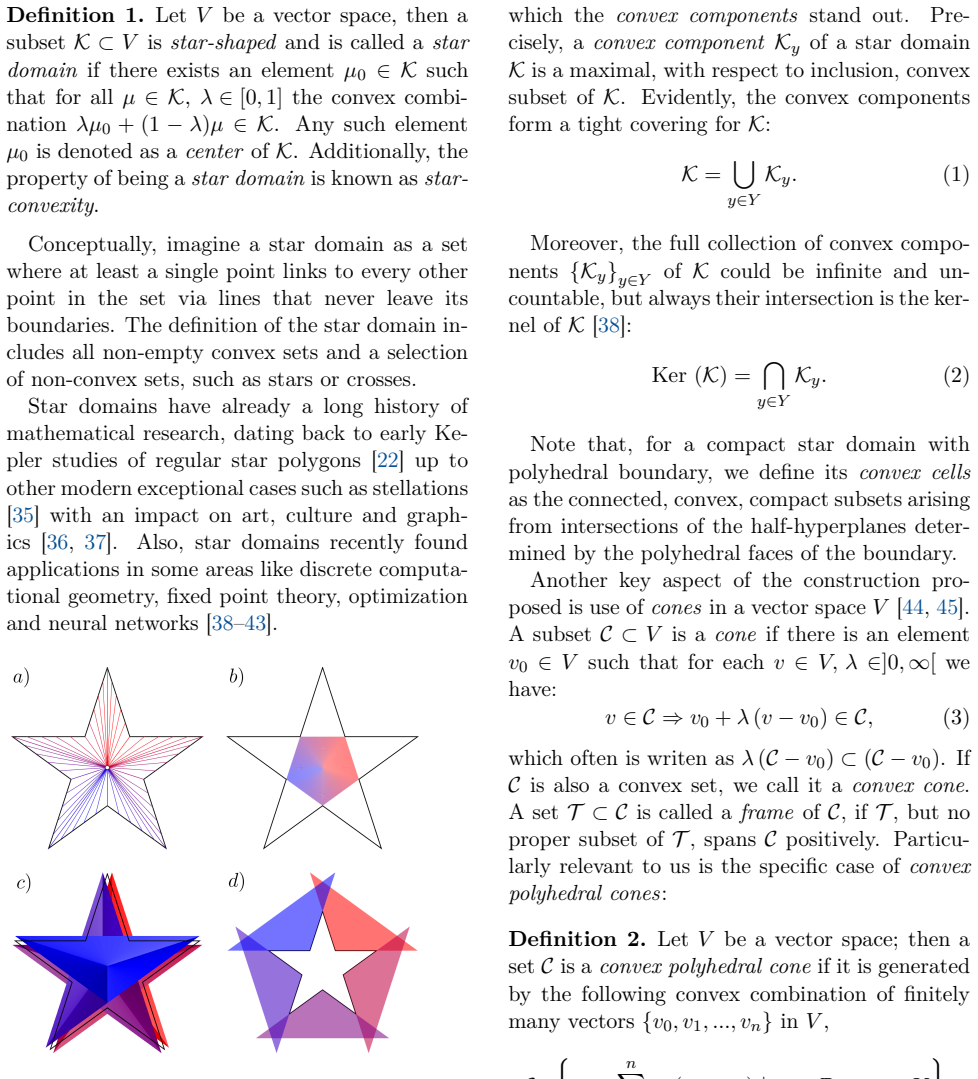
- [Introduction / preliminaries] Notation for star-shaped sets should be introduced with a precise mathematical definition (e.g., existence of a center point such that all line segments from the center remain inside the set) before the first application.
- [Applications to quantum combs] The claim that the approach applies to “testing of quantum combs” would benefit from a short explicit example showing how a star-shaped witness improves over the convex case.
Simulated Author's Rebuttal
We thank the referee for the careful reading and constructive feedback. The comments highlight important points for strengthening the operational foundations of the framework. We respond to each major comment below.
read point-by-point responses
-
Referee: [Operational interpretations section (around the definition of free operations)] The central claim that star-shaped free sets admit consistent free operations requires an explicit construction (beyond the abstract) of completely positive trace-preserving maps that leave the star-shaped set invariant without forcing its convex hull; the skeptic note correctly identifies this as load-bearing, and the manuscript must exhibit at least one concrete family of such maps for the discord or non-Markovianity examples.
Authors: We agree that explicit constructions of free operations are necessary to make the operational interpretation fully concrete. The manuscript defines free operations abstractly as CPTP maps that preserve the star-shaped free set. To address this concern directly, the revised manuscript will add explicit families of such maps. For the quantum discord example, we will exhibit local dephasing channels and certain conditional unitaries that map zero-discord states to zero-discord states while leaving the star-shaped structure intact (i.e., without enlarging the set to its convex hull). Analogous explicit maps will be supplied for the non-Markovianity estimation example. revision: yes
-
Referee: [Non-linear witnesses and applications to discord / non-Markovianity] For the non-linear witnesses introduced to outperform linear ones, it must be verified that each witness is non-negative everywhere on the claimed star-shaped free set (not merely on its extreme points or rays); if the functional can take negative values inside the set, the separation property fails and the construction reduces to a convex theory or becomes inconsistent.
Authors: We thank the referee for emphasizing this verification requirement. The non-linear witnesses are constructed so that non-negativity holds along every ray emanating from the center of the star-shaped set; because the set is star-shaped, this covers the entire set. In the discord and non-Markovianity sections we already perform this check by direct substitution along the rays. Nevertheless, to remove any ambiguity we will add an explicit lemma in the revision proving that the chosen functionals remain non-negative at every interior point of the star-shaped sets under consideration. revision: partial
Circularity Check
No circularity; new non-convex constructions are self-contained
full rationale
The paper introduces a novel class of resource theories using non-convex star-shaped sets, supplies operational interpretations, and demonstrates advantages in tasks like quantum discrimination and non-Markovianity estimation. No load-bearing step reduces by construction to fitted inputs, self-definitions, or self-citation chains; the central claims rest on explicit new definitions and comparisons to convex cases rather than tautological renaming or parameter fitting. This matches the expectation that most papers score 0-2 when derivations remain independent of their own outputs.
Axiom & Free-Parameter Ledger
Forward citations
Cited by 1 Pith paper
-
A Deficiency-Based Approach for the Operational Interpretation of Quantum Resources with Applications
Defines resource deficiency relative to maximal sets to extend operational interpretations of quantum resources and link them to experimental gate noise estimation.
Reference graph
Works this paper leans on
-
[1]
A resource-based view of quantum information
C. H. Bennett. “A resource-based view of quantum information”. Quantum Inf. Com- put.4, 460–466 (2004)
work page 2004
-
[2]
A resource framework for quantum shannon theory
I. Devetak, A. W. Harrow, and A. J. Win- ter. “A resource framework for quantum shannon theory”. IEEE Trans. Inf.54, 4587–4618 (2008)
work page 2008
-
[3]
R. Horodecki, P. Horodecki, M. Horodecki, and K. Horodecki. “Quantum entan- glement”. Rev. Mod. Phys.81, 865– 942 (2009)
work page 2009
-
[4]
Local information as a re- source in distributed quantum systems
M. Horodecki, K. Horodecki, P. Horodecki, R. Horodecki, J. Oppenheim, A. Sen(De), and U. Sen. “Local information as a re- source in distributed quantum systems”. Phys. Rev. Lett.90, 100402 (2003)
work page 2003
-
[5]
G. Vidal and R. Tarrach. “Robustness of entanglement”. Phys. Rev. A59, 141– 155 (1999)
work page 1999
-
[6]
Colloquium: Quantum coherence as a resource
A. Streltsov, G. Adesso, and M. B. Ple- nio. “Colloquium: Quantum coherence as a resource”. Rev. Mod. Phys.89, 041003 (2017)
work page 2017
-
[7]
An introductory review of the resource theory approach to ther- modynamics
M. Lostaglio. “An introductory review of the resource theory approach to ther- modynamics”. Rep. Prog. Phys.82, 114001 (2019)
work page 2019
-
[8]
E. Chitambar and G. Gour. “Quantum resource theories”. Rev. Mod. Phys.91, 025001 (2019)
work page 2019
-
[9]
Allsetsofincompatiblemeasurementsgive an advantage in quantum state discrimina- tion
P. Skrzypczyk, I. Supic, and D. Cavalcanti. “Allsetsofincompatiblemeasurementsgive an advantage in quantum state discrimina- tion”. Phys. Rev. Lett.122, 130403 (2019)
work page 2019
-
[10]
The resource theory of stabilizer quantum computation
V. Veitch, S. A. H. Mousavian, D. Gottes- man, and J. Emerson. “The resource theory of stabilizer quantum computation”. New J. Phys.16, 013009 (2014)
work page 2014
-
[11]
On nonlocality as a re- source theory and nonlocality measures
J. I. de Vicente. “On nonlocality as a re- source theory and nonlocality measures”. J. Phys. A: Math. Theor.47, 424017 (2014)
work page 2014
-
[12]
Op- erational significance of the quantum resource theory of buscemi nonlocality
P. Lipka-Bartosik, A. F. Ducuara, T. Purves, and P. Skrzypczyk. “Op- erational significance of the quantum resource theory of buscemi nonlocality”. PRX Quantum2, 020301 (2021)
work page 2021
-
[13]
Ap- plication of the resource theory of channels to communication scenarios
R. Takagi, K. Wang, and M. Hayashi. “Ap- plication of the resource theory of channels to communication scenarios”. Phys. Rev. Lett.124, 120502 (2020)
work page 2020
-
[14]
Convex resource theory of non-gaussianity
R. Takagi and Q. Zhuang. “Convex resource theory of non-gaussianity”. Phys. Rev. A 97, 062337 (2018)
work page 2018
-
[15]
H. Wojewódka-Ściążko, Z. Puchała, and K. Korzekwa. “Resource engines”. Quan- tum8, 1222 (2024)
work page 2024
-
[16]
R. Takagi and B. Regula. “General re- source theories in quantum mechanics and beyond: Operational characterization via discrimination tasks”. Phys. Rev. X9, 031053 (2019)
work page 2019
-
[17]
Convex combinations of cp-divisible pauli channels that are not semigroups
V. Jagadish, R. Srikanth, and F. Petruc- cione. “Convex combinations of cp-divisible pauli channels that are not semigroups”. Phys. Lett.A 384, 126907 (2020)
work page 2020
-
[18]
Colloquium: Non-markovian dynamics in open quantum systems
H.-P. Breuer, E.-M. Laine, J. Piilo, and B. Vacchini. “Colloquium: Non-markovian dynamics in open quantum systems”. Rev. Mod. Phys.88, 021002 (2016)
work page 2016
-
[19]
Markovianity and non-markovianity in quantum and classical systems
B. Vacchini, A. Smirne, E.-M. Laine, J. Pi- Accepted in Quantum 2026-04-07, click title to verify. Published under CC-BY 4.0.48 ilo, and H.-P. Breuer. “Markovianity and non-markovianity in quantum and classical systems”. New J. Phys.13, 093004 (2011)
work page 2026
-
[20]
Reconfigurable quan- tum local areanetwork over deployedfiber
M. Alshowkan et al. “Reconfigurable quan- tum local areanetwork over deployedfiber”. PRX Quantum2, 040304 (2021)
work page 2021
-
[21]
Quantum internet: A vision for the road ahead
S. Wehner, D. Elkouss, and R. Hanson. “Quantum internet: A vision for the road ahead”. Science362(2018)
work page 2018
-
[23]
Continuity of robustness measures in quantum resource theories
J. Schluck, G. Murta, H. Kampermann, D. Bruß, and N. Wyderka. “Continuity of robustness measures in quantum resource theories”. J. Phys. A: Math. Theor. (2022)
work page 2022
-
[24]
Every quantum helps: Op- erational advantage of quantum resources beyond convexity
K. Kuroiwa, R. Takagi, G. Adesso, and H. Yamasaki. “Every quantum helps: Op- erational advantage of quantum resources beyond convexity”. Phys. Rev. Lett.132, 150201 (2024)
work page 2024
-
[25]
Quantum-state texture and gate identification
F. Parisio. “Quantum-state texture and gate identification”. Phys. Rev. Lett.133, 260801 (2024)
work page 2024
-
[26]
Nonlinear entanglement witnesses
O. Gühne and N. Lütkenhaus. “Nonlinear entanglement witnesses”. Phys. Rev. Lett. 96, 170502 (2006)
work page 2006
-
[27]
Nonlinear improvement of qubit-qudit entanglement witnesses
S.-Q. Shen, J.-M. Liang, M. Li, J. Yu, and S.-M. Fei. “Nonlinear improvement of qubit-qudit entanglement witnesses”. Phys. Rev. A101, 012312 (2020)
work page 2020
-
[28]
Measurement-device-independent nonlin- ear entanglement witnesses
K. Sen, C. Srivastava, and U. Sen. “Measurement-device-independent nonlin- ear entanglement witnesses”. J. Phys. A56, 315301 (2023)
work page 2023
-
[29]
Semidefinite programs for completely bounded norms
J. Watrous. “Semidefinite programs for completely bounded norms”. Theory Com- put.5, 217–238 (2009)
work page 2009
-
[30]
Pspace has constant-round quantum interactive proof systems
J. Watrous. “Pspace has constant-round quantum interactive proof systems”. Theor. Comput. Sci.292, 575–588 (2003)
work page 2003
-
[31]
Distinguishing Short Quan- tum Computations
B. Rosgen. “Distinguishing Short Quan- tum Computations”. In S. Albers and P. Weil, editors, 25th International Sym- posium on Theoretical Aspects of Com- puter Science. Volume 1 of Leibniz Interna- tional Proceedings in Informatics (LIPIcs), pages 597–608. Dagstuhl, Germany (2008). Schloss Dagstuhl–Leibniz-Zentrum fuer In- formatik
work page 2008
-
[32]
Completely positive linear maps on complex matrices
M.-D. Choi. “Completely positive linear maps on complex matrices”. Linear Algebra and its Applications10, 285–290 (1975)
work page 1975
-
[33]
Linear transformations which preserve trace and positive semidefi- niteness of operators
A. Jamiołkowski. “Linear transformations which preserve trace and positive semidefi- niteness of operators”. Reports on Mathe- matical Physics3, 275–278 (1972)
work page 1972
- [34]
-
[35]
H. Coxeter, P. Du-Val, H. Flather, and J. Petrie. “The fifty-nine icosahedra”. University of Toronto Studies. Mathemat- ical Series. 6. University of Toronto Press. (1951)
work page 1951
-
[36]
Lurton,An Introduction to Underwater Acoustics: Principles and Applications, 2nd ed
E. Moreale and M. Emmer. “Mathematics and culture i”. Mathematics and Cul- ture. Springer Berlin Heidelberg. (2003). url:link.springer.com/book/9783540017707
-
[37]
New trends in computer graph- ics: Proceedings of cg international ’88
N. Magnenat-Thalmann and D. Thalmann, editors. “New trends in computer graph- ics: Proceedings of cg international ’88”. Springer. (2012)
work page 2012
-
[38]
G. Hansen, I. Herburt, H. Martini, and M. Moszyńska. “Starshaped sets”. Aequa- tiones Mathematicae94(2020)
work page 2020
-
[39]
Com- putational geometry: An introduction
F. P. Preparata and M. I. Shamos. “Com- putational geometry: An introduction”. Springer. (2012)
work page 2012
-
[40]
Existence of solutions and star-shapedness in minty variational inequalities
G. P. Crespi, I. Ginchev, and M. Rocca. “Existence of solutions and star-shapedness in minty variational inequalities”. J. Glob. Optim.32, 485–494 (2005)
work page 2005
-
[41]
Lower convergence of minimal sets in star-shaped vector optimization prob- lems
R. Hu. “Lower convergence of minimal sets in star-shaped vector optimization prob- lems”. J. Appl. Math.2014, 1–7 (2014)
work page 2014
-
[42]
A reverse isoperimetric in- equality for embedded starshaped plane curves
J. Fang. “A reverse isoperimetric in- equality for embedded starshaped plane curves”. Archiv der Mathematik108, 621– 624 (2017)
work page 2017
-
[43]
Star-shaped space of solu- tions of the spherical negative perceptron
B. L. Annesi, C. Lauditi, C. Lucibello, E. M. Malatesta, G. Perugini, F. Pittorino, and L. Saglietti. “Star-shaped space of solu- tions of the spherical negative perceptron”. Phys. Rev. Lett.131, 227301 (2023)
work page 2023
-
[44]
Theory of linear and integer programming
A. Schrijver. “Theory of linear and integer programming”. Wiley. (1986). url: openli- brary.org/isbn/0471982326
-
[45]
Algebraic and geometric ideas in the theory of discrete optimization
J. A. De Loera, R. Hemmecke, and M. Köppe. “Algebraic and geometric ideas in the theory of discrete optimization”. SIAM. (2012). Accepted in Quantum 2026-04-07, click title to verify. Published under CC-BY 4.0.49
work page 2012
-
[46]
Order-preserving functions: Ap- plications to majorization and order statis- tics
A. W. Marshall, D. W. Walkup, and R. J.- B. Wets. “Order-preserving functions: Ap- plications to majorization and order statis- tics”. Pacific Journal of Mathematics23, 569–584 (1967)
work page 1967
-
[47]
L. Lovász and M. D. Plummer. “Matching theory”. AMS Chelsea Publishing. Ameri- can Mathematical Society. (2009)
work page 2009
-
[48]
G. Hansen and H. Martini. “On closed star- shaped sets”. Journal of Convex Analysis 17, 659–671 (2010). url: www.heldermann- verlag.de/jca/jca17/jca0840_b.htm
work page 2010
-
[49]
R. T. Rockafellar. “Convex analysis”. Princeton University Press. (1970)
work page 1970
-
[50]
Quantum channels and rep- resentation theory
W. G. Ritter. “Quantum channels and rep- resentation theory”. J. Math. Phys.46, 082103 (2005)
work page 2005
-
[51]
R. A. Bertlmann and P. Krammer. “Bloch vectors for qudits”. J. Phys. A: Math. Theor.41, 235303 (2008)
work page 2008
-
[52]
Probabilistic theories with purification
G. Chiribella, G. M. D’Ariano, and P. Perinotti. “Probabilistic theories with purification”. Phys. Rev. A81, 062348 (2010)
work page 2010
-
[53]
Universal structure of objective states in all fundamental causal theories
C. M. Scandolo, R. Salazar, J. K. Korbicz, and P. Horodecki. “Universal structure of objective states in all fundamental causal theories”. Phys. Rev. Res.3, 033148 (2021)
work page 2021
-
[54]
The maximum numbers of faces of a convex polytope
P. McMullen. “The maximum numbers of faces of a convex polytope”. Mathematika 17, 179–184 (1970)
work page 1970
-
[55]
G. M. Ziegler. “Lectures on polytopes”. Vol- ume 152 of Graduate Texts in Mathemat- ics. Springer-Verlag. New York (1995)
work page 1995
-
[56]
Computational geome- try: Algorithms and applications
M. de Berg, O. Cheong, M. van Kreveld, and M. Overmars. “Computational geome- try: Algorithms and applications”. Springer Berlin Heidelberg. (2008)
work page 2008
-
[57]
Computa- tional geometry: An introduction
F. Preparata and M. Shamos. “Computa- tional geometry: An introduction”. Mono- graphs in Computer Science. Springer New York. (2012)
work page 2012
-
[58]
Surface recon- struction from unorganized points
H. Hoppe, T. DeRose, T. Duchamp, J. Mc- Donald, and W. Stuetzle. “Surface recon- struction from unorganized points”. SIG- GRAPHComput.Graph.26, 71–78(1992)
work page 1992
-
[59]
R. Engelking. “General topology”. Vol- ume 6 of Sigma Series in Pure Mathemat- ics. Heldermann Verlag. (1989). url: open- library.org/isbn/9783885380064
-
[60]
Real analysis: Modern techniques and their applications
G. B. Folland. “Real analysis: Modern techniques and their applications”. Wi- ley. (1999). 2 edition. url: openli- brary.org/isbn/9780471317166
-
[61]
Operational advan- tage of quantum resources in subchannel discrimination
R. Takagi, B. Regula, K. Bu, Z.-W. Liu, and G. Adesso. “Operational advan- tage of quantum resources in subchannel discrimination”. Phys. Rev. Lett.122, 140402 (2019)
work page 2019
-
[62]
K. Kuroiwa, R. Takagi, G. Adesso, and H. Yamasaki. “Robustness- and weight- based resource measures without convexity restriction: Multicopy witness and opera- tional advantage in static and dynamical quantum resource theories”. Phys. Rev. A 109, 042403 (2024)
work page 2024
-
[63]
L. Turner, M. Guţă, and G. Adesso. “All non-gaussian states are advantageous for channel discrimination: robustness of non- convex continuous variable quantum re- sources”. New Journal of Physics27, 094507 (2025)
work page 2025
-
[64]
The knowledge complexity of interactive proof systems
S. Goldwasser, S. Micali, and C. Rackoff. “The knowledge complexity of interactive proof systems”. SIAM Journal on Comput- ing18, 186–208 (1989)
work page 1989
-
[65]
Quantum circuit architec- ture
G. Chiribella, G. M. D’Ariano, and P. Perinotti. “Quantum circuit architec- ture”. Phys. Rev. Lett.101, 060401 (2008)
work page 2008
-
[66]
M. T. Quintino, Q. Dong, A. Shimbo, A. Soeda, and M. Murao. “Reversing un- known quantum transformations: Univer- sal quantum circuit for inverting general unitary operations”. Phys. Rev. Lett.123, 210502 (2019)
work page 2019
-
[67]
Re- versing unknown qubit-unitary operation, deterministically and exactly
S. Yoshida, A. Soeda, and M. Murao. “Re- versing unknown qubit-unitary operation, deterministically and exactly”. Phys. Rev. Lett.131, 120602 (2023)
work page 2023
-
[68]
Optimal quan- tum networks and one-shot entropies
G. Chiribella and D. Ebler. “Optimal quan- tum networks and one-shot entropies”. New J. Phys.18, 093053 (2016)
work page 2016
-
[69]
Optimal quantum learning of a unitary transforma- tion
A. Bisio, G. Chiribella, G. M. D’Ariano, S. Facchini, and P. Perinotti. “Optimal quantum learning of a unitary transforma- tion”. Phys. Rev. A81, 032324 (2010)
work page 2010
-
[70]
Op- timal probabilistic storage and retrieval of unitary channels
M. Sedlák, A. Bisio, and M. Ziman. “Op- timal probabilistic storage and retrieval of unitary channels”. Phys. Rev. Lett.122, 170502 (2019)
work page 2019
-
[71]
C. Zhu, Y. Mo, Y.-A. Chen, and X. Wang. “Reversing unknown quantum processes Accepted in Quantum 2026-04-07, click title to verify. Published under CC-BY 4.0.50 via virtual combs for channels with lim- ited information”. Physical Review Let- ters133(2024)
work page 2026
-
[72]
Parameterized quan- tum comb and simpler circuits for revers- ing unknown qubit-unitary operations
Y. Mo, L. Zhang, Y.-A. Chen, Y. Liu, T. Lin, and X. Wang. “Parameterized quan- tum comb and simpler circuits for revers- ing unknown qubit-unitary operations”. npj Quantum Information11(2025)
work page 2025
-
[73]
Coherence as a resource for Shor’s algorithm
F. Ahnefeld, T. Theurer, D. Egloff, J. M. Matera, and M. B. Plenio. “Coherence as a resource for Shor’s algorithm”. Phys. Rev. Lett.129, 120501 (2022)
work page 2022
-
[74]
The first law of general quantum resource theories
C. Sparaciari, L. del Rio, C. M. Scandolo, P. Faist, and J. Oppenheim. “The first law of general quantum resource theories”. Quantum4, 259 (2020)
work page 2020
-
[75]
Set coherence: Basis- independent quantification of quantum coherence
S. Designolle, R. Uola, K. Luoma, and N. Brunner. “Set coherence: Basis- independent quantification of quantum coherence”. Phys. Rev. Lett.126, 220404 (2021)
work page 2021
-
[76]
Multiobject operational tasks for convex quantum resource theories of state-measurement pairs
A. F. Ducuara, P. Lipka-Bartosik, and P. Skrzypczyk. “Multiobject operational tasks for convex quantum resource theories of state-measurement pairs”. Phys. Rev. Res.2, 033374 (2020)
work page 2020
-
[77]
Resource theory of absolute negativity
R. Salazar, J. Czartowski, and A. de Oliveira Junior. “Resource theory of absolute negativity” (2022). arXiv:2205.13480
-
[78]
Introduction to the theory of cooperative games
B. Peleg and P. Sudhölter. “Introduction to the theory of cooperative games”. The- ory and decision library. Kluwer Academic Publishers. (2003)
work page 2003
-
[79]
Cooperative game theory tools in coalitional control networks
F. Muros. “Cooperative game theory tools in coalitional control networks”. Springer Theses. Springer International Publishing. (2019)
work page 2019
-
[80]
Game theory with ap- plications to economics
J. W. Friedman. “Game theory with ap- plications to economics”. Oxford Uni- versity Press. (1990). 2 edition. url: search.worldcat.org/title/489629514
-
[81]
I. Curiel. “Cooperative game theory and applications: Cooperative games arising fromcombinatorialoptimizationproblems”. Theory and Decision Library C. Springer US. (1997)
work page 1997
discussion (0)
Sign in with ORCID, Apple, or X to comment. Anyone can read and Pith papers without signing in.