Effects of Final State Interactions on Landau Singularities
Pith reviewed 2026-05-23 23:47 UTC · model grok-4.3
The pith
Final-state rescattering modifies the line shapes from triangle singularities while preserving their potential to mimic resonances.
A machine-rendered reading of the paper's core claim, the machinery that carries it, and where it could break.
Core claim
Triangle singularities may lead to line-shapes which mimic the effects of resonances; this well-known effect is scrutinized here in the presence of final-state rescattering using Landau equations and a modern scattering formalism with explicit two- and three-body unitarity.
What carries the argument
Landau equations applied to triangle diagrams that include final-state rescattering, combined with a scattering formalism that maintains explicit two- and three-body unitarity.
If this is right
- The positions and strengths of the singularities shift once rescattering is included.
- The resonance-mimicking peaks remain but appear with modified widths and heights.
- The unitary formalism supplies a controlled way to calculate these effects in processes with both two- and three-body intermediate states.
- Invariant-mass distributions in decays or collisions can be reinterpreted once the rescattering corrections are applied.
Where Pith is reading between the lines
- Similar analyses could be performed for other Landau singularities such as those from box diagrams once the same unitary framework is extended.
- Data analyses that search for resonances should subtract the expected contributions from these modified triangle singularities to reduce false-positive rates.
- The approach suggests that multi-channel unitarity constraints may systematically alter the visibility of kinematic peaks in heavier systems.
Load-bearing premise
The modern scattering formalism with explicit two- and three-body unitarity correctly captures the modifications to triangle singularities without introducing uncontrolled approximations in the relevant kinematic regimes.
What would settle it
An experimental line shape in a kinematic region dominated by a triangle singularity that deviates from the amplitude computed in the unitary formalism while agreeing with a non-unitary approximation.
Figures





read the original abstract
In certain kinematic and particle mass configurations, triangle singularities may lead to line-shapes which mimic the effects of resonances. This well-known effect is scrutinized here in the presence of final-state rescattering. The goal is achieved first by utilizing general arguments provided by Landau equations, and second by applying a modern scattering formalism with explicit two- and three-body unitarity.
Editorial analysis
A structured set of objections, weighed in public.
Referee Report
Summary. The paper investigates how final-state rescattering affects triangle singularities (identified via Landau equations) that can produce resonance-like line shapes. It employs general Landau-equation arguments followed by a modern scattering formalism enforcing explicit two- and three-body unitarity to compute modified amplitudes and line shapes in relevant kinematic regimes.
Significance. If the central results hold, the work would provide a controlled framework for separating kinematic singularities from dynamical resonances in the presence of final-state interactions, which is directly relevant to ongoing analyses of exotic hadron candidates in LHCb, Belle II, and other experiments.
major comments (3)
- [§3] §3 (Formalism): The three-body unitarity implementation relies on a partial-wave truncation and separable approximations whose convergence near the triangle-singularity locus is not quantified; this directly affects the reliability of the claimed line-shape modifications.
- [§4] §4 (Results): The comparison between the Landau-equation prediction and the unitarized amplitude shows visible distortions, but no systematic error estimate is provided for the truncation parameters, leaving open whether the reported differences are robust or artifacts of the cutoff choice.
- [Eq. (12)] Eq. (12) and surrounding text: The dispersion-relation subtraction constants are fixed by hand; it is not shown that varying them within the range allowed by two-body unitarity leaves the singularity-induced line shape qualitatively unchanged.
minor comments (2)
- [Abstract] The abstract and introduction use “modern scattering formalism” without a concise definition or reference to the specific truncation scheme on first use.
- [Figure 2] Figure 2: the kinematic boundaries of the triangle singularity are not overlaid on the plotted line shapes, making it harder to judge the proximity of the peak to the singular point.
Simulated Author's Rebuttal
We thank the referee for the careful reading and constructive comments on our manuscript. The points raised have led us to strengthen the discussion of numerical controls and parameter dependence. We respond to each major comment below.
read point-by-point responses
-
Referee: [§3] §3 (Formalism): The three-body unitarity implementation relies on a partial-wave truncation and separable approximations whose convergence near the triangle-singularity locus is not quantified; this directly affects the reliability of the claimed line-shape modifications.
Authors: We agree that explicit quantification of convergence is valuable. In the revised manuscript we have added a dedicated paragraph in §3 together with supplementary numerical tests that increase the partial-wave cutoff by two units. These tests show that the line-shape modifications remain stable to within a few percent in the kinematic region of interest, supporting the robustness of the reported effects. revision: yes
-
Referee: [§4] §4 (Results): The comparison between the Landau-equation prediction and the unitarized amplitude shows visible distortions, but no systematic error estimate is provided for the truncation parameters, leaving open whether the reported differences are robust or artifacts of the cutoff choice.
Authors: We have addressed this by performing a systematic variation of the truncation and cutoff parameters over a physically motivated range. The revised §4 now includes uncertainty bands obtained from these variations; the distortions relative to the pure Landau prediction remain outside the estimated uncertainty, indicating that they are not cutoff artifacts. revision: yes
-
Referee: [Eq. (12)] Eq. (12) and surrounding text: The dispersion-relation subtraction constants are fixed by hand; it is not shown that varying them within the range allowed by two-body unitarity leaves the singularity-induced line shape qualitatively unchanged.
Authors: We have now varied the subtraction constants over the interval permitted by two-body unitarity while keeping the two-body phase shifts fixed. The revised text and an additional figure demonstrate that the qualitative features of the singularity-induced line shape are preserved; only the overall normalization changes mildly. This check has been added after Eq. (12). revision: yes
Circularity Check
No circularity: derivation relies on external Landau equations and independent unitarity formalism
full rationale
The paper derives its results on triangle singularities under final-state interactions by first invoking the standard Landau equations (a general kinematic tool independent of the present work) and second by applying a modern scattering formalism that enforces explicit two- and three-body unitarity. No step reduces a claimed prediction to a fitted parameter, a self-citation chain, or a definitional tautology; the central claim remains an application of established external methods rather than a renaming or self-referential construction. The derivation is therefore self-contained against external benchmarks.
Axiom & Free-Parameter Ledger
Lean theorems connected to this paper
-
IndisputableMonolith/Foundation/AbsoluteFloorClosure.lean; IndisputableMonolith/Cost/FunctionalEquation.leanreality_from_one_distinction; washburn_uniqueness_aczel unclear?
unclearRelation between the paper passage and the cited Recognition theorem.
The Landau equations... αi(q²i − m²i) = 0... Qα = 0... det Q = 0... triangle singularity... subleading singularities... ladder diagrams... IVU framework... T(√s,q,p) = (B+C) + ∫ T τ (B+C)... Γ = ∫ T τ D
What do these tags mean?
- matches
- The paper's claim is directly supported by a theorem in the formal canon.
- supports
- The theorem supports part of the paper's argument, but the paper may add assumptions or extra steps.
- extends
- The paper goes beyond the formal theorem; the theorem is a base layer rather than the whole result.
- uses
- The paper appears to rely on the theorem as machinery.
- contradicts
- The paper's claim conflicts with a theorem or certificate in the canon.
- unclear
- Pith found a possible connection, but the passage is too broad, indirect, or ambiguous to say the theorem truly supports the claim.
Forward citations
Cited by 2 Pith papers
-
Two bodies left behind
In quasi-free high-energy breakup of a heavy-light bound state, the leading amplitude factors as the product of the remnant light-particle scattering amplitude, a probe-dependent dynamical function, and a real bound-s...
-
Study of the molecular Properties of the $P_c$ and $P_{cs}$ States
Coupled-channel calculations show Pc and Pcs states as molecular bound states with RMS radii 0.5-2 fm when heavy-quark spin symmetry is respected across all channels.
Reference graph
Works this paper leans on
-
[1]
Rational Analytic Continuation (RAC) Method 14
-
[2]
Effects of Final State Interactions on Landau Singularities
Cahill & Sloan (CS) Method 14 C. Results 16 IV. Conclusions 17 Acknowledgments 18 References 19 I. INTRODUCTION The resonance spectrum of QCD is an emergent feature of the theory, manifesting its non-perturbative nature. Resonance parameters are encoded in the analytic structure of the transition amplitudes, i.e., in the poles and residues on the unphysic...
work page internal anchor Pith review Pith/arXiv arXiv 2024
-
[3]
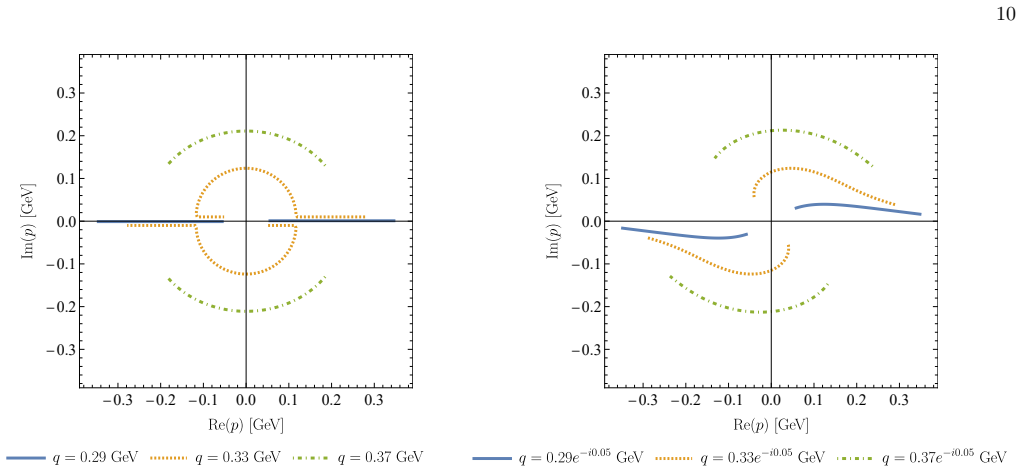
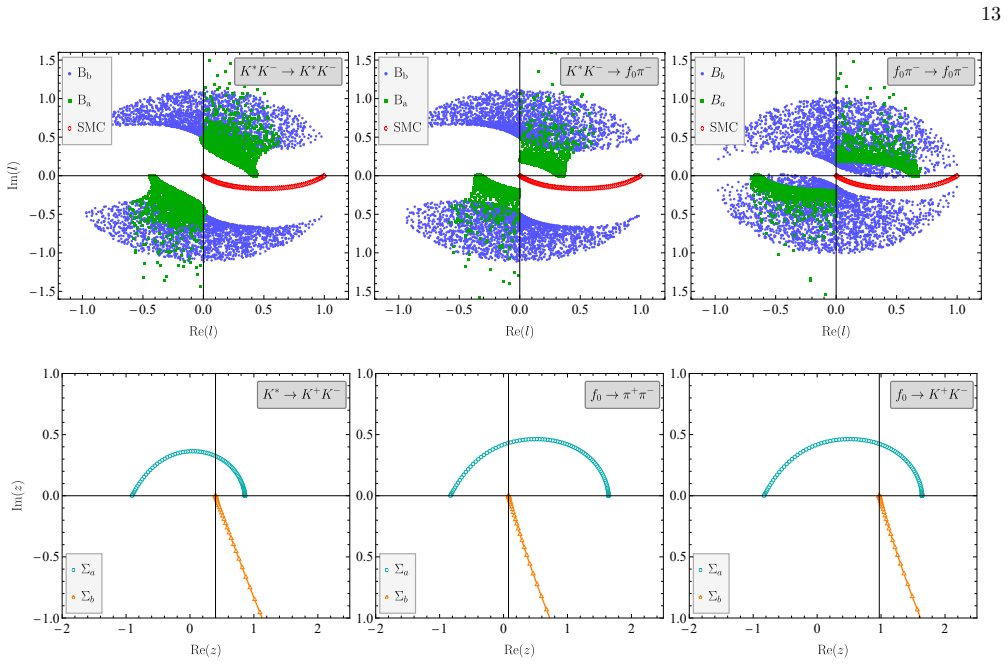
Find a contour on the complex momentum-plane for which the resolvent is non-singular. We use a hard cutoff of Λ = 1 GeV in the integrals over spectator momenta, whereas the self-energy integral, which enters the isobar propagator, does not have a cutoff. Since we are considering two channels, all our amplitudes are 2 × 2 matrices in the channel space, and...
-
[4]
Discretize the integration interval and solve the integral equation . The latter step boils down to solving the matrix equation T = B(1 − τ B)−1 (3.13) for complex spectator momenta on the SMC
-
[5]
Carry out the integral in Eq. (3.2) to obtain Γ(√s, q ∈ C). For momenta on the SMC, this amounts to evaluating the matrix equation Γ = T τ D , (3.14) where Γ is a vector of the dimension equal to the number of discrete points chosen in step 2
-
[6]
This is an unavoidable step when comparing with experimentally accessible line- shapes
Determine Γ for real momenta. This is an unavoidable step when comparing with experimentally accessible line- shapes. Various methods exist to achieve this goal [82–86]. We will concentrate on two of them which we find 14 the most convenient: the Rational Analytic Continuation (RAC) method (Sect. III B 1) and the Cahill & Sloan (CS) method (Sect. III B 2)...
-
[7]
Rational Analytic Continuation (RAC) Method A very transparent and flexible method to obtain the decay amplitudes for real momenta relies on the analyticity of the decay amplitudes in complex momenta. Specifically, the obtained result in the complex momentum-plane is analytically continued to the real axis using an analytic function. Typically, for the la...
-
[8]
naked” (Γ △) and “fully dressed
Cahill & Sloan (CS) Method This method was first introduced in Ref. [83]. One begins with the quantity Γ( √s, q) again, given by Eq. (3.2), for values q on the SMC, which again avoids the singularities as described before. Then one uses the integral representation given by Eq. (3.2) and analytically continues to the real axis by using Cauchy’s theorem. Fo...
- [9]
-
[10]
Spectral representation for u- and t-channel exchange processes in a partial-wave decomposition
M. F. M. Lutz, E. E. Kolomeitsev, and C. L. Korpa, “Spectral representation for u- and t-channel exchange processes in a partial-wave decomposition,” Phys. Rev. D 92, 016003 (2015), arXiv:1506.02375 [hep-ph]
work page internal anchor Pith review Pith/arXiv arXiv 2015
-
[11]
On coupled-channel dynamics in the presence of anomalous thresholds,
M. F. M. Lutz and C. L. Korpa, “On coupled-channel dynamics in the presence of anomalous thresholds,” Phys. Rev. D 98, 076003 (2018), arXiv:1808.08695 [hep-ph]
-
[12]
Coupled-channel system with anomalous thresholds and unitarity,
Csaba L. Korpa, Matthias F. M. Lutz, Xiao-Yu Guo, and Yonggoo Heo, “Coupled-channel system with anomalous thresholds and unitarity,” Phys. Rev. D 107, L031505 (2023), arXiv:2211.03508 [hep-ph]
-
[13]
An introduction to the quark model
Jean-Marc Richard, “An introduction to the quark model,” in Ferrara International School Niccol` o Cabeo 2012: Hadronic spectroscopy (2012) arXiv:1205.4326 [hep-ph]
work page internal anchor Pith review Pith/arXiv arXiv 2012
-
[14]
Baryons as relativistic three-quark bound states
Gernot Eichmann, Helios Sanchis-Alepuz, Richard Williams, Reinhard Alkofer, and Christian S. Fischer, “Baryons as relativistic three-quark bound states,” Prog. Part. Nucl. Phys. 91, 1–100 (2016), arXiv:1606.09602 [hep-ph]
work page internal anchor Pith review Pith/arXiv arXiv 2016
-
[15]
On light baryons and their excitations
Gernot Eichmann, Christian S. Fischer, and Helios Sanchis-Alepuz, “Light baryons and their excitations,” Phys. Rev. D 94, 094033 (2016), arXiv:1607.05748 [hep-ph]
work page internal anchor Pith review Pith/arXiv arXiv 2016
-
[16]
Masses of ground-state mesons and baryons, including those with heavy quarks,
Pei-Lin Yin, Chen Chen, Gast˜ ao Krein, Craig D. Roberts, Jorge Segovia, and Shu-Sheng Xu, “Masses of ground-state mesons and baryons, including those with heavy quarks,” Phys. Rev. D 100, 034008 (2019), arXiv:1903.00160 [nucl-th]
-
[17]
Diquark-Antidiquarks with Hidden or Open Charm and the Nature of X(3872)
L. Maiani, F. Piccinini, A. D. Polosa, and V. Riquer, “Diquark-antidiquarks with hidden or open charm and the nature of X(3872),” Phys. Rev. D 71, 014028 (2005), arXiv:hep-ph/0412098
work page internal anchor Pith review Pith/arXiv arXiv 2005
-
[18]
Tetraquark bound states in a Bethe-Salpeter approach
Walter Heupel, Gernot Eichmann, and Christian S. Fischer, “Tetraquark Bound States in a Bethe-Salpeter Approach,” Phys. Lett. B 718, 545–549 (2012), arXiv:1206.5129 [hep-ph]
work page internal anchor Pith review Pith/arXiv arXiv 2012
-
[19]
Roel Aaij et al. (LHCb), “Observation of J/ψp Resonances Consistent with Pentaquark States in Λ0 b → J/ψK −p Decays,” Phys. Rev. Lett. 115, 072001 (2015), arXiv:1507.03414 [hep-ex]
work page internal anchor Pith review Pith/arXiv arXiv 2015
-
[20]
Chiral dynamics of the S11(1535) and S11(1650) resonances revisited
Peter C. Bruns, Maxim Mai, and Ulf-G. Meißner, “Chiral dynamics of the S11(1535) and S11(1650) resonances revisited,” Phys. Lett. B 697, 254–259 (2011), arXiv:1012.2233 [nucl-th]
work page internal anchor Pith review Pith/arXiv arXiv 2011
-
[21]
Relativistic chiral SU(3) symmetry, large N_c sum rules and meson-baryon scattering
M. F. M. Lutz and E. E. Kolomeitsev, “Relativistic chiral SU (3) symmetry, large Nc sum rules and meson baryon scattering,” Nucl. Phys. A 700, 193–308 (2002), arXiv:nucl-th/0105042
work page internal anchor Pith review Pith/arXiv arXiv 2002
-
[22]
Weak decays of heavy hadrons into dynamically generated resonances
Eulogio Oset et al. , “Weak decays of heavy hadrons into dynamically generated resonances,” Int. J. Mod. Phys. E 25, 1630001 (2016), arXiv:1601.03972 [hep-ph]
work page internal anchor Pith review Pith/arXiv arXiv 2016
-
[23]
New insights into antikaon-nucleon scattering and the structure of the Lambda(1405)
Maxim Mai and Ulf-G. Meißner, “New insights into antikaon-nucleon scattering and the structure of the Λ(1405),” Nucl. Phys. A 900, 51 – 64 (2013), arXiv:1202.2030 [nucl-th]
work page internal anchor Pith review Pith/arXiv arXiv 2013
-
[24]
Constraints on the chiral unitary $\bar KN$ amplitude from $\pi\Sigma K^+$ photoproduction data
Maxim Mai and Ulf-G. Meißner, “Constraints on the chiral unitary ¯KN amplitude from πΣK + photoproduction data,” Eur. Phys. J. A 51, 30 (2015), arXiv:1411.7884 [hep-ph]
work page internal anchor Pith review Pith/arXiv arXiv 2015
-
[25]
How to reveal the exotic nature of the P_c(4450)
Feng-Kun Guo, Ulf-G. Meißner, Wei Wang, and Zhi Yang, “How to reveal the exotic nature of the P c(4450),” Phys. Rev. D 92, 071502 (2015), arXiv:1507.04950 [hep-ph]
work page internal anchor Pith review Pith/arXiv arXiv 2015
-
[26]
Gilberto Colangelo, Juerg Gasser, Bastian Kubis, and Akaki Rusetsky, “Cusps in K → 3π decays,” Phys. Lett. B 638, 187–194 (2006), arXiv:hep-ph/0604084
work page internal anchor Pith review Pith/arXiv arXiv 2006
-
[27]
Cusps in K --> 3pi decays: a theoretical framework
Jurg Gasser, Bastian Kubis, and Akaki Rusetsky, “Cusps in K → 3π decays: a theoretical framework,” Nucl. Phys. B 850, 96–147 (2011), arXiv:1103.4273 [hep-ph]
work page internal anchor Pith review Pith/arXiv arXiv 2011
-
[28]
Extended SAID partial-wave analysis of pion photoproduction,
William J. Briscoe, Axel Schmidt, Igor Strakovsky, Ron L. Workman, and Alfred Svarc (SAID Group), “Extended SAID partial-wave analysis of pion photoproduction,” Phys. Rev. C 108, 065205 (2023), arXiv:2309.06631 [hep-ph]
-
[29]
Complex Propagators in Perturbation Theory,
I. J. R. Aitchison and C. Kacser, “Complex Propagators in Perturbation Theory,” Phys. Rev. 133, B1239–B1257 (1964). 20
work page 1964
-
[30]
Relevance of complex branch points for partial wave analysis
S. Ceci, M. Doring, C. Hanhart, S. Krewald, U. G. Meißner, and A. Svarc, “Relevance of complex branch points for partial wave analysis,” Phys. Rev. C 84, 015205 (2011), arXiv:1104.3490 [nucl-th]
work page internal anchor Pith review Pith/arXiv arXiv 2011
-
[31]
A Discussion on Triangle Singularities in the $\Lambda_b \to J/\psi K^{-} p$ Reaction
Melahat Bayar, Francesca Aceti, Feng-Kun Guo, and Eulogio Oset, “A Discussion on Triangle Singularities in the Λ b → J/ψK −p Reaction,” Phys. Rev. D 94, 074039 (2016), arXiv:1609.04133 [hep-ph]
work page internal anchor Pith review Pith/arXiv arXiv 2016
-
[32]
Threshold cusps and triangle singularities in hadronic reactions,
Feng-Kun Guo, Xiao-Hai Liu, and Shuntaro Sakai, “Threshold cusps and triangle singularities in hadronic reactions,” Prog. Part. Nucl. Phys. 112, 103757 (2020), arXiv:1912.07030 [hep-ph]
-
[33]
Triangle and box diagrams in coupled-channel systems from the chiral Lagrangian,
Tobias Isken, Xiao-Yu Guo, Yonggoo Heo, Csaba L. Korpa, and Matthias F. M. Lutz, “Triangle and box diagrams in coupled-channel systems from the chiral Lagrangian,” Phys. Rev. D 109, 034032 (2024), arXiv:2309.09695 [hep-ph]
-
[34]
Considerations on the Schmid theorem for triangle singularities
V. R. Debastiani, S. Sakai, and E. Oset, “Considerations on the Schmid theorem for triangle singularities,” Eur. Phys. J. C 79, 69 (2019), arXiv:1809.06890 [hep-ph]
work page internal anchor Pith review Pith/arXiv arXiv 2019
-
[35]
L. R. Dai, R. Pavao, S. Sakai, and E. Oset, “Anomalous enhancement of the isospin-violating Λ(1405) production by a triangle singularity in Λ c → π+π0π0Σ0,” Phys. Rev. D 97, 116004 (2018), arXiv:1804.01136 [hep-ph]
work page internal anchor Pith review Pith/arXiv arXiv 2018
-
[36]
Triangle singularity in $\tau^- \to \nu_\tau \pi^- f_0(980)$ ($a_0(980)$) decays
L. R. Dai, Q. X. Yu, and E. Oset, “Triangle singularity in τ − → ντ π−f0(980) (a0(980)) decays,” Phys. Rev. D 99, 016021 (2019), arXiv:1809.11007 [hep-ph]
work page internal anchor Pith review Pith/arXiv arXiv 2019
-
[37]
Triangle singularity in the $J/\psi \rightarrow K^+ K^- f_0(980)(a_0(980))$ decays
Wei-Hong Liang, Hua-Xing Chen, Eulogio Oset, and En Wang, “Triangle singularity in theJ/ψ → K +K −f0(980)(a0(980)) decays,” Eur. Phys. J. C 79, 411 (2019), arXiv:1903.01252 [hep-ph]
work page internal anchor Pith review Pith/arXiv arXiv 2019
-
[38]
Triangle singularities in J/ψ → ηπ 0ϕ and π0π0ϕ,
Hao-Jie Jing, Shuntaro Sakai, Feng-Kun Guo, and Bing-Song Zou, “Triangle singularities in J/ψ → ηπ 0ϕ and π0π0ϕ,” Phys. Rev. D 100, 114010 (2019), arXiv:1907.12719 [hep-ph]
-
[39]
Comprehensive study of light axial vector mesons with the presence of triangle singu- larity,
Meng-Chuan Du and Qiang Zhao, “Comprehensive study of light axial vector mesons with the presence of triangle singu- larity,” Phys. Rev. D 104, 036008 (2021), arXiv:2103.16861 [hep-ph]
-
[40]
Ming-Xiao Duan, Lin Qiu, Xi-Zhe Ling, and Qiang Zhao, “Predictions for feed-down enhancements at the Λ cD and ΛcD∗ thresholds via the triangle and box singularities,” Phys. Rev. D 109, L031507 (2024), arXiv:2303.13329 [hep-ph]
-
[41]
Role of a triangle singularity in the $\gamma p\rightarrow K^+ \Lambda(1405)$ reaction
En Wang, Ju-Jun Xie, Wei-Hong Liang, Feng-Kun Guo, and Eulogio Oset, “Role of a triangle singularity in the γp → K +Λ(1405) reaction,” Phys. Rev. C 95, 015205 (2017), arXiv:1610.07117 [hep-ph]
work page internal anchor Pith review Pith/arXiv arXiv 2017
-
[42]
Global coupled-channel analysis of e+e− → c¯c processes in √s = 3.75 − 4.7 GeV,
S. X. Nakamura, X. H. Li, H. P. Peng, Z. T. Sun, and X. R. Zhou, “Global coupled-channel analysis of e+e− → c¯c processes in √s = 3.75 − 4.7 GeV,” (2023), arXiv:2312.17658 [hep-ph]
-
[43]
Relativistic three-body scattering and the D0D∗+ − D+D∗0 system,
Xu Zhang, “Relativistic three-body scattering and the D0D∗+ − D+D∗0 system,” Phys. Rev. D 109, 094010 (2024), arXiv:2402.02151 [hep-ph]
-
[44]
Triangle singularities in the T + cc → D∗ + D0 → π + D0D0 decay width,
N. N. Achasov and G. N. Shestakov, “Triangle singularities in the T + cc → D∗ + D0 → π + D0D0 decay width,” Phys. Rev. D 105, 096038 (2022), arXiv:2203.17100 [hep-ph]
-
[45]
Three-body unitary coupled-channel approach to radiative J/ψ decays and η (1405/1475),
S. X. Nakamura, Q. Huang, J. J. Wu, H. P. Peng, Y. Zhang, and Y. C. Zhu, “Three-body unitary coupled-channel approach to radiative J/ψ decays and η (1405/1475),” Phys. Rev. D 109, 014021 (2024), arXiv:2311.05391 [hep-ph]
-
[46]
Observation of a new narrow axial-vector meson $a_1(1420)$
C. Adolph et al. (COMPASS), “Observation of a New Narrow Axial-Vector Mesona1(1420),” Phys. Rev. Lett. 115, 082001 (2015), arXiv:1501.05732 [hep-ex]
work page internal anchor Pith review Pith/arXiv arXiv 2015
-
[47]
Partial-wave analysis of τ − → π−π−π+ντ at Belle,
Andrei Rabusov, Daniel Greenwald, and Stephan Paul (Belle), “Partial-wave analysis of τ − → π−π−π+ντ at Belle,” in 20th International Conference on Hadron Spectroscopy and Structure (2023) arXiv:2310.09155 [hep-ex]
-
[48]
M. Mikhasenko, B. Ketzer, and Andrey Sarantsev, “Nature of the a1(1420),” Phys. Rev. D 91, 094015 (2015), arXiv:1501.07023 [hep-ph]
work page internal anchor Pith review Pith/arXiv arXiv 2015
-
[49]
The "$a_1(1420)$" peak as the $\pi f_0(980)$ decay mode of the $a_1(1260)$
F. Aceti, L. R. Dai, and E. Oset, “ a1(1420) peak as the πf0(980) decay mode of the a1(1260),” Phys. Rev. D 94, 096015 (2016), arXiv:1606.06893 [hep-ph]
work page internal anchor Pith review Pith/arXiv arXiv 2016
-
[50]
Triangle Singularity as the Origin of the a1(1420),
G. D. Alexeev et al. (COMPASS), “Triangle Singularity as the Origin of the a1(1420),” Phys. Rev. Lett. 127, 082501 (2021), arXiv:2006.05342 [hep-ph]
-
[51]
Three-body Unitarity with Isobars Revisited
M. Mai, B. Hu, M. Doring, A. Pilloni, and A. Szczepaniak, “Three-body Unitarity with Isobars Revisited,” Eur. Phys. J. A 53, 177 (2017), arXiv:1706.06118 [nucl-th]
work page internal anchor Pith review Pith/arXiv arXiv 2017
-
[52]
Pole position of the a1(1260) resonance in a three-body unitary framework,
Daniel Sadasivan, Andrei Alexandru, Hakan Akdag, Felipe Amorim, Ruair´ ı Brett, Chris Culver, Michael D¨ oring, Frank X. Lee, and Maxim Mai, “Pole position of the a1(1260) resonance in a three-body unitary framework,” Phys. Rev. D 105, 054020 (2022), arXiv:2112.03355 [hep-ph]
-
[53]
Scattering theory for a three particle system,
L. D. Faddeev, “Scattering theory for a three particle system,” Zh. Eksp. Teor. Fiz. 39, 1459–1467 (1960)
work page 1960
-
[54]
Three-body Unitarity in the Finite Volume
M. Mai and M. D¨ oring, “Three-body Unitarity in the Finite Volume,” Eur. Phys. J. A 53, 240 (2017), arXiv:1709.08222 21 [hep-lat]
work page internal anchor Pith review Pith/arXiv arXiv 2017
-
[55]
Multi-particle systems on the lattice and chiral extrapolations: a brief review,
Maxim Mai, Michael D¨ oring, and Akaki Rusetsky, “Multi-particle systems on the lattice and chiral extrapolations: a brief review,” Eur. Phys. J. ST 230, 1623–1643 (2021), arXiv:2103.00577 [hep-lat]
-
[56]
Three-Body Dynamics of the a1(1260) Resonance from Lattice QCD,
Maxim Mai, Andrei Alexandru, Ruair´ ı Brett, Chris Culver, Michael D¨ oring, Frank X. Lee, and Daniel Sadasivan (GWQCD), “Three-Body Dynamics of the a1(1260) Resonance from Lattice QCD,” Phys. Rev. Lett. 127, 222001 (2021), arXiv:2107.03973 [hep-lat]
-
[57]
Haobo Yan, Marco Garofalo, Maxim Mai, Ulf-G. Meißner, and Carsten Urbach, “The ω-meson from lattice QCD,” (2024), arXiv:2407.16659 [hep-lat]
-
[58]
Analytic properties of the scattering amplitude and resonances parameters in a meson exchange model
M. Doring, C. Hanhart, F. Huang, S. Krewald, and U. G. Meißner, “Analytic properties of the scattering amplitude and resonances parameters in a meson exchange model,” Nucl. Phys. A 829, 170–209 (2009), arXiv:0903.4337 [nucl-th]
work page internal anchor Pith review Pith/arXiv arXiv 2009
-
[59]
Disentangling the dynamical origin of P11 Nucleon Resonances
N. Suzuki, B. Julia-Diaz, H. Kamano, T. S. H. Lee, A. Matsuyama, and T. Sato, “Disentangling the Dynamical Origin of P11 Nucleon Resonances,” Phys. Rev. Lett. 104, 042302 (2010), arXiv:0909.1356 [nucl-th]
work page internal anchor Pith review Pith/arXiv arXiv 2010
-
[60]
Solving relativistic three-body integral equations in the presence of bound states,
Andrew W. Jackura, Ra´ ul A. Brice˜ no, Sebastian M. Dawid, Md Habib E. Islam, and Connor McCarty, “Solving relativistic three-body integral equations in the presence of bound states,” Phys. Rev. D 104, 014507 (2021), arXiv:2010.09820 [hep- lat]
-
[61]
Analytic continuation of the relativistic three-particle scattering amplitudes,
Sebastian M. Dawid, Md Habib E. Islam, and Ra´ ul A. Brice˜ no, “Analytic continuation of the relativistic three-particle scattering amplitudes,” Phys. Rev. D 108, 034016 (2023), arXiv:2303.04394 [nucl-th]
-
[62]
Sebastian M. Dawid, Md Habib E. Islam, Raul A. Briceno, and Andrew W. Jackura, “Evolution of Efimov states,” Phys. Rev. A 109, 043325 (2024), arXiv:2309.01732 [nucl-th]
-
[63]
Three-body resonances in the φ4 theory,
Marco Garofalo, Maxim Mai, Fernando Romero-L´ opez, Akaki Rusetsky, and Carsten Urbach, “Three-body resonances in the φ4 theory,” JHEP 02, 252 (2023), arXiv:2211.05605 [hep-lat]
-
[64]
Analysis of rescattering effects in 3π final states,
Dominik Stamen, Tobias Isken, Bastian Kubis, Mikhail Mikhasenko, and Malwin Niehus, “Analysis of rescattering effects in 3π final states,” Eur. Phys. J. C 83, 510 (2023), [Erratum: Eur.Phys.J.C 83, 586 (2023)], arXiv:2212.11767 [hep-ph]
-
[65]
Dispersion representations and anomalous singularities of the triangle diagram
Wolfgang Lucha, Dmitri Melikhov, and Silvano Simula, “Dispersion representations and anomalous singularities of the triangle diagram,” Phys. Rev. D 75, 016001 (2007), [Erratum: Phys.Rev.D 92, 019901 (2015)], arXiv:hep-ph/0610330
work page internal anchor Pith review Pith/arXiv arXiv 2007
- [66]
-
[67]
R. L. Workman et al. (Particle Data Group), “Review of Particle Physics,” PTEP 2022, 083C01 (2022)
work page 2022
-
[68]
Ming-Zhu Liu, Ya-Wen Pan, Zhi-Wei Liu, Tian-Wei Wu, Jun-Xu Lu, and Li-Sheng Geng, “Three ways to decipher the nature of exotic hadrons: multiplets, three-body hadronic molecules, and correlation functions,” (2024), arXiv:2404.06399 [hep-ph]
-
[69]
Novel approaches in hadron spectroscopy,
Miguel Albaladejo et al. (JPAC), “Novel approaches in hadron spectroscopy,” Prog. Part. Nucl. Phys. 127, 103981 (2022), arXiv:2112.13436 [hep-ph]
-
[70]
Light-Meson Spectroscopy with COMPASS,
Bernhard Ketzer, Boris Grube, and Dmitry Ryabchikov, “Light-Meson Spectroscopy with COMPASS,” Prog. Part. Nucl. Phys. 113, 103755 (2020), arXiv:1909.06366 [hep-ex]
-
[71]
Light isovector resonances in $\pi^- p \to \pi^-\pi^-\pi^+ p$ at 190 GeV/${\it c}$
M. Aghasyan et al. (COMPASS), “Light isovector resonances inπ−p → π−π−π+p at 190 GeV/c,” Phys. Rev. D 98, 092003 (2018), arXiv:1802.05913 [hep-ex]
work page internal anchor Pith review Pith/arXiv arXiv 2018
-
[72]
Coupled channel analysis of ¯pp → π0π0η, π0ηη and K +K −π0 at 900 MeV/c and of ππ-scattering data,
M. Albrecht et al. (Crystal Barrel), “Coupled channel analysis of ¯pp → π0π0η, π0ηη and K +K −π0 at 900 MeV/c and of ππ-scattering data,” Eur. Phys. J. C 80, 453 (2020), arXiv:1909.07091 [hep-ex]
-
[73]
Amplitude analysis and branching fraction measurement of the decayD+ → K 0 Sπ+π0π0,
Medina Ablikim et al. (BESIII), “Amplitude analysis and branching fraction measurement of the decayD+ → K 0 Sπ+π0π0,” JHEP 09, 077 (2023), arXiv:2305.15879 [hep-ex]
-
[74]
Partial wave analysis of τ − → π−π+π−ντ at Belle,
Andrei Rabusov, Daniel Greenwald, and Stephan Paul, “Partial wave analysis of τ − → π−π+π−ντ at Belle,” PoS ICHEP2022, 1034 (2022), arXiv:2211.11696 [hep-ex]
-
[75]
Amplitude analysis of the D+ → π−π+π+ decay and measurement of the π−π+ S-wave amplitude,
R. Aaij et al. (LHCb), “Amplitude analysis of the D+ → π−π+π+ decay and measurement of the π−π+ S-wave amplitude,” JHEP 06, 044 (2023), arXiv:2208.03300 [hep-ex]
-
[76]
On analytic properties of vertex parts in quantum field theory,
L. D. Landau, “On analytic properties of vertex parts in quantum field theory,” Nucl. Phys. 13, 181–192 (1959)
work page 1959
-
[77]
The analytic properties of perturbation theory — I,
J. C. Polkinghorne and G. R. Screaton, “The analytic properties of perturbation theory — I,” Nuovo Cim. 15, 289–300 (1960)
work page 1960
-
[78]
The analytic properties of perturbation theory — II,
J. C. Polkinghorne and G. R. Screaton, “The analytic properties of perturbation theory — II,” Nuovo Cim. 15, 925–931 (1960). 22
work page 1960
-
[79]
Singularities in the physical region,
S. Coleman and R. E. Norton, “Singularities in the physical region,” Nuovo Cim. 38, 438–442 (1965)
work page 1965
-
[80]
M. Nauenberg and A. Pais, “Woolly cusps,” Phys. Rev. 126, 360–364 (1962)
work page 1962
discussion (0)
Sign in with ORCID, Apple, or X to comment. Anyone can read and Pith papers without signing in.