Quantum transport on Bethe lattices with non-Hermitian sources and a drain
Pith reviewed 2026-05-23 20:52 UTC · model grok-4.3
The pith
The current from peripheral sites to the center of a Bethe lattice reaches its maximum at a zero mode of the non-Hermitian PT-symmetric system.
A machine-rendered reading of the paper's core claim, the machinery that carries it, and where it could break.
Core claim
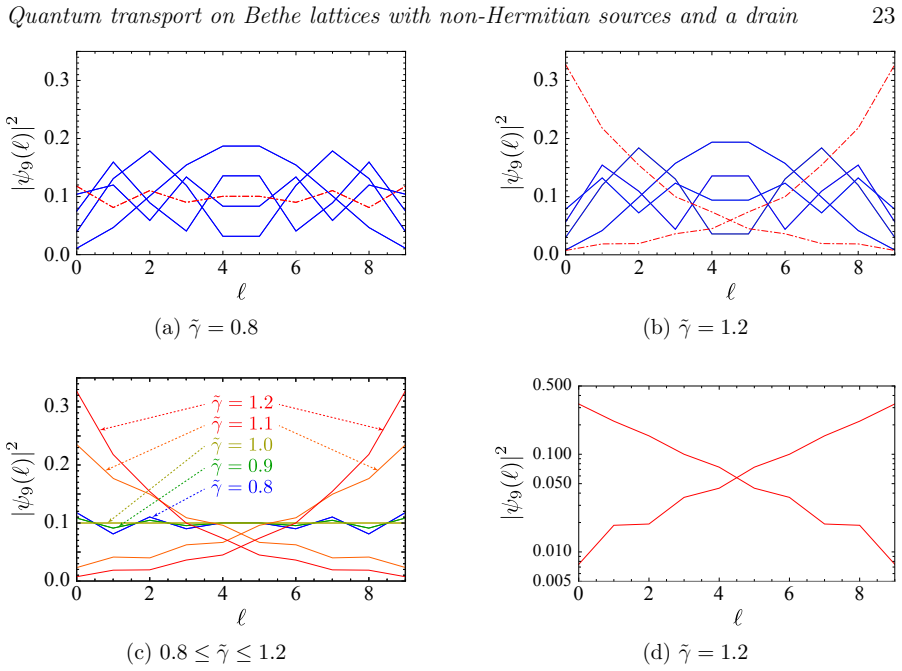
Solving the non-Hermitian eigenvalue problem shows that the steady-state current is carried only by eigenstates that penetrate to the central site. These states map onto a PT-symmetric tight-binding chain. The current as a function of source and drain strengths reaches its peak at a zero mode. When every generation has the same number of links, this peak occurs exactly at the exceptional point at which two eigenstates coalesce into the zero mode due to the non-Hermitian PT-symmetric terms.
What carries the argument
The non-Hermitian PT-symmetric eigenvalue problem whose zero mode at the exceptional point sets the current maximum.
If this is right
- Increasing source or drain strength beyond the optimum reduces the current and drives it to zero at infinite strength.
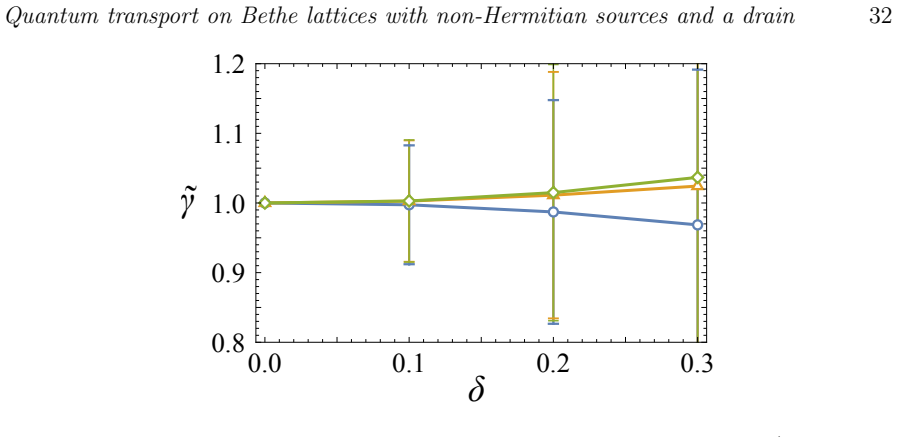
- When randomness is added to hoppings or branching numbers the current maximum still occurs near a zero mode although the point is no longer an exceptional point.
- The restriction to a few penetrating channels implies that transport efficiency is controlled by the choice of non-Hermitian parameters rather than by the full spectrum.
Where Pith is reading between the lines
- The same non-Hermitian tuning could be used to optimize transport in other branched molecular networks.
- It remains open whether the current maximum persists or shifts in the infinite-generation Bethe lattice limit.
- The reduction to an effective one-dimensional PT-symmetric chain suggests that similar maxima should appear in any tree-like structure whose effective chain supports a zero mode.
Load-bearing premise
The steady-state current can be read directly from the eigenmodes of the non-Hermitian Hamiltonian without solving the time-dependent Schrödinger equation.
What would settle it
A time-dependent simulation of the driven open system in which the long-time current does not reach its maximum at the parameter values where the zero mode or exceptional point occurs.
Figures






read the original abstract
We consider quantum transport in a tight-binding model on the Bethe lattice of finite generation, which we expect to be the first step toward analyzing electronic transport in a light-harvesting molecule. We seek conditions under which the electronic current from the peripheral light-harvesting sites to the central site reaches its maximum. As a new feature for analyzing quantum transport, we add complex potentials for sources at peripheral sites and a drain at the central site, and solve a non-Hermitian eigenvalue problem, instead of simulating an initial-value problem. Solving the eigenvalue problem clearly reveals which electronic channels contribute most to the quantum transport. The number of eigenstates that can penetrate from the peripheral sites to the central site is quite limited among the total number of eigenstates. All the other eigenstates are localized around the peripheral sites and cannot reach the central site. The former eigenstates can carry current, reducing the problem to quantum transport on a parity-time ($\PT$)-symmetric tight-binding chain. The current has a maximum with respect to the strengths of the sources and the drain. The current decreases as we increase the strengths beyond the maximum and vanishes in the limit of infinite strength. Moreover, the current maximum is given by a zero mode. When the number of links is common to all generations, the current takes the maximum value at the exceptional point where two eigenstates coalesce to a zero mode, which emerges because of the non-Hermiticity due to the $\PT$-symmetric complex potentials. By introducing randomness either into the hopping amplitude or the number of links in each generation of the tree, we obtain a random-hopping tight-binding model, in which the current reaches its maximum not exactly, but approximately, for a zero mode, although it is no longer located at an exceptional point in general.
Editorial analysis
A structured set of objections, weighed in public.
Referee Report
Summary. The manuscript models quantum transport on finite-generation Bethe lattices via a tight-binding Hamiltonian with non-Hermitian complex potentials acting as sources at peripheral sites and a drain at the center. It solves the resulting non-Hermitian eigenvalue problem to identify a small number of penetrating eigenmodes that reduce the transport problem to a PT-symmetric chain; all other modes are localized at the periphery. The central claims are that the steady-state current is maximized with respect to the source and drain strengths, that this maximum occurs at a zero mode, and that for uniform link numbers per generation the maximum is attained precisely at the PT-symmetric exceptional point where two eigenstates coalesce into the zero mode.
Significance. If the non-Hermitian eigenvalue construction is shown to reproduce the long-time steady current, the work supplies an analytic route to locating optimal transport conditions on branched lattices without full time-dependent integration, together with a concrete link between current maxima and non-Hermitian spectral features. The observation that only a few modes penetrate to the center is a useful structural insight for light-harvesting or molecular-transport models.
major comments (2)
- [Abstract; §2 (model definition)] The reduction of the steady current to the non-Hermitian eigenproblem (rather than the long-time limit of an initial-value Schrödinger evolution) is asserted in the abstract and used throughout to locate the current maxima at zero modes and exceptional points, yet no explicit derivation relating the eigenmode amplitudes to the continuity equation or to the asymptotic current is supplied; without this step the reported maxima and their coincidence with E=0 or the EP remain formal rather than physically justified.
- [§4] §4 (uniform-generation case): the statement that the current reaches its maximum exactly at the exceptional point requires an explicit expression for the current in terms of the coalescing eigenstates; the present argument only shows coalescence to a zero mode but does not demonstrate that this coalescence extremizes the current functional.
minor comments (2)
- [§2] Notation for the complex potentials (source vs. drain strengths) is introduced without a consolidated table; a single table listing all parameters and their PT-symmetric pairing would improve readability.
- [§5] The random-hopping and random-generation extensions in the final section are presented only numerically; a brief analytic argument showing why the maximum remains approximately at the zero mode would strengthen the claim.
Simulated Author's Rebuttal
We thank the referee for the detailed and constructive report. The two major comments correctly identify places where the link between the non-Hermitian spectrum and the physical steady-state current is stated rather than derived. We will supply the missing derivations in the revised manuscript.
read point-by-point responses
-
Referee: [Abstract; §2 (model definition)] The reduction of the steady current to the non-Hermitian eigenproblem (rather than the long-time limit of an initial-value Schrödinger evolution) is asserted in the abstract and used throughout to locate the current maxima at zero modes and exceptional points, yet no explicit derivation relating the eigenmode amplitudes to the continuity equation or to the asymptotic current is supplied; without this step the reported maxima and their coincidence with E=0 or the EP remain formal rather than physically justified.
Authors: We agree that an explicit derivation connecting the eigenmode amplitudes to the continuity equation and the long-time asymptotic current is required. In the revised manuscript we will insert a new subsection (placed after the model definition) that starts from the time-dependent Schrödinger equation with the non-Hermitian potentials, projects onto the eigenbasis, and shows that only the penetrating modes contribute to the steady current while the peripheral modes decay. This derivation will justify why the current maxima occur at the zero modes. revision: yes
-
Referee: [§4] §4 (uniform-generation case): the statement that the current reaches its maximum exactly at the exceptional point requires an explicit expression for the current in terms of the coalescing eigenstates; the present argument only shows coalescence to a zero mode but does not demonstrate that this coalescence extremizes the current functional.
Authors: We accept the criticism. The revised §4 will contain an explicit formula for the steady current expressed in terms of the left and right eigenvectors that coalesce at the exceptional point. We will then differentiate this expression with respect to the non-Hermitian strength parameter and show analytically that the derivative vanishes precisely at the coalescence point, thereby proving that the current is extremized there for the uniform-generation Bethe lattice. revision: yes
Circularity Check
No circularity; direct non-Hermitian eigenproblem solution on Bethe lattice yields current maxima without self-referential reduction
full rationale
The derivation solves the non-Hermitian eigenvalue problem with PT-symmetric complex potentials to identify penetrating modes, reduce to a PT-symmetric chain, and locate current maxima at zero modes or exceptional points. These steps follow from explicit diagonalization and mode analysis on the finite-generation Bethe lattice, without fitting parameters to data subsets, self-defining quantities, or load-bearing self-citations. The replacement of initial-value simulation by the eigenproblem is presented as a modeling choice whose outputs (current vs. source/drain strength) are computed directly from the resulting spectrum and eigenvectors. No step reduces by construction to its own inputs.
Axiom & Free-Parameter Ledger
free parameters (1)
- source and drain potential strengths
axioms (2)
- domain assumption Tight-binding model accurately captures electron hopping on the Bethe lattice
- ad hoc to paper Non-Hermitian complex potentials represent physical sources and a drain
Reference graph
Works this paper leans on
-
[1]
V. ˇSpiˇ cka, P. D. Keefe, and T. M. Nieuwenhuizen. Non-equilibrium quantum physics, many body systems, and foundations of quantum physics. Eur. Phys. J. Spec. Top. , 232:3185, 2023
work page 2023
- [2]
-
[3]
S. Datta. Electronic Transport in Mesoscopic Systems . Cambridge University Press, 1995
work page 1995
-
[4]
L. Novo, M. Mohseni, and Y. Omar. Disorder-assisted quantum transport in suboptimal decoherence regimes. Sci. Rep., 6:18142, 2016
work page 2016
-
[5]
N. Hatano and G. Ordonez. Time-reversal symmetric resolution of unity without background integrals in open quantum systems. J. Math. Phys. , 55:122106, 2014
work page 2014
-
[6]
N. Hatano. What is the resonant state in open quantum systems? J. Phys.: Conf. Ser. , 2038:012013, 2021
work page 2038
- [7]
-
[8]
A. Nishino and N. Hatano. Exact time-evolving scattering states in open quantum-dot systems with an interaction: discovery of time-evolving resonant states. J. Phys. A , 57:245302, 2024
work page 2024
-
[9]
T. Taira, N. Hatano, and A. Nishino. Markovianity and non-Markovianity of Particle Bath with Dirac Dispersion Relation. arXiv:2406.17436, 2024
work page internal anchor Pith review arXiv 2024
-
[10]
B. Sutherland. Localization of electronic wave functions due to local topology. Phys. Rev. B , 34:5208, 1986
work page 1986
-
[11]
D. L. Bergman, C. Wu, and L. Balents. Band touching from real-space topology in frustrated hopping models. Phys. Rev. B , 78:125104, 2008
work page 2008
-
[12]
H. Tasaki. Physics and Mathematics of Quantum Many-Body Systems . Springer, Cham, 2020
work page 2020
-
[13]
G. D. Mahan. Energy bands of the Bethe lattice. Phys. Rev. B , 63:155110, 2001
work page 2001
-
[14]
Daniel Loghin, Martin van Gijzen, and Eline Jonkers. Bounds on the eigenvalue range and on the field of values of non-Hermitian and indefinite finite element matrices. J. Comput. Appl. Math. , 189(1-2):304, 2006
work page 2006
-
[15]
K. Kawabata, K. Shiozaki, M. Ueda, and M. Sato. Symmetry and Topology in Non-Hermitian Physics. Phys. Rev. X , 9:041015, 2019
work page 2019
-
[16]
C. M. Bender and S. Boettcher. Real Spectra in Non-Hermitian Hamiltonians Having PT Symmetry. Phys. Rev. Lett. , 80:5243, 1998
work page 1998
-
[17]
C. M. Bender. Introduction to PT -symmetric quantum theory. Contemp. Phys. , 46:277, 2005
work page 2005
-
[18]
C. M. Bender, P. E. Dorey, C. Dunning, A. Fring, D. W. Hook, H. F. Jones, S. Kuzhel, G. L´ evai, and R. Tateo. PT Symmetry . World Scientific, 2019
work page 2019
-
[19]
T. E. Lee. Anomalous Edge State in a Non-Hermitian Lattice. Phys. Rev. Lett., 116:133903, 2016
work page 2016
- [20]
-
[21]
F. K. Kunst, E. Edvardsson, J. C. Budich, and E. J. Bergholtz. Biorthogonal Bulk-Boundary Correspondence in Non-Hermitian Systems. Phys. Rev. Lett. , 121:026808, 2018
work page 2018
-
[22]
F. J. Dyson. The Dynamics of a Disordered Linear Chain. Phys. Rev., 92:1331, 1953. Quantum transport on Bethe lattices with non-Hermitian sources and a drain 41
work page 1953
-
[23]
G. Theodorou and M. H. Cohen. Extended states in a one-dimensional system with off-diagonal disorder. Phys. Rev. B , 13:4597, 1976
work page 1976
-
[24]
T. P. Eggarter and R. Riedinger. Singular behavior of tight-binding chains with off-diagonal disorder. Phys. Rev. B , 18:569, 1978
work page 1978
-
[25]
T. A. L. Ziman. Localization and Spectral Singularities in Random Chains. Phys. Rev. Lett. , 49:337, 1982
work page 1982
-
[26]
P. W. Brouwer, E. Racine, A. Furusaki, Y. Hatsugai, Y. Morita, and C. Mudry. Zero modes in the random hopping model. Phys. Rev. B , 66:014204, 2002
work page 2002
- [27]
-
[28]
S. Hamanaka, A. A. Iliasov, T. Neupert, T. Bzduˇ sek, and T. Yoshida. Multifractal statistics of non-Hermitian skin effect on the Cayley tree. arXiv:2408.11024, 2024
- [29]
-
[30]
N. Hatano and D. R. Nelson. Localization Transitions in Non-Hermitian Quantum Mechanics. Phys. Rev. Lett. , 77:570, 1996
work page 1996
-
[31]
N. Hatano and D. R. Nelson. Vortex pinning and non-Hermitian quantum mechanics. Phys. Rev. B, 56:8651, 1997
work page 1997
-
[32]
D. C. Brody. Consistency of PT-symmetric quantum mechanics. J. Phys. A , 49:10LT03, 2016
work page 2016
-
[33]
C. M. Bender, S. Boettcher, and P. N. Meisinger. PT -symmetric quantum mechanics. J. Math. Phys., 40:2201, 1999
work page 1999
discussion (0)
Sign in with ORCID, Apple, or X to comment. Anyone can read and Pith papers without signing in.