From spin squeezing to fast state discrimination
Pith reviewed 2026-05-23 18:47 UTC · model grok-4.3
The pith
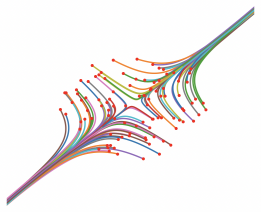
The large-N limit of spin squeezing leaves a nonlinear qubit evolution that solves single-input quantum state discrimination via a Viviani curve.
A machine-rendered reading of the paper's core claim, the machinery that carries it, and where it could break.
Core claim
In the N to infinity limit the one-axis twist torsion persists while the coherent-state center evolves as a nonlinear qubit under a two-state Gross-Pitaevskii equation. This nonlinearity implements single-input quantum state discrimination, solved by a Viviani curve on the Bloch sphere. An open-system variant containing both torsion and dissipation produces two basins of attraction with a shared boundary usable for autonomous discrimination. The two-component condensate is therefore presented as a platform for nonlinear quantum gates.
What carries the argument
The one-axis twist torsion that survives the large-N limit and generates the two-state Gross-Pitaevskii dynamics whose solution is the Viviani curve on the Bloch sphere.
If this is right
- Single-input quantum state discrimination becomes possible through the nonlinearity that remains after the large-N limit is taken.
- An open-system version with dissipation creates two basins of attraction whose boundary enables autonomous state discrimination.
- A two-component condensate can realize a nonlinear qubit usable for quantum computation tasks.
- Spin squeezing in the large-N regime supplies a concrete route to nonlinear quantum gates.
Where Pith is reading between the lines
- The same large-N reduction may simplify experimental tests by removing the need to preserve fragile pairwise entanglement.
- Similar torsion-driven nonlinearities could appear in other many-body platforms and enable analogous discrimination tasks.
- The Viviani-curve solution might be adapted to design faster or more robust discrimination protocols in quantum sensing.
Load-bearing premise
That the twisting interaction remains while two-particle entanglement is eliminated by monogamy when the atom number becomes infinite.
What would settle it
Direct observation that the Bloch-vector trajectory of a large-N condensate under one-axis twisting follows a Viviani curve and thereby achieves single-input state discrimination.
Figures


read the original abstract
There is great interest in generating and controlling entanglement in Bose-Einstein condensates and similar ensembles for use in quantum computation, simulation, and sensing. One class of entangled states useful for enhanced metrology are spin-squeezed states of $N$ two-level atoms. After preparing a spin coherent state of width $1/\sqrt{N}$ centered at coordinates $( \theta, \phi) $ on the Bloch sphere, atomic interactions generate a nonlinear evolution that shears the state's probability density, stretching it to an ellipse and causing squeezing in a direction perpendicular to the major axis. Here we consider the same setup but in the $N \rightarrow \infty $ limit . This shrinks the initial coherent state to zero area. Large $N$ also suppresses two-particle entanglement and squeezing, as required by a monogamy bound. The torsion (1-axis twist) is still present, however, and the center of the large $N$ coherent state evolves as a qubit governed by a two-state Gross-Pitaevskii equation. The resulting nonlinearity is known to be a powerful resource in quantum computation. It can be used to implement single-input quantum state discrimination, an impossibility within linear one-particle quantum mechanics. We obtain a solution to the discrimination problem in terms of a Viviani curve on the Bloch sphere. We also consider an open-system variant containing both Bloch sphere torsion and dissipation. In this case it should be possible to generate two basins of attraction within the Bloch ball, having a shared boundary that can be used for a type of autonomous state discrimination. We explore these and other connections between spin squeezing in the large $N$ limit and nonlinear quantum gates, and argue that a two-component condensate is a promising platform for realizing a nonlinear qubit.
Editorial analysis
A structured set of objections, weighed in public.
Referee Report
Summary. The manuscript claims that in the N→∞ limit of spin squeezing for N two-level atoms, the initial coherent state shrinks to zero width and two-particle entanglement is suppressed by monogamy, yet the torsional nonlinearity survives; the Bloch-vector center then obeys a two-state Gross-Pitaevskii equation whose nonlinearity enables single-input quantum state discrimination (impossible in linear QM) via an explicit Viviani-curve trajectory on the Bloch sphere. An open-system extension with dissipation is argued to produce basins of attraction usable for autonomous discrimination, positioning two-component condensates as platforms for nonlinear quantum gates.
Significance. If the reduction to the GP equation and the Viviani-curve solution are shown to hold, the work would furnish a concrete physical route from spin-squeezing metrology to nonlinear computational resources that can perform tasks forbidden in linear one-particle QM. The geometric construction supplies an explicit, falsifiable trajectory that could be tested in condensate experiments.
major comments (3)
- [Section presenting the discrimination solution] The central claim that the Viviani curve solves the single-input discrimination problem under the two-state GP dynamics is stated but not derived: no explicit substitution of the curve into the GP vector field, no verification that the resulting flow separates the target states, and no comparison showing an advantage over linear Bloch precession plus projective measurement appear in the text.
- [Large-N limit analysis] The reduction from finite-N spin squeezing to the mean-field GP equation for the Bloch-vector center is asserted via the survival of torsion and the monogamy bound, yet the explicit limiting procedure, the form of the GP equation itself, and error estimates for the N→∞ approximation are not supplied.
- [Open-system variant discussion] The open-system variant asserts that torsion plus dissipation can create two basins with a usable shared boundary, but no dynamical equations, no location of the separatrix, and no quantitative discrimination error rate are given.
minor comments (2)
- [Abstract and introduction] The abstract states that a solution “in terms of a Viviani curve” is obtained; the main text should contain a dedicated subsection that derives or verifies this curve rather than only citing the result.
- [Notation and setup] Notation for the Bloch angles (θ, φ) and the explicit form of the torsion term in the GP equation should be defined once and used consistently.
Simulated Author's Rebuttal
We thank the referee for their careful reading, positive assessment of the work's significance, and constructive major comments. We address each point below and will revise the manuscript to incorporate the requested derivations and details.
read point-by-point responses
-
Referee: [Section presenting the discrimination solution] The central claim that the Viviani curve solves the single-input discrimination problem under the two-state GP dynamics is stated but not derived: no explicit substitution of the curve into the GP vector field, no verification that the resulting flow separates the target states, and no comparison showing an advantage over linear Bloch precession plus projective measurement appear in the text.
Authors: We agree that the explicit substitution, verification, and comparison were not included in the submitted version. In the revised manuscript we will add a dedicated subsection that parametrizes the Viviani curve, substitutes it directly into the two-state GP vector field, verifies that the resulting flow separates the target states with the claimed discrimination success probability, and provides a side-by-side comparison against the linear Bloch-precession-plus-projection bound. revision: yes
-
Referee: [Large-N limit analysis] The reduction from finite-N spin squeezing to the mean-field GP equation for the Bloch-vector center is asserted via the survival of torsion and the monogamy bound, yet the explicit limiting procedure, the form of the GP equation itself, and error estimates for the N→∞ approximation are not supplied.
Authors: We acknowledge that the explicit limiting procedure and error estimates were omitted. The revision will include an appendix that starts from the finite-N spin-squeezing Hamiltonian, takes the N→∞ limit while invoking the monogamy bound to suppress entanglement, derives the precise two-state GP equation obeyed by the Bloch-vector center, and supplies rigorous error bounds on the approximation for large but finite N. revision: yes
-
Referee: [Open-system variant discussion] The open-system variant asserts that torsion plus dissipation can create two basins with a usable shared boundary, but no dynamical equations, no location of the separatrix, and no quantitative discrimination error rate are given.
Authors: We agree that the open-system section lacked the required equations and quantitative analysis. The revised manuscript will present the explicit master equation combining torsional nonlinearity and dissipation, locate the separatrix between the two basins of attraction on the Bloch ball, and provide an estimate of the discrimination error rate as a function of the dissipation parameter. revision: yes
Circularity Check
No significant circularity; derivation uses standard external mean-field limits and known nonlinear resources
full rationale
The paper's central steps invoke the established two-state Gross-Pitaevskii equation for the N→∞ mean-field evolution of the Bloch-sphere center and monogamy bounds on entanglement, both drawn from prior literature rather than fitted or self-defined within this work. The Viviani-curve solution for state discrimination is presented as an obtained mapping under the GP flow, without reduction to the inputs by construction or self-citation chains. No load-bearing self-definitional steps, fitted predictions, or ansatzes smuggled via author citations appear in the provided derivation chain. The argument remains self-contained against external benchmarks.
Axiom & Free-Parameter Ledger
axioms (2)
- domain assumption The center of the large-N coherent state evolves as a qubit governed by a two-state Gross-Pitaevskii equation.
- domain assumption Monogamy bounds suppress two-particle entanglement and squeezing in the large-N limit while leaving torsion intact.
Lean theorems connected to this paper
-
IndisputableMonolith/Cost/FunctionalEquation.leanwashburn_uniqueness_aczel unclear?
unclearRelation between the paper passage and the cited Recognition theorem.
The resulting nonlinearity is known to be a powerful resource in quantum computation. It can be used to implement single-input quantum state discrimination... We obtain a solution to the discrimination problem in terms of a Viviani curve on the Bloch sphere.
-
IndisputableMonolith/Foundation/BranchSelection.leanbranch_selection unclear?
unclearRelation between the paper passage and the cited Recognition theorem.
the center of the large N coherent state evolves as a qubit governed by a two-state Gross-Pitaevskii equation.
What do these tags mean?
- matches
- The paper's claim is directly supported by a theorem in the formal canon.
- supports
- The theorem supports part of the paper's argument, but the paper may add assumptions or extra steps.
- extends
- The paper goes beyond the formal theorem; the theorem is a base layer rather than the whole result.
- uses
- The paper appears to rely on the theorem as machinery.
- contradicts
- The paper's claim conflicts with a theorem or certificate in the canon.
- unclear
- Pith found a possible connection, but the passage is too broad, indirect, or ambiguous to say the theorem truly supports the claim.
Forward citations
Cited by 1 Pith paper
-
Optimal Bounds, Barriers, and Extensions for Non-Hermitian Bivariate Quantum Signal Processing
Tight anti-Hermitian query complexity d_I = Θ(β_I T + log(1/ε)/log log(1/ε)) is established for non-Hermitian M-QSP, with impossibility of √(β_I T) fast-forwarding, new angle-finding algorithms, and extensions to time...
Reference graph
Works this paper leans on
-
[2]
W., et al., 2019, Science, DOI: 10.1126/sci- ence.aaw5903 Barsdell et al., 2010, MNRAS, 408,
V. Giovannetti, S. Lloyd, and L. Maccone. Quantum-enhanced measurements: Beating the standard quantum limit. Science, 306:1330, 2004. DOI: 10.1126/sci- ence.1104149
-
[3]
V. Giovannetti, S. Lloyd, and L. Maccone. Quantum metrology. Phys. Rev. Lett. , 96:010401, 2006. DOI: 10.1103/PhysRevLett.96.010401
-
[4]
M. Kitagawa and M. Ueda. Squeezed spin states. Phys. Rev. A, 47:5138, 1993. DOI: 10.1103/PhysRevA.47.5138
-
[5]
J. Hald, J. L. Sørensen, C. Schori, and E. S. Polzik. Spin squeezed atoms: A macroscopic entangled ensemble created by light. Phys. Rev. Lett. , 39:1319, 1999. DOI: 10.1103/PhysRevLett.83.1319
-
[6]
A. Kuzmich, L. Mandel, and N. P. Bigelow. Generation of spin squeezing via contin- uous quantum nondemolition measurement. Phys. Rev. Lett. , 85:1594, 2000. DOI: 10.1103/PhysRevLett.85.1594
-
[9]
J. Ma, X. Wang, C. P. Sun, and F. Nori. Quantum spin squeezing. Phys. Rep., 509: 89, 2011. DOI: 10.1016/j.physrep.2011.08.003
-
[10]
C. L. Degen, F. Reinhard, and P. Cappellaro. Quantum sensing. Rev. Mod. Phys., 89:035002, 2017. DOI: 10.1103/RevModPhys.89.035002
work page internal anchor Pith review doi:10.1103/revmodphys.89.035002 2017
-
[11]
J. Est` eve, C. Gross, A. Weller, S. Giovanazzi, and M. K. Oberthaler. Squeezing and entanglement in a Bose–Einstein condensate. Nature, 455:1216, 2008. DOI: 10.1038/nature07332
-
[12]
L. Pezz` e, A. Smerzi, M. K. Oberthaler, R. Schmied, and P. Treutlein. Quantum metrology with nonclassical states of atomic ensembles. Rev. Mod. Phys., 90:035005,
-
[13]
DOI: 10.1103/RevModPhys.90.035005
work page internal anchor Pith review doi:10.1103/revmodphys.90.035005
-
[14]
X. Chai, D. Lao, K. Fujimoto, R. Hamazaki, M. Ueda, and C. Raman. Magnetic solitons in a spin-1 Bose-Einstein condensate. Phys. Rev. Lett. , 125:030402, 2020. DOI: 10.1103/PhysRevLett.125.030402
-
[15]
L. Xin, M. S. Chapman, and T. A. B. Kennedy. Fast generation of time-stationary spin-1 squeezed states by nonadiabatic control. PRX Quantum , 3:010328, 2022. DOI: 10.1103/PRXQuantum.3.010328
-
[16]
L. Xin, M. Barrios, J. T. Cohen, and M. S. Chapman. Long-lived squeezed ground states in a quantum spin ensemble. Phys. Rev. Lett. , 131:133402., 2023. DOI: 10.1103/PhysRevLett.131.133402
-
[17]
D. Barberena, A. Chu, J. K. Thompson, and A. M. Rey. Trade-offs between unitary and measurement induced spin squeezing in cavity QED. arXiv: 2309.15353
- [18]
-
[19]
J. M. Radcliffe. Some properties of coherent spin states. J. Phys. A: Gen. Phys. , 4: 313, 1971. DOI: 10.1088/0305-4470/4/3/009. 23
-
[22]
T. Byrnes, D. Rosseau, M. Khosla, A. Pyrkov, A. Thomasen, T. Mukai, S. Koyama, A. Abdelrahman, and E. Ilo-Okeke. Macroscopic quantum information process- ing using spin coherent states. Optics Communications , 337:102, 2015. DOI: 10.1016/j.optcom.2014.08.017
-
[23]
D. S. Abrams and S. Lloyd. Nonlinear quantum mechanics implies polynomial-time solution for NP-Complete and #P problems. Phys. Rev. Lett. , 81:3992, Nov 1998. DOI: 10.1103/PhysRevLett.81.3992. URL https://link.aps.org/doi/10.1103/ PhysRevLett.81.3992
-
[24]
A. M. Childs and J. Young. Optimal state discrimination and unstruc- tured search in nonlinear quantum mechanics. Phys. Rev. A , 93:022314, 2016. DOI: 10.1103/PhysRevA.93.022314. URL https://link.aps.org/doi/10.1103/ PhysRevA.93.022314
-
[25]
H. Bechmann-Pasquinucci, B. Huttner, and N. Gisin. Nonlinear quantum state transformation of spin-1/2. Phys. Lett. A , 242:198, 1998
work page 1998
-
[26]
M. Czachor. Notes on nonlinear quantum algorithms. Acta Phys. Slov. , 48:157, 1998
work page 1998
- [27]
-
[28]
D. R. Terno. Nonlinear operations in quantum-information theory. Phys. Rev. A , 59:3320, 1999. DOI: 10.1103/PhysRevA.59.3320
-
[29]
D. Bacon. Quantum computational complexity in the presence of closed timelike curves. Phys. Rev. A , 70:032309, Sep 2004. DOI: 10.1103/PhysRevA.70.032309. URL https://link.aps.org/doi/10.1103/PhysRevA.70.032309
-
[30]
NP-complete Problems and Physical Reality
S. Aaronson. NP-complete problems and physical reality. arXiv: quant-ph/0502072
work page internal anchor Pith review Pith/arXiv arXiv
-
[31]
T. A. Brun, J. Harrington, and M. M. Wilde. Localized closed timelike curves can perfectly distinguish quantum states. Phys. Rev. Lett. , 102:210402, 2009. DOI: 10.1103/PhysRevLett.102.210402. URL https://link.aps.org/doi/10. 1103/PhysRevLett.102.210402
-
[33]
M. E. Kahou and D. L. Feder. Quantum search with interacting Bose-Einstein condensates. Phys. Rev. A , 88:032310, 2013. DOI: 10.1103/PhysRevA.88.032310. URL https://link.aps.org/doi/10.1103/PhysRevA.88.032310
-
[34]
D. A. Meyer and T. G. Wong. Nonlinear quantum search using the Gross-Pitaevskii equation. New J. Phys. , 15:063014, 2013
work page 2013
-
[35]
D. A. Meyer and T. G. Wong. Quantum search with general nonlinearities. Phys. Rev. A, 89:012312, 2014. DOI: doi:10.1088/1367-2630/15/6/063014
-
[36]
G. Di Molfetta and B. Herzog. Searching via nonlinear quantum walk on the 2D-grid. arXiv: 2009.07800
-
[37]
S. Deffner. Nonlinear speed-ups in ultracold quantum gases. Europhys. Lett., 140: 48001, 2022. DOI: 10.1209/0295-5075/ac9fed. 24
-
[39]
M. R. Geller. Fast quantum state discrimination with nonlinear PTP channels. Adv. Quantum Technol., page 2200156, 2023. DOI: 10.1002/qute.202200156. arXiv: 2111.05977
-
[40]
M. R. Geller. Protocol for nonlinear state discrimination in rotating condensate. Adv. Quantum Technol., page 202300431, 2024. DOI: 10.1002/qute.202300431. arXiv: 2404.16288
- [41]
-
[42]
S. M. Barnet and S. Croke. Quantum state discrimination. arXiv: 0810.1970
work page internal anchor Pith review Pith/arXiv arXiv 1970
-
[44]
J. Bae and L.-C. Kwek. Quantum state discrimination and its applications. J. Phys. A: Math. Theor. , 48:083001, 2015. DOI: 10.1088/1751-8113/48/8/083001
-
[45]
M. Rouhbakhsh and S. A. Ghoreishi. Minimum-error discrimination of qubit states revisited. arXiv: 2108.12299
-
[46]
S. Arora and B. Barak. Computational Complexity: A Modern Approach. Cambridge University Press, 2009
work page 2009
-
[47]
C. G. Shull, D. K. Atwood, J. Arthur, and M. A. Horne. Search for a nonlinear variant of the Schr¨ odinger equation by neutron interferometry.Phys. Rev. Lett., 44: 765, 1980. DOI: 10.1103/PhysRevLett.44.765
-
[48]
R. G¨ ahler, A. G. Klein, and A. Zeilinger. Neutron optical tests of nonlinear wave mechanics. Phys. Rev. A , 23:1611, 1981. DOI: 10.1103/PhysRevA.23.1611
- [49]
-
[50]
URL https://link.aps.org/doi/10
DOI: 10.1103/PhysRevLett.62.485. URL https://link.aps.org/doi/10. 1103/PhysRevLett.62.485
-
[51]
J. J. Bollinger, D. J. Heinzen, W. M. Itano, S. L. Gilbert, and D. J. Wineland. Test of the linearity of quantum mechanics by rf spectroscopy of the 9Be+ ground state. Phys. Rev. Lett. , 63:1031, 1989. DOI: 10.1103/PhysRevLett.63.1031. URL https://link.aps.org/doi/10.1103/PhysRevLett.63.1031
-
[53]
R. L. Walsworth, I. F. Silvera, E. M. Mattison, and R. F. C. Vessot. Test of the linearity of quantum mechanics in an atomic system with a hydrogen maser. Phys. Rev. Lett., 64:2599, 1990. DOI: 10.1103/PhysRevLett.64.2599. URL https://link. aps.org/doi/10.1103/PhysRevLett.64.2599
-
[54]
P. K. Majumder, B. J. Venema, S. K. Lamoreaux, B. R. Heckel, and E. N. Fortson. Test of the linearity of quantum mechanics in optically pumped 201Hg. Phys. Rev. Lett., 65:2931, 1990. DOI: 10.1103/PhysRevLett.65.2931. URL https://link.aps. org/doi/10.1103/PhysRevLett.65.2931
-
[55]
S. Forstner, M. Zych, S. Basiri-Esfahani, K. E. Khosla, and W. P. Bowen. Nanome- chanical test of quantum linearity. Optica, 7:1427, 2020. DOI: 10.1364/OP- TICA.391671
work page doi:10.1364/op- 2020
-
[56]
I. J. Arnquist, F. T. Avignone, A. S. Barabash, C. J. Barton, K. H. Bhimani, E. Blalock, B. Bos, M. Busch, M. Buuck, T. S. Caldwell, Y-D. Chan, C. D. Christof- 25 ferson, P.-H. Chu, M. L. Clark, C. Cuesta, J. A. Detwiler, Yu. Efremenko, H. Ejiri, S. R. Elliott, G. K. Giovanetti, M. P. Green, J. Gruszko, I. S. Guinn, V. E. Guiseppe, C. R. Haufe, R. Henning...
-
[57]
M. Polkovnikov, A. V. Gramolin, D. E. Kaplan, S. Rajendran, and A. O. Sushkov. Experimental limit on nonlinear state-dependent terms in quantum theory. Phys. Rev. Lett., 130:040202, 2023. DOI: 10.1103/PhysRevLett.130.040202
-
[58]
J. Broz, B. You, S. Khan, H. H¨ affner, D. E. Kaplan, and S. Rajendran. Test of causal nonlinear quantum mechanics by Ramsey interferometry with a trapped ion. Phys. Rev. Lett., 130:200201, 2023. DOI: 10.1103/PhysRevLett.130.200201
-
[59]
C. H. Bennett, E. Bernstein, G. Brassard, and U. Vazirani. Strengths and weaknesses of quantum computing. SIAM J. Comput. , 26:1510, 1997. DOI: 10.1137/S0097539796300933
-
[60]
E. P. Gross. Structure of a quantized vortex in boson systems. Nuovo Cimento, 20: 454, 1961. DOI: 10.1007/BF02731494
-
[61]
L. P. Pitaevskii. Vortex lines in an imperfect Bose gas. Sov. Phys. JETP , 13:451, 1961
work page 1961
-
[62]
L. Erd˝ os and B. Schlein. Quantum dynamics with mean field interactions: A new approach. J. Stat. Phys. , 134:859, 2009. DOI: 10.1007/s10955-008-9570-7
-
[64]
E. H. Lieb and D. W. Robinson. The finite group velocity of quantum spin systems. Comm. Math. Phys. , 28:251, 1972. DOI: 10.1007/BF01645779
-
[65]
Z. Idziaszek, T. Calarco, and P. Zoller. Controlled collisions of a single atom and an ion guided by movable trapping potentials. Phys. Rev. A, 76:033409, 2007. DOI: 10.1103/PhysRevA.76.033409
-
[66]
M. Tomza, K. Jachymski, R. Gerritsma, A. Negretti, T. Calarco, Z. Idziaszek, and P. S. Julienne. Cold hybrid ion-atom systems. Rev. Mod. Phys. , 91:035001, 2019. DOI: 10.1103/RevModPhys.91.035001
-
[67]
S. Jyothi, K. N. Egodapitiya, B. Bondurant, Z. Jia, E. Pretzsch, P. Chiappina, G. Shu, and K. R. Brown. A hybrid ion-atom trap with integrated high resolution mass spectrometer. Rev.. Sci.. Instrum. , 90:103201, 2019. DOI: 10.1063/1.5121431
-
[68]
L. Karpa. Interactions of ions and ultracold neutral atom ensembles in composite optical dipole traps: Developments and perspectives. Atoms, 9:39, 2021. DOI: 10.3390/atoms9030039
-
[69]
R. S. Lous and R. Gerritsma. Ultracold ion-atom experiments: cooling, chemistry, and quantum effects. Advances in Atomic, Molecular, and Optical Physics , 71:65,
-
[70]
DOI: 10.1016/bs.aamop.2022.05.002
-
[71]
C. Zipkes, S. Palzer, C. Sias, and M. Kohl. A trapped single ion inside a Bose–Einstein condensate. Nature, 464:388, 2010. DOI: 10.1038/nature08865
-
[72]
J. Schmidt, P. Weckesser, F. Thielemann, T. Schaetz, and L. Karpa. Optical traps for sympathetic cooling of ions with ultracold neutral atoms. Phys. Rev. Lett., 124: 053402, 2020. DOI: 10.1103/PhysRevLett.124.053402. 26
-
[73]
R. Gerritsma, A. Negretti, H. Doerk, Z. Idziaszek, T. Calarco, and F. Schmidt-Kaler. Bosonic Josephson junction controlled by a single trapped ion. Phys. Rev. Lett., 109: 080402, 2012. DOI: 10.1103/PhysRevLett.109.080402
-
[74]
J. Joger, A. Negretti, and R. Gerritsma. Quantum dynamics of an atomic double- well system interacting with a trapped ion. Phys. Rev. A , 89:063621, 2014. DOI: 10.1103/PhysRevA.89.063621
-
[75]
M. R. Ebgha, S. Saeidian, P. Schmelcher, and A. Negretti. Compound atom-ion Josephson junction: Effects of finite temperature and ion motion. Phys. Rev. A , 100:033616, 2019. DOI: 10.1103/PhysRevA.100.033616
-
[76]
C. E. Wieman, D. E. Pritchard, and D. J. Wineland. Atom cooling, trapping, and quantum manipulation. Rev. Mod. Phys. , 71:S253, 1999. DOI: 10.1103/RevMod- Phys.71.S253
-
[77]
F. Dalfovo, S. Giorgini, L. P. Pitaevskii, and S. Stringari. Theory of Bose- Einstein condensation in trapped gases. Rev. Mod. Phys. , 71:463, 1999. DOI: 10.1103/RevModPhys.71.463
-
[78]
A. J. Leggett. Bose-Einstein condensation in the alkali gases: Some fundamental concepts. Rev. Mod. Phys., 73:307, 2001. DOI: 10.1103/RevModPhys.73.307
-
[79]
O. Morsch and M. Oberthaler. Dynamics of Bose-Einstein condensates in optical lattices. Rev. Mod. Phys., 78:179, 2006. DOI: 10.1103/RevModPhys.78.179
-
[80]
E. H. Lieb, R. Seiringer, and J. Yngvason. Bosons in a trap: A rigorous derivation of the Gross-Pitaevskii energy functional. Phys. Rev. A , 61:043602, 2000. DOI: 10.1103/PhysRevA.61.043602
- [81]
- [82]
-
[83]
J. Fr¨ ohlich, S. Graffi, and S. Schwarz. Mean-field and classical limit of many- body Schr¨ odinger dynamics for bosons. Comm. Math. Phys. , 271:681, 2007. DOI: 10.1007/s00220-007-0207-5
-
[84]
L. Erd˝ os, B. Schlein, and H.-T. Yau. Rigorous derivation of the Gross-Pitaevskii equation. Phys. Rev. Lett., 98:040404, 2007. DOI: 10.1103/PhysRevLett.98.040404
-
[85]
I. Rodnianski and B. Schlein. Quantum fluctuations and rate of convergence towards mean field dynamics. Comm. Math. Phys. , 291:31, 2009. DOI: 10.1007/s00220-009- 0867-4
-
[86]
A. Knowles and P. Pickl. Mean-field dynamics: Singular potentials and rate of convergence. Commun. Math. Phys., 298:101, 2010. DOI: 10.1007/s00220-010-1010- 2
-
[87]
L. Chen, J. O. Lee, and B. Schlein. Rate of convergence towards Hartree dynamics. J. Stat. Phys. , 144:872, 2011. DOI: 10.1007/s10955-011-0283-y
-
[88]
On the rate of convergence for the mean field approximation of many-body quantum dynamics
Z. Ammari, M. Falconi, and B. Pawilowski. On the rate of convergence for the mean field approximation of many-body quantum dynamics. arXiv: 1411.6284v1
work page internal anchor Pith review Pith/arXiv arXiv
-
[89]
P. Pickl. Derivation of the time dependent Gross–Pitaevskii equation with external fields. Reviews in Mathematical Physics , 27:1550003, 2015. DOI: 10.1142/S0129055X15500038
-
[90]
N. Benedikter, M. Porta, and B. Schlein. Effective Evolution Equations from Quan- tum Dynamics. Springer, Berlin, 2016. DOI: 10.1007/978-3-319-24898-1
discussion (0)
Sign in with ORCID, Apple, or X to comment. Anyone can read and Pith papers without signing in.