Intensity correlations in decoy-state BB84 quantum key distribution systems
Pith reviewed 2026-05-23 18:11 UTC · model grok-4.3
The pith
Higher-order intensity correlations between pulses in decoy-state BB84 QKD reduce the asymptotic key rate more than nearest-neighbor correlations.
A machine-rendered reading of the paper's core claim, the machinery that carries it, and where it could break.
Core claim
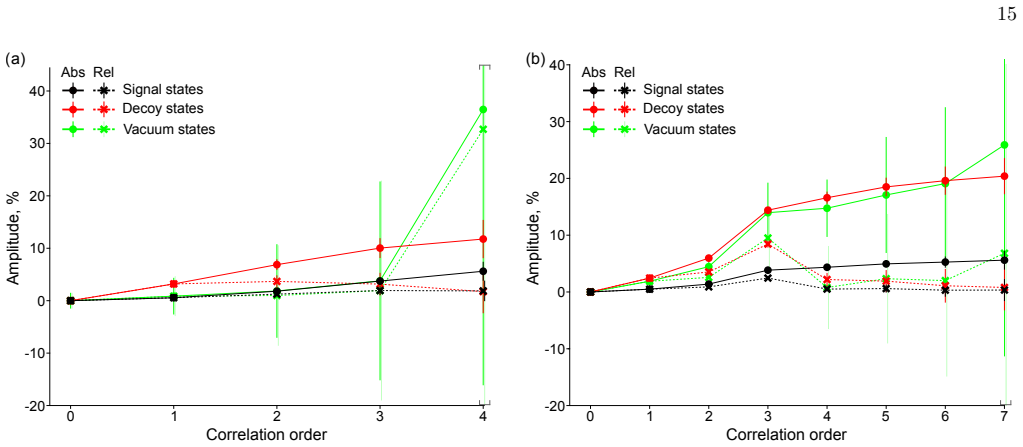
In two industrial prototypes of decoy-state BB84 QKD systems, higher-order correlations between emitted optical pulses have a greater impact on the intensity of the generated signals than nearest-neighbour correlations, and these correlations significantly reduce the asymptotic secret key rate.
What carries the argument
Experimental measurement of intensity correlations across sequences of optical pulses in the transmitter lasers, followed by recalculation of the secret key rate that incorporates the additional information leaked by those correlations.
If this is right
- The asymptotic key rate in high-repetition-rate decoy-state BB84 must be lowered when higher-order correlations are present.
- The basic premise that pulse intensities are independent of prior encoding choices no longer holds once multi-pulse correlations are measured.
- Security proofs for decoy-state QKD at elevated clock rates require explicit inclusion of correlations beyond nearest neighbours.
- Raising repetition rate to increase key rate can introduce a security penalty that offsets part of the gain.
Where Pith is reading between the lines
- QKD system designers may need to add hardware filters or software corrections that suppress long-range intensity correlations.
- The same measurement approach could be applied to other laser-based QKD protocols to check whether the key-rate penalty appears elsewhere.
- If higher-order correlations prove common, the practical advantage of very high repetition rates in fiber QKD would be smaller than currently estimated.
Load-bearing premise
The correlations measured in these two specific industrial prototypes are representative of decoy-state BB84 systems in general and the key-rate formula correctly accounts for all information leaked by the observed correlations.
What would settle it
A measurement of pulse intensities in additional decoy-state BB84 transmitters that shows higher-order correlations have smaller or equal effect on intensity compared with nearest-neighbour correlations, or a recalculation showing no reduction in asymptotic key rate once those correlations are included.
Figures


read the original abstract
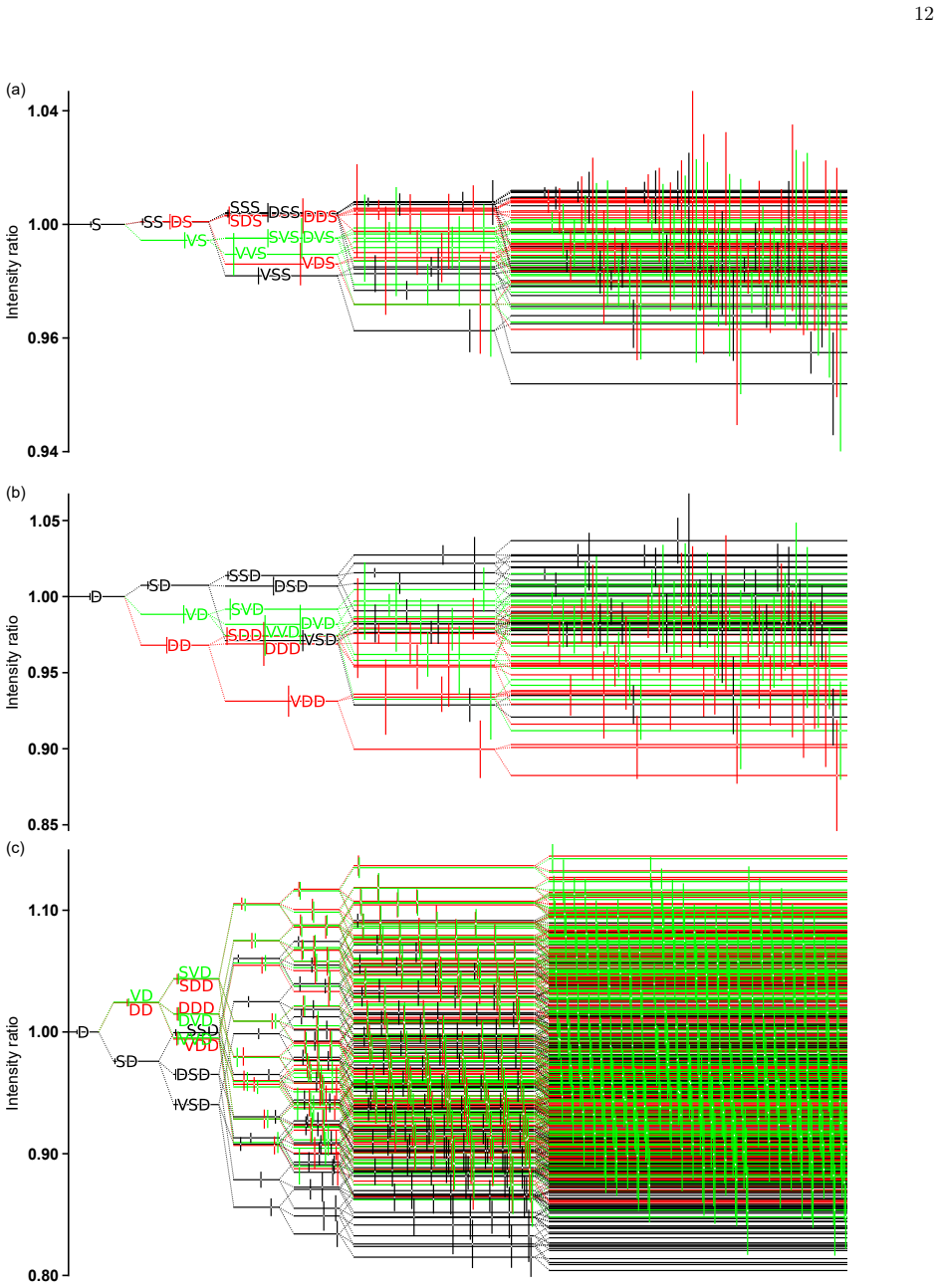
The decoy-state method is a prominent approach to enhance the performance of quantum key distribution (QKD) systems that operate with weak coherent laser sources. Due to the limited transmissivity of single photons in optical fiber, current experimental decoy-state QKD setups increase their secret key rate by raising the repetition rate of the transmitter. However, this usually leads to correlations between subsequent optical pulses. This phenomenon leaks information about the encoding settings, including the intensities of the generated signals, which invalidates a basic premise of decoy-state QKD. Here we characterize intensity correlations between the emitted optical pulses in two industrial prototypes of decoy-state BB84 QKD systems and show that they significantly reduce the asymptotic key rate. In contrast to what has been conjectured, we experimentally confirm that the impact of higher-order correlations on the intensity of the generated signals can be much higher than that of nearest-neighbour correlations.
Editorial analysis
A structured set of objections, weighed in public.
Referee Report
Summary. The paper reports experimental measurements of intensity correlations (nearest-neighbor and higher-order) between optical pulses in two industrial decoy-state BB84 QKD prototypes. It claims that higher-order correlations can dominate the intensity fluctuations and that, when incorporated into a modified decoy-state analysis, these correlations produce a substantial reduction in the asymptotic secret key rate compared with the standard uncorrelated model.
Significance. If the quantitative mapping from measured correlation coefficients to leaked intensity-setting information is shown to be robust, the result would be significant for practical high-repetition-rate QKD: it supplies concrete evidence that current decoy-state security proofs must be adjusted for real devices and quantifies the resulting key-rate penalty on representative hardware.
major comments (2)
- [key-rate calculation section] The conversion from the measured correlation matrix (nearest-neighbor plus higher-order terms) to the effective photon-number distribution or mutual-information bound used in the key-rate formula is not derived or validated in sufficient detail; without an explicit leakage model (e.g., a stated truncation or Markov assumption) it is unclear whether the reported key-rate reduction is model-independent or an artifact of the chosen mapping.
- [experimental results and discussion] The claim that the observed correlations are representative of the general class of decoy-state BB84 systems rests on data from only two industrial prototypes; the manuscript does not provide a statistical argument or additional devices that would support extrapolation beyond these specific transmitters.
minor comments (2)
- [figures] Figure captions should explicitly state the number of pulses used for each correlation estimate and the statistical uncertainty on the reported coefficients.
- [methods] Notation for the correlation functions (e.g., C_{i,j} versus C^{(k)}) should be defined once in the main text rather than only in the supplementary material.
Simulated Author's Rebuttal
We thank the referee for the constructive comments. We address each major point below and will revise the manuscript accordingly to strengthen the presentation of the leakage model and to clarify the scope of the experimental claims.
read point-by-point responses
-
Referee: [key-rate calculation section] The conversion from the measured correlation matrix (nearest-neighbor plus higher-order terms) to the effective photon-number distribution or mutual-information bound used in the key-rate formula is not derived or validated in sufficient detail; without an explicit leakage model (e.g., a stated truncation or Markov assumption) it is unclear whether the reported key-rate reduction is model-independent or an artifact of the chosen mapping.
Authors: We agree that the mapping requires an explicit derivation. In the revised manuscript we will add a dedicated subsection deriving the effective photon-number distribution from the measured correlation matrix under a finite-order Markov assumption with truncation at the observed correlation order. We will also include numerical validation showing that the key-rate penalty is driven by the measured coefficients and remains stable under small variations of the truncation order. revision: yes
-
Referee: [experimental results and discussion] The claim that the observed correlations are representative of the general class of decoy-state BB84 systems rests on data from only two industrial prototypes; the manuscript does not provide a statistical argument or additional devices that would support extrapolation beyond these specific transmitters.
Authors: The manuscript reports measurements on two commercial-grade transmitters and does not assert statistical representativeness of all possible systems. We will revise the discussion to explicitly state the limited sample size, note that the observed higher-order correlations arise from common hardware features of high-repetition-rate intensity modulators, and add a caveat that broader device surveys would be needed for quantitative extrapolation while emphasizing the practical relevance of the demonstrated effect. revision: partial
Circularity Check
No significant circularity; experimental measurements are self-contained.
full rationale
The paper reports direct experimental characterization of intensity correlations in two industrial QKD prototypes and their measured effect on asymptotic key rate. No derivation chain is presented that reduces a claimed prediction or first-principles result to fitted parameters, self-citations, or ansatzes by construction. The central claims rest on observed data rather than any self-referential modeling step, satisfying the default expectation that experimental work of this type contains no circularity.
Axiom & Free-Parameter Ledger
axioms (1)
- standard math Standard assumptions of quantum mechanics and linear optics for pulse propagation
Lean theorems connected to this paper
-
IndisputableMonolith/Foundation/RealityFromDistinction.leanreality_from_one_distinction unclear?
unclearRelation between the paper passage and the cited Recognition theorem.
We experimentally study intersymbol intensity correlations in two industrial prototypes of decoy-state BB84 systems... apply the security proof recently developed in [41]... quantify the impact... on their performance in terms of secret key rate (SKR).
-
IndisputableMonolith/Cost/FunctionalEquation.leanwashburn_uniqueness_aczel unclear?
unclearRelation between the paper passage and the cited Recognition theorem.
the overlap parameter which quantifies the tightness of the constraints... τξ=1a,b,c,n = [∑... √(pnk+1|ak+1,a pnk+1|ak+1,b)]²
What do these tags mean?
- matches
- The paper's claim is directly supported by a theorem in the formal canon.
- supports
- The theorem supports part of the paper's argument, but the paper may add assumptions or extra steps.
- extends
- The paper goes beyond the formal theorem; the theorem is a base layer rather than the whole result.
- uses
- The paper appears to rely on the theorem as machinery.
- contradicts
- The paper's claim conflicts with a theorem or certificate in the canon.
- unclear
- Pith found a possible connection, but the passage is too broad, indirect, or ambiguous to say the theorem truly supports the claim.
Reference graph
Works this paper leans on
-
[1]
C. H. Bennett and G. Brassard, Quantum cryptography: Public key distribution and coin tossing, inProc. Inter- national Conference on Computers, Systems, and Sig- nal Processing(IEEE Press, New York, Bangalore, India,
-
[2]
F. Xu, X. Ma, Q. Zhang, H.-K. Lo, and J.-W. Pan, Se- cure quantum key distribution with realistic devices, Rev. Mod. Phys.92, 025002 (2020)
work page 2020
-
[3]
H.-K. Lo, M. Curty, and K. Tamaki, Secure quantum key distribution, Nat. Photonics8, 595 (2014)
work page 2014
-
[4]
S. Pirandola, U. L. Andersen, L. Banchi, M. Berta, D. Bunandar, R. Colbeck, D. Englund, T. Gehring, C. Lupo, C. Ottaviani, J. L. Pereira, M. Razavi, J. Sham- sul Shaari, M. Tomamichel, V. C. Usenko, G. Vallone, P. Villoresi, and P. Wallden, Advances in quantum cryp- tography, Adv. Opt. Photonics12, 1012 (2020)
work page 2020
- [5]
-
[6]
P. W. Shor and J. Preskill, Simple proof of security of the BB84 quantum key distribution protocol, Phys. Rev. Lett.85, 441 (2000)
work page 2000
-
[7]
Koashi, Simple security proof of quantum key dis- tribution based on complementarity, New J
M. Koashi, Simple security proof of quantum key dis- tribution based on complementarity, New J. Phys.11, 045018 (2009)
work page 2009
-
[8]
Renner, Security of quantum key distribution, Int
R. Renner, Security of quantum key distribution, Int. J. Quantum Inf.6, 1 (2008)
work page 2008
-
[9]
G. Brassard, N. L¨ utkenhaus, T. Mor, and B. C. Sanders, Limitations on practical quantum cryptography, Phys. Rev. Lett.85, 1330 (2000)
work page 2000
-
[10]
V. Makarov, A. Anisimov, and J. Skaar, Effects of de- tector efficiency mismatch on security of quantum cryp- tosystems, Phys. Rev. A74, 022313 (2006), erratum ibid. 78, 019905 (2008)
work page 2006
-
[11]
Y. Zhao, C.-H. F. Fung, B. Qi, C. Chen, and H.-K. Lo, Quantum hacking: Experimental demonstration of time- shift attack against practical quantum-key-distribution systems, Phys. Rev. A78, 042333 (2008)
work page 2008
-
[12]
L. Lydersen, C. Wiechers, C. Wittmann, D. Elser, J. Skaar, and V. Makarov, Hacking commercial quan- tum cryptography systems by tailored bright illumina- tion, Nat. Photonics4, 686 (2010)
work page 2010
-
[13]
I. Gerhardt, Q. Liu, A. Lamas-Linares, J. Skaar, C. Kurt- siefer, and V. Makarov, Full-field implementation of a perfect eavesdropper on a quantum cryptography system, Nat. Commun.2, 349 (2011)
work page 2011
- [14]
- [15]
-
[16]
D. D. Ruzhitskaya, I. V. Zhluktova, M. A. Petrov, K. A. Zaitsev, P. P. Acheva, N. A. Zunikov, A. V. Shilko, D. Aktas, F. Johlinger, D. O. Trefilov, A. A. Ponosova, V. A. Kamynin, and V. V. Makarov, Vulnerabilities in the quantum key distribution system induced under a pulsed laser attack, Sci. Tech. J. Inf. Technol. Mech. Opt.21, 837 (2021), in Russian
work page 2021
-
[17]
P. Ye, W. Chen, G.-W. Zhang, F.-Y. Lu, F.-X. Wang, G.-Z. Huang, S. Wang, D.-Y. He, Z.-Q. Yin, G.-C. Guo, and Z.-F. Han, Induced-photorefraction attack against quantum key distribution, Phys. Rev. Appl.19, 054052 (2023)
work page 2023
-
[18]
D. Gottesman, H.-K. Lo, N. L¨ utkenhaus, and J. Preskill, Security of quantum key distribution with imperfect de- vices, Quantum Inf. Comput.4, 325 (2004)
work page 2004
-
[19]
C. C. W. Lim, M. Curty, N. Walenta, F. Xu, and H. Zbinden, Concise security bounds for practical decoy- state quantum key distribution, Phys. Rev. A89, 022307 (2014)
work page 2014
- [20]
-
[21]
M. Pereira, G. Kato, A. Mizutani, M. Curty, and K. Tamaki, Quantum key distribution with correlated sources, Sci. Adv.6, eaaz4487 (2020)
work page 2020
-
[22]
C. Marquardt, U. Seyfarth, S. Bettendorf, M. Bohmann, A. Buchner, M. Curty, D. Elser, S. Eul, T. Gehring, N. Jain, T. Klocke, M. Reinecke, N. Sieber, R. Ursin, M. Wehling, and H. Weier, Imple- mentation attacks against QKD systems, BSI technical report,https://www.bsi.bund.de/EN/ Service-Navi/Publikationen/Studien/QKD-Systems/ Implementation_Attacks_QKD_S...
work page 2024
-
[23]
G. Curr´ as-Lorenzo, M. Pereira, G. Kato, M. Curty, and K. Tamaki, A security framework for quantum key distri- bution implementations, arXiv:2305.05930 [quant-ph]
-
[24]
A. Trushechkin, Security of quantum key distribution with detection-efficiency mismatch in the multiphoton case, Quantum6, 771 (2022)
work page 2022
-
[25]
D. Tupkary, S. Nahar, P. Sinha, and N. L¨ utkenhaus, Phase error rate estimation in QKD with imperfect de- tectors, arXiv:2408.17349 [quant-ph]
-
[26]
A. R. Dixon, J. F. Dynes, M. Lucamarini, B. Fr¨ ohlich, A. W. Sharpe, A. Plews, W. Tam, Z. L. Yuan, Y. Tanizawa, H. Sato, S. Kawamura, M. Fujiwara, M. Sasaki, and A. J. Shields, Quantum key distribution with hacking countermeasures and long term field trial, Sci. Rep.7, 1978 (2017)
work page 1978
-
[27]
A. Ponosova, D. Ruzhitskaya, P. Chaiwongkhot, V. Egorov, V. Makarov, and A. Huang, Protecting fiber- optic quantum key distribution sources against light- injection attacks, PRX Quantum3, 040307 (2022)
work page 2022
-
[28]
V. Makarov, A. Abrikosov, P. Chaiwongkhot, A. K. Fe- dorov, A. Huang, E. Kiktenko, M. Petrov, A. Ponosova, D. Ruzhitskaya, A. Tayduganov, D. Trefilov, and K. Za- itsev, Preparing a commercial quantum key distribu- tion system for certification against implementation loop- holes, Phys. Rev. Appl.22, 044076 (2024)
work page 2024
-
[29]
H.-K. Lo, M. Curty, and B. Qi, Measurement-device- independent quantum key distribution, Phys. Rev. Lett. 108, 130503 (2012)
work page 2012
-
[30]
M. Lucamarini, Z. L. Yuan, J. F. Dynes, and A. J. Shields, Overcoming the rate–distance limit of quantum key distribution without quantum repeaters, Nature557, 400 (2018)
work page 2018
- [31]
-
[32]
S. Wang, D.-Y. He, Z.-Q. Yin, F.-Y. Lu, C.-H. Cui, W. Chen, Z. Zhou, G.-C. Guo, and Z.-F. Han, Beat- ing the fundamental rate-distance limit in a proof-of- principle quantum key distribution system, Phys. Rev. X9, 021046 (2019)
work page 2019
- [33]
-
[34]
S. Wang, Z.-Q. Yin, D.-Y. He, W. Chen, R.-Q. Wang, P. Ye, Y. Zhou, G.-J. Fan-Yuan, F.-X. Wang, W. Chen, Y.-G. Zhu, P. V. Morozov, A. V. Divochiy, Z. Zhou, G.-C. Guo, and Z.-F. Han, Twin-field quantum key distribution over 830-km fibre, Nat. Photonics16, 154 (2022)
work page 2022
-
[35]
Y. Liu, W.-J. Zhang, C. Jiang, J.-P. Chen, C. Zhang, W.-X. Pan, D. Ma, H. Dong, J.-M. Xiong, C.-J. Zhang, H. Li, R.-C. Wang, J. Wu, T.-Y. Chen, L. You, X.-B. Wang, Q. Zhang, and J.-W. Pan, Experimental twin-field quantum key distribution over 1000 km fiber distance, Phys. Rev. Lett.130, 210801 (2023)
work page 2023
-
[36]
F. Xu, K. Wei, S. Sajeed, S. Kaiser, S. Sun, Z. Tang, L. Qian, V. Makarov, and H.-K. Lo, Experimental quan- 17 tum key distribution with source flaws, Phys. Rev. A92, 032305 (2015)
work page 2015
-
[37]
E. Diamanti, H.-K. Lo, B. Qi, and Z. Yuan, Practical challenges in quantum key distribution, npj Quantum Inf.2, 16025 (2016)
work page 2016
-
[38]
F. Gr¨ unenfelder, A. Boaron, D. Rusca, A. Martin, and H. Zbinden, Performance and security of 5 GHz repe- tition rate polarization-based quantum key distribution, Appl. Phys. Lett.117, 144003 (2020)
work page 2020
- [39]
-
[40]
V. Zapatero, ´A. Navarrete, K. Tamaki, and M. Curty, Security of quantum key distribution with intensity cor- relations, Quantum5, 602 (2021)
work page 2021
- [41]
-
[42]
M. Pereira, G. Curr´ as-Lorenzo, ´A. Navarrete, A. Mizu- tani, G. Kato, M. Curty, and K. Tamaki, Modified BB84 quantum key distribution protocol robust to source im- perfections, Phys. Rev. Res.5, 023065 (2023)
work page 2023
-
[43]
G. Curr´ as-Lorenzo, S. Nahar, N. L¨ utkenhaus, K. Tamaki, and M. Curty, Security of quantum key distribution with imperfect phase randomisation, Quantum Sci. Technol. 9, 015025 (2023)
work page 2023
-
[44]
M. Pereira, G. Curr´ as-Lorenzo, A. Mizutani, D. Rusca, M. Curty, and K. Tamaki, Quantum key distribution with unbounded pulse correlations, Quantum Sci. Tech- nol.10, 015001 (2024)
work page 2024
-
[45]
K. Yoshino, M. Fujiwara, K. Nakata, T. Sumiya, T. Sasaki, M. Takeoka, M. Sasaki, A. Tajima, M. Koashi, and A. Tomita, Quantum key distribution with an effi- cient countermeasure against correlated intensity fluctu- ations in optical pulses, npj Quantum Inf.4, 8 (2018)
work page 2018
-
[46]
G. L. Roberts, M. Pittaluga, M. Minder, M. Lucamarini, J. F. Dynes, Z. L. Yuan, and A. J. Shields, Patterning- effect mitigating intensity modulator for secure decoy- state quantum key distribution, Opt. Lett.43, 5110 (2018)
work page 2018
-
[47]
X. Kang, F.-Y. Lu, S. Wang, J.-L. Chen, Z.-H. Wang, Z.-Q. Yin, D.-Y. He, W. Chen, G.-J. Fan-Yuan, G.-C. Guo, and Z.-F. Han, Patterning-effect calibration algo- rithm for secure decoy-state quantum key distribution, J. Lightwave Technol.41, 75 (2023)
work page 2023
- [48]
-
[49]
Wang, Beating the photon-number-splitting attack in practical quantum cryptography, Phys
X.-B. Wang, Beating the photon-number-splitting attack in practical quantum cryptography, Phys. Rev. Lett.94, 230503 (2005)
work page 2005
-
[50]
H.-K. Lo, X. Ma, and K. Chen, Decoy state quantum key distribution, Phys. Rev. Lett.94, 230504 (2005)
work page 2005
-
[51]
X. Ma, B. Qi, Y. Zhao, and H.-K. Lo, Practical decoy state for quantum key distribution, Phys. Rev. A72, 012326 (2005)
work page 2005
-
[52]
A. Savitzky and M. J. E. Golay, Smoothing and differ- entiation of data by simplified least squares procedures, Anal. Chem.36, 1627 (1964)
work page 1964
-
[53]
M. U. A. Bromba and H. Ziegler, Application hints for Savitzky-Golay digital smoothing filters, Anal. Chem. 53, 1583 (1981)
work page 1981
-
[54]
P. Grassberger, R. Hegger, H. Kantz, C. Schaffrath, and T. Schreiber, On noise reduction methods for chaotic data, Chaos3, 127 (1993)
work page 1993
-
[55]
K. Konstantinides, B. Natarajan, and G. S. Yovanof, Noise estimation and filtering using block-based singu- lar value decomposition, IEEE Trans. Image Process.6, 479 (1997)
work page 1997
-
[56]
S. K. Jha and R. D. S. Yadava, Denoising by singular value decomposition and its application to electronic nose data processing, IEEE Sens. J.11, 35 (2011)
work page 2011
- [57]
- [58]
-
[59]
F.-Y. Lu, X. Lin, S. Wang, G.-J. Fan-Yuan, P. Ye, R. Wang, Z.-Q. Yin, D.-Y. He, W. Chen, G.-C. Guo, and Z.-F. Han, Intensity modulator for secure, stable, and high-performance decoy-state quantum key distribu- tion, npj Quantum Inf.7, 75 (2021)
work page 2021
- [60]
-
[61]
D. Trefilov,Imperfect state preparation in quantum key distribution, Master’s thesis, Higher School of Economics (2021)
work page 2021
- [62]
-
[63]
M. Christandl, R. K¨ onig, and R. Renner, Postselec- tion technique for quantum channels with applications to quantum cryptography, Phys. Rev. Lett.102, 020504 (2009)
work page 2009
-
[64]
Renner, Symmetry of large physical systems implies independence of subsystems, Nat
R. Renner, Symmetry of large physical systems implies independence of subsystems, Nat. Phys.3, 645 (2007)
work page 2007
-
[65]
R. Renner and J. I. Cirac, de Finetti representation theo- rem for infinite-dimensional quantum systems and appli- cations to quantum cryptography, Phys. Rev. Lett.102, 110504 (2009)
work page 2009
-
[66]
H.-L. Yin, T.-Y. Chen, Z.-W. Yu, H. Liu, L.-X. You, Y.-H. Zhou, S.-J. Chen, Y. Mao, M.-Q. Huang, W.- J. Zhang, H. Chen, M. J. Li, D. Nolan, F. Zhou, X. Jiang, Z. Wang, Q. Zhang, X.-B. Wang, and J.-W. Pan, Measurement-device-independent quantum key dis- tribution over a 404 km optical fiber, Phys. Rev. Lett. 117, 190501 (2016)
work page 2016
discussion (0)
Sign in with ORCID, Apple, or X to comment. Anyone can read and Pith papers without signing in.