REVIEW 4 major objections 6 minor 42 references
Free Lunch in Pathology Foundation Model: Task-specific Model Adaptation with Concept-Guided Feature Enhancement
T0 review · 4 major / 6 minor · reviewed 2026-08-12 · deepseek-v4-flash
Pith's one-line read Concept anchors boost pathology AI on unseen hospital sites.
desk verdict A genuinely useful empirical adapter for pathology MIL, with solid OOD validation and released code, but the information-bottleneck derivation in Eq. (3) is broken, so the claimed mechanism should not be taken at face value. read the letter →
The pith
A machine-rendered reading of the paper's core claim, the machinery that carries it, and where it could break.
The reading
What carries the argument
The load-bearing object is the pair of concept anchors c = {ccs, cca}: averaged text embeddings from the pathology vision-language model's text encoder, formed from expert- or LLM-generated prompts for each cancer subtype plus class-agnostic tissue types such as adipose, connective, necrotic, and normal tissue. The CIB module performs a mutual-information split I(x;α) = I(α;c) + I(x;α|c), maximizing the predictive term with an InfoNCE lower bound on a representative patch subset and minimizing the superfluous term with a variational information-bottleneck KL divergence on all patches. The CFI module then maps the cosine-similarity vector between calibrated features and class-specific anchors through a self-normalizing network to produce an interference feature. Together they turn generic foundation-model features into task-specific ones without fine-tuning the encoder.
What would settle it
Take any out-of-domain site from the breast cancer dataset and compute, for each slide, the fraction of patches whose cosine similarity to the correct class anchor is lower than their similarity to a wrong-class anchor. If that fraction is high, or the anchors for different subtypes are barely separable in the text space, CATE's alignment assumption fails; the same experiment on a site where CATE shows a large OOD gain should show a low fraction, and randomly permuting class labels in the prompts should erase the gain.
Extended reading notes
Core claim
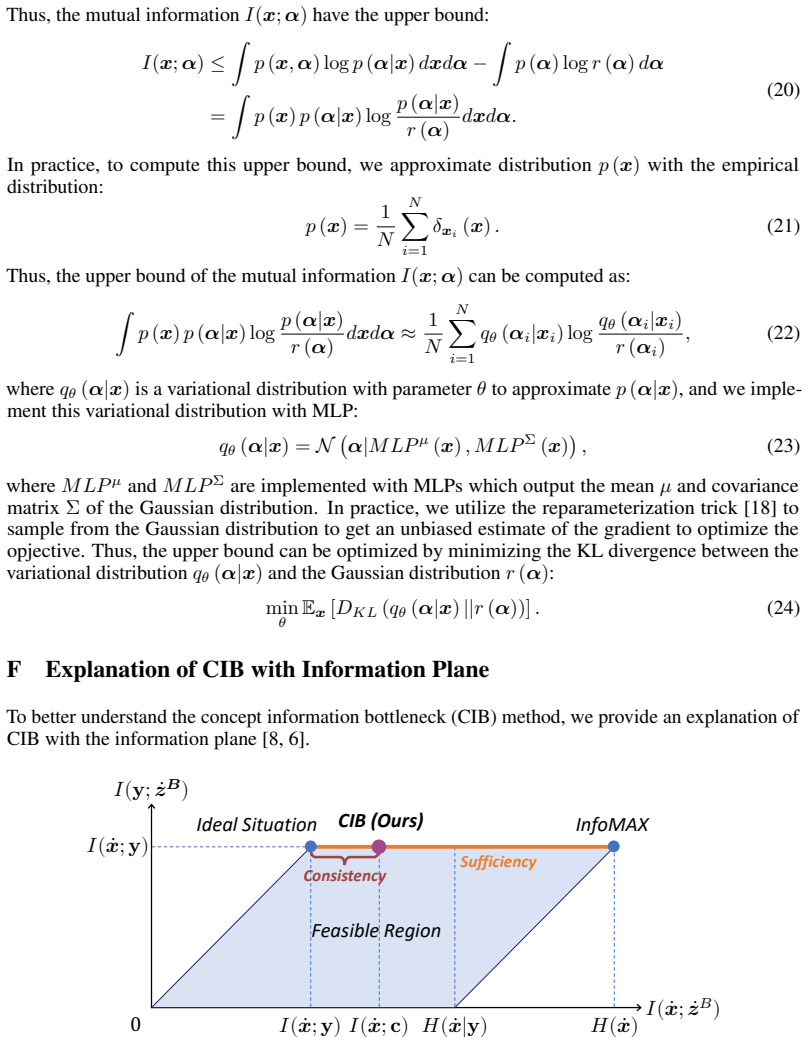
On the paper's own terms, the central discovery is that the information bottleneck objective, normally unusable without patch-level labels, becomes usable when the label is replaced by semantic concept anchors from the pathology vision-language model's text encoder. The paper derives I(x;α) = I(α;c) + I(x;α|c), identifies the first term as predictive information and the second as superfluous, then maximizes the first via InfoNCE and minimizes the second via a variational KL upper bound, with the concept anchors supplying the task signal that slide-level labels cannot. A second module converts cosine similarities between calibrated features and class-specific concept anchors into an interference vector through a self-normalizing network. The concatenation of calibrated and interference features is what a downstream MIL model consumes, and the experiments report consistent out-of-domain gains.
Load-bearing premise
The method works only if concept anchors extracted from the pathology vision-language model's text encoder stay aligned with the image feature space and are discriminative for the task across all hospital sites; if the prompts are generic or the alignment is biased, the modules may reinforce shortcuts instead of removing them.
Editorial extensions
If this is right
- Plugging CATE into any attention, graph, or transformer MIL model improves out-of-domain cancer subtyping without retraining the foundation model.
- Out-of-domain gains come from removing site-specific shortcuts, so in-domain performance can drop on datasets where each site contains only one cancer subtype, as the paper observes for NSCLC and RCC.
- The concept-aligned CIB module is essential: removing concept alignment or replacing CIB with a plain MLP degrades performance, showing the gain is not from added parameters.
- CATE also transfers beyond subtyping: supplementary Gleason grading experiments on prostate cancer show consistent improvements over the base MIL model.
- The method adds only a small amount of trainable parameters and training time, making it practical as a lightweight adapter in existing pathology pipelines.
Reading between the lines
- If concept anchors are the bottleneck, then richer, pathologist-verified prompts or automatically retrieved morphological descriptions should push out-of-domain robustness even further; the paper hints at this but does not test it.
- The same calibration logic could transfer to other domains where a vision-language model provides aligned image-text spaces, such as radiology or general pathology tasks like biomarker prediction, as long as class-specific semantic descriptions are available.
- Because the CFI module explicitly stores similarity to concept anchors, the method carries a built-in interpretability tool: anchor similarities can double as per-patch explanations for why a region is attended to.
- The reported OOD evaluation with site splits is a demanding test, so the practical value of CATE is specifically in domain shift; on random splits the gains are smaller, suggesting the method is a generalization enhancer rather than a general feature-quality booster.
Signed reviews
Editorial analysis
A structured set of objections, weighed in public.
Referee Report
Summary. The paper proposes CATE, a plug-and-play feature-calibration module for pathology foundation models used in multiple-instance learning (MIL) for whole-slide image classification. CATE extracts concept anchors from the text encoder of the CONCH vision-language model, then uses a Concept-guided Information Bottleneck (CIB) module to calibrate image features and a Concept-Feature Interference (CFI) module to generate discriminative similarity-based features. The method is evaluated on TCGA-BRCA, TCGA-NSCLC, and TCGA-RCC cancer subtyping under in-domain/out-of-domain site splits, across several MIL backbones, with ablation and visualization studies. The central claim is that CATE is a lightweight, annotation-free adapter that improves both accuracy and generalization of MIL models.
Significance. If the claims hold, CATE would be a practically useful adapter for pathology foundation models, since it requires no additional patch-level supervision and can be integrated into existing MIL frameworks. The paper has notable strengths: the source code is released; the evaluation spans multiple MIL backbones, multiple cancer types, and explicit out-of-domain site splits; and the ablation study attempts to isolate the contribution of each module. The main weakness is that the information-theoretic derivation in Section 3.2 contains a mathematical gap, and several empirical results are either discounted or left unexplained. The contribution is potentially valuable, but the current manuscript overstates the theoretical grounding and the generality of the performance gains.
major comments (4)
- [§3.2, Eq. (3)] The chain-rule decomposition in Eq. (3) omits a term. The correct identity is I(x̂; α̂) = I(α̂; c) + I(x̂; α̂ | c) − I(x̂; c | α̂). The omitted term I(x̂; c | α̂) is zero exactly when α̂ is sufficient for c, which is the condition the CIB objective is supposed to enforce. The proposed losses do not enforce this condition: PIM maximizes a lower bound on I(α̂; c), SIM minimizes an upper bound on I(x; α), and neither minimizes I(x̂; c | α̂). Consequently, the identification of I(α̂; c) as 'predictive information' and of I(x̂; α̂ | c) as 'superfluous information' is not established. Since the abstract and Section 3.2 attribute the generalization gains to discarding task-irrelevant information, the central mechanism currently lacks a valid derivation. The authors should either add a constraint or regularizer that enforces the sufficiency condition, or reframe the CIB objective as a heuristic whose behavior is validated only empirically.
- [§4.3, Table 2] In Table 2, CATE-MIL is consistently worse than ABMIL on in-domain metrics for both NSCLC and RCC (e.g., NSCLC NIND=2 IND-AUC 0.985 vs. 0.997; RCC NIND=3 IND-AUC 0.989 vs. 0.997). The text acknowledges this but immediately discounts it with the footnote that in-domain performance 'does not represent the true ability' of the models. However, the abstract and contributions claim that CATE 'significantly enhances the performance and generalization capabilities of MIL models.' The systematic in-domain degradation on two of the three datasets is a limitation that should be reported and analyzed, not set aside. The site-preserved cross-validation results in Appendix B.4 are a useful step, but they do not appear in the main paper and do not fully reconcile the discrepancy.
- [§4.4, Table 3] The PIM-only ablation shows a large drop on NSCLC NIND=4: OOD-AUC is 0.901 versus the 0.951 baseline, and the full model recovers to 0.970. The text states that PIM 'enables ABMIL to achieve improved performance in most experiments,' but this hides a substantial counterexample. The authors should explain why PIM alone can substantially hurt in one of the six evaluated settings, why adding SIM fixes the problem, and whether this pattern is reproducible across random seeds. Without this, the claim that PIM reliably extracts task-relevant information is not supported.
- [§3.2 and §3.3] The representative patch subset x̂ is selected by similarity between image features and class-specific concepts, and the same concepts are then used as positives in the PIM loss in Eq. (4) and as the comparison anchors in the CFI module in Eq. (10). This creates a selection bias: patches that are already close to the concept anchors are chosen and then pulled even closer, so part of the reported alignment between calibrated features and concept anchors may be an artifact of the selection step rather than evidence of learned calibration. A control experiment using randomly selected patches, or using a disjoint set of concepts for selection and supervision, would clarify whether the classification gains come from the calibration or from the selection. The held-out-site evaluation mitigates circularity for the final classification claim, but the interpretability and mechanism claims in Section 4.2 remain affected.
minor comments (6)
- [Figure 2 caption] The caption labels both the third and fourth panels as '(c)'; the CFI panel should be labeled '(d)'.
- [Title page footnote] The footnote reads 'Corresponding Auther'; this should be 'Corresponding Author'.
- [§3.4, Eq. (11)] The hyperparameters λP and λS are introduced but their numeric values are not given in the main text; Appendix C reports that λS is approximately 30, but λP should also be stated explicitly.
- [§4.4, Table 3] The SIM-only row for BRCA NIND=2 reports a standard deviation of 0.140 on the OOD-AUC, which is much larger than in any other condition; the authors should comment on this instability.
- [§4.3] The sentence claiming CATE-MIL 'consistently outperforms other models in both OOD and IND performance' is immediately followed by the admission that it performs poorly on in-domain NSCLC and RCC; the wording should be qualified to avoid the apparent contradiction.
- [Appendix C.2] The choice of k=10 is motivated by an ablation on one dataset; the paper should state whether the same k was used for all datasets and whether the ablation was performed on validation or test data.
Circularity Check
Information-bottleneck derivation in Eq. (3) assumes the sufficiency condition it is supposed to enforce, and the concept anchors are used both to select and to supervise the same alignment; the mechanism is partially circular, though the held-out OOD gains are independent.
-
self definitional
[Section 3.2, Eq. (3) and the following paragraph]
"Thus, if α̂ is sufficient for c (i.e., I(x̂; c| α̂) = 0 ), then α̂ is as predictive for label y as the joint of original feature x̂ and concept anchor c. Applying the chain rule of mutual information, we derive: I(x̂; α̂) = I(α̂; c) Predictive Information + I(x̂; α̂|c) Superfluous Information . (3)"
The general chain rule is I(x̂;α̂)=I(x̂;c)+I(x̂;α̂|c)−I(x̂;c|α̂). The printed two-term equality is obtained only by imposing I(x̂;c|α̂)=0 and the implied equality I(x̂;c)=I(α̂;c), which is exactly the sufficiency condition the CIB module is supposed to produce. The paper then sets the objective as maximizing I(α̂;c) and minimizing I(x̂;α̂|c), but the implemented PIM (InfoNCE lower bound) and SIM (KL upper bound on I(x;α)) do not constrain I(x̂;c|α̂). The information-bottleneck rationale—that CATE discards task-irrelevant information while preserving predictive information—is therefore not derived; the decomposition is valid only by assuming the very sufficiency property that the method claims to enforce.
-
other
[Section 3.1 Concept Extraction; Section 3.2 PIM/Discussion; Section 3.3]
"these concepts are generated by the text encoder of pathology VLM ... Note that due to the inherent consistency between the image and text embedding space in VLM, these extracted concepts can also be regarded as image concept vectors. ... It should be noted that the PIM supervises only the representative subset x̂ containing task-relevant information (selected by the similarity between image features and corresponding class-specific concepts)."
The same CONCH VLM supplies the image features, the concept anchors, and the criterion for what counts as task-relevant. Representative patches are selected by similarity to class-specific anchors, PIM maximizes InfoNCE similarity between the calibrated features and those same anchors, and CFI concatenates cosine similarity to the same anchors as an additional feature. The reported improvement in task-concept alignment (Figure 3) is therefore substantially a consequence of the training objective rather than an independent measurement of a separately derived effect.
full rationale
CATE's headline empirical claim—improved OOD cancer subtyping over six MIL backbones on public TCGA-BRCA, TCGA-NSCLC, and TCGA-RCC datasets—is evaluated on held-out sites and against external CONCH features and public data; those numbers are independently measured, so the paper is not globally circular. No load-bearing self-citation chain appears: the only overlapping self-citation (Conslide) is in related work, and the image/text encoder supplying the concept anchors is the external CONCH model, not the authors' own prior work. The circularity is confined to the mechanism section. Equation (3) presents an information-bottleneck decomposition as a derived chain rule, but the printed two-term equality holds only under I(x̂;c|α̂)=0, the sufficiency condition the module is meant to deliver; the PIM and SIM losses do not implement that constraint, so the predictive-versus-superfluous split is assumed rather than derived. Additionally, the same concept anchors are used to select representative patches, to supervise the alignment loss, and to define the CFI similarity features, making the reported task-relevant alignment partly definitional. Because these issues affect the claimed rationale rather than the benchmark results, the score is 4 rather than a higher value.
Assumptions & free parameters
free parameters (5)
- k (number of representative patches) =
10
- λS (SIM loss weight) =
~30
- λP (PIM loss weight) =
not fixed; tuned
- τ (InfoNCE temperature) =
not reported
- Concept prompt lists and templates =
hand-crafted/LLM-generated per dataset
assumptions (6)
- domain assumption CONCH's text and image feature spaces are semantically aligned so text concept anchors act as image concept vectors.
- domain assumption Consistency I(y; x|c) = 0: the concept anchor c and original feature x hold no separate label information beyond each other.
- domain assumption Sufficiency of the joint (x,c): a feature containing all information from x and c is predictive of y.
- standard math InfoNCE provides a valid lower bound on mutual information I(α;c).
- standard math Variational bound on I(x;α) with Gaussian prior is valid.
- ad hoc to paper The chain rule decomposition in Eq (3) is correct.
Cite this review
Pith. "Pith review of Free Lunch in Pathology Foundation Model: Task-specific Model Adaptation with Concept-Guided Feature Enhancement." pith.science (2026). https://pith.science/paper/OBFEYJK6
@misc{pith2026241109894,
  author       = {Pith},
  title        = {Pith review of: Free Lunch in Pathology Foundation Model: Task-specific Model Adaptation with Concept-Guided Feature Enhancement},
  year         = {2026},
  howpublished = {\url{https://pith.science/paper/OBFEYJK6}},
  note         = {Machine review of arXiv:2411.09894}
}
read the original abstract
Whole slide image (WSI) analysis is gaining prominence within the medical imaging field. Recent advances in pathology foundation models have shown the potential to extract powerful feature representations from WSIs for downstream tasks. However, these foundation models are usually designed for general-purpose pathology image analysis and may not be optimal for specific downstream tasks or cancer types. In this work, we present Concept Anchor-guided Task-specific Feature Enhancement (CATE), an adaptable paradigm that can boost the expressivity and discriminativeness of pathology foundation models for specific downstream tasks. Based on a set of task-specific concepts derived from the pathology vision-language model with expert-designed prompts, we introduce two interconnected modules to dynamically calibrate the generic image features extracted by foundation models for certain tasks or cancer types. Specifically, we design a Concept-guided Information Bottleneck module to enhance task-relevant characteristics by maximizing the mutual information between image features and concept anchors while suppressing superfluous information. Moreover, a Concept-Feature Interference module is proposed to utilize the similarity between calibrated features and concept anchors to further generate discriminative task-specific features. The extensive experiments on public WSI datasets demonstrate that CATE significantly enhances the performance and generalizability of MIL models. Additionally, heatmap and umap visualization results also reveal the effectiveness and interpretability of CATE. The source code is available at https://github.com/HKU-MedAI/CATE.
Figures


Figures from the paper (5 more)




Reference graph
Works this paper leans on
-
[1]
Deep variational information bottleneck
Alexander A Alemi, Ian Fischer, Joshua V Dillon, and Kevin Murphy. Deep variational information bottleneck. arXiv preprint arXiv:1612.00410, 2016
arXiv 2016
-
[2]
Scaling vision transformers to gigapixel images via hierarchical self-supervised learning
Richard J Chen, Chengkuan Chen, Yicong Li, Tiffany Y Chen, Andrew D Trister, Rahul G Krishnan, and Faisal Mahmood. Scaling vision transformers to gigapixel images via hierarchical self-supervised learning. In Proceedings of the IEEE/CVF Conference on Computer Vision and Pattern Recognition, pages 16144–16155, 2022
2022
-
[3]
Towards a general- purpose foundation model for computational pathology
Richard J Chen, Tong Ding, Ming Y Lu, Drew FK Williamson, Guillaume Jaume, Andrew H Song, Bowen Chen, Andrew Zhang, Daniel Shao, Muhammad Shaban, et al. Towards a general- purpose foundation model for computational pathology. Nature Medicine, 30(3):850–862, 2024
work page 2024
-
[4]
Robust whole slide image analysis for cervical cancer screening using deep learning
Shenghua Cheng, Sibo Liu, Jingya Yu, Gong Rao, Yuwei Xiao, Wei Han, Wenjie Zhu, Xiaohua Lv, Ning Li, Jing Cai, et al. Robust whole slide image analysis for cervical cancer screening using deep learning. Nature communications, 12(1):5639, 2021
2021
-
[5]
Deep learning-based transformation of h&e stained tissues into special stains
Kevin de Haan, Yijie Zhang, Jonathan E Zuckerman, Tairan Liu, Anthony E Sisk, Miguel FP Diaz, Kuang-Yu Jen, Alexander Nobori, Sofia Liou, Sarah Zhang, et al. Deep learning-based transformation of h&e stained tissues into special stains. Nature communications, 12(1):1–13, 2021. 10
work page 2021
-
[6]
Learning robust representations via multi-view information bottleneck
Marco Federici, Anjan Dutta, Patrick Forré, Nate Kushman, and Zeynep Akata. Learning robust representations via multi-view information bottleneck. arXiv preprint arXiv:2002.07017, 2020
arXiv 2002
-
[7]
Scaling self-supervised learning for histopathology with masked image modeling
Alexandre Filiot, Ridouane Ghermi, Antoine Olivier, Paul Jacob, Lucas Fidon, Alice Mac Kain, Charlie Saillard, and Jean-Baptiste Schiratti. Scaling self-supervised learning for histopathology with masked image modeling. medRxiv, pages 2023–07, 2023
work page 2023
-
[8]
On information plane analyses of neural network classifiers—a review
Bernhard C Geiger. On information plane analyses of neural network classifiers—a review. IEEE Transactions on Neural Networks and Learning Systems, 33(12):7039–7051, 2021
work page 2021
Show all 42 references
-
[9]
Devon Hjelm, Alex Fedorov, Samuel Lavoie-Marchildon, Karan Grewal, Philip Bachman, Adam Trischler, and Yoshua Bengio
R. Devon Hjelm, Alex Fedorov, Samuel Lavoie-Marchildon, Karan Grewal, Philip Bachman, Adam Trischler, and Yoshua Bengio. Learning deep representations by mutual information estimation and maximization. In 7th International Conference on Learning Representations, ICLR 2019, New...
2019
-
[10]
Hˆ 2-mil: exploring hierarchical representation with heterogeneous multiple instance learning for whole slide image analysis
Wentai Hou, Lequan Yu, Chengxuan Lin, Helong Huang, Rongshan Yu, Jing Qin, and Liansheng Wang. Hˆ 2-mil: exploring hierarchical representation with heterogeneous multiple instance learning for whole slide image analysis. In Proceedings of the AAAI conference on artificial inte...
2022
-
[11]
The impact of site-specific digital histology signatures on deep learning model accuracy and bias
Frederick M Howard, James Dolezal, Sara Kochanny, Jefree Schulte, Heather Chen, Lara Heij, Dezheng Huo, Rita Nanda, Olufunmilayo I Olopade, Jakob N Kather, et al. The impact of site-specific digital histology signatures on deep learning model accuracy and bias. Nature communic...
2021
-
[12]
Densely connected convolutional networks
Gao Huang, Zhuang Liu, Laurens Van Der Maaten, and Kilian Q Weinberger. Densely connected convolutional networks. In Proceedings of the IEEE conference on computer vision and pattern recognition, pages 4700–4708, 2017
2017
-
[13]
Conslide: Asynchronous hierarchical interaction transformer with breakup-reorganize rehearsal for contin- ual whole slide image analysis
Yanyan Huang, Weiqin Zhao, Shujun Wang, Yu Fu, Yuming Jiang, and Lequan Yu. Conslide: Asynchronous hierarchical interaction transformer with breakup-reorganize rehearsal for contin- ual whole slide image analysis. In Proceedings of the IEEE/CVF International Conference on Comp...
2023
-
[14]
A visual–language foundation model for pathology image analysis using medical twitter
Zhi Huang, Federico Bianchi, Mert Yuksekgonul, Thomas J Montine, and James Zou. A visual–language foundation model for pathology image analysis using medical twitter. Nature medicine, 29(9):2307–2316, 2023
2023
-
[15]
Quilt-1m: One million image-text pairs for histopathology
Wisdom Ikezogwo, Saygin Seyfioglu, Fatemeh Ghezloo, Dylan Geva, Fatwir Sheikh Mo- hammed, Pavan Kumar Anand, Ranjay Krishna, and Linda Shapiro. Quilt-1m: One million image-text pairs for histopathology. Advances in Neural Information Processing Systems, 36, 2024
2024
-
[16]
Attention-based deep multiple instance learning
Maximilian Ilse, Jakub Tomczak, and Max Welling. Attention-based deep multiple instance learning. In International conference on machine learning, pages 2127–2136. PMLR, 2018
2018
-
[17]
Additive mil: Intrinsically interpretable multiple instance learning for pathology
Syed Ashar Javed, Dinkar Juyal, Harshith Padigela, Amaro Taylor-Weiner, Limin Yu, and Aa- ditya Prakash. Additive mil: Intrinsically interpretable multiple instance learning for pathology. Advances in Neural Information Processing Systems, 35:20689–20702, 2022
2022
-
[18]
Auto-encoding variational bayes
Diederik P Kingma and Max Welling. Auto-encoding variational bayes. arXiv preprint arXiv:1312.6114, 2013
2013 arXiv
-
[19]
Self-normalizing neural networks
Günter Klambauer, Thomas Unterthiner, Andreas Mayr, and Sepp Hochreiter. Self-normalizing neural networks. Advances in neural information processing systems, 30, 2017
2017
-
[20]
Clipath: Fine-tune clip with visual feature fusion for pathology image analysis towards minimizing data collection efforts
Zhengfeng Lai, Zhuoheng Li, Luca Cerny Oliveira, Joohi Chauhan, Brittany N Dugger, and Chen-Nee Chuah. Clipath: Fine-tune clip with visual feature fusion for pathology image analysis towards minimizing data collection efforts. In Proceedings of the IEEE/CVF International Confe...
2023
-
[21]
Dual-stream multiple instance learning network for whole slide image classification with self-supervised contrastive learning
Bin Li, Yin Li, and Kevin W Eliceiri. Dual-stream multiple instance learning network for whole slide image classification with self-supervised contrastive learning. In Proceedings of the IEEE/CVF conference on computer vision and pattern recognition, pages 14318–14328, 2021
2021
-
[22]
Generalizable whole slide image classification with fine-grained visual- semantic interaction
Hao Li, Ying Chen, Yifei Chen, Rongshan Yu, Wenxian Yang, Liansheng Wang, Bowen Ding, and Yuchen Han. Generalizable whole slide image classification with fine-grained visual- semantic interaction. In Proceedings of the IEEE/CVF Conference on Computer Vision and Pattern Recogni...
2024
-
[23]
Artificial intelligence for multimodal data integration in oncology
Jana Lipkova, Richard J Chen, Bowen Chen, Ming Y Lu, Matteo Barbieri, Daniel Shao, Anurag J Vaidya, Chengkuan Chen, Luoting Zhuang, Drew FK Williamson, et al. Artificial intelligence for multimodal data integration in oncology. Cancer cell, 40(10):1095–1110, 2022
2022
-
[24]
Pathotune: Adapting visual foundation model to pathological specialists
Jiaxuan Lu, Fang Yan, Xiaofan Zhang, Yue Gao, and Shaoting Zhang. Pathotune: Adapting visual foundation model to pathological specialists. arXiv preprint arXiv:2403.16497, 2024
2024 arXiv
-
[25]
A visual-language foundation model for computational pathology
Ming Y Lu, Bowen Chen, Drew FK Williamson, Richard J Chen, Ivy Liang, Tong Ding, Guil- laume Jaume, Igor Odintsov, Long Phi Le, Georg Gerber, et al. A visual-language foundation model for computational pathology. Nature Medicine, pages 1–12, 2024
2024
-
[26]
Data-efficient and weakly supervised computational pathology on whole-slide images
Ming Y Lu, Drew FK Williamson, Tiffany Y Chen, Richard J Chen, Matteo Barbieri, and Faisal Mahmood. Data-efficient and weakly supervised computational pathology on whole-slide images. Nature biomedical engineering, 5(6):555–570, 2021
2021
-
[27]
Representation learning with contrastive predictive coding
Aaron van den Oord, Yazhe Li, and Oriol Vinyals. Representation learning with contrastive predictive coding. arXiv preprint arXiv:1807.03748, 2018
2018 arXiv
-
[28]
Dinov2: Learning robust visual features without supervision
Maxime Oquab, Timothée Darcet, Théo Moutakanni, Huy V o, Marc Szafraniec, Vasil Khalidov, Pierre Fernandez, Daniel Haziza, Francisco Massa, Alaaeldin El-Nouby, et al. Dinov2: Learning robust visual features without supervision. arXiv preprint arXiv:2304.07193, 2023
2023 arXiv
-
[29]
The rise of ai language patholo- gists: Exploring two-level prompt learning for few-shot weakly-supervised whole slide image classification
Linhao Qu, Kexue Fu, Manning Wang, Zhijian Song, et al. The rise of ai language patholo- gists: Exploring two-level prompt learning for few-shot weakly-supervised whole slide image classification. Advances in Neural Information Processing Systems, 36, 2024
2024
-
[30]
Learning transferable visual models from natural language supervision
Alec Radford, Jong Wook Kim, Chris Hallacy, Aditya Ramesh, Gabriel Goh, Sandhini Agarwal, Girish Sastry, Amanda Askell, Pamela Mishkin, Jack Clark, et al. Learning transferable visual models from natural language supervision. In International conference on machine learning, pa...
2021
-
[31]
Fine-tuning and training of densenet for histopathology image representation using tcga diagnostic slides
Abtin Riasatian, Morteza Babaie, Danial Maleki, Shivam Kalra, Mojtaba Valipour, Sobhan Hemati, Manit Zaveri, Amir Safarpoor, Sobhan Shafiei, Mehdi Afshari, et al. Fine-tuning and training of densenet for histopathology image representation using tcga diagnostic slides. Medical...
2021
-
[32]
Model-based domain generalization
Alexander Robey, George J Pappas, and Hamed Hassani. Model-based domain generalization. Advances in Neural Information Processing Systems, 34:20210–20229, 2021
2021
-
[33]
Transmil: Transformer based correlated multiple instance learning for whole slide image classification
Zhuchen Shao, Hao Bian, Yang Chen, Yifeng Wang, Jian Zhang, Xiangyang Ji, et al. Transmil: Transformer based correlated multiple instance learning for whole slide image classification. Advances in Neural Information Processing Systems, 34:2136–2147, 2021
2021
-
[34]
Artificial intelligence in histopathology: enhancing cancer research and clinical oncology
Artem Shmatko, Narmin Ghaffari Laleh, Moritz Gerstung, and Jakob Nikolas Kather. Artificial intelligence in histopathology: enhancing cancer research and clinical oncology. Nature Cancer, 3(9):1026–1038, 2022
2022
-
[35]
Feature re-embedding: Towards foundation model-level performance in computational pathology
Wenhao Tang, Fengtao Zhou, Sheng Huang, Xiang Zhu, Yi Zhang, and Bo Liu. Feature re-embedding: Towards foundation model-level performance in computational pathology. arXiv preprint arXiv:2402.17228, 2024
2024 arXiv
-
[36]
Virchow: A million-slide digital pathology foundation model
Eugene V orontsov, Alican Bozkurt, Adam Casson, George Shaikovski, Michal Zelechowski, Siqi Liu, Philippe Mathieu, Alexander van Eck, Donghun Lee, Julian Viret, et al. Virchow: A million-slide digital pathology foundation model. arXiv preprint arXiv:2309.07778, 2023
2023 arXiv
-
[37]
Transformer-based unsupervised contrastive learning for histopathological image classification
Xiyue Wang, Sen Yang, Jun Zhang, Minghui Wang, Jing Zhang, Wei Yang, Junzhou Huang, and Xiao Han. Transformer-based unsupervised contrastive learning for histopathological image classification. Medical image analysis, 81:102559, 2022
2022
-
[38]
Collaborative optimization and aggregation for decentralized do- main generalization and adaptation
Guile Wu and Shaogang Gong. Collaborative optimization and aggregation for decentralized do- main generalization and adaptation. In Proceedings of the IEEE/CVF International Conference on Computer Vision, pages 6484–6493, 2021
2021
-
[39]
Bayes-mil: A new probabilistic perspective on attention-based multiple instance learning for whole slide images
Cui Yufei, Ziquan Liu, Xiangyu Liu, Xue Liu, Cong Wang, Tei-Wei Kuo, Chun Jason Xue, and Antoni B Chan. Bayes-mil: A new probabilistic perspective on attention-based multiple instance learning for whole slide images. In The Eleventh International Conference on Learning Represe...
2022
-
[40]
Dtfd-mil: Double-tier feature distillation multiple instance learning for 12 histopathology whole slide image classification
Hongrun Zhang, Yanda Meng, Yitian Zhao, Yihong Qiao, Xiaoyun Yang, Sarah E Coupland, and Yalin Zheng. Dtfd-mil: Double-tier feature distillation multiple instance learning for 12 histopathology whole slide image classification. In Proceedings of the IEEE/CVF Conference on Comp...
2022
-
[41]
Text-guided foundation model adaptation for pathological image classification
Yunkun Zhang, Jin Gao, Mu Zhou, Xiaosong Wang, Yu Qiao, Shaoting Zhang, and Dequan Wang. Text-guided foundation model adaptation for pathological image classification. In International Conference on Medical Image Computing and Computer-Assisted Intervention, pages 272–282. Spr...
2023
-
[42]
kX i=1 log 1 + p ccs pos p ( ˆαi) p ccspos, ˆαi (m − 1) E ˆαi p ccs j , ˆαi p ccs j p ( ˆαi) + n E ˆαi p cca j , ˆαi p cca j p ( ˆαi) !!# = − E ˆα,ccspos
Jinghao Zhou, Chen Wei, Huiyu Wang, Wei Shen, Cihang Xie, Alan Yuille, and Tao Kong. ibot: Image bert pre-training with online tokenizer. arXiv preprint arXiv:2111.07832, 2021. 13 A Overview The structure of this supplementary material as shown below, • Appendix B presents add...
2021 arXiv
Reviewed August 12, 2026 · model on record in the stance chip above.
Discussion (0). Continue with ORCID to comment.