pith. machine review for the scientific record. sign in

cs.CV

Computer Vision and Pattern Recognition

Covers image processing, computer vision, pattern recognition, and scene understanding. Roughly includes material in ACM Subject Classes I.2.10, I.4, and I.5.

0
cs.CV 2026-05-13 Recognition

Synthetic data trains 4B model to beat larger open-source agents

Covering Human Action Space for Computer Use: Data Synthesis and Benchmark

Renderer pipeline and CUActSpot benchmark cover complex interactions across five modalities that prior click-only tests miss.

Figure from the paper full image
abstract click to expand
Computer-use agents (CUAs) automate on-screen work, as illustrated by GPT-5.4 and Claude. Yet their reliability on complex, low-frequency interactions is still poor, limiting user trust. Our analysis of failure cases from advanced models suggests a long-tail pattern in GUI operations, where a relatively small fraction of complex and diverse interactions accounts for a disproportionate share of task failures. We hypothesize that this issue largely stems from the scarcity of data for complex interactions. To address this problem, we propose a new benchmark CUActSpot for evaluating models' capabilities on complex interactions across five modalities: GUI, text, table, canvas, and natural image, as well as a variety of actions (click, drag, draw, etc.), covering a broader range of interaction types than prior click-centric benchmarks that focus mainly on GUI widgets. We also design a renderer-based data-synthesis pipeline: scenes are automatically generated for each modality, screenshots and element coordinates are recorded, and an LLM produces matching instructions and action traces. After training on this corpus, our Phi-Ground-Any-4B outperforms open-source models with fewer than 32B parameters. We will release our benchmark, data, code, and models at https://github.com/microsoft/Phi-Ground.git
0
0
cs.CV 2026-05-13 1 theorem

Unified model makes understanding and generation emerge together

SenseNova-U1: Unifying Multimodal Understanding and Generation with NEO-unify Architecture

SenseNova-U1 removes the structural split between perception and creation, matching specialists in both while extending to action and world-

abstract click to expand
Recent large vision-language models (VLMs) remain fundamentally constrained by a persistent dichotomy: understanding and generation are treated as distinct problems, leading to fragmented architectures, cascaded pipelines, and misaligned representation spaces. We argue that this divide is not merely an engineering artifact, but a structural limitation that hinders the emergence of native multimodal intelligence. Hence, we introduce SenseNova-U1, a native unified multimodal paradigm built upon NEO-unify, in which understanding and generation evolve as synergistic views of a single underlying process. We launch two native unified variants, SenseNova-U1-8B-MoT and SenseNova-U1-A3B-MoT, built on dense (8B) and mixture-of-experts (30B-A3B) understanding baselines, respectively. Designed from first principles, they rival top-tier understanding-only VLMs across text understanding, vision-language perception, knowledge reasoning, agentic decision-making, and spatial intelligence. Meanwhile, they deliver strong semantic consistency and visual fidelity, excelling in conventional or knowledge-intensive any-to-image (X2I) synthesis, complex text-rich infographic generation, and interleaved vision-language generation, with or without think patterns. Beyond performance, we show detailed model design, data preprocessing, pre-/post-training, and inference strategies to support community research. Last but not least, preliminary evidence demonstrates that our models extend beyond perception and generation, performing strongly in vision-language-action (VLA) and world model (WM) scenarios. This points toward a broader roadmap where models do not translate between modalities, but think and act across them in a native manner. Multimodal AI is no longer about connecting separate systems, but about building a unified one and trusting the necessary capabilities to emerge from within.
0
0
cs.CV 2026-05-13 Recognition

Forearm guidance recovers absolute 3D hands from one egocentric camera

EgoForce: Forearm-Guided Camera-Space 3D Hand Pose from a Monocular Egocentric Camera

A unified network with forearm modeling works across camera types and cuts error by up to 28 percent on standard benchmarks without device‑‑

Figure from the paper full image
abstract click to expand
Reconstructing the absolute 3D pose and shape of the hands from the user's viewpoint using a single head-mounted camera is crucial for practical egocentric interaction in AR/VR, telepresence, and hand-centric manipulation tasks, where sensing must remain compact and unobtrusive. While monocular RGB methods have made progress, they remain constrained by depth-scale ambiguity and struggle to generalize across the diverse optical configurations of head-mounted devices. As a result, models typically require extensive training on device-specific datasets, which are costly and laborious to acquire. This paper addresses these challenges by introducing EgoForce, a monocular 3D hand reconstruction framework that recovers robust, absolute 3D hand pose and its position from the user's (camera-space) viewpoint. EgoForce operates across fisheye, perspective, and distorted wide-FOV camera models using a single unified network. Our approach combines a differentiable forearm representation that stabilizes hand pose, a unified arm-hand transformer that predicts both hand and forearm geometry from a single egocentric view, mitigating depth-scale ambiguity, and a ray space closed-form solver that enables absolute 3D pose recovery across diverse head-mounted camera models. Experiments on three egocentric benchmarks show that EgoForce achieves state-of-the-art 3D accuracy, reducing camera-space MPJPE by up to 28% on the HOT3D dataset compared to prior methods and maintaining consistent performance across camera configurations. For more details, visit the project page at https://dfki-av.github.io/EgoForce.
0
0
cs.CV 2026-05-13 2 theorems

Agentic search resolves external facts into pixel object locations

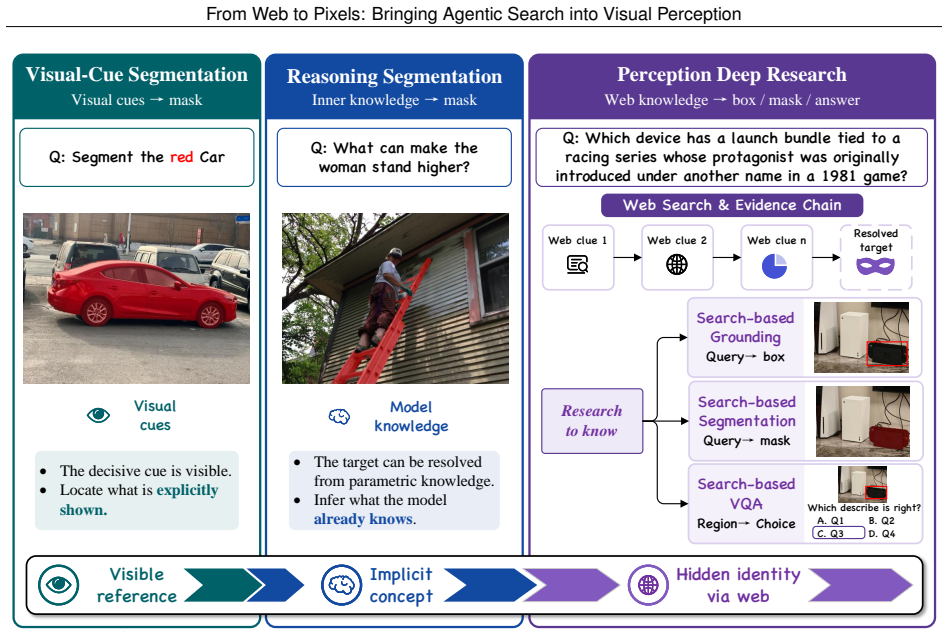
From Web to Pixels: Bringing Agentic Search into Visual Perception

A benchmark shows vision systems must search the web to identify targets before accurate grounding, segmentation or VQA is possible.

Figure from the paper full image
abstract click to expand
Visual perception connects high-level semantic understanding to pixel-level perception, but most existing settings assume that the decisive evidence for identifying a target is already in the image or frozen model knowledge. We study a more practical yet harder open-world case where a visible object must first be resolved from external facts, recent events, long-tail entities, or multi-hop relations before it can be localized. We formalize this challenge as Perception Deep Research and introduce WebEye, an object-anchored benchmark with verifiable evidence, knowledge-intensive queries, precise box/mask annotations, and three task views: Search-based Grounding, Search-based Segmentation, and Search-based VQA. WebEyes contains 120 images, 473 annotated object instances, 645 unique QA pairs, and 1,927 task samples. We further propose Pixel-Searcher, an agentic search-to-pixel workflow that resolves hidden target identities and binds them to boxes, masks, or grounded answers. Experiments show that Pixel-Searcher achieves the strongest open-source performance across all three task views, while failures mainly arise from evidence acquisition, identity resolution, and visual instance binding.
0
0
cs.CV 2026-05-13 2 theorems

Causal model generates coherent multi-shot videos in real time

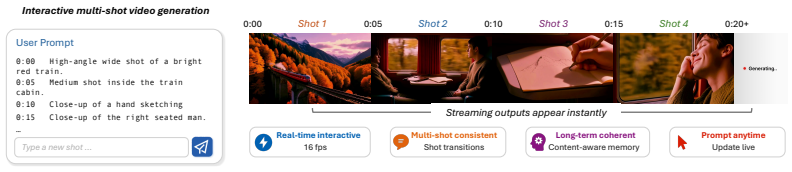
CausalCine: Real-Time Autoregressive Generation for Multi-Shot Video Narratives

Training on native sequences plus content-aware memory retrieval lets it approach bidirectional quality while staying interactive and causal

Figure from the paper full image
abstract click to expand
Autoregressive video generation aims at real-time, open-ended synthesis. Yet, cinematic storytelling is not merely the endless extension of a single scene; it requires progressing through evolving events, viewpoint shifts, and discrete shot boundaries. Existing autoregressive models often struggle in this setting. Trained primarily for short-horizon continuation, they treat long sequences as extended single shots, inevitably suffering from motion stagnation and semantic drift during long rollouts. To bridge this gap, we introduce CausalCine, an interactive autoregressive framework that transforms multi-shot video generation into an online directing process. CausalCine generates causally across shot changes, accepts dynamic prompts on the fly, and reuses context without regenerating previous shots. To achieve this, we first train a causal base model on native multi-shot sequences to learn complex shot transitions prior to acceleration. We then propose Content-Aware Memory Routing (CAMR), which dynamically retrieves historical KV entries according to attention-based relevance scores rather than temporal proximity, preserving cross-shot coherence under bounded active memory. Finally, we distill the causal base model into a few-step generator for real-time interactive generation. Extensive experiments demonstrate that CausalCine significantly outperforms autoregressive baselines and approaches the capability of bidirectional models while unlocking the streaming interactivity of causal generation. Demo available at https://yihao-meng.github.io/CausalCine/
0
0
cs.CV 2026-05-13 2 theorems

Gaussian Splatting resolves its own photometric ambiguities

Revisiting Photometric Ambiguity for Accurate Gaussian-Splatting Surface Reconstruction

An indication module detects underconstrained regions and steers corrections to form definite surfaces without extra supervision.

Figure from the paper full image
abstract click to expand
Surface reconstruction with differentiable rendering has achieved impressive performance in recent years, yet the pervasive photometric ambiguities have strictly bottlenecked existing approaches. This paper presents AmbiSuR, a framework that explores an intrinsic solution upon Gaussian Splatting for the photometric ambiguity-robust surface 3D reconstruction with high performance. Starting by revisiting the foundation, our investigation uncovers two built-in primitive-wise ambiguities in representation, while revealing an intrinsic potential for ambiguity self-indication in Gaussian Splatting. Stemming from these, a photometric disambiguation is first introduced, constraining ill-posed geometry solution for definite surface formation. Then, we propose an ambiguity indication module that unleashes the self-indication potential to identify and further guide correcting underconstrained reconstructions. Extensive experiments demonstrate our superior surface reconstructions compared to existing methods across various challenging scenarios, excelling in broad compatibility. Project: https://fictionarry.github.io/AmbiSuR-Proj/ .
0
0
cs.CV 2026-05-13 Recognition

Self-reflective RL improves multimodal image generation and editing

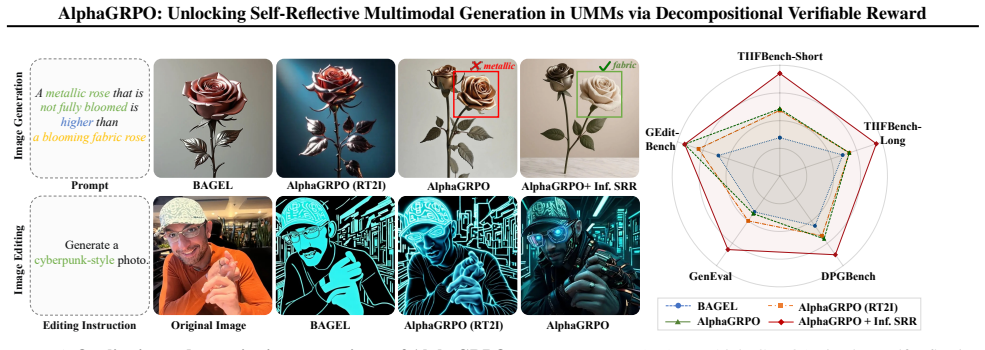
AlphaGRPO: Unlocking Self-Reflective Multimodal Generation in UMMs via Decompositional Verifiable Reward

Decomposing prompts into verifiable questions lets models infer hidden intents and correct their own errors without editing-specific data.

Figure from the paper full image
abstract click to expand
In this paper, we propose AlphaGRPO, a novel framework that applies Group Relative Policy Optimization (GRPO) to AR-Diffusion Unified Multimodal Models (UMMs) to enhance multimodal generation capabilities without an additional cold-start stage. Our approach unlocks the model's intrinsic potential to perform advanced reasoning tasks: Reasoning Text-to-Image Generation, where the model actively infers implicit user intents, and Self-Reflective Refinement, where it autonomously diagnoses and corrects misalignments in generated outputs. To address the challenge of providing stable supervision for real-world multimodal generation, we introduce the Decompositional Verifiable Reward (DVReward). Unlike holistic scalar rewards, DVReward utilizes an LLM to decompose complex user requests into atomic, verifiable semantic and quality questions, which are then evaluated by a general MLLM to provide reliable and interpretable feedback. Extensive experiments demonstrate that AlphaGRPO yields robust improvements across multimodal generation benchmarks, including GenEval, TIIF-Bench, DPG-Bench and WISE, while also achieving significant gains in editing tasks on GEdit without training on editing tasks. These results validate that our self-reflective reinforcement approach effectively leverages inherent understanding to guide high-fidelity generation. Project page: https://huangrh99.github.io/AlphaGRPO/
0
0
cs.CV 2026-05-13 2 theorems

Vision transformers scale linearly by routing patches through learned cores

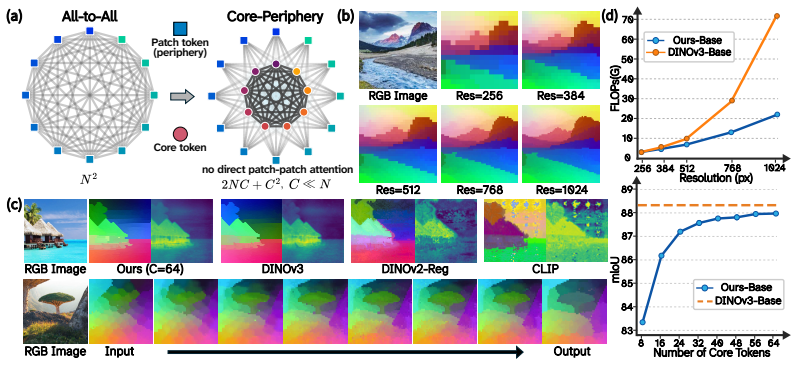
Elastic Attention Cores for Scalable Vision Transformers

A small fixed set of cores replaces quadratic self-attention, cutting cost while matching foundation-model accuracy on classification and 2D

Figure from the paper full image
abstract click to expand
Vision Transformers (ViTs) achieve strong data-driven scaling by leveraging all-to-all self-attention. However, this flexibility incurs a computational cost that scales quadratically with image resolution, limiting ViTs in high-resolution domains. Underlying this approach is the assumption that pairwise token interactions are necessary for learning rich visual-semantic representations. In this work, we challenge this assumption, demonstrating that effective visual representations can be learned without any direct patch-to-patch interaction. We propose VECA (Visual Elastic Core Attention), a vision transformer architecture that uses efficient linear-time core-periphery structured attention enabled by a small set of learned cores. In VECA, these cores act as a communication interface: patch tokens exchange information exclusively through the core tokens, which are initialized from scratch and propagated across layers. Because the $N$ image patches only directly interact with a resolution invariant set of $C$ learned "core" embeddings, this yields linear complexity $O(N)$ for predetermined $C$, which bypasses quadratic scaling. Compared to prior cross-attention architectures, VECA maintains and iteratively updates the full set of $N$ input tokens, avoiding a small $C$-way bottleneck. Combined with nested training along the core axis, our model can elastically trade off compute and accuracy during inference. Across classification and dense tasks, VECA achieves performance competitive with the latest vision foundation models while reducing computational cost. Our results establish elastic core-periphery attention as a scalable alternative building block for Vision Transformers.
0
0
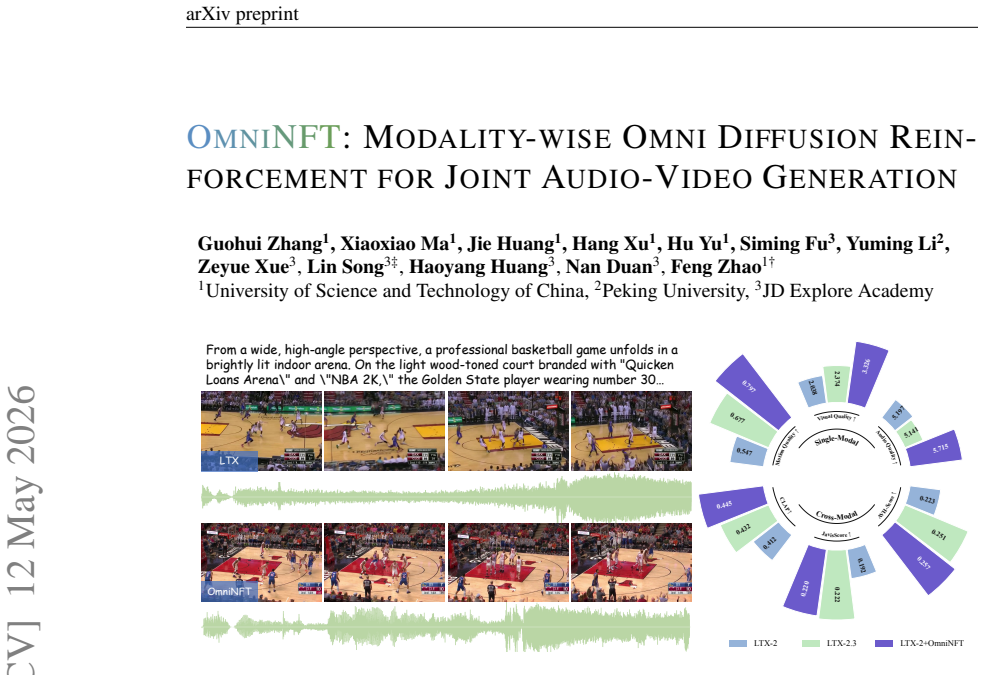
cs.CV 2026-05-13 2 theorems

Modality routing in RL improves audio-video generation

OmniNFT: Modality-wise Omni Diffusion Reinforcement for Joint Audio-Video Generation

Advantage routing, gradient surgery, and region reweighting fix inconsistencies that plague vanilla RL in joint diffusion models.

Figure from the paper full image
abstract click to expand
Recent advances in joint audio-video generation have been remarkable, yet real-world applications demand strong per-modality fidelity, cross-modal alignment, and fine-grained synchronization. Reinforcement Learning (RL) offers a promising paradigm, but its extension to multi-objective and multi-modal joint audio-video generation remains unexplored. Notably, our in-depth analysis first reveals that the primary obstacles to applying RL in this stem from: (i) multi-objective advantages inconsistency, where the advantages of multimodal outputs are not always consistent within a group; (ii) multi-modal gradients imbalance, where video-branch gradients leak into shallow audio layers responsible for intra-modal generation; (iii) uniform credit assignment, where fine-grained cross-modal alignment regions fail to get efficient exploration. These shortcomings suggest that vanilla RL fine-tuning strategy with a single global advantage often leads to suboptimal results. To address these challenges, we propose OmniNFT, a novel modality-aware online diffusion RL framework with three key innovations: (1) Modality-wise advantage routing, which routes independent per-reward advantages to their respective modality generation branches. (2) Layer-wise gradient surgery, which selectively detaches video-branch gradients on shallow audio layers while retaining those for cross-modal interaction layers. (3) Region-wise loss reweighting, which modulates policy optimization toward critical regions related to audio-video synchronization and fine-grained alignment. Extensive experiments on JavisBench and VBench with the LTX-2 backbone demonstrate that OmniNFT achieves comprehensive improvements in audio and video perceptual quality, cross-modal alignment, and audio-video synchronization.
0
0
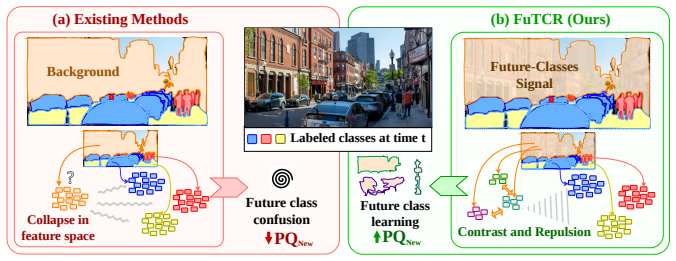
cs.CV 2026-05-13 2 theorems

FuTCR improves new-class panoptic quality by up to 28%

FuTCR: Future-Targeted Contrast and Repulsion for Continual Panoptic Segmentation

By spotting future-like areas inside background pixels and repelling known classes, it keeps representational space open for new categories.

Figure from the paper full image
abstract click to expand
Continual Panoptic Segmentation (CPS) requires methods that can quickly adapt to new categories over time. The nature of this dense prediction task means that training images may contain a mix of labeled and unlabeled objects. As nothing is known about these unlabeled objects a priori, existing methods often simply group any unlabeled pixel into a single "background" class during training. In effect, during training, they repeatedly tell the model that all the different background categories are the same (even when they aren't). This makes learning to identify different background categories as they are added challenging since these new categories may require using information the model was previously told was unimportant and ignored. Thus, we propose a Future-Targeted Contrastive and Repulsive (FuTCR) framework that addresses this limitation by restructuring representations before new classes are introduced. FuTCR first discovers confident future-like regions by grouping model-predicted masks whose pixels are consistently classified as background but exhibit non-background logits. Next, FuTCR applies pixel-to-region contrast to build coherent prototypes from these unlabeled regions, while simultaneously repelling background features away from known-class prototypes to explicitly reserve representational space for future categories. Experiments across six CPS settings and a range of dataset sizes show FuTCR improves relative new-class panoptic quality over the state-of-the-art by up to 28%, while preserving or improving base-class performance with gains up to 4%.
0
0
cs.CV 2026-05-13 2 theorems

LychSim gives vision researchers Python control over Unreal scenes

LychSim: A Controllable and Interactive Simulation Framework for Vision Research

A procedural pipeline and MCP integration deliver diverse OOD environments with rich ground truth for closed-loop testing.

abstract click to expand
While self-supervised pretraining has reduced vision systems' reliance on synthetic data, simulation remains an indispensable tool for closed-loop optimization and rigorous out-of-distribution (OOD) evaluation. However, modern simulation platforms often present steep technical barriers, requiring extensive expertise in computer graphics and game development. In this work, we present LychSim, a highly controllable and interactive simulation framework built upon Unreal Engine 5 to bridge this gap. LychSim is built around three key designs: (1) a streamlined Python API that abstracts away underlying engine complexities; (2) a procedural data pipeline capable of generating diverse, high-fidelity environments with varying out-of-distribution (OOD) visual challenges, paired with rich 2D and 3D ground truths; and (3) a native integration of the Model Context Protocol (MCP) that transforms the simulator into a dynamic, closed-loop playground for reasoning agentic LLMs. We further annotate scene-level procedural rules and object-level pose alignments to enable semantically aligned 3D ground truths and automated scene modification. We demonstrate LychSim's capability across multiple downstream applications, including serving as a synthetic data engine, powering reinforcement learning-based adversarial examiners, and facilitating interactive, language-driven scene layout generation. To benefit the broader vision community, LychSim will be made publicly available, including full source code and various data annotations.
0
0
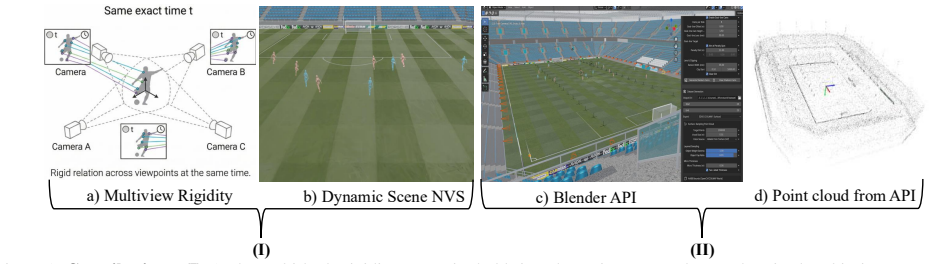
cs.CV 2026-05-13 2 theorems

Sync'd multi-view cameras let plain 3DGS handle dynamic scenes

3D Gaussian Splatting for Efficient Retrospective Dynamic Scene Novel View Synthesis with a Standardized Benchmark

No temporal deformation needed when views are calibrated and time-aligned; new Blender benchmark shows the simplified pipeline works.

Figure from the paper full image
abstract click to expand
Retrospective novel view synthesis (NVS) of dynamic scenes is fundamental to applications such as sports. Recent dynamic 3D Gaussian Splatting (3DGS) approaches introduce temporally coupled formulations to enforce motion coherence across time. In this paper, we argue that, in a synchronized multi-view (MV) setting typical of sports, the dynamic scene at each time step is already strongly geometrically constrained. We posit that the availability of calibrated, synchronized viewpoints provides sufficient spatial consistency, and therefore, explicit temporal coupling, or complex multi-body constraints seems unnecessary for retrospective NVS. To this end, we propose an approach tailored for synchronized MV dynamic scene. By initializing the SfM-derived point cloud at the start time and propagating optimized Gaussians over time, we show that efficient retrospective NVS can be achieved without imposing a temporal deformation constraint. Complementing our methodological contribution, we introduce a Dynamic MV dataset framework built on Blender for reproducible NeRF and 3DGS research. The framework generates high-quality, synchronized camera rigs and exports training-ready datasets in standard formats, eliminating inconsistencies in coordinate conventions and data pipelines. Using the framework, we construct a dynamic benchmark suite and evaluate representative NeRF and 3DGS approaches under controlled conditions. Together, we show that, under a synchronized MV setup, efficient retrospective dynamic scene NVS can be achieved using 3DGS. At the same time, the dataset-generation framework enables reproducible and principled benchmarking of dynamic NVS methods.
0
0
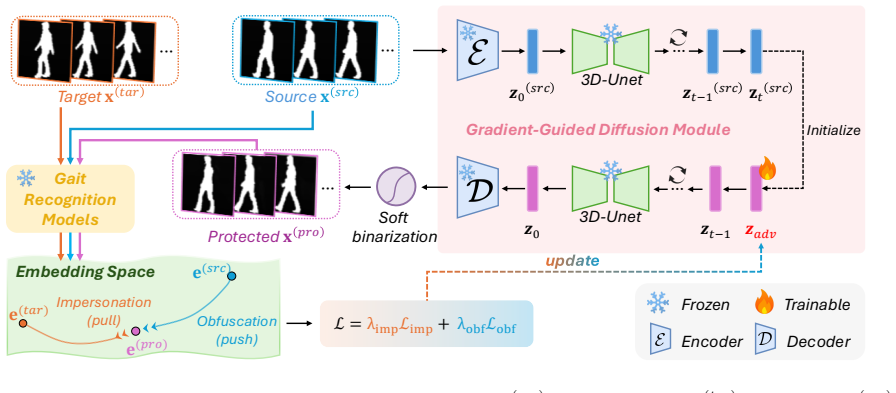
cs.CV 2026-05-13 Recognition

Diffusion optimization impersonates targets to de-identify gait

GaitProtector: Impersonation-Driven Gait De-Identification via Training-Free Diffusion Latent Optimization

The result lowers identification accuracy to 15 percent on standard tests while keeping diagnostic performance largely intact.

Figure from the paper full image
abstract click to expand
Conventional gait de-identification methods often encounter an inherent trade-off: they either provide insufficient identity suppression or introduce spatiotemporal distortions that impede structure-sensitive downstream applications. We propose GaitProtector, an impersonation-driven gait de-identification framework that formulates privacy protection as a unified objective with two tightly coupled components: (i) obfuscation, which repels the protected gait from the source identity, and (ii) impersonation, which attracts it toward a selected target identity. The target identity serves as a semantic anchor that biases optimization toward structurally plausible gait patterns under the pretrained diffusion prior, helping preserve dominant body shape and motion dynamics. We instantiate this idea through a training-free diffusion latent optimization pipeline. Instead of retraining a generator for each dataset, we invert each input silhouette sequence into the latent trajectory of a pretrained 3D video diffusion model and iteratively optimize latent codes with a differentiable adversarial objective to synthesize protected gaits. Experiments on the CASIA-B dataset show that GaitProtector achieves a 56.7% impersonation success rate under black-box gait recognition and reduces Rank-1 identification accuracy from 89.6% to 15.0%, while maintaining favorable visual and temporal quality. We further evaluate downstream utility on the Scoliosis1K dataset, where diagnostic accuracy decreases only from 91.4% to 74.2%. To the best of our knowledge, this work is the first to leverage pretrained 3D diffusion priors in a training-free manner for silhouette-based gait de-identification.
0
0
cs.CV 2026-05-13 Recognition

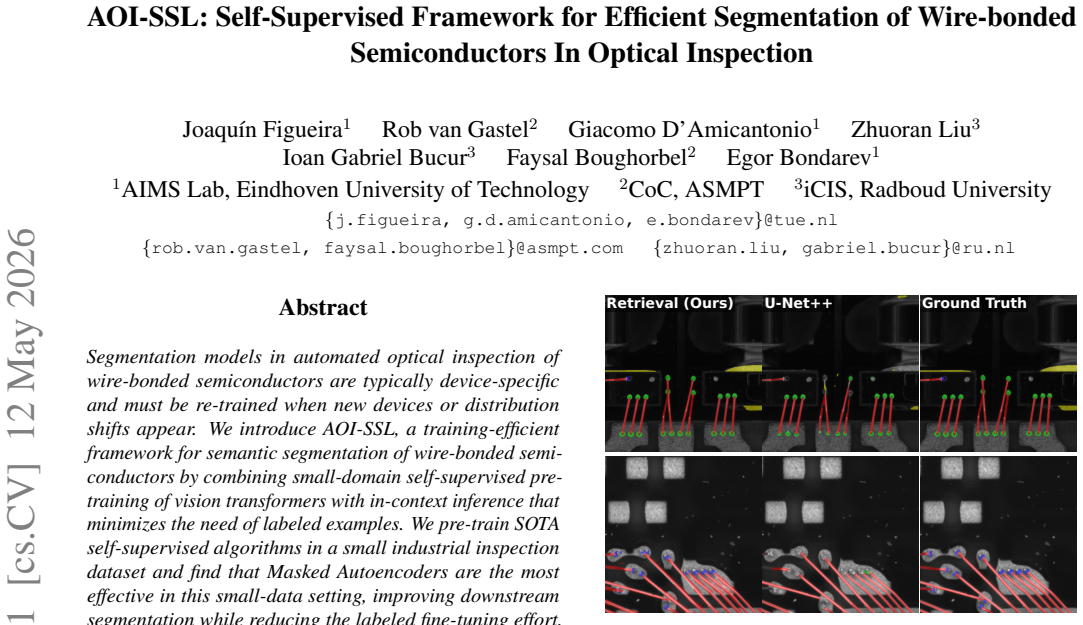
Self-supervised pre-training boosts semiconductor wire-bond segmentation

AOI-SSL: Self-Supervised Framework for Efficient Segmentation of Wire-bonded Semiconductors In Optical Inspection

Masked Autoencoders trained on limited inspection images outperform ImageNet weights and allow instant adaptation via patch retrieval.

Figure from the paper full image
abstract click to expand
Segmentation models in automated optical inspection of wire-bonded semiconductors are typically device-specific and must be re-trained when new devices or distribution shifts appear. We introduce AOI-SSL, a training-efficient framework for semantic segmentation of wire-bonded semiconductors by combining small-domain self-supervised pre-training of vision transformers with in-context inference that minimizes the need of labeled examples. We pre-train SOTA self-supervised algorithms in a small industrial inspection dataset and find that Masked Autoencoders are the most effective in this small-data setting, improving downstream segmentation while reducing the labeled fine-tuning effort. We further introduce in-context, patch-level retrieval methods that predict masks directly from dense encoder embeddings with negligible additional training. We show that, in this setting, simple similarity-based retrieval performs on par with more complex attention-based aggregation used currently in the literature. Furthermore, our experiments demonstrate that self-supervised pre-training significantly improves segmentation quality compared to training from scratch and to ImageNet pre-trained backbones under a fixed fine-tuning computational budget. Finally, the results reveal that retrieval based segmentation outperforms fine-tuning when targeting single device images, allowing for near-instant adaptation to difficult samples.
0
0
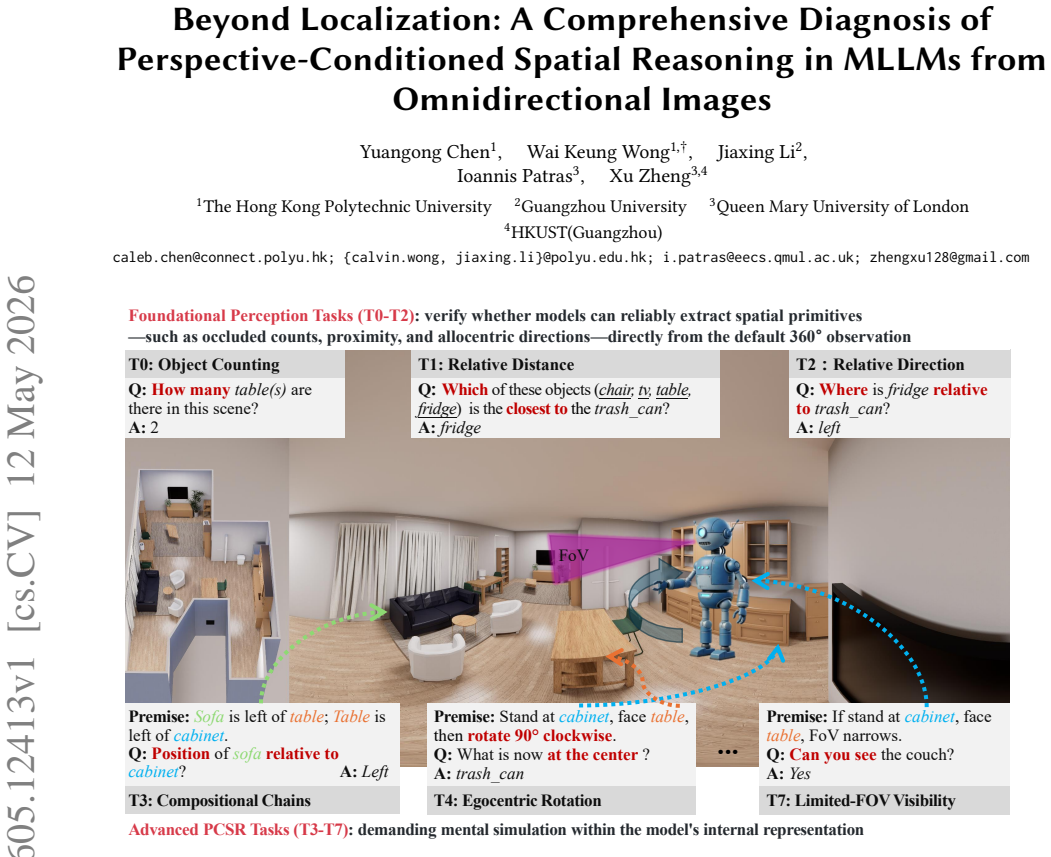
cs.CV 2026-05-13 2 theorems

MLLMs accuracy falls from 58% to 1% on complex 360 spatial tasks

Beyond Localization: A Comprehensive Diagnosis of Perspective-Conditioned Spatial Reasoning in MLLMs from Omnidirectional Images

Benchmark shows basic direction tasks are manageable while egocentric rotation and composition collapse performance across models.

Figure from the paper full image
abstract click to expand
Multimodal Large Language Models (MLLMs) show strong visual perception, yet remain limited in reasoning about space under changing viewpoints. We study this challenge as Perspective-Conditioned Spatial Reasoning (PCSR) in 360-degree omnidirectional images, where broad scene coverage reduces ambiguity from partial observations without eliminating the need for viewpoint-dependent inference. To assess this capability, we introduce PCSR-Bench, a diagnostic benchmark of 84,373 question-answer pairs from 2,600 omnidirectional images across 26 indoor environments. PCSR-Bench contains eight tasks spanning foundational perception (e.g., object counting, relative distance, and relative direction) and advanced PCSR, including compositional chains, egocentric rotation, perspective re-anchoring, ego-distortion, and limited-FOV visibility. We evaluate 14 representative MLLMs and observe a substantial perception-reasoning gap: accuracy reaches 57.59% on foundational relative direction, but drops to 13.49% on egocentric rotation, 7.13% on egocentric distortion, and 0.64% on open-ended compositional reasoning. To probe the plasticity of this gap, we conduct an RL-based diagnostic study on a 7B-scale model. Reward shaping improves a matched 7B baseline from 31.10% to 60.06% under a controlled setting, suggesting that PCSR is partial plasticity rather than being fully immutable. Still, the gains are task-selective, sensitive to reward design including both weight allocation and reward formulation, and partially dependent on the evaluation protocol. These results position PCSR as a key bottleneck in current MLLMs and highlight limited but meaningful room for recovery under targeted optimization.
0
0
cs.CV 2026-05-13 Recognition

Geometry proxies replace corrupted queries in sparse 3D diffusion

GeoQuery: Geometry-Query Diffusion for Sparse-View Reconstruction

Depth-derived correspondence fields create reliable proxy queries so diffusion refinement stays consistent from few input views.

Figure from the paper full image
abstract click to expand
3D Gaussian Splatting (3DGS) has emerged as a prominent paradigm for 3D reconstruction and novel view synthesis. However, it remains vulnerable to severe artifacts when trained under sparse-view constraints. While recent methods attempt to rectify artifacts in rendered views using image diffusion models, they typically rely on multi-view self-attention to retrieve information from reference images. We observe that this mechanism often fails when the rendered novel views output by 3DGS are heavily corrupted: damaged query features lead to erroneous cross-view retrieval, resulting in inconsistent rendering refinement. To address this, we propose GeoQuery, a geometry-guided diffusion framework that integrates generative priors with explicit geometric cues via a novel Geometry-guided Cross-view Attention (GCA) mechanism. First, by leveraging predicted depth maps and camera poses, we construct a geometry-induced correspondence field to sample reference features, forming a geometry-aligned proxy query that replaces the corrupted rendering features. Furthermore, we design a new cross-view feature aggregation pipeline, in which we restrict the cross-view attention to a local window around each proxy query to effectively retrieve useful features while suppressing spurious matches. GeoQuery can be seamlessly integrated into existing diffusion-based pipelines, enabling robust reconstruction even under extreme view sparsity. Extensive experiments on sparse-view novel view synthesis and rendering artifact removal demonstrate the effectiveness of our approach.
0
0
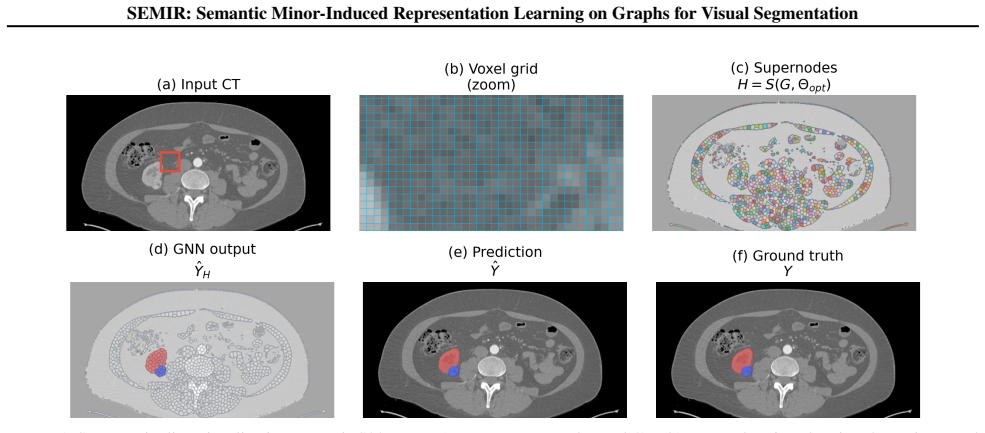
cs.CV 2026-05-13 2 theorems

Learned graph minor boosts small-structure segmentation

SEMIR: Semantic Minor-Induced Representation Learning on Graphs for Visual Segmentation

SEMIR contracts the image grid into a boundary-aligned minor for GNN inference that lifts exactly to pixel labels, raising minority Dice on

Figure from the paper full image
abstract click to expand
Segmenting small and sparse structures in large-scale images is fundamentally constrained by voxel-level, lattice-bound computation and extreme class imbalance -- dense, full-resolution inference scales poorly and forces most pipelines to rely on fixed regionization or downsampling, coupling computational cost to image resolution and attenuating boundary evidence precisely where minority structures are most informative. We introduce SEMIR (Semantic Minor-Induced Representation Learning), a representation framework that decouples inference from the native grid by learning a task-adapted, topology-preserving latent graph representation with exact decoding. SEMIR transforms the underlying grid graph into a compact, boundary-aligned graph minor through parameterized edge contraction, node deletion, and edge deletion, while preserving an exact lifting map from minor predictions to lattice labels. Minor construction is formalized as a few-shot structure learning problem that replaces hand-tuned preprocessing with a boundary-alignment objective: minor parameters are learned by maximizing agreement between predicted boundary elements and target-specific semantic edges under a boundary Dice criterion, and the induced minor is annotated with scale- and rotation-robust geometric and intensity descriptors and supports efficient region-level inference via message passing on a graph neural network (GNN) with relational edge features. We benchmark SEMIR on three tumor segmentation datasets -- BraTS 2021, KiTS23, and LiTS -- where targets exhibit high structural variability and distributional uncertainty. SEMIR yields consistent improvements in minority-structure Dice at practical runtime. More broadly, SEMIR establishes a framework for learning task-adapted, topology-preserving latent representations with exact decoding for high-resolution structured visual data.
0
0
cs.CV 2026-05-13 Recognition

Rectified flow delivers single-step super-resolution

Fast Image Super-Resolution via Consistency Rectified Flow

Consistency regularization and dual scheduling match diffusion quality without multiple passes.

Figure from the paper full image
abstract click to expand
Diffusion models (DMs) have demonstrated remarkable success in real-world image super-resolution (SR), yet their reliance on time-consuming multi-step sampling largely hinders their practical applications. While recent efforts have introduced few- or single-step solutions, existing methods either inefficiently model the process from noisy input or fail to fully exploit iterative generative priors, compromising the fidelity and quality of the reconstructed images. To address this issue, we propose FlowSR, a novel approach that reformulates the SR problem as a rectified flow from low-resolution (LR) to high-resolution (HR) images. Our method leverages an improved consistency learning strategy to enable high-quality SR in a single step. Specifically, we refine the original consistency distillation process by incorporating HR regularization, ensuring that the learned SR flow not only enforces self-consistency but also converges precisely to the ground-truth HR target. Furthermore, we introduce a fast-slow scheduling strategy, where adjacent timesteps for consistency learning are sampled from two distinct schedulers: a fast scheduler with fewer timesteps to improve efficiency, and a slow scheduler with more timesteps to capture fine-grained texture details. Extensive experiments demonstrate that FlowSR achieves outstanding performance in both efficiency and image quality.
0
0
cs.CV 2026-05-13 1 theorem

Granular alignment fixes norm mismatches for stable visual reasoning

Fill the GAP: A Granular Alignment Paradigm for Visual Reasoning in Multimodal Large Language Models

GAP aligns at feature, context, and capacity levels to deliver top perception and reasoning scores on Qwen2.5-VL 7B.

abstract click to expand
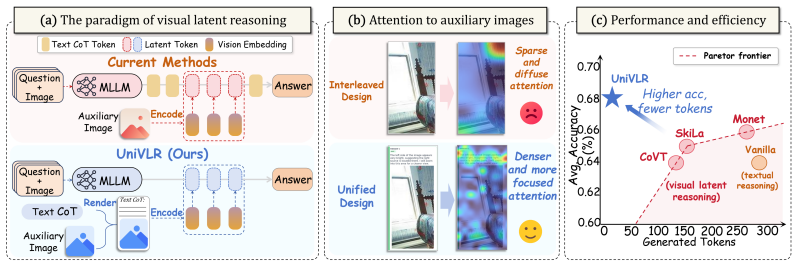
Visual latent reasoning lets a multimodal large language model (MLLM) create intermediate visual evidence as continuous tokens, avoiding external tools or image generators. However, existing methods usually follow an output-as-input latent paradigm and yield unstable gains. We identify evidence for a feature-space mismatch that can contribute to this instability: dominant visual-latent models build on pre-norm MLLMs and reuse decoder hidden states as predicted latent inputs, even though these states occupy a substantially different norm regime from the input embeddings the model was trained to consume~\citep{xie2025mhc,li2026siamesenorm,team2026attention}. This mismatch can make direct latent feedback unreliable. Motivated by this diagnosis, we propose \textbf{GAP}, a \textbf{G}ranular \textbf{A}lignment \textbf{P}aradigm for visual latent modeling. GAP aligns visual latent reasoning at three levels: feature-level alignment maps decoder outputs into input-compatible visual latents through a lightweight PCA-aligned latent head; context-level alignment grounds latent targets with inspectable auxiliary visual supervision; and capacity-guided alignment assigns latent supervision selectively to examples where the base MLLM struggles. On Qwen2.5-VL 7B, the resulting model achieves the best mean aggregate perception and reasoning performance among our supervised variants. Inference-time intervention probing further suggests that generated latents provide task-relevant visual signal beyond merely adding token slots.
0
0
cs.CV 2026-05-13 Recognition

Evolved prompts lift dense segmentation accuracy by 1.4 to 8.4 percent

VIP: Visual-guided Prompt Evolution for Efficient Dense Vision-Language Inference

Visual guidance refines text queries inside dino.txt to cut mismatches and deliver higher-fidelity maps at almost no extra cost

Figure from the paper full image
abstract click to expand
Pursuing training-free open-vocabulary semantic segmentation in an efficient and generalizable manner remains challenging due to the deep-seated spatial bias in CLIP. To overcome the limitations of existing solutions, this work moves beyond the CLIP-based paradigm and harnesses the recent spatially-aware dino$.$txt framework to facilitate more efficient and high-quality dense prediction. While dino$.$txt exhibits robust spatial awareness, we find that the semantic ambiguity of text queries gives rise to severe mismatch within its dense cross-modal interactions. To address this, we introduce Visual-guided Prompt evolution (VIP) to rectify the semantic expressiveness of text queries in dino$.$txt, unleashing its potential for fine-grained object perception. Towards this end, VIP integrates alias expansion with a visual-guided distillation mechanism to mine valuable semantic cues, which are robustly aggregated in a saliency-aware manner to yield a high-fidelity prediction. Extensive evaluations demonstrate that VIP: 1. surpasses the top-leading methods by 1.4%-8.4% average mIoU, 2. generalizes well to diverse challenging domains, and 3. requires marginal inference time and memory overhead.
0
0
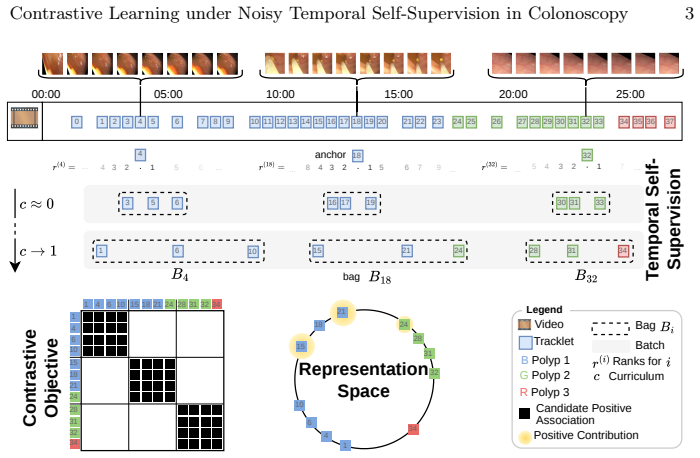
cs.CV 2026-05-13 2 theorems

Noisy timing cues train polyp AI that matches foundation models

Contrastive Learning under Noisy Temporal Self-Supervision for Colonoscopy Videos

Temporal self-supervision plus a noise-tolerant loss yields strong representations for retrieval and classification from only 27 videos.

Figure from the paper full image
abstract click to expand
Learning robust representations of polyp tracklets is key to enabling multiple AI-assisted colonoscopy applications, from polyp characterization to automated reporting and retrieval. Supervised contrastive learning is an effective approach for learning such representations, but it typically relies on correct positive and negative definitions. Collecting these labels requires linking tracklets that depict the same underlying polyp entity throughout the video, which is costly and demands specialized clinical expertise. In this work, we leverage the sequential workflow of colonoscopy procedures to derive self-supervised associations from temporal structure. Since temporally derived associations are not guaranteed to be correct, we introduce a noise-aware contrastive loss to account for noisy associations. We demonstrate the effectiveness of the learned representations across multiple downstream tasks, including polyp retrieval and re-identification, size estimation, and histology classification. Our method outperforms prior self-supervised and supervised baselines, and matches or exceeds recent foundation models across all tasks, using a lightweight encoder trained on only 27 videos. Code is available at https://github.com/lparolari/ntssl.
0
0
cs.CV 2026-05-13 Recognition

Generation signal halves visual tokens in multimodal models

G²TR: Generation-Guided Visual Token Reduction for Separate-Encoder Unified Multimodal Models

VAE latent consistency selects tokens that keep both reasoning accuracy and editing quality intact.

Figure from the paper full image
abstract click to expand
The development of separate-encoder Unified multimodal models (UMMs) comes with a rapidly growing inference cost due to dense visual token processing. In this paper, we focus on understanding-side visual token reduction for improving the efficiency of separate-encoder UMMs. While this topic has been widely studied for MLLMs, existing methods typically rely on attention scores, text-image similarity and so on, implicitly assuming that the final objective is discriminative reasoning. This assumption does not hold for UMMs, where understanding-side visual tokens must also preserve the model's capabilities for editing images. We propose G$^2$TR, a generation-guided visual token reduction framework for separate-encoder UMMs. Our key insight is that the generation branch provides a task-agnostic signal for identifying understanding-side visual tokens that are not only semantically relevant but also important for latent-space image reconstruction and generation. G$^2$TR estimates token importance from consistency with VAE latent, performs balanced token selection, and merges redundant tokens into retained representatives to reduce information loss. The method is training-free, plug-and-play, and applied only after the understanding encoding stage, making it compatible with existing UMM inference pipelines. Experiments on image understanding and editing benchmarks show that G$^2$TR substantially reduces visual tokens and prefill computation by 1.94x while maintaining both reasoning accuracy and editing quality, outperforming baselines on almost all benchmarks.
0
0
cs.CV 2026-05-13 2 theorems

Images as sentence tokens raise multi-image generation accuracy

Images in Sentences: Scaling Interleaved Instructions for Unified Visual Generation

Placing visual features at semantic positions lets transformers use local context for better object binding and consistency on complex tasks

abstract click to expand
While recent advancements in multimodal language models have enabled image generation from expressive multi-image instructions, existing methods struggle to maintain performance under complex interleaved instructions. This limitation stems from the structural separation of images and text in current paradigms, which forces models to bridge difficult long-range dependencies to match descriptions with visual targets. To address these challenges, we propose \texttt{I}mages i\texttt{N} \texttt{SE}n\texttt{T}ences (\textit{a.k.a}, INSET), a unified generation model that seamlessly embeds images as native vocabulary within textual instructions. By positioning visual features directly at their corresponding semantic slots, INSET leverages the contextual locality of transformers for precise object binding, effectively treating images as dense, expressive language tokens. Furthermore, we introduce a scalable data engine that synthesizes 15M high-quality interleaved samples from standard image and video datasets, utilizing VLMs and LLMs to construct rich, long-horizon sequences. Evaluation results on InterleaveBench demonstrate that INSET significantly outperforms state-of-the-art methods in multi-image consistency and text alignment, with performance gaps widening as input complexity increases. Beyond standard generation, our approach inherently extends to multimodal image editing, integrating visual content as part of the instruction to facilitate highly expressive and creative visual manipulations.
0
0
cs.CV 2026-05-13 2 theorems

Stereo event cameras track 3D hand poses at 30 mm error

EgoEV-HandPose: Egocentric 3D Hand Pose Estimation and Gesture Recognition with Stereo Event Cameras

New bird's-eye-view module and real-world dataset overcome low-light and occlusion limits for VR and robotics use.

Figure from the paper full image
abstract click to expand
Egocentric 3D hand pose estimation and gesture recognition are essential for immersive augmented/virtual reality, human-computer interaction, and robotics. However, conventional frame-based cameras suffer from motion blur and limited dynamic range, while existing event-based methods are hindered by ego-motion interference, monocular depth ambiguity, and the lack of large-scale real-world stereo datasets. To overcome these limitations, we propose EgoEV-HandPose, an end-to-end framework for joint 3D bimanual pose estimation and gesture recognition from stereo event streams. Central to our approach is KeypointBEV, a flexible stereo fusion module that lifts features into a canonical bird's-eye-view space and employs an iterative reprojection-guided refinement loop to progressively resolve depth uncertainty and enforce kinematic consistency. In addition, we introduce EgoEVHands, the first large-scale real-world stereo event-camera dataset for egocentric hand perception, containing 5,419 annotated sequences with dense 3D/2D keypoints across 38 gesture classes under varying illumination. Extensive experiments demonstrate that EgoEV-HandPose achieves state-of-the-art performance with an MPJPE of 30.54mm and 86.87% Top-1 gesture recognition accuracy, significantly outperforming RGB-based stereo and prior event-camera methods, particularly in low-light and bimanual occlusion scenarios, thereby setting a new benchmark for event-based egocentric perception. The established dataset and source code will be publicly released at https://github.com/ZJUWang01/EgoEV-HandPose.
0
0
cs.CV 2026-05-13

Hybrid Mamba-CLIP model hits 97.63% F1 on farmland SCD

Large-Small Model Collaboration for Farmland Semantic Change Detection

The approach uses textual priors and hard-region supervision to suppress seasonal pseudo-changes with only 6.65 million trainable parameters

Figure from the paper full image
abstract click to expand
Farmland Semantic Change Detection (SCD) is essential for cultivated land protection, yet existing benchmarks and models remain insufficient for fine-grained farmland conversion monitoring. Current datasets often lack dedicated "from-to" annotations, while visual change detection models are easily disturbed by phenology-induced pseudo-changes caused by crop rotation, seasonal variation, and illumination differences. To address these challenges, we construct HZNU-FCD, a large-scale fine-grained farmland SCD benchmark with a unified five-class farmland-to-non-farmland annotation protocol. It contains 4,588 bitemporal image pairs with pixel-level labels for practical farmland protection. Based on this benchmark, we propose a large-small collaborative SCD framework that integrates a task-driven small visual model with a frozen large vision-language model. The small model, Fine-grained Difference-aware Mamba (FD-Mamba), learns dense change representations for boundary preservation and small-region localization. The large-model pathway, Cross-modal Logical Arbitration (CMLA), introduces CLIP-based textual priors for prompt-guided semantic arbitration and pseudo-change suppression. To enable effective collaboration, we design a hard-region co-training strategy that supervises the CMLA semantic score map only on low-confidence pixels. Experiments show that our method achieves 97.63% F1, 96.32% IoU, and 96.35% SCD_IoU_mean on HZNU-FCD with only 6.65M trainable parameters. Compared with the multimodal ChangeCLIP-ViT, which leverages vision-language information for change detection, our method improves F1 by 10.19 percentage points on HZNU-FCD. It also achieves 91.43% F1 and 84.21% IoU on LEVIR-CD, and 93.85% F1 and 88.41% IoU on WHU-CD, demonstrating strong robustness and generalization. The code is available at https://github.com/Lovelymili/FD-Mamba.
0
0
cs.CV 2026-05-13 Recognition

Visual pages match text prompts in frozen generators

Beyond Text Prompts: Visual-to-Visual Generation as A Unified Paradigm

A training-free swap lets users specify outputs with sketches and references at 0.85 GenEval score.

Figure from the paper full image
abstract click to expand
Humans often specify and create through visual artifacts: typography sheets, sketches, reference images, and annotated scenes. Yet modern visual generators still ask users to serialize this intent into text, a bottleneck that compresses signals like spatial structure, exact appearance, and glyph shape. We propose \textbf{\emph{visual-to-visual} (V2V)} generation, in which the user conditions a generative model with a visual specification page rather than a text prompt. The page is not an edit target, but a visual document that specifies the desired output. We introduce \textbf{V2V-Zero}, a training-free framework that exposes this interface in existing vision-language model (VLM) conditioned generators by replacing text-only conditioning with final-layer hidden states extracted from visual pages, exploiting the fact that the frozen VLM already maps both text and images into the generator's conditioning space. On GenEval, V2V-Zero reaches 0.85 with a frozen Qwen-Image backbone, closely matching its optimized text-to-image performance without fine-tuning. To evaluate the broader V2V space, we introduce \textbf{Simple-V2V Bench}, spanning seven visual-conditioning tasks and seven models, including GPT Image 2, Nano Banana 2, Seedream 5.0 Lite, open-weight baselines, and a video extension. V2V-Zero scores 32.7/100, outperforming evaluated open-weight image baselines and revealing a clear capability hierarchy: attribute binding is strong, content generation is unreliable, and structural control remains hard even for commercial systems. A HunyuanVideo-1.5 extension scores 20.2/100, showing the interface transfers beyond images. Mechanistic analysis shows the default reasoning path is primarily visually routed, with 95.0\% of conditioning-token attention mass on visual-page hidden states.
0
0
cs.CV 2026-05-13 Recognition

Rule-based features raise accuracy of CAD bending effort predictions

CAD-feature enhanced machine learning for manufacturing effort estimation on sheet metal bending parts

Graph models that receive recognized bend and flange details outperform pure geometry versions on synthetic and real factory data.

Figure from the paper full image
abstract click to expand
Graph-based machine learning has emerged as a promising approach for manufacturability analysis by learning directly from CAD models represented as Boundary Representations (B-reps), exploiting both surface geometry and topological connectivity. However, purely geometric representations often lack the process-specific semantics required for accurate manufacturability prediction: many manufacturing factors, such as surface roles or bend intent, are not explicitly encoded in shape alone and are difficult for data-driven models to infer reliably. We propose a hybrid approach that addresses this challenge by enriching B-rep attributed adjacency graphs with manufacturing features recognized through a rule-based module. Applied to sheet metal bending, recognized features, such as bend characteristics, flange lengths, and surface roles are integrated as node attributes, concentrating the learning signal on process-relevant geometric patterns. Experiments on both a large-scale synthetic manufacturability benchmark and a real-world industrial dataset with measured bending times, one of the first such validations on genuine production data, demonstrate that combining domain knowledge with graph-based learning improves prediction accuracy across both tasks. The results demonstrate that hybrid modeling offers a feasible and effective path toward deployable tools for manufacturability assessment and effort estimation in industrial CAD environments.
0
0
cs.CV 2026-05-13 2 theorems

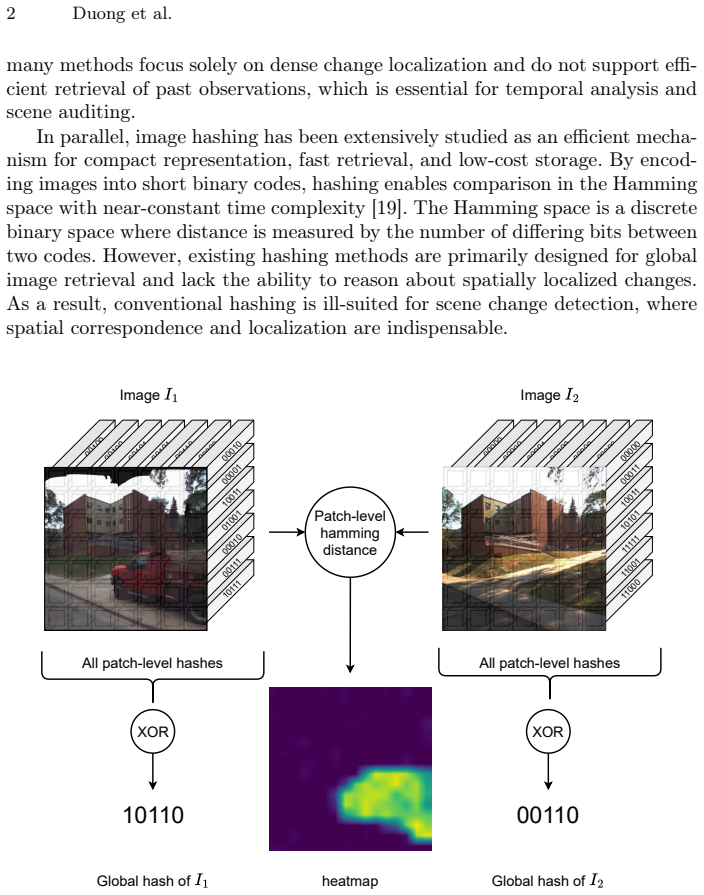
Patch hashing detects and locates scene changes at low cost

From Image Hashing to Scene Change Detection

HashSCD encodes aligned patches into codes and combines them with XOR so global and local changes are read directly from Hamming distances.

Figure from the paper full image
abstract click to expand
Image hashing provides compact representations for efficient storage and retrieval but is inherently limited to global comparison and cannot reason about where changes occur. This limitation prevents hashing from being directly applicable to scene change detection, where spatial localization is essential. In this work, we revisit hashing from a scene change detection perspective and propose HashSCD, a patch-wise hashing framework that enables both efficient global change detection and localized change identification. HashSCD encodes spatially aligned patches into compact hash codes and aggregates them through an XOR-like operation, allowing change detection and localization to be performed directly in the Hamming space without repeated inference on previous images. The model is trained in an unsupervised manner using contrastive learning at both patch and global levels. Experiments demonstrate that HashSCD achieves competitive performance compared to state-of-the-art unsupervised hashing and scene change detection methods, while significantly reducing computational cost and storage requirements.
0
0
cs.CV 2026-05-13 2 theorems

Hybrid network suppresses metal artifacts in CT scans for radiotherapy

H3D-MarNet: Wavelet-Guided Dual-Path Learning for Metal Artifact Suppression and CT Modality Transformation for Radiotherapy Workflows

Wavelet preprocessing plus CNN-transformer fusion converts kVCT to MVCT at 28 dB PSNR on affected slices

Figure from the paper full image
abstract click to expand
Metal artifacts in computed tomography (CT) severely degrade image quality, compromising diagnostic accuracy and radiotherapy planning, especially in cancer patients with high-density implants. We propose H3D-MarNet, a two-stage framework for artifact-aware CT domain transformation from kilo-voltage CT (kVCT) to mega-voltage CT (MVCT). In the first stage, a wavelet-based preprocessing module suppresses metal-induced artifacts through frequency-aware denoising while preserving anatomical structures. In second stage, Domain-TransNet performs kVCT-to-MVCT domain transformation using a hybrid volumetric learning architecture. Domain-TransNet integrates a CNN-based encoder to capture fine-grained local anatomical details and a transformer-based encoder to model long-range volumetric dependencies. The complementary representations are fused through an attention-based feature fusion mechanism to ensure spatial and contextual coherence across slices. A multi-stage, attention-guided decoder, supported by deep supervision, progressively reconstructs artifact-suppressed MVCT volumes. Extensive experiments demonstrate that H3D-MarNet achieves 28.14 dB PSNR and 0.717 SSIM on artifact-affected slices from full dataset, indicating effective metal artifact suppression and anatomical preservation, highlighting its potential for reliable CT modality transformation in clinical radiotherapy workflows.
0
0
cs.CV 2026-05-13 Recognition

The paper identifies that vision-language models fail to reliably detect tiny

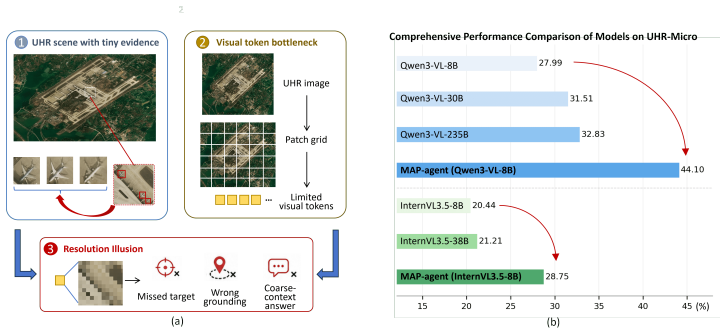
UHR-Micro: Diagnosing and Mitigating the Resolution Illusion in Earth Observation VLMs

VLMs show a resolution illusion on UHR Earth observation imagery where higher resolution does not improve micro-target perception…

Figure from the paper full image
abstract click to expand
Vision-Language Models (VLMs) increasingly operate on ultra-high-resolution (UHR) Earth observation imagery, yet they remain vulnerable to a severe scale mismatch between large-scale scene context and micro-scale targets. We refer to this empirical gap as a "resolution illusion": higher input resolution provides the appearance of richer visual detail, but does not necessarily yield reliable perception of spatially small, task-relevant evidence. To benchmark this challenge, we introduce UHR-Micro, a benchmark comprising 11,253 instructions grounded in 1,212 UHR images, designed to evaluate VLMs at the spatial limits of native Earth observation imagery. UHR-Micro spans diverse micro-target scales, context requirements, task families, and visual conditions, and provides diagnostic annotations that support controlled evaluation and fine-grained error attribution. Experiments with representative high-resolution VLMs show substantial failures in spatial grounding and evidence parsing, despite access to high-resolution inputs. Further analysis suggests that these failures are not fully resolved by increasing model capacity, but are closely tied to insufficient guidance in locating and using task-relevant micro-evidence. Motivated by this finding, we propose Micro-evidence Active Perception (MAP), a reference agent that decomposes queries into evidence-seeking steps, actively inspects candidate regions, and grounds its answers in localized observations. MAP-Agent improves micro-level perception by making high-resolution reasoning evidence-centered rather than image-centered. Together, UHR-Micro and MAP-Agent provide a diagnostic platform for evaluating, understanding, and advancing high-resolution reasoning in Earth observation VLMs. Datasets and source code were released at https://github.com/MiliLab/UHR-Micro.
0
0
cs.CV 2026-05-13 2 theorems

Three height bands give 49-FPS LiDAR pedestrian detection

TriBand-BEV: Real-Time LiDAR-Only 3D Pedestrian Detection via Height-Aware BEV and High-Resolution Feature Fusion

TriBand-BEV encodes full 3D scans as 2D BEV then reconstructs boxes, reaching 58.7 easy AP on KITTI on one GPU.

Figure from the paper full image
abstract click to expand
Safe autonomous agents and mobile robots need fast real time 3D perception, especially for vulnerable road users (VRUs) such as pedestrians. We introduce a new bird's eye view (BEV) encoding, which maps the full 3D LiDAR point cloud into a light-weight 2D BEV tensor with three height bands. We explicitly reformulate 3D detection as a 2D detection problem and then reconstruct 3D boxes from the BEV outputs. A single network detects cars, pedestrians, and cyclists in one pass. The backbone uses area attention at deep stages, a hierarchical bidirectional neck over P1 to P4 fuses context and detail, and the head predicts oriented boxes with distribution focal learning for side offsets and a rotated IoU loss. Training applies a small vertical re bin and a mild reflectance jitter in channel space to resist memorization. We use an interquartile range (IQR) filter to remove noisy and outlier LiDAR points during 3D reconstruction. On KITTI dataset, TriBand-BEV attains 58.7/52.6/47.2 pedestrian BEV AP(%) for easy, moderate, and hard at 49 FPS on a single consumer GPU, surpassing Complex-YOLO, with gains of +12.6%, +7.5%, and +3.1%. Qualitative scenes show stable detection under occlusion. The pipeline is compact and ready for real time robotic deployment. Our source code is publicly available on GitHub.
0
0
cs.CV 2026-05-13 Recognition

Overhead views in training raise long-range camera HD map accuracy by 44 percent

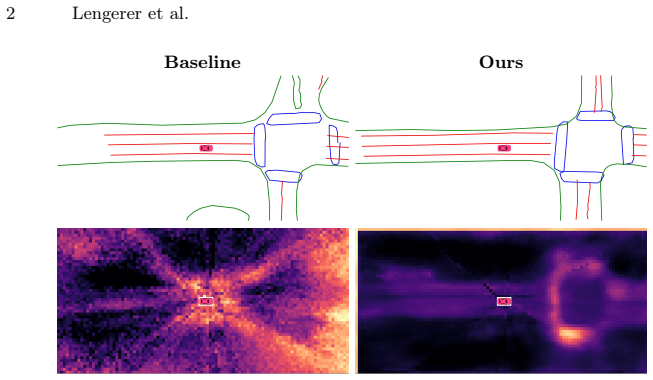
Learning Ego-Centric BEV Representations from a Perspective-Privileged View: Cross-View Supervision for Online HD Map Construction

Cross-view supervision aligns BEV features from a privileged teacher to improve structural coherence without extra sensors at inference.

Figure from the paper full image
abstract click to expand
Bird's-eye-view (BEV) representations derived from multi-camera input have become a central interface for online high-definition (HD) map construction. However, most approaches rely solely on ego-centric supervision, requiring large-scale scene structure to be inferred from incomplete observations, occlusions, and diminishing information density at long range, where perspective effects and spatial sparsity hinder consistent structural reasoning. We introduce Cross-View Supervision (CVS), a representation learning paradigm that transfers geometric and topological priors from an ego-aligned overhead perspective into camera-based BEV encoders. Rather than adding auxiliary semantic losses, CVS aligns representations in a shared BEV feature space and distills globally consistent structural knowledge from a perspective-privileged teacher into the ego-centric backbone. This supervision enhances structural coherence without modifying the inference architecture or requiring overhead input at test time. Experiments on nuScenes using ego-aligned aerial imagery from the AID4AD cross-view extension demonstrate consistent improvements over StreamMapNet while maintaining identical camera-only inference. CVS yields +3.9\,mAP in the standard $60\times30\,\mathrm{m}$ region and +9.9\,mAP in the extended $100\times50\,\mathrm{m}$ setting, corresponding to a 44\% relative gain at long range. These results highlight perspective-privileged structural supervision as a promising training principle for improving BEV representation learning in HD map construction.
0
0
cs.CV 2026-05-13 1 theorem

Synthetic videos with controlled views boost 3D pose estimation on new domains

Enhancing Domain Generalization in 3D Human Pose Estimation through Controllable Generative Augmentation

Varying poses, backgrounds and viewpoints creates augmented training data that performs better on unseen real-world scenarios and datasets.

abstract click to expand
Pedestrian motion, due to its causal nature, is strongly influenced by domain gaps arising from discrepancies between training and testing data distributions. Focusing on 3D human pose estimation, this work presents a controllable human pose generation framework that synthesizes diverse video data by systematically varying poses, backgrounds, and camera viewpoints. This generative augmentation enriches training datasets, enhances model generalization, and alleviates the limitations of existing methods in handling domain discrepancies. By leveraging both indoor/real-world and outdoor/virtual datasets, we perform cross-domain data fusion and controllable video generation to construct enriched training data, tailored to realistic deployment settings. Extensive experiments show that the augmented datasets significantly improve model performance on unseen scenarios and datasets, validating the effectiveness of the proposed approach.
1 0
0
cs.CV 2026-05-13 2 theorems

DPO with rule distortions sharpens video-audio timing

SyncDPO: Enhancing Temporal Synchronization in Video-Audio Joint Generation via Preference Learning

On-the-fly negative pairs let models learn subtle synchronization without costly sampling.

Figure from the paper full image
abstract click to expand
Recent advancements in video-audio joint generation have achieved remarkable success in semantic correspondence. However, achieving precise temporal synchronization, which requires fine-grained alignment between audio events and their visual triggers, remains a challenging problem. The post-training method for joint generation is largely dominated by Supervised Fine-Tuning, but the commonly used Mean Squared Error loss provides insufficient penalties for subtle temporal misalignments. Direct Preference Optimization offers an alternative by introducing explicit misaligned counterparts to better improve temporal sensitivity. In this paper we propose a post-training framework SyncDPO, leveraging DPO to improve the temporal sensitivity of V-A joint generation. Conventional DPO pipelines typically depend on costly sampling-and-ranking procedures to construct preference pairs, resulting in substantial computational cost. To improve efficiency, we introduce a suite of on-the-fly rule-based negative construction strategies that distort temporal structures without incurring additional annotation or sampling. We demonstrate that the temporal alignment capability can be effectively reinforced by providing explicit negative supervision through temporally distorted V-A pairs. Accordingly, we implement a curriculum learning strategy that progressively increases the difficulty of negative samples, transitioning from coarse misalignment to subtle inconsistencies. Extensive objective and subjective experiments across four diverse benchmarks, ranging from ambient sound videos to human speech videos, demonstrate that SyncDPO significantly outperforms other methods in improving model's temporal alignment capability. It also demonstrates superior generalization on out-of-distribution benchmark by capturing intrinsic motion-sound dynamics. Demo and code is available in https://syncdpo.github.io/syncdpo/.
0
0
cs.CV 2026-05-13 Recognition

Reference-guided refiner fixes diffusion view synthesis artifacts

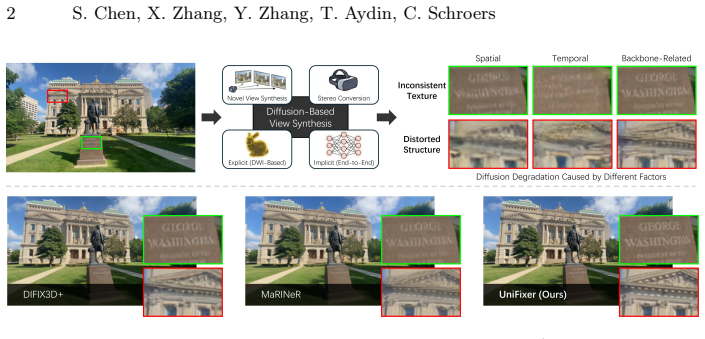
UniFixer: A Universal Reference-Guided Fixer for Diffusion-Based View Synthesis

Coarse-to-fine modules using one reference view achieve zero-shot correction of blur and distortions across backbones and tasks.

Figure from the paper full image
abstract click to expand
With the recent surge of generative models, diffusion-based approaches have become mainstream for view synthesis tasks, either in an explicit depth-warp-inpaint or in an implicit end-to-end manner. Despite their success, both paradigms often suffer from noticeable quality degradation, e.g., blurred details and distorted structures, caused by pixel-to-latent compression and diffusion hallucination. In this paper, we investigate diffusion degradation from three key dimensions (i.e., spatial, temporal, and backbone-related) and propose UniFixer, a universal reference-guided framework that fixes diverse degradation artifacts via a coarse-to-fine strategy. Specifically, a reference pre-alignment module is first designed to perform coarse alignment between the reference view and the degraded novel view. A global structure anchoring mechanism then rectifies geometric distortions to ensure structural fidelity, followed by a local detail injection module that recovers fine-grained texture details for high-quality view synthesis. Our UniFixer serves as a plug-and-play refiner that achieves zero-shot fixing across different types of diffusion degradation, and extensive experiments verify our state-of-the-art performance on novel view synthesis and stereo conversion.
0
0
cs.CV 2026-05-13 Recognition

Vision models sustain 30x longer latent reasoning chains

Self-Consistent Latent Reasoning: Long Latent Sequence Reasoning for Vision-Language Model

SCOLAR generates auxiliary visual tokens in one shot from full hidden states to prevent information collapse and raise benchmark accuracy by

Figure from the paper full image
abstract click to expand
In language reasoning, longer chains of thought consistently yield better performance, which naturally suggests that visual latent reasoning may likewise benefit from longer latent sequences. However, we discover a counterintuitive phenomenon: the performance of existing latent visual reasoning methods systematically degrades as the latent sequence grows longer. We reveal the root cause: Information Gain Collapse -- autoregressive generation makes each step highly dependent on prior outputs, so subsequent tokens can barely introduce new information. We further identify that heavily pooled ($\geq 128\times$) image embeddings used as supervision targets provide no more signal than meaningless placeholders. Motivated by these insights, we propose SCOLAR (Self-COnsistent LAtent Reasoning), which introduces a lightweight detransformer that leverages the LLM's full-sequence hidden states to generate auxiliary visual tokens in a single shot, with each token independently anchored to the original visual space. Combined with three-stage SFT and ALPO reinforcement learning, SCOLAR extends acceptable latent CoT length by over $30\times$, achieves state-of-the-art among open-source models on real-world reasoning benchmarks (+14.12% over backbone), and demonstrates strong out-of-distribution generalization.
0
0
cs.CV 2026-05-13 1 theorem

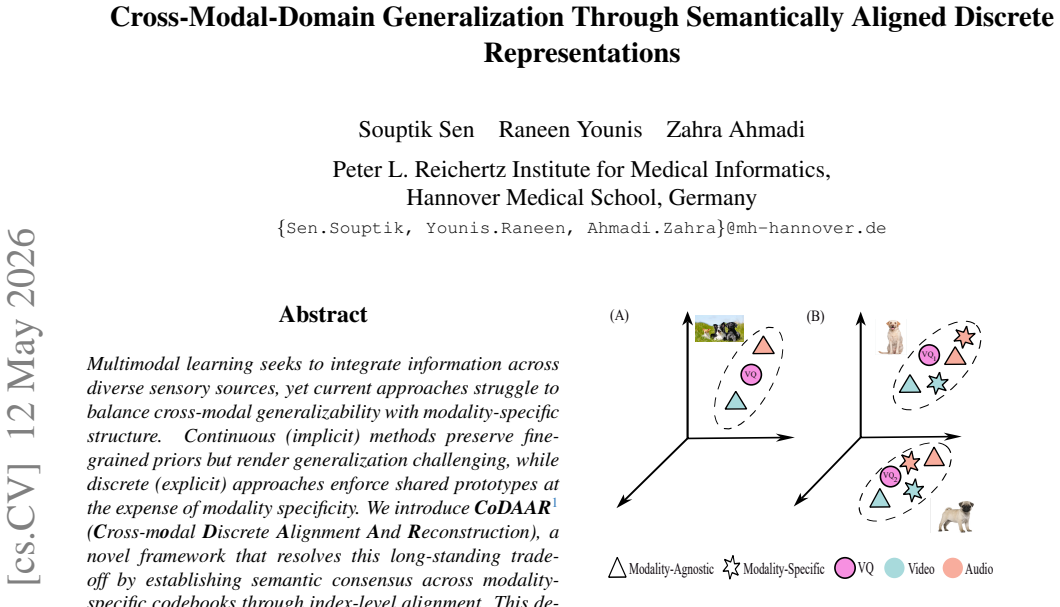
Index-level codebook alignment unifies multimodal representations

Cross-Modal-Domain Generalization Through Semantically Aligned Discrete Representations

CoDAAR keeps modality-specific codebooks separate yet aligns them at the index level so the shared space generalizes across tasks and new数据集

Figure from the paper full image
abstract click to expand
Multimodal learning seeks to integrate information across diverse sensory sources, yet current approaches struggle to balance cross-modal generalizability with modality-specific structure. Continuous (implicit) methods preserve fine-grained priors but render generalization challenging, while discrete (explicit) approaches enforce shared prototypes at the expense of modality specificity. We introduce CoDAAR (Cross-modal Discrete Alignment And Reconstruction), a novel framework that resolves this long-standing trade-off by establishing semantic consensus across modality-specific codebooks through index-level alignment. This design uniquely allows CoDAAR to preserve modality-unique structures while achieving generalizable cross-modal representations within a unified discrete space. CoDAAR combines two complementary mechanisms: Discrete Temporal Alignment (DTA), which enables fine-grained temporal quantization, and Cascading Semantic Alignment (CSA), which promotes progressive cross-modal semantic agreement. Together, they establish a competition-free unified representation space. Trained with self-supervised reconstruction objectives on paired multimodal sequences, CoDAAR demonstrates robust cross-modal and cross-domain generalization. Across Cross-Modal Generalization benchmarks, including event classification, localization, video segmentation, and cross-dataset transfer, CoDAAR achieves state-of-the-art performance, establishing a new paradigm for discrete and generalizable multimodal representation learning.
0
0
cs.CV 2026-05-13 1 theorem

Smart pose selection cuts visual localization training time by 3x

PoseCompass: Intelligent Synthetic Pose Selection for Visual Localization

PoseCompass ranks synthetic views by difficulty, novelty and quality, halving median errors on 7-Scenes.

Figure from the paper full image
abstract click to expand
In visual localization, Absolute Pose Regression (APR) enables real-time 6-DoF camera pose inference from single images, yet critically depends on fine-tuning data quality and coverage. While recent methods leverage 3D Gaussian Splatting (3DGS) for novel view synthesis-based data augmentation, random sampling generates redundant views and noisy samples from poorly reconstructed regions. To mitigate this research gap, we propose PoseCompass, an intelligent pose selection pipeline for 3DGS-based APR. PoseCompass formulates synthetic pose selection and derives a value-based pose ranking mechanism to identify informative poses. The ranking integrates three dimensions: Localization Difficulty, favoring challenging regions; Coverage Novelty, exploring under-sampled areas; and Rendering Observability, filtering artifacts and noise. PoseCompass then generates trajectory-constrained candidates, selects the top-K ranked poses, and synthesizes views using 3DGS with lightweight diffusion-based alignment. Finally, the pose regressor is fine-tuned on mixed real and synthetic data. We evaluate PoseCompass on 7-Scenes, where it reduces adaptation time from 15.2 to 5.1 minutes, a 3x speedup, while cutting median pose errors by 53.8 percent and significantly outperforming random baselines.
0
0
cs.CV 2026-05-13 1 theorem

Fine-only tracker boosts heart point accuracy by 6.5%

EchoTracker2: Enhancing Myocardial Point Tracking by Modeling Local Motion

EchoTracker2 skips coarse initialization and cuts median trajectory error 12% by modeling local continuous cardiac motion.

Figure from the paper full image
abstract click to expand
Myocardial point tracking (MPT) has recently emerged as a promising direction for motion estimation in echocardiography, driven by advances in general-purpose point tracking methods. However, myocardial motion fundamentally differs from motion encountered in natural videos, as it arises from physiologically constrained deformation that is spatially and temporally continuous throughout the cardiac cycle. Consequently, motion trajectories typically remain locally confined despite substantial tissue deformation. Motivated by these properties, we revisit the architectural design for MPT and find that coarse initialization in commonly used two-stage coarse-to-fine architectures may be unnecessary in this domain. In this work, we propose a fine-stage-only architecture, \textbf{EchoTracker2}, which enriches pixel-precise features with local spatiotemporal context and integrates them with long-range joint temporal reasoning for robust tracking. Experimental results across in-distribution, out-of-distribution (OOD), and public synthetic datasets show that our model improves position accuracy by $6.5\%$ and reduces median trajectory error by $12.2\%$ relative to a domain-specific state-of-the-art (SOTA) model. Compared to the best general-purpose point tracking method, the improvements are $2.0\%$ and $5.3\%$, respectively. Moreover, EchoTracker2 shows better agreement with expert-derived global longitudinal strain (GLS) and enhances test-rest reproducibility. Source code will be available at: https://github.com/riponazad/ptecho.
0
0
cs.CV 2026-05-13 Recognition

One autoregressive model makes personalized ad images and text

Design Your Ad: Personalized Advertising Image and Text Generation with Unified Autoregressive Models

It learns from click history to tailor both visuals and copy, beating separate systems on a new million-scale dataset.

Figure from the paper full image
abstract click to expand
Generating realistic and user-preferred advertisements is a key challenge in e-commerce. Existing approaches utilize multiple independent models driven by click-through-rate (CTR) to controllably create attractive image or text advertisements. However, their pipelines lack cross-modal perception and rely on CTR that only reflects average preferences. Therefore, we explore jointly generating personalized image-text advertisements from historical click behaviors. We first design a Unified Advertisement Generative model (Uni-AdGen) that employs a single autoregressive framework to produce both advertising images and texts. By incorporating a foreground perception module and instruction tuning, Uni-AdGen enhances the realism of the generated content. To further personalize advertisements, we equip Uni-AdGen with a coarse-to-fine preference understanding module that effectively captures user interests from noisy multimodal historical behaviors to drive personalized generation. Additionally, we construct the first large-scale Personalized Advertising image-text dataset (PAd1M) and introduce a Product Background Similarity (PBS) metric to facilitate training and evaluation. Extensive experiments show that our method outperforms baselines in general and personalized advertisement generation. Our project is available at https://github.com/JD-GenX/Uni-AdGen.
0
0
cs.CV 2026-05-13 Recognition

Two-stage inversion separates lens

MULTI: Disentangling Camera Lens, Sensor, View, and Domain for Novel Image Generation

MULTI extracts general then specific factors to combine them freely and shrink gaps in synthetic data distributions.

Figure from the paper full image
abstract click to expand
Recent text-to-image models produce high-quality images, yet text ambiguity hinders precise control when specific styles or objects are required. There have been a number of recent works dealing with learning and composing multiple objects and patterns. However, current work focuses almost entirely on image content, overlooking imaging factors such as camera lens, sensor types, imaging viewpoints, and scenes' domain characteristics. We introduce this new challenge as Imaging Factor Disentanglement and show limitations of current approaches in the regime. We, therefore, propose the new method Multi-factor disentanglement through Textual Inversion (MULTI). It consists of two stages: in the first stage, we learn general factors, and in the second stage, we extract dataset-specific ones. This setup enables the extension of existing datasets and novel factor combinations, thereby reducing distribution gaps. It further supports modifications of specific factors and image-to-image generation via ControlNets. The evaluation on our new DF-RICO benchmark demonstrates the effectiveness of MULTI and highlights the importance of Factor Disentanglement as a new direction of research.
0
0
cs.CV 2026-05-13 2 theorems

Diffusion stages progress from geometry to appearance

MoCam: Unified Novel View Synthesis via Structured Denoising Dynamics

MoCam temporally decouples alignment and refinement to handle incomplete point clouds for both static and dynamic scenes.

Figure from the paper full image
abstract click to expand
Generative novel view synthesis faces a fundamental dilemma: geometric priors provide spatial alignment but become sparse and inaccurate under view changes, while appearance priors offer visual fidelity but lack geometric correspondence. Existing methods either propagate geometric errors throughout generation or suffer from signal conflicts when fusing both statically. We introduce MoCam, which employs structured denoising dynamics to orchestrate a coordinated progression from geometry to appearance within the diffusion process. MoCam first leverages geometric priors in early stages to anchor coarse structures and tolerate their incompleteness, then switches to appearance priors in later stages to actively correct geometric errors and refine details. This design naturally unifies static and dynamic view synthesis by temporally decoupling geometric alignment and appearance refinement within the diffusion process. Experiments demonstrate that MoCam significantly outperforms prior methods, particularly when point clouds contain severe holes or distortions, achieving robust geometry-appearance disentanglement.
0
0
cs.CV 2026-05-13 Recognition

Perceptual entropy prevents diversity collapse in flow-based RLHF

When Policy Entropy Constraint Fails: Preserving Diversity in Flow-based RLHF via Perceptual Entropy

It captures diversity in perceptual spaces where standard entropy stays constant due to fixed noise schedules.

Figure from the paper full image
abstract click to expand
RLHF is widely used to align flow-matching text-to-image models with human preferences, but often leads to severe diversity collapse after fine-tuning. In RL, diversity is often assumed to correlate with policy entropy, motivating entropy regularization. However, we show this intuition breaks in flow models: policy entropy remains constant, even while perceptual diversity collapses. We explain this mismatch both theoretically and empirically: the constant entropy arises from the fixed, pre-defined noise schedule, while the diversity collapse is driven by the mode-seeking nature of policy gradients. As a result, policy entropy fails to prevent the model from converging to a narrow high-reward region in the perceptual space. To this end, we introduce perceptual entropy that captures diversity in a perceptual space and maintains the property of standard entropy. Building upon this insight, we propose two entropy-regularized strategies, Perceptual Entropy Constraint and Perceptual Constraints on Generation Space, to preserve perceptual diversity and improve the quality. Experiments across two base models, neural and rule-based rewards, and three perceptual spaces demonstrate consistent gains in the quality-diversity trade-off; PEC achieves the best overall score of 0.734 (vs. baseline's 0.366); a complementary setting of PEC further reaches a diversity average of 0.989 (vs. baseline's 0.047). Our project page (https://xiaofeng-tan.github.io/projects/PEC) is publicly available.
0
0
cs.CV 2026-05-13 Recognition

Early fusion of visual features improves multi-reference generation

UniCustom: Unified Visual Conditioning for Multi-Reference Image Generation

Merging semantic and appearance encodings before language model processing reduces identity leakage when multiple reference images guide a 2

Figure from the paper full image
abstract click to expand
Multi-reference image generation aims to synthesize images from textual instructions while faithfully preserving subject identities from multiple reference images. Existing VLM-enhanced diffusion models commonly rely on decoupled visual conditioning: semantic ViT features are processed by the VLM for instruction understanding, whereas appearance-rich VAE features are injected later into the diffusion backbone. Despite its intuitive design, this separation makes it difficult for the model to associate each semantically grounded subject with visual details from the correct reference image. As a result, the model may recognize which subject is being referred to, but fail to preserve its identity and fine-grained appearance, leading to attribute leakage and cross-reference confusion in complex multi-reference settings. To address this issue, we propose UniCustom, a unified visual conditioning framework that fuses ViT and VAE features before VLM encoding. This early fusion exposes the VLM to both semantic cues and appearance-rich details, enabling its hidden states to jointly encode the referred subject and corresponding visual appearance with only a lightweight linear fusion layer. To learn such unified representations, we adopt a two-stage training strategy: reconstruction-oriented pretraining that preserves reference-specific appearance details in the fused hidden states, followed by supervised finetuning on single- and multi-reference generation tasks. We further introduce a slot-wise binding regularization that encourages each image slot to preserve low-level details of its corresponding reference, thereby reducing cross-reference entanglement. Experiments on two multi-reference generation benchmarks demonstrate that UniCustom consistently improves subject consistency, instruction following, and compositional fidelity over strong baselines.
0
0
cs.CV 2026-05-13 2 theorems

Flow-matching solves irregular eroded jigsaw puzzles

The Missing GAP: From Solving Square Jigsaw Puzzles to Handling Real World Archaeological Fragments

GAP datasets model real archaeological fragments; PuzzleFlow beats prior square-piece methods on complex reassembly.

Figure from the paper full image
abstract click to expand
Jigsaw puzzle solving has been an increasingly popular task in the computer vision research community. Recent works have utilized cutting-edge architectures and computational approaches to reassemble groups of pieces into a coherent image, while achieving increasingly good results on well established datasets. However, most of these approaches share a common, restricting setting: operating solely on strictly square puzzle pieces. In this work, we introduce GAP, a set of novel jigsaw puzzles datasets containing synthetic, heavily eroded pieces of unrestricted shapes, generated by a learned distribution of real-world archaeological fragments. We also introduce PuzzleFlow, a novel ViT and Flow-Matching based framework for jigsaw puzzle solving, capable of handling complex puzzle pieces and demonstrating superior performance on GAP when compared to both classic and recent prominent works in this domain.
0
0
cs.CV 2026-05-13 2 theorems

Coffee-prep videos reveal no model dominates all visual tasks

BARISTA: A Multi-Task Egocentric Benchmark for Compositional Visual Understanding

185 egocentric recordings with full scene graphs test grounding, interactions, relations, and temporal reasoning in zero-shot settings.

Figure from the paper full image
abstract click to expand
Scene understanding is central to general physical intelligence, and video is a primary modality for capturing both state and temporal dynamics of a scene. Yet understanding physical processes remains difficult, as models must combine object localization, hand-object interactions, relational parsing, temporal reasoning, and step-level procedural inference. Existing benchmarks usually evaluate these capabilities separately, limiting diagnosis of why models fail on procedural tasks. We introduce BARISTA, a densely annotated egocentric dataset and benchmark of 185 real-world coffee-preparation videos covering fully automatic, portafilter-based, and capsule-based workflows. BARISTA provides verified per-frame scene graphs linking persistent object identities to masks, tracks, boxes, attributes, typed relations, hand-object interactions, activities, and process steps. From these graphs, we derive zero-shot language-based tasks spanning phrase grounding, hand-object interaction recognition, referring, activity recognition, relation extraction, and temporal visual question answering. Experiments reveal strong variation across task families and no consistently dominant model family, positioning BARISTA as a challenging diagnostic benchmark for procedural video understanding. Code and dataset available at https://huggingface.co/datasets/ramblr/BARISTA.
0
0
cs.CV 2026-05-13 Recognition

Paired dropout with low-frequency consistency improves sparse-view 3DGS

PairDropGS: Paired Dropout-Induced Consistency Regularization for Sparse-View Gaussian Splatting

Enforcing agreement on coarse structures between paired dropped subsets stabilizes training and boosts reconstruction quality in under-con<f

Figure from the paper full image
abstract click to expand
Dropout-based sparse-view 3D Gaussian Splatting (3DGS) methods alleviate overfitting by randomly suppressing Gaussian primitives during training. Existing methods mainly focus on designing increasingly sophisticated dropout strategies, while they overlook the resulting inconsistencies among different dropped Gaussian subsets. This oversight often leads to unstable reconstruction and suboptimal Gaussian representation learning.In this paper, we revisit dropout-based sparse-view 3DGS from a consistency regularization perspective and propose PairDropGS, a Paired Dropout-induced Consistency Regularization framework for sparse-view Gaussian splatting. Specifically, PairDropGS first constructs a pair of the dropped Gaussian subsets from a shared Gaussian field and designs a low-frequency consistency regularization to constrain their low-frequency rendered structures. This design encourages the shared Gaussian field to preserve stable scene layout and coarse geometry under different random dropouts, while avoiding excessive constraints on ambiguous high-frequency details. Moreover, we introduce a progressive consistency scheduling strategy to gradually strengthen the consistency regularization during training for stability and robustness of reconstruction. Extensive experiments on widely-used sparse-view benchmarks demonstrate that PairDropGS achieves superior training stability, significantly outperforms existing dropout-based 3DGS methods in reconstruction quality, while exhibiting the simplicity and plug-and-play nature for improving dropout-based optimization.
0
0
cs.CV 2026-05-13 2 theorems

Dual branches with language routing reach 93.5% zero-shot anomaly AUROC

Anomaly-Aware Vision-Language Adapters for Zero-Shot Anomaly Detection

Specialized normal and anomaly adapters are combined dynamically using fixed text descriptions, enabling generalization across industrial to

abstract click to expand
Zero-shot anomaly detection aims to identify defects in unseen categories without target-specific training. Existing methods usually apply the same feature transformation to all samples, treating normal and anomalous data uniformly despite their fundamentally asymmetric distributions, compact normals versus diverse anomalies. We instead exploit this natural asymmetry by proposing AVA-DINO, an anomaly-aware vision-language adaptation framework with dual specialized branches for normal and anomalous patterns that adapt frozen DINOv3 visual features. During training on auxiliary data, the two branches are learned jointly with a text-guided routing mechanism and explicit routing regularization that encourages branch specialization. At test time, only the input image and fixed, predefined language descriptions are used to dynamically combine the two branches, enabling an asymmetric activation. This design prevents degenerate uniform routing and allows context-specific feature transformations. Experiments across nine industrial and medical benchmarks demonstrate state-of-the-art performance, achieving 93.5% image-AUROC on MVTec-AD and strong cross-domain generalization to medical imaging without domain-specific fine-tuning. https://github.com/aqeeelmirza/AVA-DINO
1 0
0
cs.CV 2026-05-13 2 theorems

Text priors improve optical-SAR registration under deformation

TAR: Text Semantic Assisted Cross-modal Image Registration Framework for Optical and SAR Images

TAR adds scene and land-cover text descriptors to raise matching accuracy over visual-only methods when geometric changes are large.

Figure from the paper full image
abstract click to expand
Existing deep learning-based methods can capture shared features from optical and synthetic aperture radar (SAR) images for spatial alignment. However, optical-SAR registration remains challenging under large geometric deformations, because the model needs to simultaneously handle cross-modal appearance discrepancies and complex spatial transformations. To address this issue, this paper proposes a text semantic-assisted cross-modal image registration framework, named TAR, for optical and SAR images. TAR exploits text semantic priors from remote sensing scenes and land-cover categories to alleviate the modality gap and enhance cross-modal feature learning. TAR consists of three components: a multi-scale visual feature learning (MSFL) module, a text-assisted feature enhancement (TAFE) module, and a coarse-to-fine dense matching (CFDM) module. MSFL extracts multi-scale visual features from optical and SAR images. TAFE constructs text descriptors related to remote sensing scenes and land-cover objects, and uses a frozen RemoteCLIP text encoder to extract text features. These text features are introduced through visual-text interaction to enhance high-level visual features for more reliable coarse matching. CFDM then establishes coarse correspondences based on the enhanced high-level features and refines the matched locations using low-level features. Experimental results on cross-modal remote sensing images demonstrate the effectiveness of TAR, which achieves stronger matching performance than several state-of-the-art methods and yields significant gains under large geometric deformations.
0
0
cs.CV 2026-05-13 2 theorems

Shared motion model adapts to new robots with unpaired videos

OmniHumanoid: Streaming Cross-Embodiment Video Generation with Paired-Free Adaptation

Factorized learning and isolated attention let one transfer network handle multiple humanoid forms without retraining or paired data.

Figure from the paper full image
abstract click to expand
Cross-embodiment video generation aims to transfer motions across different humanoid embodiments, such as human-to-robot and robot-to-robot, enabling scalable data generation for embodied intelligence. A major challenge in this setting is that motion dynamics are partly transferable across embodiments, whereas appearance and morphology remain embodiment-specific. Existing approaches often entangle these factors, and many require paired data for every target embodiment, which limits scalability to new robots. We present OmniHumanoid, a framework that factorizes transferable motion learning and embodiment-specific adaptation. Our method learns a shared motion transfer model from motion-aligned paired videos spanning multiple embodiments, while adapting to a new embodiment using only unpaired videos through lightweight embodiment-specific adapters. To reduce interference between motion transfer and embodiment adaptation, we further introduce a branch-isolated attention design that separates motion conditioning from embodiment-specific modulation. In addition, we construct a synthetic cross-embodiment dataset with motion-aligned paired videos rendered across diverse humanoid assets, scenes, and viewpoints. Experiments on both synthetic and real-world benchmarks show that OmniHumanoid achieves strong motion fidelity and embodiment consistency, while enabling scalable adaptation to unseen humanoid embodiments without retraining the shared motion model.
0
0
cs.CV 2026-05-13 Recognition

Training-free decoupling boosts 4D dynamic scene reconstruction

4DVGGT-D: 4D Visual Geometry Transformer with Improved Dynamic Depth Estimation

Separating camera motion from object dynamics in monocular videos improves point-cloud metrics without fine-tuning.

abstract click to expand
Reconstructing dynamic 4D scenes from monocular videos is a fundamental yet challenging task. While recent 3D foundation models provide strong geometric priors, their performance significantly degrades in dynamic environments. This degradation stems from a fundamental tension: the inherent coupling of camera ego-motion and object motion within global attention mechanisms. In this paper, we propose a novel, training-free progressive decoupling framework that disentangles dynamics from statics in a principled, coarse-to-fine manner. Our core insight is to resolve the tension by first stabilizing the camera pose, followed by geometric refinement. Specifically, our approach consists of three synergistic components: (1) a Dynamic-Mask-Guided Pose Decoupling module that isolates pose estimation from dynamic interference, yielding a stable motion-free reference frame; (2) a Topological Subspace Surgery mechanism that orthogonally decomposes the depth manifold, safely preserving dynamic objects while injecting refined, mask-aware geometry into static regions; and (3) an Information-Theoretic Confidence-Aware Fusion strategy that formulates depth integration as a heteroscedastic Bayesian inference problem, adaptively blending multi-pass predictions via inverse-variance weighting. Extensive experiments on standard 4D reconstruction benchmarks demonstrate that our method achieves consistent and substantial improvements across principal point-cloud metrics. Notably, our approach shows competitive performance in robust 4D scene reconstruction without requiring fine-tuning, suggesting the potential of mathematically grounded dynamic-static disentanglement.
0
0
cs.CV 2026-05-13 2 theorems

Spectral projection enables compact vision transformers for medical images

Spectral Vision Transformer for Efficient Tokenization with Limited Data

By projecting images onto a spectral basis the architecture gains spatial invariance and efficiency while performing as well as larger patch

Figure from the paper full image
abstract click to expand
We propose a novel spectral vision transformer architecture for efficient tokenization in limited data, with an emphasis on medical imaging. We outline convenient theoretical properties arising from the choice of basis including spatial invariance and optimal signal-to-noise ratio. We show reduced complexity arising from the spectral projection compared to spatial vision transformers. We show equitable or superior performance with a reduced number of parameters as compared to a variety of models including compact and standard vision transformers, convolutional neural networks with attention, shifted window transformers, multi-layer perceptrons, and logistic regression. We include simulated, public, and clinical data in our analysis and release our code at: \verb+github.com/agr78/spectralViT+.
0
0
cs.CV 2026-05-13 2 theorems

Transformer separates what from where for emergent object discovery

What-Where Transformer: A Slot-Centric Visual Backbone for Concurrent Representation and Localization

Raw attention maps reveal multiple objects under standard single-label ImageNet training, improving zero-shot discovery and segmentation.

Figure from the paper full image
abstract click to expand
Many image understanding tasks involve identifying what is present and where it appears. However, tasks that address where, such as object discovery, detection, and segmentation, are often considerably more complex than image classification, which primarily focuses on what. One possible reason is that classification-oriented backbones tend to emphasize semantic information about what, while implicitly entangling or suppressing information about where. In this work, we focus on an inductive bias termed what-where separation, which encourages models to represent object appearance and spatial location in a decomposed manner. To incorporate this bias throughout an attentive backbone in the style of Vision Transformer (ViT), we propose the What-Where Transformer (WWT). Our method introduces two key novel designs: (1) it treats tokens as representations of what and attention maps as representations of where, and processes them in concurrent feed-forward modules via a multi-stream, slot-based architecture; (2) it reuses both the final-layer tokens and attention maps for downstream tasks, and directly exposes them to gradients derived from task losses, thereby facilitating more effective and explicit learning of localization. We demonstrate that even under standard single-label classification-based supervision on ImageNet, WWT exhibits emergent multiple object discovery directly from raw attention maps, rather than via additional postprocessing such as token clustering. Furthermore, WWT achieves superior performance compared to ViT-based methods on zero-shot object discovery and weakly supervised semantic segmentation, and it is transferable to various localization setups with minimal modifications. Code will be published after acceptance.
0
0
cs.CV 2026-05-13 2 theorems

Gradient-guided edits create better image model explanations

FAME: Feature Activation Map Explanation on Image Classification and Face Recognition

FAME uses network gradients to perturb inputs and generate attribution maps that compete with top methods while exposing limits of standard

Figure from the paper full image
abstract click to expand
Deep Learning has revolutionized machine learning, reaching unprecedented levels of accuracy, but at the cost of reduced interpretability. Especially in image processing systems, deep networks transform local pixel information into more global concepts in a highly obscured manner. Explainable AI methods for image processing try to shed light on this issue by highlighting the regions of the image that are important for the prediction task. Among these, Class Activation Mapping (CAM) and its gradient-based variants compute attributions based on the feature map and upscale them to the image resolution, assuming that feature map locations are influenced only by underlying regions. Perturbation-based methods, such as CorrRISE, on the other hand, try to provide pixel-level attributions by perturbing the input with fixed patches and checking how the output of the network changes. In this work, we propose Feature Activation Map Explanation (FAME), which combines both worlds by using network gradients to compute changes to the input image, manipulating it in a gradient-driven way rather than using fixed patches. We apply this technique on two common tasks, image classification and face recognition, and show that CAM's above-mentioned assumption does not hold for deeper networks. We qualitatively and quantitively show that FAME produces attribution maps that are competitive state-of-the-art systems. Our code is available: {\footnotesize https://github.com/AIML-IfI/fame.}
0
0
cs.CV 2026-05-13 Recognition

L2P turns latent models into pixel generators with shallow training

L2P: Unlocking Latent Potential for Pixel Generation

Freezing most layers and using only synthetic data lets it match source performance at 4K resolution on 8 GPUs.

Figure from the paper full image
abstract click to expand
Pixel diffusion models have recently regained attention for visual generation. However, training advanced pixel-space models from scratch demands prohibitive computational and data resources. To address this, we propose the Latent-to-Pixel (L2P) transfer paradigm, an efficient framework that directly harnesses the rich knowledge of pre-trained LDMs to build powerful pixel-space models. Specifically, L2P discards the VAE in favor of large-patch tokenization and freezes the source LDM's intermediate layers, exclusively training shallow layers to learn the latent-to-pixel transformation. By utilizing LDM-generated synthetic images as the sole training corpus, L2P fits an already smooth data manifold, enabling rapid convergence with zero real-data collection. This strategy allows L2P to seamlessly migrate massive latent priors to the pixel space using only 8 GPUs. Furthermore, eliminating the VAE memory bottleneck unlocks native 4K ultra-high resolution generation. Extensive experiments across mainstream LDM architectures show that L2P incurs negligible training overhead, yet performs on par with the source LDM on DPG-Bench and reaches 93% performance on GenEval.
0
0
cs.CV 2026-05-13 Recognition

Memory method improves video object segmentation under corruptions

Robust Promptable Video Object Segmentation

Object-specific memory representations let MoGA adapt to each tracked object's degradation while keeping predictions consistent across time.

Figure from the paper full image
abstract click to expand
The performance of promptable video object segmentation (PVOS) models substantially degrades under input corruptions, which prevents PVOS deployment in safety-critical domains. This paper offers the first comprehensive study on robust PVOS (RobustPVOS). We first construct a new, comprehensive benchmark with two real-world evaluation datasets of 351 video clips and more than 2,500 object masks under real-world adverse conditions. At the same time, we generate synthetic training data by applying diverse and temporally varying corruptions to existing VOS datasets. Moreover, we present a new RobustPVOS method, dubbed Memory-object-conditioned Gated-rank Adaptation (MoGA). The key to successfully performing RobustPVOS is two-fold: effectively handling object-specific degradation and ensuring temporal consistency in predictions. MoGA leverages object-specific representations maintained in memory across frames to condition the robustification process, which allows the model to handle each tracked object differently in a temporally consistent way. Extensive experiments on our benchmark validate MoGA's efficacy, showing consistent and significant improvements across diverse corruption types on both synthetic and real-world datasets, establishing a strong baseline for future RobustPVOS research. Our benchmark is publicly available at https://sohyun-l.github.io/RobustPVOS_project_page/.
0
0
cs.CV 2026-05-13 Recognition

Dual-branch method finds forgeries at full image resolution

EDGER: EDge-Guided with HEatmap Refinement for Generalizable Image Forgery Localization

Edge frequency signals and patch synthetic scores together locate manipulated regions across domains and sizes.

Figure from the paper full image
abstract click to expand
Text-guided inpainting has made image forgery increasingly realistic, challenging both SID and IFL. However, existing methods often struggle to point out suspicious signals across domains. To address this problem, we propose EDGER, a patch-based, dual-branch framework that localizes manipulated regions in arbitrary resolution images without sacrificing native resolution. The first branch, Edge-Guided Segmentation, introduces a Frequency-based Edge Detector to emphasize high-frequency inconsistencies at manipulation boundaries, and fine-tunes a SegFormer to fuse RGB and edge features for pixel-level masks. Since edge evidence is most informative only when patches contain both authentic and manipulated pixels, we complement Edge-Guided Segmentation with a Synthetic Heatmapping branch, a classification-based localizer that fine-tunes a CLIP-ViT image encoder with LoRA to flag fully synthetic patches. Together, Synthetic Heatmapping provides coarse, patch-level synthetic priors, while Edge-Guided Segmentation sharpens boundaries within partially manipulated patches, yielding comprehensive localization. Evaluated in the MediaEval 2025, SynthIM challenge, Manipulated Region Localization Task's setting, our approach scales to multi-megapixel imagery and exhibits strong cross-domain generalization. Extensive ablations highlight the complementary roles of frequency-based edge cues and patch-level synthetic priors in driving accurate, resolution-agnostic localization.
0
0
cs.CV 2026-05-13 Recognition

No single ImageNet model tops all metrics on every target dataset

A Transfer Learning Evaluation of Deep Neural Networks for Image Classification

Fine-tuning eleven base networks on five domains shows accuracy, speed, and size trade-offs that guide practical choices.

Figure from the paper full image
abstract click to expand
Transfer learning is a machine learning technique that uses previously acquired knowledge from a source domain to enhance learning in a target domain by reusing learned weights. This technique is ubiquitous because of its great advantages in achieving high performance while saving training time, memory, and effort in network design. In this paper, we investigate how to select the best pre-trained model that meets the target domain requirements for image classification tasks. In our study, we refined the output layers and general network parameters to apply the knowledge of eleven image processing models, pre-trained on ImageNet, to five different target domain datasets. We measured the accuracy, accuracy density, training time, and model size to evaluate the pre-trained models both in training sessions in one episode and with ten episodes.
0
0
cs.CV 2026-05-13 2 theorems

Single continuous 4D spline abstracts 3D shapes with global coherence

Optimizing 4D Wires for Sparse 3D Abstraction

Variable-width B-spline replaces fragmented curve collections for connected wire structures

Figure from the paper full image
abstract click to expand
We present a unified framework for 3D geometric abstraction using a single continuous 4D wire, parameterized as a B-spline with spatial coordinates and variable width $(x,y,z,w)$. Existing approaches typically represent shapes as collections of many independent curve segments, which often leads to fragmented structures and limited physical realizability. In contrast, we show that a single continuous spline is sufficiently expressive to capture complex volumetric forms while enforcing global topological coherence. By imposing continuity, our method transforms 3D sketching from a local density-accumulation process into a global routing problem, providing a strong inductive bias toward cleaner aesthetics and improved structural coherence. To enable gradient-based optimization, we introduce a differentiable rendering pipeline that efficiently rasterizes variable-width curves with bounded projection error. This formulation supports robust optimization using modern guidance signals such as Score Distillation Sampling (SDS) or CLIP. We demonstrate applications including image-to-3D abstraction, multi-view wire art generation, and differentiable stylized surface filling. Experiments show that our unified representation produces structures with higher semantic fidelity and improved structural coherence compared to approaches based on collections of discrete curves.
0
0
cs.CV 2026-05-13 2 theorems

Hyperbolic field encodes 3D scene hierarchies from 2D cues

H2G: Hierarchy-Aware Hyperbolic Grouping for 3D Scenes

A Lorentz space aligns fine object parts and coarse structures in one embedding using tree supervision from foundation models.

Figure from the paper full image
abstract click to expand
Hierarchical 3D grouping aims to recover scene groups across multiple granularities, from fine object parts to complete objects, without relying on semantic labels or a fixed vocabulary. The main challenge is to transform 2D foundation-model cues into coherent hierarchy supervision and embed that hierarchy in a 3D representation. We propose H2G, a hyperbolic affinity field for hierarchical 3D grouping. Our method derives semantically organized tree supervision by interpreting foundation-model affinities through Dasgupta's objective for similarity-based hierarchical clustering. This supervision is distilled into a single Lorentz hyperbolic feature field, whose geometry is well suited for tree-like branching structures. A hierarchy-aware objective aligns the field with fine-level assignments, coarse object structure, compact feature clusters, and LCA (Lowest Common Ancestor) ordering. This formulation represents multiple grouping levels in one feature space, enabling semantic hierarchical grouping grounded in 2D foundation-model knowledge.
0
0
cs.CV 2026-05-13 Recognition

Medical AI correctness spans labels

What Does It Mean for a Medical AI System to Be Right?

Beyond benchmark scores, systems for tasks like plasma cell classification must also deliver stable expert data, interpretable outputs, and,

abstract click to expand
This paper examines what it means for a medical AI system to be right by grounding the question in a specific clinical context: the automatic classification of plasma cells in digitized bone marrow smears for the diagnosis of multiple myeloma. Drawing on philosophy of science and research ethics, the paper argues that correctness in medical AI is not a singular property reducible to benchmark performance, but a multi-dimensional concept involving the availability of expertly labeled medical datasets, the explainability and interpretability of model outputs, the clinical meaningfulness of evaluation metrics, and the distribution of accountability in human-AI workflows. As such, the paper develops this argument through four interrelated themes: the instability of ground truth labels, the opacity of overconfident AI, the inadequacy of standard clinical metrics, and the risk of automation bias in time-pressured clinical settings.
0
0
cs.CV 2026-05-13 2 theorems

Benchmark tests VLLMs on 3,000 years of Chinese script changes

Chronicles-OCR: A Cross-Temporal Perception Benchmark for the Evolutionary Trajectory of Chinese Characters

2,800 balanced images separate visual perception from meaning across seven evolutionary stages

Figure from the paper full image
abstract click to expand
Vision Large Language Models (VLLMs) have achieved remarkable success in modern text-rich visual understanding. However, their perceptual robustness in the face of the continuous morphological evolution of historical writing systems remains largely unexplored. Existing ancient text datasets typically focus on isolated historical periods, failing to capture the systematic visual distribution shifts spanning thousands of years. To bridge this gap and empower Digital Humanities, we introduce Chronicles-OCR, the first comprehensive benchmark specifically designed to evaluate the cross-temporal visual perception capabilities of VLLMs across the complete evolutionary trajectory of Chinese characters, known as the Seven Chinese Scripts. Curated in collaboration with top-tier institutional domain experts, the dataset comprises 2,800 strictly balanced images encompassing highly diverse physical media, ranging from tortoise shells to paper-based calligraphy. To accommodate the drastic morphological and topological variations across different historical stages, we propose a novel Stage-Adaptive Annotation Paradigm. Based on this, Chronicles-OCR formulates four rigorous quantitative tasks: cross-period character spotting, fine-grained archaic character recognition via visual referring, ancient text parsing, and script classification. By isolating visual perception from semantic reasoning, Chronicles-OCR provides an authoritative platform to expose the limitations of current VLLMs, paving the way for robust, evolution-aware historical text perception. Chronicles-OCR is publicly available at https://github.com/VirtualLUOUCAS/Chronicles-OCR.
0
0
cs.CV 2026-05-13 Recognition

Frozen CLIP features top ResNet for instructional video summaries

Multimodal Abstractive Summarization of Instructional Videos with Vision-Language Models

ClipSum reaches 33% ROUGE-1 on YouCook2 using pre-aligned 512-dimensional features, beating both ResNet and fine-tuned CLIP.

Figure from the paper full image
abstract click to expand
Multimodal video summarization requires visual features that align semantically with language generation. Traditional approaches rely on CNN features trained for object classification, which represent visual concepts as discrete categories not aligned with natural language. We propose ClipSum, a framework that leverages frozen CLIP vision-language features with explicit temporal modeling and dimension-adaptive fusion for instructional video summarization. CLIP's contrastive pre-training on 400M image-text pairs yields visual features semantically aligned with the linguistic concepts that text decoders generate, bridging the vision-language gap at the representation level. On YouCook2, ClipSum achieves 33.0% ROUGE-1 versus 30.5% for ResNet-152 with 4x lower dimensionality (512 vs. 2048), demonstrating that semantic alignment matters more than feature capacity. Frozen CLIP (33.0%) surpasses fine-tuned CLIP (32.3%), showing that preserving pre-trained alignment is more valuable than task-specific adaptation. https://github.com/aqeeelmirza/clipsum
0
0
cs.CV 2026-05-13 2 theorems

Cluster constraints lift tail-class accuracy in VLM prompt tuning

Cluster-Aware Neural Collapse Prompt Tuning for Long-Tailed Generalization of Vision-Language Models

CPT derives local boundaries from pre-trained semantics and applies three neural-collapse losses to improve long-tail performance without er

Figure from the paper full image
abstract click to expand
Prompt learning has emerged as an efficient alternative to fine-tuning pre-trained vision-language models (VLMs). Despite its promise, current methods still struggle to maintain tail-class discriminability when adapting to class-imbalanced datasets. In this work, we propose cluster-aware neural collapse prompt tuning (CPT), which enhances the discriminability of tail classes in prompt-tuned VLMs without sacrificing their overall generalization. First, we design a cluster-invariant space by mining semantic assignments from the pre-trained VLM and mapping them to prompt-tuned features. This computes cluster-level boundaries and restricts the constraints to local neighborhoods, which reduces interference with the global semantic structure of the pre-trained VLM. Second, we introduce neural-collapse-driven discriminability optimization with three losses: textual Equiangular Tight Frame (ETF) separation loss, class-wise convergence loss, and rotation stabilization loss. These losses work together to shape intra-cluster geometry for better inter-class separation and intra-class alignment. Extensive experiments on 11 diverse datasets demonstrate that CPT outperforms SOTA methods, with stronger performance on long-tail classes and good generalization to unseen classes.
0
0
cs.CV 2026-05-13 2 theorems

Cross-modal local scan in Mamba yields linear-cost depth upsampling

Interactive State Space Model with Cross-Modal Local Scanning for Depth Super-Resolution

Semantic correlations between RGB and depth features are turned into dense interactions without quadratic attention cost.

Figure from the paper full image
abstract click to expand
Guided depth super-resolution (GDSR) reconstructs HR depth maps from LR inputs with HR RGB guidance. Existing methods either model each modality independently or rely on computationally expensive attention mechanisms with quadratic complexity, hindering the establishment of efficient and semantically interactive joint representations. In this paper, we observe that feature maps from different modalities exhibit semantic-level correlations during feature extraction. This motivates us to develop a more flexible approach enabling dense, semantically-aware deep interactions between modalities. To this end, we propose a novel GDSR framework centered around the Interactive State Space Model. Specifically, we design a cross-modal local scanning mechanism that enables fine-grained semantic interactions between RGB and depth features. Leveraging the Mamba architecture, our framework achieves global modeling with linear complexity. Furthermore, a cross-modal matching transform module is introduced to enhance interactive modeling quality by utilizing representative features from both modalities. Extensive experiments demonstrate competitive performance against state-of-the-art methods.
0
0
cs.CV 2026-05-13 Recognition

Vision-aware fixes boost self-trained multimodal reasoning

Learn to Think: Improving Multimodal Reasoning through Vision-Aware Self-Improvement Training

Resampling partial traces and scoring visual attention reduce bias and imbalance for stronger performance.

Figure from the paper full image
abstract click to expand
Post-training with explicit reasoning traces is common to improve the reasoning capabilities of Multimodal Large Language Models (MLLMs). However, acquiring high-quality reasoning traces is often costly and time-consuming. Hence, the self-improvement paradigm has emerged, enabling MLLMs to self-generate reasoning traces for training without external supervision. Despite its effectiveness, we reveal two shortcomings in the self-improvement training of MLLMs: 1) data imbalance, where simple samples are over-trained, but the challenging yet crucial samples are under-trained; 2) language prior bias, where MLLMs overly rely on linguistic priors while neglecting the visual cues. To this end, we propose VISTA, a vision-aware self-improvement training framework for enhancing the multimodal reasoning of MLLMs. Specifically, VISTA first introduces a prefix resampling strategy to reuse the partial correct reasoning traces for efficient data collection, and then designs a vision-aware attention score to quantify the model's focus on visual information. Extensive experiments show that VISTA can be applied to various post-training scenarios, i.e., supervised fine-tuning and preference learning, and effectively enhances the multimodal reasoning performance across various MLLMs and tasks, e.g., bringing up to +13.66% average performance gains for Qwen2.5-VL-3B-Instruct.
0
0
cs.CV 2026-05-13 2 theorems

Heat diffusion in attention holds characters steady across story frames

RealDiffusion: Physics-informed Attention for Multi-character Storybook Generation

A training-free tweak averages features to stop identity drift while small noise keeps plots moving.

Figure from the paper full image
abstract click to expand
While modern diffusion models excel at generating diverse single images, extending this to sequential generation reveals a fundamental challenge: balancing narrative dynamism with multi-character coherence. Existing methods often falter at this trade-off, leading to artifacts where characters lose their identity or the story stagnates. To resolve this critical tension, we introduce RealDiffusion, a unified framework designed to reconcile robust coherence with narrative dynamism. Heat diffusion serves as a dissipative prior that averages neighboring features along the sequence and removes high-frequency noise within the subject region. This suppresses attribute drift and stabilizes identity across frames. A region-aware stochastic process then introduces small perturbations that explore nearby modes and prevent collapse so the story maintains pose change and scene evolution. We thus introduce a lightweight, training-free Physics-informed Attention mechanism that injects controllable physical priors into the self-attention layers during inference. By modeling feature evolution as a configurable physical system, our method regularizes spatio-temporal relationships without suppressing intentional, prompt-driven changes. Extensive experiments demonstrate that RealDiffusion achieves substantial gains in character coherence while preserving narrative dynamism, outperforming state-of-the-art approaches. Code is available at https://github.com/ShmilyQi-CN/RealDiffusion.
0
0
cs.CV 2026-05-13 1 theorem

Hierarchical scaffolding accelerates vectorization 2.5 times

Vector Scaffolding: Inter-Scale Orchestration for Differentiable Image Vectorization

Balancing interior and boundary gradients builds stable multi-scale curves from raster images with higher fidelity.

Figure from the paper full image
abstract click to expand
Differentiable vector graphics have enabled powerful gradient-based optimization of vector primitives directly from raster images. However, existing frameworks formulate this as a flat optimization problem, forcing hundreds to thousands of randomly initialized curves to blindly compete for pixel-level error reduction. This disordered optimization leads to topology collapse, where macroscopic structures are distorted by internal high-frequency noise, resulting in a redundant and uneditable "polygon soup" that limits practical editability. To address this limitation, we propose Vector Scaffolding, a novel hierarchical optimization framework that shifts from flat pixel-matching to structured topological construction tailored for vector graphics. By identifying a key cause of topology collapse as the mathematical imbalance between area and boundary gradients, we introduce Interior Gradient Aggregation to stabilize the learning dynamics of multi-scale curve mixtures. Upon this stabilized landscape, we employ Progressive Stratification and Rapid Inflation Scheduling to progressively densify vector primitives with extremely high learning rates ($\times 50$). Experiments demonstrate that our approach accelerates optimization by $2.5\times$ while simultaneously improving PSNR by up to 1.4 dB over the previous state of the art.
0
0
cs.CV 2026-05-13

Topology classifier outperforms point-wise NCM in incremental learning

Beyond Point-wise Neural Collapse: A Topology-Aware Hierarchical Classifier for Class-Incremental Learning

Hierarchical manifold modeling plus residual drift tracking improves accuracy when classes arrive over time.

Figure from the paper full image
abstract click to expand
The Nearest Class Mean (NCM) classifier is widely favored in Class-Incremental Learning (CIL) for its superior resistance to catastrophic forgetting compared to Fully Connected layers. While Neural Collapse (NC) theory supports NCM's optimality by assuming features collapse into single points, non-linear feature drift and insufficient training in CIL often prevent this ideal state. Consequently, classes manifest as complex manifolds rather than collapsed points, rendering the single-point NCM suboptimal. To address this, we propose Hierarchical-Cluster SOINN (HC-SOINN), a novel classifier that captures the topological structure of these manifolds via a ``local-to-global'' representation. Furthermore, we introduce Structure-Topology Alignment via Residuals (STAR) method, which employs a fine-grained pointwise trajectory tracking mechanism to actively deform the learned topology, allowing it to adapt precisely to complex non-linear feature drift. Theoretical analysis and Procrustes distance experiments validate our framework's resilience to manifold deformations. We integrated HC-SOINN into seven state-of-the-art methods by replacing their original classifiers, achieving consistent improvements that highlight the effectiveness and robustness of our approach. Code is available at https://github.com/yhyet/HC_SOINN.
0
0
cs.CV 2026-05-13 2 theorems

Road geometry calibrates UAV video to metric BEV traffic views

Mobile Traffic Camera Calibration from Road Geometry for UAV-Based Traffic Surveillance

Lane markings and borders map oblique drone footage to stable ground coordinates for speed and track measurement.

Figure from the paper full image
abstract click to expand
Unmanned aerial vehicles (UAVs) can provide flexible traffic surveillance where fixed roadside cameras are unavailable, costly, or impractical. However, raw UAV video is difficult to use for traffic analytics because vehicle motion is observed in perspective image coordinates rather than in a stable metric road coordinate system. This paper presents a lightweight pipeline for converting monocular oblique UAV traffic video into a local metric bird's-eye-view (BEV) representation. Visible road geometry, including lane markings, road borders, and crosswalks, is used to estimate a road-plane homography from image coordinates to metric ground-plane coordinates. Vehicle observations from dataset annotations or detectors are then projected to BEV using estimated ground contact points. The resulting trajectories support estimation of vehicle direction, speed, heading, and dynamic 3D cuboids on the road plane. We evaluate the pipeline on UAVDT using ground-truth annotations to isolate calibration and geometric reconstruction from detector and tracker errors. For sequence M1401, 40 sampled frames from img000001-img000196 produce 632 metric cuboid instances across 23 tracks. Results show that road-geometry calibration can transform monocular UAV footage into interpretable traffic-camera-style analytics, including BEV tracks and synchronized 3D cuboid visualizations. They also reveal key limitations: far-field vehicles are sensitive to homography errors, manual validation is currently more reliable than fully automatic calibration, and the single-plane assumption limits performance in non-planar or ambiguous road regions. The proposed pipeline provides a practical foundation for deployable UAV traffic cameras and future real-time traffic digital-twin systems.
0
0
cs.CV 2026-05-13 2 theorems

Few-shot LoRA diffusion generates synthetics that lift rare-class recall

Few-Shot Synthetic Data Generation with Diffusion Models for Downstream Vision Tasks

Moderate synthetic additions from 20-50 real images improve F1 on real test sets in chest X-ray and crack detection tasks.

Figure from the paper full image
abstract click to expand
Class imbalance is a persistent challenge in visual recognition, particularly in safety-critical domains where collecting positive examples is expensive and rare events are inherently underrepresented. We propose a lightweight synthetic data augmentation pipeline that fine-tunes a LoRA adapter on as few as 20-50 real images of a rare class and uses a pretrained diffusion model to generate synthetic samples for training. We systematically vary the synthetic-to-real ratio and evaluate the approach across two structurally different domains: chest X-ray pathology classification (NIH ChestX-ray14) and industrial surface crack detection (Magnetic Tile Defect dataset). All evaluations are performed on held-out sets of real images only. Across both domains, synthetic augmentation consistently improves rare-class recall and F1 compared to training with real data alone. Performance improves with moderate synthetic augmentation and shows diminishing returns as the synthetic ratio increases. These results suggest that LoRA-adapted diffusion models provide a simple and scalable mechanism for augmenting rare classes, enabling effective learning in data-scarce scenarios across heterogeneous visual domains.
0
0
cs.CV 2026-05-13 2 theorems

Sparse attention graphs recover subspaces in multiview data

Learning Subspace-Preserving Sparse Attention Graphs from Heterogeneous Multiview Data

Bilinear factorization and dynamic gating with entmax projection build graphs that align semantics better than prior methods.

Figure from the paper full image
abstract click to expand
The high-dimensional features extracted from large-scale unlabeled data via various pretrained models with diverse architectures are referred to as heterogeneous multiview data. Most existing unsupervised transfer learning methods fail to faithfully recover intrinsic subspace structures when exploiting complementary information across multiple views. Therefore, a fundamental challenge involves constructing sparse similarity graphs that preserve these underlying subspace structures for achieving semantic alignment across heterogeneous views. In this paper, we propose a sparse attention graph learning (SAGL) method that learns subspace-preserving sparse attention graphs from heterogeneous multiview data. Specifically, we introduce a bilinear attention factorization scheme to capture asymmetric similarities among the high-dimensional features, which breaks the symmetry bottleneck that is inherent in the traditional representation learning techniques. A dynamic sparsity gating mechanism then predicts a feature-specific compression factor for adaptively controlling the topological contributions of neighbors. Furthermore, we employ a structured sparse projection via $\alpha$-entmax to generate subspace-preserving sparse attention graphs for individual views. SAGL leverages these view-specific graphs to conduct sparse information aggregation, yielding discriminative representations for multiview learning tasks. In addition, we provide a rigorous theoretical analysis that bridges differentiable sparse attention and probability simplex constraints. Extensive experiments conducted on multiple benchmark datasets demonstrate that SAGL consistently outperforms the state-of-the-art unsupervised transfer learning approaches.
0
0
cs.CV 2026-05-13 1 theorem

Block-conditional Gibbs refinement tops FVD for training-free camera control

h-control: Training-Free Camera Control via Block-Conditional Gibbs Refinement

Inner-loop refinement on 3D patches reconciles depth-warped guidance with pretrained priors more robustly than heuristic tuning on RealEstat

Figure from the paper full image
abstract click to expand
Training-free camera control for pretrained flow-matching video generators is a partial-observation inverse problem: a depth-warped guidance video supplies noisy evidence on a subset of latent sites, which the sampler must reconcile with the pretrained prior. Existing methods struggle to balance the trade-off between trajectory adherence and visual quality and the heuristic guidance-strength tuning lacks robustness. We propose \textbf{$h$-control}, which resolves this dilemma through a structural change to the sampler: each outer hard-replacement guidance step is augmented with an inner-loop \emph{block-conditional pseudo-Gibbs refinement} on the unobserved complement at the same noise level, with provable convergence to the partial-observation conditional data law. To accelerate convergence on high-dimensional video latents, we exploit their conditional locality, partitioning the unobserved complement into 3D patches, each tracked by a custom mixing indicator that adaptively freezes converged patches. On RealEstate10K and DAVIS, \textbf{$h$-control} attains the best FVD against all seven training-free and training-based competitors, outperforming every training-free baseline on every reported metric.
0
0
cs.CV 2026-05-13 2 theorems

Frame interleaving speeds video DiT inference by 2x+

FIS-DiT: Breaking the Few-Step Video Inference Barrier via Training-Free Frame Interleaved Sparsity

Training-free subset manipulation exploits latent duality to cut few-step latency while keeping quality intact

Figure from the paper full image
abstract click to expand
While the overall inference latency of Video Diffusion Transformers (DiTs) can be substantially reduced through model distillation, per-step inference latency remains a critical bottleneck. Existing acceleration paradigms primarily exploit redundancy across the denoising trajectory; however, we identify a limitation where these step-wise strategies encounter diminishing returns in few-step regimes. In such scenarios, the scarcity of temporal states prevents effective feature reuse or predictive modeling, creating a formidable barrier to further acceleration. To overcome this, we propose Frame Interleaved Sparsity DiT (FIS-DiT), a training-free and operator-agnostic framework that shifts the optimization focus from the temporal trajectory to the latent frame dimension. Our approach is motivated by an intrinsic duality within this dimension: the existence of frame-wise sparsity that permits reduced computation, coupled with a structural consistency where each frame position remains equally vital to the global spatiotemporal context. Leveraging this insight, we implement Frame Interleaved Sparsity (FIS) as an execution strategy that manipulates frame subsets across the model hierarchy, refreshing all latent positions without requiring full-scale block computation. Empirical evaluations on Wan 2.2 and HunyuanVideo 1.5 demonstrate that FIS-DiT consistently achieves 2.11--2.41$\times$ speedup with negligible degradation across VBench-Q and CLIP metrics, providing a scalable and robust pathway toward real-time high-definition video generation.
0
0
cs.CV 2026-05-13 2 theorems

Biological ambiguity explains inconsistent MRI-to-PET synthesis

When Brains Disagree: Biological Ambiguity Underlies the Challenge of Amyloid PET Synthesis from Structural MRI

Decoupled neurodegeneration and amyloid processes create ambiguous mappings that limit model performance regardless of architecture.

Figure from the paper full image
abstract click to expand
Structural MRI-to-amyloid PET synthesis has been proposed as a non-invasive alternative for amyloid assessment in Alzheimer's disease (AD). However, reported performance of identical models varies widely across studies, and increasingly complex architectures have not led to consistent gains. This inconsistency is thought to be caused by a fundamental biological ambiguity: MRI captures neurodegeneration, while PET measures amyloid pathology - two processes that are often temporally decoupled in AD. As a result, similar MRI patterns may correspond to different amyloid states, creating ambiguous one-to-many mappings. MRI-to-amyloid PET synthesis may therefore be intrinsically ill-posed; however, this idea has yet to be tested scientifically. The aim of this work is to test this hypothesis through two controlled experiments. We first control the training distribution by stratifying paired MRI-PET data by amyloid and neurodegeneration status. Using two standard synthesis models under a controlled design, we show that biologically unambiguous mappings are learnable in isolation, but performance collapses when data ambiguity is introduced. This demonstrates that ambiguity in the data distribution, rather than architectural capacity, constrains performance. Second, we show that introducing orthogonal biological information in the form of plasma biomarkers resolves this ambiguity. When multimodal inputs are incorporated, performance improves and stability is restored. Together, these findings suggest that limited and inconsistent performance in MRI-to-amyloid PET synthesis is explained by intrinsic biological ambiguity, and that stable, meaningful progress requires multimodal integration rather than architectural complexity.
0
0
cs.CV 2026-05-13 2 theorems

Graph attention counts floors in street-view facades

GATA2Floor: Graph attention for floor counting in street-view facades

A GATv2 model connects windows vertically and assigns them to latent levels, enabling label-free floor prediction from facade images.

abstract click to expand
Automated analysis of building facades from street-level imagery has great potential for urban analytics, energy assessment, and emergency planning. However, it requires reasoning over spatially arranged elements rather than solely isolated detections. In this work, we model each facade as a graph over window/door detections with a vertical prior on edges. Additionally, we introduce GATA2Floor, a multi-head Graph Attention v2 (GATv2) based model that predicts the global floor count of a building and, via learnable cross-attention queries, softly assigns elements to latent floor slots, yielding interpretable outputs and robustness to irregular designs. To mitigate the lack of labeled datasets, we demonstrate that the proposed graph-based reasoning can be applied without annotations by leveraging a lightweight label-free proposal mechanism based on self-supervised features and vision-language scoring. Our approach demonstrates the value of graph-attention-based relational reasoning for facade understanding.
1 0
0
cs.CV 2026-05-13 Recognition

Unified visual latents cut reasoning tokens in multimodal models

UniVLR: Unifying Text and Vision in Visual Latent Reasoning for Multimodal LLMs

Text traces and images are rendered together then compressed so the model reasons directly from latents without verbose text output.

Figure from the paper full image
abstract click to expand
Multimodal large language models are increasingly expected to perform thinking with images, yet existing visual latent reasoning methods still rely on explicit textual chain-of-thought interleaved with visual latent tokens. This interleaved design limits efficiency and keeps reasoning fragmented across separate text and vision channels. We propose UniVLR, a unified visual latent reasoning framework that treats textual reasoning and auxiliary visual evidence as a shared visual workspace. Instead of preserving text CoT as an independent inference-time path, UniVLR renders reasoning traces together with auxiliary images and learns to compress this unified representation into compact visual latent tokens. At inference time, the model reasons only through visual latents and directly decodes the final answer, avoiding both external tool calls and verbose text reasoning. Experiments on real-world perception and visual reasoning tasks show that UniVLR outperforms prior visual latent reasoning methods while using substantially fewer generated reasoning tokens, suggesting a more unified and efficient paradigm for visual thinking in MLLMs.
0
0
cs.CV 2026-05-13 2 theorems

Radar perturbs Mamba scan parameters to cut depth error 30 percent

Selection, Not Fusion: Radar-Modulated State Space Models for Radar-Camera Depth Estimation

Zero-init modulation of step size and readout inside the selective scan delivers state-of-the-art accuracy on nuScenes at lowest latency.

Figure from the paper full image
abstract click to expand
Radar-camera depth estimation must turn an ultra-sparse, all-weather, metric radar signal into a dense per-pixel depth map. Existing methods -- concatenation, confidence-aware gating, sparse supervision, graph-based extraction -- combine radar and image features outside the backbone's sequence operator, and even cross-modal Mamba variants leave the selection mechanism itself unimodal. We argue that the selection mechanism is the right place for radar to enter. We introduce Radar-Modulated Selection (RMS), a minimal and principled way to inject radar into Mamba's selective scan: radar modulates the scan from within, adding zero-initialised perturbations to the step size $\Delta$ and readout $\mathbf{C}$ while leaving the input projection $\mathbf{B}$ and state dynamics $\mathbf{A}$ image-only. The construction is exactly equivalent to a pretrained image-only Mamba at initialisation, ensuring radar only influences the model where it improves accuracy. Two further properties follow that out-of-scan fusion cannot offer: linear-cost cross-modal coupling at every recurrence step, and a natural fallback to the image-only backbone when radar is absent. We deploy RMS in a Multi-View Scan Pyramid (MVSP) that matches the fusion operator to radar's spatial reach at each scale. SemoDepth achieves state-of-the-art performance on nuScenes, reducing MAE by 34.0%, 29.9%, and 29.9% over the previous best at 0--50, 0--70, and 0--80m, while attaining the lowest single-frame latency (26.8ms). A further ablation shows that out-of-scan feature blending adds no accuracy on top of RMS, providing empirical validation that in-scan selection can replace out-of-scan fusion.
0
0
cs.CV 2026-05-13 Recognition

Camera-radar fusion in shared polar view boosts detection accuracy

REFNet++: Multi-Task Efficient Fusion of Camera and Radar Sensor Data in Bird's-Eye Polar View

Transforming both sensors to bird's-eye polar domain allows efficient multi-task learning for vehicles and free space on the RADIal dataset.

Figure from the paper full image
abstract click to expand
A realistic view of the vehicle's surroundings is generally offered by camera sensors, which is crucial for environmental perception. Affordable radar sensors, on the other hand, are becoming invaluable due to their robustness in variable weather conditions. However, because of their noisy output and reduced classification capability, they work best when combined with other sensor data. Specifically, we address the challenge of multimodal sensor fusion by aligning radar and camera data in a unified domain, prioritizing not only accuracy, but also computational efficiency. Our work leverages the raw range-Doppler (RD) spectrum from radar and front-view camera images as inputs. To enable effective fusion, we employ a variational encoder-decoder architecture that learns the transformation of front-view camera data into the Bird's-Eye View (BEV) polar domain. Concurrently, a radar encoder-decoder learns to recover the angle information from the RD data that produce Range-Azimuth (RA) features. This alignment ensures that both modalities are represented in a compatible domain, facilitating robust and efficient sensor fusion. We evaluated our fusion strategy for vehicle detection and free space segmentation against state-of-the-art methods using the RADIal dataset.
0
0
cs.CV 2026-05-13

Diffusion model splits natural photos into hidden and visible layers

RevealLayer: Disentangling Hidden and Visible Layers via Occlusion-Aware Image Decomposition

RevealLayer recovers occluded content with region attention and guided adapters, trained on a new 100K annotated dataset.

Figure from the paper full image
abstract click to expand
Recent diffusion-based approaches have made substantial progress in image layer decomposition. However, accurately decomposing complex natural images remains challenging due to difficulties in occlusion completion, robust layer disentanglement, and precise foreground boundaries. Moreover, the scarcity of high-quality multi-layer natural image datasets limits advancement. To address these challenges, we propose RevealLayer, a diffusion-based framework that decomposes an RGB image into multiple RGBA layers, enabling precise layer separation and reliable recovery of occluded content in natural images. RevealLayer incorporates three key components: (1) a Region-Aware Attention module to disentangle hidden and visible layers; (2) an Occlusion-Guided Adapter to leverage contextual information to enhance overlapping regions; and (3) a composite loss to enforce sharp alpha boundaries and suppress residual artifacts. To support training and evaluation, we introduce RevealLayer-100K, a high-quality multi-layer natural image constructed through a collaboration between automated algorithms and human annotation, and further establish RevealLayerBench for benchmarking layer decomposition in general natural scenes. Extensive experiments demonstrate that RevealLayer consistently outperforms existing approaches in layer decomposition.
0

browse all of cs.CV → full archive · search · sub-categories