REVIEW 2 major objections 6 minor 3 cited by
WEAVE First Light Observations: Origin and Dynamics of the Shock Front in Stephan's Quintet
T0 review · 2 major / 6 minor · reviewed 2026-08-12 · deepseek-v4-flash
Pith's one-line read The paper argues that the large-scale shock in Stephan's Quintet is weak in the hot X-ray plasma and boosts radio emission about tenfold by adiabatically compressing a pre-existing cosmic-ray electron population, rather than by…
desk verdict A solid, data-rich paper with a plausible adiabatic-compression story; the factor-of-ten boost is the one number that needs hardening before it carries the argument. read the letter →
The pith
A machine-rendered reading of the paper's core claim, the machinery that carries it, and where it could break.
The reading
What carries the argument
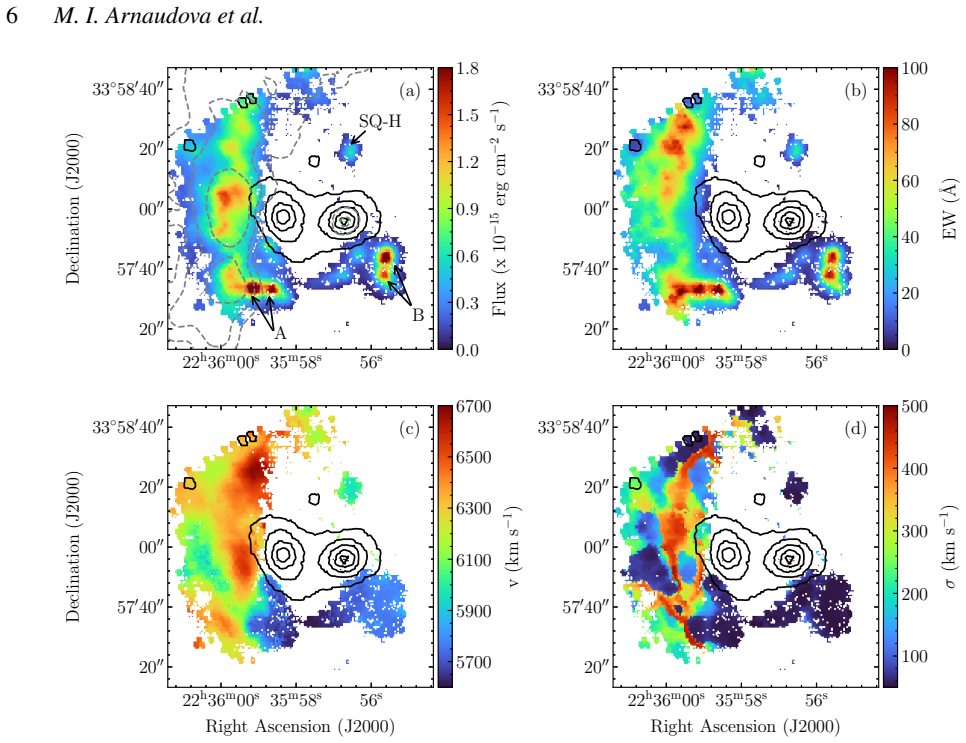
The load-bearing object is the theoretical radio boosting factor from Colafrancesco et al. (2017), $A \sim C^{(-s+2)/3} [C^{2/3}]^{1-\alpha} C^{-1}$, with $s = 2\alpha - 1$ the momentum spectral index and $\alpha = -0.85$ the low-frequency radio spectral index. The compression ratio $C$ is tied to the Mach number by the Rankine–Hugoniot relation $M = (2C/(\gamma_g + 1 - C(\gamma_g-1)))^{1/2}$; taking $\gamma_g = 5/3$ and $4/3$ as limiting adiabatic indices gives $C \approx 3.3$–$4.9$ and hence $A \approx 8.6$–$17.5$. The observed counterpart is the ratio of 1.7 GHz flux density inside the dynamically defined shock region to that just outside, which is about 10. Supporting machinery includes the velocity–velocity-dispersion diagram that defines the shock region dynamically, the spectral curvature parameter (uniform at $\sim$0.32 in the shock, implying an aged pre-existing electron spectrum), and the magnetic-field/lifetime estimate using equipartition and the van der Laan–Perola model.
What would settle it
Measure the X-ray surface-brightness and temperature jump across the same shock front, since a Mach number near 3.8 predicts a compression factor $C$ of 3.3–4.9 and hence a clear X-ray discontinuity; if the X-ray jump is absent or much smaller while the radio boost remains about ten, the adiabatic-compression explanation for the radio jump would fail.
Extended reading notes
Core claim
The central claim is that the large-scale shock in Stephan's Quintet is a weak shock in the hot phase: $\mathcal{M}\sim 2$–$4$, rising to $\sim$3.8 if the front is inclined at $31^\circ$ to the line of sight. At these Mach numbers diffusive shock acceleration is inefficient, so the observed synchrotron emission is not produced at the shock front. Instead the front acts as a compressor: the pre-existing cosmic-ray electron population, mixed into the hot plasma, is adiabatically compressed along with the magnetic field, shifting the electron energy distribution to higher energies and raising the synchrotron luminosity. The shock in the cold neutral gas is a different object: there the velocity jump and assumed pre-shock density give a hypersonic Mach number exceeding 25, sufficient to ionize the HI filaments and explain the emission-line spectrum. The paper therefore separates the shock's role in the cold phase, ionization and excitation, from its role in the hot phase, compression of fossil radio plasma.
Load-bearing premise
The load-bearing premise is that the 1.7 GHz flux density just outside the dynamically defined shock region represents the pre-compression state of the plasma now inside it, with no correction for unrelated radio sources, path-length differences, or projection; a secondary reliance is the assumed pre-shock density of $n_H = 1$ cm$^{-3}$ for the cold-gas Mach number.
Editorial extensions
If this is right
- The 35 kpc radio filament can be explained without ongoing particle acceleration at the current shock, separating the shock's radiative signature from its particle-acceleration efficiency.
- The electron lifetime limit of about 11 Myr is comparable to the estimated 14 Myr crossing time of the intruder galaxy, placing the shock's origin at the ongoing collision.
- The Balmer-decrement extinction map's anti-correlation with infrared PAH, H2 and hot-dust emission indicates that the shock has cleared or destroyed dust in the diffuse gas, while surviving dense grains can host H2 condensation.
- The hypersonic cold-gas shock with Mach number above 25 can ionize the pre-existing HI filaments and explains the observed HI deficiency near the front.
Reading between the lines
- If the paper is right, low-Mach shocks in galaxy groups and clusters can produce radio-bright regions by compressing fossil electrons, so the absence of efficient particle acceleration does not make a shock radio-silent.
- A direct testable extension is to measure the X-ray surface-brightness jump and radio spectral curvature at the same location: compression should preserve the pre-shock curved spectrum, while re-acceleration would flatten it inside the shock.
- The same approach, defining the shock dynamically and comparing inside/outside radio flux density, could be applied to other merging galaxy groups to search for more compression-boosted radio plasma.
Signed reviews
Editorial analysis
A structured set of objections, weighed in public.
Referee Report
Summary. This paper combines WEAVE LIFU first-light integral-field spectroscopy with LoTSS 144 MHz, VLA 1.7 and 4.86 GHz, and JWST MIRI/NIRCam data to study the large-scale shock front in Stephan's Quintet. The authors dynamically define a shock region from H-alpha velocity and velocity-dispersion cuts, stack spectra to obtain an electron temperature upper limit T_e < 22,500 K and density n_e = 480 +/- 70 cm^-3, compare BPT line ratios with MAPPINGS III fast-shock models, estimate Mach numbers in the cold gas (M >~ 25) and hot plasma (M ~ 2-4), and propose that the hot-phase shock adiabatically compresses pre-existing relativistic electrons, boosting the 1.7 GHz radio luminosity by a factor of about ten, in agreement with a theoretical compression factor A ~ 8.6-17.5 from Eq. (3).
Significance. If the adiabatic-compression interpretation is correct, this is an important observational case in which synchrotron emission is enhanced without fresh particle acceleration, with implications for radio relics and cosmic-ray physics in galaxy groups. The paper is strong in its use of first-light WEAVE data, BIC-based multi-component spectral fitting, kinematically defined regions, spectral-index and spectral-curvature maps, and a quantitative comparison built on independently measured Mach number, spectral index, and compression ratio; no parameter is fitted to force the central claim. The main weakness is the empirical baseline used for the observed radio boost, which needs to be strengthened before the factor-of-ten agreement can be considered established.
major comments (2)
- [Sec. 5.5] The observed radio boost of ~10 is the decisive test of the adiabatic-compression scenario, but the baseline is neither quantified nor justified. The text says 'we consider the 1.7 GHz flux density outside the dynamically defined shock region ... and inside the boundary to represent the flux density before and after the shock-induced compression,' yet no flux values, uncertainties, or error propagation are given. The exterior region may contain unrelated radio sources (e.g., SQ-R, NGC 7319, background objects), projection effects, path-length differences, or a pre-existing surface-brightness gradient; without a control measurement (for example, a radial profile across the front, a compact-source-subtracted image, or a spectral-index comparison showing that the same electron population is being compared) the agreement between observed and theoretical boost factors is not a meaningful confirmation. This is load-bearing for the central claim that the shocked radio plasma is compressed rather than re-accelerated.
- [Sec. 5.4 and Sec. 5.5] The theoretical boost range A ~ 8.6-17.5 is evaluated using M ~ 3.8, but the manuscript also allows M_hot >~ 1.9 (Section 5.4). At the lower end, with M = 2, Eq. (4) gives C ~ 2.2-2.8 depending on the adiabatic index, and Eq. (3) gives A ~ 4-6, well below the claimed observed factor of about ten. Because the adiabatic-compression claim rests on quantitative agreement, the paper must propagate the full uncertainty in M_hot (including the assumed 31-degree inclination), alpha, and C through Eq. (3), and state whether the agreement persists over the allowed range. A narrower Mach-number determination from the X-ray data, or a conservative lower bound on A, would make the test robust.
minor comments (6)
- [Sec. 5.2.1 and Fig. 9] The pre-shock density is stated as n = 1 cm^-2 in the text of Section 5.2.1 but as n = 0.1 cm^-3 in the caption of Figure 9, while Section 5.4 refers to n_H = 1 cm^-3 as the value assumed by the MAPPINGS models; these values need to be reconciled and the units corrected.
- [Sec. 5.3, 5.5, 5.6] The spectral index used for the boost calculation is not consistent across the paper: Section 5.3 reports an integrated alpha_LOW of -0.87 +/- 0.16, Section 5.5 uses alpha = -0.85, and Section 5.6 refers to 'the lowest measured radio spectral index' in deriving s = -2.7; the precise choice and its uncertainty should be stated once and used consistently.
- [Sec. 5.5] The observed flux-density ratio of about ten should be reported with the actual inside/outside 1.7 GHz flux densities, the uncertainty from image noise, and the sensitivity to the exact kinematic mask (the sigma >= 150 km/s and v = 6000-6600 km/s cuts defined in Section 4.1); the current '~10' is not reproducible.
- [Sec. 5.4] The cold-gas Mach number M >~ 25 is sensitive to the assumed pre-shock density n_H = 1 cm^-3, which is not independently constrained; the paper should state explicitly that M_cold scales as n_H^-1/2 and give a conservative range for plausible IGM densities.
- [Sec. 5.1] The statement that the MCMC fitting of the stacked spectrum uses 'a method similar to that described in Section 4.1' appears to refer to the spectral fitting method of Section 3 rather than the kinematic region definition of Section 4.1; please correct the cross-reference.
- [Sec. 5.2.1] The text says the pre-shock density n = 1 cm^-2 'is the only value available for the models with varying metal abundances,' but the MAPPINGS III library contains multiple densities; if this statement is accurate, a citation or explanation is needed, and otherwise the sentence should be revised.
Circularity Check
No significant circularity: the radio-boost comparison uses an independently estimated Mach number, measured spectral index, and a direct flux-density ratio; no fitted parameter is renamed as a prediction.
full rationale
The central claim (Section 5.5) is that a weak shock in the hot plasma (M ~ 3.8) adiabatically compresses a pre-existing cosmic-ray electron population, boosting the synchrotron radio luminosity by about a factor of ten. The quantitative test compares a theoretical boost factor A ~ 8.6-17.5, computed from Eq. 3 with the compression ratio C from Eq. 4, to an observed 1.7 GHz flux-density ratio of ~10 between the inside and outside of the dynamically defined shock region. None of the inputs to the theoretical A is fitted to the observed ratio: M comes from the kinematics of NGC7318b relative to the group systemic velocity and the X-ray sound speed (Section 5.4), the spectral index alpha_LOW = -0.85 is measured from the 144 MHz and 1.7 GHz images (Section 5.3), and C follows from M through the standard Rankine-Hugoniot relation (Eq. 4). The observed ratio is a direct aperture measurement, not an adjusted parameter, and the shock mask is defined from optical emission-line velocity dispersion, not from the radio images used to measure the ratio. The paper itself flags the subjectivity of the kinematic decomposition and states the conclusions are insensitive to its details (Section 4.1), which addresses the closest potential concern about the inside/outside baseline. The assumption that the exterior radio flux represents the pre-shock state of the interior plasma is a physical and projection-dependent assumption, but it is not circular: it is not used to construct the theoretical boost factor. Self-citations (e.g., Arnaudova et al. 2024 for stacking methodology, Jin et al. 2024 for the WEAVE pipeline, Smith et al. 2016 for the WEAVE-LOFAR survey) are methodological and non-load-bearing for the weak-shock/adiabatic-compression conclusion. The derivation is therefore self-contained against external data and literature, and no circular step is exhibited.
Assumptions & free parameters
free parameters (7)
- Pre-shock cold gas density n_H =
1 cm^-3 (assumed)
- Pre-shock hot plasma temperature T =
0.4 keV (4.6e6 K)
- Shock region geometry for equipartition =
cylinder radius 6 kpc, height 35 kpc
- Volume filling factor and proton energy ratio =
1.0 and 0
- Electron Lorentz factor limits =
gamma_min=1, gamma_max=1e5
- MAPPINGS pre-shock density for line-ratio comparison =
1 cm^-3 in text; 0.1 cm^-3 in Figure 9 caption
- Extinction parameters for Balmer decrement =
case B T=1e4 K, n_e=100 cm^-3, Calzetti curve, R_V=4.05
assumptions (6)
- domain assumption The shock region is the set of spaxels with velocity 6000-6600 km/s and velocity dispersion >= 150 km/s in the v-sigma diagram.
- domain assumption The hot X-ray plasma is at rest with respect to the group systemic velocity of 6600 km/s.
- domain assumption Ram pressure balance between the cold and hot phases gives v_cold = sqrt(n_hot/n_cold) v_shock.
- domain assumption Case B recombination applies to the Balmer lines.
- domain assumption The relativistic radio-emitting plasma is co-spatial with the hot X-ray phase.
- domain assumption The pre-collision X-ray temperature of the filament was 0.4 keV.
Cite this review
Pith. "Pith review of WEAVE First Light Observations: Origin and Dynamics of the Shock Front in Stephan's Quintet." pith.science (2026). https://pith.science/paper/SAZQTFOG
@misc{pith2026241113635,
  author       = {Pith},
  title        = {Pith review of: WEAVE First Light Observations: Origin and Dynamics of the Shock Front in Stephan's Quintet},
  year         = {2026},
  howpublished = {\url{https://pith.science/paper/SAZQTFOG}},
  note         = {Machine review of arXiv:2411.13635}
}
abstract
We present a detailed study of the large-scale shock front in Stephan's Quintet, a byproduct of past and ongoing interactions. Using integral-field spectroscopy from the new William Herschel Telescope Enhanced Area Velocity Explorer (WEAVE), recent 144 MHz observations from the LOFAR Two-metre Sky Survey (LoTSS), and archival data from the Very Large Array and James Webb Space Telescope (JWST), we obtain new measurements of key shock properties and determine its impact on the system. Harnessing the WEAVE large integral field unit's (LIFU) field of view (90 $\times$ 78 arcsec$^{2}$), spectral resolution ($R\sim2500$) and continuous wavelength coverage across the optical band, we perform robust emission line modeling and dynamically locate the shock within the multi-phase intergalactic medium (IGM) with higher precision than previously possible. The shocking of the cold gas phase is hypersonic, and comparisons with shock models show that it can readily account for the observed emission line ratios. In contrast, we demonstrate that the shock is relatively weak in the hot plasma visible in X-rays (with Mach number of $\mathcal{M} \sim 2 - 4$), making it inefficient at producing the relativistic particles needed to explain the observed synchrotron emission. Instead, we propose that it has led to an adiabatic compression of the medium, which has increased the radio luminosity ten-fold. Comparison of the Balmer line-derived extinction map with the molecular gas and hot dust observed with JWST suggests that pre-existing dust may have survived the collision, allowing the condensation of H$_{2}$ - a key channel for dissipating the shock energy.
Figures


Figures from the paper (8 more)


Forward citations
Cited by 3 Pith papers
-
The Treble Clef radio phoenix and its old nonthermal filaments
VLSS J0318.9+5755 (the Treble Clef) is a radio phoenix with ultra-steep spectrum in a massive merging cluster at z≈0.117 in the Zone of Avoidance, shaped by ICM gas motions that may also power a candidate radio halo.
-
The topology of the magnetic field in Abell 2255 out to its virial radius. Results from the LOFAR Galaxy Cluster Ultra-Deep Field
The magnetic field in Abell 2255 shows ordered, region-dependent orientations inferred from synchrotron intensity gradients, with radial fields in bridges and tangential fields in relics.
-
The DESI View of the Faint Radio Source Population in LoTSS DR2
Probabilistic spectroscopic classification of 251k LoTSS radio sources yields the largest high-confidence sample and confirms LERGs accrete below ~1% Eddington while HERGs accrete above it.
Reference graph
Works this paper leans on
-
[1]
write newline
" write newline "" before.all 'output.state := FUNCTION fin.entry write newline FUNCTION new.block output.state before.all = 'skip after.block 'output.state := if FUNCTION new.sentence output.state after.block = 'skip output.state before.all = 'skip after.sentence 'output.state := if if FUNCTION not #0 #1 if FUNCTION and 'skip pop #0 if FUNCTION or pop #1...
-
[2]
Allen R. J., Hartsuiker J. W., 1972, @doi [ ] 10.1038/239324a0 , https://ui.adsabs.harvard.edu/abs/1972Natur.239..324A 239, 324
-
[3]
Allen M. G., Groves B. A., Dopita M. A., Sutherland R. S., Kewley L. J., 2008, @doi [ ] 10.1086/589652 , https://ui.adsabs.harvard.edu/abs/2008ApJS..178...20A 178, 20
doi:10.1086/589652 2008
-
[4]
Aoki K., Kosugi G., Wilson A. S., Yoshida M., 1999, @doi [The Astrophysical Journal] 10.1086/307559 , https://ui.adsabs.harvard.edu/abs/1999ApJ...521..565A 521, 565
doi:10.1086/307559 1999
-
[5]
Appleton P. N., et al., 2006, @doi [ ] 10.1086/502646 , https://ui.adsabs.harvard.edu/abs/2006ApJ...639L..51A 639, L51
doi:10.1086/502646 2006
-
[6]
Appleton P. N., et al., 2017, @doi [ ] 10.3847/1538-4357/836/1/76 , https://ui.adsabs.harvard.edu/abs/2017ApJ...836...76A 836, 76
-
[7]
Appleton P. N., et al., 2023, @doi [ ] 10.3847/1538-4357/accc2a , https://ui.adsabs.harvard.edu/abs/2023ApJ...951..104A 951, 104
-
[8]
Arnaudova M. I., et al., 2024, @doi [ ] 10.1093/mnras/stae233 , https://ui.adsabs.harvard.edu/abs/2024MNRAS.528.4547A 528, 4547
Show all 107 references
-
[9]
A., Phillips M
Baldwin J. A., Phillips M. M., Terlevich R., 1981, @doi [ ] 10.1086/130766 , https://ui.adsabs.harvard.edu/abs/1981PASP...93....5B 93, 5
1981 doi
-
[10]
E., Hernquist L., 1996, @doi [ ] 10.1086/177957 , https://ui.adsabs.harvard.edu/abs/1996ApJ...471..115B 471, 115
Barnes J. E., Hernquist L., 1996, @doi [ ] 10.1086/177957 , https://ui.adsabs.harvard.edu/abs/1996ApJ...471..115B 471, 115
1996 doi
-
[11]
Beck R., Krause M., 2005, @doi [Astronomische Nachrichten] 10.1002/asna.200510366 , https://ui.adsabs.harvard.edu/abs/2005AN....326..414B 326, 414
2005 doi
-
[13]
Botteon A., Brunetti G., Ryu D., Roh S., 2020b, @doi [ ] 10.1051/0004-6361/201936216 , https://ui.adsabs.harvard.edu/abs/2020A&A...634A..64B 634, A64
-
[14]
W., 2014, @doi [International Journal of Modern Physics D] 10.1142/S0218271814300079 , https://ui.adsabs.harvard.edu/abs/2014IJMPD..2330007B 23, 1430007
Brunetti G., Jones T. W., 2014, @doi [International Journal of Modern Physics D] 10.1142/S0218271814300079 , https://ui.adsabs.harvard.edu/abs/2014IJMPD..2330007B 23, 1430007
2014 doi
-
[15]
M., Burbidge G
Burbidge E. M., Burbidge G. R., 1961, @doi [ ] 10.1086/147146 , https://ui.adsabs.harvard.edu/abs/1961ApJ...134..244B 134, 244
1961 doi
-
[16]
CASA Team et al., 2022, @doi [Publications of the Astronomical Society of the Pacific] 10.1088/1538-3873/ac9642 , https://ui.adsabs.harvard.edu/abs/2022PASP..134k4501C 134, 114501
2022 doi
-
[17]
Calistro Rivera G., et al., 2017, @doi [ ] 10.1093/mnras/stx1040 , https://ui.adsabs.harvard.edu/abs/2017MNRAS.469.3468C 469, 3468
2017 doi
-
[18]
C., Kinney A
Calzetti D., Armus L., Bohlin R. C., Kinney A. L., Koornneef J., Storchi-Bergmann T., 2000, @doi [ ] 10.1086/308692 , https://ui.adsabs.harvard.edu/abs/2000ApJ...533..682C 533, 682
2000 doi
-
[20]
Cazaux S., Tielens A. G. G. M., 2004, @doi [ ] 10.1086/381775 , https://ui.adsabs.harvard.edu/abs/2004ApJ...604..222C 604, 222
2004 doi
-
[21]
T., et al., 2018, @doi [Astronomy and Astrophysics] 10.1051/0004-6361/201833133 , https://ui.adsabs.harvard.edu/abs/2018A&A...619A..36C 619, A36
Chy \.z y K. T., et al., 2018, @doi [Astronomy and Astrophysics] 10.1051/0004-6361/201833133 , https://ui.adsabs.harvard.edu/abs/2018A&A...619A..36C 619, A36
2018 doi
-
[22]
Cibinel A., et al., 2019, @doi [ ] 10.1093/mnras/stz690 , https://ui.adsabs.harvard.edu/abs/2019MNRAS.485.5631C 485, 5631
2019 doi
-
[23]
E., et al., 2010, @doi [ ] 10.1088/0004-637X/710/1/248 , https://ui.adsabs.harvard.edu/abs/2010ApJ...710..248C 710, 248
Cluver M. E., et al., 2010, @doi [ ] 10.1088/0004-637X/710/1/248 , https://ui.adsabs.harvard.edu/abs/2010ApJ...710..248C 710, 248
2010 doi
-
[24]
M., 2017, @doi [Monthly Notices of the Royal Astronomical Society] 10.1093/mnras/stx1806 , https://ui.adsabs.harvard.edu/abs/2017MNRAS.471.4747C 471, 4747
Colafrancesco S., Marchegiani P., Paulo C. M., 2017, @doi [Monthly Notices of the Royal Astronomical Society] 10.1093/mnras/stx1806 , https://ui.adsabs.harvard.edu/abs/2017MNRAS.471.4747C 471, 4747
2017 doi
-
[25]
H., Ramos Almeida C., Watkins A
Comer \'o n S., Knapen J. H., Ramos Almeida C., Watkins A. E., 2021, @doi [ ] 10.1051/0004-6361/202039382 , https://ui.adsabs.harvard.edu/abs/2021A&A...645A.130C 645, A130
2021 doi
-
[26]
S., Ramsay S
Dalton G., et al., 2012, in McLean I. S., Ramsay S. K., Takami H., eds, Society of Photo-Optical Instrumentation Engineers (SPIE) Conference Series Vol. 8446, Ground-based and Airborne Instrumentation for Astronomy IV. p. 84460P, @doi 10.1117/12.925950
2012 doi
-
[27]
Della Bruna L., et al., 2022, @doi [ ] 10.1051/0004-6361/202243395 , https://ui.adsabs.harvard.edu/abs/2022A&A...666A..29D 666, A29
2022 doi
-
[28]
H., 2020, @doi [ ] 10.1051/0004-6361/201937384 , https://ui.adsabs.harvard.edu/abs/2020A&A...635A.197D 635, A197
D \' az-Garc \' a S., Knapen J. H., 2020, @doi [ ] 10.1051/0004-6361/201937384 , https://ui.adsabs.harvard.edu/abs/2020A&A...635A.197D 635, A197
2020 doi
-
[30]
C ., 2023, Advances in Space Research, 71, 1219
Doj c inovi \'c I., Kova c evi \'c -Doj c inovi \'c J., Popovi \'c L. C ., 2023, Advances in Space Research, 71, 1219
2023
-
[31]
Dom \' nguez A., et al., 2013, @doi [ ] 10.1088/0004-637X/763/2/145 , https://ui.adsabs.harvard.edu/abs/2013ApJ...763..145D 763, 145
2013 doi
-
[32]
A., et al., 2005, @doi [ ] 10.1086/423948 , https://ui.adsabs.harvard.edu/abs/2005ApJ...619..755D 619, 755
Dopita M. A., et al., 2005, @doi [ ] 10.1086/423948 , https://ui.adsabs.harvard.edu/abs/2005ApJ...619..755D 619, 755
2005 doi
-
[33]
A., et al., 2006, @doi [ ] 10.1086/508261 , https://ui.adsabs.harvard.edu/abs/2006ApJS..167..177D 167, 177
Dopita M. A., et al., 2006, @doi [ ] 10.1086/508261 , https://ui.adsabs.harvard.edu/abs/2006ApJS..167..177D 167, 177
2006 doi
-
[34]
M., Drissen L., Kehrig C., Martin T., 2019, @doi [ ] 10.1051/0004-6361/201935686 , https://ui.adsabs.harvard.edu/abs/2019A&A...629A.102D 629, A102
Duarte Puertas S., Iglesias-P \'a ramo J., Vilchez J. M., Drissen L., Kehrig C., Martin T., 2019, @doi [ ] 10.1051/0004-6361/201935686 , https://ui.adsabs.harvard.edu/abs/2019A&A...629A.102D 629, A102
2019 doi
-
[35]
Duarte Puertas S., Vilchez J. M., Iglesias-P \'a ramo J., Drissen L., Kehrig C., Martin T., P \'e rez-Montero E., Arroyo-Polonio A., 2021, @doi [ ] 10.1051/0004-6361/202038734 , https://ui.adsabs.harvard.edu/abs/2021A&A...645A..57D 645, A57
2021 doi
-
[36]
En lin T. A., Br \"u ggen M., 2002, @doi [Monthly Notices of the Royal Astronomical Society] 10.1046/j.1365-8711.2002.05261.x , https://ui.adsabs.harvard.edu/abs/2002MNRAS.331.1011E 331, 1011
2002
-
[37]
A., Gopal-Krishna 2001, @doi [Astronomy and Astrophysics] 10.1051/0004-6361:20000198 , https://ui.adsabs.harvard.edu/abs/2001A&A...366...26E 366, 26
En lin T. A., Gopal-Krishna 2001, @doi [Astronomy and Astrophysics] 10.1051/0004-6361:20000198 , https://ui.adsabs.harvard.edu/abs/2001A&A...366...26E 366, 26
2001 doi
-
[38]
Feretti L., Giovannini G., Govoni F., Murgia M., 2012, @doi [ ] 10.1007/s00159-012-0054-z , https://ui.adsabs.harvard.edu/abs/2012A&ARv..20...54F 20, 54
2012 doi
-
[39]
L., 1999, @doi [ ] 10.1086/316293 , https://ui.adsabs.harvard.edu/abs/1999PASP..111...63F 111, 63
Fitzpatrick E. L., 1999, @doi [ ] 10.1086/316293 , https://ui.adsabs.harvard.edu/abs/1999PASP..111...63F 111, 63
1999 doi
-
[40]
L., Danese L., 1994, @doi [ ] 10.1093/mnras/268.1.235 , https://ui.adsabs.harvard.edu/abs/1994MNRAS.268..235G 268, 235
Granato G. L., Danese L., 1994, @doi [ ] 10.1093/mnras/268.1.235 , https://ui.adsabs.harvard.edu/abs/1994MNRAS.268..235G 268, 235
1994 doi
-
[41]
S., Ramsay S
Grandmont F., Drissen L., Mandar J., Thibault S., Baril M., 2012, in McLean I. S., Ramsay S. K., Takami H., eds, Society of Photo-Optical Instrumentation Engineers (SPIE) Conference Series Vol. 8446, Ground-based and Airborne Instrumentation for Astronomy IV. p. 84460U, @doi 1...
2012 doi
-
[42]
C., et al., 2012, @doi [ ] 10.1088/0004-637X/744/1/6010.1086/141956 , https://ui.adsabs.harvard.edu/abs/2012ApJ...744...60G 744, 60
Green J. C., et al., 2012, @doi [ ] 10.1088/0004-637X/744/1/6010.1086/141956 , https://ui.adsabs.harvard.edu/abs/2012ApJ...744...60G 744, 60
2012
-
[43]
W., 2003, in Heck A., ed., Astrophysics and Space Science Library Vol
Greisen E. W., 2003, in Heck A., ed., Astrophysics and Space Science Library Vol. 285, Information Handling in Astronomy - Historical Vistas. p. 109, @doi 10.1007/0-306-48080-8_7
2003 doi
-
[44]
N., 2009, @doi [ ] 10.1051/0004-6361/200811263 , https://ui.adsabs.harvard.edu/abs/2009A&A...502..515G 502, 515
Guillard P., Boulanger F., Pineau Des For \^e ts G., Appleton P. N., 2009, @doi [ ] 10.1051/0004-6361/200811263 , https://ui.adsabs.harvard.edu/abs/2009A&A...502..515G 502, 515
2009 doi
-
[45]
Guillard P., et al., 2022, @doi [ ] 10.3847/1538-4357/ac313f , https://ui.adsabs.harvard.edu/abs/2022ApJ...925...63G 925, 63
2022 doi
-
[46]
J., Birkinshaw M., Worrall D
Hardcastle M. J., Birkinshaw M., Worrall D. M., 1998, @doi [Monthly Notices of the Royal Astronomical Society] 10.1111/j.1365-8711.1998.01159.x10.1046/j.1365-8711.1998.01159.x , https://ui.adsabs.harvard.edu/abs/1998MNRAS.294..615H 294, 615
1998
-
[47]
J., et al., 2023, @doi [ ] 10.1051/0004-6361/202347333 , https://ui.adsabs.harvard.edu/abs/2023A&A...678A.151H 678, A151
Hardcastle M. J., et al., 2023, @doi [ ] 10.1051/0004-6361/202347333 , https://ui.adsabs.harvard.edu/abs/2023A&A...678A.151H 678, A151
2023 doi
-
[48]
J., et al., 2017, @doi [ ] 10.1093/mnras/stx820 , https://ui.adsabs.harvard.edu/abs/2017MNRAS.469..639H 469, 639
Harwood J. J., et al., 2017, @doi [ ] 10.1093/mnras/stx820 , https://ui.adsabs.harvard.edu/abs/2017MNRAS.469..639H 469, 639
2017 doi
-
[49]
Heesen V., et al., 2022, @doi [Astronomy and Astrophysics] 10.1051/0004-6361/202142878 , https://ui.adsabs.harvard.edu/abs/2022A&A...664A..83H 664, A83
2022 doi
-
[50]
P., Palumbo G
Hickson P., Mendes de Oliveira C., Huchra J. P., Palumbo G. G., 1992, @doi [ ] 10.1086/171932 , https://ui.adsabs.harvard.edu/abs/1992ApJ...399..353H 399, 353
1992 doi
-
[51]
F., Hernquist L., Cox T
Hopkins P. F., Hernquist L., Cox T. J., Di Matteo T., Robertson B., Springel V., 2006, @doi [ ] 10.1086/499298 , https://ui.adsabs.harvard.edu/abs/2006ApJS..163....1H 163, 1
2006 doi
-
[52]
M., Petropoulou V., Sulentic J
Iglesias-P \'a ramo J., L \'o pez-Mart \' n L., V \' lchez J. M., Petropoulou V., Sulentic J. W., 2012, @doi [ ] 10.1051/0004-6361/201118055 , https://ui.adsabs.harvard.edu/abs/2012A&A...539A.127I 539, A127
2012 doi
-
[53]
Jin S., et al., 2024, @doi [ ] 10.1093/mnras/stad557 , https://ui.adsabs.harvard.edu/abs/2024MNRAS.530.2688J 530, 2688
2024 doi
-
[54]
P., Tielens A
Jones A. P., Tielens A. G. G. M., Hollenbach D. J., McKee C. F., 1994, @doi [ ] 10.1086/174689 , https://ui.adsabs.harvard.edu/abs/1994ApJ...433..797J 433, 797
1994 doi
-
[55]
G., et al., 2023, @doi [ ] 10.1051/0004-6361/202244622 , https://ui.adsabs.harvard.edu/abs/2023A&A...670A..21J 670, A21
Jones M. G., et al., 2023, @doi [ ] 10.1051/0004-6361/202244622 , https://ui.adsabs.harvard.edu/abs/2023A&A...670A..21J 670, A21
2023 doi
-
[56]
P., 2007, @doi [The Astrophysical Journal] 10.1086/521717 , https://ui.adsabs.harvard.edu/abs/2007ApJ...669..729K 669, 729
Kang H., Ryu D., Cen R., Ostriker J. P., 2007, @doi [The Astrophysical Journal] 10.1086/521717 , https://ui.adsabs.harvard.edu/abs/2007ApJ...669..729K 669, 729
2007 doi
-
[57]
Kauffmann G., et al., 2003, @doi [ ] 10.1046/j.1365-8711.2003.06291.x , https://ui.adsabs.harvard.edu/abs/2003MNRAS.341...33K 341, 33
2003
-
[58]
Kelz A., et al., 2006, @doi [ ] 10.1086/497455 , https://ui.adsabs.harvard.edu/abs/2006PASP..118..129K 118, 129
2006 doi
-
[59]
J., Dopita M
Kewley L. J., Dopita M. A., Sutherland R. S., Heisler C. A., Trevena J., 2001, @doi [ ] 10.1086/321545 , https://ui.adsabs.harvard.edu/abs/2001ApJ...556..121K 556, 121
2001 doi
-
[60]
J., Groves B., Kauffmann G., Heckman T., 2006, @doi [ ] 10.1111/j.1365-2966.2006.10859.x , https://ui.adsabs.harvard.edu/abs/2006MNRAS.372..961K 372, 961
Kewley L. J., Groves B., Kauffmann G., Heckman T., 2006, @doi [ ] 10.1111/j.1365-2966.2006.10859.x , https://ui.adsabs.harvard.edu/abs/2006MNRAS.372..961K 372, 961
2006
-
[61]
H., Cisternas M., Querejeta M., 2015, @doi [ ] 10.1093/mnras/stv2135 , https://ui.adsabs.harvard.edu/abs/2015MNRAS.454.1742K 454, 1742
Knapen J. H., Cisternas M., Querejeta M., 2015, @doi [ ] 10.1093/mnras/stv2135 , https://ui.adsabs.harvard.edu/abs/2015MNRAS.454.1742K 454, 1742
2015 doi
-
[62]
S., et al., 2014, @doi [ ] 10.1088/0004-637X/784/1/1 , https://ui.adsabs.harvard.edu/abs/2014ApJ...784....1K 784, 1
Konstantopoulos I. S., et al., 2014, @doi [ ] 10.1088/0004-637X/784/1/1 , https://ui.adsabs.harvard.edu/abs/2014ApJ...784....1K 784, 1
2014 doi
-
[63]
P., Rodr \' guez-Ardila A., Fraga L., 2020, @doi [ ] 10.1051/0004-6361/202038088 , https://ui.adsabs.harvard.edu/abs/2020A&A...642A.203L 642, A203
Lima-Costa F., Martins L. P., Rodr \' guez-Ardila A., Fraga L., 2020, @doi [ ] 10.1051/0004-6361/202038088 , https://ui.adsabs.harvard.edu/abs/2020A&A...642A.203L 642, A203
2020 doi
-
[64]
S., 2011, High Energy Astrophysics
Longair M. S., 2011, High Energy Astrophysics
2011
-
[65]
Markevitch M., Vikhlinin A., 2007, @doi [Physics Reports] 10.1016/j.physrep.2007.01.001 , https://ui.adsabs.harvard.edu/abs/2007PhR...443....1M 443, 1
2007 doi
-
[66]
Markevitch M., Govoni F., Brunetti G., Jerius D., 2005, @doi [The Astrophysical Journal] 10.1086/430695 , https://ui.adsabs.harvard.edu/abs/2005ApJ...627..733M 627, 733
2005 doi
-
[67]
W., M \'a rquez I., 1997, @doi [ ] 10.1086/310817 , https://ui.adsabs.harvard.edu/abs/1997ApJ...485L..69M 485, L69
Moles M., Sulentic J. W., M \'a rquez I., 1997, @doi [ ] 10.1086/310817 , https://ui.adsabs.harvard.edu/abs/1997ApJ...485L..69M 485, L69
1997 doi
-
[68]
Murgia M., et al., 2011, @doi [ ] 10.1051/0004-6361/201015302 , https://ui.adsabs.harvard.edu/abs/2011A&A...526A.148M 526, A148
2011 doi
-
[69]
T., Spangler S
Myers S. T., Spangler S. R., 1985, @doi [ ] 10.1086/163040 , https://ui.adsabs.harvard.edu/abs/1985ApJ...291...52M 291, 52
1985 doi
-
[70]
J., 2013, @doi [ ] 10.1093/mnras/stt1263 , https://ui.adsabs.harvard.edu/abs/2013MNRAS.435..149N 435, 149
Nikiel-Wroczy \'n ski B., Soida M., Urbanik M., Beck R., Bomans D. J., 2013, @doi [ ] 10.1093/mnras/stt1263 , https://ui.adsabs.harvard.edu/abs/2013MNRAS.435..149N 435, 149
2013 doi
-
[71]
M., Raychaudhury S., David L
O'Sullivan E., Giacintucci S., Vrtilek J. M., Raychaudhury S., David L. P., 2009, @doi [ ] 10.1088/0004-637X/701/2/1560 , https://ui.adsabs.harvard.edu/abs/2009ApJ...701.1560O 701, 1560
2009 doi
-
[72]
E., Ferland G
Osterbrock D. E., Ferland G. J., 2006, Astrophysics of gaseous nebulae and active galactic nuclei
2006
-
[73]
A., Chandler C
Perley R. A., Chandler C. J., Butler B. J., Wrobel J. M., 2011, @doi [The Astrophysical Journal] 10.1088/2041-8205/739/1/L1 , https://ui.adsabs.harvard.edu/abs/2011ApJ...739L...1P 739, L1
2011 doi
-
[74]
Pierce J. C. S., et al., 2023, @doi [ ] 10.1093/mnras/stad455 , https://ui.adsabs.harvard.edu/abs/2023MNRAS.522.1736P 522, 1736
2023 doi
-
[75]
M., et al., 2022, @doi [ ] 10.3847/2041-8213/ac8a4e , https://ui.adsabs.harvard.edu/abs/2022ApJ...936L..14P 936, L14
Pontoppidan K. M., et al., 2022, @doi [ ] 10.3847/2041-8213/ac8a4e , https://ui.adsabs.harvard.edu/abs/2022ApJ...936L..14P 936, L14
2022 doi
-
[76]
Proxauf B., \"O ttl S., Kimeswenger S., 2014, @doi [ ] 10.1051/0004-6361/201322581 , https://ui.adsabs.harvard.edu/abs/2014A&A...561A..10P 561, A10
2014 doi
-
[77]
R., et al., 2018, @doi [ ] 10.3847/1538-4357/aaa2fc , https://ui.adsabs.harvard.edu/abs/2018ApJ...853...87R 853, 87
Rigby J. R., et al., 2018, @doi [ ] 10.3847/1538-4357/aaa2fc , https://ui.adsabs.harvard.edu/abs/2018ApJ...853...87R 853, 87
2018 doi
-
[78]
F., D \' az A
Rodr \' guez-Baras M., Rosales-Ortega F. F., D \' az A. I., S \'a nchez S. F., Pasquali A., 2014, @doi [ ] 10.1093/mnras/stu851 , https://ui.adsabs.harvard.edu/abs/2014MNRAS.442..495R 442, 495
2014 doi
-
[79]
M., et al., 2005, @doi [ ] 10.1086/429877 , https://ui.adsabs.harvard.edu/abs/2005PASP..117..620R 117, 620
Roth M. M., et al., 2005, @doi [ ] 10.1086/429877 , https://ui.adsabs.harvard.edu/abs/2005PASP..117..620R 117, 620
2005 doi
-
[80]
Ryu D., Kang H., Cho J., Das S., 2008, @doi [Science] 10.1126/science.1154923 , https://ui.adsabs.harvard.edu/abs/2008Sci...320..909R 320, 909
2008 doi
-
[81]
F., et al., 2015, @doi [ ] 10.1051/0004-6361/201424873 , https://ui.adsabs.harvard.edu/abs/2015A&A...574A..47S 574, A47
S \'a nchez S. F., et al., 2015, @doi [ ] 10.1051/0004-6361/201424873 , https://ui.adsabs.harvard.edu/abs/2015A&A...574A..47S 574, A47
2015 doi
-
[82]
L., McAlpine W., Hickox R
Satyapal S., Ellison S. L., McAlpine W., Hickox R. C., Patton D. R., Mendel J. T., 2014, @doi [ ] 10.1093/mnras/stu650 , https://ui.adsabs.harvard.edu/abs/2014MNRAS.441.1297S 441, 1297
2014 doi
-
[83]
J., Finkbeiner D
Schlegel D. J., Finkbeiner D. P., Davis M., 1998, @doi [ ] 10.1086/305772 , https://ui.adsabs.harvard.edu/abs/1998ApJ...500..525S 500, 525
1998 doi
-
[84]
W., et al., 2022, @doi [ ] 10.1051/0004-6361/202142484 , https://ui.adsabs.harvard.edu/abs/2022A&A...659A...1S 659, A1
Shimwell T. W., et al., 2022, @doi [ ] 10.1051/0004-6361/202142484 , https://ui.adsabs.harvard.edu/abs/2022A&A...659A...1S 659, A1
2022 doi
-
[85]
H., 2021, @doi [Galaxies] 10.3390/galaxies9040121 , https://ui.adsabs.harvard.edu/abs/2021Galax...9..121S 9, 121
Singh V., Dutta S., Wadadekar Y., Ishwara-Chandra C. H., 2021, @doi [Galaxies] 10.3390/galaxies9040121 , https://ui.adsabs.harvard.edu/abs/2021Galax...9..121S 9, 121
2021 doi
-
[86]
W., O'Shea B
Skillman S. W., O'Shea B. W., Hallman E. J., Burns J. O., Norman M. L., 2008, @doi [ ] 10.1086/592496 , https://ui.adsabs.harvard.edu/abs/2008ApJ...689.1063S 689, 1063
2008 doi
-
[87]
Smith D. J. B., Simpson C., Swinbank A. M., Rawlings S., Jarvis M. J., 2010, @doi [ ] 10.1111/j.1365-2966.2010.16279.x , https://ui.adsabs.harvard.edu/abs/2010MNRAS.404.1089S 404, 1089
2010
-
[88]
Smith D. J. B., et al., 2013, @doi [ ] 10.1093/mnras/stt1737 , https://ui.adsabs.harvard.edu/abs/2013MNRAS.436.2435S 436, 2435
2013 doi
- [89]
-
[90]
S., Gallagher J
Sparke L. S., Gallagher J. S., 2000, Galaxies in the universe: an introduction. Cambridge University Press
2000
-
[91]
Stephan M., 1877, @doi [ ] 10.1093/mnras/37.6.334 , https://ui.adsabs.harvard.edu/abs/1877MNRAS..37..334S 37, 334
-
[92]
Sulentic J. W., Rosado M., Dultzin-Hacyan D., Verdes-Montenegro L., Trinchieri G., Xu C., Pietsch W., 2001, @doi [ ] 10.1086/324455 , https://ui.adsabs.harvard.edu/abs/2001AJ....122.2993S 122, 2993
2001 doi
-
[93]
R., Clark B
Thompson A. R., Clark B. G., Wade C. M., Napier P. J., 1980, @doi [ ] 10.1086/190688 , https://ui.adsabs.harvard.edu/abs/1980ApJS...44..151T 44, 151
1980 doi
-
[94]
Trinchieri G., Sulentic J., Breitschwerdt D., Pietsch W., 2003, @doi [ ] 10.1051/0004-6361:20030108 , https://ui.adsabs.harvard.edu/abs/2003A&A...401..173T 401, 173
2003 doi
-
[95]
Trinchieri G., Sulentic J., Pietsch W., Breitschwerdt D., 2005, @doi [ ] 10.1051/0004-6361:20052910 , https://ui.adsabs.harvard.edu/abs/2005A&A...444..697T 444, 697
2005 doi
-
[96]
Vazza F., Roediger E., Br \"u ggen M., 2012, @doi [Astronomy and Astrophysics] 10.1051/0004-6361/201118688 , https://ui.adsabs.harvard.edu/abs/2012A&A...544A.103V 544, A103
2012 doi
-
[97]
Vink J., Yamazaki R., 2014, @doi [ ] 10.1088/0004-637X/780/2/125 , https://ui.adsabs.harvard.edu/abs/2014ApJ...780..125V 780, 125
2014 doi
-
[98]
A., et al., 2014, in Chiozzi G., Radziwill N
Walton N. A., et al., 2014, in Chiozzi G., Radziwill N. M., eds, Society of Photo-Optical Instrumentation Engineers (SPIE) Conference Series Vol. 9152, Software and Cyberinfrastructure for Astronomy III. p. 91520R, @doi 10.1117/12.2055457
2014 doi
-
[99]
H., 2011, Journal of Astronomical History and Heritage, https://ui.adsabs.harvard.edu/abs/2011JAHH...14....3W 14, 3
Wielebinski R., Junkes N., Grahl B. H., 2011, Journal of Astronomical History and Heritage, https://ui.adsabs.harvard.edu/abs/2011JAHH...14....3W 14, 3
2011
-
[100]
A., Yun M
Williams B. A., Yun M. S., Verdes-Montenegro L., 2002, @doi [ ] 10.1086/339839 , https://ui.adsabs.harvard.edu/abs/2002AJ....123.2417W 123, 2417
2002 doi
-
[101]
Xanthopoulos E., Muxlow T. W. B., Thomasson P., Garrington S. T., 2004, @doi [Monthly Notices of the Royal Astronomical Society] 10.1111/j.1365-2966.2004.08133.x , https://ui.adsabs.harvard.edu/abs/2004MNRAS.353.1117X 353, 1117
2004
-
[103]
K., Lu N., Condon J
Xu C. K., Lu N., Condon J. J., Dopita M., Tuffs R. J., 2003b, @doi [The Astrophysical Journal] 10.1086/377445 , https://ui.adsabs.harvard.edu/abs/2003ApJ...595..665X 595, 665
-
[104]
K., et al., 2008, in Chary R
Xu C. K., et al., 2008, in Chary R. R., Teplitz H. I., Sheth K., eds, Astronomical Society of the Pacific Conference Series Vol. 381, Infrared Diagnostics of Galaxy Evolution. p. 88
2008
-
[105]
Yttergren M., Misquitta P., S \'a nchez-Monge \'A ., Valencia-S M., Eckart A., Zensus A., Peitl-Thiesen T., 2021, @doi [ ] 10.1051/0004-6361/202040188 , https://ui.adsabs.harvard.edu/abs/2021A&A...656A..83Y 656, A83
2021 doi
-
[106]
Zaragoza-Cardiel J., et al., 2015, @doi [ ] 10.1093/mnras/stv1024 , https://ui.adsabs.harvard.edu/abs/2015MNRAS.451.1307Z 451, 1307
2015 doi
-
[107]
B., et al., 2015, @doi [ ] 10.1088/0004-637X/815/1/48 , https://ui.adsabs.harvard.edu/abs/2015ApJ...815...48Z 815, 48
Zhu G. B., et al., 2015, @doi [ ] 10.1088/0004-637X/815/1/48 , https://ui.adsabs.harvard.edu/abs/2015ApJ...815...48Z 815, 48
2015 doi
-
[108]
W., 2019, @doi [ ] 10.3847/1538-4357/ab3226 , https://ui.adsabs.harvard.edu/abs/2019ApJ...882..135Z 882, 135
Zhu H., Slane P., Raymond J., Tian W. W., 2019, @doi [ ] 10.3847/1538-4357/ab3226 , https://ui.adsabs.harvard.edu/abs/2019ApJ...882..135Z 882, 135
2019 doi
-
[109]
J., et al., 2017, @doi [Nature Astronomy] 10.1038/s41550-016-0005 , https://ui.adsabs.harvard.edu/abs/2017NatAs...1E...5V 1, 0005
van Weeren R. J., et al., 2017, @doi [Nature Astronomy] 10.1038/s41550-016-0005 , https://ui.adsabs.harvard.edu/abs/2017NatAs...1E...5V 1, 0005
2017 doi
-
[110]
M., Rots A
van der Hulst J. M., Rots A. H., 1981, @doi [ ] 10.1086/113060 , https://ui.adsabs.harvard.edu/abs/1981AJ.....86.1775V 86, 1775
1981 doi
-
[111]
C., 1969, , https://ui.adsabs.harvard.edu/abs/1969A&A.....3..468V 3, 468
van der Laan H., Perola G. C., 1969, , https://ui.adsabs.harvard.edu/abs/1969A&A.....3..468V 3, 468
1969
Reviewed August 12, 2026 · model on record in the stance chip above.
Discussion (0). Continue with ORCID to comment.