pith.machine review for the scientific record.sign in
astro-ph.GA
Astrophysics of Galaxies
Phenomena pertaining to galaxies or the Milky Way. Star clusters, HII regions and planetary nebulae, the interstellar medium, atomic and molecular clouds, dust. Stellar populations. Galactic structure, formation, dynamics. Galactic nuclei, bulges, disks, halo. Active Galactic Nuclei, supermassive black holes, quasars. Gravitational lens systems. The Milky Way and its contents
We present an automatic method based on machine-learning convolutional neural network (CNN) architecture to detect Lyman alpha emitters (LAE) hidden in the Data Release 1 spectroscopic dataset of the Dark Energy Spectroscopic Instrument (DESI). Those LAEs mostly have incorrect redshift estimations because the current DESI pipeline is not designed to detect and measure the redshifts of galaxies at $z>2$. To uncover those sources, we first visually inspect thousands of DESI spectra and construct a sample, consisting of both LAEs and non-LAEs, for training and testing the CNN-based model to (1) detect LAEs in DESI spectra and (2) determine their Ly$\alpha$ redshifts. The final model yields $95.2\%$ purity and $95.9\%$ completeness for detecting LAEs. We apply this model to approximately $2\times10^{6}$ spectra of sources targeted as emission-line galaxies and detect 19,685 LAEs from $z\sim2$ to $3.5$ within 12 minutes with a single GPU, illustrating the high efficiency of this model for identifying LAEs. The detected LAEs are mostly at the bright end of the luminosity function with Ly$\alpha$ luminosity $L_{\rm Ly\alpha} \gtrsim 10^{43}$ erg/s. The high signal-to-noise composite spectrum of the detected LAEs further shows various spectral features, including P-Cygni profiles of metal lines and MgII emission lines, possible indicators of Lyman continuum escape fraction, revealing the rich astrophysical information in this LAE sample. Finally, this sample can be used to train and validate the pipelines for redshift determination of LAEs for the preparation of the DESI-II survey.
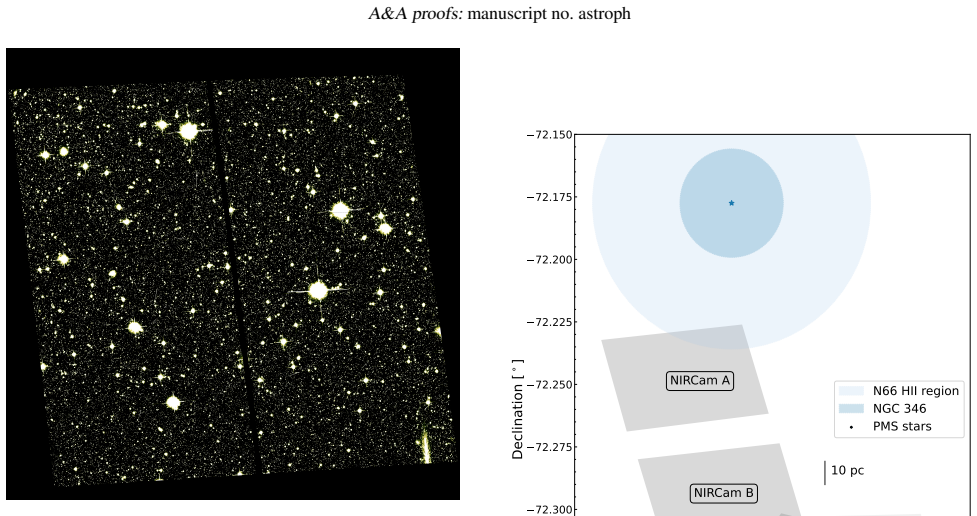
We studied the properties of star formation and the characteristics of young stars in a quiet region located beyond the outskirts of the prominent star-forming cluster NGC 346 in the Small Magellanic Cloud (SMC). Utilising observations from the Hubble Space Telescope across the broad V and I bands, as well as the narrow Halpha band, we identified populations with ages of roughly 10, 60, 400 Myr and of 5 Gyr through isochrone comparison. We successfully identified 137 bona fide pre-main sequence (PMS) candidates exhibiting Halpha excess with a significance level of 5 sigma, accompanied by an Halpha line emission equivalent width exceeding 20 \AA. Physical parameters for these PMS stars were determined, including mass, age, accretion luminosity, and mass accretion rate. Most PMS stars have an age around 16 Myr and an average mass of 0.80 \pm 0.16 M_sun. The median mass accretion rate for all 137 PMS stars is estimated to be about 8.0 x 10^(-9) M_sun/yr. While this rate is lower than that observed in the NGC 346 cluster itself, it is comparable with those measured for PMS stars in low-density star-forming regions in the SMC, despite the absence of apparent clustering and nebulosity. Furthermore, our analysis reveals that the ratios of accreting and non-accreting PMS stars to non-PMS stars and their mass accretion rate correlate with their distance from a group of hot massive stars in the vicinity. This suggests that the ultraviolet radiation emitted by these massive stars might erode the circumstellar discs of nearby PMS stars. Lastly, the overlap between our studied region and observations from the James Webb Space Telescope reveals that some of the identified PMS stars display near-infrared excess.
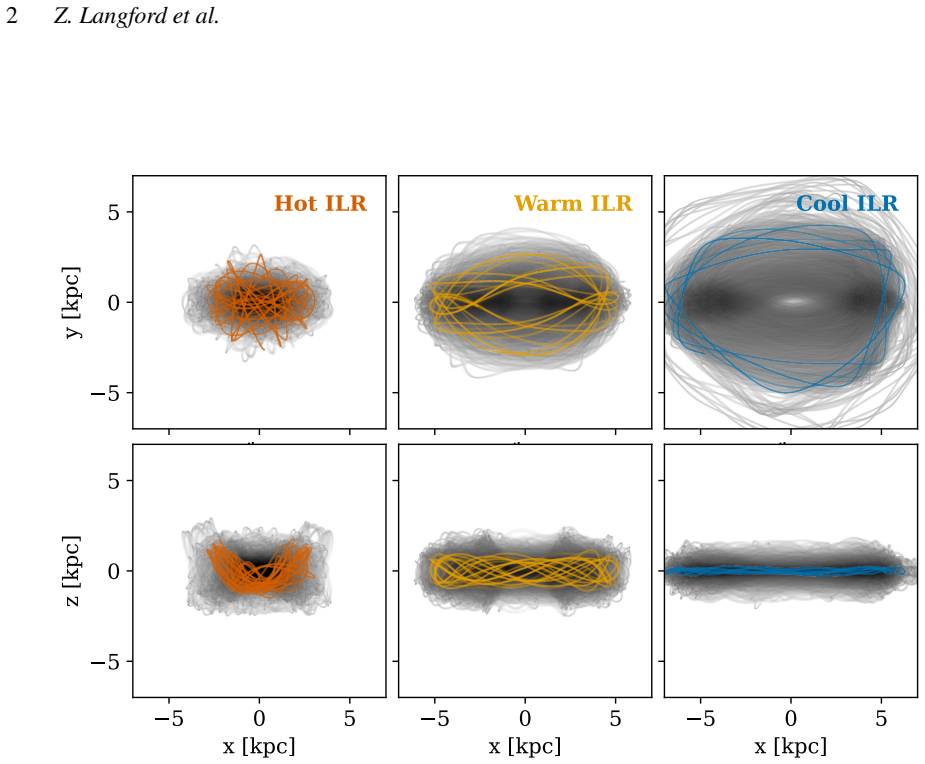
We present an update to the frequency analysis method for measuring the properties of a galactic bar. The method involves computing the fundamental frequencies of orbits in rotating, N-body-derived potential models, classifying the stars as members of bar supporting orbits, and finding the extent of the apo-centre distribution. In this work, we apply an updated classification criterion designed to isolate the so-called "Warm" inner Lindblad resonance (ILR) orbits. These orbits have been shown to contain the looped x1 orbits, which dominate the "shoulder regions" of the bar and largely contribute to the radial extent. We apply this method to existing Gaia, APOGEE, and OGLE data of more than 200,000 stars to constrain the properties of the Milky Way bar. We find that multiple bar lengths and pattern speeds are consistent with the data to within 5 percent.
Infrared dark clouds (IRDCs) contains cold dense gas at the earliest stage of massive star and cluster formation. In studying the IRDCs, a universal and fundamental task is to resolve their internal hierarchical structures. Various packages and algorithms were developed for this purpose, but with most of them mainly focused on certain individual steps in data processing. In this work, we build a more automatic procedure for multi-band structure measurement HONKAI (Hierarchical cOre ideNtification and Kinematic property AssIgnment), which can resolve the elemental components including cores and clumps, disentangle the velocity components in spectral data, measure their physical properties, and generate a catalogue for all the measured properties. We use {\sc honkai} for a joint study towards three IRDCs observed in 850 $\mu$m dust continuum with James Clerk Maxwell Telescope (JCMT) and the $^{13}CO$ $(1-0)$ data cube with the Purple Mount Observatory 14-m telescope. 193 dense cores in 16 clumps are identified. As major dynamical properties, a large amount of the cores (136 out of 193) are measured to have large virial ratio of $R_{\rm vir}>1$, but their mass-size relation is bellow the threshold for massive star formation. Meanwhile, core mass function (CMF) also exhibits a steeper slope towards high-mass end compared to more evolved core samples. These three properties in accordance suggest that although many IRDC cores are self-gravitating, only a small fraction are seemingly possible to form high-mass stars. In subsequent core evolution, some further mass assembly trend may be involved to facilitate the high-mass star formation.
Active galactic nuclei (AGN) profoundly affect the interstellar medium of their host galaxies through intense radiation fields and powerful winds. Characterising this feedback is essential for understanding galaxy formation and evolution. Here we revisit the origin of proximate damped Lyman-$\alpha$ absorbers (PDLAs), which trace cold gas within 3000 km/s of the quasar redshift, and interpret their kinematics and physical properties within a unified framework. We searched the SDSS DR16 database for low-ionisation metal absorption-line systems at the quasar redshift (referred to as ProxSys). This approach enables us to identify and classify different types of proximate absorbers, including so-called Ghostly systems, coronagraphic DLAs (DLA-Cor), standard DLAs, and sub-DLAs, based on the presence of strong Lyman-alpha absorption, partial covering signatures, or excited atomic transitions such as SiII*. We find that about 13% of ProxSys belong to the Ghostly or DLA-Cor classes and exhibit strong absorption from excited species. The different classes of ProxSys form a continuous sequence characterised by decreasing SiII*, CIV, and NV absorption strengths and dust content. Their velocity distributions reveal multiple kinematic components. Standard DLAs cluster within 1000km/s of the quasar systemic redshift, consistent with gas in the host galaxy, whereas Ghostly and SiII* bearing systems display broader distributions, including outflows reaching -2000 km/s and a smaller population of inflowing clouds up to +1200 km/s. Median stacked spectra confirm that Ghostly and coronagraphic systems arise in dense, compact gas partially covering the quasar emission regions. These results support a scenario in which cold, dense clouds participate in a dynamic cycle of inflow and outflow in the vicinity of quasars, consistent with chaotic cold accretion.
We investigate whether atmosphere models traditionally used for massive stars with strong winds can produce synthetic spectra morphologically similar to those of Little Red Dots (LRDs). We compute atmosphere models and synthetic spectra with the code CMFGEN. The models assume a thermalized radiation field at the inner boundary, parameterized by a temperature varying between 5000 and 12000~K. We adopt a typical luminosity of 1e10 Lsun. The models are spherical, assume an expanding atmosphere, and are computed under non-LTE conditions and for several metallicities. The spectral energy distribution (SED) is different from a blackbody, with a blue optical spectrum. Broad hydrogen emission lines are produced, their wings being formed by electron scattering. The SED near the Balmer and Paschen limit is rather continuous. A Balmer break is predicted for the coolest temperature models provided the wind density is reduced. The SED and Balmer decrement of most LRDs is reproduced by the models, provided they are dust-attenuated with Av~1.9-2.7. Assuming the absorbed luminosity is re-radiated in the infrared, the energy output at these wavelengths is consistent with observational constraints. The models predict FeII, oxygen and calcium lines. OI lines at 8446 A and 1.129 um are produced mostly by Lybeta fluorescence. The strength of emission lines from metals depends on input temperature, metallicity, and details of the radiative transfer models. CMFGEN atmosphere models predict a large number of spectral properties observed in many LRDs. They struggle to simultaneously produce a genuine Balmer break and strong emission lines. Whether they are more relevant or not to explain LRDs' spectra compared to alternative models is unclear, leaving open the question of the physical conditions in LRDs.
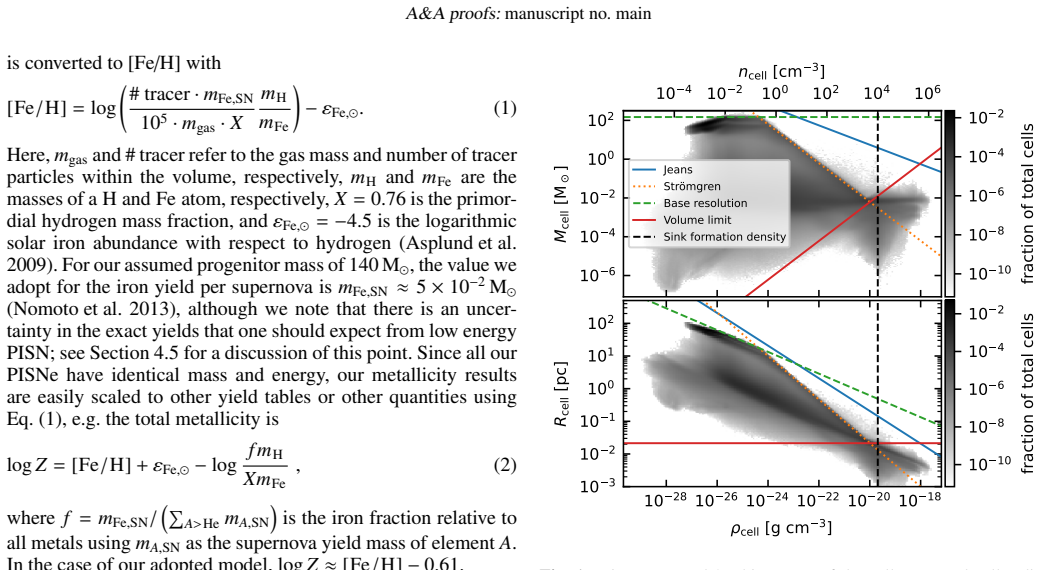
The first generation of stars, Population III (Pop III), is believed to be massive, with some potentially having masses in the range 140 M$_\odot$ to 270 M$_\odot$ and capable of exploding as a pair-instability supernova (PISN). Such events release large amounts of energy and produce substantial quantities of metals, suggesting that they should leave characteristic signatures in the abundance patterns of extremely metal-poor (EMP) stars observed in the local Universe. No clear imprint of PISNe is seen in the local EMP star population, implying either that these events were rare or that stars forming from PISN-enriched gas had metallicities too high to find them in the EMP population. Previous work explored the latter possibility by investigating the enrichment by PISNe with masses and explosion energies at the upper end of the theoretical range (270 M$_\odot$, $10^{53}$ erg). Here, we complement that work at the opposite extreme: Pop III stars at the lower mass (140 M$_\odot$) and explosion energy ($5\cdot 10^{51}$ erg) limit. Using a cosmological hydrodynamic simulation, we self-consistently track the formation of Pop III stars, their radiative and mechanical feedback, and the subsequent formation of second-generation stars in metal-enriched gas. We find that all second-generation stars are exclusively internally enriched by their progenitor within the same halo, thereby imprinting the abundance pattern of a single first-generation star. The median [Fe/H] abundance of second-generation stars is ~ -5.5 which is 2.9 dex smaller than in the high-energy PISN case. Our results demonstrate that if Pop III PISNe were common, we would expect to find stars with the characteristic odd-even abundance pattern produced by PISNe within the observed EMP population. Their absence in observations therefore strongly disfavours PISNe as the dominant channel of early metal enrichment.
Context. Giant Low Surface Brightness galaxies, such as Malin 1, host extended discs exceeding 100 kpc. Their formation and evolution remain debated, with interactions with satellite galaxies and accretion streams proposed as key contributors. Malin 1 hosts satellites and exhibits two giant stellar streams, likely the result of past interactions. Aims. We investigate the orbital dynamics of Malin 1's satellites and their possible connections with observed stellar streams, testing their nature with different formation scenarios. Methods. We constructed gravitational potentials using optical and HI data, including stellar, gaseous, and dark matter components, and explored a wide parameter space while testing NFW and ISO halo profiles. Results. Some scenarios produced bound solutions. The ISO halo model ($M_{\text{Virial}} \approx 2.6 \times 10^{12}~M_{\odot}$) favours bound satellite orbits more than the NFW model ($M_{\text{Virial}} \approx 1.4 \times 10^{12}~M_{\odot}$). Giant stellar streams could be substructures of some satellite galaxies along their leading and trailing trajectories. The most distant Malin 1 satellite could have reached pericenter $\sim 1.6$ Gyr ago, while closer companions interacted as early as $\sim 100$ Myr ago. At the same time, one close companion displays both leading and trailing arms in radial and polar orbits. Furthermore, we also identify some unbound solutions linking satellites with streams. Conclusions. Satellites and stream alignment indicate that past interactions shaped Malin 1's morphology. Our modelling constrains progenitors and orbital histories, providing insights into the dynamical evolution of gLSBGs. Findings are consistent with recent studies using Malin 1 kinematic data.
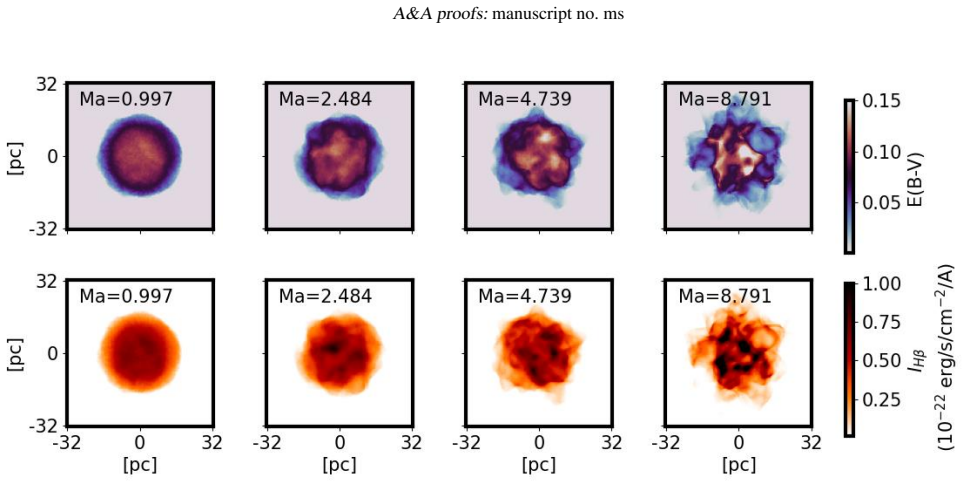
The internal dust attenuation of the Hii region reduces the observed emission-line fluxes. Turbulent density fields within each Hii region change the degree of the line-of-the-sight obscuration of the emission-line fluxes. In this paper, we implement the dust Monte-Carlo radiative transfer in the latest M3D code, creating the emission-line maps attenuated by the internal turbulent dust obscuration with the varying Mach numbers. The internal density and temperature fluctuations of Hii regions make the radiative transfer of hydrogen lines neither Case A nor Case B conditions, resulting in the global H{\alpha} to H\b{eta} ratio of approximately 3.02-3.03, differing from the widely-used value of 2.86. This deviation from Case B is because the temperature of these Hii regions is cooler than 10,000 K. We further derive the internal nebular attenuation curve from the attenuated Hydrogen lines, finding that the clumpy structures within Hii regions do not change the slope of the internal attenuation curve. This is because the heavy dust obscuration of dense clumps is canceled out by the high in-situ production of emission-line intensities.
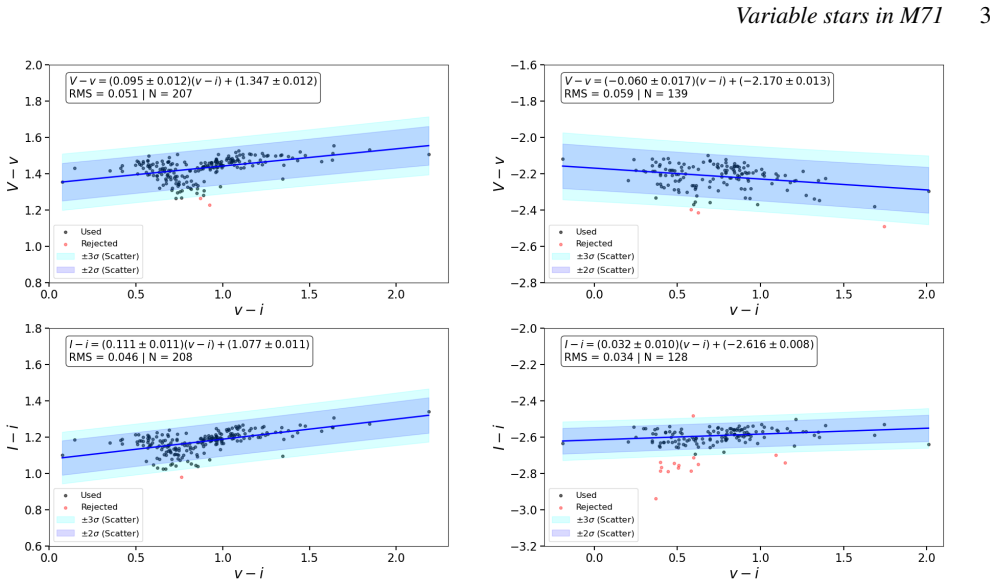
M71 is a nearby, metal-rich globular cluster at low Galactic latitude, where field contamination and spatially variable extinction complicate colour-magnitude diagrams (CMDs) and the identification of cluster member variable stars. Our aims are (i) to construct a homogeneous census of variable stars in M71 by refining their periods and classifications and identifying new candidates, and (ii) to derive a decontaminated, differentially dereddened CMD to constrain its physical properties. We obtained Johnson-Kron-Cousins $VI$ time-series CCD photometry and reduced it using difference image analysis. Cluster membership was established from \textit{Gaia}~DR3 proper motions, and a differential-reddening correction was applied across the field of view. The resulting CMD, cleaned of field stars, was compared with tailored isochrones to estimate age ($12.9^{+0.9}_{-0.8}$ Gyr), metallicity ([Fe/H] =$-0.88^{+0.13}_{-0.15}$), mean reddening ($E(B-V)$ = $0.21 \pm 0.02$), and distance modulus ($(m-M)_{0}$ = $13.01 \pm 0.06$). Variable stars were identified using two complementary approaches: a periodogram-free string-length scan refined with phase dispersion minimisation, and a robust inter-site screening based on median statistics combined with a generalised Lomb-Scargle significance criterion. We identified 21 variable stars not previously reported in the Catalog of Variable Stars in Globular Clusters and provided their periods, amplitudes, classifications, membership status, and light curves. This combined strategy yields a consistent picture of M71, expanding its known variable-star population and confirming parameters typical of metal-rich Galactic disk globular clusters.
The JAGB method has been proposed in recent years as a possible distance indicator for galaxies in the Local Group and beyond. However, the nature of the stars populating the J region, and the conditions required for the direct application of this method, still need to be clarified. We investigate the robustness of the JAGB method through a detailed theoretical analysis of the stars populating the J region of the (J-Ks, J) diagram. The main goal is to identify the properties of the corresponding J luminosity function (JLF) that are minimally affected by the previous evolutionary history of the host galaxy, particularly its metal enrichment history. We use a population synthesis approach based on AGB stellar evolution models coupled consistently with dust formation in the stellar wind. Synthetic stellar distributions in the (J-Ks, J) diagram and the related JLFs are calculated for different assumptions on the metallicity evolution of the interstellar medium, in order to study how the JLF depends on the efficiency of metal enrichment. We find that the JAGB population is dominated by stars formed between about 1 and 6 Gyr ago, while stars formed outside this interval contribute only marginally to the JAGB region. The shape of the JLF strongly depends on the metal enrichment history, and the position of the J-band peak varies by more than 0.3 mag among the different cases explored. Conversely, the mean J-band magnitude, MavJ, is much less sensitive to the previous history of the galaxy and therefore represents a more reliable distance indicator. For all the cases investigated we find MavJ = -6.2 +/- 0.05 mag. We also discuss the uncertainties related to the still poorly constrained mass-loss process experienced by low-mass stars during the red giant branch phase.
An update of the evidence that radio galaxies and clusters of galaxies are more common than average near the plane of the de Vaucouleurs Local Supercluster shows that in the distance range 100 to 200Mpc objects whose positions are correlated with the plane of the Local Supercluster include galaxies that are exceptionally luminous at two microns, radio galaxies, and clusters of galaxies. There can be little doubt about this property of cosmic structure. I also argue for detection of this correlation for the galaxies at 400Mpc distance that are exceptionally luminous at two microns. It will be interesting to learn whether these results are expected in the standard cosmology.
We present a radio continuum study of photometrically selected cosmic noon (0.5<z<3) post-starburst galaxies (PSBs) in the UKIDSS Deep Survey (UDS) field to assess if radio-mode Active Galactic Nuclei (AGN) are linked to the quenching of star formation at cosmic noon. Our cross-matching using the deep Very Large Array (VLA) imaging at 1.4 GHz results in a mean radio detection fraction ($f_{det}$) of only 0.8$\%$ for PSBs above a radio luminosity threshold of $L_{\rm 1.4 GHz} \geq 10^{24}$ W Hz$^{-1}$, increasing to 5$\pm2\%$ for massive PSBs with stellar masses M$_*>10^{11}$M$_\odot$. Massive PSBs have a comparable detection fraction to that of massive quiescent galaxies ($f_{det}=8\pm1\%$), and both classes have lower fractions than that of massive star-forming galaxies ($f_{det}=13\pm1\%$) in the same field. The radio luminosities of detected PSBs, ${\rm L}_{1.4}\sim 10^{22.8}-10^{24.9}$W/Hz, exceed those from star formation by a median factor of 37 indicative of a possible AGN origin. Their compact morphologies ($\lesssim15$ kpc at $z_{med}=1.5$) suggest low-luminosity AGN with less powerful jets. Stacking the undetected PSBs reveals a weak radio detection ($3.9\sigma$) in the highest mass bin (M$_*>10^{11}$M$_\odot$). In contrast, 1.4 GHz detected quiescent galaxies have radio luminosities reaching radio-loud levels, and a higher prevalence of extended morphologies indicative of large-scale jetted AGN. The AGN contribution is also detected in stacked measurements of quiescent galaxies. Overall, our results support a short radio AGN duty cycle for PSBs, characterized by weak radio jets, suggesting radio-driven maintenance mode feedback may become important at older ages.
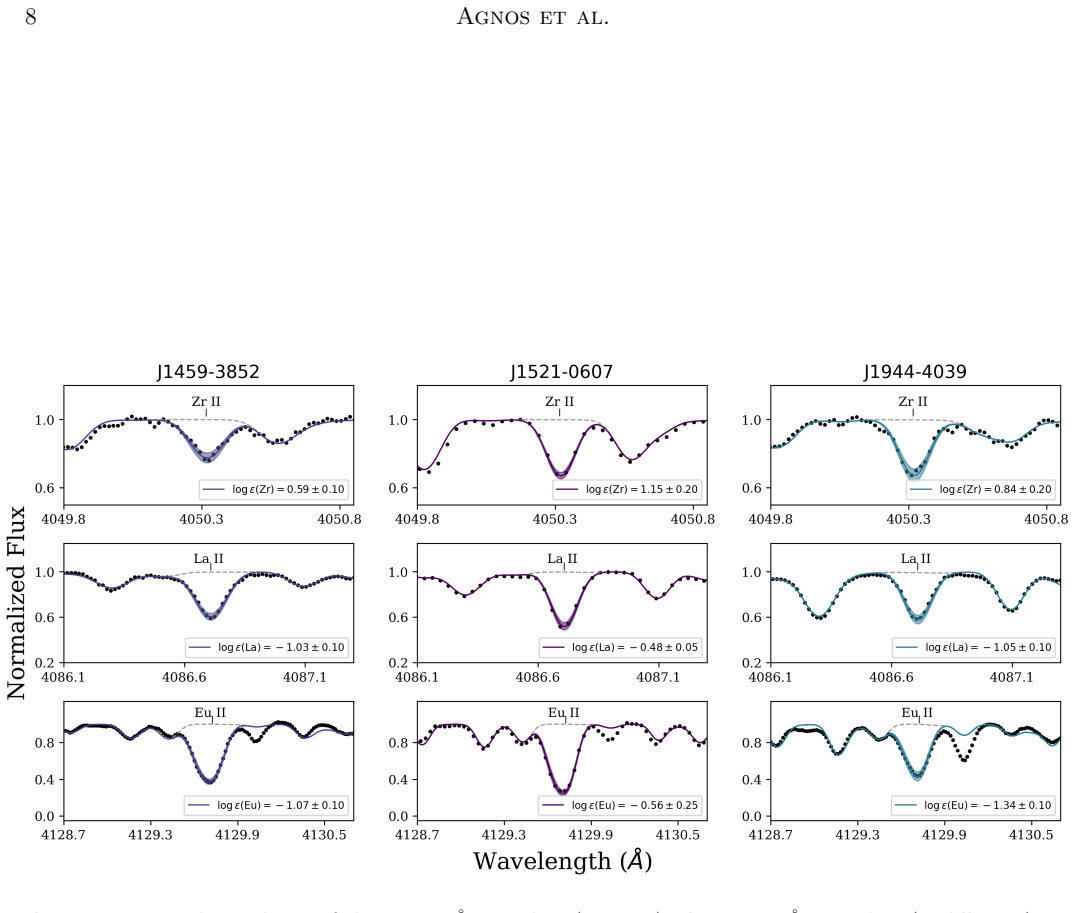
As part of the ongoing work of the $R$-Process Alliance (RPA), detailed abundance measurements of 29 heavy elements in three metal-poor stars, 2MASS J14592981$-$3852558, 2MASS J19445483$-$4039459, and 2MASS J15211026$-$0607566, are presented based on an analysis of high-resolution ($R\sim 80,000$), high signal-to-noise ``portrait'' spectra from the Magellan Inamori Kyocera Echelle (MIKE) spectrograph on the Magellan-Clay Telescope at Las Campanas Observatory. The selected targets were identified as $r$-process-enhanced metal-poor stars in previous RPA snapshot analyses. They have also been linked to possible chemodynamically tagged groups, indicating that the stars may have formed in dwarf galaxies that were later accreted into the Milky Way halo. These stars have also been tentatively linked to the Thamnos structure. The detailed chemical abundances in this work confirm that 2MASS J14592981$-$3852558 and J15211026$-$0607566 are $r$-II stars, while 2MASS J19445483$-$4039459 is found to lie just below the threshold for $r$-I status. The $r$-II stars show signs of slight enhancement in fission fragments compared to 2MASS J19445483$-$4039459. Based on radioactive age dating with Th, the $r$-process material in the two $r$-II stars is found to be old (with ages $>10$ Gyr); neither star shows signs of an actinide boost. The varying elemental compositions suggest that these stars likely did not originate in the same environment, though each could be consistent with originating in the Thamnos progenitor.
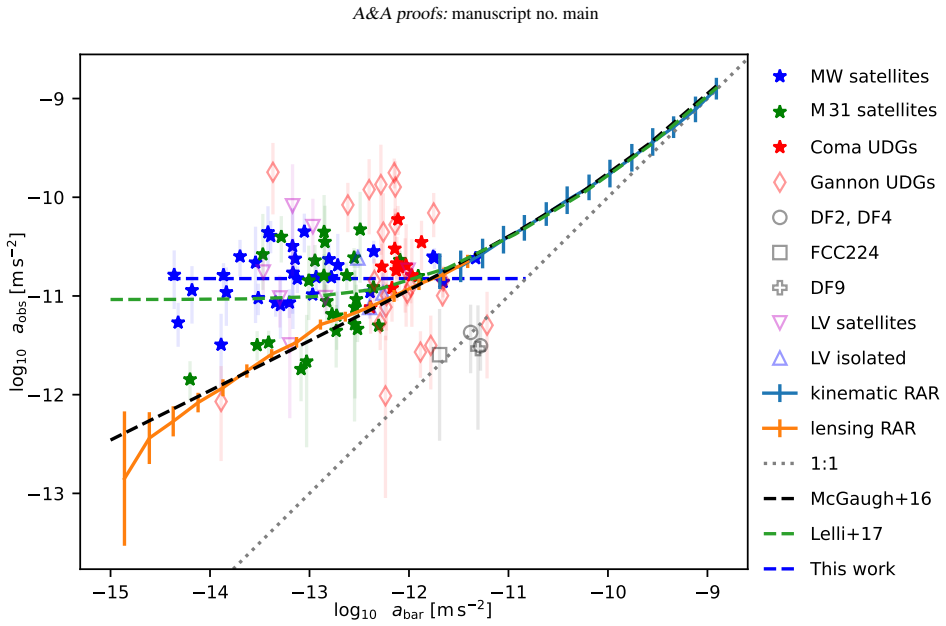
The standard theory of galaxy formation predicts that all galaxies should contain dark matter, yet a handful of recently discovered galaxies appear to lack it, challenging our understanding of galaxy formation. We investigate whether such dark-matter deficient objects can be identified from their baryonic properties alone, analogously to the radial-acceleration relation, which tightly links baryon and dark matter distributions in spiral galaxies. Using a sample of ultra-diffuse and dwarf spheroidal galaxies -- systems whose baryonic properties resemble those of the confirmed dark-matter-deficient galaxies -- we systematically search for a formula to predict baryonic fractions from stellar mass, effective radius, distance to the host, and the host's baryonic mass. We find that baryonic fraction correlates most strongly with the gravitational acceleration expected from baryons alone, $a_\mathrm{bar}$, or equivalently, with mean surface brightness, following an approximately $a_\mathrm{bar}^{-1}$ dependence. This scaling resembles the radial-acceleration relation but differs in functional form and applies to a different galaxy population. Strikingly, the dark-matter-deficient galaxies occupy the extreme end of the correlation. This suggests that they result from standard formation processes operating at unusual intensities rather than from exotic mechanisms. Importantly, the correlation predicts that all ultra-diffuse galaxies brighter than approximately 25 mag arcsec$^{-2}$ in the $g$-band should have very low dark matter content, offering a straightforward observational criterion for identifying these rare objects.
The unexpectedly high abundance of bright, blue, super-early galaxies ($z\gtrsim10$) has challenged most pre-JWST models of early galaxy formation and motivated a wide range of proposed explanations. We systematically investigate whether galaxy clustering can discriminate among representative scenarios that reproduce the observed UV luminosity function. Using the Shin-Uchuu dark-matter-only simulation, we populate $z \approx 11$ halos with galaxies according to solutions based on i) attenuation-free, ii) feedback-free bursts, iii) bursty star formation, and iv) primordial black hole models. For each model, we compute the two-point correlation function and predict the galaxy bias for flux-limited samples at different thresholds in the $-20 < {\rm M_{UV}} < -16$ magnitude range. We find that all models predict similar bias values ($b \approx 7$) for faint galaxies (${\rm M_{UV}}\approx-16$), but diverge at ${\rm M_{UV}}\lesssim-18$, as the underlying halo-mass to ${\rm M_{UV}}$ relations differ significantly. In particular, the primordial black hole scenario predicts an almost luminosity-independent bias, whereas the other models generally predict increasing bias with luminosity, reaching $b \approx 14$ for ${\rm M_{UV}} \approx -19$. Current observational estimates of the bias cannot yet rule out any of the models at a significant statistical confidence. More precise measurements from future JWST programs, together with improved theoretical predictions, will be required to break the present degeneracies. Ideally, constraints from a complete sample of galaxies with ${\rm M_{UV}} < -18$ would probe the knee of the $b({\rm M_{UV}})$ function, taking advantage of the difference in model predictions and strengthening our analysis. Although requiring further refinement, galaxy clustering is confirmed to be a promising probe of the physical origin of the JWST high-redshift luminosity function.
Modified gravity theories such as Modified Newtonian Dynamics (MOND) and Scalar-Tensor-Vector Gravity (STVG) have been proposed as alternatives to dark matter, but decisive tests have been hindered by degeneracies between baryonic structure and gravitational laws. Here we break this degeneracy using independent, high-precision constraints: the Milky Way radial rotation curve, vertical phase-space spirals from Gaia, and a broken-exponential stellar disk. A joint reconstruction of the radial and vertical gravitational fields reveals a structural inconsistency in modified gravity -- no model can simultaneously reproduce both observations. Our results strongly disfavor MOND at $>13\sigma$ and STVG at $>4\sigma$. In contrast, dark matter halo models naturally explain the observations, providing a self-consistent test of gravity on galactic scales.
Wide-field imaging surveys now provide photometry for billions of sources, while spectroscopic observations remain limited, motivating methods that can extract spectroscopic information from photometric data. We present a generative framework for the joint probabilistic inference of galaxy redshifts and rest-frame spectra from broadband photometric fluxes. The model provides a sampling-based estimate of the photometric-redshift probability density function (PDF) for each galaxy, from which accurate point estimates are derived, and reconstructs rest-frame spectra that preserve key spectral properties. We pre-train a spectral autoencoder, SPENDER, on 5 million DESI DR1 spectra to learn a low-dimensional latent space that represents rest-frame spectra. Conditioned on galaxy broadband photometric fluxes, a diffusion model jointly infers the corresponding spectral latent representation and photometric redshift. The inferred latent representation is decoded into a high-resolution rest-frame spectrum, which can be transformed to the observed frame by redshifting and resampling. Sampling from the conditional diffusion model yields a full photometric-redshift PDF for each galaxy, with the resulting point estimates showing a precision comparable to that of a gradient-boosted decision tree model. In most cases, the reconstructed rest-frame spectra reproduce the overall continuum shape and capture the presence of prominent spectral features. For galaxies with sufficiently high signal-to-noise ratios in their observed spectra, the Dn4000 index shows good agreement between the reconstructed spectra and the observed spectra. On average, the spectral reconstruction residuals are close to the noise level of the observed spectra. Latent-diffusion generative modeling enables joint inference of galaxy photometric-redshift PDFs and rest-frame spectra from photometric fluxes.
The neutral hydrogen (Hi) 21-cm line serves as a powerful tracer of the neutral interstellar medium (ISM). Thermal stability analysis suggests that the neutral ISM is bistable in nature, consisting of the cold neutral medium (CNM) embedded within the warm neutral medium (WNM), both in approximate thermal pressure equilibrium. When turbulence is incorporated into the numerical simulations, a third thermally unstable medium (UNM) emerges between the CNM and the WNM. Although observational studies support the existence of this intermediate phase, a clear empirical correlation between the fraction of the UNM gas and the strength of the turbulence remains elusive. In this study, we investigate the various phases of neutral ISM using Hi 21-cm emission-absorption spectra from the publicly available GWA and LAB surveys and compare it with TIGRESS-NCR and TIGRESS-CLASSIC numerical simulations. From our observational modeling, we find that 19.8% of the gas reside in the CNM phase, 32.5% in the UNM phase, and 47.8% in the WNM phase, assuming phase boundaries defined by spin temperature: T_s < 250 K for the CNM, 250 K < T_s < 5000 K for the UNM, and T_s > 5000 K for the WNM. These results are entirely in agreement with the TIGRESS-NCR numerical simulation. We further expect that deep, sensitive absorption studies with the Square Kilometre Array (SKA) or the Next Generation Very Large Array (ngVLA) or existing Upgraded Giant Metrewave Radio Telescope (uGMRT) capable of robustly detecting WNM clouds in absorption will place more tighter observational constraints on the fraction of the gas in three different phases of the neutral ISM.
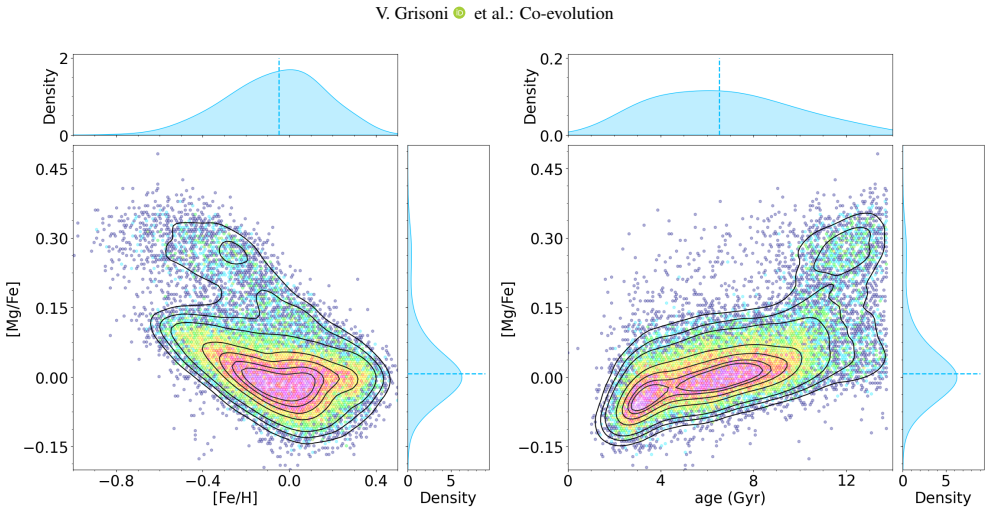
Observational data have revealed a clear dichotomy in the [{\alpha}/Fe] vs. [Fe/H] diagram of the Milky Way thick and thin disc stars. Many recent studies have shown evidences of a co-evolution phase between the high- and low-{\alpha} disc sequences as well as the presence of very old low-{\alpha} stars. We aim to revise the parallel chemical evolution model that assumes two parallel histories of star formation for the two discs, by considering a pre-enriched delayed second infall episode in our revised scenario. By means of our chemical evolution models, we aim to explore the effects of a phase of co-evolution and the presence of old low-{\alpha} stars, as recently observed. We consider a new version of the parallel scenario for the Milky Way thick and thin disc formation, which consists into two distinct infall episodes of slightly pre-enriched gas. The gas is considered to be extragalactic but possibly contaminated by chemically enriched gas of a massive dwarf galaxy as Gaia-Enceladus, which merged with the Milky Way at least 10 Gyrs ago. Moreover, we test in our model observationally derived star formation histories of kinematically selected thick and thin discs, suggesting that the star formation is triggered by the passages of the Sagittarius galaxy. Our models can well explain the [{\alpha}/Fe] vs. [Fe/H] diagram from APOGEE DR17. Our revised chemical evolution model with a pre-enriched and delayed (roughly 1 Gyr) second infall episode, explains not only the abundance patterns of high- and low-{\alpha} stars but also stellar age distributions for the selected observational sample. We predict a short co-evolution period in between the two phases and we can explain the observed old low-{\alpha} stars, but still further data for precise stellar ages would be needed to put more stringent constraints on their physical nature.
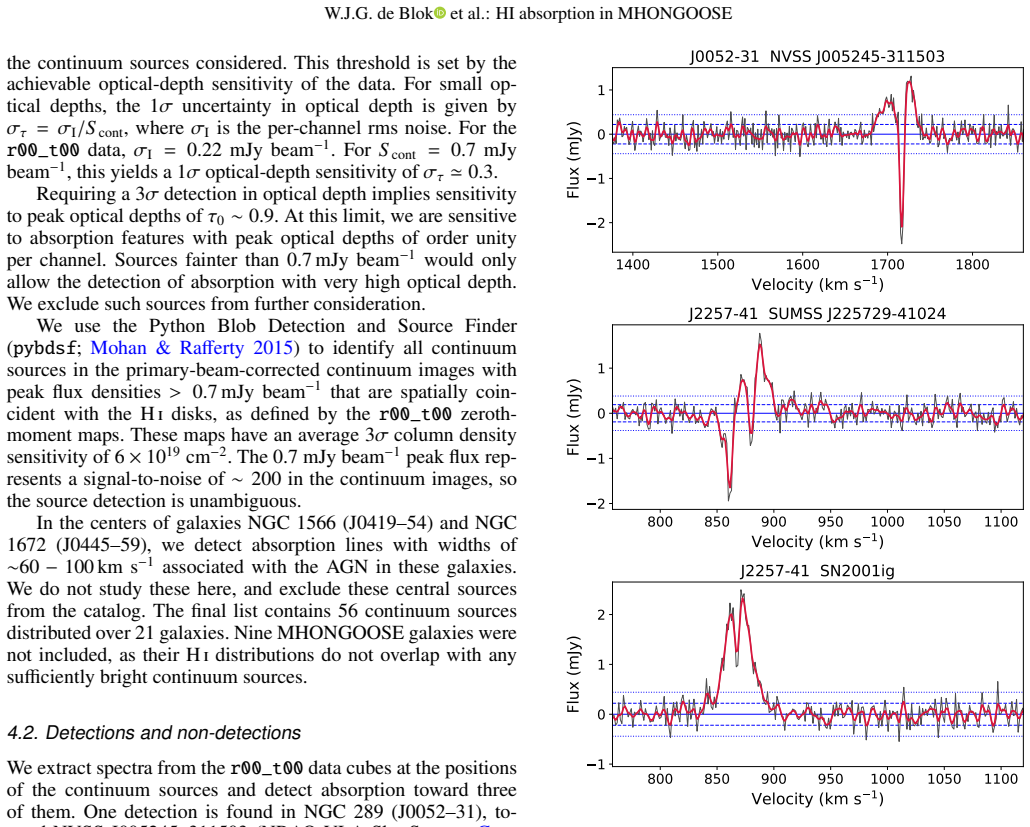
Combined HI emission-absorption studies constrain the spin temperature and phase structure of the neutral atomic hydrogen interstellar medium (ISM), but have largely been limited to the Milky Way and the Local Group. We extend this technique to galaxies at distances of 7-22 Mpc using deep data from the MeerKAT HI Observations of Nearby Galactic Objects - Observing Southern Emitters (MHONGOOSE) survey, and quantify the detection fraction and Cold Neutral Medium (CNM) properties at these distances. We search for HI absorption toward 56 background continuum sources in 21 out of the 30 MHONGOOSE galaxies (with nine galaxies lacking suitable background sources), and detect absorption associated with the galaxies' HI disks in three cases: one sight line in NGC 289 and two in NGC 7424. This corresponds to detection rates of 3/56 (5 percent) for the full sample and 3/31 (10 percent) for a clean sub-sample of sight lines, considering only unresolved background sources behind 14 low-inclination galaxies. Detections occur only where both the continuum flux and the foreground \HI column density are high, with optical-depth sensitivity as the primary limiting factor. For the detected sight lines, we model the absorption and emission spectra to derive spin temperatures and CNM fractions using the standard combined emission-absorption method. The CNM spin temperatures and line widths are comparable to Local Group measurements, but the inferred CNM fractions are systematically lower. We argue that this difference is primarily a resolution effect: at the distances of our galaxies, the emission spectra average over several hundred parsecs, diluting structured CNM relative to the smoother Warm Neutral Medium (WNM). This demonstrates that emission-absorption analyses can be extended beyond the Local Group, provided that care is taken in constructing representative emission spectra.
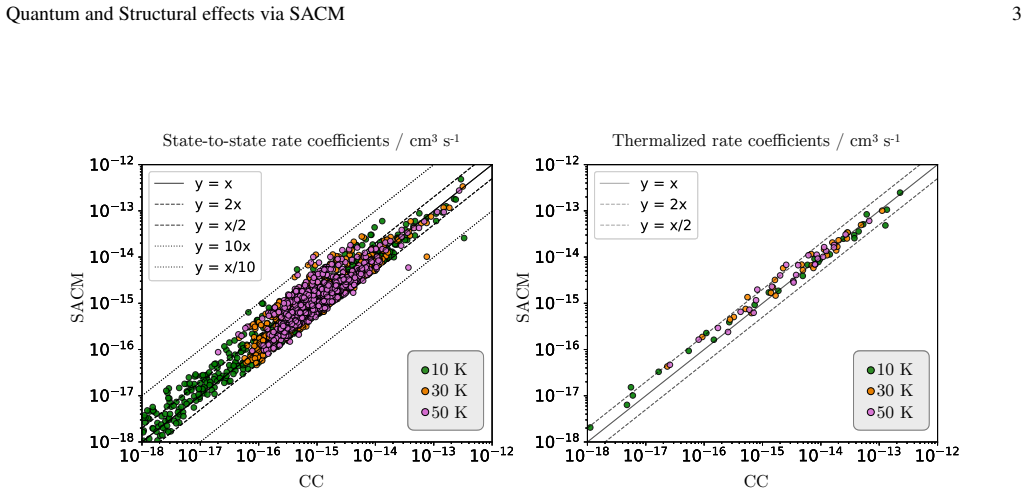
This work spotlights the Statistical Adiabatic Channel Model as an efficient and accurate method for deriving low temperature (de)-excitation rate coefficients for collisions induced by heavy projectiles. For such systems, fully quantum treatments become intractable, while quasi-classical methods fail at low temperature. Here, we demonstrate that the Statistical Adiabatic Channel Model overcomes these limitations by combining statistical sampling with an adiabatic channel representation. Its application to the HCN and HNC isomers colliding with CO yields rate coefficients in quantitative agreement with full quantum results benchmarked for the lowest total angular momentum. These systems are relevant for modeling cometary comae, where reliable molecular data remain scarce. Remarkably, this approach also reproduces near-resonant energy transfer and isomeric effects, demonstrating that essential quantum and structural features can be captured within a statistical framework.
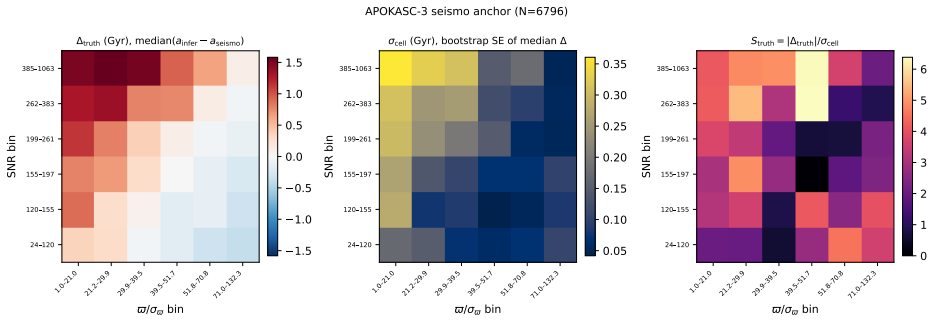
The formation timescale of the Milky Way thick disk is one of the central debates in Galactic archaeology. The age-metallicity relation (AMR), formation timescale, and chemical evolution gradients are frequently used to infer a rapid assembly, short-timescale enrichment, and bursty formation history of the thick disk. However, stellar ages are not directly observable, introducing the potential risk that inferred ages may harbor a systematic compression tied to observational quality.
In this paper, we use the same stellar sample and identical physical covariate matching conditions, but two independent age scales--spectroscopic inferred ages (astroNN) and asteroseismic ages (APOKASC-3)--to compare the observable signatures of the thick-disk formation history. We find that several key observables previously supporting a rapid thick-disk formation are systematically weakened under seismic anchoring: the AMR slope flattens from -3.29 to -1.86 Gyr dex-1 (Delta a = +1.43), the formation timescale widens from 3.04 to 3.55 Gyr, and the peak formation age shifts from 9.1 to 6.0 Gyr.
Through transport inversion experiments, we further show that additive noise can only broaden the age distribution and cannot reproduce the above pattern, whereas a compressive transport map (lambda < 1) simultaneously reproduces a narrower age distribution, a steeper AMR, and rapid-formation-like observables. This result indicates that the compression transformation itself is sufficient to generate rapid-formation-friendly observables without requiring an intrinsically bursty formation history. Our findings reveal that statistical interpretations of the Milky Way formation history may depend sensitively on the stellar age definition itself.
Identifying remnant radio-loud active galactic nuclei (AGNs) is challenging due to their diverse morphological and spectral characteristics. Using three-dimensional hydrodynamic simulations of 15 radio galaxies, we investigate how the spectral evolution of remnants depends on progenitor power, active lifetime, environment, and underlying dynamics. The simulations span low-density group and high-density cluster environments re-gridded from smooth-particle-hydrodynamic cosmological simulations. The resulting remnants exhibit a wide range of morphologies, from amorphous structures to double-lobed forms. We find that jet power correlates with the spectral slope. As the remnant lobes evolve, we find surface brightness depends strongly on environment: group remnants are systematically dimmer and more amorphous than cluster remnants, highlighting a potential observational bias against these low-surface-brightness sources. In our models, we estimate that the peak surface brightness of a low-redshift, 50 Myr-old remnant from a low-power progenitor in a 10^{13} M_sun group environment should be routinely detectable at the 3{\sigma} level with LOFAR, although 20-30% of the emission would remain undetectable within a reasonable integration time. We find young remnants exhibit low-frequency (150-1400 MHz) spectral indices that overlap with active sources, and follow a consistent and established spectral-evolution sequence: significant curvature ({\alpha}_{1400}^{6000} - {\alpha}_{150}^{1400} > 0.5) develops before an ultra-steep low-frequency index ({\alpha}_{150}^{1400} > 1.2). The results presented in this work are intended as a reference point for current and upcoming low-frequency studies of radio remnants.
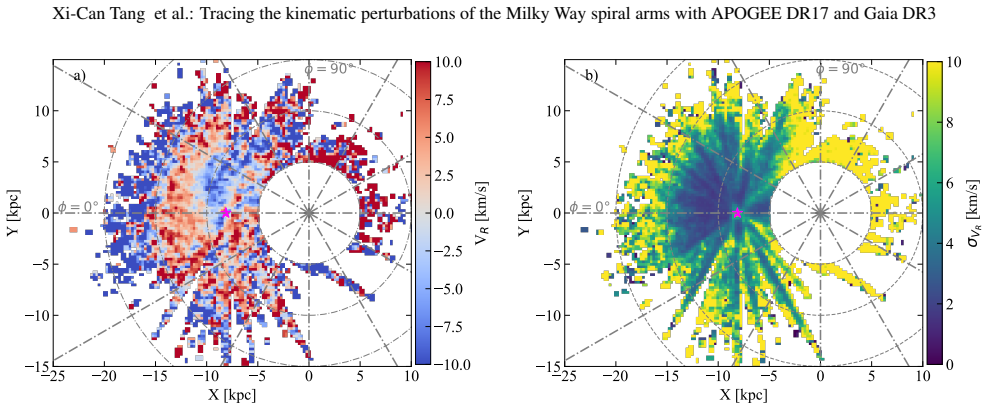
Aims. We constrain the dynamical perturbations of the spiral arms in the Milky Way disk, based on the non-axisymmetric streaming motions of RGB stars revealed by APOGEE and \textit{Gaia}.
Methods. We develop a revised steady-state radial-velocity response model that incorporates both the \(V_{R,\sin}\) and the dynamically important \(V_{R,\cos}\) components for a two-armed logarithmic spiral potential. The model is validated using orbit integrations with \texttt{AGAMA} and Bayesian parameter recovery with \texttt{dynesty}, and is applied to the smoothed two-dimensional radial-velocity field of RGB stars while accounting for Lindblad and corotation resonances.
Results. The revised model reproduces the phase and amplitude of the mock radial-velocity field to the \(\sim2\%\) level, substantially improving upon earlier \(V_{R,\sin}\)-only formulations. Applied to the observational data, it yields a robust pitch angle of \(p \simeq 10^\circ\) and a local surface density contrast of \(\xi \simeq 5\)--\(18\%\) at the solar radius. The radial scale length is less well-constrained (\(h_{R,1} \simeq 40\)--\(50\,\mathrm{kpc}\)) due to intrinsic parameter covariance. Resonance effects strongly shape the velocity field, thus affecting the fitting: the radial velocity becomes extremely large near the Lindblad resonances, whereas it vanishes close to the corotation resonance.
Conclusions. Our results demonstrate that including both the \(V_{R,\sin}\) and \(V_{R,\cos}\) terms is essential for a physically consistent interpretation of stellar streaming motions induced by a spiral potential. The observed kinematics constrain the spiral pattern speed to \(\Omega_{p} \approx 10\)--\(20\,\mathrm{km\,s}^{-1}\mathrm{kpc}^{-1}\).
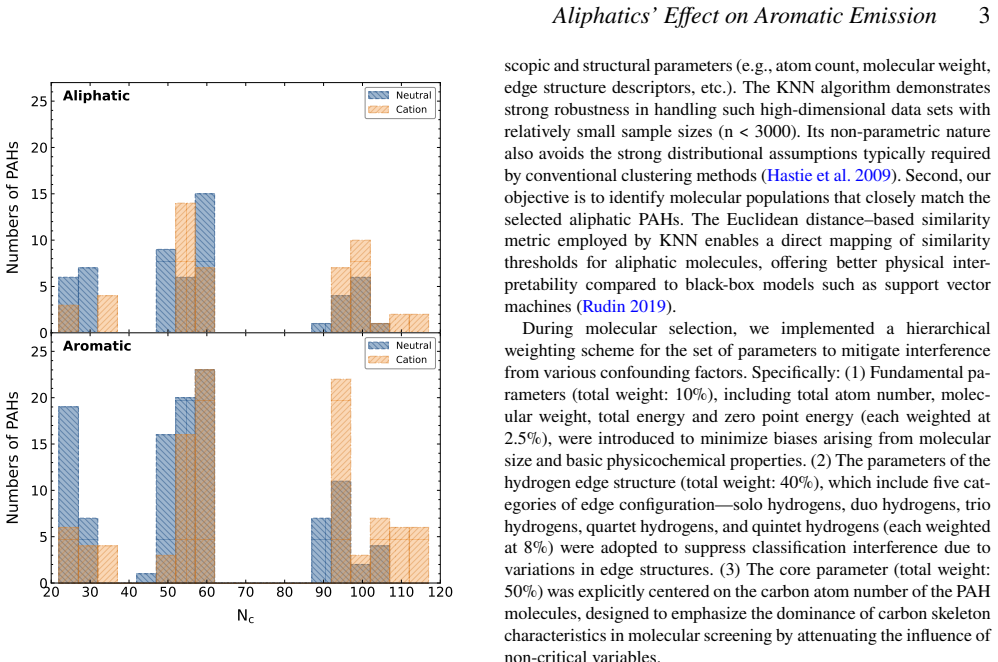
Intensity ratios of aromatic emission features are widely used to diagnose the size and ionization state of polycyclic aromatic hydrocarbons (PAHs) in astronomical environments. However, PAHs are known to typically carry aliphatic side chains, a structural feature that may compromise the reliability of traditional diagnostic methods. This study systematically investigates the effects of aliphatic components on the aromatic emission properties of PAHs. Based on theoretical data from the NASA Ames PAH IR Spectroscopic Database, we compare the emission behavior of purely aromatic PAHs with those containing aliphatic substituents, revealing that aliphatic functionalization may modify the intensity ratio of the 11.2 $\mu$m band relative to the 7.7 $\mu$m and 3.3 $\mu$m bands. This potentially leads to misidentification of their ionization state if molecular structural effects are neglected. Further analysis indicates that the impact of aliphatic components on diagnostic band ratios strongly depends on PAH size: small PAHs exhibit significant emission ratio shifts, deviating from traditional size/ionization trends, while larger PAHs are minimally affected. Despite these shifts, the classic $(I_{11.2/7.7})$ versus $(I_{11.2/3.3})$ diagnostic grid remains largely applicable to mixed aromatic-aliphatic PAHs, although some systematic calibration may be needed. Our findings emphasize the necessity for caution when interpreting PAH band ratios in aliphatic-rich environments, as variations in PAH molecular composition may distort inferences about physical conditions.
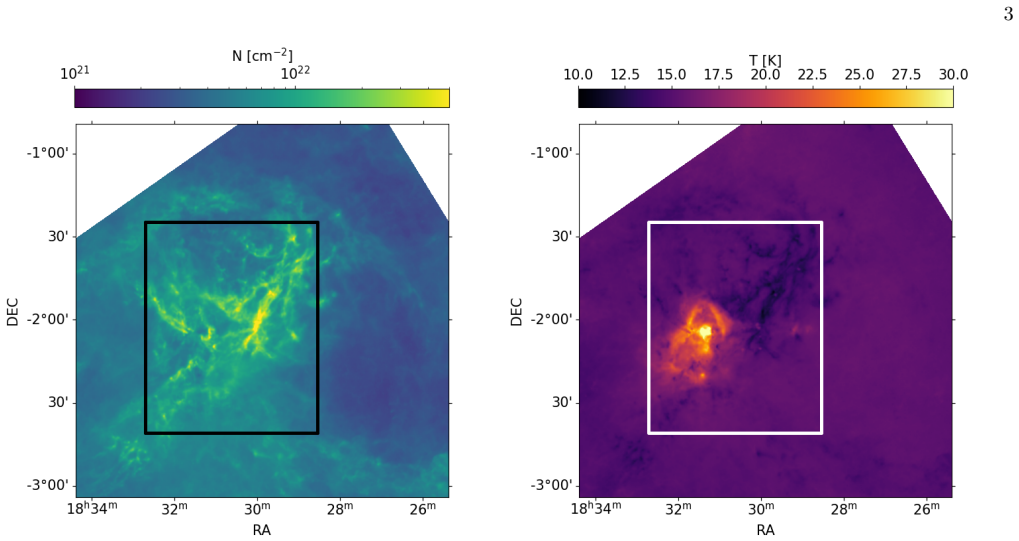
We simulate star formation and star cluster assembly inside a molecular cloud with parameters we derive directly from observations of the Aquila Rift. We model the evolution of stars and gas together while resolving close encounters between stars, the formation of new stars, and stellar feedback to follow cluster formation up to the expulsion of the surrounding gas. We find that star formation takes place in clumps spaced unevenly along Serpens South and that these clumps accrete surrounding gas to grow and form new stars. Gas flows along the filament promote the merger of these clumps into a star cluster inside the Serpens South filament. The imprints of these mergers are seen in the dynamics of the Serpens South cluster in the form of velocity space anisotropies, cluster rotation, and cluster expansion. Before gas is removed from the simulation, the Serpens South cluster merges with the nearby cluster W40 non-monolithically resulting in a fractal cluster at the end of the simulation. The dynamics inherited from the mergers throughout the simulation are still seen in the final bound stellar system after the gas has been removed. We compare these results with recent observations of Milky Way clusters to comment on their formation histories. We also study how our results change when lowering the mass resolution of our simulation and removing observations of dense gas tracers from our initial condition setup. Each of the three simulations result in different final cluster configurations pointing towards the importance of gas in cluster assembly.
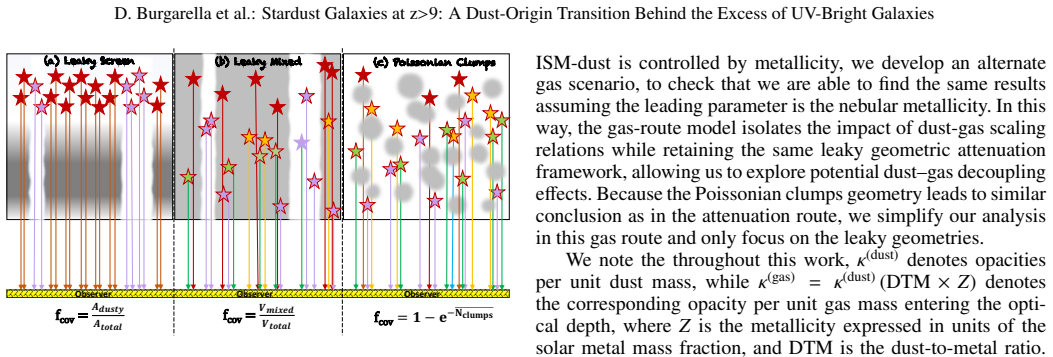
Recent JWST observations suggest that galaxies at z > 9 may be dominated by low-opacity SNe-produced dust before efficient ISM grain growth is established. This transition in dust origin and opacity could explain both the prevalence of galaxies with extremely low dust attenuation and the excess of UV-bright galaxies relative to most pre-JWST predictions. We investigate whether this transition, combined with evolving star-formation efficiency, can reproduce these observed properties. We develop a physically motivated attenuation framework combining (i) extinction laws for reverse-shock-processed SNe dust, (ii) metallicity- and dust-to-metal-dependent opacity scalings, and (iii) porous radiative-transfer geometries allowing partial UV-photon leakage. Unlike outflow-driven scenarios requiring large-scale gas evacuation, our approach preserves gas reservoirs while reducing effective UV opacity through dust composition and geometry. We introduce extinction-based, gas-based, and hybrid attenuation prescriptions linking SNe-dominated and ISM grain-growth dust regimes. We find that the observed A_FUV-M_star relation at z > 9 is best reproduced for an intrinsic FUV dust opacity kappa_UV(dust)=1000 cm2/g, characteristic of low-opacity SNe dust, naturally producing very low attenuation even in gas-rich galaxies. This regime reproduces galaxies with extremely low dust attenuation (GELDAs), which dominate observed samples at z > 9. Applied to intrinsic UV luminosity function models, our SNe-dominated and hybrid prescriptions mainly suppress the brightest galaxies, bringing predictions into agreement with JWST measurements without requiring extreme star-formation efficiencies or dust-free interstellar media. Our results suggest that the UV-bright galaxy excess at z > 9 reflects a transition in dust origin and opacity during the earliest phases of galaxy evolution.
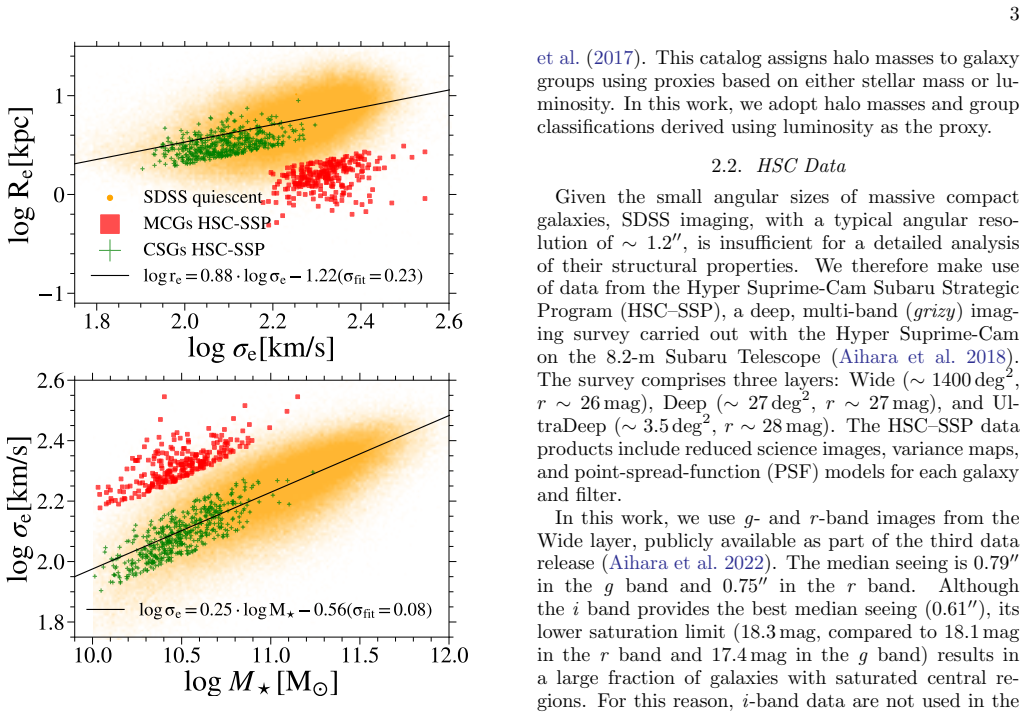
We investigate the morphology and structural properties of 246 massive compact quiescent galaxies (MCGs; $\log M_{\star} \sim 10$-$11$, $\sigma_{\mathrm{e}} \sim 150$-$350\,$km\,s$^{-1}$, $R_{\mathrm{e}} \sim 0.7$-$2.5\,$kpc) at $z \sim 0$, selected as outliers in the stellar mass-velocity dispersion and velocity dispersion-size relations, using $g$-, $r$-, and $i$-band Hyper Suprime-Cam images. We compare them to a control sample of average-sized quiescent galaxies (CSGs) matched in stellar mass, star formation rate, redshift, and $g-i$ color. Both samples are dominated by S0 galaxies, comprising $93\%$ of MCGs and $71\%$ of CSGs, while ellipticals account for $4\%$ and $11\%$, respectively. The fraction of interacting or morphologically disturbed systems is low in both samples ($13\%$ for MCGs and $16\%$ for CSGs). Multi-component decompositions of the $g$- and $r$-band images show that $75\%$ of MCGs require a three-component model (bulge, disk, and envelope), while $21\%$ are best fit by two components and $4\%$ by a single S\'ersic profile. Two-component MCGs are preferentially low-inclination systems, suggesting that the three-component fraction represents a lower limit. In contrast, only $7\%$ of CSGs exhibit a comparable three-component structure. Bars are present in $29\%$ of CSGs but are absent in MCGs. For three-component systems, MCGs and CSGs have similar bulge ($R_\mathrm{e}=0.39$ vs.\ $0.45$\,kpc) and envelope ($R_\mathrm{e}=6.4$ vs.\ $5.8$\,kpc) sizes, while MCG disks are significantly more compact ($R_\mathrm{e}=1.9$ vs.\ $3.3$\,kpc). The envelope component shows a broad ellipticity distribution ($\epsilon_\mathrm{Envelope} \sim 0.0$-$0.6$), which we interpret as corresponding to either a stellar halo or a thick disk.
The identification of physically associated kiloparsec-scale quasar pairs is important for understanding galaxy evolution, the growth of supermassive black holes, and their co-evolution with host galaxies. However, their rarity and the high contamination from stellar superpositions and projected alignments require efficient pre-selection methods. We develop a machine-learning framework to produce photometric-redshift point estimates and redshift probability density functions for quasars, with the main goal of identifying high-probability quasar pair candidates in the MGQPC catalogue. We construct two large spectroscopically confirmed quasar samples with multi-wavelength photometry, based on SDSS and DESI Legacy Imaging Surveys data. CatBoost is used for point-estimate photometric-redshift regression, and FlexZBoost is used for full redshift-PDF estimation. The workflow achieves robust performance, with a normalised median absolute deviation of 0.036 and an outlier fraction of 5.6% on the test sample. Applying the trained model to the MGQPC catalogue, we identify 185 high-probability quasar pair candidates based on photometric-redshift consistency. Among them, 20 systems have been subsequently confirmed as genuine physical pairs by independent spectroscopic observations. The resulting MGQPC photometric-redshift catalogue provides a useful resource for future spectroscopic follow-up of quasar pairs and dual supermassive black holes.
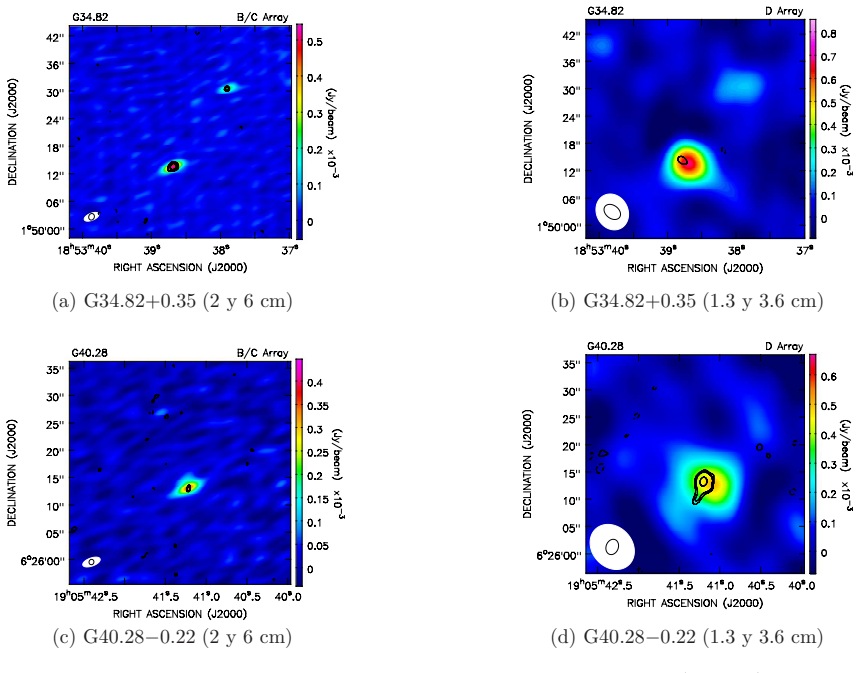
Hypercompact HII regions (HC) are regions of ionized gas associated with the early stages of high-mass star formation. With the aim of better understanding their characteristics, we studied five candidate HC HII regions. Here, we present observations with the Jansky Very Large Array (VLA) at 2 and 6 cm, with angular resolutions in the range of $\sim$1 -- 3\arcsec and report the images of the detected sources and the measured parameters. In addition, we explore several possible scenarios, considering the regions as both uniform and non-uniform spheres, and as winds, both spherical and collimated. In most cases, the sources were unresolved, but by applying the models, we estimate that their sizes vary in a range of 0.3 to 3.7 mpc while their electron densities are in the range of $1.3 \times 10^{5}$ to $2.4 \times 10^{6}$ cm$^{-3}$, indicating that most sources are consistent with small, weak UC HII regions, although a few remain viable candidates for HC HII regions, with G40.28$-$0.22 as the strongest case. We do not rule out the possibility that some sources are jets or stellar winds.
We quantify systematic biases in rotation curves inferred from steady, axisymmetric Jeans modelling when the underlying stellar velocity field is non-axisymmetric. Using a high-resolution $N$-body/hydrodynamic simulation of an isolated Milky Way-like disk galaxy, we construct mock stellar-kinematic measurements for two observer azimuths relative to the bar. One observer is placed at a Solar-like viewing angle of $25^\circ$ from the bar major axis, and the other at $115^\circ$. For each configuration, we analyse multiple snapshots and compare the Jeans-inferred circular-speed curve, $V_{\rm c,Jeans}(R)$, with a reference axisymmetric circular-speed curve, $V_{\rm c,axi}(R)$, defined from the azimuthally averaged ($m=0$) component of the gravitational field. The Jeans analysis is performed in a wedge-shaped mock observational volume that mimics limited sky coverage. For the $25^\circ$ configuration, the mean azimuthal streaming is typically higher than the azimuthally averaged expectation by $\approx 10$--$15~\mathrm{km\,s^{-1}}$, which leads to an average overestimate of the axisymmetrically defined circular speed by $\approx 4\%$ ($\approx 10~\mathrm{km\,s^{-1}}$) in the inner disk. Across snapshots, the mean offset corresponds to a $\sim 1.5$--$2\sigma$ systematic deviation of $V_{\rm c,Jeans}$ from $V_{\rm c,axi}$. For the $115^\circ$ configuration, the bias reverses sign and $V_{\rm c,Jeans}$ tends to underestimate $V_{\rm c,axi}$. Under the usual spherical approximation, a $\approx 4\%$ bias in $V_{\rm c}$ corresponds to an $\approx 8\%$ bias in the enclosed dynamical mass at fixed radius. These results imply that steady, axisymmetric Jeans modelling of Milky Way stellar kinematics can overestimate the axisymmetrically defined circular-speed curve at the percent level unless non-axisymmetric streaming is modelled explicitly or included in the error budget.
Obtaining robust galaxy number counts is crucial for understanding galaxy evolution, and submillimetre counts in particular have proven valuable for revising subgrid physics models in cosmological simulations. In confusion-limited surveys, which are common at these wavelengths, statistical methods such as $P(D)$ fluctuation analysis are required to recover counts of faint, unresolved galaxies. However, the standard $P(D)$ framework assumes that galaxies are Poisson-distributed, whereas in reality galaxies are clustered. Using simulations, we demonstrate that this clustering systematically biases $P(D)$-derived number counts, and present an empirical method that simultaneously measures and corrects for this bias by combining the 1- and 2-point statistics in the map, thereby maximising the information extracted from the data. Applying this method to deep Herschel-SPIRE observations of the GOODS-N field, we provide revised galaxy number counts at 250, 350 and 500$\mu$m. Our results indicate that at 500$\mu$m clustering inflates the apparent counts by a factor of 1.6 around 10mJy and slightly suppresses the faintest sub-mJy counts, with milder effects at 350$\mu$m and 250$\mu$m owing to the smaller beam sizes. This methodology is broadly applicable to other confusion-limited data sets with well-characterised beam and noise properties, including SCUBA-2 and CCAT, enabling unbiased exploitation of the full statistical information in current and future far-infrared and submillimetre surveys.
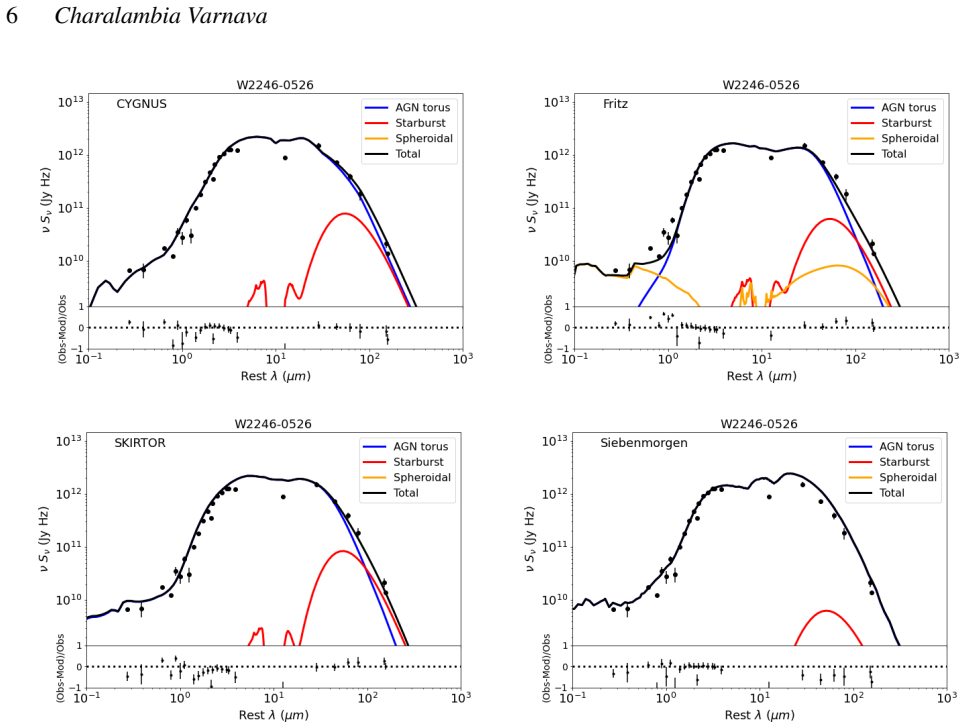
We present new JWST/MIRI-MRS data of the z=4.601 extremely luminous obscured quasar WISEA J224607.56-052634.9 (W2246-0526). Our fits of its spectral energy distribution (SED) with the SED fitting code SMART (Spectral energy distributions Markov chain Analysis with Radiative Transfer models) predict an active galactic nucleus (AGN) fraction in the range 72-81 per cent, an intrinsic AGN luminosity of 4.2-7.2 x 10^14 Lo, a polar dust luminosity of 1.6-1.7 x 10^14 Lo, a black hole mass of 1.3-2.3 x 10^10 Mo (assuming the quasar is accreting at the Eddington limit), a star formation rate (SFR) of 360-2900 Mo/yr and a stellar mass of 4.8-5 x 10^11 Mo. The stellar and black hole masses of W2246-0526 are typical of a giant elliptical galaxy at z=0. We find statistically significant evidence for the presence of a hot dust component, which we interpret as polar dust in the context of a torus geometry, based on recent results obtained for nearby AGN. We explore two smooth and two two-phase models for the AGN torus, to put constraints on the AGN fraction of the galaxy, the black hole mass and its SFR. We show that the presence of polar dust affects the estimate of the AGN luminosity and we recommend to take into account this component in SED fits of other high-redshift obscured AGN/quasars. Despite the large difference in luminosity, we discuss possible links between the presence of this hot dust component in W2246-0526 and in some local AGN, suggesting that they may have a different origin.
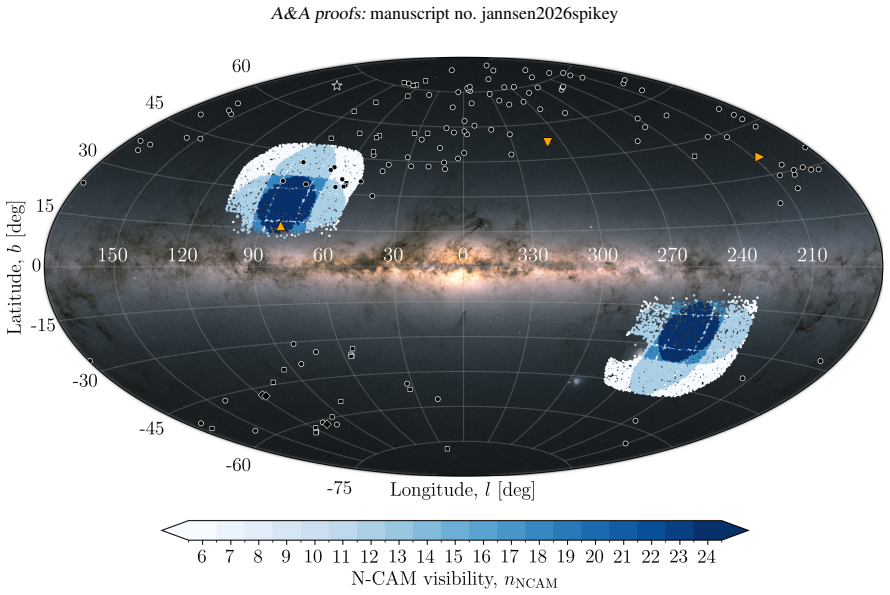
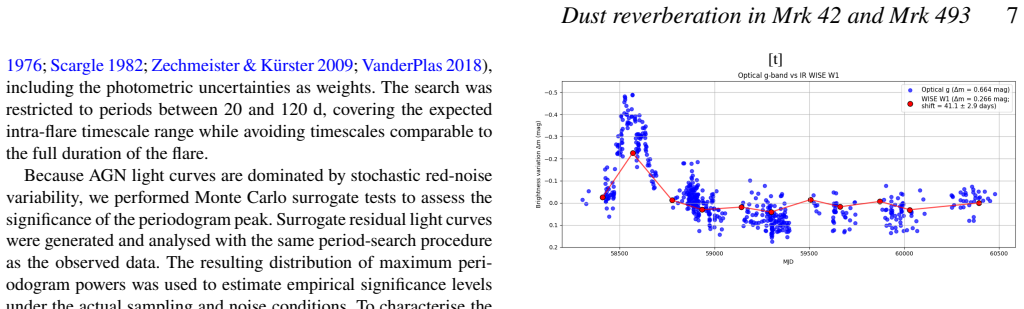
The search for supermassive black hole binaries (SMBHBs) has, in recent years, seen the dawn of exploration with several hundred candidates claimed from photometric and spectroscopic surveys monitoring AGNs. While only a handful persist to date, the advent of upcoming high-precision wide-field photometric missions motivates continuing the pursuit of confirming SMBHBs in the optical. We explore the possibility of using the ESA Plato space mission to detect photometric signatures of SMBHBs. Motivated by the Kepler observation of Spikey, the best known self-lensing flare (SLF) candidate to date, this work aims to benchmark the scientific outcome if Plato were to observe Spikey-like objects via its Guest Observer programme. Starting from the Gaia database, we assemble a catalogue of 12,226 bright ($G < 19$) high-probability Quasars for the two pointing fields of Plato's nominal mission. This Plato Quasar catalogue will be pivotal for future follow-up observations of larger photometric searches such as the Vera Rubin LSST survey. We use the Plato camera simulator, PlatoSim, to realistically explore the noise budget in Plato's faint limit, while generating mock light curves to benchmark Plato's ability to recover signatures of SMBHBs. We show that, although not at all designed for the purpose, Plato is capable of detecting Spikey-like SMBHB candidates through their relativistic photometric signatures using Bayesian inference and evidence. Plato will in particular be able to confirm or rule out Spikey and Spikey-like objects with a limiting magnitude of $G\leq18$. With a minimum 2-yr baseline per pointing field, we show that Plato not only could play an essential role in future SMBHB research, but may be an integrated part of the observational fleet of continuous high-precision facilities monitoring SMBHB candidates in the near future.
Active galactic nuclei (AGNs) exhibit complex variability across multiple wavelengths, reflecting diverse physical processes near their central engines. This work investigates the temporal variability of four AGNs Mrk~509, NGC~5548, NGC~4151, and NGC~4593 using multifractal detrended moving average (MFDMA) analysis and Fisher-Shannon information plane applied to their X-ray, ultraviolet, and optical light curves. These methods quantify the scaling behavior and complexity of the variability, revealing persistent correlations and distinct variability patterns across energy bands. The Fisher-Shannon analysis further characterizes the degree of stochasticity and structural complexity in the emission processes. Our findings support the interpretation that multifractal and information-theoretic measures provide effective diagnostics of the physical mechanisms driving AGN variability. This study demonstrates the utility of advanced time series techniques as effective diagnostics of AGN variability mechanisms.
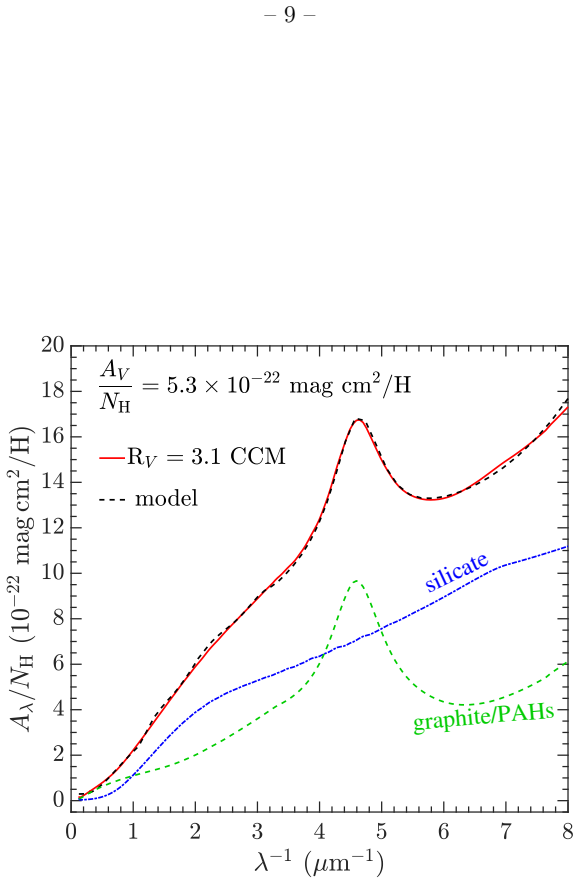
Accurate estimates of the absorption of X-rays by interstellar gas and dust are of crucial importance for the analysis and interpretation of almost all astronomical soft X-ray observations. However, the present X-ray absorption data extensively used by the community were derived from a reduced interstellar abundance (~70% of solar) and ignoring dust scattering. Therefore, these X-ray absorption data, although highly popular, could have been substantially underestimated. Here we update the interstellar X-ray absorption and scattering by making use of updated atomic cross sections, updated interstellar abundances, and realistic X-ray dust physics, and appropriately distributing metal elements in gas and dust. The resulting X-ray absorption and scattering data are publicly available on GitHub.
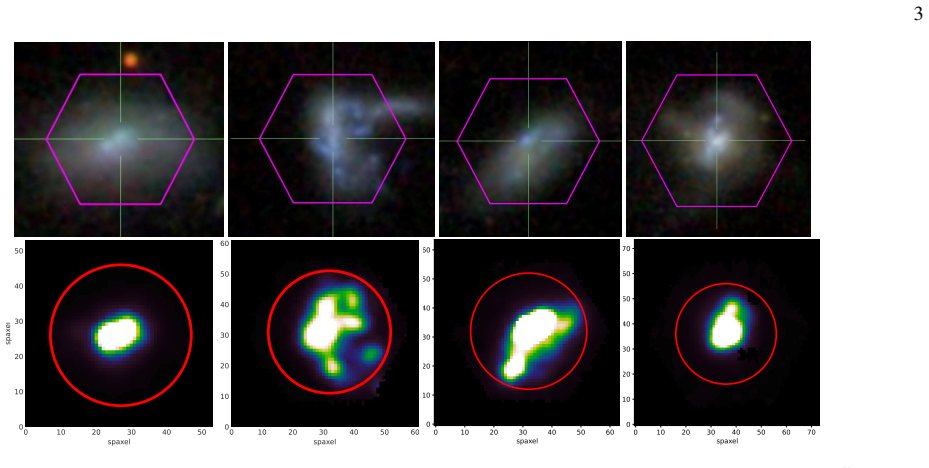
We present James Clerk Maxwell Telescope (JCMT) observations of the $^{12}$CO(J = 2-1) emission of 42 low-mass, star-forming disk galaxies of morphological type Scd or later from the Mapping Nearby Galaxies at Apache Point Observatory (MaNGA) survey. The sample, which probes the M33-like stellar-mass regime, is complemented with metallicities, star formation rates, and \hi\ masses used to investigate the star formation process and to test scaling relations involving molecular gas mass in low-mass systems. We detect CO emission in 55% of the sample and derive H$_2$ masses using both a constant Galactic and a metallicity-dependent CO-to-H$_2$ conversion factor. The 12 $\mu$m luminosity, which includes polycyclic aromatic hydrocarbon features, exhibits a tight linear correlation with the CO line emission, making it a robust tracer of global molecular gas content. The molecular gas mass - star formation rate relation, i.e. the Kennicutt-Schmidt law, is the most fundamental one and it is found to remain linear down to low stellar masses. We also find that the mean molecular gas depletion time is slightly shorter in low-mass late-type galaxies than in more massive systems, consistent with their higher specific star formation rates. Finally, while the specific molecular gas mass ($M_{\rm H_2}/M_*$) shows no significant dependence on stellar mass and a large intrinsic scatter, the HI-to-stellar mass ratio ($M_{\rm HI}/M_*$) decreases with increasing stellar mass and molecular fraction ($M_{\rm H_2}/M_{\rm gas}$), highlighting the progressive transition from atomic- to molecular-dominated interstellar medium along the galaxy population.
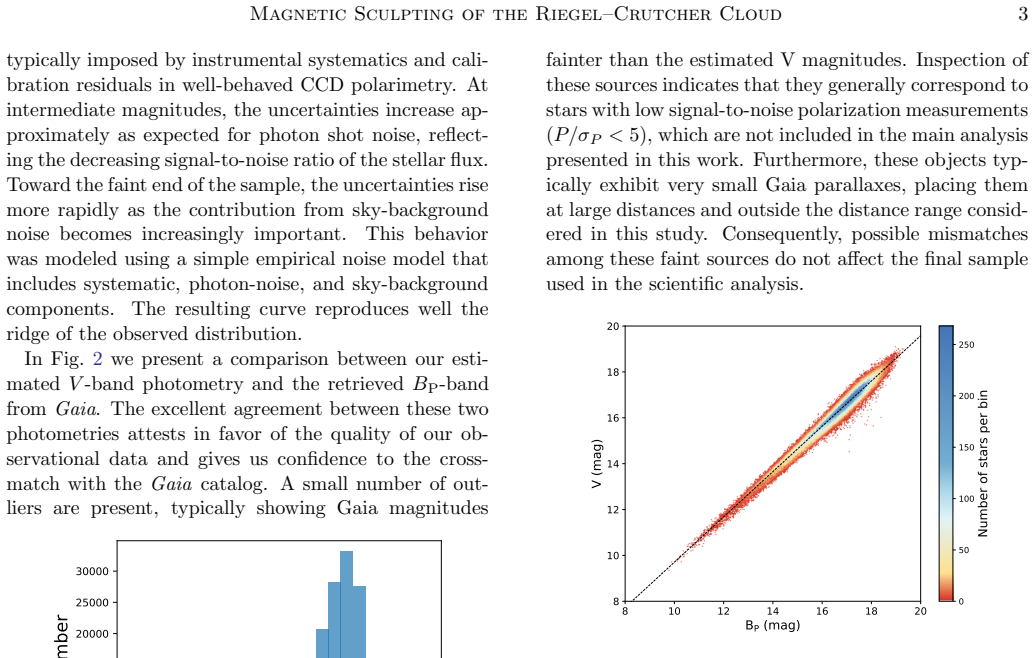
Filamentary structures are ubiquitous in the interstellar medium, yet the extent to which magnetic fields influence the morphology of cold atomic gas remains an open question. The nearby Riegel-Crutcher cloud, composed of long and narrow H I filaments observed in self-absorption, provides a critical test case. We present the most extensive optical polarimetric survey of this region to date, comprising more than 90,000 high signal-to-noise stellar polarization measurements combined with Gaia DR3 data. Using stellar polarization, extinction estimates, and archival Na I absorption data, we locate the cloud at a distance of $150 \pm 15$ pc, consistent with that of the Pipe Nebula. The plane-of-sky magnetic field traced by optical starlight polarization closely matches that inferred independently from Planck 353 GHz dust-emission polarization, revealing a coherent large-scale magnetic field across the region. A Rolling Hough Transform analysis shows that the H I filaments are tightly aligned with this field orientation. Together, these results provide strong observational evidence that the structure of the cold neutral medium in the Riegel-Crutcher cloud is closely linked to a highly ordered magnetic field. This level of coherence supports a scenario in which magnetic fields play a dynamically important role in shaping the cloud structure, and suggests that the Riegel-Crutcher cloud is part of a larger magnetized complex influencing gas flows in the solar neighborhood.
Linear C4H and cyclic c-C3H2, as small unsaturated hydrocarbons, are the key precursors to complex organic molecules and are critical components of the interstellar medium. We present on-the-fly mapping observations of C4H 9-8 lines, c-C3H2 2-1, H13CO+ 1-0, and H42 toward a sample of 22 massive star-forming regions using the IRAM 30m telescope. Our aim is to further explore the evolution of these carbon-chain molecules by combining observational results obtained in cold cores. We employed H13CO+ 1-0 and H42 as tracers to probe the positions of molecular cloud cores and ionised hydrogen regions (HII regions), respectively. One chemical model in particular, which includes gas, dust grain surface, and icy mantle phases for C4H and c-C3H2 molecules, was used to make comparisons with observed abundances. From mapping observations targeting 31 regions across 22 sources, C4H 9-8 (J = 19/2-17/2) and C4H 9-8 (J = 17/2-15/2) were detected in only 17 regions, while H13CO+ 1-0 and c-C3H2 2-1 were successfully detected in all 31 regions. We find that the emission of C4H 9-8 and c-C3H2 2-1 is concentrated at the edges of H42 emission regions. The C4H/H13CO+ and c-C3H2/H13CO+ relative abundance ratios range from 0.17 to 1.77 and 1.42 to 6.69, respectively, with a median C4H/c-C3H2 ratio of 0.13. By combining the observational results of cold cores, we find that C4H/H13CO+ and c-C3H2/H13CO+ ratios show a strong decreasing trend as molecular cores evolve. The decreasing trends in C4H/H13CO+ and c-C3H2/H13CO+ ratios imply that small unsaturated hydrocarbons can be consumed and converted into other organic molecules during the evolution of molecular cores. The spatial concentration of C4H and c-C3H2 emission at the edges of H42 regions further supports their role as precursors in the chemical pathways that lead to complex organic molecules in the interstellar medium.
We present an analysis of specific star formation rates (sSFR) across the galaxy merger sequence using visual classifications from the Zooniverse citizen science project "Cosmic Disco: Characterizing Galaxy Collisions". Our sample comprises 4884 galaxy systems pre-selected as merger candidates from SDSS DR17 ($0.01 < z < 0.05$, $M_* > 10^{8.5}M_\odot$) using Zoobot, of which 3690 were classified as mergers spanning pre-interaction through post-coalescence stages by citizen scientist volunteers. We find a weak but statistically significant positive correlation between $\log(\mathrm{sSFR})$ and visual merger stage ($r = 0.161$, $p = 7.23 \times 10^{-23}$), with a best-fit relation $\log\left(sSFR\right)=(0.148\pm0.015)\, S_{\rm Merg}-(1.865\pm0.038)$. The large RMS scatter (0.661 dex) reflects visual merger stages capturing wide merger timescales, and our results corroborate previous findings of increasing SFR enhancement with merger progression. This work shows that citizen science is a viable complement to automated and pair-based approaches to evaluate timescales for galaxies across the merger sequence.
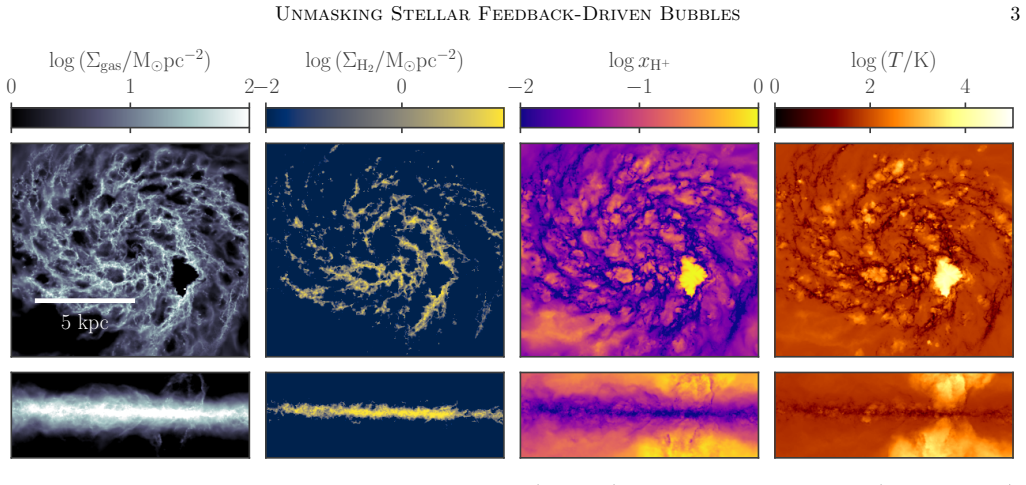
The identification and tracking of stellar feedback-driven galaxy bubbles is an important topic in star formation and galactic structure research. However, current observational analysis of bubbles is limited in scope; information on bubble lifetime is inaccessible. Simulation data thus provides a unique opportunity to glean some of these characteristics at high resolution. We present an investigation into the characteristics and evolution of hot, ionized bubbles in the interstellar medium of a dwarf spiral (NGC300-like) galaxy. We calculate the average radius, lifetime, temperature, density, and spatial distribution of the simulated feedback-driven bubbles using Lagrangian gas parcels, and we examine the relationship between these characteristics and the local galactic environment. We find exponential distributions of bubble lifetime and size, and we find a positive correlation between bubble lifetime and galactocentric radius. Finally, we predict how the data would appear in H$\alpha$ tracers and compare the simulated values to observations. We find an additional positive correlation between the size of the bubbles and the galactocentric radius using their H$\alpha$ tracers.
Our knowledge of the space velocity of Messier 87, which is the dominant galaxy in the Virgo cluster, has been limited to the radial velocity component. Using a cadence of precision position measurements with the global geodetic very long baseline interferometry (VLBI) system over 28 years, we determined the proper motion vector of the radio-emitting core by a robust statistical method involving 1-norm optimization and bootstrapping. The proper motion vector is directed at a position angle $189.2\degr \pm 3.5\degr$ in the equatorial International Celestial Reference Frame, and its magnitude is $10.19$ $\mu$as yr$^{-1}$ with an uncertainty of $0.64$ $\mu$as yr$^{-1}$. The projected velocity of the AGN in the tangential sky plane is ($787\pm50$)~km~s$^{-1}$. The peculiar velocity of Messier 87 with respect to the preferred rest frame of the cosmic microwave background field is approximately 1037 km s$^{-1}$ (assuming a distance of 16.1 Mpc) with an angle of 65$^\circ$ to the current line of sight, which implies a tangential relative motion of M87 and the Galaxy. The peculiar velocity of M87 is directionally concordant with the reconstructed and $\Lambda$CDM-simulated motion of the Virgo filament towards the Great Attractor, but the Milky Way moves slower by 470 ~km~s$^{-1}$ in that direction.
We identify compact groups of galaxies (CGs) in the IllustrisTNG-300 simulation using a Friends-of-Friends (FoF) algorithm. Our approach is designed to be comparable to systematic CG searches based on spectroscopic surveys, while avoiding the conventional Hickson selection criteria, which can bias samples toward relatively low-density environments. We construct two CG catalogs: one based on a three-dimensional distance linking length of 73 kpc (i.e., $50~h^{-1}$ kpc), and another based on projected and radial linking lengths of 73 kpc and $1000~\rm km~s^{-1}$. We refer to these as the position-position-position (PPP) and position-position-velocity (PPV) CG catalogs, respectively. The PPV catalog provides a direct analog to observed CG samples. At $z = 0$ in TNG300, we identify 383 PPP CGs and 1666 PPV CGs. A large fraction ($\sim 80\%$) of PPV CGs are not physically compact systems but are contaminated by line-of-sight interlopers. We demonstrate that the scaling relation between total group stellar mass and velocity dispersion is an effective diagnostic for identifying false positives with line-of-sight interlopers. We further examine the large-scale environments of CGs and show that they reside in a wide range of densities, including the central regions of galaxy clusters. These CG catalogs provide a robust foundation for studying the formation and evolution of CGs in cosmological simulations.
Using Extreme Value Statistics applied to the observed galaxy stellar mass and the UV luminosity functions, we empirically estimate masses and luminosities of the most extreme galaxies in cosmological surveys, including the full sky. We incorporate uncertainties in stellar mass measurements (Eddington bias) and the scatter in the stellar-halo mass relation to derive empirical limits for galaxies residing in the most massive halos. The maximum observed $M_\ast$ strongly depends on survey area and redshift, ranging from $M_\ast \sim 7 \times 10^{12} M_\odot$ for full-sky surveys at $z\sim0$ to $M_\ast \sim 10^{10}M_\odot$ at $z\sim16$. Massive galaxies, particularly at high redshift, approach the theoretical maximum baryonic mass available in halos $M_\ast \sim 0.16 \times M_{\mathrm{vir}}$, consistent with previous claims. Accounting for measurement uncertainties significantly reduces the inferred maximum $M_\ast$ by up to $\sim1$ dex at $z\gtrsim10$, yielding stellar masses consistent with $M_\ast < 0.16$ at all redshifts. Assuming a perfect rank-order correspondence between the most massive halos and galaxies would guarantee this inequality at all redshifts. At 2 $\lesssim$ z $\lesssim$ 6, the most massive galaxies have stellar masses comparable to the total cold gas reservoir from cold and cooling flows, suggesting near-maximal star formation efficiencies, SFEs. At higher redshifts, halos are predicted to host galaxies undergoing starburst phases. When accounting for dust attenuation and adopting empirically inferred SFEs, we find good agreement between the model and the brightest observed UV galaxies at high redshifts. At lower redshifts, however, observed UV galaxies are too bright. Overall, our results indicate that current observations remain broadly consistent with $\Lambda$CDM once statistical and observational effects are properly accounted for.
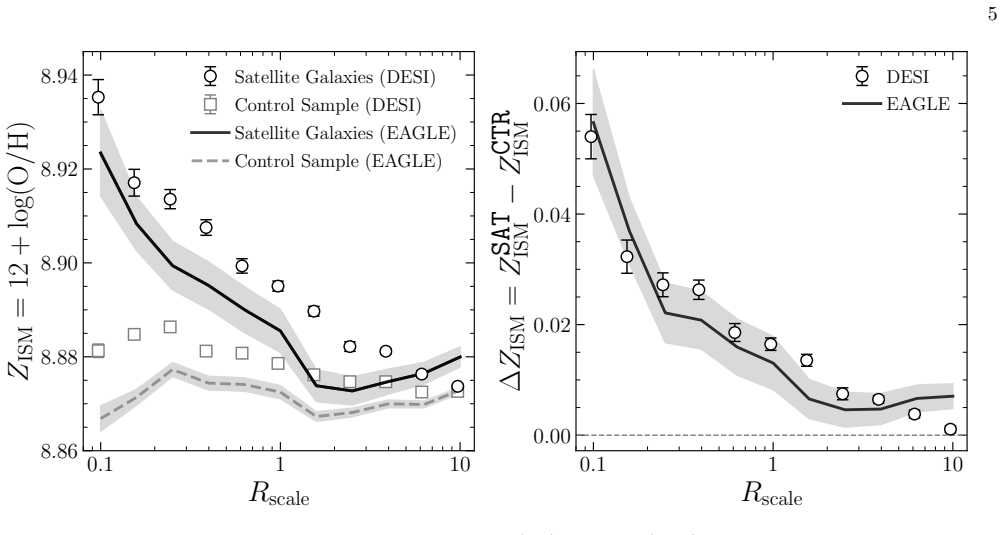
Environmental effects are a primary driver of elevated gas-phase metallicities in galaxies around massive clusters, but the underlying physical mechanisms for this satellite metallicity enhancement (SME) are still unclear. Using the Dark Energy Spectroscopic Instrument (DESI) Data Release 1, we present the first measurement of the average SME as a function of projected cluster-centric distance. The resulting profile reveals three distinct regimes: a steep decline from the cluster center, a plateau near the cluster boundary, and an extended downturn across several cluster radii. Remarkably, the complex shape and amplitude of this observed SME profile are successfully reproduced in the EAGLE cosmological simulation. Drawing insights from EAGLE, we develop a novel satellite chemical evolution model to decompose the observed SME into physical contributions from suppressed star formation, stellar mass loss, and enriched gas inflow. Our analysis shows that continuous accretion of enriched intracluster medium dominates the SME plateau within the cluster virial radius, while mass loss and quenching jointly drive the rapid metallicity decline in the cluster core. Our method disentangles the impacts of three environmental processes on galactic chemical enrichment in the cosmic web, providing a powerful framework for understanding cluster galaxy evolution with current and future spectroscopic surveys.
I present the Spitzer Spectroscopic Data Fusion, a collection of merged spectroscopic redshift catalogs covering fourteen of the most widely studied extragalactic survey fields. Building on the Spitzer Data Fusion multi-wavelength photometric database, the collection merges several publicly available spectroscopic redshift catalogs within each field using a 1 arcsec matching radius, delivers a single best redshift per source together with provenance and overlap flags, and is available on Zenodo at https://zenodo.org/doi/10.5281/zenodo.6368347 The dataset is regularly updated as new spectroscopic surveys are published. It is intended as a community calibration resource for photometric redshift training, SED fitting, and multi-wavelength cross-identification studies.
The [$^{12}$C II] emission at 158 $\mu$m is a key cooling line of the interstellar medium and traces gas kinematics in spectrally resolved observations. Its spectral profile is often modified by optical depth effects. The intrinsic line shape can be reconstructed by comparison with emission from the less abundant $^{13}$C isotope. Due to the additional neutron spin, [$^{13}$C II] emission splits into three hyperfine structure (hfs) transitions. Laboratory measurements have provided the centroid frequency and the strongest component ($F=2-1$); the two weaker components ($F=1-0$ and $F=1-1$) have been inferred only from quantum-mechanical calculations. The magnetic-dipole hfs constants, from which the transition frequencies follow, have not been measured experimentally. The high spectral resolution of observations with the upgraded German Receiver for Astronomy at Terahertz Frequencies (upGREAT) on board SOFIA enabled simultaneous detection of all three hfs transitions. From these astronomical data we determine, for the first time, the magnetic-dipole hfs constants $A_{1/2}^{\rm hf} = 810.71(11)$ MHz and $A_{3/2}^{\rm hf} = 162.18(5)$ MHz of the [$^{13}$C II] $2s^2\,2p\,{}^2P^\circ$ ground term. Combined with the laboratory centroid frequency, this yields the rest frequencies of all three hfs lines. Using [$^{12}$C II] as a reference, we also improve the precision of the [$^{13}$C II] centroid frequency. This work shows that spectrally resolved astronomical observations can constrain fundamental atomic properties, with hfs precision rivaling laboratory measurements. The approach extends to other atomic and molecular transitions where laboratory data are difficult to obtain.
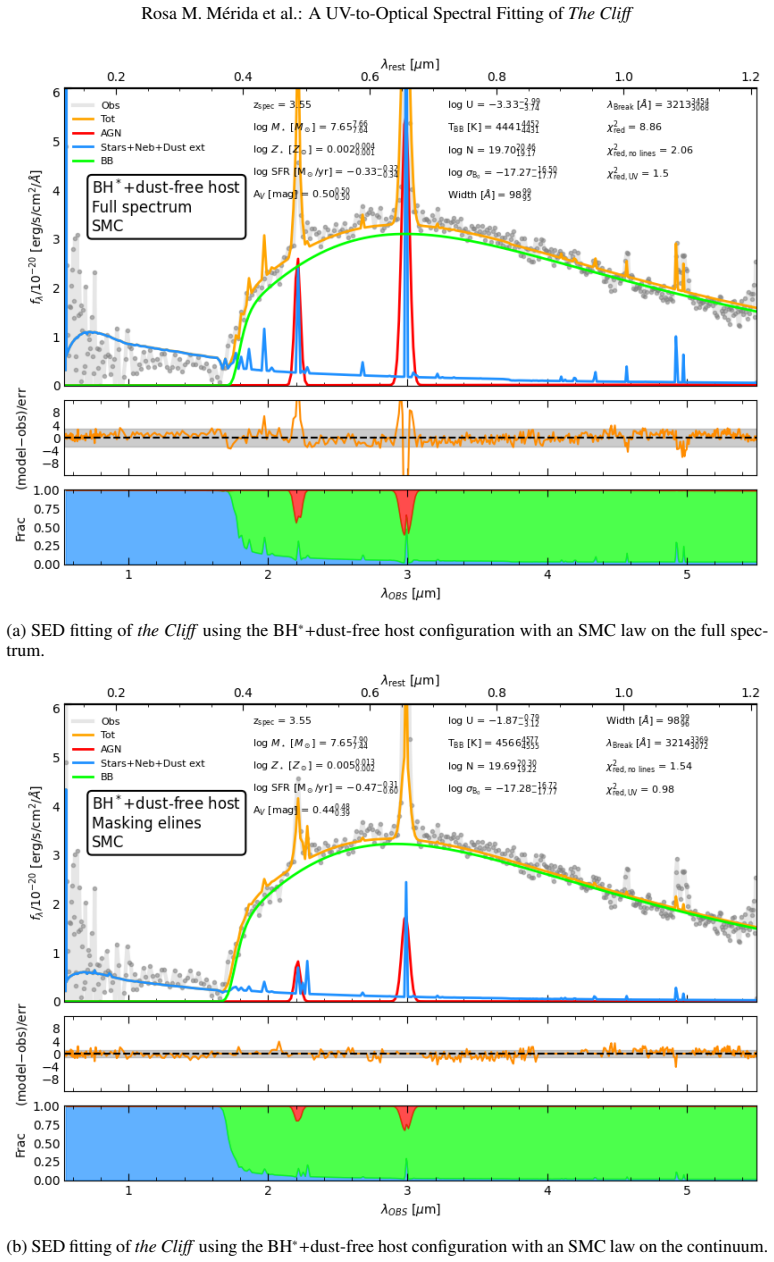
In the black hole star (BH*) model, the characteristic "V"-shaped SED of LRDs is produced by an accreting BH embedded in a dense neutral-gas envelope with a near-unity covering factor. This envelope reprocesses radiation and emits as a ~5,000K blackbody, producing the optical continuum. Meanwhile, the UV is powered by a low-mass, dust-free, metal-poor host. The BH* scenario is promising, but it has yet to undergo detailed testing; conducting a self-consistent UV-to-optical spectral-fitting analysis of LRDs would provide a robust assessment of the model. In this work, we test the BH* scenario by fitting the full JWST/NIRSpec PRISM spectrum of The Cliff ($z_{spec}=3.55$), an LRD that played a pivotal role in the development of this model. A Bagpipes fit that allows stellar, nebular, AGN, and blackbody components naturally yields a BH*-like solution for The Cliff, even with broad priors. Our method allows us to characterize its host, despite remaining unresolved in JWST imaging. From the continuum, we infer the host to be low-mass (log $M_\star/M_\odot$~7.7), star-forming, metal-poor, affected by non-negligible dust attenuation ($A_V$~0.5 mag) acting on both stellar and nebular components. Larger $M_\star$ (up to log $M_\star/M_\odot$~8.1) and attenuations (up to $A_V$~1 mag) are obtained depending on the assumed dust attenuation law. Modest AGN UV leakage is consistently allowed by the code, but remains weak and not robustly constrained, with both AGN+host and host-dominated UV scenarios yielding equivalent fits. The star formation history of the host is relatively smooth, with the galaxy already assembling log $M_\star/M_\odot$~7 about 200 Myr before $z_{spec}=3.55$. The BH-to-$M_\star$ ratio exceeds the values expected from BH-host scaling relations, especially at recent times. This tension may indicate either inaccurate estimates of the BH properties or non-coeval BH-host evolution.
Extreme sudden changes in the flow of accreting gas onto SMBHs manifest themselves via large-amplitude continuum variability and changes to broad Balmer emission profiles, driving changing-look AGN. X-ray flux monitoring with SRG/eROSITA revealed that in the Seyfert AGN HE 1237-2252 the soft X-ray flux dipped abruptly, by a factor of 17 within 18 months. We initiated a follow-up campaign that caught the luminosity recovery after the dip, and enabled us to study how the various accretion components responded during this flux recovery. Our campaign included multiband photometry, X-ray spectroscopy, and optical spectroscopy. We tracked as the accretion rate relative to Eddington increased by a factor of 7 in 3 years. Based on broad Hbeta variability, HE 1237-2252 was subtype 1.0-1.2 in 2002, transitioned to subtype 1.8 by the time of the luminosity dip, and then transitioned back to subtype 1.0 within 3 months as luminosity recovered. Both transitions saw broad Hbeta integrated line flux change by factors of 4-6. The broad Balmer profile is decomposed into a broad Gaussian consistent with virialized gas at 27+/-3 lt-dy, plus a double-peaked profile, consistent with a diskline structure at more than roughly 5 lt-dy. The diskline component's relative contribution to the total profile increases as continuum flux rises. The lack of obscuration in the X-ray spectra, as well as the IR continuum dip, point to an intrinsic pause in the accretion rate as opposed to variable line-of-sight obscuration. Candidates for the underlying mechanisms include propagating cold and warm fronts in the accretion disk. The increased prominence of the diskline BLR component's emission could be due to evolution in the physical extent of the X-ray corona, and in the fraction of >13.6 eV photons intercepted by the diskline, as the accretion rate increases.
Stellar streams are excellent probes of the gravitational potential in which they evolve. In the Milky Way (MW), globular cluster (GC) streams are routinely used to infer properties about time-dependent perturbations of the underlying potential. This implies that streams with Galactocentric radii small enough to be perturbed by the MW bar should offer constraints on it, such as its pattern speed, which currently has a wide range of values reported in the literature and is important when studying stellar kinematics. The GC M92 has a small pericentre and should be affected by the bar. It has a diffuse stellar stream, but confirming stream members has previously been hindered by a lack of spectroscopic data. In this paper, we use Dark Energy Spectroscopic Instrument (DESI) observations together with photometric and astrometric data to obtain spectroscopic members of the M92 stream for the first time. We identify a clear spatial distribution and gradients in distance moduli, proper motions, and radial velocities that confirm the stream's existence. We compare the observed stream to mock streams generated in different barred potentials and estimate the MW bar's pattern speed $\Omega = 29.1^{+0.7}_{-0.4}$ km s$^{-1}$ kpc$^{-1}$ and $\dot \Omega = 0.7^{+3.5}_{-2.3}$ km s$^{-1}$ kpc$^{-1}$ Gyr$^{-1}$. This is the first time a stellar stream is used to probabilistically infer these bar properties, and it opens up an exciting realm of inner Galactic potential characterisation using stellar streams.
Stellar streams trace the gravitational potential of their host galaxies and offer a direct probe of dark matter halo geometry. Cosmological simulations predict that halo shapes depend on both baryonic physics and the nature of dark matter, yet observational constraints on halo flattening and orientation remain limited, especially for individual galaxies. We present Potamides, which utilizes the curvature of extragalactic stellar streams to derive constraints on halo shapes. We apply Potamides to 15 stellar streams from the Stellar Stream Legacy Survey to infer the projected axis ratios and orientation of their host halos. We find that some streams in our sample exclude large regions of halo flattenings and halo orientations. Systems with edge-on wrapping loops or sharp turning points yield the strongest constraints, whereas great circle-like streams remain largely uninformative. All streams in our sample support a spherical halo for a given flattening direction. These results demonstrate that stream morphology can provide halo shape constraints for individual external galaxies. With upcoming surveys (such as Euclid, Rubin, Roman, and ARRAKIHS) expected to discover large numbers of stellar streams, this curvature-based technique will enable rapid statistical tests of dark matter and baryonic physics through the shapes and alignments of halos and disks across cosmic time.
Fanaroff-Riley class I (FRI) radio galaxies show centre-brightened emission from disrupted lower power jets, while traditionally more luminous class II (FRIIs), are edge-brightened, with relativistic jets terminating in hotspots. Population studies of radio-loud AGN (RLAGN) with low frequency, deep, wide-field surveys have revealed FRII-like radio structures at lower luminosities. We present the first high-resolution morphological investigation of a representative LOFAR-selected sample of low-luminosity FRIIs, to determine whether this new population is physically distinct from traditional high-luminosity FRIIs. Using new $1.5$-GHz Jansky Very Large Array (VLA) observations for a sample of 19 low-luminosity FRIIs, from the LOFAR Two Metre Sky Survey Data Release 1 (LoTSS DR1), with luminosities up to three orders of magnitude lower than the typical FR break ($L_{150} = 10^{26}$ W Hz$^{-1}$). We examine the compact features and perform spectral index analysis to identify hotspots, cores and signatures of restarting or remnant activity. We find a higher prevalence of cores and a comparable number of hotspots in the low-luminosity FRII sample compared to a randomly-selected sample of luminous ($L_{150}>10^{26}$ W Hz$^{-1}$) FRIIs selected from the same parent LOFAR sample. Approximately 32 per cent of low-luminosity FRIIs show restarting or remnant behaviour, while $\sim 32$ per cent are active FRIIs with compact hotspots. Our results show that FRII source dynamics occur at low radio luminosities, but reinforce earlier conclusions that the population of low-luminosity edge-brightened RLAGN is highly diverse. Binary morphological classifications should be used cautiously as a first step towards more nuanced investigations of the complexity of jet life cycles and evolution.
We investigate the long-term dynamical evolution of Ter2, Ter4, and Ter5, focusing on their mutual interactions, mass-loss behaviour, and survivability in the dense Galactic centre environment. We performed a suite of high-resolution direct N-body simulations over 8 Gyr, modelling three individual clusters that we also modelled as combined systems. We compared reference runs of isolated clusters with simulations of the full three-cluster system to quantify possible differences in mass loss, potential energy, and orbital behaviour. Our simulations reveal multiple close encounters between the Terzan clusters. The most significant encounters occur between Ter2-Ter4 and Ter4-Ter5, with their tidal radii exceeding the minimum separation. A notable case is the pair Ter2-Ter4, which approaches within 10 pc at a relative velocity of ~320 km/s. We found that the mass-loss rate is higher for the low-mass Ter2 and Ter4 systems in the combined three-cluster simulations than in our similar isolated runs, highlighting the importance of mutual cluster interactions. The common run clearly demonstrates that mutual gravitational interactions between clusters drive significant triaxial deformations, especially for Ter2 and Ter5, which evolve from nearly spherical to distinctly prolate shapes. In contrast, the isolated runs show clusters that remained almost perfectly spherical, confirming that the observed shape changes are correlated with the mutual interactions. The survivability and dynamical evolution of Galactic centre globular clusters cannot be fully understood without accounting for collective interactions among all systems within a few kiloparsecs. Our results emphasise the necessity of complex multi-cluster modelling in realistic Galactic potentials to capture the long-term fate of surviving and dissolved clusters
Glycine-the simplest amino acid-has remained undetected in the interstellar medium despite decades of sensitive searches, motivating alternative approaches to constrain its astrochemical origin. A promising strategy is to investigate the broader $\rm C_{2}H_{5}O_{2}N$ isomer family and identify detectable members that can serve as observational anchors for glycine-related chemistry. Herein, we report the first robust interstellar detection of methyl carbamate toward the hot molecular core G358.93-0.03 MM1 using ALMA 1 mm observations. Ten unblended rotational transitions are identified, yielding a column density of (4.21$\pm0.84)\times10^{15} \rm cm^{-2}$ and an excitation temperature of $204\pm10$ K. We also searched for other $\rm C_{2}H_{5}O_{2}N$ isomers with available rotational spectroscopic data, including glycine, but none were detected, allowing us to derive upper limits on their column densities. The resulting abundance pattern deviates significantly from the Minimum Energy Principle predictions, highlighting that the $\rm C_{2}H_{5}O_{2}N$ family is shaped primarily by kinetic chemical process rather than thermodynamic equilibrium. The observed methyl carbamate abundance is consistent with a grain-surface formation scenario involving radical-radical recombination ($\rm CH_{3}$O + $\rm NH_{2}$CO), further supported by its correlated abundances with its proposed precursors, methanol and formamide, across diverse astrophysical environments. This detection establishes methyl carbamate as a new observational anchor for glycine chemistry, providing critical constraints on the formation pathways of amino-acid-related molecules in star-forming regions.
We present a novel methodology for mapping dust extinction in nearby galaxies at parsec-scale resolution. We apply it to HST 68 fields within the Small and Large Magellanic Clouds (23 fields in the SMC and 45 fields in the LMC) using multi-band HST photometry from the Scylla and METAL surveys. Our technique leverages \textit{kriging}, a geostatistical interpolation method built on the principles of Gaussian Process regression, combined with Gaussian mixture modeling to statistically isolate background stellar sources and account for line-of-sight depth effects. 3D dust simulations demonstrate the method's capability to recover column densities to an accuracy of $A_V \approx 0.1$ mag in fields with at least 1000 sources. The resulting $4^{\prime\prime}$ resolution ($\sim1$-pc) dust maps reveal detailed structure and strong spatial correlation with ancillary ISM tracers, especially in star-forming regions like 30 Doradus. Global extinction of total column densities follows log-normal profiles in both galaxies, with the SMC exhibiting slightly higher mean extinction ($e^{\mu}=0.47$ mag) than the broader LMC ($e^{\mu}=0.43$ mag), likely due to significant line-of-sight depths. We find systematic offsets between dust mass surface densities ($\Sigma_{D}$) derived from extinction versus FIR emission in both galaxies, with $\Sigma_{D, FIR}/\Sigma_{D, A_V}$ ratios ranging from $0.6-1.8$. This work provides the highest-resolution dust extinction maps in SMC and LMC to date, which offer a vital independent benchmark for constraining dust emissivity, $\text{CO}$-dark gas fractions, and the multi-scale structure of the ISM in low-metallicity environments.
Synthetic maps from magnetized interstellar turbulence reproduce observed spectral properties and TE signal without extra tuning.
abstractclick to expand
We present the analysis of high-resolution synthetic dust polarization maps derived from large-scale simulations of magnetized multiphase interstellar turbulence carried out with the AthenaK code on the $Frontier$ exascale supercomputer at the Oak Ridge National Laboratory. Our turbulence model accurately captures spectral properties of the $E$- and $B$-modes measured by $Planck$ at 353 GHz. The simulations provide new insights into the physical origins of the observed $E/B$ asymmetry and positive $TE$ signal, facilitating the development of advanced models of Galactic foreground emission for current and future CMB experiments.
Galaxy formation scenarios can be interpreted through galaxy morphology and the level of rotational versus pressure support, quantified through the ratio of a galaxy's rotation speed to its velocity dispersion: $V/\sigma$. Observational studies of dwarf galaxies find that $V/\sigma$ does not strongly depend on environment, and may weakly depend on galaxy mass, which could shift our understanding of how dwarf galaxies form. We utilize the Marvelous Massive Dwarfs suite to examine whether $V/\sigma$ depends on mass in simulations, and understand how this varies for different baryonic components of the galaxy: HI gas, young stars ($<$ 1 Gyr) and old stars ($>$ 1 Gyr). We use a simulation sample of 67 isolated dwarf galaxies with M$_\star=10^6-10^9$ M$_\odot$ and produce line-of-sight maps for rotation speed and dispersion for different viewing angles of each galaxy. We find that $V/\sigma$ increases with mass, and that HI gas and young stars are more rotation-supported ($V/\sigma\approx 1-13$) while old stars are more dispersion-supported ($V/\sigma\approx 0.2-5$). This result is consistent with the scenario where young stars are born from dynamically cold gas in the interstellar medium and undergo dynamical heating over time. We quantify the effects of spatial resolution in observational determinations of $V/\sigma$ and find that existing observations using old stars may underestimate the intrinsic $V/\sigma$. We find a correlation between $V/\sigma_\mathrm{HI,global}$ and HI line profile shape that is qualitatively similar to previous simulation results, but we find higher $V/\sigma_\mathrm{HI,global}$ compared to prior work which found values $\lesssim 2$ for most galaxies in this mass range. Our results motivate future work to examine $V/\sigma$ and dwarf galaxy formation with different kinematic tracers of the galaxy.
We present the results of our investigations of spectrally and spatially resolved (sub)millimeter HCN-to-HCO$^{+}$ flux ratios at J=2-1, J=3-2, and/or J=4-3 in 18 nearby ($z <$ 0.15) ultraluminous infrared galaxies (ULIRGs), using ALMA $\lesssim$0.2" ($\lesssim$500 pc) resolution data. The geometry of elevated HCN-to-HCO$^{+}$ flux ratios (with $>$3$\sigma$ detections for both molecular lines) in position-position-velocity (PPV) space is visually classified into (i) spherical shell (spectrally and spatially distinct), (ii) spectrally distinct and spatially compact, and (iii) filled (spectrally filled and spatially compact). These can naturally be explained by the elevation of the flux ratio due to (i) a spatially resolved outflow, (ii) an AGN and/or a spatially unresolved outflow with blueshifted and redshifted emission components, and (iii) an AGN and/or a spatially confined outflow with not clearly separated blueshifted and redshifted velocity components, respectively. Signatures of elevated HCN-to-HCO$^{+}$ flux ratios originated from (a) spatially resolved outflow and (b) AGN and/or spatially unresolved outflow are seen in seven and nine ULIRGs, respectively. In the former spatially resolved outflow-origin case, modest-velocity components relative to the maximum outflow velocity tend to be probed by spaxels with elevated HCN-to-HCO$^{+}$ flux ratios. The spectrally and spatially resolved HCN-to-HCO$^{+}$ flux ratios can provide additional information on the physical origin of the elevated flux ratios in nearby ULIRG nuclei, compared to previously conducted spatially integrated and/or velocity-integrated analyses.
Heavily reddened quasars (HRQs) are luminous, dust-obscured broad-line quasars thought to represent a short-lived phase of intense black hole growth and feedback. Previous studies have been limited by small sample sizes, restricting robust statistical analysis. We expand the sample of the most luminous HRQs to enable population-level studies, connecting their spectral energy distributions (SEDs) to other quasar populations and placing them within an evolutionary sequence of massive galaxy and black hole formation. We assemble multiwavelength broadband photometry for the brightest HRQ candidates (K$_{AB}$ < 18 mag) and select AGN with red near-infrared colours (J-K)$_{AB}$ > 1.6. Using SPHEREx spectrophotometry, we confirm HRQs and determine redshifts. Detailed SED fitting allows comparison with other luminous quasars, including a control sample of hyper-luminous, unobscured Quaia quasars and luminous Hot Dust-Obscured Galaxies (Hot DOGs). We confirm 77 new HRQs with redshifts 1.5 < z < 3.9, dust-corrected optical continuum luminosities log$_{10}(\lambda L_\lambda (3000A)$ [erg/s])>47.0, and line-of-sight extinctions 0.4 < E(B-V) < 1.6 (A$_V$ mag). This more than doubles the known HRQs at z > 1.5, including the first seven at z > 3. A UV excess consistent with scattered quasar emission is detected in 76% of HRQs. We show that HRQs are hot-dust poor compared to blue quasars of similar luminosity and redshift. Their 6um continuum luminosities are systematically fainter at fixed 3000A continuum luminosity relative to blue Quaia quasars, indicating deficiency in both hot and warm dust. These results support a scenario in which HRQs represent a blow-out phase, where strong feedback begins clearing obscuring material from central regions.
A central question in galactic dynamics and galactic archeology is: how much do the orbits of stars redistribute (migrate) after birth? We use the FIRE-2 cosmological zoom-in simulations of 11 Milky Way-mass galaxies to quantify the change in the orbital specific angular momentum, j_phi, orbital radius, R_orbit, and azimuthal velocity, v_phi, of stars from birth to today. We examine the dependences on stellar age, present-day R_orbit, and birth R_orbit, characterizing both the median (net) change, Delta R_orbit, and its scatter, sigma(Delta R_orbit). We comprehensively compare five ways of measuring orbital radius; we find generally consistent trends, but only when measuring radius today and radial redistribution self-consistently. Stars selected by their birth R_orbit typically decreased in R_orbit, j_phi, and v_phi since birth. The trend for stars at a given R_orbit today depends on age: those younger than ~5 Gyr generally decreased in R_orbit, j_phi, and v_phi since birth, while those older generally increased in R_orbit, j_phi, and v_phi since birth. sigma(Delta R_orbit), a standard metric of radial redistribution, increases with stellar age only up to ~ 3 Gyr; it saturates at sigma(Delta R_orbit) ~2 kpc for older stars. This saturation contradicts a common expectation of a monotonic increase with age. Our results broadly agree with recent observational inferences of Delta R_orbit and sigma(Delta R_orbit) in the Milky Way. Across our FIRE-2 sample, the timing of disk formation does not correlate with sigma(Delta R_orbit), but it correlates with (net) Delta R_orbit.
JWST has enabled the detection of galaxies in the earliest stages of cosmic history. We compare the ultraviolet luminosity functions (UVLFs) at redshifts $z=7-15$ predicted by the new cosmological hydrodynamics simulations, COLIBRE with observations, including those from JWST. The UV luminosities of COLIBRE galaxies are derived using the radiative transfer code SKIRT, which tracks stellar emission and its processing through the multi-phase interstellar medium and dust distribution predicted by COLIBRE. We find that although COLIBRE is consistent with the observed evolution of the stellar mass function up to $z=12$, its dust-attenuated UVLFs fall systematically below the observations at the bright end: at the number density of $10^{-6}\,\mathrm{Mpc^{-3}\,mag^{-1}}$, the brightest galaxies are underluminous by $\approx 1\,\rm mag$ at $z=7$, increasing to $\approx 2.5\,\rm mag$ at $z=15$. Accounting for observational uncertainties brings the COLIBRE UVLFs closer to the observational data, but does not fully resolve the discrepancy. Ignoring dust attenuation allows COLIBRE to produce sufficiently bright galaxies at $7\lesssim z \lesssim 12$, while at $z=15$, COLIBRE still underpredicts the luminosities of the brightest galaxies, indicating the need for additional physical mechanisms to boost the UV luminosities at the earliest cosmic epochs, such as a ''top-heavy'' stellar initial mass function. We fit the COLIBRE UVLFs with Schechter functions and calculate the evolution of the best-fit parameters. We find that the galaxy number density decreases, the characteristic luminosity becomes fainter and the faint-end slope becomes steeper towards higher redshifts. The UV luminosity density decreases by a factor of $\approx 300$ from $z = 7$ to $z = 15$.
We present an HST imaging survey of a 1.1 sq. degree sky area toward the Milky Way Galactic Bulge. This field significantly overlaps with the upcoming Nancy Grace Roman Galactic Bulge Time Domain Survey (GBTDS). High angular resolution imaging of this area with HST before the start of the Roman Galactic Exoplanet Survey (RGES) will greatly strengthen Roman's ability to characterize detected exoplanet systems, as well as provide a rich and wide-field archive for use as a legacy dataset toward the Galactic Bulge for the broader community. We conduct coordinated-parallel imaging with both wide-field cameras on HST, Wide-field Camera 3 (WFC3) and Advanced Camera for Surveys (ACS), utilizing the F606W and F814W passbands. Approximately 70% of the survey was conducted during HST Cycle 32, with the remaining 30% conducted during Cycle 33. In this paper, the first in a series, we give a general overview of the program and the observing strategy, and present early results. This campaign secures HST's lasting impact on the high-precision study of stellar populations, dynamics, exoplanet systems, interstellar extinction, metallicities, cluster associations, and more toward the center of our Galaxy.
Optical emission-line ratios in star-forming galaxies at $z \sim 3$-8, such as [OIII]/H$\beta$ and [OIII]/[OII], are strongly offset from those at $z \sim 0$-2, pointing to more extreme ionization and ISM conditions in the early Universe. To constrain the physical origin of these offsets, we developed Lumen, a framework for modelling nebular emission from spatially distributed HII regions in cosmological simulations. We apply Lumen to IllustrisTNG50, validate its predictions at low redshift, and test a suite of proposed mechanisms for producing extreme line ratios at $z = 3$-8. We focus on the [NII]/H$\alpha$ versus [OIII]/H$\beta$ (N2-BPT) diagram, the [SII]/H$\alpha$ versus [OIII]/H$\beta$ (S2-VO87) diagram, and the [OIII]/[OII] versus ([OII]+[OIII])/H$\beta$ (O32-R23) diagram. We find that $\alpha$-enhancement alone cannot explain the bulk of observations. Moderate offsets emerge from the combined effects of $\alpha$-enhancement, a higher IMF upper-mass cutoff, and AGN contributions. The most extreme [OIII]/H$\beta$ and [OIII]/[OII] values require high ionization parameters powered by massive star clusters of $\gtrsim 10^5$-$10^6\,\mathrm{M}_\odot$, consistent with recent JWST observations. Reproducing the highest [NII]/H$\alpha$ ratios additionally requires enhanced nitrogen abundances. Although gas densities of $n \sim 10^4\,\mathrm{cm}^{-3}$ can boost several diagnostic ratios, they suppress [SII]/H$\alpha$ and are therefore in tension with current observations. Overall, models combining harder ionizing spectra, elevated ionization parameters from massive star clusters, and enhanced nitrogen abundances reproduce the observed high-$z$ galaxy population across the N2-BPT, S2-VO87, and O32-R23 diagrams. This successful model also motivates new demarcation lines for star-forming galaxies in the N2-BPT and S2-VO87 diagrams.
The competition between metal synthesis and feedback from massive stars establishes the mass-metallicity relation (MZR) at low-redshifts. Examining this relation at higher redshifts, particularly at the low-mass end $\lesssim10^{8}\,{\rm M_\odot}$, is essential for understanding chemical enrichment and stellar feedback. In this study, we utilize the deep ($\sim30\,$hrs) JWST/NIRSpec G395M GLIMPSE-D survey of the lensed field Abell S1063, to explore the low-mass end of the MZR at high redshift ($z\sim6-8$). We identify eight [OIII]$\lambda$4364 emitters, enabling the most reliable "direct" metallicity measurements in galaxies down to stellar masses of $\sim10^{6-8}\,{\rm M_\odot}$. By combining our sample and galaxies with [OIII]$\lambda$4364 detections from the literature, we calculate direct metallicities for 21 galaxies. We compare our direct metallicities to those derived from strong-line diagnostics, and find them to be consistent with previous calibrations. We fit the MZR at $10^{6.7-9}\,M_{\odot}$ with $\sim0.3-0.5$ dex lower metallicity than local galaxies at similar stellar mass. We find the slope to be $0.25\pm0.10$, comparable to the local MZR; and the MZR exhibits a scatter of $\sim0.2\,$dex, which is larger than the local MZR, The lower metallicities may reflect denser, more gas-rich early environments, with continuous inflow of metal-poor gas diluting the ISM metallicity. In addition, we show that in extremely high electron densities ($n_e \gtrsim 10^5\,{\rm cm^{-3}}$), metallicities can be significantly underestimated ($\sim0.5$ dex), if lower $n_e$ are assumed for galaxies with high $n_e$. In a nutshell, these observations provide the first glimpse of the low-mass MZR at $z\sim6-8$ using direct metallicity measurements. More deep spectroscopic observations in lensed fields will be critical to robustly characterize the MZR and chemical evolution in the early universe.
Cosmic rays (CRs) are important drivers for molecular chemistry in star-forming regions, and laboratory experiments have shown that CRs can stimulate the release of complex organic molecules (COMs) such as methanol. Observationally, this has primarily been tested in cold, low-mass cores, so studying how CRs affect COM formation in a high-mass star-forming environment is of great interest. We performed a high-sensitivity wide-band spectral line survey with the Onsala 20 m telescope towards the high-mass protostar Cepheus A HW2, which is known to host an ionised jet. Consistent with previous studies, two primary velocity components ($-11$ km s$^{-1}$ and $-5$ km s$^{-1}$) were identified. Column densities and relative abundances of the detected ions and COMs were estimated from rotational diagrams, single transitions and RADEX grid searches (CH$_3$OH: $1.6\times10^{-9}$, CH$_3$CN: $5.9\times10^{-11}$, t-HCOOH: $7.9\times10^{-11}$, H$_2$CCO: $1.7\times10^{-11}$, CH$_3$CHO: $1.9\times10^{-11}$, CH$_3$OCHO: $7.6\times10^{-10}$ at $-11$ km s$^{-1}$). Deuterium fractions were also estimated (in range $0.002-0.3$ at $-11$ km s$^{-1}$), and the volume density of molecular hydrogen ($2.6\times10^5$ cm$^{-3}$ at $-11$ km s$^{-1}$) was constrained from the RADEX grid searches. Electron fractions and CR ionisation rates (CRIR, $6.8\times10^{-17}$ s$^{-1}$ at $-11$ km s$^{-1}$, $\leq9.2\times10^{-19}$ s$^{-1}$ at $-5$ km s$^{-1}$) were estimated through analytic chemistry using different ions as probes. The gas-grain chemical code Nautilus reproduced the observed abundances of CH$_3$OH, CH$_3$CN, HCO$^+$, N$_2$H$^+$ at the observed density, temperature and CRIR within the uncertainty of the model. The results indicate that the CR ionisation rate of the kinematic component associated with most of the COMs' emission in the region is locally enhanced.
The radial acceleration relation (RAR) links observed and baryonic accelerations, and is best established in rotation curves of late-type galaxies. Pulsar timing, which measures line-of-sight (LOS) differential accelerations between the Sun and pulsars, provides a novel probe of this relation, including along directions outside the Galactic disc. By combining these pulsar differential accelerations with the acceleration at the Sun, we test whether current pulsar timing data carry information on a vector generalisation of the RAR, ${g}_{\rm obs}=\nu(|{g}_{\rm bar}|){g}_{\rm bar}$. Comparing the measured SPARC RAR (generalised to 3D) to 26 binary-system pulsars with literature accelerations, we find a reduced $\chi^2$ of 3.58, compared with 10.86 for Newtonian baryonic gravity alone. However, setting all accelerations to that of the Sun gives a reduced $\chi^2$ of 3.75, showing that this vector RAR test is dominated by the Solar acceleration with current data.
This work presents the first dedicated optical--mid-infrared time-domain variability and dust-reverberation analysis of the isolated NLSy1 galaxies Mrk 42 and Mrk 493. We combine ZTF optical light curves, WISE mid-infrared monitoring, archival Swift and SDSS data, and high-cadence IAC80 optical observations. Using colour--magnitude relations, flux--flux analysis, and interpolated cross-correlation functions, we trace variable optical continuum and delayed dust response. Both galaxies show positive optical--MIR lags consistent with dust reverberation. For Mrk 493, we measure an observed-frame g--W1 lag of $\tau_{\rm obs}=79.4\pm2.2$ d, corresponding to $R_{\rm dust}(W1)\simeq0.0648$ pc. For Mrk 42, the corresponding lag is $\tau_{\rm obs}=39.1\pm2.6$ d, giving $R_{\rm dust}(W1)\simeq0.0320$ pc. These lags provide optical--MIR dust-reverberation radii and BLR--dust scale comparisons for both objects; the resulting $R_{\rm dust}/R_{\rm BLR}$ ratios are $\simeq6.8$ for Mrk 493 and $\sim6$--7 for Mrk 42. For Mrk 42, we derive the first host-subtracted AGN continuum luminosity at 5100 \AA\ from SDSS spectral decomposition, giving a self-consistent BLR--dust comparison on an AGN-only luminosity basis. Both galaxies have similar radial hierarchies but different colour behaviour: Mrk 493 shows significant optical and MIR bluer-when-brighter trends, whereas Mrk 42 shows strong optical but weak MIR colour variability. We also identify and analyse a major optical flare in Mrk 42 with four internal maxima spaced by 45--47 d. We interpret this signal as quasi-periodic substructure within a broader accretion-driven flare, rather than as a strictly coherent periodic process. These results indicate that, even in dynamically isolated environments, the variability of low-mass, high-accretion-rate AGNs is governed mainly by the intrinsic state of the accretion flow and its coupling to circumnuclear dust.
We present Very Large Telescope/Xshooter spectrophotometric observations of eleven low-redshift (z<0.085) compact star-forming galaxies (`high O32 sample'). These galaxies are characterised by extremely high emission-line ratios [OIII]$\lambda$5007/[OII]3727, ranging from 11 to 42. Galaxies with such high ratios are thought to be promising candidates for leaking large amounts of Lyman continuum radiation. They are characterized by low oxygen abundances 12+log(O/H)\,=7.5-8.0 and low stellar masses M*~10^6-10^8 Msun. Strong emission lines of various ions in all spectra are used to derive helium and oxygen abundances, and N/O, Ne/O, S/O, Cl/O, Ar/O and Fe/O abundance ratios. We also derived macroscopic velocity dispersions sigma(lambda) from various emission lines of different ions. We find that sigma(4861) of the Hbeta emission line is increased with increasing stellar mass and decreasing O32 ratio. On the other hand, sigma(lambda)/sigma(4861) ratios for various lines are close to 1. Exceptions are sigma(lambda)/sigma(4861) of two lines, HeII 4686 and HeI 10830, which are considerably higher than unity and of four lines, [OII] 3726,3729, [SII] 6717,6731, with sigma(lambda)/sigma(4861) lower than unity. The two former lines are likely produced in the inner parts of HII regions and are broadened by dynamical processes generated by massive stars, and by radiative scattering in the case of the HeI 10830 emission line. Emission in the four latter lines is produced mainly in the outer and likely more quiet parts of HII regions.
We develop a model-independent framework to quantify phase-space "crystallization", the degree of ordered radial and kinematic substructure, in 79 Galactic globular clusters using the Gaia EDR3-based membership catalogue of E. Vasiliev & H. Baumgardt (2021a). We construct a scalar crystallization index, C_index, by combining a radial inhomogeneity metric (z_rad) and a local, cluster-centric tangential-velocity metric (z_vel) standardized against empirical nulls. The population distribution is strongly non-Gaussian: most clusters are consistent with smooth, equilibrium expectations, while a small high-C tail (C_index >= 2) identifies dynamically complex systems, including NGC 5139 (\omega Cen) and NGC 104 (47 Tuc). Correlation and fixed-N tests show that sample size affects detectability, but does not by itself explain all high-rank objects. Through synthetic injection tests in dynamically "quiet" control clusters, we demonstrate sensitivity to ultra-cold, shell-confined kinematic components, ruling out single-shell structures comprising more than a few to ~ 10-20% of core stars in the best-sampled control clusters. We find no evidence, within the sensitivity of the adopted diagnostics, for phase-space structures that require explanations beyond known dynamical processes. However, C_index provides a useful tool for ranking clusters by dynamical extremeness, serving both as a diagnostic for internal complexity and as a quantitative metric for prioritizing follow-up dynamical or technosignature-oriented observations.
We investigate the physical origin of kinematically persistent planes (KPPs) of satellite galaxies in a sample of 190 Milky Way (MW)/M31-like host-satellite systems drawn from the TNG50 simulation. Building on the identification of 46 early KPPs in a previous work, we analyse their formation in the context of the high-redshift evolution of the local Cosmic Web by tracking the deformation of the so-called Lagrangian Volumes (LVs) surrounding each system. Using a reduced tensor-of-inertia analysis, we characterise the time evolution of the principal directions of collapse and relate them to the clustering of satellite orbital poles. We find that in approximately 67\% of KPPs satellite orbital poles align with the LV direction of strongest collapse, $\vec{e}_3$, while a smaller fraction ($\sim20\%$) align with the intermediate axis, $\vec{e}_2$; alignments with the major axis are rare. These alignments are statistically distinct from random expectations and reflect the confinement of satellites to planar configurations normal to the corresponding LV principal directions. We perform a kinematic analysis of satellite motion within KPPs, finding that vertical and radial motions relative to these KPPs decay early, leading to rotation-dominated, ``disky'' configurations. The characteristic timescales for satellites to settle onto a common orbital plane, for satellite orbital pole clustering, and for LV shape evolution are found to be quasi-coeval, peaking at a Universe age T$_{\rm uni}\sim4$~Gyr, during the fast mass assembly phase of the host halo. These results support a scenario in which early KPPs are fossil remnants of high-redshift, anisotropic mass collapse driven by the local Cosmic Web formation process in $\Lambda$CDM.
Large spectroscopic and astrometric surveys have revealed complex wave-like features in the Milky Way disk, suggesting that its kinematic and chemical structures are shaped by time-dependent perturbations. Recent studies have reported oscillatory patterns in the Rg-Vphi-VR space, hinting at a possible structural transition in the outer disk. We aim to characterise the transition between the inner and outer Galactic thin disk and to investigate whether radial corrugations can provide a plausible physical interpretation of the observed features. We analysed two large stellar samples from LAMOST DR8 and Gaia DR3, combining spatial, kinematic, and chemical diagnostics. A simplified corrugation model consisting of two radial waves propagating in opposite directions was constructed and fitted to the observed VR pattern. We further validated the model using N-body simulations. Both LAMOST and Gaia samples reproduce the previously reported wave-like pattern in the Rg-Vphi-VR plane. We identify a clear transition between the inner and outer disks via the variations in rotational velocity and metallicities. The corrugation model naturally reproduces the periodic variation of VR with galactocentric radius, and the superposition of the inward and outward propagating modes gives rise to a comparable oscillatory pattern in both observations and simulations. Our modelling suggests that radial corrugations can provide a plausible interpretation of the observed kinematic signatures. The results highlight the complex, multi-perturber nature of the Galactic disk and motivate further investigation with upcoming surveys.
We present the first results from a program searching for extended Ly$\alpha$ halos around high redshift ($ z \gtrsim 6.5$) quasars using the red channel of the Keck Cosmic Web Imager (KCWI). Our observations reveal a Ly$\alpha$ halo extending to $\simeq11$ pkpc around the $z=6.64$ broad absorption line quasar J0910$-$0414. The Ly$\alpha$ velocity field displays a rotation-like gradient, and the gas velocity dispersion is consistent with gravitationally dominated motion ($\sigma_{\mathrm{Ly\alpha}}<300$ km s$^{-1}$). Comparison with the $[\mathrm{C\;II}]$ kinematics of the host galaxy core from ALMA observations shows that the Ly$\alpha$-emitting gas extends over a much larger region, shows distinct kinematics, and has a smaller velocity dispersion ($\sigma_{\mathrm{Ly\alpha}} \simeq 0.6\sigma_{\mathrm{[C\;II]}}$). The Ly$\alpha$ spectral region of the quasar is largely obscured by a deep $\mathrm{N\;V}$ absorption trough, and as a result, roughly $55\%$ of the total Ly$\alpha$ flux is from the extended halo. These observations demonstrate the potential of KCWI for probing the cool gas reservoir that fuels the growth of quasars and their hosts in the epoch of reionization.
We present spatially resolved Keck/LRIS spectroscopy of three clumpy star-forming galaxies at $z\sim0.1$, comparing outflow properties traced by H$\alpha$ and Mg II emission with those probed by Mg II and Na I D absorption. Outflow velocities measured using Mg II absorption ($\langle v_{\rm out} \rangle = -560 \pm 30$~\kms) are consistently higher than those traced by H$\alpha$ emission ($\langle v_{\rm out} \rangle = -124 \pm 3$~\kms) across $\sim$5 kpc$^{2}$ regions. Despite this offset, the correlation between $v_{\rm out}$ and galaxy properties, such as SFR and $\Sigma_{\rm SFR}$, show similar slopes for both tracers, with Mg II absorption systematically offset by $\sim 0.4$ dex. In two galaxies, Mg II emission is also detected, yielding velocities consistent with H$\alpha$. In one galaxy we also detect outflows in Na I D absorption and find similar velocities as Mg II in absorption, which leads to a $\sim$0.4 dex higher Na I D outflow velocities compared to those measured in emission. Our spatially resolved results are consistent with those found for galactic-scale measurements, implying the outflow relationships are similar from the sales of $\sim$1-2 kpc to global measurements. Combined with literature measurements, these results suggest that the offset in velocities is driven not by ionisation state, but rather by the systematics associated to how absorption and emission measures trace the gas density.
The extremely metal-poor nature of the C-19 stream indicates that its progenitor was a primordial stellar system born in the very early Universe. Current observations show that it has a small metallicity dispersion (0.18 at the 95% confidence level), which is the signature of a globular cluster origin, while at the same time displaying an unusually large velocity dispersion ($\sim10$ km/s) typical of dwarf galaxies. To reconcile this conflicting observational evidence, previous simulations have focused on potential interactions with dark matter subhalos, which can efficiently make a cluster stream dynamically hot. In this work, we explore internal dynamical processes in star cluster formation, focusing on initial conditions shaped by gas expulsion and a top-heavy initial mass function. We find that the large observed velocity dispersion and broad stream morphology can be reproduced by a cluster that underwent severe gas expulsion and expansion during its birth phase, which is potentially a typical formation scenario of extremely metal-poor star clusters. A top-heavy IMF and binaries can also increase the velocity dispersion. The formation of C-19 may involve a combination of these effects.
We analyzed the distribution of spin parity in spiral galaxies using the HSC DR2 data. The spiral winding parity of disk galaxies, observed as S-spiral or Z-spiral projected onto the sky plane, provides robust information on the sign of the line-of-sight component of their spin vectors, specifically whether the spin vector points toward or away from us. The distribution of 49,494 S/Z annotated spirals with spectroscopic redshift (0.05 $\le z$) was analyzed for 46,247 fiducial cubic search volumes of various sizes, 20--200 Mpc, deployed in the 3D supergalactic coordinates. We counted the number of S-spirals and Z-spirals in each cube, evaluated the binomial probability of the observed S/Z imbalance, and identified statistically anomalous cube candidates.
The observed cumulative distribution functions for the 256 sets of cubes are in good agreement with the theoretical binomial distribution and with those obtained from 1000 Monte Carlo realizations assuming random S/Z spin assignments. The number of statistically anomalous cubes is also comparable to that expected from the random assignments. These results indicate that the spin-vector distribution of spiral galaxies is consistent with statistical randomness expected from the standard cosmological model of structure formation.
We present sensitive ($\sim$9 $\mu$Jy), sub-arcsecond resolution radio continuum observations at 9.0 GHz (3.3 cm) and 14.0 GHz (2.1 cm) obtained with the Karl G. Jansky Very Large Array (VLA) toward the nearby Coronet Cluster in Corona Australis (d $\approx$ 150 pc). We monitored the region from March 2012 to February 2015 using all available VLA configurations, allowing us to construct deep X- and Ku-band maps at multiple angular resolutions. We detected 20 radio sources, including 14 previously known Young Stellar Objects (YSOs), five sources possibly associated with shock emission, and one background galaxy. We resolved IRS 5, previously known to be a binary system, and identified IRS 7A and IRS 7B as multiple systems at centimetre wavelengths. The younger Class 0 and I YSOs exhibit spectral indices $\alpha_{pk}$ ranging from -0.4 to 1.7, while the more evolved Class II YSOs show flatter values between 0 and 0.8, consistent with free-free emission, with minor contributions from non-thermal emission. The Class III source is only constrained by an upper limit. Radio variability, measured as a fraction of the mean intensity peak, is found to be ubiquitous and independent of evolutionary stage. Variability structure functions computed for nine sources indicate no preferred timescales for most of them. We also investigate spectral index variability for six sources and find significant variations in only one object. Finally, we analyse the extended radio emission toward IRS 7B, where some subcomponents exhibit negative spectral indices suggestive of non-thermal processes.
We investigate the mass-metallicity relation (MZR) from z=1 to z=9 using electron-temperature-based gas-phase metallicities and examine how auroral-line selection, star-formation history, and secondary abundances affect its interpretation in the early Universe. We compile a homogeneous sample of 286 star-forming galaxies observed with JWST/NIRSpec medium resolution spectroscopy, selected through detections of the [O\,III]\,$\lambda$4363 auroral line from the public DAWN JWST Archive (DJA). We derive electron densities, temperatures, and oxygen abundances using the direct $T_e$ method, along with relative N/O and He/H abundances. Stellar masses are obtained via SED fitting and star-formation rates from reddening-corrected Balmer emission lines. To quantify auroral-line selection biases, we additionally stack galaxy spectra with and without auroral-line detections, extending the MZR into regimes inaccessible to individual measurements. The auroral-line-detected sample spans log(M*/Msun)=6.77-10.5 and 12+log(O/H)=6.9-8.4. A linear fit gives an MZR slope of $\gamma$=0.38 $\pm$ 0.09. Stacked galaxies without individual $\lambda$4363 detections define a relation with a similar slope but metallicities higher by ~0.2-0.3 dex at fixed stellar mass. Auroral-line detections also show higher SFRs, larger equivalent widths, and larger offsets from the fundamental metallicity relation, whereas non-detections appear more chemically evolved and closer to it. Several stacked bins also show enhanced N/O and He/H ratios. These results indicate that the low-mass high-redshift MZR traced by JWST is shaped by both recent star-formation history and auroral-line selection effects. Auroral lines preferentially identify high-EW, high-sSFR galaxies in the low-metallicity envelope, whereas non-detections reveal a more enriched sequence closer to the metallicity expected from the FMR.
Molecular clouds form stars from the interstellar medium via gravitational collapse, following a sequence from low-density gas to high-density cores and eventually the formation of stars. In classical density wave theory, gas clouds orbiting the galaxy experience gas compression and triggered star formation, while encountering the gravitational well of spiral arms. We aim to trace these different phases of the molecular cloud life cycle via tracers of molecular gas (CO), dense molecular gas (HCN), and star formation (H$\alpha$, 24 $\mu$m) within the spiral arms of two grand-design spiral galaxies: NGC 4321 and M51 (NGC 5194). In the spiral arms of these galaxies, we investigate the relation between molecular gas, dense gas, and star formation (CO-HCN-SFR) at matched physical resolutions of 270 pc and 125 pc in NGC 4321 and M51, respectively. We employed spiral arm masks for these galaxies and investigate trends of HCN/CO and SFR/HCN (SFR/CO), which serve as proxies for the dense gas fraction and dense (molecular) gas star formation efficiency, perpendicular to the spiral arm spines. We find that HCN/CO, SFR/CO, and SFR/HCN increase from the upstream towards the downstream side of both spiral arms of NGC 4321, while their trends are less prominent in M51. Our results indicate that large-scale galactic dynamics (e.g. density waves) can induce a sequence of gas density and star formation-to-gas density variations perpendicular to the spiral arms. This sequence contributes to the increased scatter seen among spectroscopic ratios such as HCN/CO and SFR/HCN at sub-kiloparsec scales.
We analyze the spectra of the central nuclei of extremely red quasars (ERQs) observed as part of the JWST ERS Q3D program. We focus on the complex kinematic structures of the prominent rest-frame optical emission lines. Our modeling allows us to deblend the lines and separate the emission into distinct kinematic components that imply velocity- and density-stratified gas structures on a range of physical scales within the ERQs. Supplementing the JWST data with archival data, we analyze the spectral energy distributions (SEDs) of the ERQs and find they are consistent with a significantly dust-obscured central source with a small amount of relatively-unobscured UV/optical flux that is scattered into our line-of-sight. While the kinematics of the UV and optical emission lines largely agree, the UV lines are dominated by scattered light. In contrast, the optical emission-line ratios indicate a combination of scattered and obscured emission. Our analysis focuses on one ERQ, J0834, because its distinct spectroscopic features allow the emission to be easily decomposed into separate kinematic components.