Chiral Phonons in 2D Halide Perovskites
Pith reviewed 2026-05-23 16:44 UTC · model grok-4.3
The pith
Chiral phonons in 2D halide perovskites carry angular momentum that temperature gradients drive into observable currents.
A machine-rendered reading of the paper's core claim, the machinery that carries it, and where it could break.
Core claim
Chiral phonons exist in 2D halide perovskites formed with chiral organic cations. Low-energy vibrational modes that originate from the inorganic layers are the ones that predominantly exhibit chirality. When a temperature gradient is imposed, these modes generate substantial angular momentum that is large enough to produce experimentally detectable signals through coupling to spin and heat transport.
What carries the argument
Chiral phonons: circularly polarized vibrational modes in a chiral crystal lattice that carry net angular momentum.
If this is right
- Low-energy phonons from the inorganic framework dominate the chiral contribution rather than the organic cations.
- A temperature gradient induces a net angular momentum current carried by these chiral phonons.
- The angular momentum can couple to electron spin, offering a mechanism for observed spin-dependent transport phenomena.
- The same platform allows joint study of phononic, electronic, and spintronic responses in one material family.
Where Pith is reading between the lines
- Varying the chiral organic cation might allow systematic tuning of the phonon angular momentum without changing the inorganic lattice.
- Similar angular-momentum-carrying phonons could be searched for in other layered chiral semiconductors that lack the perovskite chemistry.
- Time-resolved probes of phonon polarization under controlled heat flow would provide an independent test of the predicted currents.
Load-bearing premise
The on-the-fly machine-learning force fields, trained on density functional theory data, reproduce the phonon dispersion relations, circular polarization, and angular momentum values that would be obtained from direct first-principles calculations on the same atomic structures.
What would settle it
A first-principles phonon calculation or inelastic scattering measurement on the same chiral 2D perovskite structures that shows the low-energy modes lack circular polarization or produce negligible net angular momentum under a temperature gradient.
Figures


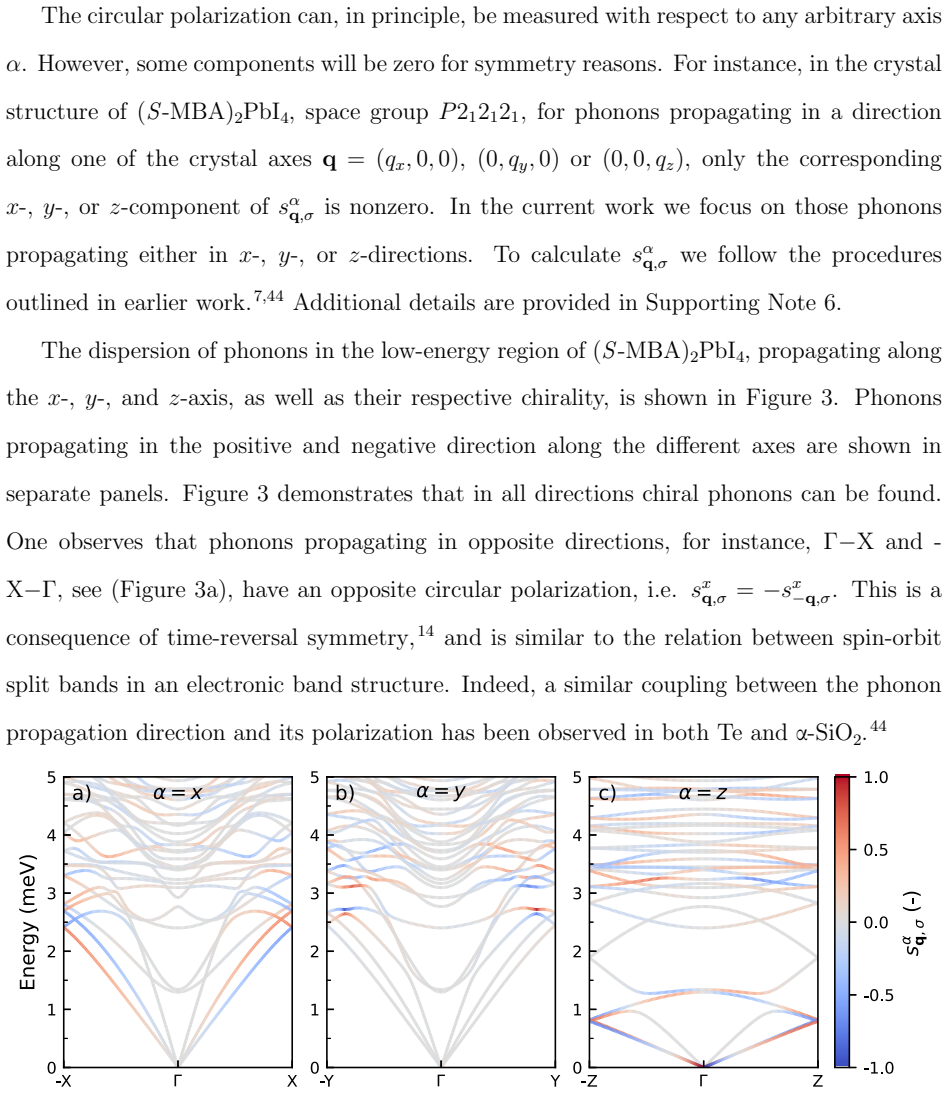


read the original abstract
Phonons in chiral crystal structures can be circularly polarized, making them chiral. Chiral phonons carry angular momentum, which is observable in heat currents, and, via coupling to electron spin, in spin currents. Two-dimensional (2D) halide perovskites, versatile direct band gap semiconductors, can easily form chiral structures by incorporating chiral organic cations. As a result, they exhibit phenomena such as chirality-induced spin selectivity (CISS) and the spin Seebeck effect, although the underlying mechanisms remain unclear. Using on-the-fly machine-learning force fields trained against density functional theory calculations, we confirm the presence of chiral phonons, a potential key factor for these effects. Our analysis reveals that low-energy phonons, originating from the inorganic framework, primarily exhibit chirality. Under a temperature gradient, these chiral phonons generate substantial angular momentum, leading to experimentally observable effects. These findings position chiral 2D perovskites as a promising platform for exploring the interplay between phononic, electronic, spintronic, and thermal properties.
Editorial analysis
A structured set of objections, weighed in public.
Referee Report
Summary. The manuscript claims that low-energy phonons originating from the inorganic framework in chiral 2D halide perovskites primarily exhibit chirality. Using on-the-fly machine-learning force fields (MLFF) trained against density functional theory (DFT), the authors confirm the presence of these chiral phonons and show that they generate substantial angular momentum under a temperature gradient, potentially explaining observed effects such as chirality-induced spin selectivity (CISS) and the spin Seebeck effect.
Significance. If the MLFF-derived phonon properties prove accurate, the work would provide a mechanistic link between structural chirality, phonons, and spin/thermal transport in these versatile semiconductors, strengthening their candidacy for spintronic and thermoelectric applications. The on-the-fly MLFF approach is a methodological strength for scaling beyond direct DFT limits.
major comments (2)
- [Abstract] Abstract: the claim of confirmation via MLFF supplies no quantitative validation metrics, error analysis, or side-by-side comparison to direct DFT phonon calculations (dispersions, eigenvectors, circular polarizations, or mode angular momenta), leaving the central claim without visible supporting evidence.
- [Methods] Methods/results sections: the fidelity of on-the-fly MLFFs to direct DFT for the small eigenvector components that determine circular polarization and angular momentum is unbenchmarked; such quantities are sensitive to force-field inaccuracies even when energies and forces are adequately reproduced.
minor comments (2)
- Specify the exact chiral organic cations, inorganic frameworks, and supercell sizes employed, along with any convergence tests for the MLFF training.
- Clarify how the temperature gradient is applied and how the resulting angular momentum is quantified (e.g., via specific formulas or summation over modes).
Simulated Author's Rebuttal
We thank the referee for their constructive comments, which highlight important aspects of validation for our MLFF-based phonon analysis. We address each major comment below and will revise the manuscript to incorporate additional benchmarks and clarifications.
read point-by-point responses
-
Referee: [Abstract] Abstract: the claim of confirmation via MLFF supplies no quantitative validation metrics, error analysis, or side-by-side comparison to direct DFT phonon calculations (dispersions, eigenvectors, circular polarizations, or mode angular momenta), leaving the central claim without visible supporting evidence.
Authors: We agree that the abstract would benefit from explicit reference to validation. In the revised manuscript we will modify the abstract to note the on-the-fly training protocol and direct the reader to the quantitative error metrics (energy and force RMSE) and phonon dispersion comparisons already present in the Methods and Supplementary Information. We will also add a concise statement on the level of agreement obtained for circular polarization of the low-energy modes. revision: yes
-
Referee: [Methods] Methods/results sections: the fidelity of on-the-fly MLFFs to direct DFT for the small eigenvector components that determine circular polarization and angular momentum is unbenchmarked; such quantities are sensitive to force-field inaccuracies even when energies and forces are adequately reproduced.
Authors: This is a valid concern. While the current manuscript reports overall force and energy accuracy during on-the-fly training, it does not include explicit eigenvector-level benchmarks. In the revision we will add a dedicated subsection (or supplementary figure) comparing DFT and MLFF phonon eigenvectors and the resulting circular polarization and mode angular momenta for representative structures, thereby addressing the sensitivity of these derived quantities. revision: yes
Circularity Check
No significant circularity; derivation is self-contained
full rationale
The paper trains on-the-fly ML force fields against DFT data then computes phonon dispersions, circular polarizations, and angular momenta from the resulting dynamical matrices. This is a standard two-stage computational workflow with no equations shown to reduce the reported angular momentum or chirality metrics to fitted parameters by construction. No self-citation chains, uniqueness theorems, or ansatzes imported from prior author work are invoked to force the central claim. The assumption that the MLFF reproduces DFT eigenvectors is an external validation question, not a definitional loop. The provided abstract and reader summary contain no load-bearing steps that match any of the enumerated circularity patterns.
Axiom & Free-Parameter Ledger
axioms (1)
- domain assumption Density functional theory provides a sufficiently accurate reference for training force fields that capture phonon chirality.
Reference graph
Works this paper leans on
-
[1]
SI Note: Density functional theory (DFT) S3
-
[2]
SI Note: Machine-learning force fields (MLFFs) S5
-
[3]
SI Note: Phonon calculations S7
-
[4]
SI Note: Density of states (DOS) S9 A. Enantiomeric effects S9 B. Influence of cations S9
-
[5]
SI Note: Phonon group velocities S11
-
[6]
Phonon circular polarization S12 B
SI Note: Chiral phonons S12 A. Phonon circular polarization S12 B. Circular polarization in chiral perovskites S13 C. Circular polarization in achiral perovskites S15 D. Circular polarization spectrum S17
-
[7]
Atomic motion in eigenmodes S18 B
SI Note: Phonon modes S18 A. Atomic motion in eigenmodes S18 B. Eigenmodes in chiral perovskites S18 C. Eigenmodes in structural enantiomers S20
-
[8]
Phonon angular momentum S22 A. Response tensor S22 B. Symmetry constraints S22 C. Convergence S23 References S24 S2
-
[9]
SI NOTE: DENSITY FUNCTIONAL THEORY (DFT) Density functional theory (DFT) calculations were perform ed using the Vienna Ab-initio Sim- ulation Package ( VASP) [1–3]. The projector-augmented wave (PA W) pseudopotenti als [4] had the following valence electron configurations: H (1s 1), C (2s 22p2), N (2s 22p3), I (5s 25p5) and Pb (6s 26p2). In the machine-lea...
work page 1975
-
[10]
SI NOTE: MACHINE-LEARNING FORCE FIELDS (MLFFS) Machine-learning force fields (MLFFs) were trained against total energies, forces, and stresses from density functional theory (DFT) calculations. The tra ining sets were automatically con- structed using an on-the-fly active learning scheme togethe r with dynamical simulations in an NpT ensemble [12, 13]. Loca...
work page 2000
-
[11]
SI NOTE: PHONON CALCULATIONS Harmonic phonon calculations were performed using the finit e displacement method in super- cells, as implemented in phonopy [18, 19]. The crystal structures were optimized with machin e- learning force fields (MLFFs), allowing the atomic position s, cell shape, and cell volume to change until the forces are below 10 -3 eV ˚ A− ...
-
[12]
SI NOTE: DENSITY OF STATES (DOS) A. Enantiomeric effects To investigate the effect of structural enantiomers of MBA 2PbI4 on the phonon spectrum, particularly the low enery vibrations, we compared the DOS o f the enantiomers. In Figure S3 the DOS of ( S-MBA)2PbI4, (R-MBA)2PbI4, and ( rac-MBA)2PbI4 are shown. The comparison shows that the DOS of the two mirr...
-
[13]
SI NOTE: PHONON GROUP VELOCITIES The group velocity of phonons is defined by the following rela tion vq,σ = ∇ qω q,σ , (1) which is the gradient of the angular frequency ω q,σ as a function of the wave vector q. The group velocity of the acoustic phonons is determined arbitr arily close to the Γ-point along high- symmetry paths. For the 2D halide perovskit...
work page 2073
-
[14]
SI NOTE: CHIRAL PHONONS A. Phonon circular polarization From the supercell approach, we obtain an atomic polarizati on vector ei, q,σ for the ith atom in the unit cell at every wave vector q and mode index σ, which is of the form ei, q,σ = (xi, y i, z i) , (2) where xi, yi, and zi represent the displacement of the ith atom in the x-, y-, and z-direction, ...
-
[15]
SI NOTE: PHONON MODES A. Atomic motion in eigenmodes As mentioned before, phonon eigenmodes are described at ever y wave vector q and mode index σ by a polarization vector ei, q,σ for which i labels the atoms in the unit cell. This polarization vector has the form ei, q,σ = (xi, y i, z i) , (13) where xi, yi, and zi denote the displacement of the ith atom...
-
[16]
PHONON ANGULAR MOMENTUM A. Response tensor In equilibrium, Jph, the angular momentum per unit volume of a phonon system [22] is expressed as Jph = ℏ V ∑ q,σ sq,σ [ f0 (ω q,σ ) + 1 2 ] , (17) where ℏ is the reduced Planck constant, V is the unit cell volume, f0 = 1/ (exp [ℏω q,σ /k BT ] − 1) is the Bose-Einstein distribution, with kB the Boltzmann constant...
-
[17]
G. Kresse and J. Hafner, Ab Initio Molecular-Dynamics Simul ation of the Liquid-Metal–Amorphous- Semiconductor Transition in Germanium, Phys. Rev. B 49, 14251 (1994)
work page 1994
-
[18]
G. Kresse and J. Furthm¨ uller, Efficiency of Ab-Initio Total E nergy Calculations for Metals and Semiconductors Using a Plane-Wave Basis Set, Comput. Mater. Sc i. 6, 15 (1996)
work page 1996
-
[19]
G. Kresse and J. Furthm¨ uller, Efficient Iterative Schemes for Ab Initio Total-Energy Calculations Using a Plane-Wave Basis Set, Phys. Rev. B 54, 11169 (1996)
work page 1996
-
[20]
G. Kresse and D. Joubert, From Ultrasoft Pseudopotentials to th e Projector Augmented-Wave Method, Phys. Rev. B 59, 1758 (1999)
work page 1999
-
[21]
J. Sun, A. Ruzsinszky, and J. P. Perdew, Strongly Constrained and Appropriately Normed Semilocal Density Functional, Phys. Rev. Lett. 115, 036402 (2015)
work page 2015
-
[22]
J. P. Perdew, K. Burke, and M. Ernzerhof, Generalized Gradie nt Approximation Made Simple, Phys. Rev. Lett. 77, 3865 (1996)
work page 1996
- [23]
-
[24]
M. K. Jana, R. Song, H. Liu, D. R. Khanal, S. M. Janke, R. Zhao, C. Li u, Z. Valy Vardeny, V. Blum, and D. B. Mitzi, Organic-to-Inorganic Structural Chirality Tra nsfer in a 2D Hybrid Perovskite and Impact on Rashba-Dresselhaus Spin-Orbit Coupling, Nat. Commun . 11, 4699 (2020)
work page 2020
-
[25]
Y. Dang, X. Liu, Y. Sun, J. Song, W. Hu, and X. Tao, Bulk Chiral Hal ide Perovskite Single Crystals for Active Circular Dichroism and Circularly Polarized Lumin escence, J. Phys. Chem. Lett. 11, 1689 (2020)
work page 2020
-
[26]
M. Menahem, Z. Dai, S. Aharon, R. Sharma, M. Asher, Y. Diskin-Pos ner, R. Korobko, A. M. Rappe, and O. Yaffe, Strongly Anharmonic Octahedral Tilting in T wo-Dimensional Hybrid Halide Perovskites, ACS Nano 15, 10153 (2021)
work page 2021
-
[27]
K.-z. Du, Q. Tu, X. Zhang, Q. Han, J. Liu, S. Zauscher, and D. B . Mitzi, Two-Dimensional Lead(II) Halide-Based Hybrid Perovskites Templated by Acen e Alkylamines: Crystal Structures, Optical Properties, and Piezoelectricity, Inorg. Chem. 56, 9291 (2017)
work page 2017
-
[28]
R. Jinnouchi, F. Karsai, and G. Kresse, On-the-Fly Machine L earning Force Field Generation: Application to Melting Points, Phys. Rev. B 100, 014105 (2019). S24
work page 2019
-
[29]
R. Jinnouchi, J. Lahnsteiner, F. Karsai, G. Kresse, and M. Bok dam, Phase Transitions of Hy- brid Perovskites Simulated by Machine-Learning Force Fields Trained on the Fly with Bayesian Inference, Phys. Rev. Lett. 122, 225701 (2019)
work page 2019
-
[30]
A. P. Bart´ ok, R. Kondor, and G. Cs´ anyi, On Representing Che mical Environments, Phys. Rev. B 87, 184115 (2013)
work page 2013
-
[31]
M. Parrinello and A. Rahman, Crystal Structure and Pair Pote ntials: A Molecular-Dynamics Study, Phys. Rev. Lett. 45, 1196 (1980)
work page 1980
-
[32]
M. Parrinello and A. Rahman, Polymorphic Transitions in Singl e Crystals: A New Molecular Dy- namics Method, J. Appl. Phys. 52, 7182 (1981)
work page 1981
-
[33]
M. Pols, G. Brocks, S. Calero, and S. Tao, Temperature-Depende nt Chirality in Halide Perovskites, J. Phys. Chem. Lett. 15, 8057 (2024)
work page 2024
-
[34]
Togo, First-principles Phonon Calculations with Phonopy and Ph ono3py, J
A. Togo, First-principles Phonon Calculations with Phonopy and Ph ono3py, J. Phys. Soc. Jpn. 92, 012001 (2023)
work page 2023
-
[35]
A. Togo, L. Chaput, T. Tadano, and I. Tanaka, Implementation Str ategies in Phonopy and Phono3py, J. Phys. Condens. Matter 35, 353001 (2023)
work page 2023
- [36]
-
[37]
H. Chen, W. Wu, J. Zhu, Z. Yang, W. Gong, W. Gao, S. A. Yang, and L. Zh ang, Chiral Phonon Diode Effect in Chiral Crystals, Nano Lett. 22, 1688 (2022)
work page 2022
-
[38]
L. Zhang and Q. Niu, Angular Momentum of Phonons and the Einstein–d e Haas Effect, Phys. Rev. Lett. 112, 085503 (2014)
work page 2014
-
[39]
Y.-J. Choi and S.-H. Jhi, Divergence of Phonon Angular Momentum Dri ven by Temperature and Strain, Phys. Rev. B 106, 094311 (2022). S25
work page 2022
discussion (0)
Sign in with ORCID, Apple, or X to comment. Anyone can read and Pith papers without signing in.