Two Distinct Populations of Dark Comets Delineated by Orbits and Sizes
Pith reviewed 2026-05-23 07:37 UTC · model grok-4.3
The pith
Dark comets divide into two populations: larger eccentric ones as comet continuum end members and smaller circular ones as a potential new class.
A machine-rendered reading of the paper's core claim, the machinery that carries it, and where it could break.
Core claim
This set of dark comets reveals the delineation between two distinct populations: larger, 'outer' dark comets on eccentric orbits that are end members of a continuum in activity level of comets, and smaller, 'inner' dark comets on near-circular orbits that could signify a new population. These objects may trace various stages in the life cycle of a previously undetected, but potentially numerous, volatile-rich population that may have provided essential material to the Earth.
What carries the argument
The division of dark comets into outer and inner populations based on their sizes and orbital eccentricities, which links the former to the comet activity spectrum and the latter to a distinct source.
Load-bearing premise
The observed accelerations result from asymmetric outgassing of volatiles rather than radiation pressure or other nongravitational forces, and the absence of dust confirms the objects lack comae.
What would settle it
High-resolution imaging that detects a coma or dust around any of these objects, or precise orbit determinations showing accelerations match radiation pressure models instead of outgassing.
Figures









read the original abstract
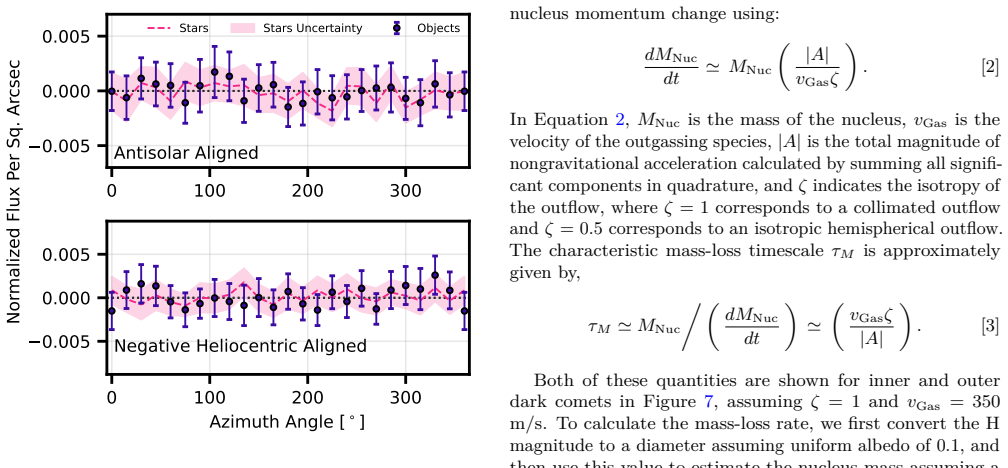
Small bodies are capable of delivering essential prerequisites for the development of life, such as volatiles and organics, to the terrestrial planets. For example, empirical evidence suggests that water was delivered to the Earth by hydrated planetesimals from distant regions of the Solar System. Recently, several morphologically inactive near-Earth objects (NEOs) were reported to experience significant nongravitational accelerations inconsistent with radiation-based effects, and possibly explained by volatile-driven outgassing. However, these "dark comets" display no evidence of comae in archival images, which are the defining feature of cometary activity. Here we report detections of nongravitational accelerations on seven additional objects previously classified as inactive (doubling the population) that could also be explainable by asymmetric mass loss. A detailed search of archival survey and targeted data rendered no detection of dust activity in any of these objects in individual or stacked images. We calculate dust production limits of $\sim10$, $0.1$, and $0.1$ kg s$^{-1}$ for 1998 FR$_{11}$, 2001 ME$_{1}$, and 2003 RM with these data, indicating little or no dust surrounding the objects during the observations. This set of dark comets reveals the delineation between two distinct populations: larger, "outer" dark comets on eccentric orbits that are end members of a continuum in activity level of comets, and smaller, "inner" dark comets on near-circular orbits that could signify a new population. These objects may trace various stages in the life cycle of a previously undetected, but potentially numerous, volatile-rich population that may have provided essential material to the Earth.
Editorial analysis
A structured set of objections, weighed in public.
Referee Report
Summary. The paper reports detections of nongravitational accelerations on seven additional near-Earth objects previously classified as inactive, doubling the known sample of 'dark comets.' Archival imaging yields no coma detections and dust production upper limits of ~10, 0.1, and 0.1 kg s^{-1} for three objects. The authors delineate two populations: larger 'outer' dark comets on eccentric orbits interpreted as end-members of a cometary activity continuum, and smaller 'inner' dark comets on near-circular orbits proposed as a distinct new population potentially linked to volatile delivery to Earth.
Significance. If the attribution of the observed accelerations to asymmetric outgassing is robust, the work would double the sample of dark comets and provide evidence for two distinct dynamical classes, with implications for the inventory of volatile-rich small bodies and their role in terrestrial planet volatile delivery. The dust limits and new detections constitute concrete observational contributions.
major comments (2)
- [Abstract] Abstract and main text: the central claim that the nongravitational accelerations are 'inconsistent with radiation-based effects' and therefore attributable to volatile outgassing is load-bearing for both the population split and the 'new population' interpretation, yet the manuscript provides no quantitative modeling (e.g., Yarkovsky drift rates as a function of size, spin period, thermal inertia, and obliquity) that excludes radiation-pressure or Yarkovsky contributions across the reported size range, particularly for the smaller inner population.
- [Abstract] The delineation into 'outer' and 'inner' populations rests on the assumption that the seven new objects (plus prior ones) exhibit accelerations produced by asymmetric mass loss rather than other mechanisms; without explicit parameter-space exclusion of alternatives for the full sample, the continuum claim for the eccentric group and the novelty claim for the circular group remain interpretive.
minor comments (1)
- The dust production limits are reported for only three of the seven new objects; clarifying whether the remaining four have comparable limits or different observational constraints would strengthen the inactivity claim.
Simulated Author's Rebuttal
We thank the referee for the detailed and constructive report. The two major comments both concern the robustness of attributing the observed nongravitational accelerations to outgassing rather than radiation-based effects and the resulting population interpretations. We address each point below and indicate where revisions will be made.
read point-by-point responses
-
Referee: [Abstract] Abstract and main text: the central claim that the nongravitational accelerations are 'inconsistent with radiation-based effects' and therefore attributable to volatile outgassing is load-bearing for both the population split and the 'new population' interpretation, yet the manuscript provides no quantitative modeling (e.g., Yarkovsky drift rates as a function of size, spin period, thermal inertia, and obliquity) that excludes radiation-pressure or Yarkovsky contributions across the reported size range, particularly for the smaller inner population.
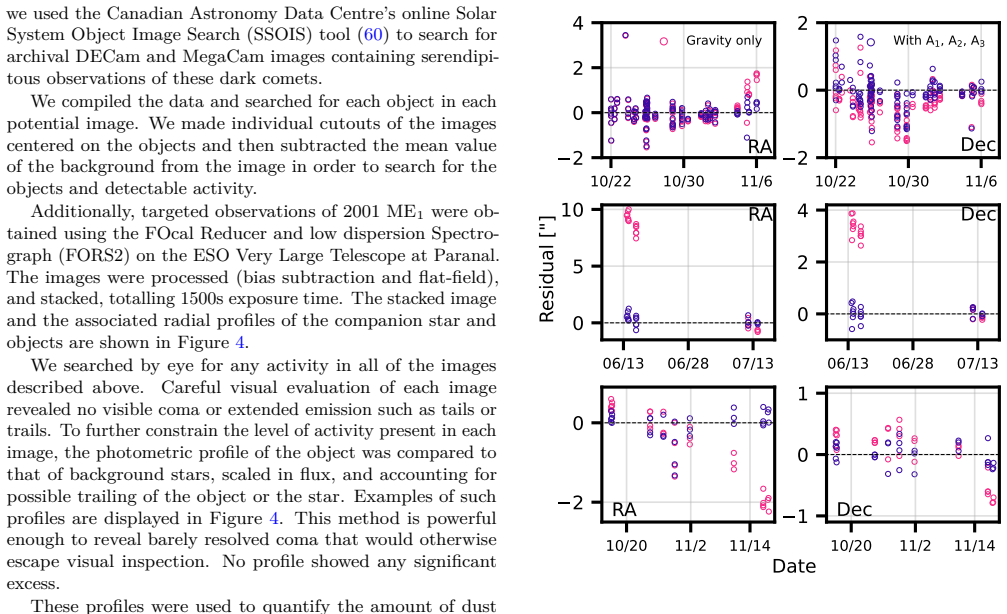
Authors: We agree that the manuscript does not contain a dedicated quantitative parameter-space exploration of Yarkovsky or radiation-pressure accelerations. The original text relies on order-of-magnitude comparisons to published Yarkovsky models for objects of comparable size and on the fact that the measured accelerations exceed those typically reported for inactive NEOs of similar diameter. To address the referee's concern directly, we will add a new appendix that computes expected Yarkovsky drift rates over a grid of diameters (0.1–2 km), spin periods (2–20 h), thermal inertias (10–1000 J m^{-2} K^{-1} s^{-1/2}), and obliquities (0–180°), using the standard formulation of Vokrouhlický et al. These calculations will show that the observed accelerations lie outside the plausible Yarkovsky range for the reported sizes and orbital distances, particularly for the inner population. The revised manuscript will therefore include this explicit exclusion. revision: yes
-
Referee: [Abstract] The delineation into 'outer' and 'inner' populations rests on the assumption that the seven new objects (plus prior ones) exhibit accelerations produced by asymmetric mass loss rather than other mechanisms; without explicit parameter-space exclusion of alternatives for the full sample, the continuum claim for the eccentric group and the novelty claim for the circular group remain interpretive.
Authors: The population division is observationally driven by the clear separation in semimajor axis, eccentricity, and diameter, with the acceleration measurements serving as supporting evidence rather than the sole basis. We acknowledge, however, that a comprehensive exclusion of every conceivable non-outgassing mechanism across the entire sample was not performed. The revised text will add a concise discussion section that (i) reiterates why radiation pressure is ruled out by the magnitude of the accelerations and (ii) notes that other mechanisms (e.g., electrostatic levitation or binary interactions) lack supporting observational signatures in the existing data. We will also qualify the language around the “new population” interpretation to emphasize that it is the most parsimonious explanation given current evidence, while explicitly calling for future detailed dynamical modeling. These changes will be made without altering the core observational results. revision: partial
Circularity Check
No circularity; purely observational classification from external data.
full rationale
The paper reports detections of nongravitational accelerations on seven NEOs using standard orbital fits to astrometric data, combined with archival imaging limits on dust production. The two-population delineation follows directly from measured sizes, eccentricities, and semimajor axes without any fitted parameters, self-referential predictions, or load-bearing self-citations that reduce the central claim to its own inputs. No equations or derivations are presented that loop back by construction; the work is an empirical cataloguing exercise against external benchmarks.
Axiom & Free-Parameter Ledger
axioms (1)
- standard math Standard models of nongravitational accelerations in solar system dynamics apply to these objects
invented entities (1)
-
Inner dark comets as a distinct new population
no independent evidence
Reference graph
Works this paper leans on
-
[3]
Meadows VS, Arney GN, Schmidt BE, Des Marais DJ
Meech K, Raymond SN (2020) Origin of Earth’s Water: Sources and Constraints inPlanetary Astrobiology, eds. Meadows VS, Arney GN, Schmidt BE, Des Marais DJ. p. 325
work page 2020
-
[4]
(2023) (523599) 2003 RM: The Asteroid that Wanted to be a Comet
Farnocchia D, et al. (2023) (523599) 2003 RM: The Asteroid that Wanted to be a Comet. Planet. Sci. J. 4(2):29
work page 2023
-
[5]
(2023) Dark Comets? Unexpectedly Large Nongravitational Accelerations on a Sample of Small Asteroids
Seligman DZ, et al. (2023) Dark Comets? Unexpectedly Large Nongravitational Accelerations on a Sample of Small Asteroids. Planet. Sci. J. 4(2):35
work page 2023
-
[6]
Vokrouhlický D, Bottke WF , Chesley SR, Scheeres DJ, Statler TS (2015) The Y arkovsky and YORP Effects in Asteroids IV. pp. 509–531
work page 2015
- [7]
-
[8]
(2013) Near Earth Asteroids with measurable Y arkovsky effect.Icarus 224(1):1–13
Farnocchia D, et al. (2013) Near Earth Asteroids with measurable Y arkovsky effect.Icarus 224(1):1–13
work page 2013
-
[9]
Greenberg AH, Margot JL, Verma AK, Taylor PA, Hodge SE (2020) Y arkovsky Drift Detections for 247 Near-Earth Asteroids. Astron. J. 159(3):92
work page 2020
-
[10]
Micheli M, Tholen DJ, Elliott GT (2012) Detection of radiation pressure acting on 2009 BD. New A 17(4):446–452
work page 2012
-
[11]
Micheli M, Tholen DJ, Elliott GT (2013) 2012 LA, an optimal astrometric target for radiation pressure detection. Icarus 226(1):251–255
work page 2013
- [12]
-
[13]
(2014) Constraining the Physical Properties of Near-Earth Object 2009 BD
Mommert M, et al. (2014) Constraining the Physical Properties of Near-Earth Object 2009 BD. Astrophys. J. 786(2):148
work page 2014
-
[14]
(2014) Physical Properties of Near-Earth Asteroid 2011 MD
Mommert M, et al. (2014) Physical Properties of Near-Earth Asteroid 2011 MD. Astrophys. J. L. 789(1):L22
work page 2014
-
[15]
Farnocchia D, et al. (2017) Mass estimate and close approaches of near-Earth asteroid 2015 TC25 in AAS/Division for Planetary Sciences Meeting Abstracts #49 . p. 100.09
work page 2017
-
[16]
(2020) Establishing Earth’s Minimoon Population through Characterization of Asteroid 2020 CD3
Fedorets G, et al. (2020) Establishing Earth’s Minimoon Population through Characterization of Asteroid 2020 CD3. Astron. J. 160(6):277
work page 2020
-
[17]
Masiero JR, et al. (2018) Small and Nearby NEOs Observed by NEOWISE During the First Three Y ears of Survey: Physical Properties.Astron. J. 156(2):60. Seligman et al. PNAS | December 11, 2024 | vol. 121 | no. 51 | 11
work page 2018
-
[18]
(2017) Minor Planets 2017 SN_33 and 2017 U1
Williams GV, et al. (2017) Minor Planets 2017 SN_33 and 2017 U1. Central Bureau Electronic T elegrams4450:1
work page 2017
-
[19]
(2018) Non-gravitational acceleration in the trajectory of 1I/2017 U1 (’Oumua- mua)
Micheli M, et al. (2018) Non-gravitational acceleration in the trajectory of 1I/2017 U1 (’Oumua- mua). Nature 559:223–226
work page 2018
-
[20]
(2017) A brief visit from a red and extremely elongated interstellar asteroid
Meech KJ, et al. (2017) A brief visit from a red and extremely elongated interstellar asteroid. Nature 552:378–381
work page 2017
- [21]
-
[22]
(2017) Interstellar Interloper 1I/2017 U1: Observations from the NOT and WIYN Telescopes
Jewitt D, et al. (2017) Interstellar Interloper 1I/2017 U1: Observations from the NOT and WIYN Telescopes. ApJL 850:L36
work page 2017
-
[23]
(2024) Seasonally varying outgassing as an explanation for dark comet accelerations
Taylor AG, et al. (2024) Seasonally varying outgassing as an explanation for dark comet accelerations. Icarus 408:115822
work page 2024
-
[24]
(1999) Radar and Optical Observations of Asteroid 1998 KY26
Ostro SJ, et al. (1999) Radar and Optical Observations of Asteroid 1998 KY26. Science 285:557–559
work page 1999
-
[25]
Masiero JR, et al. (2020) Physical Properties of 299 NEOs Manually Recovered in Over Five Y ears of NEOWISE Survey Data.Planet. Sci. J. 1(1):9
work page 2020
-
[26]
(2021) Asteroid Diameters and Albedos from NEOWISE Reactivation Mission Y ears Six and Seven.Planet
Masiero JR, et al. (2021) Asteroid Diameters and Albedos from NEOWISE Reactivation Mission Y ears Six and Seven.Planet. Sci. J. 2(4):162
work page 2021
-
[27]
(2002) Asteroid Radar Astronomy in Asteroids III, eds
Ostro SJ, et al. (2002) Asteroid Radar Astronomy in Asteroids III, eds. Bottke, W. F . J, Cellino A, Paolicchi P , Binzel RP . pp. 151–168
work page 2002
-
[28]
(Paris, Gauthier-Villars et fils) Vol
Tisserand F (1896) T raité de mécanique céleste. (Paris, Gauthier-Villars et fils) Vol. 4
-
[29]
Murray CD, Dermott SF (1999) Solar System Dynamics
work page 1999
-
[30]
Chebotarev GA, Kazimirchak-Polonskaia EI, Marsden BG
Kresák L (1972) On the Dividing Line Between Cometary and Asteroidal Orbits in The Motion, Evolution of Orbits, and Origin of Comets , eds. Chebotarev GA, Kazimirchak-Polonskaia EI, Marsden BG. Vol. 45, p. 503
work page 1972
-
[31]
Vaghi S (1973) The Origin of Jupiter’s Family of Comets. Astron. Astrophys. 24:41
work page 1973
-
[32]
Levison HF (1996) Comet Taxonomy in Completing the Inventory of the Solar System , As- tronomical Society of the Pacific Conference Series, eds. Rettig T, Hahn JM. Vol. 107, pp. 173–191
work page 1996
-
[33]
Pravec P , Harris AW (2007) Binary asteroid population. 1. Angular momentum content.Icarus 190(1):250–259
work page 2007
-
[34]
(2012) Discovery of Main-belt Comet P/2006 VW 139 by Pan-STARRS1
Hsieh HH, et al. (2012) Discovery of Main-belt Comet P/2006 VW 139 by Pan-STARRS1. Astrophys. J. L. 748:L15
work page 2012
-
[35]
Hirabayashi M, et al. (2021) Hayabusa2 extended mission: New voyage to rendezvous with a small asteroid rotating with a short period. Advances in Space Research 68(3):1533–1555
work page 2021
-
[36]
(2023) Preliminary design of the Hayabusa2 extended mission to the fast- rotating asteroid 1998 KY26
Kikuchi S, et al. (2023) Preliminary design of the Hayabusa2 extended mission to the fast- rotating asteroid 1998 KY26. Acta Astronautica 211:295–315
work page 2023
-
[37]
(2017) Dust Detection Mode of the Hayabusa2 LIDAR
Senshu H, et al. (2017) Dust Detection Mode of the Hayabusa2 LIDAR. Space Sci. Rev. 208(1-4):65–79
work page 2017
-
[38]
(2015) Detectability of hydrous minerals using ONC-T camera onboard the Hayabusa2 spacecraft
Kameda S, et al. (2015) Detectability of hydrous minerals using ONC-T camera onboard the Hayabusa2 spacecraft. Advances in Space Research 56(7):1519–1524
work page 2015
-
[39]
(2017) Hayabusa2 Mission Overview
Watanabe Si, et al. (2017) Hayabusa2 Mission Overview. Space Sci. Rev. 208(1-4):3–16
work page 2017
-
[40]
(2017) Thermal Imaging Performance of TIR Onboard the Hayabusa2 Spacecraft
Arai T, et al. (2017) Thermal Imaging Performance of TIR Onboard the Hayabusa2 Spacecraft. Space Sci. Rev. 208(1-4):239–254
work page 2017
-
[41]
(2017) Thermal Infrared Imaging Experiments of C-Type Asteroid 162173 Ryugu on Hayabusa2
Okada T, et al. (2017) Thermal Infrared Imaging Experiments of C-Type Asteroid 162173 Ryugu on Hayabusa2. Space Sci. Rev. 208(1-4):255–286
work page 2017
- [42]
-
[43]
(2017) Development of the Laser Altimeter (LIDAR) for Hayabusa2
Mizuno T, et al. (2017) Development of the Laser Altimeter (LIDAR) for Hayabusa2. Space Sci. Rev. 208(1-4):33–47
work page 2017
-
[44]
(2017) Albedo Observation by Hayabusa2 LIDAR: Instrument Performance and Error Evaluation
Y amada R, et al. (2017) Albedo Observation by Hayabusa2 LIDAR: Instrument Performance and Error Evaluation. Space Sci. Rev. 208(1-4):49–64
work page 2017
-
[45]
Kameda S, et al. (2017) Preflight Calibration Test Results for Optical Navigation Camera Telescope (ONC-T) Onboard the Hayabusa2 Spacecraft. Space Sci. Rev. 208(1-4):17–31
work page 2017
-
[46]
(2017) NIRS3: The Near Infrared Spectrometer on Hayabusa2
Iwata T, et al. (2017) NIRS3: The Near Infrared Spectrometer on Hayabusa2. Space Sci. Rev. 208(1-4):317–337
work page 2017
-
[47]
Suzuki H, et al. (2018) Initial inflight calibration for Hayabusa2 optical navigation camera (ONC) for science observations of asteroid Ryugu. Icarus 300:341–359
work page 2018
-
[48]
Tatsumi E, et al. (2019) Updated inflight calibration of Hayabusa2’s optical navigation camera (ONC) for scientific observations during the cruise phase. Icarus 325:153–195
work page 2019
-
[49]
(2024) The dynamical origins of the dark comets and a proposed evolutionary track
Taylor AG, et al. (2024) The dynamical origins of the dark comets and a proposed evolutionary track. Icarus p. 116207
work page 2024
-
[50]
Marty B, et al. (2016) Origins of volatile elements (H, C, N, noble gases) on Earth and Mars in light of recent results from the ROSETTA cometary mission. Earth and Planetary Science Letters 441:91–102
work page 2016
-
[51]
(2011) Ocean-like water in the Jupiter-family comet 103P/Hartley 2.Nature 478(7368):218–220
Hartogh P , et al. (2011) Ocean-like water in the Jupiter-family comet 103P/Hartley 2.Nature 478(7368):218–220
work page 2011
-
[52]
(2015) 67P/Churyumov-Gerasimenko, a Jupiter family comet with a high D/H ratio
Altwegg K, et al. (2015) 67P/Churyumov-Gerasimenko, a Jupiter family comet with a high D/H ratio. Science 347(6220):1261952
work page 2015
-
[53]
(2006) Organics Captured from Comet 81P/Wild 2 by the Stardust Space- craft
Sandford SA, et al. (2006) Organics Captured from Comet 81P/Wild 2 by the Stardust Space- craft. Science 314(5806):1720
work page 2006
-
[54]
Meteoritics and Planetary Science 44(9):1323–1330
Elsila JE, Glavin DP , Dworkin JP (2009) Cometary glycine detected in samples returned by Stardust. Meteoritics and Planetary Science 44(9):1323–1330
work page 2009
-
[55]
Altwegg K, Balsiger H, Fuselier SA (2019) Cometary Chemistry and the Origin of Icy Solar System Bodies: The View After Rosetta. ARA&A 57:113–155
work page 2019
-
[56]
Sonnett S, Kleyna J, Jedicke R, Masiero J (2011) Limits on the size and orbit distribution of main belt comets. Icarus 215:534–546
work page 2011
- [57]
-
[58]
Farnocchia D, Chesley SR, Milani A, Gronchi GF , Chodas PW (2015) Orbits, Long-Term Predictions, Impact Monitoring in Asteroids IV. pp. 815–834
work page 2015
-
[59]
Eggl S, Farnocchia D, Chamberlin AB, Chesley SR (2020) Star catalog position and proper motion corrections in asteroid astrometry II: The Gaia era. Icarus 339:113596
work page 2020
-
[60]
Vereš P , Farnocchia D, Chesley SR, Chamberlin AB (2017) Statistical analysis of astrometric errors for the most productive asteroid surveys. Icarus 296:139–149
work page 2017
-
[61]
Carpino M, Milani A, Chesley SR (2003) Error statistics of asteroid optical astrometric obser- vations. Icarus 166(2):248–270
work page 2003
-
[62]
Gwyn SDJ, Hill N, Kavelaars JJ (2012) SSOS: A Moving-Object Image Search Tool for Asteroid Precovery. P ASP124(916):579
work page 2012
-
[63]
(2015) Density and Charge of Pristine Fluffy Particles from Comet 67P/Churyumov-Gerasimenko
Fulle M, et al. (2015) Density and Charge of Pristine Fluffy Particles from Comet 67P/Churyumov-Gerasimenko. Astrophys. J. L. 802(1):L12
work page 2015
-
[64]
Luu JX, Jewitt DC (1992) High resolution surface brightness profiles of near-earth asteroids. Icarus 97(2):276–287
work page 1992
- [65]
-
[66]
(2021) No Activity among 13 Centaurs Discovered in the Pan-STARRS1 Detection Database
Lilly E, et al. (2021) No Activity among 13 Centaurs Discovered in the Pan-STARRS1 Detection Database. Planet. Sci. J. 2(4):155
work page 2021
-
[67]
Zenteno A, et al. (2016) Galaxy populations in the 26 most massive galaxy clusters in the South Pole Telescope SPT -SZ survey.Mon. Not. R. Astron. Soc. 462:830–843
work page 2016
-
[68]
(2016) The SXDF-ALMA 2-arcmin 2 Deep Survey: Stacking Rest-frame Near-infrared Selected Objects
Wang WH, et al. (2016) The SXDF-ALMA 2-arcmin 2 Deep Survey: Stacking Rest-frame Near-infrared Selected Objects. Astrophys. J. 833:195
work page 2016
-
[69]
Sykes MV, Walker RG (1992) Cometary dust trails. I - Survey. Icarus 95:180–210
work page 1992
-
[70]
Giorgini JD, et al. (1996) JPL ’s On-Line Solar System Data Service in AAS/Division for Planetary Sciences Meeting Abstracts #28 , AAS/Division for Planetary Sciences Meeting Abstracts. Vol. 28, p. 25.04
work page 1996
-
[71]
(2023) NEOMOD: A New Orbital Distribution Model for Near-Earth Objects
Nesvorný D, et al. (2023) NEOMOD: A New Orbital Distribution Model for Near-Earth Objects. Astron. J. 166(2):55
work page 2023
-
[72]
Hergenrother CW, Whiteley RJ (2011) A survey of small fast rotating asteroids among the near-Earth asteroid population. Icarus 214(1):194–209
work page 2011
-
[73]
Hsieh HH, Novakovi ´c B, Kim Y , Brasser R (2018) Asteroid Family Associations of Active Asteroids. Astron. J. 155:96
work page 2018
-
[74]
(2019) Episodes of particle ejection from the surface of the active asteroid (101955) Bennu
Lauretta DS, et al. (2019) Episodes of particle ejection from the surface of the active asteroid (101955) Bennu. Science 366(6470):3544
work page 2019
-
[75]
(2017) Origin and Evolution of Short-period Comets.Astrophys
Nesvorný D, et al. (2017) Origin and Evolution of Short-period Comets.Astrophys. J. 845(1):27. 12 | www.pnas.org/cgi/doi/10.1073/pnas.2406424121 Seligman et al
discussion (0)
Sign in with ORCID, Apple, or X to comment. Anyone can read and Pith papers without signing in.