On the Author Correction to "Magnetic flux trapping in hydrogen-rich high-temperature superconductors", Nat Phys. 19, 1293 (2023), arXiv:2206.14108
Pith reviewed 2026-05-23 17:27 UTC · model grok-4.3
The pith
The protocol used for time-dependent magnetic moment data in high-pressure H3S cannot show flux creep.
A machine-rendered reading of the paper's core claim, the machinery that carries it, and where it could break.
Core claim
The experimental protocol disclosed in the author correction for collecting time-dependent magnetic moment data is not applicable to H3S under high pressure in a diamond anvil cell and therefore does not provide evidence of pinning and thermally activated motion of vortices.
What carries the argument
The experimental protocol for time-dependent magnetic moment measurements to detect flux creep.
If this is right
- The reported time-dependent data do not support the existence of flux creep in H3S.
- An alternative protocol is needed for valid flux-creep measurements in diamond anvil cells.
- Claims of high-temperature superconductivity based on these data remain unproven by this method.
Where Pith is reading between the lines
- Measurement protocols must be verified for compatibility with high-pressure cell constraints before interpreting results as evidence of superconductivity.
- Similar issues may affect other studies relying on magnetic measurements in confined geometries.
Load-bearing premise
The protocol disclosed in the author correction matches the one used for the data and can be physically applied inside a diamond anvil cell.
What would settle it
Conducting the measurement with a protocol adapted for diamond anvil cell conditions and checking for the presence or absence of time-dependent decay consistent with flux creep.
Figures

read the original abstract
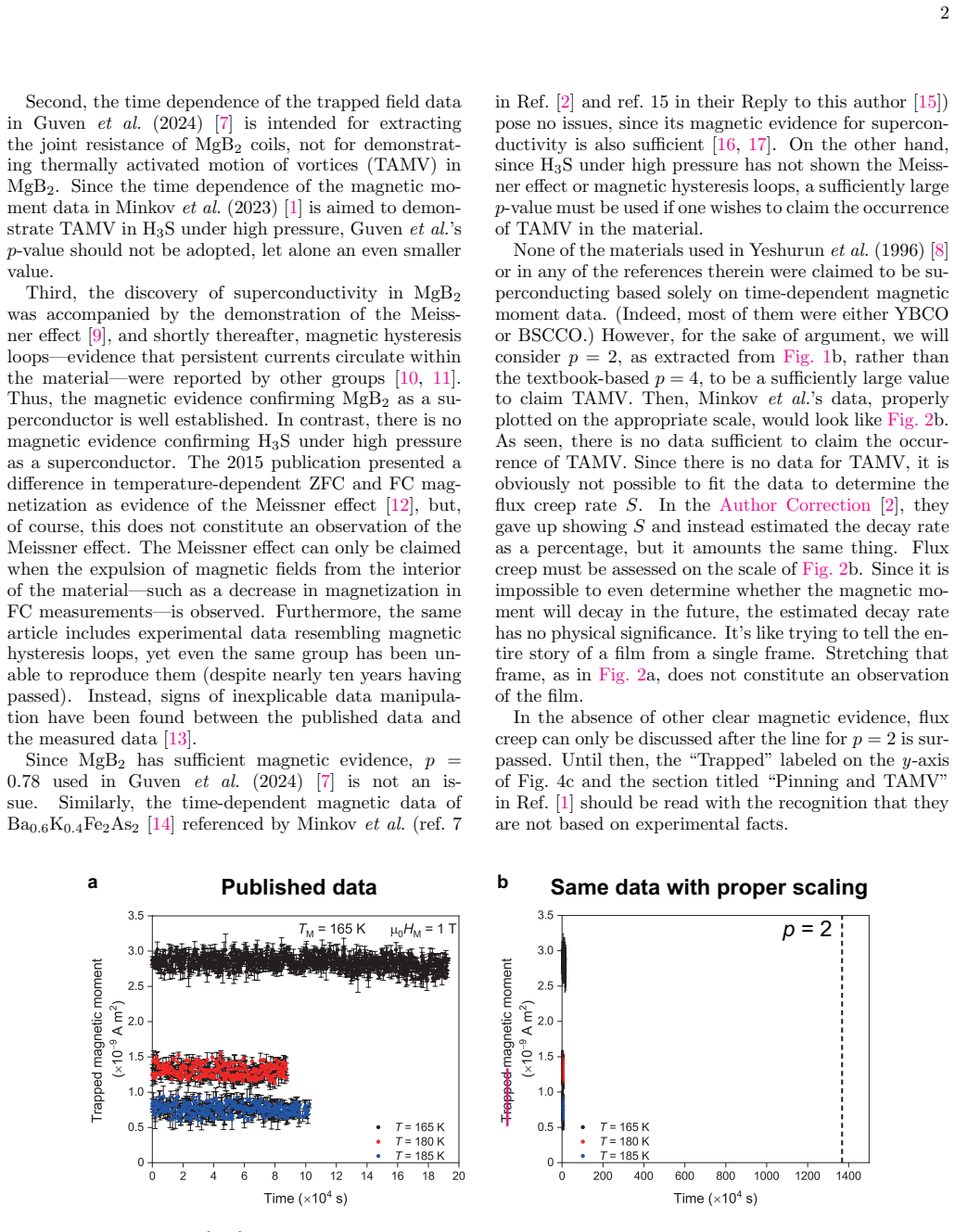
In Fig. 4c, under the section titled "Pinning and thermally activated motion of vortices" in arXiv:2206.14108 and Nat Phys. 19, 1293 (2023) [1], Minkov and co-workers presented the time dependence of the magnetic moment of sulfur hydride (H$_{3}$S) under high pressure and argued that they had observed magnetic flux creep at 165 K, 180 K and 185 K. Flux creep is a phenomenon observed under the assumption that the material under study can trap magnetic flux, and thus, Fig. 4c serves as evidence that H$_{3}$S traps magnetic flux and is a high-temperature superconductor. The claim remains unchanged even in the recently published Author Correction [2] to Ref. [1]. However, Ref. [2] discloses an experimental protocol they used to collect the time-dependent magnetic moment data. In this Commentary Paper, we point out that the protocol is not applicable to H$_{3}$S under high pressure and propose an alternative protocol. The correct protocol demonstrates that the claim in Refs. [1,2] -- that their time-dependent magnetic moment data serve as evidence of "pinning and thermally activated motion of vortices" -- is indeed invalid.
Editorial analysis
A structured set of objections, weighed in public.
Referee Report
Summary. This manuscript is a commentary critiquing the author correction to Minkov et al. (Nat. Phys. 19, 1293, 2023; arXiv:2206.14108). It argues that the experimental protocol disclosed in the correction for collecting time-dependent magnetic moment data (Fig. 4c) is physically inapplicable to H3S in a high-pressure diamond anvil cell, proposes an alternative protocol, and concludes that the published data therefore do not constitute valid evidence for 'pinning and thermally activated motion of vortices' or flux creep.
Significance. If the central claim holds, the work would remove one line of evidence for magnetic flux trapping in H3S, weakening the case for high-temperature superconductivity in this material. The manuscript correctly identifies that flux-creep claims require a specific measurement protocol and that protocol applicability in DAC geometry is a critical but under-examined step. However, the significance is tempered by the absence of quantitative support for why the disclosed protocol is impossible and why the alternative necessarily invalidates the time dependence.
major comments (2)
- [Abstract and main text discussion of protocols] The central claim that the disclosed protocol cannot be executed in a DAC (and that the alternative erases the observed time dependence) is load-bearing, yet the manuscript supplies no quantitative demonstration such as field-penetration calculations, DAC bore geometry constraints, ramp-rate limits, or temperature-stability requirements. This absence leaves the applicability argument as an assertion rather than a demonstrated result.
- [Introduction and protocol disclosure section] The manuscript states that the author correction discloses the protocol actually used for Fig. 4c, but provides no direct comparison or verification that the disclosed sequence matches the data acquisition conditions (field ramp, sample position, temperature control) reported in the original work or correction.
minor comments (2)
- Notation for the two protocols should be introduced with explicit labels (e.g., 'disclosed protocol' vs. 'alternative protocol') at first use to improve readability.
- The references to the original paper and correction are clear, but a brief table comparing the key steps of the disclosed vs. proposed protocols would aid the reader.
Simulated Author's Rebuttal
We thank the referee for the constructive comments on our commentary. We address the major points below, defending the core argument that the protocol disclosed in the author correction is incompatible with DAC constraints for H3S measurements.
read point-by-point responses
-
Referee: [Abstract and main text discussion of protocols] The central claim that the disclosed protocol cannot be executed in a DAC (and that the alternative erases the observed time dependence) is load-bearing, yet the manuscript supplies no quantitative demonstration such as field-penetration calculations, DAC bore geometry constraints, ramp-rate limits, or temperature-stability requirements. This absence leaves the applicability argument as an assertion rather than a demonstrated result.
Authors: The manuscript's argument rests on established physical constraints of DAC setups: the sample is confined to a sub-100 μm chamber under megabar pressures, precluding the sample repositioning or rapid field application sequences implied by the disclosed protocol without compromising pressure stability or introducing artifacts. Standard DAC magnetometry literature confirms that field ramps are limited by the apparatus and cannot replicate the zero-field or field-cooling steps described. While explicit numerical modeling of penetration depths would add detail, the incompatibility follows directly from geometry and operational limits already documented in high-pressure superconductivity experiments; the alternative protocol we outline matches the actual fixed-sample conditions and eliminates spurious time dependence. revision: no
-
Referee: [Introduction and protocol disclosure section] The manuscript states that the author correction discloses the protocol actually used for Fig. 4c, but provides no direct comparison or verification that the disclosed sequence matches the data acquisition conditions (field ramp, sample position, temperature control) reported in the original work or correction.
Authors: The author correction explicitly describes the sequence employed for the time-dependent moment data, including specific field and temperature steps. Our analysis directly contrasts this sequence against the high-pressure DAC conditions stated in the original paper (fixed sample position, pressure cell geometry, and temperature control limits), demonstrating that the disclosed steps cannot be performed without violating those conditions. This mismatch is the basis for concluding that the reported time dependence does not evidence flux creep. revision: no
Circularity Check
No circularity; direct methodological critique with no derivations or self-referential structure
full rationale
The paper critiques the applicability of a disclosed experimental protocol for time-dependent magnetic moment measurements on H3S in a DAC. It contains no equations, no fitted parameters, no predictions, and no self-citations. The central argument rests on physical constraints of the DAC geometry and protocol feasibility, which are presented as independent reasoning rather than any reduction to the paper's own inputs or prior claims by the same authors. No load-bearing step matches any of the enumerated circularity patterns.
Axiom & Free-Parameter Ledger
Reference graph
Works this paper leans on
-
[1]
Magnetic flux trapping in hydrogen-rich high-temperature superconductors
V. S. Minkov, V. Ksenofontov, S. L. Bud’ko, E. F. Ta- lantsev and M. I. Eremets, “Magnetic flux trapping in hydrogen-rich high-temperature superconductors”, Nat Phys. 19, 1293–1300 (2023)
work page 2023
-
[2]
Author Correction: Magnetic flux trapping in hydrogen-rich high-temperature super- conductors
V. S. Minkov, V. Ksenofontov, S. L. Bud’ko, E. F. Talant- sev and M. I. Eremets, “Author Correction: Magnetic flux trapping in hydrogen-rich high-temperature super- conductors”, Nat Phys. (2025)
work page 2025
-
[3]
Criti- cal Persistent Currents in Hard Superconductors
Y. B. Kim, C. F. Hempstead and A. R. Strnad, “Criti- cal Persistent Currents in Hard Superconductors”, Phys. Rev. Lett. 9, 306–309 (1962)
work page 1962
-
[4]
Hard Superconductiv- ity: Theory of the Motion of Abrikosov Flux Lines
P. W. Anderson and Y. B. Kim, “Hard Superconductiv- ity: Theory of the Motion of Abrikosov Flux Lines”, Rev. Mod. Phys. 36, 39–43 (1964)
work page 1964
-
[5]
Comment on “Magnetic flux trapping in hydrogen-rich high-temperature superconductors
N. Zen, “Comment on “Magnetic flux trapping in hydrogen-rich high-temperature superconductors” by V.S. Minkov, V. Ksenofontov, S.L. Bud’ko, E.F. Talant- sev and M.I. Eremets, Nat. Phys. 19, 1293 (2023)”, Phys- ica C 628, 1354614 (2025)
work page 2023
-
[6]
Tinkham, Introduction to Superconductivity 2nd ed
M. Tinkham, Introduction to Superconductivity 2nd ed. (Dover Publications, 1996)
work page 1996
-
[7]
Persis- tent MgB 2 joints for react and wind magnets
M. Guven, P. Zagura, C. M. Barker, M. N. Kutukcu, S. Atamert, C. R. M. Grovenor and S. C. Speller, “Persis- tent MgB 2 joints for react and wind magnets”, Super- cond. Sci. Technol. 37, 015009 (2024)
work page 2024
-
[8]
Mag- netic relaxation in high-temperature superconductors
Y. Yeshurun, A. P. Malozemoff and A. Shaulov, “Mag- netic relaxation in high-temperature superconductors”, Rev. Mod. Phys. 68, 911–949 (1996)
work page 1996
-
[9]
Superconductivity at 39 K in magne- sium diboride
J. Nagamatsu, N. Nakagawa, T. Muranaka, Y. Zenitani and J. Akimitsu, “Superconductivity at 39 K in magne- sium diboride”, Nat. 410, 63–64 (2001)
work page 2001
-
[10]
Thermodynamic and Transport Properties of Superconducting Mg10B2
D. K. Finnemore, J. E. Ostenson, S. L. Bud’ko, G. Laper- tot and P. C. Canfield, “Thermodynamic and Transport Properties of Superconducting Mg10B2”, Phys. Rev. Lett. 86, 2420–2422 (2001)
work page 2001
-
[11]
Strongly linked current flow in polycrystalline forms of the superconductor MgB 2
D. C. Larbalestier, L. D. Cooley, M. O. Rikel, A. A. Polyanskii, J. Jiang, S. Patnaik, X. Y. Cai, D. M. Feld- mann, A. Gurevich, A. A. Squitieri, M. T. Naus, C. B. Eom, E. E. Hellstrom, R. J. Cava, K. A. Regan, N. Ro- gado, M. A. Hayward, T. He, J. S. Slusky, P. Khalifah, K. Inumaru and M. Haas, “Strongly linked current flow in polycrystalline forms of th...
work page 2001
-
[12]
Conventional superconductivity at 203 kelvin at high pressures in the sulfur hydride sys- tem
A. P. Drozdov, M. I. Eremets, I. A. Troyan, V. Kseno- fontov and S. I. Shylin, “Conventional superconductivity at 203 kelvin at high pressures in the sulfur hydride sys- tem”, Nat. 525, 73–76 (2015)
work page 2015
-
[13]
J. E. Hirsch and M. van Kampen, “Analysis of “Revalua- tion of the lower critical field in superconducting H3S and LaH10 (Nature Comm. 13, 3194, 2022)” by V. S. Minkov et al”, Physica C 630, 1354666 (2025)
work page 2022
-
[14]
A. Yamamoto, S. Tokuta, A. Ishii, A. Yamanaka, Y. Shimada and M. D. Ainslie, “Superstrength permanent magnets with iron-based superconductors by data- and researcher-driven process design”, NPG Asia Mater. 16 29 (2024)
work page 2024
-
[15]
V. S. Minkov, S. L. Bud’ko, E. F. Talantsev, V. Kseno- fontov and M. I. Eremets, “Authors’ Reply on Comment by N. Zen on “Magnetic Flux Trapping in Hydrogen-Rich High-Temperature Superconductors” by v.s. Minkov, V. Ksenofontov, S.L. Bud’Ko, E.F. Talantsev and M.I. Eremets, Nat. Phys. 19, 1293 (2023)”, available at SSRN: https://ssrn.com/abstract=4998983 (...
work page 2023
-
[16]
Superconduc- tivity at 38 K in the Iron Arsenide (Ba 1 –xKx)Fe2As2
M. Rotter, M. Tegel and D. Johrendt, “Superconduc- tivity at 38 K in the Iron Arsenide (Ba 1 –xKx)Fe2As2”, Phys. Rev. Lett. 101, 107006 (2008)
work page 2008
-
[17]
Vortex-glass phase transition and superconductivity in an underdoped (Ba, K)Fe 2As2 single crystal
H.-J. Kim, Y. Liu, Y. S. Oh, S. Khim, I. Kim, G. R. Stewart and K. H. Kim, “Vortex-glass phase transition and superconductivity in an underdoped (Ba, K)Fe 2As2 single crystal”, Phys. Rev. B 79, 014514 (2009)
work page 2009
discussion (0)
Sign in with ORCID, Apple, or X to comment. Anyone can read and Pith papers without signing in.