REVIEW 4 major objections 5 minor 1 cited by
Dynamic Try-On: Taming Video Virtual Try-on with Dynamic Attention Mechanism
T0 review · 4 major / 5 minor · reviewed 2026-08-11 · deepseek-v4-flash
Pith's one-line read A new video try-on framework claims to keep garment detail and limb consistency during rapid motion while using less training memory than prior approaches.
desk verdict A genuinely useful memory-saving backbone design for video try-on, but the paper's headline LDAM claim is not backed by its own confounded ablation. read the letter →
The pith
A machine-rendered reading of the paper's core claim, the machinery that carries it, and where it could break.
The reading
What carries the argument
The dynamic attention mechanism, combining DFFM and LDAM. DFFM reuses the DiT backbone as the garment encoder: a first forward pass on the garment image saves each block's features into a feature bank, and during denoising the corresponding saved garment feature is duplicated across frames and fused with the denoising feature through a cross-attention residual. LDAM turns human pose keypoints into a limb token mask, then runs masked self-attention separately on the tokens of each limb, restoring updated tokens to their original indices through a zero-initialized linear layer; this lets limbs attend across time without paying the quadratic cost of 3D full attention.
What would settle it
Run Dynamic Try-On and a strong baseline such as ViViD on a public benchmark containing fast limb movements and occlusion, training both from the same OpenSora weights with identical data and compute; if ViViD matches or beats its VFID/FVD scores, the central superiority claim fails.
Extended reading notes
Core claim
The paper's central claim is that the two challenges of video try-on—preserving garment detail and keeping limbs temporally consistent under fast motion—can be addressed inside a Diffusion Transformer without an extra garment encoder or expensive 3D full attention. The Dynamic Feature Fusion Module stores intermediate garment features during a first forward pass and injects them via residual cross-attention during denoising, effectively making the backbone its own garment encoder. The Limb-aware Dynamic Attention Module selects tokens belonging to each limb from the pose skeleton, pads and groups them, runs masked self-attention within each group, and writes the results back at their original token locations, which the paper illustrates as enabling frame-to-frame limb correspondence directly instead of through background tokens. The authors state that LDAM 'surpasses 3D full attention layers in both VRAM consumption and performance' and that Dynamic Try-On 'outperforms the existing methods in generating videos, both quantitatively and qualitatively.'
Load-bearing premise
The robustness claim for complex postures rests on a private, unreleased e-commerce dataset; the public quantitative evaluation uses only the VVT dataset, whose motions are relatively simple.
Editorial extensions
If this is right
- If the reported VVT numbers hold, Dynamic Try-On is the strongest video try-on method on SSIM, LPIPS, VFID, and FVD among the compared approaches.
- Because DFFM removes the parallel garment encoder, training memory scales with the backbone's own growth rather than a duplicated encoder; the paper reports DFFM fitting a 44-block model where the prior paradigm runs out of memory.
- Because LDAM is sparse and pose-driven, it offers a cheaper route to temporal coherence than inserting 3D full attention, and the ablation reports it beating full attention on all four metrics.
- Initialized from OpenSora weights and trained in three stages, the framework suggests that similar staged fine-tuning on other DiT video backbones could reproduce the gains.
Reading between the lines
- LDAM's approach of routing limb tokens through per-limb self-attention could transfer to other articulated animation tasks such as dance generation or avatar control, wherever pose keypoints are available.
- Because the complex-posture dataset is private and unreleased, the robustness claim can only be independently tested after a public benchmark with fast or occluded limbs is established.
- The DFFM idea of reusing the backbone as its own reference encoder may extend to other conditional generation tasks where the conditioning image shares the latent space, such as video inpainting or object-driven animation.
Signed reviews
Editorial analysis
A structured set of objections, weighed in public.
Referee Report
Summary. The paper proposes Dynamic Try-On, a DiT-based video virtual try-on framework that avoids a separate garment encoder by reusing the denoising backbone for garment feature extraction and storing the features in a Dynamic Feature Fusion Module (DFFM). It also introduces a Limb-aware Dynamic Attention Module (LDAM) that selects limb tokens from pose keypoints and applies masked self-attention to improve temporal consistency of body parts. The method is evaluated on the VVT benchmark and on a private e-commerce dataset, and is compared against GAN-based, image-based, and video diffusion baselines. The paper claims lower training memory than parallel garment encoders, improved limb consistency, and state-of-the-art video try-on quality.
Significance. If the claims hold, the framework addresses two practical bottlenecks in video try-on: the memory cost of garment encoders and temporal consistency under rapid motion. The external VVT evaluation is a reasonable benchmark, and Table 3 provides a useful memory-scaling comparison. However, the load-bearing comparison of LDAM against 3D full attention is confounded, the quantitative superiority claim is not fully supported by the reported numbers, and the robustness claim for complex postures relies on an unreleased private dataset. The paper does not provide code or data, so reproducibility is limited.
major comments (4)
- [Sec. 4.5, Table 4] The claim that LDAM surpasses 3D full attention layers in both VRAM consumption and performance is confounded in Table 4. The 3D full attention row is evaluated without DFFM, while the LDAM row includes DFFM; the two no-attention rows show that DFFM itself changes memory (58.3G vs 48.5G at 192x256) and changes evaluation metrics (SSIM 0.918 vs 0.915, LPIPS 0.092 vs 0.104, FVD 63.53 vs 66.25). In addition, Sec. 4.5 states that 3D full attention was inserted only into the first seven DiT blocks to prevent OOM, while LDAM is plugged into the backbone without an equivalent insertion-depth restriction. The reported comparison therefore does not isolate the effect of LDAM, and the specific claim in Contribution (3) is not supported by the evidence presented.
- [Sec. 4.4, Table 2] The text states that Dynamic Try-On outperforms existing methods quantitatively and 'in all aspects,' but Table 2 does not support this: Dynamic Try-On has LPIPS 0.098, which is worse than ClothFormer (0.081) and Tunnel Try-on (0.054), and FVD is missing for ClothFormer and Tunnel Try-on, preventing a complete video-level comparison. Moreover, the table reports no error bars, significance tests, or multiple-seed statistics, and the SSIM margin over ClothFormer (0.924 vs 0.921) is small enough that the superiority claim requires a controlled evaluation protocol.
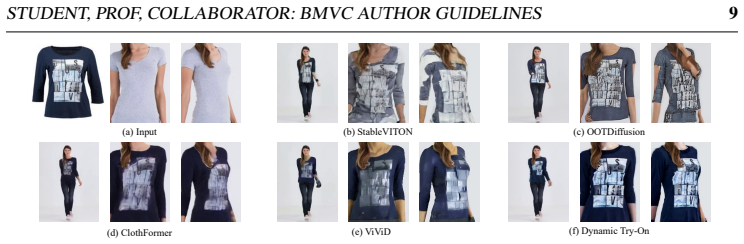
- [Sec. 4.1, Sec. 4.3] The claim of robustness to complex human postures is mainly supported by qualitative results on a private e-commerce dataset that is not released and for which no quantitative metrics are provided. The only quantitative evaluation is on VVT, which the paper itself describes as involving simpler motions. As a result, the paper's central robustness claim is not independently verifiable with the submitted evidence.
- [Sec. 4.2, Sec. 4.4] The evaluation protocol is under-specified: the paper does not state the number of evaluation samples, sampling steps, classifier-free guidance scale, random seeds, or whether all baselines use the same frame count and post-processing for VFID/FVD. These details are necessary to reproduce the quantitative comparisons and to interpret small metric differences.
minor comments (5)
- [Sec. 2.2] There is a typo: 'MagicAnimate [46] has has demonstrated' should be 'has demonstrated.'
- [Sec. 4.4] The citation 'MagicAnimate[2]' appears to be wrong: the MagicAnimate method is reference [46], while [2] is Magic Clothing. In Table 2, 'OOTDiffusion [3]' should be '[44]'.
- [References] References [40] and [41] are duplicates of the same paper (Patch-Routed Spatially-Adaptive GAN) and should be merged.
- [Table 4] The row/column checkmarks in Table 4 are hard to parse because the cells are not visually separated; please use explicit component labels for each row, such as 'w/o DFFM', 'w/ DFFM', 'None', '3D Full Attention', and 'LDAM'.
- [Sec. 3.4] The mapping from pose keypoints to the limb token mask S_l is not specified; please state how keypoint coordinates are quantized to patch tokens and how padding tokens are excluded from the masked self-attention.
Circularity Check
No circular derivation chain; the only same-author citation is non-load-bearing, and the central results rest on external benchmarks.
full rationale
The paper's central claims are benchmark-based rather than definitional. DFFM and LDAM are new modules whose reported memory savings and quality metrics are measured against external baselines on the public VVT test set (Tabs. 2-4), not quantities derived from the method's own fitted parameters. The only notable same-author reference is [52], cited in Sec. 3.3 as part of the sentence 'A line of work [8, 15, 18, 34, 44, 45, 52] has proved the effectiveness of this attention fusion operation...' This citation is one item in a list of seven supporting a known fusion design and is not the load-bearing justification for the paper's novelty, which is the reusable-backbone DFFM and the pose-guided LDAM. The skeptical concern about Tab. 4 - namely that the LDAM row differs from the 3D-full-attention row in both DFFM and attention type, and that 3D full attention is restricted to the first seven DiT blocks - describes an experimental-control weakness, not a circular reduction. No equation or procedure in the paper is equivalent to its input by construction, and no fitted quantity is renamed as a prediction. Accordingly, the circularity score is minimal.
Assumptions & free parameters
free parameters (4)
- limb token length n =
12 (at 192x256)
- number of limbs L =
4
- 3D full attention block count =
7 blocks
- learning rate =
1e-5
assumptions (3)
- standard math Diffusion Transformer and latent diffusion formulations are assumed as background.
- domain assumption Pose keypoints can be mapped to patch token indices that identify limb regions in the latent space.
- domain assumption Pretrained OpenSora weights transfer to the video try-on task after multi-stage fine-tuning.
Cite this review
Pith. "Pith review of Dynamic Try-On: Taming Video Virtual Try-on with Dynamic Attention Mechanism." pith.science (2026). https://pith.science/paper/VAHX57EW
@misc{pith2026241209822,
  author       = {Pith},
  title        = {Pith review of: Dynamic Try-On: Taming Video Virtual Try-on with Dynamic Attention Mechanism},
  year         = {2026},
  howpublished = {\url{https://pith.science/paper/VAHX57EW}},
  note         = {Machine review of arXiv:2412.09822}
}
read the original abstract
Video try-on stands as a promising area for its tremendous real-world potential. Previous research on video try-on has primarily focused on transferring product clothing images to videos with simple human poses, while performing poorly with complex movements. To better preserve clothing details, those approaches are armed with an additional garment encoder, resulting in higher computational resource consumption. The primary challenges in this domain are twofold: (1) leveraging the garment encoder's capabilities in video try-on while lowering computational requirements; (2) ensuring temporal consistency in the synthesis of human body parts, especially during rapid movements. To tackle these issues, we propose a novel video try-on framework based on Diffusion Transformer(DiT), named Dynamic Try-On. To reduce computational overhead, we adopt a straightforward approach by utilizing the DiT backbone itself as the garment encoder and employing a dynamic feature fusion module to store and integrate garment features. To ensure temporal consistency of human body parts, we introduce a limb-aware dynamic attention module that enforces the DiT backbone to focus on the regions of human limbs during the denoising process. Extensive experiments demonstrate the superiority of Dynamic Try-On in generating stable and smooth try-on results, even for videos featuring complicated human postures.
Figures


Figures from the paper (1 more)
Forward citations
Cited by 1 Pith paper
-
UniVVT: A Unified End-to-End Framework for High-Fidelity Video Virtual Try-on
UniVVT reports state-of-the-art video and image virtual try-on by conditioning a diffusion video generator on task tokens from a multimodal language model, with no masks, poses, or warping at inference.
Reference graph
Works this paper leans on
-
[1]
Quo vadis, action recognition? a new model and the kinetics dataset
Joao Carreira and Andrew Zisserman. Quo vadis, action recognition? a new model and the kinetics dataset. In 2017 IEEE Conference on Computer Vision and Pattern Recognition (CVPR) , Jul 2017. doi: 10.1109/cvpr.2017.502. URL http://dx. doi.org/10.1109/cvpr.2017.502
-
[2]
Magic clothing: Controllable garment-driven image synthesis
Weifeng Chen, Tao Gu, Yuhao Xu, and Chengcai Chen. Magic clothing: Controllable garment-driven image synthesis. arXiv preprint arXiv:2404.09512, 2024
arXiv 2024
-
[3]
Anydoor: Zero-shot object-level image customization
Xi Chen, Lianghua Huang, Yu Liu, Yujun Shen, Deli Zhao, and Hengshuang Zhao. Anydoor: Zero-shot object-level image customization. arXiv preprint arXiv:2307.09481, 2023
arXiv 2023
-
[4]
Viton-hd: High- resolution virtual try-on via misalignment-aware normalization
Seung-Hwan Choi, Sunghyun Park, Minsoo Lee, and Jaegul Choo. Viton-hd: High- resolution virtual try-on via misalignment-aware normalization. In Proceedings of the IEEE/CVF Conference on Computer Vision and Pattern Recognition , pages 14131– 14140, 2021
work page 2021
-
[5]
Fw-gan: Flow-navigated warping gan for video virtual try-on
Haoye Dong, Xiaodan Liang, Xiaohui Shen, Bowen Wu, Bing-Cheng Chen, and Jian Yin. Fw-gan: Flow-navigated warping gan for video virtual try-on. In 2019 IEEE/CVF International Conference on Computer Vision (ICCV) , Oct 2019. doi: 10.1109/iccv. 2019.00125. URL http://dx.doi.org/10.1109/iccv.2019.00125
arXiv 2019
-
[6]
Flownet: Learning optical flow with convolutional networks
Alexey Dosovitskiy, Philipp Fischer, Eddy Ilg, Philip Hausser, Caner Hazirbas, Vladimir Golkov, Patrick Van Der Smagt, Daniel Cremers, and Thomas Brox. Flownet: Learning optical flow with convolutional networks. In Proceedings of the IEEE Inter- national Conference on Computer Vision, pages 2758–2766, 2015
work page 2015
-
[7]
Scaling rectified flow transformers for high-resolution image synthesis, 2024
Patrick Esser, Sumith Kulal, Andreas Blattmann, Rahim Entezari, Jonas Müller, Harry Saini, Yam Levi, Dominik Lorenz, Axel Sauer, Frederic Boesel, Dustin Podell, Tim Dockhorn, Zion English, Kyle Lacey, Alex Goodwin, Yannik Marek, and Robin Rom- bach. Scaling rectified flow transformers for high-resolution image synthesis, 2024
work page 2024
-
[8]
Vivid: Video virtual try-on using diffusion models, 2024
Zixun Fang, Wei Zhai, Aimin Su, Hongliang Song, Kai Zhu, Mao Wang, Yu Chen, Zhiheng Liu, Yang Cao, and Zheng-Jun Zha. Vivid: Video virtual try-on using diffusion models, 2024
work page 2024
Show all 56 references
-
[9]
Parser-free virtual try-on via distilling appearance flows
Yuying Ge, Yibing Song, Ruimao Zhang, Chongjian Ge, Wei Liu, and Ping Luo. Parser-free virtual try-on via distilling appearance flows. In Proceedings of the IEEE/CVF Conference on Computer Vision and Pattern Recognition , pages 8485– 8493, 2021. 12 STUDENT, PROF, COLLABORA TOR...
2021
-
[10]
Sparsectrl: Adding sparse controls to text-to-video diffusion models
Yuwei Guo, Ceyuan Yang, Anyi Rao, Maneesh Agrawala, Dahua Lin, and Bo Dai. Sparsectrl: Adding sparse controls to text-to-video diffusion models. arXiv preprint arXiv:2311.16933, 2023
2023 arXiv
-
[11]
Animatediff: Animate your personalized text-to-image diffusion models without specific tuning
Yuwei Guo, Ceyuan Yang, Anyi Rao, Zhengyang Liang, Yaohui Wang, Yu Qiao, Ma- neesh Agrawala, Dahua Lin, and Bo Dai. Animatediff: Animate your personalized text-to-image diffusion models without specific tuning. International Conference on Learning Representations, 2024
2024
-
[12]
Xintong Han, Zuxuan Wu, Zhe Wu, Ruichi Yu, and Larry S. Davis. Viton: An image- based virtual try-on network. In Proceedings of the IEEE Conference on Computer Vision and Pattern Recognition, pages 7543–7552, 2018
2018
-
[13]
Style-based global appearance flow for virtual try-on
Sen He, Yi-Zhe Song, and Tao Xiang. Style-based global appearance flow for virtual try-on. In Proceedings of the IEEE/CVF Conference on Computer Vision and Pattern Recognition, pages 3470–3479, 2022
2022
-
[14]
Open-sora: Democratizing efficient video production for all
hpcaitech. Open-sora: Democratizing efficient video production for all. https: //github.com/hpcaitech/Open-Sora, 2024
2024
-
[15]
Animate anyone: Consistent and controllable image-to-video synthesis for character animation
Li Hu, Xin Gao, Peng Zhang, Ke Sun, Bang Zhang, and Liefeng Bo. Animate anyone: Consistent and controllable image-to-video synthesis for character animation. arXiv preprint arXiv:2311.17117, 2023
2023 arXiv
-
[16]
Clothformer: Taming video virtual try-on in all module
Jianbin Jiang, Tan Wang, He Yan, and Junhui Liu. Clothformer: Taming video virtual try-on in all module. In Proceedings of the IEEE Conference on Computer Vision and Pattern Recognition (CVPR), 2022
2022
-
[17]
Dreampose: Fashion image-to-video synthesis via stable diffusion, 2023
Johanna Karras, Aleksander Holynski, Ting-Chun Wang, and Ira Kemelmacher- Shlizerman. Dreampose: Fashion image-to-video synthesis via stable diffusion, 2023. URL https://arxiv.org/abs/2304.06025
2023 arXiv
-
[18]
Fashion-vdm: Video diffusion model for virtual try-on
Johanna Karras, Yingwei Li, Nan Liu, Luyang Zhu, Innfarn Yoo, Andreas Lugmayr, Chris Lee, and Ira Kemelmacher-Shlizerman. Fashion-vdm: Video diffusion model for virtual try-on. In Proceedings of ACM SIGGRAPH Asia 2024 , December 2024
2024
-
[19]
Stablevi- ton: Learning semantic correspondence with latent diffusion model for virtual try-on
Jeongho Kim, Gyojung Gu, Minho Park, Sunghyun Park, and Jaegul Choo. Stablevi- ton: Learning semantic correspondence with latent diffusion model for virtual try-on. arXiv preprint arxiv:2312.01725, 2023
2023 arXiv
-
[20]
Kingma and Max Welling
Diederik P. Kingma and Max Welling. Auto-encoding variational bayes. CoRR, abs/1312.6114, 2013. URL https://api.semanticscholar.org/ CorpusID:216078090
2013 arXiv
-
[21]
Shineon: Illuminating design choices for practical video-based virtual clothing try-on
Gaurav Kuppa, Andrew Jong, Xin Liu, Ziwei Liu, and Teng-Sheng Moh. Shineon: Illuminating design choices for practical video-based virtual clothing try-on. In 2021 IEEE Winter Conference on Applications of Computer Vision Workshops (WACVW) , Jan 2021. doi: 10.1109/wacvw52041.20...
2021
-
[22]
Open-sora-plan, April 2024
PKU-Yuan Lab and Tuzhan AI etc. Open-sora-plan, April 2024. URL https:// doi.org/10.5281/zenodo.10948109. STUDENT, PROF, COLLABORA TOR: BMVC AUTHOR GUIDELINES 13
2024 doi
-
[23]
Deepfashion: Pow- ering robust clothes recognition and retrieval with rich annotations
Ziwei Liu, Ping Luo, Shi Qiu, Xiaogang Wang, and Xiaoou Tang. Deepfashion: Pow- ering robust clothes recognition and retrieval with rich annotations. In Proceedings of the IEEE Conference on Computer Vision and Pattern Recognition , pages 1096–1104, 2016
2016
-
[24]
Fixing weight decay regularization in adam
Ilya Loshchilov and Frank Hutter. Fixing weight decay regularization in adam. ArXiv, abs/1711.05101, 2017. URL https://api.semanticscholar.org/ CorpusID:3312944
2017 arXiv
-
[25]
Step-video-t2v technical report: The practice, challenges, and future of video foundation model, 2025
Guoqing Ma, Haoyang Huang, Kun Yan, Liangyu Chen, Nan Duan, Shengming Yin, Changyi Wan, Ranchen Ming, Xiaoniu Song, Xing Chen, Yu Zhou, Deshan Sun, Deyu Zhou, Jian Zhou, Kaijun Tan, Kang An, Mei Chen, Wei Ji, Qiling Wu, Wen Sun, Xin Han, Yanan Wei, Zheng Ge, Aojie Li, Bin Wang...
2025 arXiv
-
[26]
T2i-adapter: Learning adapters to dig out more controllable ability for text-to-image diffusion models
Chong Mou, Xintao Wang, Liangbin Xie, Yanze Wu, Jian Zhang, Zhongang Qi, Ying Shan, and Xiaohu Qie. T2i-adapter: Learning adapters to dig out more controllable ability for text-to-image diffusion models. arXiv preprint arXiv:2302.08453, 2023
2023 arXiv
-
[27]
sora: Creating video from text
OpenAI. "sora: Creating video from text.". https://openai.com/sora, 2024
2024
-
[28]
Scalable diffusion models with transformers
William Peebles and Saining Xie. Scalable diffusion models with transformers. arXiv preprint arXiv:2212.09748, 2022
2022 arXiv
-
[29]
High-resolution image synthesis with latent diffusion models
Robin Rombach, Andreas Blattmann, Dominik Lorenz, Patrick Esser, and Bjorn Ommer. High-resolution image synthesis with latent diffusion models. In 2022 IEEE/CVF Conference on Computer Vision and Pattern Recognition (CVPR) , Jun
2022
-
[30]
U-net: Convolutional networks for biomedical image segmentation
Olaf Ronneberger, Philipp Fischer, and Thomas Brox. U-net: Convolutional networks for biomedical image segmentation. In Nassir Navab, Joachim Hornegger, William M. Wells, and Alejandro F. Frangi, editors, Medical Image Computing and Computer- Assisted Intervention – MICCAI 201...
2015
-
[31]
Towards accurate generative models of video: A new metric & challenges
Thomas Unterthiner, Sjoerd van Steenkiste, Karol Kurach, Raphaël Marinier, Marcin Michalski, and Sylvain Gelly. Towards accurate generative models of video: A new metric & challenges. ArXiv, abs/1812.01717, 2018. URL https://api. semanticscholar.org/CorpusID:54458806
2018 arXiv
-
[32]
Shazeer, Niki Parmar, Jakob Uszkoreit, Llion Jones, Aidan N
Ashish Vaswani, Noam M. Shazeer, Niki Parmar, Jakob Uszkoreit, Llion Jones, Aidan N. Gomez, Lukasz Kaiser, and Illia Polosukhin. Attention is all you need. In Neural Information Processing Systems , 2017. URL https://api. semanticscholar.org/CorpusID:13756489
2017
-
[33]
Stable-pose: Leveraging transformers for pose-guided text-to-image gen- eration
Jiajun Wang, MORTEZA GHAHREMANI, Yitong Li, Björn Ommer, and Christian Wachinger. Stable-pose: Leveraging transformers for pose-guided text-to-image gen- eration. In The Thirty-eighth Annual Conference on Neural Information Processing Systems, 2024. URL https://openreview.net/...
2024
-
[34]
Stablegarment: Garment-centric generation via stable diffusion, 2024
Rui Wang, Hailong Guo, Jiaming Liu, Huaxia Li, Haibo Zhao, Xu Tang, Yao Hu, Hao Tang, and Peipei Li. Stablegarment: Garment-centric generation via stable diffusion, 2024
2024
-
[35]
Disco: Disentangled control for referring human dance generation in real world
Tan Wang, Linjie Li, Kevin Lin, Chung-Ching Lin, Zhengyuan Yang, Hanwang Zhang, Zicheng Liu, and Lijuan Wang. Disco: Disentangled control for referring human dance generation in real world. arXiv preprint arXiv:2307.00040, 2023
2023 arXiv
-
[36]
Videocomposer: Compositional video synthesis with motion controllability
Xiang* Wang, Hangjie* Yuan, Shiwei* Zhang, Dayou* Chen, Jiuniu Wang, Yingya Zhang, Yujun Shen, Deli Zhao, and Jingren Zhou. Videocomposer: Compositional video synthesis with motion controllability. 2023
2023
-
[37]
Unianimate: Taming unified video diffusion mod- els for consistent human image animation
Xiang Wang, Shiwei Zhang, Changxin Gao, Jiayu Wang, Xiaoqiang Zhou, Yingya Zhang, Luxin Yan, and Nong Sang. Unianimate: Taming unified video diffusion mod- els for consistent human image animation. arXiv preprint arXiv:2406.01188, 2024
2024 arXiv
-
[38]
Image quality assessment: from error visibility to structural similarity
Zhou Wang, Alan Conrad Bovik, Hamid Rahim Sheikh, and Eero P Simoncelli. Image quality assessment: from error visibility to structural similarity. In IEEE Transactions on Image Processing, volume 13, pages 600–612, 2004
2004
-
[39]
Hunyuanvideo: A systematic framework for large video generative models, 2024
Zijian Zhang et al Weijie Kong, Qi Tian. Hunyuanvideo: A systematic framework for large video generative models, 2024. URL https://arxiv.org/abs/2412. 03603
2024
-
[40]
Towards scalable unpaired virtual try-on via patch- routed spatially-adaptive gan
Zhenyu Xie, Zaiyu Huang, Fuwei Zhao, Haoye Dong, Michael Kampffmeyer, and Xiaodan Liang. Towards scalable unpaired virtual try-on via patch- routed spatially-adaptive gan. In M. Ranzato, A. Beygelzimer, Y . Dauphin, P.S. Liang, and J. Wortman Vaughan, editors, Advances in Neur...
-
[41]
Kampffmeyer, and Xiaodan Liang
Zhenyu Xie, Zaiyu Huang, Fuwei Zhao, Haoye Dong, Michael C. Kampffmeyer, and Xiaodan Liang. Towards scalable unpaired virtual try-on via patch-routed spatially- adaptive gan. In Neural Information Processing Systems , 2021. URL https:// api.semanticscholar.org/CorpusID:2444784...
2021
-
[42]
Dynamicrafter: Animating open-domain images with video diffusion priors
Jinbo Xing, Menghan Xia, Yong Zhang, Haoxin Chen, Wangbo Yu, Hanyuan Liu, Xin- tao Wang, Tien-Tsin Wong, and Ying Shan. Dynamicrafter: Animating open-domain images with video diffusion priors. arXiv preprint arXiv:2310.12190, 2023
-
[43]
Easyanimate: A high-performance long video generation method based on transformer architecture, 2024
Jiaqi Xu, Xinyi Zou, Kunzhe Huang, Yunkuo Chen, Bo Liu, MengLi Cheng, Xing Shi, and Jun Huang. Easyanimate: A high-performance long video generation method based on transformer architecture, 2024. URLhttps://arxiv.org/abs/2405. 18991
2024
-
[44]
Ootdiffusion: Outfitting fusion based latent diffusion for controllable virtual try-on
Yuhao Xu, Tao Gu, Weifeng Chen, and Chengcai Chen. Ootdiffusion: Outfitting fusion based latent diffusion for controllable virtual try-on. arXiv preprint arXiv:2403.01779, 2024
2024 arXiv
-
[45]
Tunnel try-on: Excavating spatial- temporal tunnels for high-quality virtual try-on in videos
Zhengze Xu, Mengting Chen, Zhao Wang, Linyu Xing, Zhonghua Zhai, Nong Sang, Jinsong Lan, Shuai Xiao, and Changxin Gao. Tunnel try-on: Excavating spatial- temporal tunnels for high-quality virtual try-on in videos. arXiv preprint, 2024
2024
-
[46]
Magicanimate: Temporally consistent human image animation using diffusion model
Zhongcong Xu, Jianfeng Zhang, Jun Hao Liew, Hanshu Yan, Jia-Wei Liu, Chenxu Zhang, Jiashi Feng, and Mike Zheng Shou. Magicanimate: Temporally consistent human image animation using diffusion model. 2024
2024
-
[47]
Paint by example: Exemplar-based image editing with diffusion models
Binxin Yang, Shuyang Gu, Bo Zhang, Ting Zhang, Xuejin Chen, Xiaoyan Sun, Dong Chen, and Fang Wen. Paint by example: Exemplar-based image editing with diffusion models. arXiv preprint arXiv:2211.13227, 2022
2022 arXiv
-
[48]
Cogvideox: Text-to-video diffusion models with an expert transformer
Zhuoyi Yang, Jiayan Teng, Wendi Zheng, Ming Ding, Shiyu Huang, Jiazheng Xu, Yuanming Yang, Wenyi Hong, Xiaohan Zhang, Guanyu Feng, et al. Cogvideox: Text-to-video diffusion models with an expert transformer. arXiv preprint arXiv:2408.06072, 2024
2024 arXiv
-
[49]
Adding conditional control to text- to-image diffusion models
Lvmin Zhang, Anyi Rao, and Maneesh Agrawala. Adding conditional control to text- to-image diffusion models. In Proceedings of the IEEE/CVF International Conference on Computer Vision, pages 3836–3847, 2023
2023
-
[50]
The unreasonable effectiveness of deep features as a perceptual metric
Richard Zhang, Phillip Isola, Alexei A Efros, Eli Shechtman, and Oliver Wang. The unreasonable effectiveness of deep features as a perceptual metric. In Proceedings of the IEEE Conference on Computer Vision and Pattern Recognition , pages 586–595, 2018
2018
-
[51]
I2vgen-xl: High-quality image-to-video synthesis via cascaded diffusion models
Shiwei* Zhang, Jiayu* Wang, Yingya* Zhang, Kang Zhao, Hangjie Yuan, Zhiwu Qing, Xiang Wang, Deli Zhao, and Jingren Zhou. I2vgen-xl: High-quality image-to-video synthesis via cascaded diffusion models. 2023
2023
-
[52]
Viton-dit: Learn- ing in-the-wild video try-on from human dance videos via diffusion transformers.arXiv preprint, 2024
Jun Zheng, Fuwei Zhao, Youjiang Xu, Xin Dong, and Xiaodan Liang. Viton-dit: Learn- ing in-the-wild video try-on from human dance videos via diffusion transformers.arXiv preprint, 2024
2024
-
[53]
Gp-vton: Towards general purpose virtual try-on via col- laborative local-flow global-parsing learning
Xie Zhenyu, Huang Zaiyu, Dong Xin, Zhao Fuwei, Dong Haoye, Zhang Xijin, Zhu Feida, and Liang Xiaodan. Gp-vton: Towards general purpose virtual try-on via col- laborative local-flow global-parsing learning. In Proceedings of the IEEE/CVF Con- ference on Computer Vision and Patt...
2023
-
[54]
Mv- ton: Memory-based video virtual try-on network
Xiaojing Zhong, Zhonghua Wu, Taizhe Tan, Guosheng Lin, and Qingyao Wu. Mv- ton: Memory-based video virtual try-on network. In Proceedings of the 29th ACM International Conference on Multimedia , Oct 2021. doi: 10.1145/3474085.3475269. URL http://dx.doi.org/10.1145/3474085.3475269
2021
-
[2021]
URL https://proceedings.neurips.cc/paper/2021/file/ 151de84cca69258b17375e2f44239191-Paper.pdf
2021
-
[2022]
URL http://dx.doi.org/10
doi: 10.1109/cvpr52688.2022.01042. URL http://dx.doi.org/10. 1109/cvpr52688.2022.01042
2022
Reviewed August 11, 2026 · model on record in the stance chip above.
Discussion (0). Continue with ORCID to comment.