REVIEW 3 major objections 5 minor 4 cited by
MulSMo: Multimodal Stylized Motion Generation by Bidirectional Control Flow
T0 review · 3 major / 5 minor · reviewed 2026-08-11 · deepseek-v4-flash
Pith's one-line read MulSMo claims that letting the style signal and content signal adjust each other during generation, rather than letting style only influence content, produces stylized motion that keeps the style's dynamics while still following the…
desk verdict A solid, well-engineered stylized motion generation paper with a genuine architectural novelty and a real, fixable evaluation concern. read the letter →
The pith
A machine-rendered reading of the paper's core claim, the machinery that carries it, and where it could break.
The reading
What carries the argument
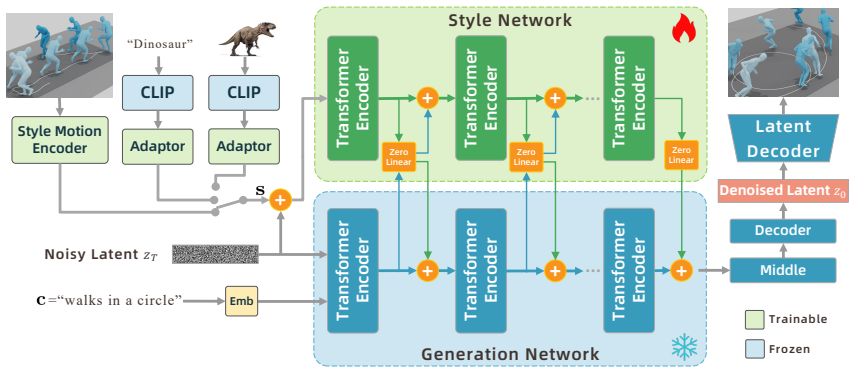
The central object is the bidirectional control flow itself: paired fusion modules placed at every encoder block of the denoiser, one sending style features into the content stream and one sending content features back into the style stream, with both initialized as zero linear layers so training starts from the frozen generation model. Alongside it, a contrastive learning scheme with a small MLP adaptor aligns CLIP text and image embeddings with style-motion embeddings, which is what converts a label word or a picture into a usable style control. The motion-aligned temporal VAE uses a temporal gating mechanism to suppress noise in attention and aligns its latent tokens with a pretrained motion transformer, giving the diffusion process a more temporally faithful latent representation.
What would settle it
Ask human raters to match generated motions to style labels for dynamics-heavy styles such as 'flapping' versus 'aeroplane' under identical content prompts, comparing MulSMo with a one-way control baseline; if raters do not select MulSMo's outputs as more faithful to the intended label, the claim that bidirectional flow preserves style dynamics is refuted.
Extended reading notes
Core claim
The paper's central claim is that the conflict between style and content in stylized motion generation is not just a matter of fusion strength but a structural flaw in the direction of control. Existing ControlNet-style methods let the style stream influence the content stream only, so when the style motion's dynamics diverge from the content text, the model tends to drop the conflicting dynamics. MulSMo instead wires zero-initialized linear fusion blocks in both directions at every encoder layer, so the style stream is continuously reshaped by the content stream while the content stream is shaped by the style. The paper argues this co-adaptation preserves the temporal dynamics that distinguish nearby styles such as 'flapping' and 'aeroplane'. The same framework is extended to text and image style inputs by a contrastive alignment between CLIP embeddings and style-motion embeddings, and to a stronger latent diffusion base by a motion-aligned temporal VAE.
Load-bearing premise
The entire style signal, both for guidance and for the reported metric, is defined by a pretrained style classifier trained on 100STYLE labels; if that classifier does not agree with how humans perceive style, the model may be optimizing toward a proxy rather than toward real style transfer.
Editorial extensions
If this is right
- Styles that differ mainly in dynamics, such as 'flapping' versus 'aeroplane', can be told apart in generation instead of collapsing to similar motions.
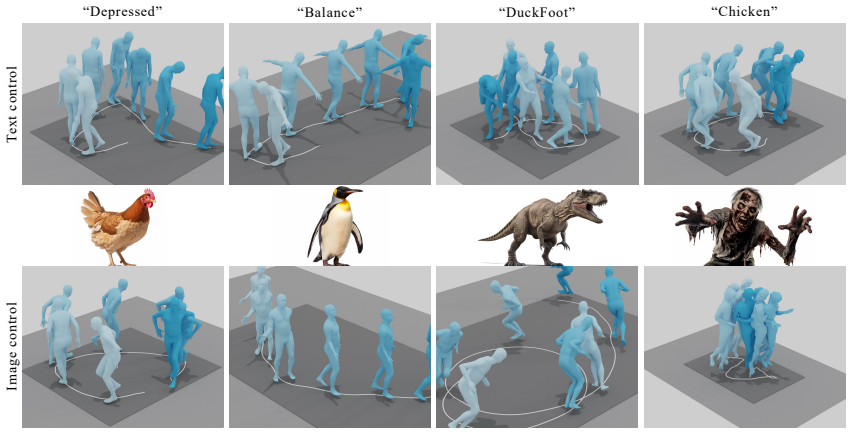
- A single word or an image can act as the style input, so users no longer need a reference motion capture clip to specify a style.
- The motion-aligned temporal VAE improves text-to-motion generation even with a CLIP text encoder, not only with the stronger LaMP encoder.
- Because the generation network stays frozen, the style network can be trained once and then reused across content prompts and style modalities without per-style fine-tuning.
- The same bidirectional mechanism carries over to motion style transfer on datasets unseen during training, such as Xia, indicating that the learned control flow generalizes.
Reading between the lines
- The bidirectional feedback idea is a general architectural principle: any conditional diffusion model that injects a control stream into a frozen generator could benefit from letting the control stream be reshaped by the content stream, especially when the control signal and the content can conflict.
- The contrastive alignment between CLIP embeddings and motion embeddings is not limited to text and images; an audio or video style encoder that shares the same latent space could be added without retraining the motion generation network.
- Because the style guidance and the style evaluation both rely on the same 100STYLE-trained classifier, a natural next test is to measure the model's style accuracy with independent human raters or an out-of-distribution style classifier; that would separate genuine style transfer from optimization against the proxy.
Signed reviews
Editorial analysis
A structured set of objections, weighed in public.
Referee Report
Summary. The paper proposes MulSMo, a stylized human motion generation method that combines three components: a bidirectional control flow between the style and content encoders of a ControlNet-style architecture, contrastive learning to align motion, text, and image style embeddings, and a motion-aligned temporal VAE (MaTLD) for latent diffusion. Experiments on 100STYLE, HumanML3D, KIT-ML, and Xia datasets report improvements over SMooDi and other baselines in Style Recognition Accuracy (SRA), FID, R-precision, and foot-skating ratio, as well as qualitative results for text- and image-guided style control. The central claim is that the bidirectional feedback adjusts the style toward the content, alleviating style-content conflict and better preserving style dynamics.
Significance. If the claimed results hold, the bidirectional control flow is a conceptually simple and potentially useful architectural modification for stylized motion generation, and the multimodal style control (motion/text/image) is practically valuable. The paper ships pseudocode and commits to public code, includes ablations that isolate the bidirectional encoder flow, provides a user study, and reports results on multiple datasets. However, the main quantitative evaluation relies on a style classifier that is also used as the feature extractor for guidance, which is a correctness risk that needs to be resolved before the central claim can be fully accepted. The lack of error bars on the primary stylized-generation tables is an additional weakness.
major comments (3)
- [Section 3.5, Eq. (5); supplementary Section C] The classifier-based style guidance uses a style feature extractor f obtained by training a style classifier on 100STYLE labels and removing its final layer, while the Style Recognition Accuracy (SRA) metric is computed with a pretrained style classifier on the same 100STYLE label set. Since Eq. (5) explicitly minimizes the L1 distance between f(ˆx0) and f(s) at every denoising step, the reported SRA improvements (e.g., Table 1: 78.029 vs. 72.418) may partly reflect optimization against the evaluation metric rather than perceptually faithful style transfer. The paper provides no validation that f's style judgments agree with human perception; the user study in supplementary Section H compares only whole systems (Ours vs. SMooDi) and does not assess the classifier's accuracy. Please address this by (i) using a held-out or independently trained style classifier for SRA, (ii) validating the classifier against human style annotations, or (iii) demonstrating that guidance using a different feature extractor still yields SRA gains.
- [Tables 1–3 and Table 5] The central quantitative claims are reported without error bars or significance tests. For example, Table 2 shows an SRA improvement of 1.089 percentage points between BiFlow+MLD (70.238) and the full model (71.327), and Table 3 shows a difference of 0.092 points (67.870 vs. 67.962); without variance estimates or significance tests, these differences may be within sampling noise. Table 4 already reports means with standard deviations for the text-to-motion task, so please extend this protocol to the stylized generation and style transfer tables.
- [Section 4.3, Table 5] The ablation of control-flow architectures is not a fully controlled comparison. Row (a) (unidirectional) uses the optimal guidance scale and style guidance scale from SMooDi, while rows (b)–(d) use the same fixed scales. To support the claim that bidirectional encoder fusion alone causes the observed improvement, either optimize the guidance scales for architecture (a) under the same protocol or add an additional row for (b) using (a)'s scales. Otherwise the difference may be attributed to guidance-scale tuning rather than the architectural change.
minor comments (5)
- [Section 4.3] The text refers to 'Table 4' when reporting the ablation results; the corresponding table is numbered Table 5.
- [Section 3.6, Eq. (9)] The loss is defined as Lall = Lstd + λprLpr, but the text states 'λpr and λcyc are hyperparameters' without ever defining or using λcyc. Either remove λcyc or introduce the corresponding cyclic loss.
- [Equation (5)] The gradient term is written as +τ ∇zt G(zt,t,s), and later in the text and supplementary τ is set to negative values (e.g., τ = −0.2, τ = −0.4). The sign convention should be stated explicitly to avoid confusion about whether the guidance moves toward or away from the style embedding.
- [Supplementary Section B] The evaluation excludes the ACT group of style labels from SRA computation 'following SMooDi'. This filtering is not mentioned in the main evaluation section; please state it there for transparency, as it affects the interpretation of the reported SRA numbers.
- [Supplementary Section H] The user study says each participant is 'provided with 24 video segments' but does not clarify whether these are 24 pairwise comparisons (Ours vs. SMooDi) or something else. Please specify the exact number of trials and how preferences were aggregated.
Circularity Check
The style classifier used for classifier-based guidance (Eq. 5) is also used to compute the SRA metric, so reported style-reflection gains partly measure optimization against the evaluation classifier.
-
self definitional
[Section 3.5 (Eq. 5) and Supplementary Section C (Evaluation Metrics)]
"G(zt, t,s) =|f ( ˆx0) − f (s)|, ... The style feature extractor is obtained by training a style classifier on the 100STYLE dataset [26] and removing its final layer. ... We compute the SRA for the generated motion with a pretrainde style classifier."
Equation (5) defines the classifier-based style guidance as the gradient of the L1 distance between f(ˆx0) and f(s), where Section 3.5 states that f is 'obtained by training a style classifier on the 100STYLE dataset and removing its final layer.' Supplementary Section C states that 'SRA for the generated motion' is computed 'with a pretrainde style classifier.' The paper describes only this one 100STYLE-trained style classifier, so the same network (or a network trained on the same labels) supplies both the optimization target and the evaluation metric.
full rationale
Score 5 reflects a partial circularity in the headline SRA metric, not a fully circular derivation. The bidirectional control flow itself is an architectural contribution with independent evidence: the Table 5 ablation compares unidirectional and bidirectional flows under comparable guidance settings, and the paper reports independent metrics (FID, R-precision, CRA, foot-skating ratio) plus a user study that does not rely on the SRA classifier. However, the main style-reflection evidence (SRA in Tables 1-3) is not independent of the method's own classifier-based guidance: Eq. (5) steers generated latents toward f(s), and Supplementary C computes SRA with a pretrained style classifier; the paper describes a single 100STYLE-trained style classifier for both roles. This makes the absolute SRA improvements, and the advantage over baselines that do not use this classifier guidance (MLD+Aberman, MLD+Motion Puzzle), partly a metric-optimization artifact. No load-bearing self-citation chain was found: LaMP [24] is a same-group pretrained model used as a component, but the supplementary CLIP-based MaTLD results show the VAE contribution is not solely due to LaMP; SMooDi [50] is used as a baseline and protocol source, not as proof of the method's claims.
Assumptions & free parameters
free parameters (5)
- classifier-free content guidance weight w_c =
15
- classifier-free style guidance weight w_s =
1.6
- classifier-based style guidance weight tau =
-0.2 for stylized generation, -0.4 for style transfer
- content prior preservation loss weight lambda_pr =
not reported
- InfoNCE temperature tau_t =
not reported
assumptions (4)
- domain assumption The style classifier trained on 100STYLE labels is a valid style oracle for both evaluation and guidance.
- domain assumption Motion sequences from 100STYLE can be retargeted to the HumanML3D SMPL skeleton without losing stylistic dynamics.
- domain assumption Pseudo text descriptions generated by MotionGPT for 100STYLE style motions are reliable content labels for training.
- ad hoc to paper Contrastive learning on the 100STYLE dataset alone can align text/image embeddings with motion style embeddings sufficiently for multimodal control.
Cite this review
Pith. "Pith review of MulSMo: Multimodal Stylized Motion Generation by Bidirectional Control Flow." pith.science (2026). https://pith.science/paper/TROCD2YK
@misc{pith2026241209901,
  author       = {Pith},
  title        = {Pith review of: MulSMo: Multimodal Stylized Motion Generation by Bidirectional Control Flow},
  year         = {2026},
  howpublished = {\url{https://pith.science/paper/TROCD2YK}},
  note         = {Machine review of arXiv:2412.09901}
}
read the original abstract
Generating motion sequences conforming to a target style while adhering to the given content prompts requires accommodating both the content and style. In existing methods, the information usually only flows from style to content, which may cause conflict between the style and content, harming the integration. Differently, in this work we build a bidirectional control flow between the style and the content, also adjusting the style towards the content, in which case the style-content collision is alleviated and the dynamics of the style is better preserved in the integration. Moreover, we extend the stylized motion generation from one modality, i.e. the style motion, to multiple modalities including texts and images through contrastive learning, leading to flexible style control on the motion generation. Extensive experiments demonstrate that our method significantly outperforms previous methods across different datasets, while also enabling multimodal signals control. The code of our method will be made publicly available.
Figures


Figures from the paper (8 more)



Forward citations
Cited by 4 Pith papers
-
Absolute Coordinates Make Motion Generation Easy
Using absolute 3D joint coordinates with a plain Transformer and velocity-prediction diffusion outperforms the standard local-relative motion representation, improving fidelity and enabling direct control.
-
Rethinking Diffusion for Text-Driven Human Motion Generation: Redundant Representations, Evaluation, and Masked Autoregression
A masked-autoregressive diffusion model trained on a compact essential-feature latent space claims state-of-the-art text-to-motion generation under a new essential-dimension evaluation protocol.
-
ClusterStyle: Modeling Intra-Style Diversity with Prototypical Clustering for Stylized Motion Generation
ClusterStyle clusters each motion style into global and local prototypes and conditions a latent diffusion model on them, improving stylized motion generation fidelity and enabling controllable within-style diversity ...
-
Motion Generation: A Survey of Generative Approaches and Benchmarks
A structured survey that categorizes recent motion generation methods by underlying generative approach and compiles datasets, metrics, and statistical trends.
Reference graph
Works this paper leans on
-
[1]
Unpaired motion style transfer from video to animation
Kfir Aberman, Yijia Weng, Dani Lischinski, Daniel Cohen- Or, and Baoquan Chen. Unpaired motion style transfer from video to animation. ACM Transactions on Graphics, 2020. 3, 7
work page 2020
-
[2]
Lead: Latent realignment for human motion diffu- sion
Nefeli Andreou, Xi Wang, Victoria Fern ´andez Abrevaya, Marie-Paule Cani, Yiorgos Chrysanthou, and Vicky Kalo- geiton. Lead: Latent realignment for human motion diffu- sion. arXiv preprint arXiv:2410.14508, 2024. 3
arXiv 2024
-
[3]
Gesturediffuclip: Gesture diffusion model with clip latents.ACM Transactions on Graphics, 2023
Tenglong Ao, Zeyi Zhang, and Libin Liu. Gesturediffuclip: Gesture diffusion model with clip latents.ACM Transactions on Graphics, 2023. 3, 5
work page 2023
-
[4]
Gener- ating human motion in 3d scenes from text descriptions
Zhi Cen, Huaijin Pi, Sida Peng, Zehong Shen, Minghui Yang, Shuai Zhu, Hujun Bao, and Xiaowei Zhou. Gener- ating human motion in 3d scenes from text descriptions. In Proceedings of the IEEE/CVF Conference on Computer Vi- sion and Pattern Recognition, pages 1855–1866, 2024. 3
2024
-
[5]
Motionclr: Motion generation and training-free edit- ing via understanding attention mechanisms
Ling-Hao Chen, Wenxun Dai, Xuan Ju, Shunlin Lu, and Lei Zhang. Motionclr: Motion generation and training-free edit- ing via understanding attention mechanisms. arXiv preprint arXiv:2410.18977, 2024. 3
arXiv 2024
-
[6]
Executing your commands via motion diffusion in latent space
Xin Chen, Biao Jiang, Wen Liu, Zilong Huang, Bin Fu, Tao Chen, and Gang Yu. Executing your commands via motion diffusion in latent space. In Proceedings of the IEEE Con- ference on Computer Vision and Pattern Recognition, 2023. 3, 4, 8, 11
work page 2023
-
[7]
Diffh2o: Diffusion-based synthesis of hand-object interactions from textual descriptions
Sammy Christen, Shreyas Hampali, Fadime Sener, Edoardo Remelli, Tomas Hodan, Eric Sauser, Shugao Ma, and Bugra Tekin. Diffh2o: Diffusion-based synthesis of hand-object interactions from textual descriptions. In SIGGRAPH Asia 2024 Conference Papers, 2024. 3
work page 2024
-
[8]
Motionlcm: Real-time control- lable motion generation via latent consistency model
Wenxun Dai, Ling-Hao Chen, Jingbo Wang, Jinpeng Liu, Bo Dai, and Yansong Tang. Motionlcm: Real-time control- lable motion generation via latent consistency model. arXiv preprint arXiv:2404.19759, 2024. 3
arXiv 2024
Show all 59 references
-
[9]
Diffusion models beat gans on image synthesis
Prafulla Dhariwal and Alexander Nichol. Diffusion models beat gans on image synthesis. Advances in Neural Informa- tion Processing Systems, 2021. 6, 12
2021
-
[10]
Im- age style transfer using convolutional neural networks
Leon A Gatys, Alexander S Ecker, and Matthias Bethge. Im- age style transfer using convolutional neural networks. In Proceedings of the IEEE Conference on Computer Vision and Pattern Recognition, 2016. 3
2016
-
[11]
Generating diverse and natural 3d human motions from text
Chuan Guo, Shihao Zou, Xinxin Zuo, Sen Wang, Wei Ji, Xingyu Li, and Li Cheng. Generating diverse and natural 3d human motions from text. In Proceedings of the IEEE Con- ference on Computer Vision and Pattern Recognition, 2022. 3, 7, 8, 11
2022
-
[12]
Momask: Generative masked model- ing of 3d human motions
Chuan Guo, Yuxuan Mu, Muhammad Gohar Javed, Sen Wang, and Li Cheng. Momask: Generative masked model- ing of 3d human motions. In Proceedings of the IEEE Con- ference on Computer Vision and Pattern Recognition, 2024. 3
2024
-
[13]
Generative human motion stylization in latent space
Chuan Guo, Yuxuan Mu, Xinxin Zuo, Peng Dai, Youliang Yan, Juwei Lu, and Li Cheng. Generative human motion stylization in latent space. arXiv preprint arXiv:2401.13505,
-
[14]
Momentum contrast for unsupervised visual rep- resentation learning
Kaiming He, Haoqi Fan, Yuxin Wu, Saining Xie, and Ross Girshick. Momentum contrast for unsupervised visual rep- resentation learning. In Proceedings of the IEEE/CVF con- ference on computer vision and pattern recognition , pages 9729–9738, 2020. 4
2020
-
[15]
Lora: Low-rank adaptation of large language models
Edward J Hu, Yelong Shen, Phillip Wallis, Zeyuan Allen- Zhu, Yuanzhi Li, Shean Wang, Lu Wang, and Weizhu Chen. Lora: Low-rank adaptation of large language models. arXiv preprint arXiv:2106.09685, 2021. 1, 3, 5
2021 arXiv
-
[16]
Arbitrary style transfer in real-time with adaptive instance normalization
Xun Huang and Serge Belongie. Arbitrary style transfer in real-time with adaptive instance normalization. In Proceed- ings of the International Conference on Computer Vision ,
-
[17]
Mo- tion puzzle: Arbitrary motion style transfer by body part
Deok-Kyeong Jang, Soomin Park, and Sung-Hee Lee. Mo- tion puzzle: Arbitrary motion style transfer by body part. ACM Transactions on Graphics, 2022. 2, 3, 7, 11
2022
-
[18]
Motiongpt: Human motion as a foreign lan- guage
Biao Jiang, Xin Chen, Wen Liu, Jingyi Yu, Gang Yu, and Tao Chen. Motiongpt: Human motion as a foreign lan- guage. Advances in Neural Information Processing Systems, 36:20067–20079, 2023. 11
2023
-
[19]
Customizing text-to-image models with a single image pair
Maxwell Jones, Sheng-Yu Wang, Nupur Kumari, David Bau, and Jun-Yan Zhu. Customizing text-to-image models with a single image pair. arXiv preprint arXiv:2405.01536, 2024. 3
2024 arXiv
-
[20]
Gmd: Controllable human motion synthesis via guided diffusion models
Korrawe Karunratanakul, Konpat Preechakul, Supasorn Suwajanakorn, and Siyu Tang. Gmd: Controllable human motion synthesis via guided diffusion models. In Proceed- ings of the International Conference on Computer Vision ,
-
[21]
Most: Motion style transformer between diverse ac- tion contents
Boeun Kim, Jungho Kim, Hyung Jin Chang, and Jin Young Choi. Most: Motion style transformer between diverse ac- tion contents. In Proceedings of the IEEE/CVF Conference on Computer Vision and Pattern Recognition , pages 1705– 1714, 2024. 1, 3
2024
-
[22]
Perceptual characteristics by motion style category
Hye Ji Kim and Sung-Hee Lee. Perceptual characteristics by motion style category. In Eurographics (Short Papers),
-
[23]
Auto-encoding vari- ational bayes, 2013
Diederik P Kingma, Max Welling, et al. Auto-encoding vari- ational bayes, 2013. 4
2013
-
[24]
Lamp: Language-motion pretraining for motion generation, retrieval, and captioning
Zhe Li, Weihao Yuan, Yisheng He, Lingteng Qiu, Shen- hao Zhu, Xiaodong Gu, Weichao Shen, Yuan Dong, Zi- long Dong, and Laurence T Yang. Lamp: Language-motion pretraining for motion generation, retrieval, and captioning. arXiv preprint arXiv:2410.07093, 2024. 3, 4, 7, 13
-
[25]
Decoupled weight decay regularization
I Loshchilov. Decoupled weight decay regularization. arXiv preprint arXiv:1711.05101, 2017. 7, 11
2017 arXiv
-
[26]
Ian Mason, Sebastian Starke, and Taku Komura. Real-time style modelling of human locomotion via feature-wise trans- formations and local motion phases.Proceedings of the ACM on Computer Graphics and Interactive Techniques, 2022. 3, 6, 7, 11
2022
-
[27]
Soomin Park, Deok-Kyeong Jang, and Sung-Hee Lee. Di- verse motion stylization for multiple style domains via spatial-temporal graph-based generative model.Proceedings of the ACM on Computer Graphics and Interactive Tech- niques, 2021. 3
2021
-
[28]
Hoi-diff: Text-driven synthe- sis of 3d human-object interactions using diffusion models
Xiaogang Peng, Yiming Xie, Zizhao Wu, Varun Jampani, Deqing Sun, and Huaizu Jiang. Hoi-diff: Text-driven synthe- sis of 3d human-object interactions using diffusion models. arXiv preprint arXiv:2312.06553, 2023. 3
2023 arXiv
-
[29]
The KIT motion-language dataset
Matthias Plappert, Christian Mandery, and Tamim Asfour. The KIT motion-language dataset. Big Data, 4(4):236–252,
-
[30]
Smcd: High realism motion style transfer via mamba-based diffusion
Ziyun Qian, Zeyu Xiao, Zhenyi Wu, Dingkang Yang, Mingcheng Li, Shunli Wang, Shuaibing Wang, Dongliang Kou, and Lihua Zhang. Smcd: High realism motion style transfer via mamba-based diffusion. arXiv preprint arXiv:2405.02844, 2024. 1, 3
2024 arXiv
-
[31]
Single motion diffusion
Sigal Raab, Inbal Leibovitch, Guy Tevet, Moab Arar, Amit H Bermano, and Daniel Cohen-Or. Single motion diffusion. arXiv preprint arXiv:2302.05905, 2023. 3
2023 arXiv
-
[32]
Learn- ing transferable visual models from natural language super- vision
Alec Radford, Jong Wook Kim, Chris Hallacy, Aditya Ramesh, Gabriel Goh, Sandhini Agarwal, Girish Sastry, Amanda Askell, Pamela Mishkin, Jack Clark, et al. Learn- ing transferable visual models from natural language super- vision. In Proceedings of the International Conference ...
2021
-
[33]
High-resolution image syn- thesis with latent diffusion models
Robin Rombach, Andreas Blattmann, Dominik Lorenz, Patrick Esser, and Bj¨orn Ommer. High-resolution image syn- thesis with latent diffusion models. In Proceedings of the IEEE Conference on Computer Vision and Pattern Recogni- tion, 2022. 3
2022
-
[34]
Ziplora: Any subject in any style by effectively merging loras
Viraj Shah, Nataniel Ruiz, Forrester Cole, Erika Lu, Svetlana Lazebnik, Yuanzhen Li, and Varun Jampani. Ziplora: Any subject in any style by effectively merging loras. In Pro- ceedings of the European Conference on Computer Vision , pages 422–438. Springer, 2025. 3
2025
-
[35]
Denoising diffusion implicit models
Jiaming Song, Chenlin Meng, and Stefano Ermon. Denoising diffusion implicit models. arXiv preprint arXiv:2010.02502, 2020. 12
2010 arXiv
-
[36]
Arbitrary mo- tion style transfer with multi-condition motion latent diffu- sion model
Wenfeng Song, Xingliang Jin, Shuai Li, Chenglizhao Chen, Aimin Hao, Xia Hou, Ning Li, and Hong Qin. Arbitrary mo- tion style transfer with multi-condition motion latent diffu- sion model. In Proceedings of the IEEE/CVF Conference on Computer Vision and Pattern Recognition , pa...
-
[37]
Rsmt: Real-time stylized motion transition for characters
Xiangjun Tang, Linjun Wu, He Wang, Bo Hu, Xu Gong, Yuchen Liao, Songnan Li, Qilong Kou, and Xiaogang Jin. Rsmt: Real-time stylized motion transition for characters. In ACM SIGGRAPH 2023 Conference Proceedings , pages 1– 10, 2023
2023
-
[38]
Style-erd: Responsive and coherent online motion style transfer
Tianxin Tao, Xiaohang Zhan, Zhongquan Chen, and Michiel van de Panne. Style-erd: Responsive and coherent online motion style transfer. Arxiv, 2022. 3
2022
-
[39]
Human motion diffusion model
Guy Tevet, Sigal Raab, Brian Gordon, Yonatan Shafir, Daniel Cohen-or, and Amit Haim Bermano. Human motion diffusion model. In Proceedings of the International Confer- ence on Learning Representations, 2023. 3
2023
-
[40]
Tlcontrol: Trajectory and language control for human motion synthesis
Weilin Wan, Zhiyang Dou, Taku Komura, Wenping Wang, Dinesh Jayaraman, and Lingjie Liu. Tlcontrol: Trajectory and language control for human motion synthesis. arXiv preprint arXiv:2311.17135, 2023. 3
2023 arXiv
-
[41]
Styleadapter: A unified stylized image generation model
Zhouxia Wang, Xintao Wang, Liangbin Xie, Zhongang Qi, Ying Shan, Wenping Wang, and Ping Luo. Styleadapter: A unified stylized image generation model. International Jour- nal of Computer Vision, 2024. 3
2024
-
[42]
Autoregressive stylized motion syn- thesis with generative flow
Yu-Hui Wen, Zhipeng Yang, Hongbo Fu, Lin Gao, Yanan Sun, and Yong-Jin Liu. Autoregressive stylized motion syn- thesis with generative flow. InProceedings of the IEEE Con- ference on Computer Vision and Pattern Recognition, 2021. 3
2021
-
[43]
Thor: Text to human-object inter- action diffusion via relation intervention
Qianyang Wu, Ye Shi, Xiaoshui Huang, Jingyi Yu, Lan Xu, and Jingya Wang. Thor: Text to human-object inter- action diffusion via relation intervention. arXiv preprint arXiv:2403.11208, 2024. 3
2024 arXiv
-
[44]
Realtime style transfer for unlabeled heterogeneous human motion
Shihong Xia, Congyi Wang, Jinxiang Chai, and Jessica Hod- gins. Realtime style transfer for unlabeled heterogeneous human motion. ACM Transactions on Graphics, 34(4):1–10,
-
[45]
Omnicontrol: Control any joint at any time for human motion generation
Yiming Xie, Varun Jampani, Lei Zhong, Deqing Sun, and Huaizu Jiang. Omnicontrol: Control any joint at any time for human motion generation. In Proceedings of the Interna- tional Conference on Learning Representations, 2024. 3
2024
-
[46]
Hierarchical style-based networks for motion synthesis
Jingwei Xu, Huazhe Xu, Bingbing Ni, Xiaokang Yang, Xi- aolong Wang, and Trevor Darrell. Hierarchical style-based networks for motion synthesis. In Proceedings of the Euro- pean Conference on Computer Vision, 2020. 3
2020
-
[47]
Generating human interaction motions in scenes with text control
Hongwei Yi, Justus Thies, Michael J Black, Xue Bin Peng, and Davis Rempe. Generating human interaction motions in scenes with text control. In European Conference on Com- puter Vision, pages 246–263. Springer, 2025. 3
2025
-
[48]
Freedom: Training-free energy-guided condi- tional diffusion model
Jiwen Yu, Yinhuai Wang, Chen Zhao, Bernard Ghanem, and Jian Zhang. Freedom: Training-free energy-guided condi- tional diffusion model. In Proceedings of the IEEE/CVF In- ternational Conference on Computer Vision , pages 23174– 23184, 2023. 6
2023
-
[49]
Adding conditional control to text-to-image diffusion models
Lvmin Zhang, Anyi Rao, and Maneesh Agrawala. Adding conditional control to text-to-image diffusion models. In Proceedings of the International Conference on Computer Vision, 2023. 1, 3, 4
2023
-
[50]
Smoodi: Stylized motion diffusion model
Lei Zhong, Yiming Xie, Varun Jampani, Deqing Sun, and Huaizu Jiang. Smoodi: Stylized motion diffusion model. In Proceedings of the European Conference on Computer Vi- sion, 2024. 2, 3, 4, 5, 6, 7, 11, 12, 13 A. Introduction This is the supplementary material, which is divided ...
2024
-
[51]
The details of dataset are shown in Section B
-
[52]
The evaluation metrics are shown in Section C
-
[53]
The baselines we use in the experiment are shown in Section D
-
[54]
We provide the pseudo code, which is presented in Algorithm 1
-
[55]
The details of motion style transfer task are elaborated in Section F
-
[56]
The inference time cost is provided in Section G
-
[57]
We report a user study of our method in Section H
-
[58]
More ablation studies are conducted in Section I
-
[59]
Runsforward
More visualization results are presented in Section J, including additional qualitative results and some cases to validate the generalization ability. B. Datasets. We utilize the HumanML3D dataset [11] as the motion con- tent dataset and the 100STYLE dataset [26] as the motion...
Reviewed August 11, 2026 · model on record in the stance chip above.
Discussion (0). Continue with ORCID to comment.