Low-Energy Nuclear Recoil Calibration of XENONnT with a ⁸⁸YBe Photoneutron Source
Pith reviewed 2026-05-23 07:38 UTC · model grok-4.3
The pith
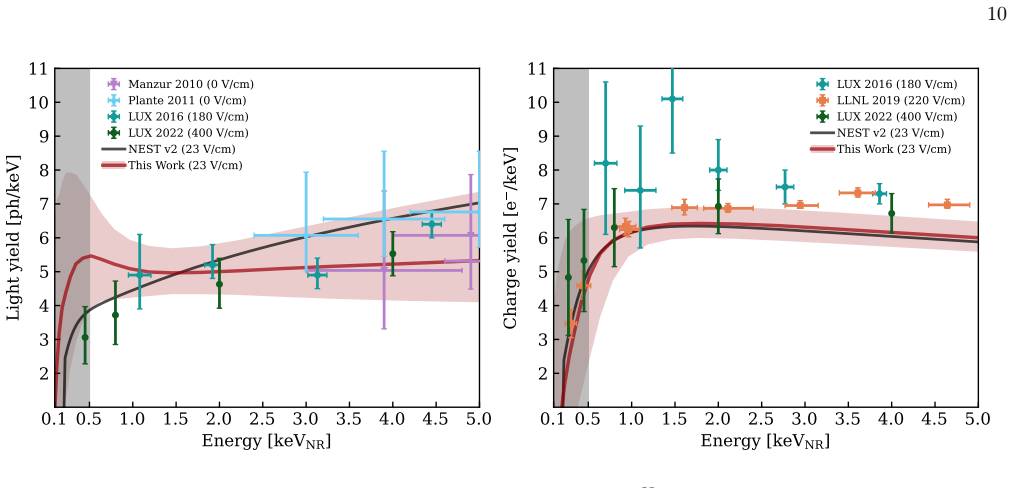
XENONnT extracted liquid xenon light and charge yields for nuclear recoils between 0.3 and 5 keV_NR at 23 V/cm using a photoneutron source.
A machine-rendered reading of the paper's core claim, the machinery that carries it, and where it could break.
Core claim
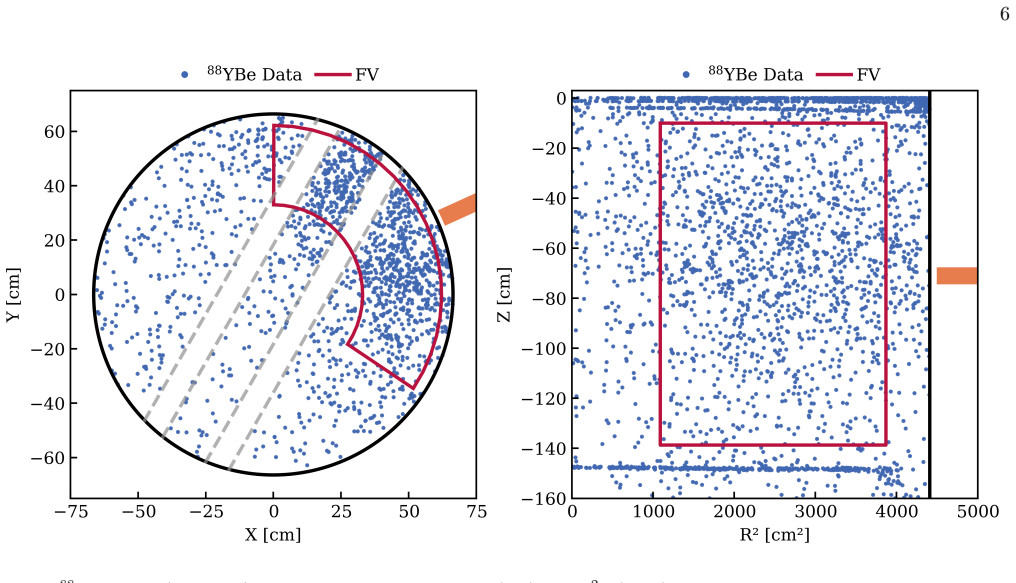
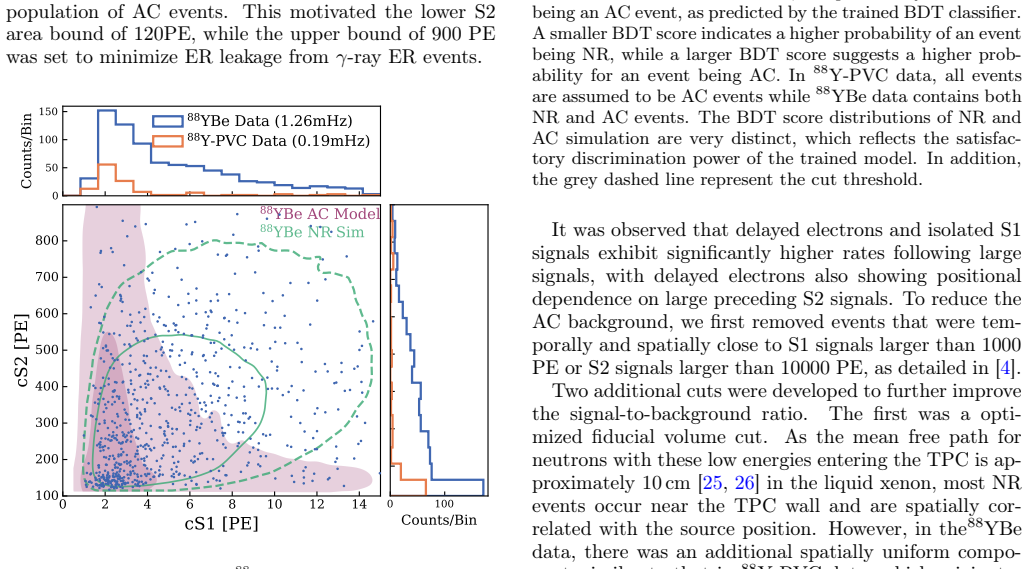
We have successfully used a Yttrium-Beryllium photoneutron source that emits 152 keV neutrons for the calibration of the light and charge yields of the XENONnT experiment for the first time. After data selection, we accumulated 474 events from 183 hours of exposure with this source. The expected background was 55 ± 12 accidental coincidence events, estimated using a dedicated 152 hour background calibration run with a Yttrium-PVC gamma-only source and data-driven modeling. From these calibrations, we extracted the light (charge) yield for liquid xenon at our field strength of 23 V/cm between 0.3 (0.7) keV_NR and 5.0 keV_NR.
What carries the argument
The 88YBe photoneutron source producing 152 keV neutrons to induce and measure low-energy nuclear recoils in liquid xenon.
If this is right
- This calibration enables accurate measurement of solar 8B neutrino coherent elastic neutrino-nucleus scattering.
- Searches for light dark matter particles with masses below 12 GeV/c² become feasible in XENONnT.
- The light and charge yields provide a direct reference for interpreting signals in the 0.3-5 keV_NR range.
Where Pith is reading between the lines
- The same photoneutron source technique could be applied to other noble-liquid detectors to allow direct comparison of response models across experiments.
- These yield data could be used to test and refine theoretical predictions of scintillation and ionization quenching at sub-keV energies.
- Improved event selection or longer exposures might push the calibration threshold lower in follow-up measurements.
Load-bearing premise
The background of 55 ± 12 accidental coincidence events estimated from the dedicated 152-hour Yttrium-PVC gamma-only run accurately represents the background in the photoneutron data set.
What would settle it
An independent run with the same source or another low-energy neutron source yielding a significantly different number of events after background subtraction or inconsistent yield values would challenge the extracted calibration.
Figures





read the original abstract
Characterizing low-energy, keV-range nuclear recoils near the detector threshold is one of the major challenges for large direct dark matter detectors. To that end, we have successfully used a Yttrium-Beryllium photoneutron source that emits 152 keV neutrons for the calibration of the light and charge yields of the XENONnT experiment for the first time. After data selection, we accumulated 474 events from 183 hours of exposure with this source. The expected background was $55 \pm 12$ accidental coincidence events, estimated using a dedicated 152 hour background calibration run with a Yttrium-PVC gamma-only source and data-driven modeling. From these calibrations, we extracted the light (charge) yield for liquid xenon at our field strength of 23 V/cm between 0.3 (0.7) keV$_{\rm NR}$ and 5.0 keV$_{\rm NR}$. This calibration is crucial for accurately measuring the solar $^8$B neutrino coherent elastic neutrino-nucleus scattering and searching for light dark matter particles with masses below 12 GeV/c$^2$.
Editorial analysis
A structured set of objections, weighed in public.
Referee Report
Summary. The manuscript reports the first calibration of low-energy nuclear recoil light and charge yields in XENONnT using a 88YBe photoneutron source that produces 152 keV neutrons. After 183 h of exposure, 474 events are selected following data cuts; an estimated background of 55 ± 12 accidental coincidences (derived from a separate 152 h 88Y-PVC gamma-only run plus data-driven modeling) is subtracted. From the resulting sample the light (charge) yield is extracted between 0.3 (0.7) keV_NR and 5.0 keV_NR at the operating field of 23 V/cm. The result is presented as essential for 8B CEvNS and sub-12 GeV/c² dark-matter searches.
Significance. If the background model is shown to transfer reliably, the measurement supplies the first direct experimental anchor for liquid-xenon response in the sub-keV_NR regime that is currently inaccessible to other calibration techniques. This directly improves the sensitivity reach of XENONnT and similar detectors for solar neutrinos and light dark matter.
major comments (1)
- [Abstract (background estimation paragraph)] Abstract (background estimation paragraph): the central yields rest on subtracting 55 ± 12 events from 474 selected events. The background is obtained from a dedicated gamma-only run and data-driven modeling, yet no internal cross-check (sideband, time-structure, or coincidence-rate comparison within the photoneutron dataset itself) is described that would confirm the model fully captures differences in trigger conditions, neutron-induced secondaries, or accidental rates. This transferability assumption is load-bearing for the reported 0.3–5 keV_NR yields.
Simulated Author's Rebuttal
We thank the referee for the careful and constructive review of our manuscript. The background estimation is indeed central to the reported yields, and we address the concern regarding validation of the model transferability below.
read point-by-point responses
-
Referee: [Abstract (background estimation paragraph)] Abstract (background estimation paragraph): the central yields rest on subtracting 55 ± 12 events from 474 selected events. The background is obtained from a dedicated gamma-only run and data-driven modeling, yet no internal cross-check (sideband, time-structure, or coincidence-rate comparison within the photoneutron dataset itself) is described that would confirm the model fully captures differences in trigger conditions, neutron-induced secondaries, or accidental rates. This transferability assumption is load-bearing for the reported 0.3–5 keV_NR yields.
Authors: We agree that the background model transferability requires robust support. The estimate of 55 ± 12 accidental coincidences is derived from a dedicated 152-hour 88Y-PVC gamma-only run combined with data-driven modeling that incorporates measured rates under comparable trigger conditions. The manuscript presents this procedure, but we acknowledge that explicit internal cross-checks (e.g., sideband or time-structure comparisons performed directly on the photoneutron dataset) are not described. In the revised version we will add a dedicated validation subsection that includes (i) a time-structure comparison between the photoneutron and gamma-only datasets and (ii) a coincidence-rate consistency check using event subsets outside the nuclear-recoil acceptance region. These additions will quantify any residual differences arising from neutron-induced secondaries or trigger variations and will be accompanied by an updated systematic uncertainty budget. The central yield values are not expected to change. revision: yes
Circularity Check
No circularity: direct experimental yields from independent data runs
full rationale
The paper describes an experimental calibration using a photoneutron source, accumulating 474 events over 183 hours, subtracting an estimated 55±12 background events from a separate 152-hour gamma-only run with data-driven modeling, and extracting light/charge yields in the 0.3–5 keV_NR range. No equations, fitted parameters, or derivation steps are shown that reduce the reported yields to prior assumptions by construction. The background subtraction relies on an external run rather than self-referential fitting or self-citation chains. This is a standard data-collection result with no load-bearing self-definitional or fitted-input-called-prediction patterns.
Axiom & Free-Parameter Ledger
axioms (2)
- domain assumption The ⁸⁸YBe source produces neutrons at 152 keV as expected from known nuclear decay and photoneutron reaction kinematics.
- domain assumption Accidental coincidence background in the signal run is accurately modeled by the gamma-only calibration run and data-driven methods.
Forward citations
Cited by 1 Pith paper
-
Probing the Solar $^8$B Neutrino Fog with XENONnT
XENONnT measures solar 8B neutrino coherent scattering at 3.3 sigma, finds no light dark matter, and constrains the weak mixing angle at low momentum transfer.
Reference graph
Works this paper leans on
- [1]
-
[2]
D. Z. Freedman, Coherent effects of a weak neutral cur- rent, Phys. Rev. D9, 1389 (1974)
work page 1974
-
[3]
V. B. Kopeliovich and L. L. Frankfurt, Isotopic and chiral structure of neutral current, JETP Lett.19, 145 (1974)
work page 1974
-
[4]
E. Aprile et al. (XENON), First Indication of Solar 8B Neutrinos via Coherent Elastic Neutrino-Nucleus Scattering with XENONnT, Phys. Rev. Lett. 133, 191002 (2024), arXiv:2408.02877 [nucl-ex]
- [5]
-
[6]
D. E. Kaplan, M. A. Luty, and K. M. Zurek, Asym- metric Dark Matter, Phys. Rev. D 79, 115016 (2009), arXiv:0901.4117 [hep-ph]
work page internal anchor Pith review Pith/arXiv arXiv 2009
-
[7]
Dark Matter Self-interactions and Small Scale Structure
S. Tulin and H.-B. Yu, Dark Matter Self-interactions and Small Scale Structure, Phys. Rept. 730, 1 (2018), arXiv:1705.02358 [hep-ph]
work page internal anchor Pith review Pith/arXiv arXiv 2018
-
[8]
E. Aprileet al. (XENON), First Search for Light Dark Matter in the Neutrino Fog with XENONnT (2024), arXiv:2409.17868 [hep-ex]
-
[9]
Aprileet al.(XENON), The XENONnT dark mat- ter experiment, Eur
E. Aprile et al. (XENON), The XENONnT dark mat- ter experiment, Eur. Phys. J. C 84, 784 (2024), arXiv:2402.10446 [physics.ins-det]
-
[10]
E. Aprileet al.(XENON), XENONnT Analysis: Signal Reconstruction, Calibration and Event Selection (2024), arXiv:2409.08778 [hep-ex]
-
[11]
E. Aprile et al. (XENON), XENONnT WIMP Search: Signal & Background Modeling and Statistical Inference (2024), arXiv:2406.13638 [physics.data-an]
-
[12]
J. I. Collar, Applications of an 88Y /Be photo-neutron calibration source to Dark Matter and Neutrino Ex- periments, Phys. Rev. Lett. 110, 211101 (2013), arXiv:1303.2686 [physics.ins-det]
work page internal anchor Pith review Pith/arXiv arXiv 2013
-
[13]
Qin,Computational techniques for the direct detection of dark matter, Ph.D
J. Qin,Computational techniques for the direct detection of dark matter, Ph.D. thesis, Purdue University (2023)
work page 2023
-
[14]
A. E. Robinson, Reanalysis of radioisotope measure- ments of the 9Be(γ, n)8Be cross-section, Phys. Rev. C 94, 024613 (2016), arXiv:1602.05911 [nucl-ex]
work page internal anchor Pith review Pith/arXiv arXiv 2016
- [15]
-
[16]
A, General physics38 11, 5539 (1988)
Hunter, Carter, and Christophorou, Low-energy electron drift and scattering in krypton and xenon., Physical re- view. A, General physics38 11, 5539 (1988)
work page 1988
-
[17]
Aprileet al.(XENON), First Dark Matter Search with Nuclear Recoils from the XENONnT Experiment, Phys
E. Aprileet al.(XENON), First Dark Matter Search with Nuclear Recoils from the XENONnT Experiment, Phys. Rev. Lett. 131, 041003 (2023), arXiv:2303.14729 [hep- ex]
-
[18]
J. Aalberset al.(LZ), The design, implementation, and performance of the LZ calibration systems, JINST 19 (08), P08027, arXiv:2406.12874 [physics.ins-det]
-
[19]
R. L. Workmanet al.(Particle Data Group), Review of Particle Physics, PTEP2022, 083C01 (2022)
work page 2022
-
[20]
S. Agostinelliet al. (GEANT4), GEANT4–a simulation toolkit, Nucl. Instrum. Meth. A506, 250 (2003)
work page 2003
-
[21]
B. Hamermesh, M. Hamermesh, and A. Wattenberg, The angular distribution of the photo-neutrons from beryl- 12 lium, Phys. Rev.76, 611 (1949)
work page 1949
-
[22]
M. Szydagis, J. Balajthy, G. Block, J. Brodsky, J. Cutter, S. Farrell, J. Huang, E. Kozlova, B. Lenardo, A. Man- alaysay, D. McKinsey, M. Mooney, J. Mueller, K. Ni, G. Rischbieter, M. Tripathi, C. Tunnell, V. Velan, and Z. Zhao, Noble element simulation technique (2022)
work page 2022
-
[23]
E. Aprile et al. (XENON), Emission of single and few electrons in XENON1T and limits on light dark matter, Phys. Rev. D106, 022001 (2022), arXiv:2112.12116 [hep- ex]
-
[24]
D. Y. Akimov et al., Observation of delayed electron emission in a two-phase liquid xenon detector, JINST 11 (03), C03007
- [25]
-
[26]
Shibata et al., Jendl-4.0: A new library for nuclear science and engineering, J
K. Shibata et al., Jendl-4.0: A new library for nuclear science and engineering, J. nucl. sci. tech48, 1 (2011)
work page 2011
-
[27]
Aprileet al.(XENONnT), Design and performance of the field cage for the XENONnT experiment, Eur
E. Aprileet al.(XENONnT), Design and performance of the field cage for the XENONnT experiment, Eur. Phys. J. C 84, 138 (2024), arXiv:2309.11996 [hep-ex]
-
[28]
T. Chen and C. Guestrin, XGBoost: A scalable tree boosting system, in Proceedings of the 22nd ACM SIGKDD International Conference on Knowledge Dis- covery and Data Mining, KDD ’16 (ACM, New York, NY, USA, 2016) pp. 785–794
work page 2016
-
[29]
Aprileet al.(XENON), Wfsim: The xenon waveform simulator, https://github.com/XENONnT/WFSim (2021)
E. Aprileet al.(XENON), Wfsim: The xenon waveform simulator, https://github.com/XENONnT/WFSim (2021)
work page 2021
-
[30]
XENON Collaboration, XENONnT/axidence: strax- based data-driven accidental coincidence background simulation and peak-level salting (2024)
work page 2024
-
[31]
XENON Collaboration, XENONnT/appletree: A high- performance program simulates and fits response of xenon (2024)
work page 2024
-
[32]
M. Szydagiset al., A Review of NEST Models, and Their Application to Improvement of Particle Identification in Liquid Xenon Experiments (2022), arXiv:2211.10726 [hep-ex]
- [33]
-
[34]
D. S. Akeribet al.(LUX), Low-energy (0.7-74 keV) nu- clear recoil calibration of the LUX dark matter exper- iment using D-D neutron scattering kinematics (2016), arXiv:1608.05381 [physics.ins-det]
work page internal anchor Pith review Pith/arXiv arXiv 2016
- [35]
-
[36]
A. Manzur et al., Scintillation efficiency and ioniza- tion yield of liquid xenon for mono-energetic nuclear re- coils down to 4 keV, Phys. Rev. C81, 025808 (2010), arXiv:0909.1063 [physics.ins-det]
work page internal anchor Pith review Pith/arXiv arXiv 2010
-
[37]
G.Plante et al.,NewMeasurementoftheScintillationEf- ficiency of Low-Energy Nuclear Recoils in Liquid Xenon, Phys. Rev. C84, 045805 (2011), arXiv:1104.2587 [nucl- ex]
work page internal anchor Pith review Pith/arXiv arXiv 2011
-
[38]
XENON Collaboration, XENONnT/saltax (2024)
work page 2024
-
[39]
D. Foreman-Mackey, D. W. Hogg, D. Lang, and J. Good- man, emcee: the mcmc hammer, Publ. Astron. Soc. Pac. 125, 306 (2013)
work page 2013
-
[40]
Foreman-Mackeyet al., emcee v3: A python ensem- ble sampling toolkit for affine-invariant mcmc, J
D. Foreman-Mackeyet al., emcee v3: A python ensem- ble sampling toolkit for affine-invariant mcmc, J. Open Source Softw. 4, 1864 (2019)
work page 2019
-
[41]
S. Baker and R. D. Cousins, Clarification of the Use of Chi Square and Likelihood Functions in Fits to His- tograms, Nucl. Instrum. Meth.221, 437 (1984)
work page 1984
-
[42]
XENON Collaboration, XENONnT/gofevaluation (2024)
work page 2024
discussion (0)
Sign in with ORCID, Apple, or X to comment. Anyone can read and Pith papers without signing in.