REVIEW 3 major objections 6 minor 19 references
Artificial Intelligence-Driven Clinical Decision Support Systems
T0 review · 3 major / 6 minor · reviewed 2026-08-10 · deepseek-v4-flash
Pith's one-line read This review argues that deploying AI in clinical decision support depends on balancing technical accuracy with reliable validation, calibration, decision curve analysis, fairness, explainability, and privacy.
desk verdict A solid, clearly written review chapter with no new science; it works as a teaching survey, but the unsourced privacy-performance numbers in §4.4 need to be fixed before it can be trusted as a reference. read the letter →
The pith
A machine-rendered reading of the paper's core claim, the machinery that carries it, and where it could break.
The reading
What carries the argument
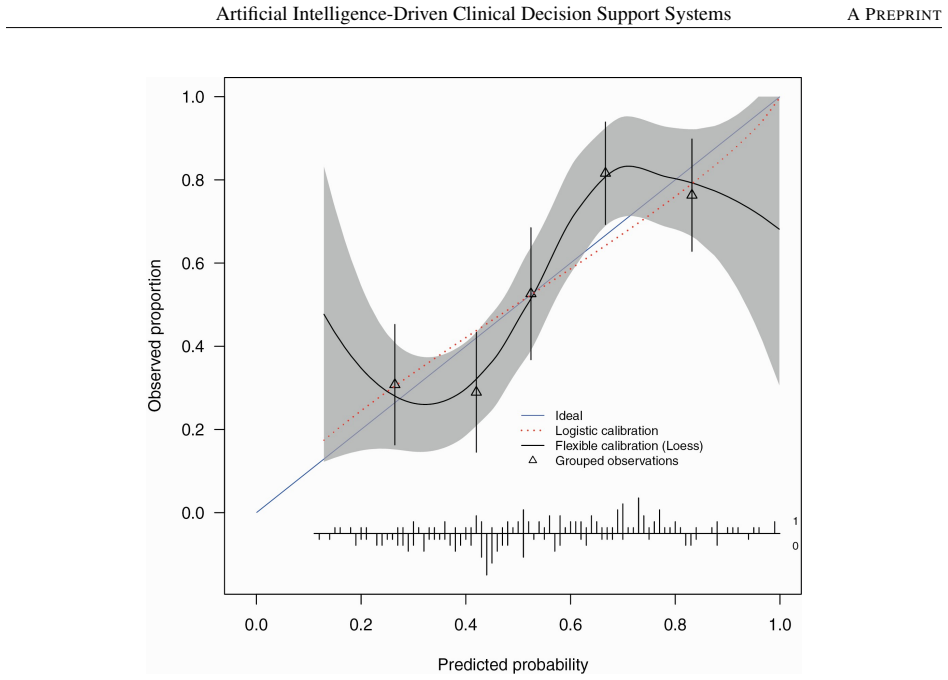
The central object is the ABCD validation framework for clinical prediction models: A) calibration in the large, which checks that overall predicted risk matches observed event rates; B) calibration slope, which checks that predicted risks are not systematically too high or low across risk levels; C) discrimination, established through internal and external validation; and D) decision-curve analysis. The chapter adds the net benefit quantity, $NB = \frac{TP}{N} - \frac{FP}{N} \times \frac{ThresP}{1-ThresP}$, where ThresP is the threshold probability at which a clinician would intervene, as the bridge from statistical performance to clinical consequences. It then treats fairness criteria (independence, separation, sufficiency) and privacy mechanisms (differential privacy, federated learning) as load-bearing extensions of that framework.
What would settle it
Run the same clinical prediction task under centralized, differentially private, federated, and synthetic-data training on a shared clinical dataset and compare accuracy; finding that differential privacy costs more than 20 percent accuracy, or that federated learning matches centralized performance, would falsify the generalized ranges the chapter repeats.
Extended reading notes
Core claim
The chapter's central claim is that the successful implementation of AI in clinical decision support requires treating technical discrimination as only one component of a responsible development pathway. Its stated conclusion is that the pathway must address "not only technical excellence in model performance, but also robust validation, proper calibration, and thorough decision curve analysis," and then balance fairness, explainability, and privacy. The argument is carried by the ABCD validation scheme—calibration in the large, calibration slope, discrimination with internal and external validation, and decision-curve analysis—extended with safeguards against bias, attacks on explanations, and privacy leakage. If the chapter is right, a model that scores well on AUC but is poorly calibrated, biased across groups, unexplainable, or vulnerable to data leakage is not clinically suitable, no matter how accurate it looks.
Load-bearing premise
The load-bearing premise is that the uncited performance-loss figures in Section 4.4—differential privacy reducing accuracy by 5 to 20 percent, federated learning by 3 to 15 percent, and synthetic data by up to 30 percent—are accurate enough to guide practical choices; if they are wrong or highly context-dependent, the chapter's privacy-performance guidance misleads.
Editorial extensions
If this is right
- Reporting a model's AUC without its calibration curve becomes insufficient; the intercept and slope of calibration plus the decision-curve net benefit should accompany any claim of clinical usefulness.
- External validation should be treated as a requirement rather than a bonus, since a model developed without it should generally be considered at high risk of bias.
- Removing sensitive attributes does not remove bias; fairness requires measuring calibration within subgroups and accepting trade-offs among independence, separation, and sufficiency when disease prevalence differs across groups.
- Privacy protection belongs in early model design, because deep learning models memorize training data and are vulnerable to membership inference and re-identification attacks.
- Explainability methods themselves can be attacked, so a trustworthy explanation pipeline needs defenses such as smoothed activations and differential privacy.
Reading between the lines
- A natural extension is to turn the chapter's synthesis into a checklist-style evaluation protocol: auditors would require calibration curves, decision curves, subgroup fairness metrics, and privacy-leakage measurements in every clinical AI approval package, which would shift incentives for model developers.
- The Section 4.4 trade-off figures, repeated without citation, function as empirical claims; a cross-dataset benchmark measuring accuracy loss under differential privacy, federated learning, and synthetic data would either anchor them or force a revision.
- The chapter's account of adversarial attacks on explanations implies a testable extension: measuring whether clinicians in human-in-the-loop studies are actually misled by attacked explanations, not just whether heatmaps change.
- Because the same memorization and re-identification risks appear in home sensing, the chapter's privacy arguments carry over to ambient health monitoring, where raw signals may not be visually interpretable by humans.
Signed reviews
Editorial analysis
A structured set of objections, weighed in public.
Referee Report
Summary. This manuscript is a survey chapter on artificial intelligence-driven clinical decision support systems. It covers the development and validation of predictive models (internal/external validation, calibration, decision curve analysis), responsible AI considerations (fairness, explainability, privacy), and the trade-offs introduced by privacy-preserving techniques. The chapter's central claim, stated in the conclusions, is that successful AI implementation in clinical decision support requires balancing technical accuracy with robust validation, calibration, decision curve analysis, fairness, explainability, and privacy. The text is largely a synthesis of existing frameworks such as Steyerberg and Vergouwe's ABCD validation, PROBAST, and Vickers's decision curve analysis, illustrated with examples from the authors' own prior work.
Significance. As a survey, the chapter provides a readable and reasonably comprehensive overview of best practice for trustworthy clinical AI. Its strengths include the correct presentation of standard technical material (the differential privacy definitions in Section 4.2.1, the net benefit formula in Section 1.6, and the DP-SGD pseudocode), the use of concrete clinical examples, and a clear organizational structure that connects validation, fairness, explainability, and privacy. The chapter does not claim new empirical or theoretical results; its value is as a synthesis and roadmap for practitioners. However, the credibility of the privacy-performance trade-off discussion rests in part on unsourced quantitative claims in Section 4.4, which need to be corrected or substantiated before the chapter can be considered fully reliable.
major comments (3)
- [Section 4.4] The paragraph beginning 'Empirical research has demonstrated...' states specific performance-degradation ranges for differential privacy (5-20 percent), federated learning (3-15 percent), and synthetic data (up to 30 percent) without any citations or contextual qualifiers. These numbers are highly dependent on task, model, privacy budget, and data regime; presenting them as established fixed bounds is misleading. Since this paragraph directly supports the chapter's concluding recommendation to balance privacy and performance, the authors must either supply systematic references with explicit task-specific evidence or reframe these ranges as illustrative and non-universal. This is a load-bearing weakness in the privacy trade-off argument.
- [Section 1.2, Eq. (2)] Equation (2) uses the symbol m' without defining it. The surrounding text says 'm' represents the sample size' but m was defined earlier in Eq. (1) and m' is never introduced. The notation should be harmonized (either use m or explicitly define m' and its relationship to m). This ambiguity undermines the technical presentation of the hold-out error bound and should be corrected.
- [Section 4.2.1 / Algorithm 1] The text accompanying DP-SGD states that the approach involves 'clipping gradients and adding Gaussian noise proportional to ϵ'. This is inaccurate: in DP-SGD, the added noise is calibrated to the clipping norm (C) and the sensitivity, while ϵ is a privacy-loss parameter that emerges from the analysis; a larger ϵ typically corresponds to less noise, not more. Reword to avoid an incorrect inverse relationship between noise and ϵ.
minor comments (6)
- [Title and front matter] The title as rendered contains a spurious space and hyphen: 'ARTIFICIAL INTELLIGENCE -D RIVEN' should be 'ARTIFICIAL INTELLIGENCE-DRIVEN'.
- [Section 1.2] The sentence following Eq. (2) describes the error bound as providing 'a probability of accuracy of (1 − δ)'; this is a loose paraphrase of a confidence interval and should be phrased in standard probabilistic language.
- [Section 1.4] The symbols α (calibration-in-the-large) and β (calibration slope) are mentioned but not formally defined with equations; please introduce them explicitly at first use.
- [Section 1.2 / Figure 3] The text refers to 'Figure 3b(a)' for the confusion matrix; this appears to be a typo for 'Figure 3a'. Please check all figure cross-references.
- [Section 3.3] The phrase 'Permutation based approaches such as permutation feature importance permutes' has an agreement error; also, the following sentence 'In other cases, they can apply a surrogate model' has an unclear antecedent for 'they'.
- [Abstract] The phrase 'The discussion advances in an analysis' should be 'The discussion advances to an analysis'.
Circularity Check
No circular derivation: the chapter's recommendations are synthesized from external frameworks, and author self-citations are illustrative only.
full rationale
This chapter is a survey of clinical decision support system validation, calibration, decision curve analysis, fairness, explainability, and privacy, so there is no derived predictive or theoretical result that could reduce to its own inputs. The central conclusion, that successful AI implementation must balance accuracy with robust validation, calibration, decision curve analysis, fairness, explainability, and privacy, is a synthesis of external frameworks such as Steyerberg and Vergouwe (2014), Van Calster et al. (2019), Vickers et al. (2006, 2018, 2019), the PROBAST framework (Wolff et al., 2019), and de Hond et al. (2022), rather than a self-citation chain. The author self-citations, including Leighton et al. (2019, 2021) for the psychosis risk model examples, Jones et al. (2020) for saliency maps, and Zakariyya et al. (2024) for differentially private radar sensing, are used as illustrative applications of externally established methods; none carries the logical burden of the chapter's recommendations. No uniqueness theorem is imported from the authors' prior work, no fitted parameter is relabeled as a prediction, and no known result is merely renamed. The one notable evidentiary weakness is Section 4.4, which states without citation that differential privacy reduces accuracy by 5 to 20 percent, federated learning by 3 to 15 percent, and synthetic data by up to 30 percent; this unsupported empirical claim is a correctness and verification concern, not a circularity, because those ranges are not derived from, and do not restate, the chapter's own definitions or assumptions. Since no load-bearing step reduces by construction or by self-citation to its inputs, no circular step is exhibited.
Assumptions & free parameters
assumptions (2)
- domain assumption The cited literature is summarized accurately and is representative of current best practice in clinical AI.
- ad hoc to paper The unsourced performance-degradation ranges in Section 4.4, including DP reducing accuracy by 5 to 20 percent, federated learning by 3 to 15 percent, and synthetic data by up to 30 percent, are accurate reflections of empirical evidence.
Cite this review
Pith. "Pith review of Artificial Intelligence-Driven Clinical Decision Support Systems." pith.science (2026). https://pith.science/paper/JDJAD6IJ
@misc{pith2026250109628,
  author       = {Pith},
  title        = {Pith review of: Artificial Intelligence-Driven Clinical Decision Support Systems},
  year         = {2026},
  howpublished = {\url{https://pith.science/paper/JDJAD6IJ}},
  note         = {Machine review of arXiv:2501.09628}
}
read the original abstract
As artificial intelligence (AI) becomes increasingly embedded in healthcare delivery, this chapter explores the critical aspects of developing reliable and ethical Clinical Decision Support Systems (CDSS). Beginning with the fundamental transition from traditional statistical models to sophisticated machine learning approaches, this work examines rigorous validation strategies and performance assessment methods, including the crucial role of model calibration and decision curve analysis. The chapter emphasizes that creating trustworthy AI systems in healthcare requires more than just technical accuracy; it demands careful consideration of fairness, explainability, and privacy. The challenge of ensuring equitable healthcare delivery through AI is stressed, discussing methods to identify and mitigate bias in clinical predictive models. The chapter then delves into explainability as a cornerstone of human-centered CDSS. This focus reflects the understanding that healthcare professionals must not only trust AI recommendations but also comprehend their underlying reasoning. The discussion advances in an analysis of privacy vulnerabilities in medical AI systems, from data leakage in deep learning models to sophisticated attacks against model explanations. The text explores privacy-preservation strategies such as differential privacy and federated learning, while acknowledging the inherent trade-offs between privacy protection and model performance. This progression, from technical validation to ethical considerations, reflects the multifaceted challenges of developing AI systems that can be seamlessly and reliably integrated into daily clinical practice while maintaining the highest standards of patient care and data protection.
Figures


Figures from the paper (8 more)



Reference graph
Works this paper leans on
-
[1]
Towards better clinical prediction models: seven steps for development and an abcd for validation
Ewout W Steyerberg and Yvonne Vergouwe. Towards better clinical prediction models: seven steps for development and an abcd for validation. European heart journal, 35(29):1925–1931,
work page 1925
-
[3]
Model-agnostic interpretability of machine learning
Marco Tulio Ribeiro, Sameer Singh, and Carlos Guestrin. Model-agnostic interpretability of machine learning. arXiv preprint arXiv:1606.05386,
-
[7]
Membership inference attacks against machine learning models
Reza Shokri, Marco Stronati, Congzheng Song, and Vitaly Shmatikov. Membership inference attacks against machine learning models. In 2017 IEEE symposium on security and privacy (SP), pages 3–18. IEEE,
work page 2017
-
[10]
doi:10.1109/SSCI50451.2021.9660129. Zhi Li, Daichi Amagata, Yihong Zhang, Takahiro Hara, Shuichiro Haruta, Kei Yonekawa, and Mori Kurokawa. Mutual information-based preference disentangling and transferring for non-overlapped multi-target cross-domain recommendations. In Proceedings of the 47th International ACM SIGIR Conference on Research and Developmen...
arXiv 2021
-
[11]
Ml privacy meter: Aiding regulatory compliance by quantifying the privacy risks of machine learning
Sasi Kumar Murakonda and Reza Shokri. Ml privacy meter: Aiding regulatory compliance by quantifying the privacy risks of machine learning. arXiv preprint arXiv:2007.09339,
arXiv 2007
-
[13]
Differential privacy with weightedϵ for privacy-preservation in human activity recognition
21 Artificial Intelligence-Driven Clinical Decision Support Systems A PREPRINT Ryusei Fujimoto, Yugo Nakamura, and Yutaka Arakawa. Differential privacy with weightedϵ for privacy-preservation in human activity recognition. In 2023 IEEE International Conference on Pervasive Computing and Communications Workshops and other Affiliated Events (PerCom Workshop...
work page 2023
-
[14]
Deep learn- ing with differential privacy
Martin Abadi, Andy Chu, Ian Goodfellow, H Brendan McMahan, Ilya Mironov, Kunal Talwar, and Li Zhang. Deep learn- ing with differential privacy. In Proceedings of the 2016 ACM SIGSAC conference on computer and communications security, pages 308–318,
work page 2016
-
[16]
Memguard: Defending against black-box membership inference attacks via adversarial examples
Jinyuan Jia, Ahmed Salem, Michael Backes, Yang Zhang, and Neil Zhenqiang Gong. Memguard: Defending against black-box membership inference attacks via adversarial examples. In Proceedings of the 2019 ACM SIGSAC conference on computer and communications security, pages 259–274,
work page 2019
Show all 19 references
-
[17]
Explaining and harnessing adversarial examples
Ian J Goodfellow, Jonathon Shlens, and Christian Szegedy. Explaining and harnessing adversarial examples. arXiv preprint arXiv:1412.6572,
-
[18]
Adversarial machine learning at scale
Alexey Kurakin, Ian Goodfellow, and Samy Bengio. Adversarial machine learning at scale. arXiv preprint arXiv:1611.01236,
-
[19]
Towards evaluating the robustness of neural networks
Nicholas Carlini and David Wagner. Towards evaluating the robustness of neural networks. In 2017 ieee symposium on security and privacy (sp), pages 39–57. Ieee,
2017
-
[2014]
Adaptive laplace mechanism: Differential privacy preservation in deep learning
NhatHai Phan, Xintao Wu, Han Hu, and Dejing Dou. Adaptive laplace mechanism: Differential privacy preservation in deep learning. In 2017 IEEE international conference on data mining (ICDM), pages 385–394. IEEE,
2017
-
[2016]
An efficient dp-sgd mechanism for large scale nlu models
Christophe Dupuy, Radhika Arava, Rahul Gupta, and Anna Rumshisky. An efficient dp-sgd mechanism for large scale nlu models. In ICASSP 2022-2022 IEEE International Conference on Acoustics, Speech and Signal Processing (ICASSP), pages 4118–4122. IEEE,
2022
-
[2017]
Membership inference attacks from first principles
Nicholas Carlini, Steve Chien, Milad Nasr, Shuang Song, Andreas Terzis, and Florian Tramer. Membership inference attacks from first principles. In 2022 IEEE Symposium on Security and Privacy (SP), pages 1897–1914. IEEE,
2022
-
[2020]
Putting fairness principles into practice: Challenges, metrics, and improvements
20 Artificial Intelligence-Driven Clinical Decision Support Systems A PREPRINT Alex Beutel, Jilin Chen, Tulsee Doshi, Hai Qian, Allison Woodruff, Christine Luu, Pierre Kreitmann, Jonathan Bischof, and Ed H Chi. Putting fairness principles into practice: Challenges, metrics, an...
2019
-
[2021]
Improving ecg classification interpretability using saliency maps
Yola Jones, Fani Deligianni, and Jeff Dalton. Improving ecg classification interpretability using saliency maps. In 2020 IEEE 20th International Conference on Bioinformatics and Bioengineering (BIBE), pages 675–682. IEEE,
2020
-
[2022]
Towards explainable, privacy-preserved human-motion affect recognition
Matthew Malek–Podjaski and Fani Deligianni. Towards explainable, privacy-preserved human-motion affect recognition. In 2021 IEEE Symposium Series on Computational Intelligence (SSCI) , pages 01–09,
2021
-
[2023]
Differentially private integrated decision gradients (idg-dp) for radar-based human activity recognition
Idris Zakariyya, Linda Tran, Kaushik Bhargav Sivangi, Paul Henderson, and Fani Deligianni. Differentially private integrated decision gradients (idg-dp) for radar-based human activity recognition. arXiv preprint arXiv:2411.02099,
-
[2024]
URL https://www.ahajournals.org/doi/abs/10.1161/ CIRCULATIONAHA.123.067750
doi:10.1161/CIRCULATIONAHA.123.067750. URL https://www.ahajournals.org/doi/abs/10.1161/ CIRCULATIONAHA.123.067750. Shufan Yang, Julien Le Kernec, Olivier Romain, Francesco Fioranelli, Pierre Cadart, Jérémy Fix, Chenfang Ren, Giovanni Manfredi, Thierry Letertre, Israel David Hi...
Reviewed August 10, 2026 · model on record in the stance chip above.
Discussion (0). Continue with ORCID to comment.