REVIEW 4 major objections 7 minor 9 references
Scalability Analysis of 5G-TSN Applications in Indoor Factory Settings
T0 review · 4 major / 7 minor · reviewed 2026-08-10 · deepseek-v4-flash
Pith's one-line read 5G-TSN can provide bounded delay in simulated indoor factories
desk verdict Useful first simulation baseline combining 3GPP indoor factory channels with 5G-TSN, but the 'bounded delay' claim rests on averages and needs worst-case statistics and artifacts. read the letter →
The pith
A machine-rendered reading of the paper's core claim, the machinery that carries it, and where it could break.
The reading
What carries the argument
The argument runs on three pieces: the indoor-factory channel model that defines signal quality for each layout, using profiles that vary clutter and base-station height; the TSN traffic shaping inside the network, with strict-priority queueing for control traffic, a credit-based shaper for video, and best-effort handling for background; and the 5G bridge architecture that attaches TSN flows to the wireless link. The channel model sets the signal quality, which determines error rates and end-to-end delay, while the traffic shapers decide which packets wait when resources are scarce.
What would settle it
A real-world trial in an indoor factory with a single base station, 50 moving devices, and the same traffic mix: if network-control packets miss their latency bound in a sparse-clutter, low-base-station layout, the central claim would be falsified.
Extended reading notes
Core claim
The central discovery is that a 5G-TSN network can support time-critical network-control traffic with bounded end-to-end delay in an indoor factory, provided the factory has sparse clutter and a low base station. Under the standard indoor-factory channel model, the sparse-clutter, low-base-station profile (InF-SL) sustains the highest signal-to-interference-plus-noise ratio and the lowest latency across device counts from 5 to 50, while the dense-clutter, high-base-station profile (InF-DH) shows the worst performance. The paper shows that at 50 devices, control-traffic delay rises because video transmissions occupy resources, and it proposes strict-priority scheduling combined with preemption to restore bounded delay.
Load-bearing premise
The load-bearing premise is that the simulation stack accurately reproduces the behavior of a real standard-compliant 5G-TSN system, including radio scheduling and error recovery; the paper's own conclusion notes that real-world deployment and validation are still needed.
Editorial extensions
If this is right
- In the sparse-clutter, low-base-station profile (InF-SL), 5G-TSN maintains high signal quality and low end-to-end delay for network-control traffic as device count rises to 50.
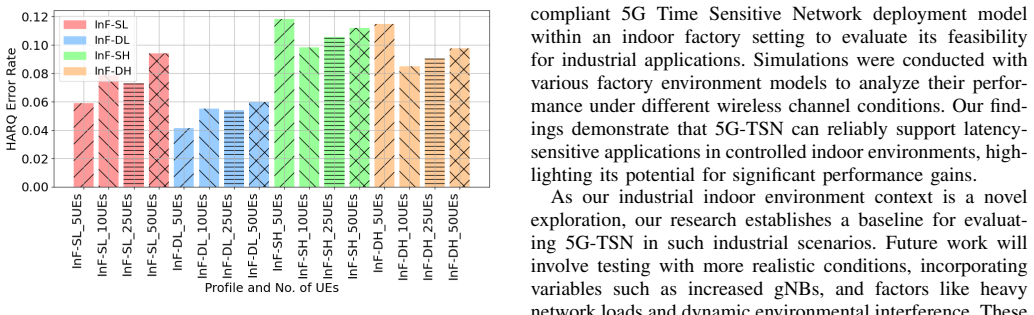
- Dense clutter combined with a high base station (InF-DH) degrades signal quality and increases error rates, making such layouts the hardest for wireless TSN.
- At 50 UEs, video traffic competes with control traffic for radio resources and raises control-packet delay; the paper suggests preemptive scheduling to fix this.
- Uplink and downlink behave similarly, with low base-station placement giving better reliability in both directions.
Reading between the lines
- If confirmed in hardware, the result implies that factory layout planning should prioritize sparse clutter and low antenna mounting to make wireless TSN viable without extra scheduling complexity.
- The study assumes a single base station, so it leaves open how handover between base stations would affect bounded delay in larger factories; a multi-base-station extension would be a natural next test.
- The proposed preemptive scheduling could be evaluated in the same simulation before any physical deployment, offering a low-cost check of the mitigation strategy.
- Because the results are simulation-only, the quantitative latency values should be treated as indicative rather than guaranteed until measured on real equipment.
Signed reviews
Editorial analysis
A structured set of objections, weighed in public.
Referee Report
Summary. The manuscript evaluates the scalability of a simulated 5G-TSN deployment in indoor factory environments. The authors integrate 3GPP TR 38.901 indoor factory (InF) path-loss and LOS probability models into an OMNeT++/Simu5G/5GTQ simulation, with four InF profiles (InF-SL, InF-DL, InF-SH, InF-DH), a single gNB, and 5, 10, 25, or 50 UEs generating three traffic classes (Network Control, Video, Best Effort). Performance is reported as SINR distributions, average end-to-end delay, and HARQ error rates for downlink and uplink. The abstract concludes that 5G-TSN 'has the potential to provide bounded delay for latency-sensitive applications in scalable indoor factory settings.' The paper is framed as, to the authors' knowledge, the first scalability study of 3GPP-standardized 5G-TSN in a wireless manufacturing environment.
Significance. If substantiated, the paper would provide a useful early quantitative baseline for wireless TSN scalability in industrial settings, since it applies standardized InF channel models with a concrete traffic mix and network stack. Its strengths include the use of well-known external frameworks (OMNeT++, Simu5G, 5GTQ) and the explicit reporting of simulation parameters in Table I, which aids reproducibility. However, the actual evidence consists of qualitative trends in average delay and error rates; the central claim of 'bounded delay' is not directly supported by the metrics presented. The contribution is therefore incremental and needs substantial strengthening before the stated conclusions can be accepted.
major comments (4)
- [Abstract and §V] The central claim that 5G-TSN 'has the potential to provide bounded delay' is not supported by the reported evidence. Figures 5 and 6 show only average end-to-end delay, while TSN bounded latency is a worst-case or high-probability upper-bound property, typically expressed against a deadline such as the 5QI delay budget in 3GPP TS 23.501 Table 5.7.4-1. No target latency deadline is specified for the NC traffic stream, and no maximum, 99th percentile, or tail-delay statistic is reported. Adding worst-case/percentile delay against a concrete budget (e.g., the relevant 5QI delay budget) is essential to justify 'bounded delay' in the abstract and conclusion.
- [§IV, Figs. 5–8] No statistical confidence information is provided: the number of simulation runs, random seeds, confidence intervals, or error bars are absent. The HARQ error rates in Figs. 7 and 8 are ratios of failed to total transmissions, but without run-level variance it is impossible to know whether differences between profiles, such as the claimed lower error rate of InF-DL versus InF-SL at higher UE densities, are significant or simply simulation noise. The paper should report run counts and error bars or confidence intervals for the delay and error-rate results.
- [§IV, distance regions and scalability] The manuscript defines three distance regions (d1, d2, d3) and states that delay and HARQ results are analyzed, but Figs. 5–8 appear to use only the d2 constraint (the text says 'a maximum distance (d2) constraint of 170 meters'). The scalability claim across 'indoor factory settings' would require results for d1 and d3, or at least a clear justification for why d2 alone is representative. In addition, the maximum tested density is 50 UEs with a single gNB; this is a limited basis for the strong word 'scalable' in the abstract. Reporting results for the full distance range and more UE counts would make the scalability analysis more convincing.
- [§IV, simulation fidelity] The paper repeatedly describes the simulation as '3GPP compliant' and 'standardised,' but no validation or calibration of the simulator against known 3GPP or field results is provided. Section V itself concedes that 'future efforts could focus on real-world deployment and validation to confirm simulation results.' For a simulation-only study, a sanity check (e.g., comparing simulated path loss or SINR against TR 38.901 reference values, or calibrating the scheduler/HARQ behavior against published 5G results) is needed to support the claim that the model faithfully represents a real 5G-TSN system. Without this, the correctness of the qualitative conclusions rests on the unverified fidelity of the simulator stack.
minor comments (7)
- [Abstract and §IV] The abstract states that 5G offers 'negligible jitter,' but jitter is not measured or reported anywhere in the paper; this claim should be removed or qualified.
- [Throughout] The notation is inconsistent: the text uses 'OMNET++' while the OMNeT++ project uses 'OMNeT++,' and 'iNet' should be 'INET.' Please unify these names.
- [§III, Eqs. (6)–(8)] InF-HH is defined with a LOS probability of 1 in Eq. (8), but InF-HH is not included in the simulations reported in Table I or the figures. The omission should be stated explicitly, or the profile should be included for completeness.
- [Table I] The table lists 'Target Bler 0.01' but the standard abbreviation is 'BLER'; also, the choice of numerology index 4 is not explained in the text, even though numerology directly affects subcarrier spacing and symbol duration and hence latency.
- [§IV, HARQ definition] The HARQ error rate is defined as 'the ratio of failed transmissions to the total number of transmissions,' but it is unclear whether this is per UE, per packet, or aggregated over the whole simulation. Please clarify the denominator and whether retransmissions at different HARQ attempts are counted separately.
- [§V] The concluding statement that '5G-TSN can reliably support latency-sensitive applications' is stronger than the evidence, since no reliability target (e.g., 99.999% or a specific maximum error probability) is stated. The wording should be aligned with the reported metrics.
- [Acknowledgments] The acknowledgment contains a typo: 'Taighde ireann Research Ireland' should be 'Taighde Éireann Research Ireland.'
Circularity Check
No load-bearing circularity: the simulation outputs are not identified with their inputs; the only self-citation is background, and the 'bounded delay' claim is a metric-mismatch, not a circular derivation.
full rationale
The paper's derivation chain is a simulation study: the 3GPP TR 38.901 indoor-factory path-loss and LOS-probability equations, the 5QI QoS mappings from TS 23.501, and the behavior of the OMNeT++/Simu5G/5GTQ stack enter as external inputs, while the end-to-end delays and HARQ error rates are measured outputs. No equation or fitted parameter is shown to reduce to the claimed conclusion that 5G-TSN can provide bounded delay; the result is produced by an external simulator stack, which raises soundness/reproducibility concerns but not circularity. The only self-citation, reference [1], supports the background statement that wireless TSN is a promising solution and is not load-bearing in the derivation. The abstract's 'bounded delay' assertion is not supported by the presented average-delay metric, and no worst-case or percentile bound is stated; this is a correctness/evidence gap rather than a self-definitional or fitted-input reduction. Under the hard rule that circularity requires a quoted equation or fitted parameter that is equivalent to the target result, no such step exists here.
Assumptions & free parameters
free parameters (4)
- Application traffic parameters (NC, Video, BE) =
Table II: NC 498B/55ms; Video 1453B/uniform(60,65)ms; BE 1429B/exponential(600ms)
- Mobility speed range =
0.2-1.5 m/s (Random Waypoint)
- Number of UEs =
5, 10, 25, 50
- Distance regions d1, d2, d3 =
85 m, 170 m, 255 m
assumptions (5)
- domain assumption 3GPP TR 38.901 InF channel model is accurate for indoor factories
- domain assumption Simu5G and 5GTQ correctly implement 3GPP 5G NR and 5G-TSN behavior
- domain assumption Random Waypoint mobility with 0.2-1.5 m/s represents AGV motion
- domain assumption The specified traffic model (NC, Video, BE) captures real industrial application streams
- ad hoc to paper A single gNB topology is adequate to infer scalability
Cite this review
Pith. "Pith review of Scalability Analysis of 5G-TSN Applications in Indoor Factory Settings." pith.science (2026). https://pith.science/paper/JKSATNRV
@misc{pith2026250113138,
  author       = {Pith},
  title        = {Pith review of: Scalability Analysis of 5G-TSN Applications in Indoor Factory Settings},
  year         = {2026},
  howpublished = {\url{https://pith.science/paper/JKSATNRV}},
  note         = {Machine review of arXiv:2501.13138}
}
read the original abstract
While technologies such as Time-Sensitive Networking (TSN) improve deterministic behaviour, real-time functionality, and robustness of Ethernet, future industrial networks aim to be increasingly wireless. While wireless networks facilitate mobility, reduce cost, and simplify deployment, they do not always provide stringent latency constraints and highly dependable data transmission as required by many manufacturing systems. The advent of 5G, with its Ultra-Reliable Low-Latency Communication (URLLC) capabilities, offers potential for wireless industrial networks. 5G offers elevated data throughput, very low latency, and negligible jitter. As 5G networks typically include wired connections from the base station to the core network, integration of 5G with time-sensitive networking is essential to provide rigorous QoS standards. This paper assesses the scalability of 5G-TSN for various indoor factory applications and conditions using OMNET++ simulation. Our research shows that 5G-TSN has the potential to provide bounded delay for latency-sensitive applications in scalable indoor factory settings.
Figures


Figures from the paper (3 more)


Reference graph
Works this paper leans on
-
[1]
K. Zanbouri, M. Noor-A-Rahim, J. John, C. J. Sreenan, H. V . Poor, and D. Pesch, “A comprehensive survey of wireless time-sensitive networking (TSN): Architecture, technologies, applications, and open issues,” IEEE Communications Surveys & Tutorials , pp. 1–1, 2024
work page 2024
-
[2]
Performance of integrated 3GPP 5G and IEEE TSN networks,
P. M. Rost and T. Kolding, “Performance of integrated 3GPP 5G and IEEE TSN networks,” IEEE Communications Standards Magazine , vol. 6, no. 2, pp. 51–56, 2022
work page 2022
-
[3]
Study on channel model for frequencies from 0.5 to 100 GHz,
3rd Generation Partnership Project (3GPP), “Study on channel model for frequencies from 0.5 to 100 GHz,” 3GPP, Tech. Rep. TR 38.901, 2022, Version 17.0.0. [On- line]. Available: https://portal.3gpp.org/desktopmodules/Specifications/ SpecificationDetails.aspx?specificationId=3173
work page 2022
-
[4]
E. A. Oyekanlu, A. C. Smith, W. P. Thomas, G. Mulroy, D. Hitesh, M. Ramsey, D. J. Kuhn, J. D. Mcghinnis, S. C. Buonavita, N. A. Looper, M. Ng, A. Ngoma, W. Liu, P. G. Mcbride, M. G. Shultz, C. Cerasi, and D. Sun, “A review of recent advances in automated guided vehicle technologies: Integration challenges and research areas for 5G-Based smart manufacturin...
work page 2020
-
[5]
An overview of the OMNeT++ simulation environment,
A. Varga and R. Hornig, “An overview of the OMNeT++ simulation environment,” in Proceedings of the 1st International ICST Conference on Simulation Tools and Techniques for Communications, Networks and Systems. ICST, 5 2010
work page 2010
-
[6]
L. M ´esz´aros, A. Varga, and M. Kirsche, INET Framework . Cham: Springer International Publishing, 2019, pp. 55–106. [Online]. Available: https://doi.org/10.1007/978-3-030-12842-5 2
-
[7]
Simu5G: Simulator for 5G new radio networks,
Simu5G, “Simu5G: Simulator for 5G new radio networks,” accessed on 2024-08-23. [Online]. Available: https://simu5g.org/
work page 2024
-
[8]
5GTQ: QoS- Aware 5G-TSN simulation framework,
R. Debnath, M. S. Akinci, D. Ajith, and S. Steinhorst, “5GTQ: QoS- Aware 5G-TSN simulation framework,” inProceedings of the 2023 IEEE 98th V ehicular Technology Conference (VTC2023-Fall), 2023, pp. 1–7
work page 2023
Show all 9 references
-
[9]
Technical Specification Group Services and System Aspects; System Architecture for the 5G System (3GPP TS 23.501 version 18.7.0 Release 18),
3GPP, “Technical Specification Group Services and System Aspects; System Architecture for the 5G System (3GPP TS 23.501 version 18.7.0 Release 18),” https://www.etsi.org/deliver/etsi ts/123500 123599/ 123501/18.07.00 60/ts 123501v180700p.pdf, 2024
2024
Reviewed August 10, 2026 · model on record in the stance chip above.
Discussion (0). Continue with ORCID to comment.