pith. machine review for the scientific record. sign in

cs.NI

Networking and Internet Architecture

Covers all aspects of computer communication networks, including network architecture and design, network protocols, and internetwork standards (like TCP/IP). Also includes topics, such as web caching, that are directly relevant to Internet architecture and performance. Roughly includes all of ACM Subject Class C.2 except C.2.4, which is more likely to have Distributed, Parallel, and Cluster Computing as the primary subject area.

0
cs.NI 2026-05-13 2 theorems

Processing energy dominates RAN consumption

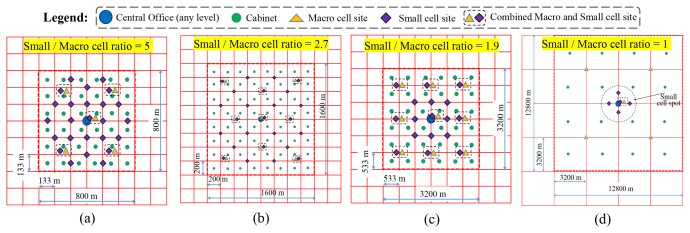
Energy Consumption in Next Generation Radio Access Networks

Baseband processing location strongly affects efficiency in next-generation mobile networks.
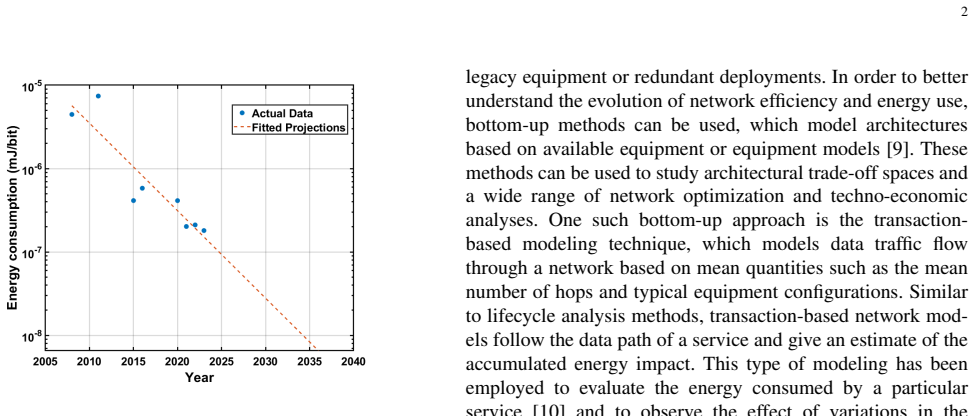
Figure from the paper full image
abstract click to expand
The radio access network (RAN) accounts for the largest share of energy consumption in mobile networks, making it essential to understand how and where this energy is used, particularly as future networks move toward higher levels of densification. Open radio access networks (O-RAN) have emerged as a promising approach to support this evolution through open interfaces that enable a multivendor environment, support for hierarchical intelligent controls, and simplified, cost-effective radio units that facilitate large-scale deployments. This paper examines the energy consumption in next-generation RAN architectures through transaction-based energy models. The model captures both processing and transmission energy components and evaluates how energy use varies with the placement of baseband processing (BBP) across network nodes and with different levels of network densification. Results indicate that processing energy dominates total consumption and that the location of BBP strongly influences overall energy efficiency. These insights can inform the design of future RAN deployments that balance flexibility, cost, and sustainability.
0
0
cs.NI 2026-05-13 Recognition

Buffering in destination switches cuts cross-DC LLM training delays by 14%

Avoiding Cross-Datacenter Collective Congestion via Disaggregated Buffering

Spillway stores packets lost during collisions at the receiving datacenter and drains them after congestion clears, requiring no host orζ‘†ζžΆζ‘†ζžΆ

Figure from the paper full image
abstract click to expand
LLM training at the scale of tens of thousands of GPUs now spans multiple datacenters (DC), making cross-DC collectives over long-haul links unavoidable. A critical and overlooked bottleneck arises when these collectives collide with intra-DC traffic at the destination - a common pattern in real workloads. The multi-millisecond congestion control loop is too slow to react, triggering severe packet loss and congestion collapse. We present Spillway, a transparent in-network mechanism that buffers dropped packets in switch-disaggregated buffers in a destination data center and drains them once congestion subsides. Through large-scale end-to-end simulations and a hardware prototype, we show that Spillway eliminates performance degradation from collective collisions, reducing iteration time by up to 14 %, without changes to end hosts or training frameworks.
0
0
cs.NI 2026-05-13 Recognition

LLMs should orchestrate 6G networks as central agents

Agents Should Replace Narrow Predictive AI as the Orchestrator in 6G AI-RAN

Position paper argues that replacing narrow predictive models with large language models in the RAN controller can close the intent gap and

Figure from the paper full image
abstract click to expand
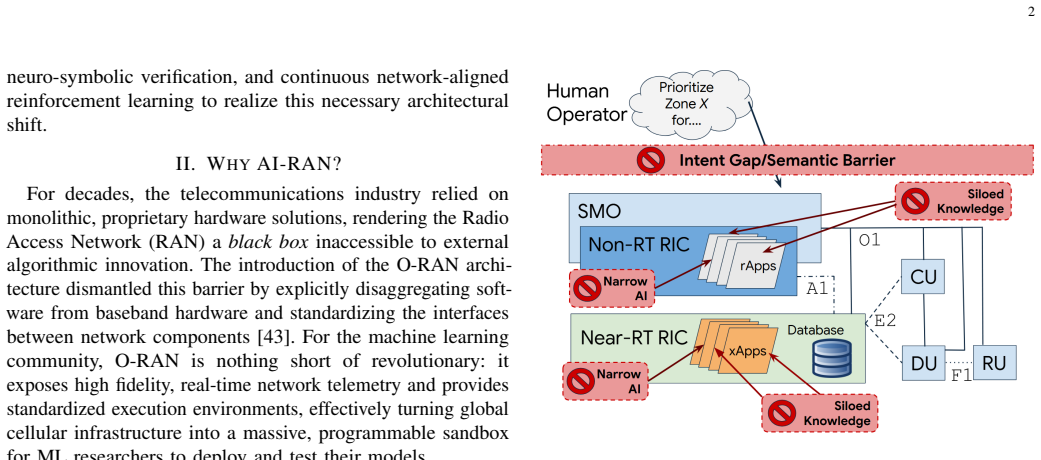
This position paper argues that to achieve Level 5 autonomous 6G networks, the next generation of Artificial Intelligence in Radio Access Networks (AI-RAN) should transition away from fragmented, narrow predictive models and instead adopt multimodal Large Language Models (LLMs) as central reasoning agents. Current AI-RAN architectures rely on disjointed Deep Neural Networks (DNNs) and Deep Reinforcement Learning (DRL) agents that operate in isolated domains. These narrow models suffer from siloed knowledge, severe brittleness to out-of-distribution dynamics, and a fundamental inability to bridge the intent gap the semantic disconnect between high-level, unstructured operator directives and rigid numerical network configurations. We propose elevating LLMs, or domain-adapted Large Telecom Models (LTMs), to act as the cognitive operating system situated within the RAN Intelligent Controller (RIC), the control and orchestration layer of AI-RAN. In this architecture, LLMs do not replace narrow models but orchestrate them as executable subroutines, dynamically translating human intent into concrete policies and utilizing Retrieval-Augmented Generation (RAG) to autonomously diagnose complex, multi-vendor network anomalies. To make this architectural shift a reality, we call upon the machine learning community to prioritize critical foundational research tailored to the strict constraints of telecommunications, specifically focusing on continuous alignment via network-driven feedback (RLNF), extreme sub-8-bit edge quantization, neuro-symbolic verification to curb hallucinations, and securing orchestration frameworks against adversarial prompt injections.
0
0
cs.NI 2026-05-12 Recognition

Transformers forecast spectrum activity with 3.25 dB RMSE across 33 bands

Large Spectrum Models (LSMs): Decoder-Only Transformer-Powered Spectrum Activity Forecasting via Tokenized RF Data

Custom tokenization of 22 TB of raw RF data lets decoder-only models generalize to new locations for dynamic spectrum access.

Figure from the paper full image
abstract click to expand
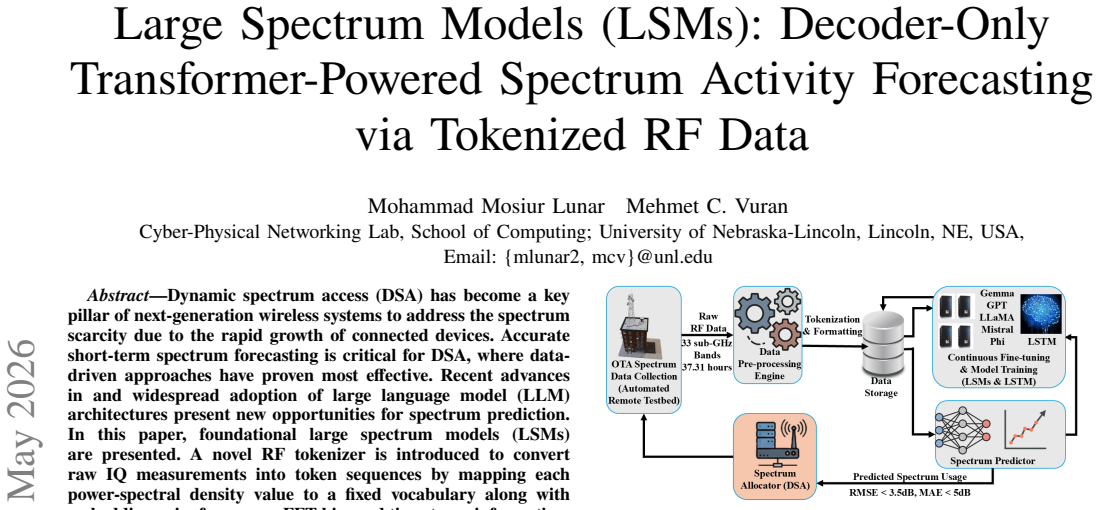
Dynamic spectrum access (DSA) has become a key pillar of next-generation wireless systems to address the spectrum scarcity due to the rapid growth of connected devices. Accurate short-term spectrum forecasting is critical for DSA, where data-driven approaches have proven most effective. Recent advances in and widespread adoption of large language model (LLM) architectures present new opportunities for spectrum prediction. In this paper, foundational large spectrum models (LSMs) are presented. A novel RF tokenizer is introduced to convert raw IQ measurements into token sequences by mapping each power-spectral density value to a fixed vocabulary along with embedding gain, frequency, FFT bin, and timestamp information. Five established open-source LLM architectures (Gemma-2B, GPT-2, LLaMA-7B, Mistral-7B, and Phi-1) are trained on this tokenized spectrum data for the task of spectrum forecasting, yielding LSMs. To leverage the scaling gains of LSMs, a fully automated outdoor wireless testbed is employed to collect over 22 TB of raw spectrum data across 33 sub-GHz frequency bands, yielding 8.4B tokens in total. Across all 33 bands, the best model (LSM-Mistral) achieves a root-mean-square error of 3.25 dB and 97% of predictions have a mean absolute error below 5 dB. Generalization of LSMs is illustrated by fine-tuning the models on data collected in different locations, where RMSE is maintained below 3.7 dB. These results demonstrate that widespread decoder-only transformer architectures can serve as effective predictive models for large-scale RF spectrum forecasting.
0
0
cs.NI 2026-05-12 2 theorems

Platforms let anyone measure mobile network security

Democratizing Measurement of Critical Mobile Infrastructure: Security and Privacy in an Increasingly Centralized Communication Ecosystem

Without needing operator permission, new open tools enable reproducible experiments on cellular networks and messaging apps to check for隐私r

Figure from the paper full image
abstract click to expand
Cellular networks serve as the backbone of global communication, providing critical access to telephony and the Internet, often in regions lacking alternatives. However, the growing complexity of these networks, driven by architectural innovations (e.g., Voice over IP, eSIMs) and commercial dynamics (e.g., roaming, virtual operators, zero-rating), remains poorly understood due to the lack of open, scalable, and geographically diverse measurement tools and independent measurement studies. Moreover, access to mobile networks today is no longer limited to the traditional radio interface. Technologies like Voice-over-WiFi (VoWiFi) offer alternative connectivity paths via third-party Internet infrastructure, extending operator reach into environments with limited cellular coverage. At the same time, over-the-top (OTT) messaging services such as WhatsApp and Signal have become central to modern communication, accounting for a substantial share of global messaging and voice traffic while bypassing traditional operator-controlled channels entirely. This dissertation addresses these challenges by introducing new approaches for independent, scalable, and reproducible measurements of mobile communication systems without requiring cooperation from network or platform operators. We design, implement, and open-source measurement platforms that enable controlled experiments across cellular radio networks, operator-provided services, and OTT messaging applications.
0
0
cs.NI 2026-05-12 2 theorems

Symbolic rules recover 78-87% of DRL performance in O-RAN

Demystifying Deep Reinforcement Learning: A Neuro-Symbolic Framework for Interpretable Open RAN Automation

DeRAN abstracts telemetry into semantic concepts then builds readable policies for slicing and mobility on a live 5G testbed.

Figure from the paper full image
abstract click to expand
Open Radio Access Networks (O-RAN) are increasingly adopting data-driven control through Deep Reinforcement Learning (DRL) to optimize complex tasks such as network slicing and mobility management. However, the deployment of DRL in carrier-grade networks is hindered by its inherent opacity and stochastic execution, which limit operator trust, auditability, and safe deployment. Existing explainable AI (XAI) approaches primarily provide post-hoc insights and fail to produce executable, interpretable policies suitable for operational environments. In this paper, we present DeRAN, a neuro-symbolic framework that bridges the gap between DRL performance and operational transparency by distilling black-box DRL policies into human-readable symbolic representations. DeRAN introduces a concept-driven abstraction layer that transforms high-dimensional network telemetry into a compact set of semantically meaningful features, enabling interpretable policy learning. Building on the semantically grounded concepts, DeRAN synthesizes symbolic policies using deep symbolic regression (DSR) for continuous control and neurally guided differentiable logic (NUDGE) for discrete decision-making. We implement DeRAN on a live 5G O-RAN testbed and evaluate it on two representative use cases. Experimental results demonstrate that DeRAN achieves 78% and 87% of DRL's cumulative rewards in the two use cases, while offering interpretability and auditability by design. Source code is available at https://github.com/Jadejavu/DeRAN
0
0
cs.NI 2026-05-12 2 theorems

Symbolic rules replace black-box DRL in Open RAN at 78-87% performance

Demystifying Deep Reinforcement Learning: A Neuro-Symbolic Framework for Interpretable Open RAN Automation

DeRAN extracts human-readable policies from reinforcement learning for network slicing and mobility management while preserving most rewards

Figure from the paper full image
abstract click to expand
Open Radio Access Networks (O-RAN) are increasingly adopting data-driven control through Deep Reinforcement Learning (DRL) to optimize complex tasks such as network slicing and mobility management. However, the deployment of DRL in carrier-grade networks is hindered by its inherent opacity and stochastic execution, which limit operator trust, auditability, and safe deployment. Existing explainable AI (XAI) approaches primarily provide post-hoc insights and fail to produce executable, interpretable policies suitable for operational environments. In this paper, we present DeRAN, a neuro-symbolic framework that bridges the gap between DRL performance and operational transparency by distilling black-box DRL policies into human-readable symbolic representations. DeRAN introduces a concept-driven abstraction layer that transforms high-dimensional network telemetry into a compact set of semantically meaningful features, enabling interpretable policy learning. Building on the semantically grounded concepts, DeRAN synthesizes symbolic policies using deep symbolic regression (DSR) for continuous control and neurally guided differentiable logic (NUDGE) for discrete decision-making. We implement DeRAN on a live 5G O-RAN testbed and evaluate it on two representative use cases. Experimental results demonstrate that DeRAN achieves 78% and 87% of DRL's cumulative rewards in the two use cases, while offering interpretability and auditability by design. Source code is available at https://github.com/Jadejavu/DeRAN
0
0
cs.NI 2026-05-12 2 theorems

Attention fuses LEO measurements for spectrum cartography

Learning-Based Spectrum Cartography in Low Earth Orbit Satellite Networks: An Overview

Review shows attention-based learning adapts to orbital dynamics and data reliability for localization, mapping, and allocation.

Figure from the paper full image
abstract click to expand
Low earth orbit (LEO) satellite networks are emerging as a key infrastructure for global connectivity and space-based sensing. Many tasks in such systems can be formulated as measurement-set-to-spatial-inference problems, where spatial variables are inferred from sparse and heterogeneous wireless observations. Spectrum cartography provides a unifying framework for this paradigm, encompassing representative tasks such as satellite-assisted localization and radio map reconstruction, as well as map-informed resource allocation. Yet the highly dynamic orbital geometry, complex propagation conditions, and reliability-varying nature of LEO measurements pose fundamental challenges for traditional model-driven and interpolation-based methods. This article surveys the literature from 1964 to 2026 on learning-based spectrum cartography as applied to LEO satellite networks, with a particular focus on attention mechanisms as a principled operator for adaptive and reliability-aware measurement fusion across localization, radio map reconstruction, and resource allocation tasks. We review modeling foundations and key challenges of representative tasks, and analyze how attention-based learning enables flexible fusion of heterogeneous measurements for both inference and map-informed decision-making. Representative formulations and simulation studies are provided to illustrate the framework and demonstrate its effectiveness, offering a unified perspective for measurement-driven inference and decision-making in LEO satellite networks.
0
0
cs.NI 2026-05-12 2 theorems

50% less energy for satellite edge computing at 95% latency compliance

Statistical Analysis for Energy-Efficient Satellite Edge Computing with Latency Guarantees

Parametric models of execution and communication delays let operators pick GPU speeds that hit deadlines reliably without wasting power.

Figure from the paper full image
abstract click to expand
Being able to provide latency guarantees for orbital edge computing applications through Low Earth Orbit (LEO) satellite constellations is a major milestone for their integration into 5G and 6G networks. However, achieving this is fundamentally challenged by the inherent randomness in both communication and computing latency, driven by complex network dynamics, satellite motion, and hardware variability. In this paper, we perform a statistical analysis of the latency of satellite edge computing using representative computing hardware and an object detection algorithm running on a satellite image dataset. The resulting model captures the trade-off between data availability and estimation uncertainty, enabling data-driven optimization methods to meet latency targets with statistical guarantees while minimizing energy consumption. Our results show that parametric estimation and quantile regression for the execution time of the image processing algorithms can be effectively combined with models for the communication latency to select an optimal GPU clock frequency. This achieves a 95% probability of meeting a $500$ ms end-to-end deadline while reducing energy consumption by more than 50% compared to a baseline that relies on a Chebyshev-Cantelli inequality to bound execution-time quantiles. The proposed framework is generalizable across satellite edge computing workloads and hardware platforms.
0
0
cs.NI 2026-05-12 2 theorems

Field tests show DRL MAC achieves high-throughput fair underwater access

Is DRL-based MAC Ready for Underwater Acoustic Networks? Exploring Its Practicality in Real Field Experiments

By handling observation losses and balancing rewards, EA-MAC sets node schedules without extra information exchange.

Figure from the paper full image
abstract click to expand
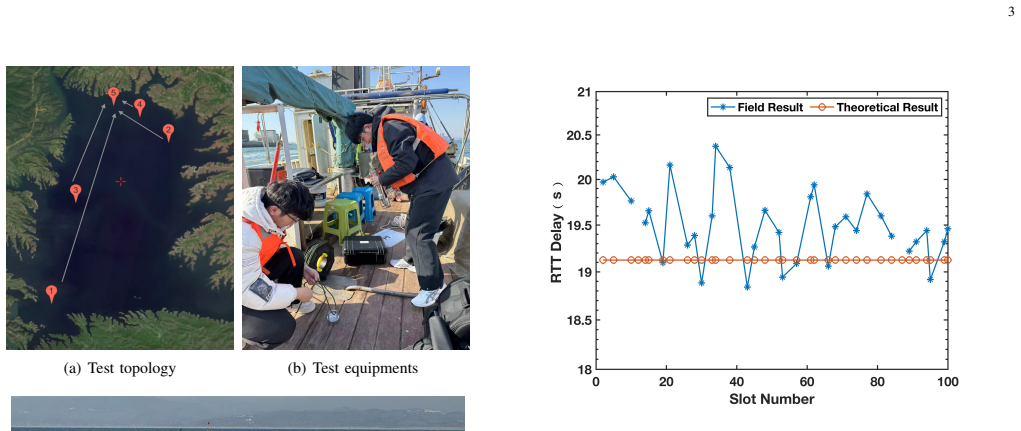
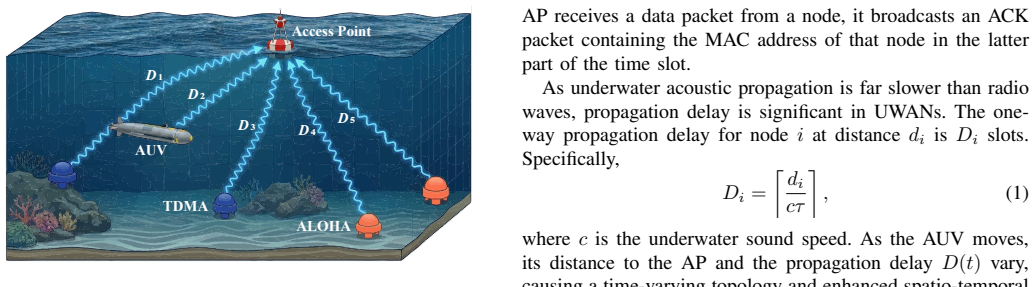
Medium Access Control (MAC) protocols rely on neighbor and environment information to design collision-free access rules for Underwater Acoustic Networks (UANs). Acquiring this information suffers from high communication overhead due to the unique underwater acoustic channel characteristics, such as long propagation delay, spatiotemporal variations in communication quality, and high attenuation. Deep Reinforcement Learning (DRL) is promising to circumvent the UANs' physical constraints and provide a low-overhead solution for underwater MAC protocols, since it can decide access rules based on real-time observation without extra information exchange. However, the unique underwater acoustic channel characteristics impose significant challenges on observation acquisition, training time, and the balance of multiple reward factors for DRL-based MAC protocols. Most existing methods remain at the theoretical level: (1) they design partial intelligent agents failing to achieve fully autonomous access; (2) they assume unreasonable simulation scenarios, weakening the effects of underwater acoustic channel characteristics on MAC protocols. To enhance the practicality of DRL-based MAC protocols, we first analyze the application challenges of DRL in UANs through real field experiments. Based on the above challenges, we propose a DRL-based MAC protocol that considers observation loss and balances multiple reward factors to achieve efficient Entire Autonomous access in the UAN (EA-MAC). To further explore the feasibility of DRL-based MAC protocols, we implement EA-MAC and other state-of-the-art protocols on underwater acoustic modems and evaluate their performance in real field experiments. Experimental results demonstrate that EA-MAC can adaptively determine the scheduling sequence for each node, enabling high-throughput and fair communication in a straightforward manner for UANs.
0
0
cs.NI 2026-05-12 Recognition

Adaptive offloading lifts LLM throughput 65% at 47% lower energy

GELATO: Generative Entropy- and Lyapunov-based Adaptive Token Offloading for Device-Edge Speculative LLM Inference

Drift-plus-penalty budgeting and entropy early exits balance speed and power in device-edge speculative decoding.

Figure from the paper full image
abstract click to expand
The recent growth of on-device Large Language Model (LLM) inference has driven significant interest in device-edge collaborative LLM inference. As a promising architecture, Speculative Decoding (SD) is increasingly adopted where a lightweight draft model rapidly generates candidate tokens to be verified by a powerful target model. However, a fundamental challenge lies in achieving per-token resource scheduling to effectively adapt SD paradigm to resource-constrained edge environment. This paper proposes a Generative Entropy- and Lyapunov-based Adaptive Token Offloading framework, named GELATO, to maximize decoding throughput under energy constraints in a device-edge collaborative SD system. Specifically, an outer drift-plus-penalty loop makes online decisions to establish a reference drafting budget, managing long-term energy-throughput trade-off. Further, a nested entropy-driven generation mechanism executes early exiting to adapt to per-token dynamic generative uncertainty. Theoretical analysis establishes a rigorous performance bound on long-term throughput for GELATO. Extensive evaluations demonstrate that GELATO achieves a globally optimal tradeoff, outperforming state-of-the-art distributed SD architectures by 64.98% in token throughput and reducing energy consumption by 47.47% under resource-constrained environments, while preserving LLM decoding quality.
0
0
cs.NI 2026-05-12 2 theorems

RL policy hits 95 percent qualified frames over LEO links

Learning to Compress and Transmit: Adaptive Rate Control for Semantic Communications over LEO Satellite-to-Ground Links

Adaptive JSCC compression uses SNR forecasts to meet quality targets inside short satellite visibility windows with zero packet loss.

Figure from the paper full image
abstract click to expand
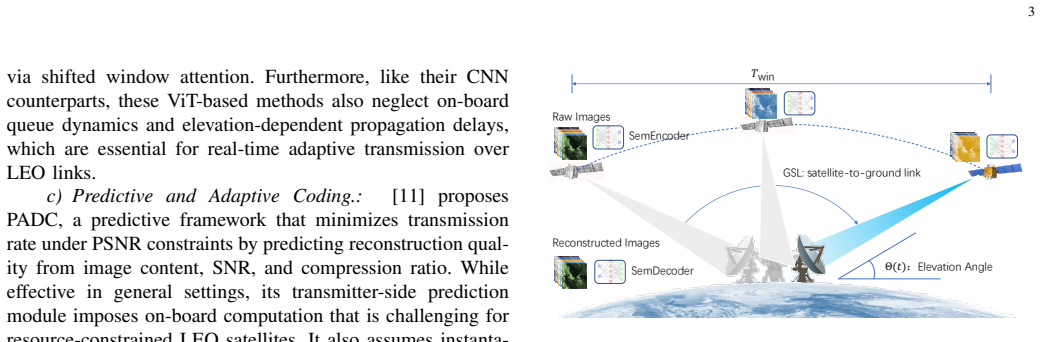
The bottleneck of satellite-to-ground links poses a major challenge for the timely downlink of massive on-board imagery. This paper studies adaptive image transmission over LEO satellite-to-ground links using joint source-channel coding (JSCC). We propose an RL-based framework that dynamically selects the channel dimension (compression ratio) of a SwinJSCC encoder to maximize the number of received satisfying reconstruction-quality constraints (PSNR and MS-SSIM) within a finite visibility window. The agent leverages SNR prediction to perform proactive rate adaptation and incorporates an on-board transmission-queue model that captures bursty encoding while penalizing both buffer overflow and underutilization. Simulations under realistic overpass conditions show that the proposed policy substantially outperforms fixed-rate baselines, achieving nearly 95% qualified frames with zero packet loss.
0
0
cs.NI 2026-05-12 2 theorems

Packet metadata switches resident BNN models in 0.005 us

In-Network Artificial Computing Enhanced Light Model-Switching for Emergency Communications Networks

Emergency networks sustain 1.894 Mpps at 0.528 us inference latency on commodity hardware.

Figure from the paper full image
abstract click to expand
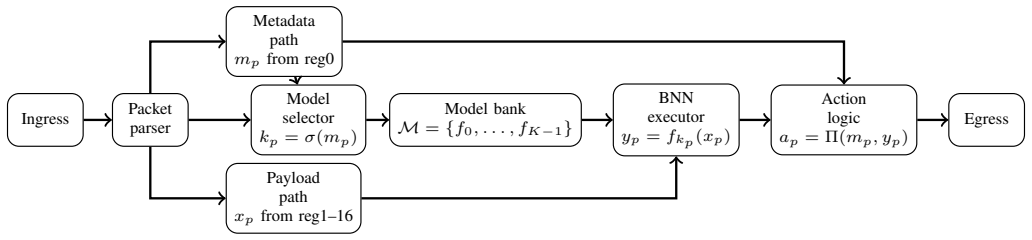
Emergency communications networks require in-network intelligence for timely traffic handling under dynamic demands and runtime constraints. In these environments, packets may need different inference behaviors, and conventional model replacement via control-plane updates is too slow for responsive operation. We propose an in-network artificial computing framework with lightweight model-switching, where multiple Binary Neural Network (BNN) models are kept resident within a shared execution framework. Packet metadata selects the active model at packet granularity with O(1) selection cost. A fixed 1024-byte payload is aligned with x86 AVX-512, enabling efficient memory access. The framework is realized on an eBPF/XDP + AF_XDP stack. Experimental results show that the system sustains 1.894 Mpps with a 0.528 us inference latency, while model selection adds only 0.005 us. Our results demonstrate that different resident models induce distinct packet-processing behaviors, that scaling to 16 slots preserves low switching overhead, and that online model switching completes without wrong-verdict packets. These results show the practicality of lightweight in-network artificial computing on commodity hardware.
0
0
cs.NI 2026-05-12 Recognition

Simulator models edge computing on optical networks

GenioSim: A Novel Simulation Platform for Edge Computing over Optical Networks

GenioSim captures realistic PON behavior in OLTs and ONTs with hybrid virtualization to test policies for capacity planning and offloading.

Figure from the paper full image
abstract click to expand
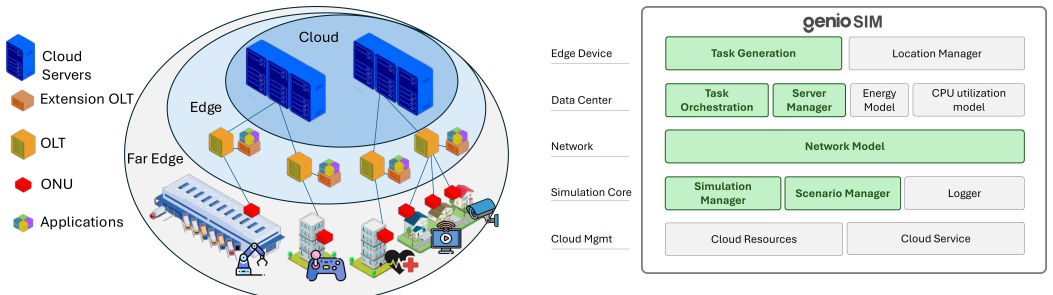
The convergence of Passive Optical Networks (PONs) and edge computing creates new opportunities: Optical Line Terminals (OLTs) and Optical Network Terminals (ONTs) can be repurposed as low-latency edge compute nodes for offloading workloads. However, exploring such design options early in the development cycle is costly and time-consuming, as prototyping requires specialized hardware and realistic traffic conditions. Simulation becomes essential, yet current tools are unable to accurately model this emerging class of systems. To address these gaps, we introduce GenioSim, a simulation platform for hierarchical PON-enabled edge infrastructures. It models OLTs and ONTs with realistic PON behavior, supports hybrid container- and VM-based virtualization, and provides multiple service and execution models. These capabilities enable the evaluation of resource management policies under complex, heterogeneous conditions. We present experiments in the context of use cases of industrial relevance, to show GenioSim can provide insights for capacity planning and for the choice of policies for container placement and task offloading in PON-enabled edge infrastructures.
0
0
cs.NI 2026-05-12 Recognition

Memory mapping bridges cognitive gap in 6G AI networks

Bridging the Cognitive Gap: A Unified Memory Paradigm for 6G Agentic AI-RAN

Biological hierarchies placed on computing fabrics let agents share states across time scales without compression losses.

Figure from the paper full image
abstract click to expand
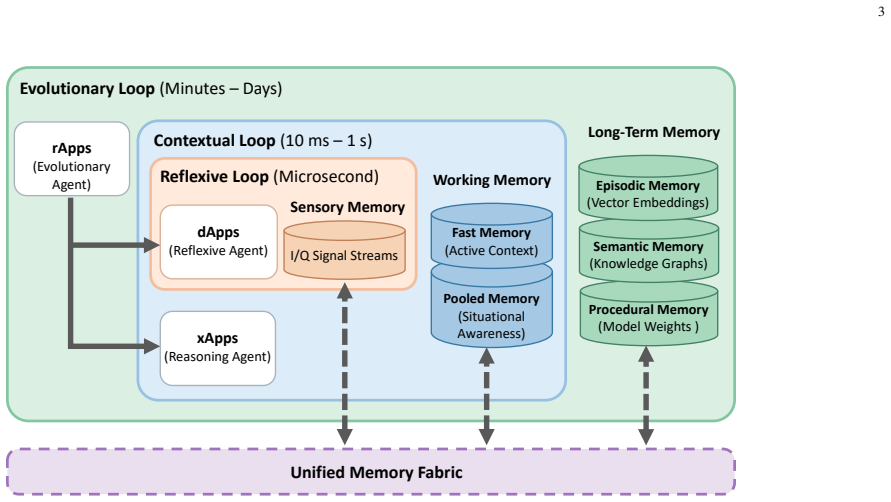
As 6G evolves, the radio access network must transcend traditional automation to embrace agentic AI capable of perception, reasoning, and evolution. A fundamental cognitive gap persists in current disaggregated architectures, where interfaces force the physical layer to compress high-dimensional states into low-dimensional metrics, trapping reasoning agents behind a semantic bottleneck. This article envisions a shift from interface-bound to memory-centric architectures. We propose a unified memory paradigm that dissolves the boundaries between sensing and reasoning by mapping biological memory hierarchies onto heterogeneous computing fabrics. Enabled by emerging coherent interconnects, this approach creates a cognitive continuum where microsecond-level reflexes, millisecond-level reasoning, and long-term evolution share state across time scales. By replacing message passing with zero-copy observability, we empower AI agents to bridge the gap between real-time responsiveness and long-horizon context for truly autonomous 6G networks.
0
0
cs.NI 2026-05-12 1 theorem

CloudEmu replays real traces for repeatable vehicle video tests

CloudEmu: A Trace-Driven Cloud-Native Emulation Testbed for Vehicle Video Uplink over Cellular Networks

Virtual nodes tie cellular dynamics to route positions so uplink stacks can be validated without repeated road trials.

Figure from the paper full image
abstract click to expand
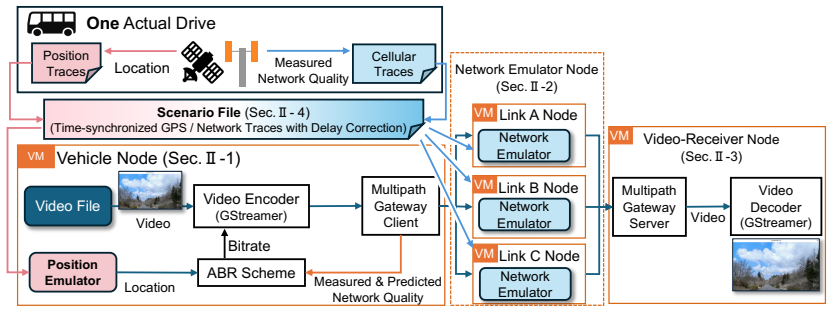
We present CloudEmu, a trace-driven, cloud-native cellular-emulation testbed for vehicle video uplink communication. Reliable, low-latency video uplink over cellular networks is essential for remote monitoring of autonomous vehicles. However, existing testbeds fall into two extremes. Physical-vehicle platforms provide realism but are costly and make validation under identical network conditions difficult, whereas simulations are inexpensive and reproducible but generally cannot replay field-measured end-to-end performance dynamics without substantial calibration or readily run production video-uplink stacks. A software-defined, cloud-native emulation approach can combine the fidelity of trace-driven replay with the agility and scalability that network softwarization principles offer. To this end, we propose CloudEmu that replays time-synchronized cellular and position traces, collected once from vehicles, on commodity Linux-based virtual vehicle and video-receiver nodes. A Linux-based emulation framework couples traffic replay with position replay, tying network dynamics to each point along the route and enabling repeatable, route-aware experiments without repeated on-road trials. Our demo deploys a production-grade video-uplink stack on CloudEmu, allowing attendees to experience low-cost, repeatable trials and controlled comparisons under identical replayed network conditions.
0
0
cs.NI 2026-05-12 Recognition

TSN scheduler packs matching flows to accept 8 percent more traffic

Mixed-Criticality Flow Scheduling with Low Delay and Limited Bandwidth in TSN

Aggregating frames with same endpoints and harmonic periods then splitting non-critical ones cuts bandwidth use by 12 percent while raising

Figure from the paper full image
abstract click to expand
Time-Sensitive Networking (TSN) is a promising Ethernet protocol with time determinism, widely used in time-critical systems such as industrial automation, automotive networks, and avionics. By allocating dedicated time windows for time-sensitive flows, TSN enables deterministic transmission; however, as network traffic grows, multiple flows may contend for the same window, causing large delays. Frame aggregation can mitigate this by combining multiple small frames into a larger one, thereby reducing the number of frames and required time windows, but existing approaches typically handle only single-priority traffic and cannot fully utilize pre-allocated time windows. To address this limitation, we propose MCFS-2L, a mixed-criticality flow scheduling scheme with low delay and limited bandwidth usage. MCFS-2L first aggregates critical and non-critical frames with the same source and destination nodes and harmonic periods into a single frame, and then applies a dynamic reassembly and scheduling method that selectively disaggregates non-critical frames from unschedulable aggregated frames. Experimental results show that MCFS-2L increases the acceptance ratio of critical and non-critical flows by up to 4.78% and 8.58%, respectively, while reducing bandwidth utilization by up to 11.88%.
0
0
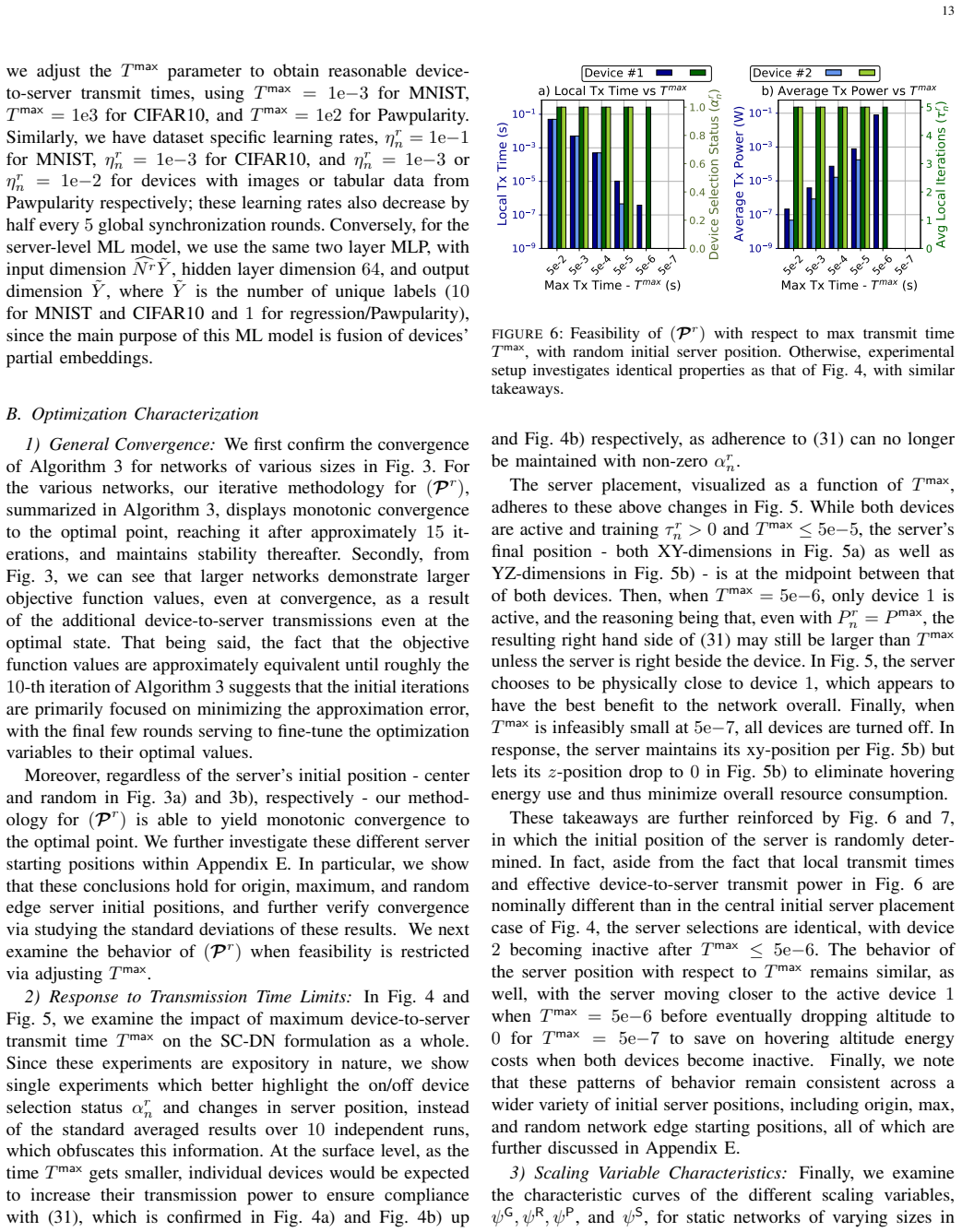
cs.NI 2026-05-11 2 theorems

Method optimizes server placement for vertical federated learning in dynamic networks

Optimizing Server Placement for Vertical Federated Learning in Dynamic Edge/Fog Networks

Proving a stationary point exists each round enables joint tuning of placement, power, frequency and iterations, improving accuracy with cut

Figure from the paper full image
abstract click to expand
We investigate the control and optimization of vertical federated learning (VFL), a class of distributed machine learning (ML) methods in which edge/fog devices contain separate data features, in dynamic edge/fog networks. Owing to heterogeneous data features and hardware across edge/fog networks, devices' contributions to VFL vary substantially, and, moreover, dynamic edge/fog networks can lead to the permanent exit or entry of select data features. In this setting, our proposed methodology, server controlled VFL in dynamic networks (SC-DN), first establishes the existence of a global first-order stationary point for every global round, and then leverages this result to jointly optimize ML model training and resource consumption based on four key control variables: (i) server placement, (ii) device-to-server transmit power, (iii) local device processor frequency, and (iv) local training iterations per global round. The resulting optimization formulation contains coupled variables as well as numerous forms of logarithmic constraints which we show is a mixed-integer signomial program, an NP-hard problem, and for which we develop a general solver. Finally, via experiments on both image and multi-modal datasets, we show that our methodology demonstrates superior classification/regression performance and resource consumption savings than even greedy methodologies.
0
0
cs.NI 2026-05-11 2 theorems

LLMs pass TSN quizzes yet miscalculate delays by 36-100 percent

TSNBench: Benchmarking LLM Proficiency in Time-Sensitive Networking

New benchmark shows multiple-choice scores hide large errors in worst-case delay tasks for safety-critical networks

Figure from the paper full image
abstract click to expand
We present TSNBench, the first benchmark for evaluating large language model (LLM) proficiency in Time-Sensitive Networking (TSN), a suite of IEEE 802.1 standards for deterministic communication with bounded latency in safety-critical domains such as autonomous vehicles, aviation, defense, and industrial automation. While LLMs have been extensively evaluated on general knowledge tasks, their capabilities in safety-critical networking domains remain largely unexplored. TSNBench comprises 939 expert-validated multiple-choice questions (MCQs) covering diverse TSN mechanisms, along with 100 open-ended Worst-Case Delay (WCD) computation tasks for Credit-Based Shaper (CBS) and Cyclic Queuing and Forwarding (CQF) across varying network topologies and traffic conditions. MCQ answers are validated by domain experts, and open-ended ground truth WCD values are computed using a verified Network Calculus (NC) solver for CBS and closed-form mathematical upper bounds for CQF. We evaluate 16 LLMs and find that although models achieve 67 to 95% accuracy on MCQs, they fail substantially on open-ended WCD computation. For CBS, only GPT-5 achieves a Mean Absolute Percentage Error (MAPE) of 36.2%, meaning its predicted WCD deviates by 36.2% of the actual TSN flow delay on average, while most models exceed 80%. For CQF, the best model achieves 41.8% MAPE, with most models clustering between 80% and 100%. Such errors are large relative to TSN latency budgets and can lead to violations of real-time constraints and unsafe configurations. TSNBench demonstrates that MCQ benchmarks may overestimate LLM capabilities in safety-critical networking domains.
0
0
cs.NI 2026-05-11 2 theorems

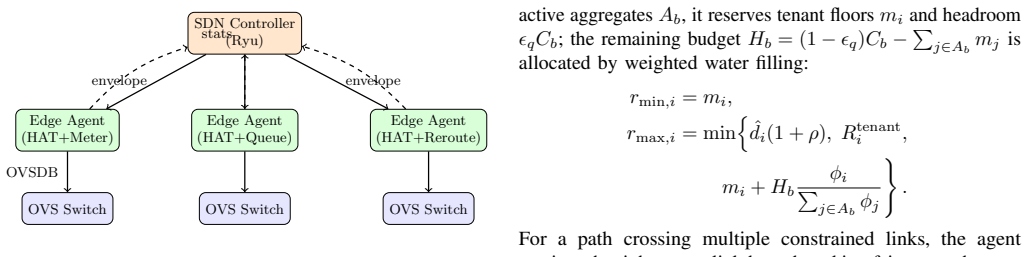
Policy envelopes let local agents adapt SDN traffic safely

PolicyCache-SDN: Hierarchical Intra-Path Learning for Adaptive SDN Traffic Control

Central compilation of bounds enables online learning that raises link use 35% and cuts violations to under 7%

Figure from the paper full image
abstract click to expand
Software defined networks offer global visibility, yet centralized control loops are too slow for transient congestion and bursty traffic dynamics. Existing learned traffic control schemes often rely on offline training, making them fragile under distribution shifts. We present PolicyCache-SDN, a hierarchical SDN traffic control framework that enables local online adaptation under centralized policy control. Its key abstraction is a policy envelope: the controller compiles network wide intent into bounded per path action spaces, while edge agents learn and execute metering, queueing, and rerouting decisions only within those bounds. Policy envelopes also make local actions auditable and reversible when they affect shared bottlenecks. Evaluation on a 1,024 host software SDN testbed shows that PolicyCache-SDN improves average core link utilization by 35.5% over Static ECMP and 18.3% over Centralized TE. It reduces elephant flow P99 FCT by 34.3% over end host congestion control, lowers SLA violations from 18.2% to 6.8%, and uses less than 2% CPU and 12 MB memory per edge agent. The source code is available in an anonymized repository at https://anonymous.4open.science/r/JCC2026-PolicyCache-SDN/.
0
0
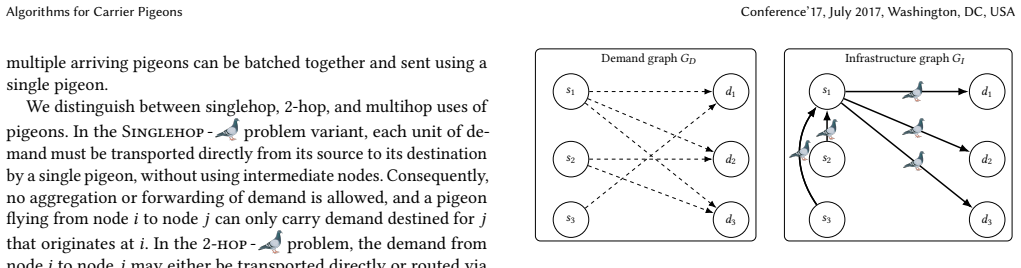
cs.NI 2026-05-11 Recognition

Pigeon scheduling approximates minimum birds within factor 2

The Carrier Pigeon Internet Protocol: An Algorithmic (and Lighthearted) Perspective

Even though exact minimization for two- and multihop cases is NP-hard, demand aggregation solves it in polynomial time with a factor-two gu

Figure from the paper full image
abstract click to expand
The theoretical model behind the pigeon post as a link layer in a communication network was introduced by Shannon (under the guise of studying One-Time Pads for cryptography). That is, to send a one-hop message to $v$, a node $u$ needs a mail pigeon bred and raised at $v$. When sending a message using a pigeon to $v$, node $u$ loses the pigeon. To send another message to $v$, node $u$ needs another pigeon of $v$. It has been demonstrated that the communication bandwidth achievable with pigeon post can exceed that of networks using other media. This has already motivated the introduction of Internet standards that allow the use of pigeons as Internet link-layer media. In this paper, we begin to fill in the missing piece: designing algorithms for breeding and scheduling pigeons to meet a given communication demand efficiently, minimizing the number of pigeons required. We consider singlehop, 2-hop, and multihop pigeon use. While the singlehop variant admits a simple characterization, both the 2-hop and the multihop variants are NP-hard. For the latter variants, we present a polynomial-time algorithm based on demand aggregation that achieves a 2-approximation for the number of pigeons used. We believe that this pigeon-based perspective offers both amusing and instructive insights into network design and hopefully, into ornithology.
0
0
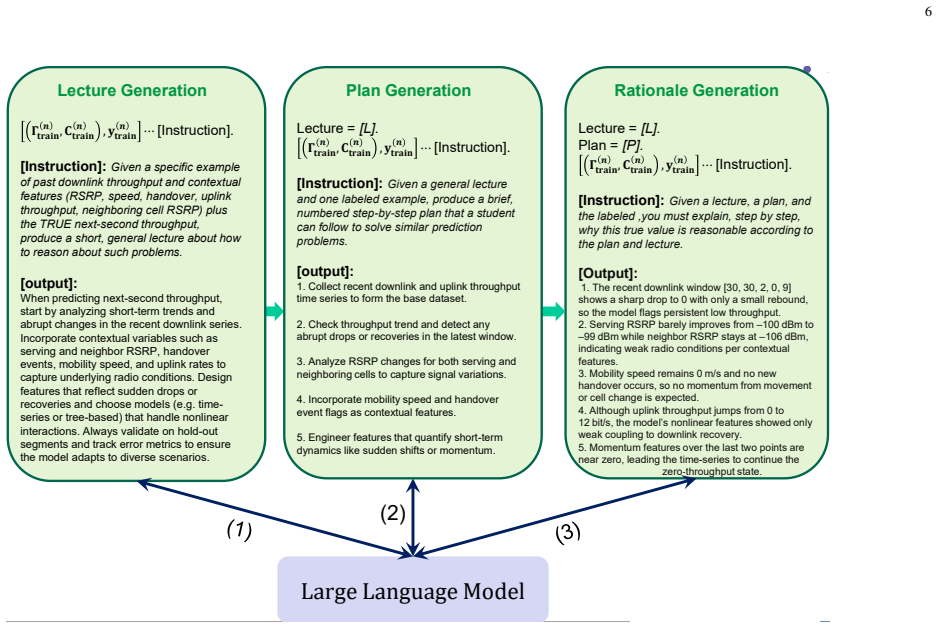
cs.NI 2026-05-11 2 theorems

CoT reasoning lifts LLM traffic prediction accuracy by 15%

Chain-of-Thought Reasoning Enhances In-Context Learning for LLM-Based Mobile Traffic Prediction

Plan-based rationales and pattern similarity retrieval let models handle rapid fluctuations in 5G data without retraining.

Figure from the paper full image
abstract click to expand
Accurate short-term mobile traffic prediction is important for proactive resource allocation and low-latency network management in fifth generation (5G) and sixth generation (6G). While large language models (LLMs) can perform in-context learning (ICL) without task-specific retraining, naive ICL prompting may suffer from numerical instability and limited temporal reasoning when traffic dynamics fluctuate rapidly. In this paper, we propose a chain-of-thought (CoT)-enabled LLM-based mobile traffic prediction framework that operates in two phases: (i) an offline phase that constructs structured CoT demonstrations by generating rationales via a plan-based CoT (PCoT) pipeline (lecture, plan, and rationale), and (ii) an online phase that performs close to real-time prediction by retrieving the most relevant demonstrations using a similarity policy that considers both the historical throughput pattern and its short-term changes. We evaluate the proposed framework using a real-world 5G measurement dataset that includes both driving and static scenarios across diverse applications. Our numerical results reveal that the proposed 2-shot CoT-LLM can improve mean absolute error (MAE), root mean square error (RMSE) and R2-score by up to 14.88%, 15.03%, and 22.41%, respectively, compared to the 2-shot ICL-LLM and classical baselines. Furthermore, by optimizing the number of in-context examples, we achieve additional improvements of 4.58%, 5.70%, and 4.85% in MAE, RMSE, and R2-score, respectively.
0
0
cs.NI 2026-05-11 Recognition

Differentiated allocation secures critical WNCS reliability

Semantics-Aware Communication:A Differentiated Allocation Perspective

Semantic categorization lets limited compute resources protect high-priority actuations while regular tasks tolerate more delay.

Figure from the paper full image
abstract click to expand
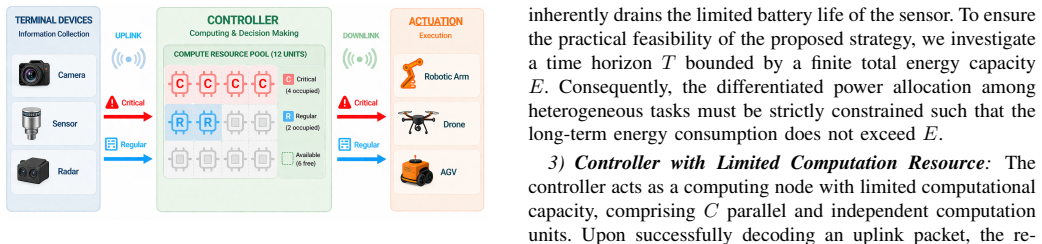
We study the joint optimization of timeliness and reliability in semantics-aware Wireless Networked Control Systems (WNCS) under computation resource constraints. The sampled data are categorized into regular and critical tasks based on the semantic states, facilitating differentiated resource allocation. Task-aware Age of Actuation (AoA) and Cost of Missing Actuation (CoMA), are used to characterize the task-level freshness and the reliability penalty of missed actuations, respectively. By modeling the controller as a discrete-time multi-rate Geo/D/C/C queue, we evaluate the performance of regular and critical tasks, the latter imposing higher computational demands. Results confirm that differentiated resource allocation across heterogeneous tasks effectively guarantees the actuation reliability of critical tasks in severely constrained environments.
0
0
cs.NI 2026-05-11 2 theorems

Token-flow optimization sets locational prices for AI services

Locational Pricing for Generative-AI Services via Token-Flow Market Clearing

Dual variables from a network-constrained linear program show how compute capacity and bandwidth limits shape regional costs and dispatch in

Figure from the paper full image
abstract click to expand
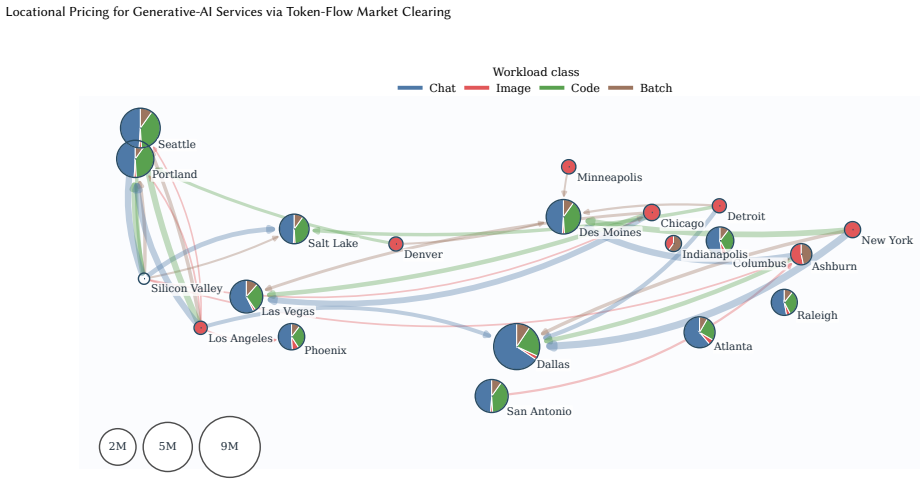
GenAI services are in an early yet fast expanding phase. Providers compete on model capability and service quality, while the underlying infrastructure remains expensive and heterogeneous across regions, workloads, and compute assets. If these services diffuse into routine daily use, the relevant engineering problem becomes not only better models but also efficient dispatch on a geographically distributed AI service infrastructure. To address this, we formulate a network-constrained token-flow market that clears AI workloads across compute nodes and communication links. The baseline model is a linear program that co-optimizes routing and processing subject to compute-capacity and bandwidth constraints; its dual variables define location- and workload-specific marginal service prices. We further introduce a transfer-aware extension that prices data movement in physical units and isolates bandwidth congestion rents. In a 5-node U.S. case study, the transfer-aware model uncovers four saturated backbone links and raises total operating cost by 2.7\% relative to the token-equivalent baseline, while tightening the chatbot latency limit from 100~ms to 15~ms increases one locational price by 117\%. A 20-node scale-up exhibits the same merit-order dispatch logic and becomes infeasible once demand exceeds aggregate capacity. These results suggest that locational pricing is a useful organizing principle for operating an emerging AI service infrastructure and, over time, for designing competitive markets around it.
0
0
cs.NI 2026-05-11 2 theorems

LUDB++ tightens latency bounds for shaped FIFO networks

LUDB++: Enabling LUDB for the Analysis of Shaped Feedforward FIFO Networks using Network Calculus

Extending the least upper delay bound method to include shapers improves accuracy over standard LUDB and beats ELP in most of 130 test cases

Figure from the paper full image
abstract click to expand
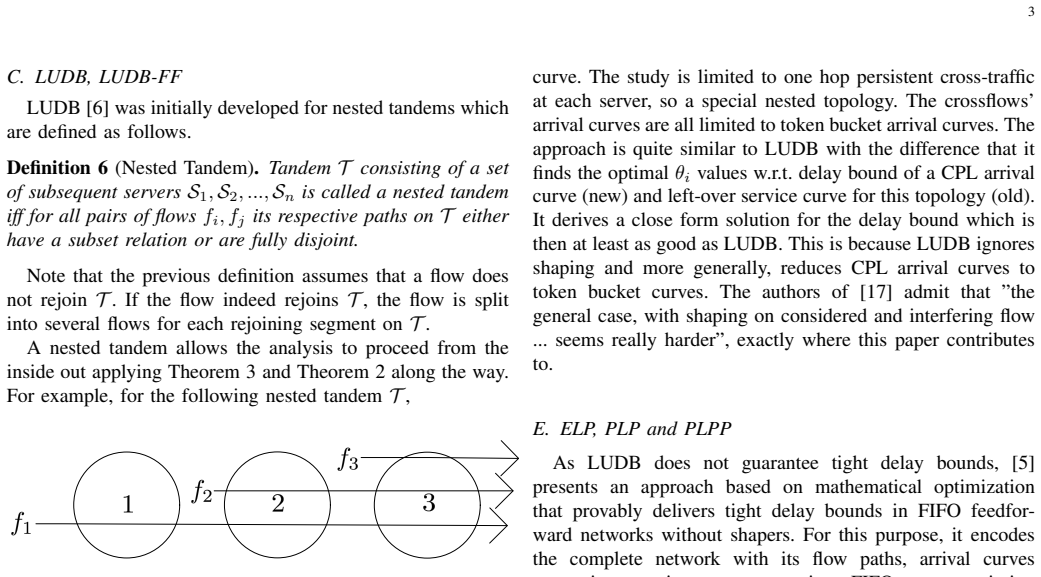
This paper discusses how latency guarantees for non-cyclic (feedforward) First-In-First-Out (FIFO) networks with shapers can be computed within the Network Calculus (NC) framework. Shapers are methods implemented in software or hardware and may reside inside the network and at the endpoint which constrain the rate and maximum packet sizes for the transmission of specific data streams (flows) or groups thereof. Shaping can improve latencies and is an important aspect of Time-Sensitive Networking (TSN). Several methods in NC exist to analyze FIFO networks. Among them is the Least Upper Delay Bound (LUDB) methodology. So far, LUDB does not incorporate shaping assumptions into its analysis. This paper addresses this gap resulting in the new methodology called LUDB++. The evaluation on a set of different line topologies and a tree topology with a total of 130 configurations shows that LUDB++ delivers more accurate latency bounds compared to LUDB. Moreover, the Exponential Linear Program (ELP) method, which considers FIFO and shaping inside the network, yields the most accurate bounds to this date. ELP is superseded by LUDB++ for most of cases by a margin of up to 9.13%.
0
0
cs.NI 2026-05-11 2 theorems

Hierarchical DRL with dynamic weights improves multi-UAV task success

Technical Report: A Hierarchical Dynamically Weighting Deep Reinforcement Learning Method for Multi-UAV Multi-Task Coordination

Episode and step-level weighting yields faster convergence and higher completion rates than standard methods in simulated emergency missions

Figure from the paper full image
abstract click to expand
This paper investigates the multi-UAV multi-task coordination problem in infrastructure-less emergency scenarios, where UAVs collaboratively are required to jointly perform aerial image acquisition and ground-user communication. To tackle the challenge of balancing heterogeneous tasks within dynamic environments, we propose a hierarchical dynamic weighting Deep Reinforcement Learning (DRL) framework. Specifically, an episode-level module is introduced to capture global task preferences, while a step-level module adaptively adjusts the objective weights according to real-time system conditions. By integrating global and instantaneous weights, the proposed framework improves decision stability and responsiveness during task execution. Simulation results demonstrate that the proposed method achieves faster convergence, more stable training, and higher task completion efficiency than conventional works.
0
0
cs.NI 2026-05-11 Recognition

DDS middleware suits gigabit Ethernet for farm machinery

Suitability of the Data Distribution Service for Next-Generation Ethernet-Based Agricultural Machinery Networking

Proof-of-concept with Task Controller fulfills requirements, but security cuts throughput; new flexible DDI proposed.

Figure from the paper full image
abstract click to expand
The current state of the art in the agricultural industry for inter-manufacturer, plug-and-play communications is the ISO 11783 standard series, which mandates the use of 250 Kb/s CAN bus. To support higher data rates, the ISO 23870 series is under development, defining a gigabit automotive Ethernet physical layer for next-generation machine-to-machine communication networks. However, middleware is needed to handle the complexity of the system by providing an additional layer of abstraction. It should address the future needs of the industry such as higher levels of automation, additional data logging, modern data types, quality of service configuration, and best-practice cybersecurity. Data Distribution Service (DDS) is a potential middleware for use in such a network. DDS provides many features not present in the current ISO 11783, it is a standardised protocol for data sharing between distributed applications. This work analyses the extent to which DDS can be used to develop a system which meets the requirements for next-generation communication networking for agricultural machinery. A proof-of-concept design is presented, including a Task Controller and implement and it is shown that the requirements are fulfilled. A new DDI concept is proposed that decomposes the monolithic numeric DDI of ISO 11783 into separate typed Enums for handling group, handling feature, and SI units, enabling more flexible signal definitions. Four security configurations are tested in the proof-of-concept implementation and it is shown that enabling security features has a significant impact on throughput.
0
0
cs.NI 2026-05-11 Recognition

6G Sensing Requires New Governance for Legal Compliance

Unconsented Sensing: A Sociotechnical Governance Framework for 6G ISAC

Current technical privacy measures underestimate legal issues from ML analysis of raw sensing data under GDPR and the EU AI Act.

Figure from the paper full image
abstract click to expand
The forthcoming deployment of 6G Integrated Sensing and Communication (ISAC) will transform cellular infrastructure into pervasive, continuous environmental and biometric sensing grids. While current telecom standardization efforts (e.g., 3GPP, ETSI) have formally recognized privacy and trustworthiness as critical pillars for 6G, their proposed mitigations remain overwhelmingly technocentric, relying on cryptographic anonymization and physical layer security. This approach critically underestimates the sociotechnical and legal complexities of the downstream machine learning (ML) models required to interpret raw sensing data, creating a profound collision with existing digital rights legislation. This position paper argues that technical security is insufficient. ISAC trustworthiness must be redefined as mandatory regulatory and sociotechnical compliance. We identify the specific legal friction points between continuous ISAC surveillance and the mandates of emerging global digital rights regimes, using the stringent requirements of the EU AI Act and GDPR as our primary regulatory baselines. To bridge this gap, we propose a governance framework centered on three pillars: Purpose-bound sensing activation, citizen transparency mechanisms, and algorithmic accountability for ISAC-driven ML models. Ultimately, this paper provides a regulatory roadmap to prevent the illegal deployment of 6G sensing infrastructures and ensure they remain viable before physical deployment.
0
0
cs.NI 2026-05-11 Recognition

Map-and-encap recurs in every scalable routing solution

From Map-and-Encap to BIER: Observations on Network Routing Scalability

Observations from unicast and multicast history show why BGP cannot scale and what future designs need.

Figure from the paper full image
abstract click to expand
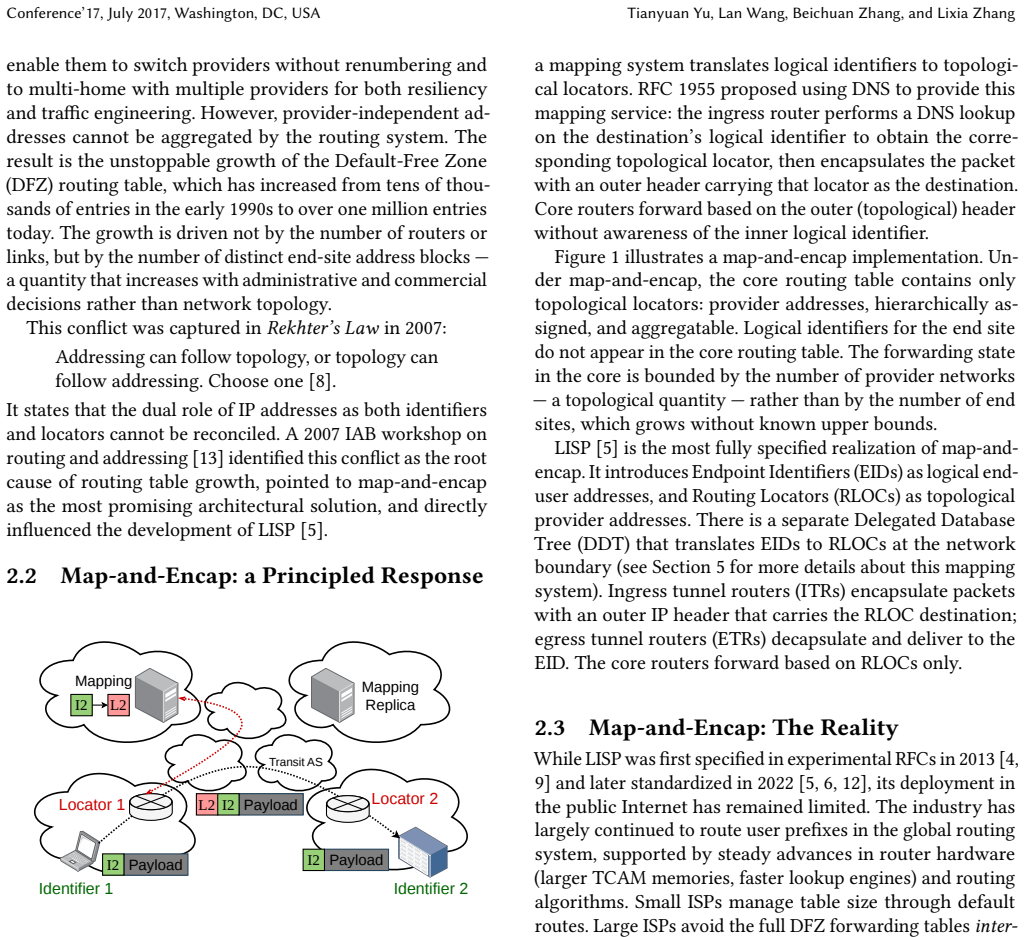
The TCP/IP protocol stack uses IP addresses for two distinct roles: identifying hosts and locating their attachment points in the network topology. This dual purpose creates a fundamental tension that has led to routing and forwarding scalability challenges throughout the history of the Internet in unicast packet delivery and, more notably, in multicast delivery. This paper reviews the evolution of routing scalability solutions over the years and makes four observations. First, map-and-encap is a recurring architectural solution shared by all scalable unicast and multicast delivery methods, developed independently across different problem contexts. Second, a new solution tends to succeed when it can bring immediate local gains to early adopters without requiring coordination across administrative domains. Third, network routing and forwarding designs that depend on external factors, such as the number of distinct end sites or even application-specific deliveries, inherently preclude an upper bound on their scalability. Fourth, today's inter-domain routing protocol, BGP, lacks a topological abstraction equivalent to an egress router within a routing domain, thereby inherently preventing a map-and-encap solution for scalability. These observations offer insights into the design of future scalable routing system architectures.
0
0
cs.NI 2026-05-08 2 theorems

PQC message sizes degrade 6G handshake reliability at the edge

Toward Quantum-Safe 6G: Experimental Evaluation of Post-Quantum Cryptography Techniques

Benchmarks find computation times acceptable yet ciphertext and signature expansion reduces success rates and throughput in wireless edge 6G

Figure from the paper full image
abstract click to expand
6G networks will require quantum-secure cryptography deployed across core infrastructure, edge nodes, resource-constrained IoT devices. Although post-quantum cryptographic (PQC) algorithms have been standardized by NIST, their practical deployability in bandwidth and latency limited wireless systems remains unclear. This paper presents a practical evaluation of NIST selected PQC schemes, including ML-KEM (Kyber), ML-DSA (Dilithium), and Falcon. Benchmarks conducted with OpenSSL and the OQS provider on heterogeneous platforms show that while computational performance is acceptable, ciphertext and signature size expansion significantly impact handshake reliability and bandwidth efficiency, particularly at the network edge. The results highlight key system-level trade-offs and motivate the need for PQC optimization and deployment-aware design for future quantum-secure 6G networks.
0
0
cs.NI 2026-05-08

DRL reaches optimal underwater channel access without ranging

Delay-Robust Deep Reinforcement Learning for Ranging-Free Channel Access under Mobility in Underwater Acoustic Networks

CHILL-STER algorithm stabilizes learning under long delays and mobility using only a known maximum delay bound.

Figure from the paper full image
abstract click to expand
Long propagation delays in underwater acoustic networks (UWANs) cause spatio-temporal uncertainty, constraining channel utilization in medium access control (MAC) protocols. Node mobility within autonomous underwater vehicle scenarios exacerbates these challenges by introducing dynamic propagation delays and varying spatial topologies. We present MobiU-MAC, a deep reinforcement learning (DRL)-based MAC protocol for mobile node access in UWANs that maximizes throughput via autonomous learning. MobiU-MAC incorporates CHILL-STER, a novel DRL algorithm optimized for UWANs that is both ranging-free and delay-robust. CHILL-STER employs a credit horizon-limited $\lambda$-return (CHILL-Return) mechanism to achieve stable learning under asynchronous delayed rewards, while the companion spatio-temporal experience replay (STER) mechanism addresses topological changes arising from node mobility. This work also demonstrates theoretically that DRL attains optimal policy learning equivalent to a standard Markov decision process under long propagation delays without requiring ranging. Performance evaluations indicate that MobiU-MAC outperforms existing DRL-based MAC protocols for UWANs by leveraging the maximum system delay boundary without ranging overhead, supporting the effectiveness of the proposed theory and algorithm in complex underwater dynamic environments.
0
0
cs.NI 2026-05-08 2 theorems

Randomness test decides when wireless physical layer auth is safe

When to Use Wireless Challenge-Response Physical Layer Authentication: Design of a Measurable Guideline for OFDM

New adversary model shows how channel correlations enable attacks on OFDM challenge-response systems, yielding a guideline for safe use.

Figure from the paper full image
abstract click to expand
The security of wireless challenge-response Physical Layer Authentication (PLA) based on Orthogonal Frequency Division Multiplexing (OFDM) relies on a sufficiently random fading channel condition, which is commonly assumed in existing studies. However, in practical scenarios, such a condition is not always guaranteed and the responses of OFDM subchannels may exhibit correlation.} Consequently, ensuring the security of such PLA systems remains an unsolved problem. In this paper, we propose a novel adversary model, called Maximum Differential Likelihood Generator (MDLG), which exploits the weak correlation property in practical wireless channel to launch effective attacks against PLA. Based on this model, we create a measurable guideline using randomness testing to decide when we can in fact use PLA in a practical wireless channel condition. Extensive real-world experiments validate the effectiveness of the MDLG attack and demonstrate how the proposed guideline can help protect the security of PLA.
0
0
cs.NI 2026-05-08

TSNFA detects all events with zero false positives in IoT meshes

Edge Triggering in IoT Mesh Networks: A Comparative Monte Carlo Study of Seven Detection Algorithms

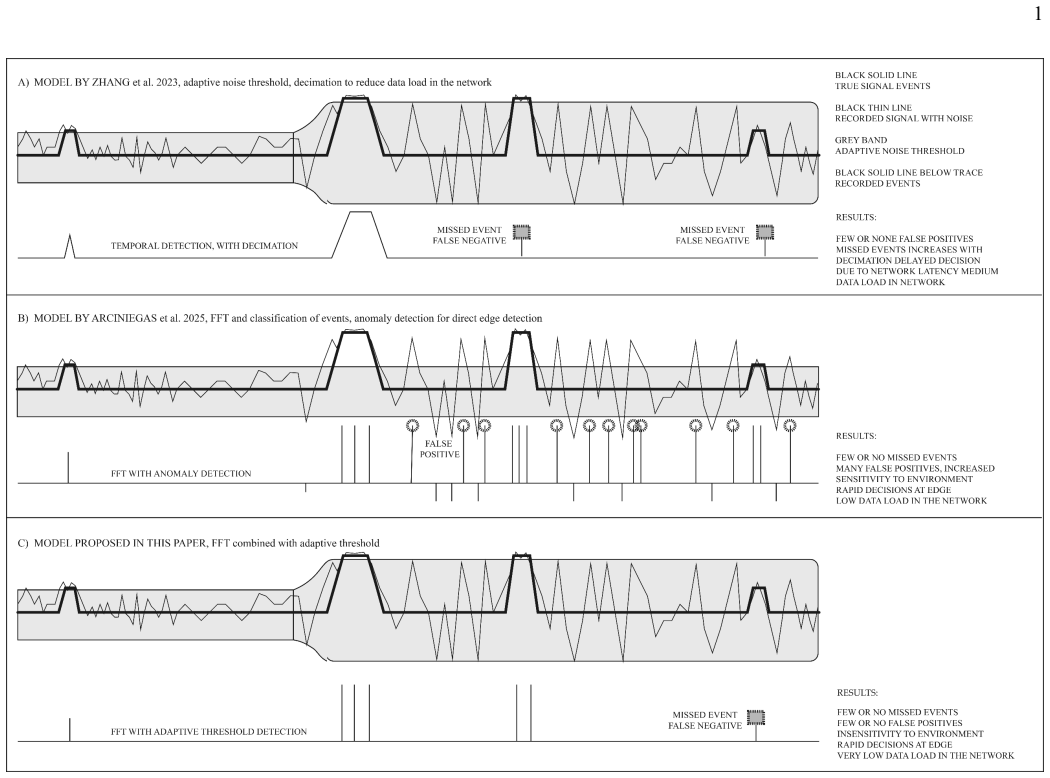
Simulation shows three combined defences are needed for reliable autonomous triggering under realistic noise.

Figure from the paper full image
abstract click to expand
Real-time event detection in Internet of Things (IoT) mesh sensor networks presents significant challenges due to time-varying noise conditions, limited computational resources at edge nodes, and the need for autonomous operation without centralised coordination. This paper presents a comprehensive Monte Carlo simulation study comparing the Temporal Spectral Noise-Floor Adaptation (TSNFA) method against six alternative detection algorithms, evaluated across a 200-node mesh network over 24 hours with realistic noise models including 60 Hz electromagnetic interference (EMI), sinusoidally drifting noise power (+/- 6 dB), and intermittent digital switching bursts. TSNFA achieves 100% detection rate with zero false positives, uniquely combining three interlocking defences: spectral band selection, temporal persistence filtering, and adaptive noise-floor tracking. Every competing algorithm omits at least one of these three defences and fails correspondingly, with false-positive rates ranging from 0 (Send-on-Delta, which also detects nothing) to 13,387,930 (broadband energy ratio). These results identify the three-defence combination as necessary and sufficient for autonomous edge triggering in resource-constrained IoT deployments.
0
0
cs.NI 2026-05-08

Local spectral adaptation cuts false triggers in IoT sensors

Temporal Spectral Noise-Floor Adaptation for Error-Intolerant Trigger Integrity in IoT Mesh Networks

Each node tracks its own evolving noise floor to ignore wind, rain and vibration while catching real events without calibration or cloud aid

Figure from the paper full image
abstract click to expand
In this paper, we present a lightweight, embedded algorithm for autonomous edge event triggering in IoT sensor nodes suitable for operating in mesh networks. The device acquires local sensor data, performs deterministic FFT spectral feature extraction in firmware, and maintains a temporal spectral noise-floor baseline that absorbs non-stationary environmental excitations such as rain, wind, and mechanical vibration. While adaptive thresholds in IoT sensor nodes are often applied to manage communication load or stabilize long-term metrics, this work focuses on maintaining a time-evolving spectral noise floor to preserve event trigger reliability in dynamic environments. Our method targets trigger integrity under environmental non-stationary conditions, enabling calibration-free deployment of autonomous nodes; without shared noise models or cloud-side inference. Local decision authority preserves node responsiveness when connectivity is intermittent and mitigates security risks inherent in centralized remote-analysis systems. We validate the algorithm in a single node mesh sensor deployed in a dynamic outdoor environment using a radar-class proximity sensor as one example sensor modality. Results demonstrate substantial suppression of nuisance-induced triggers, reduced false-event traffic amplification in the mesh, bounded embedded execution, and reliable detection sensitivity to true spectral signatures.
0
0
cs.NI 2026-05-08

Per-region motion vectors cut video analytics latency up to 84%

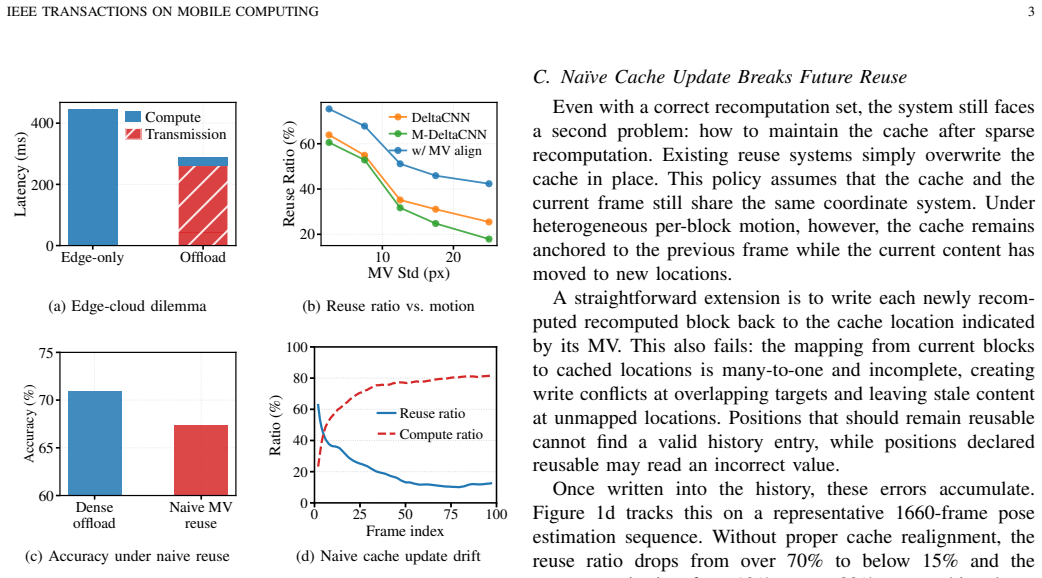
FluxShard: Motion-Aware Feature Cache Reuse for Collaborative Video Analytics in Mobile Edge Computing

FluxShard remaps cached features by block displacement so most content stays reusable even when different parts of a mobile scene move atδΈεŒηš„

Figure from the paper full image
abstract click to expand
Caching and reusing intermediate features across consecutive frames is a common technique to reduce redundant computation and transmission for edge-cloud video analytics in mobile edge computation. Existing methods manage the cache in a fixed or globally shifted coordinate system, treating it as an indivisible whole. Under the non-uniform motion patterns of mobile scenes, this whole-scene granularity invalidates large portions of the cache even when most content has merely shifted spatially, wasting computation and bandwidth. The root cause is a granularity mismatch: the cache is managed per scene, yet motion varies per region. In this paper, we present FluxShard, a motion-aware edge-cloud video analytics system that uses codec-level block motion vectors (MVs) to manage feature cache reuse and recomputation at the granularity of individual motion regions. By re-indexing cached features along per-block MVs, FluxShard separates spatial displacement from content changes, recovering reusable content that whole-scene methods would otherwise discard. To ensure correct reuse under heterogeneous motion, the Receptive Field Alignment Principle (RFAP) identifies, from the input-level MV field alone, the positions that must be recomputed due to inconsistent spatial composition within receptive fields. To maintain cache coherence across frames, MV-guided cache remapping warps the entire feature cache to the current coordinate system each frame, sustaining a high reuse ratio over time. A profiling-driven dispatcher routes the remaining sparse workload between edge and cloud for lower latency. Evaluation across multiple vision tasks, dynamic video benchmarks, and network conditions shows that FluxShard reduces latency by 32.6-83.8% and energy by 14.9-64.0% over all baselines under the prescribed accuracy budget.
0
0
cs.NI 2026-05-08

Simulator models 6G network fallback after partial disasters

A Disaster-Aware Integrated TN-NTN System-Level Simulator for Resilient 6G Wireless Networks

It tracks throughput, packet loss, and latency when terrestrial base stations fail and users migrate to satellites or UAVs.

Figure from the paper full image
abstract click to expand
Non-terrestrial networks (NTN) have been standardized by the 3rd generation partnership project (3GPP) as a key component of future 6G systems to enhance coverage and resilience. In particular, NTN technologies such as low-earth orbit (LEO) satellites, high-altitude platform stations (HAPS), and unmanned aerial vehicles (UAVs) are expected to support terrestrial networks (TN) during extreme events and disasters. In this paper, we present a lightweight system-level simulator for evaluating post-failure fallback behavior in integrated TN-NTN wireless networks under a partial-failure disaster model. The simulator follows 3GPP Rel-17/18 modeling principles, supports probabilistic terrestrial next-generation node B (gNB) failures, and service migration to NTN. The simulator supports comparative analysis of throughput, packet reception ratio (PRR), and latency under different user loads, disaster severities, and NTN provisioning levels. Results show the expected capacity-delay tradeoff of terrestrial operation, the reliability and stability of non-terrestrial service, and the balanced resilience behavior of hybrid TN-NTN operation. The proposed framework provides a tractable tool for studying wireless network resilience and traffic management in future integrated 6G mobile systems.
0
0
cs.NI 2026-05-08

NTN outperforms D2C for scalable 6G satellite networks

Comparative Analysis of Direct-to-Cell (D2C) and 3GPP Non-Terrestrial Networks (NTN) for Global Connectivity

D2C connects with standard phones for fast emergency access, but standardized NTN delivers better performance, security and growth for true

Figure from the paper full image
abstract click to expand
The quest for ubiquitous mobile coverage has catalyzed two fundamentally distinct architectural paradigms: Direct-to-Cell (D2C) and standardized 3GPP Non-Terrestrial Networks (NTN). D2C, pioneered by SpaceX Starlink and AST SpaceMobile, leverages existing terrestrial spectrum and unmodified consumer handsets to provide emergency connectivity as a market-driven overlay. In contrast, 3GPP NTN, standardized across Releases 17-19, offers a systematic satellite-native framework designed for long-term scalability, high-throughput broadband, and deep integration with terrestrial 5G/6G networks. This paper presents a comprehensive technical comparison of these approaches, analyzing their standardization trajectories, network architectures, physical-layer innovations, security postures, and operational trade-offs. We further examine their implications for emerging 6G use cases, particularly autonomous driving, where safety-critical redundancy motivates a hybrid tri-link architecture combining terrestrial 5G, NTN broadband, and D2C emergency fallback. Our analysis shows that, although D2C enables rapid market entry through legacy-device compatibility, NTN provides superior performance, security, and scalability, positioning it as the foundational framework for 6G satellite-terrestrial convergence. A hybrid model that combines the strengths of both paradigms is identified as the most practical path toward truly global connectivity.
0
0
cs.NI 2026-05-08

PtMP IPoWDM cuts CAPEX 92% and power 99% over ten years

Bridging the 6G Gap: Scaling Sustainable ROADM-Based IP-over-WDM via DSCM-Enabled Point-to-Multipoint Designs

DSCM-enabled point-to-multipoint designs outperform traditional point-to-point across geotypes in simulations for 6G scaling.

Figure from the paper full image
abstract click to expand
This study compares transponder-based, Point-to-Point, and DSCM-based Point-to-Multipoint (PtMP) access-metro architectures. Findings demonstrate that PtMP IPoWDM significantly optimizes efficiency across diverse geotypes, slashing CAPEX by 92.0% and power by 99.2% compared to the traditional benchmark over a ten-year horizon.
0
0
cs.NI 2026-05-08

Bypassing one layer in 6G optical nets cuts TCO by 17.5%

SixGman: An Open-Source Planner for Fixed 6G Hierarchical Optical Access-Core Networks

SixGman evaluation on a 157-node real topology also reports 29% lower energy use and reduced latency.

Figure from the paper full image
abstract click to expand
This paper introduces SixGman, an open-source optical network planning tool for evaluating access-metro-core aggregation network architectures. The framework integrates traffic generation, dual-homed routing, Quality of Transmission (QoT) estimation, spectrum and fiber assignment, techno-economic analysis, energy consumption evaluation, and visualization capabilities. Its modular design, based on standardized interfaces and clearly defined functions, enables flexible, transparent, and reproducible network simulations. SixGman is applied to the Telef\'onica MAN157 metro-urban topology, composed of 157 optical nodes, 220 links, and four hierarchical layers (HL1-HL4), to compare a conventional full hierarchical architecture with an HL3-bypassed architecture where electrical aggregation at HL3 nodes is removed. The analysis includes traffic distribution, IP router utilization, link congestion, latency, Total Cost of Ownership (TCO), and energy consumption. Results show that HL3 bypassing improves traffic distribution, reduces optical and electrical resource usage, lowers end-to-end latency, and decreases both capital and operational expenditures. Compared to the full hierarchical architecture, the HL3-bypassed scenario achieves reductions of up to 17.5% in TCO and 29.1% in cumulative energy consumption. These results demonstrate the potential of SixGman as a flexible planning platform for cost- and energy-efficient optical network design.
0
0
cs.NI 2026-05-07

O-RAN dApps: containers trade latency for scalability

Performance Characterization of dApps in Open Radio Access Networks

Tests across bare-metal and container setups identify bottlenecks that hardware offloading can fix for better real-time performance.

Figure from the paper full image
abstract click to expand
Despite recommendations to deploy real-time Open Radio Access Network (O-RAN) applications (dApps) in containerized environments, existing approaches predominantly rely on bare-metal servers. Moreover, current dApp deployments offer limited visibility into the resource usage patterns of both intelligent and non-intelligent dApps, hindering informed deployment decisions. This work addresses these gaps by implementing and evaluating representative dApps across multiple deployment scenarios (bare-metal and containers) to characterize the trade-offs in latency, scalability, and resource utilization. Additionally, we identify key performance bottlenecks and demonstrate how offloading dApps to emerging hardware accelerators, such as smart Network Interface Cards (NICs), can alleviate these limitations and improve real-time responsiveness in O-RAN systems.
0
0
cs.NI 2026-05-07

Lookahead cache cuts short-video CDN midgress costs up to 111%

SILC: Lookahead Caching for Short-form Video Delivery Systems

By folding recommendation sequences and popularity overlaps into eviction decisions, SILC lowers origin fetches versus ten standard policies

Figure from the paper full image
abstract click to expand
Short video platforms like TikTok, Instagram Reels, and YouTube Shorts have gained immense popularity in the last few years and are responsible for a large and growing fraction of Internet traffic. We identify two unique opportunities for improving short video delivery using their existing interactions with content delivery networks (CDNs). First, short videos use a push-based recommendation system, where the user is presented a sequence of videos recommended by the algorithm rather than user explicitly picking content to watch (e.g., in YouTube). Such push-based short video systems offer a unique opportunity for system design by providing visibility into upcoming requests. Second, the popularity of these videos follows a highly skewed Pareto distribution, leading to geographical and temporal overlap amongst videos being served. We leverage these opportunities to build SILC - a lookahead-aware caching system, aimed at (i) reducing CDN cache miss rates, as well as (ii) reducing midgress bandwidth between the CDN and the origin server. Our evaluation of SILC uses traces that we collect from real users, through (i) an in-person user study, and (ii) a data donation program involving 100 TikTok users across the world. Using a combination of these traces, we simulate traffic from 10,000 simultaneous users. Our evaluation shows that, compared to 10 state-of-the-art heuristic and learning-based cache eviction policies, SILC reduces a CDN's midgress costs by 11.1% to 111%.
0
0
cs.NI 2026-05-07

Camera vision narrows mmWave beam search for vehicles

Look Once, Beam Twice: Camera-Primed Real-Time Double-Directional mmWave Beam Management for Vehicular Connectivity

Hybrid VIBE reaches 1.1-1.4% outage in tests, beating 5G NR and pure ML for real-time V2X links

Figure from the paper full image
abstract click to expand
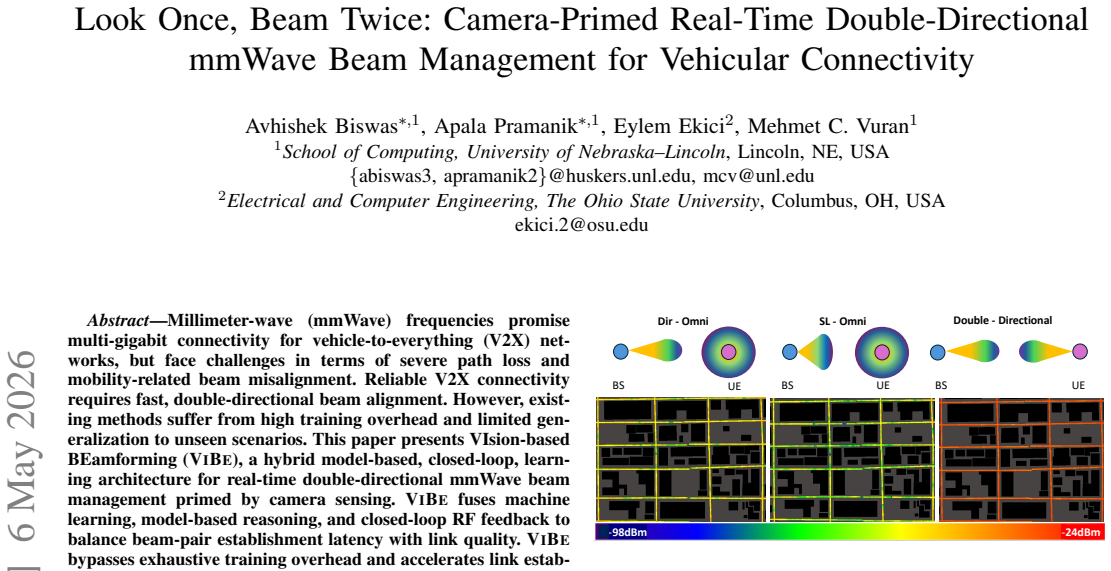
Millimeter-wave (mmWave) frequencies promise multi-gigabit connectivity for vehicle-to-everything (V2X) networks, but face challenges in terms of severe path loss and mobility-related beam misalignment. Reliable V2X connectivity requires fast, double-directional beam alignment. However, existing methods suffer from high training overhead and limited generalization to unseen scenarios. This paper presents VIsion-based BEamforming(VIBE), a hybrid model-based, closed-loop, learning architecture for real-time double-directional mmWave beam management primed by camera sensing. VIBE fuses machine learning, model-based reasoning, and closed-loop RF feedback to balance beam-pair establishment latency with link quality. VIBE bypasses exhaustive training overhead and accelerates link establishment by leveraging camera observations to reduce the beam-search space. Lightweight beam refinement and offset tracking mechanisms adaptively refine beams in response to dynamic application requirements. VIBE is implemented and evaluated across online indoor/outdoor testbeds, public datasets, and real-time vehicular experiments, demonstrating strong generalization capabilities, making it suitable for real-time V2X communication. Comparisons with 5G NR hierarchical beamforming show that VIBE consistently maintains lower outage rates. Furthermore, VIBE outperforms state-of-the-art end-to-end ML models for beam selection when evaluated on public datasets and achieves outage rates as low as 1.1-1.4 %. The results show that a hybrid model-based, closed-loop learning architecture is better suited for real-world mmWave vehicular connectivity than end-to-end trained ML models. For reproducibility, we publish our code to https://github.com/UNL-CPN-Lab/Look-Once-Beam-Twice.
0
0
cs.NI 2026-05-07

Chunk size dictates switch speed in all-optical satellite networks

Traffic Chunk Sizing vs. Optical Switching Speed in Future All-Optical Satellite Networks

Ground station traffic assembly choices set the performance bar for onboard optical fabrics

Figure from the paper full image
abstract click to expand
To enable efficient resource utilization under stringent Size, Weight, and Power (SWaP) constraints through transparent and all-optical switched satellites transmission, various switching paradigms can be considered, including packet, burst, or circuit. To this end, the traffic assembly and algorithmic design for path computations at the ground stations play a key role in determining the switching fabric design. Generally, traffic can be buffered and assembled in chunks at the ground stations and forwarded over the pre-computed optical path in space, similar to terrestrial optical burst switching or fast circuit switching. Regardless of the chosen paradigm, the switching fabric must satisfy specific latency performance requirements. This paper studies the performance of all-optical satellite networks based on the maximum traffic chunk sizes that can be scheduled and the performance of optical switching fabrics in the future over all-optical constellations. We consider various optical switching technologies, including MEMS- and integrated photonic-based solutions, in the context of switching speed, power consumption, and insertion loss. Simulation results indicate that traffic chunk size critically impacts the performance required by optical switching fabrics onboard a satellite.
0
0
cs.NI 2026-05-07

Demand-aware nets reach 5/8 throughput vs 1/2 for fixed ones

A Separation Between Optimal Demand-Oblivious and Demand-Aware Network Throughput

This beats the known demand-oblivious limit and resolves an open question on adaptive network performance.

Figure from the paper full image
abstract click to expand
The performance of distributed applications often critically depends on the interconnecting network or more specifically on its throughput: how fast data can be carried across a network. Over the last years, great progress has been made in understanding demand-oblivious throughput: how fast a given demand matrix describing pairwise communication requirements can be served on a given network. However, surprisingly little is known today about the achievable demand-aware throughput: the throughput on a network topology which can be optimized toward the demand. Such demand-aware networks have recently gained popularity in datacenters and are enabled by emerging reconfigurable optical technologies. In this paper, we are interested in both the achievable demand-aware throughput bounds as well as in the computational complexity of finding a throughput-optimizing network topology. We take a systematic approach and investigate four variants of demand-aware throughput: we analyze, and derive bounds for, two definitions of throughput, the classic throughput usually considered in the literature, and a new generalized definition which we call weak throughput; for each of them, we consider two routing models, a direct one, where demand can only be served on a single hop, and a general one, where multi-hop routing is allowed. Our main result is a separation result which solves an open problem in the literature about the classic throughput definition, showing that demand-aware topologies can outperform demand-oblivious topologies even in the worst case: the demand-aware throughput asymptotically approaches at least 5/8, while it is known that the demand-oblivious throughput is n/(2n-1), which is roughly 1/2. In terms of computational complexity, we show that computing the demand-aware weak throughput is NP-hard, but computing the demand-aware (weak) direct throughput is polynomial-time solvable.
0
0
cs.NI 2026-05-07

Structured policy lifts LLM network troubleshooting performance

SADE: Symptom-Aware Diagnostic Escalation for LLM-Based Network Troubleshooting

SADE encodes Cisco layer-by-layer methods to separate evidence from hypotheses on eleven unseen scenarios.

Figure from the paper full image
abstract click to expand
Large language model (LLM) agents are increasingly applied to network troubleshooting, but root-cause localization on public benchmarks remains well below practical deployment thresholds. We argue this is because existing agents do not encode the disciplined, layer-by-layer methodology that human network engineers use, and instead rely on free-form deliberation that conflates evidence acquisition with hypothesis commitment. We present SADE (Symptom-Aware Diagnostic Escalation), an agent that encodes the classical Cisco troubleshooting methodology as an explicit policy. SADE pairs a phase-gated diagnostic workflow, which separates evidence acquisition from hypothesis commitment, with a routed library of fault-family skills and high-yield diagnostic helpers. On a held-out 523 incident set of the public NIKA benchmark covering eleven unseen scenarios, SADE improves root-cause F1 by 37 percentage points over a ReAct + GPT-5 baseline; a model-controlled comparison against the same Claude Sonnet backend without the SADE policy attributes 22 of those points to the diagnostic policy alone, showing that the gain is not a side-effect of the model upgrade.
0
0
cs.NI 2026-05-07

Multi-agent RL halves routing overhead in LEO networks

Queue-Aware and Resilient Routing in LEO Satellite Networks Using Multi-Agent Reinforcement Learning

Each satellite picks next hops locally from queue and resilience signals, sidestepping the signaling costs that grow with centralized recall

Figure from the paper full image
abstract click to expand
With the rapid growth in data demand and stringent latency requirements of modern applications has driven significant interest in Low Earth Orbit (LEO) satellite constellations as an emerging solution for global Internet coverage. However, routing in LEO networks remains a fundamental challenge due to highly dynamic topologies, time-varying traffic conditions, and its susceptibility to link failures. Conventional routing algorithms typically assume static link metrics and fail to account for queue backlogs or real-time system variations, making them less effective in such environments. We propose a queue-aware multi-agent deep reinforcement learning (MA-DRL) framework for routing in LEO satellite networks. Each satellite is modeled as an independent agent responsible for making local routing decisions, enabling a distributed and scalable solution. The proposed framework formulates a latency-aware optimization problem that incorporates background traffic, queue dynamics at each satellite, and a resilience score to improve robustness. We evaluate the proposed approach against the state-action-reward-state-action (SARSA) and Dijkstra algorithms. While Dijkstra achieves the lowest end-to-end latency under ideal conditions, its computational and signaling overhead becomes a significant bottleneck as the network scales. In contrast, our proposed approach incurs significantly lower overhead (approximately 50% of Dijkstra at a 5 s recalculation interval), scales efficiently with network size, and effectively manages queue backlogs and resilience under increasing traffic load, demonstrating enhanced robustness and scalability in LEO satellite networks while maintaining competitive latency and resilience scores.
0
0
cs.NI 2026-05-07

Decoupled optimization lifts multi-UAV IoV task success

Joint Optimization of Trajectory Control, Resource Allocation, and Task Offloading for Multi-UAV-Assisted IoV

SOCP paths, DRL-LLM resources with reward decoupling, and LP offloading together cut delay and energy versus standard multi-agent RL in city

abstract click to expand
This paper investigates a multi-Unmanned Aerial Vehicle (UAV) joint base station-assisted Internet of Vehicles (IoV) task offloading system in dense urban environments. To minimize system delay and energy consumption under strict coupling constraints, the complex non-convex optimization problem is decoupled into a hierarchical execution framework. First, a sequential distributed optimization algorithm based on Second-Order Cone Programming (SOCP) is proposed to optimize the 3D flight trajectory of each UAV, ensuring adaptive network coverage. Second, a novel hybrid resource scheduling paradigm synergizing Deep Reinforcement Learning (DRL) and Large Language Models (LLMs) is developed. Within this framework, the DRL agent dictates the initial resource allocation, while the LLM acts as a semantic macro-scheduler to rectify long-tail allocation imbalances for failed and surplus tasks. Crucially, a reward decoupling mechanism is introduced to isolate DRL training from external LLM interventions, thereby ensuring policy convergence. Finally, the task offloading ratios are precisely determined via Linear Programming (LP) within an alternating optimization loop. Simulation results demonstrate that the proposed method significantly outperforms traditional multi-agent reinforcement learning baselines in terms of task success rate and system efficiency.
0
0
cs.NI 2026-05-07

ReGuard finds 43-64% worse cases for RL network controllers

Worst-Case Discovery and Runtime Protection for RL-Based Network Controllers

It locates larger gaps than baselines and closes 79-85% of them with simple rules that leave normal performance untouched.

Figure from the paper full image
abstract click to expand
RL-based controllers achieve strong average-case performance in networking tasks such as congestion control and adaptive bitrate streaming. Yet their performance can degrade severely under network conditions where strong performance is still achievable. Identifying such conditions and quantifying the resulting performance gap is intractable by enumeration, while the sequential and closed-loop nature of RL controllers makes formal verification methods impractical. We present ReGuard, a framework that discovers worst-case scenarios for a given RL controller and protects it against them at inference time without retraining. Discovery is formulated as a bilevel regret-maximization problem, which yields a certified lower bound on the worst-case performance gap. The discovered trajectories are then analyzed as counterfactuals and compiled into lightweight logic rules that intervene only when a risky state is detected, leaving the controller's behavior unchanged otherwise. We evaluate ReGuard across three RL-based network controllers: Pensieve, Sage, and Park. ReGuard discovers scenarios in which the controller's performance is 43$-$64% worse than what is achievable. ReGuard not only discovers gaps 57% to 6$\times$ larger than those found by the strongest baselines but also shrinks them by 79$-$85% via lightweight rule-based protection while preserving nominal performance. ReGuard's protection extends beyond the scenarios it discovers, improving performance across a wider range of network conditions.
0
0
cs.NI 2026-05-06

MRC lets AI training survive network faults by spraying across paths

Resilient AI Supercomputer Networking using MRC and SRv6

New RDMA protocol plus SRv6 source routing keeps frontier-model jobs running in clusters over 100K GPUs

Figure from the paper full image
abstract click to expand
Tail latency dominates the performance of synchronous pretraining jobs when running at very large scales. We describe a three-pronged approach: (1) a new RDMA-based transport protocol, MRC, sprays across many paths and actively load-balances between them, eliminating the issue of flow collisions (2) the use of multi-plane Clos topologies to get the benefits of high switch radix and redundancy, allowing training clusters well over 100K GPUs to be built as two-tier topologies while increasing physical redundancy, and (3) the use of static source-routing using SRv6 to allow MRC the freedom to bypass failures by itself. We describe our experiences running MRC and static SRv6 routing in production in OpenAI and Microsoft's largest training clusters, where it has been used to train the latest frontier models. We demonstrate how MRC allows AI training jobs to ride out many network failures that previously would have interrupted training.
0
0
cs.NI 2026-05-06

Federated learning fails at 5s latency due to TCP handshake timeouts

Surviving the Edge: Federated Learning under Networking and Resource Constraints

Tests identify exact failure thresholds for packet loss and dropouts, showing that three TCP tweaks can extend operation in constrained edge

Figure from the paper full image
abstract click to expand
Motivated by the growing proliferation of federated learning (FL) in edge environments, we present the first systematic characterization of transport-layer breaking points in FL systems operating under conditions of highly constrained network and compute resources. Using a reproducible testbed with chaos engineering tools, we evaluate Flower under progressively degraded network conditions representative of resource-constrained deployments in Africa and similar environments. Our empirical investigation reveals a fundamental mismatch between FL's burst-idle communication pattern and standard TCP connection management. We identify precise operational boundaries: FL training catastrophically fails at 5-second one-way latency due to TCP handshake timeouts, above 50% packet loss due to buffer exhaustion, and with 90% client dropout rates. Through systematic analysis of connection patterns during training rounds, we demonstrate that FL's periodic model update bursts, separated by extended local training periods, violate the assumptions underlying default TCP configurations. To validate the significance of these findings, we show that adjusting just three TCP connection management parameters can significantly reduce training time under extreme latency, proving that transport-layer awareness is not merely beneficial but essential for FL deployment at the network edge. Our characterization methodology and findings provide practitioners with concrete thresholds for determining when standard FL deployments will fail and when advanced reliability techniques become necessary.
0
0
cs.NI 2026-05-06

Sliding translation in coprime arrays expands DOF for non-circular DOA

Nested array design of extended coprime sets for DOA estimation of non-circular signals

Merging sum and difference co-arrays removes redundancy and improves accuracy over standard nested designs.

Figure from the paper full image
abstract click to expand
In recent years, direction of arrival estimation utilizing non-circular signals has become a focal point for scholarly research. To enhance the degrees of freedom (DOF) in receiver arrays specifically for non-circular signal DOA estimation, this study introduces a novel array configuration. This design leverages an extended coprime framework, applying a sliding translation technique to optimize sensor placement. Crucially, this rearranged structure preserves the continuity of the difference co-array (DCA). Furthermore, the sum co-array (SCA) is shifted to merge seamlessly with the DCA, eliminating redundancy and substantially expanding both the virtual aperture array (VAA) and the DOF. Consequently, the proposed array demonstrates superior performance in practical DOA estimation tasks involving non-circular signals. Simulation results and comparative analyses confirm that, relative to traditional Nested Arrays (NA), Extended Sliding Nested Array (ESNA), and other benchmark structures, the proposed array achieves better DOF and VAA, leading to enhanced estimation accuracy in practical scenarios.
0
0
cs.NI 2026-05-06

Passive check finds 0.5% drops in adaptive networks

SprayCheck: Finding Gray Failures in Adaptive Routing Networks

SprayCheck spots gray failures from traffic statistics alone, letting operators reroute before ML training slows.

Figure from the paper full image
abstract click to expand
Distributed machine learning (ML) training has become a dominant workload in modern data center networks, operating at massive scale with clusters comprising tens to hundreds of thousands of GPUs. The scale of these networks makes failures, and particularly gray failures, inevitable. Gray failures can significantly degrade both network and application performance, yet they are notoriously difficult to detect, localize, and debug. To meet the performance demands of ML workloads, adaptive routing is widely deployed to maximize network utilization by dynamically spreading traffic across many paths. While adaptive routing increases network utilization, it also greatly intensifies the effect of gray failures. Prior work has either dismissed gray failures as negligible or proposed detection mechanisms that fail to scale, rendering these approaches increasingly impractical for large-scale clusters. We present SprayCheck, a passive gray failure detection system that leverages the statistical properties of adaptive routing and network load balancing. By combining these properties with flow-level information, SprayCheck can identify failures before they significantly impact application performance, enabling preemptive rerouting and improving overall performance. Importantly, this is achieved through passive observation of traffic spraying, without introducing additional load on the network. We evaluate SprayCheck and show that it can detect and localize a single-link packet-drop-rate $1.5\%$ within a single iteration and as little as $0.5\%$ within 5 training iterations of Llama-3 70B in a 64 spine topology.
0
0
cs.NI 2026-05-06

Hybrid solver cuts co-location risk 40% in LEO satellite slices

Cross-Slice Co-Location Risk-Aware SFC Provisioning in Multi-Slice LEO Satellite Networks

Risk-aware SFC placement also slashes avoidable migrations by 80% and delivers 23x faster decisions after the first epoch.

Figure from the paper full image
abstract click to expand
We address cross-slice co-location risk in multi-slice low Earth orbit (LEO) satellite edge networks, where virtual network functions (VNFs) from different network slices sharing the same satellite instance create a cross-slice security exposure channel. We formulate a risk-aware service function chain (SFC) placement problem as a mixed-integer linear program (MILP) over a dynamically evolving LEO satellite constellation, jointly optimizing cross-slice co-location risk, CPU resource consumption, and VNF migration stability under satellite capacity, inter-satellite link (ISL) capacity, visibility, and end-to-end (E2E) delay constraints. The risk model employs a multiplicative co-location formulation, inspired by the risk assessment principles from ISO/NIST frameworks, with exact and coarse (slice-level)formulations that analytically establish bounds on the co-location exposure. To solve this problem, we propose a three-stage hybrid optimizer combining time epoch preprocessing, simulated annealing-based warm-start, and branch-and-bound refinement. Experimental evaluation demonstrates a 40% reduction in co-location risk and an 80% reduction in avoidable VNF migrations relative to the greedy baseline at negligible CPU overhead, and a 23x warm-start speedup from 256s cold-start to 11s per epoch, confirming real-time viability from the second epoch.
0
0
cs.NI 2026-05-06

Crowdsensing platforms finish 41% more tasks without full info

Dynamic Hypergame for Task Assignment in Multi-platform Mobile Crowdsensing Under Incomplete Information

Dynamic hypergame perceptions let platforms and mobile units adapt proposals and acceptances over repeated interactions.

Figure from the paper full image
abstract click to expand
Mobile crowdsensing (MCS) is a promising distributed sensing paradigm for future wireless networks, where MCS platforms (MCSPs) recruit mobile units (MUs) through monetary incentives for sensing data collection. While most existing studies assume a single MCSP, practical deployments involve multiple competing MCSPs that simultaneously propose task offers to MUs, and MUs accept offers that maximize their revenue. This interaction gives rise to a two-sided matching game with contracts (MWC), decomposed into two components: (i) task proposal problem of the MCSPs and (ii) task acceptance problem of the MUs. To optimally solve (i), every MCSP requires information about other platforms' preferences and the qualities of the MUs in advance. Similarly, to solve (ii) optimally, the MUs require information about the task execution efforts of all tasks in advance. Such information is unavailable at the MCSPs and at the MUs. To address the challenge of unknown preferences of the other MCSPs, the MWC is posed as a dynamic hypergame, where every MCSP models the unknown preferences through perceptions and refines them over repeated interactions. To solve the dynamic hypergame under incomplete information, we propose PACMAB, a fully decentralized perception-aware two-sided learning framework where, (i) each MCSP learns an adaptive task proposal strategy under competition, and (ii) each MU learns task acceptance policy by estimating task execution efforts. Computational complexity of PACMAB shows that it scales favorably for the MCSPs as well as the MUs. Extensive simulations show that PACMAB consistently outperforms the benchmarks by completing at least 41% more tasks without assuming complete information.
0
0
cs.NI 2026-05-06

DACP protocol streams scientific data and results across centers

DACP: A Scientific Data Access and Collaboration Protocol

Unified IDs plus reverse supply let users discover holdings and run computations where the data already lives.

Figure from the paper full image
abstract click to expand
Scientific computing is rapidly entering a data-intensive era. However, existing general-purpose network protocol stacks face limitations in eliminating data silos and improving data accessibility and interoperability, making it difficult to effectively meet the demands of emerging paradigms such as AI4Science. To address these challenges, we propose the Data Access and Collaboration Protocol (DACP). DACP defines the Streaming Data Frame (SDF) as its core data model. Through Unified Resource Identification, columnar stream framing, and a reverse supply mechanism, DACP enables data discovery, in-situ computation, and the streaming return of results across scientific data centers, thereby facilitating efficient cross-domain collaboration. Furthermore, this paper introduces faird, a reference server implementation of DACP. This work provides a viable path for building scalable and collaborative scientific data infrastructures.
0
0
cs.NI 2026-05-06

Local clocks enable deterministic LEO satellite transmissions

CRT: Collision-Tolerant Residence Time for Deterministic Transmission in LEO Satellite Networks

CRT compensates for varying link delays and bounds collision jitter to support time-sensitive services without global synchronization.

Figure from the paper full image
abstract click to expand
Low-Earth Orbit (LEO) satellite networks are a key enabler for the 6G Non-Terrestrial Network (NTN) architecture. However, supporting time-sensitive services in LEO networks is challenging due to highly dynamic topologies and the difficulty of maintaining precise global time synchronization. Existing Time-Sensitive Networking (TSN) mechanisms largely rely on static topologies and strict synchronization, which makes them ill-suited to dynamic LEO environments. To address this issue, we propose CRT, a deterministic transmission framework tailored for LEO networks. CRT regulates per-hop residence time using local clocks, thereby compensating for link-delay variations without requiring strict global synchronization. To handle asynchronous collisions, CRT adopts a collision-tolerant scheduling strategy that maximizes the number of schedulable flows while bounding collision-induced jitter. We formalize the corresponding scheduling problem and show that it is NP-hard. We further develop CRT-Fast, an efficient heuristic algorithm. It combines iterative layering with path continuity to control collision intensity and improve path stability under topology changes. Simulations on Iridium and Starlink constellations show that the proposed method achieves lower delay jitter and high schedulability under heavy traffic loads.
0
0
cs.NI 2026-05-06

PPO method lifts 5G slice QoS satisfaction above baselines

QoS Assurance Mechanism for 5G Network Slicing Based on the Deep Reinforcement Learning PPO Algorithm

Joint optimization of bandwidth, compute and wireless resources via constrained MDP, attention topology and LSTM timing yields steadier low-

abstract click to expand
With the increasing diversity of 5G service types and the intensifying dynamic fluctuations of network load, achieve differentiated quality of service assurance in a network slicing environment has become a key issue in resource management. To address this problem, this paper proposes a deep reinforcement learning mechanism for 5G network slicing quality of service assurance based on the traditional proximal policy optimization actor-critic framework. First, the slicing resource allocation is modeled as a constrained Markov decision process, jointly considering the collaborative optimization of bandwidth, computing, and wireless resources. Meanwhile, a graph attention network and bidirectional long short-term memory are introduced to extract topological correlations and temporal service features, combined with an adaptive Lagrangian penalty and dynamic reward shaping mechanism, to comprehensively optimize delay, throughput, reliability, fairness, and slice isolation performance. Experimental results show that the proposed method outperforms existing baseline models in terms of quality of service satisfaction rate, delay control, resource utilization, and convergence stability.
0
0
cs.NI 2026-05-06

Single-step 6DMA lifts IoV uplink rates with near-zero delay

Single-Step Six-Dimensional Movable Antenna Reconfiguration for High-Mobility IoV: Modeling, Analysis, and Optimization

Grid positions and vehicle-distribution predictions enable CSI-free local adjustments that avoid service interruptions in fast networks.

Figure from the paper full image
abstract click to expand
The Six-Dimensional Movable Antenna (6DMA) system has emerged as a promising technology to enhance wireless capacity by fully exploiting spatial degrees of freedom. However, applying 6DMA to high-mobility Internet of Vehicles (IoV) scenarios faces significant challenges, primarily due to the difficulty of acquiring instantaneous Channel State Information (CSI) and the risk of service interruptions caused by mechanical reconfiguration delays. To address these issues, this paper proposes a low-complexity, CSI-free single-step reconfiguration framework. First, we design a deterministic discrete position generation scheme based on a latitude-longitude grid with inherent topological structures. Leveraging graph theory, we explicitly model and theoretically derive the lower bounds of movement and time costs for antenna reconfiguration. Subsequently, utilizing the directional sparsity of 6DMA channels, we develop an adaptive optimization strategy that fuses offline environmental priors with online historical feedback. Furthermore, a periodic reconfiguration mechanism based on predicted cumulative vehicle distributions is introduced. By strictly restricting antenna adjustments to the first-order spatial neighborhood, the proposed single-step method effectively eliminates service interruptions. Simulation results demonstrate that the proposed scheme significantly outperforms traditional fixed and global-search-based benchmarks in terms of uplink sum rate, while incurring negligible mechanical overhead and latency, thereby validating its feasibility and robustness in highly dynamic vehicular networks.
0
0
cs.NI 2026-05-05

Renewables cut satellite computing energy by 76 percent

Renewables Power the Orbit? Achieving Sustainable Space Edge Computing via QoS-Aware Offloading

Offloading tasks to ground data centers near clean power sources also shortens delays in Starlink-scale networks.

Figure from the paper full image
abstract click to expand
Low-Earth-Orbit (LEO) satellite constellations are becoming integral to 6G infrastructure, but increasing in-orbit computation accelerates battery degradation and raises sustainability concerns. Meanwhile, renewable-heavy regions worldwide experience persistent energy curtailment due to transmission bottlenecks, leaving substantial clean energy stranded near generation sites. We identify a satellite-grid co-design opportunity: adaptively offloading task-critical data from satellite to data centers co-located with renewable power plants. However, realizing this vision requires jointly considering intermittent and capacity-limited communication windows, as well as time-varying electricity budgets. In this paper, we propose SQSO, a Sustainable and QoS-aware Satellite Offloading framework that models per-interval task offloading as a constrained optimization over dynamic topology and electricity prices. Under this framework, we design $\text{AO}^2$, an adaptive offloading orchestration algorithm to solve the formulated optimization problem. Using Starlink-scale simulations and real-world electricity price traces, $\text{AO}^2$ reduces energy consumption by up to 76.03% and battery life consumption by up to 76.85% compared to state-of-the-art schemes, while also lowering task delay. This work highlights that sustainable scaling of LEO constellations requires co-design of space networking and renewable energy infrastructure, while our solution promotes renewable-aware task offloading and cross-domain collaboration for space-energy integration in the 6G era.
0
0
cs.NI 2026-05-05

Personalized federated learning hits 99% radar recall in CBRS

PERFECT: Personalized Federated Learning for CBRS Radar Detection

Local training at each sensor protects naval radar without moving raw data, matching central accuracy.

Figure from the paper full image
abstract click to expand
The Citizens Broadband Radio Service (CBRS) band is pivotal for expanding next-generation wireless services, but its success hinges on robustly protecting incumbent users, such as naval radar systems, from interference. This task is delegated to a network of Environmental Sensing Capability (ESC) sensors, which must detect faint radar signals amidst heavy co-channel interference from commercial LTE and 5G users. Traditional centralized detection models raise significant data privacy concerns and are ill-suited for the Non-Independent and Identically Distributed (non-IID) nature of data from geographically dispersed sensors. To overcome these limitations, we propose a novel Federated Learning (FL) framework PERFECT that leverages ESC level personalization for robust and efficient radar detection. PERFECT preserves privacy by training models locally on ESC sensors. Furthermore, our framework is the first to effectively handle non-IID scenarios through model personalization where different ESCs observe distinct radar types. We demonstrate through extensive simulations that PERFECT achieves the mandated 99% recall for radar detection, matching centralized performance while significantly enhancing privacy, efficiency, and scalability for dynamic spectrum sharing.
0
0
cs.NI 2026-05-05

Size separates topology-shaping parameters from performance ones

Sensitivity Analysis of Tactical Wireless Network Design Under Realistic Operational Constraints

Statistical tests on optimized tactical wireless designs show structural rules trigger thresholds at certain scales while other factors only

Figure from the paper full image
abstract click to expand
The design of tactical wireless networks reflects a complex interplay among structural constraints, technological choices, and underlying modeling assumptions. Although optimization-based approaches have been widely explored, the impact of configuration parameters on network topology quality and overall performance is still not fully understood. This paper presents a comprehensive sensitivity analysis of tactical wireless network design under realistic operational constraints. It systematically investigates three categories of parameters: (i) structural topology rules, including master hub selection; (ii) technological factors such as antenna beamwidth; and (iii) modeling parameters embedded in the objective formulation. Optimized topologies are produced using a Tabu Search metaheuristic, and statistical analyses based on the Friedman and Wilcoxon tests are performed to assess the significance of observed variations across different network sizes. The findings reveal scale-dependent technological transitions and threshold effects in structural constraints. The analysis differentiates parameters that fundamentally reshape network topology from those that primarily influence performance magnitude. Together, these insights provide practical guidance for parameter tuning and topology configuration in mission-critical tactical wireless deployments.
0
0
cs.NI 2026-05-05

Metrics show replica counts overestimate 6G resilience

Degeneracy-Aware Functional and Algorithmic Resilience in Virtualized 6G Networks Under Correlated Failures

Structurally diverse alternatives provide better protection than replication against correlated failures in virtualized networks.

Figure from the paper full image
abstract click to expand
Redundancy is widely used to sustain service continuity in programmable and virtualized networks; however, replicated functions often share platforms, software stacks, and control dependencies, making them vulnerable to correlated failures. Consequently, replica counts alone may overestimate true resilience. This paper adopts a degeneracy-aware perspective, where robustness depends on the availability of structurally diverse yet functionally equivalent alternatives. We formalize this perspective through three complementary metrics: the Functional Substitution Score (FSS), which quantifies structurally distinct substitutes for a function; the Algorithmic Resilience Quotient (ARQ), which measures diversity among algorithms that remain comparable in delivered performance; and the Multi-Layer Degeneracy Index (MLDI), which captures how functional diversity is distributed across architectural layers. Using targeted disruption protocols on a synthesized data, we show that redundancy and robustness can diverge substantially. The results show that FSS separates structural diversity from replica count, ARQ distinguishes genuine algorithmic alternatives from near-duplicate implementations, and MLDI captures cross-layer buffering that remains hidden under redundancy-only analysis. These findings establish degeneracy as a practical resilience primitive for open, disaggregated, and virtualized 6G systems.
0
0
cs.NI 2026-05-05

Agentic AI prototype controls mobile core network via tools

Tool Use as Action: Towards Agentic Control in Mobile Core Networks

MCP and A2A protocols support intent execution while packet flows and latencies are measured from prompt to completion.

Figure from the paper full image
abstract click to expand
Artificial Intelligence (AI) will play an essential role in 6G. It will fundamentally reshape the network architecture itself and drive major changes in the design of network entities, interfaces, and procedures. The adoption of agentic AI in next-generation networks is expected to enhance network intelligence and autonomy through agents capable of planning, reasoning, and acting, while also opening up new business opportunities. Under this vision, existing network functions are expected to evolve into AI-enabled agents and tools that deliver both connectivity and beyond-connectivity services. As an initial attempt to move toward this vision, this paper presents a tool-based interface design and an experimental prototype that are based on agentic AI for the mobile core network, with the Model Context Protocol (MCP) and the Agent2Agent (A2A) protocol as foundational protocols. MCP is selected to design the interface between the agent and network tools, and the A2A protocol is used for message exchange between AI agents. In such an experimental setup, we analyze packet-level message flows between the agents, tools, and network functions and break down the latency of end-to-end operations, starting from the prompt injection until the completion of the input task. This work demonstrates how an AI agent-based core network combined with network-specific tools can be utilized in next generation mobile systems to execute intent-based tasks.
0
0
cs.NI 2026-05-05 3 theorems

Single-tool procedure cuts LLM agent latency in networks

Beyond State Machines: Executing Network Procedures with Agentic Tool-Calling Sequences

UE IP allocation tests show iterative reasoning slows execution and raises errors while encapsulated tools maintain reliability over moreζ­₯ιͺ€.

Figure from the paper full image
abstract click to expand
Agentic AI will be an essential enabling technology for designing future mobile communication systems, which could provide flexible and customized services, automate complex network operations, and drive autonomous decision-making across the network. This work studies how Large Language Model (LLM)-based network AI agents can be utilized to execute network procedures expressed as sequences of tool invocations. We investigate four approaches, which differ in how the agent obtains the procedure and in how execution is distributed between the agent and the underlying tools. We evaluated the latency and execution correctness across these approaches using a User Equipment (UE) IP allocation procedure as a case study. Furthermore, we conduct a stress test to examine how many sequential procedural steps an LLM agent can reliably execute before failure. Our results show that approaches relying on iterative agent-side reasoning incur higher latency and are more prone to execution errors, while approaches where the procedure is encapsulated within a single tool, which internally orchestrates the required steps by invoking other tools, reduce latency by limiting repeated reasoning. The stress-test results further show that the model with advanced tool-calling capability maintains reliable execution over longer procedures than the other evaluated models; however, all models exhibit reliability degradation as procedure length increases, revealing clear execution limits in multi-step tool-based workflows. To systematically analyze failures in procedure execution, we introduce a procedure-specific error taxonomy that categorizes deviations in multi-step procedural execution.
0
0
cs.NI 2026-05-05 2 theorems

AI autonomously designs Wi-Fi rate controls that beat Minstrel

IteRate: Autonomous AI Synthesis of In-Kernel eBPF Wi-Fi Rate Control Algorithms

On a 58-node testbed the closed-loop system writes eBPF kernel code to achieve 21% faster web loads, 7% better video QoE, and 21% higherpeak

Figure from the paper full image
abstract click to expand
Wi-Fi rate adaptation remains a persistent challenge in wireless networking. Deployed algorithms like Minstrel-HT have remained largely stagnant for over a decade, relying on hand-tuned heuristics that fail to generalize to the complexity of modern wireless environments. We present \name, an autonomous research system that closes the loop on rate control development. IteRate uses a multi-agent AI architecture to conduct the full scientific cycle: formulating hypotheses, writing eBPF programs that run inside the Linux kernel, deploying them over-the-air to Wi-Fi devices, collecting fine-grained telemetry for analysis, and iterating based on experimental evidence, all without human intervention. IteRate makes three contributions. (1) a novel kernel module that exposes per-frame hardware telemetry including modulation and coding schemes (MCS) and retry counts to eBPF programs, (2) a structured agentic AI architecture employing specialized agents for algorithm design, experiment execution, and data analysis, coordinated via a hypothesis-driven research protocol with persistent knowledge, and (3) a closed-loop pipeline that automates the cross-compilation, deployment, and evaluation of in-kernel logic onto embedded Wi-Fi targets. On a 58-node testbed running five workloads. relative to the well-known Minstrel algorithm, IteRate achieves 21% faster web-page loads, 7% higher video quality of experience (QoE), and 21% higher peak throughput. Our work demonstrates that AI agents, when equipped with appropriate kernel-level hooks and a disciplined scientific workflow, can effectively automate the research required to design Wi-Fi rate controllers.
0
0
cs.NI 2026-05-05 2 theorems

Choir hits high bitrate and low delay for 5G video together

Choir: Tackling RTBC Performance Impossible Triangle with 5G Collaboration

By guiding senders from the base station using radio and video patterns, it also ensures fairness for multiple streams.

Figure from the paper full image
abstract click to expand
Real-time broadband communication (RTBC) scenarios, such as cloud virtual reality and 8K live streaming, further raise the criteria of the performance triangle, requiring video bitrates exceeding 30 Mbps, tail delay below 50 ms, and fairness guarantees for multi-user concurrent access. Based on our testing and analysis, existing RTBC-oriented rate control solutions, including end-to-end algorithms and network-assisted algorithms, fail to simultaneously satisfy all performance metrics. The native dynamic delay and physical-layer resource allocation strategy inherent to the 5G radio access network (RAN) are the key reasons. These solutions lack adaptation to the 5G architecture, leading to reduced decision performance. This paper proposes Choir, an innovative collaborative solution mainly deployed on 5G base stations that deeply integrates 5G radio characteristics and video streaming traffic patterns to guide efficient sender-side rate control. Extensive simulation and testbed evaluations demonstrate Choir's significant performance in achieving high average bitrate, low tail delay, and inter-flow fairness across different 5G network scenarios.
0
0
cs.NI 2026-05-05 2 theorems

IoT devices identified from first seconds of traffic metadata

Early-Stage IoT Device Identification Using Passive Network Traffic Analysis

Passive flow features yield up to 99% accuracy for 37 devices, with longer windows not improving results.

Figure from the paper full image
abstract click to expand
The rapid proliferation of Internet of Things (IoT) devices introduces significant security challenges due to limited visibility and weak device-level guarantees. Accurate and timely identification of devices is essential for enforcing network policies and detecting unauthorised hardware, yet existing approaches often rely on long-term traffic observation, payload inspection, or infrastructure-dependent features. In this paper, we investigate whether IoT devices can be reliably identified during the early stages of network attachment using only passive traffic analysis. We propose a lightweight approach based on flow-level features extracted from metadata, avoiding payload inspection and active probing. Through systematic evaluation across multiple observation windows, we show that device-specific signatures emerge within the first few seconds of communication, enabling high-accuracy identification (up to 99%) across 37 IoT devices. Notably, extending the observation window does not consistently improve performance and may slightly degrade accuracy, indicating that the most discriminative behaviour occurs during initial device startup. These findings demonstrate the feasibility of fast, privacy-preserving IoT device identification at the network edge, supporting real-time enforcement, device inventory, and anomaly detection in practical deployments.
0
0
cs.NI 2026-05-05 3 theorems

Learning-based routing cuts LEO satellite queues by 23 percent

Spatial-Temporal Learning-Based Distributed Routing for Dynamic LEO Satellite Networks

Graph attention and LSTM inside a DQN let satellites choose paths from local observations alone and avoid congestion proactively.

Figure from the paper full image
abstract click to expand
In this paper, we propose a spatial-temporal learning-based distributed routing framework for dynamic Low Earth Orbit (LEO) satellite networks, where graph attention networks (GAT) and long short-term memory (LSTM) are integrated within a deep Q-network (DQN)-based architecture to enable distributed and adaptive routing decisions based on local observations. The routing problem is formulated as a partially observable Markov decision process (POMDP) to address partial observability under dynamic topology and time-varying traffic. Simulation results show that the proposed method significantly outperforms conventional and learning-based routing schemes in terms of throughput, packet loss, queue length, and end-to-end delay, while achieving proactive congestion avoidance with up to 23.26% queue reduction. In addition, the proposed approach maintains low computational overhead with negligible carbon emissions, demonstrating its efficiency from a Green AI perspective.
0
0
cs.NI 2026-05-05 3 theorems

Infer shared parameters to complete traffic matrices

Rethinking Traffic Matrix Completion: Estimate the Process, Not the Entries

By estimating process parameters from multiple partial frames inside stationary windows, the method beats direct entry-filling baselines,ε°€ε…Άs

Figure from the paper full image
abstract click to expand
Traffic matrix measurement is fundamental for datacenter operations, but obtaining complete traffic matrices at scale remains challenging due to the prohibitive cost of global fine-grained measurement and partial observations resulting from network faults. Although existing matrix completion methods (reduce cost) achieve satisfactory performance in specific scenarios, their reliance on restrictive assumptions or black-box mappings results in a lack of interpretability and an inability to characterize uncertainty. In this paper, we propose Utimac, an uncertainty-aware traffic matrix completion for data center networks. Our analysis shows that, within a locally stationary window, log-domain traffic can be decomposed into a principal statistical component and a sparse deviation component. Based on this insight, we formulate traffic matrix completion as a parameter inference problem: multiple partially observed frames within a window are used to infer shared parameters and recover missing entries. To avoid the intractability and boundary degeneracy of the original integral-form marginal likelihood, we construct a regularized surrogate objective and solve the resulting joint optimization problem with block coordinate descent. Utimac consistently outperforms all baselines on data center networks datasets in both overall and burst scenarios, with its advantage becoming more pronounced as observations grow sparser. All code is publicly available in an anonymous repository: https://anonymous.4open.science/r/Utimac-0551/
0
0
cs.NI 2026-05-05 2 theorems

One NIC data path runs TCP and RoCE at line rate

A Protocol-Independent Transport Architecture

Uniform abstraction replaces protocol-specific logic so the hardware stays programmable without losing speed.

Figure from the paper full image
abstract click to expand
The network transport layer is increasingly implemented in the NIC hardware to meet the performance demands of modern workloads, but this has made it difficult to evolve or deploy new transport protocols. Existing approaches either fix protocol logic in the data-path or build protocol-specific assumptions into the architecture that limit the range of protocols that can be supported on a single hardware substrate. We present PITA, a protocol-independent transport architecture that enables full data-path programmability while sustaining line-rate performance. PITA eliminates protocol-specific assumptions by structuring the data-path around a uniform abstraction over events, state, and instructions, and rethinks core components, including scheduling, packet generation, and data reassembly, to operate on this abstraction. We evaluate PITA along key dimensions reflecting the goals of its protocol-agnostic datapath design. Specifically, we show that PITA supports diverse protocol semantics by showing it can implement TCP and \roce on the same data path and preserve their distinct end-to-end behavior. Through targeted microbenchmarks and synthesis on Alveo U250 cards, we show that PITA's redesigned components sustain high performance under demanding conditions, with modest hardware overhead and meeting timing at 250MHz.
0
0
cs.NI 2026-05-05 2 theorems

ZEBRIS trading mechanism enforces compliance in zero-trust edge services

Zero-Trust Bilateral Edge Service Trading with Deposit-Refund Regulation for Runtime Compliance

Deposit-refund rules tied to runtime outcomes improve welfare and reduce delay plus privacy costs over baselines while keeping rationality.

Figure from the paper full image
abstract click to expand
Privacy-sensitive edge services necessitate optimizing diverse-type resource scheduling to support trustworthy provisioning within a zero-trust security framework. However, existing studies rarely model how runtime compliance jointly affects bilateral clearing, ex-post settlement, and future seller eligibility in dynamic edge markets. To address this issue, we propose ZEBRIS, a zero-trust bilateral edge service trading framework with deposit-refund regulation for privacy-sensitive services. Specifically, edge provisioning is modeled as a trading form of zero-trust-compliant service packages, where the buyer-side effective valuation captures service value, delay penalty, and privacy risk, while the seller-side effective ask incorporates resource and compliance costs. This yields a resource-aware positive-margin bilateral clearing mechanism under shared resource and security constraints. To discipline post-clearing moral hazard, we further design a capped deposit-refund settlement rule based on measurable runtime compliance and update each seller's future security posture according to realized compliance outcomes. ZEBRIS satisfies bilateral individual rationality and no-subsidy weak budget balance. Experiments demonstrate that ZEBRIS improves social welfare and compliance robustness while reducing service delay and privacy-risk-weighted cost over representative baselines.
0
0
cs.NI 2026-05-05 3 theorems

Predictive standby UAVs cut interruptions in edge services

Forecasting-Driven Stable Successor Matching for UAV-Assisted Continuous Edge Services

LSTM forecasts of UAV failure let the system reserve a successor ahead of time, keeping missions running with only modest extra cost.

Figure from the paper full image
abstract click to expand
Continuous and reliable service support is crucial for emerging latency-sensitive and computation-intensive applications in UAV-assisted edge networks (UENs) due to operational dynamics and environmental uncertainty. Although conventional designs can improve coverage and computing efficiency, they often rely on instantaneous resource optimization or reactive handover, rendering ongoing services vulnerable to non-negligible interruptions when the serving UAV degrades due to mobility, energy depletion, or channel dynamics. To avoid such post-failure recovery, a promising approach is to prepare a successor UAV in advance, i.e., a standby UAV that reserves minimal resources and synchronizes service context for possible takeover. Thus, we consider a dynamic UEN architecture where each mobile user carries an ongoing computing mission requiring persistent service support, while UAVs provide wireless access and computing services under time-varying network dynamics and stringent onboard energy constraints. To facilitate proactive and continuous service provisioning, we propose a forecasting-driven proactive reservation-based continuous service scheduling framework, termed Fresco. In Fresco, an LSTM-based module is first used to predict short-term disruption risks of ongoing missions from historical network observations. Guided by these predictions, an online risk-aware successor matching scheme selects suitable standby UAVs for high-risk missions under delay, resource, and energy constraints, while incorporating minimal communication/computation reservation and lightweight service-context synchronization for efficient takeover preparation. Experiments show that Fresco significantly reduces service interruptions and improves mission continuity over reactive and non-predictive baselines, with only modest reservation overhead.
0
0
cs.NI 2026-05-05 3 theorems

Risk budgets stabilize continuous edge inference scheduling

Risk-Budgeted Online Scheduling for Continuous Edge Inference over Evolving Time Horizons

Updatable user risk states and short-term forecasts balance immediate speed with long-term reliability under changing bandwidth and compute

Figure from the paper full image
abstract click to expand
Continuous edge inference necessitates not merely low per-timeslot latency, but sustained timeliness guarantees in the presence of time-varying channels, fluctuating edge workloads, and coupled bandwidth-computing resource constraints. Existing studies predominantly optimize instantaneous delay or per-timeslot utility, while largely overlooking the regulation of cross-time deadline violation dynamics in continuous services. To address this, we propose AEGIS, a prediction-empowered risk-budgeted online scheduling framework for continuous edge inference. AEGIS models deadline-violation tendency as an updatable cross-time control state through dynamic user-level risk budgets, so that online scheduling accounts for both instantaneous efficiency and long-term service stability. To support proactive decision making, AEGIS leverages LSTM-based short-term state prediction to construct a smooth deadline-violation risk surrogate, and formulates the resulting time-wise resource competition as a potential-aligned game under coupled feasibility constraints. An asynchronous online algorithm is then developed with finite-step convergence. Experiments demonstrate that AEGIS improves the timely inference ratio, reduces average violation risk and violation burst length, and achieves a favorable delay--risk--convergence trade-off over representative baselines.
0
0
cs.NI 2026-05-05 3 theorems

MARL controller lifts 5G cell throughput with small fairness cost

Hierarchical Cooperative MARL for Joint Downlink PRB and Power Allocation in a 5G System

Two-stage agents trained in ray tracing beat proportional-fair scheduling on aggregate rate while Jain index falls only modestly.

Figure from the paper full image
abstract click to expand
Efficient downlink radio resource management in 5G requires jointly optimizing user scheduling and transmit-power allocation under time-varying wireless conditions. This is challenging in OFDMA systems because PRB assignment is combinatorial, power allocation is continuous, and performance depends on channel evolution, link adaptation, and long-term fairness. We propose a hierarchical cooperative multi-agent reinforcement learning framework with staged curriculum training for joint downlink PRB and power allocation in a physically grounded 5G environment. System-level simulation is implemented in Sionna, while Sionna RT supports wireless scene construction and mobility-aware ray-traced channel generation. The control task is decomposed into two sequential stages: a PRB agent learns user-level resource shares, which are converted to exact PRB assignments by a deterministic channel-aware quota resolver, and a power agent distributes the base-station power budget across users and their assigned PRB-symbol resources. The framework operates in a cross-layer loop with adaptive modulation and coding, HARQ feedback, outer-loop link adaptation, and a fairness-aware reward based on smoothed throughput and Jain's fairness index. Training stability is improved through a three-phase curriculum for PRB allocation, power control, and joint fine-tuning. Under matched channel realizations, we compare against a PF scheduler with equal-power transmission and two ablations isolating the learned PRB and power-control components. Results show that both learned components improve throughput distribution relative to PF, while the full PRB and power controller achieves the largest cell-throughput gain with only a modest reduction in Jain's fairness index.
0
0
cs.NI 2026-05-04 3 theorems

Stabilized RL trains first graph transformer to beat optical network benchmarks

Graph Transformers and Stabilized Reinforcement Learning for Large-Scale Dynamic Routing Modulation and Spectrum Allocation in Elastic Optical Networks

Method supports up to 13% more traffic on networks of 143 nodes while keeping blocking below 0.1%.

Figure from the paper full image
abstract click to expand
Reinforcement learning (RL) has been widely applied to dynamic routing, modulation and spectrum assignment (RMSA) in optical networks, yet no prior work has trained a transformer model for this task. We attribute this to the high data and compute requirements of transformers and potential training instabilities with RL. We address this gap by combining recent advances from the machine learning literature (rotary positional encodings for graph-structured data, off-policy invalid action masking, and valid mass regularization) with GPU-accelerated simulation to achieve, for the first time, stable RL training of a transformer for dynamic RMSA. We demonstrate, through systematic benchmarking against previous RL methods and heuristic algorithms, that ours is the first RL method to exceed all benchmarks, increasing the supportable traffic load by up to 13\%. To demonstrate the scalability of our approach, we train on real network topologies from the TopologyBench database up to 143 nodes and 362 links, with 320 x 12.5\,GHz frequency slot units per link, and 100\,Gbps traffic requests. To our knowledge, these are the largest dynamic RMSA problems to which RL has been applied. We find up to 4\% increased traffic load can be supported at low blocking probability (<0.1\%) with our method compared to the best available benchmark algorithm. We present an ablation study of the components of our training algorithm, the dynamics of the loss function during training, and analyze the allocation decisions of the trained models. We make all code used to produce this paper openly available for reproduction and future benchmarking: https://github.com/micdoh/XLRON.
0
0
cs.NI 2026-05-04 4 theorems

Ten LEO satellites enable 24/7 space connectivity via mmWave relays

Toward the Internet of Space Things: Performance Analysis of LEO Satellite Relay Networks using mmWave and sub-THz links

Relay networks deliver orders-of-magnitude higher capacity than ground stations for continuous space vehicle data transfer.

Figure from the paper full image
abstract click to expand
As the commercial space economy expands, existing ground-based infrastructure faces severe bottlenecks in supporting the data-intensive continuous connectivity needs of next-generation "space users," including CubeSats, space data centers, and more. Even when utilizing existing Ku-band ground relay networks, the contact time with a CubeSat at low-Earth orbit (LEO) is often still limited to minutes per day only. This paper analyzes an alternative system design that leverages emerging high-rate millimeter-wave (mmWave) and sub-terahertz (sub-THz) inter-satellite links to build a high-throughput and high-availability satellite-based relay backbone for space vehicles. To evaluate this concept, we develop a comprehensive mathematical framework that jointly incorporates complex time-variant orbital dynamics and mmWave/sub-THz link characteristics. We then derive the key performance indicators, including contact probability, channel capacity, and energy efficiency. The numerical results, cross-verified by computer simulations, demonstrate that such systems can provide improvements of up to several orders of magnitude compared to existing networks of ground stations. Notably, we identify a fundamental bound on download capacity and show that continuous 24/7 connectivity becomes achievable with only ten LEO relay satellites. These findings establish mmWave and sub-THz satellite relay networks as a promising, scalable, and energy-efficient solution, thus unlocking improved connectivity with various space vehicles of tomorrow.
0
0
cs.NI 2026-05-04 2 theorems

Scheduling priorities maximize hybrid satellite throughput over power increases

Throughput Analysis and On-Board Buffer Sizing for Hybrid RF and Optical LEO Satellites

Analysis of RF and laser LEO links shows optimal scheduling cuts buffer needs and packet loss while raising data rates under weather outages

Figure from the paper full image
abstract click to expand
Low Earth Orbit (LEO) satellite networks are increasingly adopting laser (Free Space Optics, FSO) links to provide high-capacity communications. Although laser inter-satellite links offer high throughput and low latency, RF up- and downlinks remain necessary to maintain connectivity during optical outages caused by adverse atmospheric conditions. In such hybrid link scenarios, satellite buffer design remains a key challenge, since up- and downlink traffic must be buffered and forwarded among satellite nodes. The hybrid RF/FSO scenario requires careful transmission scheduling, especially at envisioned optical transmission rates of 100Gb/s and beyond, making buffer sizing critical under strict onboard energy and weight constraints. Thus, this paper analyzes throughput performance and buffer sizing in hybrid RF/laser satellite networks with finite buffer capacity, interference-aware scheduling, and weather-dependent laser link outage probabilities. Numerical results indicate that laser communications bring significant performance gains. Instead of increasing the transmission power of the satellite to maximize the throughput, we can select a suitable transmission scheduling priority to achieve a maximum throughput, while minimizing the buffer requirement, and lowering packet loss probability under realistic operational conditions and constraints.
0
0
cs.NI 2026-05-04

GPU solver finds optimal WAN routes 5-10x faster

GATE: GPU-Accelerated Traffic Engineering for the WAN

Parallel decomposition lets it converge on fair allocations quickly enough for real-time adjustments in large cloud networks.

Figure from the paper full image
abstract click to expand
Traffic engineering (TE) has become a crucial tool for enforcing routing policy and maintaining operational efficiency in large networks. Existing TE solutions pick an objective function to optimize, aiming to balance (i) allocating traffic optimally with (ii) reacting quickly to demand changes and disruption events. However, as the scale of networks grows, the runtime of the existing optimal solution becomes infeasibly large. The alternative - approximate solvers - result in costly inefficiencies. We present GPU-Accelerated Traffic Engineering (GATE), which achieves the best of both worlds: enabling fast TE runtimes through a highly-parallelizable GPU-compatible decomposition, while iteratively converging to the provably optimal solution. GATE unlocks a unique set of desirable properties: it becomes increasingly parallelizable with network size, supports a wide spectrum of fairness objectives, and offers theoretically guaranteed convergence to the optimal solution and near-optimal convergence within a bounded time. We evaluate GATE on production traces from two large cloud WANs, and show that GATE achieves near-optimal solutions 5-10x faster than state-of-the-art.
0
0
cs.NI 2026-05-04

Federated learning detects 5G RF jamming at 97% accuracy privately

Toward Resilient 5G Networks: Comparative Analysis of Federated and Centralized Learning for RF Jamming Detection

By training on local IQ samples from synchronization blocks, the system matches centralized performance without transmitting raw data.

Figure from the paper full image
abstract click to expand
Jamming attacks are proliferating and pose a significant threat to the security of 5G and beyond networks. These attacks target 5G radio frequency (RF) domain and can disrupt the communication in wireless networks. While conventional machine learning and deep learning approaches demonstrate its potential for jamming detection, they typically require centralized data collection, compromising the privacy of user equipment (UEs). This work proposes a federated learning (FL)-based jamming detection framework that operates on over-the-air In-phase and Quadrature (IQ) samples extracted from Synchronization Signal Blocks (SSBs) in the RF domain. The framework enables collaborative model training across multiple UEs without sharing raw RF signal data. We adopt Federated Averaging (FedAvg) algorithm to train a 1D convolutional neural network (1DCNN) for effective detection of attacks. Numerical results demonstrate that the proposed FL framework achieves 97% accuracy and 97% F1-score, outperforming centralized baselines including MLP, 1DCNN, SVM, and logistic regression, while preserving the data privacy of all participating UEs
0
0
cs.NI 2026-05-04

Android app shares VPN over hotspot with per-user data tracking

ShieldShare: Building a VPN-backed Android Hotspot for Secure Internet Sharing with Per-User Traffic Accounting

ShieldShare routes client traffic through VPN tunnels and meters usage separately without needing root privileges.

Figure from the paper full image
abstract click to expand
Virtual Private Networks (VPNs) have become essential privacy tools for mobile users, yet current implementations face significant limitations in shared environments. Mainstream VPN providers impose device limits, while Android's native hotspot functionality lacks support for routing shared traffic through VPN connections. Existing solutions either require root access or lack comprehensive monitoring capabilities. This paper presents ShieldShare, a proxy-based Android application that enables secure VPN-backed hotspot sharing with per-user traffic accounting without requiring root access. Our system employs a modular architecture comprising VPN detection, hotspot management, proxy-based traffic forwarding supporting HTTP, HTTPS, and SOCKS5, and comprehensive traffic metering with quota management. Our evaluation shows that ShieldShare reliably routes client traffic through VPN tunnels while maintaining accurate per-client bandwidth allocation and accounting. This enables affordable, community-controlled secure access in censored or high-surveillance environments, benefiting activists, investigative journalists, and shared household networks. We release ShieldShare as open-source software to support further research and real-world deployment.
0

browse all of cs.NI β†’ full archive Β· search Β· sub-categories