REVIEW 4 major objections 6 minor 1 cited by
Looking into the faintEst WIth MUSE (LEWIS): Exploring the nature of ultra-diffuse galaxies in the Hydra-I cluster II. Stellar kinematics and dynamical masses
T0 review · 4 major / 6 minor · reviewed 2026-08-10 · deepseek-v4-flash
Pith's one-line read MUSE integral-field spectroscopy reveals that the ultra-diffuse galaxies of the Hydra I cluster split into mildly rotating and non-rotating classes.
desk verdict The first large 2D stellar kinematic census for UDGs is genuinely new and worth publishing, but the rotating/non-rotating two-class claim is not established by the data as presented. read the letter →
The pith
A machine-rendered reading of the paper's core claim, the machinery that carries it, and where it could break.
The reading
What carries the argument
The central machinery is the spatially resolved stellar velocity field, obtained by Voronoi-tessellating MUSE spaxels (average S/N 6–11 per bin) and fitting every binned spectrum with pPXF, then extracting velocity profiles along the photometric major and minor axes. The semi-amplitude $\Delta V$ of these profiles is the quantity that sorts galaxies into rotation along the major axis (R), rotation along an intermediate axis (IR), no rotation (NR), or unconstrained (U). A 1D stacked spectrum inside the effective radius yields $\sigma_{\rm eff}$, and dynamical masses are computed from $\sigma_{\rm eff}$ or, for the five brightest rotating galaxies, from the luminosity-weighted second velocity moment $V_{\rm rms}$. The value of $\lambda_R$, the projected specific angular momentum, then gives the rotation-versus-dispersion support for those five galaxies.
What would settle it
Point deeper or higher spectral-resolution observations at the six unconstrained galaxies and the weakest rotators, reaching per-bin S/N above 15 and velocity fields beyond one effective radius. If the roughly 40 km s$^{-1}$ gradients disappear, wander off the photometric axes, or align with tidal features and isophotal twists, the two-class claim would lose its observational support.
Extended reading notes
Core claim
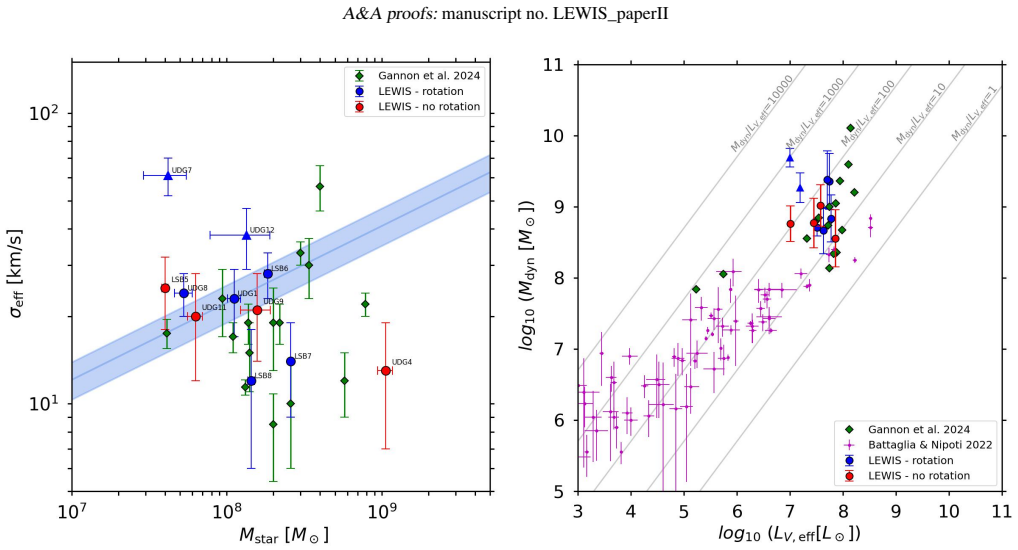
On the paper's own terms, the discovery is that ultra-diffuse galaxies in a cluster are not one kinematically uniform population. From the 2D stellar velocity maps, 7 of the 18 LEWIS galaxies show mild rotation with $\Delta V\sim25$–$40$ km s$^{-1}$ (three along the photometric major axis, four along an intermediate axis), 5 show no evidence of rotation, and 6 are unconstrained because their spectra are too faint. The paper presents this as the first large census of velocity profiles for UDGs and argues that the existence of rotating and non-rotating classes implies different formation pathways. It also finds $\sigma_{\rm eff}$ peaking near 20–30 km s$^{-1}$, dynamical mass-to-light ratios $M_{\rm dyn}/L_{V,\rm eff}\sim10$–$100$ $M_\odot/L_\odot$, and no clear correlation between kinematics and cluster-centric distance or infall stage.
Load-bearing premise
The classification into rotating and non-rotating systems assumes that small velocity differences in low-signal-to-noise spectra (some only about $2\sigma$, such as $\Delta V=41\pm21$ km s$^{-1}$ for UDG7 and UDG12) trace genuine stellar rotation rather than noise, projection effects, or tidal distortions; the paper itself states that an external tidal distortion could produce the same signal.
Editorial extensions
If this is right
- Two kinematic classes in the same cluster mean formation models must produce both rotation-supported and dispersion-supported UDGs, so the observed rotation fraction becomes a constraint on the relative rates of those channels.
- For rotating UDGs, $\sigma_{\rm eff}$ overestimates the true velocity dispersion, so dynamical masses computed from it (as for UDG7 and UDG12) can be wrong by up to an order of magnitude; $V_{\rm rms}$ is the safer input.
- The LEWIS UDGs and LSBs are dark-matter-dominated at levels above dwarf galaxies of the same luminosity, so any successful formation scenario must put these objects in massive halos or explain the high mass-to-light ratios otherwise.
- Absence of a clear correlation between rotation and cluster-centric distance or infall epoch argues that internal properties or pre-infall history, rather than current location in Hydra I, set the kinematics.
- The $\lambda_R$ values $0.25$–$0.35$ for five rotating galaxies show they are rotation-supported, consistent with simulated field UDGs, so cluster membership does not automatically erase rotational support.
Reading between the lines
- If the rotation is intrinsic, the cleanest testable extension is that the rotating and non-rotating classes should differ in globular-cluster system rotation and star formation histories; the planned LEWIS stellar-population and globular-cluster analyses can check whether the two classes have distinct ages or globular-cluster content.
- Because six of eighteen galaxies were unconstrained and several others yielded only two spatial bins, seven of eighteen is likely a lower limit on the rotating fraction; deeper data could make the split sharper or reveal a continuum.
- Rotation along an intermediate axis in roundish galaxies may be a signature of triaxiality or tidal perturbation rather than a disk; comparing the kinematic axis with isophotal twists and tidal tails would test whether the IR class is a true kinematic class or an artifact.
- The two-class claim predicts that independent measurements of dark matter content should separate the classes if they formed through different channels; the paper does not test that prediction, but GC dynamics from the same MUSE data could.
Signed reviews
Editorial analysis
A structured set of objections, weighed in public.
Referee Report
Summary. The paper presents MUSE integral-field spectroscopy for a sample of ultra-diffuse galaxies (UDGs) and low-surface-brightness (LSB) galaxies in the Hydra I cluster, as part of the LEWIS Large Programme. The authors measure stacked 1D velocity dispersions σ_eff, construct 2D stellar velocity fields via Voronoi binning, extract velocity profiles along photometric axes, and use the semi-amplitude ΔV to classify galaxies as rotating (R), rotating along an intermediate axis (IR), non-rotating (NR), or unconstrained (U). From these measurements they derive dynamical masses and dark-matter content, compare the sample with the Faber-Jackson relation, compute λ_R for five galaxies, and conclude that UDGs in Hydra I split into rotating and non-rotating classes, implying different formation channels.
Significance. If the central result holds, this is the first homogeneous, large census of spatially resolved stellar kinematics for UDGs in a cluster environment, providing a unique observational benchmark for formation scenarios (e.g., born versus tidal UDGs). The paper also delivers the first 2D velocity maps for a sample of UDGs, carefully characterizes the MUSE LSF, and uses Monte Carlo perturbations to estimate parameter uncertainties. These strengths make the paper potentially valuable for the UDG community, provided that the kinematic classification and the headline numbers are made robust and internally consistent.
major comments (4)
- [Abstract and Table 2] The abstract claims '7 out of 18 UDGs in LEWIS show a mild rotation', but Table 2 lists only four UDGs (UDG1, UDG7, UDG8, UDG12) with R or IR classifications; the remaining three rotators (LSB6, LSB7, LSB8) are LSB galaxies, not UDGs. The counts of 7 rotating, 5 non-rotating, and 6 unconstrained are therefore inconsistent with the table for the UDG subsample. This needs to be corrected in the abstract and Section 7, and the implications for the 'two classes of UDGs' conclusion must be re-evaluated.
- [Section 5.1, Table 2] The R/IR/NR classification is not reproducible from the quoted ΔV values because no quantitative significance threshold is defined and the assignments are not a monotonic function of ΔV/σ_ΔV. For example, UDG4 (NR) has ΔV = 18 ± 6 km/s (3σ), while UDG8 (IR) has ΔV = 20 ± 2 km/s (10σ), but UDG7 and UDG12 (R and IR) have ΔV = 41 ± 21 km/s (~2σ). The paper should adopt an objective criterion (e.g., a minimum ΔV/σ_ΔV, a comparison with noise from randomized bin shuffling, or a kinematic position-angle fit) and apply it uniformly; otherwise the two-class conclusion in Section 6 rests on a fragile qualitative judgment.
- [Section 5.1 and Section 6] The 'NR' class is defined as 'no evidence of rotation along any axis', which is an upper limit rather than a positive detection, given per-bin S/N = 6–11 (Section 4.2) and velocity profiles that do not extend beyond Reff (Section 5.1). The paper itself acknowledges that a measured velocity difference 'could be induced by an external tidal distortion rather than the internal stellar kinematics'. The conclusion that LEWIS UDGs 'can be grouped, on average, into two classes' therefore overstates the evidence: the observed ΔV distribution shows no demonstrated bimodality, and the non-rotating sample could contain undetected rotation. A quantitative treatment of the detection limits and a noise-injection test are needed to support the two-class claim.
- [Table 2, Section 5.1] UDG10 is listed as NR in Table 2 with ΔV = 18 ± 6 km/s, but it is omitted from the NR list in Section 5.1 (which names UDG4, UDG9, UDG11, and LSB5). This discrepancy affects the census and the abstract count of '5 do not have evidence of any rotation'. Please clarify whether UDG10 is classified as NR or unconstrained and update the text and figure accordingly.
minor comments (6)
- [Table 2] UDG7 and UDG12 both have ΔV = 41 ± 21 km/s and the identical uncertainty; please verify that this is not a typographical copy error, and report the actual measured values and errors.
- [Section 4.2, Figure 2] The caption of Figure 2 states that red and blue lines mark the photometric major and minor axes, but the text in Section 4.2 refers to 'apertures parallel to the photometric major and minor axes'; please clarify whether the velocity profiles are extracted in apertures parallel to the axes or along the axes themselves.
- [Section 5.3, Equation (5.3)] The Wolf et al. (2010) formula is quoted in text but not numbered; considering that the paper uses both σ_eff and V_rms for different galaxies, please number the equation and explicitly state the replacement of σ with V_rms in the rotating cases, as well as the caveat that the formula is strictly derived for dispersion-supported systems.
- [Section 5.4, Figure 5] The λ_R values are derived for only five galaxies, all LSBs and UDGs combined, and the figure shows no distinction between UDGs and LSBs; the text should avoid overinterpreting the 'rotation-supported' label for the sample as a whole, given the small number and the S/N limits.
- [Throughout] There are several typographical and formatting issues, including 'V oronoi' with a space, 'di fferent' and 'a ffected' with extra spaces, and inconsistent notation for S/N (e.g., 'S/N' vs 'S /N'). A careful proofreading pass is recommended.
- [Section 4.1] The text says that for S/N < 10 the estimate of σ_eff is 'heavily overestimated', but Figure 3 (left panel) includes only constrained-fit galaxies for the LEWIS sample; please state explicitly how the unconstrained and intermediate-fit galaxies are treated in the physical interpretation of σ_eff, beyond their exclusion from the FJ and Mdyn/L analyses.
Circularity Check
No significant circularity: the two-class result is a direct summary of the measured velocity profiles; the main self-reference is a minor, non-load-bearing citation to LEWIS Paper I for sigma_eff validation.
full rationale
The derivation chain is observational and self-contained with respect to the central claim. The line-of-sight velocity maps are produced by fitting MUSE spectra with pPXF in Voronoi bins, DeltaV is measured as the semi-difference of the first and last points of the extracted velocity profiles, and the R/IR/NR labels in Table 2 are a direct categorization of those profiles. The Section 6 conclusion of two classes of galaxies showing mild rotation and those not showing evidence of rotation along any axis restates that categorization rather than fitting it, so it is an empirical summary, not a circular derivation. The only same-team self-reference is the reliance on LEWIS Paper I (Iodice et al. 2023) for the Monte Carlo validation that sigma_eff can be recovered below the MUSE spectral resolution at S/N > 15; this validation is not reproduced as code in the present paper. However, it is not the load-bearing chain for the two-class rotation result, which depends on VLOS rather than sigma_eff, and the paper also cites independent support from Cappellari (2017) and Eftekhari et al. (2022). The reader-level concern that the R/IR/NR classification is qualitative, that some DeltaV values are only about 2 sigma, and that the NR class is an upper limit rather than a positive detection is a correctness and robustness issue, not a case of the prediction reducing to its inputs by construction. No fitted parameter is renamed as a prediction, no uniqueness theorem is imported from the authors' prior work, and no known result is repackaged under new coordinates. Therefore the paper has no significant circularity; the minor same-team methodological citation is not load-bearing for the main kinematic conclusion.
Assumptions & free parameters
free parameters (3)
- S/N threshold for constrained fit =
15
- S/N threshold for unconstrained fit =
10
- Target S/N for Voronoi binning =
5 to 11 per galaxy
assumptions (5)
- domain assumption All LEWIS targets lie at the Hydra I cluster distance and are cluster members.
- domain assumption pPXF estimates of σeff are unbiased at S/N>15 even below the MUSE spectral resolution, as demonstrated in LEWIS Paper I (Iodice et al. 2023).
- domain assumption The Wolf et al. (2010) mass estimator Mdyn=4Reff,cσeff^2/G gives the enclosed mass within the deprojected circularised half-light radius, including for mildly rotating systems via σeff≈Vrms.
- domain assumption The velocity differences along the photometric axes reflect internal stellar rotation rather than tidal distortion or noise.
- domain assumption Stellar masses from g and r photometry with the Into & Portinari (2013) colour-M/L relation are accurate.
Cite this review
Pith. "Pith review of Looking into the faintEst WIth MUSE (LEWIS): Exploring the nature of ultra-diffuse galaxies in the Hydra-I cluster II. Stellar kinematics and dynamical masses." pith.science (2026). https://pith.science/paper/5CTK345B
@misc{pith2026250116190,
  author       = {Pith},
  title        = {Pith review of: Looking into the faintEst WIth MUSE (LEWIS): Exploring the nature of ultra-diffuse galaxies in the Hydra-I cluster II. Stellar kinematics and dynamical masses},
  year         = {2026},
  howpublished = {\url{https://pith.science/paper/5CTK345B}},
  note         = {Machine review of arXiv:2501.16190}
}
abstract
Context: This paper focuses on a class of galaxies characterised by an extremely low surface brightness: the ultra-diffuse galaxies (UDGs). We used new integral-field spectroscopic data from the ESO Large Programme Looking into the faintEst WIth MUSE (LEWIS) project. Aims: Our main goals are addressing the formation channels and investigating possible correlations of their observational properties. In particular, we derive their stellar kinematics and dynamical properties. Methods: We extract the 1D stacked spectrum inside the effective radius to obtain an unbiased measure of $\sigma_{\rm eff}$. To derive the spatially-resolved stellar kinematics, we first apply the Voronoi tessellation algorithm to bin the spaxels in the datacube and then follow the same prescription adopted for the 1D case. In addition, we extract the velocity profiles along the galaxy's major and minor axes. Results: We find that 7 out of 18 UDGs in LEWIS show a mild rotation, 5 do not have evidence of any rotation, and the remaining 6 UDGs are unconstrained cases. This is the first large census of velocity profiles for UDGs. On average, UDGs in LEWIS are characterised by low values of $\sigma_{\rm eff}$, comparable with available values from the literature. In the Faber-Jackson relation plane, we found a group of UDGs consistent with the relation within the errorbars, whereas outliers are objects with non-negligible rotation components. UDGs and LSBs in LEWIS have larger dark matter content than dwarf galaxies with similar total luminosity. We do not find clear correlations between the derived properties and the local environment. Conclusions: Based on the stellar kinematics, two classes of UDGs are found in the Hydra I cluster: the rotating and non-rotating systems. This result, combined with other structural properties, can help to discriminate between the several formation scenarios proposed for UDGs.
Figures


Figures from the paper (4 more)


Forward citations
Cited by 1 Pith paper
-
Searching for Nearby Diffuse Dwarf Galaxies in the COSMOS Field
Three nearby low-surface-brightness dwarf galaxies, two of them ultra-diffuse galaxies, are identified in the COSMOS field and characterized with multiwavelength SED fitting.
Reference graph
Works this paper leans on
-
[1]
, " * write output.state after.block = add.period write newline
ENTRY address archiveprefix author booktitle chapter edition editor howpublished institution eprint journal key month note number organization pages publisher school series title type volume year label extra.label sort.label short.list INTEGERS output.state before.all mid.sentence after.sentence after.block FUNCTION init.state.consts #0 'before.all := #1 ...
-
[2]
write newline
" write newline "" before.all 'output.state := FUNCTION n.dashify 't := "" t empty not t #1 #1 substring "-" = t #1 #2 substring "--" = not "--" * t #2 global.max substring 't := t #1 #1 substring "-" = "-" * t #2 global.max substring 't := while if t #1 #1 substring * t #2 global.max substring 't := if while FUNCTION word.in bbl.in " " * FUNCTION format....
-
[3]
J., et al
Alabi , A., Ferr \'e -Mateu , A., Romanowsky , A. J., et al. 2018, , 479, 3308
2018
-
[4]
B., Romanowsky , A
Alabi , A. B., Romanowsky , A. J., Forbes , D. A., Brodie , J. P., & Okabe , N. 2020, , 496, 3182
2020
-
[5]
Amorisco , N. C. & Loeb , A. 2016, , 459, L51
2016
-
[6]
2012, , 545, A37
Arnaboldi , M., Ventimiglia , G., Iodice , E., Gerhard , O., & Coccato , L. 2012, , 545, A37
2012
-
[7]
M., Sip o cz , B
Astropy Collaboration , Price-Whelan , A. M., Sip o cz , B. M., et al. 2018, , 156, 123
2018
-
[8]
P., Tollerud , E
Astropy Collaboration , Robitaille , T. P., Tollerud , E. J., et al. 2013, , 558, A33
2013
Show all 129 references
-
[9]
2010, in , Vol
Bacon , R., Accardo , M., Adjali , L., et al. 2010, in , Vol. 7735, Ground-based and Airborne Instrumentation for Astronomy III, 773508
2010
-
[10]
2017, , 608, A1
Bacon , R., Conseil , S., Mary , D., et al. 2017, , 608, A1
2017
-
[11]
2016, MPDAF: MUSE Python Data Analysis Framework , Astrophysics Source Code Library, record ascl:1611.003
Bacon , R., Piqueras , L., Conseil , S., Richard , J., & Shepherd , M. 2016, MPDAF: MUSE Python Data Analysis Framework , Astrophysics Source Code Library, record ascl:1611.003
2016
-
[12]
& Nipoti , C
Battaglia , G. & Nipoti , C. 2022, Nature Astronomy, 6, 1492
2022
-
[13]
A., Romanowsky , A
Beasley , M. A., Romanowsky , A. J., Pota , V., et al. 2016, ApJL, 819, L20
2016
-
[14]
A., Sales , L
Benavides , J. A., Sales , L. V., Abadi , M. G., et al. 2023, , 522, 1033
2023
-
[15]
J., Zaritsky , D., et al
Bennet , P., Sand , D. J., Zaritsky , D., et al. 2018, , 866, L11
2018
-
[16]
2023, astropy/photutils: 1.8.0
Bradley, L., Sip o cz, B., Robitaille, T., et al. 2023, astropy/photutils: 1.8.0
2023
-
[17]
L., Forbes , D
Buzzo , M. L., Forbes , D. A., Brodie , J. P., et al. 2022, , 517, 2231
2022
-
[18]
L., Forbes , D
Buzzo , M. L., Forbes , D. A., Jarrett , T. H., et al. 2024, , 529, 3210
2024
-
[19]
2017, , 466, 798
Cappellari , M. 2017, , 466, 798
2017
-
[20]
& Copin , Y
Cappellari , M. & Copin , Y. 2003, , 342, 345
2003
-
[21]
& Emsellem , E
Cappellari , M. & Emsellem , E. 2004, , 116, 138
2004
-
[22]
Cardona-Barrero , S., Di Cintio , A., Brook , C. B. A., et al. 2020, , 497, 4282
2020
-
[23]
2021, , 502, 398
Carleton , T., Guo , Y., Munshi , F., Tremmel , M., & Wright , A. 2021, , 502, 398
2021
-
[24]
V., Afanasiev , A
Chilingarian , I. V., Afanasiev , A. V., Grishin , K. A., Fabricant , D., & Moran , S. 2019, , 884, 79
2019
-
[25]
Chilingarian , I. V. & Grishin , K. A. 2020, , 132, 064503
2020
-
[26]
V., Prugniel , P., Sil'Chenko , O
Chilingarian , I. V., Prugniel , P., Sil'Chenko , O. K., & Afanasiev , V. L. 2007, , 376, 1033
2007
-
[27]
& Zabludoff , A
Christlein , D. & Zabludoff , A. I. 2003, , 591, 764
2003
-
[28]
Collins , M. L. M., Read , J. I., Ibata , R. A., et al. 2021, , 505, 5686
2021
-
[29]
Collins , M. L. M., Tollerud , E. J., Rich , R. M., et al. 2020, MNRAS, 491, 3496
2020
-
[30]
S., et al
Courteau , S., Cappellari , M., de Jong , R. S., et al. 2014, Reviews of Modern Physics, 86, 47
2014
-
[31]
Danieli , S., van Dokkum , P., Conroy , C., Abraham , R., & Romanowsky , A. J. 2019, , 874, L12
2019
-
[32]
2022, ApJL, 927, L28
Danieli , S., van Dokkum , P., Trujillo-Gomez , S., et al. 2022, ApJL, 927, L28
2022
-
[33]
B., Dutton , A
Di Cintio , A., Brook , C. B., Dutton , A. A., et al. 2017, , 466, L1
2017
-
[34]
S., Peletier , R
Eftekhari , F. S., Peletier , R. F., Scott , N., et al. 2022, , 517, 4714
2022
-
[35]
2011, , 414, 888
Emsellem , E., Cappellari , M., Krajnovi \'c , D., et al. 2011, , 414, 888
2011
-
[36]
2007, , 379, 401
Emsellem , E., Cappellari , M., Krajnovi \'c , D., et al. 2007, , 379, 401
2007
-
[37]
Emsellem , E., van der Burg , R. F. J., Fensch , J., et al. 2019, , 625, A76
2019
-
[38]
2011, , 532, A95
Falc \'o n-Barroso , J., S \'a nchez-Bl \'a zquez , P., Vazdekis , A., et al. 2011, , 532, A95
2011
-
[39]
Fensch , J., van der Burg , R. F. J., Je r \'a bkov \'a , T., et al. 2019, , 625, A77
2019
-
[40]
A., et al
Ferr \'e -Mateu , A., Alabi , A., Forbes , D. A., et al. 2018 a , , 479, 4891
2018
-
[41]
A., et al
Ferr \'e -Mateu , A., Alabi , A., Forbes , D. A., et al. 2018 b , MNRAS, 479, 4891
2018
-
[42]
S., Forbes , D
Ferr \'e -Mateu , A., Gannon , J. S., Forbes , D. A., et al. 2023, MNRAS
2023
-
[43]
A., Alabi , A., Romanowsky , A
Forbes , D. A., Alabi , A., Romanowsky , A. J., Brodie , J. P., & Arimoto , N. 2020, , 492, 4874
2020
-
[44]
A., Gannon , J., Iodice , E., et al
Forbes , D. A., Gannon , J., Iodice , E., et al. 2023, , 525, L93
2023
-
[45]
A., Gannon , J
Forbes , D. A., Gannon , J. S., Romanowsky , A. J., et al. 2021, MNRAS, 500, 1279
2021
-
[46]
A., Read , J
Forbes , D. A., Read , J. I., Gieles , M., & Collins , M. L. M. 2018, MNRAS, 481, 5592
2018
-
[47]
M., et al
Freudling , W., Romaniello , M., Bramich , D. M., et al. 2013, , 559, A96
2013
-
[48]
S., Dullo , B
Gannon , J. S., Dullo , B. T., Forbes , D. A., et al. 2021, MNRAS, 502, 3144
2021
-
[49]
S., Ferr \'e -Mateu , A., Forbes , D
Gannon , J. S., Ferr \'e -Mateu , A., Forbes , D. A., et al. 2024, , 531, 1856
2024
-
[50]
S., Forbes , D
Gannon , J. S., Forbes , D. A., Brodie , J. P., et al. 2023, , 518, 3653
2023
-
[51]
S., Forbes , D
Gannon , J. S., Forbes , D. A., Romanowsky , A. J., et al. 2020, MNRAS, 495, 2582
2020
-
[52]
S., Forbes , D
Gannon , J. S., Forbes , D. A., Romanowsky , A. J., et al. 2022, , 510, 946
2022
-
[53]
2018, , 859, 37
Gu , M., Conroy , C., Law , D., et al. 2018, , 859, 37
2018
-
[54]
& Koposov , S
Huang , K.-W. & Koposov , S. E. 2021, , 500, 986
2021
-
[55]
Hunter , J. D. 2007, Computing in Science and Engineering, 9, 90
2007
-
[56]
& Portinari , L
Into , T. & Portinari , L. 2013, , 430, 2715
2013
-
[57]
2020 a , A&A, 642, A48
Iodice , E., Cantiello , M., Hilker , M., et al. 2020 a , A&A, 642, A48
2020
-
[58]
2020 b , , 642, A48
Iodice , E., Cantiello , M., Hilker , M., et al. 2020 b , , 642, A48
2020
-
[59]
2023, , 679, A69
Iodice , E., Hilker , M., Doll , G., et al. 2023, , 679, A69
2023
-
[60]
2021, , 652, L11
Iodice , E., La Marca , A., Hilker , M., et al. 2021, , 652, L11
2021
-
[61]
2020 c , , 635, A3
Iodice , E., Spavone , M., Cattapan , A., et al. 2020 c , , 635, A3
2020
-
[62]
M., & Dolag , K
Ivleva , A., Remus , R.-S., Valenzuela , L. M., & Dolag , K. 2024, , 687, A105
2024
-
[63]
R., Romanowsky , A
Janssens , S. R., Romanowsky , A. J., Abraham , R., et al. 2022, MNRAS, 517, 858
2022
-
[64]
P., Koposov , S
Ji , A. P., Koposov , S. E., Li , T. S., et al. 2021, , 921, 32
2021
-
[65]
D., Makarova , L
Karachentsev , I. D., Makarova , L. N., Sharina , M. E., & Karachentseva , V. E. 2017, Astrophysical Bulletin, 72, 376
2017
-
[66]
2015, , 807, L2
Koda , J., Yagi , M., Yamanoi , H., & Komiyama , Y. 2015, , 807, L2
2015
-
[67]
& Bonev , T
Kostov , A. & Bonev , T. 2018, Bulgarian Astronomical Journal, 28, 3
2018
-
[68]
G., Carter , D., et al
Kourkchi , E., Khosroshahi , H. G., Carter , D., et al. 2012, , 420, 2819
2012
-
[69]
2024, The Open Journal of Astrophysics, 7
Kravtsov, A. 2024, The Open Journal of Astrophysics, 7
2024
-
[70]
2022 a , , 665, A105
La Marca , A., Iodice , E., Cantiello , M., et al. 2022 a , , 665, A105
2022
-
[71]
2022 b , , 659, A92
La Marca , A., Peletier , R., Iodice , E., et al. 2022 b , , 659, A92
2022
-
[72]
P., Janowiecki , S., et al
Leisman , L., Haynes , M. P., Janowiecki , S., et al. 2017, , 842, 133
2017
-
[73]
2015, , 584, A113
Lelli , F., Duc , P.-A., Brinks , E., et al. 2015, , 584, A113
2015
-
[74]
W., et al
Lim , S., C \^o t \'e , P., Peng , E. W., et al. 2020, , 899, 69
2020
-
[75]
W., C \^o t \'e , P., et al
Lim , S., Peng , E. W., C \^o t \'e , P., et al. 2018, ApJ, 862, 82
2018
-
[76]
2021, , 500, 1323
Lima-Dias , C., Monachesi , A., Torres-Flores , S., et al. 2021, , 500, 1323
2021
-
[77]
okas , E. L. 2024, , 687, A82
2024
-
[78]
R., Habas , R., Poulain , M., et al
Marleau , F. R., Habas , R., Poulain , M., et al. 2021, , 654, A105
2021
-
[79]
2019, , 485, 796
Martin , G., Kaviraj , S., Laigle , C., et al. 2019, , 485, 796
2019
-
[80]
F., Ibata , R
Martin , N. F., Ibata , R. A., Lewis , G. F., et al. 2016, ApJ, 833, 167
2016
-
[81]
J., Brodie , J
Mart \' n-Navarro , I., Romanowsky , A. J., Brodie , J. P., et al. 2019, , 484, 3425
2019
-
[82]
2016, AJ, 151, 96
Mart \' nez-Delgado , D., L \"a sker , R., Sharina , M., et al. 2016, AJ, 151, 96
2016
-
[83]
McConnachie , A. W. 2012, , 144, 4
2012
-
[84]
C., Durrell , P
Mihos , J. C., Durrell , P. R., Toloba , E., et al. 2022, ApJ, 924, 87
2022
-
[85]
R., Marleau , F
M \"u ller , O., Durrell , P. R., Marleau , F. R., et al. 2021, , 923, 9
2021
-
[86]
R., Duc , P.-A., et al
M \"u ller , O., Marleau , F. R., Duc , P.-A., et al. 2020, A&A, 640, A106
2020
-
[87]
M., Rom \'a n , J., et al
M \"u ller , O., Rich , R. M., Rom \'a n , J., et al. 2019, , 624, L6
2019
-
[88]
J., Laine , S., et al
Pandya , V., Romanowsky , A. J., Laine , S., et al. 2018, , 858, 29
2018
-
[89]
2017, arXiv e-prints, arXiv:1710.03554
Piqueras , L., Conseil , S., Shepherd , M., et al. 2017, arXiv e-prints, arXiv:1710.03554
2017 arXiv
-
[90]
2018, , 474, 580
Ploeckinger , S., Sharma , K., Schaye , J., et al. 2018, , 474, 580
2018
-
[91]
M., Gullieuszik , M., Tonnesen , S., et al
Poggianti , B. M., Gullieuszik , M., Tonnesen , S., et al. 2019, , 482, 4466
2019
-
[92]
J., Hilker , M., van der Burg , R
Prole , D. J., Hilker , M., van der Burg , R. F. J., et al. 2019, , 484, 4865
2019
-
[93]
2017, , 843, 128
Rhee , J., Smith , R., Choi , H., et al. 2017, , 843, 128
2017
-
[94]
& Trujillo , I
Rom \'a n , J. & Trujillo , I. 2017, , 468, 703
2017
-
[95]
2017, , 470, 4231
Rong , Y., Guo , Q., Gao , L., et al. 2017, , 470, 4231
2017
-
[96]
A., Falc \'o n-Barroso , J., et al
Ruiz-Lara , T., Beasley , M. A., Falc \'o n-Barroso , J., et al. 2018, MNRAS, 478, 2034
2018
-
[97]
2022, , 511, 4633
Saifollahi , T., Zaritsky , D., Trujillo , I., et al. 2022, , 511, 4633
2022
-
[98]
V., Navarro , J
Sales , L. V., Navarro , J. F., Pe \ n afiel , L., et al. 2020, , 494, 1848
2020
-
[99]
& Binggeli , B
Sandage , A. & Binggeli , B. 1984, , 89, 919
1984
-
[100]
S., Peletier , R
Scott , N., Eftekhari , F. S., Peletier , R. F., et al. 2020, , 497, 1571
2020
-
[101]
P., van Dokkum , P., et al
Shen , Z., Bowman , W. P., van Dokkum , P., et al. 2024, arXiv e-prints, arXiv:2407.05200
2024 arXiv
-
[102]
2021, ApJL, 914, L12
Shen , Z., Danieli , S., van Dokkum , P., et al. 2021, ApJL, 914, L12
2021
-
[103]
2023, arXiv e-prints, arXiv:2309.08592
Shen , Z., van Dokkum , P., & Danieli , S. 2023, arXiv e-prints, arXiv:2309.08592
2023 arXiv
-
[104]
2019, , 488, L24
Silk , J. 2019, , 488, L24
2019
-
[105]
T., Lilly , S
Soto , K. T., Lilly , S. J., Bacon , R., Richard , J., & Conseil , S. 2016, , 458, 3210
2016
-
[106]
S., et al
Spavone , M., Iodice , E., Lohmann , F. S., et al. 2024, , 689, A306
2024
-
[107]
2018, , 856, L31
Toloba , E., Lim , S., Peng , E., et al. 2018, , 856, L31
2018
-
[108]
V., Lim , S., et al
Toloba , E., Sales , L. V., Lim , S., et al. 2023, arXiv e-prints, arXiv:2305.06369
2023 arXiv
-
[109]
E., et al
Torrealba , G., Belokurov , V., Koposov , S. E., et al. 2019, MNRAS, 488, 2743
2019
-
[110]
C., Brooks , A
Tremmel , M., Wright , A. C., Brooks , A. M., et al. 2020, , 497, 2786
2020
-
[111]
van der Burg , R. F. J., Hoekstra , H., Muzzin , A., et al. 2017, , 607, A79
2017
-
[112]
C., & Varoquaux , G
van der Walt , S., Colbert , S. C., & Varoquaux , G. 2011, Computing in Science and Engineering, 13, 22
2011
-
[113]
2016, , 828, L6
van Dokkum , P., Abraham , R., Brodie , J., et al. 2016, , 828, L6
2016
-
[114]
J., et al
van Dokkum , P., Abraham , R., Romanowsky , A. J., et al. 2017, ApJL, 844, L11
2017
-
[115]
van Dokkum , P., Danieli , S., Abraham , R., Conroy , C., & Romanowsky , A. J. 2019 a , , 874, L5
2019
-
[116]
van Dokkum , P., Danieli , S., Abraham , R., Conroy , C., & Romanowsky , A. J. 2019 b , , 874, L5
2019
-
[117]
2018, Nature, 555, 629
van Dokkum , P., Danieli , S., Cohen , Y., et al. 2018, Nature, 555, 629
2018
-
[118]
A., et al
van Dokkum , P., Shen , Z., Keim , M. A., et al. 2022, Nature, 605, 435
2022
-
[119]
G., Romanowsky , A
van Dokkum , P. G., Romanowsky , A. J., Abraham , R., et al. 2015, , 804, L26
2015
-
[120]
2016, , 463, 3409
Vazdekis , A., Koleva , M., Ricciardelli , E., R \"o ck , B., & Falc \'o n-Barroso , J. 2016, , 463, 3409
2016
-
[121]
J., et al
Vazdekis , A., Ricciardelli , E., Cenarro , A. J., et al. 2012, , 424, 157
2012
-
[122]
J., Brodie , J., et al
Villaume , A., Romanowsky , A. J., Brodie , J., et al. 2022, , 924, 32
2022
-
[123]
E., et al
Virtanen, P., Gommers, R., Oliphant, T. E., et al. 2020, Nature Methods, 17, 261
2020
-
[124]
A., Stinson , G
Wang , L., Dutton , A. A., Stinson , G. S., et al. 2015, , 454, 83
2015
-
[125]
A., Villaume , A., Laine , S., et al
Webb , K. A., Villaume , A., Laine , S., et al. 2022, MNRAS, 516, 3318
2022
-
[126]
M., Palsa , R., Streicher , O., et al
Weilbacher , P. M., Palsa , R., Streicher , O., et al. 2020, , 641, A28
2020
-
[127]
D., Bullock , J
Wolf , J., Martinez , G. D., Bullock , J. S., et al. 2010, , 406, 1220
2010
-
[128]
2016, , 225, 11
Yagi , M., Koda , J., Komiyama , Y., & Yamanoi , H. 2016, , 225, 11
2016
-
[129]
2022, , 261, 11
Zaritsky , D., Donnerstein , R., Karunakaran , A., et al. 2022, , 261, 11
2022
Reviewed August 10, 2026 · model on record in the stance chip above.
Discussion (0). Continue with ORCID to comment.