REVIEW 4 major objections 5 minor 59 references
Convection-modulated topological edge mode and extended-localized criticality in thermal metamaterials
T0 review · 4 major / 5 minor · reviewed 2026-08-10 · deepseek-v4-flash
Pith's one-line read Sinusoidally modulated ring rotations make thermal diffusion reproduce a non-Hermitian tight-binding model with imaginary on-site potential, producing exponentially localized topological edge modes and an extended-localized transition at…
desk verdict A clean numerical transfer of the imaginary-AAH model to convection-driven thermal rings; the m=1 sector works, but the temperature-field claims need an explicit m=0 filter. read the letter →
The pith
A machine-rendered reading of the paper's core claim, the machinery that carries it, and where it could break.
The reading
What carries the argument
The mechanism is the advection-to-imaginary-potential mapping in a coupled ring chain. Each ring obeys the diffusion-convection equation $\partial_t T_j = (\kappa/\rho C)\partial_x^2 T_j + v_j\partial_x T_j + h(T_{j-1}+T_{j+1}-2T_j)$; the plane-wave ansatz $T_j=A_j e^{i(\beta x-\omega t)}$ converts the rotating-velocity term $v_j\partial_x T_j$ into $i\beta v_j A_j$. With the fundamental azimuthal mode $\beta=1/R$ and the choice $v_j=R V\sin(2\pi\alpha j+\delta)$, this becomes the imaginary on-site potential $iV_j$ of the non-Hermitian Aubry–André–Harper (AAH)-type Hamiltonian, while the coupling $h$ plays the role of the hopping $t$. The periodic case $\alpha=1/4$ gives the imaginary band gap and edge modes protected by non-Hermitian particle-hole symmetry; the quasiperiodic case $\alpha=(\sqrt{5}-1)/2$ gives the extended-localized transition, with IPR and Lyapunov exponent as diagnostics. This same machinery is what lets the simulated temperature fields exhibit the predicted localization and critical behavior.
What would settle it
Measure the azimuthal temperature profile on the rings in the $\alpha=1/4$ configuration, or simulate Eq. (3) without the $m=1$ truncation: if modes other than $m=1$ carry significant amplitude, the imaginary spectrum should show no protected gap and the edge-ring temperature should decay at a rate different from the predicted $-\mathrm{Im}(\omega)_{\mathrm{edge}}=0.101$ rad/s.
Extended reading notes
Core claim
At the center of the paper is the claim that a chain of coupled rotating rings can translate thermal convection into the imaginary on-site potential of a non-Hermitian tight-binding model. Starting from Fourier's law with a convection term, the authors substitute the plane-wave ansatz $T_j=A_j e^{i(\beta x-\omega t)}$ and keep only the fundamental azimuthal mode ($m=1$, so $\beta=1/R$). The effective Hamiltonian then has the same form as $\hat{H}=t\sum_j(a_j^\dagger a_{j+1}+\mathrm{H.c.})+i\sum_j V_j a_j^\dagger a_j$, up to an overall factor $i$ and a constant shift, with $V_j=V\sin(2\pi\alpha j+\delta)$ when each ring rotates at $v_j=R V\sin(2\pi\alpha j+\delta)$. For $\alpha=1/4$ the imaginary spectrum develops a gap containing topological edge modes whose temperature fields decay exponentially at the boundary rings; the non-Hermitian electric polarization takes the quantized value $|p_x|=1/2$ in the nontrivial phase. For $\alpha=(\sqrt{5}-1)/2$ the bulk modes undergo an extended-localized transition at $V=2h$, confirmed by the inverse participation ratio, the Lyapunov exponent, and transient temperature simulations in which the localized phase shows moving multiple localization centers.
Load-bearing premise
Everything rests on the assumption that the temperature around each ring is a single rotating wave with one wavelength around the circumference, so the rotation speed becomes a clean imaginary on-site potential and the constant shift can be dropped; if higher-order azimuthal modes or geometry-dependent coupling change that wavelength, the predicted edge modes and transition need not appear.
Editorial extensions
If this is right
- A thermal device built on this scheme can hold heat at its boundary rings and release it with a controlled exponential decay rate, with the edge mode surviving disorder in the ring rotation velocities.
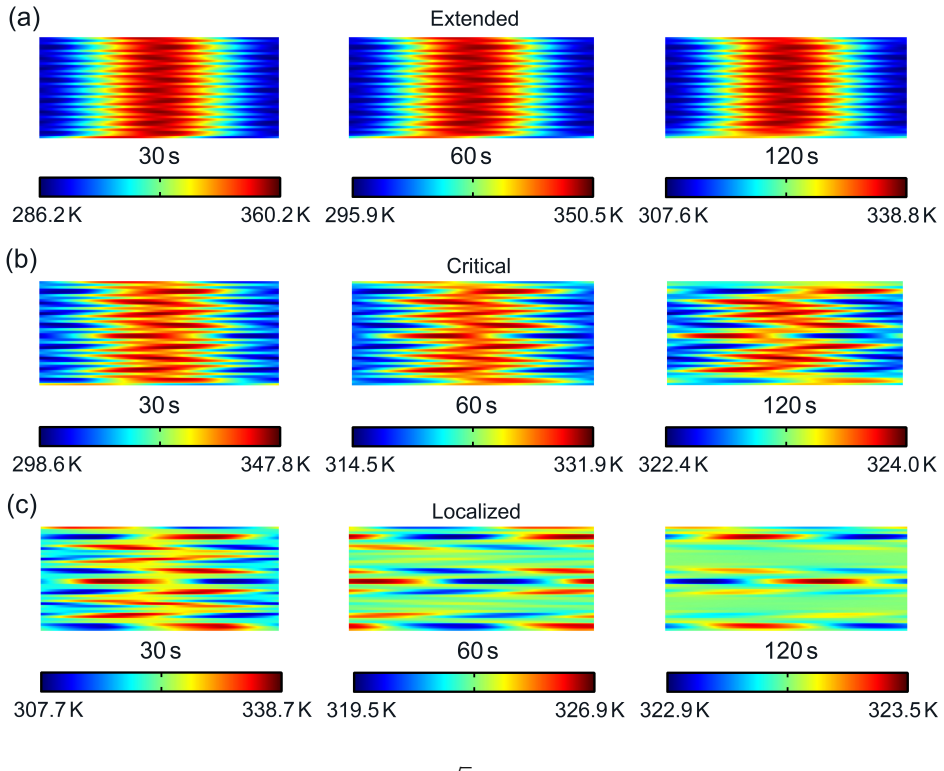
- The quasiperiodic modulation gives a heat-flow switch: below $V=2h$ the temperature field stays extended and nearly stationary, while above $V=2h$ it breaks into moving localized hotspots, so the convection amplitude controls whether heat spreads uniformly or concentrates.
- Because the control parameter is rotation speed rather than material thermal conductivity, the same ring chain can be reconfigured dynamically, offering a practical route to programmable thermal routing.
- In the localized phase the moving multiple localization centers can drive thermoelectric generation, e.g., as a double-trace generator that powers two loads simultaneously.
- The observed signatures are inherently diffusive: the topological edge mode decays in time rather than propagating, so experimental tests should look at transient cooling of edge rings, not steady-state wave transport.
Reading between the lines
- Editorial inference: the same convection-modulation mapping should work for higher azimuthal modes ($m>1$), yielding effective tight-binding models with different parameters or longer-range couplings and thereby a broader family of thermal Hamiltonians than the AAH form considered here.
- Editorial inference: since rotation speeds can be varied in time, sweeping the phase $\delta$ or the amplitude $V$ slowly should realize adiabatic topological pumping of heat across the chain, a dynamical protocol the paper does not discuss.
- Editorial inference: the mechanism is not obviously restricted to one-dimensional chains; a two-dimensional lattice of rotating rings could realize imaginary-potential landscapes that produce corner modes or skin-effect-like heat accumulation, which the paper leaves unexamined.
Signed reviews
Editorial analysis
A structured set of objections, weighed in public.
Referee Report
Summary. The manuscript proposes a thermal-metamaterial realization of the non-Hermitian Aubry-André-Harper (AAH) model with a purely imaginary onsite potential. The key idea is a chain of coupled rings whose rotation velocities are modulated sinusoidally as v_j = R V sin(2πα j + δ), so that advection in each ring acts as an effective imaginary potential after a plane-wave ansatz is made for the azimuthal temperature dependence. For α = 1/4 the authors predict topological edge modes inside an imaginary band gap, and for α = (√5−1)/2 they predict an extended-localized transition at V = 2h. The claims are supported by tight-binding spectra, polarization calculations, COMSOL eigenvalue simulations, transient temperature-field simulations, and a disorder-robustness test. The central mapping from the diffusion equation to the tight-binding model, Eq. (3) to Eq. (4), is standard but relies on a single-mode (m = 1) truncation and omits the effect of the m = 0 sector.
Significance. If the mapping is valid, the work makes a useful contribution to topological thermotics by showing that a dynamically tunable parameter—convection—can implement non-Hermitian topological phases and localization criticality in a purely dissipative platform. The proposed design is physically concrete and the simulations include explicit COMSOL spectra, eigenfields, and transient temperature fields, giving the paper a practical character. A notable strength is that the connection between the diffusion equation and the non-Hermitian tight-binding model is derived without fitted parameters, and the disorder test in Appendix C addresses robustness explicitly. The main significance, however, is conditional on the m = 1 projection: if the observable temperature fields are not filtered to the m = 1 sector, the claimed edge-mode localization and the V = 2h criticality are not properties of the physical temperature field, because the decoupled m = 0 sector dominates at long times and contains no convection-induced imaginary potential.
major comments (4)
- [Sec. II, Eq. (4)] The reduction from Eq. (3) to Eq. (4) uses the ansatz T_j = A_j e^{i(βx−ωt)} with β = m/R. Because the velocity modulation v_j is independent of x, different azimuthal orders m are decoupled: each m satisfies its own tight-binding chain with onsite term β v_j = (m/R) v_j and uniform loss S_m = −D(m/R)^2 − 2h. The m = 0 sector has β = 0, so it has no convection-induced imaginary potential and its decay rate is simply −2h, which is slower than the m = 1 decay rate. The manuscript never states whether the transient temperature-field simulations in Figs. 4 and 6 are filtered to m = 1 or intended to show the raw temperature field. The linear initial condition described in Appendix B certainly contains an m = 0 component. If the plotting or analysis subtracts the azimuthal average, this must be stated explicitly; otherwise the displayed localization and criticality may be artifacts of the m = 1 projection rather than of the physical temperature field.
- [Sec. II, paragraph after Eq. (4)] The sentence 'the coupled ring chain Hamiltonian Eq. 4 has the same form with the model Hamiltonian Eq. 1, differing only by a factor of i' is incomplete. Eq. (4) contains the uniform imaginary onsite term iS, with S = −[β²κ/(ρC) + 2h], in addition to the modulated term. The uniform shift iS does not change eigenstates but it does shift all decay rates and therefore affects the quantitative comparison in Fig. 4(d), where the reported edge-mode decay rate −Im(ω)_edge = 0.101 rad/s includes the contribution of S. The exact relation is Eq. (4) = iH + iS (with t = h), not merely a factor of i. Please state this explicitly and account for S when comparing decay rates.
- [Sec. II, justification of m = 1 truncation] The statement that 'only the slowest decaying mode can be observed in diffusion systems' does not justify the choice m = 1, because the m = 0 mode decays with rate −2h, which is slower than the m = 1 mode. If the slowest-decay argument is used, it selects m = 0, not m = 1. The choice m = 1 must be justified either by the initial excitation (preparation of a specific azimuthal profile) or by an explicit statement that the m = 0 component is removed from the observables. As written, the selection of m = 1 is an ad hoc truncation that is load-bearing for all subsequent claims about edge modes and criticality.
- [Sec. IV, Figs. 5 and 6] The extended-localized transition at V = 2h is demonstrated for the tight-binding model in Fig. 5, and the temperature-field simulations in Fig. 6 are presented as supporting evidence. But if the temperature field is not restricted to the m = 1 sector, the agreement between Fig. 5 and Fig. 6 is not a test of the criticality claim. In particular, the m = 0 sector always contributes a uniform, slowly decaying component, so the 'extended' temperature field at V = h and the 'localized' temperature field at V = 3h need to be shown to be m = 1 observables. Please specify how the m = 0 sector is handled in the transient simulation and in the displayed temperature fields.
minor comments (5)
- [Abstract and Sec. I] The phrase 'fantastic tunability' is informal for a journal article; consider replacing it with a more quantitative or precise statement about the tunability of convection.
- [Throughout] There are several typographical artifacts, including 'di ffusion' in the abstract and main text; these should be corrected to 'diffusion'.
- [Appendix B, Eq. (3)] The interlayer coupling terms h[T_{j−1} − T_j] + h[T_{j+1} − T_j] need a brief statement of the open boundary condition for j = 1 and j = N, since the summation limits are not specified in the text.
- [Appendix C] The sentence 'the times of sampling is 50' is a grammatical error; it should read 'the number of disorder samples is 50.'
- [Appendix F, Fig. 11 caption] The color name 'modena' is not standard; please provide an RGB value or a conventional color name for the cold source.
Circularity Check
No significant circularity: the thermal-to-tight-binding mapping is derived in the text, the AAH results are imported from external prior work, and the COMSOL simulations are parameter-free consistency checks.
full rationale
The derivation chain starts from Fourier's equation (Eq. 3). Substituting T_j = A_j e^{i(beta x - omega t)} and keeping the m=1 sector yields Eq. 4 with hopping ih and onsite term iS - beta v_j; setting v_j = R V sin(2*pi*alpha*j + delta) gives an imaginary onsite modulation proportional to V sin(...), i.e., the imaginary-AAH model of Eq. 1 up to an overall factor and a constant shift S. This is an algebraic mapping, not a fitted relation. The amplitude V and phase delta are design inputs, and the topological edge-mode and localization properties of Eq. 1 are imported from external prior work (Refs. 19, 33, 34), not from a self-citation chain. The COMSOL eigenvalue and transient simulations are numerical integrations of the same PDE with fixed material parameters; no parameter is fitted to a target output, so the simulations are consistency checks rather than predictions that reduce to their inputs. Self-citations [56-59] supply the ring-chain geometry and are not load-bearing: the crucial Hamiltonian reduction is written out in Eqs. (3)-(4). The restriction to the m=1 sector and the neglected m=0/slow-diffusion sector is a modeling approximation that may affect whether raw temperature fields show the claimed criticality, but this is a validity/correctness limitation, not circularity. The constant shift S is a uniform imaginary offset that does not alter eigenstate localization, though it shifts decay rates; the paper's comparison with Eq. 1 is somewhat loose, but again this is an imprecision rather than a circular reduction.
Assumptions & free parameters
free parameters (3)
- Onsite potential amplitude V =
h, 2h, 3h (simulation cases)
- Phase δ =
0.25π, 0.75π, 0.4π
- Inverse period α =
1/4 and (√5−1)/2
assumptions (4)
- domain assumption Fourier's law with advection terms: Eq. (3) describes heat transport in each rotating ring.
- domain assumption Plane-wave ansatz and m=1 truncation for the ring temperature field.
- standard math Known results for the imaginary-AAH model: α=1/4 gives topological edge modes; irrational α gives extended-localized transition at V=2h.
- standard math Non-Hermitian bulk-edge correspondence and biorthogonal Wilson-loop polarization (Appendix A).
Cite this review
Pith. "Pith review of Convection-modulated topological edge mode and extended-localized criticality in thermal metamaterials." pith.science (2026). https://pith.science/paper/6TIWAHAH
@misc{pith2026250116705,
  author       = {Pith},
  title        = {Pith review of: Convection-modulated topological edge mode and extended-localized criticality in thermal metamaterials},
  year         = {2026},
  howpublished = {\url{https://pith.science/paper/6TIWAHAH}},
  note         = {Machine review of arXiv:2501.16705}
}
read the original abstract
Convection offers a dynamic and flexible approach to achieving a variety of novel physical phenomena beyond pure conduction. Here, we demonstrate that thermal metamaterials with convection modulation enable the realization of non-Hermitian topological edge modes and bulk mode criticality. We illustrate that a periodic modulation can induce localized edge modes within the band gap. The temperature field of the topological state is localized at the edge rings, decaying exponentially at a fixed rate. Additionally, we introduce an extended-localized criticality through the quasiperiodic convection modulation in thermotics. The convections have an advantage of fantastic tunability in the application. Our work proposes a scheme for implementing topological modes and bulk mode criticality through modulating convection in diffusion systems, paving the way for the design of reconfigurable thermal devices.
Figures


Figures from the paper (8 more)




Reference graph
Works this paper leans on
-
[1]
M. Z. Hasan and C. L. Kane, Colloquium: Topological insulators, Rev. Mod. Phys. 82, 3045 (2010)
2010
-
[2]
Qi and S.-C
X.-L. Qi and S.-C. Zhang, Topological insulators and superconductors, Rev. Mod. Phys. 83, 1057 (2011)
2011
-
[3]
L. Lu, J. D. Joannopoulos, and M. Solja ˇci´c, Topological photonics, Nat. Photonics 8, 821 (2014)
work page 2014
-
[4]
Ozawa, H
T. Ozawa, H. M. Price, A. Amo, N. Goldman, M. Hafezi, L. Lu, M. C. Rechtsman, D. Schuster, J. Simon, O. Zilberberg, and I. Carusotto, Topological photonics, Rev. Mod. Phys.91, 015006 (2019)
2019
-
[5]
H. Xue, Y . Yang, and B. Zhang, Topological acoustics, Nat. Rev. Mater.7, 974 (2022)
2022
-
[6]
S. D. Huber, Topological mechanics, Nat. Phys. 12, 621 (2016)
2016
-
[7]
S. Aubry and G. Andr ´e, Analyticity breaking and Anderson localization in incommensurate lattices, Ann. Isr. Phys. Soc. 3, 133 (1980)
work page 1980
-
[8]
P. G. Harper, Single band motion of conduction electrons in a uniform magnetic field, Proc. Phys. Soc. London Sect. A 68, 874 (1955)
work page 1955
Show all 59 references
-
[9]
L.-J. Lang, X. Cai, and S. Chen, Edge states and topological phases in one-dimensional optical super- lattices, Phys. Rev. Lett. 108, 220401 (2012)
2012
-
[10]
Kraus, Y
Y . Kraus, Y . Lahini, Z. Ringel, M. Verbin, and O. Zilberberg, Topological states and adiabatic pumping in quasicrystals, Phys. Rev. Lett. 109, 106402 (2012)
2012
-
[11]
Verbin, O
M. Verbin, O. Zilberberg, Y . E. Kraus, Y . Lahini, and Y . Silberberg, Observation of topological phase transitions in photonic quasicrystals, Phys. Rev. Lett. 110, 076403 (2013)
2013
-
[12]
Roati, C
G. Roati, C. D’Errico, L. Fallani, M. Fattori, C. Fort, M. Zaccanti, G. Modugno, M. Modugno, and M. Inguscio, Anderson localization of a non-interacting Bose-Einstein condensate, Nature 453, 895 (2008)
2008
-
[13]
Lahini, R
Y . Lahini, R. Pugatch, F. Pozzi, M. Sorel, R. Morandotti, N. Davidson, and Y . Silberberg, Direct observation of a localization transition in quasiperiodic photonic lattices, Phys. Rev. Lett.103, 013901 (2009)
2009
-
[14]
Ashida, Z
Y . Ashida, Z. Gong, and M. Ueda, Non-Hermitian physics, Adv. Phys.69, 249 (2020)
2020
-
[15]
E. J. Bergholtz, J. C. Budich, and F. K. Kunst, Exceptional topology of non-Hermitian systems, Rev. Mod. Phys. 93, 015005 (2021). 19
2021
-
[16]
Yao and Z
S. Yao and Z. Wang, Edge states and topological invariants of non-Hermitian systems, Phys. Rev. Lett. 121, 086803 (2018)
2018
-
[17]
Zhang, T
X. Zhang, T. Zhang, M.-H. Lu, and Y .-F. Chen, A review on non-Hermitian skin effect, Adv. Phys. X 7, 2109431 (2022)
2022
-
[18]
R. Lin, T. Tai, L. Li, and C. H. Lee, Topological non-Hermitian skin e ffect, Front. Phys. 18, 53605 (2023)
2023
-
[19]
Takata and M
K. Takata and M. Notomi, Photonic topological insulating phase induced solely by gain and loss, Phys. Rev. Lett. 121, 213902 (2018)
2018
-
[20]
Luo and C
X.-W. Luo and C. Zhang, Higher-order topological corner states induced by gain and loss, Phys. Rev. Lett. 123, 073601 (2019)
2019
-
[21]
L. Yu, H. Xue, R. Guo, E. A. Chan, Y . Y . Terh, C. Soci, B. Zhang, and Y . D. Chong, Dirac mass induced by optical gain and loss, Nature 632, 63 (2024)
2024
-
[22]
H. Zhao, X. Qiao, T. Wu, B. Midya, S. Longhi, and L. Feng, Non-Hermitian topological light steering, Science 365, 1163 (2019)
2019
-
[23]
Bogaerts, D
W. Bogaerts, D. P ´erez, J. Capmany, D. A. B. Miller, J. Poon, D. Englund, F. Morichetti, and A. Melloni, Programmable photonic circuits, Nature 586, 207 (2020)
2020
-
[24]
P ´erez-L´opez, A
D. P ´erez-L´opez, A. L ´opez, P. DasMahapatra, and J. Capmany, Multipurpose self-configuration of programmable photonic circuits, Nat. Commun. 11, 6359 (2020)
2020
-
[25]
M. B. On, F. Ashtiani, D. Sanchez-Jacome, D. Perez-Lopez, S. J. B. Yoo, and A. Blanco-Redondo, Programmable integrated photonics for topological Hamiltonians, Nat. Commun. 15, 629 (2024)
2024
-
[26]
Longhi, Topological phase transition in non-Hermitian quasicrystals, Phys
S. Longhi, Topological phase transition in non-Hermitian quasicrystals, Phys. Rev. Lett. 122, 237601 (2019)
2019
-
[27]
Longhi, Metal-insulator phase transition in a non-Hermitian Aubry-Andr ´e-Harper model, Phys
S. Longhi, Metal-insulator phase transition in a non-Hermitian Aubry-Andr ´e-Harper model, Phys. Rev. B 100, 125157 (2019)
2019
-
[28]
Jiang, L
H. Jiang, L. Lang, C. Yang, S.-L. Zhu, and S. Chen, Interplay of non-Hermitian skin e ffects and Anderson localization in non-reciprocal quasiperiodic lattices, Phys. Rev. B 100, 054301 (2019)
2019
-
[29]
Y . Liu, Y . Wang, X.-J. Liu, Q. Zhou, and S. Chen, Exact mobility edges,PT-symmetry breaking and skin effect in one-dimensional non-Hermitian quasicrystals, Phys. Rev. B 103, 014203 (2021)
2021
-
[30]
Y . Liu, Q. Zhou, and S. Chen, Localization transition, spectrum structure and winding numbers for one-dimensional non-Hermitian quasicrystals, Phys. Rev. B 104, 024201 (2021). 20
2021
-
[31]
Y . Wang, X. Xia, L. Zhang, H. Yao, S. Chen, J. You, Q. Zhou, and X.-J. Liu, One-dimensional quasiperiodic mosaic lattice with exact mobility edges, Phys. Rev. Lett. 125, 196604 (2020)
2020
-
[32]
X.-C. Zhou, Y . Wang, T.-F. J. Poon, Q. Zhou, and X.-J. Liu, Exact new mobility edges between critical and localized states, Phys. Rev. Lett. 131, 176401 (2023)
2023
-
[33]
Zhu, L.-J
B. Zhu, L.-J. Lang, Q. Wang, Q. J. Wang, and Y . D. Chong, Topological transitions with an imaginary Aubry-Andr´e-Harper potential, Phys. Rev. Res. 5, 023044 (2023)
2023
-
[34]
E. L. Pereira, H. Li, A. Blanco-Redondo, and J. L. Lado, Non-Hermitian topology and criticality in photonic arrays with engineered losses, Phys. Rev. Res. 6, 023004 (2024)
2024
-
[35]
S. Yang, J. Wang, G. Dai, F. Yang, and J. Huang, Controlling macroscopic heat transfer with thermal metamaterials: Theory, experiment and application, Phys. Rep. 908, 1 (2021)
2021
-
[36]
Y . Li, W. Li, T. Han, X. Zheng, J. Li, B. Li, S. Fan, and C.-W. Qiu, Transforming heat transfer with thermal metamaterials and devices, Nat. Rev. Mater.6, 488 (2021)
2021
-
[37]
Zhang, L
Z. Zhang, L. Xu, T. Qu, M. Lei, Z.-K. Lin, X. Ouyang, J.-H. Jiang, and J. Huang, Di ffusion metama- terials, Nat. Rev. Phys. 5, 218 (2023)
2023
-
[38]
F. Yang, Z. Zhang, L. Xu, Z. Liu, P. Jin, P. Zhuang, M. Lei, J. Liu, J.-H. Jiang, X. Ouyang, F. March- esoni, and J. Huang, Controlling mass and energy di ffusion with metamaterials, Rev. Mod. Phys. 96, 015002 (2024)
2024
-
[39]
Z. Liu, P. Jin, M. Lei, C. Wang, F. Marchesoni, J.-H. Jiang, and J. Huang, Topological thermal trans- port, Nat. Rev. Phys. 6, 554 (2024)
2024
-
[40]
L. Xu, J. Wang, G. Dai, S. Yang, F. Yang, G. Wang, J. Huang, Geometric phase, effective conductivity enhancement, and invisibility cloak in thermal convection-conduction, Int. J. Heat Mass Tran. 165, 120659 (2021)
2021
-
[41]
Yoshida and Y
T. Yoshida and Y . Hatsugai, Bulk-edge correspondence of classical di ffusion phenomena, Sci. Rep. 11, 888 (2021)
2021
-
[42]
M. Qi, D. Wang, P.-C. Cao, X.-F. Zhu, C.-W. Qiu, H. Chen, and Y . Li, Geometric phase and localized heat diffusion, Adv. Mater. 34, 2202241 (2022)
2022
-
[43]
H. Hu, S. Han, Y . Yang, D. Liu, H. Xue, G.-G. Liu, Z. Cheng, Q. Wang, S. Zhang, B. Zhang, and Y . Luo, Observation of topological edge states in thermal diffusion, Adv. Mater. 34, 2202257 (2022)
2022
-
[44]
Liu, P.-C
Z. Liu, P.-C. Cao, L. Xu, G. Xu, Y . Li, and J. Huang, Higher-order topological in-bulk corner state in pure diffusion systems, Phys. Rev. Lett. 132, 176302 (2024). 21
2024
-
[45]
H. Wu, H. Hu, X. Wang, Z. Xu, B. Zhang, Q. Wang, Y . Zheng, J. Zhang, T. Cui, and Y . Luo, Higher- order topological states in thermal diffusion, Adv. Mater. 35, 202210825 (2023)
2023
-
[46]
R. Ju, G. Xu, L. Xu, M. Qi, D. Wang, P.-C. Cao, R. Xi, Y . Shou, H. Chen, C.-W. Qiu, and Y . Li, Convective thermal metamaterials: Exploring high-efficiency, directional, and wave-like heat transfer, Adv. Mater. 35, 2209123 (2022)
2022
-
[47]
Li, K.-J
Y . Li, K.-J. Zhu, Y .-G. Peng, W. Li, T. Yang, H.-X. Xu, H. Chen, X.-F. Zhu, S. Fan, and C.-W. Qiu, Thermal meta-device in analogue of zero-index photonics, Nat. Mater. 18, 48 (2019)
2019
-
[48]
G. Xu, K. Dong, Y . Li, H. Li, K. Liu, L. Li, J. Wu, and C.-W. Qiu, Tunable analog thermal material, Nat. Commun. 11, 6028 (2020)
2020
-
[49]
L. Xu, G. Xu, J. Huang, and C.-W. Qiu, Di ffusive Fizeau drag in spatiotemporal thermal metamateri- als, Phys. Rev. Lett. 128, 145901 (2022)
2022
-
[50]
L. Xu, G. Xu, J. Li, Y . Li, J. Huang, and C.-W. Qiu, Thermal Willis coupling in spatiotemporal diffusive metamaterials, Phys. Rev. Lett. 129, 155901 (2022)
2022
-
[51]
J. Li, Y . Li, P.-C. Cao, M. Qi, X. Zheng, Y .-G. Peng, B. Li, X.-F. Zhu, A. Al `u, H. Chen, and C.-W. Qiu, Reciprocity of thermal diffusion in time-modulated systems, Nat. Commun. 13, 167 (2022)
2022
-
[52]
Li, Y .-G
Y . Li, Y .-G. Peng, L. Han, M.-A. Miri, W. Li, M. Xiao, X.-F. Zhu, J. Zhao, A. Al`u, S. Fan, and C.-W. Qiu, Anti-parity-time symmetry in diffusive systems, Science 364, 170 (2019)
2019
-
[53]
G. Xu, Y . Li, W. Li, S. Fan, and C.-W. Qiu, Configurable phase transitions in a topological thermal material, Phys. Rev. Lett. 127, 105901 (2021)
2021
-
[54]
P.-C. Cao, R. Ju, D. Wang, M. Qi, Y .-K. Liu, Y .-G. Peng, H. Chen, X.-F. Zhu, and Y . Li, Observation of parity-time symmetry in diffusive systems, Sci. Adv. 15, 2169 (2024)
2024
-
[55]
G. Xu, W. Li, X. Zhou, H. Li, Y . Li, S. Fan, S. Zhang, D. N. Christodoulides, and C.-W. Qiu, Observa- tion of Weyl exceptional rings in thermal diffusion, Proc. Natl. Acad. Sci. U. S. A. 119, e2110018119 (2022)
2022
-
[56]
P.-C. Cao, Y . Li, Y .-G. Peng, M. Qi, W.-X. Huang, P.-Q. Li, and X.-F. Zhu, Diffusive skin effect and topological heat funneling, Commun. Phys. 4, 230 (2021)
2021
-
[57]
Cao, Y .-G
P.-C. Cao, Y .-G. Peng, Y . Li, and X.-F. Zhu, Phase-locking diffusive skin effect, Chin. Phys. Lett. 39, 057801 (2022)
2022
-
[58]
Liu, P.-C
Z. Liu, P.-C. Cao, Y . Li, and J. Huang, Extended-localized transition in di ffusive quasicrystals, Phys. Rev. Appl. 21, 064035 (2024). 22
2024
-
[59]
Liu and J
Z. Liu and J. Huang, Topological plasma transport from a diffusion view, Chin. Phys. Lett.40, 110305 (2023). 23
2023
Reviewed August 10, 2026 · model on record in the stance chip above.
Discussion (0). Continue with ORCID to comment.