VeloxQ: A Fast and Efficient QUBO Solver
Pith reviewed 2026-05-23 04:36 UTC · model grok-4.3
The pith
VeloxQ solves large QUBO problems on ordinary computers and scales to instances with 10^8 variables where others cannot.
A machine-rendered reading of the paper's core claim, the machinery that carries it, and where it could break.
Core claim
VeloxQ delivers competitive solution quality and runtime across the benchmark suite of native quantum-annealer topologies, embedded all-to-all instances, HUBO-derived instances, planted-solution instances, certified-solver regimes, and dense Branch-and-Bound test cases; in several regimes it outperforms the compared solvers and is the only method runnable on the largest sparse instances with up to 10^8 sparsely connected variables within the computational budget.
What carries the argument
VeloxQ, a solver for Quadratic Unconstrained Binary Optimization (QUBO) problems implemented on conventional computing infrastructure.
Load-bearing premise
The benchmark instances and comparison protocols are representative of practical QUBO difficulty with runtime and quality metrics measured under equivalent conditions across platforms.
What would settle it
A new set of large sparse QUBO instances with 10^8 variables on which VeloxQ produces lower-quality solutions or requires more runtime than at least one compared solver such as D-Wave or CPLEX.
Figures






read the original abstract
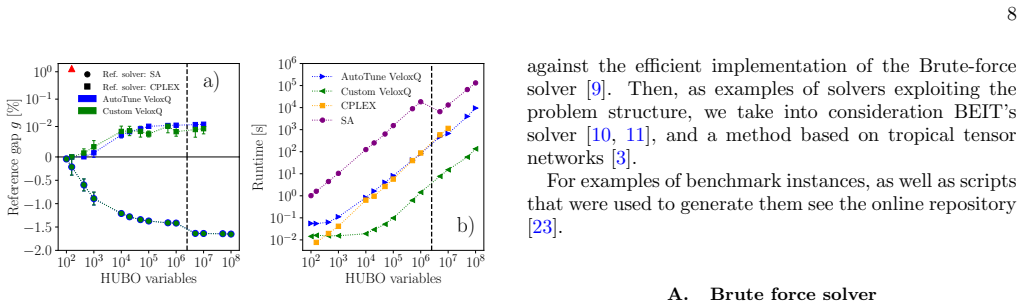
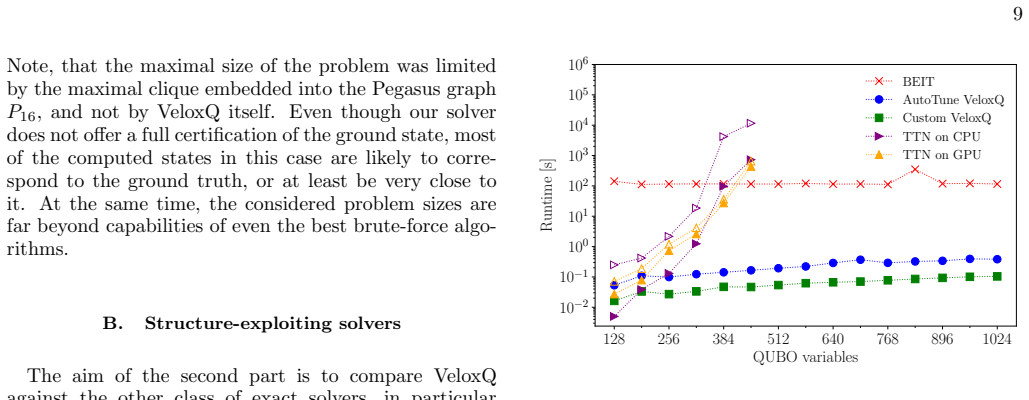
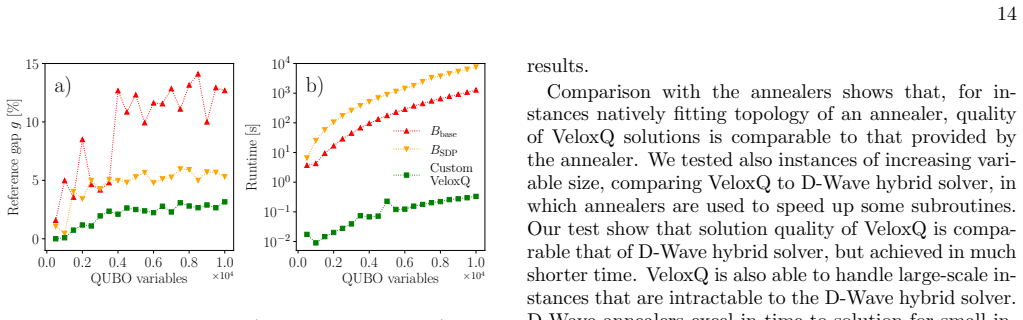
We introduce VeloxQ, a fast solver for Quadratic Unconstrained Binary Optimization (QUBO) problems, which are central to many real-world optimization tasks. Unlike approaches that depend on emerging quantum hardware, VeloxQ can be deployed on conventional computing infrastructure. We benchmark VeloxQ against state-of-the-art QUBO solvers from several families. These include quantum annealers, specifically D-Wave's Advantage and Advantage2 platforms; the digital-quantum BF-DCQO algorithm for Higher-Order Unconstrained Binary Optimization (HUBO) developed by Kipu Quantum; physics-inspired algorithms including Simulated Bifurcation, Parallel Annealing, and tropical tensor networks; and conventional methods including CPLEX, brute force, BEIT's Chimera solver, and Branch-and-Bound variants. The benchmark suite covers native quantum-annealer topologies, embedded all-to-all instances, HUBO-derived instances, planted-solution instances, certified-solver regimes, and dense Branch-and-Bound test cases. Across the benchmark suite, VeloxQ delivers competitive solution quality and runtime, and in several regimes outperforms the compared solvers. VeloxQ also demonstrates strong scalability. Among the solvers considered in this study, it was the only method we could run on the largest sparse instances within our computational budget, including problems with up to $10^{8}$ sparsely connected variables. These findings position VeloxQ as a competitive and practical tool for tackling large-scale QUBO/HUBO problems, offering a practical alternative to existing quantum and classical optimization methods.
Editorial analysis
A structured set of objections, weighed in public.
Referee Report
Summary. The manuscript introduces VeloxQ, a classical solver for Quadratic Unconstrained Binary Optimization (QUBO) problems deployable on conventional hardware. It benchmarks VeloxQ against quantum annealers (D-Wave Advantage and Advantage2), the BF-DCQO algorithm, physics-inspired methods (Simulated Bifurcation, Parallel Annealing, tropical tensor networks), and classical solvers (CPLEX, brute force, BEIT Chimera, Branch-and-Bound). The benchmark suite includes native topologies, embedded all-to-all instances, HUBO-derived problems, planted-solution instances, certified regimes, and dense test cases. The central empirical claim is that VeloxQ achieves competitive solution quality and runtime, outperforms comparators in several regimes, and is the only solver runnable on the largest sparse instances (up to 10^8 variables) within the computational budget.
Significance. If the benchmark protocols and results are reproducible and the implementation details are fully specified, the work would be significant as a practical classical baseline for large-scale QUBO/HUBO problems. The explicit comparison across quantum and classical families on a diverse suite, together with the reported scalability to 10^8-variable sparse instances, provides a concrete data point on the current reach of classical methods versus quantum-inspired approaches.
minor comments (3)
- [Abstract] Abstract: the statement that VeloxQ 'outperforms the compared solvers' in several regimes would be strengthened by at least one quantitative example (e.g., a specific runtime or quality ratio on a named instance family) rather than remaining purely qualitative.
- The manuscript should include a dedicated section or appendix describing the algorithmic core of VeloxQ (pseudocode, key heuristics, or complexity statements) so that the performance claims can be assessed independently of the benchmark tables.
- Benchmark description: clarify whether all solvers were run with default parameters or with instance-specific tuning, and whether wall-clock time includes embedding or preprocessing steps for the quantum platforms.
Simulated Author's Rebuttal
We thank the referee for their positive assessment of VeloxQ and the recommendation for minor revision. The report correctly identifies the paper's focus on providing a practical classical baseline with extensive cross-family benchmarks and scalability to 10^8-variable instances. No major comments were raised in the report.
Circularity Check
No significant circularity; empirical benchmark paper
full rationale
The paper introduces VeloxQ and presents empirical benchmark comparisons against quantum annealers, physics-inspired algorithms, and classical solvers across native topologies, embedded instances, HUBO-derived cases, planted solutions, and large sparse problems up to 10^8 variables. No derivation chain, equations, fitted parameters, or self-citation load-bearing steps are described. The central claims are performance statements grounded in reported runtime and quality metrics rather than any mathematical reduction to inputs. This is a standard empirical report with no internal circularity.
Axiom & Free-Parameter Ledger
Lean theorems connected to this paper
-
IndisputableMonolith/Foundation/RealityFromDistinction.leanreality_from_one_distinction unclear?
unclearRelation between the paper passage and the cited Recognition theorem.
We introduce VeloxQ, a fast solver for Quadratic Unconstrained Binary Optimization (QUBO) problems... benchmarks against... D-Wave... Kipu Quantum... Simulated Bifurcation... CPLEX...
-
IndisputableMonolith/Cost/FunctionalEquation.leanwashburn_uniqueness_aczel unclear?
unclearRelation between the paper passage and the cited Recognition theorem.
VeloxQ... demonstrates strong scalability... only method we could run on the largest sparse instances... up to 10^8 sparsely connected variables.
What do these tags mean?
- matches
- The paper's claim is directly supported by a theorem in the formal canon.
- supports
- The theorem supports part of the paper's argument, but the paper may add assumptions or extra steps.
- extends
- The paper goes beyond the formal theorem; the theorem is a base layer rather than the whole result.
- uses
- The paper appears to rely on the theorem as machinery.
- contradicts
- The paper's claim conflicts with a theorem or certificate in the canon.
- unclear
- Pith found a possible connection, but the passage is too broad, indirect, or ambiguous to say the theorem truly supports the claim.
Forward citations
Cited by 3 Pith papers
-
Simulated Bifurcation Quantum Annealing
SBQA adds inter-replica interactions to simulated bifurcation to mimic quantum tunneling and improves performance on sparse rugged optimization problems over standard SBM.
-
Quantum-inspired dynamical models on quantum and classical annealers
A parallel-in-time encoding turns quantum dynamical propagators into QUBO instances for direct benchmarking of quantum annealers against classical solvers on models from single-qubit rotations to PT-symmetric systems.
-
Recent quantum runtime (dis)advantages
End-to-end runtime definitions and strong classical baselines show that three recent quantum advantage claims in annealing, Simon's problem, and hybrid algorithms do not hold on NISQ hardware.
Reference graph
Works this paper leans on
-
[1]
H. Goto, Bifurcation-based adiabatic quantum computa- tion with a nonlinear oscillator network, Scientific Re- ports 6, 21686 (2016)
work page 2016
-
[2]
H. Goto, K. Tatsumura, and A. R. Dixon, Combina- torial optimization by simulating adiabatic bifurcations in nonlinear hamiltonian systems, Science Advances 5, eaav2372 (2019)
work page 2019
- [3]
-
[4]
S. Kirkpatrick, C. D. Gelatt, and M. P. Vecchi, Optimiza- tion by Simulated Annealing, Science 220, 671 (1983)
work page 1983
-
[5]
Quantumz.io, VeloxQ QUBO solver (2025), accessed: 2025-01-31
work page 2025
- [6]
-
[7]
K. Ja lowiecki, M. M. Rams, and B. Gardas, Brute-forcing spin-glass problems with cuda, Computer Physics Com- munications 260, 107728 (2021)
work page 2021
-
[8]
K. Ja lowiecki and L. Pawela, Omnisolver: An extensi- ble interface to Ising spin–glass and QUBO solvers, Soft- wareX 24, 101559 (2023)
work page 2023
-
[9]
K. Ja lowiecki, L. Pawela, B. Gardas, A. Przybysz, and J. Tuziemski, GPU based brute-force solver for QUBO and Ising instances, In preparation (2025)
work page 2025
-
[10]
BEIT, BEIT QUBO solver user manual, accessed: 2024- 12-19
work page 2024
-
[11]
BEIT, AWS Marketplace: QUBO Solver by BEIT (2024), accessed: 2025-01-30
work page 2024
-
[12]
J.-G. Liu, L. Wang, and P. Zhang, Tropical tensor net- work for ground states of spin glasses, Physical Review Letters 126 (2021)
work page 2021
-
[13]
A. Chalkis, T. Kleinert, and B. Sofranac, QUBO Dual Bounds via SDP Plane Projection Method, arXiv:2312.15026 (2023)
-
[14]
Quantagonia, How good is good enough?, Quantagonia Blog (2023), accessed: 2024-12-11
work page 2023
-
[15]
F. Sheldon, F. L. Traversa, and M. Di Ventra, Taming a nonconvex landscape with dynamical long-range or- der: Memcomputing Ising benchmarks, Physical Review E 100 (2019)
work page 2019
-
[16]
Y. Yamamoto, T. Leleu, S. Ganguli, and H. Mabuchi, Co- herent Ising machines — quantum optics and neural net- work perspectives, Applied Physics Letters 117 (2020)
work page 2020
-
[17]
J. Si, S. Yang, Y. Cen, J. Chen, and Y. Huang et al., Energy-efficient superparamagnetic Ising machine and its application to traveling salesman problems, Nature Com- munications 15, 3457 (2024)
work page 2024
-
[18]
J. Wang, D. Ebler, K. Y. M. Wong, D. S. W. Hui, and J. Sun, Bifurcation behaviors shape how continuous phys- ical dynamics solves discrete Ising optimization, Nature Communications 14, 2510 (2023)
work page 2023
-
[19]
H. Wang, Z. Liu, Z. Xie, L. Li, and Z. Miao et al., Paral- lel Ising annealer via gradient-based hamiltonian monte carlo, Quantum Machine Intelligence 7, 6 (2025)
work page 2025
-
[20]
P.-L. Bartosik, K. Donatella, M. Aifer, D. Melanson, and M. Perarnau-Llobet et al., Thermodynamic algorithms for quadratic programming, arXiv:2411.14224 (2024)
- [21]
-
[22]
CPLEX, IBM ILOG, Users manual for CPLEX (2024)
work page 2024
-
[23]
J. Paw lowski, J. Tuziemski, P. Tarasiuk, A. Przybysz, and R. A. Adamski et al., VoloxQ data repository, ac- cessed: 2025-01-31
work page 2025
-
[24]
G. Kochenberger, J.-K. Hao, F. Glover, M. Lewis, and Z. L¨ u, The unconstrained binary quadratic programming problem: A survey, Journal of Combinatorial Optimiza- tion 28, 58 (2014)
work page 2014
- [25]
-
[26]
S. Boettcher, Analysis of the relation between quadratic unconstrained binary optimization and the spin-glass ground-state problem, Physical Review Research 1, 033142 (2019)
work page 2019
- [27]
-
[28]
Lewis, Guide to graph colouring (Springer, 2021)
R. Lewis, Guide to graph colouring (Springer, 2021)
work page 2021
-
[29]
C. W. Commander, Maximum Cut Problem, MAX-CUT, in Encyclopedia of Optimization, edited by C. A. Floudas and P. M. Pardalos (Springer US, Boston, MA, 2009) pp. 1991–1999. 19
work page 2009
-
[30]
K. L. Hoffman, M. Padberg, and G. Rinaldi, Travel- ing salesman problem, in Encyclopedia of Operations Re- search and Management Science, edited by S. I. Gass and M. C. Fu (Springer US, Boston, MA, 2013) pp. 1573– 1578
work page 2013
-
[31]
S. Eggersgl¨ uß and R. Drechsler, Boolean satisfiability, in High Quality Test Pattern Generation and Boolean Sat- isfiability (Springer US, Boston, MA, 2012) pp. 41–57
work page 2012
-
[32]
Dattani, Quadratization in discrete optimization and quantum mechanics, arxiv:1901.04405 (2019)
N. Dattani, Quadratization in discrete optimization and quantum mechanics, arxiv:1901.04405 (2019)
-
[33]
Gurobi Optimization, LLC, Gurobi Optimizer Reference Manual (2024)
work page 2024
-
[34]
Bierlaire, Optimization: Principles and Algorithms , 2nd ed
M. Bierlaire, Optimization: Principles and Algorithms , 2nd ed. (EPFL Press, Lausanne, 2018)
work page 2018
-
[35]
C. Fan, M. Shen, Z. Nussinov, Z. Liu, and Y. Sun et al., Searching for spin glass ground states through deep reinforcement learning, Nature Communications 14, 725 (2023)
work page 2023
-
[36]
S. Boettcher, Deep reinforced learning heuristic tested on spin-glass ground states: The larger picture, Nature Communications 14, 5658 (2023)
work page 2023
-
[37]
E. J. Crosson and D. A. Lidar, Prospects for quantum enhancement with diabatic quantum annealing, Nature Reviews Physics 3, 466 (2021)
work page 2021
-
[38]
A. Villanueva, P. Najafi, and H. J. Kappen, Why adi- abatic quantum annealing is unlikely to yield speed-up, Journal of Physics A: Mathematical and Theoretical 56, 465304 (2023)
work page 2023
-
[39]
A. Irb¨ ack, L. Knuthson, S. Mohanty, and C. Peterson, Folding lattice proteins with quantum annealing, Physi- cal Review Research 4, 043013 (2022)
work page 2022
- [40]
-
[41]
Verresen, Everything is a quantum Ising model, arXiv:2301.11917 (2023)
R. Verresen, Everything is a quantum Ising model, arXiv:2301.11917 (2023)
- [42]
- [43]
-
[44]
Google Quantum AI and Collaborators, Quantum er- ror correction below the surface code threshold, Nature (2024)
work page 2024
-
[45]
A Quantum Approximate Optimization Algorithm
E. Farhi, J. Goldstone, and S. Gutmann, A quantum approximate optimization algorithm, arxiv:1411.4028 (2014)
work page internal anchor Pith review Pith/arXiv arXiv 2014
- [46]
- [47]
-
[48]
Q.-G. Zeng, X.-P. Cui, B. Liu, Y. Wang, and P. Mosharev et al., Performance of quantum annealing inspired algo- rithms for combinatorial optimization problems, Com- munications Physics 7, 249 (2024)
work page 2024
-
[49]
S. Boyd, N. Parikh, E. Chu, B. Peleato, and J. Eckstein, Distributed Optimization and Statistical Learning via the Alternating Direction Method of Multipliers (2011)
work page 2011
-
[50]
ADMM and Accelerated ADMM as Continuous Dynamical Systems
G. Fran¸ ca, D. P. Robinson, and R. Vidal, Admm and ac- celerated admm as continuous dynamical systems (2018), arXiv:1805.06579
work page internal anchor Pith review Pith/arXiv arXiv 2018
-
[51]
G. Fran¸ ca, D. P. Robinson, and R. Vidal, Gradient flows and proximal splitting methods: A unified view on ac- celerated and stochastic optimization, Physical Review E 103 (2021)
work page 2021
-
[52]
G. Fran¸ ca, D. P. Robinson, and R. Vidal, A nonsmooth dynamical systems perspective on accelerated extensions of admm, IEEE Transactions on Automatic Control 68, 2966–2978 (2023)
work page 2023
-
[53]
D-Wave, Minor embbeding, accessed: 2025-01-30
work page 2025
-
[54]
K. Boothby, P. Bunyk, J. Raymond, and A. Roy, Next- generation topology of D-Wave quantum processors, arxiv:2003.00133 (2020)
-
[55]
K. Boothby, A. D. King, and J. Raymond, Zephyr topol- ogy of D-Wave quantum processors (2021), accessed: 2025-01-31
work page 2021
-
[56]
H. M. Markowitz, Portfolio selection: efficient diversifi- cation of investments (Yale University Press, 1959)
work page 1959
-
[57]
D-Wave, D-Wave hybrid framework (2025), accessed: 2025-01-30
work page 2025
-
[58]
D-Wave, The D-Wave Clarity Roadmap (2025), accessed: 2025-01-30
work page 2025
-
[59]
Z. L¨ u, F. Glover, and J.-K. Hao, A hybrid metaheuristic approach to solving the ubqp problem, European Journal of Operational Research 207, 1254 (2010)
work page 2010
-
[60]
I. Zintchenko, M. B. Hastings, and M. Troyer, From lo- cal to global ground states in Ising spin glasses, Physical Review B 91, 024201 (2015)
work page 2015
-
[61]
H. Goto, K. Endo, M. Suzuki, Y. Sakai, and Taro et al., High-performance combinatorial optimization based on classical mechanics, Science Advances 7, eabe7953 (2021)
work page 2021
-
[62]
I. Hen, Equation Planting: A Tool for Benchmarking Ising Machines, Physical Review Applied 12, 011003 (2019)
work page 2019
- [63]
- [64]
- [65]
-
[66]
L. A. Wolsey, Integer Programming (John Wiley & Sons, 1998)
work page 1998
-
[67]
T. H¨ aner, K. E. Booth, S. E. Borujeni, and E. Y. Zhu, Solving QUBOs with a quantum-amenable branch and bound method, arXiv:2407.20185 (2024)
- [68]
-
[69]
F. G.S L. Brand˜ ao, R. Kueng, and D. Stilck Fran¸ ca, Faster quantum and classical SDP approximations for quadratic binary optimization, Quantum 6, 625 (2022). 20
work page 2022
-
[70]
M. Born and V. Fock, Beweis des Adiabatensatzes, Zeitschrift f¨ ur Physik51, 165 (1928)
work page 1928
-
[71]
BinaryConnect: Training Deep Neural Networks with binary weights during propagations
M. Courbariaux, Y. Bengio, and J.-P. David, Bina- ryConnect: Training Deep Neural Networks with binary weights during propagations, arXiv:1511.00363 (2016)
work page internal anchor Pith review Pith/arXiv arXiv 2016
-
[72]
Qian, On the momentum term in gradient descent learning algorithms, Neural Networks 12, 145 (1999)
N. Qian, On the momentum term in gradient descent learning algorithms, Neural Networks 12, 145 (1999)
work page 1999
- [73]
-
[74]
A. Wiegele, Biq mac library - binary quadratic and Max- Cut library, https://biqmac.aau.at/biqmaclib.html, accessed: 2025-01-16
work page 2025
-
[75]
R. B. Lehoucq, D. C. Sorensen, and C. Yang, ARPACK Users’ Guide: Solution of Large-Scale Eigenvalue Prob- lems with Implicitly Restarted Arnoldi Methods , Tech. Rep. (Rice University, 1998)
work page 1998
discussion (0)
Sign in with ORCID, Apple, or X to comment. Anyone can read and Pith papers without signing in.