REVIEW 3 major objections 4 minor 99 references
A Simple Voltage-Modulated Markov Chain Model for the Piezo1 Ion Channel to Investigate Electromechanical Pacing
T0 review · 3 major / 4 minor · reviewed 2026-08-09 · deepseek-v4-flash
Pith's one-line read A four-state Markov chain model of the Piezo1 stretch-activated channel quantitatively reproduces voltage-clamp inactivation and desensitization data and, in a ventricular myocyte model, qualitatively explains rate-dependent loss of…
desk verdict Sensible model idea, honest limitations, but the fitted parameter table makes the Markov chain invalid as written; re-fit needed before the pacing claims can stand. read the letter →
The pith
A machine-rendered reading of the paper's core claim, the machinery that carries it, and where it could break.
The reading
What carries the argument
The engine of the paper is a four-state continuous-time Markov chain with states $O$ (open), $C$ (closed), $I_1$ (fast-inactivated), and $I_2$ (slow-inactivated). Transition rates have the Eyring-like form $r_i \exp(c_i^m p + c_i^e \Delta\mu)$, where $p$ is pressure and $\Delta\mu$ is the electrochemical driving force, set equal to the membrane voltage because the Piezo1 reversal potential is near zero. Pressure dependence is kept on the closed-to-$I_1$ and $I_1$-to-open transitions, and the $I_2$-to-open transition depends on the product $p\,\Delta\mu$; every edge also carries a voltage term, and detailed balance is enforced through parameter constraints. The channel's open probability drives separate Ohmic Na$^+$, K$^+$, and Ca$^{2+}$ currents that are added to the Mahajan-Shiferaw myocyte model, which is what lets voltage and pressure jointly shape capture and loss of capture.
What would settle it
A decisive check is to compute the generator matrix entries from Table 1 at physiological pressure and voltage; if any off-diagonal rate is negative, the channel is not a Markov chain and the fitted equations as written cannot be integrated as probability dynamics.
Extended reading notes
Core claim
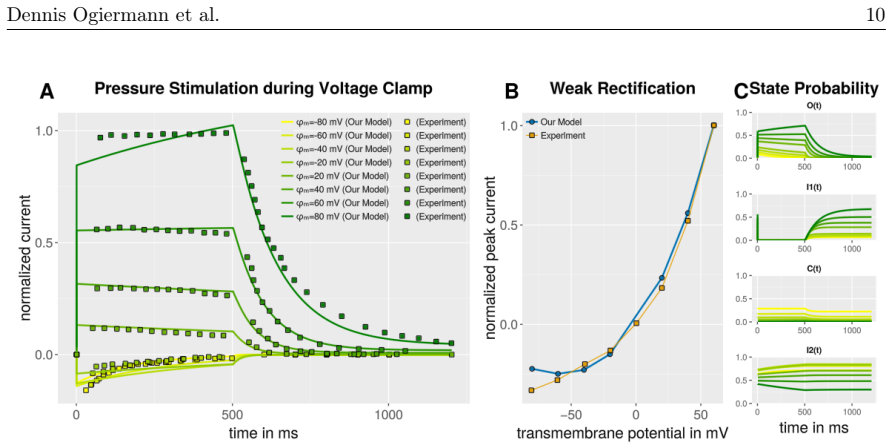
The central claim is that Piezo1's electromechanical response can be captured by a four-state continuous-time Markov chain in which every transition rate depends exponentially on pressure and on the electrochemical driving force, here identified with the transmembrane voltage. On that basis the paper reports quantitative agreement with the voltage-clamp recordings of Moroni et al. for voltage-dependent inactivation and weak rectification, and qualitative agreement for desensitization during repeated pressure stimuli and for the reset of desensitization when pressure is applied at positive driving forces. When the channel is coupled to the Mahajan-Shiferaw rabbit ventricular myocyte model, the simulations reproduce the essential pacing phenomenon: mechanical capture is lost after a number of mechanical stimuli, and that number depends on pacing rate and on alternating electrical stimuli, matching the direction of the Quinn-Kohl observations. The authors also state plainly that no tested parameter combination reproduces every experimental pacing outcome quantitatively, and that Piezo1 alone may not suffice.
Load-bearing premise
The model is a probability model only if all transition rates are non-negative for every pressure and voltage used, but the fitted parameters include negative rate coefficients and the paper gives no rule for interpreting a negative rate.
Editorial extensions
If this is right
- The voltage-modulated Markov chain gives a mechanistic explanation for why positive electrochemical driving forces reset Piezo1 desensitization: at positive voltages the channel population re-enters states that can open again on the next pressure step.
- In the Mahajan-Shiferaw cell, adding Piezo1 raises intracellular Na$^+$ and Ca$^{2+}$ by roughly 8--10%, shortens the action potential, and depresses its peak; stronger pressure steps increase Na$^+$ more than Ca$^{2+}$, a prediction that could be tested ion-selectively.
- The integrated model reproduces the qualitative ranking that alternating mechanical and electrical stimuli (2:1 E:M) causes faster loss of capture than 3:1 E:M for some parameterizations, supporting the claim that voltage modulation contributes to capture loss.
- Because no single parameter set matches all Quinn-Kohl protocols quantitatively, the authors conclude that mechanisms beyond Piezo1, possibly other stretch-activated currents or tissue-level conduction, are needed for full quantitative agreement.
Reading between the lines
- If the transition rates from Table 1 are evaluated literally at physiological pressures and voltages, some generator-matrix entries are negative; the model would not define a Markov chain, and the pacing results may depend on how the solver handles these entries. Refitting with non-negativity constraints is the natural next step.
- The paper's finding that a lower reversal potential of roughly $-30$ mV would be needed for reset during passive filling suggests that the assumption $\Delta\mu = $ membrane voltage is a sensitive point; if recent estimates near $-15$ mV hold, the model's reset dynamics could change substantially.
- A direct experimental falsification would be to measure Piezo1 open probability under a two-pulse protocol at a series of positive voltages and compare the reset time constant to the model's prediction; because the model was fit only to current traces, the state probabilities themselves are an unvalidated prediction.
Signed reviews
Editorial analysis
A structured set of objections, weighed in public.
Referee Report
Summary. The paper proposes a four-state continuous-time Markov chain model of the Piezo1 ion channel with voltage- and pressure-dependent transition rates, fits the rate parameters to voltage-clamp current traces from Moroni et al. (2018), and integrates the resulting channel model into the Mahajan-Shiferaw rabbit ventricular myocyte model. The integrated model is then used to simulate idealized cardiac cycles and electromechanical pacing protocols modeled on the experiments of Quinn and Kohl (2016). The authors report that the channel model reproduces a wide range of Piezo1 experimental observations, and that the cell-level model qualitatively captures some rate-dependent features of mechanical capture and loss of capture, although it does not reproduce all experimental findings.
Significance. If the model were valid, it would be a valuable contribution: it is, to the authors' knowledge, the first Markov-chain-based Piezo1 model integrated into a ventricular myocyte model, it is provided in open CellML form with reproducible simulation scripts, and it is calibrated against independent patch-clamp data rather than only against the target pacing experiments. The experimental comparisons in Figures 3 and 4 show qualitatively reasonable behavior, and the authors are transparent about the model's limitations. However, the paper's central quantitative claim is undermined by a fundamental mathematical flaw in the fitted rate parameters, as detailed in the major comments. The pacing-level conclusions are also weakened by the fact that the two cell-level free parameters (scaling and prNaK) are fitted to the very Quinn-Kohl capture counts the model is then said to explain.
major comments (3)
- [§2.1.2, Table 1] The fitted rate coefficients r4, r5, r6, r7, and r8 in Table 1 are negative, while the transition rates are defined as k_i = r_i * exp(...) with exponential factors that are always positive. For example, k4 = r4 exp(cm4 p + ce4 Δμ) is negative for all p and Δμ because r4 = -0.008945307. A continuous-time Markov chain requires every transition rate to be non-negative for all states and all conditions; negative off-diagonal entries in the generator mean that probability mass is not conserved and the process has no stochastic interpretation. Since all subsequent simulations (Figures 3-7) use these parameters, the central claim that the model quantitatively reproduces experimental observations is not supported as stated. This is a load-bearing error that affects the entire model, not a cosmetic issue.
- [§2.2 (detailed balance constraint)] The authors state that detailed balance is enforced by requiring r1*r3*r5 = r2*r4*r6, leading to r2 = r1*r3*r5/(r4*r6). With the printed parameter values, r1, r2, r3 are positive while r4, r5, r6 are negative, so the left-hand side r1*r3*r5 is negative and the right-hand side r2*r4*r6 is positive. The equality cannot hold. This means either the table is misprinted or the constraint was not actually enforced during optimization. In either case, the manuscript presents an internally inconsistent parameter set, and the relationship between the stated constraint and the reported fit is not credible. The authors need to re-examine their optimization code and either report a parameter set that satisfies detailed balance with all non-negative r_i or explain and justify the discrepancy.
- [§3, Figs. 6-7 and §4] The cell-level claim that the model can 'qualitatively explain some of the experimental observations from Quinn and Kohl' is weakened by the in-sample nature of the parameter choice. The free parameters scaling and prNaK are explicitly varied 'to reproduce the total number of captured mechanical stimuli recorded in the experiments' (Section 3), and Figure 7 shows the loss surface over these parameters. The paper then reports that no parameter combination reproduces all experimental findings, and specifically that no simulation reproduces the observation that alternating electrical and mechanical stimuli cause faster loss of mechanical capture than mechanical pacing alone. The abstract's phrasing ('qualitatively reproduce some aspects') is accurate but the discussion should more clearly state that the pacing-level result is a partial in-sample fit rather than a validated prediction, especially since the channel model itself is invalid for the reasons above.
minor comments (4)
- [§1 and §4.2] There are several typos and spacing errors, e.g., 'an thus' (Section 2.1.3), 'T able 1' (Table 1 caption), 'eletromechanical' (Section 4.2), and a run-on 'the proposedmodelisabletoreproduce' (Section 3). A careful proofread is needed.
- [Fig. 1] The transition rate labels in Figure 1 are hard to read: the subscripts and exponents (e.g., ce7Δμp) are not clearly formatted, and the figure does not indicate that the parameters in Table 1 are for normalized p and Δμ even though the text says p and Δμ are normalized in the optimization. Please clarify.
- [§2.2] The loss function in Eq. (6) is described as a 'Huber-type Lasso loss' with H(x) = min(|x|, x^2). The notation 'min(|x|, x^2)' is not standard; for |x|>1 this is x^2, which grows unboundedly, so it is not the usual Huber loss. Please define the functions precisely to avoid confusion.
- [§4.1] The sentence about Buonocunto et al. mentions 'their experimental work suggests that the reversal potential ... around -15 mV', but the citation [8] is a computational characterization paper; please verify whether this is an experimental or computational finding.
Circularity Check
Cell-level pacing agreement is obtained by fitting the two free parameters to the very capture counts reported as reproduced; the channel-level comparisons are externally calibrated and not circular.
-
fitted input called prediction
[Section 3, electromechanical pacing study (Figs. 6-7), and Section 4 (Discussion & Conclusion)]
"First, a coarse parameter grid was utilized (not shown) to narrow down the parameter space to reproduce the total number of captured mechanical stimuli recorded in the experiments. In this first sweep of the parameter space, we identified that the conductance scaling parameter should be between 0.13 and 0.23, while the relative NaK contribution should be between 0.0 and 0.16. This region was then analyzed using a fine grid. ..."
The free parameters scaling and prNaK are selected in a coarse-to-fine sweep whose explicit target is the Quinn-Kohl capture numbers N, and the same N values are then presented as reproduced by the model. The agreement is therefore a fit rather than an independent prediction: the parameter search was constructed to make the outcome match. The fitted values (e.g., scaling = 0.23, prNaK = 0.067) are also carried into the idealized-cycle study, so the later mechanistic claims share the fitted input. The channel-level fits to Moroni et al. and the comparison with Wu et al. are external and non-circular; only the cell-level 'reproductions' reduce to the fitting target.
full rationale
The Piezo1 Markov chain itself is fitted to voltage-clamp data from Moroni et al. and then confronted with held-out figures from the same work and with independent data from Wu et al. without re-tuning; that part is self-contained and externally falsifiable. The circularity is confined to the cell-level study: scaling and prNaK are declared unknown, then a coarse-to-fine parameter sweep is explicitly aimed at reproducing the Quinn-Kohl capture counts, after which the paper states that the model reproduces those counts and 'qualitatively explain[s]' loss of capture. This is a fitted input called a reproduction rather than a prediction. The negative fitted rates and the detailed-balance sign inconsistency in Table 1 are serious mathematical validity problems, but they are correctness concerns, not circularity in the derivation sense, so they do not raise the circularity score. Overall partial circularity (4/10) is appropriate because the central channel model retains independent empirical content despite the fitted cell-level pacing results.
Assumptions & free parameters
free parameters (5)
- Markov chain rate and coupling parameters (r1-r8, ce1-ce8, cm2, cm4) =
See Table 1; 18 values, e.g., r1=0.02634342, ce1=-2.3753126, cm2=12.101605
- scaling (conductance scale, related to NPz1) =
Study range 0.13-0.23; best region shown in Fig. 7
- prNaK (relative Na-K permeability in EK,s) =
Study range 0.0-0.16
- Characteristic pressures for diastolic stretch (25 mmHg) and saturating stretch (70 mmHg) =
25 mmHg and 70 mmHg
- Piezo1 reversal potential Er =
0 mV
assumptions (6)
- domain assumption Detailed balance holds for the Piezo1 Markov chain under arbitrary electrochemical gradients.
- domain assumption The four-state Markov chain topology (O, I1, I2, C) with the given pressure- and voltage-dependent rates is an adequate representation of Piezo1 gating.
- ad hoc to paper The rate expressions r_i exp(...) with the fitted parameters define valid continuous-time Markov chain transition rates.
- domain assumption Piezo1 reversal potential is 0 mV, so the electrochemical driving force equals the membrane voltage.
- domain assumption The Piezo1 current is Ohmic and consists of independent K+, Na+, and Ca2+ components with no interactions between ions in the pore.
- ad hoc to paper Axial stretch of the cardiomyocyte maps linearly to the pressure variable in the channel model, with 30% stretch equal to 70 mmHg and 10% diastolic stretch equal to 25 mmHg.
Cite this review
Pith. "Pith review of A Simple Voltage-Modulated Markov Chain Model for the Piezo1 Ion Channel to Investigate Electromechanical Pacing." pith.science (2026). https://pith.science/paper/KPQGOT6O
@misc{pith2026250119366,
  author       = {Pith},
  title        = {Pith review of: A Simple Voltage-Modulated Markov Chain Model for the Piezo1 Ion Channel to Investigate Electromechanical Pacing},
  year         = {2026},
  howpublished = {\url{https://pith.science/paper/KPQGOT6O}},
  note         = {Machine review of arXiv:2501.19366}
}
read the original abstract
Piezo1 ion channels are voltage-modulated, stretch-activated ion channels involved in a variety of important physiological and pathophysiological processes, as for example cardiovascular development and homeostasis. Since its discovery, it has been known that this type of ion channel desensitizes when exposed to stretch. However, recent experiments on Piezo1 ion channels have uncovered that their stretch response is qualitatively different when exposed to positive electrochemical driving forces, where the desensitization is reset. In this work, we propose a novel voltage-modulated mathematical model of Piezo1 based on a continuous-time Markov chain. We show that our Piezo1 model is able to quantitatively reproduce a wide range of experimental observations. Furthermore, we integrate our new ion channel model into the Mahajan-Shiferaw ventricular cardiomyocyte model to study the effect of electromechanical pacing at the cellular scale. This integrated cell model is able to qualitatively reproduce some aspects of the experimental observations regarding the rate-dependence of electromechanical pacing protocols. Our studies suggest that the Piezo1 ion channel is an important component that significantly contributes to the electromechanical coupled response of cardiomyocytes.
Figures


Figures from the paper (4 more)


Reference graph
Works this paper leans on
-
[1]
Hanna H. Allerkamp, Alexander I. Bondarenko, Ines Tawfik, Nilüfer Kamali-Simsek, Monika Horvat Mercnik, Corina T. Madreiter-Sokolowski, and Christian Wadsack. In vitro examination of Piezo1-TRPV4 dynamics: Implications for placental endothelial function in normal and preeclamptic pregnancies.American Journal of Physiology-Cell Physiology, 328(1):C227–C244...
-
[2]
Aronis, Rheeda Ali, and Natalia A
Konstantinos N. Aronis, Rheeda Ali, and Natalia A. Trayanova. The role of personalized atrial modeling in understanding atrial fibrillation mechanisms and improving treatment. International Journal of Cardiology, 287:139–147, July 2019. ISSN 01675273. doi: 10. 1016/j.ijcard.2019.01.096
2019
-
[3]
Augustin, Matthias A
Christoph M. Augustin, Matthias A. F. Gsell, Elias Karabelas, Erik Willemen, Frits W. Prinzen, Joost Lumens, Edward J. Vigmond, and Gernot Plank. A computationally efficient physiologically comprehensive 3D–0D closed-loop model of the heart and circu- lation. Computer Methods in Applied Mechanics and Engineering, 386:114092, December
-
[4]
Piezo1linksmechanosensationtocardiacgrowth
JohannesBacks. Piezo1linksmechanosensationtocardiacgrowth. Nature Cardiovascular Research, 1(6):533–534, June 2022. ISSN 2731-0590. doi: 10.1038/s44161-022-00084-y
-
[5]
Chilman Bae, Radhakrishnan Gnanasambandam, Chris Nicolai, Frederick Sachs, and Philip A. Gottlieb. Xerocytosis is caused by mutations that alter the kinetics of the mechanosensitive channel PIEZO1. Proceedings of the National Academy of Sciences, 110(12), March 2013. ISSN 0027-8424, 1091-6490. doi: 10.1073/pnas.1219777110
-
[6]
Chilman Bae, Philip A. Gottlieb, and Frederick Sachs. Human PIEZO1: Removing Inactivation. Biophysical Journal, 105(4):880–886, August 2013. ISSN 00063495. doi: 10.1016/j.bpj.2013.07.019
-
[7]
Fiona Bartoli, Elizabeth L. Evans, Nicola M. Blythe, Leander Stewart, Eulashini Chuntharpursat-Bon, Marjolaine Debant, Katie E. Musialowski, Laeticia Lichtenstein, GregoryParsonage, T.SimonFuters, NeilA.Turner, andDavidJ.Beech. GlobalPIEZO1 Gain-of-Function Mutation Causes Cardiac Hypertrophy and Fibrosis in Mice.Cells, 11 (7):1199, April 2022. ISSN 2073-...
-
[8]
Electrophysiologicaleffectsofstretch-activatedionchannels: Asystematiccomputational characterization
Melania Buonocunto, Aurore Lyon, Tammo Delhaas, Jordi Heijman, and Joost Lumens. Electrophysiologicaleffectsofstretch-activatedionchannels: Asystematiccomputational characterization. The Journal of Physiology, 602(18):4585–4604, September 2024. ISSN 0022-3751, 1469-7793. doi: 10.1113/JP284439
Show all 99 references
-
[9]
Piezo1 links mechanical forces to red blood cell volume.eLife, 4: e07370, May 2015
Stuart M Cahalan, Viktor Lukacs, Sanjeev S Ranade, Shu Chien, Michael Bandell, and Ardem Patapoutian. Piezo1 links mechanical forces to red blood cell volume.eLife, 4: e07370, May 2015. ISSN 2050-084X. doi: 10.7554/eLife.07370
2015 doi
-
[10]
Inference of ventricular activation propertiesfromnon-invasiveelectrocardiography
Julia Camps, Brodie Lawson, Christopher Drovandi, Ana Minchole, Zhinuo Jenny Wang, Vicente Grau, Kevin Burrage, and Blanca Rodriguez. Inference of ventricular activation propertiesfromnon-invasiveelectrocardiography. arXiv:2010.15214 [eess, q-bio], October 2020. Voltage-Modula...
2010 arXiv
-
[11]
Human ventricular activation sequence and the simulation of the electrocar- diographic QRS complex and its variability in healthy and intraventricular block con- ditions
Louie Cardone-Noott, Alfonso Bueno-Orovio, Ana Mincholé, Nejib Zemzemi, and Blanca Rodriguez. Human ventricular activation sequence and the simulation of the electrocar- diographic QRS complex and its variability in healthy and intraventricular block con- ditions. EP Europace,...
2016 doi
-
[12]
Alberdi Celaya, J
E. Alberdi Celaya, J. J. Anza Aguirrezabala, and P. Chatzipantelidis. Implementation of an Adaptive BDF2 Formula and Comparison with the MATLAB Ode15s.Procedia Computer Science, 29:1014–1026, 2014. ISSN18770509. doi: 10.1016/j.procs.2014.05.091
2014 doi
-
[13]
Hyman, Oleksandr V
Jiehan Chong, Dario De Vecchis, Adam J. Hyman, Oleksandr V. Povstyan, Melanie J. Ludlow, Jian Shi, David J. Beech, and Antreas C. Kalli. Modeling of full-length Piezo1 suggests importance of the proximal N-terminus for dome structure.Biophysical Journal, 120(8):1343–1356, Apri...
2021 doi
-
[14]
Cooling, Jonathan Cooper, Alan Garny, Keri Moyle, David P
Michael Clerx, Michael T. Cooling, Jonathan Cooper, Alan Garny, Keri Moyle, David P. Nickerson, Poul M. F. Nielsen, and Hugh Sorby. CellML 2.0.Journal of Integrative Bioin- formatics, 17(2-3):20200021, August 2020. ISSN 1613-4516. doi: 10.1515/jib-2020-0021
2020 doi
-
[15]
Colli Franzone, L
P. Colli Franzone, L. F. Pavarino, and S. Scacchi. Effects of mechanical feedback on the stability of cardiac scroll waves: A bidomain electro-mechanical simulation study.Chaos: An Interdisciplinary Journal of Nonlinear Science, 27(9):093905, September 2017. ISSN 1054-1500. do...
2017 doi
-
[16]
Earley, Sanjeev Ranade, Matt J
Bertrand Coste, Jayanti Mathur, Manuela Schmidt, Taryn J. Earley, Sanjeev Ranade, Matt J. Petrus, Adrienne E. Dubin, and Ardem Patapoutian. Piezo1 and Piezo2 Are Essential Components of Distinct Mechanically Activated Cation Channels.Science, 330 (6000):55–60, October 2010. IS...
2010 doi
-
[17]
Santos, Ruhma Syeda, Jörg Grandl, Kathryn S
Bertrand Coste, Bailong Xiao, Jose S. Santos, Ruhma Syeda, Jörg Grandl, Kathryn S. Spencer, Sung Eun Kim, Manuela Schmidt, Jayanti Mathur, Adrienne E. Dubin, Mauri- cio Montal, and Ardem Patapoutian. Piezo proteins are pore-forming subunits of me- chanically activated channels...
2012 doi
-
[18]
Beech, and Antreas C
Dario De Vecchis, David J. Beech, and Antreas C. Kalli. Molecular dynamics simulations of Piezo1 channel opening by increases in membrane tension.Biophysical Journal, 120 (8):1510–1521, April 2021. ISSN 00063495. doi: 10.1016/j.bpj.2021.02.006
2021 doi
-
[19]
Arevalo, Adityo Prakosa, David J
Dongdong Deng, Hermenegild J. Arevalo, Adityo Prakosa, David J. Callans, and Na- talia A. Trayanova. A feasibility study of arrhythmia risk prediction in patients with myocardial infarction and preserved ejection fraction.EP Europace, 18(suppl_4):iv60– iv66, December 2016. ISS...
2016 doi
-
[20]
Henry. Eyring. The Activated Complex and the Absolute Rate of Chemical Reactions. Chemical Reviews, 17(1):65–77, August 1935. ISSN 0009-2665, 1520-6890. doi: 10.1021/ cr60056a006
1935
-
[21]
The Activated Complex in Chemical Reactions.The Journal of Chemical Physics, 3(2):107–115, February 1935
Henry Eyring. The Activated Complex in Chemical Reactions.The Journal of Chemical Physics, 3(2):107–115, February 1935. ISSN 0021-9606, 1089-7690. doi: 10.1063/1. 1749604
1935 doi
-
[22]
A com- prehensive and biophysically detailed computational model of the whole human heart Dennis Ogiermann et al
Marco Fedele, Roberto Piersanti, Francesco Regazzoni, Matteo Salvador, Pasquale Clau- dio Africa, Michele Bucelli, Alberto Zingaro, Luca Dede’, and Alfio Quarteroni. A com- prehensive and biophysically detailed computational model of the whole human heart Dennis Ogiermann et a...
2023
-
[23]
Alan Garny and Peter J. Hunter. OpenCOR: A modular and interoperable approach to computational biology. Frontiers in Physiology, 6:26, February 2015. ISSN 1664-042X. doi: 10.3389/fphys.2015.00026
2015
-
[24]
Differential effects of mechano-electric feedback mecha- nisms on whole-heart activation, repolarization, and tension.The Journal of Physiology, 602(18):4605–4624, September2024
Tobias Gerach and Axel Loewe. Differential effects of mechano-electric feedback mecha- nisms on whole-heart activation, repolarization, and tension.The Journal of Physiology, 602(18):4605–4624, September2024. ISSN0022-3751, 1469-7793. doi: 10.1113/JP285022
-
[25]
Electro-Mechanical Whole-Heart Digital Twins: A Fully Coupled Multi-Physics Ap- proach
Tobias Gerach, Steffen Schuler, Jonathan Fröhlich, Laura Lindner, Ekaterina Kovacheva, Robin Moss, Eike Moritz Wülfers, Gunnar Seemann, Christian Wieners, and Axel Loewe. Electro-Mechanical Whole-Heart Digital Twins: A Fully Coupled Multi-Physics Ap- proach. Mathematics, 9(11)...
2021 doi
-
[26]
A monolithic algorithm for the simulation of cardiac electromechanics in the human left ventricle.Mathematics in Engineering, 1(1):1–37, 2019
Antonello Gerbi, Luca Dedè, Alfio Quarteroni, Antonello Gerbi, Luca Dedè, and Alfio Quarteroni. A monolithic algorithm for the simulation of cardiac electromechanics in the human left ventricle.Mathematics in Engineering, 1(1):1–37, 2019. ISSN 2640-3501. doi: 10.3934/Mine.2018.1.1
2019 doi
-
[27]
Gottlieb, and Frederick Sachs
Radhakrishnan Gnanasambandam, Chilman Bae, Philip A. Gottlieb, and Frederick Sachs. Ionic Selectivity and Permeation Properties of Human PIEZO1 Channels.PLOS ONE, 10(5):e0125503, May 2015. ISSN 1932-6203. doi: 10.1371/journal.pone.0125503
2015 doi
-
[28]
The generalized Hill model: A kine- matic approach towards active muscle contraction.Journal of the Mechanics and Physics of Solids, 72:20–39, December 2014
Serdar Göktepe, Andreas Menzel, and Ellen Kuhl. The generalized Hill model: A kine- matic approach towards active muscle contraction.Journal of the Mechanics and Physics of Solids, 72:20–39, December 2014. ISSN 0022-5096. doi: 10.1016/J.JMPS.2014.07.015
2014 doi
-
[29]
Gottlieb
P.A. Gottlieb. A Tour de Force. In Current Topics in Membranes, volume 79, pages 1–36. Elsevier, 2017. ISBN 978-0-12-809389-4. doi: 10.1016/bs.ctm.2016.11.007
2017 doi
-
[30]
Gottlieb, Chilman Bae, and Frederick Sachs
Philip A. Gottlieb, Chilman Bae, and Frederick Sachs. Gating the mechanical channel Piezo1: A comparison between whole-cell and patch recording.Channels, 6(4):282–289, July 2012. ISSN 1933-6950, 1933-6969. doi: 10.4161/chan.21064
2012 doi
-
[31]
Computational modeling: What does it tell us about atrial fibrillation therapy?International Journal of Cardiology, 287: 155–161, July 2019
Eleonora Grandi, Dobromir Dobrev, and Jordi Heijman. Computational modeling: What does it tell us about atrial fibrillation therapy?International Journal of Cardiology, 287: 155–161, July 2019. ISSN 01675273. doi: 10.1016/j.ijcard.2019.01.077
2019 doi
-
[32]
Chan, Adam P
Yang Guo, Delfine Cheng, Ze-Yan Yu, Teresa Schiatti, Andrea Y. Chan, Adam P. Hill, Rémi Peyronnet, Michael P. Feneley, Charles D. Cox, and Boris Martinac. Functional coupling between Piezo1 and TRPM4 influences the electrical activity of HL-1 atrial myocytes. The Journal of Ph...
2024 doi
-
[33]
Hindmarsh, Peter N
Alan C. Hindmarsh, Peter N. Brown, Keith E. Grant, Steven L. Lee, Radu Serban, Dan E. Shumaker, and Carol S. Woodward. SUNDIALS: Suite of nonlinear and differ- ential/algebraic equation solvers. ACM Transactions on Mathematical Software, 31(3): 363–396, September 2005. ISSN 00...
2005
-
[34]
Peter J. Huber. Robust Estimation of a Location Parameter.The Annals of Mathematical Statistics, 35(1):73–101, March 1964. ISSN 0003-4851. doi: 10.1214/aoms/1177703732. Voltage-Modulated Piezo1 Ion Channel Model 21
1964
-
[35]
Izu, Peter Kohl, Penelope A
Leighton T. Izu, Peter Kohl, Penelope A. Boyden, Masahito Miura, Tamas Banyasz, Ni- pavan Chiamvimonvat, Natalia Trayanova, Donald M. Bers, and Ye Chen-Izu. Mechano- electric and mechano-chemo-transduction in cardiomyocytes.The Journal of Physiology, 598(7):1285–1305, 2020. IS...
2020 doi
-
[36]
The mechanosensitive Piezo1 channel mediates heart mechano- chemo transduction
Fan Jiang, Kunlun Yin, Kun Wu, Mingmin Zhang, Shiqiang Wang, Heping Cheng, Zhou Zhou, and Bailong Xiao. The mechanosensitive Piezo1 channel mediates heart mechano- chemo transduction. Nature Communications, 12(1):869, December 2021. ISSN 2041-
2021
-
[37]
J Keener and J Sneyd, editors.Mathematical Physiology I: Cellular Physiology, II: Sys- tems Physiology. 2009
2009
-
[38]
Benjamin Kloth, Giulia Mearini, Florian Weinberger, Justus Stenzig, Birgit Geertz, Jutta Starbatty, Diana Lindner, Udo Schumacher, Hermann Reichenspurner, Thomas Eschen- hagen, and Marc N. Hirt. Piezo2 is not an indispensable mechanosensor in murine cardiomyocytes. Scientific ...
2022 doi
-
[39]
Computational modelling of mechano- electric feedback and its arrhythmogenic effects in human ventricular models
Yongjae Lee, Barış Cansız, and Michael Kaliske. Computational modelling of mechano- electric feedback and its arrhythmogenic effects in human ventricular models. Com- puter Methods in Biomechanics and Biomedical Engineering, 25(15):1767–1783, Novem- ber 2022. ISSN 1025-5842, 1...
2022
-
[40]
Piezo1 ion channels inherently function as inde- pendent mechanotransducers
Amanda H Lewis and Jörg Grandl. Piezo1 ion channels inherently function as inde- pendent mechanotransducers. eLife, 10:e70988, October 2021. ISSN 2050-084X. doi: 10.7554/eLife.70988
2021 doi
-
[41]
Lewis, Alisa F
Amanda H. Lewis, Alisa F. Cui, Malcolm F. McDonald, and Jörg Grandl. Transduction of Repetitive Mechanical Stimuli by Piezo1 and Piezo2 Ion Channels.Cell Reports, 19 (12):2572–2585, June 2017. ISSN 22111247. doi: 10.1016/j.celrep.2017.05.079
2017 doi
-
[42]
Lewis, Marie E
Amanda H. Lewis, Marie E. Cronin, and Jörg Grandl. Piezo1 ion channels are capa- ble of conformational signaling. Neuron, 112(18):3161–3175.e5, September 2024. ISSN 08966273. doi: 10.1016/j.neuron.2024.06.024
2024 doi
-
[43]
Lud- low, Alicia Sedo, Adam J
Jing Li, Bing Hou, Sarka Tumova, Katsuhiko Muraki, Alexander Bruns, Melanie J. Lud- low, Alicia Sedo, Adam J. Hyman, Lynn McKeown, Richard S. Young, Nadira Y. Yul- dasheva, Yasser Majeed, Lesley A. Wilson, Baptiste Rode, Marc A. Bailey, Hyejeong R. Kim, Zhaojun Fu, Deborah A. ...
2014
-
[44]
Stretch-activated channel Piezo1 is up-regulated in failure heart and cardiomyocyte stimulated by AngII.American Journal of Translational Research, 9(6):2945–2955, 2017
Jianlin Liang, Boshui Huang, Guiyi Yuan, Ying Chen, Fasheng Liang, Huayuan Zeng, Shaoxin Zheng, Liang Cao, Dengfeng Geng, and Shuxian Zhou. Stretch-activated channel Piezo1 is up-regulated in failure heart and cardiomyocyte stimulated by AngII.American Journal of Translational...
2017
-
[45]
Gregory B. Lim. Piezo1 senses pressure overload and initiates cardiac hypertrophy. Nature Reviews Cardiology, 19(8):503–503, August 2022. ISSN 1759-5002, 1759-5010. doi: 10.1038/s41569-022-00746-1. Dennis Ogiermann et al. 22
2022 doi
-
[46]
Liu and Jorge Nocedal
Dong C. Liu and Jorge Nocedal. On the limited memory BFGS method for large scale optimization. Mathematical Programming, 45(1-3):503–528, August 1989. ISSN 0025- 5610, 1436-4646. doi: 10.1007/BF01589116
1989 doi
-
[47]
Loman, Yingbo Ma, Vasily Ilin, Shashi Gowda, Niklas Korsbo, Nikhil Yewale, Chris Rackauckas, and Samuel A
Torkel E. Loman, Yingbo Ma, Vasily Ilin, Shashi Gowda, Niklas Korsbo, Nikhil Yewale, Chris Rackauckas, and Samuel A. Isaacson. Catalyst: Fast Biochemical Modeling with Julia. Preprint, Systems Biology, August 2022
2022
-
[48]
ModelingToolkit: A Composable Graph Transformation System For Equation-Based Modeling, March 2021
Yingbo Ma, Shashi Gowda, Ranjan Anantharaman, Chris Laughman, Viral Shah, and Chris Rackauckas. ModelingToolkit: A Composable Graph Transformation System For Equation-Based Modeling, March 2021
2021
-
[49]
Restrepo, Alain Karma, Alan Garfinkel, Zhilin Qu, and James N
Aman Mahajan, Yohannes Shiferaw, Daisuke Sato, Ali Baher, Riccardo Olcese, Lai-Hua Xie, Ming-Jim Yang, Peng-Sheng Chen, Juan G. Restrepo, Alain Karma, Alan Garfinkel, Zhilin Qu, and James N. Weiss. A Rabbit Ventricular Action Potential Model Replicating Cardiac Dynamics at Rap...
-
[50]
van Berlo, and Jeffery D
Marjorie Maillet, Jop H. van Berlo, and Jeffery D. Molkentin. Molecular basis of physiological heart growth: Fundamental concepts and new players. Nature Reviews Molecular Cell Biology, 14(1):38–48, January 2013. ISSN 1471-0072, 1471-0080. doi: 10.1038/nrm3495
2013 doi
-
[51]
McMillin, Anita E
Margaret J. McMillin, Anita E. Beck, Jessica X. Chong, Kathryn M. Shively, Kati J. Buckingham, Heidi I.S. Gildersleeve, Mariana I. Aracena, Arthur S. Aylsworth, Pierre Bitoun, John C. Carey, Carol L. Clericuzio, Yanick J. Crow, Cynthia J. Curry, Koenraad Devriendt, DavidB.Ever...
2014
-
[52]
Rocio Servin-Vences, Raluca Fleischer, Oscar Sánchez-Carranza, and Gary R
Mirko Moroni, M. Rocio Servin-Vences, Raluca Fleischer, Oscar Sánchez-Carranza, and Gary R. Lewin. Voltage gating of mechanosensitive PIEZO channels.Nature Communi- cations, 9(1):1096, December 2018. ISSN 2041-1723. doi: 10.1038/s41467-018-03502-7
2018 doi
-
[53]
Wülfers, Raphaela Lewetag, Tibor Hornyik, Stefanie Perez-Feliz, Tim Strohbach, Marius Menza, Axel Krafft, Katja E
Robin Moss, Eike M. Wülfers, Raphaela Lewetag, Tibor Hornyik, Stefanie Perez-Feliz, Tim Strohbach, Marius Menza, Axel Krafft, Katja E. Odening, and Gunnar Seemann. A computational model of rabbit geometry and ECG: Optimizing ventricular activation sequence and APD distribution...
2022
-
[54]
Mulhall, Anant Gharpure, Rachel M
Eric M. Mulhall, Anant Gharpure, Rachel M. Lee, Adrienne E. Dubin, Jesse S. Aaron, Kara L. Marshall, Kathryn R. Spencer, Michael A. Reiche, Scott C. Henderson, Teng- Leong Chew, and Ardem Patapoutian. Direct observation of the conformational states of PIEZO1. Nature, 620(7976)...
2023 doi
-
[55]
Niederer and Nicolas P
Steven A. Niederer and Nicolas P. Smith. A Mathematical Model of the Slow Force Response to Stretch in Rat Ventricular Myocytes. Biophysical Journal, 92(11):4030– 4044, June 2007. ISSN 0006-3495. doi: 10.1529/biophysj.106.095463
2007 doi
-
[56]
Y. A. Nikolaev, C. D. Cox, P. Ridone, P. R. Rohde, J. F. Cordero-Morales, V. Vásquez, D. R. Laver, and B. Martinac. Mammalian TRP ion channels are insensitive to membrane stretch. Journal of Cell Science, page jcs.238360, January 2019. ISSN 1477-9137, 0021-
2019
-
[57]
Dennis Ogiermann, Daniel Balzani, and Luigi E. Perotti. The Effect of Modeling As- sumptions on the ECG in Monodomain and Bidomain Simulations. In Daniel B. Ennis, Luigi E. Perotti, and Vicky Y. Wang, editors,Functional Imaging and Modeling of the Heart, volume 12738, pages 50...
2021 doi
-
[58]
Dennis Ogiermann, Daniel Balzani, and Luigi E. Perotti. An extended generalized hill model for cardiac tissue: Comparison with different approaches based on experimental data. In Functional Imaging and Modeling of the Heart, pages 555–564, Cham, June
-
[59]
Olasveengen, Mary E
Theresa M. Olasveengen, Mary E. Mancini, Gavin D. Perkins, Suzanne Avis, Steven Brooks, Maaret Castrén, Sung Phil Chung, Julie Considine, Keith Couper, Raffo Es- calante, Tetsuo Hatanaka, Kevin K.C. Hung, Peter Kudenchuk, Swee Han Lim, Chika Nishiyama, Giuseppe Ristagno, Feder...
2020
-
[60]
Britton, Hua Rong Lu, Jutta Rohrbacher, An N
Elisa Passini, Oliver J. Britton, Hua Rong Lu, Jutta Rohrbacher, An N. Hermans, David J. Gallacher, Robert J.H. Greig, Alfonso Bueno-Orovio, and Blanca Rodriguez. Human in silico drug trials demonstrate higher accuracy than animal models in predict- ing clinical pro-arrhythmic...
2017
-
[61]
Pennington, Jack Taylor, and Bernard Lown
James E. Pennington, Jack Taylor, and Bernard Lown. Chest Thump for Reverting Ven- tricular Tachycardia. New England Journal of Medicine, 283(22):1192–1195, November
-
[62]
Gavin D. Perkins, Jan-Thorsen Gräsner, Federico Semeraro, Theresa Olasveengen, Jas- meet Soar, Carsten Lott, Patrick Van De Voorde, John Madar, David Zideman, Spyridon Mentzelopoulos, Leo Bossaert, Robert Greif, Koen Monsieurs, Hildigunnur Svavarsdót- tir, Jerry P. Nolan, S. A...
2021
-
[63]
L E Perotti, S Krishnamoorthi, N P Borgstrom, D B Ennis, and W S Klug. Regional segmentation of ventricular models to achieve repolarization dispersion in cardiac elec- trophysiology modeling.International journal for numerical methods in biomedical engi- neering, 31(8), Augus...
2015 doi
-
[64]
Nerbonne, and Peter Kohl
Rémi Peyronnet, Jeanne M. Nerbonne, and Peter Kohl. Cardiac Mechano-Gated Ion Channels and Arrhythmias.Circulation Research, 118(2):311–329, January 2016. ISSN 0009-7330, 1524-4571. doi: 10.1161/CIRCRESAHA.115.305043
2016 doi
-
[65]
Aditya V. S. Ponnaluri, Luigi E. Perotti, Michael Liu, Zhilin Qu, James N. Weiss, Daniel B. Ennis, William S. Klug, and Alan Garfinkel. Electrophysiology of Heart Failure Using a Rabbit Model: From the Failing Myocyte to Ventricular Fibrilla- tion. PLOS Computational Biology, ...
2016 doi
-
[66]
Alexander Quinn and Peter Kohl
T. Alexander Quinn and Peter Kohl. Comparing maximum rate and sustainability of pacing by mechanical vs. electrical stimulation in the Langendorff-perfused rabbit heart. EP Europace, 18(suppl_4):iv85–iv93, December 2016. ISSN 1099-5129, 1532-2092. doi: 10.1093/europace/euw354
2016 doi
-
[67]
Alexander Quinn, Honghua Jin, Peter Lee, and Peter Kohl
T. Alexander Quinn, Honghua Jin, Peter Lee, and Peter Kohl. Mechanically Induced Ectopy via Stretch-Activated Cation-Nonselective Channels Is Caused by Local Tissue Deformation and Results in Ventricular Fibrillation if Triggered on the Repolarization Wave Edge (Commotio Cordi...
2017 doi
-
[68]
DifferentialEquations.jl – A Performant and Feature-Rich Ecosystem for Solving Differential Equations in Julia
Christopher Rackauckas and Qing Nie. DifferentialEquations.jl – A Performant and Feature-Rich Ecosystem for Solving Differential Equations in Julia. Journal of Open Research Software, 5(1):15, May 2017. ISSN 2049-9647. doi: 10.5334/jors.151
2017 doi
-
[69]
Ranade, Zhaozhu Qiu, Seung-Hyun Woo, Sung Sik Hur, Swetha E
Sanjeev S. Ranade, Zhaozhu Qiu, Seung-Hyun Woo, Sung Sik Hur, Swetha E. Murthy, Stuart M. Cahalan, Jie Xu, Jayanti Mathur, Michael Bandell, Bertrand Coste, Yi- Shuan J. Li, Shu Chien, and Ardem Patapoutian. Piezo1, a mechanically activated ion channel, is required for vascular...
2014 doi
-
[70]
Molecular candidates for cardiac stretch- activated ion channels.Global Cardiology Science & Practice, 2014(2):9–25, June 2014
Alistair Reed, Peter Kohl, and Rémi Peyronnet. Molecular candidates for cardiac stretch- activated ion channels.Global Cardiology Science & Practice, 2014(2):9–25, June 2014. ISSN 2305-7823. doi: 10.5339/gcsp.2014.19. Voltage-Modulated Piezo1 Ion Channel Model 25
2014 doi
-
[71]
Stretch-Activated Ion Channels: What Are They?Physiology, 25(1): 50–56, February 2010
Frederick Sachs. Stretch-Activated Ion Channels: What Are They?Physiology, 25(1): 50–56, February 2010. ISSN 1548-9213, 1548-9221. doi: 10.1152/physiol.00042.2009
2010
-
[72]
Sánchez, G
C. Sánchez, G. D’Ambrosio, F. Maffessanti, E. G. Caiani, F. W. Prinzen, R. Krause, A. Auricchio, and M. Potse. Sensitivity analysis of ventricular activation and electrocar- diogram in tailored models of heart-failure patients.Medical & Biological Engineering & Computing, 56(3...
2018 doi
-
[73]
Murthy, Jennifer M
Kei Saotome, Swetha E. Murthy, Jennifer M. Kefauver, Tess Whitwam, Ardem Pat- apoutian, and Andrew B. Ward. Structure of the mechanically activated ion channel Piezo1. Nature, 554(7693):481–486, February 2018. ISSN 0028-0836, 1476-4687. doi: 10.1038/nature25453
2018 doi
-
[74]
On ventricular standstill [Stokes-Adams attacks] and other ar- rhythmias of temporary nature
Eduard Franz Schott. On ventricular standstill [Stokes-Adams attacks] and other ar- rhythmias of temporary nature. page 211, 1920
1920
-
[75]
Rog-Zielinska, Ursula Ravens, Pe- ter Kohl, Franziska Schneider-Warme, and Rémi Peyronnet
Ana Simon-Chica, Alexander Klesen, Ramona Emig, Andy Chan, Joachim Greiner, Do- minic Grün, Achim Lother, Ingo Hilgendorf, Eva A. Rog-Zielinska, Ursula Ravens, Pe- ter Kohl, Franziska Schneider-Warme, and Rémi Peyronnet. Piezo1 stretch-activated channel activity differs betwee...
2024 doi
-
[76]
Cardiac Piezo1 Exacerbates Lethal Ventricular Arrhythmogenesis by Linking Mechanical Stress with Ca2+ Handling After Myocardial Infarction.Research, 6:0165, January 2023
Sheng-an Su, Yuhao Zhang, Wudi Li, Yutao Xi, Yunrui Lu, Jian Shen, Yuankun Ma, Yaping Wang, Yimin Shen, Lan Xie, Hong Ma, Yao Xie, and Meixiang Xiang. Cardiac Piezo1 Exacerbates Lethal Ventricular Arrhythmogenesis by Linking Mechanical Stress with Ca2+ Handling After Myocardia...
2023 doi
-
[77]
Chemical activation of the mechanotransduction channel Piezo1.eLife, 4:e07369, May 2015
Ruhma Syeda, Jie Xu, Adrienne E Dubin, Bertrand Coste, Jayanti Mathur, Truc Huynh, JasonMatzen, JianminLao, DavidCTully, IngoHEngels, HMichaelPetrassi, AndrewM Schumacher, Mauricio Montal, Michael Bandell, and Ardem Patapoutian. Chemical activation of the mechanotransduction c...
2015 doi
-
[78]
Development, calibration, and validation of a novel human ventricular myocyte model in health, disease, and drug block.eLife, 8:e48890, December 2019
Jakub Tomek, Alfonso Bueno-Orovio, Elisa Passini, Xin Zhou, Ana Minchole, Oliver Britton, Chiara Bartolucci, Stefano Severi, Alvin Shrier, Laszlo Virag, Andras Varro, and Blanca Rodriguez. Development, calibration, and validation of a novel human ventricular myocyte model in h...
2019 doi
-
[79]
Wall, Julius M
Samuel T. Wall, Julius M. Guccione, Mark B. Ratcliffe, and Joakim S. Sundnes. Elec- tromechanical feedback with reduced cellular connectivity alters electrical activity in an infarct injured left ventricle: A finite element model study. American Journal of Physiology-Heart and...
2012
-
[80]
Wijerathne, Alper D
Tharaka D. Wijerathne, Alper D. Ozkan, and Jérôme J. Lacroix. Yoda1’s energetic footprint on Piezo1 channels and its modulation by voltage and temperature.Proceedings of the National Academy of Sciences, 119(29):e2202269119, July 2022. ISSN 0027-8424, 1091-6490. doi: 10.1073/p...
2022 doi
-
[81]
Lewis, Ashley N
Jason Wu, Michael Young, Amanda H. Lewis, Ashley N. Martfeld, Breanna Kalmeta, and Jörg Grandl. Inactivation of Mechanically Activated Piezo1 Ion Channels Is Determined by the C-Terminal Extracellular Domain and the Inner Pore Helix.Cell Reports, 21(9): 2357–2366, November 201...
2017 doi
-
[82]
Graham, Charles D
Ze-YanYu, HutaoGong, ScottKesteven, YangGuo, JianxinWu, JinyuanLi, SiiriIismaa, Xenia Kaidonis, Robert M. Graham, Charles D. Cox, Michael P. Feneley, and Boris Martinac. Piezo1 and TRPM4 work in tandem to initiate cardiac hypertrophic signalling in response to pressure overloa...
2022 doi
-
[83]
Iismaa, Xenia Kaidonis, Robert M
Ze-Yan Yu, Hutao Gong, Scott Kesteven, Yang Guo, Jianxin Wu, Jinyuan Vero Li, Delfine Cheng, Zijing Zhou, Siiri E. Iismaa, Xenia Kaidonis, Robert M. Graham, Charles D. Cox, Michael P. Feneley, and Boris Martinac. Piezo1 is the cardiac mechanosensor that initiates the cardiomyo...
2022 doi
-
[84]
Yu, Jonathan Stock, Jianyang Du, and Lixia Yue
Zhichao Yue, Jia Xie, Albert S. Yu, Jonathan Stock, Jianyang Du, and Lixia Yue. Role of TRP channels in the cardiovascular system.American Journal of Physiology-Heart and Circulatory Physiology, 308(3):H157–H182, February 2015. ISSN 0363-6135, 1522-1539. doi: 10.1152/ajpheart....
2015
-
[85]
Schulz, Brett L
Ryan Zarychanski, Vincent P. Schulz, Brett L. Houston, Yelena Maksimova, Don- ald S. Houston, Brian Smith, Jesse Rinehart, and Patrick G. Gallagher. Muta- tions in the mechanotransduction protein PIEZO1 are associated with hereditary xe- rocytosis. Blood, 120(9):1908–1915, Aug...
1908 doi
-
[86]
A pro- tein interaction mechanism for suppressing the mechanosensitive Piezo channels.Na- ture Communications, 8(1):1797, December 2017
Tingxin Zhang, Shaopeng Chi, Fan Jiang, Qiancheng Zhao, and Bailong Xiao. A pro- tein interaction mechanism for suppressing the mechanosensitive Piezo channels.Na- ture Communications, 8(1):1797, December 2017. ISSN 2041-1723. doi: 10.1038/ s41467-017-01712-z
2017
-
[87]
A Novel Triple-gate Model for Mechanosensitive Ion Chan- nel Piezo1
Yu Zhang and Qingsong Zou. A Novel Triple-gate Model for Mechanosensitive Ion Chan- nel Piezo1. In2022 10th International Conference on Bioinformatics and Computational Biology (ICBCB),pages135–141, Hangzhou, China, May2022.IEEE. ISBN978-1-66540- 108-1. doi: 10.1109/ICBCB55259...
-
[88]
Piezo1-Mediated Mechanotransduction Promotes Cardiac Hypertrophy by Impairing Calcium Homeosta- sis to Activate Calpain/Calcineurin Signaling.Hypertension, 78(3):647–660, September
Yuhao Zhang, Sheng-an Su, Wudi Li, Yuankun Ma, Jian Shen, Yaping Wang, Yimin Shen, Jian Chen, Yongli Ji, Yao Xie, Hong Ma, and Meixiang Xiang. Piezo1-Mediated Mechanotransduction Promotes Cardiac Hypertrophy by Impairing Calcium Homeosta- sis to Activate Calpain/Calcineurin Si...
-
[89]
A hydrophobic gate in the inner pore helix is the major determinant of inactivation in mechanosensitive Piezo channels
Wang Zheng, Elena O Gracheva, and Sviatoslav N Bagriantsev. A hydrophobic gate in the inner pore helix is the major determinant of inactivation in mechanosensitive Piezo channels. eLife, 8:e44003, January 2019. ISSN 2050-084X. doi: 10.7554/eLife.44003
2019 doi
-
[90]
Investigating the structural dynamics of the PIEZO1 channel activation and inactivation by coarse-grained modeling
Wenjun Zheng and Frederick Sachs. Investigating the structural dynamics of the PIEZO1 channel activation and inactivation by coarse-grained modeling. Proteins: Structure, Function, and Bioinformatics, 85(12):2198–2208, December 2017. ISSN 0887-3585, 1097-
2017
-
[96]
doi: 10.1161/HYPERTENSIONAHA.121.17177
ISSN 0194-911X, 1524-4563. doi: 10.1161/HYPERTENSIONAHA.121.17177
-
[134]
doi: 10.1002/prot.25384
-
[1723]
doi: 10.1038/s41467-021-21178-4
- [1970]
- [2008]
-
[2021]
doi: 10.1016/j.cma.2021.114092
ISSN 0045-7825. doi: 10.1016/j.cma.2021.114092
2021
-
[2023]
ISBN 978-3-031-35302-4
Springer Nature Switzerland. ISBN 978-3-031-35302-4
-
[6203]
doi: 10.1371/journal.pone.0270559
-
[9533]
doi: 10.1242/jcs.238360
Reviewed August 9, 2026 · model on record in the stance chip above.
Discussion (0). Continue with ORCID to comment.