pith. machine review for the scientific record. sign in

q-bio.QM

Quantitative Methods

All experimental, numerical, statistical and mathematical contributions of value to biology

0
q-bio.QM 2026-05-13 Recognition

Missed events correction clarifies IP3R Park and Drive modes

Accounting for Missed Events in the Bayesian Modeling of IP3R Multimodal Gating

Bayesian analysis reveals both modes use the same 3-state model but stabilize different closed states, with calcium controlling switches.
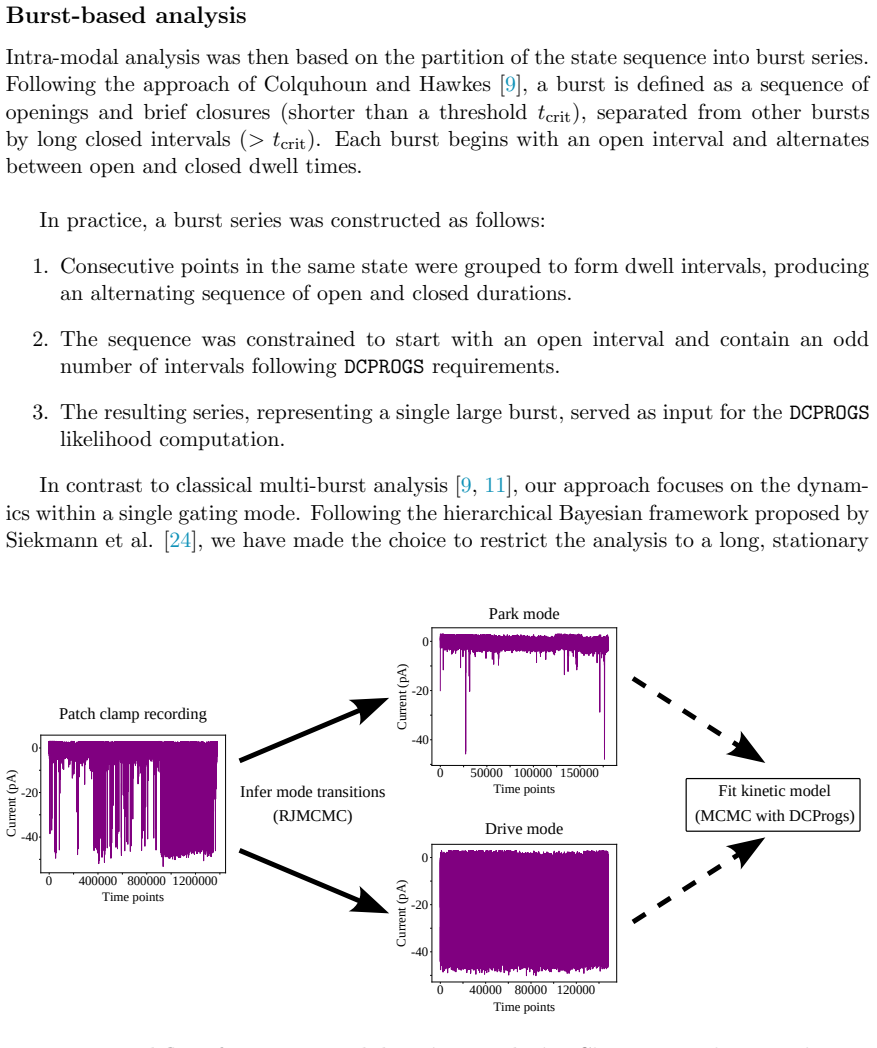
Figure from the paper full image
abstract click to expand
The Inositol 1,4,5-trisphosphate receptor channel (IP 3 R) is an important calcium channel involved in calcium-induced calcium release, playing a prominent role in intracellular calcium signaling. However, accurately characterizing its gating behavior remains a challenge, particularly due to the temporal resolution of patch clamp techniques that is not large enough to detect all short-lived events. This limitation can significantly bias the inference of kinetic models describing the receptor activity. To address this issue, we focused on the quantitative analysis of IP 3 R gating behavior using patch clamp data, with particular attention to missed events. We modeled IP 3 R channel gating using Hierarchical Markov chains and used a Bayesian approach that integrates missed event correction directly into the likelihood function, enabling more accurate parameter inference and model evaluation. We show that accounting for missed events deeply clarifies the multi-modal model that emerges from model selection. In this new model, the Park and Drive modes both consist of the same 3-state Markov model, with mode-dependent kinetic parameters: the Drive mode stabilizes the closed state directly connected to the open one, whereas the Park mode stabilizes the other closed state, that is not connected to the open one. Intermediate Ca 2+ concentrations are found to strongly depress the Drive to Park transition rate, so that the IP 3 R channel undergoes frequent transitions to the Park mode only for __ 50 nM or micromolar Ca 2+ concentrations. Overall, our approach provides a refined perspective on IP 3 R channel modeling and highlights the critical importance of accounting for missed events upon model selection based on single-channel recordings.
0
0
q-bio.QM 2026-05-13 1 theorem

NORI resolves ambiguous biology mappings orders of magnitude faster

NORI: Fast probabilistic inference for ambiguous observation-entity mappings

Faster probabilistic inference enables large-scale analysis and hyperparameter optimization in protein inference and omics studies.

abstract click to expand
NORI performs probabilistic inference to resolve ambiguous mappings between experimental observations and biological entities orders of magnitude faster than state-of-the-art methods. This makes large-scale analysis and extensive hyperparameter optimization possible, and supports a broader range of bioinformatics applications, including protein inference, taxonomic and functional analysis in omics-fields.
0
0
q-bio.QM 2026-05-12 Recognition

Seven papers let LLM workflow expand TPD databases by 81-92%

Beyond Manual Curation: Augmenting Targeted Protein Degradation Databases via Agentic Literature Extraction Workflows

Prompt refinement and term substitution recover structured assay records with over 82 percent expert validation on newly added entries.

Figure from the paper full image
abstract click to expand
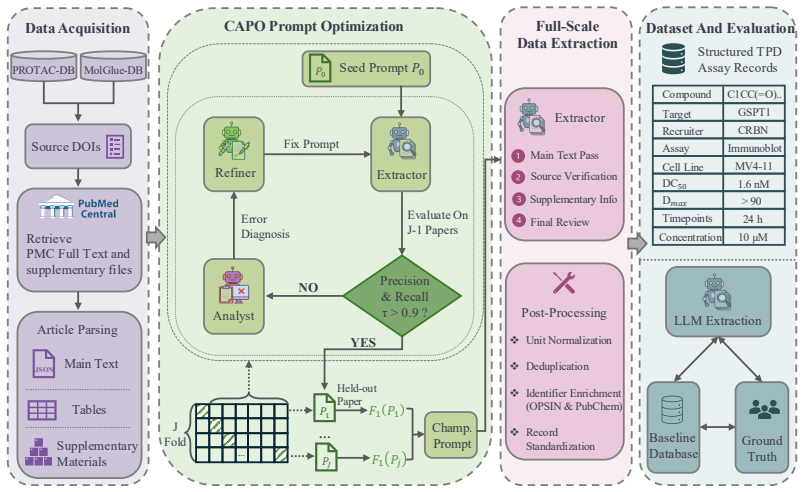
Predictive models in biomedicine depend on structured assay data locked in the text, tables, and supplements of primary publications. This bottleneck is especially acute in targeted protein degradation (TPD), where each assay record must combine compound identity, degradation target, recruiter, assay context, and endpoint values reported across sections, tables, and supplementary files. Inconsistent compound identifiers and incomplete or implicit assay context further demand domain-specific logic that generic LLM pipelines do not provide. Existing molecular glue and PROTAC databases are manually curated and often lack the experimental context required for downstream modeling. We formulate TPD database extraction as a domain-specific curation task and present an expert-in-the-loop LLM workflow, evaluated through a triangular comparison among LLM predictions, standardized baseline records, and expert-annotated ground truth. A lightweight cross-validated prompt-refinement module adapts extraction instructions from scarce expert annotations. With only seven annotated molecular glue publications, the workflow achieved record-level $F_1 = 0.98$ and transferred to PROTACs by terminology substitution alone, maintaining record-level $F_1 > 0.93$. Applied at scale, it expanded molecular glue and PROTAC databases by 81% and 92% records, respectively, with 92% and 82.5% of newly recovered records validated as correct upon expert review. The workflow also recovered kinetic and assay-context information essential for cross-study potency comparison and condition-aware degradation modeling. We release the workflow, prompts, evaluation code, and extracted datasets as resources for TPD data curation and AI-assisted scientific curation more broadly.
0
0
q-bio.QM 2026-05-12 2 theorems

Regression to the Mean and Dilution Share One Root Cause

The Same Problem by Different Names: Unifying Regression Dilution and Regression to the Mean

Measurement error in the predictor creates both problems; optimality maps show when Berry correction or structural methods recover the true,

Figure from the paper full image
abstract click to expand
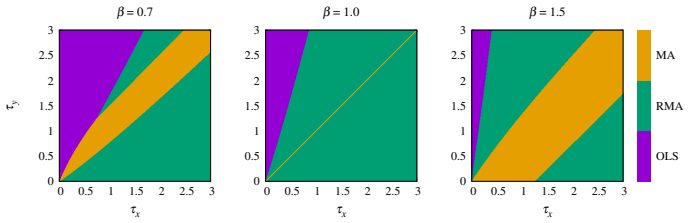
Regression to the Mean and Regression Dilution are often viewed as unrelated issues in the clinical and ecological literatures. In reality, they are different names for the same problem: measurement error in an independent variable that biases the perceived relationship between two factors. This study unifies these traditions by comparing specialized clinical tools, like the Berry correction, with standard structural estimators such as Major Axis and Reduced Major Axis regression. Using an analytical framework, we evaluate how these methods perform across various noise levels and sample sizes. Our results show that the Berry method is a specialized tool designed for clinical scenarios where a 1:1 relationship is expected. However, applying it to ecological trade-offs with negative slopes can lead to severe errors. We provide maps of optimality to identify which estimator most accurately recovers the true biological signal under different conditions. By reconciling these disparate methods, we offer a principled guide for researchers to choose the correct tool based on their data's noise profile rather than their disciplinary tradition.
0
0
q-bio.QM 2026-05-11 2 theorems

No LLM masters all three protein design stages

VibeProteinBench: An Evaluation Benchmark for Language-interfaced Vibe Protein Design

VibeProteinBench tests open-ended recognition, engineering, and generation tasks and finds every model falls short on at least one, showing

Figure from the paper full image
abstract click to expand
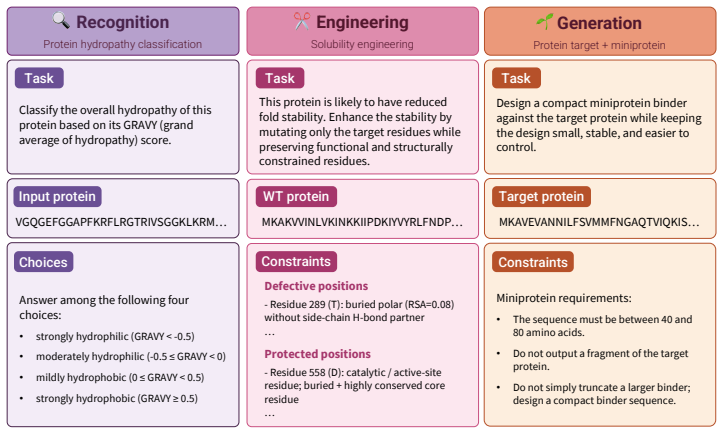
Protein design aims to compose amino-acid sequences that fold into stable three-dimensional structures while satisfying targeted functional properties. The field is increasingly shifting toward vibe protein design, where a single model is expected to generate novel sequences, engineer existing proteins, and reason about protein characteristics through flexible natural-language constraints. Large language models (LLMs) have emerged as a leading paradigm in this space. However, existing evaluation benchmarks often limit their scope to a partial aspect of protein design, while others restrict design objectives to structured input schemas, lacking an integrated framework that evaluates the broad spectrum of protein design competence under open-ended intents. To this end, we present Vibe Protein design Benchmark (VibeProteinBench), a language-interfaced benchmark that probes generalist capabilities through three complementary stages mirroring a computational protein design workflow: recognition, engineering, and generation. Each stage is grounded in expert-curated mechanistic rationales and multi-faceted in silico validation, to computationally verify whether model outputs are biologically plausible. Evaluations across diverse general-purpose and domain-specialized LLMs reveal that no model achieves strong performance across all three stages, suggesting that generalist protein design remains a substantial open challenge for current LLMs.
0
0
q-bio.QM 2026-05-11 1 theorem

R package MeTime stores all metabolomics steps in one container

MeTime: An R package for reproducible longitudinal metabolomics data analysis

Longitudinal studies keep data, metadata and results together so workflows stay transparent and reports generate automatically.

abstract click to expand
MeTime is an opensource R package for reproducible analysis of longitudinal metabolomics data. It builds upon a central S4 container, metime_analyser, that stores multiple datasets, associated metadata and analysis outputs, enabling unified handling of complex longitudinal studies. Analyses are constructed by piping modular functions, beginning with data transformations (mod_), followed by calculations (calc_), and optional meta-analysis (meta_), so entire workflows remain transparent and easy to modify. MeTime wraps numerous existing methods within a consistent interface, including sample and metabolite distributions, correlation and distance matrices, dimensionality reduction (PCA, UMAP, tSNE), random forest imputation and feature selection via Boruta, eigenmetabolites and WGCNA based clustering, conservation index analysis, regression models (linear, mixed effects, and generalized additive), and partial correlation networks. By retaining all intermediate results and provenance within the container, MeTime facilitates iterative exploration and ensures reproducible reporting via automatically generated HTML and PDF outputs. Comprehensive user guides, case studies and reference documentation accompany the package, making MeTime a versatile platform for longitudinal omics workflows.
0
0
q-bio.QM 2026-05-11 2 theorems

Graph model connects protein networks to cancer pathways at 90% accuracy

PPI-Net connects molecular protein interactions to functional processes in disease

Hierarchical propagation through interaction and pathway graphs improves prediction and reveals functional disease mechanisms in multiple癌

abstract click to expand
Understanding how molecular alterations propagate across biological systems to drive disease remains a central challenge. Although high-throughput profiling enables comprehensive characterization of tumor states, most models neglect structured biological relationships or lack interpretability across scales. Here we present PPI-Net, a hierarchical graph neural network that integrates protein-protein interaction (PPI) networks with pathway-level representations to model disease from molecular interactions to functional processes. Patient-specific molecular profiles are embedded within a shared interaction network from STRING and propagated through a multi-layer Reactome hierarchy using graph attention, enabling aggregation of gene-level signals into higher-order biological programs. Across RNA-seq data from ten cancer types from The Cancer Genome Atlas, PPI-Net achieves robust predictive performance, with balanced accuracy exceeding 90% in multiple cohorts. Comparative analysis on RNA-Seq data from breast cancer demonstrated that PPI-Net's integration of the Reactome hierarchy improved balanced accuracy by 6.7% relative to a PPI-only model, while hierarchical multi-level supervision improved balanced accuracy by 12.3% relative to using only a single top-level prediction head. Applying a multi-omics approach using RNA-seq and methylation data improves model interpretation, recovering canonical oncogenic modules, including TP53-AKT signaling and stress response pathways, while revealing convergence onto coherent programs such as ion signaling and cellular responses to stimuli. These results demonstrate that integrating interaction networks with pathway hierarchies enables accurate prediction while providing mechanistic insight into cancer biology.
0
0
q-bio.QM 2026-05-11 2 theorems

Models trained on real folds design RNA under mixed constraints

GoForth: Language Models for RNA Design under Structure, Sequence, and Coding Constraints

Encoder-decoder approach generates fast high-quality sequences from structure, sequence, and coding targets without post-filtering.

Figure from the paper full image
abstract click to expand
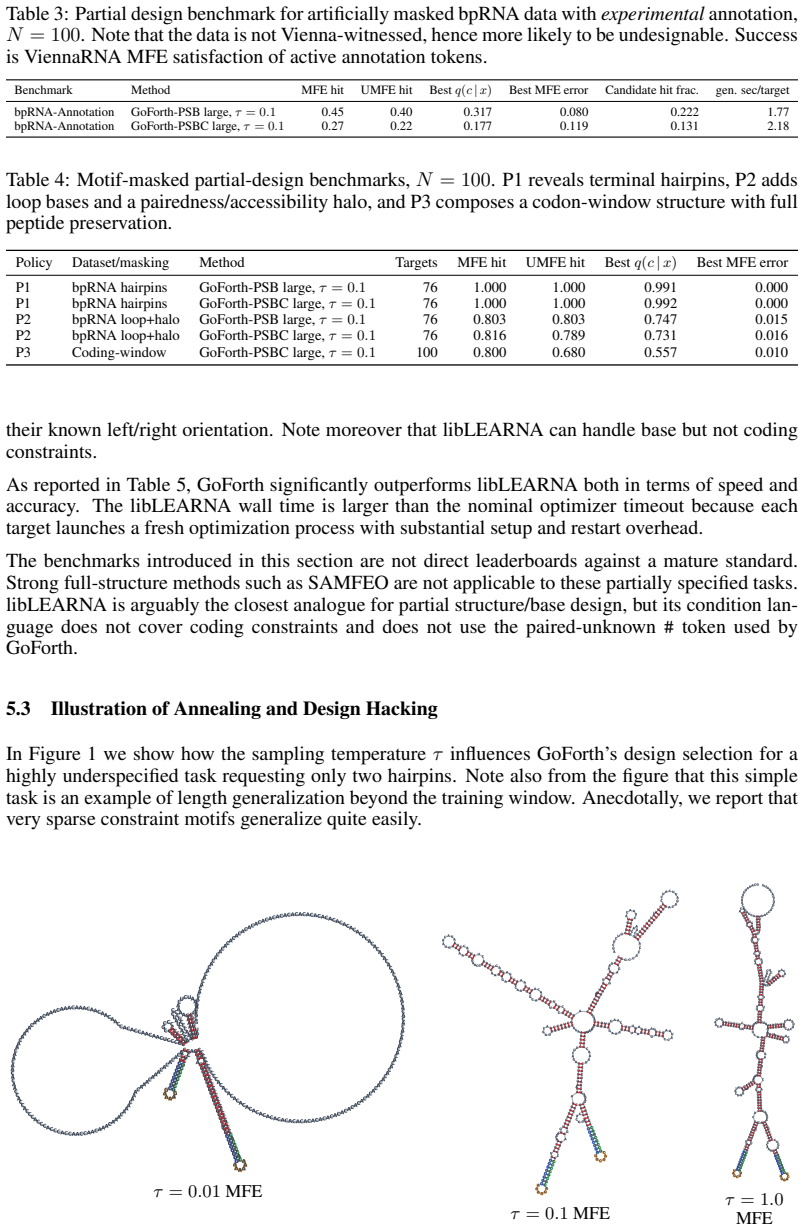
RNA inverse sequence design has broad biological and engineering applications, but computational methods for practical design queries remain limited. Such queries may impose several constraints at once, including target folds or motifs, fixed bases, and coding restrictions, while leaving arbitrary sequence and structure in unspecified regions. Because these constraints may permit many acceptable sequences, we study RNA design as a conditional generative modeling problem. The basic object is a conditional law over RNA sequences given a user-specified condition, with full inverse folding as a special case. We introduce GoForth, a forward-trained RNA language model that conditions on structure, sequence, and coding targets. The formulation separates three ingredients that are often entangled in RNA design: a sequence prior, a forward folding sampler, and a reward or likelihood oracle. We train encoder-decoder models on witnessed folds rather than on outputs from an inverse-design teacher and validate our methodology on full inverse-folding benchmarks, as well as tasks involving constraints on structure, sequence, and coding. The resulting models achieve fast and high-quality candidate generation for mixed RNA design specifications. Moreover they furnish useful semantic embeddings of design tasks and a robust learned notion of designability.
0
0
q-bio.QM 2026-05-08 Recognition

Shared neural co-variability peaks in V1 and falls higher up

Partitioning Neural Co-Variability

A population model separates single-neuron variability from structured gain covariance, revealing area-specific patterns missed by scalar F1

Figure from the paper full image
abstract click to expand
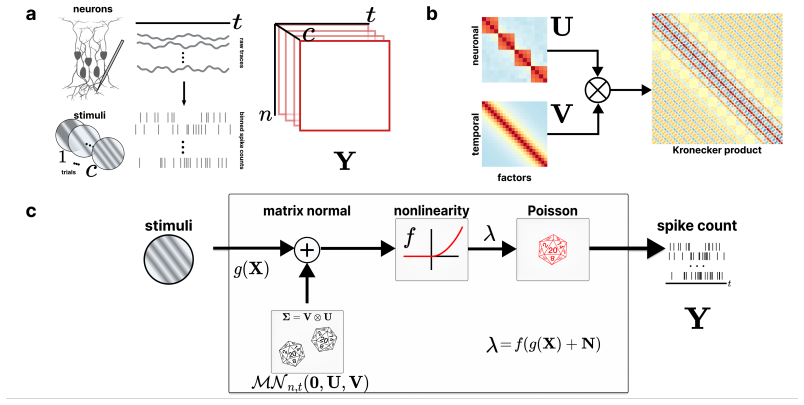
Trial-to-trial variability of neural responses has been linked to important aspects of neural computation and is essential for understanding how neuronal populations respond. While current overdispersion models treat each neuron's gain as independent of each other, this assumption fails to capture the network statistics of neuronal populations. As no existing model can capture overdispersed structured spiking gain-modulation across a neural population, network-level gain covariance remains largely unstudied. We thus present the Poisson matrix-normal latent variable (PMNLV) model, which extends single-neuron overdispersion to neural populations by placing a matrix-normal prior over the latent gain with a Kronecker-factored covariance. Spike counts are Poisson-distributed with a rate equal to the sum of a per-neuron stimulus tuning term and a matrix-normal gain, passed through a quadratic soft-rectifying link. We derive two complementary estimation algorithms: a variational EM (VEM) with a matrix-normal posterior that recovers dense Kronecker factors without structural assumptions, and a Kernel Tournament Method (KTM) that performs data-driven selection over a biologically motivated kernel dictionary and composite likelihood. On simulated data, both algorithms recover the inter-neuron and temporal covariance factors and accurate tuning curves. Applying VEM to Neuropixel recordings across four cortical regions of mouse visual hierarchy, we replicate a previous finding that single-neuron marginal variability changes little across cortical areas. We then show that shared population co-variability, invisible to scalar summaries e.g., the Fano factor, peaks in primary visual cortex and declines in higher visual areas. The PMNLV framework is applicable to any simultaneously recorded population where structured gain covariance is of scientific interest.
0
0
q-bio.QM 2026-05-08

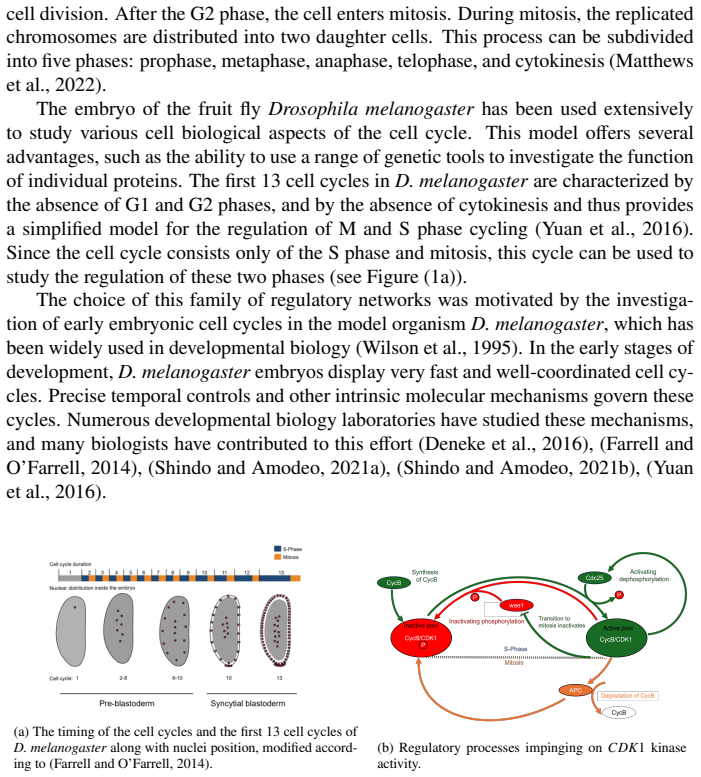
Slowing cyclin B synthesis lengthens early fly cell cycles

Mathematical Modeling of Early Embryonic Cell Cycles of Drosophila melanogaster

A reduced model reproduces the experimental increase in period over 14 divisions once synthesis rate is made time-dependent.

Figure from the paper full image
abstract click to expand
In the early stages of development, Drosophila melanogaster embryos possess very fast and well-coordinated cell cycles. In the cell cycle, CDK activity is essentially regulated by binding CDK and CycB to form an active complex and by phosphorylating CDK via CDC25 and dephosphorylating it via Wee1. We develop a mathematical model for the embryonic cell cycle which is biochemically sound and which can be rigorously analysed after a model reduction. We show that there exists a region in the parameter space where the model describes oscillations. We then focus on the role of two parameters: the CycB synthesis and the activation coefficient of APC. Our main biological hypothesis is that the first one is responsible for the period lengthening over the first 14 cycles which can be experimentally observed and this hypothesis is supported by numerical simulations of our model: if the CycB synthesis is made time-dependent with a prescribed dynamics, then our simulations show qualitatively a very similar behavior to experimental data reported in the literature.
0
0
q-bio.QM 2026-05-08 3 theorems

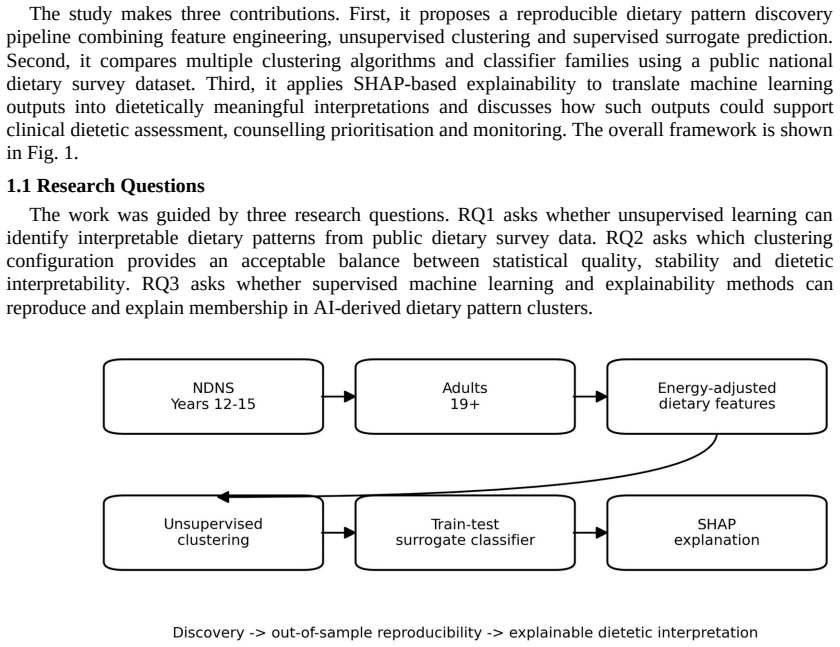
Four dietary patterns emerge from UK survey via K-means

An Explainable Unsupervised-to-Supervised Machine Learning Framework for Dietary Pattern Discovery Using UK National Dietary Survey Data

A surrogate classifier reproduces the groups with high accuracy and SHAP links each to specific nutrients for counselling use.

Figure from the paper full image
abstract click to expand
Clinical dietary assessment can generate detailed but high-dimensional nutrient and food-group information that is difficult to translate quickly into counselling priorities. This paper proposes an explainable unsupervised-to-supervised machine learning framework for discovering, reproducing and interpreting dietary patterns using public UK National Diet and Nutrition Survey data. Adult participants aged 19 years and above from NDNS Years 12-15 were represented using 25 energy-adjusted nutrient and food-group features. K-means, Gaussian Mixture Models and Agglomerative Clustering were compared across k = 2-8, with stability and dietetic interpretability used alongside internal validation metrics. The selected K-means k = 4 solution identified four interpretable dietary patterns: high fat/meat and sodium, higher fibre fruit-vegetable micronutrient, high free-sugar snacks and sugary drinks, and dairy/cereal calcium-rich saturated-fat. A supervised surrogate classifier reproduced held-out cluster membership with high test performance (macro-F1 = 0.963), but was interpreted only as an explanatory surrogate rather than as an independent clinical prediction model. SHAP analysis linked predictions to dietetically meaningful drivers, suggesting potential value for dietitian-in-the-loop assessment, counselling prioritisation and follow-up monitoring.
0
0
q-bio.QM 2026-05-08

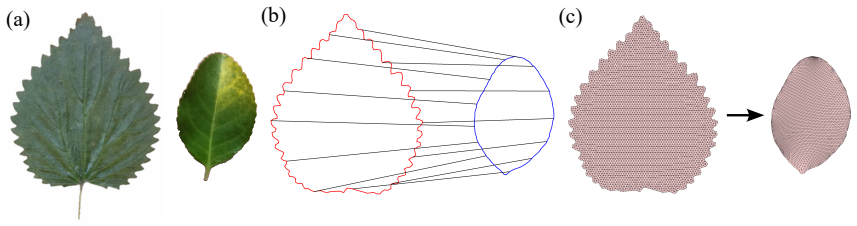
Boundary registration plus quasi-conformal fill quantifies planar shape variation

Planar morphometry via functional shape data analysis and quasi-conformal mappings

Elastic matching of outlines followed by interior mapping outperforms single-domain descriptions on leaf and wing datasets.

Figure from the paper full image
abstract click to expand
The study of shapes is one of the most fundamental problems in life sciences. Although numerous methods have been developed for the morphometry of planar biological shapes over the past several decades, most of them focus solely on either the outer silhouettes or the interior features of the shapes without capturing the coupling between them. Moreover, many existing shape mapping techniques are limited to establishing correspondence between planar structures without further allowing for the quantitative analysis or modelling of shape changes. In this work, we introduce FDA-QC, a novel planar morphometry method that combines functional shape data analysis (FDA) techniques and quasi-conformal (QC) mappings, taking both the boundary and interior of the planar shapes into consideration. Specifically, closed planar curves are represented by their square-root velocity functions and registered by elastic matching in the function space. The induced boundary correspondence is then extended to the entire planar domains by a quasi-conformal map, optionally with landmark constraints. Moreover, the proposed FDA-QC method can naturally lead to a unified framework for shape morphing and shape variation quantification. We apply the FDA-QC method to various leaf and insect wing datasets, and the experimental results show that the proposed combined approach captures morphological variation more effectively than purely boundary-based or interior-based descriptions. Altogether, our work paves a new way for understanding the growth and form of planar biological shapes.
0
0
q-bio.QM 2026-05-06 3 theorems

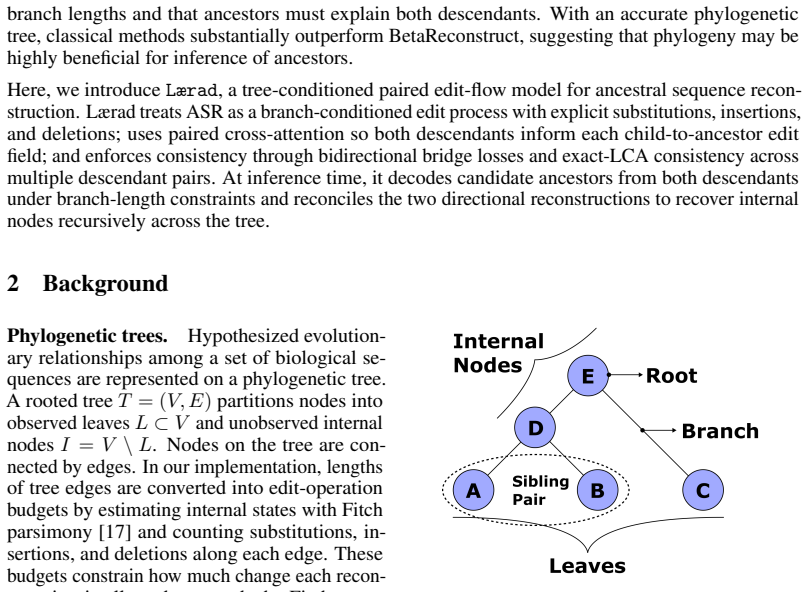
Edit-flow model localizes changes more accurately on indel-rich sequences

Tree-Conditioned Edit Flows for Ancestral Sequence Reconstruction

Paired bidirectional trajectories trained on natural proteins outperform classical methods when insertions and deletions are present.

Figure from the paper full image
abstract click to expand
Ancestral sequence reconstruction (ASR) aims to infer extinct protein sequences at internal nodes of a phylogenetic tree. Classical ASR methods are typically based on continuous-time Markov substitution models, but they treat sites largely independently and handle insertions and deletions only weakly or not at all. We introduce a tree-conditioned edit-flow model for variable-length ASR. Given two descendant sequences and their branch distances to a shared ancestor, the model reconstructs the ancestor through paired bidirectional edit trajectories constrained to agree on a common ancestral state. On a benchmark of experimentally evolved sequences with only context-independent substitutions, the model does not match the accuracy of the best classical method, yet still achieves reasonable performance despite being trained on natural sequences that include insertions, deletions, and substitutions. On a benchmark of natural homologous sequences with abundant insertions and deletions, the model most accurately localizes inferred evolutionary change.
0
0
q-bio.QM 2026-05-06 3 theorems

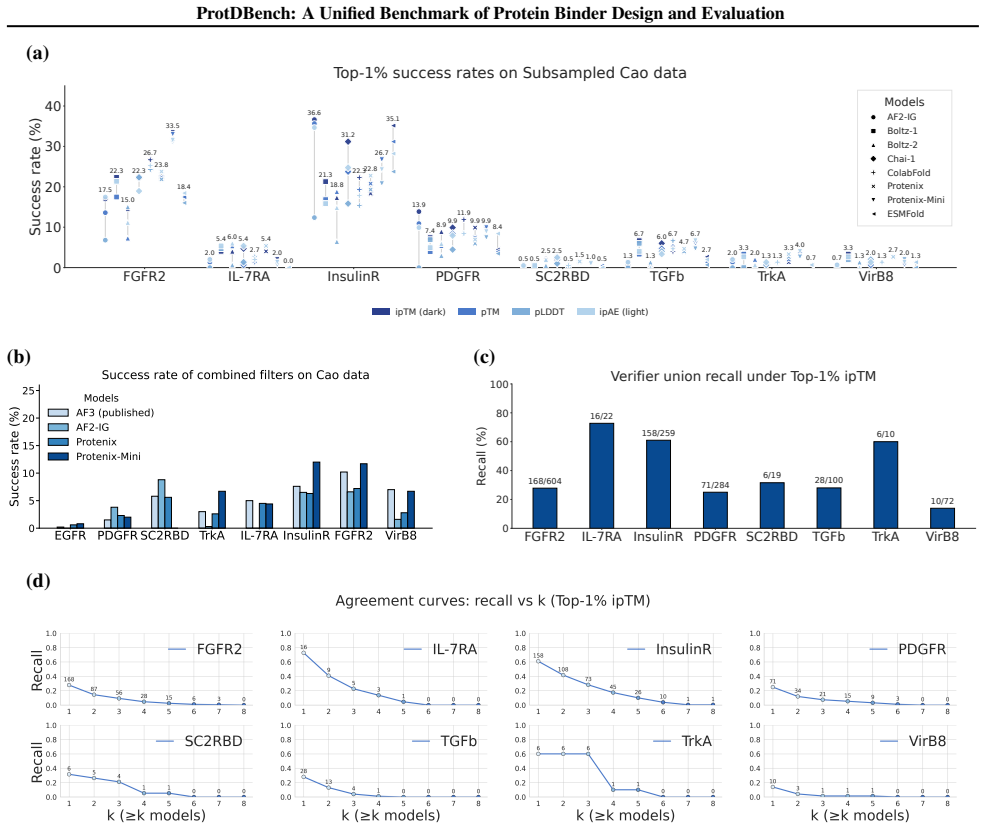
Benchmark shows protein binder verifiers often disagree

ProtDBench: A Unified Benchmark of Protein Binder Design and Evaluation

Identical designs receive conflicting success labels from different structure models, changing how design methods rank under fixed time and

Figure from the paper full image
abstract click to expand
Recent advances in de novo protein binder design have enabled increasing experimental validation, yet reported in silico metrics remain difficult to interpret or compare across studies due to non-standardized evaluation protocols. We introduce ProtDBench, a standardized and throughput-aware evaluation framework for protein binder design. ProtDBench defines unified benchmark tasks, evaluation protocols, and success criteria, enabling systematic analysis of how evaluation design influences observed performance. Using a large wet-lab annotated dataset, we analyze commonly used structure prediction models as evaluation verifiers, revealing substantial verifier-dependent bias and limited agreement under identical filtering protocols. We then benchmark representative open-source generative binder design methods across ten diverse protein targets under a fixed evaluation protocol. Beyond per-sequence success rates, ProtDBench incorporates throughput-aware metrics based on a fixed 24-hour budget, as well as cluster-level success criteria to account for structural diversity. Together, these results expose systematic differences induced by filtering rules, success definitions, and throughput-aware evaluation between computational efficiency, success rate, and structural diversity. Overall, ProtDBench provides a fair and reproducible evaluation pipeline that supports systematic and controlled comparison of protein binder design methods under realistic evaluation settings.
0
0
q-bio.QM 2026-05-06

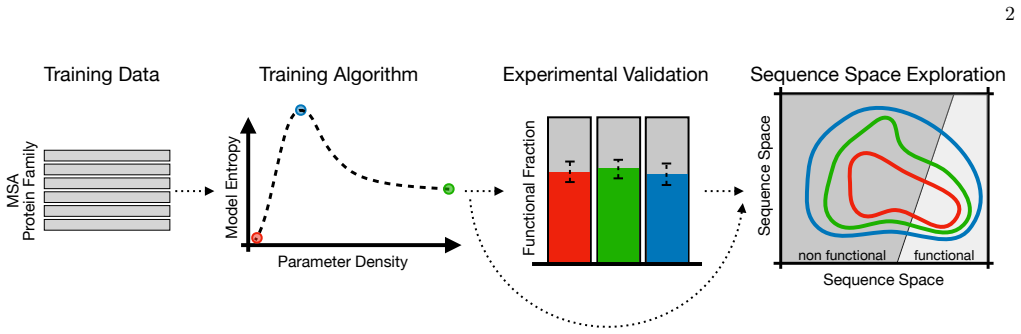
High-entropy models sample 15 orders more functional protein sequences

Expanding functional protein sequence space using high entropy generative models

Boltzmann Machines on evolutionary data produce working enzymes across vastly larger spaces than dense models while matching their success

Figure from the paper full image
abstract click to expand
Boltzmann Machines trained on evolutionary sequence data have emerged as a powerful paradigm for the data-driven design of artificial proteins. However, the relationship between model architecture, specifically parameter density, and experimental performance remains poorly understood. Here, we investigate this relationship using the Chorismate Mutase enzyme family as a model system. We compare standard fully connected Boltzmann Machines for Direct Coupling Analysis (bmDCA) with sparse models generated via progressive edge activation (eaDCA) and edge decimation (edDCA). We identify a maximum-entropy model (meDCA) along the decimation trajectory that represents an optimal balance between constraint satisfaction and the flexibility of the probability distribution. We synthesized and tested artificial sequences from all models using an in vivo complementation assay, finding that all architectures, regardless of sparsity, generate functional enzymes with high success rates, even at significant divergence from natural sequences. Despite this functional equivalence, we demonstrate that the meDCA model samples a viable sequence space that is more than fifteen orders of magnitude larger than its low-entropy counterparts. Furthermore, comparative analyses reveal that high-entropy models systematically minimize overfitting and better capture the local neutral spaces surrounding natural proteins. These findings suggest that while various models satisfying coevolutionary statistics can generate functional sequences, high-entropy Boltzmann Machines provide a superior representation of the underlying evolutionary fitness landscape.
0
0
q-bio.QM 2026-05-06

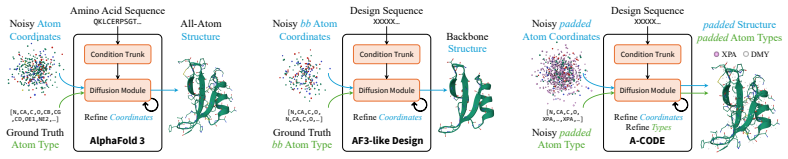
Atomic diffusion unifies protein sequence and structure design

A-CODE: Fully Atomic Protein Co-Design with Unified Multimodal Diffusion

One-stage model on atom coordinates and types outperforms staged methods and supports non-canonical amino acids.

Figure from the paper full image
abstract click to expand
We present A-CODE, a fully atomic unified one-stage protein co-design model that simultaneously refines discrete atom types and continuous atom coordinates. Unlike predominant two-stage methods that cascade structure design with amino acid-level sequence design, our approach is fully atomic within a unified multimodal diffusion framework, in which residue identities are inferred solely from atom-level predictions. Built upon the powerful all-atom architecture, A-CODE achieves superior designability for unconditional protein generation, outperforming all existing one-stage and two-stage design models. For binder design, A-CODE rivals and even outperforms existing state-of-the-art two-stage design models and, compared with the existing one-stage co-design model, achieves a drastic tenfold improvement in success rate on hard tasks. The inherent flexibility of our atomic formulation enables, for the first time, seamless adaptation to non-canonical amino acid (ncAA) modeling. Our fully atomic framework establishes a new, versatile foundation for all-atom generative modeling that can be naturally extended to complex biomolecular systems.
0
1
q-bio.QM 2026-05-06

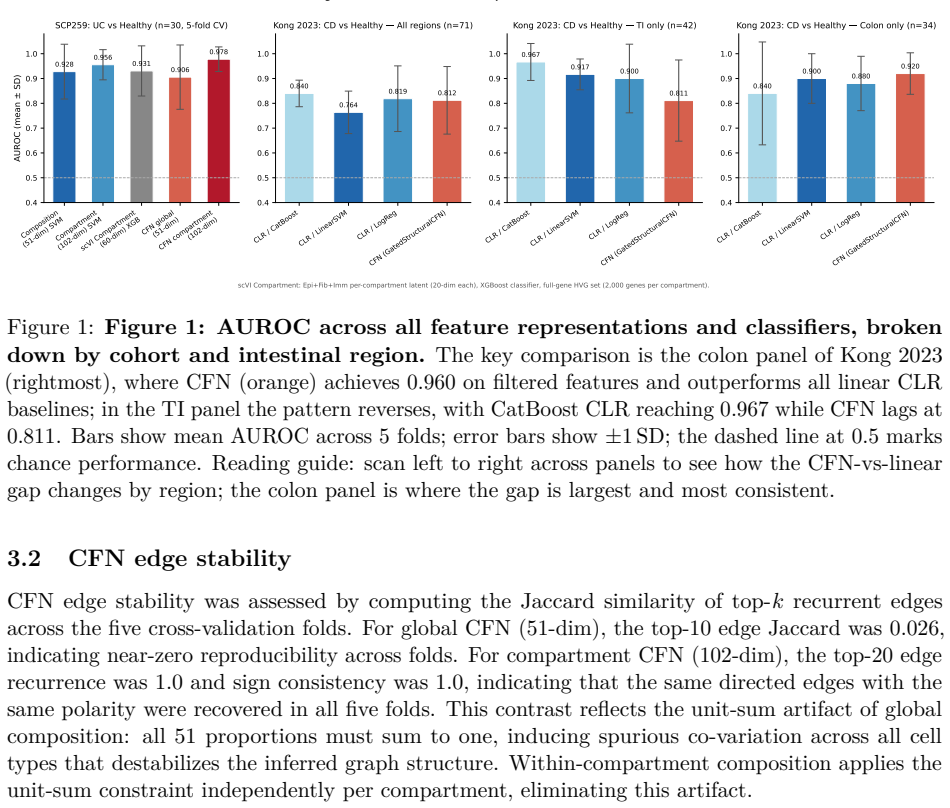
Compartment-stratified features classify IBD at AUROC 0.96 under donor-aware splits

Donor-Aware scRNA-seq Benchmarks for IBD Classification

Benchmark on two cohorts shows CFN edges linear CLR in colon while compartment labels remove spurious dependency instability.

Figure from the paper full image
abstract click to expand
Donor-level disease classification from single-cell RNA sequencing (scRNA-seq) requires strict donor-aware cross-validation: naive pipelines that split cells randomly conflate training and test donors, inflating reported performance through pseudoreplication. We present a donor-aware benchmark evaluating three feature representations across two independent IBD cohorts: centered log-ratio (CLR) transformed cell-type composition, GatedStructuralCFN dependency embeddings, and scVI variational autoencoder latent embeddings. The cohorts are the SCP259 ulcerative colitis atlas (UC vs. Healthy, n=30 donors, 51 cell types) and the Kong 2023 Crohn's disease atlas (CD vs. Healthy, n=71 donors, 55-68 cell types across three intestinal regions). Compartment-stratified CLR composition achieves AUROC 0.956 +/- 0.061 on SCP259; GatedStructuralCFN on the same features achieves 0.978 +/- 0.050. In the Kong cohort, CFN achieves its best performance in the colon region (0.960 +/- 0.055 after feature filtering), exceeding linear CLR (0.900 +/- 0.100), while terminal ileum classification is dominated by linear models (CatBoost CLR 0.967 +/- 0.075 vs. CFN 0.811 +/- 0.164). Cross-dataset transfer (CD->UC, four shared cell types) achieves AUC 0.833 with XGBoost CLR; the reverse direction performs at chance. CFN edge stability analysis shows that compartment-wise composition eliminates spurious unit-sum-induced instability present in global composition (Jaccard 0.026 vs. top-20 recurrence 1.0). CFN shows a consistent numerical advantage over linear models in the colon region of CD (AUROC 0.960 vs. 0.900), though no inter-method comparison reached statistical significance at n<=34 donors per region. Compartment-aware feature construction is critical for both classification performance and structural interpretability. Code: https://github.com/Jonathan-321/sfn-scrna-study
0
0
q-bio.QM 2026-05-04

Joint QSM cuts variability across repeated brain scans

Longitudinal QSM: Enhancing consistency of multiple time point susceptibility maps via simultaneous reconstruction

Simultaneous reconstruction with sparse change penalty stabilizes normal tissue while keeping lesion signals intact in stroke and MS data.

abstract click to expand
Quantitative susceptibility mapping (QSM) has been increasingly applied in longitudinal studies of neurodegenerative diseases and aging to assess temporal alterations in brain iron and myelin. The accuracy of such investigations depends on the repeatability and sensitivity of measurements. However, the ill-posed nature of the QSM processing steps makes the reconstruction vulnerable to background field changes, head orientation changes, noise, and imperfect registration, which compromise repeatability and sensitivity and hinder reliable detection of true changes. To address these limitations, we propose Longitudinal QSM, a simultaneous reconstruction framework that jointly estimates susceptibility maps across time points while enforcing spatial sparsity of temporal changes. The method was evaluated through simulations and in-vivo experiments and compared with conventional reconstruction methods. Longitudinal QSM consistently reduced inter-scan variability and accurately recovered simulated lesion changes. Application to stroke patient and multiple sclerosis patient data further demonstrated that the framework stabilizes non-lesion variability while preserving lesion-related temporal changes. This approach offers a promising tool for monitoring subtle temporal changes in brain iron and myelin in various neurodegenerative diseases as well as throughout aging and development.
0
0
q-bio.QM 2026-05-04

Model ties indoor light to cognition via three channels

How Light Reshapes the Mind. An Active Inference Framework for the Cognitive and Emotional Effects of Indoor Lighting

Simulations of five-hour reading confirm six predictions on how illuminance, colour temperature and spectrum alter performance and eye data.

Figure from the paper full image
abstract click to expand
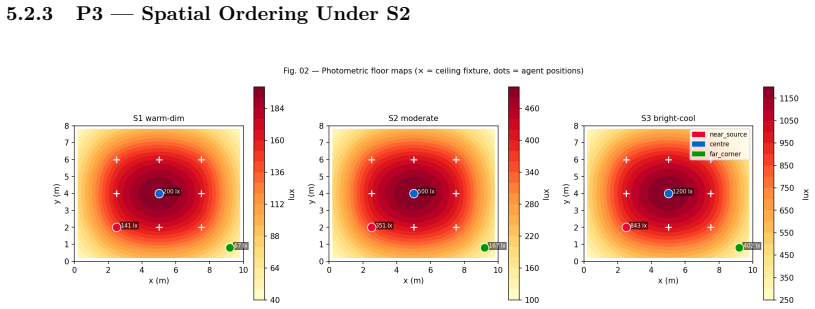
Indoor lighting affects cognition, affect, and behavioural regulation, but these effects are often treated as isolated findings rather than as parts of a unified process. This paper proposes an active inference account of shared indoor lighting in multi-user environments such as offices, classrooms, and libraries. It argues that lighting shapes behaviour through three distinct channels: illuminance modulates perceptual precision, correlated colour temperature modulates arousal relative to circadian optimum, and spectral composition biases behavioural disposition toward engagement or rest. The paper formalises this hypothesis through a proof-of-concept POMDP model of agents performing sustained reading over five hours, using both reading performance and eye-tracking observations. The model generates six falsifiable predictions, all confirmed across 20 Monte Carlo simulations.
0
0
q-bio.QM 2026-05-04

Joint sequence-structure decoding yields more functional proteins

Co-Generative De Novo Functional Protein Design

CodeFP adds local functional motifs and extra supervision to generate designs that improve both activity and foldability over prior methods.

Figure from the paper full image
abstract click to expand
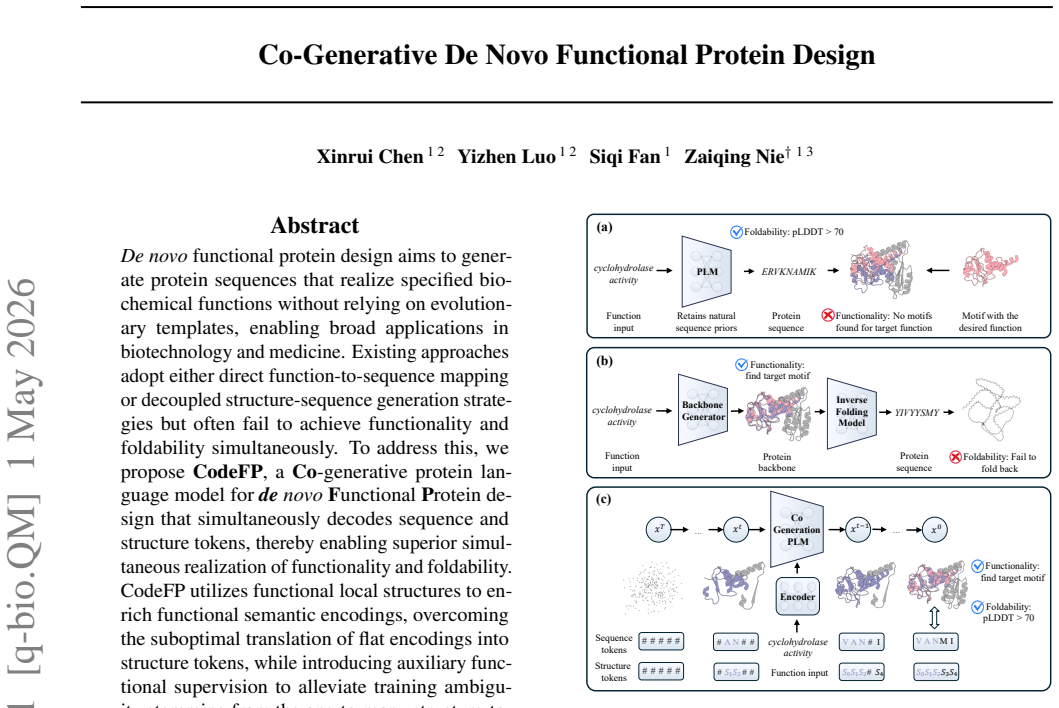
De novo functional protein design aims to generate protein sequences that realize specified biochemical functions without relying on evolutionary templates, enabling broad applications in biotechnology and medicine. Existing approaches adopt either direct function-to-sequence mapping or decoupled structure-sequence generation strategies but often fail to achieve functionality and foldability simultaneously. To address this, we propose CodeFP, a Co-generative protein language model for de novo Functional Protein design that simultaneously decodes sequence and structure tokens, thereby enabling superior simultaneous realization of functionality and foldability. CodeFP utilizes functional local structures to enrich functional semantic encodings, overcoming the suboptimal translation of flat encodings into structure tokens, while introducing auxiliary functional supervision to alleviate training ambiguity stemming from the one-to-many structure-to-token mapping. Extensive experiments show that CodeFP consistently achieves average improvements of 6.1% in functional consistency and 3.2% in foldability over the strongest baseline.
0
0
q-bio.QM 2026-05-04

Low-precision math speeds biological stochastic simulations

Reduced-Precision Stochastic Simulation for Mathematical Biology

16-bit propensities plus stochastic rounding keep SSA distributions identical to 64-bit references while shrinking memory and adding modest

Figure from the paper full image
abstract click to expand
The stochastic simulation algorithm (SSA) is widely used to perform exact forward simulation of discrete stochastic processes in biology. However, the computational cost, driven by sequential event-by-event sampling across large ensembles, remains a computational barrier. We investigate whether reduced-precision floating-point arithmetic can accelerate SSA without degrading statistical fidelity, drawing on the success of reduced-precision methods in weather and climate modelling. We evaluate two strategies across five canonical models (birth--death, Schl\"{o}gl, Telegraph, dimerisation, repressilator): (i) mixed precision, computing propensities in 16-bit while maintaining accumulators in 32-bit; and (ii) uniform precision, performing all arithmetic in 16-bit. Mixed-precision SSA produces ensemble statistics that closely match the 64-bit reference for all models, as measured by Kolmogorov--Smirnov tests and Wasserstein distances. Under uniform precision, deterministic rounding introduces systematic biases across several models, with catastrophic failures in some cases. Stochastic rounding (SR) and propensity normalisation eliminate these biases, restoring distributional fidelity across all models tested (KS $p > 0.05$). Our results establish mixed-precision SSA with SR as a viable acceleration strategy for mathematical biology: 16-bit formats shrink per-variable data size by $2$--$4\times$ relative to \texttt{fp32}/\texttt{fp64}, yielding comparable reductions in memory footprint and up to $\sim 1.5\times$ wall-clock speedup on CPU hardware that lacks native 16-bit arithmetic. As a hardware-level acceleration, mixed-precision SSA complements algorithmic methods such as tau-leaping and maps naturally onto modern GPU and TPU architectures with native 16-bit arithmetic.
0
0
q-bio.QM 2026-05-04

Universal space predicts brain fMRI signals across states with r over 0.9

A Universal Space of Brain Dynamics for Unveiling Cognitive Transitions and Individual Differences

Separating wiring from timing creates a model that works for 963 people and tracks how cognition changes.

abstract click to expand
Representing dynamical systems through data-driven universal spaces has proven effective; however, achieving this universality for human brain activity remains a significant challenge, further aggravated by diverse cognitive states and individual subjects. Recognizing that spatial properties reflect physical wiring while temporal properties reflect brain function, we develop Universal Brain Dynamics (UBD) to construct a universal space tailored to brain activity and quantify corresponding dynamics using a model-derived Jacobian matrix. Crucially, we validate UBD's universality by accurately predicting functional magnetic resonance imaging (fMRI) signals (Pearson's r > 0.9) across eight states and 963 subjects in the Human Connectome Project (HCP). Through evaluating resting-state fMRI represented within UBD, we gain insight into how infra-slow fluctuation (ISF) underpins brain activity. Furthermore, we reveal a new perspective on structure-function coupling (SFC) by analyzing the temporal sequence of brain dynamics. Extending UBD to task-evoked states, we derive brain dynamics across various cognitive conditions, elucidating the neural mechanisms driving cognitive transitions at a finer granularity. For individual differences, we compare brain dynamics across subjects to identify the neural underpinnings of these variations. Our findings suggest that synergistically integrating spatial and temporal properties of brain activity establishes a universal space for its unfolding, enabling the precise numerical analysis of underlying neural mechanisms across varying conditions.
0
0
q-bio.QM 2026-05-01

Neural ODE predicts amyloid PET signals years ahead

LNODE: latent dynamics reveal the shared spatiotemporal structure of amyloid-β progression

Jointly calibrated on thousands of scans, the underparameterized model fits data to R² over 0.99 and reveals distinct progression subtypes.

Figure from the paper full image
abstract click to expand
We introduce LNODE, a mechanism-based phenomenological model for amyloid beta (A$\beta$) dynamics, calibrated using positron emission tomography (PET) imaging. A$\beta$ is a key biomarker of Alzheimer's disease. LNODE is designed to support the fusion, harmonization, quantitative analysis, and interpretation of Abeta PET scans. We evaluate LNODE on 1461 subjects in the ADNI cohort and 1070 subjects in the A4 Study, using MUSE and DKT anatomical atlases. LNODE is formulated as a regional neural ordinary differential equation (ODE) model that is jointly calibrated on all available scans within a cohort. The model captures the spatial propagation, proliferation, and clearance of A$\beta$ and incorporates a latent-state representation that modulates A$\beta$ dynamics. The temporal evolution of these latent states is governed by cohort-shared parameters, enabling LNODE to represent both population-level trajectories and subject-specific deviations. The proposed model demonstrates strong parameter identifiability and stability properties, supported by synthetic experiments and analytical analysis of the Hessian condition number. To mitigate overfitting and reduce spurious correlations, LNODE is intentionally underparameterized, employing approximately five to ten parameters per subject. Despite this parsimonious parameterization, LNODE achieves $R^2 > 0.99$ in both the ADNI and A4 datasets. LNODE exhibits strong predictive performance: in the A4 cohort, it accurately forecasts the A$\beta$ PET signal in previously unseen follow-up scans, including cases with inter-scan intervals exceeding four years. Clustering in the learned latent-state space reveals distinct subgroups, consistent with the existence of different subtypes of Alzheimer's disease progression.
0
0
q-bio.QM 2026-05-01

Framework keeps epidemic simulations positive and bounded at any step size

EPITIME: A Computational Framework for Integral Epidemic Models with Structure-Preserving Discretizations

Non-standard discretizations in EPITIME maintain key properties of age-of-infection and behavioral models regardless of time step.

Figure from the paper full image
abstract click to expand
We present EPITIME (EPidemic Integral models TIMe profile Explorer), a computational framework for the simulation of two classes of integral epidemic models: an age of infection model and an information dependent behavioural model. The framework combines structure preserving Non-Standard Finite Difference discretizations with modular implementations in MATLAB and Python, together with routines for parameter handling, input validation, performance assessment, and graphical interaction. The proposed methods preserve key qualitative properties of the continuous problems, including positivity, boundedness, invariant regions, and correct long term behaviour, independently of the time step. We outline the numerical schemes for both model classes and their main analytical properties, including first order convergence. We then describe the software architecture and illustrate its use through numerical experiments on asymptotic behaviour, inverse reconstruction of an infectivity kernel from COVID 19 incidence data, and behavioural dynamics under different memory kernels. Overall, EPITIME provides a reliable and accessible computational environment for the numerical study of renewal epidemic models.
0
0
q-bio.QM 2026-04-29

Model generates 3D skulls from four specimens respecting evolution

PhyloSDF: Phylogenetically-Conditioned Neural Generation of 3D Skull Morphology via Residual Flow Matching

Residual flow matching and phylogenetic loss produce novel shapes at 88-129 percent of real intra-species variation across 24 finch species.

Figure from the paper full image
abstract click to expand
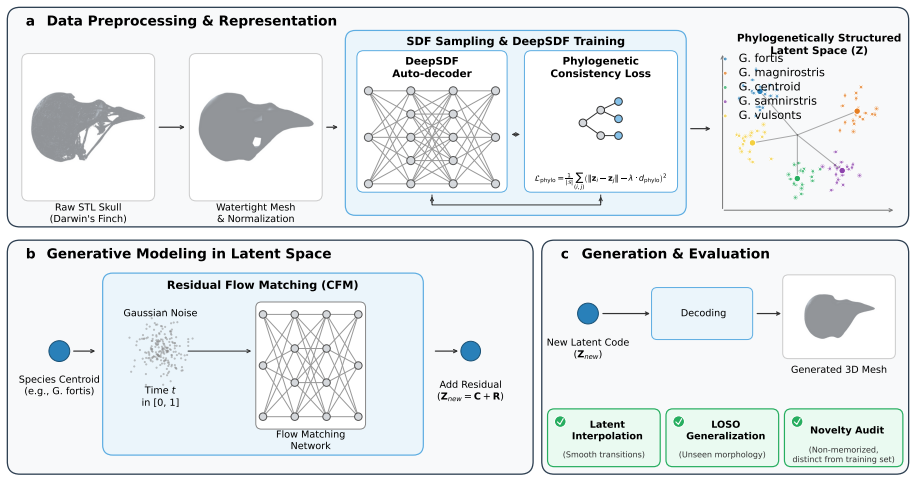
Generating novel, biologically plausible three-dimensional morphological structures is a fundamental challenge in computational evolutionary biology, hampered by extreme data scarcity and the requirement that generated shapes respect phylogenetic relationships among species. In this work, we present PhyloSDF, a phylogenetically-conditioned neural generative model for 3D biological morphology that integrates two innovations: (1) a DeepSDF auto-decoder regularized by a novel Phylogenetic Consistency Loss that structures the latent space to correlate with evolutionary distances (Pearson $r=0.993$); (2) a Residual Conditional Flow Matching (Residual CFM) architecture that factorizes generation into analytic species-centroid lookup and learned residual prediction, enabling generation from as few as ~4 specimens per species. We evaluate PhyloSDF on 100 micro-CT-scanned skulls of Darwin's Finches and their relatives across 24 species. The model generates novel meshes achieving 88-129% of real intra-species variation at the code level, with all 180 generated meshes verified as non-memorized. Residual CFM surpasses denoising diffusion (which fails entirely at this scale), standard flow matching (which mode-collapses to 3-6% variation), and a Gaussian mixture baseline in both fidelity (Chamfer Distance 0.00181 vs. 0.00190) and morphometric Fr\'{e}chet distance (10,641 vs. 13,322). Leave-one-species-out experiments across 18 species demonstrate phylogenetic extrapolation capability, and smooth latent interpolations produce biologically plausible ancestral skull reconstructions.
0
0
q-bio.QM 2026-04-28

Long-memory models confirm cued gait anti-persistence as real fractional process

Persistent and anti-persistent stride-to-stride fluctuations: an ARFIMA decomposition consistent with closed-loop sensorimotor control

ARFIMA decomposition isolates true long-range correlations from short-memory effects and aligns with a closed-loop sensorimotor model better

Figure from the paper full image
abstract click to expand
Stride-to-stride fluctuations in human walking carry a fractal correlation structure that reverses sign under external cueing: self-paced gait is persistent, whereas metronomic or visually cued gait is anti-persistent. Three decades of detrended fluctuation analysis (DFA) have established this reversal as a scaling-exponent shift, but DFA cannot distinguish genuine long-memory dynamics from short-memory autoregressive moving-average (ARMA) processes that produce the same apparent exponent. We fit the full eight-model ARFIMA(1,d,1) family to stride interval and stride speed series from three independent datasets (N = 70 subjects) spanning overground walking, fixed-speed treadmill walking, metronomic and visual cueing, and graded positional constraint. Model evidence is aggregated through BIC-based Schwarz weights, and the fractional differencing parameter d together with the autoregressive and moving-average coefficients phi and theta are estimated by Bayesian model averaging. Three findings emerge. Long-memory specifications decisively outweigh ARMA alternatives under both persistent and anti-persistent conditions, establishing cued gait anti-persistence as a genuine fractional phenomenon. DFA alpha overestimates d + 0.5 by 0.25 to 0.34 alpha units owing to short-memory components that DFA conflates with long-memory persistence, establishing ARFIMA-based decomposition as the more informative estimator. The estimated (d, phi, theta) parameters are consistent with a corrective sensorimotor model in which a fractal intrinsic generator, a reactive feedback correction, and a motor-delay component together shape stride-interval fluctuations, with the strength of the correction varying according to the type and tightness of external constraint. A unified mechanistic account of these parameter ranges across rhythmic, spatial, and unconstrained conditions remains an open question.
0
0
q-bio.QM 2026-04-27

Action-only views and limited attention trap groups in echo chambers

Messaging strategies and the emergence of echo chambers in collective decision-making

Two messaging constraints make collective accuracy sensitive to social weighting, locking decisions into self-reinforcing states that ignore

Figure from the paper full image
abstract click to expand
Collective decision-making arises from individual agents integrating their own personal observations with information obtained from social partners. In many biological systems that exhibit collective decision-making, the process by which social information is produced, transmitted, and used is subject to two key constraints. First, individuals often do not observe the internal states or personal observations of their neighbors; instead, they observe neighbors' discrete actions. Second, agents often have limited attention, such that, at any given moment, only a subset of social partners influences decisions. Using methods from nonlinear dynamics, we show that either of these constraints can cause collective accuracy to become extremely sensitive to the weight individuals place on the information they receive from others. This sensitivity arises from the spontaneous formation of echo chamber-like states in which individuals receive and transmit homogeneous social messages. Under such conditions, collectives become locked in self-reinforcing states that prevent them from tracking changes in the environment. We reveal the mathematical basis of this phenomenon, and show that it emerges not only in generic models of collective decision-making but also in models developed to describe specific biological systems, including neural circuits, eusocial insect colonies, and mobile animal groups. Finally, we identify biologically plausible mechanisms through which individuals may reduce the risk of echo chamber formation and achieve robust yet sensitive collective decisions without requiring fine-tuning parameters. Our results reveal how fundamental constraints on communication shape the dynamics and reliability of collective decisions across diverse biological systems.
0
0
q-bio.QM 2026-04-27

Hyperbolic VAE yields more accurate protein ancestor reconstructions

HyperEvoGen: Exploring deep phylogeny using non-Euclidean variational inference

Embeddings place sequences so distances reflect evolutionary divergence, avoiding saturation in standard metrics on deep phylogenies.

abstract click to expand
Homologous proteins evolve from a common ancestral sequence, constrained by intricate patterns of co-evolving residues. Accurate reconstruction of evolutionary histories remains a challenge, primarily due to the inability of the existing approaches to capture long-range coevolutionary ties and lack of a precise metric to represent the evolutionary distance between sequences. Standard approaches are based on p-distance or substitution-corrected measures such as Jukes-Cantor. These methods saturate in cases of deep evolutionary divergence, losing all evolutionary signal after enough time. We present HyperEvoGen, a Poincar\'e variational autoencoder with adversarial training, hyperbolic latent geometry, and a compound loss function that learns evolutionarily meaningful representations from single-family alignments. The arrangement of protein sequences in HyperEvoGen's hyperbolic embedding aims to preserve phylogenetic structure and produce latent distances which scale with true evolutionary divergence. HyperEvoGen enables fast, scalable modeling of protein evolution while preserving hierarchical relatedness in a geometry-aware representation. On Potts-coupled simulation benchmarks, it produces more accurate ancestral reconstructions than conventional baselines, and offers higher-quality sequence generation with less training time than Potts models. This combination of accuracy and throughput supports large-family evolutionary studies and accelerates design-oriented applications.
0
0
q-bio.QM 2026-04-24

Three parameters generate nearly all mollusk shell shapes

Local growth laws determine global shape of molluscan shells

A local growth rule at the edge, applied repeatedly, reduces shell diversity to scaling, orientation, and the initial edge curve.

Figure from the paper full image
abstract click to expand
Molluscan shells come in various shapes and sizes. Despite this diversity, each species produces a shell with a characteristic shape that is independent of environmental conditions. We seek to understand this robust complexity. We are guided by two principles in the spirit of D'Arcy Thompson. First, the growth is governed by the repeated and continuous application of a fixed growth law, even as the shell evolves in overall shape, without any complex biological machinery to monitor and control the growth. Second, the growth law depends solely on local geometry at the shell's growing edge. The first principle naturally leads to the mathematical statement that the shape of the shell is generated by the action of a Lie group on a protoconch. The second naturally leads to a particular representation of the Lie group. We use this representation to show that the shapes of nearly all known molluscan shells can be described by essentially three parameters: a scalar (scaling), a vector (orientation), and a curve (edge of the protoconch). We relate these parameters to the phylogenetic tree. In addition to the morphogenetic insight, our results potentially point to a new approach to engineering complex structures.
0
0
q-bio.QM 2026-04-24

Campaigns link receptors and ligands to docking engines in one database

ProDock: From multi-target consensus docking into database-backed storage

ProDock replaces scattered scripts with explicit many-to-many studies that keep results comparable and auditable across targets.

Figure from the paper full image
abstract click to expand
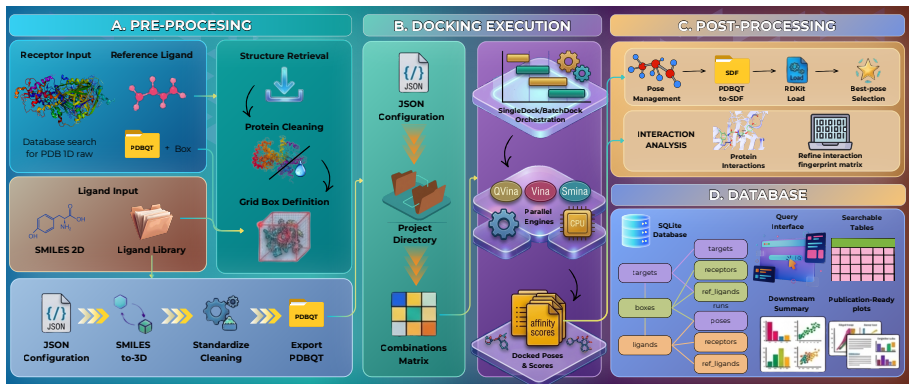
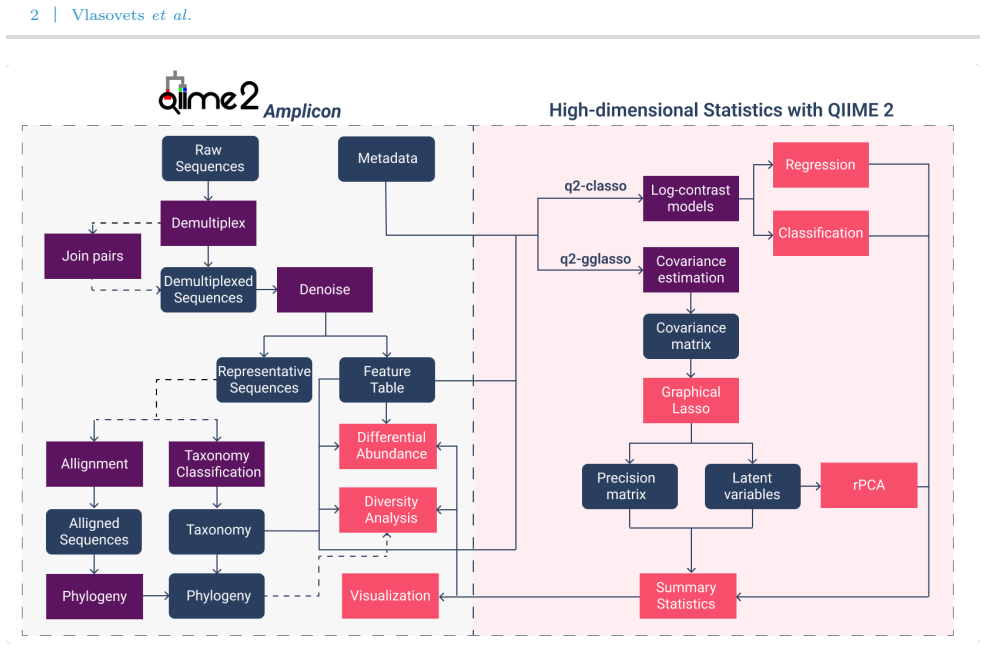
Protein--ligand docking is widely used in structure-based discovery, but routine studies often fail at the workflow level rather than at the scoring level. Receptor cleaning, ligand preparation, file conversion, box definition, run organization, and downstream parsing are frequently handled by fragmented scripts, which reduces reproducibility, obscures provenance, and complicates comparative analysis across targets, ligands, and docking settings. We present ProDock, an open-source Python toolkit for reproducible protein--ligand docking and postprocessing. ProDock organizes application-oriented docking into four connected layers: receptor and ligand preprocessing, provenance-aware docking execution, postprocessing of poses and interaction fingerprints, and SQLite-backed storage for later querying. The package supports inputs ranging from PDB identifiers and local receptor files to \texttt{SMILES} strings and prepared ligand directories, and integrates receptor preparation, ligand preparation, reference-ligand-based box generation, campaign serialization, batch docking, pose crawling, score extraction, interaction profiling, and database insertion within a consistent project-local workflow. By representing studies as explicit many-to-many campaigns linking multiple receptors, ligands, and docking backends, ProDock converts fragmented engine-specific outputs into structured analytical results that are easier to compare, reuse, and audit. ProDock is implemented in Python and released under an open-source license at https://github.com/Medicine-Artificial-Intelligence/ProDock. Documentation is available at https://prodock.readthedocs.io/en/latest.
0
0
q-bio.QM 2026-04-23

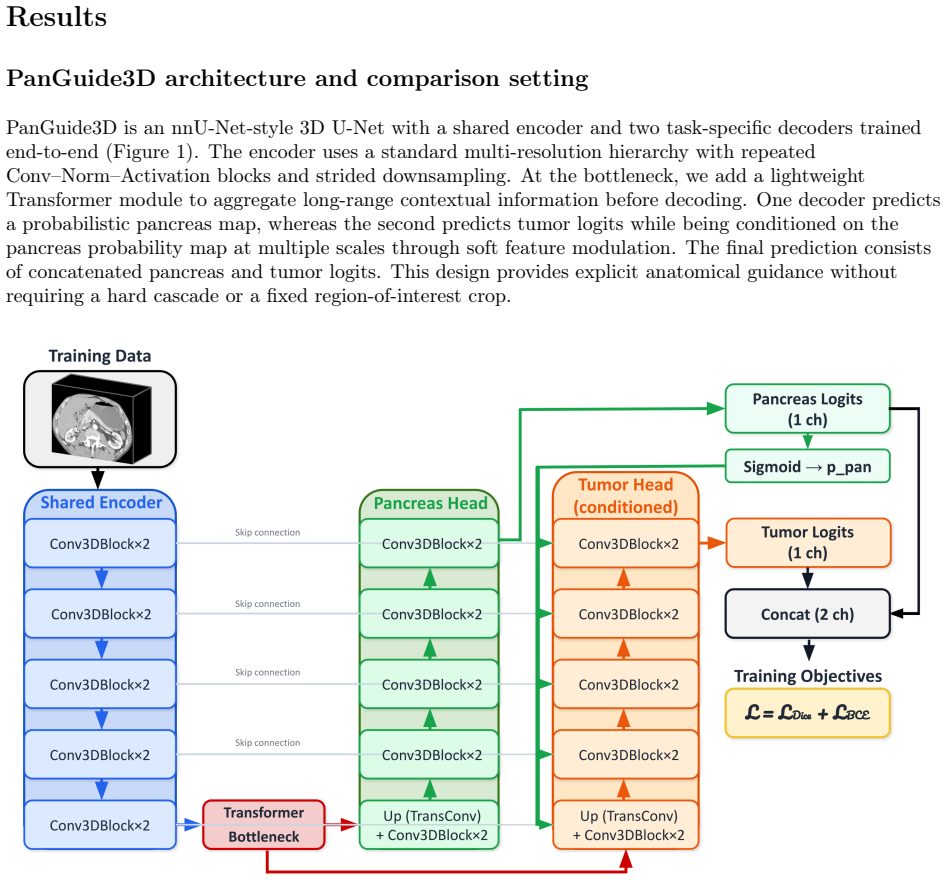
Pancreas probability maps guide better tumor segmentation across cohorts

PanGuide3D: Cohort-Robust Pancreas Tumor Segmentation via Probabilistic Pancreas Conditioning and a Transformer Bottleneck

Conditioning the tumor decoder on a probabilistic pancreas map plus a transformer bottleneck raises accuracy on small tumors and new patient

Figure from the paper full image
abstract click to expand
Pancreatic tumor segmentation in contrast-enhanced computed tomography (CT) is clinically important yet technically challenging: lesions are often small, heterogeneous, and easily confused with surrounding soft tissue, and models that perform well on one cohort frequently degrade under cohort shift. Our goal is to improve cross-cohort generalization while keeping the model architecture simple, efficient, and practical for 3D CT segmentation. We introduce PanGuide3D, a cohort-robust architecture with a shared 3D encoder, a pancreas decoder that predicts a probabilistic pancreas map, and a tumor decoder that is explicitly conditioned on this pancreas probability at multiple scales via differentiable soft gating. To capture long-range context under distribution shift, we further add a lightweight Transformer bottleneck in the U-Net bottleneck representation. We evaluate cohort transfer by training on the PanTS (Pancreatic Tumor Segmentation) cohort and testing both in-cohort (PanTS) and out-of-cohort on MSD (Medical Segmentation Decathlon) Task07 Pancreas, using matched preprocessing and training protocols across strong baselines. We collect voxel-level segmentation metrics, patient-level tumor detection, subgroup analyses by tumor size and anatomical location, volume-conditioned performance analyses, and calibration measurements to assess reliability. Across the evaluated models, PanGuide3D achieves the best overall tumor performance and shows improved cross-cohort generalization, particularly for small tumors and challenging anatomical locations, while reducing anatomically implausible false positives. These findings support probabilistic anatomical conditioning as a practical strategy for improving cross-cohort robustness in an end-to-end model and suggest potential utility for contouring support, treatment planning, and multi-institutional studies.
0
0
q-bio.QM 2026-04-23

Continuous server benchmarks protein function predictors

LAFA: A Framework for Reproducible Longitudinal Assessment of Protein Function Annotation Models

LAFA runs containerized methods repeatedly as annotations accumulate, replacing infrequent challenges with ongoing performance tracking.

Figure from the paper full image
abstract click to expand
Motivation: Protein function prediction is a challenging task and an open problem in computational biology. The Critical Assessment of protein Function Annotation (CAFA) is a triennial, community-driven initiative that provides an independent, large-scale evaluation of computational methods for protein function prediction through time-delayed benchmarking experiments. CAFA has played a key role in highlighting high-performing methodologies and fostering detailed analysis and exchange of ideas. However, outside the periodic CAFA challenges, there is no platform for the continuous evaluation of newly developed methods and tracking performance as function annotations accumulate. Results: Here we introduce the Longitudinal Assessment of Protein Function Annotation Models server (LAFA) as a persistent benchmarking system for protein function prediction methods. LAFA provides a continuous evaluation of containerized function prediction methods, enabling up-to-date and robust comparative assessment of method performance under evolving ground truth. LAFA accelerates methodological iteration, supports reproducibility, and offers a more dynamic and fine-grained view of progress in protein function prediction. Code and Data Availability: LAFA is available at https://functionbench.net/. Detailed evaluation results can be found at https://github.com/anphan0828/CAFA_forever
0
0
q-bio.QM 2026-04-23

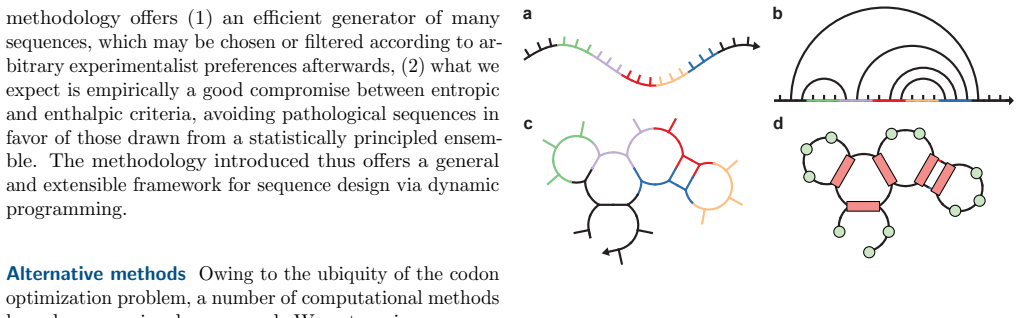
Web server detects row and hot mutations missed by standard tools

VARIANT: Web Server for Decoding and Analyzing Viral Mutations at Genome and Protein Levels

VARIANT flags consecutive and spaced substitutions in 3-nt windows plus potential frameshift regions across major viral genomes

Figure from the paper full image
abstract click to expand
A comprehensive analysis of viral mutations is essential for understanding viral evolution, disease epidemiology, diagnosis, drug resistance, etc. However, challenges remain in capturing complex mutation patterns and supporting diverse viral families with varying genome architectures. To address these needs, we present VARIANT, an web server for mutational analysis of RNA viral genomes and associated viral products across both single- and multi-segment virus genomes. The server takes as input a viral reference genome, a reference protein sequence, and/or multiple sequence alignment, and automatically provides full annotation of mutation types, including standard categories such as point mutations (missense, silent, and nonsense), insertions, deletions, or frameshift events in both coding and non-coding regions. In addition, VARIANT detects three biologically significant mutation patterns that are overlooked by conventional software/packages: ``row mutations'' (consecutive substitutions within a window of 3 nts), ``hot mutations'' (two non-consecutive substitutions within a window of 3 nts), and potential programmed ribosomal frameshifting (PRF) regions. The server currently contains automatic analysis of major viral pathogens, including SARS-CoV-2, HIV-1, Influenza H3N2, Ebola virus, and Chikungunya virus. It also allows users to analyze customized viruses. Users can track VARIANT analysis progress in real time, visualize mutation distributions, and download structured results in ZIP format. VARIANT also incorporates dual graph topology analysis to classify frameshifting element structures from dot-bracket notation input. This feature enables systematic comparison of RNA secondary structure motifs across viral families by mapping structures to a comprehensive library of dual graph topologies. The web server is freely available at https://variant.up.railway.app.
0
0
q-bio.QM 2026-04-23

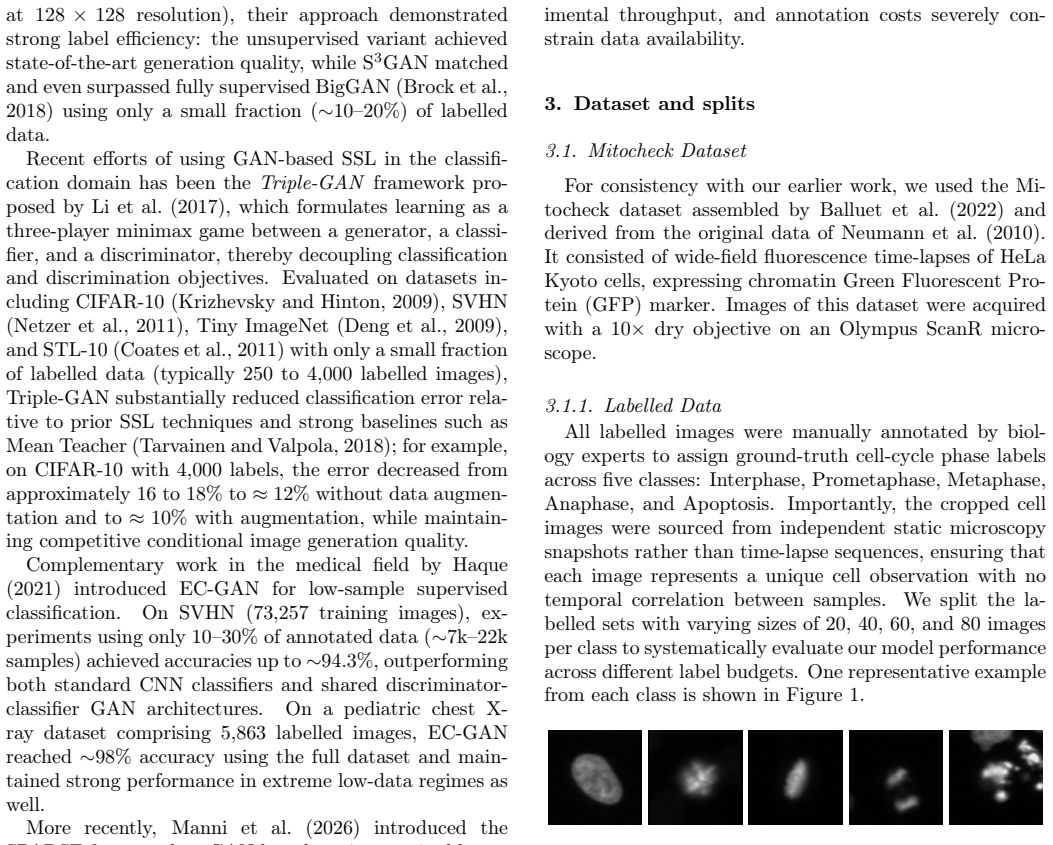
SGAN classifies mitosis stages at 93% accuracy with 80 labels per class

Semi supervised GAN for smart microscopy, fast and data efficient cell cycle classification

Unlabelled images and synthetic samples keep performance stable under imbalance and allow adaptation to new cell types.

Figure from the paper full image
abstract click to expand
Modern optical microscopes are fully motorised; however, transforming them into truly smart systems requires real-time adjustment of acquisition settings in response to detected objects and dynamic biological events. At the core are classification algorithms that commonly depend on customised softwares and are generally designed for narrowly-defined biological applications. In addition, they often require substantial annotated datasets for effective training. We introduce a semi-supervised generative adversarial network (SGAN) for robust cell-cycle stage classification under low-resource conditions, adaptable to diverse cellular structures. The framework combines unlabelled microscopy images with synthetically generated samples to mitigate limited annotation, while preserving stable performance even when the unlabelled subset is class-imbalanced. Tested on the Mitocheck dataset, which features five mitosis classes, the model achieved $93 \pm 2\%$ accuracy using only 80 labelled per class and 600 unlabelled images. The proposed algorithm is generic and can be readily adapted to new labeling schemes, classification targets, cell lines, or microscopy modalities through transfer learning. SGAN is well suited for integration into automated microscopes, enabling efficient and adaptable image analysis across diverse biological and microscopy applications.
0
0
q-bio.QM 2026-04-23

Multimodal model boosts accuracy in virtual cell genetic perturbation forecasts

AROMA: Augmented Reasoning Over a Multimodal Architecture for Virtual Cell Genetic Perturbation Modeling

Text, graphs, and sequences fused with two-stage training deliver stronger results on unseen cells and sparse knowledge scenarios.

Figure from the paper full image
abstract click to expand
Virtual cell modeling predicts molecular state changes under genetic perturbations in silico, which is essential for biological mechanism studies. However, existing approaches suffer from unconstrained reasoning, uninterpretable predictions, and retrieval signals that are weakly aligned with regulatory topology. To address these limitations, we propose AROMA, an Augmented Reasoning Over a Multimodal Architecture for virtual cell genetic perturbation modeling. AROMA integrates textual evidence, graph-topology information, and protein sequence features to model perturbation-target dependencies, and is trained with a two-stage optimization strategy to yield predictions that are both accurate and interpretable. We also construct two knowledge graphs and a perturbation reasoning dataset, PerturbReason, containing more than 498k samples, as reusable resources for the virtual cell domain. Experiments show that AROMA outperforms existing methods across multiple cell lines, and remains robust under zero-shot evaluation on an unseen cell line, as well as in knowledge-sparse, long-tail scenarios. Overall, AROMA demonstrates that combining knowledge-driven multimodal modeling with evidence retrieval provides a promising pathway toward more reliable and interpretable virtual cell perturbation prediction. Model weights are available at https://huggingface.co/blazerye/AROMA. Code is available at https://github.com/blazerye/AROMA.
0
0
q-bio.QM 2026-04-22

Continuous tokenization unifies single-cell proteomics data

scpFormer: A Foundation Model for Unified Representation and Integration of the Single-Cell Proteomics

Pre-trained on 390 million cells, the model integrates variable panels, clusters cells, expands data in silico, and transfers patterns to bu

abstract click to expand
The integration of single-cell proteomic data is often hindered by the fragmented nature of targeted antibody panels. To address this limitation, we introduce scpFormer, a transformer-based foundation model designed for single-cell proteomics. Pre-trained on over 390 million cells, scpFormer replaces standard index-based tokenization with a continuous, sequence-anchored approach. By combining Evolutionary Scale Modeling (ESM) with value-aware expression embeddings, it dynamically maps variable panels into a shared semantic space without artificial discretization. We demonstrate that scpFormer generates global cell representations that perform competitively in large-scale batch integration and unsupervised clustering. Moreover, its open-vocabulary architecture facilitates in silico panel expansion, assisting in the reconstruction of biological manifolds in sparse clinical datasets. Finally, this learned protein co-expression logic is transferable to bulk-omics tasks, supporting applications like cancer drug response prediction. scpFormer provides a versatile, panel-agnostic framework to facilitate scalable biomarker discovery and precision oncology.
0
0
q-bio.QM 2026-04-22

Algorithm samples RNA sequences from codon-constrained folding energies

Direct RNA sequence design under codon constraints using expressive tensor-based secondary structure models

Direct Boltzmann sampling replaces approximate objectives in designing protein-encoding RNAs for therapeutics.

Figure from the paper full image
abstract click to expand
Nucleic acid sequence design via codon optimization is a fundamental task with applications across synthetic biology, mRNA therapeutics, and vaccine design. Given a target protein, it is a major open challenge to navigate the combinatorially large design space of codon sequences mapping to its amino acid sequence. Computational approaches generally seek to optimize simple objectives based on the codon sequence, possibly together with more complicated contributions based on secondary structure analysis. In this work, we demonstrate a direct and efficient algorithm to sample sequences from a suitable Boltzmann distribution defined in terms of the codon sequence and a fully detailed secondary structure free energy model, as well as related algorithms for exact computation of statistical quantities such as free energies, base pairing probabilities, and base and codon marginals. These algorithms draw upon a recently developed tensor-based formulation of secondary structure thermodynamics and demonstrate, for the first time, that global sequence design can be accomplished with respect to a highly accurate free energy model. Moreover, the algorithms can leverage any available CPU and GPU resources in parallel for massive computational speedups.
1 0
0
q-bio.QM 2026-04-22

Polymer replication peaks in info-per-energy at specific alphabet size

Information-to-energy trade-offs and the optimal alphabet of polymer replication

The ratio reaches its maximum at an alphabet size fixed by monomer assembly energy; DNA's four bases lie far beyond that point.

Figure from the paper full image
abstract click to expand
We analyze information transmission in a recently proposed coarse-grained model of polymer replication by framing it as a communication channel between templates and copies. By calculating the mutual information in the steady-state limit of long chains, we recover the accurate-random phase diagram and establish that the information per-monomer depends solely on template specificity within the accurate regime. Crucially, even in the accurate region, small error fractions lead to substantial information loss due to the nonlinear relationship between errors and mutual information. Examining the information-to-energy cost ratio reveals non-monotonic behavior as a function of monomer alphabet size, with an optimum determined primarily by the per-monomer assembly free energy. For DNA's four-base alphabet, we find that the observed effective assembly energy (at least $14\,k_B T$) places the system far from the information-transmission optimum, suggesting that biological replication may prioritize the suppression of spontaneous random assembly over information-to-energy efficiency. We also characterize achievable rate-fidelity trade-offs using Shannon bounds, providing a theoretical framework for evaluating future proofreading mechanisms in ensemble models.
0
0
q-bio.QM 2026-04-21

Workflow extracts connected 3D fiber networks from microscope images

ToFiE, a Topology-aware Fiber Extraction workflow for 3D reconstruction of dense and heterogeneous biological fiber networks from microscopy images

Preserving topology lets researchers measure how fiber junctions shape the mechanical behavior of collagen and similar biological materials.

abstract click to expand
Fibrous networks are ubiquitous structural components in biology, spanning cellulose in plant cell walls, fibrin in blood clots, and collagen in the extracellular matrix of animal tissues. Theoretical models predict that network connectivity critically influences their mechanical behavior. However, accurately reconstructing network topology from 3D image data remains a major challenge as current segmentation methods are not designed to preserve network topology and often rely on intensity-based thresholding, which can fragment fibers and distort junction connectivity. Here, we introduce ToFiE, an open-source topology-aware fiber extraction workflow for reconstructing dense and heterogeneous fibrous networks from high resolution microscopy images while preserving connectivity in three dimensions. We validate ToFiE using synthetic fluorescence microscopy images of fiber networks with varying topologies and signal-to-noise ratios. We further demonstrate its performance by reconstructing the fiber networks of a library of collagen gels with various microstructures, imaged using confocal fluorescence microscopy. Altogether, the results establish ToFiE as a practical semi-automated framework for extracting mechanically relevant network information from imaging data across a broad range of fibrous materials.
0
0
q-bio.QM 2026-04-20

3D hip scans yield consistent bone parameters across Hologic models

3D-DXA Cortical and Trabecular Parameters: Agreement Between Hologic Densitometers in Clinical Practice

Biases in cortical and trabecular densities stay below clinical significance thresholds for monitoring.

abstract click to expand
Background: Three-dimensional dual-energy X-ray absorptiometry reconstructs three-dimensional maps of the proximal femur's density distribution from standard hip scans, enabling the estimation of trabecular and cortical bone parameters. The aim of this study was to assess the agreement of these three-dimensional cortical and trabecular femur parameters across different series and models of Hologic densitometers. Methodology: The study cohort was composed of 103 women and men recruited from four clinical centers in Spain and France. Subjects had duplicated hip scans using different Hologic scanners from the Horizon, Discovery, and QDR4500 series. Analyses were performed using 3D-Shaper software. Inter-scanner agreement was evaluated using Deming regression and Bland-Altman analysis. Results: The parameters demonstrated strong inter-device agreement across all clinical centers and scanner models, with coefficients of determination greater than 0.91. Absolute biases were less than 2.5 mg$/$cm$^3$ for integral volumetric bone mineral density, less than 2.9 mg$/$cm$^3$ for trabecular volumetric bone mineral density, and less than 1.7 mg$/$cm$^2$ for cortical surface bone mineral density. No statistically significant bias was found between parameters obtained from different scanners. Furthermore, the observed bias was lower than the expected least significant change, indicating that inter-scanner variability across these devices is not clinically significant. Conclusions: This study demonstrated excellent agreement for standard and three-dimensional derived bone parameters at the hip across Hologic densitometers. These findings support their suitability for clinical use.
0
0
q-bio.QM 2026-04-20

Basal pacing produces higher self-connectivity in CRT hemodynamic graphs

Topological analysis of hemodynamic response to cardiac resynchronization therapy

Swine study finds 0.57 basal versus 0.14 mid and 0.24 apical; lateral endocardial stimulation widens the regional contrast.

Figure from the paper full image
abstract click to expand
Objective: The Mapper algorithm is a qualitative method in topological data analysis that constructs graphs from point clouds by combining dimensionality reduction and clustering techniques. The aim of this study is to apply Mapper, together with novel quantitative indices, to compare the effects of biventricular pacing from the left ventricular epicardium versus the endocardium in a swine model of pacing-induced non-ischemic cardiomyopathy. Methods: The distributions of four hemodynamic variables from a previous study on endocardial and epicardial cardiac resynchronization in an experimental swine model of nonischemic cardiomyopathy were analyzed using the Mapper algorithm, enhanced with numerical indices quantifying self-connectivity, scattering, and homogeneity of the resulting colored graphs. Results: Statistically significant differences were observed between pacing from basal regions versus mid or apical regions, with the following self-connectivity index values: basal $0.57$; mid $0.14$ ($p < 0.01$); apical $0.24$ ($p < 0.01$). Endocardial stimulation at lateral sites increased the contrast between the distributions of basal versus mid or apical data, when compared with epicardial stimulation. Conclusions: Topological analysis using the Mapper algorithm, enhanced with quantitative statistical measures, revealed new and biologically plausible significant differences in pacing effects across heart regions.
0
0
q-bio.QM 2026-04-20

Reflective AI cycle designs proteins from text specs

ProtoCycle: Reflective Tool-Augmented Planning for Text-Guided Protein Design

ProtoCycle plans, runs simulated engineering checks, reflects on results, and revises to close the plan-to-sequence gap while keeping foldab

Figure from the paper full image
abstract click to expand
Designing proteins that satisfy natural language functional requirements is a central goal in protein engineering. A straightforward baseline is to fine-tune generic instruction-tuned LLMs as direct text-to-sequence generators, but this is data- and compute-hungry. With limited supervision, LLMs can produce coherent plans in text yet fail to reliably realize them as sequences. This plan-execute gap motivates ProtoCycle, an agentic framework for protein design that uses LLMs primarily to drive a multi-round, feedback-driven decision cycle. ProtoCycle couples an LLM planner with a lightweight tool environment designed to emulate the iterative workflow of human protein engineering and uses LLM-driven reflection on tool feedback to revise plans. Trained with supervised trajectories and online reinforcement learning, ProtoCycle achieves strong language alignment while maintaining competitive foldability, and ablations show that reflection substantially improves sequence quality.
0
0
q-bio.QM 2026-04-20

Multi-agent system runs full molecular dynamics research end-to-end

MDAgent: A Multi-Agent Framework for End-to-End Molecular Dynamics Research

MDAgent pairs agent collaboration with memory of past cases to plan, simulate, analyze, and interpret biomolecular studies.

Figure from the paper full image
abstract click to expand
Molecular dynamics (MD) simulation is a powerful tool for studying biomolecular structural changes, molecular recognition, transmembrane transport, and functional mechanisms. However, its practical bottleneck lies not only in software operation or parameter setup, but in translating experimental questions into executable, interpretable, and reviewable computational workflows. Here, we present MDAgent, a multi-agent system for end-to-end molecular dynamics research. The system integrates problem understanding, literature-guided strategy design, simulation execution, trajectory analysis, mechanistic interpretation, and quality supervision into a unified workflow, enabling agents not only to run simulations but also to generate research-oriented computational plans and analytical reports. We further introduce a case-based learning mechanism based on Skill and Memory, which stores reusable knowledge from prior tasks, including parameter choices, operational rules, analytical logic, and problem-solving pathways, thereby supporting cross-task transfer without retraining the underlying model. Across multiple representative molecular simulation tasks, MDAgent achieved stable end-to-end performance with improved strategic adaptability, interpretability, and generalization. In an independent complex task involving conformational transitions of TMEM16F and XKR8, the system successfully completed system design, simulation, and mechanistic analysis for large membrane proteins. These results show that combining multi-agent collaboration with case-based learning can transform MD agents from workflow automation tools into scientific question-oriented computational research systems, providing a scalable framework for AI-driven automated research.
0
0
q-bio.QM 2026-04-20

Coherence metric links CRISPR size to stress and regulator type

Geometric coherence of single-cell CRISPR perturbations reveals regulatory architecture and predicts cellular stress

Shesha quantifies directional consistency of cell shifts, showing master regulators scatter responses while lineage factors align them and c

Figure from the paper full image
abstract click to expand
Genome engineering has achieved remarkable sequence-level precision, yet predicting the transcriptomic state that a cell will occupy after perturbation remains an open problem. Single-cell CRISPR screens measure how far cells move from their unperturbed state, but this effect magnitude ignores a fundamental question: do the cells move together? Two perturbations with identical magnitude can produce qualitatively different outcomes if one drives cells coherently along a shared trajectory while the other scatters them across expression space. We introduce a geometric stability metric, Shesha, that quantifies the directional coherence of single-cell perturbation responses as the mean cosine similarity between individual cell shift vectors and the mean perturbation direction. Across five CRISPR datasets (2,200+ perturbations spanning CRISPRa, CRISPRi, and pooled screens), stability correlates strongly with effect magnitude (Spearman $\rho=0.75-0.97$), with a calibrated cross-dataset correlation of 0.97. Crucially, discordant cases where the two metrics decouple expose regulatory architecture: pleiotropic master regulators such as CEBPA and GATA1 pay a "geometric tax," producing large but incoherent shifts, while lineage-specific factors such as KLF1 produce tightly coordinated responses. After controlling for magnitude, geometric instability is independently associated with elevated chaperone activation (HSPA5/BiP; $\rho_{partial}=-0.34$ and $-0.21$ across datasets), and the high-stability/high-stress quadrant is systematically depleted. The magnitude-stability relationship persists in scGPT foundation model embeddings, confirming it is a property of biological state space rather than linear projection. Perturbation stability provides a complementary axis for hit prioritization in screens, phenotypic quality control in cell manufacturing, and evaluation of in silico perturbation predictions.
0
0
q-bio.QM 2026-04-20 2 theorems

Coherence metric flags stress beyond perturbation size

Geometric coherence of single-cell CRISPR perturbations reveals regulatory architecture and predicts cellular stress

Across CRISPR screens, aligned cell shifts mark lower stress while scattered ones mark pleiotropic regulators and chaperone activation.

Figure from the paper full image
abstract click to expand
Genome engineering has achieved remarkable sequence-level precision, yet predicting the transcriptomic state that a cell will occupy after perturbation remains an open problem. Single-cell CRISPR screens measure how far cells move from their unperturbed state, but this effect magnitude ignores a fundamental question: do the cells move together? Two perturbations with identical magnitude can produce qualitatively different outcomes if one drives cells coherently along a shared trajectory while the other scatters them across expression space. We introduce a geometric stability metric, Shesha, that quantifies the directional coherence of single-cell perturbation responses as the mean cosine similarity between individual cell shift vectors and the mean perturbation direction. Across five CRISPR datasets (2,200+ perturbations spanning CRISPRa, CRISPRi, and pooled screens), stability correlates strongly with effect magnitude (Spearman $\rho=0.75-0.97$), with a calibrated cross-dataset correlation of 0.97. Crucially, discordant cases where the two metrics decouple expose regulatory architecture: pleiotropic master regulators such as CEBPA and GATA1 pay a "geometric tax," producing large but incoherent shifts, while lineage-specific factors such as KLF1 produce tightly coordinated responses. After controlling for magnitude, geometric instability is independently associated with elevated chaperone activation (HSPA5/BiP; $\rho_{partial}=-0.34$ and $-0.21$ across datasets), and the high-stability/high-stress quadrant is systematically depleted. The magnitude-stability relationship persists in scGPT foundation model embeddings, confirming it is a property of biological state space rather than linear projection. Perturbation stability provides a complementary axis for hit prioritization in screens, phenotypic quality control in cell manufacturing, and evaluation of in silico perturbation predictions.
0
0
q-bio.QM 2026-04-17

New QIIME 2 plugins bring sparse regression to microbiome counts

Sparse regression, classification, and microbial network estimation in QIIME2 with q2-classo and q2-gglasso

q2-classo predicts outcomes from composition; q2-gglasso recovers networks with latent factors, shown on soil data.

Figure from the paper full image
abstract click to expand
Motivation: Statistical analysis of microbial count data derived from 16S rRNA or metagenomics sequencing poses unique challenges due to the sparse, compositional, and high-dimensional nature of the data. While QIIME 2 already provides many tools for data pre-processing and analysis, plugins for statistical regression, classification, and microbial network estimation tailored to compositional count data are relatively scarce. Results: We present q2-classo and q2-gglasso, two novel QIIME 2 plugins that implement penalized regression, classification, and graphical modeling approaches for microbial compositional data. q2-classo enables the prediction of a continuous or binary outcome of interest using compositional microbiome data as predictors. Both sparse log-contrast regression and classification, as well as tree-aggregated log-contrast models are available. q2-gglasso enables the estimation of taxon-taxon association networks through sparse graphical model estimation, such as, e.g., the SPIEC-EASI framework, as well as adaptive and latent graphical models. The latent model can decompose taxon-taxon associations into a sparse direct interaction matrix and a latent (low-rank) matrix which enables robust principal component embedding of a data set. Within the QIIME 2 ecosystem we demonstrate their application on the Atacama soil microbiome dataset, illustrating robust model selection, classification, and microbial network estimation with covariates and latent factors. Availability: The software is freely available under the BSD-3-Clause License. Source code is available at https://github.com/bio-datascience/q2-gglasso and https://github.com/bio-datascience/q2-classo-latest, with installation through QIIME 2 and Docker.
0
0
q-bio.QM 2026-04-17

Neuron-astrocyte net cuts blind navigation paths sixfold

Dual-Timescale Memory in a Spiking Neuron-Astrocyte Network for Efficient Navigation

Short-term local suppression of visited spots combined with long-term action reinforcement lets agents find goals faster without maps.

Figure from the paper full image
abstract click to expand
Biological agents navigate complex environments by combining long-term memory of successful actions with short-term suppression of recently visited locations-a capability that remains difficult to replicate in artificial systems, especially under partial observability. Inspired by the complementary timescales of neural and astrocytic dynamics, we introduce a spiking neuron-astrocyte network (SNAN) where spike-timing-dependent plasticity (STDP) reinforces successful action sequences on a distant time scale, while astrocytic calcium transients suppress recently visited states on a short-term time scale, effectively blocking locations already explored. This dual-timescale memory mechanism biases the agent toward unexplored regions, accelerating goal finding without requiring explicit global statistics. We show that in grid-world navigation tasks with extreme partial observability, SNAN reduces median path length by up to sixfold and drastically improves goal completion rates compared to baseline agents. The astrocytic modulation inherently mitigates the exploration-exploitation trade-off as an emergent consequence of local state suppression. This kind of local sensory data modulation can be considered as a new type of working memory referred to as a "Topological-Context Memory". To validate hardware feasibility using neuromorphic approaches, we map STDP to a memristive VTEAM model and implement a subset of the network on a crossbar array, achieving order-of-magnitude gains in speed per area and energy per decision over CPU implementations. Our results establish astrocyte-inspired dual-timescale memory as a scalable, hardware-realizable principle for neuromorphic robotics and edge-AI systems.
0
0
q-bio.QM 2026-04-16

LLM filtering lifts BRCA classifier to 0.927 AUC with 17 genes

Mamba-SSM with LLM Reasoning for Feature Selection: Faithfulness-Aware Biomarker Discovery

Mamba saliency genes cleaned by chain-of-thought reasoning beat a 5000-gene variance baseline on held-out TCGA data.

Figure from the paper full image
abstract click to expand
Gradient saliency from deep sequence models surfaces candidate biomarkers efficiently, but the resulting gene lists can be contaminated by tissue-composition confounders that degrade downstream classifiers. We study whether LLM chain-of-thought (CoT) reasoning can filter these confounders, and whether reasoning quality is associated with downstream performance. We train a Mamba SSM on TCGA-BRCA RNA-seq and extract the top-50 genes by gradient saliency; DeepSeek-R1 evaluates every candidate with structured CoT to produce a final 17-gene set. On the held-out test split, the raw 50-gene saliency set (no LLM) performs worse than a 5,000-gene variance baseline (AUC 0.832 vs. 0.903), while the LLM-filtered set surpasses it (AUC 0.927), using 294x fewer features. A faithfulness audit (COSMIC CGC, OncoKB, PAM50) shows that 6 of 17 selected genes (35.3%) are validated BRCA biomarkers, while 10 of 16 known BRCA genes present in the input were missed - including FOXA1. This divergence between downstream performance and reasoning faithfulness suggests selective faithfulness in this setting: targeted confounder removal can improve predictive performance without comprehensive recall.
0
0
q-bio.QM 2026-04-15

Cortisol addition raises wearable stress classification to 94 percent

Differentiating Physical and Psychological Stress Using Wearable Physiological Signals and Salivary Cortisol

Heart rate and skin data alone mix psychological stress with rest, but hormone levels clarify the distinction in controlled tests.

Figure from the paper full image
abstract click to expand
Objective: This study aimed to assess how wearable physiological signals, alone and combined with salivary cortisol, distinguish physical and psychological stress and their recovery states. Methods: Six healthy adults completed three laboratory sessions on separate days: rest, physical stress (high-intensity cycling), or psychological stress (modified Trier Social Stress Test). Heart rate, heart rate variability, electrodermal activity, and wrist accelerometry were recorded continuously, and salivary cortisol was sampled at five time points. Features were extracted in non-overlapping 10-minute windows and labelled as rest, physical stress, physical recovery, psychological stress, or psychological recovery. A gradient boosting classifier was trained using wearable features alone and with five additional cortisol features per window. Performance was evaluated using leave-one-participant-out cross-validation. Results: Wearable-only classification achieved 77.8% overall accuracy, with high accuracy for physical stress and recovery but frequent misclassification of psychological stress and recovery (recall 50.0% and 54.2%). Including cortisol improved overall accuracy (94.4%), particularly for psychological states, increasing recall to 83.3% and 87.5%. Cortisol also reduced misclassification between psychological stress and rest. Conclusion: Wearable signals alone were insufficient to reliably distinguish psychological stress from rest and recovery. Integrating salivary cortisol improved classification of psychological stress and recovery and reduced confusion with rest, highlighting the value of endocrine context alongside wearable physiology. Significance: These findings support multimodal stress monitoring and motivate larger, ecologically valid studies and scalable alternatives to repeated cortisol sampling.
0
0
q-bio.QM 2026-04-15

OLS overestimates IQ-motion slope by factor of 4.67

The IQ-Motion Confound in Multi-Site Autism fMRI May Be Inflated by Site-Correlated Measurement Uncertainty

Errors-in-variables correction on ABIDE-I data shows site-correlated uncertainty inflates the apparent confound.

Figure from the paper full image
abstract click to expand
Multi-site autism neuroimaging studies routinely control for the confound between full-scale IQ and head motion by regressing framewise displacement against IQ scores and removing shared variance. This procedure assumes that ordinary least squares (OLS) provides an unbiased estimate of the confound magnitude. We tested this assumption on the ABIDE-I phenotypic dataset (n=935 subjects across 19 international scanning sites) using Probability Cloud Regression, an errors-in-variables (EIV) estimator that models per-observation measurement uncertainty in both variables. IQ measurement error was derived from published Wechsler test-retest reliability coefficients; response-side uncertainty was represented by a site-level proxy equal to the within-site standard deviation of mean framewise displacement. Three findings emerged. First, OLS overestimates the IQ-motion slope by a factor of 4.67 relative to the EIV-corrected estimate when the bias factor is computed from the full-precision fitted coefficients (OLS -0.00125, EIV -0.00027 mm per IQ point after rounding for display). Second, under leave-site-out cross-validation a single pooled predictor of raw FD produces negative out-of-sample R^2 at all 19 sites (overall R^2 = -0.074), indicating that the pooled predictor does not transport cleanly across sites once site information is removed. Third, the direction of the EIV-corrected slope is robust across all 64 configurations of an 8x8 sensitivity grid spanning 12-fold ranges of each noise parameter. These results suggest that pooled OLS may overstate the IQ-motion association in ABIDE-I, but direct downstream consequences for motion-correction pipelines remain to be quantified using raw motion traces and connectivity-level re-analysis. Formal EIV methods appear to remain uncommon in multi-site neuroimaging confound estimation.
0
0
q-bio.QM 2026-04-14

Protein sequences alone give limited Parkinson's classification power

Evaluating the Limitations of Protein Sequence Representations for Parkinson's Disease Classification

Multiple representations tested under nested cross-validation reach F1 scores near 0.70 with overlapping classes and no significant method差异

Figure from the paper full image
abstract click to expand
The identification of reliable molecular biomarkers for Parkinson's disease remains challenging due to its multifactorial nature. Although protein sequences constitute a fundamental and widely available source of biological information, their standalone discriminative capacity for complex disease classification remains unclear. In this work, we present a controlled and leakage-free evaluation of multiple representations derived exclusively from protein primary sequences, including amino acid composition, k-mers, physicochemical descriptors, hybrid representations, and embeddings from protein language models, all assessed under a nested stratified cross-validation framework to ensure unbiased performance estimation. The best-performing configuration (ProtBERT + MLP) achieves an F1-score of 0.704 +/- 0.028 and ROC-AUC of 0.748 +/- 0.047, indicating only moderate discriminative performance. Classical representations such as k-mers reach comparable F1 values (up to approximately 0.667), but exhibit highly imbalanced behavior, with recall close to 0.98 and precision around 0.50, reflecting a strong bias toward positive predictions. Across representations, performance differences remain within a narrow range (F1 between 0.60 and 0.70), while unsupervised analyses reveal no intrinsic structure aligned with class labels, and statistical testing (Friedman test, p = 0.1749) does not indicate significant differences across models. These results demonstrate substantial overlap between classes and indicate that primary sequence information alone provides limited discriminative power for Parkinson's disease classification. This work establishes a reproducible baseline and provides empirical evidence that more informative biological features, such as structural, functional, or interaction-based descriptors, are required for robust disease modeling.
0
0
q-bio.QM 2026-04-13

Blood count trajectories flag cancer years before symptoms

Patterns in Individual Blood Count Trajectories in the UK Biobank Characterise Disease-Specific Signatures and Anticipate Pan-Cancer Risk

Normalised longitudinal CBC data analysed with machine learning yields disease-specific patterns detectable prior to diagnosis in large-coh

Figure from the paper full image
abstract click to expand
We investigate the longitudinal behaviour of blood markers from common haematological tests as a marker of disease and as a function of disease progression in a variety of conditions including cancer, cardiovascular disease, and infections. We study confounding and non-confounding factors to allow for the earlier detection of disease and conditions based on their longitudinal signatures from biomarker patterns commonly measured in popular and scalable common blood tests across routine clinical tests, in particular the Complete Blood Count (CBC or FBC). Our analysis with normalised temporal profiles and machine learning techniques even before any symptoms appear demonstrates that analyte-group patterns found in blood testing are disease sensitive and disease specific. We demonstrate that CBC markers contribute to the majority of the predictive signal, while biochemistry and other blood panels provide only a modest additional gain mostly associated to very the individual disease for which the test was designed (e.g. CRP, liver enzymes, blood sugar). Our results demonstrate how regular monitoring, computational intelligence, and machine learning applied to longitudinal CBC data can converge to uncover disease patterns, advancing the potential for precision healthcare and predictive medicine on a mass scale leveraging an existing and pervasive blood test.
0
0
q-bio.QM 2026-04-13

CNN classifies five activities from accelerometers at 0.83 F1

An Open-Source, Open Data Approach to Activity Classification from Triaxial Accelerometry in an Ambulatory Setting

Open dataset and code from 23 subjects supply activity context for health metrics and monitoring tools

Figure from the paper full image
abstract click to expand
The accelerometer has become an almost ubiquitous device, providing enormous opportunities in healthcare monitoring beyond step counting or other average energy estimates in 15-60 second epochs. Objective: To develop an open data set with associated open-source code for processing 50 Hz tri-axial accelerometry-based to classify patient activity levels and natural types of movement. Approach: Data were collected from 23 healthy subjects (16 males and seven females) aged between 23 and 62 years using an ambulatory device, which included a triaxial accelerometer and synchronous lead II equivalent ECG for an average of 26 minutes each. Participants followed a standardized activity routine involving five distinct activities: lying, sitting, standing, walking, and jogging. Two classifiers were constructed: a signal processing technique to distinguish between high and low activity levels and a convolutional neural network (CNN)-based approach to classify each of the five activities. Main results: The binary (high/low) activity classifier exhibited an F1 score of 0.79. The multi-class CNN-based classifier provided an F1 score of 0.83. The code for this analysis has been made available under an open-source license together with the data on which the classifiers were trained and tested. Significance: The classification of behavioral activity, as demonstrated in this study, offers valuable context for interpreting traditional health metrics and may provide contextual information to support the future development of clinical decision-making tools for patient monitoring, predictive analytics, and personalized health interventions.
0
0
q-bio.QM 2026-04-13

Cluster-first pipeline labels histology structures at 96.8% alignment

Cluster-First Labelling: An Automated Pipeline for Segmentation and Morphological Clustering in Histology Whole Slide Images

Humans annotate representative groups of cells and nuclei rather than every object in large tissue slides.

Figure from the paper full image
abstract click to expand
Labelling tissue components in histology whole slide images (WSIs) is prohibitively labour-intensive: a single slide may contain tens of thousands of structures--cells, nuclei, and other morphologically distinct objects--each requiring manual boundary delineation and classification. We present a cloudnative, end-to-end pipeline that automates this process through a cluster-first paradigm. Our system tiles WSIs, filters out tiles deemed unlikely to contain valuable information, segments tissue components with Cellpose-SAM (including cells, nuclei, and other morphologically similar structures), extracts neural embeddings via a pretrained ResNet-50, reduces dimensionality with UMAP, and groups morphologically similar objects using DBSCAN clustering. Under this paradigm, a human annotator labels representative clusters rather than individual objects, reducing annotation effort by orders of magnitude. We evaluate the pipeline on 3,696 tissue components across 13 diverse tissue types from three species (human, rat, rabbit), measuring how well unsupervised clusters align with independent human labels via per-tile Hungarian-algorithm matching. Our system achieves a weighted cluster-label alignment accuracy of 96.8%, with 7 of 13 tissue types reaching perfect agreement. The pipeline, a companion labelling web application, and all evaluation code are released as open-source software.
0
0
q-bio.QM 2026-04-10

Dual triangular masks give bidirectional attention free positional bias

Dual Triangle Attention: Effective Bidirectional Attention Without Positional Embeddings

Splitting each head into past and future triangles lets models learn order in masked language tasks on text and proteins without extra embed

Figure from the paper full image
abstract click to expand
Bidirectional transformers are the foundation of many sequence modeling tasks across natural, biological, and chemical language domains, but they are permutation-invariant without explicit positional embeddings. In contrast, unidirectional attention inherently encodes positional information through its triangular mask, enabling models to operate without positional embeddings altogether. Here, we introduce Dual Triangle Attention, a novel bidirectional attention mechanism that separates the query-key subspace of each attention head into two complementary triangular masks: one that attends to past-and-self positions and one that attends to future-and-self positions. This design provides bidirectional context while maintaining the causal mask's implicit positional inductive bias in both directions. Using PyTorch's flex_attention, Dual Triangle Attention is implemented as a single compiled kernel call with no additional parameters beyond standard multi-head attention. We evaluated Dual Triangle Attention across three settings: (1) a synthetic argmax position probe, (2) masked language modeling (MLM) on natural language, and (3) MLM on protein sequences. In the argmax task, both Dual Triangle Attention and causal attention learn positional information without explicit positional embeddings, whereas standard bidirectional attention cannot. In the MLM experiments, Dual Triangle Attention with Rotary Positional Embeddings (RoPE) achieved the best context extension performance and strong performance across the board. These findings suggest that Dual Triangle Attention is a viable attention mechanism for bidirectional transformers, with or without positional embeddings.
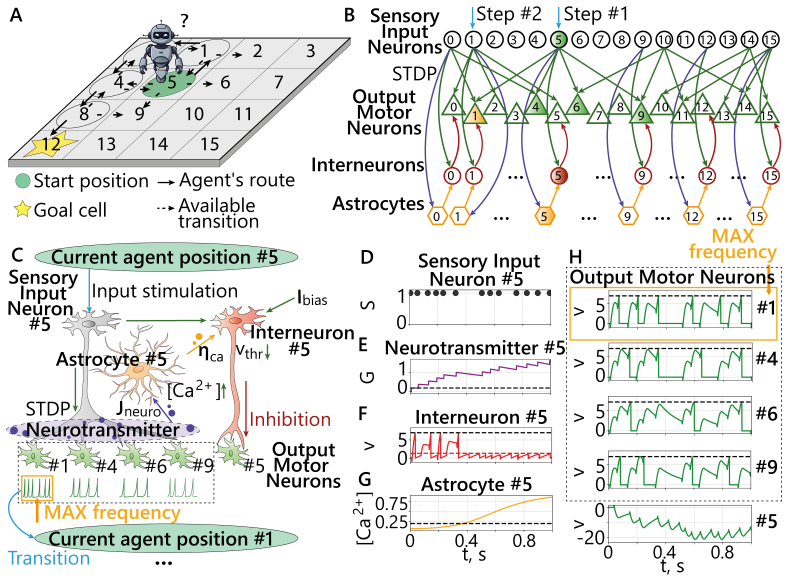
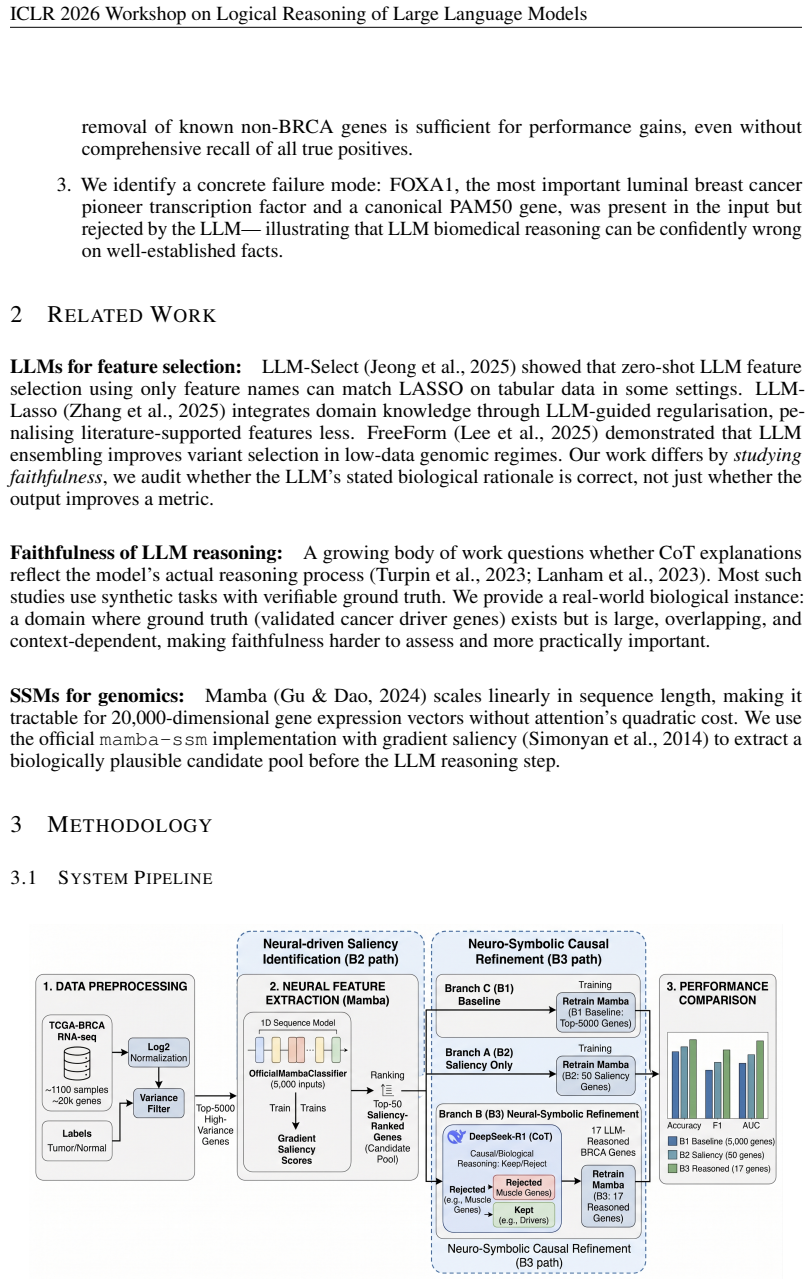
0
0
q-bio.QM 2026-04-10

Satellite models overestimate high-latitude NPP by 2.5-4 times

Resolving satellite-in situ mismatches in Net Primary Production using high-frequency in situ bio-optical observations in the subpolar Northwest Atlantic

Moored bio-optical data in the Northwest Atlantic show VGPM misses blooms while BIO struggles with photosynthetic parameters.
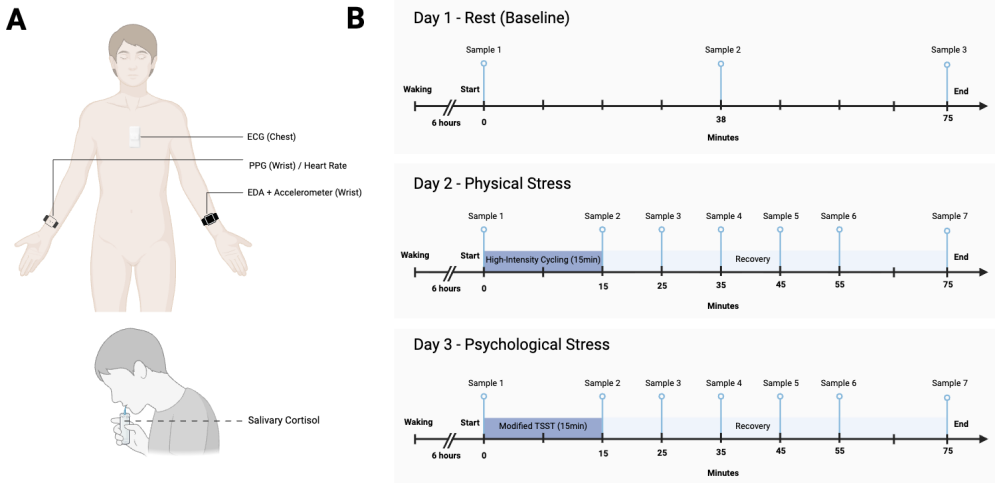
Figure from the paper full image
abstract click to expand
Net primary productivity (NPP) forms the basis of biological carbon pump, but its estimates in high-latitude regions remain highly uncertain despite its disproportional importance for the global carbon sink. Optical satellites are limited by cloud cover, low irradiance, and shallow light penetration, with uncertainties further exacerbated by the lack of in situ validations and regional model tuning for NPP measurements. This study compared two satellite-based models, a global (VGPM) and a regionally tuned (BIO) NPP model, with a time series of in situ NPP. Using a high-frequency, depth-resolved moored profiler in the subpolar Northwest Atlantic (56{\deg}N) in 2016, in situ NPP was estimated by daily bio-optical profiles and prior measurement of photosynthesis-irradiance (P-I) parameters. Our findings indicated that satellite-derived estimates of depth-integrated NPP were overestimated by a factor of 2.5 to 4. However, the reasons for the discrepancies varied between the VGPM and BIO model. VGPM used global photosynthetic parameters with a simplified depth assumption, leading to an unrealistic vertical structure for depth-integrated NPP, despite its surface values were lower than in situ estimates. A major phytoplankton bloom in June-July was missed by VGPM, likely due to the use of non-regionally calibrated OCI Chl-a, which led to an underestimation of biomass. In contrast, the BIO model used regionally tuned POLY4 Chl-a products, and the differences in the assignment of P-I parameters accounted for the remaining discrepancies. This study showed the possibility to reach good agreement between satellite and in situ NPPs if the challenge of P-I assignment can be overcome. We recommend further studies to investigate discrepancies of NPP estimates in high-latitude regions, focusing on data sources and model choices, as well as improving regional model calibration to enhance NPP accuracy.
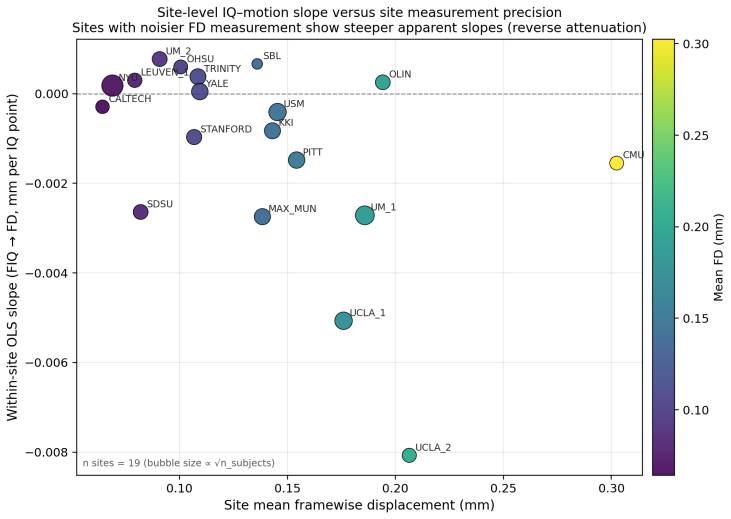
0
0
q-bio.QM 2026-04-09

Pipeline finds continuous contractile phenotypes in 670 microbundles

Quantifying the Spatiotemporal Dynamics of Engineered Cardiac Microbundles

Intra-condition differences often surpass those between 20 experimental conditions in this open analysis of cardiac tissues.

Figure from the paper full image
abstract click to expand
Brightfield time-lapse imaging is widely used in cardiac tissue engineering, yet the absence of standardized, interpretable analytical frameworks limits reproducibility and cross-platform comparison. We present an open, scalable computational pipeline for quantifying spatiotemporal contractile dynamics in microscopy videos of human induced pluripotent stem cell-derived cardiac microbundles. Building on our open-source tools "MicroBundleCompute" and "MicroBundlePillarTrack," we define a suite of 16 interpretable structural, functional, and spatiotemporal metrics that capture tissue deformation, synchrony, and heterogeneity. The framework integrates full-field displacement tracking, strain reconstruction, spatial registration, dimensionality reduction, and topology-based vector-field analysis within a unified workflow. Applied to a dataset of 670 cardiac microbundles spanning 20 experimental conditions, the pipeline reveals continuous variation in contractile phenotypes rather than discrete condition-specific clustering, with intra-condition variability often exceeding inter-condition differences. Redundancy analysis identifies a reduced core set of 10 metrics that retain most informational content while minimizing multicollinearity. Analysis of denoised displacement fields shows that contraction is dominated by a global isotropic mode, with localized saddle-type deformation patterns present in approximately half of the samples. All software and workflows are released openly to enable reproducible, scalable analysis of dynamic tissue mechanics.
0
0
q-bio.QM 2026-04-09

Model predicts activity cliffs to cut experiments by 31 percent

Predicting Activity Cliffs for Autonomous Medicinal Chemistry

11-feature predictor with 3D context ranks high-impact positions first across protein families and new scaffolds.

Figure from the paper full image
abstract click to expand
Activity cliff prediction - identifying positions where small structural changes cause large potency shifts - has been a persistent challenge in computational medicinal chemistry. This work focuses on a parsimonious definition: which small modifications, at which positions, confer the highest probability of an outcome change. Position-level sensitivity is calculated using 25 million matched molecular pairs from 50 ChEMBL targets across six protein families, revealing that two questions have fundamentally different answers. "Which positions vary most?" is answered by scaffold size alone (NDCG@3 = 0.966), requiring no machine learning. "Which are true activity cliffs?" - where small modifications cause disproportionately large effects, as captured by SALI normalization - requires an 11-feature model with 3D pharmacophore context (NDCG@3 = 0.910 vs. 0.839 random), generalizing across all six protein families, novel scaffolds (0.913), and temporal splits (0.878). The model identifies the cliff-prone position first 53% of the time (vs. 27% random - 2x lift), reducing positions a chemist must explore from 3.1 to 2.1 - a 31% reduction in first-round experiments. Predicting which modification to make is not tractable from structure alone (Spearman 0.268, collapsing to -0.31 on novel scaffolds). The system is released as open-source code and an interactive webapp.
0
0
q-bio.QM 2026-04-08 Recognition

Multi-agent debate lifts single-cell annotation accuracy to 75.5%

MAT-Cell: A Multi-Agent Tree-Structured Reasoning Framework for Batch-Level Single-Cell Annotation

MAT-Cell builds verifiable reasoning trees from gene data and priors, then has agents debate claims to reach better consensus than standard

Figure from the paper full image
abstract click to expand
Automated single-cell annotation is difficult when the most abundant genes are not the most discriminative ones, or when a target state is poorly covered by a fixed reference atlas. GPTCelltype-style one-shot prompting allows large language models (LLMs) to produce plausible labels from generic expression signals, while reference-based annotators can force unfamiliar states into the nearest known category. We propose MAT-Cell, a prompt-driven framework for batch-level single-cell annotation that separates evidence grounding from label decision. MAT-Cell first uses Reverse Verification Query (RVQ) to combine tissue context, observed differentially expressed genes, and LLM-elicited biological priors into structured candidate-specific premises. Verifier agents then convert these premises into explicit premise-to-claim reasoning trees, and bounded multi-round debate compares,challenges, and revises the resulting claims before consensus or final adjudication.The returned Syllogistic Derivation Tree (SDT) provides an auditable debate trace rather than a formal proof of the annotation. In open-candidate benchmarks across five datasets, a locally deployed Qwen3-30B model with MAT-Cell achieves 75.5% average accuracy, compared with 64.2% for the strongest evaluated CoT baseline and 51.9% for the strongest evaluated scPilot variant. In oracle-candidate bench-marks across three species,MAT-Cell remains competitive across backbones, and local inference substantially reduces monetary cost for batch annotation. Code is available at: https://anonymous.4open.science/r/MATCell-4067
0
0
q-bio.QM 2026-04-08 2 theorems

LLM toxicity predictions often lack biological mechanism grounding

ToxReason: A Benchmark for Mechanistic Chemical Toxicity Reasoning via Adverse Outcome Pathway

A benchmark based on adverse outcome pathways shows high accuracy does not ensure models reason correctly about how chemicals cause harm.

Figure from the paper full image
abstract click to expand
Recent advances in large language models (LLMs) have enabled molecular reasoning for property prediction. However, toxicity arises from complex biological mechanisms beyond chemical structure, necessitating mechanistic reasoning for reliable prediction. Despite its importance, current benchmarks fail to systematically evaluate this capability. LLMs can generate fluent but biologically unfaithful explanations, making it difficult to assess whether predicted toxicities are grounded invalid mechanisms. To bridge this gap, we introduce ToxReason, a benchmark grounded in the Adverse Outcome Pathway (AOP) that evaluates organ-level toxicity reasoning across multiple organs. ToxReason integrates experimental drug-target interaction evidence with toxicity labels, requiring models to infer both toxic outcomes and their underlying mechanisms from Molecular Initiating Event (MIE) to Adverse Outcome (AO). Using ToxReason, we evaluate toxicity prediction performance and reasoning quality across diverse LLMs. We find that strong predictive performance does not necessarily imply reliable reasoning. Furthermore, we show that reasoning-aware training improves mechanistic reasoning and, consequently, toxicity prediction performance. Together, these results underscore the necessity of integrating reasoning into both evaluation and training for trustworthy toxicity modeling.
2 0
0
q-bio.QM 2026-04-08 Recognition

Dual-stream calibration internalizes clinical reasoning at inference

From Exposure to Internalization: Dual-Stream Calibration for In-context Clinical Reasoning

Semantic entropy minimization and structural meta-learning adapt models to individual cases and outperform baselines on thirteen datasets.

Figure from the paper full image
abstract click to expand
Contextual clinical reasoning demands robust inference grounded in complex, heterogeneous clinical records. While state-of-the-art fine-tuning, in-context learning (ICL), and retrieval-augmented generation (RAG) enable knowledge exposure, they often fall short of genuine contextual internalization: dynamically adjusting a model's internal representations to the subtle nuances of individual cases at inference time. To address this, we propose Dual-Stream Calibration (DSC), a test-time training framework that transcends superficial knowledge exposure to achieve deep internalization during inference. DSC facilitates input internalization by synergistically aligning two calibration streams. Unlike passive context exposure, the Semantic Calibration Stream enforces a deliberative reflection on core evidence, internalizing semantic anchors by minimizing entropy to stabilize generative trajectories. Simultaneously, the Structural Calibration Stream assimilates latent inferential dependencies through an iterative meta-learning objective. By training on specialized support sets at test-time, this stream enables the model to bridge the gap between external evidence and internal logic, synthesizing fragmented data into a coherent response. Our approach shifts the reasoning paradigm from passive attention-based matching to an active refinement of the latent inferential space. Validated against thirteen clinical datasets, DSC demonstrates superiority across three distinct task paradigms, consistently outstripping state-of-the-art baselines ranging from training-dependent models to test-time learning frameworks.
0
0
q-bio.QM 2026-04-07 2 theorems

Impulsivity and monitoring predict teen substance starts

Time-Varying Environmental and Polygenic Predictors of Substance Use Initiation in Youth: A Survival and Causal Modeling Study in the ABCD Cohort

Longitudinal models from youth cohort data link dynamic risks and genetic scores to earlier alcohol, nicotine, and cannabis use.

Figure from the paper full image
abstract click to expand
Early initiation of alcohol, nicotine, cannabis, and other substances predicts later substance use disorders and related psychopathology. We integrate time-varying environmental factors with polygenic risk scores (PRS) in a longitudinal framework to identify determinants of substance initiation in adolescence. Using data from the Adolescent Brain Cognitive Development (ABCD) Study with repeated assessments over approximately four years, we defined time-to-event outcomes for first use of alcohol, nicotine, cannabis, and any substance. We constructed high-dimensional panels of time-varying environmental covariates across family, school, neighborhood, behavioral, and health domains, alongside time-invariant covariates and PRS for alcohol, cannabis, nicotine, and general substance use disorders. Time-varying Cox models with clustered standard errors were applied. Univariate analyses showed broad associations between earlier initiation and multiple environmental domains, including impulsivity, sleep disturbance, parental monitoring, caffeine use, and school functioning. In multivariable models, a smaller set of predictors remained robust, particularly impulsivity traits, parental monitoring, and selected health and lifestyle factors. PRS were positively associated with earlier initiation, with the strongest and most consistent effects for nicotine-related genetic risk. Secondary analyses using marginal structural models suggested that higher parental monitoring is protective, whereas higher impulsivity and caffeine exposure are associated with increased risk. These results demonstrate that integrating dynamic environmental exposures with genetic liability can identify key risk factors for adolescent substance initiation and highlight actionable targets for prevention.
0
0
q-bio.QM 2026-04-06 2 theorems

Monotonicity closes moment bounds via backward equation

Bounding Transient Moments for a Class of Stochastic Reaction Networks Using Kolmogorov's Backward Equation

Finite linear system gives guaranteed upper and lower trajectories for copy-number moments in reaction networks

Figure from the paper full image
abstract click to expand
Stochastic chemical reaction networks (SRNs) in cellular systems are commonly modeled as continuous-time Markov chains (CTMCs) describing the dynamics of molecular copy numbers. The exact evaluation of transient copy number statistics is, however, often hindered by a non-closed hierarchy of moment equations. In this paper, we propose a method for computing theoretically guaranteed upper and lower bounds on transient moments based on the Kolmogorov's backward equation, which provides a dual representation of the CME, the governing equation for the probability distribution of the CTMC. This dual formulation avoids the moment closure problem by shifting the source of infinite dimensionality to the dependence on the initial state. We show that, this dual formulation, combined with the monotonicity of the CTMC generator, leads to a finite-dimensional linear time-invariant system that provides bounds on transient moments. The resulting system enables efficient evaluation of moment bounds across multiple initial conditions by simple inner-product operations without recomputing the bounding system. Further, for certain classes of SRNs, the bounding ODEs admit explicit construction from the reaction model, providing a systematic and constructive framework for computing provable bounds.
0
0
q-bio.QM 2026-04-06 2 theorems

Pretrained CalM beats baselines on calcium trace forecasting

Self-Supervised Foundation Model for Calcium-imaging Population Dynamics

Self-supervised model on multi-animal data adapts to decode behavior better than supervised alternatives.

Figure from the paper full image
abstract click to expand
Recent work suggests that large-scale, multi-animal modeling can significantly improve neural recording analysis. However, for functional calcium traces, existing approaches remain task-specific, limiting transfer across common neuroscience objectives. To address this challenge, we propose \textbf{CalM}, a self-supervised neural foundation model trained solely on neuronal calcium traces and adaptable to multiple downstream tasks, including forecasting and decoding. Our key contribution is a pretraining framework, composed of a high-performance tokenizer mapping single-neuron traces into a shared discrete vocabulary, and a dual-axis autoregressive transformer modeling dependencies along both the neural and the temporal axis. We evaluate CalM on a large-scale, multi-animal, multi-session dataset. On the neural population dynamics forecasting task, CalM outperforms strong specialized baselines after pretraining. With a task-specific head, CalM further adapts to the behavior decoding task and achieves superior results compared with supervised decoding models. Moreover, linear analyses of CalM representations reveal interpretable functional structures beyond predictive accuracy. Taken together, we propose a novel and effective self-supervised pretraining paradigm for foundation models based on calcium traces, paving the way for scalable pretraining and broad applications in functional neural analysis. Code will be released soon.
0

browse all of q-bio.QM → full archive · search · sub-categories