Topological altermagnetic Josephson junctions
Pith reviewed 2026-05-23 02:24 UTC · model grok-4.3
The pith
Altermagnets enable Majorana end modes in Josephson junctions with topology controlled by orientation angle.
A machine-rendered reading of the paper's core claim, the machinery that carries it, and where it could break.
Core claim
By integrating altermagnets with their spin-polarized bands and zero magnetization into planar Josephson junctions, the work shows that Majorana end modes emerge robustly in the d_{x^2-y^2}-wave configuration but vanish for d_{xy}-wave, demonstrating that the altermagnet's crystallographic orientation angle serves as a control parameter for topology while mitigating orbital effects.
What carries the argument
The crystallographic orientation angle θ of the altermagnet, which selects d-wave symmetry and thereby determines whether Majorana end modes appear.
Load-bearing premise
Altermagnets' intrinsic spin-polarized band splitting and zero net magnetization integrate with superconducting pairing in a planar junction without competing effects that destroy the topological phase.
What would settle it
Experimental observation of Majorana end modes in d_{x^2-y^2}-wave altermagnetic junctions and their absence in d_{xy}-wave junctions as the orientation is varied.
Figures


read the original abstract
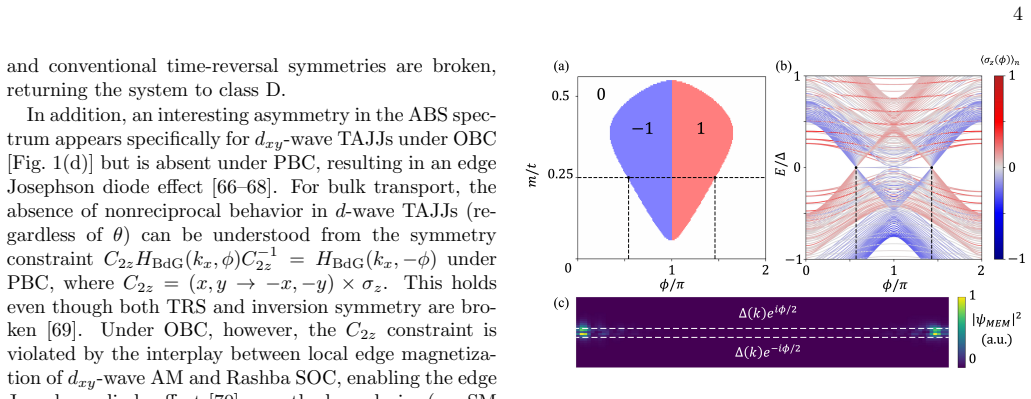
Planar Josephson junctions are pivotal for engineering topological superconductivity, yet are severely hindered by orbital effects induced by in-plane magnetic fields. In this work, we introduce the generic topological altermagnetic Josephson junctions (TAJJs) by leveraging the intrinsic spin-polarized band splitting and zero net magnetization attributes of altermagnets. Our proposed TAJJs effectively mitigate the detrimental orbital effects while robustly hosting Majorana end modes (MEMs) at both ends of the junction. Specifically, we demonstrate that MEMs emerge in $d_{x^2-y^2}$-wave TAJJs but vanish in the $d_{xy}$-wave configuration, thereby establishing the crystallographic orientation angle $\theta$ of the altermagnet as a novel control parameter of topology. The distinct spin-polarization of the MEMs provides an unambiguous experimental signature for the spin-resolved measurement. Furthermore, by harnessing the synergy between the $d_{x^2-y^2}$-wave altermagnet and its superconducting counterpart, our proposal extends to high-$T_c$ platforms naturally. Overall, this work establishes altermagnets as a versatile paradigm for realizing topological superconductivity, bridging conceptual innovations with scalable quantum architectures devoid of orbital effects and stray fields.
Editorial analysis
A structured set of objections, weighed in public.
Referee Report
Summary. The manuscript proposes topological altermagnetic Josephson junctions (TAJJs) that exploit the intrinsic spin-polarized band splitting and zero net magnetization of altermagnets to realize Majorana end modes (MEMs) in planar junctions while avoiding orbital effects from in-plane magnetic fields. It claims that MEMs appear in d_{x^2-y^2}-wave TAJJs but vanish in the d_{xy}-wave orientation, thereby identifying the crystallographic angle θ as a control parameter for the topological phase. The work further suggests spin-polarized MEMs as an experimental signature and natural extension to high-T_c platforms.
Significance. If the central claims are substantiated with explicit calculations, the proposal would introduce altermagnets as a new platform for topological superconductivity that sidesteps stray-field and orbital issues, potentially enabling scalable high-T_c implementations with a tunable control parameter θ. This could meaningfully expand the toolkit beyond conventional magnetic-field or Rashba-based junctions.
major comments (2)
- [Abstract] Abstract and main text: the claim that MEMs emerge only for d_{x^2-y^2} orientation (and vanish for d_{xy}) is presented without any explicit Hamiltonian, symmetry analysis, Bogoliubov-de Gennes equations, or numerical diagonalization results. No section derives or demonstrates that the topological phase is controlled solely by θ independent of interface scattering or proximity-induced competing orders.
- [Abstract] The assertion that altermagnet-SC integration in planar geometry introduces no competing effects that destroy the topological phase (the weakest assumption) is not tested or bounded; the manuscript supplies no band-structure calculations, self-consistent gap equations, or disorder-averaged spectra to isolate θ as the sole control parameter.
minor comments (1)
- Notation for the two altermagnetic orientations (d_{x^2-y^2} vs. d_{xy}) should be defined with explicit lattice vectors or momentum-space forms in the first section where they appear.
Simulated Author's Rebuttal
We thank the referee for the careful reading and constructive comments. We address the points below and will revise the manuscript to provide more explicit derivations, calculations, and discussion of model assumptions.
read point-by-point responses
-
Referee: [Abstract] Abstract and main text: the claim that MEMs emerge only for d_{x^2-y^2} orientation (and vanish for d_{xy}) is presented without any explicit Hamiltonian, symmetry analysis, Bogoliubov-de Gennes equations, or numerical diagonalization results. No section derives or demonstrates that the topological phase is controlled solely by θ independent of interface scattering or proximity-induced competing orders.
Authors: We thank the referee for this observation. The manuscript contains the effective Hamiltonian and numerical spectra demonstrating the θ dependence, but we agree that the derivations and robustness analysis can be presented more explicitly. In the revised version we will add a dedicated section with the full Hamiltonian, symmetry analysis under the altermagnetic point group, the Bogoliubov-de Gennes equations, and additional numerical diagonalization results (including weak interface scattering) to show that θ remains the dominant control parameter within the model. revision: yes
-
Referee: [Abstract] The assertion that altermagnet-SC integration in planar geometry introduces no competing effects that destroy the topological phase (the weakest assumption) is not tested or bounded; the manuscript supplies no band-structure calculations, self-consistent gap equations, or disorder-averaged spectra to isolate θ as the sole control parameter.
Authors: We acknowledge that the manuscript does not contain explicit band-structure calculations or self-consistent gap equations addressing competing orders. In the revision we will add a discussion section that bounds the orbital and proximity-induced effects using the zero net magnetization of the altermagnet, includes simple tight-binding band-structure results for the interface, and clarifies the regime where θ controls the topology. Full self-consistent or disorder-averaged spectra lie beyond the present scope but will be noted as a limitation and direction for future work. revision: partial
Circularity Check
No significant circularity; derivation relies on standard altermagnet-SC models without self-referential reduction.
full rationale
The paper sets up TAJJs by combining known altermagnetic spin splitting (zero net magnetization) with superconducting pairing in a planar junction, then computes the presence/absence of MEMs for different crystallographic orientations θ via the resulting Bogoliubov-de Gennes spectrum. This follows directly from the model's Hamiltonian and symmetry analysis rather than any fitted parameter renamed as prediction, self-definitional loop, or load-bearing self-citation. The orientation dependence is an output of the explicit calculation, not an input by construction. No ansatz is smuggled via prior author work, and the result is externally falsifiable against standard altermagnet and Josephson junction benchmarks. The reader's score of 2 reflects at most incidental self-citation that is not load-bearing.
Axiom & Free-Parameter Ledger
axioms (1)
- domain assumption Altermagnets exhibit intrinsic spin-polarized band splitting with zero net magnetization
Forward citations
Cited by 1 Pith paper
-
Perfect spin nonreciprocity in gated superconducting altermagnetic heterostructures
Gating a finite normal region between a superconducting altermagnet and a metallic reservoir produces perfect nonreciprocal spin and charge currents with tunable polarity via gate voltage and region length.
Reference graph
Works this paper leans on
- [1]
-
[2]
S. Nadj-Perge, I. K. Drozdov, J. Li, H. Chen, S. Jeon, J. Seo, A. H. MacDonald, B. A. Bernevig, and A. Yaz- dani, Science346, 602 (2014)
work page 2014
- [3]
-
[4]
S. Jeon, Y. Xie, J. Li, Z. Wang, B. A. Bernevig, and A. Yazdani, Science358, 772 (2017)
work page 2017
-
[5]
S. Nakosai, Y. Tanaka, and N. Nagaosa, Physical Review B - Condensed Matter and Materials Physics88(2013), 10.1103/PhysRevB.88.180503
-
[8]
M. M. Vazifeh and M. Franz, Physical Review Letters 111(2013), 10.1103/PhysRevLett.111.206802
-
[9]
A. M. Black-Schaffer and J. Linder, Phys. Rev. B84, 180509 (2011)
work page 2011
-
[10]
A. Y. Kitaev, Physics-Uspekhi44, 131 (2001)
work page 2001
-
[11]
Beenakker, Annual Review of Condensed Matter Physics4, 113 (2013)
C. Beenakker, Annual Review of Condensed Matter Physics4, 113 (2013)
work page 2013
-
[12]
New directions in the pursuit of majorana fermions in solid state systems,
J. Alicea, “New directions in the pursuit of majorana fermions in solid state systems,” (2012)
work page 2012
- [13]
-
[14]
R. M. Lutchyn, E. P. A. M. Bakkers, L. P. Kouwenhoven, P. Krogstrup, C. M. Marcus, and Y. Oreg, Nature Re- views Materials3, 52 (2018)
work page 2018
-
[15]
K. Flensberg, F. von Oppen, and A. Stern, Nature Re- views Materials6, 944 (2021)
work page 2021
-
[16]
Quantum bits with joseph- son junctions,
A. F. Kockum and F. Nori, “Quantum bits with joseph- son junctions,” inFundamentals and Frontiers of the Josephson Effect, edited by F. Tafuri (Springer Interna- tional Publishing, Cham, 2019) pp. 703–741
work page 2019
-
[17]
F. Pientka, A. Keselman, E. Berg, A. Yacoby, A. Stern, and B. I. Halperin, Phys. Rev. X7, 021032 (2017)
work page 2017
-
[18]
H. Ren, F. Pientka, S. Hart, A. T. Pierce, M. Kosowsky, L. Lunczer, R. Schlereth, B. Scharf, E. M. Hankiewicz, L. W. Molenkamp, B. I. Halperin, and A. Yacoby, Nature 569, 93 (2019)
work page 2019
-
[19]
A. Fornieri, A. M. Whiticar, F. Setiawan, E. Portol´ es, A. C. Drachmann, A. Keselman, S. Gronin, C. Thomas, T. Wang, R. Kallaher, G. C. Gardner, E. Berg, M. J. 6 Manfra, A. Stern, C. M. Marcus, and F. Nichele, Nature 569, 89 (2019)
work page 2019
-
[20]
C. T. Ke, C. M. Moehle, F. K. de Vries, C. Thomas, S. Metti, C. R. Guinn, R. Kallaher, M. Lodari, G. Scap- pucci, T. Wang, R. E. Diaz, G. C. Gardner, M. J. Man- fra, and S. Goswami, Nature Communications10, 3764 (2019)
work page 2019
-
[21]
Y.-M. Xie, E. Lantagne-Hurtubise, A. F. Young, S. Nadj- Perge, and J. Alicea, Phys. Rev. Lett.131, 146601 (2023)
work page 2023
-
[22]
M. Hell, M. Leijnse, and K. Flensberg, Phys. Rev. Lett. 118, 107701 (2017)
work page 2017
-
[23]
M. C. Dartiailh, W. Mayer, J. Yuan, K. S. Wickramas- inghe, A. Matos-Abiague, I. ˇZuti´ c, and J. Shabani, Phys. Rev. Lett.126, 036802 (2021)
work page 2021
-
[24]
A. Banerjee, O. Lesser, M. A. Rahman, H.-R. Wang, M.- R. Li, A. Kringhøj, A. M. Whiticar, A. C. C. Drachmann, C. Thomas, T. Wang, M. J. Manfra, E. Berg, Y. Oreg, A. Stern, and C. M. Marcus, Phys. Rev. B107, 245304 (2023)
work page 2023
- [25]
-
[26]
A. I. Buzdin, Rev. Mod. Phys.77, 935 (2005)
work page 2005
-
[27]
L. ˇSmejkal, J. Sinova, and T. Jungwirth, Physical Re- view X12(2022), 10.1103/PhysRevX.12.031042
-
[28]
Emerging re- search landscape of altermagnetism,
L. ˇSmejkal, J. Sinova, and T. Jungwirth, “Emerging re- search landscape of altermagnetism,” (2022)
work page 2022
-
[29]
C. Song, H. Bai, Z. Zhou, L. Han, H. Reichlova, J. H. Dil, J. Liu, X. Chen, and F. Pan, Nature Reviews Materials , 1 (2025)
work page 2025
- [30]
-
[31]
H. G. Giil and J. Linder, Phys. Rev. B109, 134511 (2024)
work page 2024
-
[32]
S. Shim, M. Mehraeen, J. Sklenar, S. S.-L. Zhang, A. Hoffmann, and N. Mason, Annual Review of Condensed Matter Physics (2024), https://doi.org/10.1146/annurev-conmatphys-042924- 123620
-
[33]
H.-Y. Ma, M. Hu, N. Li, J. Liu, W. Yao, J.-F. Jia, and J. Liu, Nature communications12, 2846 (2021)
work page 2021
- [35]
- [36]
- [37]
-
[38]
Y.-X. Li, Y. Liu, and C.-C. Liu, Physical Review B109, L201109 (2024)
work page 2024
- [39]
-
[40]
J. A. Ouassou, A. Brataas, and J. Linder, Phys. Rev. Lett.131, 076003 (2023)
work page 2023
-
[41]
C. W. J. Beenakker and T. Vakhtel, Phys. Rev. B108, 075425 (2023)
work page 2023
-
[42]
C. Sun, A. Brataas, and J. Linder, Physical Review B 108(2023), 10.1103/PhysRevB.108.054511
-
[44]
B. Lu, K. Maeda, H. Ito, K. Yada, and Y. Tanaka, (2024), 10.1103/PhysRevLett.133.226002
- [45]
-
[46]
S.-B. Zhang, L.-H. Hu, and T. Neupert, Nature Com- munications15, 1801 (2024)
work page 2024
-
[47]
J.-X. Hu, O. Matsyshyn, and J. C. Song, Physical Re- view Letters134, 026001 (2025)
work page 2025
- [48]
-
[49]
J. Krempask´ y, L.ˇSmejkal, S. W. D’Souza, M. Hajlaoui, G. Springholz, K. Uhl´ ıˇ rov´ a, F. Alarab, P. C. Constanti- nou, V. Strocov, D. Usanov, W. R. Pudelko, R. Gonz´ alez- Hern´ andez, A. B. Hellenes, Z. Jansa, H. Reichlov´ a, Z. ˇSob´ aˇ n, R. D. G. Betancourt, P. Wadley, J. Sinova, D. Kriegner, J. Min´ ar, J. H. Dil, and T. Jungwirth, Na- ture626, 5...
work page 2024
-
[50]
S. Reimers, L. Odenbreit, L. ˇSmejkal, V. N. Strocov, P. Constantinou, A. B. Hellenes, R. J. Ubiergo, W. H. Campos, V. K. Bharadwaj, A. Chakraborty, T. Den- neulin, W. Shi, R. E. Dunin-Borkowski, S. Das, M. Kl¨ aui, J. Sinova, and M. Jourdan, Nature Communications15 (2024), 10.1038/s41467-024-46476-5
-
[51]
S. Lee, S. Lee, S. Jung, J. Jung, D. Kim, Y. Lee, B. Seok, J. Kim, B. G. Park, L. ˇSmejkal, C. J. Kang, and C. Kim, Physical Review Letters132(2024), 10.1103/PhysRevLett.132.036702
-
[52]
G. Yang, Z. Li, S. Yang, J. Li, H. Zheng, W. Zhu, Z. Pan, Y. Xu, S. Cao, W. Zhao, A. Jana, J. Zhang, M. Ye, Y. Song, L.-H. Hu, L. Yang, J. Fujii, I. Vobornik, M. Shi, H. Yuan, Y. Zhang, Y. Xu, and Y. Liu, Nature Commu- nications16, 1442 (2025)
work page 2025
-
[53]
Z. Zhou, X. Cheng, M. Hu, R. Chu, H. Bai, L. Han, J. Liu, F. Pan, and C. Song, Nature (2025), 10.1038/s41586-024-08436-3
- [54]
-
[55]
M. Kjaergaard, F. Nichele, H. J. Suominen, M. P. Nowak, M. Wimmer, A. R. Akhmerov, J. A. Folk, K. Flensberg, J. Shabani, C. J. Palmstrøm, and C. M. Marcus, Nature Communications7, 12841 (2016)
work page 2016
-
[56]
Z. Wan, A. Kazakov, M. J. Manfra, L. N. Pfeiffer, K. W. West, and L. P. Rokhinson, Nature Communications6, 7426 (2015)
work page 2015
-
[57]
J. Shabani, M. Kjaergaard, H. J. Suominen, Y. Kim, F. Nichele, K. Pakrouski, T. Stankevic, R. M. Lutchyn, P. Krogstrup, R. Feidenhans’l, S. Kraemer, C. Nayak, M. Troyer, C. M. Marcus, and C. J. Palmstrøm, Phys. Rev. B93, 155402 (2016)
work page 2016
-
[58]
J. D. Sau, R. M. Lutchyn, S. Tewari, and S. Das Sarma, Phys. Rev. Lett.104, 040502 (2010)
work page 2010
-
[59]
J. Bardeen, L. N. Cooper, and J. R. Schrieffer, Phys. Rev.108, 1175 (1957)
work page 1957
-
[60]
T. Mizushima and K. Machida, Philosophical Transactions of the Royal Society A: Mathemati- cal, Physical and Engineering Sciences376(2018), 10.1098/rsta.2015.0355
-
[61]
J. Liu, A. C. Potter, K. T. Law, and P. A. Lee, Phys. Rev. Lett.109, 267002 (2012)
work page 2012
-
[62]
Topological altermag- netic Josephson junctions
The Supplemental Material of “Topological altermag- netic Josephson junctions”, which includes nine parts: I. Tight-binding model; II. Winding number for the BDI symmetry class; III. ABS spectrum ofd x2−y2-wave TAJJs: Scattering matrix formalism; IV. Evolution of topological phases with chemical potential and SOC strength; V. The ABS spectrum degeneracy a...
-
[63]
J. J. He, T. K. Ng, P. A. Lee, and K. T. Law, Phys. Rev. Lett.112, 037001 (2014)
work page 2014
-
[64]
E. W. Hodt, P. Sukhachov, and J. Linder, Phys. Rev. B 110, 054446 (2024)
work page 2024
-
[65]
H. G. Giil, B. Brekke, J. Linder, and A. Brataas, (2024)
work page 2024
- [66]
- [67]
-
[68]
M. Davydova, S. Prembabu, and L. Fu, Science Ad- vances8, eabo0309 (2022)
work page 2022
- [69]
-
[70]
E. Zhang, Z.-T. Sun, Z. Jia, J. Yang, J. Yan, L. Ai, Y.-M. Xie, Y. Zhang, X.-J. Gao, X. Xu,et al., Science Advances 11, eads8730 (2025)
work page 2025
- [71]
-
[72]
T. D. Stanescu and S. Tewari, Journal of Physics: Con- densed Matter25, 233201 (2013)
work page 2013
-
[73]
Y.-M. Xie, K. T. Law, and P. A. Lee, Phys. Rev. Res. 3, 043086 (2021)
work page 2021
- [74]
-
[75]
P. Hirschfeld, M. Korshunov, and I. Mazin, Reports on Progress in Physics74, 124508 (2011)
work page 2011
-
[76]
Stewart, Reviews of Modern Physics83, 1589 (2011)
G. Stewart, Reviews of Modern Physics83, 1589 (2011)
work page 2011
-
[77]
Z. Yan, F. Song, and Z. Wang, Phys. Rev. Lett.121, 096803 (2018)
work page 2018
-
[78]
J. Ding, Z. Jiang, X. Chen, Z. Tao, Z. Liu, T. Li, J. Liu, J. Sun, J. Cheng, J. Liu, Y. Yang, R. Zhang, L. Deng, W. Jing, Y. Huang, Y. Shi, M. Ye, S. Qiao, Y. Wang, Y. Guo, D. Feng, and D. Shen, Phys. Rev. Lett.133, 206401 (2024)
work page 2024
-
[79]
Q. Song, H. Zhang, T. Su, W. Yuan, Y. Chen, W. Xing, J. Shi, J. Sun, and W. Han, Science Advances3, e1602312 (2017)
work page 2017
- [80]
-
[81]
O. Amin, A. Dal Din, E. Golias, Y. Niu, A. Zakharov, S. Fromage, C. Fields, S. Heywood, R. Cousins, F. Mac- cherozzi,et al., Nature636, 348 (2024)
work page 2024
- [82]
-
[83]
H. Oka, O. O. Brovko, M. Corbetta, V. S. Stepanyuk, D. Sander, and J. Kirschner, Rev. Mod. Phys.86, 1127 (2014)
work page 2014
-
[84]
W. Wulfhekel and J. Kirschner, Annual Review of Mate- rials Research37, 69 (2007)
work page 2007
discussion (0)
Sign in with ORCID, Apple, or X to comment. Anyone can read and Pith papers without signing in.