Linear sigma model with quarks and Polyakov loop in rotation: phase diagrams, Tolman-Ehrenfest law and mechanical properties
Pith reviewed 2026-05-22 22:32 UTC · model grok-4.3
The pith
In this effective QCD model, rotation lowers the critical temperatures for both chiral restoration and deconfinement.
A machine-rendered reading of the paper's core claim, the machinery that carries it, and where it could break.
Core claim
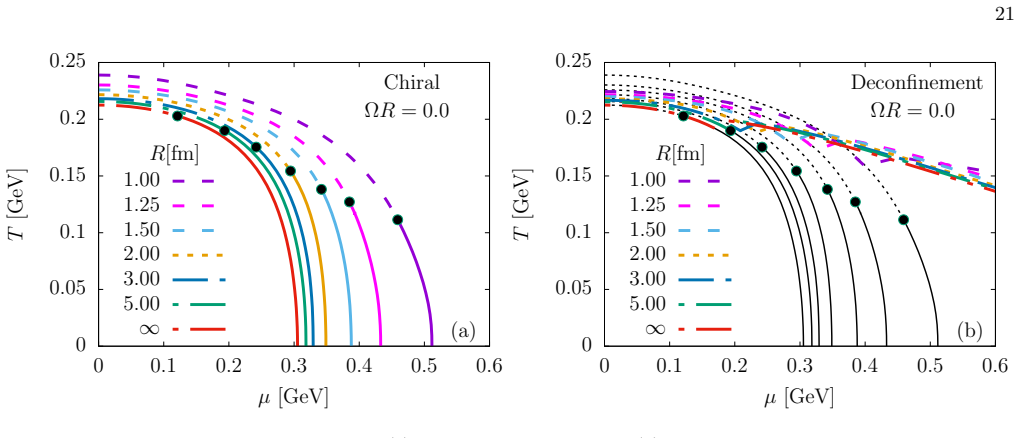
Within the Polyakov linear sigma model with quarks in the homogeneous approximation and with spectral boundary conditions at the cylinder surface, the critical temperatures of the chiral restoration and deconfinement transitions both decrease as angular frequency increases; thermodynamic consistency with the Tolman-Ehrenfest law is recovered only for large system size, while mechanical coefficients such as the moment of inertia and K_n shape factors are obtained from derivatives of the grand potential.
What carries the argument
Polyakov-enhanced linear sigma model coupled to quarks under rotation, in the homogeneous approximation with spectral boundary conditions enforcing causality.
If this is right
- Both the chiral and deconfinement transition lines shift to lower temperatures with increasing angular frequency.
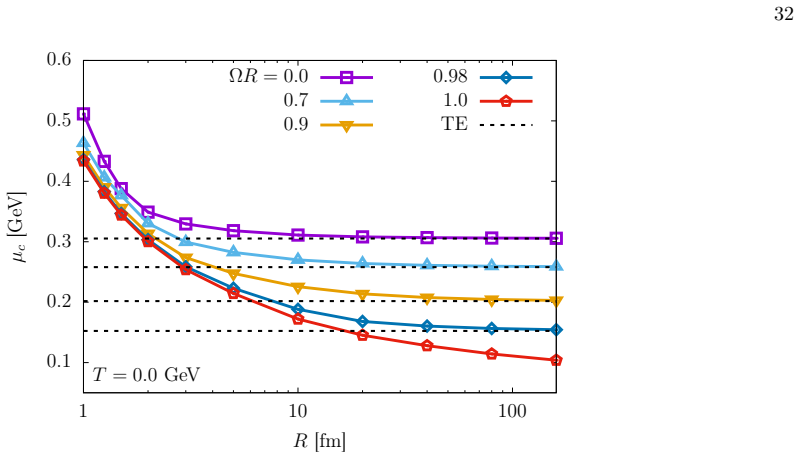
- Thermodynamic quantities satisfy the Tolman-Ehrenfest law only when the cylindrical volume becomes large.
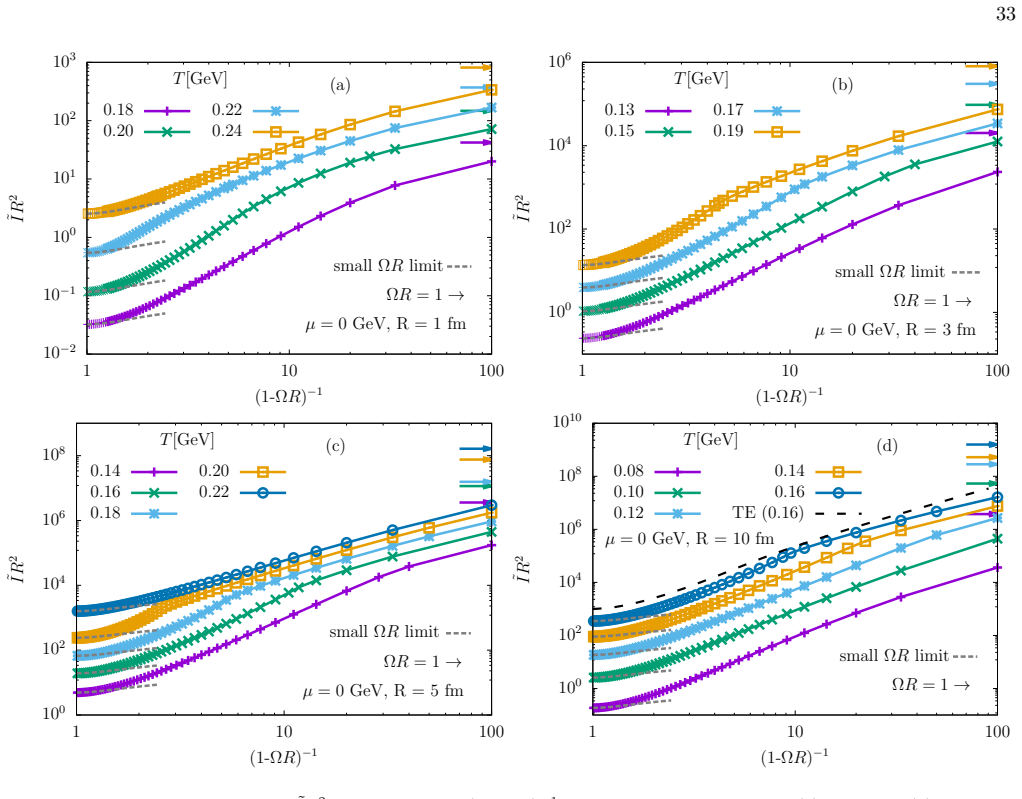
- The moment of inertia and the K_n coefficients that measure the response of the thermodynamic potential to angular velocity are directly computable from the model.
- The phase structure depends on the interplay between temperature, baryon chemical potential, and angular frequency within the causality constraint.
Where Pith is reading between the lines
- The reported decrease in transition temperatures may require inhomogeneous field configurations or altered boundary conditions to reconcile with lattice QCD.
- The mechanical coefficients could be tested in rotating heavy-ion collision environments where vorticity is present.
- The large-volume limit needed for Tolman-Ehrenfest consistency suggests finite-size effects dominate the thermodynamics at accessible angular velocities.
Load-bearing premise
The system can be described by spatially uniform fields together with the specific spectral boundary conditions chosen to enforce causality at the cylindrical surface.
What would settle it
A first-principles lattice simulation that finds the critical temperatures increasing or staying constant with rotation would contradict the model's reported decrease.
Figures






read the original abstract
We study the effect of rotation on the confining and chiral properties of QCD using the Polyakov-enhanced linear sigma model coupled to quarks. Working in the homogeneous approximation, we obtain the phase diagram at finite temperature, baryon density and angular frequency, taking into account the causality constraint enforced by the spectral boundary conditions at a cylindrical surface. We explicitly address various limits with respect to system size $R$, angular frequency $\Omega$ and chemical potential $\mu$. We demonstrate that, in this model, the critical temperatures of both the chiral restoration and the deconfinement transitions diminish in response to the increasing rotation, being in contradiction with the first-principle lattice results. We demonstrate that consistency between the thermodynamics of the model and the Tolman-Ehrenfest law is achieved in the limit of large volume. We also compute the mechanical characteristics of the rotating plasma, such as the moment of inertia and the $K_n$ shape coefficients describing the response of the thermodynamic potential with respect to the increase of angular velocity $\Omega$.
Editorial analysis
A structured set of objections, weighed in public.
Referee Report
Summary. The manuscript studies the Polyakov-linear sigma model coupled to quarks under rotation in the homogeneous approximation. It constructs the phase diagram in T, μ, and Ω subject to causality-enforcing spectral boundary conditions on a cylinder of radius R, reports that both chiral-restoration and deconfinement critical temperatures decrease with increasing Ω (in contrast to lattice QCD), verifies thermodynamic consistency with the Tolman-Ehrenfest law only in the large-R limit, and computes mechanical response functions including the moment of inertia and Kn shape coefficients.
Significance. If the homogeneous ansatz remains valid, the calculation supplies an explicit effective-model realization of rotation effects on the QCD phase structure together with concrete mechanical coefficients; the systematic treatment of the R, Ω, μ limits and the large-volume recovery of Tolman-Ehrenfest consistency are positive technical features. The reported disagreement with lattice data is already noted by the authors and therefore does not constitute an internal inconsistency, but it does limit immediate phenomenological weight.
major comments (2)
- [Abstract / homogeneous approximation] Abstract and the homogeneous-approximation paragraph: the central claim that both critical temperatures decrease with Ω is obtained exclusively under the spatially constant order-parameter ansatz. The Tolman-Ehrenfest effect and centrifugal contributions are expected to induce radial dependence; the manuscript only demonstrates consistency in the large-R limit, so the finite-R phase boundaries may shift once spatially varying configurations are allowed.
- [Model definition / parameter section] Parameter inheritance (implicit in the model setup): the Polyakov-linear-sigma parameters are taken from fits to non-rotating phenomenology; the Ω dependence is therefore not an independent prediction but follows by construction from those fixed values, weakening the status of the reported phase diagram as a genuine rotation-induced effect.
Simulated Author's Rebuttal
We thank the referee for the careful reading of our manuscript and the constructive comments. We address each major point below.
read point-by-point responses
-
Referee: [Abstract / homogeneous approximation] Abstract and the homogeneous-approximation paragraph: the central claim that both critical temperatures decrease with Ω is obtained exclusively under the spatially constant order-parameter ansatz. The Tolman-Ehrenfest effect and centrifugal contributions are expected to induce radial dependence; the manuscript only demonstrates consistency in the large-R limit, so the finite-R phase boundaries may shift once spatially varying configurations are allowed.
Authors: We agree that all reported results, including the decrease of both critical temperatures with Ω, are obtained strictly within the homogeneous (spatially constant) ansatz for the order parameters. This approximation is explicitly stated throughout the manuscript and is adopted to render the rotating system tractable while enforcing causality via spectral boundary conditions. We already note that thermodynamic consistency with the Tolman-Ehrenfest law holds only in the large-R limit. Spatially inhomogeneous configurations could indeed alter the finite-R phase boundaries, but their inclusion would require a substantially more involved numerical treatment that lies beyond the present scope. We will revise the abstract and the relevant introductory paragraphs to state more explicitly that the phase diagram is obtained under the homogeneous approximation. revision: yes
-
Referee: [Model definition / parameter section] Parameter inheritance (implicit in the model setup): the Polyakov-linear-sigma parameters are taken from fits to non-rotating phenomenology; the Ω dependence is therefore not an independent prediction but follows by construction from those fixed values, weakening the status of the reported phase diagram as a genuine rotation-induced effect.
Authors: The model parameters are fixed by reproducing vacuum phenomenology and the non-rotating transition temperatures, as is standard for effective QCD models. Once these parameters are set, the rotation dependence arises dynamically from the quark coupling, the Polyakov-loop potential, and the causality-enforcing boundary conditions. The observed decrease of critical temperatures with Ω is therefore a direct consequence of the model's structure under rotation rather than an additional free parameter. While the quantitative location of the phase boundaries inherits the non-rotating calibration, the qualitative trend constitutes a genuine prediction of the effective theory for rotating matter. revision: no
Circularity Check
No significant circularity; derivation is self-contained model calculation
full rationale
The paper fixes model parameters from non-rotating QCD phenomenology (standard effective-model practice) and then solves the effective potential in the rotating frame using the homogeneous ansatz and spectral boundary conditions. The reported decrease in critical temperatures with angular velocity emerges from the modified Dirac operator and metric, not from any fit to rotating data or self-referential definition. No load-bearing self-citation chain or ansatz smuggling is present; the central claim is a direct numerical output of the model equations and remains independently falsifiable against lattice results. This is the normal, non-circular case for an effective-model study.
Axiom & Free-Parameter Ledger
free parameters (1)
- Polyakov-linear-sigma model parameters
axioms (2)
- domain assumption Homogeneous field approximation
- domain assumption Spectral boundary conditions at cylindrical surface
Forward citations
Cited by 2 Pith papers
-
Chiral symmetry breaking and inhomogeneous phases in thermal anti-de Sitter spacetime
In the quark-meson model on thermal AdS, chiral symmetry is always broken near the boundary with unique regular inhomogeneous condensate solutions; temperature restores symmetry while negative curvature favors breakin...
-
Relativistic Barnett effect and Curie law in a rigidly rotating free Fermi gas
In a rigidly rotating free Fermi gas, the relativistic Barnett effect produces different Fermi energies for spin-up and spin-down fermions, leading to a moment of inertia that scales as 1/T at high temperature, analog...
Reference graph
Works this paper leans on
-
[1]
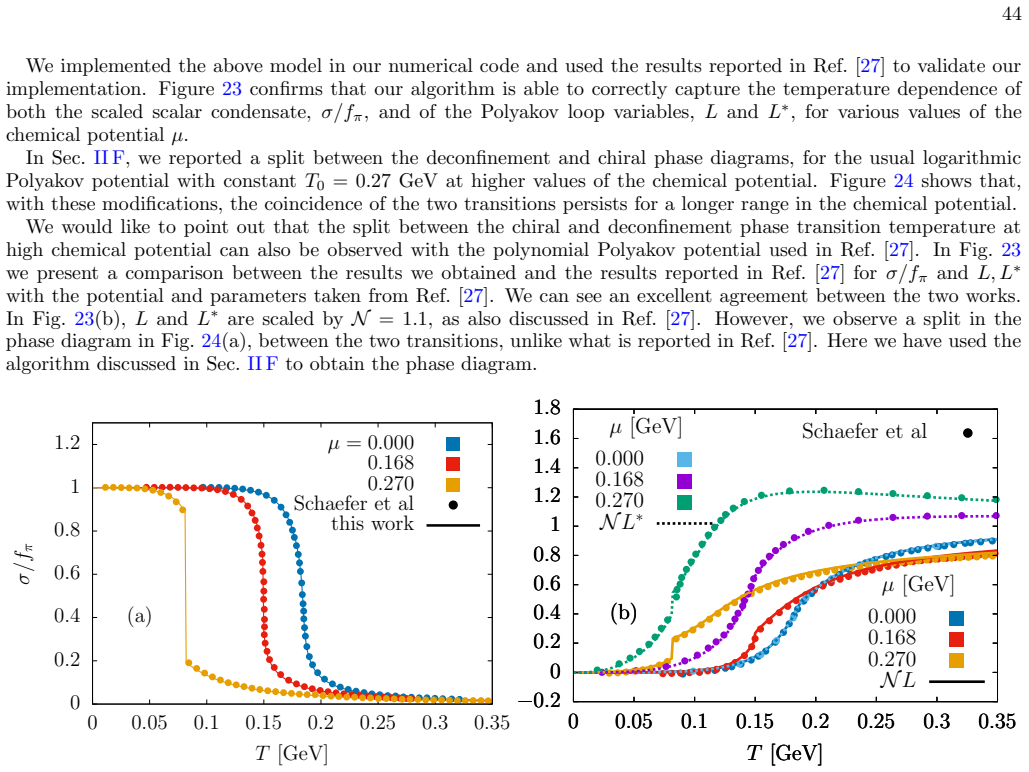
Polynomial Polyakov potential In the polynomial parametrization, the potential can be written as follows, V p. L T 4 = − b2(T ) 2 L∗L − b3 6 [(L∗)3 + L3] + b4 4 (L∗L)2, (A1) where b3 and b4 are constants, while b2(T ) is parametrized b2(T ) = a0 + a1 T0 T + a2 T0 T 2 + a3 T0 T 3 . (A2) Imposing the Stefan-Boltzmann limit (assuming L, L∗ → 1 when T → ∞) im...
-
[2]
However, in presence of dynamical quarks, one can expect this transition temperature to be modified
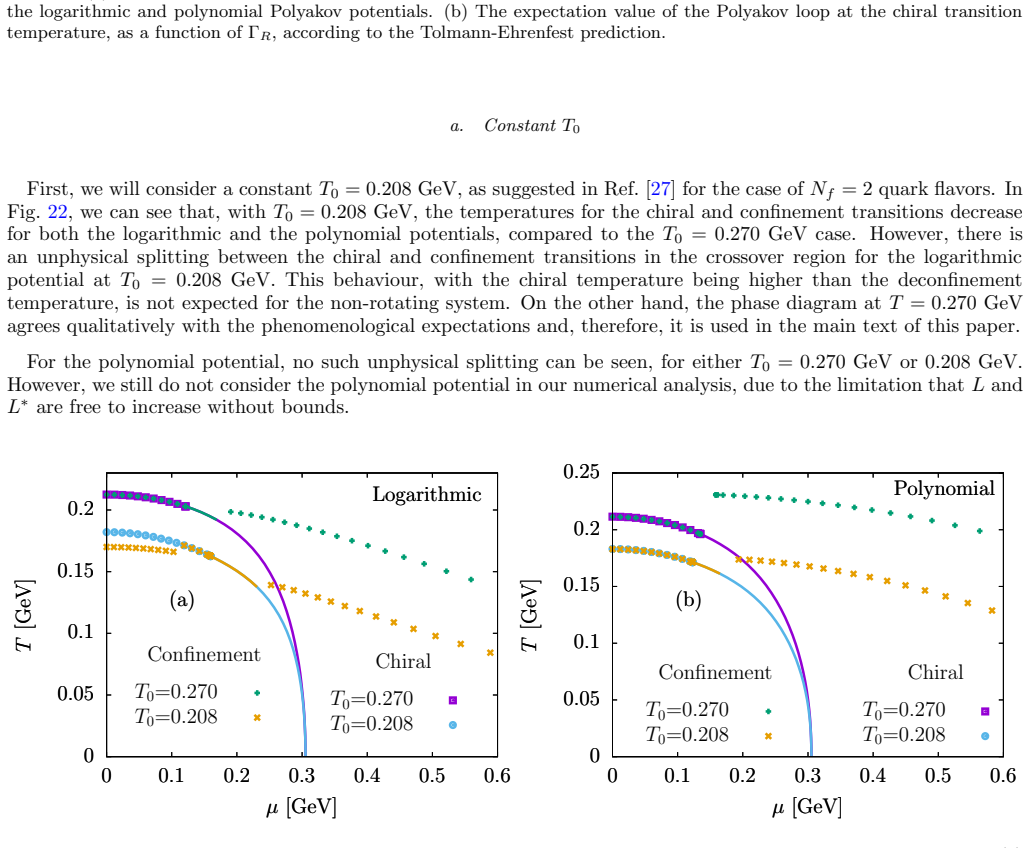
Choice of T0 So far, for both logarithmic and polynomial potentials, we have considered T0 = 0 .27 GeV, corresponding to the confinement-deconfinement transition, measured on the lattice for the SU(3) pure gauge theory. However, in presence of dynamical quarks, one can expect this transition temperature to be modified. In this section, we will discuss the...
-
[3]
B. I. Abelev et al. (STAR), Phys. Rev. C 76, 024915 (2007), [Erratum: Phys.Rev.C 95, 039906 (2017)], arXiv:0705.1691 [nucl-ex]
work page internal anchor Pith review Pith/arXiv arXiv 2007
-
[4]
Global $\Lambda$ hyperon polarization in nuclear collisions: evidence for the most vortical fluid
L. Adamczyk et al. (STAR), Nature 548, 62 (2017), arXiv:1701.06657 [nucl-ex]
work page internal anchor Pith review Pith/arXiv arXiv 2017
- [5]
-
[6]
F. Becattini, J. Liao, and M. Lisa, Lect. Notes Phys. 987, 1 (2021), arXiv:2102.00933 [nucl-th]
-
[7]
Lattice QCD in rotating frames
A. Yamamoto and Y. Hirono, Phys. Rev. Lett. 111, 081601 (2013), arXiv:1303.6292 [hep-lat]
work page internal anchor Pith review Pith/arXiv arXiv 2013
-
[8]
V. V. Braguta, A. Y. Kotov, D. D. Kuznedelev, and A. A. Roenko, Pisma Zh. Eksp. Teor. Fiz. 112, 9 (2020)
work page 2020
- [9]
- [10]
-
[11]
V. V. Braguta, I. E. Kudrov, A. A. Roenko, D. A. Sychev, and M. N. Chernodub, JETP Lett. 117, 639 (2023)
work page 2023
- [12]
-
[13]
J.-C. Yang and X.-G. Huang, QCD on Rotating Lattice with Staggered Fermions (2023), arXiv:2307.05755 [hep-lat]
- [14]
- [15]
- [16]
-
[17]
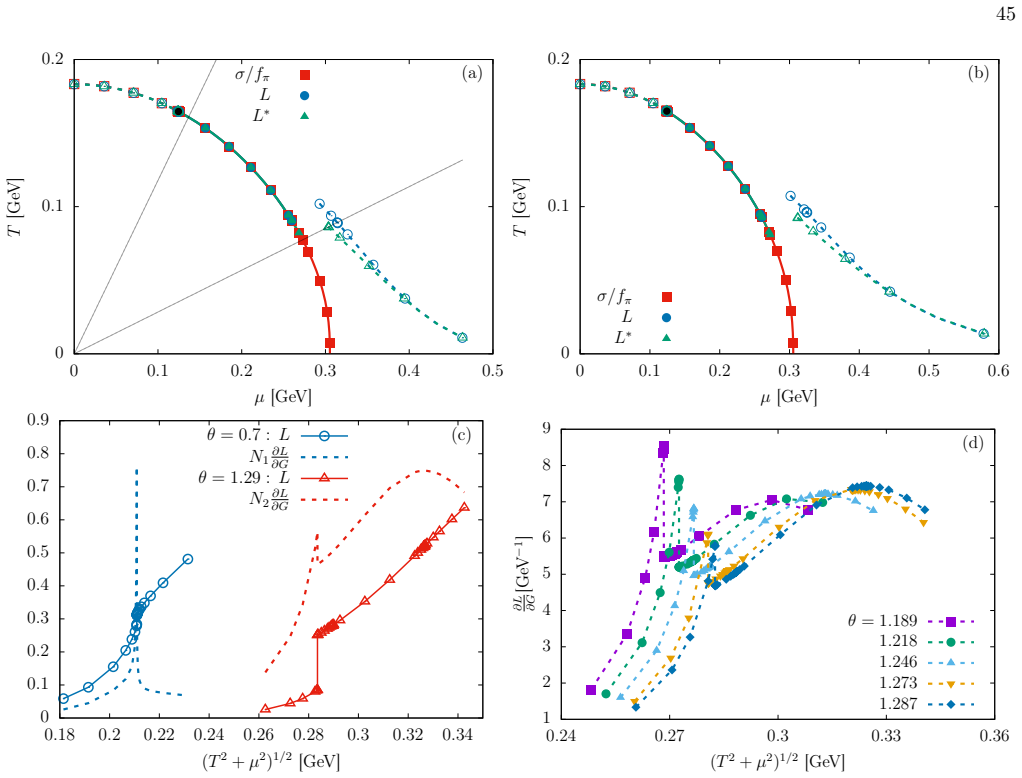
R. C. Tolman, Phys. Rev. 35, 904 (1930). 45 0 0.1 0.2 0 0 .1 0 .2 0 .3 0 .4 0 .5 (a) T [GeV] µ [GeV] σ/fπ L L∗ 0 0.1 0.2 0 0 .1 0 .2 0 .3 0 .4 0 .5 0 .6 (b) T [GeV] µ [GeV] σ/fπ L L∗ 0 0.1 0.2 0.3 0.4 0.5 0.6 0.7 0.8 0.9 0.18 0 .2 0 .22 0 .24 0 .26 0 .28 0 .3 0 .32 0 .34 (c) (T 2 + µ2)1/2 [GeV] θ = 0.7 : L N1 ∂L ∂G θ = 1.29 : L N2 ∂L ∂G 1 2 3 4 5 6 7 8 9 ...
work page 1930
- [18]
- [19]
- [20]
-
[21]
Y. Fujimoto, K. Fukushima, and Y. Hidaka, Phys. Lett. B 816, 136184 (2021), arXiv:2101.09173 [hep-ph]
- [22]
-
[23]
Y. Jiang, Phys. Rev. D 110, 054047 (2024), arXiv:2406.03311 [nucl-th]
-
[24]
S. Morales-Tejera, V. E. Ambru¸ s, and M. N. Chernodub, Firewall boundaries and mixed phases of rotating quark matter in linear sigma model (2025), arXiv:2502.19087 [nucl-th]
- [25]
- [26]
- [27]
- [28]
-
[29]
The Phase Structure of the Polyakov--Quark-Meson Model
B.-J. Schaefer, J. M. Pawlowski, and J. Wambach, Phys. Rev. D 76, 074023 (2007), arXiv:0704.3234 [hep-ph]
work page internal anchor Pith review Pith/arXiv arXiv 2007
-
[30]
Polyakov loop modeling for hot QCD
K. Fukushima and V. Skokov, Prog. Part. Nucl. Phys. 96, 154 (2017), arXiv:1705.00718 [hep-ph]
work page internal anchor Pith review Pith/arXiv arXiv 2017
-
[31]
E. Siri and N. Sadooghi, Phys. Rev. D 111, 036011 (2025), arXiv:2411.12581 [hep-ph]
- [32]
- [33]
-
[34]
Polyakov loop, diquarks and the two-flavour phase diagram
S. Roessner, C. Ratti, and W. Weise, Phys. Rev. D 75, 034007 (2007), arXiv:hep-ph/0609281
work page internal anchor Pith review Pith/arXiv arXiv 2007
-
[35]
Phases of QCD: lattice thermodynamics and a field theoretical model
C. Ratti, M. A. Thaler, and W. Weise, Phys. Rev. D 73, 014019 (2006), arXiv:hep-ph/0506234
work page internal anchor Pith review Pith/arXiv arXiv 2006
-
[36]
Boundary effects and gapped dispersion in rotating fermionic matter
S. Ebihara, K. Fukushima, and K. Mameda, Phys. Lett. B 764, 94 (2017), arXiv:1608.00336 [hep-ph]. 46
work page internal anchor Pith review Pith/arXiv arXiv 2017
- [37]
- [38]
-
[39]
V. E. Ambrus and E. Winstanley, Phys. Rev. D 93, 104014 (2016), arXiv:1512.05239 [hep-th]
work page internal anchor Pith review Pith/arXiv arXiv 2016
- [40]
-
[41]
M. N. Chernodub and S. Gongyo, JHEP 01, 136, arXiv:1611.02598 [hep-th]
work page internal anchor Pith review Pith/arXiv arXiv
-
[42]
M. N. Chernodub and S. Gongyo, Phys. Rev. D 95, 096006 (2017), arXiv:1702.08266 [hep-th]
work page internal anchor Pith review Pith/arXiv arXiv 2017
-
[43]
M. N. Chernodub and S. Gongyo, Phys. Rev. D 96, 096014 (2017), arXiv:1706.08448 [hep-th]
work page internal anchor Pith review Pith/arXiv arXiv 2017
-
[44]
Quantum corrections to the stress-energy tensor in thermodynamic equilibrium with acceleration
F. Becattini and E. Grossi, Phys. Rev. D 92, 045037 (2015), arXiv:1505.07760 [gr-qc]
work page internal anchor Pith review Pith/arXiv arXiv 2015
-
[45]
V. E. Ambrus, Phys. Lett. B 771, 151 (2017), arXiv:1704.02933 [hep-th]
work page internal anchor Pith review Pith/arXiv arXiv 2017
-
[46]
Local thermodynamical equilibrium and the beta frame for a quantum relativistic fluid
F. Becattini, L. Bucciantini, E. Grossi, and L. Tinti, Eur. Phys. J. C 75, 191 (2015), arXiv:1403.6265 [hep-th]
work page internal anchor Pith review Pith/arXiv arXiv 2015
-
[47]
M. Buzzegoli and F. Becattini, JHEP 12, 002, [Erratum: JHEP 03, 045 (2022)], arXiv:1807.02071 [hep-th]
- [48]
- [49]
- [50]
-
[51]
T. P˘ atuleanu, A. D. Fodor, V. E. Ambrus, and C. Crucean, Phys. Rev. D 111, 116004 (2025), arXiv:2502.09738 [hep-th]
-
[52]
T. K. Herbst, J. M. Pawlowski, and B.-J. Schaefer, Phys. Lett. B 696, 58 (2011), arXiv:1008.0081 [hep-ph]
work page internal anchor Pith review Pith/arXiv arXiv 2011
- [53]
-
[54]
M. Daum, R. Frosch, and P. R. Kettle, Phys. Lett. B 796, 11 (2019)
work page 2019
- [55]
-
[56]
J. I. Kapusta and C. Gale,Finite-Temperature Field Theory: Principles and Applications, 2nd ed., Cambridge Monographs on Mathematical Physics (Cambridge University Press, 2006)
work page 2006
-
[57]
Chiral Phase Transition within Effective Models with Constituent Quarks
O. Scavenius, A. Mocsy, I. N. Mishustin, and D. H. Rischke, Phys. Rev. C 64, 045202 (2001), arXiv:nucl-th/0007030
work page internal anchor Pith review Pith/arXiv arXiv 2001
-
[58]
Quark number susceptibilities: lattice QCD versus PNJL model
C. Ratti, S. Roessner, and W. Weise, Phys. Lett. B 649, 57 (2007), arXiv:hep-ph/0701091
work page internal anchor Pith review Pith/arXiv arXiv 2007
-
[59]
C. G. Broyden, Math. Comput. 19, 577 (1965)
work page 1965
-
[60]
W. H. Press, S. A. Teukolsky, W. T. Vetterling, and B. P. Flannery,Numerical Recipes in C, 2nd ed. (Cambridge University Press, Cambridge, USA, 1992)
work page 1992
- [61]
- [62]
-
[63]
L. Schubnikow and W. J. de Haas, Proceedings of the Royal Netherlands Academy of Arts and Sciences 33, 130 (1930)
work page 1930
-
[64]
C. Cercignani and G. M. Kremer, The Relativistic Boltzmann Equation: Theory and Applications (Springer, 2002)
work page 2002
-
[65]
V. E. Ambru¸ s and E. Winstanley, Phys. Lett. B734, 296 (2014), arXiv:1401.6388 [hep-th]
work page internal anchor Pith review Pith/arXiv arXiv 2014
- [66]
-
[67]
The pressure of hot QCD up to g^6 ln(1/g)
K. Kajantie, M. Laine, K. Rummukainen, and Y. Schroder, Phys. Rev. D 67, 105008 (2003), arXiv:hep-ph/0211321
work page internal anchor Pith review Pith/arXiv arXiv 2003
-
[68]
S. K. Ghosh, T. K. Mukherjee, M. G. Mustafa, and R. Ray, Phys. Rev. D 77, 094024 (2008), arXiv:0710.2790 [hep-ph]
work page internal anchor Pith review Pith/arXiv arXiv 2008
-
[69]
T. K. Herbst, J. M. Pawlowski, and B.-J. Schaefer, Phys. Rev. D 88, 014007 (2013), arXiv:1302.1426 [hep-ph]
work page internal anchor Pith review Pith/arXiv arXiv 2013
discussion (0)
Sign in with ORCID, Apple, or X to comment. Anyone can read and Pith papers without signing in.