Direction switchable single-photon emitter using a Rydberg polariton
Pith reviewed 2026-05-22 21:19 UTC · model grok-4.3
The pith
A Rydberg polariton can be redirected into multiple output channels by altering its Rydberg component with a stimulated Raman transition and choosing the retrieval laser direction.
A machine-rendered reading of the paper's core claim, the machinery that carries it, and where it could break.
Core claim
The central claim is that a Rydberg polariton functions as a direction-switchable single-photon emitter. The Rydberg component is modified through a stimulated Raman transition that uses a specific intermediate state. Selecting the direction of the retrieval laser then redirects the emitted photon into chosen alternative modes. Building on this, the scheme enables quantum routing across N channels with unity efficiency while suppressing motional dephasing to achieve photon lifetimes exceeding 10 μs.
What carries the argument
Stimulated Raman transition on a chosen intermediate state that alters the Rydberg component of the polariton, paired with directional control of the retrieval laser to select the output mode.
If this is right
- Single photons can be routed to N output channels with unity efficiency.
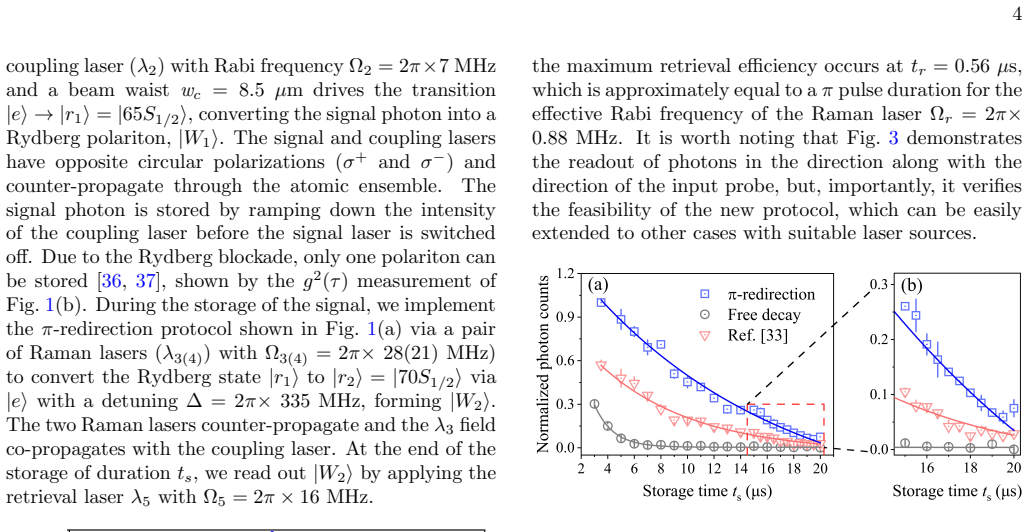
- Photon lifetime extends beyond 10 μs, exceeding 20 times the photon processing time.
- The emitter supports large-scale photonic circuits for quantum networks.
- Direction switching occurs through state change and laser adjustment without major added loss.
Where Pith is reading between the lines
- The state-change technique could extend to other atomic ensembles or hybrid systems for photon control.
- Practical limits on N might emerge from optical alignment constraints in a multi-port experiment.
- Longer lifetimes could allow Rydberg polaritons to perform additional quantum gates before decoherence.
Load-bearing premise
The stimulated Raman transition and directional retrieval incur negligible loss and introduce no new decoherence channels that would prevent unity routing efficiency or the claimed lifetime extension.
What would settle it
An experiment that measures routing efficiency significantly below unity or a photon lifetime that fails to reach 10 microseconds under the described conditions would disprove the central claims.
Figures



read the original abstract
All-optical redirection or routing of single photons is essential for quantum networks. Although studied in various systems both in theory and experiment, the redirection of single photons with many output ports, compatible with large-scale photonic circuits, still needs to be explored. Here, we demonstrate a direction switchable single-photon emitter using a Rydberg polariton. The Rydberg component of the stored photon is changed using a stimulated Raman transition with a specific intermediate state. By adjusting the direction of the retrieval laser, we can redirect the emitted photon into a rich variety of alternative modes. Building upon this scheme, we propose a quantum routing of single photons with \textit{N} output channels and unity routing efficiency. In addition, the protocol reduces the effect of motional dephasing increasing the photon lifetime to $>10~\mu$s ($>20$ times photon processing time), enabling functional quantum devices based on Rydberg polaritons.
Editorial analysis
A structured set of objections, weighed in public.
Referee Report
Summary. The manuscript claims an experimental demonstration of a direction-switchable single-photon emitter based on a Rydberg polariton, achieved via a stimulated Raman transition on a chosen intermediate state to alter the Rydberg component, followed by directional retrieval to redirect the photon. It proposes an N-channel quantum router with unity routing efficiency and asserts that the protocol mitigates motional dephasing to extend the photon lifetime beyond 10 μs (>20 times the processing time).
Significance. If the experimental claims hold with supporting measurements, the work would offer a practical all-optical routing method for single photons in Rydberg systems, potentially scalable to multi-port networks. The reported lifetime extension would address a key limitation in Rydberg polariton devices, enabling longer coherence times for quantum information processing.
major comments (2)
- [Abstract] Abstract: The demonstration and lifetime claim (>10 μs) are stated without any accompanying data, error bars, efficiency values, or quantification of motional dephasing reduction; this leaves the unity-efficiency N-channel routing proposal unsupported by evidence.
- [Abstract] Abstract (scheme paragraph): The assumption that the stimulated Raman transition plus directional retrieval preserves single-photon character with negligible added loss or decoherence is load-bearing for both the experimental result and the unity-efficiency proposal, yet no retrieval fidelity comparisons or loss analysis before/after the transition are referenced.
Simulated Author's Rebuttal
We thank the referee for their detailed review and constructive comments on our manuscript. We address each major comment point-by-point below, providing clarifications from the full text and indicating where revisions will strengthen the presentation.
read point-by-point responses
-
Referee: [Abstract] Abstract: The demonstration and lifetime claim (>10 μs) are stated without any accompanying data, error bars, efficiency values, or quantification of motional dephasing reduction; this leaves the unity-efficiency N-channel routing proposal unsupported by evidence.
Authors: The abstract is a concise summary; the supporting experimental data—including lifetime traces with error bars (>10 μs), retrieval efficiencies, and motional dephasing analysis—are presented in the results section and associated figures of the full manuscript. The N-channel router is explicitly a theoretical proposal extrapolated from the demonstrated scheme, with unity efficiency following from the measured components and standard polariton retrieval arguments. To address the concern about standalone readability, we will revise the abstract to incorporate key quantitative values and brief references to the supporting measurements. revision: yes
-
Referee: [Abstract] Abstract (scheme paragraph): The assumption that the stimulated Raman transition plus directional retrieval preserves single-photon character with negligible added loss or decoherence is load-bearing for both the experimental result and the unity-efficiency proposal, yet no retrieval fidelity comparisons or loss analysis before/after the transition are referenced.
Authors: The manuscript reports g^{(2)}(0) measurements confirming single-photon character both before and after the Raman transition, along with retrieval efficiency values. Explicit side-by-side fidelity comparisons and a quantitative loss budget are not highlighted in the abstract due to length constraints. We will add a dedicated paragraph or supplementary note with before/after retrieval fidelity data and loss analysis in the revised manuscript to make this evidence more directly accessible. revision: yes
Circularity Check
No circularity: experimental demonstration with no load-bearing derivations or self-citation loops
full rationale
The paper presents an experimental demonstration of a direction-switchable single-photon emitter via Rydberg polariton and a proposal for N-channel routing. Central claims rest on physical implementation (stimulated Raman transition, directional retrieval) and measured performance (lifetime >10 μs), not on internal equations that reduce to fitted inputs or self-citations by construction. No derivation chain, uniqueness theorem, or ansatz is invoked that loops back to the paper's own results. The scheme is self-contained against external benchmarks of Rydberg EIT and polariton storage; validity hinges on unshown data rather than definitional equivalence.
Axiom & Free-Parameter Ledger
Lean theorems connected to this paper
-
IndisputableMonolith/Cost/FunctionalEquation.leanwashburn_uniqueness_aczel unclear?
unclearRelation between the paper passage and the cited Recognition theorem.
The Rydberg component of the stored photon is changed using a stimulated Raman transition with a specific intermediate state. By adjusting the direction of the retrieval laser, we can redirect the emitted photon...
-
IndisputableMonolith/Foundation/ArrowOfTime.leanarrow_from_z unclear?
unclearRelation between the paper passage and the cited Recognition theorem.
the protocol reduces the effect of motional dephasing increasing the photon lifetime to >10 μs
What do these tags mean?
- matches
- The paper's claim is directly supported by a theorem in the formal canon.
- supports
- The theorem supports part of the paper's argument, but the paper may add assumptions or extra steps.
- extends
- The paper goes beyond the formal theorem; the theorem is a base layer rather than the whole result.
- uses
- The paper appears to rely on the theorem as machinery.
- contradicts
- The paper's claim conflicts with a theorem or certificate in the canon.
- unclear
- Pith found a possible connection, but the passage is too broad, indirect, or ambiguous to say the theorem truly supports the claim.
Reference graph
Works this paper leans on
-
[1]
Monroe, Quantum information processing with atoms and photons, Nature 416, 238 (2002)
C. Monroe, Quantum information processing with atoms and photons, Nature 416, 238 (2002)
work page 2002
-
[2]
T. E. Northup and R. Blatt, Quantum information trans- fer using photons, Nature Photonics 8, 356 (2014)
work page 2014
-
[3]
H. J. Kimble, The quantum internet, Nature 453, 1023 (2008)
work page 2008
-
[4]
L. Zhou, L.-P. Yang, Y. Li, and C. P. Sun, Quantum routing of single photons with a cyclic three-level system, Phys. Rev. Lett. 111, 103604 (2013)
work page 2013
-
[5]
J. Lu, L. Zhou, L.-M. Kuang, and F. Nori, Single-photon router: Coherent control of multichannel scattering for single photons with quantum interferences, Phys. Rev. A 89, 013805 (2014)
work page 2014
-
[6]
M. Ahumada, P. A. Orellana, F. Dom´ ınguez-Adame, and A. V. Malyshev, Tunable single-photon quantum router, Phys. Rev. A 99, 033827 (2019)
work page 2019
-
[7]
T. Aoki, A. S. Parkins, D. J. Alton, C. A. Regal, B. Dayan, E. Ostby, K. J. Vahala, and H. J. Kimble, Efficient routing of single photons by one atom and a mi- crotoroidal cavity, Phys. Rev. Lett. 102, 083601 (2009)
work page 2009
- [8]
-
[9]
I. Shomroni, S. Rosenblum, Y. Lovsky, O. Bechler, G. Guendelman, and B. Dayan, All-optical routing of sin- gle photons by a one-atom switch controlled by a single photon, Science 345, 903 (2014)
work page 2014
- [10]
- [11]
- [12]
-
[13]
I.-C. Hoi, C. M. Wilson, G. Johansson, T. Palomaki, B. Peropadre, and P. Delsing, Demonstration of a single- photon router in the microwave regime, Phys. Rev. Lett. 107, 073601 (2011)
work page 2011
-
[14]
P. Y. Wen, A. F. Kockum, H. Ian, J. C. Chen, F. Nori, and I.-C. Hoi, Reflective amplification without popula- tion inversion from a strongly driven superconducting qubit, Phys. Rev. Lett. 120, 063603 (2018)
work page 2018
-
[15]
Z. Wang, Y. Wu, Z. Bao, Y. Li, C. Ma, H. Wang, Y. Song, H. Zhang, and L. Duan, Experimental realization of a de- terministic quantum router with superconducting quan- tum circuits, Phys. Rev. Appl. 15, 014049 (2021)
work page 2021
-
[16]
O. Firstenberg, C. S. Adams, and S. Hofferberth, Non- linear quantum optics mediated by rydberg interactions, Journal of Physics B: Atomic, Molecular and Optical Physics 49, 152003 (2016)
work page 2016
-
[17]
Y. O. Dudin and A. Kuzmich, Strongly Interacting Ryd- berg Excitations of a Cold Atomic Gas, Science 336, 887 (2012)
work page 2012
-
[18]
T. Peyronel, O. Firstenberg, Q.-Y. Liang, S. Hofferberth, A. V. Gorshkov, T. Pohl, M. D. Lukin, and V. Vuleti´ c, Quantum nonlinear optics with single photons enabled by strongly interacting atoms, Nature 488, 57 (2012)
work page 2012
-
[19]
D. Maxwell, D. J. Szwer, D. Paredes-Barato, H. Busche, J. D. Pritchard, A. Gauguet, K. J. Weatherill, M. P. A. Jones, and C. S. Adams, Storage and control of optical photons using rydberg polaritons, Phys. Rev. Lett. 110, 103001 (2013)
work page 2013
-
[20]
D. P. Ornelas-Huerta, A. N. Craddock, E. A. Gold- schmidt, A. J. Hachtel, Y. Wang, P. Bienias, A. V. Gorshkov, S. L. Rolston, and J. V. Porto, On-demand indistinguishable single photons from an efficient and pure source based on a Rydberg ensemble, Optica 7, 813 (2020)
work page 2020
-
[21]
A. Padr´ on-Brito, J. Lowinski, P. Farrera, K. Theophilo, and H. de Riedmatten, Probing the indistinguishability of single photons generated by Rydberg atomic ensembles, Phys. Rev. Research 3, 033287 (2021)
work page 2021
-
[22]
S. Baur, D. Tiarks, G. Rempe, and S. D¨ urr, Single- Photon Switch Based on Rydberg Blockade, Phys. Rev. Lett. 112, 073901 (2014)
work page 2014
- [23]
-
[24]
H. Gorniaczyk, C. Tresp, J. Schmidt, H. Fedder, and S. Hofferberth, Single-Photon Transistor Mediated by Interstate Rydberg Interactions, Phys. Rev. Lett. 113, 053601 (2014)
work page 2014
- [25]
-
[26]
S. Shi, B. Xu, K. Zhang, G.-S. Ye, D.-S. Xiang, Y. Liu, J. Wang, D. Su, and L. Li, High-fidelity photonic quan- tum logic gate based on near-optimal Rydberg single- photon source, Nat. Commun. 13, 4454 (2022)
work page 2022
-
[27]
G.-S. Ye, B. Xu, Y. Chang, S. Shi, T. Shi, and L. Li, A photonic entanglement filter with Rydberg atoms, Nat. Photonics 17, 538 (2023)
work page 2023
- [28]
-
[29]
N. L. R. Spong, Y. Jiao, O. D. W. Hughes, K. J. Weather- ill, I. Lesanovsky, and C. S. Adams, Collectively Encoded Rydberg Qubit, Phys. Rev. Lett. 127, 063604 (2021)
work page 2021
-
[30]
C. R. Murray and T. Pohl, Coherent Photon Manipula- tion in Interacting Atomic Ensembles, Physical Review X 7, 031007 (2017)
work page 2017
-
[31]
Y. Ou, Q. Zhang, and G. Huang, Quantum reflection of single photons in a cold Rydberg atomic gas, Optics Letters 47, 4395 (2022)
work page 2022
-
[32]
N. E. Palaiodimopoulos, S. Ohler, M. Fleischhauer, and D. Petrosyan, Chiral quantum router with Rydberg atoms, Physical Review A 109, 032622 (2024)
work page 2024
-
[33]
X.-P. Du, Q. Cao, N. Dang, and L. Tan, Quantum router modulated by two Rydberg atoms in a X-shaped coupled cavity array, The European Physical Journal D 75, 79 (2021)
work page 2021
-
[34]
Y. Jiao, C. Li, X.-F. Shi, J. Fan, J. Bai, S. Jia, J. Zhao, and C. S. Adams, Suppression of motional dephasing us- ing state mapping, Phys. Rev. Lett. 134, 053604 (2025)
work page 2025
-
[35]
M. Fleischhauer and M. D. Lukin, Quantum memory for photons: Dark-state polaritons, Phys. Rev. A 65, 022314 (2002)
work page 2002
- [36]
-
[37]
C. S. Adams, J. D. Pritchard, and J. P. Shaffer, Rydberg atom quantum technologies, J. Phys. B: At. Mol. Opt. Phys. 53, 012002 (2020)
work page 2020
discussion (0)
Sign in with ORCID, Apple, or X to comment. Anyone can read and Pith papers without signing in.