Highly integrated broadband entropy source for quantum random number generators based on vacuum fluctuations
Pith reviewed 2026-05-22 18:05 UTC · model grok-4.3
The pith
A compact hybrid chip generates quantum random numbers at 67.9 Gbps from vacuum fluctuations after equalization.
A machine-rendered reading of the paper's core claim, the machinery that carries it, and where it could break.
Core claim
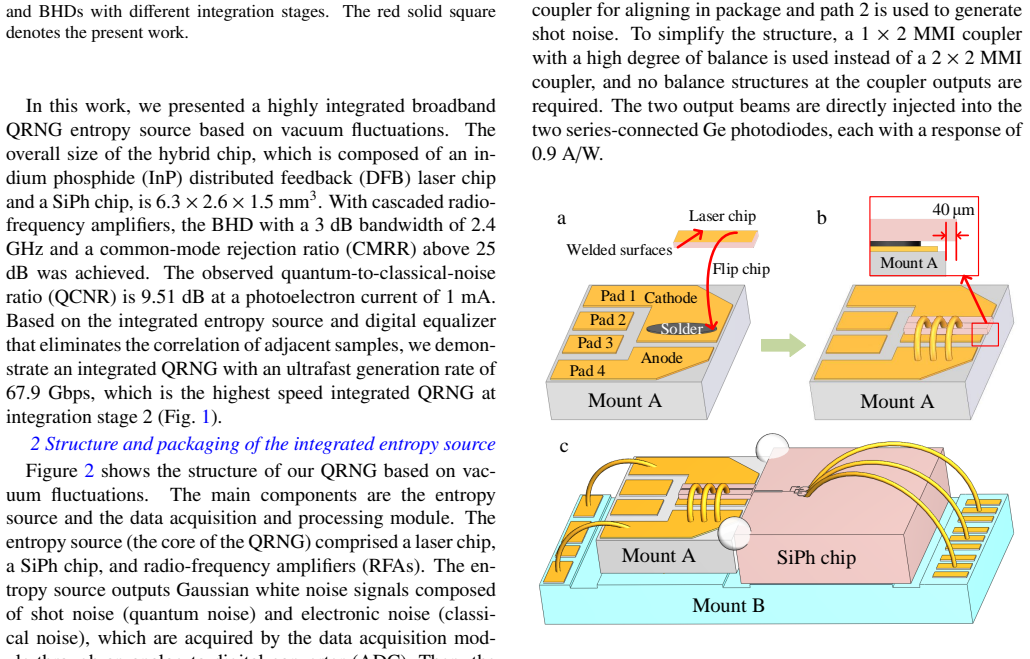
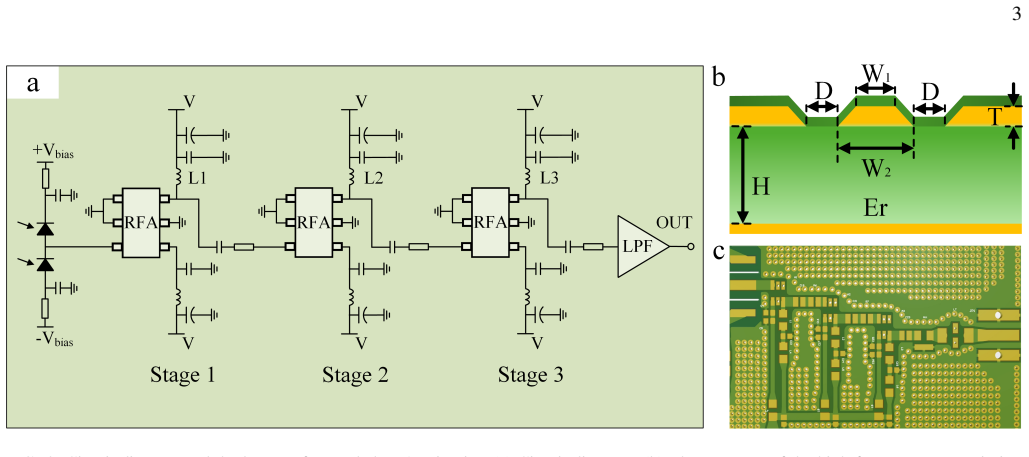
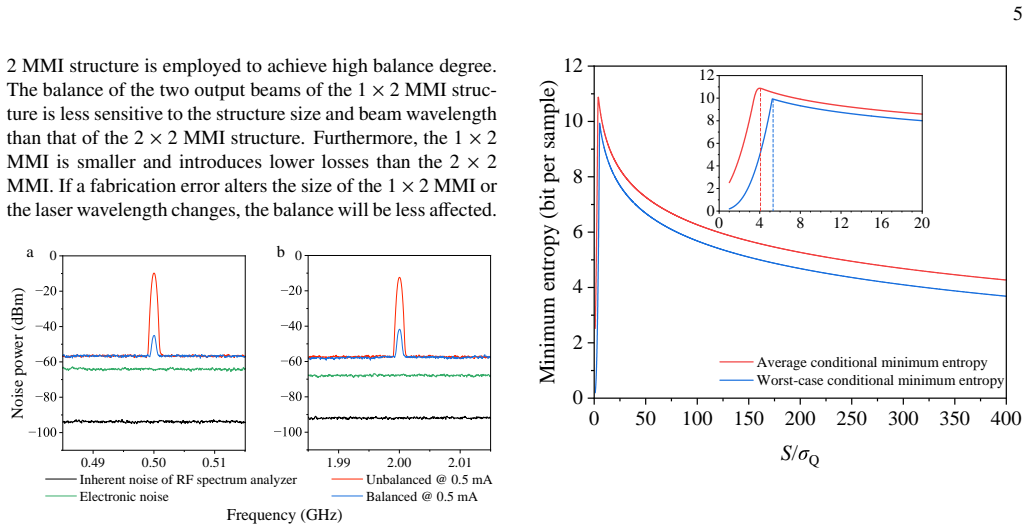
The authors designed and experimentally verified a highly integrated broadband entropy source for a quantum random number generator based on vacuum fluctuations. The core is a hybrid laser-and-silicon-photonics chip of size 6.3 × 2.6 × 1.5 mm³. A balanced homodyne detector using cascaded radio-frequency amplifiers reaches a 3 dB bandwidth of 2.4 GHz and common-mode rejection above 25 dB. The quantum-to-classical-noise ratio is 9.51 dB at 1 mA photoelectron current. After equalizer optimization that eliminates dependence of adjacent samples, the quantum random number generation rate reaches 67.9 Gbps under average conditional minimum entropy and 61.9 Gbps under worst-case conditional minimum
What carries the argument
The hybrid laser-and-silicon-photonics chip with its cascaded-amplifier balanced homodyne detector that measures broadband vacuum fluctuations while suppressing classical noise.
If this is right
- The small chip size allows vacuum-fluctuation QRNG entropy sources to fit into compact integrated systems.
- Equalizer processing removes sample dependence and thereby supports generation rates above 60 Gbps.
- The reported 2.4 GHz bandwidth and 25 dB common-mode rejection establish a practical noise floor for high-speed operation.
- The device advances integrability of vacuum-based QRNGs without requiring larger discrete components.
Where Pith is reading between the lines
- If the integration scales, such chips could enable mass production of high-speed QRNG modules for consumer devices.
- Higher bandwidth versions might extend the approach to even faster rates needed for future quantum communication links.
- Real-world deployment tests could check whether the negligible classical noise assumption holds under varying temperatures or electromagnetic conditions.
Load-bearing premise
The measured noise after the balanced homodyne detector and equalizer remains dominated by vacuum fluctuations with negligible residual classical correlations or bias from the optimization.
What would settle it
A measured quantum-to-classical-noise ratio falling well below 9.51 dB or the appearance of measurable correlations in the equalized output samples would show the claimed rates cannot be sustained.
Figures




read the original abstract
In this work, we designed and experimentally verified a highly integrated broadband entropy source for a quantum random number generator (QRNG) based on vacuum fluctuations. The core of the entropy source is a hybrid laser-and-silicon-photonics chip, which is only 6.3 $ \times $ 2.6 $ \times $ 1.5 mm$^{3}$ in size. A balanced homodyne detector based on cascaded radio-frequency amplifiers in the entropy source achieves a 3 dB bandwidth of 2.4 GHz and a common-mode rejection ratio above 25 dB. The quantum-to-classical-noise ratio is 9.51 dB at a photoelectron current of 1 mA. The noise equivalent power and equivalent transimpedance are 8.85$\,\text{pW}/\sqrt{\text{Hz}}$ , and 22.8 k$\Omega$, respectively. After optimization using equalizer technology that eliminates the dependence of adjacent samples, the quantum random number generation rate reaches 67.9 Gbps under average conditional minimum entropy and 61.9 Gbps under the worst-case conditional minimum entropy. The developed hybrid chip enhances the integrability and speed of QRNG entropy sources based on vacuum fluctuations.
Editorial analysis
A structured set of objections, weighed in public.
Referee Report
Summary. The manuscript presents the design and experimental verification of a compact hybrid laser-silicon photonics chip (6.3 × 2.6 × 1.5 mm³) serving as a broadband entropy source for vacuum-fluctuation QRNGs. It reports a balanced homodyne detector with 2.4 GHz 3 dB bandwidth, >25 dB common-mode rejection ratio, 9.51 dB quantum-to-classical noise ratio at 1 mA photocurrent, and, after equalizer optimization to remove adjacent-sample correlations, QRNG rates of 67.9 Gbps (average conditional minimum entropy) and 61.9 Gbps (worst-case conditional minimum entropy).
Significance. If the post-equalizer noise remains vacuum-fluctuation dominated with negligible residual classical correlations or optimization-induced bias, the work would advance integrated, high-speed QRNG entropy sources by combining high bandwidth, good CMRR, and competitive extraction rates in a small footprint. The experimental integration and concrete performance numbers are strengths, though the rates hinge on the validity of the min-entropy estimates.
major comments (1)
- Equalizer optimization and entropy calculation: The central performance claims (67.9 Gbps average and 61.9 Gbps worst-case) rely on the assertion that equalization fully eliminates adjacent-sample dependence while preserving the vacuum-fluctuation statistics. With a reported QNR of only 9.51 dB at 1 mA (implying classical noise remains ~10 % of total power), the manuscript should supply post-equalizer autocorrelation functions, higher-order statistics, or an explicit adversary model to bound any residual classical leakage or filter-induced bias in the conditional min-entropy; without these, the rates cannot be fully substantiated.
minor comments (2)
- The noise-equivalent power (8.85 pW/√Hz) and equivalent transimpedance (22.8 kΩ) are reported without explicit reference to the measurement conditions or frequency range over which they were extracted.
- Clarify whether the quoted chip dimensions include the laser or only the silicon-photonics portion, and whether the balanced detector is monolithically integrated or hybrid-assembled.
Simulated Author's Rebuttal
We thank the referee for their careful and constructive review of our manuscript. We address the single major comment below and have revised the manuscript to include additional supporting data and clarifications on the entropy estimation procedure.
read point-by-point responses
-
Referee: Equalizer optimization and entropy calculation: The central performance claims (67.9 Gbps average and 61.9 Gbps worst-case) rely on the assertion that equalization fully eliminates adjacent-sample dependence while preserving the vacuum-fluctuation statistics. With a reported QNR of only 9.51 dB at 1 mA (implying classical noise remains ~10 % of total power), the manuscript should supply post-equalizer autocorrelation functions, higher-order statistics, or an explicit adversary model to bound any residual classical leakage or filter-induced bias in the conditional min-entropy; without these, the rates cannot be fully substantiated.
Authors: We agree that additional evidence strengthens the central claims. In the revised manuscript we now include the post-equalizer autocorrelation functions computed over 100 lags, which fall to the level of statistical fluctuations, together with the skewness and kurtosis of the equalized samples to confirm consistency with a Gaussian distribution. The conditional minimum-entropy extraction already incorporates the measured 9.51 dB QNR, so the ~10 % classical-noise power is explicitly accounted for in both the average and worst-case bounds. Because the equalizer is a deterministic linear filter applied uniformly to the digitized trace, it does not introduce sample-dependent bias beyond the noise ratio already used in the entropy calculation. We have added a short paragraph discussing these points and the assumptions underlying the min-entropy estimates. revision: yes
Circularity Check
No circularity: experimental QRNG rates derived from direct hardware measurements
full rationale
The paper reports the design, fabrication, and experimental characterization of a hybrid integrated entropy source for vacuum-fluctuation QRNG. All load-bearing claims—the 9.51 dB QNR, 2.4 GHz bandwidth, and final 67.9 Gbps / 61.9 Gbps rates—are obtained from measured spectra, autocorrelation functions, and conditional min-entropy estimates performed on the physical output of the balanced homodyne detector plus equalizer. These quantities are computed from raw time-series data rather than from any self-referential definition, fitted parameter that is then renamed as a prediction, or uniqueness theorem imported via self-citation. The equalizer step is presented as a standard whitening filter whose performance is validated by post-processing statistics; no equation reduces to its own input by construction. The work is therefore self-contained against external benchmarks and receives a score of zero.
Axiom & Free-Parameter Ledger
axioms (1)
- domain assumption Vacuum fluctuations provide a source of true quantum entropy suitable for random number generation when properly detected and processed.
Lean theorems connected to this paper
-
IndisputableMonolith/Cost/FunctionalEquation.leanwashburn_uniqueness_aczel unclear?
unclearRelation between the paper passage and the cited Recognition theorem.
After optimization using equalizer technology that eliminates the dependence of adjacent samples, the quantum random number generation rate reaches 67.9 Gbps under average conditional minimum entropy...
-
IndisputableMonolith/Foundation/RealityFromDistinction.leanreality_from_one_distinction unclear?
unclearRelation between the paper passage and the cited Recognition theorem.
The quantum-to-classical-noise ratio is 9.51 dB at a photoelectron current of 1 mA.
What do these tags mean?
- matches
- The paper's claim is directly supported by a theorem in the formal canon.
- supports
- The theorem supports part of the paper's argument, but the paper may add assumptions or extra steps.
- extends
- The paper goes beyond the formal theorem; the theorem is a base layer rather than the whole result.
- uses
- The paper appears to rely on the theorem as machinery.
- contradicts
- The paper's claim conflicts with a theorem or certificate in the canon.
- unclear
- Pith found a possible connection, but the passage is too broad, indirect, or ambiguous to say the theorem truly supports the claim.
Forward citations
Cited by 1 Pith paper
-
An analysis of nuclear parton distribution function based on relative entropy
A relative-entropy method with a minimum-relative-entropy hypothesis reproduces quark nPDF shapes from global fits and indicates that EPPS21 gluon central values align more closely with the hypothesis than nNNPDF3.0.
Reference graph
Works this paper leans on
-
[1]
M. Herrero-Collantes and J. C. Garcia-Escartin, Rev. Mod. Phys. 89, 015004 (2017)
work page 2017
-
[2]
X. Ma, X. Yuan, Z. Cao, B. Qi, and Z. Zhang, npj Quantum Inf. 2(1), 1 (2016)
work page 2016
- [3]
- [4]
-
[5]
S. Liu, Z. Lu, P. Wang, Y . Tian, X. Wang, and Y . Li, npj Quan- tum Inf. 9, 92 (2023)
work page 2023
-
[6]
Y . Tian, Y . Zhang, S. Liu, P. Wang, Z. Lu, X. Wang, and Y . Li, Opt. Lett. 48, 2953 (2023)
work page 2023
-
[7]
S. Liu, Y . Tian, Y . Zhang, Z. Lu, X. Wang, and Y . Li, Optica. 11, 1762 (2024)
work page 2024
-
[8]
Y . Tian, P. Wang, J. Liu, S. Du, W. Liu, Z. Lu, X. Wang, and Y . Li, Optica. 9, 492 (2022)
work page 2022
-
[9]
T. Jennewein, U. Achleitner, G. Weihs, H. Weinfurter, and A. Zeilinger, Rev. Sci. Instrum. 71, 1675 (2000)
work page 2000
- [10]
-
[11]
M. A. Wayne, E. R. Je ffrey, G. M. Akselrod, and P. G. Kwiat, J. Mod. Opt. 56, 516 (2009)
work page 2009
-
[12]
M. Wahl, M. Leifgen, M. Berlin, T. R ¨ohlicke, H. J. Rahn, and O. Benson, Appl. Phys. Lett. 98, 171105 (2011)
work page 2011
-
[13]
H. F ¨urst, H. Weier, S. Nauerth, D. G. Marangon, C. Kurtsiefer, and H. Weinfurter, Opt. Express. 18, 13029 (2010)
work page 2010
-
[14]
M. Ren, E. Wu, Y . Liang, Y . Jian, G. Wu, and H. Zeng, Phys. Rev. A. 83, 023820 (2011)
work page 2011
- [15]
-
[16]
C. Gabriel, C. Wittmann, D. Sych, R. Dong, W. Mauerer, U. L. Andersen, C. Marquardt, and G. Leuchs, Nat. Photonics. 4, 711 (2010)
work page 2010
-
[17]
Y . Shen, L. Tian, and H. Zou, Phys. Rev. A. 81, 063814 (2010)
work page 2010
- [18]
-
[19]
H. Guo, W. Tang, Y . Liu, and W. Wei, Phys. Rev. E. 81, 051137 (2010)
work page 2010
-
[20]
B. Qi, Y . M. Chi, H. K. Lo, and L. Qian, Opt. Lett. 35, 312 (2010)
work page 2010
- [21]
-
[22]
C. R. Williams, J. C. Salevan, X. Li, R. Roy, and T. E. Murphy, Opt. Express. 18, 23584 (2010)
work page 2010
-
[23]
P. J. Bustard, D. Mo ffatt, R. Lausten, G. Wu, I. A. Walmsley, and B. J. Sussman, Opt. Express. 19, 25173 (2011)
work page 2011
-
[24]
A. Marandi, N. C. Leindecker, K. L. V odopyanov, and R. L. Byer, in Nonlinear Optics: Materials, Fundamentals and Appli- cations, (Optica Publishing Group, p. NME4.) (2011)
work page 2011
-
[25]
C. Abellan, W. Amaya, D. Domenech, P. Mu ˜noz, J. Capmany, S. Longhi, M. W. Mitchell, and V . Pruneri, Optica. 3, 989 (2016)
work page 2016
- [26]
- [27]
-
[28]
T. Gehring, C. Lupo, A. Kordts, D. S. Nikolic, N. Jain, T. Ry- dberg, T. B. Pedersen, S. Pirandola, and U. L. Andersen, Nat. Commun. 12, 605 (2021)
work page 2021
-
[29]
M. Avesani, D. G. Marangon, G. Vallone, and P. Villoresi, Nat. Commun. 9, 5365 (2018)
work page 2018
-
[30]
B. Xu, Z. Chen, H. Guo, Z. Li, J. Yang, Q. Su, W. Huang, Y . Zhang, and H. Guo, Quantum Sci. Technol. 4, 025013 (2019)
work page 2019
-
[31]
L. Li, M. Cai, T. Wang, Z. Tan, P. Huang, K. Wu, and G. Zeng, Photonics Res. 12, 1379 (2024)
work page 2024
-
[32]
S. Y . Siew, B. Li, F. Gao, H. Y . Zheng, W. Zhang, P. Guo, and G. Q. Lo, J. Lightwave Technol. 39, 4374 (2021)
work page 2021
-
[33]
F. Raffaelli, G. Ferranti, D. H. Mahler, P. Sibson, J. E. Kennard, A. Santamato, and J. C. Matthews, Quantum Sci. Technology. 3, 025003 (2018)
work page 2018
-
[34]
B. Bai, J. Huang, G. R. Qiao, Y . Q. Nie, W. Tang, T. Chu, J. Zhang, and J. W. Pan, Appl. Phys. Lett. 118, 264001 (2021)
work page 2021
-
[35]
C. Bruynsteen, M. Vanhoecke, J. Bauwelinck, and X. Yin, Op- tica. 8, 1146 (2021)
work page 2021
-
[36]
C. Bruynsteen, T. Gehring, C. Lupo, J. Bauwelinck, and X. Yin, PRX Quantum. 4, 010330 (2023)
work page 2023
-
[37]
S. Q. Ng, G. Zhang, C. Lim, and C. Wang, Quantum Sci. Tech- nology. 9(4), 045010 (2024)
work page 2024
-
[38]
Y . Bian, Y . Pan, X. Xu, Y . Zhang, and B. Xu, Appl. Phys. Lett. 124, 174001 (2024)
work page 2024
-
[39]
J. F. Tasker, J. Frazer, G. Ferranti, E. J. Allen, L. F. Brunel, S. Tanzilli, and J. C. Matthews, Nat. Photonics. 15(1), 11 (2021)
work page 2021
-
[40]
J. F. Tasker, J. Frazer, G. Ferranti, and J. C. F. Matthews, Sci. Adv. 10, 6890 (2024)
work page 2024
-
[41]
A. Marinins, S. H ¨ansch, H. Sar, F. Chancerel, N. Golshani, H. L. Wang, A. Tsiara, D. Coenen, P. Verheyen, G. Capuz, et al., IEEE J. Sel. Top. Quantum Electron. 29, 1 (2022)
work page 2022
-
[42]
N. Li, G. Chen, D. K. Ng, L. W. Lim, J. Xue, C. P. Ho, Y . H. Fu, and L. Y . Lee, Adv. Opt. Mater. 10, 2201008 (2022)
work page 2022
-
[43]
X. Wang, X. Guo, Y . Jia, Y . Zhang, Z. Lu, J. Liu, and Y . Li, J. Lightwave Technol. 41(17), 5518 (2023)
work page 2023
-
[44]
Y . Jia, X. Wang, X. Hu, X. Hua, Y . Zhang, X. Guo, S. Zhang, X. Xiao, S. Yu, J. Zou, and Y . Li, New J. Phys. 25(10), 103030 (2023)
work page 2023
-
[45]
J. Y . Haw, S. M. Assad, A. M. Lance, N. H. Y . Ng, V . Sharma, P. K. Lam, and T. Symul, Phys. Rev. Appl. 3(5), 054004 (2015)
work page 2015
-
[46]
Z. Lu, J. Liu, X. Wang, P. Wang, Y . Li, and K. Peng, Opt. Ex- press. 29(8), 12440 (2021)
work page 2021
discussion (0)
Sign in with ORCID, Apple, or X to comment. Anyone can read and Pith papers without signing in.